Report Release: GLAAD’s 21st Annual Where We Are on TV Report

GLAAD has released its 21st edition of Where We Are on TV today. This report tracks LGBTQ characters on scripted broadcast, cable, and streaming television, and provides insight and guidance on the state of LGBTQ inclusion on TV.
Where We Are On TV tracks characters that are in a TV season that premiered from June 1, 2025 – May 31, 2026 and notes character diversity and demographics among the tracked LGBTQ characters.
Highlights:
- Zero Transgender Characters will return to TV next year
- Representation of LGBTQ characters of color is at an eight-year-low at 44%
- LGBTQ-led shows such as Heated Rivalry, Pluribus, The Hunting Wives, and more are critical and commercial successes.
READ THE FULL REPORT HERE
Audiences want LGBTQ characters and stories on TV:
- More than half of Gen Z want to see LGBTQ representation on TV. Nearly 90% of Gen Z are regular moviegoers, more than any other generation. (MRI-Simmons, 2026)
- Gen Z is 61% more likely to talk about TV shows on social media than other generation groups (MRI-Simmons, 2026).
- With nearly one quarter of Gen Z identifying as LGBTQ and being the most reliable movie-going generation, studios must include LGBTQ stories to engage this audience (MRI-Simmons, 2026).
LGBTQ-inclusive series are cultural hits
- Heated Rivalry was a cultural phenomenon HBO Max’s most watched acquired scripted series ever, peaking at 52x average demand.
- Pluribus became Apple TV’s most watched original series in the US, with 50x average viewer demand, six Emmy Awards, and a 99% on Rotten Tomatoes.
- The Hunting Wives doubled its viewership on its second week after release, topping the Netflix charts, as it gained season two and three renewals.
- Stranger Things and Hazbin Hotel were the two most in demand series of this research period at 174x and 73x demand, respectively.
Yet LGBTQ inclusion on TV continues to declining:
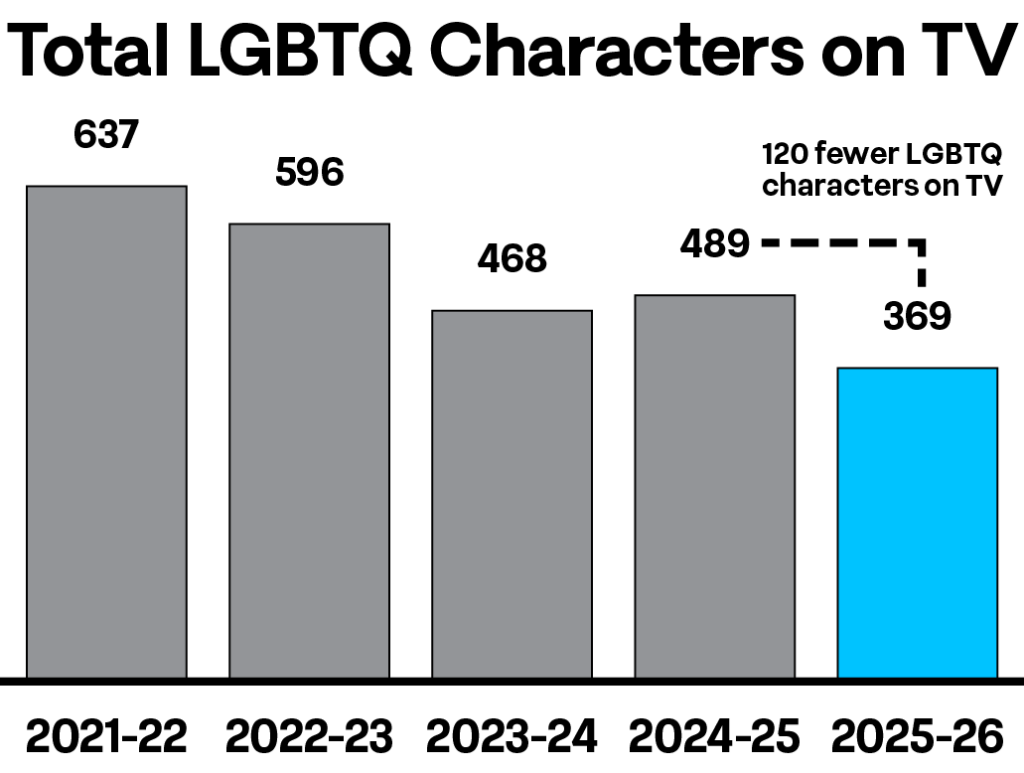
- On scripted primetime broadcast, cable and streaming original series that aired a new season from June 1, 2025 to May 31, 2026, GLAAD counted 369 LGBTQ characters in total. That is a decrease of 120 characters and 25% from the 489 LGBTQ characters counted in the previous season.
- Of the total LGBTQ characters, 161 out of 369 (44%) are characters of color, a decrease from the 51% characters of color counted the previous year, and an eight-year-low.
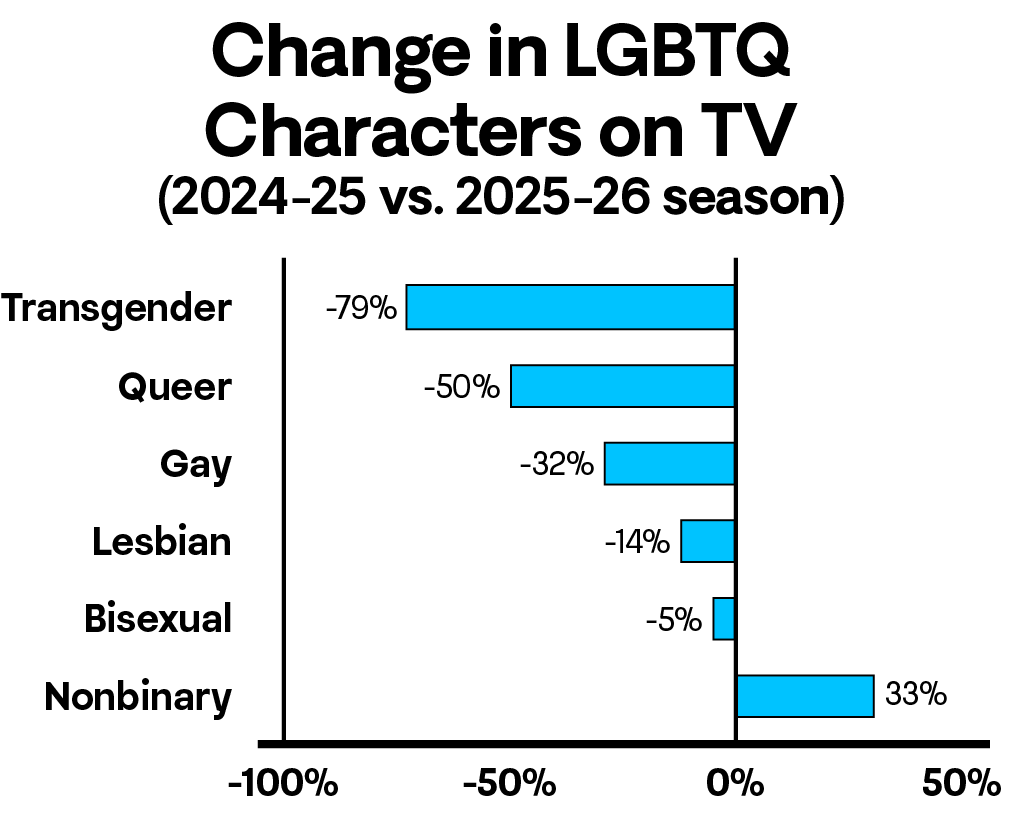
- There are only seven (2%) transgender characters out of all 369 LGBTQ characters. This is a massive decrease from the 33 transgender characters counted last year. These characters are made up of six women, and one man. None of them will return next year.
- There are zero characters living with HIV out of all 369 LGBTQ characters.
- Of the 369 LGBTQ characters, 141 of them (38%) will not be returning due to series cancellations or endings, limited series format, or a character dying or leaving the show.
From GLAAD President & CEO, Sarah Kate Ellis:
“Hollywood is slashing LGBTQ stories and characters even while demand is increasing. It’s a bad business decision and one of the drivers turning audiences away from traditional TV and streaming platforms. With the wild success of Heated Rivalry, Pluribus, The Hunting Wives, Stranger Things, and more, the message from viewers could not be more clear: authentic representation is television’s most powerful growth engine.”
From Vice President, GLAAD Media Institute, Nick Adams:
“Since the record high of 42 transgender characters in the 2021-2022 report, this study has seen a year-over-year decline in the number of transgender characters on television. Now we see no transgender characters on television. Meanwhile, trans people are under attack from local, state, and federal politicians who are enacting laws and policies which threaten the civil rights and safety of transgender Americans. Authentic trans characters on television can show audiences that transgender people are their friends, co-workers, family, and neighbors. And yet, at a time when those stories are needed most, TV executives have turned away.”
Creating more diverse, fair, and accurate representation in Hollywood:
We know that inclusion in storytelling is good for business. GLAAD is committed to continuing to serve the industry as a partner, consulting on content, spotlighting promising projects, creators, and successful titles, and holding the industry accountable for telling stories which reflect the diversity of the LGBTQ community.