A Wednesday morning fire in Baltimore that put three people in the hospital is being investigated as a possible hate crime, authorities told WJZ.
Based on a preliminary investigation, authorities believe someone set fire to at least one Pride flag outside a row home in the 300 block of E. 31st Street and the flames spread to the home and neighboring homes, a Baltimore Police spokesperson said.
Three victims were taken to Shock Trauma for treatment, he said. A 30-year-old woman and 57-year-old man were hospitalized in critical condition, and a 74-year-old man is in serious condition, the Baltimore City Fire Department told WJZ.
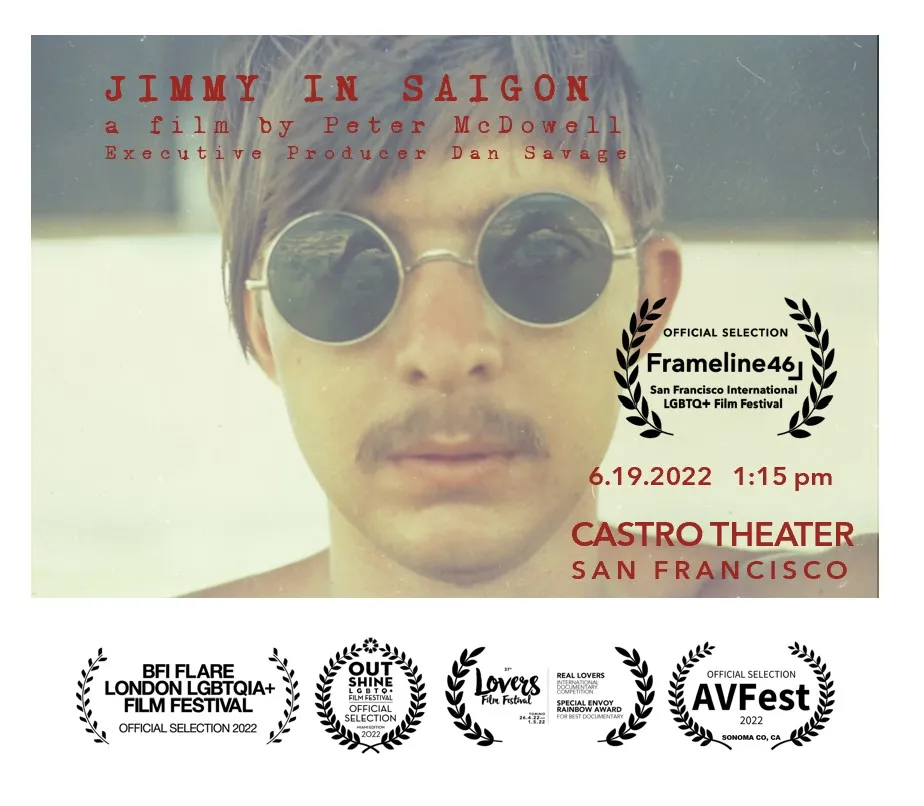
When his golden-haired, blue-eyed brother Jimmy mysteriously died in Vietnam in 1975, gay filmmaker Peter McDowell was just a kid, growing up within his family’s “veil of silence.” As an adult, armed with a video camera, Peter embarks on a quest to uncover the possibly queer brother he never knew. Plotted like a terrific detective story, Jimmy in Saigon follows Peter’s search for the truth about the strikingly enigmatic Jimmy—a rebellious kid drafted into the war, who stunned his family by returning to Saigon after his tour of duty to enjoy “hedonistic pleasures.”
The film will screen at Frameline 46 San Francisco International LGBTQ Film Festival at the Castro Theatre June 19 at 1:15 p.m. It will be available for streaming online June 24 – 30. For tickets and more information go to www.frameline.org
Gaysonoma’s Gary Carnivele recently interviewed director Peter McDowell.
Gary Carnivele: Congratulations on the success of “Jimmy and Saigon” Peter.
Peter McDowell: Thank you.
GC: Tell us a bit about your education on professional background
PM: I’ve been interested in film my whole life. I made some short films as a kid and an ended up interested in opera. Then I got my degree in arts administration and arts management and I ended up working for a short time for the San Francisco Opera in the early 90s. Then I went into a big career in arts management in San Francisco, Chicago, and New York. I made a few short films in San Francisco in the 90s that were in Frameline in ’94 and ’95. Then, I kind of let the filmmaking go for a while and it wasn’t until 2010 that I decided to take it up again with the with this project.
GC: Talk about your brother Jimmy and the impact his life and experiences had on you and your family.
PM: I’m originally from Champagne Urbana Illinois, the college town in the middle of Illinois about 2 1/2 hours south of Chicago. I’m the youngest of six children. Good Catholic family. Most of my siblings and I were born in the 50s and 60s. My brother Jimmy was the oldest in the family born in 1948. He was almost 20 years older than I and he died in 1972 when I was five years old. He was 24 when he died under somewhat mysterious circumstances in Saigon, Vietnam and of course I was just a little kid I remember when he died. I remember the terror and agony in my house when everybody found out. I’m not sure I was aware of who he was at that young age. I have some lovely pictures of the two of us together that prove that we definitely spent time together. I’m so sorry that I don’t really remember those times. I’ve always been very drawn in by history and wanted to know a lot more about Jimmy.
GC: In 2010, you decided to make the film. At the time did you see the structure of the film or did you just think I want to start investigating what happened and I’ll see if there’s a film there?
PM: The latter. I decided to just go for it. The task that I gave myself was to try to interview everybody that ever knew him, almost 40 years after he died. Other people I contacted were floored to hear from me because they hadn’t been in touch with anyone in our family at all since he died. So I set off just trying to talk to all these people as well as members of my family and I really thought at that point that I would be going to Vietnam right away. My goal was to go to Vietnam and try to see if I could walk in his footsteps and retrace his steps and also try to find some people that he knew/. It took me a good six years. I started in 2010 and it took me about six years to get to Vietnam.
GR: What surprised you most about Jimmy’s service in Vietnam, his decision to return soon after the end of the war, and his life after he return to Vietnam?
PM: I’m lucky that my brother left behind about 200 letters and he wrote tons of letters to my mom. My mom is the most fabulous pack rat who saves everything. Thank goodness she had his letters. One of my brother’s friends is a former librarian and stored in archived all of his letters from Jimmy. I have this sort of treasure trove of letters and I tried to piece together his life. A couple of things surprised me and it was very surprising to everybody that he went back as a civilian. He was in the army, did his duty and recieved an honorable discharge. Then within six months he decided to return to Vietnam, which was unheard of – nobody really did that at the time and then I noticed some inconsistencies of things that he was saying to some friends but not to others. Some things that he said my mother were actually not true and so I realized he was probably hiding something if he was making up some things
GC: Were you prepared for what you would find out in Vietnam or were you truly surprised?
PM: I really had no idea. I was looking for people that knew him and I didn’t know whether they would be alive or dead. I didn’t know if they would still be living there or know the answers to my questions. I cannot say publicly because you have to go see the film to find out whether they’re alive or dead or whether I found them or where they were. I didn’t necessarily know that much. I had some hunches and some suspicions. I came upon a major discovery in 2018 that changed everything and allowed me to finish the film.
GC: Talk about some of the people you did meet in Vietnam who you would like to talk about that won’t reveal too much about the film. There are some fascinating twists and turns.
PM: One of the things I found out about my brother is that he loved living there. Maybe I would love it too and it was very kind of heartwarming to me that that when I went for the first time. I went twice but when I went first time in 2016 I truly am almost immediately felt that love for the country and I found it very curious and hopeful and energetic and fun and really engaging. There’s a segment of the film where we see me going down this rabbit hole – little streets – to try to find anything. I met so many people who said come with me in an effort to help me on my quest. There were a lot of false starts. I eventually met a couple of Vietnamese women who are a combination of super strong women, who’ve been through a lot, very empathetic, very earthy and very intelligent. Many of the people I was coming across were people who lived in great poverty and without formal educations so I was really impressed by the level in which we communicated about deeply emotional things, about the level of emotional intelligence. Some of these people have been through unspeakable trauma of losing family members, losing children, losing their property, losing everything. Essentially the same between the late 60s until the early 90s was really just hell in Vietnam and I think people lived through so much and the people that survived and are still around today to talk about it have this real resilience that I admire. It’s remarkable that the Vietnamese are so resilient and so willing to forgive. You know most Americans who lived through the Vietnam war zone are traumatized by what happened so it’s just hard to fathom how these folks felt.
GC: Did you come to an understanding as to why Jimmy felt so safe going back to Vietnam?
PM: I think safety means different things to different people. I think he knew he was in danger physically because of the war but I think emotionally he felt kind of at home and comforted and protected by being in Vietnam. There’s a line in the film – it’s in one of his letters – where he writes: “I can’t stand the United States.” Jimmy was 24-years-old when he wrote this. Jimmy is going through a lot of angst. A lot of people were feeling at the time of the Vietnam war in the counterculture movement real frustration. I’m really fascinated by the fact that this is the 50- year anniversary my brother’s death. He died on June 6, 1972 exactly 50 years ago so it really gives us a moment to take a pause and look back and see what was happening 50 years ago and if I, a gay man, look back and see like what happened in the world over the last 50 years. Well, a lot of things didn’t happen until after Stonewall. The first pride marches kind of started around country in the 70s but it was the landmark American Psychiatric Association ruling that being LGBT was not a disease also in the 70s, so it was a really fertile time for a change. It was a time that I am I am deeply fascinated by.
GC: You’ve really been raking in the laurels at film festivals all around the world. What are some of the experiences where you were present and able to gauge the reaction of the audiences?
PM: Thank you. It’s been an incredible experience. Our world premiere was at the British Film Institute Flare Film Festival which started off as the London LGBTQ Film Festival. It was an absolutely rapturous experience, partially because I think that it was one of the first things to really come roaring out of the pandemic – not to say that we’re totally post-pandemic but in London in March we felt comfortable going out in public and feel comfortable going into theaters and so we had a screenings at the BFI Southbank space in London. I haven’t been to London in 14 years and I was blown away by the kindness and the warmth of the British audiences. People came up to me afterwards to talk about the film people lit up my Twitter account account and was added as part of their best so London was just an exceptional experience. From there we went to Miami and had a great time in Miami at the Outshine Film Festival estival there to the lovers phone customer which is apparently the oldest festival festival Europe and I was in Torino Italy for the week and we ended up winning the top award
GC: That’s really impressive! You have attended Frameline with two short film, but this is your first full-length film at the world’s biggest LGBT+ film festival. How excited were you to learn that “Jimmy in Saigon” would be screened there this year.
PM: I was over the moon! San Francisco is my home away from home. I currently live in LA but I lived in San Francisco twice. I lived there in the mid 90s. I worked at San Francisco Opera and Yerba Buena Center for the Arts. I’m really fond of the city. I also came back briefly in the 2000s and lived in Berkeley which I also love so it’s really important for me to be able to showcase the film in the city where I have so many friends and I have so much love. The Castro Theatre just takes the cake for me. The film has been screened in a lot of 100-seat theaters around the world, which is great and I love them for that nice intimacy but this will be the first time in a huge theater. The Castro has 1400 seats, so it will be great to see how it looks in and sounds in the historic theatre.
GC: What’s the date and time of the of the screening?
PM: It’s on Sunday, June 19 at 1:15 p.m., which is Father’s Day and Juneteenth which is you know not really related to my film but it’s a day of celebration and healing and I hope people can come out to see a film that is also both a celebration and ultimately healing.
GC: Tell us about your family members’ reaction when you informed them of your decision to make the film and then what their reaction was when they first saw the film?
PM: The genre of documentaries that I made it’s called personal documentary it’s considered an unique art form because the filmmaker will put themselves in the phone because they know the audience wants to know the experience of what’s happening. 12 years ago, I went to my mom and I said I want to do this project, I want to use the letters you wrote and received. It’s an oral history of my family. I said I wanted to interview everybody whoever knew my brother and my mom was on board with that. She gave me a lot of names of people. I bought a camera and sound equipment, using my last couple bucks. I started interviewing everybody that I could, including everybody in my family. My mom has been incredibly participatory in the film. I interviewed her many times. She doesn’t want to see the film. She made a security line in the sand. Jimmy was her first child and she is still really broken up about the fact that he died at age 24, so she can’t bring herself to see it. She sort of apologized to me profusely for that. I don’t want it to reflect on her love for me or my film and I totally get it. I totally appreciate it. One of my brothers is hesitant to see it, but he might come around. My other brother, John, is actively involved in the film as the film’s composer. He wrote the soundtrack to the film. We worked on it every day for a year, so he’s seen it many times. My sister and I attended the Sonoma International Film Festival where “Jimmy in Saigon” was screened. My other sister who’s seen an early version of it but hasn’t seen the finished film yet. My family is super supportive and happy about it. There’s a little bit of the film about some of their initial resistance and when I revealed that it wasn’t just a history project but rather a work of art that I would like to share with the public. That took a little bit of adjusting to realize that your family stories would be out there and Jimmy’s story would be really, really out there.
GC: What are you hoping audiences take away from “Jimmy in Saigon?”
PM: I would say that I created this first and foremost as a cinematic therapeutic device for my family. People asked me did I get the closure or the healing that I hoped for and I say I don’t really believe in closure. I mean, no death is something that’s come to some sort of acceptance but it’s really hard to come to closure. I will say that I do think that our family has whether it’s related to the summer not I think our film families come closer together. A lot of audience members are really touched because they had a type of trauma in their family. I recently met some people that were in tears when I just told him about the story of the film and they said my uncle or my nephew sexuality or drug abuse or you know you’re right all these things that are really sad and deep and close to our hearts and most families haven’t I think people are really reacting to that. I even know a couple of men who had lovers in other countries where they had done it had difficulty with him being able to legally continue the relationship and they had tears in their eyes as well so I think it affects a lot of different people and I’m really pleased with
GC: In your documentary you touch on a good number of universal themes that many people can relate to. Most everyone’s lost a family member, many people have family members or close friends who had to fight wars. Obviously, this is a well thought out documentary, but were all these themes you set out in the beginning to explore or did you find yourself going down roads while making the film that you didn’t see that you would be going down?
PM: Yes, I did. I think mostly the roads that I didn’t see it going down were there the roads of contextualization meaning like I thought I was just going to tell Jimmy’s story from beginning to end or my story and making the phone but we realize we were putting it together that we needed to contextualize the story because I’m 54 and a lot of people in their 20s 30s maybe 40s and some teenagers they don’t really I know what the Vietnam War was like what the political climate was like in the 60s and 70s they may not have known how it was for gay people and even in the 80s which I talk about my coming out so you know a lot of them are sort of contextualization and laying out of history not only you know you are some world history but also my family and my purse Understand it and that was that was not something I anticipated but I think it’s something that works well.
GC: What future film festivals will include “Jimmy in Saigon?”
PM: We just announced three more film festivals in kind of smaller but important cites were going to be in Bentonville Arkansas which is a film festival that’s run by Gina Davis and Sandra Bullock so that’s exciting in the sort of new arts hub in Arkansas. We’re going to be in Des Moines Iowa on June 24 and then will be in Nyack New York, which is just outside of New York City, on August 15. There’s a bunch more screenings in the US and abroad on our website: saigon.com. There’s a place for people to sign up for emails so that they can learn about upcoming screenings and any word on a distribution. We’d love to get it out as a theatrical release so that it could be in some art houses around the country. We’d love to get it on PBS in this country as well as educational TV in other countries and I know eventually it will be available for streaming. That doesn’t usually come at the beginning of a film’s lifecycle. Frameline is offering a limited number of tickets for a limited number of days to see it on their streaming format.
GC: I know you’re in the midst of promoting “Jimmy in Saigon,” but have you started to think about what your next project will be?
PM: I’m not ready to rush back into another film project. I’m kind of like a parent that is just getting settled into parenthood. I do love documentaries and I love music and I’d love to make a music documentary, maybe multiple music documentaries. It was brought to my attention that “Jimmy in Saigon” is 70% music and I thought that was very touching as my brother Jimmy loved music. There’s a band that I love that I would love to make a documentary called The Roches. Love to throw my hat in the ring to make that documentary.
GC: I love the Roaches! Such a great band. I’ll be looking for that, fo sure. Thank you so much for joining us tonight Peter and best of luck with “Jimmy and Saigon” and all your future projects. Please come back when the next film is released.
PM: Thank you, Gary, I really enjoyed talking to you.
Pennsylvania’s House of Representatives unanimously voted to strike the word “homosexuality” from the state’s criminal code where it had been listed in the definition of prohibited sex acts.
Supporters say said the word doesn’t belong since being gay isn’t a crime, according to The Associated Press.
“This bill provides a long-overdue update to our crimes code to ensure nobody is prosecuted because of who they love,” state Rep. Todd Stephens, a Republican who also introduced the bill, said. “Eliminating this archaic language will also help promote a culture of acceptance and inclusion for our LGBTQ community across Pennsylvania.”
Stephens had first introduced the bill last year, according to Patch.
Pennsylvania’s law against sex work defines sexual activity so that it references “homosexual and other deviate sexual relations.”
The new definition that has been sent to the state’s Senate now reads “includes sexual intercourse and deviate sexual intercourse … and any touching on the sexual or other intimate parts of an individual for the purpose of gratifying sexual desire of either person,” according to the AP.
“Homosexuality” was also struck from the definition of sexual conduct, the news wire reports, in a section covering “obscene and other sexual materials and performances.”
“In this General Assembly, sadly, it’s a huge lift to merely agree that being gay shouldn’t be illegal,” Democratic Rep. Dan Frankel said.
Frankel urged lawmakers to go further and pass antidiscrimination legislation protecting LGBTQ+ people.
Another Democratic representative, Malcolm Kenyatta, agreed.
“I hope that we have these same votes for enshrining nondiscrimination protections, which we sorely need to do,” he said.
In June of 2016, 49 lives were tragically taken during a mass shooting on Latin Night at Pulse, a gay nightclub in Orlando, Florida. One of the survivors of that night is Jeannette Filiciano, a lesbian single mother struggling to come to terms with a tragedy for which no one will ultimately be held accountable.
Between raising her teenage son, fighting with her mom around whether homosexuality is a sin, rigorous training as she tries to go pro as a competitive bodybuilder and, a little over a year later, dealing with Hurricane Maria’s effects on her family in Puerto Rico, Jeanette’s consistent, encouraging smile and motivational attitude can only hold out for so long.
Director Maris Curran’s realistic portrait of survival—full of unglamorous perseverance and routine setbacks, losses, and triumphs—illustrates that life keeps moving, never allowing for the time to truly process trauma. But in Jeannette, we are shown how building up one’s body can also assist with healing the mind and uplifting the spirit.
“Jeannette” will be screened June 17 at 1:30 PM at the Castro Theatre and will stream online June 4 — June 30. For more information and to purchase tickets, go to www.frameline.org.
Gary Carnivele: I want to congratulate both of you on the success of “Jeanette.” It’s a beautiful film. Thank you for bringing this really important story to audiences everywhere. Jeanette, you’re an amazing woman and thank you so much for opening up your life
Please, tell us a bit about your background.
Jeanette Feliciano: I am community organizer. I am mother. I am the world champion Beachbody right now. I am a professional personal trainer. I motivate people through our personal training
Maris Curran: I am a filmmaker and I live in Los Angeles, where I work in both documentary and fiction films and I’m also a mother.
GC: Why did you make this film about Jeanette’s life?
MC: I met Jeanette while working on an anti-discrimination campaign in the wake of the Pulse Nightclub shooting. “Jeanette” is a film that I didn’t plan to make but became inspired to make. I think that upon meeting we discovered parts of ourselves reflected onto the each other which allowed this really beautiful opening up of places where we’re similar. It gave us a chance to create a really trusting relationship that allow the space to really go into what happens when the cameras go away – a place that I think we actually exist. We were really concentrate on the need to really open up conversations about how this impacted the entire community. I think that Jeanette also knows she’s a modern day superhero. I think that seeing examples of not only her resilience and her determination but her vulnerability. Watching somebody like Jeanette and her mom expressing their unconditional love. Not all mothers are alike. Here we are watching this unbelievable woman push a huge heavy truck tire and then come home and be everything to her teenage son.
GC: What was it like opening up your life and in such an intimate and detailed manner?
JF: It was something that we discussed initially. We live in a society that we look at women of color in a ceratin way. Here we have an American white woman right who wants to know about my life. I’m wondering why cry because we put all these barriers We took the colors out we took that out because we realize that we are human we all bleed the same color that helping set the timer on for me being able to be vulnerable. People don’t necessarily see my vulnerability. They don’t understand what my healing process is because I had to go right back into this world. I’ve come to realize the importance and the beauty in vulnerability and being able to connect again as human beings.
MC: This film is really not just about you but I truly feel that this documentary is made for the purpose of you seeing yourself in the spirit and understanding the importance of healing – the importance of being able to be human and vulnerable with others who are actually around you. There is beauty in that and there’s a lot of healing in that mirror.
GC: Marris, you tackle so many issues in this film – both intense and joyous – as Jeanette just mentioned. What struck you most on an emotional level about Jeanette and her experience?
MC: I think the biggest surprise that I found in making the film is that family ended up being at the forefront. I knew that Jeanette was a mother and I knew that she had been struggling with her relationship with her own mother but I didn’t realize that that would form the emotional core of the film. What life brings right in the rhythms of them is of one of the essential questions that I asked going into the film. After such trauma, how does one ever feel safe again. How does Jeanette make Anthony understand what happened to her? It was just a beautiful surprise to discover the answer to her life was through her dedication to her family, through letting go and letting herself be mothered by her mother. I think that that was really very touching to have such a lovely support group. Many of those folks are in the film.
GC: What was the reaction of your family and friends when you told them about your decision to put your life out there on film?
JF: I don’t think that it really clicked but most everyone wanted to offer their support. The community obviously rallied behind what I was doing as a trainer and somebody who continues to live life and help others. Everything just turned out beautifully. You see the support system that I do have here in Orlando and it’s something that I’ve always had even prior to Pulse. Even during my bodybuilding training, the importance of healing that I’ve unfortunately been through a lot. You are able to see that I am still connected to and still very close to all of those individuals. We are even tighter than before and they have expanded in their helping and healing others. I just think that it is phenomenal that we’ve come this far and the growth of so many people who actually a part of the filming and the sense of how our minds have changed as well with making sure that we actually care and connect with people again especially in this world that is just run by nothing but social media people have disconnected besides being on their phone people forgot to communicate but you know with with me and my friends and my family we know how to put that aside and actually enjoy the company for around us and we really talk about how is it that we can all heal individually and together
GC: Maris, you capture such intimate moments of Jeanette’s life and her interaction with her friends and family. Talk about it how much footage you shot, how long the shoot was and how difficult editing it down was?
MC: When Jeanette introduced me to the people in her life, I was accepted and welcomed and could feel this love that they have for Jeanette my extension which and you know it didn’t you know and when I would Allowed for that on the phone took five years to me right before and the editing process and it took a while because we’re not telling the story and it’s not really about and I think that it was really important to me that I felt the truth to her like that emotional in a way where the audience could have enter into Stop and keep working and then you get more money and I had it really interesting experience of where I work with is incredible and I can’t even believe that never met in person where we cut it in like the last leg amazing art of getting the film is a beautiful soul and I would get up at five in the morning it was beautiful and I think you’re really in a very strange way the circumstances of the world hired to help us finish the film because you know how they been Pre-pandemic times I would’ve said well you know he’s a zero and I’m in Los Angeles and we can’t afford to find them here and I can’t just go there and yes you know
GC: Jeanette, in the documentary you travel to Puerto Rico to help your family after the devastating hurricane. Can you give me an update about your family in Puerto Rico?
JF: I was just there to help in any way I could. I bought and hooked up a generator and had to find food. There are a lot of things that happened in Puerto Rico even before the hurricane. I wanted to be there for my sister, but also to help the community of Puerto Rico. I was knocking on doors to check on people – to make sure they had they’re basic needs met. I went back to my island to do my part I spoke to my sister last night we were on the phone for two hours and they’re doing great. I love the bond that my mom and my sister have created within the past year. My sister is able to talk to my mom and ask for advice and ask for counsel. Finally get it I think it’s just so important you know my mom is doing great she’s always come here and she’s always hanging out with my partner. Now everything, thank God, is absolutely amazing. When it comes to my family and my family bonding, I just wanted to continue to support everyone and for everyone to express the love I know is there. That’s why I am the way that I am with Anthony. He is my world and I make sure that he knows how much I love him because I did’t always have that. I have it now but it’s so important for our children to have that. For us to break the cycle. Everything that we do in life should be led by love first and foremost because that is something that every human being
GC: Maris, what was it like when “Jeanette” was accepted into Frameline
MC: Wonderful! can’t wait to share the phone with dad he will text them and I hope that the film opens up some of those doors so that people are able to talk about things that sometimes they would rather not talk about but that can be really nice now that you’re not we will you be here in San Francisco unfortunately I will not be there I think we’re going to probably be doing a Q&A through Zoom after the “Jeanette” is shown at Frameline.
GC: What are you both up to now?
MC: I’m working on a new film here in Los Angeles that’s about a justice program and how it works. I have a little baby who I just brought into the world. I’m traveling around with “Jeanette,” and couldn’t ask for anything more than that.
JF: My son Anthony is getting ready to go to college. My partner has moved in with her son so I have an eight-year -old right so I need to make sure that I’m reading that he’s showing love to each and every person the same way that I believe Anthony is. I’m currently the world champion in my catgegory so I will be competing this coming November, which keeps me very busy. I just want people to have a sense of being seen and being able to see themselves.
GC: Thank you both for making this beautiful film. Best of luck with reaching as wide an audience as possible. Please come back whenever you’ve got something else in the works. Happy Pride!
President Joe Biden is set to sign an executive order Wednesday aimed at combating a historic number of anti-LGBTQ bills introduced in state legislatures across the country.
The order will direct federal health and education agencies to expand access to gender affirming care and advance LGBTQ-inclusive learning environments at American schools.
The president’s order comes during LBGTQ Pride month and as advocates fight against a record number of anti-LGBTQ bills introduced in states across the country this year — more than 320, according to the Human Rights Campaign (HRC), the nation’s largest LGBTQ advocacy group.
“President Biden always stands up to bullies and that’s what these extreme MAGA laws and policies do — they bully kids,” a senior administration official told reporters in a briefing on Wednesday. “Hateful, discriminatory laws that target children are out of line with where the American people are, and President Biden is going to use his executive authority to protect kids and families.”
A bulk of the bills signed into law in recent months — 24 in 13 states, according to the HRC — aim to limit access to gender affirming care for transgender youth, prohibit trans girls and women from competing on girls’ sports teams in school, and bar the instruction of LGBTQ issues in school.
Under the executive order, a coordinating committee will also be established to lead efforts across federal agencies to strengthen the collection of data on sexual orientation and gender identity.
Get the Morning Rundown
Get a head start on the morning’s top stories.SIGN UPTHIS SITE IS PROTECTED BY RECAPTCHA PRIVACY POLICY | TERMS OF SERVICE
It will also direct the Department of Health and Human Services to expand resources to address LGBTQ youth suicide and homelessness and study barriers same-sex married couples face in accessing government benefits.
The new measures coincide with a recent surge in charged rhetoric surrounding how and whether children should learn about LGBTQ issues.
In recent months, conservative lawmakers, television pundits and other public figures have accused opponents of a newly enacted Florida education law, which critics have dubbed the “Don’t Say Gay” law, of trying to “groom” or “indoctrinate” children. The word “grooming” has long been used to mischaracterize LGBTQ people, particularly gay men and transgender women, as child sex abusers.
Advocates have been urging public officials against using the charged rhetoric, warning that it could cause violence directed at LGBTQ Americans.
At least three LGBTQ events were targeted by white nationalist groups last weekend, with police arresting 31 people at an annual Pride in the Park event in Coeur d’Alene, Idaho, on charges of suspicion of conspiracy to riot. Those arrested came to the event with gas masks and shields.
The president has been urging Congress to pass comprehensive LGBTQ rights legislation in the form of the Equality Act. But after passing in the House last year, the bill stalled in the Senate. Biden again called on Congress to take action in a White House fact sheet.
Louisiana became the 18th state to bar transgender women and girls from playing on female school sports teams Monday after the state’s Democratic governor chose not to veto or approve the bill.
Both chambers of the Republican-controlled Legislature passed the bill last month, and Gov. John Bel Edwards said during a news conference Monday that he would not sign the bill, but he also wouldn’t veto it. Under Louisiana law, any bill passed by the end of the Legislative session becomes law if the governor doesn’t take action on it.
Edwards said the bill “was going to become law whether or not I signed it or vetoed it,” citing the fact that it had more than two-thirds majority support in both chambers of the Legislature — which would allow for a legislative veto override.
The bill, called the Fairness in Women’s Sports Act, requires that schools “designate intercollegiate and interscholastic athletic teams according to the biological sex of the team members.” It defines “biological sex” as the sex listed on a person’s birth certificate at the time of their birth. It also explicitly states that teams designated for females are “not open to participation” by anyone whose birth certificate said male, which specifically excludes trans girls and women.
The bill will become law Aug. 1 and will apply to public elementary, middle and high schools, as well as public universities. It will also apply to any private school or university that receives public funds.
The bill gives students and others the ability to sue schools who allow trans girls and women to play on female sports teams, and prevents action taken against anyone who reports a school who violates the law.
Edwards vetoed a similar bill last year calling it “a solution in search of a problem that simply does not exist in Louisiana.”
He reiterated that stance Monday and said there still “hasn’t been a single instance in Louisiana of a trans girl participating in sports,” but that he has allowed the bill to take effect because he anticipates that the Legislature would have overridden his veto, especially now that the bill’s scope is more narrow and doesn’t affect intramural sports.
Get the Morning Rundown
Get a head start on the morning’s top stories.SIGN UPTHIS SITE IS PROTECTED BY RECAPTCHA PRIVACY POLICY | TERMS OF SERVICE
“I think it’s unfortunate but it is where we are,” Edwards said. “And I hope we can all get to a point soon where we realize that these young people are doing the very best that they can to survive.”
He added that the effect of the bill, “whether it’s intended or not,” is to “send a strong message to at least some of these young people that they shouldn’t be who they think they are, who they believe they are, who they know that they are. And I find that very distressing. I do believe that we can be better than that.”
Republican state Sen. Beth Mizell has said she sponsored the bill to protect cisgender girls and women, who identify with their assigned sexes at birth, from having to compete against trans girls, whom she believes have an inherent physical advantage, local outlet the Louisiana Illuminator reported.
Some proponents of the legislation also argue that it does not ban transgender students from participating in athletics, because they can participate on the team that matches their assigned sex at birth.
But advocates who sued to stop a similar law from taking effect in Idaho disagree with that point of view.
During oral arguments in front of the 9th U.S. Circuit Court of Appeals last year, Chase Strangio, an attorney for the American Civil Liberties Union, argued that a lower court had previously found that it “is not feasible to force a trans girl to compete on a team for boys,” crediting expert testimony from Dr. Jack Turban, a child and adolescent psychiatry fellow at Stanford University, and testimony from Lindsay Hecox, a trans college student and one of the plaintiffs suing over Idaho’s law.
Strangio argued that competing on the boys’ team would’ve undermined Hecox’s medical treatment and “would be so substantially humiliating to her” that it’s not an option.
Gloria Allen, a Black transgender icon and activist who dedicated her life to Chicago’s trans community, died on Monday at the age of 76.
Allen — also known as “Mama Gloria” — is believed to have died peacefully while asleep in her Chicago apartment at an LGBTQ senior residence home, according to a statement from Luchina Fisher, who directed a documentary about Allen in 2020.
Allen transitioned in the 1950s, prior to the modern LGBTQ rights movement that began with the 1969 Stonewall riots and long before the term “transgender” became mainstream. In a previous interview with NBC News, she credited her coming out to the love and support of her mother, Alma, a showgirl and former Jet magazine centerfold, and her grandmother, Mildred, a seamstress for cross-dressers and strippers.
“I didn’t have all the tools that they have out today for the younger people. So I had to do my thing, and I did it. I walked with my head up high due to my family,” she said, noting there weren’t any community centers or resources for LGBTQ people that she could readily access. “I didn’t know anything about lesbians and gays, because we didn’t have any rights back then.”
Allen worked at the University of Chicago Hospital as a licensed practical nurse and then in private homes as a nurse’s aide. But she was best known for her work in transgender activism.
More than a decade ago, as a trans elder, Allen started a charm school at Center on Halsted in Chicago to educate trans youth about etiquette and proper behavior. Her school inspired the 2015 play “Charm,” written by Philip Dawkins, which ran in Chicago, Minneapolis, Los Angeles, New York and Washington, D.C.
Get the Morning Rundown
Get a head start on the morning’s top stories.SIGN UPTHIS SITE IS PROTECTED BY RECAPTCHA PRIVACY POLICY | TERMS OF SERVICE
Allen then rose to national prominence nearly two years ago, when she became the subject of a documentary feature “Mama Gloria.” The documentary showcased the intersection of race- and gender-based oppression, and it showed how trans people can thrive when they are loved and supported by their families.
“I want the world to know I have a life, and I have a right to be here on this planet,” Allen told NBC News shortly after the documentary’s release. “I’m happy to tell my story.”
Fisher paid tribute on Tuesday to Allen and her accomplishments for trans rights.
“Mama Gloria Allen always called me her angel. But she was my angel,” Fisher wrote on Twitter. “These last four years have been life-changing. I will carry her love and spirit with me always. RIP #mamagloria“
“I felt like I was flying,” says Aloysius Ssali, recalling the day he was granted refugee status in the UK in 2010. He had been living on London’s streets for five years, homeless and undocumented since the UK didn’t formally recognize sexuality as a reason for protection at the time.
Ssali grew up as a gay man in Uganda, where homosexuality can be punished by life imprisonment and where he had been targeted for campaigning for LGBTQ rights. When he returned home in 2005 after studying in the UK, he was captured and tortured – a common occurrence in the country, which ranks 13th on the LGBTQ danger index.
After finally being granted asylum in the UK at age 33, his elated feeling was soon quashed due to further barriers.
“Navigating the system as a gay man was very difficult,” he told LGBTQ Nation.
Wanting to support others in the same position, he founded Say it Loud Club, a community of LGBTQ asylum seekers and refugees helping others to navigate the UK immigration system. Over 10 years later, more claims were being granted based on sexuality and gender identity, and Ssali believed things were slowly progressing.
But in April, when the British Home Office announced plans to relocate asylum seekers to Rwanda, Ssali was “horrified”. Under the $150 million deal, people deemed to have traveled to the UK illegally will be relocated to Rwanda for processing and resettlement, a plan some are comparing to the United States’ Asylum Cooperative Agreement.
While the scheme has elicited concerns for all asylum seekers, human rights organizations are particularly concerned about LGBTQ individuals.
“Everyone we work with is completely terrified,” says Sonia Lenegan, legal and policy director at Rainbow Migration, an organization that supports LGBTQ people through the UK’s asylum system.
While homosexuality was decriminalized in Rwanda in 2010, it “remains frowned upon”, according to the British government’s own foreign office, with LGBTQ people facing societal abuse, including by authorities, and gender transitioning remaining illegal. The Home Office admitted to the persecution of the LGBTQ community in Rwanda in a report, but said ill-treatment is not systemic.
“They are basing it on the idea that people are not actively prosecuted for being part of the LGBTQ community,” says Daniel Sohege, director of Stand For All, a human rights advocacy organization. “But there are multiple cases of people being prosecuted under public decency acts.”
Human Rights Watch reported last year that Rwandan authorities had arbitrarily detained over a dozen gay and transgender people before a conference in Kigali, accusing them of “not representing Rwandan values.”
“People are being stigmatized, abused and discriminated out of existence,” Lenegan told LGBTQ Nation. “You can say that on paper something is lawful, but in reality, it is very difficult for [LGBTQ] people to live openly in Rwanda.”
Neela Ghoshal, senior director of law, policy and research at Outright International, a US-based LGBTQ human rights organization, says there is “no space for dissent or freedom of expression” in Rwanda, and LGBTQ people, particularly refugees, cannot count on protection from the state against discrimination. She warns the UK to learn from the Trump-era Asylum Cooperative Agreement, which saw asylum seekers relocated to Guatemala– a country deemed highly unsafe for LGBTQ people and referred to as “among the most dangerous countries in the world” by the US State Department itself– where at least 20 LGBTQ people were murdered in 2020 alone.
While the scheme was suspended by the Biden administration last year, LGBTQ asylum seekers were highly endangered. Ghoshal says no provisions were made for LGBTQ people and the majority of asylum cases were never heard. She worries the same could apply to Rwanda.
“[The Home Office] seems to see the potential for violence against LGBTIQ+ people […] as an acceptable level of collateral damage, which, from a human rights standpoint, is absolutely unacceptable,” Ghoshal told LGBTQ Nation. “If you’re actually concerned about helping people find a safe place, this kind of offshoring of asylum claims doesn’t work.”
The United Nations has firmly opposed the UK-Rwanda deal, saying offshoring schemes like these evade international obligations under the Refugee Convention and wealthy nations should provide their share of safety for asylum seekers. But the Biden administration’s plans to end Title 42, an order invoked by the Trump administration that utilized the COVID-19 pandemic as a reason to deport asylum seekers from the US, were blocked by a federal judge.
Ghoshal hopes that the UK can do better.
“If the UK government continues with this policy, the conclusion that we […] will have to draw is that the UK doesn’t care about asylum seekers’ safety, including LGBTIQ+ asylum seekers,” she says.
The British Home Office says the scheme is a way to fight human trafficking, but opponents argue that it will just do the opposite once those resettled in Rwanda decide to leave. This was the case in Guatemala, with many leaving in attempts to reach the US again.
“People just disappeared,” Ghoshal says. “Most of the LGBTIQ people who ended up in that program were not willing to sit and wait in Guatemala where they felt unsafe.”
Trans women are in particular danger of abuse when trafficked and on trafficking routes between Central America, Mexico, and the US; Outright International documented multiple rape cases – another warning Ghoshal has against the UK’s policy.
“The Home Office has a track record of ignoring the LGBTQ community and the threats of persecution they’re under,” Sohege says. “They’ve started from a principle of, ‘we want to push this policy through’ […] and have just completely dismissed concerns from experts in the field.”
LGBTQ asylum seekers in the UK are going into hiding to avoid being taken to Rwanda, according to Rainbow Migration, which could put them at risk of exploitation and discrimination in employment, housing, and elsewhere. For LGBTQ asylum seekers who have struggled to come out, Ssali thinks this will reverse years of campaigning.
“We ask people: ‘Please don’t hide, please come out– we are going to give you a safe space’,” he says. “Now, that trust has been broken.”
While some hope provisions are put in place for LGBTQ people, many think the policy should be scrapped altogether.
“I don’t think there’s any way to make it tolerable,” Ghoshal says. “As someone who knows the overall human rights situation in the region, I believe firmly that it is not just LGBTIQ+ people who are going to be at risk. Anybody who is forced to live in Rwanda and who enjoys their freedom of expression is going to face potential risk.”
Legal cases are underway and many hope the policy won’t stand up to international scrutiny since the plans breaching three articles of the European Commission for Human Rights and three of the Refugee Convention.
“The UK’s priorities are upside down,” Ghoshal says. “If Britain wants to create a fake threat that asylum seekers are somehow going to cause harm in the UK, […] and the result is actually doing concrete harm to LGBTQ people, this is in complete violation of international human rights law and the basic sense of humanity.”
A Home Office spokesperson said Rwanda is “a safe and secure country” in which “LGBT+ people [do] not face a real risk of persecution”, and that they will assess each case individually. But campaigners are doing all they can to reverse the plans, and organizations like Say it Loud Club will continue to fight for LGBTQ asylum seekers.
“We have to be at the forefront; the people of color, the ethnic minorities, the LGBTQ people,” Ssali says. “We are the product of the asylum system in this country. The asylum system doesn’t belong to the government, it belongs to people like us.”
When director Robin Hunzinger’s grandmother Emma died, she left behind a cache of letters from a woman named Marcelle. From these letters spins this tale of a passionate but thwarted relationship in 1920s France, as separation and sickness come between the secret young lovers. In this strikingly artistic documentary, an actor’s urgently performed voiceover, ghostly archival images, and a contemporary soundtrack combine to reflect, within this nearly century-old romance, an erotic vibrancy that is eternal.
The tale begins as an idyllic summer romance, but, forced to live apart, Marcelle’s letters reveal how her attachment to Emma quickly becomes an intense touchstone. Afflicted with tuberculosis, Marcelle is confined to a sanitarium, where she becomes ringleader and self-appointed seducer of a pack of similarly ailing young women—the cheekily nicknamed “blood-spitters gang”—while her ardor for absent Emma never diminishes. Director Hunzinger deftly deploys evocative period imagery to conjure the worlds and poignant stories of these rebellious young women, bringing their passions and pains to vivid new life.
This film will be screened at SFMOMA Phyllis Wattis Theater 18, 2022 6:00 PM — 7:18 PM
Streaming online JUNE 24, 2022 12:01 AM — JUNE 30, 2022 11:59 PM
A California gay couple was attacked during Pride weekend in midtown Sacramento’s LGBTQ-friendly Lavender Heights district. The couple was enjoying a night out at Kiki’s Chicken Place before a homophobic man began attacking the pair because of a discarded cigarette.
In a video, it can be seen that the perpetrator of the attack threw a punch landing on one of the victims before a brawl broke out involving several of the restaurant’s patrons. Customers of the establishment broke up the fight before the attacker could do even more damage to the couple.
After the incident, the couple immediately gave a statement to police to investigate the attacker who had disappeared after customers had intervened in the fight. Now, the couple is speaking out about the attack and the ongoing investigation.
“I’m just hoping for justice. I’m hoping there is someone out there who can help identify who these people are,” Derek, one of the victims, told ABC 10.
The search for the suspect is still ongoing, so the victims have not gone public with their last names or images. The only problem is that Sacramento PD has suspended their case.
“I’m mostly upset at Sac PD (Sacramento Police Department) at the moment, due to the fact that there are plenty of leads. I would like more attention from Sac PD. I would like them to re-open the case and do something about it,” the second victim, Jose, said in a statement.
Police have confirmed that the investigation was briefly closed but has now since been reopened. Police said the case will be investigated by detectives assigned to the Bias Crimes Task Force. This task force specifically looks at hate crimes and Derek and Jose’s case qualifies as a hate crime against LGBTQ people.
“As a department, we take all allegations of bias-related crime seriously and remain committed to conducting a comprehensive investigation into this incident,” Sacramento Police Department said in a statement.
The couple discusses the fear they experienced when enjoying a regular night out in their favorite neighborhood.
“It’s scary to think about going out at night to a restaurant or for a drink and not feeling comfortable in the city you are living in,” Derek said.
The couple said this started when a customer at Kiki’s Chicken Place threw a cigarette on the ground.
“I don’t like litterbugs,” Jose said. “So, I went and picked it up and threw it away inside the restaurant. He started approaching me with a very intimidating attitude. He started telling me if I had a problem to let him know because he can go ahead and smoke us both.”
The situation escalated when the perpetrator began shouting gay slurs at Derek and Jose, and the attacker, seen on the video provided by the couple, is shown punching Derek in the face.
Jose is seen jumping up and fighting back. He ended up covered in blood with scratches, bruises, and a broken nose. The couple said they filed a police report after the incident on Friday only to learn the case was suspended days later for a so-called lack of evidence.
Sacramento Police Chief Kathy Lester called the couple to speak to them directly. Now that the case has been reopened, the hope is that Derek and Jose will receive the justice they deserve.