The Board of Directors is excited to announce the appointment of Adrian Shanker (he/him) as the next Executive Director of The Spahr Center! In a national search for a new executive, organizations like ours endeavor to find the impossible. A person who has a big heart for our community and a bold vision for our future. Someone who can engage at both the grassroots level and on the national stage. A leader with the technical skills to manage a complex, growing organization and one who will do so guided by the values of equity and justice. We put together candidate profiles that ask for so much because the work ahead of us is so important. I am honored to introduce Adrian to The Spahr Community. I am excited for the agency’s future with him at the helm.
Adrian is an experienced LGBTQ+ community leader with a focus on LGBTQ+ health policy and promotion, barriers to care, and health equity. He joins The Spahr Center after founding and leading Bradbury-Sullivan LGBT Community Center in Allentown, Pennsylvania for seven years. Adrian brings extensive knowledge of health promotion, community building, and non-profit management. His leadership will support The Spahr Center in reaching the goals outlined in its Strategic Plan: ensuring every LGBTQ+, HIV-positive and affected person in Marin County feels that we belong, are valued, and that our civic institutions ensure our health and well-being. Adrian currently serves on the Presidential Advisory Council on HIV/AIDS in the Biden-Harris Administration. He previously served as president of Equality Pennsylvania for three years during the fight for marriage equality. With expertise in LGBTQ+ health promotion and policy, he is also editor of the critically-acclaimed anthology Bodies and Barriers: Queer Activists on Health and the forthcoming anthology Crisis and Care: Queer Activist Responses to a Global Pandemic. He earned a Graduate Certificate in LGBT Health Policy Practice from George Washington University and a B.A. in Political Science and Religion Studies from Muhlenberg College. Adrian will begin working full time at The Spahr Center beginning on April 1, 2022. Please join us in welcoming Adrian to our community at our event, New Horizons, on April 14, from 6:00 to 7:30. Tickets are $65 per person and will go on sale on February 22. Dana Van Gorder’s last day as Executive Director will be on February 28, 2022. We are deeply grateful for his leadership at The Spahr Center over the past three years as well as his decades of service to the LGBTQ+ community. Dana brought a wealth of experience in HIV and LGBTQ+ advocacy and services that allowed us to grow our organization to new heights. His resolute leadership through the uncertainty of the COVID-19 pandemic ensured that our Center remained stable, that our clients remained supported, that we launched our Strategic Plan, grew our budget, and established new programs. We congratulate Dana on his lifelong career of serving our community, and wish him all the best in his retirement. We are grateful to The Spahr Center staff for their support throughout the search process. They have worked tirelessly to promote the health of our most vulnerable community members during the pandemic and are true champions. We extend deep appreciation to Kevin Chase Executive Search Group for leading the search that culminated in selecting Adrian as our Executive Director. Please join me in making a donation to The Spahr Center in honor of Dana’s service to our community and Adrian’s appointment. We have so much to celebrate and such important work ahead! In community, Denny David, Board President
George M. Johnson’s young-adult memoir “All Boys Aren’t Blue,” about growing up Black and queer, appeared on The New York Timesbestseller list this month for the first time since its publication nearly two years ago. The spike in sales was undoubtedly fueled by the publicity the title received after being banned in public libraries and schools in at least 19 states, according to Johnson’s count.
“People were seeing me on list after list and congratulating me and being like, ‘Oh, my God, you must be so happy. This must be such a badge of honor. Your sales must be so great,’” author Mark Oshiro said of banned and challenged book lists. “That’s not how it actually works.”
When Oshiro, who uses gender-neutral pronouns, heard one of their books, “Each of Us a Desert,” a fantasy novel about two girls falling in love on a quest through the desert, was on Texas Rep. Matt Krause’s list of 850 books to be pulled from Texas schools, they didn’t realize how much attention this particular list would get. After all, their books had been on many such lists before. But even with all the publicity surrounding the Krause list — which included titles the lawmaker said could “make students feel uncomfortable” — because Oshiro’s book was just one of hundreds, they didn’t see a spike in sales, despite the many calls online to buy the banned books in support.
Since the list’s release in October, Oshiro has had multiple teachers cancel class visits, an immediate and significant loss of income for an author.
“That’s been a much more obvious barometer for me of what’s been going on for me than book sales,” they said.
Deborah Caldwell-Stone, director of the American Library Association’s Office for Intellectual Freedom, said book bans can indeed generate more demand for certain titles, as communities will often buy a copy of a book to donate to a public library when a school library bans it. However, she said, she is also concerned about quiet censorship, a term that includes instances when librarians or educators choose not to buy a book out of fear of potential challenges.
Book challenges doubled from 2020 to 2021, according to the association, and Caldwell-Stone said she is also concerned about what’s happening on the legislative front, with proposals such as Florida’s “Don’t Say Gay” bill and a bill in Tennessee that would prohibit any instructional materials that “promote, normalize, support, or address” LGBTQ people or issues.
Author Adib Khorram, whose young-adult book about a gay teenager, “Darius the Great Deserves Better,” appears on Krause’s list, said he is also concerned about so-called quiet censorship.
“I think the atmosphere of fear the bans create is actually far worse than the bans themselves,” he said. “On that list of 850 books, one or two of them are going to be very loudly talked about, and people are going to go check them out. But 848 are going to quietly disappear.”
Khorram is one of many LGBTQ authors and authors of color now weighing how this climate factors into their future work. When he was writing his biographical blurb for his next book, “Kiss & Tell,” that comes out next month, he said he paused when choosing whether to include that he is a queer Iranian American.
“There’s every chance that just having that in my bio will make people not stock the book,” he said. Ultimately, he did choose to include that personal information, saying he did not want to let the current climate affect his work.
“Adults fearing the discomfort of majoritized students is not going to stop me from writing books that uphold the lives and dignity of minoritized students,” he added.
Maia Kobabe, who uses gender-neutral pronouns, is also writing a new book without the bans in mind. In the meantime, Kobabe’s illustrated memoir, “Gender Queer,” has seen skyrocketing sales along with frequent challenges and bans. Already on its fifth printing, a new hardcover edition will come out in June.
While Kobabe acknowledges that “Gender Queer” being banned and challenged has led to a flurry of publicity that it would not have otherwise received, Kobabe worries about who is gaining access to the book through the increase in sales. Those who listen to NPR to hear an interview, read articles about book banning or have their own income to buy books are the ones increasing the sales, according to Kobabe, but the young people who don’t have money to buy books or who need the access at the library to read it there instead of bringing a book back to an unaccepting home will not be the ones contributing to the sales numbers.
“The part that really hurts is the fact that the people who might need this book the most are the people who are going to have less access,” Kobabe said. “So it’s just another case of the most marginalized readers being further marginalized.”
Kobabe added, “I would rather have the book not be banned and have it just quietly existing on library shelves where queer and questioning teens could discover it in a peaceful, quiet way and could safely read it on a shelf.”
As for Johnson, who uses gender-neutral pronouns, making The New York Times bestseller list is bittersweet. Having their book banned has not been easy, Johnson added, but they said they are the kind of person who isn’t afraid to fight back.
“It sucks. It is overwhelming. It’s heavy,” Johnson explained. “But at the same time, I’m witnessing parents buy this book for their teens. I’m witnessing parents and teens reading the book together. I’m also witnessing students find their agency and find their voice because I’m using mine.”
Editor’s note: The writer of this article is the author of two young-adult books on Texas Rep. Matt Krause’s list of 850 books to remove from Texas schools: “Queer, There, and Everywhere” and “Rainbow Revolutionaries.”
Sen. Rick Scott, R-Fla., laid out a conservative blueprint this week for a GOP takeover of Congress, and included in his “11-Point Plan to Rescue America” are a number of proposals that would limit the rights of lesbian, gay, bisexual, transgender and queer people.
The document outlines Republican policy objectives on everything from the economy to abortion, but the point that caused the most alarm to LGBTQ advocates was in a section titled “Gender, Life, Science.”
“Men and women are biologically different, ‘male and female He created them,'” Scott wrote. “Facts are facts, the earth is round, the sun is hot, there are two genders, and abortion stops a beating heart. To say otherwise is to deny science.”
In this section, Scott — who served as Florida’s governor from2011 to 2019 — called for nationwide bans on government forms that “include questions about ‘gender identity’ or ‘sexual preference’”; gender-affirming procedures on minors; and transgender women and girls participating on female sports teams.
“We will protect women’s sports by banning biological males from competing,” the policy outline states. “It is hugely unfair and would erase many of the gains women have made in athletics over the last 50 years.”
Scott’s proposals echo the ongoing nationwide push of anti-LGBTQ legislation by state lawmakers.
So far this year, conservative state lawmakers have filed more than 170 anti-LGBTQ bills — already surpassing last year’s 139 total — according to Freedom for All Americans. The majority of the bills target transgender minors’ ability to receive gender-affirming health care or participate in sports.
In the eighth point of Scott’s plan, labeled simply “Family,” he called out the “radical left” for seeking to “devalue and redefine the traditional family,” using language associated with activists opposed to same-sex marriage.
LGBTQ advocates slammed Scott’s proposals.
Brandon Wolf, the press secretary for advocacy group Equality Florida, said that Scott’s manifesto was “affirmation of what we’ve been trying to warn folks about.”
“What is happening in Florida isn’t isolated,” Wolf told NBC News. “It’s a test market for a national strategy by the extreme right to legislate this country back to 1960, mire us in culture wars and decimate the progress we’ve won.”
Scott, a first-term senator who is chairman of the National Republican Senatorial Committee, is not the only Republican to preview how the GOP would pursue anti-LGBTQ legislation should it regain power in Washington.
Last month, former President Donald Trump said he would ban transgender women from participating in women’s sports nationwide if he were re-elected.
“We will ban men from participating in women’s sports,” Trump said during a rally in Conroe, Texas. “So ridiculous.”
Aside from how the GOP should navigate LGBTQ rights, Scott’s manifesto called for Republicans to “eliminate racial politics in America,” finish building a southern border wall and name it after Trump, and battle “the new religion of wokeness.”
Horizons Foundation, the world’s first LGBTQ community foundation, today announced 31 grantee partners receiving a total of $402,000 through its flagship Community Issues Funding Program, which provides funding to grassroots LGBTQ organizations in the SF Bay Area.
“Grassroots LGBTQ nonprofits continue to develop innovative ways to serve the community, especially groups that are traditionally underfunded and underserved,” said Francisco O. Buchting, Horizons’ Vice President of Grants, Programs, and Communications.
These 31 grants will support organizations working across broad funding areas: advocacy and civil rights, arts and culture, community building and leadership, and health and human services. These grantee partners will focus on a variety of projects, such as:
Funding gender-affirming surgery for transmen of color. Dem Bois Inc. is aiding female-to-male, transmasculine people of color in obtaining gender-affirming surgery, which is often prohibitively expensive yet critical to their ability to live fulfilled, authentic lives.
Providing housing to LGBTQ asylum seekers. In response to the ongoing need to support LGBTQ people seeking refuge from persecution abroad, Rainbow Beginnings is housing LGBTQ asylum seekers and providing them with legal resources, employment mentoring, mental health counseling, and medical services.
Developing theatre rooted in the Latino/a/x queer experience. In the South Bay, Colectivo Acción Latina de Ambiente is producing Spanish-language plays through its Teatro Alebrijes.
Empowering LGBTQ youth. Health Initiatives for Youth is providing support, community, and leadership development opportunities to LGBTQ youth, many of whom are underserved youth of color, at middle and high schools in West Oakland.
Reducing isolation among LGBTQ seniors in the North Bay. Sebastopol Area Senior Center is supporting older LGBTQ adults in West Sonoma County by hosting in-person and online dances, discussions, and educational workshops.
These grants represent the first in Horizons’ updated grantmaking strategy, which prioritizes continued investment in grassroots LGBTQ organizations serving the transgender community, LGBTQ people of color, and bisexuals. The strategy also prioritizes specific segments of the LGBTQ community, namely youth, elders, and refugees and asylees. At the same time, Horizons maintains its longstanding “Open Door” policy that provides support across the diverse ecosystem of grassroots LGBTQ nonprofits and programs, including those that fall outside the stated priorities.
Guided by principles of trust-based philanthropy, the grantmaking process continues to include Horizons’ hallmark community review panel, and grants awarded are primarily for unrestricted operating support. Grants are funded in large part by Horizons’ LGBTQ Community Endowment Fund, a permanent source of resources for the community.
About Horizons Foundation
Horizons Foundation (www.horizonsfoundation.org) envisions a world where all LGBTQ people live freely and fully. The world’s first community foundation of, by, and for LGBTQ people, Horizons invests in LGBTQ organizations, strengthens a culture of LGBTQ giving, and builds a permanent endowment to secure our community’s future for generations to come. Learn more at horizonsfoundation.org.
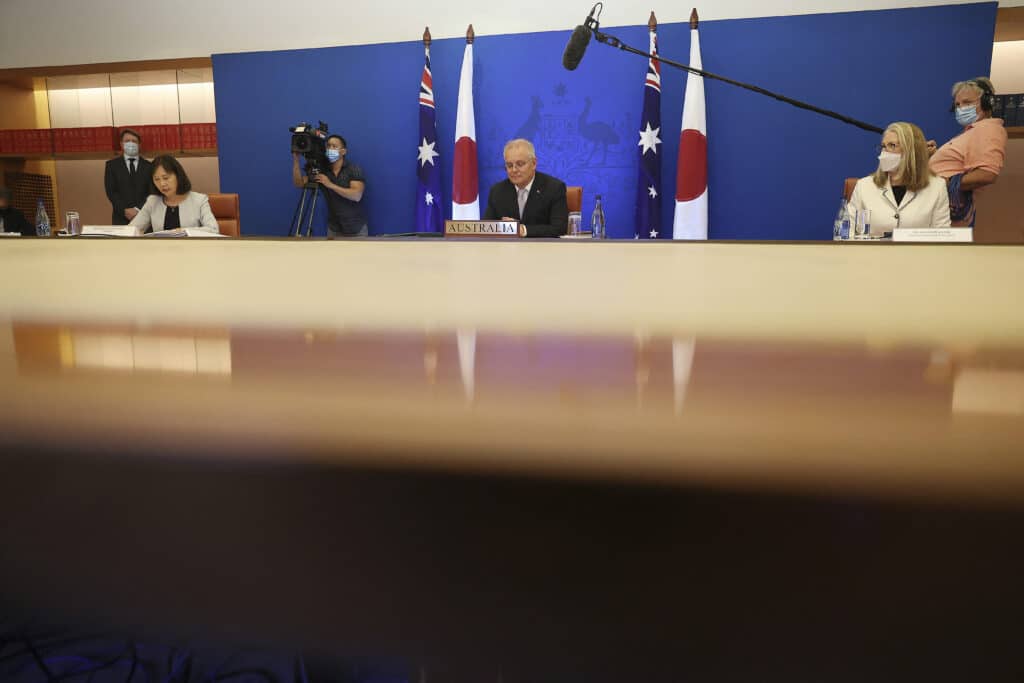
Australian prime minister Scott Morrison has vowed to stop students from being expelled for their sexuality or gender identity by religious schools.
In an unexpected turnaround, the right-wing leader who has long been upfront about his evangelical Christian faith, promised to stop faith-based schools from discriminating against pupils, parents and guardians.
Morrison made the surprise remarks that left fellow lawmakers and religious activists stunned to Brisbane’s B105.3radio station on Thursday (3 February).
It required families to sign enrolment paperwork that said being LGBT+ is “immoral” and compared it to incest, bestiality and paedophilia.
“No, I don’t support that,” Morrison told the station. “My kids go to a Christian school here in Sydney, and I wouldn’t want my school doing that either.”
Morrison said he will introduce amendments to the Religious Discrimination Bill – which has been a thorny issue for both faith groups and LGBT+ rights campaigners – to prevent religious schools from discriminating in this way.
The bill, introduced last November, would allow faith-based organisations like churches, schools and workplaces to offset anti-discrimination laws, as long as their “statements of belief” don’t “threaten, intimidate, harass or vilify a person or group”.
“The bill we’re going to be taking through the parliament,” Morrison added, “we will have an amendment that will deal with that to ensure kids cannot be discriminated on that basis.
“I’ve been saying that for years. That’s always been my view.”
Scott Morrison (C) attends a virtual summit with Japanese premier Kishida Fumio. (AFP via Getty Images)
He added said that schools “should be able to teach kids” in a way that aligns with their faith, from Christianity to Islam.
The Religious Discrimination Bill, he said, would protect Australians “whether they have a faith or they don’t”.
Morrison’s comments signal a fallback by his government, whose hardline Liberal Party MPs have pushed the Religious Discrimination Bill in parliament.
Federal attorney general Michaelia Cash only recently claimed that scrapping the exemption from the bill was not feasible. Instead, she said, the Sex Discrimination Act would be amended to shield LGBT+ students – in 12 months, that is.
But it has faced an uncertain future, with moderate Liberals saying they will not vote for it unless the exemption allowing faith-based schools to turn away queer students is removed.
Morrison has supported better protecting queer students since 2018, but policy-makers struggled to roll out reforms at the time that wasn’t shot with loopholes that would have allowed schools to discriminate LGBT+ people in different ways instead.
Christian groups say Scott Morrison has ‘betrayed’ them
Choosing a pretty weird hill to die on, Christian groups recoiled in rage at Scott Morrison’s vow to close religious school exemptions.
“Scott Morrison has betrayed the foundation of the Religious Discrimination Bill,” said Greg Bondar, FamilyVoice NSW director, in a social media statement.
Bondar said it is a “sad day for all Australians” – certainly not for students expelled for being LGBT+, however – and that it has “put religious freedom and free speech at risk”.
Equality Australia, the nation’s top queer rights group, welcomed Morrison’s comments with cautious optimism and urged his administration to “scrap the flawed” bill altogether.
“The prime minister made a commitment in 2018 to remove the outdated carve-outs in national anti-discrimination laws which allow discrimination against LGBTQ+ people in religious schools,” said the group’s legal director Ghassan Kassisieh in a statement.
“This reform is long overdue, and better protections must apply to both teachers and students.
“But the Morrison government’s Religious Discrimination Bill will invite exactly this type of practice in employment across faith-based organisations, from schools, aged-care services, emergency accommodation and hospitals.
“The prime minister may be putting out one small fire, but his Religious Discrimination Bill will unleash a firestorm of discrimination in religious organisations against anyone that holds a different belief from their faith-based employer – even when they can faithfully do the job that is required of them.”
Students have repeatedly vandalized Pride posters at Spencer Lyst’s high school in Williamson County, Tennessee. Teachers have skipped over LGBTQ issues in class textbooks. Trans kids in his state have been legally barred from competing on school sports teams that align with their gender identity. Parents have called on school officials to remove books about sexual orientation and gender identity from the county’s elementary curriculum. And while leading hisschool’s Pride club at a September homecoming parade, Lyst and other LGBTQ students were booed by a group of parents.
“I’m so used to it, but it shouldn’t be something I have to think about,” Lyst, 16, said of the near-constant feeling of being attacked at school because of his identity.
He even said it’s “difficult” to walk into the school bathroom for fear of what or who “might be in there.”
“Like, can I go to the bathroom or am I going to get hate for just existing?” he said.
Lyst’s school experience is a far cry from an isolated case.
Spencer LystCourtesy Spencer Lyst
Since the start of the school year, school officials in states across the country have banned books about gay and trans experiences, removed LGBTQ-affirming posters and flags and disbanded gay-straight alliance clubs. In school districts throughout the nation, students have attacked their queer classmates, while state lawmakers have filed hundreds of anti-LGBTQ bills with many seeking to redefine lesbian, gay, bisexual, transgender and queer students’ places in U.S. schools.
“There is no separating any of these things,” Mary Emily O’Hara, the rapid response manager at LGBTQ advocacy group GLAAD, said at a media briefing on Monday. “What we’re seeing here is anti-LGBTQ groups, on a national level, making schools the new battleground across the board, across various kinds of school policies and various forms of legislation. Schools are the target right now for the anti-LGBTQ movement.”
In the majority of cases, conservative school officials, lawmakers and parents say LGBTQ issues do not belong in school because they are “political” and “not age-appropriate” for students. Conversely, queer youth and their families, along with LGBTQ and ally teachers, say they feel they are being “erased” from the U.S. education system.
‘I’m not going back in the closet’
South Florida mom Jennifer Solomon, 50, has four children. Her eldest child, Nicolette, 28, is a lesbian who teaches fourth grade in Miami-Dade County. Her youngest, Cooper, 11, identifies as male, but Solomon said his “expression is female.” Cooper “never wanted to be a girl,” his mom explained, but he prefers to wear his school’s girls uniform and enjoys dressing up like a fairy-tale princess for fun.
“An easy way to describe it is that he’s the opposite of a tomboy,” she told NBC News.
Despite how hard she works to protect her children, Solomon — who leads her local chapter of PFLAG, an LGBTQ family advocacy group — said the slew of anti-LGBTQ school policies “keeps me up at night.”
Nicolette, Cooper and Jennifer Solomon.Courtesy Jennifer Solomon
On Monday, Solomon’s governor, Republican Ron DeSantis, signaledthat he would support a new piece of state legislation — titled the Parental Rights in Education bill, but dubbed the “Don’t Say Gay” bill — that would prohibit the discussion of sexuality and gender identity in schools.
Speaking at a news event in Miami, DeSantis said it is “entirely inappropriate” for teachers to be having conversations with students about gender identity, citing alleged instances of them telling children, “Don’t worry, don’t pick your gender yet,” and “hiding” classroom lessons from parents.
“Parental rights? Whose parental rights? Only parental rights if you’re raising a child according to DeSantis?” Solomon, who is a nurse manager at a health care company, said of DeSantis’ concerns. “DeSantis tries to paint this picture that every family is this 1950s mom and dad with two kids and a cat and dog. That is not what Florida looks like; that is not what the country looks like.”
“DeSantis has found a weak spot, and that weak spot is children,” she added, suggesting that DeSantis is supporting the measure for political gain.
Nicolette Solomon said she is already hesitant to mention her wife — and by default her sexuality — at school, but she said passage of the “Don’t Say Gay” bill would be “the straw that breaks the camel’s back” and vowed to quit if it becomes law.
Nicolette Solomon and her wifeCourtesy Nicolette Solomon
“If I can’t be myself, seven hours a day, five days a week, then I’m going back in the closet, and I can’t do that. It’s not good for my own mental health,” she said. “And I don’t think I can bear to see the students struggle and want to ask me about these things and then have to deny them that knowledge. That’s not who I am as a teacher.”
In less than two months since the start of the year, conservative state lawmakers have filed more than 170 anti-LGBTQ bills — already surpassing last year’s 139 total — with at least 69 of them centered on school policies, according to Freedom for All Americans. The nonprofit group, which advocates for LGBTQ nondiscrimination protections nationwide, said in an email that it didn’t track LGBTQ school policy bills last year, as it was not as much of a “sweeping trend” as it is now.
Three states — including Lyst’s home state of Tennessee — passed bills last year that allow parents to opt students out of any lessons or coursework that mention sexual orientation or gender identity, according to GLSEN, an advocacy group that aims to end LGBTQ discrimination in education. In addition to the “Don’t Say Gay” bill advancing in Florida, there are 15 bills under consideration in eight states that would silence speech about LGBTQ identities in classrooms, according to free speech nonprofit organization PEN America.
But perhaps the biggest trend in state bills targeting LGBTQ youths are those focused on transgender students.
Last year, legislators in at least 30 states weighed legislation that would bar trans students from competing on school sports teams that align with their gender identity, according to LGBTQ advocacy group Human Rights Campaign. Nine of those states enacted the bills into law. So far this year, 27 states have proposed similar bills, with South Dakota enacting its version of the legislation into law this month.
While not school related, there has also been a slew of bills that seek to prevent transgender youths from accessing gender-affirming health care. At least 20 states have proposed such measures since early 2021, with two states — Arkansas and Tennessee — enacting these bills into law. However, a federal judge temporarily blocked the Arkansas law in July after the American Civil Liberties Union challenged it in court on behalf of trans youths and their families.
Cooper Solomon said he thinks lawmakers are pushing anti-LGBTQ legislation “because they were born in another time.”
“I guess back then, a long time ago, they didn’t accept this, and they thought it was really bad,” the fifth grader said. “I would just like them to know that it’s OK to be like this, and it’s not going to hurt anyone.”
Legislation aside, the last straw for Jack Petocz, 17, was when his high school in Flagler County, Florida, removed a young adult memoir detailing the trials of being a Black queer boy: George M. Johnson’s “All Boys Aren’t Blue.”
In November, a school board member filed a criminal complaint against school officials for allowing copies of the book— which has been challenged in at least 19 states —to remain in two of the county’s high schools. The complaint was dismissed, but the superintendent decided to keep the book off of shelves until new policies are drafted to give parents more control over the library’s collection.
“I felt that my community was under attack, that they were trying to silence LGBTQ+ experiences and voices within our community,” Petocz, who is gay and led a student protest in response to the book’s removal, said. “We’re already a minority. Why are you trying to suppress this critical information within our libraries, you know? These books are critical to providing a sense of identity.”
Books about race, sexual orientation and gender identity have historically been challenged in schools, but over the last several months, school libraries have seen a surge of opposition.
In the fall, as book bans started to take off in counties across the country, national groups — including No Left Turn in Education and Moms for Liberty — began circulating lists of school library books that they said were “indoctrinating kids to a dangerous ideology” to rally support.
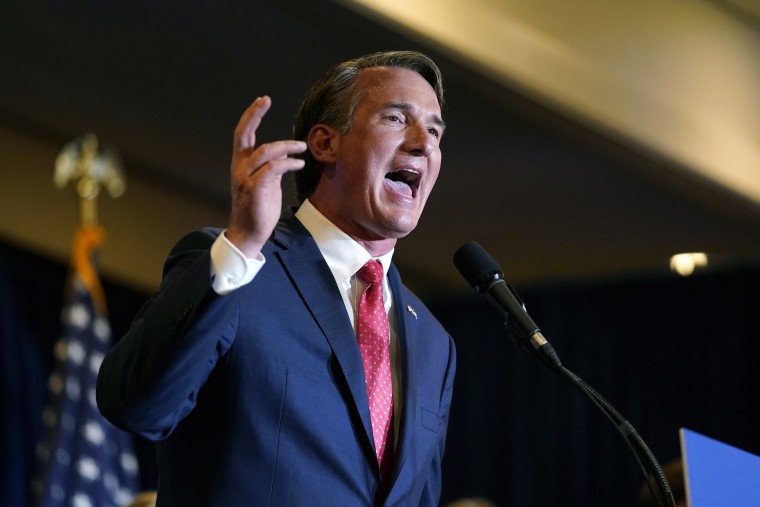
The bans then became a talking point in the contentious Virginia governor’s race, where the Republican candidate, former private equity executive and political newcomer Glenn Youngkin, made education a central issue of his campaign and swept to victory.
Virginia Gov.-elect Glenn Youngkin speaks at an election night party in Chantilly, Va., on Nov. 3, 2021.Andrew Harnik / AP file
Youngkin’s victory prompted other politicians to jump onto the issue, with the governors of Texas and South Carolina urging state school officials in November to ban several books, deriding them as “pornography” and “obscene” content.
School board members in Virginia’s Spotsylvania County made national headlines after calling for LGBTQ books with “sexually explicit” material to be incinerated.
Deborah Caldwell-Stone, director of the American Library Association Office for Intellectual Freedom, said in November that while challenges to books with LGBTQ- and race-related content have historically been “constant,” the association has recently seen a “chilling” uptick.
“I’ve worked at ALA for two decades now, and I’ve never seen this volume of challenges come in,” she said.“The impact will fall to those students who desperately want and need books that reflect their lives, that answer questions about their identity, about their experiences that they always desperately need and often feel that they can’t talk to adults about.”
To counter LGBTQ book bans — and school bans on race-related texts — a group of more than 600 writers, including bestselling children’s author Judy Blume; publishers; bookstore owners; and advocacy groups signed a joint statement in December condemning the trend, arguing it “threatens the education of America’s children.”
Setting a ‘different tone’
While state bills and book bans have garnered the most media attention, advocates say there are a host of other troubling trends adding to the distress that many queer students are feeling: removals of Pride flags and other LGBTQ-affirming symbols from classrooms, disbandments of gay-straight alliance clubs and resignations of teachers in protest of anti-LGBTQ policies.
In the fall, for example, rainbow stickers were ordered to be scraped off classroom doors at MacArthur High School near Dallas.
“While we appreciate the sentiment of reaching out to students who may not previously always had such support, we want to set a different tone this year,” an email from a school official addressed to school staff read. NBC News obtained the email from a MacArthur High School teacher.
The sticker removals prompted a protest from the student body, but the pushback did not successfully encourage school officials to change their stance on the policy.
School board members in Newberg, Oregon, made national headlines in the fall for taking similar actions. In September, the school board banned educators from displaying Pride and Black Lives Matter flags and other symbols it considered “political” in school.
“We don’t pay our teachers to push their political views on our students. That’s not their place,” the school board member who authored the policy, Brian Shannon, said at a recorded board meeting.
The policy prompted town protests that attracted some members of the Proud Boys, a far-right group that has endorsed violence, who counterprotested the efforts. An attempt to recall Shannon and another school board member over the flag removals failed last month.
Some teachers have resigned in school districts over similar measures, like a Missouri teacher who resigned in September after his district mandated that he take down his Pride flag and not discuss human sexuality or “sexual preference” at school. In December, parents accused teachers at a middle school in Tennessee of trying to “indoctrinate” kids into being gay after helping students start a gay-straight alliance club.
In addition to parents, school officials and lawmakers, classmates are among those targeting LGBTQ students, according to advocacy groups and local news reports.
A national survey of LGBTQ students published in 2020 by GLSEN found that 69 percent of respondents reported experiencing verbal harassment at school based on their sexual orientation, 57 percent based on their gender expression or outward appearance, and 54 percent based on their gender identity.
Last year, more than a dozen local news articles —from California to Florida — reported on trans students being harassed or attacked by other students, some of them in bathrooms. However, advocates say it is unclear whether the attacks have increased or whether local outlets are reporting them at greater rates.
Impact of affirmation
Advocates have long been warning educators about the mental health risks plaguing LGBTQ youths and how anti-LGBTQ policies can exacerbate them.
A survey last year by The Trevor Project, an LGBTQ youth suicide prevention and crisis intervention organization, found that 42 percent of the nearly 35,000 LGBTQ youths who were surveyed — and over half of trans and nonbinary youths — seriously considered suicide within the prior year. Separately, two-thirds of LGBTQ youths said debates about anti-trans legislation have impacted their mental health negatively, according to a small survey The Trevor Project conducted in the fall.
However, researchers at The Trevor Project have also found that LGBTQ youths who reported having at least one LGBTQ-affirming space — such as a school, home or workplace — were significantly less likely to attempt suicide.
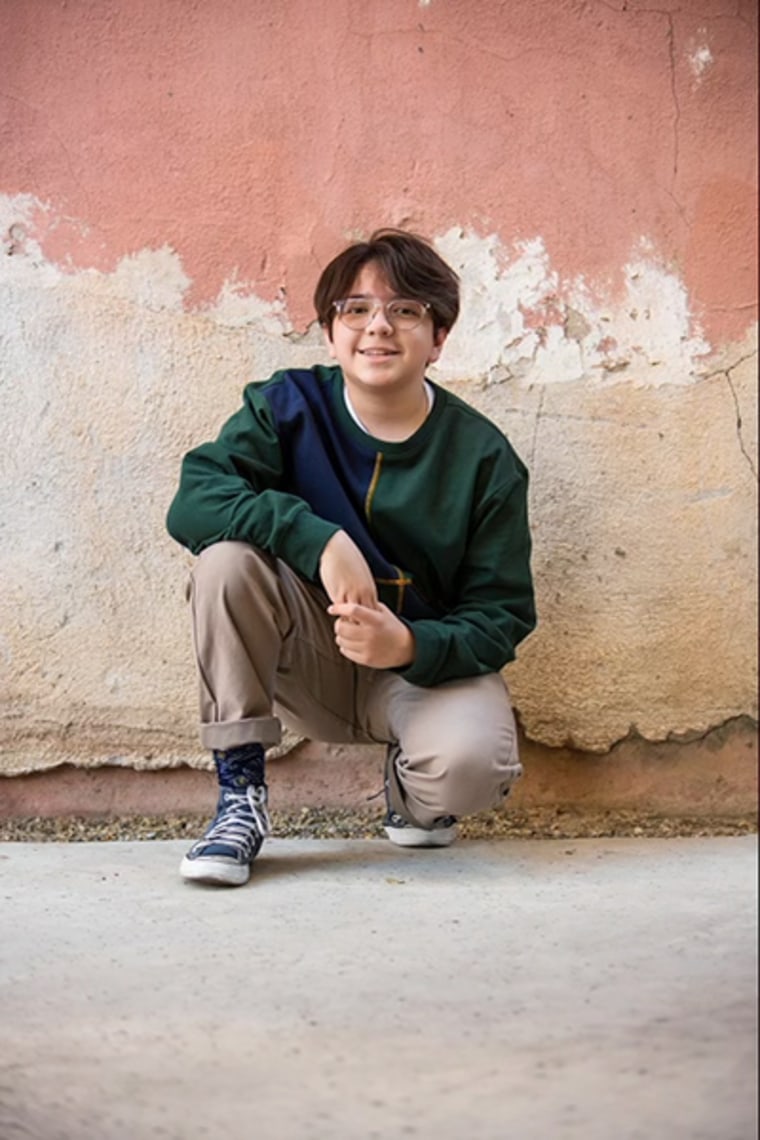
With that in mind, Lizette Trujillo drives three hours a day back and forth to her 14-year-old transgender son’s school in Tucson, Arizona. From the time when he socially transitioned in 2015, Daniel’s school was open to the idea of letting him use the bathroom that corresponded with his gender identity — which Trujillo said was not a given in Arizona — and already had experience teaching trans youth.
Daniel Trujillo.Courtesy Rachel Marie Photography
Trujillo said while the commute “is not without its challenges,” sending Daniel to a school where he is “not ‘othered’” has made him happier.
“The biggest difference at my school is that I’m supported by all my teachers and the principal and staff; I have access to sports and the bathrooms,” Daniel said. “It makes learning easier.”
It also freed up space for his mother to focus on securing her son gender-affirming health care, filing for new identification documents and working through emotional hardships.
“What people don’t realize is that you’re not just worried about school when your child socially transitions,” Trujillo said. “As you start this gender journey, you start to hit walls, and you’re like, ‘Oh, I didn’t realize I needed that,’ or, ‘I didn’t realize that was going to be a problem. I didn’t realize we were going to lose family.’”
In response to the slew of challenges plaguing LGBTQ students and teachers, President Joe Biden has vowed to lend his support. Earlier this month, the White House issued a rebuke of Florida’s “Don’t Say Gay” bill, while connecting the legislation to the disputes happening nationally.
“Make no mistake — this is not an isolated action. Across the country, we’re seeing Republican leaders take actions to regulate what students can or cannot read, what they can or cannot learn, and most troubling, who they can or cannot be,” a White House spokesperson said in a statement to NBC News. “This is politics at its worse, cynically using our students as pawns in political warfare.”
Students ‘fighting for their basic rights’
There are a number of examples across the U.S. of students getting proactive and successfully turning around anti-LGBTQ policies.
Aaryan Rawal, 17, was one of more than 400 students in Fairfax County, Virginia, who successfully urged their school officials to reinstate two LGBTQ books in November. Rawal, who is gay, said he was relieved when school board members heeded students’ demands, but he lamented that the organizing efforts forced him to miss class and lose sleep.
“No student in any county in this country wants to go to school fighting for their basic rights,” Rawal said. “Instead of doing statistics homework or hanging out with friends, we were expected to go to school board meetings and lobby school board members for stuff that really shouldn’t be up for debate.”
Last month, a group of students in Palm Beach, Florida, met with their newly hired superintendent to describe their experience being LGBTQ in their county’s schools. They went around, one by one, and relayed stories of harassment and assault from students and bullying from teachers, according to two students who attended the meeting.
“Students have just gotten a collective consciousness that, ‘School sucks and because I’m LGBT this is to be expected,’ and that’s not normal,” Marcel Whyne, a nonbinary high school student who attended the meeting, said. “That shouldn’t be the level of standard that we have for LGBT kids. You’re entitled to be treated like your peers and go to school and, you know, just be bored at school like a normal student, not terrified that you’re going to be harassed and have photos taken of you and be embarrassed and assaulted just because you’re trying to be who you are.”
As for Spencer Lyst, in Tennessee, he set out to start his high school’s Pride club, Indy Pride, last fall with the goal of spreading awareness about the school’s LGBTQ community and providing “a place for people who may feel like they don’t have one.” While being booed by adults at his school’s homecoming was a “difficult” experience, he said he remains undeterred.
“People should know that no matter what bill they try to pass or book they try to ban or thing they try to ban teachers or students from talking about in schools, it doesn’t change who people are, and it doesn’t change who we’re going to continue to be,” Lyst said. “So trying to take a legal route to ‘protect your kids’ doesn’t work. They are who they are, and if you can’t accept that, maybe it’s you who has some work to do.”
The percent of U.S. adults who identify as something other than heterosexual has doubled over the last 10 years, from 3.5 percent in 2012 to 7.1 percent, according to a Gallup poll released Thursday.
Gallup found that the increase is due to ”high LGBT self-identification, particularly as bisexual, among Generation Z adults,” who are 18 to 25.
It asked more than 12,000 U.S. adults how they identify during telephone interviews last year. It found that younger U.S. adults are much more likely to identify as LGBTQ than older generations.
More than 1 in 5, or 21 percent, of Generation Z adults identify as LGBTQ, Gallup found. That’s almost double the proportion of millennials, who are 26 to 41, at 10.5 percent, and nearly five times the proportion of Generation X, who are 42 to 57, at 4.2 percent. Less than 3 percent of baby boomers, who are 58 to 76, identify as LGBTQ, compared to just 0.8 percent of traditionalists, who are 77 or older.https://iframe.nbcnews.com/u5fH2si?_showcaption=true&app=1
As the youngest Americans slowly outnumber and replace the oldest, Gallup predicts the number of LGBTQ-identifying adults will only increase — and likely at a much faster rate than past generations.
The poll found that the percent of Generation X, baby boomers and traditionalists who identify as queer has remained relatively the same over the years. More millennials have increasingly identified as LGBTQ, but only slightly, at 5.8 percent in 2012, 7.8 percent in 2017 and 10.5 percent now.
But the poll noted that the percentage of Generation Z adults who are queer has almost doubled since 2017 — jumping from 10.5 percent in 2017 to 20.8 percent. The rise shows that younger Gen Zers, who have turned 18 since 2017, are more likely than older Gen Zers to identify as queer.
Gallup noted that the youngest Gen Zers — who are as young as 10 — still haven’t turned 18, and they are even more likely to identify as LGBTQ.
If the trend of millennials and Generation Z increasingly identifying as LGBTQ continues, “the proportion of LGBT Americans should exceed 10 percent in the near future,” Gallup found.
Bisexuals make up 4 percent of all U.S. adults
Bisexuality is the most common identifier used among LGBTQ Americans, which is in line with a Gallup report released last year. More than half of LGBTQ Americans, at 57 percent, are bisexual.
Over one-fifth of LGBTQ respondents, or 21 percent, are gay, 14 percent are lesbian, 10 percent are transgender and 4 percent identify as something e
Overall, 4 percent of U.S. adults identify as bisexual, compared to 1 percent who identify as lesbian, 1.5 percent as gay, 0.7 percent as transgender and 0.3 percent as other. Heterosexuals comprised 86.3 percent of total respondents, and 6.6 percent did not offer an opinion.
Generation Z adults are the most likely to identify as bisexual, at 15 percent overall, compared to 6 percent of millennials and less than 2 percent of Generation X, baby boomers and traditionalists.
Increasing acceptance — in certain areas
Gallup notes that the proportion of Gen Z Americans who identify as LGBTQ is increasing at a faster pace than previous generations, and that they are growing up at a time when 70 percent of Americanssupport same-sex marriage rights, and a majority also support nondiscrimination protections for LGBTQ people.
But that support varies when broken down further. For example, Gallup’s annual Values and Beliefs survey found last year that 66 percent of people favor allowing openly transgender people to serve in the military, that figure is down slightly from its previous measure in 2019, when 71 percent were in favor.
At the same time, 62 percent of Americans say trans athletes should only be allowed to play on sports teams that correspond with the sex they were assigned at birth, while 34 percent say they should be able to play on teams that match their gender identity, the survey found.
At the time, Mara Keisling, former executive director of the National Center for Transgender Equality, attributed that contrast at least in part to the wave of legislation in states seeking to bar trans students from competing on school sports teams that align with their gender identity.
But she also noted that — consistent with Gallup’s data — as more Americans know trans people and more young people identify as LGBTQ, acceptance will grow. As for those pushing anti-transgender legislation, she added, “Someday, they’ll be in the dustbin of history.”
. A relatively recent newcomer to the West Coast, Rachel spent a decade in New York City working as a dance artist. Originally from Ireland, she has taught and performed in the UK, US, India, Costa Rica, and Austria. Recent work in Sonoma County includes Dancing Lessons at Cinnabar, Barely A Person (a film exploring postpartum depression) for Heroines, Harlots and Harpies at Cloverdale Performing Arts Center, Fairy Worlds for Shakespeare in the Cannery, Equus, and A Little Night Music at 6th Street. She is the founder of the expandance technique, a somatic movement practice. Learn more about Rachel’s company at expandance.com
Q. It’s been more than 50 years since HAIR was first produced, and the US and the world have seen major cultural changes. How do you think this play stands up to the test of time? What aspects of it are still relevant and how?
Much of it is still relevant, unfortunately. We’re still living in a white supremacist, capitalist culture, and there are still wars globally, so this show is important because it talks about these things and yet there’s also hope and humor there. This show reflects a time when many of these issues were coming to a greater level of consciousness in American society, and there is a resurgence of the same in the last few years. It’s interesting to see some of the ways we’ve evolved in our thinking since that time, and some of the ways we’re still struggling to.
Q. How has the Omicron surge affected your rehearsal process? What challenges have been presented and how did you manage them?
Even with stringent Covid protocols in place, (including masks, twice or thrice weekly testing, sanitizing, distancing etc) during the first couple of weeks of rehearsal back in January, I don’t think I had more than half the cast at a time in rehearsals, and I really felt for the cast. It was also definitely a challenge choreographically, as so many of the dance numbers in this show require the whole cast. But the last few weeks things have been better *knock on wood!* It’s been helpful having a strong dance captain in Peri Zoe who I can trust to get people up to speed as needed. And I think we’re all just so happy to be back working again, and that gratitude carries us through the challenges.
Q. What are the strong suits of your actors in terms of choreography?
Their willingness and work ethic. They’ve been so open at everything I’ve thrown at them, which has been great. Between them they bring some pretty diverse skills to the show, so that’s been fun to work with.
Q. What do you think are the aspects of the play that will most appeal to our audience?
The music, the dancing, the passion, the risqué bits!
Q. How has your background in choreography prepared you for your work on this play?
I’ve been choreographing for over two decades now, and for a lot of that, improvisation has been an important part of how I work; not only in the choreographic process as a tool for creation but also as an art form in itself, and as a tool within performance. One of the original tenets of my dance company, expandance, was to include moments of improv among set choreography in all our shows. And with a lot of musicals, there often isn’t the space for that – every beat has a set movement. Hair is special because it presents so many opportunities for the actors to improvise movement between the set stuff. And these parts get rehearsed as much as the set movement, to the point where it feels as organic as anything else. It gives the actors a bit more freedom to embody their characters within the structure of the dancing, and I think that reflects Hair’scall for freedom and connection.
Q. What has been the most enjoyable part of your experience rehearsing the play so far?
It’s been an honor getting to know new, awesome people. This cast has a diverse spectrum of lived experience – from BIPOC to LGBTQI communities, from theater newbies to Equity actors, from classically trained singers to yoga practitioners to circus professionals – and it’s been incredible to meet all these folks, witness their magic, and learn from each other. Cast members have brought conversations regarding race, history, consent, communication, etc. to the table. As a queer immigrant mom, I feel grateful to connect and learn from everyone in different ways throughout this process. Also, getting to meet and work with Aja has been awesome, and I hope we get to collaborate again.
Q. What project have you either just done or going to do (or both) that you’d like our audience to know about?
I’m working on codifying the expandance technique, which involves synthesizing 15 years of movement practice and somatic exercises into readable, shareable documentation. So that’s my main project at the moment, outside of teaching and parenting duties. I’m excited to get to know the theater community in the area better and potentially explore work with directors and theaters around the County.
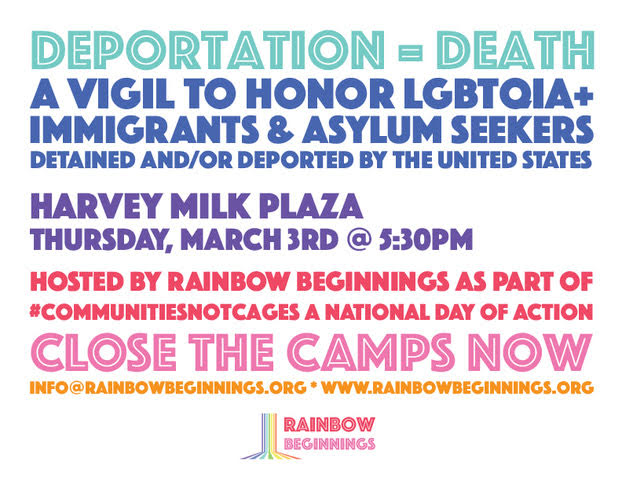
Detention Watch Network, along with many other organizations are planning a National Day of Action March 3. Here in the Bay Area, as part of this national campaign, Rainbow Beginnings is planning DEPORTATION = DEATH, a candlelight vigil at dusk to remember LGBTQ immigrants deported and asylum seekers held in concentration camps. It will be held at Harvey Milk Plaza in the Castro.
We are reaching out to invite your organization to participate in this event. We hope Queer Asylum Accompaniment Team will join us as a cosponsor. To cosponsor we ask your organization to provide a speaker for 3-5 minutes on LGBTQIA immigration needs and need to reform, and help promote this event to your staff, volunteers and members. Please let us know as soon as possible if you can sponsor.
If you have any questions or want more information please contact us.
Dive into environmental issues and discover how things work with our new science databases. From hundreds of 3-D interactive models, to in depth research on scientific topics, there is a whole world of digital science to explore! These new resources are courtesy of the California State Library as part of their K-12 Online Content Project, which enables all K-12 students in California to access vital learning support through their schools and local libraries. Find out more about these exciting resources below!
Environmental Studies In Contextbrings together periodicals and multimedia, empowering learners to critically analyze and understand important topics that affect people around the world. Explore topics and events such as Earth systems, global change, pollution, populations, and more.
Science: Interactive helps students better visualize and understand concepts in biology, chemistry, earth and space science. Students and instructors can manipulate and explore 3D models paired with reference and periodical content for further understanding.
National Geographic Kids is an online database housing books, videos, magazines, and pictures produced by National Geographic for children. The content includes the complete run of National Geographic’s Kidsmagazine from 2009 to present, over 500 books from the National Geographic Kids Collections, and hundreds of downloadable images and videos.
In Case You Missed It
Looking for more science resources? Check out some of these library favorites!
ScienceFlix™ is an online resource that focuses on engaging science content for students in grades 4-10. ScienceFlix™ offers more than 20,000 science-related assets that cover six areas of study, including earth science, space science, life science, health and the human body, physical science, and technology and engineering.
SIRS® Issues Researcher is an authoritative resource for pro/con issues assignments offering background and analysis on 360+ leading issues. Editorially curated and created content including engaging Essential Questions, and viewpoint articles help build a solid foundation for understanding complex global issues.
Escolar is a Spanish-language resource for native Spanish speakers, bilingual students, and students learning Spanish. Engaging home pages at each level are entry points to thousands of articles, images, videos, maps, and tables, many of which are newly added daily.
Dive In TodayThank you for being a member of the Sonoma County Library community. Visit us online or in person at one of our branches. Be sure to check out open jobs at Sonoma County Library here. Questions? Please call your local library branch or click here to send us a message. La ciencia cobra vida con tu tarjeta de la biblioteca Sumérgete en temas ambientales y descubre cómo funcionan las cosas con nuestras nuevas bases de datos de ciencia. ¡Desde cientos de modelos interactivos en 3D hasta investigaciones en profundidad sobre temas científicos, ¡hay todo un mundo de ciencia digital para explorar! Estos nuevos recursos son cortesía de la Biblioteca Estatal de California como parte de su Proyecto de Contenido en Línea K-12, que permite a todos los estudiantes de K-12 en California acceder a apoyo vital de aprendizaje a través de sus escuelas y bibliotecas locales. ¡Más información sobre estos emocionantes recursos a continuación!
Environmental Studies In Contextreúne publicaciones periódicas y multimedia, empoderando a los estudiantes para analizar críticamente y comprender temas importantes que afectan a las personas de todo el mundo. Explore temas y eventos como los sistemas de la Tierra, el cambio global, la contaminación, las poblaciones y más.
Science: Interactive ayuda a los estudiantes a visualizar y comprender mejor los conceptos de biología, química, ciencias de la tierra y el espacio. Los estudiantes e instructores pueden manipular y explorar modelos 3D combinados con contenido de referencia y periódico para una mayor comprensión.
National Geographic Kids es una base de datos en línea que contiene libros, videos, revistas y fotografías producidas por National Geographic para niños. El contenido incluye la tirada completa de la revista National Geographic’s Kids desde 2009 hasta la actualidad, más de 500 libros de National Geographic Kids Collections y cientos de imágenes y vídeos descargables.
En caso de que lo hayas olvidado
¿Buscas más recursos sobre la ciencia? ¡Echa un vistazo a algunos de estos favoritos de la biblioteca!
ScienceFlix™ es un recurso en línea con un enfoque de ciencias para estudiantes del 4 al 10 grado escolar. Cuenta con más de 20,000 videos sobre la ciencia de la tierra, el espacio, la vida, la salud, el cuerpo humano, la física, la tecnología e ingeniería.
SIRS® Issues Researcher es un recurso fidedigno para escribir ensayos argumentativos a favor de un tema o en contra de ello. Ofrece antecedentes y análisis sobre 360 temas principales. Brinda contenido editado y creado, incluidas las Essential Questions y los artículos de diferentes puntos de vista, ayudan a crear una base sólida para comprender problemas globales complejos.
Escolar es un recurso en español para hablantes del español, para los estudiantes bilingües y para los estudiantes que están aprendiendo el español. Las páginas de inicio en cada nivel son puntos de entrada a miles de artículos, imágenes, videos, mapas y tablas, muchos de los cuales están agregados a diario.
Sumérgete hoyGracias por ser miembro de la comunidad de Bibliotecas del Condado de Sonoma. Visítenos en línea o en persona en una de nuestras sucursales. Asegúrese de consultar los trabajos disponible en la Biblioteca del Condado de Sonoma aquí. ¿Preguntas? Por favor llame a su biblioteca local o haga clic para mandar un mensaje.If you would like to manage which emails you receive from us, please click here. Si desea gestionar los correos electrónicos que recibe de nosotros, haga clic aquí.
Dive into environmental issues and discover how things work with our new science databases. From hundreds of 3-D interactive models, to in depth research on scientific topics, there is a whole world of digital science to explore!
These new resources are courtesy of the California State Library as part of their K-12 Online Content Project, which enables all K-12 students in California to access vital learning support through their schools and local libraries. Find out more about these exciting resources below! Environmental Studies In Contextbrings together periodicals and multimedia, empowering learners to critically analyze and understand important topics that affect people around the world. Explore topics and events such as Earth systems, global change, pollution, populations, and more. Science: Interactive helps students better visualize and understand concepts in biology, chemistry, earth and space science. Students and instructors can manipulate and explore 3D models paired with reference and periodical content for further understanding. National Geographic Kids is an online database housing books, videos, magazines, and pictures produced by National Geographic for children. The content includes the complete run of National Geographic’s Kidsmagazine from 2009 to present, over 500 books from the National Geographic Kids Collections, and hundreds of downloadable images and videos. In Case You Missed It Looking for more science resources? Check out some of these library favorites! ScienceFlix™ is an online resource that focuses on engaging science content for students in grades 4-10. ScienceFlix™ offers more than 20,000 science-related assets that cover six areas of study, including earth science, space science, life science, health and the human body, physical science, and technology and engineering. SIRS® Issues Researcher is an authoritative resource for pro/con issues assignments offering background and analysis on 360+ leading issues. Editorially curated and created content including engaging Essential Questions, and viewpoint articles help build a solid foundation for understanding complex global issues. Escolar is a Spanish-language resource for native Spanish speakers, bilingual students, and students learning Spanish. Engaging home pages at each level are entry points to thousands of articles, images, videos, maps, and tables, many of which are newly added daily. Dive In Today Thank you for being a member of the Sonoma County Library community. Visit us online or in person at one of our branches. Be sure to check out open jobs at Sonoma County Library here.
La ciencia cobra vida con tu tarjeta de la biblioteca
Sumérgete en temas ambientales y descubre cómo funcionan las cosas con nuestras nuevas bases de datos de ciencia. ¡Desde cientos de modelos interactivos en 3D hasta investigaciones en profundidad sobre temas científicos, ¡hay todo un mundo de ciencia digital para explorar!
Estos nuevos recursos son cortesía de la Biblioteca Estatal de California como parte de su Proyecto de Contenido en Línea K-12, que permite a todos los estudiantes de K-12 en California acceder a apoyo vital de aprendizaje a través de sus escuelas y bibliotecas locales. ¡Más información sobre estos emocionantes recursos a continuación! Environmental Studies In Contextreúne publicaciones periódicas y multimedia, empoderando a los estudiantes para analizar críticamente y comprender temas importantes que afectan a las personas de todo el mundo. Explore temas y eventos como los sistemas de la Tierra, el cambio global, la contaminación, las poblaciones y más. Science: Interactive ayuda a los estudiantes a visualizar y comprender mejor los conceptos de biología, química, ciencias de la tierra y el espacio. Los estudiantes e instructores pueden manipular y explorar modelos 3D combinados con contenido de referencia y periódico para una mayor comprensión. National Geographic Kids es una base de datos en línea que contiene libros, videos, revistas y fotografías producidas por National Geographic para niños. El contenido incluye la tirada completa de la revista National Geographic’s Kids desde 2009 hasta la actualidad, más de 500 libros de National Geographic Kids Collections y cientos de imágenes y vídeos descargables. En caso de que lo hayas olvidado ¿Buscas más recursos sobre la ciencia? ¡Echa un vistazo a algunos de estos favoritos de la biblioteca! ScienceFlix™ es un recurso en línea con un enfoque de ciencias para estudiantes del 4 al 10 grado escolar. Cuenta con más de 20,000 videos sobre la ciencia de la tierra, el espacio, la vida, la salud, el cuerpo humano, la física, la tecnología e ingeniería. SIRS® Issues Researcher es un recurso fidedigno para escribir ensayos argumentativos a favor de un tema o en contra de ello. Ofrece antecedentes y análisis sobre 360 temas principales. Brinda contenido editado y creado, incluidas las Essential Questions y los artículos de diferentes puntos de vista, ayudan a crear una base sólida para comprender problemas globales complejos. Escolar es un recurso en español para hablantes del español, para los estudiantes bilingües y para los estudiantes que están aprendiendo el español. Las páginas de inicio en cada nivel son puntos de entrada a miles de artículos, imágenes, videos, mapas y tablas, muchos de los cuales están agregados a diario. Sumérgete hoy Gracias por ser miembro de la comunidad de Bibliotecas del Condado de Sonoma. Visítenos en línea o en persona en una de nuestras sucursales. Asegúrese de consultar los trabajos disponible en la Biblioteca del Condado de Sonoma aquí.
¿Preguntas? Por favor llame a su biblioteca local o haga clic para mandar un mensaje. If you would like to manage which emails you receive from us, please click here.
Si desea gestionar los correos electrónicos que recibe de nosotros, haga clic aquí.


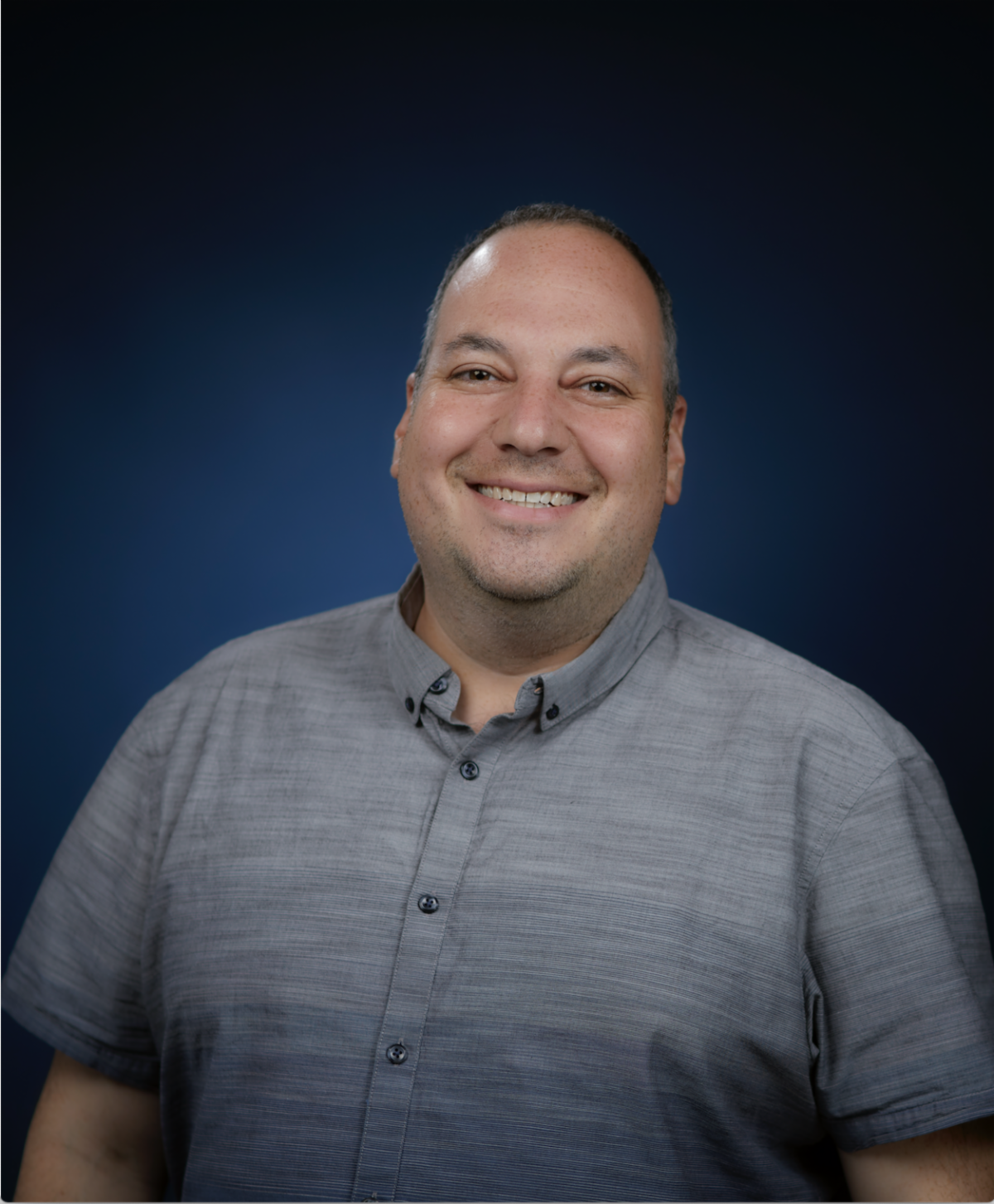 Adrian is an experienced LGBTQ+ community leader with a focus on LGBTQ+ health policy and promotion, barriers to care, and health equity. He joins The Spahr Center after founding and leading Bradbury-Sullivan LGBT Community Center in Allentown, Pennsylvania for seven years.