The Australian Human Rights Commission issued a report today analyzing the persistent practice of medically unnecessary non-consensual surgeries on children born with variations in their sex characteristics. The commission urged authorities to protect children’s rights to informed consent, and to legally regulate the operations.
Around the world since the 1950s, people born with variations in their sex characteristics, sometimes called “intersex,” have been subjected to harmful medically unnecessary “normalizing” surgeries. Surgeons popularized these cosmetic surgeries on infants to remove gonads, reduce the size of the clitoris, or increase the size of the vagina.
But these procedures are not designed to treat a medical problem, and there is no evidence they help children “fit in,” which some surgeons say is their aim. The operations carry high risks of scarring, loss of sexual sensation, incontinence, and psychological trauma. Some surgeries can sterilize the person, which an Australian Senate Committee condemned in 2013.
Its new report calls on the government to develop rights-based standards of care for children born with variation in their sex characteristics. It urges legislation to regulate the surgeries, limiting them only to when the patient has consented or where they are “required urgently to avoid serious harm” and “the risk of harm cannot be mitigated in another less intrusive way, and intervention cannot be further delayed.”
Momentum for change in Australia is afoot. Federal and local governments should urgently consider the commission’s recommendations and ensure that children born perfectly healthy – just a little different – are free to make decisions about their own bodies.
The Dutch monarchy made international news last week after announcing that royals can marry a same-sex partner without giving up their right to the throne. But while the Netherlands, which in 2001 became the first country to legalize gay marriage, has paved the wave for a queer royal to officially wear the crown, LGBTQ people have long been doing so unofficially.
While it’s difficult to assign modern labels to figures from the past, there were notable leaders from centuries — even millennia — ago, who crossed sexual and gender boundaries. Some were celebrated by their subjects, others vilified.
In light of the Dutch monarchy’s recent announcement and in honor of LGBTQ History Month, which is celebrated in October, here are 13 queer royals you didn’t learn about in school.
Emperor Ai of Han (27 – 1 B.C.)
Made emperor of the Han Dynasty at age 20, Ai was initially well received by his subjects but eventually became associated with corruption and incompetence. He was also widely known to have been romantically involved with one of his ministers, Dong Xian, though both men were married to women.
In the “Hanshu,” or “Book of Han,” Dong and Ai’s relationship is referred to as “the passion of the cut sleeve.” As the story went, the pair had fallen asleep together on a mat and, upon waking, the emperor cut the sleeve off his robe rather than disturb his lover. (The term “cut sleeve” remained a Chinese euphemism for male homosexuality for centuries.)
Dong was granted many honors, eventually being made commander of the military, and he and his family lived inside the imperial compound.
According to historian Brent Hinsch, many Han emperors reportedly had “male favorites” who were listed in both the “Book of Han” and the “Shiji,” or “Records of the Grand Historian.”
“It is not women alone who can use their looks to attract the eyes of the ruler,” the “Shiji” reads, according to Ban Gu’s “History of Early China.” “Courtiers and eunuchs can play that game as well. Many were the men of ancient times who gained favor this way.”
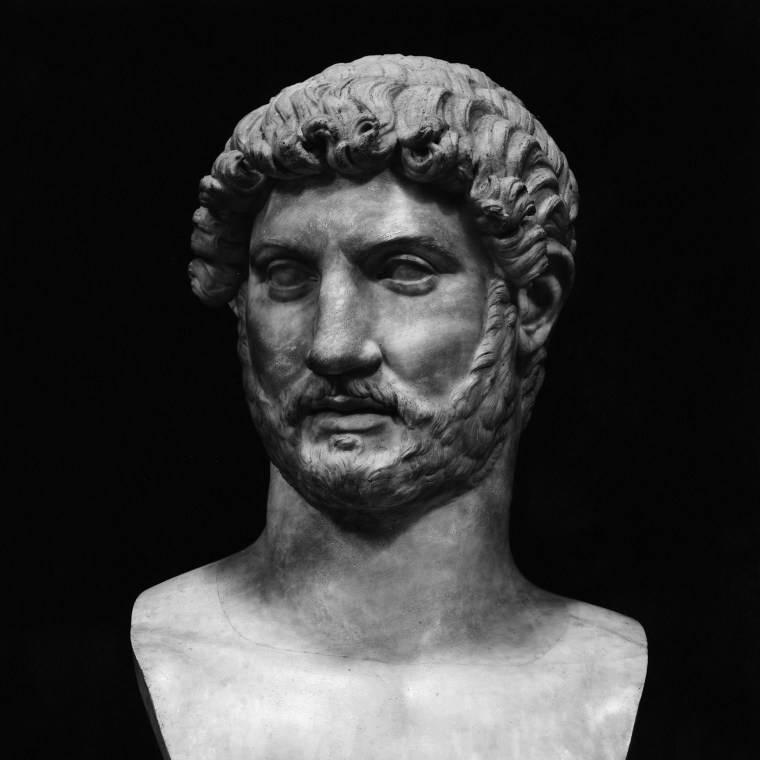
Emperor Hadrian of Rome (76 – 138 A.D.)
Another leader who showered his male lover with attention, Hadrian was in a politically arranged marriage to the great-niece of his predecessor — a loveless union that bore no children. It wasn’t unusual for high-powered Romans to have male partners in addition to their wives, but Hadrian was almost slavishly devoted to his young consort, Antinous.
The Roman emperor Hadrian.ullstein bild via Getty Images
When Antinous mysteriously drowned in the Nile in 130 A.D., Hadrian was so grief-stricken he had the young man deified and put up monuments to him everywhere.
“Hadrian was clearly bereaved and he had lots of images put up,” Thorsten Opper, who curated an exhibit on the emperor at the British Museum, told The Independent in 2008. “When a city [in Egypt] was founded close to the spot where Antinous drowned, he named it Antinopolis. It was a sort of hero cult-worship of Antinous.”
Al-Hakam II of Córdoba (915 – 976)
A 10th century caliph in Córdoba, Spain, Al-Hakam was known for his largely peaceful reign and his love of learning: His library contained more than 400,000 books, and he provided sanctuary to many writers and philosophers.
The caliph’s sexuality has been the source of some debate: According to the French medievalist Évariste Lévi-Provençal, the phrase “hubb al-walad,” found in 16th-century historian Ahmed Mohammed al-Maqqari’s compendium “Nafh at-Tib” in reference to Al-Hakam II, translates as a “preference for boys,” though other scholars maintain it refers to paternal love.
The Medieval Europe scholar Francisco Prado-Vilar wrote that knowledge of Al-Hakam’s homosexuality in the court of Córdoba “encouraged the ambitions of the factions gathered around his much younger brother, Prince al-Mughira.”
“In his youth his loves seem to have been entirely homosexual,” queer studies scholar Louis Crompton wrote in “Male Love and Islamic Law in Arab Spain.” “This exclusivity was a problem when he succeeded to the throne, since it was incumbent upon the new caliph to produce a male heir.”
Despite rumors of having a male harem, Al-Hakam did marry a Basque concubine named Subh, but reportedly gave her the masculine nickname Jafar. Subh is said to have worn the short hair and trousers of a ghulam, or young man,to garner her husband’s attention.
King Edward II of England (1284 – 1327)
King Edward II of England’s intense relationship with Piers Gaveston drew the ire of many nobles at court and forced Edward to send his favorite away more than once.
“When the king’s son gazed upon him, he straightaway felt so much love for him that he entered into a covenant of brotherhood with him and chose and firmly resolved to bind himself to him, before all mortals, in an unbreakable bond of love,” wrote one chronicler at the time.
The sexual nature of their relationship has been alluded to in Christopher Marlowe’s 1592 play, “Edward II,” and addressed more directly in queer filmmaker Derek Jarman’s 1991 film of the same name.
But even contemporaries were claiming the two men were unusually close, with some nicknaming Gaveston a “second king.”
According to English Heritage, which manages historic British monuments, “It is impossible to know the exact nature of their relationship, but there is strong evidence to suggest it was a romantic one.”
Eventually, their relationship estranged Edward from his wife, Isabella of France, and her allies at court. After he returned from exile a third time in 1311, Gaveston was hunted down and decapitated by a group of noblemen, including Edward’s cousin Thomas, the Earl of Lancaster.
In 1326, Isabella and her possible lover, Roger Mortimer, seized power and had Edward deposed and imprisoned. He died at Berkeley Castle in Gloucestershire a year later.
Rumors that Edward II had been gruesomely executed by having a red-hot poker inserted into his backside spread quickly, likely started by his political enemies.
Queen Ana Nzinga of Ndongo (1583 – 1663)
The gender-nonconforming ruler of Ndongo and Matamba in modern-day Angola, Nzinga fought off Portuguese colonialists, alternately through diplomacy, trade and guerrilla warfare.
She welcomed runaway slaves and European-trained African soldiers, and adopted kilombo, a military strategy in which male youths were taken from their families and raised communally in militias.
In a 1670 book, her Dutch bodyguard, Captain Fuller, described 60-year-old Nzinga as wearing “men’s apparel” during ritual sacrifice, “hanging about her the skins of beasts … with a sword about her neck, an axe at her girdle, and a bow and arrows in her hand.”
Fuller also described a cadre of young men whom Nzinga kept dressed in women’s clothing.
“The thing about Nzinga is her title was Ngola, and Ngola means king,” the Nigerian American photographer Mikael Owunna told NPR in 2017. “Nzinga ruled dressed in full male clothing as a king, and she had a harem of young men dressed as women who were her wives. So in the 1600s, you basically had a butch queen with a bunch of drag queens for wives leading a fight against European colonization.”
King James I of England (1566 – 1625)
The son of Mary, Queen of Scots, this British monarch, known as both King James VI of Scotland and King James I of England, has been described by the historian Michael B. Young as “the most prominent homosexual figure in the early modern period.”
Married to Anne of Denmark, James is thought to have had relationships with several male courtiers — most notably, George Villiers, whom he made the Earl and later the Duke of Buckingham. (In the early 2000s, restoration work on Apethorpe Palace revealed a secret passageway connecting James’ and Villiers’ bedchambers.)
“To the shock of many courtiers, the pair were demonstratively affectionate to each other in public, despite James’ various proclamations against homosexuality,” Daniel Smith wrote in “Love Letters of Kings and Queens.”
A popular epigram at the time compared the Jacobean monarch to his Tudor predecessor, Elizabeth I, declaring, “Elizabeth was King, now James is Queen.”
Contemporary poet Théophile de Viau put it more bluntly: “It is well known that the king of England f—- the Duke of Buckingham.”
Fending off claims of favoritism, James proclaimed, “You may be sure that I love the Earl of Buckingham more than anyone else.”
“I wish … to not to have it thought to be a defect,” he added, “for Jesus Christ did the same, and therefore I cannot be blamed. Christ had John, and I have George.”
Queen Christina of Sweden (1626 – 1689)
It’s hard to separate fact from fiction with this 17th-century Swedish royal: Her predilection for wearing men’s clothes and enjoying literature, hunting, alchemy and other male-dominated activities spurred rumors Christina was a sexual deviant or intersex.
“There is nothing feminine about her except her sex,” a Jesuit priest wrote in 1653. “Her voice, her manner of speaking, her walk, her style, her ways are all quite masculine.”
Oliver Cromwell’s secretary of state John Thurloe commented on Christina’s “Amazonian behavior” and said that “nature was mistaken in her,” while salacious French pamphlets claimed she was “one of the most ribald tribades ever heard of,” using the contemporary term for a lesbian.
But how many of those barbs were simply attempts at character assassination isn’t clear.
“The monarch has been described at best as ‘unconventional’ and at worst as an impulsive, over-emotional murderer,” historian Amy Saunders wrote in The Royal Studies Journal. “Christina’s sexuality and gender have been constantly reconstructed, re-examined, and re-interpreted.”
Since childhood, the queen’s closest companion was Countess Ebba Sparre, whom she introduced as “my bed-fellow.”
“How happy I should be if only I could see you, Beautiful One,” Christina wrote to Sparre in 1656. “But I am condemned by destiny to love and cherish you always without seeing you. I cannot be completely happy when I am separated from you.”
“It’s difficult to imagine just how Christina understood her own feelings for Ebba, and for those of other women, like the Comtesse de Suze, on whom she is said to have been keen,” Sarah Waters, author of “Tipping the Velvet,” wrote in the Feminist Review in 1994. “There was certainly gossip about Christina’s relations with women in her own day, identifying her as the aristocratic ‘tribade.’”
Christina, who abdicated rather than marry, wrote in her memoir that she felt “an insurmountable distaste for marriage” and “for all the things that females talked about and did.”
Though the 1933 film “Queen Christina” inserts a fictional heterosexual romance, the movie cemented screen goddess Greta Garbo’s status as a queer icon.
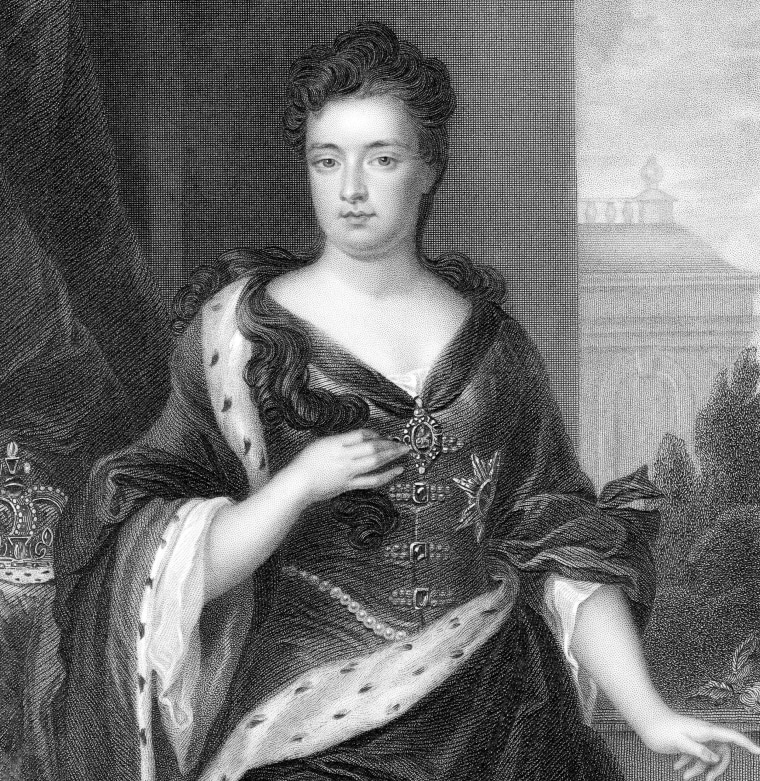
Queen Anne of England (1665 – 1714)
Anne, who suffered from frail health throughout her life, met Sarah Churchill when the two were girls. They quickly became close confidants, embarking on a relationship that lasted well into adulthood.
“If I could tell how to hinder myself from writing to you every day I would,” Anne wrote to her friend. “But really I cannot … when I am from you I cannot be at ease without enquiring after you.”
Queen Anne of England.Print Collector / /Getty Images
When Anne became queen in 1707, she made Sarah and her husband the Duke and Duchess of Marlborough and appointed Sarah the Keeper of the Privy Purse. Anne was married to Prince George of Denmark, but rumors circulated that the two women were having a secret romance.
Eventually Sarah became a bit too accustomed to her access and influence and Anne became more drawn to Sarah’s cousin, Abigail Masham.
In 1708, political pamphlets likely circulated by a jealous Sarah pointed to “dark deeds at night”between Abigail and the queen. After a final falling out at Kensington Palace in 1710, Sarah and Anne never spoke again.
“The Favourite,” a somewhat fictionalized 2018 account of Anne’s relationships with Sarah and Abigail — complete with lesbian liaisons — earned Olivia Colman a best actress Oscar as the conflicted queen.
Frederick the Great of Prussia (1712 – 1786)
Even in his lifetime, this Prussian royal was widely rumored to be a homosexual, though that term wouldn’t be coined till nearly 90 years after his death.
Two years after the king’s death, his physician Johann Georg Ritter von Zimmermann published a book in which he desperately tried to dispel gossip Frederick had a “Grecian taste in love.”
In “Frederick the Great: King of Prussia,” T.C.W. Blanning writes that Zimmermann claimed the king had a minor deformity on his penis that rendered him impotent. And rather than let that secret out, Frederick pretended to be gay, “so that he would continue to appear virile and capable of sexual intercourse, albeit with men.”
But Frederick’s proclivities were apparent at a young age: As a 16-year-old crown prince, he was caught having an affair with a 17-year-old page.
“We were unaware of my brother’s artifices,” his older sister Wihelmine wrote. “Though I had noticed that he was on more familiar terms with this page than was proper in his position I did not know how intimate the friendship was.”
Their father, King Frederick William, detested what he saw as his son’s effeminacy and was increasingly despotic toward him. Frederick tried to run away with another rumored lover, Hans Hermann von Katte, but the pair were caught.
Von Katte was executed in front of Frederick, shouting, “I die for you with joy in my heart!” before being beheaded.
Frederick became king of Prussia in 1740 and was considered a savvy military leader, politician and patron of the arts committed to the Enlightenment. But he did little to obscure his sexuality: Sanssouci, his palace in Potsdam, was filled with homoerotic art and, across Europe, “les Potsdamists” became slang for homosexuals.
The king allegedly pursued the Venetian philosopher Francesco Algarotti and even famed French philosopher Voltaire, who lived with him at Sanssouci, though it’s not certain if either relationship was sexual.
After Voltaire’s death in 1778, a manuscript of his memoir detailing Frederick’s homosexual tendencies in detail was stolen and published in the Netherlands.
Because of his military acumen, Frederick was glorified by the Nazis as a great German leader, though his sexuality was heavily obscured.
Princess Isabella of Parma (1741 – 1763)
Wed to Archduke Joseph of Austria, Isabella was rumored to truly be in love with Joseph’s sister, Archduchess Maria Christina, known affectionately as Mimi.
She spent all her time at court in Vienna with the archduchess, rather than her husband, and the two exchanged hundreds of letters. Maria Christina’s were destroyed after her death, but Isabella’s make her ardor apparent: “I am told that the day begins with God,” she wrote in one. “I, however, begin the day by thinking of the object of my love, for I think of her incessantly.”
The relationship was also a great source of conflict for Isabella, because it meant betraying her duties as the wife of a prince. More significantly, though, Isabella realized this was the great love of her life, but she knew that for Mimi, it was more of a youthful dalliance.
The princess died giving birth in 1763 at age 21.
Archduke Ludwig Viktor of Austria (1842 – 1919)
Being the younger brother of Austrian Emperor Franz Joseph I didn’t save Ludwig Viktor from ruin when he made an unwelcome pass at a man at Vienna’s Centralbad bathhouse.
“It appears there was a row, and the Archduke was knocked down by one of the bathers, an athletic young man of the middle classes,” The Chicago Tribune reported in 1906. “According to witnesses, the young man’s actions were justified.”
Ludwig was banished from Vienna for the remainder of the emperor’s life. “He has also been forced to resign his patronages, and most of his staff have been moved to other positions,” the Tribune reported, adding that the archduke has been “virtually ostracized” from society.
“The Viennese are very tolerant of scandals in imperial and aristocratic circles,” the paper wrote, “but Ludwig Viktor’s affairs proved to be too much even for them.”
The archduke spent the rest of his life in seclusion at Klessheim Palace near Salzburg, where he died at the age of 76 in 1919, three years after his brother’s death and one year after the Austro-Hungarian Empire was dissolved after the end of World War I.
Mwanga II of Buganda (1868 – 1903)
Discussion of Uganda’s treatment of homosexuality usually settles on President Yoweri Museveni’s “Kill the Gays” bill, but this 19th century kabaka, or king, of Buganda allegedly had sexual relationships with men along with his 16 wives.
In 1886, Mwanga II ordered the brutal torture and deaths of dozens of courtiers and pages, with many burned alive. While some sources claimed the incident stemmed from the victims’ attempt to save a British missionary, The New York Times reported the massacre was sparked by “the refusal of a Christian lad acting as the king’s page to commit an abominable crime.”
Whatever the cause, the mass slaughter earned international condemnation and further destabilized Mwanga’s rule, leading to his eventual exile and British annexation of Uganda in the 1890s.
The victims were beatified as martyrs in 1920, and then canonized in 1964. There is a shrine dedicated to them in Namugongo and Martyr’s Day is still celebrated in Uganda every June.
Over time, they became national heroes and the “founding narrative of Christianity in Africa,” political scientist Rahul Rao told The Atlantic.
More than a century later, right-wing religious and political leaders like Museveni still use the martyrs to justify attacks on the LGBTQ community in Uganda.
“I hear there was homosexuality in Mwanga’s palace,” Museveni told a crowd of thousands on Martyr Day in 2010, the Atlantic reported. “This was not part of our culture. I hear he learnt it from the Arabs. But the martyrs refused these falsehoods and went for the truth, which is why we are honoring them today.”
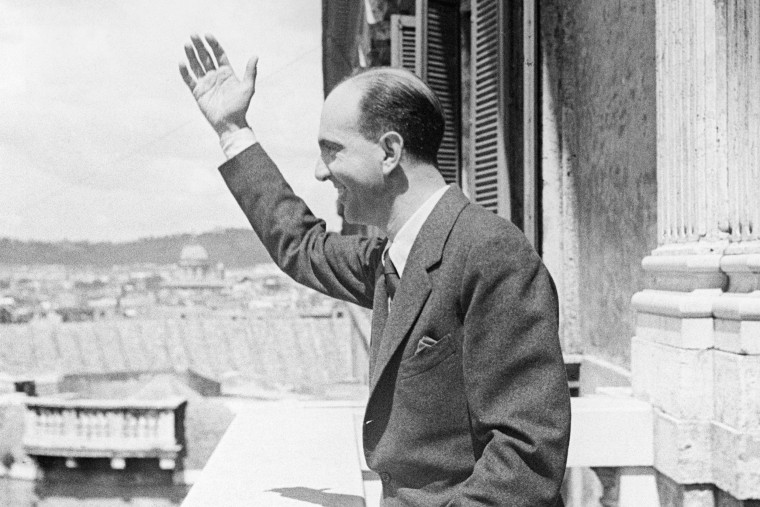
King Umberto II of Italy (1904 – 1983)
After Mussolini’s fall, Umberto’s father, King Victor Emmanuel III, was viewed as a Fascist sympathizer. Under pressure from Allied forces, he abdicated in favor of his wastrel son, Umberto, in 1943.
Italian King Umberto II greets the crowd gathered on Piazza del Quirinale in Rome in 1946.Mondadori Portfolio / Mondadori Portfolio / Getty Images
Umberto was married to Queen Marie-José of Belgium and the couple had four children. But the Orva, Mussolini’s secret police, had kept dossiers on Umberto’s male lovers, who reportedly included famed filmmaker Luchino Visconti, boxer Primo Carnero, and French actor Jean Marais.
One former fling said when he was a young lieutenant in Turin, the prince courted him incessantly, giving him a silver cigarette lighter with the inscription “Dimmi di sì!” (“Say yes to me!”).
Critics decried Umberto as dim-witted, shallow and a poor leader.
The same year he was made regent, Umberto was outed by the Fascist press in an attempt to discredit him. It worked: After just 34 days the public voted to abolish the monarchy.
Separating from his wife in 1946, Umberto lived out the rest of his life in exile. He died in Geneva at age 78.
One in four LGBT+ youth use pronouns other than he/him and she/her, according to research by a leading charity.
The study indicates that LGBT+ young people are increasingly finding different ways to express their gender identities and that many are opting for a mix of pronouns.
The survey, conducted by The Trevor Project, found that 75 per cent of LGBT+ young people exclusively use either he/him or she/her pronouns.
Meanwhile, 25 per cent use gender neutral pronouns such as they/them, either exclusively or as a combination with other pronouns.
The research found that almost two thirds of LGBT+ youth who use pronouns outside the binary use a combination of he/him, she/her and they/them.
The Trevor Project surveyed 40,000 LGBT+ young people between the ages of 13-24 in the United States, asking them: “Which pronouns do you currently use? Please select all that apply.”
Five per cent of respondents said they exclusively use pronouns other than he/him or she/her, with the majority of that group opting for they/them pronouns.
Four per cent of those surveyed reported using pronouns such as ze/zir, xe/xim or fae/faer, or said they use these pronouns in conjunction with others.
The singular ‘they’ has been used in the English language for centuries.
Many people use pronouns such as they/them, xe/xim or fae/faer to better represent their identities.
British singer Sam Smith made headlines across the world last year when they came out as non-binary and said they would be using they/them pronouns going forward.
Transphobes from various quarters have railed against the use of singular they/them pronouns, but the Oxford English Dictionary actually traces the first written use of the singular “they” to 1375 – proving that it is not a new phenomenon linguistically.
Last December, the Merriam-Webster dictionary announced that it had selected the singular “they” pronoun as its word of the year.
Internet searches for the word “they” increased by 313 per cent last year when compared to 2018, proving that more and more people are educating themselves on the importance of respecting people’s pronouns.
Six boys and one non-binary student are suing a Texas school district after they were reportedly handed suspensions for having long hair.
The American Civil Liberties Union (ACLU) of Texas filed a lawsuit last week against the Magnolia Independent School District on behalf of the students, aged between seven and 17.
According to the ACLU, the district has been “engaging in explicit gender discrimination” by enforcing sex-specific dress and grooming rules for students, and “harshly punishing” them if they do not comply.
The Magnolia ISD handbook states that hair must “be no longer than the bottom of a dress shirt collar, bottom of the ear, and out of the eyes for male students”, and must “not be pinned up in any fashion nor be worn in a ponytail or bun for male students”.
No such rules exist for female students.
The lawsuit claims that multiple students have been placed in “in-school suspension” or a “disciplinary alternative education program” over the length of their hair.
According to the school district handbook, the “disciplinary alternative education program” is used for offences like making a false report of a terrorist threat or bullying another student to the point that they take their own life.
Brian Klosterboer, ACLU of Texas staff attorney, said in a statement: “At a time when students have already been through so much due to the COVID-19 pandemic, it is outrageous that Magnolia ISD administrators are pushing students out of school because of their gender and hair.
“We have warned the district repeatedly that its gender-based hair policy violates the Constitution, but the district continues to derail students’ lives and deny their right to a public education free from discrimination.
“Magnolia ISD is failing to live up to its motto ‘to be the best district in the state of Texas,’ and the district needs to stop hurting its students.”
The 11-year-old non-binary plaintiff was ‘ostracised’ by the school district over their long hair
According to the lawsuit, the 11-year-old non-binary plaintiff, identified as TM, was sent to in-school suspension for nine days over their long hair.
“Sometimes TM expresses their gender identity more like a boy, but other times TM expresses their gender identity more like a girl,” the lawsuit reads.
“TM has worn long hair for the last couple years as a critical component of expressing their gender identity.
“If TM is forced to wear short hair based on gender stereotypes associated with their gender assigned at birth, TM will lose a vital part of who they are and sacrifice an essential element of their gender expression.”
It added that TM had been “ostracised and separated from their friends” by the in-school suspension, and it was only ended after their mother went to the press.
TM was granted a 60-day “pause” on the sex-based dress code being enforced, which will soon come to an end, putting them at “imminent risk of being sent back to [in-school suspension] and/or [disciplinary alternative education program]”.
According to Out, Magnolia ISD said in a statement that it “looks forward to the opportunity to respond” to the suit in court.
It continued: “This system of differentiated dress and grooming standards have been affirmed by courts and does not inhibit equal access to educational opportunities under Title IX.
“The rules are included in the student handbook each year and are similar to the codes of approximately half of the public school districts in Texas.”
On Tuesday (26 October), a judge temporarily blocked the school district’s enforcement of the sex-based grooming policy while legal proceedings are ongoing.
Equality legislation is close to passing in Congress, but close isn’t good enough. “Close” won’t change anything for the LGBTQ Americans who face discrimination every day. Senate Democrats and Republicans must make a push to negotiate. With a reach on both sides to find common ground, we can move equality legislation from “close” to “done deal.”
Some Democrats are waiting for the filibuster to end—despite clear evidence that they lack the votes to end it. Some Republicans are practicing a tried-and-true brand of obstructionism. To break this deadlock, we should look to the successful, bipartisan repeal of “Don’t Ask, Don’t Tell” (DADT) as a guide.
The DADT repeal is the single reference point for LGBTQ advocates for overcoming the Senate filibuster. Other victories have been in the courts; notably, the Supreme Court’s 2015 Obergefell decision that made gay marriage legal nationwide.
Before Obergefell, advocates had success in the state legislatures. I worked on campaigns for the freedom to marry in Minnesota, New Hampshire, New York and elsewhere, finding common ground between Democrats and Republicans who thought it was impossible to negotiate on marriage. Eventually, enough people from both parties came together to pass marriage laws in a majority of states.
Working together at the state level is one thing. Congress is another.
Despite Democrats’ control of the White House, Senate and House, negotiations are failing at the federal level. So, we lets look to ancient history—the 2010 repeal of DADT—for guidance on reaching 60 votes in the Senate.
The most important lesson from the DADT repeal is that Senate moderates must champion the cause and lead negotiations. The more partisan figures on both sides need to step back. Overcoming the filibuster is a job for moderates, not ideologues.
As it happens, the hero of the DADT repeal is still a senator and can help. Republican Sen. Susan Collins of Maine led the negotiations on DADT repeal.
Senator Collins supports the Equality Act in principle and even sponsored a version of the bill in past. However, the current version is too extreme for Sen. Collins, as a result, she has withdrawn as a co-sponsor. The current bill has also foundered with Sen. Lisa Murkowski, another important figure in the repeal of DADT.
The fact that moderate, pro-LGBTQ senators are unable to back the current version of the Equality Act should send a clear message to Democrats that we need to make reasonable changes to the bill. So far, the message is being ignored.
On the Democratic side, independent Sen. Joe Lieberman was essential to the repeal of DADT. There certainly were passionate, liberal Democrats who could have asserted themselves during the debate. But then, the bill would have taken longer to pass, or even might have failed.
The lesson is clear. Listen to the moderates. Let them lead this charge.
Another important lesson from the repeal of DADT is to be flexible in the legislative strategy. DADT repeal was originally an amendment to a large defense authorization bill. Rather than give up, Collins and Lieberman fought and saved DADT repeal from defeat by pulling out key provisions they knew could pass on their own and making them a standalone measure. Repeal passed with bipartisan support.
The current version of the Equality Act tries to do too much. That’s why it can’t win support from moderate Republicans who have legitimate concerns the bill might suppress free speech or shut down religious charities.
Over 60 senators can agree on the basic premise of the Equality Act. They would gladly vote to prohibit discrimination against LGBTQ Americans in employment, housing, and public accommodations, so long as the law didn’t intrude on the First Amendment.
If the far left believes that our country has too much religious liberty, they can deal with that in future legislation. But so long as we have a filibuster—and, there’s no indication it will end any time soon—the Equality Act needs to reflect our society’s current views on religious liberty.
The DADT repeal passed with 65 votes in the Senate, overcoming the filibuster. Let’s replicate that victory by using the same playbook. Moderates: Take the lead.
Tyler Deaton is the senior advisor to the American Unity Fund, a conservative nonprofit organization working to advance LGBTQ freedom and religious freedom
Danish toymaking giant Lego on Monday pledged to remove gender bias from its toys after research found girls were being held back by gender stereotypes.
The company, whose colorful building blocks and figurines sell in more than 130 countries, said it wants to make its products more inclusive so that children’s ambitions are not limited by gender.
“The company will ensure any child, regardless of gender identity, feels they can build anything they like,” Lego said in a statement.
Lego vowed to make its products “free of gender bias and harmful stereotypes,” saying there is a need for wider society to “rebuild perceptions.”
Lego did not elaborate on what exactly it would modify about its products to bring about these changes. However, in an emailed statement to NBC News, the company said it has transitioned its product and marketing department from gender-focused product groups to groups focusing on “passions and interests.” The company also said it has recently published a diversity and inclusivity playbook for its product design and marketing teams.
“The benefits of creative play such as building confidence, creativity and communication skills are felt by all children and yet we still experience age-old stereotypes that label activities as only being suitable for one specific gender,” Julia Goldin, chief product and marketing officer, said in a company statement.
Lego’s promise came as the company released new research showing that girls were more open to engage in different types of play than boys, but societal norms about play, including attitudes of their parents, limited their potential.
The research involved nearly 7,000 parents and children in seven countries, Lego said.
Some praised Lego’s decision, saying other companies would feel compelled to follow its lead.
“If manufacturers and stores alike stop relying on gender stereotyping in their appeals to children, we could begin to see more noticeable changes to the children’s marketplace,” Rebecca Hains, professor of media and communication at Salem State University and children’s media culture expert, said in a Facebook post, commenting on the announcement.
“They’re such a force in the industry that perhaps where Lego goes, others will follow,” she said.
The United Kingdom-based Let Toys Be Toys campaign, which challenges gender stereotypes in toy marketing, also welcomed the news on Twitter, saying the negative effects of gender stereotyping on children is something they have been raising with Lego since 2012. It also noted purple and blue branding of some Lego sets, catering to boys and girls differently.
“The idea that girls and boys play or should play with different toys is harmful — it reinforces harmful stereotypes,” said Pragya Agarwal, behavioral scientist and visiting professor of inequities and social justice at England’s Loughborough University.
A child plays during a visit to Legoland at the American Dream Entertainment Mall, in Rutherford, N.J.Anthony Behar / Sipa USA via AP file
On Saturday, California became the first state to say large department stores must display products like toys in gender-neutral ways.
The United Nations says that while some progress has been made in recent years, women and girls still carry the burden of gender inequality, with discriminatory laws and social norms remaining pervasive, and women continuing to be underrepresented at all levels of political leadership. Its 2020 report found that less than 50 percent of working-age women are in the labor market, and unpaid domestic and care work falls disproportionately on women, restraining their economic potential.
A 2020 report by The Fawcett Society, a U.K. gender equality group, found that harmful gender stereotypes can significantly limit children’s potential, and the toys they play with can be a contributing factor. It found that 66 percent of parents want to see companies voluntarily advertise toys to boys and girls in the same way
In the fourth century BC, a fearsome army named the Sacred Band of Thebes was formed, and it was made up entirely of gay couples.
Lawmakers in countries across the world have been banning LGBT+ people from their militaries for more than a century, from America’s “Don’t Ask, Don’t Tell” and trans military ban, to the UK’s ban on LGBT+ people in the armed forces, which was only lifted in 2000.
While the US insisted during the era of “Don’t Ask, Don’t Tell” that LGBT+ service members “would create an unacceptable risk to the high standards of morale, good order, discipline and unit cohesion that are the essence of military capability”, history tells a very different story.
The Sacred Band of Thebes was formed in Ancient Greece by a general named Gorgidas in 378 BC.
In forming the 300-strong army, Gorgidas took an unusual approach; he personally chose each member based on merit and ability, rather than social status, and only selected gay couples.
What at first seems like a strange decision makes perfect sense when explained by Plato.
In Plato’s Symposium, written just a few years after the formation of the Sacred Band of Thebes, he said: “And if there were only some way of contriving that a state or an army should be made up of lovers and their beloved, they would be the very best governors of their own city, abstaining from all dishonour, and emulating one another in honour; and when fighting at each other’s side, although a mere handful, they would overcome the world.
“For what lover would not choose rather to be seen by all mankind than by his beloved, either when abandoning his post or throwing away his arms? He would be ready to die a thousand deaths rather than endure this.
“Or who would desert his beloved or fail him in the hour of danger?”
And Plato was right.
The Sacred Band of Thebes became a fearsome army, tirelessly training to prepare themselves for battle at any minute, including through wrestling and dance.
They won multiple battles, even taking down the Spartan army, despite being vastly outnumbered.
The couples were each made up of a “lover”, who was older and more experienced, and a “beloved”, who was younger.
The ages of the soldiers were never recorded, but James DeVoto, in his book The Sacred Band, suggests that by comparing them to other armies at the time, it is likely they joined at around 20 to 21 years old, and retired by 30.
The word “sacred” in the name of the army is thought to reference a sacred vow that the couples made to one another.
The Sacred Band of Thebes was so awe-inspiring, even their enemies cried when they were defeated
The Sacred Band of Thebes was finally defeated in 338 BC, 40 years after its formation.
They fought in the Battle of Chaeronea, joining Athens to fight against Philip II of Macedon, but were eventually surrounded.
The ancient gay army was offered the chance to surrender, but as Plato predicted, they refused to give up in front of their lovers.
Every member was killed, but according to Plutarch, Philip II broke down in tears after defeating them.
He is recorded as saying: “Perish any man who suspects that these men either did or suffered anything unseemly.”
A dildo-style home insemination kit is designed to make conception a pleasurable and intimate process for queer couples.
Even if queer couples decide to self-inseminate at home, the procedure can feel strange and clinical, but the Way device makes sure that there can still be fun when it comes to baby-making.
At first glance, the insemination device looks exactly like a minimalist, silicone, pink and white dildo. But on closer inspection, a small bubble is visible at the base, which is used to hold semen.
The kit comes with a jar, into which semen is deposited, before the user sucks it into the bubble. When inserted into the vagina during sex, the bubble can be pressed to release its contents.
The tubes through which the semen travels along the dildo can also be removed, and worn as a harness around the hand to inseminate the conceiving partner while fingering.
Way device designer Kamila Rudnicka, from Poland, told Dezeen: “Hands are very important when we are making love, especially in lesbian sex.
“That’s why I decided to use them to connect two people. Just using a device will not give them the same feeling as using their own body during sex.”
During the design process, Rudnicka said she consulted with gynaecologistsand psychologists, and also interviewed potentials customers.
She said: “I wanted to create a device that would help them focus on something other than just getting pregnant.
“In a survey I did of couples, the majority said that even if at-home insemination can be less effective they still want to try it in their own bed.”
Although home insemination is a great option for many couples, it is not always as effective as other methods like intrauterine insemination (IUI) and in vitro insemination (IVF), which can be better choices for those struggling with fertility.
Rudnicka explained: “This is not a device for people who have been trying to get pregnant for years.
“It’s for couples where one side has HIV, for lesbian couples, transgender people and those with disabilities – people who are unable to conceive during their regular sexual activity… The hope is to make it a ‘first step’ people can take before resorting to the sterile medical procedure at the hospital.”
The Way is not yet on the market, and is still in the prototype phase, but the designer hopes it will be available for purchase in the near future.
British Olympic diver Tom Daley said that he will make it his “mission” to stop countries where homosexuality is punishable by death from competing in the Olympics.
“I think it’s really important to try and create change, rather than just highlighting or shining a light on those things,” Daley, who is gay, said Wednesday while accepting the Sport Award at the 2021 Attitude Awards. “So I want to make it my mission over the next, well, hopefully before the Paris Olympics in 2024, to make it so that the countries [where it’s] punishable by death for LGBT people are not allowed to compete at the Olympic Games.”https://iframe.nbcnews.com/zgXuflE
There are 11 countries where homosexuality is punishable by death — including Saudi Arabia, Afghanistan and Iran — and approximately 60 other nations where same-sex relations are criminalized in some capacity, according to Human Dignity Trust, a global advocacy group for LGBTQ rights. Many, if not all, of these countries competed at the Tokyo Olympics.
Daley also criticized the organizers of the FIFA World Cup for hosting the 2022 competition in Qatar, where the death penalty is a legal possibility, according to Human Dignity Trust.
“I think it should not be allowed for a sporting event to host in a country that criminalizes against basic human rights,” Daley said. “So, that is going to be my mission now to change that.”
International sporting organizations have previously banned countries from competing on grounds of discriminatory policies. From 1964 to 1988, the International Olympic Committee, the governing body of the Olympics, banned South Africa from competing because of apartheid, a brutal system of racial discrimination against nonwhite citizens.
The Olympic Committee has also taken measures to prevent anti-LGBTQ cities from hosting competitions since the 2014 Sochi Winter Games were criticized for Russia’s “gay propaganda law.” Tokyo passed anti-LGBTQ discrimination laws in 2018 in accordance with the committee’s policy for hosting cities, but efforts to implement similar policies throughout all of Japan have stalled.
“We fully respect Tom Daley and his view,” the Olympic Committee said to NBC News in an email.
“At the same time, the IOC has neither the mandate nor the capability to change the laws or the political system of a sovereign country,” it said. “This must rightfully remain the legitimate role of governments and respective intergovernmental organizations.”
Daley noted Wednesday that the Tokyo Games had a historic number of openly LGBTQ athletes compete. At least 186 openly LGBTQ athletes took part, according to Outsports, nearly triple the 56 who participated in the 2016 Rio de Janeiro Games.
After winning a gold medal at the Tokyo Games, his first out of his four Olympic competitions, Daley took to the podium and dedicated his win to LGBTQ people.
“I hope that any young LGBT person out there can see that no matter how alone you feel right now, you are not alone,” he said, crying tears of joy. “That you can achieve anything and that there is a whole lot of your chosen family out here, ready to support you.”
The 2022 Winter Games will be held in Beijing, where LGBTQ people are not protected by anti-discrimination laws.