In keeping with our mission of ending HIV in Sonoma County we have partnered with Q.Care, a telehealth service provider so that we can offer PrEP to all that come through our doors. With PrEP, people who are HIV negative take medication once a day to reduce the risk of getting infected if they are exposed to HIV. It is an additional method that can be used with other HIV prevention strategies such as condoms.
Executive Director, Sara Brewer states, “Despite the success of marketing PrEP to gay men, there has been less effort to inform the general public. This has led to a huge disparity of awareness, access, and usage among different populations, especially people of color, women, transgender individuals, people who inject drugs, and men who have sex with men who are not integrated into the gay community.”
Even if people have heard about PrEP there are several other potential barriers such as cost, access to medical care, insurance coverage, perceived stigma and more. At Face to Face, we see the expanded use of PrEP as the highest priority in preventing new infections and are pleased to offer support to help overcome these challenges. This is an alignment with and another step in our mission of ending HIV in Sonoma County.We are truly thrilled to be able to expand our servicesin providing PrEP to our clients.
If you know someone, or if you yourself are interested in finding out information on PrEP, our prevention team offers educational services and will assist you through every step to get on PrEP. Access includes virtual doctor visits, convenient at-home labs and prescriptions delivered directly to your door. Getting on PrEP has never been easier.Contact our PrEP Navigator, Angel Ortiz at aortiz@f2f.orgor call our offices at 707-544-1581
Senator Scott Wiener (D-San Francisco)’s Senate Bill 357, the Safer Streets for All Act, passed the Senate Public Safety Committee by a vote of 4-1. SB 357 repeals provisions of California law that criminalize loitering for the intent to engage in sex work. These provisions — arrests for which are based on an officer’s subjective perception of whether a person is “acting like” they intend to engage in sex work — result in the disproportionate criminalization of trans, Black and Brown women, and perpetuates violence toward sex workers. SB 357 does not decriminalize soliciting or engaging in sex work. Rather, it simply eliminates an anti-loitering offense that leads to harmful treatment of people for simply “appearing” to be a sex worker.
Criminalizing sex work does not make sex workers or our communities safer. Most criminal penalties for sex workers, loitering laws included, do nothing to stop sex crimes against sex workers and human trafficking. People engaged in sex work deserve to be treated with dignity and respect.
In February, a similar piece of legislation to repeal this type of loitering ban became law in New York. SB 357 is part of the movement to end discrimination against and violence toward sex workers, especially the most targeted communities — trans, Black, and Brown people. SB 357 is cosponsored by Positive Women’s Network – USA, St. James Infirmary, SWOP LA, TransLatin@ Coalition, Asian Pacific Islander Legal Outreach, Equality California and the ACLU of California.
Under current law, it is a crime to loiter in a public place with the “intent” to commit a sex work-related offense. But this law can be broadly interpreted, and thus allows for discriminatory application against the LGBTQ community and people of color. Law enforcement can use a non-exhaustive list of circumstances to subjectively determine if someone “intends” to engage in sex work, including factors such as speaking with other pedestrians, being in an area where sex work has occurred before, wearing revealing clothing, or moving in a certain way. Because current law regarding loitering is highly subjective and vague, law enforcement officers disproportionately profile and target Black and Brown transgender women by stopping and arresting people for discriminatory and inappropriate reasons. This is how Black and Brown transgender women get arrested and cited for simply walking on the street. It also gives law enforcement the ability to more easily target and arrest sex workers.
People within the LGBTQ, Black, and Brown communities report high rates of police misconduct throughout the United States and are disproportionately affected by police violence. Transgender people who have done street-based sex work are more than twice as likely to report physical assault by police officers and four times as likely to report sexual assault by police. A Black person is 3.5 times more likely to be shot by police than a white person. These statistics are a daily reality that transgender, Black and Brown people face and lead to mistrust of law enforcement.
SB 357 will repeal a discriminatory law that makes it a crime to loiter with the intent to engage in sex work, given that it fails to prevent street-based sex work and disproportionally results in the criminalization of transgender people and communities of color.
“Sex workers are workers like anyone else, and they deserve to be treated with dignity and respect,” said Senator Wiener. “Our criminal justice system criminalizes people – particularly Black, Brown and LGTBQ people – for simply existing and going about their lives. Laws like this one do nothing to make people safer, or stop sex trafficking. Instead, they criminalize members of our community who are simply going about their lives. We need to support sex workers instead of criminalizing them.”
“This is just one step towards ending the criminalization of the color of a person’s skin, their gender or their livelihood,” said Celestina Pearl of St. James Infirmary. “We all deserve to exist in public peacefully without fear of arrest.”
Fatima Shabazz of Fatima Speaks, and co-lead the Policy Committee of the DecrimSexWorkCA Coalition added, “This is the first step in repealing a Jim Crow law that criminalizes Black and trans people in public spaces.”
“For far too long, California law has been used to arbitrarily target, harass and arrest transgender and gender-nonconforming people simply for existing in public spaces,” said Tami A. Martin, Equality California Legislative Director. “Let’s be clear: this law doesn’t make our communities safer — it contributes to distrust between LGBTQ+ people of color and law enforcement. By listening to and following the lead of transgender people of color — who are most often targets of archaic and discriminatory loitering laws — California has the opportunity to boldly stand on the side of justice and improve public safety. All LGBTQ+ people deserve to exist without fear of harassment and violence, which is why we are proud to cosponsor SB 357.”
###
Equality California is the nation’s largest statewide LGBTQ+ civil rights organization. We bring the voices of LGBTQ+ people and allies to institutions of power in California and across the United States, striving to create a world that is healthy, just, and fully equal for all LGBTQ+ people. We advance civil rights and social justice by inspiring, advocating and mobilizing through an inclusive movement that works tirelessly on behalf of those we serve. www.eqca.org
Tucker Carlson blasted The Washington Post and its media columnist, Erik Wemple, on Tuesday for looking into his background and contacting Carlson’s college acquaintances.
“Jeff Bezos had one of his minions, a mentally unbalanced middle-aged man called Erik Wemple, pull our dusty college yearbook and call around and see if we’d done anything naughty at the age of 19,” Carlson told viewers, referring to the Amazon CEO, who also owns the Post. “Let us know if you hear any good stories.”
According to Carlson, “quite a few old college classmates” had contacted him Tuesday and told him Wemple had been asking questions.
Read the full article. As for the tweet below, it’s not yet clear if such a group actually existed.
Manhattan District Attorney Cy Vance, Jr., today announced the Office’s new policy to decline-to-prosecute prostitution and unlicensed massage, and appeared virtually in Manhattan Criminal Court and moved to dismiss 914 Prostitution and Unlicensed Massage cases – in line with the Office’s new policy – preventing unnecessary future contacts with the criminal justice system, eliminating the collateral consequences associated with having a prostitution case or conviction, and empowering New Yorkers to interact with law enforcement without fear of arrest or deportation.
D.A. Vance also moved to dismiss 5,080 Loitering for the Purpose of Prostitution cases, following New York State’s repeal of the statute known as “Walking While Trans” earlier this year. “Over the last decade we’ve learned from those with lived experience, and from our own experience on the ground: criminally prosecuting prostitution does not make us safer, and too often, achieves the opposite result by further marginalizing vulnerable New Yorkers,” said District Attorney Vance.
“For years, rather than seeking criminal convictions, my Office has reformed its practice to offer services to individuals arrested for prostitution. Now, we will decline to prosecute these arrests outright, providing services and supports solely on a voluntary basis. By vacating warrants, dismissing cases, and erasing convictions for these charges, we are completing a paradigm shift in our approach. These cases – many dating back to the 1970s and 1980s – are both a relic of a different New York, and a very real burden for the person who carries the conviction or bench warrant.
“With today’s dismissals, we also close the book on Loitering for the Purpose of Prostitution, known as the ‘Walking While Trans’ for its decades of discriminatory enforcement, unfairly targeting members of the LGBTQ+ community. I was proud to support the repeal of this bill, and thank Senator Brad Hoylman, Assemblywoman Amy Paulin, and the many, many survivors and advocates who fought to put an end to this practice. Indeed, none of this would have been possible without the tireless work of dedicated individuals who changed not only our laws, but law enforcement’s understanding of their lived experiences.
Suicide rates among young people have been on the rise in recent years, according to the Centers for Disease Control and Prevention, but gay and bisexual youths are almost five times as likely to have attempted suicide as their straight peers.
And, despite advances in the fight for LGBTQ equality, a new report finds that young gay people today are even more likely to have attempted suicide than in previous generations.
Researchers at the Williams Institute, a sexual orientation and gender identity think tank at UCLA School of Law, found that 30 percent of lesbian, gay and bisexual respondents ages 18 to 25 reported at least one suicide attempt, compared to 24 percent of those 34-41 and 21 percent of those 52-59.
The study, published last month in the journal PLOS One, also revealed that these young adults are experiencing higher levels of victimization, psychological distress and internalized homophobia than older generations.
“We had really expected it would be better for the younger group,” said lead author Ilan H. Meyer, a distinguished senior scholar of public policy at the institute. “But at the same time, we knew data from other studies has shown LGB youth do a lot worse than straight youth — and not much better now than in earlier times.”
Meyer and his colleagues surveyed 1,518 respondents who identified as lesbian, gay or bisexual (trans people were included in a separate study). Participants were divided into three cohorts: the “Pride” generation, those born from 1956 to 1963; the “Visibility” generation, born from 1974 to 1981; and the “Equality” generation, born from 1990 to 1997.
Using the Kessler Scale, a clinical measure of psychological distress, they found that members of the Equality generation reported almost twice as many symptoms of anxiety and depression as the Pride generation. Many factors influenced the data, Meyer said, including the fact that people are coming out younger than ever.
“That can be a positive, of course,” he said. “But it can also backfire and expose you to a lot of harassment and victimization. You might not be prepared for the consequences.”
Members of the Equality generation reported coming out to a family member at age 16 on average, compared to 22 for the Visibility generation and 26 for the Pride generation.
That can put them at risk of rejection at a time when they rely most on family for emotional and financial support, said Amy Green, vice president of research for The Trevor Project, an LGBTQ youth crisis intervention and suicide prevention organization.
According to a survey by the organization last year, 40 percent of LGBTQ youths ages 13 to 24 had seriously considered attempting suicide in the previous 12 months.
“It’s not that the world isn’t making progress for LGBTQ people, it’s that recent progress has resulted in an amazing community of young people who understand who they are but still live in a world where others may be unkind to them, reject them, bully them or discriminate against them,” Green said in an email. “And we know these experiences of victimization can compound and produce negative mental health outcomes.”
The advent of social media and the internet has also greatly affected the Equality generation’s sense of identity.
“When we asked them about other people in the community, the younger group’s answers were always — always — about social media, not about real-life encounters,” Meyer said. “People are very cruel online, whether it’s Twitter or Grindr.”
Meyer said that before he examined interviews accompanying the survey, he expected to hear people in their teens and 20s present “a different way of being gay.”
“But one of the first narratives I listened to was from an 18-year-old Latino from San Francisco, and his narrative was the same as we’ve heard for generations — homophobia, exclusion, shame. The evolution [in LGBTQ rights] hadn’t impacted his life as much as you’d expect.”
Members of the Equality generation reported more anti-LGBTQ victimization than their older counterparts, Meyer said. Nearly 3 out of 4 (72 percent) said they had been verbally insulted about their identity, and almost half (46 percent) said they had been threatened with violence. More than a third (37 percent) reported having been physically attacked or sexually assaulted.
“I believe in the power of institutions and social structures changing. I really do,” Meyer said. “But I think real progress takes longer than we think. Just because we’re seeing change doesn’t mean every gay kid’s parents are accepting or that their friends are embracing them.”
There were some silver linings: Of the three groups, members of the Equality generation most reported feeling connected to the LGBTQ community.
“That was actually surprising, because we hear so much about people feeling like they don’t belong,” Meyer said. “But this suggests there is still pride, despite the difficulties and negativity, sometimes even from within our own community.”
Coming out younger has also given them more resiliency, he added.
“Coming out earlier gives you a great start on life, even if you face hardships,” he said. “This generation is already out when they get to college. They have a better sense of who they are. Older generations had to wait longer to live their authentic lives.”
If you are an LGBTQ young person in crisis, feeling suicidal or in need of a safe and judgment-free place to talk, call the TrevorLifeline now at 1-866-488-7386.
Amy and Stephanie Mudd drove an hour from their home in Glasgow, Kentucky, to the city of Radcliff on April 3 to meet with an accountant at Aries Tax Service.
Mudd said her mother-in-law, who lives in the area, recommended the business because it offers a $55 flat fee to file taxes electronically.
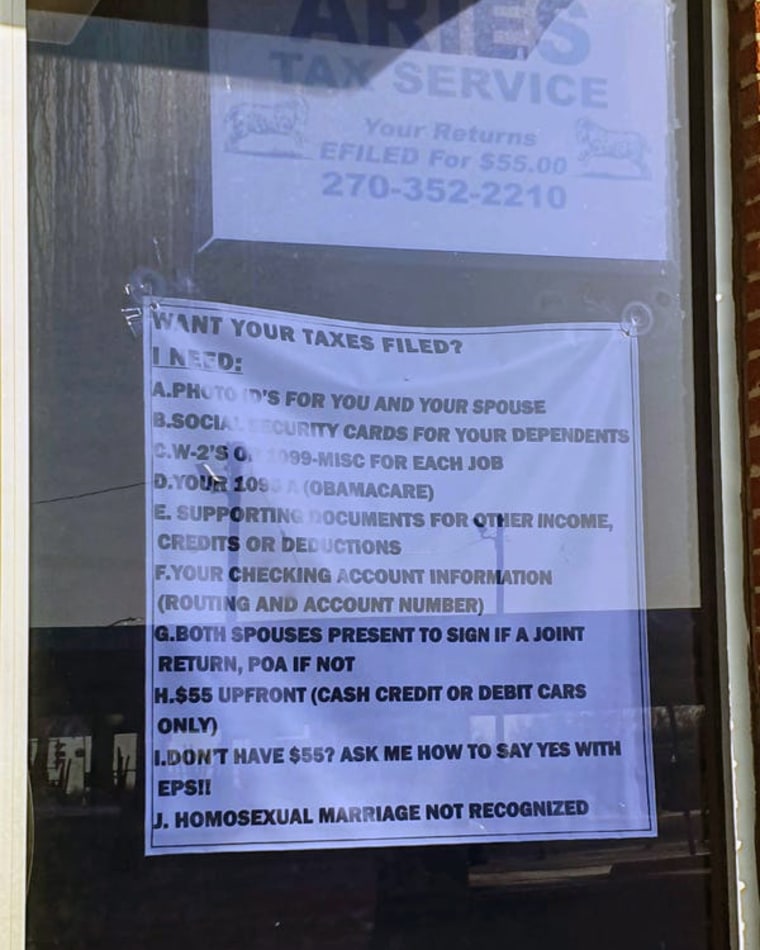
When they got there, they saw a sign on the door that listed 10 things customers should have with them if they want the business to e-file their tax return. But the last item on the list stopped them from opening the door. It read, “Homosexual marriage not recognized.”
Stephanie Mudd said the first emotion she felt was anger that businesses can still turn away same-sex couples.
“It just kind of makes your heart fall into your stomach,” Amy Mudd said.
Aries Tax Service.
The couple took a photo of the sign and left.
“We wanted to bring attention to it, so that he knows that that’s not OK,” Amy Mudd said. “Nowadays, you’re providing a public service, and it’s federal taxes, and in the United States, it’s OK for us to be married.”
Kenneth Randall, owner of Aries Tax Service, said the issue “is a matter of personal conviction.”
“I put it to any reasonable person: ‘If you have a matter that’s a central conviction for you, are you willing to stand up for it?’” he said. “I am.”
He added that there are other tax preparers in the area that same-sex couples could use and that he’s protected by federal law.
There’s no federal law that explicitly allows people, based on their personal beliefs, to turn away same-sex couples or other classes of people, but there’s also no federal or Kentucky state law that protects LGBTQ people from discrimination in public accommodations, such as businesses.
Legal advocates say situations like the Mudds’ are on the rise as conservative religious organizations, such as the Alliance Defending Freedom, have been building campaigns and lawsuits for years to challenge civil rights laws.
“They want to get legal rulings that there are religious and free speech rights to violate these laws,” said Jennifer Pizer, law and policy director at Lambda Legal, a national LGBTQ legal organization. “We have seen a significant rise and a very troubling rise in these cases, and it’s not an accident.”
For years, same-sex couples have been turned away by business owners who don’t want to provide wedding-related services, citing their religious or moral beliefs. In 2018, the Supreme Court narrowly ruled in favor of Jack Phillips, a Christian baker who refused to make a cake for a gay couple’s wedding. The court ruled on a technicality — avoiding the issue of whether a business owner, due to their religious beliefs, could refuse to serve a same-sex couple.
Earlier this month, the ADF filed a lawsuit in the U.S. District Court for the Western District of New York arguing that the state’s nondiscrimination law unconstitutionally prohibits wedding photographer Emilee Carpenter “from adopting an editorial policy consistent with her beliefs about marriage.”
The complaint says Carpenter “is already willing to work with clients no matter who they are, including those in the LGBT community” but that the state goes too far by requiring that she “celebrate” same-sex marriage in images on her website.
The ADF also argues that part of the state law limiting statements that certain customers are “unwelcome, objectionable or not accepted, desired, or solicited” interferes with Carpenter’s free speech, because it doesn’t allow her to express her views about same-sex marriage on her website.
Pizer said the New York case represents an area of law that is unsettled, specifically as it relates to people who work in artistic fields like photography.
For the most part, courts have upheld nondiscrimination laws, but in the instances they haven’t, they often rule on technicalities or rule that the laws violate the freedom of expression of creative professionals, Pizer said. For instance, in September 2019, the Arizona Supreme Court ruled that the state’s nondiscrimination law violated the free speech of two artists who create custom wedding invitations by compelling them to promote same-sex weddings.
Pizer said using free speech rights to justify discrimination “represents a dramatic shift from what the law has been for a long time.”
“Why would you think that a video of a couple’s wedding would be the message of the person holding the camera?” she said. “If the law changes in that way, then it’s hard to see where there’s a limiting principle, and it means that civil rights laws, at best, have a big hole in them and maybe, at worst, have very little effect at all.”
The free speech argument could also represent a potential challenge to the Equality Act, proposed federal legislation that would protect LGBTQ people in many areas. The measure passed the House in February but has not yet been voted on in the Senate.
Pizer said that, because Kenneth Randall is an accountant and not a creative professional, she doesn’t think an argument related to free speech would apply if there were a federal or state nondiscrimination law in Kentucky.
But Randall said he refuses to file taxes for same-sex couples because it would require him to express recognition of their marriage. Randall also sells insurance, and he said he has both sold insurance to and filed taxes for single gay people. But if a same-sex couple asked him to sell them insurance, he would only do it if he could put them down as single, he said.
“I don’t hate a particular individual. It’s a stand on a particular institution that I find wrong,” he said, adding that he’s been harassed and threatened since local news outlets published stories about his sign. “If people are willing to accept that, fine. If they are not willing to accept it, there’s plenty of other places to go for insurance.”
Pizer said the idea that people can receive services elsewhere “ignores a core purpose of civil rights laws.” She said the lunch counter sit-ins held by Black college students in Greensboro, North Carolina, in 1960 to protest racial segregation weren’t about whether they could “get a sandwich.”
“It was about whether they were being treated the same as other people,” she said.
In the absence of a federal measure like the Equality Act or a statewide nondiscrimination law, the Mudds and couples like them don’t have any options for legal recourse, Pizer said, and businesses can — and do — continue to refuse to serve them.
In North Carolina, which also doesn’t have a statewide anti-discrimination law protecting LGBTQ people, at least two wedding venues made national news within the span of four months for refusing to host events for same-sex couples.
But the issue extends far past weddings. Some states, like Arkansas, have passed legislation that allows medical providers to refuse to serve LGBTQ people if it conflicts with their religious or moral beliefs. The Supreme Court will also soon decide a case that could allow private religious adoption agencies that receive federal funds to reject same-sex couples.
Pizer said growing acceptance of LGBTQ people has pressured some religious people “to stop doing types of discrimination that they’ve done for a long time.” That pressure has made them uncomfortable and it has made them feel victimized, in some cases, she said, and they’re fighting back.
“Being encouraged to treat everyone according to the golden rule is not being victimized and it’s not being excluded and it’s not being discriminated against,” she said. “When we’re operating in the public marketplace, being asked to stop discriminating is not to suffer discrimination yourself. It’s to be invited to play by the same rules that everybody else is expected to play by.”
As for the Mudds, they said they wouldn’t pursue legal action even if they could, but they wanted to make a statement about Randall’s choice to refuse same-sex couples.
“I understand that there’s freedom in this country, and that is what we were founded on,” Amy Mudd said. “And I understand that as a private practice, I guess he is allowed to do that … but to provide a service to the public and deny such a huge population is bad business.”
Stephanie Mudd added, “If we’re talking about morals, that’s quite the opposite of morals. People often hide behind their religion to justify their hate, and that is what is so frustrating.”
Gov. Doug Ducey vetoed a controversial sex education bill but issued an executive order requiring public notice of any such curriculum before it can be used in Arizona classrooms.
The dual actions appeared to be a compromise between the provisions of Senate Bill 1456 and critics who said it would marginalize LGBTQ children by, among other things, banning discussion of issues related to gay and trans history.
Ducey called the bill “broad and overly vague” as he issued only his second veto of the legislative session. The bill was sponsored by Sen. Nancy Barto, R-Phoenix. It had strong GOP support but equally strong opposition from Democrats.
Parler will reportedly return to the Apple App Store, three months after the “free speech” social network was pulled from all major platforms.
Parler became one of America’s fastest-growing apps last year as Trump supporters flocked to it following November’s US election.
Racism, homophobia and transphobia, as well as spurious misinformation, soon became rife on the network, and the breaks were ultimately pulled soon after the Capitol riots in early January. Apple and Google blocked Parler from its app stores, while Amazon booted it from its web-hosting service, sending it briefly offline.
Now, Apple has reportedly approved Parler’s return to its App Store, according to a letter released by senator Mike Lee.
The letter, sent by Apple and dated Monday (19 April), states the app has made true on its word to improve moderation and better detect hate speech and incitements of violence.
This means that the app’s millions of users, which has included the likes of Graham Linehan, Katie Hopkins and Milo Yiannopoulos, will soon be able to download Parler on Apple devices.
Lee and representative Ken Buck had asked Apple for details as to why it removed Parler in January. The consumer electronic company explained in the letter it did so as Parler, on several occasions, “failed” to tame hate speech.
Parler hosted content prohibited by its App Store guidelines, Apple added.
Parler had long played fast and loose when it came to moderation – enticing users tired of what they saw as Twitter and Facebook’s increased crackdown on free speech.
In the days leading up to the Capitol riot, which saw a swarm of white supremacists and far-right militia groups storm the Capitol complex, Parler churned with conspiracy theories.
False accusations that Donald Trump had the election stolen from him heaved, as did a loose plot to confront Congress as it certified Joe Biden’s electoral win with violence and aggression.
As Apple’s senior director of government affairs Americas Timothy Powderly explained in the letter, Parler was full of posts that encouraged violence, denigrated various ethnic groups, races and religions, glorified Nazism, and called for violence against specific people”.
Violent rioters gather outside the Capitol building in Washington DC. (Tayfun Coskun/Anadolu Agency via Getty Images)
Shunned by tech companies, the letter shows that Pariah pleaded to Apple, “proposing updates to its app and the app’s content moderation practices”.
Across a review stage, a lengthy back-and-forth between Parler and Apple’s app review team unfolded.
“As a result of those conversations, Parler has proposed updates to its app and the app’s content moderation practices, and the App Review Team has informed Parler as of April 14, 2021, that its proposed updated app will be approved for reinstatement to the App Store,” Powderly wrote.
“Apple anticipates that the updated Parler app will become available immediately upon Parler releasing it.”
Powderly, however, did not detail what specific changes to its platform Parler has made, other than stress that it now meets Apple’s content moderation policies.
On Parler’s claims that the tech companies had plotted together to oust it, Powderly wrote: “Apple made an independent decision to remove Parler for non-compliance with the guidelines, and it did not coordinate or otherwise consult with Google or Amazon with respect to that decision.
Five leaders of the horrifying Chechen “gay purge” could finally be charged with crimes against humanity thanks to a criminal case in Germany.
The five officials are within the inner circle of Chechnya’s autocratic leader Ramzan Kadyrov, according to the Guardian, and the charge sheet against them stretches 97 pages.
t accuses the Chechen military and state apparatus of persecution, unlawful arrests, torture, sexual violence and incitement to murder at least 150 individuals on the basis of their sexual orientation since February 2017.
The criminal case was submitted in February by the European Centre for Constitutional and Human Rights (ECCHR), a German NGO, and the Russian LGBT Network, which has been instrumental in helping LGBT+ people flee the region.
“In an imperfect system of international criminal justice, with an international criminal court with limited jurisdiction, Germany attempts to guarantee that Europe is no safe haven for war criminals,” said ECCHR’s founder, Wolfgang Kaleck.
“If no other jurisdiction investigates, Germany is able and must be willing to take over tasks, representing thereby Europe and the international community.”
Two of the officials are already sanctioned by the EU, the UK and the US for their involvement in the purge: Abuzayed Vismuradov, Kadyrov’s former personal bodyguard and deputy prime minister, and Ayub Katayev, a police chief and senior official at the Russian Internal Affairs Ministry in Chechnya.
The chair of the Chechen parliament, Magomed Daudov, is also named in the criminal complaint.
If the general prosecutor in Karlsruhe decides to take on the case, Kadyrov’s associates could face an arrest warrant if they set foot in Germany – a country which Vismuradov is known to have visited repeatedly for medical care.
It’s hoped that after viewing extensive material submitted by the ECCHR, Germany’s public prosecutor will take further steps to investigate the officials, helping those persecuted to claim asylum in Europe.
The Russian Internal Affairs Ministry refutes all charges as the official line from Kadyrov and his allies is a flat denial that any LGBT+ people exist in the region, let alone a gay purge.
However, their claims are countered by dozens of harrowing refugee reportsfrom LGBT+ people who have been imprisoned, beaten, tortured and seen others killed in gay concentration camps.
George and Emily Spurrier are leaving their home of 16 years in central Arkansas due to a new law that will ban the health care that they say their 17-year-old transgender son needs.
Gov. Asa Hutchinson, a Republican, vetoed the measure earlier this month, calling it “a vast government overreach.” But the Arkansas General Assembly overrode the veto, and the bill will become law this summer.
Emily Spurrier said when her son heard the news, he sat in her car and cried for an hour.
“It was just kind of a wave of emotions, thinking about moving and then him worrying about some friends that he has here in the Little Rock area,” she said. “And then just the thought that this is really the only place he ever remembers living.”
Arkansas is the first state in the country to pass a law banning transition care for minors. The measure will bar access to reversible puberty blockers, hormone therapy and gender-affirming surgeries, though surgeries aren’t included in global standards of care for transgender minors and aren’t performed on them in Arkansas, Hutchinson said during his veto.
The Spurriers’ son, who just started using testosterone, will no longer be able to access this physician-prescribed hormone once the new law is implemented, so his family is raising money on GoFundMe to move to New Mexico by August.
“The benefits are not going to outweigh the dangers of raising our children here in this state.”
AMANDA DENNIS
The Spurriers, along with some families in Texas and North Carolina, which are considering similar legislation, told NBC News they are prepared to move to protect their children.
Fourteen states are considering bans or restrictions on transition care for trans minors, according to the American Civil Liberties Union. The Williams Institute, a think tank at the UCLA School of Law, found that 45,100 trans youth are at risk of losing access to care because of the proposals. Major medical associations such as the American Academy of Pediatrics, the American Medical Association and the Pediatric Endocrine Society oppose the bills.
As of Monday, there were at least 44 bills across 25 states targeting transgender youth, with five of them on governors’ desks, according to the ACLU and the Human Rights Campaign. A recent PBS NewsHour/NPR/Marist poll found that two-thirds of Americans are opposed to laws that would limit trans rights.
George Spurrier said that, in addition to the transition-care ban, the Arkansas Legislature is considering several other bills that create an unsafe environment for his son.
“If it had been one or two bills, we may have been more optimistic about fighting and getting through all of it,” he said. “But the fact that they just kept coming one after another after another … has just kind of demoralized us. Even if everything gets defeated or repealed, the spirit behind them is still here, and we just can’t help but feel like it’s not safe.”
In addition to the recently passed trans health care bill, Arkansas is considering four other bills targeting LGBTQ people, and the governor has signed two others into law, according to the ACLU. For example, Hutchinson signed a bill into law on March 26 that allows doctors to refuse to treat someone based on their religious or moral beliefs, a measure that advocates say would allow physicians to refuse to treat trans patients even in the emergency room.
Brooke, 8, won’t be allowed to compete on girls’ sports teams at school once one of Arkansas’ new laws takes effect.Amanda Dennis
Another Arkansas family is also facing a deadline. Amanda Dennis, who has lived in the state for most of her life, said her family has about two to three years to figure out how they’re going to get care for their transgender 8-year-old, Brooke, by the time she begins puberty.
“I will have to fly to another state — and the problem is we’re surrounded by states that are doing the same thing,” she said, adding that Kansas, Missouri and Texas are all considering similar bills.
Flying to another state wouldn’t be financially sustainable for the family, Dennis said, and like the Spurriers, she’s also worried about how other recent laws and proposed bills will affect Brooke. Dennis said her daughter wants to try out for gymnastics, cheerleading and dance, but she wouldn’t be able to compete on a girls’ team due to a bill Hutchinson signed in March that bans trans student athletes from competing on teams that align with their gender identity.
“It breaks my heart that I’m going to have to, at one point, should we choose to stay in Arkansas … tell her, ‘Brooke, you won’t be able to try out for any of these teams.’”
Arkansas is also considering a bill that would prohibit schools from requiring teachers to refer to trans students by a name and pronoun that isn’t consistent with their sex assigned at birth.
“So there’s more things coming down the pike that will really eventually force us to leave the state,” Dennis said. “The benefits are not going to outweigh the dangers of raising our children here in this state.”
Texas is considering a bill similar to Arkansas’ transition-care ban, but with criminal penalties. The bill would make it a felony for parents to provide their trans children with access to gender-affirming care. It would classify the act as child abuse, and parents who violate the proposed law could face up to 10 years in prison, have their child removed from their home and face civil litigation.
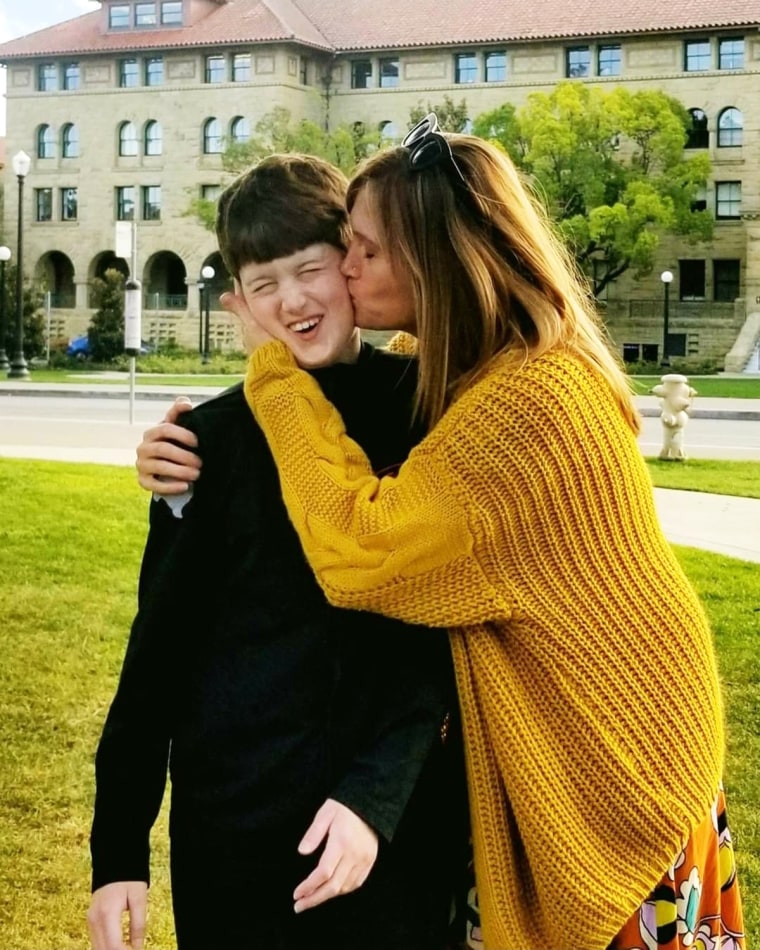
Amber Briggle kissing her son.Amber Briggle
Texas mom Amber Briggle, who lives north of Dallas, testified against the bill last week.
“I’m afraid that by speaking here today my words will be used against me should SB 1646 or SB 1311 pass, and my sweet son, whom I love more than life itself, will be taken from me,” she said.
Briggle said taking away her son’s access to care would “destroy him.”
“We gave him the support that he needed, and it was like a light switch turned on and like my baby came back to me and was perfect again,” she told NBC News, adding that the 13-year-old is a straight-A student and a great musician. “He can play the opening riff to ‘Sweet Child O’ Mine’ on his ukulele — I will say I taught him that.”
Briggle said to have that familial support taken away would be “devastating” for her son.
“It’s devastating because he is as successful as he is because he has that support,” she said. “It’s also devastating and terrifying to think that taking away that support means taking him away from his family, and placing him with, who knows.”
Moving wouldn’t be easy for the family, Briggle said. She’s a small business owner, and her husband is a tenured professor.
“It’d be really complicated for us, but it’s certainly not out of the question,” she added. “My son always comes first.”
Texas’ bill would also make it a felony for medical providers to administer transition care to minors. Kimberly Shappley, who has a trans 10-year-old named Kai and is a nurse at a clinic that serves LGBTQ people, said it’s a “double whammy” for her, because it would affect both her work and her family.
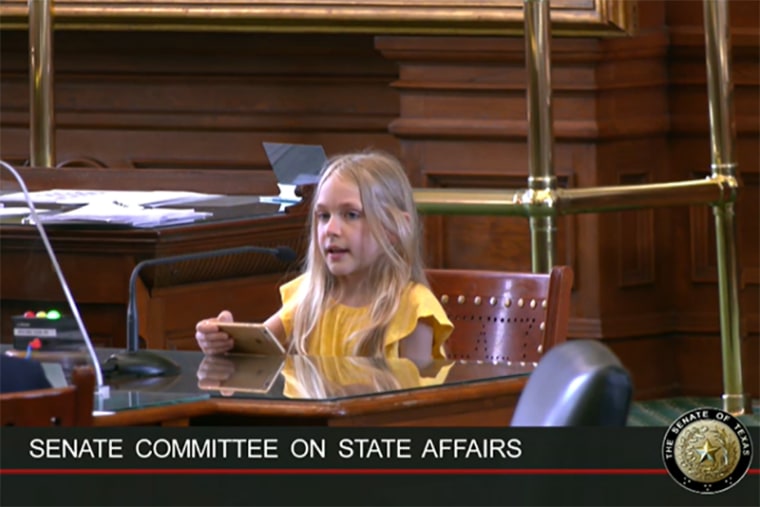
Kai Shappley, a 10-year-old transgender girl from Austin, Texas, speaks before the Texas Senate Committee on State Affairs, on April 12, 2021.Texas Senate
Shappley, a former conservative Christian minister, moved from her small Texas hometown to Austin in 2018, because she said the relatively liberal capital city has more supportive local policies for Kai.
“But if these laws passed, even Austin can’t protect us,” she said. “It’ll take everything we have — just living in Austin has been super expensive — it’ll take everything we have to relocate. I’ll do it. I’ll have to.”
Shappley said she wants to see more action from President Joe Biden and Vice President Kamala Harris. Biden released an executive orderlast month affirming that Title IX of the Education Amendments of 1972 protects students from discrimination based on sexual orientation and gender identity, but he hasn’t made a statement directly addressing the flurry of bills targeting transgender minors.
Shappley said she took time off of work to campaign for the Biden-Harris ticket, so she’s angry that they haven’t explicitly mentioned the bills.
“Even if they can’t do anything right now, tell us what your plan is,” Shappley said. “Kamala Harris had a trans flag outside of her office. OK, if you’re an ally, why aren’t you loudly telling my kid she’s gonna be OK? Why aren’t you loudly saying, ‘You know what, Mrs. Shappley, you don’t have to move; we’ve got your back.’ I want somebody to say something.”
North Carolina is also considering a ban on gender-affirming care for minors. Advocates say it would likely be vetoed by Gov. Roy Cooper, a Democrat, but Katie Jenifer and her daughter Maddie said the debate over the bill is itself harmful.
Maddie, 13, said that, though laws targeting trans youth likely won’t get past North Carolina Gov. Roy Cooper, a Democrat, the debate over the laws is itself harmful.Katie Jenifer
“If I didn’t have my hormones or my [puberty] blocker, I’d be very unhappy, and I wouldn’t want to leave the house sometimes,” Maddie, 13, said.
Even if advocates are saying the bill won’t become law, “there is still the smallest bit of chance, and that alone just makes me very anxious,” Maddie added.
Jenifer said she has told Maddie they would move should the bill or a similar one become law, but she acknowledged not everyone has that option.
“That’s the real crux of the issue: How do we help those families?” she said.
Back in Arkansas, Dennis said Brooke, who’s currently in third grade, is ready to be part of a potential legal battle against the state’s new laws.
“She wants to be someone that can be a light to other kids her age, and she really wants to be a part of the conversation,” she said, adding that Brooke is “ready to put on her activist hat and help.”
While Dennis said she and her husband are proud of their daughter, “at the same time, we do get a little bit sad that an 8-year-old has to be the voice.”