A child born to Bulgarian and British mothers has been denied Bulgarian citizenship and is now at risk of being stateless.
“Baby S” was born in December 2019 in Spain and although the baby’s birth certificate was issued by Spain with both mothers listed as parents, the baby cannot get Spanish citizenship because neither mother is Spanish. Citizenship cannot be acquired from the British mother of “Baby S” who is from Gibraltar, a British Overseas Territory, as she acquired her British citizenship by descent.
Statelessness may hinder the child from attending school, accessing health care and other social benefits. All three governments involved are parties to the 1961 Convention on the Reduction of Statelessness and have a duty to prevent the child being stateless.
The European Union Court of Justice (EUCJ), having been referred the case by a Bulgarian court, heard pleadings on behalf of the child “Baby S” this week and is expected to rule in several months’ time.
This is not the first time that the EU Court of Justice has been asked to adjudicate on the rights of a same-sex couple being discriminated against by a European country because of their sexual orientation.
In 2018, the court ruled the term “spouse” in a directive on the exercise of free movement under EU law is gender-neutral and therefore covers the same-sex spouse of an EU citizen. This case centered on whether a gay Romanian-American couple were entitled to the same residency rights in Romania as other married couples in the EU, even though Romania only recognizes civil partnerships rather than marriage between same-sex partners.
“Baby S” and her parents deserve to have their family relationship recognized by the Bulgarian government and the child should have equal access to education, medical care and other needed services. Hopefully the EU Court of Justice will use the opportunity to affirm the rights of same-sex parents and their children.
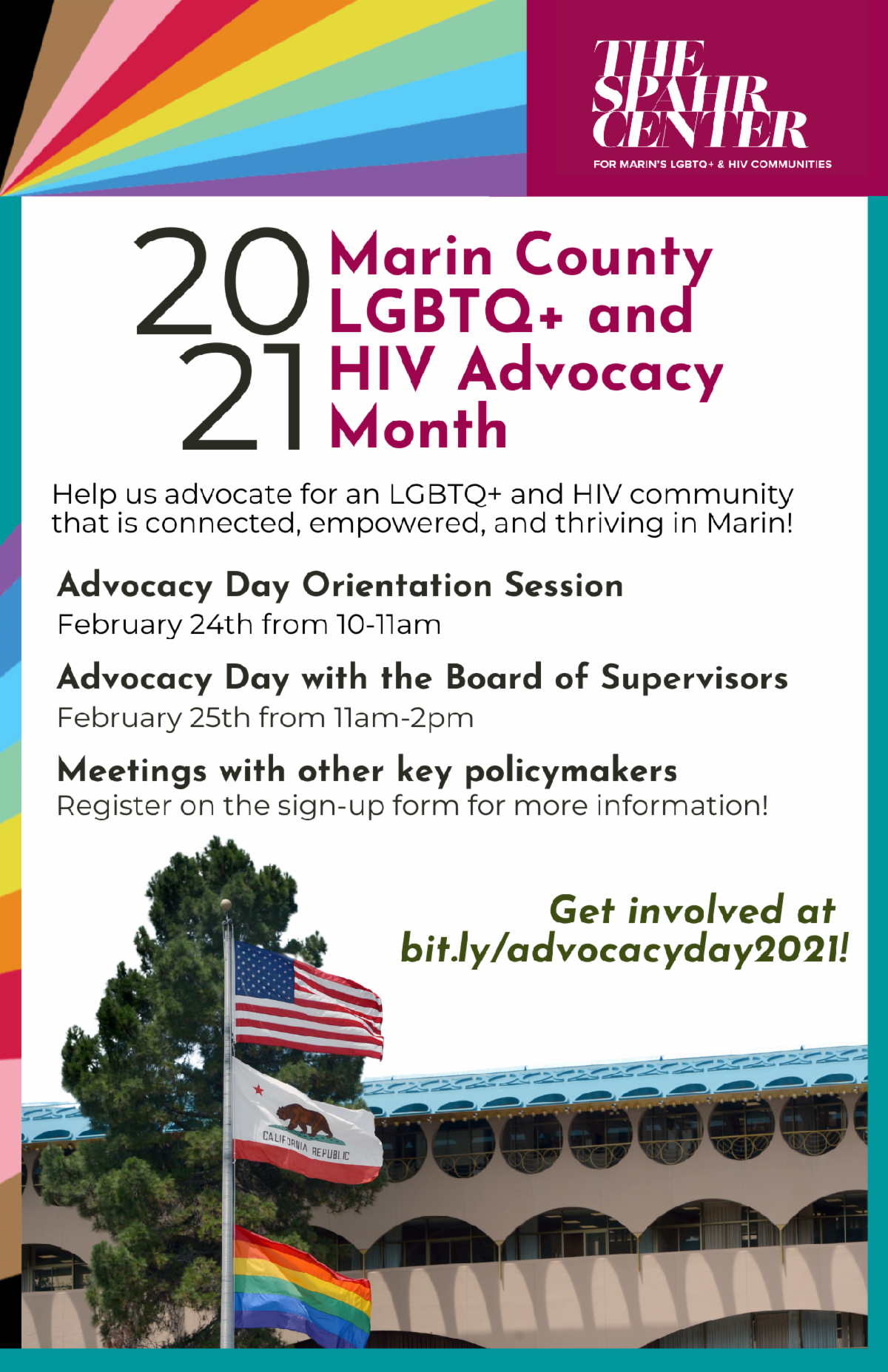
The Spahr Center’s first Advocacy Day, held in 2020, was a powerful gathering of LGBTQ+ and HIV-positive residents of Marin and their allies with members of the Board of Supervisors. You may remember that many of the Supervisors asked us to visit them once The Spahr Center had completed its 5 year Strategic Plan. We will be returning to the Board of Supervisors with our newly released vision for the agency’s work moving forward. We will also bring renewed vigor to ensure that Marin County is a supportive and empowering place for all of its residents! See our Strategic Plan, titled Raising the Bar for Our Future, at www.thespahrcenter.org. Advocacy Day with the Board of Supervisors will take place on February 25th from 11-2, with an orientation on February 24th from 10-11. We are in the process of scheduling meetings with other key County officials. We are grateful to everyone who has signed up thus far, and want to remind you that there is still time to get involved! Note that all meetings will take place over Zoom, and we will send out further meeting details and preparatory information to all those who sign up!
Bills in at least 20 states are targeting the transgender community in what LGBTQ advocates say is an organized assault by conservative groups.
On Thursday, the North Dakota House of Representatives passed a bill that would ban transgender student athletes from joining teams that match their gender identity. The measure, which passed 65 to 26, also calls for withholding state funds from sporting events that allow athletes to play as anything other than their sex assigned at birth. The bill now heads to the state Senate.
Supporters of the bill — including Republican state Rep. Ben Koppelman, its primary sponsor — say they want to protect opportunities for girls in sports, including access to athletic scholarships.
“Some have said this bill just doesn’t follow the science. We’ve got science going back well before the United States that backs this,” Koppelman said in a committee meeting, according to NBC affiliate KFYR-TV. “This isn’t new science. Men and women didn’t just cease to exist. They’ve existed for a long time and we’ve been able to recognize the differences.”
House Minority Leader Josh Boschee, a Democrat, countered that the bill would “codify discrimination.”
“North Dakota transgender youth, you are seen and you are loved by many,” Boschee later tweeted. “This vote is infuriating and we will continue to work to have it defeated in the Senate.”
The same day the North Dakota House passed its bill, the Mississippi state Senate passed its own athletic ban, which now goes to the state House for consideration. Georgia, Kansas, Utah and Tennessee advanced similar legislation last week, as well.
In 2020, legislators sponsored 20 bills to restrict transgender students’ participation in sports, according to the ACLU. At least as many have been introduced this year.
Bills driven by ‘centralized groups’
To date, the only trans sports bill to become law is Idaho’s Fairness in Women’s Sports Act, sponsored by Republican state Rep. Barbara Ehardt. Signed by Gov. Brad Little, a Republican, last March, it mandates that “biological sex” be the sole determining factor for inclusion on athletic teams at public schools and universities.
Ehardt worked with the Alliance Defending Freedom in crafting the measure, The Idaho Press reported. Founded in 1994 by Christian conservatives, the Arizona-based group has provided legal counsel for a variety of efforts to curtail LGBTQ rights, from defending gay-marriage bans to ensuring the right of businesses to refuse LGBTQ customers. Perhaps most notably, the ADF defended Jack Phillips, the owner of a Colorado bakery, Masterpiece Cakeshop, in his 2018 Supreme Court case over his refusal to sell a wedding cake to a gay couple.
Kate Oakley, state legislative director and attorney for the Human Rights Campaign, a national LGBTQ advocacy group, told NBC News that a bill under review in Montana restricting transgender sports participation was also written by the ADF. The Alliance Defending Freedom has been labeled an anti-LGBTQ hate group by the Southern Poverty Law Center, a designation the ADF dismisses as groundless and a smear tactic.
The language in the Idaho and Montana measures is strikingly similar — and interchangeable with wording in proposed sports bans in Mississippi, Louisiana, Arizona, Kansas and elsewhere.
All, for example, include an excerpt from an April 2019 Washington Post opinion piece by tennis legend Martina Navratilova, Olympic track star and NBC Sports analyst Sanya Richards-Ross and Duke law professor Doriane Lambelet Coleman. In it, the three state that “there will always be significant numbers of boys and men who would beat the best girls and women in head-to-head competition.”
The ADF did not confirm that it wrote the Idaho bill or provided template wording for legislation to any state, but Matt Sharp, an attorney for the organization, told NBC News in an email, “As is typical practice for legal organizations, Alliance Defending Freedom is often asked by legislators to review possible legislation and offer advice.”
In February 2016, Sharp claimed “lawmakers in at least five states” had used the ADF’s model legislation to draft so-called bathroom bills, The Washington Post reported. Sharp also said the Alliance mailed template bills to “thousands” of school districts.
“These bills are intended to look constituent-led, but we know it’s driven from these centralized groups,”said Chase Strangio, deputy director for transgender justice at the American Civil Liberties Union.
University of Montana cross country runner Juniper Eastwood, center, warming up with her teammates at Campbell Park in Missoula, Mont. on Aug. 15, 2019. Rachel Leathe / Bozeman Daily Chronicle via AP file
Lawyers for the ADF also filed a motion to intervene in a lawsuitagainst the Idaho bill on behalf of two female runners who lost to Juniper Eastwood, the first transgender runner to compete in NCAA Division 1 cross country. (While the case is being decided, the Idaho law is blocked from being enforced.)
And the ADF is representing three cisgender Connecticut women in a suit claiming they were forced to compete against “biological males” in high school track because the Connecticut Interscholastic Athletic Conference allows transgender students to join the teams that match their gender identity.
The complaint alleges that two transgender sprinters, Terry Miller and Andraya Yearwood, won 15 women’s state championship titles previously held by nine different girls and, from 2017 to 2019, “have taken more than 85 opportunities to participate in higher level competitions from female track athletes.”
“There are real physiological differences between boys and girls that affect athletic performance, such as size, muscle mass and bone density,” Sharp told NBC News. “We’ve seen the harms of allowing biological males to compete against women.”
A December study in the British Journal of Sports Medicine found transgender women were faster and could do more pushups and situps for two years after starting testosterone blockers. But the study’s lead author, pediatrician Timothy Roberts, told NBC News previously that, “at the recreational level, probably one year is sufficient for most people to be able to compete.”
Bloomfield High School transgender athlete Terry Miller, second from left, wins the final of the 55-meter dash over transgender athlete Andraya Yearwood, far left, and other runners in the Connecticut girls Class S indoor track meet at Hillhouse High School in New Haven, Conn., on Feb. 7, 2019.Pat Eaton-Robb / AP file
Another voice leading the fight against transgender athletes in sports is Beth Stelzer, a Minnesota-based amateur powerlifter and founder of Save Women’s Sports. According to its website, the group is a diverse coalition looking “to preserve biology-based eligibility standards for participation in female sports.”
On Thursday, Stelzer testified before Utah’s House Education Committee in favor of a transgender sports ban in that state. She’s also given testimony in support of similar bills in Minnesota, Montana and elsewhere.
Stelzer told NBC News she works more on gathering supporters to testify than on drafting legislation. “However, I do offer advice about the language used,” she said, adding that she was sad the issue had become “partisan.”
“Males participating in female sports is not about religion or politics. It is common sense,” Stelzer said. “We have women from the left, right and center coming together to preserve female sports across the world.”
Jennifer Wagner-Assali, an orthopedic surgeon and semiprofessional track cyclist, is an ambassador for Save Women’s Sports. She claims she unfairly lost the 2018 UCI Masters Track Cycling World Championship to transgender cyclist Rachel McKinnon, now known as Veronica Ivy. Ivy took gold in the 200-meter sprint and briefly set a world record for women in the 35-39 age bracket, according to Bicycling magazine. Wagner-Assali took bronze.
“All these rules were put into place, basically by stealth,” she told host Julian Vigo this month on the Substack podcast Savage Minds. “Women were not asked their opinion. These things were changed a few years ago, and they’ve just kind of become part of the rule structure. Now they’re starting to be exploited, obviously.”
‘Uncontrolled human medical experimentation’
While athletic bans are the most common forms of legislation targeting transgender individuals this session, a number of states are also considering prohibiting transition-related medical care for minors, some including criminal penalties.
Alabama’s Vulnerable Child Compassion and Protection Act would institute felony charges for health care professionals who performed procedures or prescribed medication “intended to alter the appearance of [a minor’s] gender or delay puberty, with certain exceptions.”
The bill calls puberty blockers and other transition-related treatments “dangerous and uncontrolled human medical experimentation.” It also requires teachers, principals, nurses and other school officials to tell parents if a child believes their gender is different from their sex assigned at birth.
A similar bill in Texas would redefine providing transition-related care to minors as a form of child abuse.
One of the first such bills was introduced last year by South Dakota state Rep. Fred Deutsch, a Republican. Originally, the bill would have made it a Class 4 felony to provide transition-related care to patients 16 or younger, even if they’re emancipated, but the felony charge was eventually amended to a misdemeanor. If it had passed, it would have also allowed those unhappy with their gender-affirming care to sue up until the age of 38, according to South Dakota Public Broadcasting.
In October 2019, three months before sponsoring the bill, Deutsch attended the Summit on Protecting Children From Sexualization in Washington, D.C. Panelists included representatives from the ADF, the Heritage Foundation, the Family Policy Alliance and the Kelsey Coalition, a group of parents who claim their children have been harmed by transgender health care practices. Attendees were given a gender resource guide for parents detailing how to oppose trans-affirming policies in their schools and communities, according to The Washington Post.
“In the fall of 2019, you have ADF, Heritage Foundation and these other groups start getting together and working up templates to ship out to state lawmakers,” Strangio told NBC News. “It was at the end of 2019 when we started to hear about them.”
Deutsch has also said he sent drafts of his bill to legislators in other states considering similar bans, The New York Times reported. But while a similar bill passed the South Dakota House of Representatives by a wide margin, it died in the state Senate.
Some lawmakers are opposing medical treatment for transgender youth with “conscience” bills, like a Kentucky bill that would let medical professionals in the state refuse to perform procedures that violated their religious or moral convictions.
The bill’s sponsor, state Sen. Stephen Meredith, argues it will protect children from “misguided” parents who want to force them to change genders.
“You have a 12-year-old girl who’s a tomboy,” Meredith told the Senate Judiciary Committee on Thursday, according to The Lexington Herald-Leader. “And her parents, who are misguided, think that she’s really a girl trapped in a boy’s body. And they don’t want to see her go through the rest of her life miserable. So they’re going to go and transition her.”
“Does the surgeon have the right to say, ‘No, I’m not going to do this surgery’?” he asked, according to the Herald-Leader. “So this protects everybody.”
Meredith said the language in Kentucky’s bill was based on model legislation sent to him by the conservative Kentucky Family Foundation. The foundation’s executive director, Kent Ostrander, confirmed to NBC News that the group worked with Meredith on the bill in the last legislative session.“The bill is purely designed to protect the conscience rights of medical professionals as they practice their healing arts,” Ostrander said in an email.
Separate conscience bills in South Carolina, South Dakota and Arkansas all contain identical language found in model legislationwritten by Kevin Theriot and Ken Connelly of the Alliance Defending Freedom.
An attempt to ‘sow fear and hate’
Oakley, of the Human Rights Campaign, and other LGBTQ rights advocates say the failure to stop the legalization of same-sex marriage or pass so-called transgender bathroom bills has led groups like ADF to turn their focus toward trans youth. In a statement, HRC called the current raft of transgender-focused bills “simply the latest iteration of their failing fight.”
“Opponents of equality failed to claw back marriage equality and failed in their push for bathroom bills,” the group said. “These bills are not addressing any real problem, and they’re not being requested by constituents. Rather, this effort is being driven by national far-right organizations attempting to sow fear and hate.”
Strangio said proponents of these measures are being disingenuous about protecting children and women.
“They claim children can’t consent to wanting to transition, but the bills all have the same carve-out for performing surgery on intersex infants,” he said. “It’s not about protecting, it’s about normative control.”
As for girls’ sports, Strangio said no state is anywhere near Title IX compliance, “but there’s crickets from supposed champions of women’s sports in the GOP.”
“No one is introducing legislation to increase funding to women’s sports or to ensure equal pay for female coaches,” he said. “Instead, they’re fighting hypothetical problems about 14-year-old trans girls.”
Lesbian, gay, bisexual, transgender and queer people of color are significantly more likely to experience the adverse health and economic effects of the Covid-19 pandemic than white non-LGBTQ people, according to a new study.
The study from the Williams Institute, a think tank at the UCLA School of Law, is based on a national survey of more than 12,000 U.S. adults, conducted between August and December. According to researchers, the impact of the pandemic cannot be understood without considering the intersection of race with sexual orientation and gender identity.
“People in America are experiencing the pandemic differently,” Brad Sears, interim executive director of the Williams Institute and an author of the report, told NBC News. “In many of the results, you can see a combined impact of sexual orientation and race and ethnicity.”
The disproportionate effects, the study notes, can be found “across a number of indicators.”
“LGBT people of color are more likely to have tested positive for COVID-19, to personally know someone who died of COVID-19, and to have experienced several types of economic instability as a result of the pandemic,” the study states. “They are also more likely to follow public health measures, such as getting tested for COVID-19, social distancing, and wearing masks than non-LGBT White people.”
The study comes on the heels of another from the Centers for Disease Control and Prevention that found sexual minorities have higher rates of several underlying health conditions — such as cancer, kidney disease, heart disease, diabetes and asthma — that can increase the risk of severe illness related to Covid-19.
Previous studies from the Williams Institute have also found LGBTQ people to be at risk of serious illness resulting from Covid-19 and to face higher rates of unemployment as a result of the pandemic.
Health consequences
LGBTQ people of color were twice as likely as white respondents — regardless of sexual orientation and gender identity — to report having tested positive for Covid-19 (14.5 percent vs. just over 7 percent), according to the findings, while non-LGBTQ people of color had a positivity rate of 10.6 percent.
“Race is playing a huge role here,” Sears said, adding, “When we think about an intersectional impact, this is about as clear as we can see it in the data.”https://platform.twitter.com/embed/Tweet.html?creatorScreenName=NBCNews&dnt=false&embedId=twitter-widget-0&frame=false&hideCard=false&hideThread=false&id=1359289988442017794&lang=en&origin=https%3A%2F%2Fwww.nbcnews.com%2Ffeature%2Fnbc-out%2Fnonwhite-lgbtqs-twice-likely-test-covid-positive-straight-whites-study-n1258246&siteScreenName=NBCNews&theme=light&widgetsVersion=889aa01%3A1612811843556&width=550px
In terms of a personal impact, researchers found that people of color — regardless of their sexual orientation or gender identity — were over than 50 percent more likely than their white counterparts to personally know someone who died of Covid-19.
Economic impact
The survey’s economic findings further underscore the intersectional impact of the pandemic, with LGBTQ people of color nearly three times more likely than non-LGBTQ whites to report being recently laid off (15 percent vs. 5.4 percent). LGBTQ whites and non-LGBTQ people of color reported similar rates (10.4 percent vs. 11.5 percent).
LGBTQ people of color were also nearly twice as likely than non-LGBTQ whites to report being concerned about their ability to pay their bills (63 percent vs. 33 percent), with rates for LGBTQ whites and non-LGBTQ people of color somewhere in between (42 percent and 55 percent, respectively).https://platform.twitter.com/embed/Tweet.html?creatorScreenName=NBCNews&dnt=false&embedId=twitter-widget-1&frame=false&hideCard=false&hideThread=false&id=1359171449697804291&lang=en&origin=https%3A%2F%2Fwww.nbcnews.com%2Ffeature%2Fnbc-out%2Fnonwhite-lgbtqs-twice-likely-test-covid-positive-straight-whites-study-n1258246&siteScreenName=NBCNews&theme=light&widgetsVersion=889aa01%3A1612811843556&width=550px
Sears speculated that several other factors in addition to race and LGBTQ status could be at play in the economic data, including age, gender and occupation.
The survey’s LGBTQ respondents were younger overall than the non-LGBTQ respondents, and he noted that “younger people were in jobs that were harder hit and have less economic stability.”
“The second thing that is important to keep in mind is that this is the first recession to hit women harder than men,” Sears said. “Women are more likely to identify as lesbian, bisexual and transgender.”
He also added that LGBTQ are overrepresented “in occupations that have been the hardest hit that include retail, food service and health care.”
Following public health guidance
LGBTQ people’s level of concern about the pandemic is higher than non-LGBTQ people, as is their propensity to follow public health guidelines, the report found.
Ninety percent of LGBTQ respondents said they were concerned about the pandemic, and 85 percent said they were worried about getting sick, compared to 82 percent and 75 percent of non-LGBTQ respondents, according to the report.
Approximately 94 percent of LGBTQ respondents said they followed public health guidelines like wearing a mask, compared to 89 percent of non-LGBTQ respondents, and 80 percent of LGBTQ respondents said they practiced social distancing, compared to 75 percent of non-LGBTQ respondents.
“You start seeing, not surprisingly, the groups most impacted are also the groups taking it most seriously and following through with precautions,” Sears said.
There was no significant difference between LGBTQ people and non-LGBTQ people in their intention to get the vaccination.
Government trust and missing data
The survey found a gap between LGBTQ and non-LGBTQ people when it comes to trust in institutions, with LGBTQ people reporting less trust in both the federal government (31 percent vs. 38 percent) and pharmaceutical companies (28 percent vs. 41 percent). They did, however, report a higher level of trust in the CDC than their non-LGBTQ counterparts (76 percent vs. 70 percent).
For Sears, deficits in public trust are one more reason why the lack of LGBTQ-specific data collection from the government is a problem.
“It is important for the federal government to add questions to thePulse survey,” he said, referring to the government survey launched in October to understand how Americans have been affected by the pandemic.
“The government responded very quickly in creating that survey to measure the impact that Covid was having on the American population, but they did not include questions on sexual orientation or gender identity,” he said. “We have been working to find data to fill in this gap.”
Sears noted the pandemic is revealing inequalities that have already existed in society along the lines of race, gender and sexuality, and said it would be “extremely helpful” for the Biden administration’s efforts to control the pandemic to have sexual orientation and gender identity data.
“It was no surprise that his epidemic has disproportionately impacted people of color, and it was not a surprise that this pandemic has disproportionately impacted LGBT people,” he said.
He added that an effective vaccine alone will not end the health crisis: “Addressing these entrenched inequalities of race, ethnicity, sexuality and gender is the only way to get through this pandemic and to prevent the next one.”
Jamaica should repeal its ban on gay sex immediately, a top human rights tribunal determined in a ruling dubbed “a highly significant step forward” by activists.
The Inter-American Commission on Human Rights, which monitors human rights conditions in the western hemisphere, found that the Jamaican government is responsible for violating the rights of two queer people, Gareth Henry and Simone Edwards.
The solution, the commission concluded, is a simple one: Repeal Jamaica’s colonial-era anti-LGBT+ laws immediately.
The ruling is not binding but will give hope to queer citizens of the Caribbean island nation and others like it where the homophobic views of colonialist Britain remain deeply entrenched.
“It is a highly significant step forward that must now accelerate the repeal of these stigmatising and discriminatory laws,” said Téa Braun, the director of the Human Dignity Trust who represented Henry and Edwards, according to The Guardian.
The decision was handed down in September 2019 but could not be publicly reported on until now.
The commission said Jamaican leaders should also enact anti-discrimination laws and better train law enforcement.
Gay man who fled Jamaica: ‘I finally feel I am right’
Jamaica, once described as “the most homophobic place on Earth” by Timemagazine, has long been gripped by laws banning “buggery” and “indecency”, adopted from the British constitution before independence.
Anal sex is prohibited and punishable by life imprisonment for any individual, any sexual encounter between men is illegal, and there are no protections for LGBT+ people against discrimination.
Both Henry and Edwards were driven off the island as a result of the homophobic violence they faced, the commission heard. They argued that the anti-LGBT+ laws violated their rights and legitimated the violence they faced.
Henry sought asylum in Canada after a police officer pummelled him in front of a crowd of some 200 people. Edwards was granted asylum in Europe after being gunned down outside her home by a homophobic gang in 2008 which placed her family at risk.
The ruling has brought a sense of “hope” for Henry and Edwards, that they might someday return to the island they once called home.
“All my life people have told me that who I am and who I love is wrong,” Henry said. “Now, for the first time ever, I finally feel I am right.”
Edwards explained: “It gives me hope that one day these outdated laws will be done away with and I’ll be able to return to my homeland without fear of attack.”
Rep. David Cicilline, D-R.I., reintroduced the Equality Act in the House of Representatives on Thursday, with a vote on the sweeping LGBTQ rights bill expected next week.
The move brings the bill one step closer to potentially establishing the first federal discrimination protections for LGBTQ people. Specifically, it would prohibit discrimination based on sexual orientation and gender identity in employment, housing, credit, education, public spaces, public funding and jury service.
The Equality Act passed the Democrat-controlled House in May 2019, but it stalled in the Republican-controlled Senate. Now that Democrats have taken control of the Senate, advocates are hopeful that the bill will pass.
“In 2021, every American should be treated with respect and dignity,” Cicilline, who has introduced the bill every year since 2015, said in a statement. “Yet, in most states, LGBTQ people can be discriminated against because of who they are, or who they love. It is past time for that to change.”
Democratic Sens. Jeff Merkley of Oregon, Cory Booker of New Jersey and Tammy Baldwin of Wisconsin also announced that they would reintroduce the bill in the Senate next week when the Senate floor reopens for bill introductions.
“All of us go to work and school, go home and go shopping, and none of us should have to keep our families hidden or pretend to be someone we’re not to do those things,” Merkley, who wrote the Equality Act, said in a statement. “But in 29 states, Americans can still be evicted, be thrown out of a restaurant, or be denied a loan because of who they are or whom they love.”
Before Cicilline reintroduced the bill, House Majority Leader Steny Hoyer, D-Md., announced in a letter to colleagues Tuesday that the House would vote on the Equality Act next week. In May 2019, it passed by a 236-173 vote, with eight Republicans voting for it. However, then-Senate Majority Leader Mitch McConnell, R-Ky., never took it up in the Senate.
In October of last year, Biden told Mark Segal, publisher of Philadelphia Gay News and a longtime LGBTQ rights activist, that passing the bill is “essential to ensuring that no future president can ever again roll back civil rights and protections for LGBTQ+ individuals.”
He added that he would also direct his Cabinet to enforce the Equality Act across federal agencies. “Too many states do not have laws that explicitly protect LGBTQ+ individuals from discrimination,” Biden said in the interview. “It’s wrong to deny people access to services or housing because of who they are or who they love.”
‘A clear, consistent nationwide statement’
The Equality Act was first introduced by Rep. Bella Abzug, D-N.Y., in 1974, but the bill was eventually killed.
Cicilline introduced the current version in 2015, just after the Supreme Court ruled same-sex marriage constitutional nationwide. Unlike previous versions of the act, the current version includes protections from discrimination based on sex, sexual orientation and gender identity.
LGBTQ people across the U.S. currently have some level of protection from discrimination through state and local laws and Biden’s expansion of workplace discrimination protections through the Supreme Court’s Bostock v. Clayton County, Georgia, ruling last year. However, advocates say the Equality Act is needed to fill in the gaps and ensure that all Americans, regardless of where they reside, are protected.
“While President Biden’s Executive Order implementing the Supreme Court’s Bostock ruling was a crucial step in addressing discrimination against LGBTQ people, it’s still vital that Congress pass the Equality Act to codify the Bostock decision to ensure protection in key areas of life including where existing civil rights laws do not have protections on the basis of sex,” Alphonso David, president of the Human Rights Campaign, the country’s largest LGBTQ rights group, said in a statement.
Kevin Jennings, CEO of the LGBTQ civil rights group Lambda Legal, said the legislation will give clarity to employers and landlords, among others, about discrimination.
“In some instances, individuals lose rights and protections the moment they cross the border into a neighboring state, underscoring that the current patchwork of protections for LGBTQ people is inadequate,” Jennings said in a statement. “In addition, as evidenced by the thousands of phone calls to our Help Desk we receive each year, many employers, landlords and lenders still haven’t gotten the message that discrimination is just wrong, which is why we need the absolute clarity of the Equality Act, and we need it now.”
Mara Keisling, executive director at the National Center for Transgender Equality, said the bill is especially important for transgender people who face a disproportionate amount of violence.
“No act of Congress can end bias overnight or stop all attacks against transgender people,” Keisling said in a statement. “But the Equality Act is a clear, consistent and nationwide statement that says our country believes that all people – including those who are transgender – should be treated fairly and with respect. For transgender people, every trip to the store, every dinner out, every job interview or attempt to rent an apartment carries the risk of disrespect, discrimination and potentially violence. The Equality Act will help allow transgender people to live their lives openly and without fear.”
The Log Cabin Republicans thanked Donald Trump for “standing up for family” in a bizarre Presidents’ Day video littered with falsehoods.
The gay Republican group, which claims to represent “LGBT conservative and allies” but rarely challenges rampant homophobia within the GOP, put out an odd love letter to Donald Trump to mark Presidents’ Day.
Trump is praised for “standing up for our American ideals of family, freedom and liberty” by one participant, while others resort to gaslighting as they peddle a number of abject falsehoods.
The video claims that “one of the best things that he did was launch a global campaign to decriminalise homosexuality”, though there is no evidence to suggest any such campaign ever actually existed beyond a press release, while Trump left the position of international LGBT+ envoy sitting empty for his entire term.
The group suggests that Trump was the “the first pro-gay president when entering office”, a bizarre claim given he made no pledges on LGBT+ rights at all in 2016 or 2020 aside from his pledge to sign a proposed law to permit anti-LGBT+ discrimination on the grounds of religion.
Trump is also described as the “first Republican President in American history to enter office as a supporter of marriage equality”. In reality, ahead of the 2016 election Trump said he would “strongly consider” appointing Supreme Court justices to overturn equal marriage, before committing to picking justices from a list vetted by anti-LGBT+ groups.
Indeed, several of these points were made succinctly in 2016 by none other than the Log Cabin Republicans, when the group pointedly declined to endorse Trump’s presidential bid, citing his anti-LGBT+ policies.
Internet not impressed with the Log Cabin Republicans.
Suffice to say, the clip has not gone down well outside of the increasingly-small circle of gay Trump firebrands.
A Twitter user quipped: “Just when you think LCR can’t be any more ridiculous, they never let you down.”
Another pointed out: “Less than two hours after Trump and his virulently anti-LGBTQ activist vice president Mike Pence were sworn into office, all mentions of LGBTQ issues were removed from the official White House webpage.”
One respondent said: “To me, Log Cabin Republicans are like Women for Trump. They take pleasure in remaining second-class citizens as long as they think they’re slightly elevated above other groups who are being treated like second-class citizens.”
The Book of Anna, by Joy Ladin, explores the emotional landscape of life after the Holocaust through the eyes of fictional protagonist Anna Asher. This month, EOAGH books will release a revised & expanded edition.
We meet Holocaust survivor Anna first through detailed diary entries. These day-to-day accounts of work, home, & doctor visits deepen our connection to Anna as an individual we could easily meet next door, save for the letter-headers that remind us that we meet her in Prague in the 1950s. These diary sections ground us in Anna’s interior & double as allegory. Coupled with sections of poetry, we shift genre & scope throughout the collection.
Originally published by Sheep Meadow Press in 2007, EOAGH’s updated The Book of Anna explores grief in the aftermath of the Holocaust in a way that breaks the heart open—Ladin opens the collection with a letter from Anna after receiving a poetry rejection claiming “My muse is rage, not beauty./Was. There are no muses for me now…It is time for me to write, if I write at all, the true story of my life.” We soon meet Anna’s neighbor, Suzanne Wischnauer, in the second letter. A fellow survivor of the camps, she first appears because she “smells gas.” Anna explains “I know what she smells. It’s seeping from the story I’ve started to tell.” So often we see stories of the Holocaust through textbooks, facts, museums, in a way that creates distance from the gravity & trauma of this collective wound. Ladin breaks the objectivity of history; Ladin makes the historical personal—the impossible grief of tragedy, of surviving the unspeakable. Through Anna Asher’s eyes, we are given insight into a survivor’s psyche in a way that only poetry can create. The reader is allowed to witness the irreconcilable faith of the narrator paired with their irreconcilable grief.
From linear narrative to nonlinear poetry, Ladin reconciles the irreconcilable by cultivating our presence in the collection’s world, where the unspeakable is spoken. Through sectional arrangement & timeless lines, The Book of Anna decentralizes the common fallacy that history is to be “consumed” as a separate, distant past. Here, as the epigraph reminds us, “Nothing is harder to predict than the past.” We are never looking back, but rather looking on & looking in.
While the journal texts create a linear narrative, the fragmented lyric poems center snapshots of Anna’s day to day comings and goings. We are allowed to witness Anna’s subconscious processing—a channel from trauma to healing—a momentary look into the larger connections, both triggered & opened, by the world. There are ants in the kitchen. When Anna kills them, she immediately thinks of Hitler and Stalin. When the ants reappear, they remind her of “her girlhood.” Time becomes seamless—limitless—an act of impermanence in a senseless world. Where the journal collects, the poems scavenge. We are the digger and the dirt, the earth and what the earth can and cannot hold.
At times numb, at times overtaken, Anna Asher is constantly searching for the truth—through doctor visits, theological consultations, relationships, sex, anything and everything she can get her hands on to reckon with the living, with the present moment, with continuing. As Ladin’s poem “Golem” reminds us, “Emet or Met, Truth or Death—” speaking a theme that threads The Book of Anna, reflecting the narrator’s refusal of death & search of truth in the perpetual present.
While Anna cannot escape the past, she still chooses to write through death. And with this book, Joy Ladin has chosen to write towards truth. Powerful, unsettling, and breathtaking, The Book of Anna is a must-read for 2021.
The Book of Anna
by Joy Ladin
EOAGH Books
Paperback, 9781792307225
March 2021
Today, Assemblymember Rebecca Bauer Kahan (D-Orinda), in partnership with Equality California, introduced AB 493 that will include death certificates among the official documents with nonbinary options for gender identity.
The bill will expand on Senator Toni Atkins’s 2017 legislation, SB 179, which authorized nonbinary identification on birth certificates, court documents, and driver’s licenses. California is leading the nation in inclusive recognition of gender identities, and this bill continues and strengthens that work.
“Adding nonbinary as a gender option ensures nonbinary individuals’ right to equal treatment under the law, and is a needed step towards true inclusivity throughout our legal codes” said Assemblymember Rebecca Bauer-Kahan. “Historically, US law has not recognized the many ways people experience gender. This causes serious pain and marginalization for nonbinary communities, with their existence denied on documents that identify them.”
It is essential to codify inclusive language to establish uniformity and parity across California’s legal system. Incorrectly assigning deceased nonbinary individuals a gender is disrespectful to their memories. Official erasure hurts grieving loved ones, as well as the larger nonbinary community.
“Affirming someone’s gender identity is just as important in death as it is in life,” said Equality California Executive Director Rick Chavez Zbur. “We owe it to our nonbinary community members — and their loved ones — to correctly recognize the gender identity of all Californians on their death certificates. Equality California applauds Assemblymember Bauer-Kahan for continuing the work started by Pro Tem Toni Atkins in 2017 to right this wrong.”
Nonbinary youth who reported their pronouns were not respected by those in their lives were twice as likely to attempt suicide as those whose correct pronouns were used. With suicide rates among nonbinary youth quadruple those of their peers, affirming language on death certificates is all the more essential.
This bill takes the precedent set by Senator Atkins in SB 179, as well as the current practices of using nonbinary-inclusive language and codifying it to bring code in line with California’s values, and ensures long-term protection of the nonbinary community’s civil rights.
AB 493 secures in code that nonbinary individuals are identified as such on their death certificates.
Coauthors of the bill include Assemblymembers Evan Low (D–San Jose), Alex Lee (D-Santa Clara), Sabrina Cervantes (D-Corona), Chris Ward (D-San Diego), David Chiu (San Francisco), Cristina Garcia (D- Bell Gardens), Mark Stone (D-Santa Cruz), Senate President pro Tempore Toni Atkins (D-San Diego), and Senators Scott Wiener (D-San Francisco) Susan Talamantes-Eggman (D-Castro Valley) and John Laird (D-Santa Cruz).
###
Equality California is the nation’s largest statewide LGBTQ+ civil rights organization. We bring the voices of LGBTQ+ people and allies to institutions of power in California and across the United States, striving to create a world that is healthy, just, and fully equal for all LGBTQ+ people. We advance civil rights and social justice by inspiring, advocating and mobilizing through an inclusive movement that works tirelessly on behalf of those we serve. www.eqca.org
Rush Limbaugh, a talk radio pioneer who saturated America’s airwaves with cruel bigotries, lies and conspiracy theories for over three decades, amassing a loyal audience of millions and transforming the Republican Party in the process, has died, his wife revealed at the beginning of his show on Wednesday. He was 70 years old.
Limbaugh announced in February 2020 that he had been diagnosed with advanced stage 4 lung cancer.
Former President Donald Trump awarded him the Presidential Medal of Freedom during the 2020 State of the Union, calling Limbaugh “the greatest fighter and winner you will ever meet.”
Perhaps no moment better encapsulated Limbaugh’s legacy, nor demonstrated the immense influence he came to wield in Washington.
The medal was a just reward: Trump’s ascension to the presidency couldn’t have happened without Limbaugh’s brand of right-wing media.
The modern Republican party often functioned with Limbaugh as a fulcrum. President Barack Obama’s former chief of staff, Rahm Emanuel, once called Limbaugh “the voice and intellectual force of the Republican Party.” Limbaugh would at times massage the failures of the party and its leaders, dismissing obvious policy or political failures as simply part of liberal conspiracies.
But he also helped set the agenda. When a Republican politician promoting racist and sexist policies could only use a dog whistle, Limbaugh provided a bull horn — he was, for example, an early progenitor of the racist birther conspiracy theory about Obama that Trump would later use to fuel his political career.
For decades, Limbaugh was associated with the far-right fringes of the Republican Party. In 1995, only days after Timothy McVeigh bombed a federal building in Oklahoma City, President Bill Clinton issued a blistering attack at a speech in Minneapolis in which he said the “nation’s airwaves … spread hate, they leave the impression that, by their very words, that violence is acceptable. … It is time we all stood up and spoke against that kind of reckless speech and behavior.”
Limbaugh vehemently protested the characterization, assuming that it was about him — which in all likelihood it was. “Make no mistake about it: Liberals intend to use this tragedy for their own political gain,” he said on the radio afterward.
People did take up Clinton’s charge to speak against Limbaugh’s style of “reckless speech and behavior,” but without much success. While remaining a controversial figure and at times suffering advertising boycotts and derision from the mainstream media, less than 25 years, rather than be condemned by another American president, Limbaugh was given a medal.
Decades Of Hate
A full accounting of Limbaugh’s lies and exaggerations; his racism and his misogyny; his homophobia and his Islamophobia; and his sheer cruelty could fill books — and have — but even a cursory overview of his lowlights makes his prejudice clear.
In 2003, he was forced to resign from ESPN after stating that Philadelphia Eagles quarterback Donovan McNabb was only receiving praise because the media was “very desirous that a Black quarterback do well.” In 2004, Limbaugh said the NBA should be renamed the T.B.A. —“the Thug Basketball Association.” He then added: “Stop calling them teams. Call ’em gangs.” He similarly whined that watching the NFL was like watching “a game between the Bloods and the Crips without any weapons.”
Once, after arguing with a Black man who called into his show, he told the caller to “take that bone out of your nose and call me back.“ Another time, Limbaugh asked his audience, “Have you ever noticed how all composite pictures of wanted criminals resemble Jesse Jackson?” while discussing the Black civil rights activist and politician. Limbaugh once ludicrously asserted that “if any race of people should not have guilt about slavery, it’s Caucasians.” He invited a guest on air who sang “Barack, the Magic Negro” to the tune of “Puff, the Magic Dragon.” In 2016, he read an essay on air that had been penned by a well-known white supremacist.
Limbaugh’s radio career was also one long exercise in misogyny, perhaps best summed up by his thesis that “feminism was established so as to allow unattractive women easier access to the mainstream of society.”
In one of his most infamous episodes, he called Georgetown University law student Sandra Fluke a “slut” and a “prostitute” in 2012 after she testified in Congress about the importance of women having access to birth control.
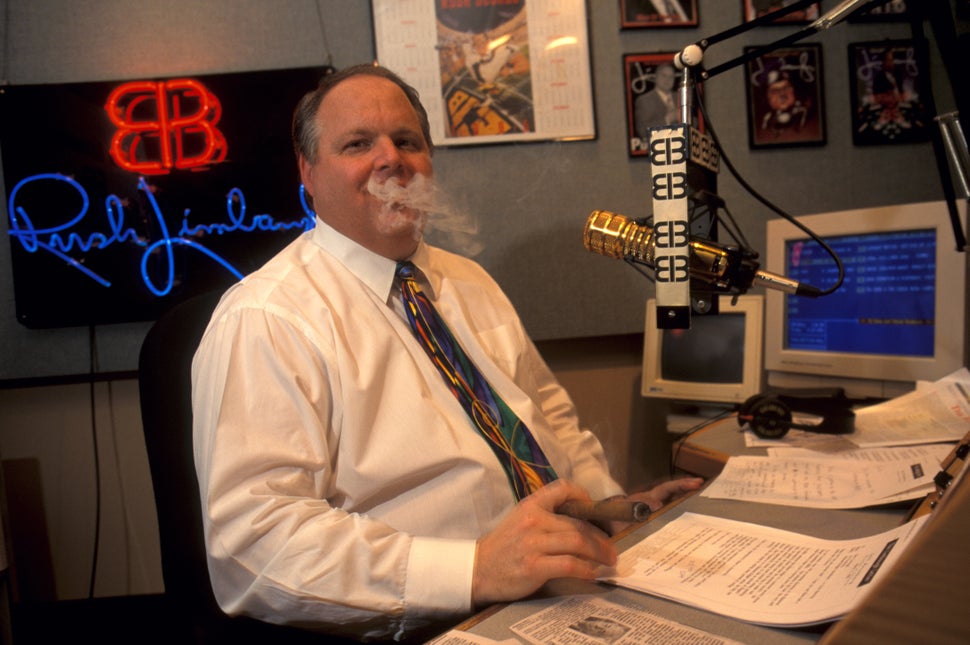
Rush Limbaugh smoking a cigar while taping his radio show.
Nearly every marginalized group or minority bore the brunt of Limbaugh’s bigotry. Once, while speaking about the genocide of America’s indigenous peoples, Limbaugh said, “Holocaust 90 million Indians? Only 4 million left? They all have casinos, what’s to complain about?”
Limbaugh frequently mirrored white nationalist talking points when discussing Latino immigrants, whom he described as lazy and dependent on the government. He called migrants at America’s southern border an “invasion.”
An opponent of marriage equality — which he suggested was “perverted” and “depraved” — Limbaugh argued in 2016 that legalizing gay marriage would lead to bestiality. “What happens if you love your dog?” he said. He once referred to transgender people as being mentally ill.
Throughout the 1980s and ’90s, Limbaugh also frequently denigrated those who were HIV positive, saying the best way to stop the spread of the virus was to “not ask another man to bend over and make love at the exit point.” He spoke out against federal funding to fight the virus too, calling it the “only federally protected virus.”
His Father’s Son
Limbaugh’s journey to becoming one of America’s foremost bigots began in Cape Girardeau, Missouri, where he was born to a prominent local political family on January 12, 1951. His father, a lawyer and Republican activist, would sternly lecture about politics in the home and rant against communism. Limbaugh later called his father “the smartest man I ever met.”
At age 14, Limbaugh says his parents bought him a Remco Carevelle radio set, which enabled him to broadcast on AM channels within a few hundred square feet of his house. In high school, Limbaugh worked as a DJ at KGMO, a local radio station co-owned by his father.
“Even when I was a little boy, I dreamed of being on the radio,” Limbaugh told biographer Ze’ev Chafetts. “In the mornings getting ready for school I’d hear the guy on the radio, and he just sounded free and happy, like he was having a wonderful time. That’s what I wanted, too.”
Limbaugh enrolled at Southeast Missouri State University but dropped out after a year to pursue a career in radio. Throughout the 1970s, he worked at different radio stations in Missouri and Pennsylvania but was often fired after clashing with management. He eventually landed a steady on-air gig in Sacramento, California, before getting hired to host his own show at WABC in New York, which remained his flagship station throughout much of his career. Subscribe to the Politics email.From Washington to the campaign trail, get the latest politics news.
As his fame rose, Limbaugh liked to explain his success by claiming he had “talent on loan from God,” but it was a Reagan-era Federal Communications Commission policy shift that allowed Limbaugh to reach national infamy and create the mold for modern right-wing media stardom. In 1987, the FCC abolished the decades-old Fairness Doctrine which mandated that TV and radio broadcasters present both sides of controversial issues. This meant that stations were no longer required to feature opposing views, and instead radio hosts like Limbaugh could spend hours spouting off right-wing fallacies without challenge.
Decades before online extremists and pro-Trump trolls used memes and ironic detachment to make their far-right beliefs seem less repugnant, Limbaugh’s employed the same strategy. He popularized cartoonish terms such as “Commie-Libs” and “Feminazi,” while also claiming that abortion represented a “modern day Holocaust.” He used mocking voices and affectations as he belittled women’s rights, Black activists and the gay community. His persona as an absurd blowhard gave audiences an excuse to brush off Limbaugh’s mainstreaming of far-right views as part of an act — just Rush being Rush, or El Rushbo, as he was often called.
Becoming A National Star
The end of the Fairness Doctrine allowed for Limbaugh’s brand of unhinged right-wing rhetoric and shock jock persona to become a media phenomenon. By 1990, his nationally syndicated show aired on 300 stations ― a number that more than doubled over the next four years.
Limbaugh’s rise turned him into a ubiquitous cultural figure in the 1990s. Limbaugh’s voice echoed for hours a day on syndicated radio stations around the country; he appeared on magazine covers and in newspaper profiles. His success made him into a curiosity for the mainstream media, but little of the coverage properly grappled with what Limbaugh was doing to radicalize his listeners.
As his radio audience grew, Limbaugh got his own half-hour television show on Fox in 1992 and created a prototype for prime time opinion shows hosted by right wing pundits like Sean Hannity and Tucker Carlson. The show’s executive producer was Limbaugh’s longtime friend Roger Ailes, who would go on to launch Fox News in 1996 and run it for two decades until he was fired for widespread sexual harassment.
Limbaugh’s political influence made him beloved among Republican Party elites. When the GOP won the House for the first time in 40 years in 1994, Republicans called him the “majority maker.” At then-House Speaker Newt Gingrich’s victory party, they sold “Rush Limbaugh for President!” T-shirts.
But Limbaugh never fully tied his fate to any one politician, always staying focused on his own success above all else. “I don’t define my success by who wins elections, because politicians are going to come and go, and I’m going to be around as long as I choose to be,” Limbaugh told Time Magazine in 2008.
Like any successful right wing media star, Limbaugh had a financial angle behind his vitriol and an appetite to center himself in controversies. He turned his infamy into extreme wealth: In 2008, he signed an an eight-year deal for his show worth around $400 million. He bought a private jet and a fleet of luxury cars to usher him from place to place.
“I wanted to be the reason people listened,” Limbaugh told The New York Times in 1990. “That’s how you pad your pocket.”
While he claimed to represent the views of the average American, Limbaugh lived for years as a caricature of an East Coast elite in his luxury condo overlooking Central Park in New York City. He sold the property in 2010 for $11.5 million, moving primarily to a sprawling mansion in Palm Beach, Florida, where he lived until his death.
Meanwhile, Limbaugh used his platform to condemn policies designed to actually help working class Americans. He fervently opposed the expansion of public health care and said an Obama-era health insurance program for low-income children “ought to die.” He condemned taxes against the ultra-rich, such as himself, and fled New York after the proposal of increased taxes on millionaires.
In 2006, Limbaugh — despite once saying that all drug addicts should be convicted and “sent up the river” — struck a plea deal with prosecutors in Florida after being charged with prescription fraud. Limbaugh, who admitted to being an oxycodone addict, was accused of “doctor shopping,” the act of deliberately deceiving physicians in order to receive multiple prescriptions. Although Limbaugh had previously told his listeners that “too many whites are getting away with drug use” and should all be sent to prison, Limbaugh avoided time behind bars himself, paying a $30,000 fine and agreeing to stay clean.
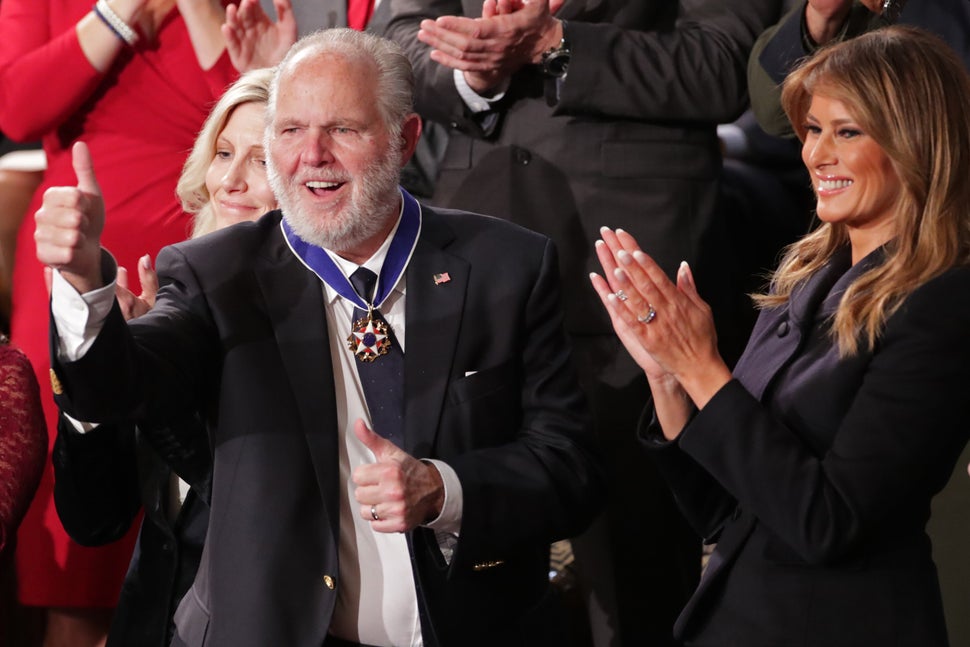
Rush Limbaugh shortly after being awarded the Presidential Medal of Freedom by First Lady Melania Trump during President Donald Trump’s State of the Union address in 2020.
The President’s Ear
Limbaugh was still the most popular radio host in America by the time of the 2016 election. Although initially supportive of Sen. Ted Cruz (R-Tx.) during the Republican primary, he became a staunch supporter of the eventual nominee, Donald Trump. Limbaugh could be counted on to support the president during some of the most disgraceful episodes of Trump’s sole term in the White House.
In 2017 white supremacists, emboldened by Trump’s presidency, gathered in Charlottesville, Virginia, for the “Unite The Right” rally, the largest such gathering in a generation. A neo-Nazi rammed his car into counter-protesters at the rally, killing one person. Trump initially refused to condemn the white supremacists, and Limbaugh swiftly came to the president’s defense, blaming anti-racist activists for the violence.
It was part of a pattern for Limbaugh, who repeatedly tried to downplay white supremacists during Trump’s four years in the White House, a period of rising far-right terror across the globe. After an avowed white supremacist massacred 51 Muslims inside two New Zealand mosques in 2019, Limbaugh speculated on air that the shooter “may in fact be a leftist” who shot Muslims “to smear” those on the right.
A day after a mob of Trump supporters — among them white supremacists and militia members — stormed the Capitol on Jan. 6, 2021, ransacking the seat of American democracy, Limbaugh falsely told his listeners no looting had occurred and that the protesters only “took selfies.”
Limbaugh then endorsed the political violence, saying he disagreed with those “who say that any violence or aggression at all is unacceptable,” before invoking America’s Founding Fathers. “I am glad Sam Adams, Thomas Paine, the actual Tea Party guys, the men at Lexington and Concord didn’t feel that way,” he said.
It’s no surprise that Limbaugh sought to downplay the historic insurrection, which Trump incited. Limbaugh was a close confidant of the president, and he and Trump often went golfing together in Florida. The president sometimes called into Limbaugh’s radio show, and Limbaugh claimed they spoke on the phone weekly.
Their relationship culminated with Trump awarding Limbaugh the Presidential Medal of Freedom during the State of the Union address in February 2020. In his speech, Trump heralded Limbaugh as “a special man” who has inspired millions of Americans through his “decades of tireless devotion to our country.” Limbaugh had announced the day before that he had lung cancer.
The next month, when the coronavirus pandemic began sweeping across the U.S., Limbaugh promoted conspiracy theories about the virus and its death toll. Despite that, Vice President Mike Pence, the head of the White House coronavirus task force, appeared on his show multiple times during this period.
Limbaugh spent his final months on air downplaying the historic pandemic and spreading dangerous medical misinformation, including calling coronavirus “the common cold” and telling listeners “we have to remember that people die every day in America.”
On the day Limbaugh died, the coronavirus had killed more than 488,000Americans.