
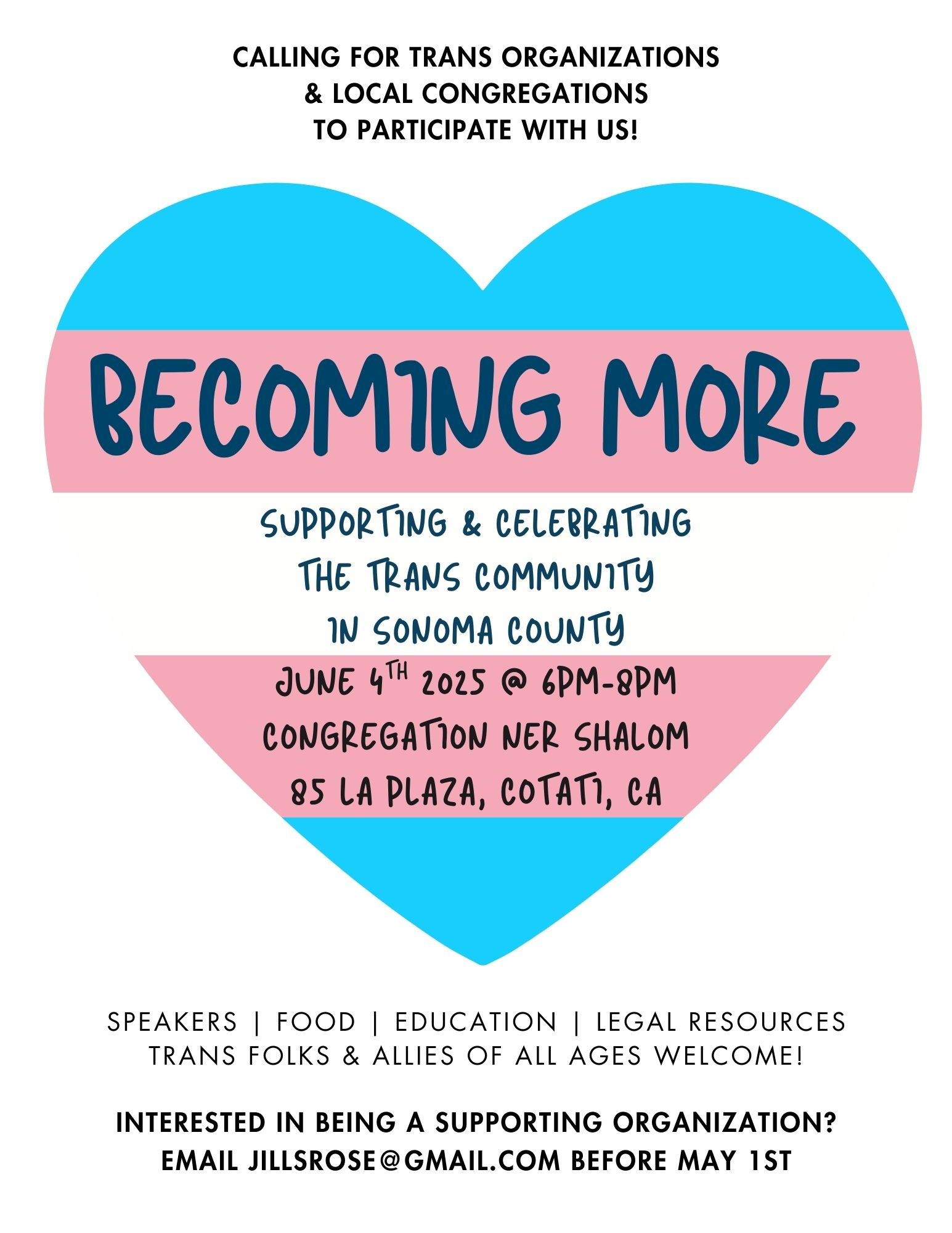
Becoming More An Event Supporting The Trans Community Happens June 4 at New Shalom in Cotati

LGBTQ+ advocates are sharply criticizing Governor Gavin Newsom’s administration following the abrupt elimination of over $17 million in dedicated health equity funding for LGBTQ+ women, transgender men, and non-binary individuals, a move they say threatens access to vital care for some of California’s most underserved communities.
Joe Hollendoner, CEO of the Los Angeles LGBT Center, issued a strong statement denouncing the decision, calling it “a betrayal of queer and trans Californians.”
He added, “We call on the Governor and the State legislature to reverse this harmful decision by honoring the promise made by the legislature in 2019 and renewing this critical funding for next year.”
The cuts affect the LGBTQ Health Equity Fund, a state initiative established in 2019 to address long-documented health disparities in this population. According to Hollendoner, the California Department of Public Health convened an emergency meeting with grant recipients on May 10, informing them that all contracts would be terminated six months early, and that the Office of Health Equity, a division created to serve marginalized gender identities, would be shuttered entirely.
The result, advocates say, will be the discontinuation of services by June 30, leaving patients without access to care designed specifically to meet their needs.
“This is not a simple budget correction,” said Hollendoner. “It is a moral failure that strips life-affirming care from communities already burdened by systemic neglect.”
The Los Angeles LGBT Center had received $1.9 million in 2022 from the fund, in partnership with five organizations, to expand its Audre Lorde Health Program, which provides trauma-informed, gender-inclusive care to LGBTQ individuals. The program has since grown in staffing and services, and has helped rebuild trust among communities often excluded from traditional healthcare.
Hollendoner warned that eliminating this funding would not only halt that progress but also unravel relationships painstakingly rebuilt after years of medical mistrust and marginalization.
The governor’s proposed budget cuts also include a pause in enrollment for undocumented adults in state-funded healthcare programs—another blow to communities navigating intersecting barriers such as racism, transphobia, xenophobia, and poverty.
“Balancing the budget on the backs of vulnerable queer communities is indefensible,” Hollendoner said. “In cutting this funding, Governor Newsom has chosen to sacrifice the health and dignity of those already navigating intersecting barriers of misogyny, racism, transphobia, and xenophobia—including undocumented LGBTQ+ people. These cuts, along with the pausing of enrollment for adult undocumented Californians, are a clear attack on our healthcare system and the people who depend on it.”
“We will not go back,” Hollendoner said.
Frameline announced the full lineup for the 49th San Francisco International LGBTQ+ Film Festival (Frameline49), the largest and longest-running queer film festival in the world. Taking place June 18–28, Frameline49’s 11 days of programming feature nearly 150 films from 40 countries and bring many notable premieres to the Bay Area, including 17 World Premieres, 2 International Premieres, 12 North American Premieres, and 11 US Premieres, and numerous West Coast, California, and Bay Area Premieres.
Previously, Frameline shared its Opening Night film, Sophie Hyde’s Jimpa, a multi-generational drama starring Olivia Colman, as well as its First Friday film, Sam Feder’s 2025 Frameline Completion Fund film Heightened Scrutiny, a salient documentary that centers on ACLU lawyer Chase Strangio as he argues at the Supreme Court for trans rights. As of today, Frameline has revealed the films for the Festival’s other two big nights, Pride Kickoff and Closing Night. Frameline49 will launch into Pride Weekend with a screening of internationally acclaimed artist Rashaad Newsome and filmmaker Johnny Symons’ Assembly, which combines performance art, music, dance, and film into a powerful illustration of the complexity and resilience of the Black experience. On the final day of the Festival, James Sweeney’s Twinless, a Sundance standout, will serve as the Closing Night film.
“Usually we kick these things off by talking about how ‘thrilled’ we are, and while we areexcited for our filmmakers and eager to share their incredible work with you all, those familiar expressions of enthusiasm feel insufficient right now,” said Allegra Madsen, Frameline’s Executive Director. “I want to emphasize how deeply I value the extraordinary work of our filmmakers this year — their vision and courage are truly remarkable. All of us are weathering challenges that threaten our identities, our histories, and our everyday lives. Like many of you, I’m exhausted and angry. With Frameline49, I want us to examine our past of LGBTQ+ activism and art and I want to honor the powerful stories of this moment, to remind us all that Frameline is both a celebration and a statement. We’ll still engage in difficult conversations and recognize the realities reflected in our films, but we’ll also create spaces where we can untense our shoulders and laugh together, without having to defend our existence.”
In a continuation of Frameline48’s Juneteenth celebration, the Festival will present a special screening at KQED of Daniel Junge and Sam Pollard’s I Was Born This Way, a documentary centered on icon and activist Archbishop Carl Bean, who sang the titular gay anthem and founded both the Minority AIDS Project and the world’s first LGBTQ+ church for people of color. Bolstered by beautiful rotoscope animation, the doc features appearances by Billy Porter, Lady Gaga, Dionne Warwick, and Questlove.
Other highlights include the World Premiere of Oriel Pe’er’s A Deeper Love: The Story of Miss Peppermint, an intimate documentary about trailblazing artist and activist Peppermint; a free advance screening of Netflix’s The Ultimatum: Queer Love season 2 at the newly opened Rikki’s sports bar; a free outdoor screening at PROXY of Yashaddai Owens’ Jimmy, an impressionistic imagining of James Baldwin’s (Benny O. Arthur) time in Paris; and a screening at Oasis of Strange Journey: The Story of Rocky Horror, a documentary about the queer touchstone directed by Linus O’Brien, the son of Rocky Horror writer Richard O’Brien.
Festival films will be screened at venues like the Roxie Theater, the American Conservatory Theater’s (A.C.T.) Toni Rembe Theater, CinemaSF’s Vogue Theatre, the Herbst Theatre, Oasis, Rikki’s, KQED, PROXY, and The New Parkway Theater. While the majority of the Festival will take place in San Francisco and Oakland, Frameline’s first-ever partnership with CAFILM Pride will bring a selection of Festival films to San Rafael (June 13–15).
“More than ever before, the Festival program was curated with community in mind,” Madsen added. “Not only do we want to center stories by and for the LGBTQ+ community, but we want to create experiences and spaces that foster crucial conversations, illustrate our collective supportiveness, and allow for resilience to the hard times to coexist with having a really good time together.”
In April, Frameline revealed its Pay-It-Forward initiative, calling upon the queer community and allies to show up for trans and nonbinary film-goers by covering the cost of their tickets to the First Friday screening of Heightened Scrutiny. Building on that momentum, the organization is launching its Queer2Queer Campaign, encouraging supporters to reaffirm their commitment to making LGBTQ+ films accessible by “adopting” a screening. By helping to cover the cost of a Festival screening, these supporters will help Frameline49 bring filmmakers and their works to the Bay Area in the face of grant cuts by The National Endowment for the Arts (NEA) and shifting corporate priorities.
Frameline’s new Director of Partnerships & Development, Matthew Ramsey, added that, “The NEA’s decision is a setback, but it will not diminish our resolve. Now is the time for our community to rally together through our Queer2Queer Campaign. Your support will directly enable us to bring vital queer stories to the screen, ensuring our filmmakers can realize their visions. Let’s show the world the unwavering strength and solidarity of the queer community!”
In that spirit of community, Frameline will continue its long legacy of throwing some of June’s best parties. Following the screening of Heightened Scrutiny on Friday, June 20, Frameline will host its First Friday Party at Charmaine’s, the Proper Hotel’s rooftop bar, where attendees can enjoy complimentary food and drink as well as a night of great music and conversation. On Friday, June 27, the screening of Assembly will be followed by Frameline’s iconic Pride Kickoff Party at Oasis, featuring drag performances by Reparations, an all-Black drag group curated by local star Nicki Jizz.
Frameline’s annual Out in the Silence Award, which is generously underwritten by Dean Hamer and Joe Wilson, honors an outstanding film that highlights brave acts of LGBTQ+ visibility. This year’s recipient is Grace Hughes-Hallet’s The Secret of Me, which centers on Jim Ambrose, who, after learning he was born intersex, helps uncover the truth about a bogus, bigoted medical study that harmed thousands of children. In addition to playing Heightened Scrutiny, Frameline49 will showcase the other features that were awarded 2025 Frameline Completion Fund grants: Niñxs by Kani Lapuerta for its North American premiere and Only Good Things (Apenas Coisas Boas) by Daniel Nolasco for its US Premiere.
Other Festival awards, which will be presented on the final day of the festival, include Frameline’s four juried awards — Outstanding First Feature Award; Outstanding Documentary Feature; Outstanding Narrative Short; and Outstanding Documentary Short — as well as the Audience Awards for Narrative Feature and Documentary Feature.
Alongside all of the new entries into the queer cinema canon, several retro films will also screen at the Festival, including the new 4K restoration of James Bidgood’s seminal underground classic Pink Narcissus; Mike Thomas’ newly-restored, San Francisco-shot landmark of early queer cinema, The Meatrack; Frances Reid, Cathy Zheutlin, and Elizabeth Stevens’ groundbreaking doc In the Best Interests of the Children; and Valencia to celebrate the 25th anniversary of Michelle Tea’s iconic SF-set book on which the film is based. Beloved film series, including Erotic Evenings and the horror-focused Frameline Fangs, will also return.
Frameline49 will also feature its first-ever showcase dedicated to past and present Colin Higgins Youth Filmmaker grantees. Now in its third year, the program, made possible by the Colin Higgins Foundation, provides young LGBTQ+ filmmakers with the much-needed financial support to continue their work and kick off their careers. The showcase, Outside Voices: New Leaders in Queer Cinema Supported by Colin Higgins Foundation, will screen at the Roxie Theater on June 25. In addition to spotlighting 2025’s films, A Bird Hit My Window and Now I’m a Lesbian by Carmela Murphy and AJ Dubler and Barbie Boy by Remi Gabriel, Outside Voices will feature the first two films made with the support of the Colin Higgins Youth Filmmaker Grant: Daisy Friedman’s Unholy and Karina Dandashi’s Baba I’m Fine.
As in years past, short films are each part of one of nine programs curated around certain themes or genres. Frameline49’s shorts programs include: Alien Extravaganza; It’s a Family Affair; Truth Be Told: Documentary Shorts; First Impressions, Lasting Connections: Date Night Shorts; Queer Quickies: Erotic Shorts; Fun in Shorts; Saturday Morning Cartoons; Homegrown; and Scared Shortless. Additionally, all four shorts projects that were awarded 2025 Frameline Completion Fund grants will screen as part of the shorts programs. These titles include: Budget Paradise by LaTajh Simmons-Weaver; Grandma Nai Who Played Favorites (ចៅសំណព្វចិត្ត) by Chheangkea; Rainbow Girls by Nana Duffuor; and The Roaming Center for Magnetic Alternativesby Brydie O’Connor.
The weekend before Frameline49 officially opens, CAFILM will help bring some Festival films to the North Bay in an exciting first-time partnership. CAFILM Pride Presents Frameline49 Picks, which runs June 13–15, will feature Elena Oxman’s San Francisco-based Outerlands, which stars Asia Kate Dillon (Billions); Rafaela Camelo’s coming-of-age drama The Nature of Invisible Things (A Natureza das Coisas Invisíveis); Joy Gharoro-Akpojotor’s Berlinale standout Dreamers; Darren Thornton’s award-winning dramedy Four Mothers; and the groundbreaking, recently restored In the Best Interests of the Children (1977) from directors Frances Reid, Cathy Zheutlin, and Elizabeth Stevens. This San Rafael-based showcase, as well as the Festival’s added screenings in Oakland, are part of The Bay & Beyond: Frameline49 in San Rafael, Oakland & SF, Presented by Bank of America. All five CAFILM Pride films will also play in the main Festival lineup.
TICKETING, VENUE + ACCESSIBILITY INFORMATION
TICKETING + ON-SALE DATES
Individual tickets for all screenings and events in the Frameline49 lineup will be available to all Frameline Members starting Thursday, May 15 at frameline.org. Tickets will go on sale to the general public on Friday, May 16 at frameline.org.
For more information on ticket pricing and membership benefits, please visit frameline.org.
BOX OFFICE LOCATIONS + HOURS
PRE-FESTIVAL
Welcome Castro
518 Valencia (Frameline49 Lounge)
DURING THE FESTIVAL
Box office locations open one hour prior to the start time of each screening at the film’s venue. Please direct ticketing questions to:
MEMBERSHIP — PLATINUM + GOLD CARDS
The best way to support Frameline49 and catch all of the year’s must-see films is by purchasing a Frameline Membership. Those who purchase at the Benefactor level or above will be entitled to a Gold or Platinum Card. At neighborhood venues — Roxie Theater, Vogue Theatre, KQED, The New Parkway, and the screening at Oasis — Gold/Platinum Cardholders must register online to reserve a seat at these small-capacity theaters.
All screenings at the Festival’s Prestige Venues — the Herbst Theatre and the A.C.T.’s Toni Rembe Theatre — as well as the First Friday and Pride Kickoff parties will NOTrequire Gold/Platinum Cardholders to register for complimentary ticket(s).
MEMBERSHIP — MORE INFORMATION
Other membership tiers come with their own perks, including vouchers for Festival tickets, discounts, and more. For additional information, including membership levels, pricing, and benefits, please contact Esme Agilar, Membership & Development Manager, at eagilar@frameline.org or visit frameline.org/support/membership.
PAY-IT-FORWARD INITIATIVE FOR FIRST FRIDAY FILM + PARTY
When you buy a ticket to the screening of Heightened Scrutiny and/or the First Friday Party, you can participate in our Pay-It-Forward initiative by purchasing tickets for others. Our hope is that no trans or nonbinary person will pay to see the film and be in community. Trans and nonbinary attendees must still reserve a space to see the film by selecting the complimentary ticket option and completing the standard checkout process.
TICKETS FOR CAFILM PRIDE PRESENTS FRAMELINE49 PICKS
Please visit rafaelfilm.cafilm.org/pride-2025/ for CAFILM Pride’s ticketing and venue information.
VENUE + ACCESSIBILITY INFORMATION
Frameline49 is exclusively in theaters and event spaces in San Francisco and Oakland, including the Roxie Theater, 518 Valencia (Festival Lounge), A.C.T.’s Toni Rembe Theatre, the Herbst Theatre, CinemaSF’s Vogue Theatre, The New Parkway Theatre, Oasis, Rikki’s, PROXY, KQED HQ, and Charmaine’s (Proper Hotel).
All venues are ADA accessible. For more information about accessibility at specific venues or programs, please visit frameline.org/accessibility.
STREAMING
Select films will be available to stream at home from June 23–30. Please visit frameline.orgfor more information about pricing and which films will be available on streaming.
FRAMELINE49 FESTIVAL PROGRAM
BIG NIGHTS
Jimpa — Opening Night Film
DIR Sophie Hyde
I Was Born This Way — Juneteenth Film
DIR Daniel Junge & Sam Pollard
West Coast Premiere | Queer Premiere
Heightened Scrutiny — First Friday Film, followed by the First Friday Party at Charmaine’s
DIR Sam Feder
SF Bay Area Premiere
Assembly — Pride Kickoff Film
DIR Rashaad Newsome & Johnny Symons
West Coast Premiere
Twinless — Closing Night Film
DIR James Sweeney
SF Bay Area Premiere | Queer Premiere
FEATURES
#300Letters (#300cartas)
DIR Lucas Santa Ana
West Coast Premiere
Baby
DIR Marcelo Caetano
SF Bay Area Premiere
Beautiful Evening, Beautiful Day (Lijepa večer, lijep dan)
DIR Ivona Juka
International Premiere | Queer Premiere
Between Goodbyes
DIR Jota Mun
SF Bay Area Premiere | Queer Premiere
A Body to Live In
DIR Angelo Madsen
West Coast Premiere
By Design
DIR Amanda Kramer
SF Bay Area Premiere | Queer Premiere
Castration Movie: Part I
DIR Louise Weard
SF Bay Area Premiere | Queer Premiere
Come See Me in the Good Light
DIR Ryan White
Queer Premiere
Coming Attractions: An Orgy of Gay Erotic Movie Trailers — Erotic Evenings
DIR Elizabeth Purchell
Preceded by GANGBANG.
A Deeper Love: The Story of Miss Peppermint
DIR Oriel Pe’er
World Premiere | Queer Premiere
Diciannove
DIR Giovanni Tortorici
SF Bay Area Premiere | Queer Premiere
Dreamers
DIR Joy Gharoro-Akpojotor
North American Premiere
Dreams in Nightmares
DIR Shatara Michelle Ford
West Coast Premiere
Drive Back Home
DIR Michael Clowater
SF Bay Area Premiere
Drone
DIR Simon Bouisson
West Coast Premiere
Four Mothers
DIR Darren Thornton
SF Bay Area Premiere
Fucktoys
DIR Annapurna Sriram
Queer Premiere
GEN_
DIR Gianluca Matarrese
West Coast Premiere
I’m Your Venus
DIR Kimberly Reed
SF Bay Area Premiere
If You Are Afraid Put Your Heart Into Your Mouth and Smile (Wenn du Angst hast nimmst du dein Herz in den Mund und lächelst)
DIR Marie Luise Lehner
North American Premiere
In the Best Interests of the Children (1977) — Retrospective
DIR Frances Reid, Cathy Zheutlin, & Elizabeth Stevens
Preceded by Lesbian Custody.
It’s Dorothy!
DIR Jeffrey McHale
West Coast Premiere | Queer Premiere
Jean Cocteau
DIR Lisa Immordino Vreeland
SF Bay Area Premiere | Queer Premiere
Keep Coming Back (Siempre vuelven)
DIR Sergio de León
US Premiere | Queer Premiere
Lakeview
DIR Tara Thorne
US Premiere
Lesbian Space Princess
DIR Emma Hough Hobbs & Leela Varghese
US Premiere
The Librarians
DIR Kim A. Snyder
SF Bay Area Premiere | Queer Premiere
Lucky, Apartment (럭키, 아파트)
DIR Kangyu Garam
North American Premiere
The Meatrack (1970) — Erotic Evenings // 2K Restoration
DIR Mike Thomas
World Premiere | Queer Premiere
A Mother Apart
DIR Laurie Townshend
SF Bay Area Premiere | Queer Premiere
The Nature of Invisible Things (A Natureza das Coisas Invisíveis)
DIR Rafaela Camelo
Night in West Texas
DIR Deborah S. Esquenazi
West Coast Premiere | Queer Premiere
A Night Like This
DIR Liam Calvert
West Coast Premiere
Night Stage (Ato Noturno)
DIR Filipe Matzembacher & Marcio Reolon
North American Premiere
Niñxs
DIR Kani Lapuerta
North American Premiere | Queer Premiere
Only Good Things (Apenas Coisas Boas)
DIR Daniel Nolasco
US Premiere | Queer Premiere
Outerlands
DIR Elena Oxman
Perro perro
DIR Marco Berger
World Premiere | Queer Premiere
Pink Narcissus (1971)— Erotic Evenings // 4K Restoration
DIR James Bidgood
SF Bay Area Premiere
Plainclothes
DIR Carmen Emmi
SF Bay Area Premiere
Playing with Fire: An Ecosexual Emergency
DIR Annie Sprinkle & Beth Stephens
World Premiere | Queer Premiere
Pooja, Sir
DIR Deepak Rauniyar
SF Bay Area Premiere
Queerpanorama
DIR Jun Li
West Coast Premiere
Preceded by Carpobrotus.
Really Happy Someday
DIR J Stevens
US Premiere
Preceded by Tessitura.
River of Grass
DIR Sasha Wortzel
West Coast Premiere | Queer Premiere
Room Temperature — Frameline Fangs
DIR Dennis Cooper & Zac Farley
SF Bay Area Premiere | Queer Premiere
Row of Life
DIR Soraya Simi
SF Bay Area Premiere
Sally
DIR Cristina Costantini
Sandbag Dam (Zečji nasip)
DIR Čejen Černić Čanak
West Coast Premiere
Sauna
DIR Mathias Broe
West Coast Premiere
The Secret of Me
DIR Grace Hughes-Hallett
2025 Out in the Silence Award Winner
The Serpent’s Skin — Frameline Fangs
DIR Alice Maio Mackay
World Premiere | Queer Premiere
Preceded by The Age of Flowering Plants (La era de las plantas con flor).
She’s the He
DIR Siobhan McCarthy
SF Bay Area Premiere | Queer Premiere
Silent Sparks (愛作歹)
DIR Ping Chu
Queer Premiere
Preceded by Like What Would Sorrow Look (愁何狀).
Skinny Love (Einskonar Ást)
DIR Sigurður Anton
North American Premiere
Some Nights I Feel Like Walking
DIR Petersen Vargas
West Coast Premiere
Thesis on a Domestication (Tesis sobre una domesticación)
DIR Javier Van de Couter
Queer Premiere
To Live, To Die, To Live Again (Vivre mourir renaître)
DIR Gaël Morel
Touch Me — Frameline Fangs
DIR Addison Heimann
West Coast Premiere | Queer Premiere
Trans Memoria
DIR Victoria Verseau
West Coast Premiere
Valencia (2013) — Retrospective
DIR Various
We Are Faheem & Karun
DIR Onir
North American Premiere
We Are Pat
DIR Rowan Haber
West Coast Premiere | Queer Premiere
Went Up the Hill — Frameline Fangs
DIR Samuel Van Grinsven
SF Bay Area Premiere
WICKET
DIR Lily Plotkin
World Premiere | Queer Premiere
SPECIAL SCREENINGS
Jimmy at PROXY
DIR Yashaddai Owens
SF Bay Area Premiere | Queer Premiere
Note: This is a FREE outdoor screening.
MĀHŪ: A Trans-Pacific Love Letter at KQED
DIR Lisette Marie Flanary
SF Bay Area Premiere | Queer Premiere
Followed by a performance led by hula master Patrick Makuakāne.
Strange Journey: The Story of Rocky Horror at Oasis
DIR Linus O’Brien
West Coast Premiere | Queer Premiere
The Ultimatum: Queer Love Season 2 Premiere Watch Party at Rikki’s
Netflix
SF Bay Area Premiere | Queer Premiere
Note: This is a FREE watch party.
SHORTS BLOCKS + SHOWCASES
Alien Extravaganza
Arctic Diva
DIR Federico Barni
Between Mars and Earth (Entre Marte y la Tierra)
DIR Diego Marzuil
Br00dm0ther’s e-Fable
DIR Zijing Zhao
The Burden
DIR Tish Arana
But wait… there’s more!
DIR Kialy Tihngang
The Last Story on Earth
DIR Aaron Immediato
PRIMALDIAL MAGMA_ZYGMUTROPHOOZE
DIR mirrored fatality
REDMAN
DIR Edith Morris
Space Plug
DIR Marcus Anthony Thomas
First Impressions, Lasting Connections: Date Night Shorts
Divine Intervention
DIR Ravenna Tran
Hold Me Close
DIR Aurora Brachman & LaTajh Simmons-Weaver
I’m the Most Racist Person I Know
DIR Leela Varghese
An Odd Turn (Un movimiento extraño)
DIR Francisco Lezama
Fun in Shorts
Gender Reveal
DIR Mo Matton
Homolita
DIR Jude Dry
Poreless
DIR Harris Doran
Girlfriend Girlfriend
DIR Sara Werner
Sister!
DIR John Onieal
Space Daddy
DIR Stephen Carruthers
Sweet Talkin’ Guy
DIR Spencer Wardwell & Dylan Wardwell
Teth
DIR Peter Darney
Homegrown Shorts
AutoErotica: We Buy Gay Stuff
DIR Jeremy von Stilb
Budget Paradise
DIR LaTajh Simmons-Weaver
En memoria
DIR Roberto Fatal
Liminality
DIR Tess Bliven
Rainbow Girls
DIR Nana Duffuor
Thanks, Babs!
DIR Jen Rainin & Rivkah Beth Medow
It’s a Family Affair
Correct Me If I’m Wrong (如你所愿)
DIR Hao Zhou
Grandma Nai Who Played Favorites (ចៅសំណព្វចិត្ត)
DIR Chheangkea
Tara
DIR Ashutosh S. Shankar
Who Raised You?
DIR Dani Guzman
You Don’t Have to Like Me
DIR Safiyah Chiniere
Saturday Morning Cartoons
27
DIR Flóra Anna Buda
Carrotica
DIR Daniel Sterlin-Altman
Chimera (Quimera)
DIR Gael Jara & Martín André
The Eating of an Orange
DIR May Kindred-Boothby
Hey Dad (嗨爸)
DIR Wei-fan Wang
Homunculus
Saturday, May 24 @ 7 pm. John Reischman & The Jaybirds at Occidental Center for the Arts. With powerful mandolinist/composer John Reischman at the helm, The Jaybirds offer a stylish take on bluegrass that seamlessly blends original songs and instrumentals with Appalachian old-time music for a truly unique band sound. After 20 years, seven acclaimed albums and two Juno nominations, JR and the Jaybirds are touring Northern California with their sophisticated yet stripped-down, happily old-fashioned and 21st-century contemporary music, and we are excited to host them! Tickets are $35 advance, $25 for OCA members at www.occidentalcenterforthearts.org. $5 additional at the door (if available). This concert likely to sell out- get your tickets asap. Ticket fees waived for tis event. Fine refreshments, OCA Art Gallery open, wheelchair accessible. 3850 Doris Murphy Ct. Occidental, CA. 95465.
A memorial to the long-ignored gay victims of the Nazi regime and to all LGBTQ people persecuted throughout history has been unveiled in Paris on Saturday.
The monument, a massive steel star designed by French artist Jean-Luc Verna, is located at the heart of Paris, in public gardens close to the Bastille Plaza. It aims to fulfill a duty to remember and to fight discrimination, Paris Mayor Anne Hidalgo said.
“Historical recognition means saying ‘this happened’ and ‘we don’t want it to happen again,’” Hidalgo said.
Describing the sculpture that looks like a big star wand lying on the ground, Verna, a visual artist who also is a LGBTQ rights activist, said: “There’s a black side in front of us, forcing us to remember. … At certain times of the day, it casts a long shadow on the ground, evoking the dangers looming over, sadly.”
The other side of the star, silvery, reflects the sky. It represents “the color of time passing, with the Paris sky moving as quickly as public opinion, which can change at any moment,” Verna said.
Historians estimate between 5,000 and 15,000 people were deported throughout Europe by the Nazi regime during World War II because they were gay.
Jacques Chirac in 2005 was the first president in France to recognize these crimes, acknowledging LGBTQ people have been “hunted down, arrested and deported.”
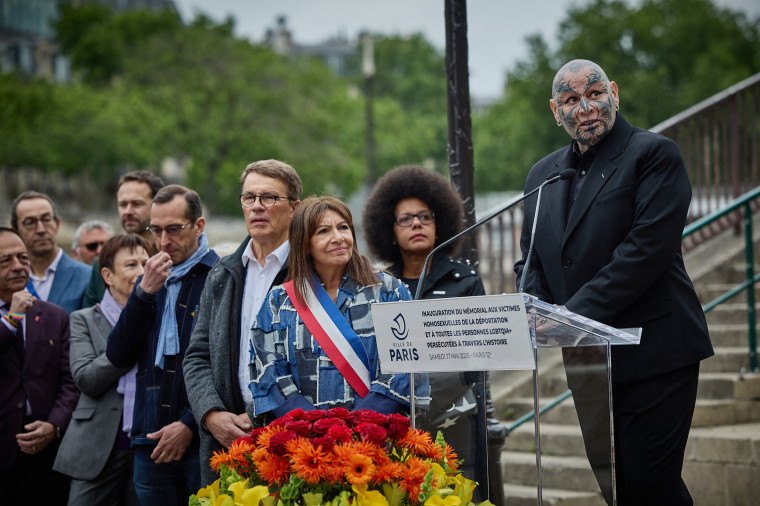
Jean-Luc Roméro, deputy mayor of Paris and a longtime LGBTQ rights activist, said “we didn’t know, unfortunately, that this monument would be inaugurated at one of the worst moments we’re going through right now.”
Referring to policies of U.S. President Donald Trump’s administration, Romero said “we’ve never experienced such setback in the United States, with what’s happening to trans people.”
Since returning to the White House in January, Trump has issued orders to recognize people as being only man or woman, keep transgender girls and women out of sports competitions for women, oust transgender military troops, restrict federal funding for gender-affirming care for transgender people under age 19 and threaten research funding for institutions that provide the care. All the efforts are being challenged in court.
In Europe, Hungary’s parliament passed this year an amendment to the constitution that allows the government to ban public events by LGBTQ+ communities, a decision that legal scholars and critics have called another step toward authoritarianism by the populist government.
GLAAD has announced the findings of its fifth annual Social Media Safety Index (SMSI), an annual report on LGBTQ safety, privacy, and expression online.
The in-depth report analyzes six major social media platforms — TikTok, YouTube, X, and Meta’s Facebook, Instagram, and Threads — across 14 indicators that address a range of issues affecting LGBTQ people online including data privacy, content moderation, workforce diversity, and more. All companies are failing to meet basic standards across most safety metrics on the SMSI scorecard.
Offering a quantitative ranking and also highlighting LGBTQ safety policy rollbacks from major platforms, the report is a wake-up call for tech leaders and employees at major platforms and for all of Silicon Valley.
As the report shows, rollbacks from some companies eerily mirror recent changes to federal websites and communications that were implemented by the Trump administration from Project 2025 (notably, Project 2025 calls for “deleting the terms sexual orientation and gender identity.”)
In January, YouTube quietly removed “gender identity” from the list of protected characteristics in its hate speech policy, and Meta removed major components of its hate speech policy protections for LGBTQ people, including adding language expressly stating it is now allowed to refer to LGBTQ people as “abnormal” and “mentally ill.” In its policy revision, Meta also uses the terms “homosexuality” and “transgenderism” — a well-known, right-wing anti-trans trope — in reference to LGBTQ people.
Although YouTube claims that “our hate speech policies haven’t changed,” it is an objective fact that, sometime between January 29th and February 6th, the company removed “gender identity and expression” from its list of protected characteristics (the change is visible here in the current and archived policy page). The SMSI report calls out this unprecedented break from best practices in the field of trust and safety, stating that: “YouTube should reverse this dangerous policy change and update its Hate Speech policy to expressly include gender identity and expression as a protected characteristic.”
These shifts — among others — undermine the safety of LGBTQ people and other historically marginalized groups, who are uniquely vulnerable to hate, harassment, and discrimination online and off.
All companies are failing to meet basic standards across most safety metrics on the SMSI scorecard. Out of a possible 100, the platforms received the following scores:

“At a time when real-world violence and harassment against LGBTQ people is on the rise, social media companies are profiting from the flames of anti-LGBTQ hate instead of ensuring the basic safety of LGBTQ users,” said GLAAD President and CEO Sarah Kate Ellis. “These low scores should terrify anyone who cares about creating safer, more inclusive online spaces.”
The quantitative methodology of GLAAD’s Platform Scorecard was created in partnership with Ranking Digital Rights (RDR) and research consultant Andrea Hackl. This year, GLAAD introduced a new scoring methodology that generated numeric ratings for each platform with regard to LGBTQ safety, privacy, and expression. The Platform Scorecard focuses on the existence of policies, and does not measure the enforcement of those policies. The 2025 scores are not directly comparable to the 2024 scores due to extensive revising of the Scorecard methodology.
The Social Media Safety Index includes specific findings and recommendations for each company, and calls on companies to urgently and tangibly prioritize LGBTQ safety. The report also highlights the volume of online anti-trans hate, harassment, and disinformation that has skyrocketed in the past year, a trend that GLAAD has qualitatively examined in the SMSI report.
Alongside these rollbacks in LGBTQ protections online, GLAAD’s Anti-LGBTQ Extremism Reporting Tracker has shown a distinct upwards trend in offline anti-LGBTQ incidents in recent years. These include both criminal and non-criminal instances of harassment, vandalism, and assault motivated by anti-LGBTQ hate.
Social media platforms are vitally important for LGBTQ people, as spaces where we connect, learn, and find community. Although today’s social media landscape does indeed look dire, it is heartening that some platforms have implemented positive initiatives in the past year. For Pride month in 2024, TikTok created their LGBTQIA+ TikTok Visionary Voices List and YouTube offered the Celebrate Pride on YouTube LGBTQ creators spotlight. In this current moment, as LGBTQ people face unprecedented attacks on our civil and human rights, now is the time for all companies to stand up for inclusive values and provide LGBTQ communities with the safety protections we need, and the celebratory and affirming messages we deserve.
Key Findings of the 2025 SMSI include:
GLAAD’s Key Recommendations:
GLAAD’s SMSI Platform Scorecard draws on RDR’s standard methodology to produce numeric ratings for each platform with regard to LGBTQ safety. This year, GLAAD added elements addressing emerging threats to LGBTQ people online as well as an indicator regarding content that promotes so-called “conversion therapy,” a practice that has been banned in 23 states and condemned by all major medical, psychiatric, and psychological organizations.
GLAAD and other monitoring organizations repeatedly encounter failures in enforcement of a company’s own guidelines for content moderation, including hate speech and harassment policies.
Specific LGBTQ safety, privacy, and expression issues identified in the SMSI include: Inadequate content moderation and problems with policy development and enforcement (including failure to mitigate anti-LGBTQ content and over-moderation of LGBTQ users); harmful algorithms and lack of algorithmic transparency; inadequate transparency and user controls around data privacy; an overall lack of transparency and accountability across the industry, among many other issues — all of which disproportionately impact LGBTQ people and other marginalized communities.
“We need to hold the line — as tech companies are taking unprecedented leaps backwards, we remain firm in advocating for basic best practices that protect the safety of LGBTQ people on these platforms,” said GLAAD’s Senior Director of Social Media Safety Jenni Olson. “This is not normal. Our communities deserve to live in a world that does not generate or profit off of hate.”
About the GLAAD Social Media Safety Program
As the leading national LGBTQ media advocacy organization, GLAAD is working every day to hold tech companies and social media platforms accountable and to secure safe online spaces for LGBTQ people. The GLAAD Social Media Safety Program produces the highly-respected annual Social Media Safety Index (SMSI)and researches, monitors, and reports on a variety of issues facing LGBTQ social media users — with a focus on safety, privacy, and expression.
The average American spends over three hours on their phone every day, and nearly half of U.S. teens say they’re on the Internet almost “constantly.”
“We are constantly shedding data as we go about our daily lives,” says Lisa Femia, staff attorney at Electronic Frontier Foundation (EFF), a digital rights advocacy group. She says with no comprehensive Federal data privacy law, there’s little legal protection surrounding our digital rights.
This lack of regulation has unique implications for LGBTQ people, especially under the current Trump administration. In March 2025, the Department of Homeland Security’s Office of Intelligence and Analysis removed protections for LGBTQ identities from its restrictions on gathering intelligence. That means queer people are no longer a protected class when it comes to surveillance efforts.
This occurred off the back of Trump’s January Executive Order, “Protecting Children From Chemical and Surgical Mutilation,” that attempts to ban trans kids’ access to healthcare. In addition, laws banning gender-affirming care have passed in at least 24 states across the country, creating a perfect storm for the government to use digital surveillance to capture folks trying to access what advocates describe as “lifesaving” treatment.
So what capabilities do law enforcement agencies and the government have when it comes to monitoring LGBTQ folks looking for resources like gender-affirming care? What are the implications for trans youth who are seeking this care out of state? And what can you do to protect yourself?
One alarming way third parties—including marketers, scammers, private investigators, tech companies, retailers and law enforcement—can access your digital footprint is through data brokers. These businesses exist solely to collect individuals’ online data to sell for profit. They have access to highly sensitive data from companies, apps and websites that collect information on people. They also indirectly gather data from public records such as voting registries. In the U.S., their work is virtually unregulated.
Through third-party apps, they can even access our health data, putting our sensitive medical information at risk. For example, after the overturning of Roe v. Wade in 2022, privacy experts were concerned that data collected by Flo, the period tracking app, could be misused, given its history of passing the health details of its users to third parties.
Because of this, Femia says it’s becoming “harder and harder for people to get the care they need, the support they need, or be who they are, without leaving a trail that a hostile law enforcement agency or state government or federal government could use to target them.”
In some cases, the government has used the “Data Broker Loophole”—a gap in the Electronics Communications Privacy Act—to bypass legal requirements of obtaining warrants and subpoenas for data and instead purchasing it directly from private brokers. In Trump’s first term, it was discovered that his Department of Homeland Security (DHS) bought cellphone location data to detect possible illegal border crossings.
One data broker, Babel Street, created a tool named Locate X—used by the Secret Service and DHS—which gathers smartphone location data to monitor people worldwide without a warrant. In practice, this is meant to help the government track serious criminal activities. But with increasing animus towards the trans community, it could potentially be used to track the movements of doctors working at gender-affirming care clinics or trans people seeking care.
While there are no documented instances of the government using this data surveillance to track folks looking for trans healthcare, that’s not the case when it comes to reproductive healthcare. In 2023, an Idaho woman and her son were charged with taking the son’s girlfriend to Oregon to get an abortion, using her cellphone location data as evidence.
And in 2024, one company used location data broker Near Intelligence to track people’s visits to nearly 600 Planned Parenthood locations across 48 states and sold the data to feed a massive anti-abortion ad campaign funded by Veritas Society, a pro-life activist group.
In addition to data brokers, American kids are being monitored when they use computers provided by their schools. The Center for Democracy and Technology (CDT) reported an increase in surveillance software to monitor online activity on school-owned devices. In fact, 81% of teachers reported that their schools use some form of monitoring software and 71% reported it being used on school-issued devices, allowing schools to survey children outside of teaching hours.
“These tools provide teachers and schools with the ability to … view students’ email, messaging, and social media content, view the contents of their screens in real time, and other monitoring functionality,” CDT reports.
While companies like GoGuardian claim to use their surveillance tools to mitigate potential security threats and monitor students’ mental health, privacy experts warn that these tools put children in homo/transphobic states at risk of their data being weaponized by their educators and law enforcement.
Subscribe for LGBTQ-focused investigative journalism.
In addition to blocking kids from visiting LGBTQ-themed websites, states like Alabama have passed bills that require school personnel to inform parents if a minor expresses a gender identity that is inconsistent with their biological sex. School personnel can enforce these bills through the surveillance of school-owned devices.
Manis says this software turns schools into another branch of America’s invasive surveillance apparatus. “It’s very difficult for those programs to stop flagging LGBTQ students even if they want to. It’s the first place conservative, anti-trans or anti-LGBTQ districts can go to [for evidence],” she says.

Beyond the classroom, the medical information of child and adult patients is at risk of being compromised.
“Medical records give you a patient’s name, prescriptions, doctor’s name, practice name, everything that you need to launch an investigation or prosecution. Same thing for prescription records. Pharmacy’s prescription records will tell you who wrote a prescription, when it was filled, who filled it,” says Manis.
In 2023, Dr. Eithan Haim, a Dallas surgeon, leaked sensitive data about children receiving transition-related care at Texas Children’s Hospital to a conservative activist who published the documents in a magazine.
Additionally, in 2023, Vanderbilt University Medical Center handed over records for more than 100 current and former patients seeking transgender health care to Attorney General Jonathan Skrmetti as part of an investigationinto possible violations of the Tennessee Medicaid False Claims Act.
HIPAA laws permit disclosures of protected health information if they are made to prevent a serious and imminent threat to health or safety, creating a loophole for local governments to work around. “The loophole is large enough that when a law enforcement agency comes knocking at a hospital’s door and asks for medical records in connection with an ongoing investigation, states typically cooperate.”
In other words, if the Trump administration wanted to come for patients, there’s a model to follow, and HIPAA laws may not protect you.
On top of all of this, automated license plate readers (ALPRs) are “commonplace” in policing. ALPRs are camera systems that capture the license plate data of passing vehicles. Nearly 90% of sheriff’s offices with more than 500 sworn deputies use ALPRs, as well as every single police department that serves over 1 million people.
A 2013 report by the American Civil Liberties Union found that license plate readers check plate numbers against “hot lists”—plates that have been uploaded to the system—to alert a law enforcement agency if a match appears. According to EFF, the data is often managed by private companies and data brokers.
In 2024, it was revealed that Sacramento authorities were collecting license plate data and sharing it with law enforcement agencies in other states. In their investigation, the Sacramento County Grand Jury expressed concern that the “data could be used to track individuals based on immigration status, place of worship, employment locations, or visits to places such as gun stores or hospitals. Particularly troubling was the potential sharing of ALPR data with other states whose citizens travel to California to seek an abortion, which has been banned or severely restricted in their home states.”
Despite the various ways you can be monitored, experts say individuals can protect themselves from digital surveillance by using encrypted messaging apps like Signal and more secure search engines like DuckDuckGo. They also recommend using Virtual Private Networks to encrypt your Internet traffic. Finally, they recommend turning your phone off when going to protests or other LGBTQ-themed events so data brokers can’t track your location.
States like California and New York are passing shield laws to protect individuals and cement themselves as data sanctuary states. These laws give consumers more control over the personal information that businesses collect about them and limit the disclosure of their personal data to out-of-state entities.
But “the way data travels doesn’t respect state lines. So the idea that there are differing protections once you hit a state border is kind of silly,” Gardner says. “Any time the states, no matter how well-intentioned, are attempting to build data protections, they’re doing it on a wobbly table that really doesn’t have a base because there are [no comprehensive federal protections].”
Greer cites the European Union’s General Data Protection Regulation as an aspirational framework for the U.S. It’s a law enforced in 2018 that grants individuals the right to their personal data.
**For more information on how to control your data, the Digital Defense Fund has a presentation here.
If objective, nonpartisan, rigorous, LGBTQ-focused journalism is important to you, please consider making a tax-deductible donation through our fiscal sponsor, Resource Impact, by clicking this button:
Friday, May 23 @ 7 pm: Four Pianists: Barbara Higbie, Tammy Hall, Adrienne Torf, and Mary Watkins at Occidental Center for the Arts. Don’t miss this rare opportunity to enjoy and celebrate the music and friendship of four gifted pianist/composers, who share five decades of collaboration in jazz, classical, gospel, folk, New Age and Women’s Music; plus Grammy/Bammy awards! This show will include solo, duo, trio and quartet performances of both beloved classics and new originals drawn from newly-released CDs by each artist. Tickets are $35 advance, $25 for OCA members at www.occidentalcenterforthearts.org. $5 additional at the door (if available). Online fees waived for this event. Get tickets early – we expect this to sell out! Fine refreshments for sale, OCA Gallery open, accessible to mobility-challenged patrons. 3850 Doris Murphy Ct. Occidental, CA. 95465.
The passage of Uganda’s Anti-Homosexuality Act in 2023 made life significantly more dangerous for lesbian, gay, bisexual, and transgender (LGBT) people and those who support them. The law, which includes the death penalty for so-called “aggravated homosexuality” and lengthy prison sentences for the “promotion of homosexuality,” has fueled a wave of arrests, raids on shelters, evictions, and public outings. Many LGBT people have gone into hiding.
Amid this repression, a small group of Ugandan mothers—some for the first time—began speaking publicly in support of their LGBT children.
In April 2023, eight of them signed an open letter to President Yoweri Museveni, urging him not to assent to the bill. They wrote: “We are not promoters of any agenda; we are Ugandan mothers who have had to overcome many of our own biases to fully understand, accept, and love our children.” They called on the president to protect all children from violence and discrimination.
He signed the bill anyway.
But the mothers did not retreat.
During 2024, Human Rights Watch met with several of these mothers in Uganda’s capital, Kampala, and the neighboring Wakiso district. In a country where public support for LGBT rights is rare and potentially criminalized, these mothers are leading with clarity, compassion, and conviction. Their stories illustrate the human cost of Uganda’s anti-LGBT laws and the quiet courage of the mothers who resist them out of love for their children.
Mama Joseph
One of the first to speak was Mama Joseph, a mother of five. Her eldest child, Joseph, now 26, identifies as gender-nonconforming. At 17, Joseph came out to their mother, saying they felt like a girl and was attracted to boys. The conversation was painful and confusing. “I cried a lot,” she said. “I knew my child was different. But it was hard.”
Like many parents, her initial reaction was to try to change her child. She sent Joseph to live with relatives, hoping they would help “correct” them. But as Joseph became depressed, Mama Joseph realized the move only caused more harm. Eventually, she brought Joseph home. “There is nothing you can do except harm,” when you try to make a child conform, she reflected. And as Joseph’s mother, she realized “No one is going to support them except me.”
Unfortunately, that support now comes with significant risk after the passage of the Anti-Homosexuality Act. Joseph lives in near-constant fear that is also affecting Mama Joseph. Simply being visible as a gender-nonconforming person can attract harassment or worse. The heated media attention on the law has created increased anxiety for LGBT people and the people who love them. “Whenever they talk about LGBT people, something bad is coming,” Mama Joseph said. But her position is clear: “No law will change my love for my child.”
Mama Denise
Mama Dennis, a woman in her late 40s, shared a similar journey. Her daughter, Dennis, is a 24-year-old transgender woman. From a young age, Dennis expressed herself in ways that challenged gender norms. She preferred dresses to trousers and loved playing with her sisters’ clothes. At 10, she entered a modeling contest against girls and won. Her mother remembers her confidence and strength.
In 2020, during the Covid-19 lockdown, when a morality-related crime happened near Dennis’s home, her neighbors took the opportunity to report Dennis’s gender expression and sexual orientation to police, even though they knew Dennis was not involved in the crime. The authorities then arrested Dennis and falsely accused her of other crimes. Her mother confronted the community directly, especially the men. “I asked them, ‘Has my child slept with any of you?’ They were embarrassed. I did not care.”
Today, because of the Anti-Homosexuality Act, Dennis is in hiding again. She no longer comes home to visit, and her absence left a silence in the house. “I miss her joy,” her mother said. “But I will keep defending her. Our children are not criminals.”
For these mothers, the law has brought not only fear, but also clarity. “This law shows us that we are not equal,” said Mama Dennis. “Our government is angry. They should use that energy to fight discrimination, not our kids.
Mama Arthur
Mama Arthur, a mother of five, has lived a different kind of struggle. Her eldest child, Arthur, was arrested in 2014 under Uganda’s previous anti-homosexuality law. Since then, Arthur has been in hiding, and their communication is limited and secretive. The real battle, though, has been at home. Her husband—Arthur’s father—has never accepted their child. “He constantly blames me,” she said. “He harasses me for having given birth to a cursed child.”
Her marriage has become a space of daily conflict. “I live like a single mom with a husband,” she said. “But I appreciate my kid very much. I accept Arthur the way they are.” She wants religious leaders, many of whom have supported the Anti-Homosexuality Act, to reconsider their messaging. “If you are a person of faith, you should preach love, not hate.”

More Mamas
The other mothers—Mama Rihanna, Mama Joshua, and Mama Hajjat—faced public scrutiny after their children were arrested in 2016 and 2022 respectively. The widespread national media coverage that followed, which included their children’s names, faces, and alleged offenses, had devastating consequences for the families. Each mother had to navigate the fallout alone.
One sold her only cow to pay legal fees and secure her child’s release. Another was forced to relocate after her neighbors turned hostile. The third hid her daughter from an abusive husband. In each case, the family’s safety, finances, and reputation were upended overnight.
Yet these mothers remain steadfast. “Sexuality doesn’t matter,” said Mama Hajjat, now in her 50s. And so she sheltered her daughter through the worst of the backlash. Over time, even her husband began to soften. “He saw what our daughter went through, what she was capable of. He started to change.”
For Mama Joshua, the issue is deeply political. “Our kids are the easiest target,” she said. “But they are not the problem.” She believes the government is scapegoating LGBT people to distract from broader governance failures. “None of this will bring jobs. It won’t build roads. It won’t feed children. It’s all distraction.”
There is evidence to support this claim. Anti-LGBT rhetoric in Uganda, as in other countries, often intensifies in moments of political or economic pressure. Leaders use moral panic to consolidate power, mobilize popular support, and deflect criticism. The Anti-Homosexuality Act, introduced and passed amidst corruption scandals and ahead of a critical election cycle, has served that purpose. But its cost—measured in fear, violence, and exile—is borne disproportionately by LGBT people and those who love them.
The mothers interviewed by Human Rights Watch are affiliated with PFLAG-Uganda, a social intervention project under Chapter Four Uganda’s Diversity Equity and Inclusion program. They do not identify as activists. Most are deeply religious, and several attend church or mosque regularly. Some are afraid of the consequences of speaking out. But none regret standing by their children.
They have formed quiet networks of solidarity since 2019, meeting regurlarly, sharing social advice and comforting one another when children disappear or flee the country. They know they are not alone, even if the state tries to isolate them.
“We are mothers,” said Mama Dennis. “We know our children. We love them.”
Their voices are clear and consistent. Some have spoken on community radio or attended court hearings. Others write letters, make phone calls, or otherwise simply refuse to abandon their children.
And their numbers are growing, with the support of Clare Byarugaba, the founder of PLFAG-Uganda.
Their message, despite everything, remains rooted in hope: That love can coexist with fear, that understanding can overcome indoctrination, and that change—however slow—is possible. “People can learn,” said one mother. “It is a matter of time.”
In Uganda, the public space for human rights has narrowed dramatically. But these women are carving out space in the most personal realm: the home. They are challenging political violence not through protest, but through presence. Through consistency. Through care.
Their resistance may not be visible on the streets, but it is steady. Their choice to love their children—and say so publicly—is both deeply personal and inherently political.
“I could never stop loving my child,” one mother said again, without hesitation.
And she never will.
Military commanders will be told to identify troops in their units who are transgender or have gender dysphoria, then send them to get medical checks in order to force them out of the service, officials said Thursday.
A senior defense official laid out what could be a complicated and lengthy new process aimed at fulfilling President Donald Trump’s directive to remove transgender service members from the U.S. military.
The new order to commanders relies on routine annual health checks that service members are required to undergo. Another defense official said the Defense Department has scrapped — for now — plans to go through troops’ health records to identify those with gender dysphoria.
Instead, transgender troops who do not voluntarily come forward could be outed by commanders or others aware of their medical status. Gender dysphoria occurs when a person’s biological sex does not match up with their gender identity.
The defense officials spoke on condition of anonymity to provide details of the new policy. The process raises comparisons to the early “don’t ask, don’t tell” policy, which at times had commanders or other troops outing gay members of the military who — at the time — were not allowed to serve openly.
Active-duty troops will have until June 6 to voluntarily identify themselves to the Defense Department, and troops in the National Guard and Reserve have until July 7.
The department is offering a financial incentive to those who volunteer to leave. They will receive roughly double the amount of separation pay than those who don’t come forward.
Initially, officials said the Defense Department would begin going through medical records to identify anyone who did not come forward voluntarily. That detail was not included in the new guidance released Thursday.
While the department believes it has the authority to review medical records, it would rather go through a more routine health assessment process, the defense official said. Traditionally, all service members go through a health assessment once a year to determine if they are still medically able to serve.
A new question about gender dysphoria is being added to that assessment. Active-duty troops who do not voluntarily come forward would have to acknowledge their gender dysphoria during that medical check, which could be scheduled months from now.
A unit commander could expedite the health assessment.
Under the new policy, “commanders who are aware of service members in their units with gender dysphoria, a history of gender dysphoria, or symptoms consistent with gender dysphoria will direct individualized medical record reviews of such service members to confirm compliance with medical standards.”
The defense official said it is the duty of the service member and the commander to comply with the new process. The department is confident and comfortable with commanders implementing the policy, and it does not believe they would use the process to take retribution against a service member, the senior defense official said.
It comes after the Supreme Court recently ruled that the Trump administration could enforce the ban on transgender people in the military while other legal challenges proceed. The court’s three liberal justices said they would have kept the policy on hold.
Officials have said that as of Dec. 9, 2024, there were 4,240 troops diagnosed with gender dysphoria in the active duty, National Guard and Reserve. But they acknowledge the number may be higher.
There are about 2.1 million total troops serving.
In a statement, Pentagon spokesman Sean Parnell said earlier this month that about 1,000 troops already have identified themselves and “will begin the voluntary separation process” from the military. That can often take weeks.
Trump tried to ban transgender troops during his first term, while allowing those currently serving to stay on. Then-President Joe Biden overturned the ban.
The new policy does not grandfather in those currently serving and only allows for limited waivers or exceptions.
Trump and Defense Secretary Pete Hegseth allege that troops with gender dysphoria don’t meet military standards. Hegseth has tied his opposition to a campaign to rid the department of “wokeness.”
“No More Trans @ DoD,” Hegseth wrote in a post on X. In a recent speech to a special operations conference, he said: “No more dudes in dresses. We’re done with that s—.”