Zambia’s president has pardoned a gay couple sentenced to 15 years in prison in November under colonial-era sodomy laws in a case that caused a diplomatic row with the United States.
Japhet Chataba, 39, and Steven Sambo, 31, were among nearly 3,000 inmates pardoned by President Edgar Lungu last Friday to commemorate Africa Freedom Day, according to the government gazette.
A Lusaka High Court judge had sentenced them to 15 years in prison under laws that forbid sex between couples “against the order of nature.”
The case drew criticism from then U.S. ambassador Daniel Foote, who said the sentence was too harsh and could damage Zambia’s reputation. Washington later withdrew Foote following the row with Zambian authorities over the issue.
Over the past decade, several African countries have come into conflict over LGBTQ rights with Western countries, many of who are major aid donors.
The previous Obama administration cut aid to Uganda and Malawi over their anti-homosexual laws and policies, although Western condemnation sometimes provokes African leaders into taking more hardline positions.
Uganda announced plans in October last year for a bill that would impose the death penalty for gay sex, but later backtracked after major aid donors said they were monitoring the situation.
The inaugural United Way Pride United grants program is now accepting applications. Thanks to many generous supporters, Pride United has raised $32,000 to be granted to nonprofit organizations supporting LGBTQ+ individuals and families in Sonoma, Mendocino, Lake, Humboldt, and Del Norte counties.
As California Gov. Gavin Newsom and state officials work to roll back the state’s shelter-in-place order in the face of mounting economic damage, the architect of the nation’s first stay-at-home order is voicing her concerns.
Santa Clara County health officer Dr. Sara Cody told her county’s board of supervisors Tuesday she is “concerned” by the state’s recent decisions to allow counties to reopen in-store retail, places of worship, barbershops and hair salons.
“The state modifications are being made without a real understanding of the consequences of what the last move has been, and with the possible serious effects for health and possible serious risk of an exponential growth in cases,” she said. “So yesterday’s actions were particularly concerning.”
On Monday, Newsom announced that places of worship and in-store retail could reopen in the 47 counties that have received clearance to move into late Stage 2 of the state reopening plan. Only 11 counties — six of which are in the Bay Area — remain in early Stage 2, but analysis shows most meet the state criteria to reopen further.
After announcing modifications Monday, Newsom announced Tuesday that hair salons and barbershops — “high-risk” businesses included in Stage 3 of the reopening plan — could also immediately resume operations in counties that have gone through the attestation process. With the five-county Bay Area consortium only open for curbside-pickup retail and manufacturing, the region now lags behind the rest of the state by two stages with early Stage 3 businesses coming back online.
Cody has previously stated that revisions to the stay-at-home order should be made every two weeks to gauge the impact of previous modifications.
“Two weeks represents the longest likely incubation period of COVID-19 and we needed to see what effect the loosening of the order on May 4 would have,” she said last week after softening the order in her county. “So today is the date that we hit the two-week mark and I’m pleased to say we’ve been making progress and sustained that progress as more activity came back online.”
During the Tuesday board of supervisors meeting, Cody expressed particular apprehension toward Newsom’s new guidance for churches, which allow for gatherings as large of 100, albeit with strict physical distancing measures. The state had received a formal warning from the United States Justice Department that not allowing places of worship to open in Stage 2 was likely a First Amendment violation.
“Gatherings are of course profoundly and personally important to all of us, but our ability to contain the virus from spreading if there’s one COVID-positive individual at such a large event is quite limited,” she said. “And it would rapidly exceed even our current ambitious and unprecedented effort to establish a large case investigation and contact tracing workforce here and elsewhere throughout the state.”
During a CNBC appearance last week, White House advisor Dr. Anthony Fauci warned that strict stay-at-home orders could cause “irreparable damage” to the economy and people’s livelihoods if imposed for much longer.
“I don’t want people to think that any of us feel that staying locked down for a prolonged period of time is the way to go,” he said.
Larry Kramer, the noted writer whose raucous, antagonistic campaign for an all-out response to the AIDS crisis helped shift national health policy in the 1980s and ’90s, died on Wednesday in Manhattan. He was 84.
His husband, David Webster, said the cause was pneumonia. Mr. Kramer had weathered illness for much of his adult life. Among other things he had been infected with H.I.V., the virus that causes AIDS, contracted liver disease and underwent a successful liver transplant.
Mr. Kramer was a founder of the Gay Men’s Health Crisis, the first service organization for H.I.V.-positive people, in 1981. His fellow directors effectively kicked him out a year later for his aggressive approach, and he returned the compliment by calling them “a sad organization of sissies.”
The National Black Justice Coalition and Black Policy Lab, a project of Pink Cornrows, has announced a new initiative to gather data on one of the most vulnerable populations in the COVID-19 pandemic, Black LGBTQ+ and same gender loving (SGL) people. COVID while Black and Queer will find crucial data on how Black LGBTQ/SGL people are weathering the pandemic at a time when data shows that Black communities make up 60% of the COVID-19 deaths in the United States.
“Existing data from this crisis has already proven what many of us have already known: Black communities continue to be the least supported and most exploited—more Black people are testing positive and dying as a result of the virus and we should expect that existing data is undercounting what’s more likely the reality given the history of Black communities not being targeted for testing and data collection” said David J. Johns, Executive Director of the National Black Justice Coalition. “What we know now is important; however, to protect all Black people, we need data on specific needs and experiences of Black LGBTQ and same gender loving people.”
The new survey will build on the Black Policy Lab’s ongoing COVID while Black initiative, which has surveyed hundreds of Black Americans in the past weeks. “Data is a powerful tool, but often isn’t the full story. Traditional empirical research and interpretation methods are not without bias, and frequently disseminated without insight from our community,” said Ifeoma Ike, attorney, researcher, and Founder of Black Policy Lab. “COVID while Black was launched to invite traditionally underrepresented and over-impacted communities to provide important data and narratives about their own lives. This valuable qualitative input does not limit our Black experiences to just statistics, but instead allows us to see trends and opportunities that hopefully will inform policymakers tasked with recovery and restoration efforts.”
Unlike other surveys, COVID while Black, for example, also allows respondents to share the names of loved ones who were ill, essential workers serving on the front lines, and those who have transitioned, contributing to a virtual homegoing experience at a time where mass gatherings are prohibited and for communities who heal, in part, by coming together.
Previous data has shown that Black people are disproportionately experiencing the severest health impacts of the disease with systemic racism within healthcare, inequalities resulting in health disparities and Black people disproportionately working in ‘essential’ jobs as major contributing factors. We also know that historically Black communities are not targeted for testing or democratized health care.
Past research has shown that LGBTQ/SGL Americans also experience underlying health disparities that increase the likelihood of testing positive for and suffering as a result of COVID19. LGBGTQ/SGL Americans are more likely to be smokers—a high risk factor—and work minimum wage jobs. Transgender people especially face widespread workplace discrimination, are more likely to be incarcerated, and more than 1 in 4 transgender people have reported being denied healthcare due to their gender identity. Black LGBTQ people also predominantly live in the South where it is legal to deny access to employment, public housing, and medical services on the basis of actual or perceived sexual identity, gender orientation, and gender expression. These are the states that are rushing to open while investing the least in targeted testing and treatment.
This new survey aims to reveal new data on how Black LGBTQ/SGL people have been affected to inform policy decisions and necessary shifts in practice. Black Policy Lab will soon launch a series of virtual summits to discuss survey results, solutions, and design policy recommendations.
Emma thought that going off to Carleton College would be the beginning of a new life. The 18-year-old trans girl had struggled to come out in high school after repeated outings to her strict Italian Catholic parents in New Jersey.
“Those were difficult,” she told Vox. “I like to say that I negotiated my way back into the closet” to finish high school.
She thought college would become her salvation and chose the liberal arts school of about 2,000 students in Northfield, Minnesota, because of a visit, during one of her tours, to the on-campus LGBTQ center.
While Emma’s dad accompanied her on the tour, he decided to spend a little time alone in town, at which point the admissions officer offered to bring her to the center.
“Meeting some very happy, very out, very successful and well-situated trans people was very important to me,” she said. “[That] ended up really selling me on the school.”
Once there, the center helped her explore and figure out a plan for coming out more broadly, and connect with other queer and transgender students. Things moved quickly for Emma, who said it only took her about a month to start asking people to refer to her with her new name and she/her pronouns. Her parents accused her of getting taken in by a cult and threatened to stop paying her tuition.
During an extended Thanksgiving break, Emma’s parents dangled her tuition in front of her like a “carrot on a string,” so she lied and agreed to go back to school as a male student — an agreement she quickly went back on once she had returned to school.
However, the coronavirus pandemic threw a wrench into her plan once Carleton decided to move to online classes on March 18. The college freshman is now back home — and back in the closet — because of Covid-19, cut off from the school LGBTQ center where she had met many of her friends and received emotional support.
Having a space where LGBTQ people can simply exist in their own skin and experience, without judgment or pressure to hide for the benefit of cisgender, heterosexual people, can be enormously beneficial.
But in recent months, queer and trans people have been feeling the loss of affirming LGBTQ spaces since cities and states began shutting down nonessential public spaces in mid-March.
Queer bars, LGBTQ centers, and affirming sexual and specialized health clinics are closed because of the pandemic. Pride celebrations all over the country, and the world, have been canceled, often replaced by virtual online events. At the moment, the safest physical place to be — at least in terms of avoiding contracting the virus — is at home, which for some queer folks is not a safe space at all, and for others serves as a callback to a previous time when LGBTQ people could not safely reveal themselves to be queer in public.
Like Emma, Max Meyer, a 25-year-old nonbinary grad student, has watched the trans support group they ran at the University of Illinois at Urbana-Champaign, the Campus Union for Trans Equality and Support (CUTES), shut down. In response, Meyer helped the group set up a Discord server to facilitate voice and text communications. But like Emma, many of the group’s students don’t have a safe home environment in which to discuss their queer identity over a computer.“MEETING SOME VERY HAPPY, VERY OUT, VERY SUCCESSFUL AND WELL-SITUATED TRANS PEOPLE WAS VERY IMPORTANT TO ME”
As a result, only about five people regularly participate in the group’s Discord meetings, a contrast to the up to 30 who would attend in-person meetings. The pandemic “raises barriers for being able to reach out and get any kind of trans support,” Meyer said. It’s “further isolating an already marginalized group away from resources, support, and people with similar experiences.”
Before the pandemic shut down the school, Meyer had been lobbying the university to allow preferred names on diplomas, but now those plans have been scuttled. Meyer is also scared for next year’s crop of incoming trans students who may not be able to access the group’s resources. Not having the CUTES physical space “really increases how much effort it takes for somebody who might be unsure or questioning to reach out and get any kind of help,” they said.
With universities planning how to handle the start of this year’s fall semester, there’s a growing concern over how best to support trans students like Emma and Max. But the concern also applies to other critical areas of the LGBTQ community, from queer bars to sexual health spaces. This pattern of queer people getting cut off from critical and affirming resources is being repeated all over the country due to the pandemic.
Queer sobriety is difficult to manage during the pandemic
Damian Jack is a 40-year-old cis gay black man living in New York City. He’s also 20 months sober and in recovery. He’s been attending regular Tuesday night sobriety support meetings at the Center, an LGBTQ community center in Manhattan’s West Village since October 2018.
Jack said that before he started working toward recovery, he pushed everyone who loved him out of his life and felt utterly alone. But through the support meetings at the Center, which he says are typically 99 percent attended by queer people, he’s been able to build a core group of friends and people he can lean on.
That support has been critical for his recovery. “My journey toward recovery, it has been long in getting here,” he told Vox. “The community itself is really what helped me a lot. And that was something that I looked everywhere else to find.”
According to 2015 data from the National Survey on Drug Use and Health, lesbian, gay, and bisexual people were twice as likely (39.1 percent to 17.1 percent) as heterosexual adults to have used illicit drugs within the past year. Additionally, a 2013 US Census Bureau surveyfound that a higher percentage of LGBTQ adults between ages 18 and 64 reported past-year binge drinking, which was defined as consuming five or more alcoholic beverages in one sitting, than heterosexual adults.
But the Center closed its doors on March 13. The loss of that critical queer recovery space, Jack said, has pushed quite a few people off the wagon again. “There are a lot of people who are suffering because of the lack of connection,” he said.
In response to the pandemic, Jack’s support group moved to regular Zoom meetings, which he said is a blessing and a curse. On the one hand, participation in meetings has expanded thanks to connections to people outside the city through LGBTQ sobriety Facebook groups like “Gay and Sober.” Where once there were usually 20 to 100 people at the in-person meetings depending on which day of the week it was held, Jack said there are about 60 people who show up on Zoom thanks to attendance from people who live too far away to attend the Manhattan-based meetings.
It’s also allowed Jack some freedom to work later on Tuesday nights, because if he misses the New York meeting, he can now hop on Zoom to attend a Los Angeles-based meeting held later in the evening.
But without that personal connection, Jack said, it’s difficult for those who may be early in their recovery journeys. “If I were to be getting sober now, it would probably be the hardest thing for me because of the fact that I needed the community around me. That was something that I searched for my entire life, and I needed that,” Jack said.
Jack said going to an LGBTQ recovery group was important for his journey to sobriety because he felt like he could be more vulnerable and authentic there compared to a cis het space. “I didn’t have much of a problem interacting with straight people when I was sober, just because I could always put on my, ‘Oh, yeah, I’m a silly gay man’ [persona],” he said.
But the group taught him how to interact with other gay people without constantly having a drink in his hand. “I was never around any gay people while I was sober; this was my first time doing that. I didn’t really have the necessary tools to communicate because I didn’t know how to communicate with anyone in a community that I was so ashamed of.”
So Jack said he tries to take newbies on socially distanced walks in the city as often as possible. “A lot of people are relapsing,” he said, thinking of one person from his group in particular. “He’s like, ‘I don’t feel connected.’”
“SARS-CoV-2 isn’t the only pathogen that we need to be mindful of right now”
For their own health, it’s recommended that queer cis men and trans women, especially, get tested regularly for sexually transmitted infections (STIs). In the 1980s, as it is now, it was important to have sexual health providers who would treat LGBTQ people without harassment, in order to contain a different deadly virus without a treatment or vaccine — HIV/AIDS.
Many of the testing protocols now being deployed to fight Covid-19 were first developed to fight the spread of HIV. But while everyone is rightly focused on the disease caused by the novel coronavirus, New York City-based sexual health advocate Jeremiah Johnson, HIV project director at the Treatment Action Group, said it’s important that queer people not lose sight of their own sexual health needs.
“When it comes to addressing sexual health services for marginalized communities, it’s always such a stigmatized topic, and we experience so much judgment and marginalization from health care systems that do not fully respect queer people,” said Johnson. “Frequently, the way that we access those services is to go to specific clinics and community-oriented clinics where we know that we’re going to get compassionate care that is reflective of our communities and fully accepting of our whole selves.”
That has become more difficult, Johnson said, because of Covid-19. “In this crisis scenario, underrepresented and historically marginalized communities have even greater dangers of being pushed to the margins and not having their needs addressed,” he told Vox.
“WHEN IT COMES TO ADDRESSING SEXUAL HEALTH SERVICES FOR MARGINALIZED COMMUNITIES … WE EXPERIENCE SO MUCH JUDGMENT AND MARGINALIZATION FROM HEALTH CARE SYSTEMS THAT DO NOT FULLY RESPECT QUEER PEOPLE”
While many sexual health clinics are still open for emergency services, like prescriptions for post-exposure prophylactics, which helps prevent transmission of HIV after contact with an infected person, and Plan B contraceptives, routine STI screenings are not considered emergency services.
“Particularly, within all of this disruption we’re seeing now, it’s difficult to get a picture of just how impacted queer communities have been in terms of accessing the unique health care services that we depend on to take care of our emotional, spiritual, physical, sexual, and health care,” Johnson said.
Further complicating matters, he said, it’s hard to tell at this point how people are behaving sexually while under stay-at-home orders and other social distancing measures. Additionally, most of the nation’s 2,200 contact tracers have shifted their focus away from STD tracking to focus on Covid-19. That could be a recipe for an STD outbreak that won’t be caught until regular testing can resume.
“We’ve seen a substantive decline in the number of new diagnoses for sexually transmitted infections in New York City, which is probably more likely a product of a lack of testing, rather than an actual reduction in the number of those infections,” said Johnson.
Johnson worries that once the Covid-19 pandemic is over and regular testing begins again, we could see a surge in the number of new STIs. “SARS-CoV-2 isn’t the only pathogen that we need to be mindful of right now,” he said.
Gay bars have been central to the LGBTQ community since Stonewall. The pandemic has ripped that connection away.
My favorite queer space, a queer women’s bar called A League of Her Own, nestled in the Adams Morgan neighborhood of Washington, DC, has been closed since the city shut down all its bars and restaurants on March 30. The bar, affectionately known by its acronym “ALOHO,” was the place where my friends and I met and hung out semi-regularly, providing a welcoming home amid political attacks on LGBTQ people from the somewhat nearby White House.
A League of Her Own is one of only two lesbian bars in Washington, DC.
The staff at ALOHO have experienced a sense of loss of the community that found itself in the basement of its gay male sibling bar, Pitchers. “I definitely, personally have had [some] struggle days,” said bar manager Jo McDaniel, who has tried to stay connected to her regulars through a weekly Instagram Live broadcast every Wednesday, which she films on-site at ALOHO. “Just being in the space makes me nostalgic and sad and all over the place. There’s a huge amount of loss.”
Queer women’s bars were already closing at an alarming rate over the past decade. ALOHO is one of only two lesbian bars in DC. NBC News estimated in early May that there are just 16 queer women’s bars in the US, down from a peak of 200in the 1980s. Though ALOHO is financially safe for now — the bar’s owner has applied for a PPP loan — McDaniel thinks that several of the small handful of queer women’s bars may not survive the pandemic.
In fact, two DC gay bars catering to men, DC Eagles and Secrets, have already announced they will not reopen once the city does. In San Francisco, the city’s oldest gay bar, the Stud, which has been open for 55 years, announced this week that it will permanently close because of Covid-19.
DC recently extended its order keeping bars closed through June 8, but McDaniel hopes the bar’s regular patrons know that the staff is still around for support. “People would come in and sort of share their problems with their bartenders, like slide into the DMs,” she said. “We’re all very public in terms of social media and we’re all still here.”
For now, the Instagram Live posts offer a brief chance for the bar’s community to reconnect. “What’s really cool is watching people who are viewing the Live chat with each other in the comments,” she said. “That’s been the thing that’s really been awesome for me is to see people essentially see each other virtually.”
As queer and trans people continue to navigate the coronavirus pandemic, those who can are trying to help others stay connected. Meanwhile, there are a lot of queer and trans people who have been put in unhealthy and potentially dangerous situations just to have a roof over their heads. Losing queer spaces exacerbates the stresses many were already facing before this.
For now, Emma is staying in the closet while living at home with her parents, but she can’t help but pine for the escape she once thought she had at school. “I had this lifeline at Carleton, where things were going to be better and I was going to go there and be myself and it was going to be really good,” she said, thinking about her current situation. “[There’s] definitely despair. I’m just awash in it.”
AGING GAYFULLY with Gary “Buz” Hermes, MA Saturdays 11 am to 1 pm June 27 to August 15an 8-week series on Zoom
Discover LGBT aging strategies and community support as you share your unique life experiences and sense of humor with your Lesbian, Gay, Bisexual and Transgender peers! Buz has delivered this series in a number of venues in recent years and garnered great and heartfelt response. The series is free; however, registration is required.
A new study has revealed that nearly a third of trans and non-binary young people have attempted suicide in the past 12 months.
More than 25,000 queer young people between the ages of 13 and 24 were surveyed for the peer-reviewed study by researchers at The Trevor Project, which has been published in the Journal of Adolescent Health.
Of the trans and non-binary youth young people responding to the survey, 78.2 per cent said that they have experienced discrimination because of their gender identity.
Trans and non-binary youth report depression, physical abuse and thoughts of suicide.
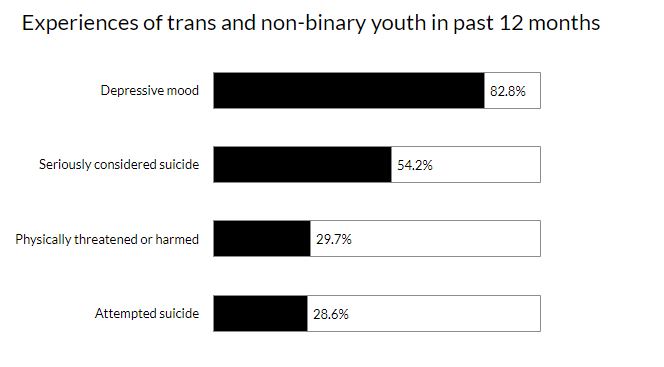
Asked about their experiences over the past 12 months, 29.7 per cent of trans and non-binary youth said they had been physically threatened or harmed.
82.8 per cent reported a depressive mood, 54.2 per cent had seriously considered suicide, and 28.6 per cent had attempted suicide.
Four in five trans and non-binary youth reported a depressive mood – while a quarter have attempted suicide
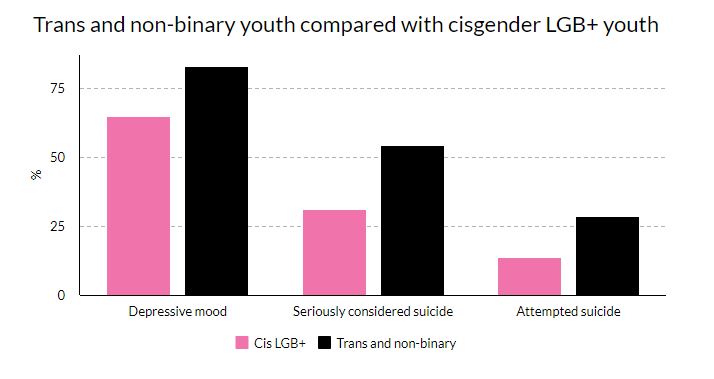
Even compared to their cisgender LGB+ peers in the Trevor Project survey, young people who identify as trans and non-binary are still more than twice as likely to experience depressive symptoms, seriously consider suicide, and attempt suicide – adjusting for age, family income and ethnicity.
Young people who identify as trans and non-binary are most at risk of depression and suicide. Trans males are the the highest-at risk group, with 35 per cent having attempted suicide in the past 12 months – but trans females and non-binary youth were also significantly more likely than cisgender LGB+ youth to report seriously considering suicide, according to the research.
Transgender young people ‘particularly vulnerable to poor mental health’.
The study corroborates findings from previous research on the issue, which has long indicated that trans youth have a greater risk of suicide.
Amy E Green, director of research at The Trevor Project, said: “Prior to this study, there was a clear lack of research on the differences in mental health and suicidality within different sub-groups of LGBT+ youth.
“These results underscore that transgender and non-binary youth are particularly vulnerable to poor mental health outcomes and suicide risk compared to their cisgender peers within the LGBT+ community. Furthermore, they show how LGBTQ-based discrimination and victimisation contribute to these increased mental health disparities.”
Research scientist Myeshia Price-Feeney, added: “At The Trevor Project, we hear from trans youth in crisis every day and we understand the detrimental impacts discrimination and harassment can have on their mental health and well-being.
“We hope this data will encourage more robust nationwide data collection on LGBT+ youth mental health, and that policymakers and health care providers will use these insights to create policies and safe spaces that protect and affirm trans youth everywhere.”
If you are in the UK and are having suicidal thoughts, suffering from anxiety or depression, or just want to talk, you can contact Samaritans on 116 123 or email jo@samaritans.org. If you are in the US call the National Suicide Prevention Line on 1-800-273-8255.
Ben Rimalower, 44, has been vacationing on New York’s Fire Island since 2005. The island’s Pines section, a popular beach destination for gay men dating back to the 1920s, has been a reliably safe and sunshine-filled locale for Rimalower and his friends, primarily other gay men, to spend the summer.
“I first fell in love with Fire Island from afar while in college in California during the early ‘90s,” he told NBC News. “It seemed like Shangri-La to me.”
Rimalower said even on the “queerest blocks” of New York City, where he lives, he’s “uncomfortable kissing or holding hands” with another man, “but on Fire Island, I’m free.”
Ben Rimalower, center, with friends in Fire Island Pines the summer of 2019. Courtesy of Ben Rimalower
This year, however, his annual trip to Fire Island Pines is shrouded in uncertainty.
“If we can go at all, it will be with lots of changes,” he lamented. “I hope we can be safe on the beach, because that’s my favorite part.”
“This is all so new and complicated,” he said, adding there’s still a chance he and his friends will cancel their trip. “We haven’t even broached the topic of house rules yet, but I imagine at least at first we won’t be having any hookups or friends over.”
With the typically busy summer season kicking off, LGBTQ beach destinations in the Northeast — a region particularly hard-hit by the global coronavirus pandemic — are bracing for a new normal, and some of their loyal patrons are apprehensive.
New York’s Fire Island
Fire Island is a narrow, car-free, barrier island just south of Long Island and not far from the ritzy beaches of the Hamptons. While Fire Island boasts 15 communities, two of them have long been popular with LGBTQ beachgoers, with the Pines historically catering to gay men and Cherry Grove to lesbians.
The Pines only has one hotel, which is currently closed, so nearly all visitors rent houses during their stay. According to a community newsletter published May 14, brokers shared that vacation renters “have generally made their last payments and are planning to come to the Pines this summer, even if bars and restaurants are not open.”
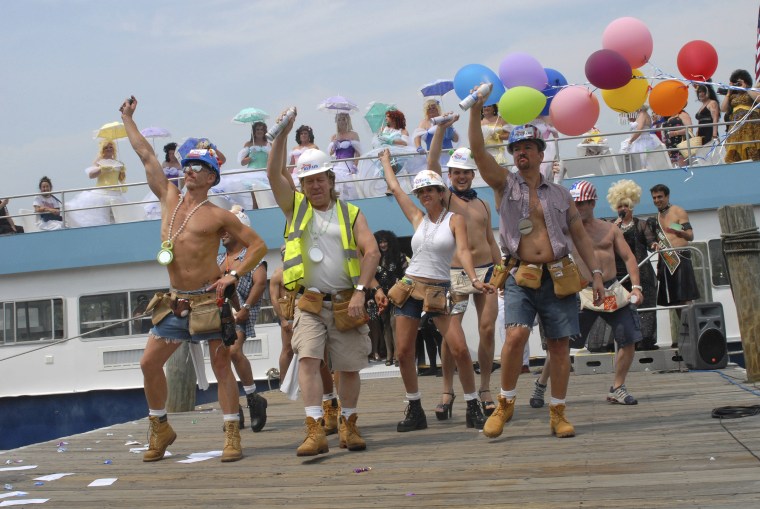
Scenes from the Invasion of the Pines in Fire Island Pines, N.Y., on July 4, 2008.Julia Weeks / AP file
P.J. McAteer, a co-owner of the Outpost Pines, which make up the majority of the Fire Island Pines’ commercial businesses, opened two of his restaurants May 15 for to-go service, and he plans to continue opening additional venues and expanding services as Suffolk County and Gov. Andrew Cuomo allow.
At his businesses, there will now be temperature and hand sanitizing stations at the entrances, a 50 percent capacity maximum and a mandate that employees wear masks and other personal protective equipment.
McAteer, who typically employs about 40 people during the summer months — from event photographers to drag queens — said his employees are eager to get to work.
“All of my staff and entertainers are chomping at the bit to come back,” he said. “They all cannot wait to be back here and bring back the life that is Fire Island Pines.”
“The gay community is very creative and inventive, especially in a crisis … We survived the HIV epidemic and made a comeback. I think the same thing about this. Those same creative energies will be out this summer.”
JAY PAGANO, FIRE ISLAND PINES PROPERTY OWNERS’ ASSOCIATION
And when beachgoers return to the island for the summer, they won’t be alone. Jay Pagano, president of the Fire Island Pines Property Owners’ Association, said occupancy has been higher than usual over the past few months, because many homeowners opted to quarantine on the island starting in mid-March.
“A large number of residents chose to spend the pandemic in the Pines,” he said in early May. “They thought it would be a safer or nicer venue to be locked down in. I’m guessing that’s probably 200 to 250 homes are occupied full-time right now, and that’s unusual this early.”
And while there hasn’t been much to do over the past two months, there’s always the beach.
“The beaches are open, and they will remain open,” Pagano explained. “We have a wonderfully wide beach this summer. We are going to encourage the residents to use it, but the requirements for social distancing and masks will be implemented on the beach as in the community, and the police will be enforcing those requirements.”
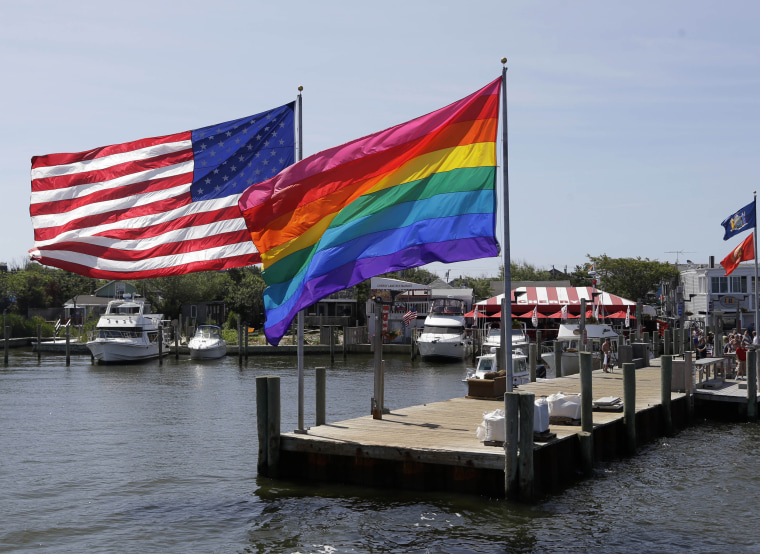
An American flag and an LGBTQ Rainbow flag are displayed on the ferry dock in the Fire Island community of Cherry Grove, N.Y. , on June 23, 2013.Seth Wenig / AP file
In neighboring Cherry Grove, the beach is also open to sunbathers, swimmers and strollers.
“It’s as safe here as it is anywhere,” Diane Romano,president of the Cherry Grove Community Association, said, adding that “the people in Cherry Grove have been really great at implementing social distancing.”
And for those thinking about heading to Fire Island’s Cherry Grove section, Romano said, “We want to make sure you’re someone that will follow guidelines and work with the community to make sure you protect yourself and others.”
In order to ensure everyone’s safety, Romano said local law enforcement, starting in mid-June, will patrol the beach to make sure everyone is following proper social distancing guidelines, which include limiting large groups from congregating.
Fire Island regulars, such as Rimalower and Zach James, who reserved a house for a week in July, are preparing for a different Fire Island experience than they’re used to, which typically includes large beach dances, drag shows and house parties.
“It’s going to be an isolated house trip without the fuss, which will be just fine,” James said. “We will change what we do out there to be in line with the world we live in.”
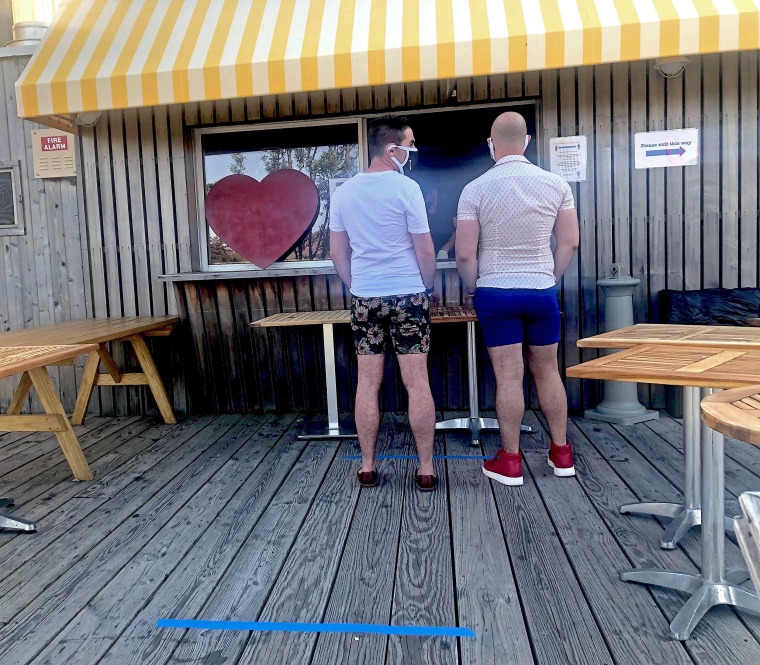
Two vacationers wear masks as they visit the Cantine in Fire Island Pines. Courtesy of Alexander Kacala
Arguably the most popular event in the Pines — the annual Pines Party dance and fundraiser, which is typically held the last weekend in July and draws an estimated 3,000 attendees — will not go on as planned this year. However, Guy Smith, the event’s creative director, said his group is “hard at planning” an alternative “to bring together our community and continue the Pines Party magic.” He said this year’s event will include live performances streaming from the Fire Island Pines that will “broaden the reach of our event and raise much-needed funds for our 2020 beneficiary, Stonewall Community Foundation.”
As for ferry service — the only way in and out of Fire Island unless you own your own boat — the schedule is more limited than recent years due to a decline in ridership amid the pandemic. The boats will be running at a maximum of 50 percent capacity, and all passengers must wear face coverings.
“Fire Island has so much beauty, and there’s so many things out here to do,” McAteer said, looking ahead to the next few months. “Whatever the new normal is, it’s going to be OK; we’re going to figure it out.”
“Summer 2020 is not canceled in my book,” he added. “Summer 2020 is just going to be done differently.”
New Jersey’s Asbury Park
Asbury Park, a 1.6-square-mile city located along the Jersey Shore, has been attracting an increasing number of LGBTQ homeowners and beachgoers since the ‘50s, when New Yorkers started purchasing and restoring Victorian homes, leading to the city’s rejuvenation.
While the city’s beach and boardwalk had been closed due to the pandemic, they recently opened ahead of the Memorial Day weekend. In order to ensure everyone’s safety, officials have put a number of new measures in place.
“We know our residents are looking forward to summer, and Asbury Park has always welcomed visitors — we know how much they help our economy,” Mayor John Moor said in a statement. “That said, this is not a normal summer season. We are in the middle of a pandemic, and we need to be smart. We are going to have to limit numbers, practice social distancing, wear face coverings and masks, and make the experience as contactless as possible for the safety of beach visitors and our staff.”
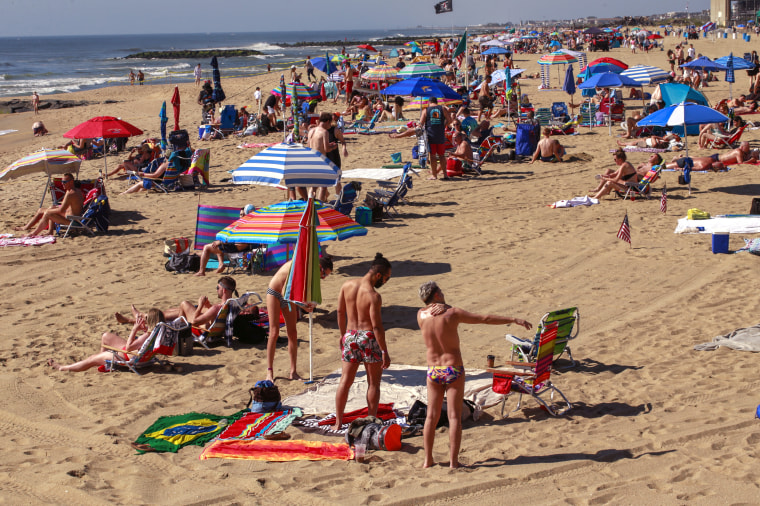
People visit the beach during Memorial Day weekend on May 26, 2019 in Asbury Park, N.J.Kena Betancur / Getty Images file
The city’s measures, which can be found on its website, will include the limited sale of beach passes, which are required for beach entry; one-way travel in each direction on the boardwalk; and a face mask requirement except when sunbathing or swimming.
“The next few weekends are going to be our tests to figure out how to do this, because all of this is so new, and we are learning as we go,” Deputy Mayor Amy Quinn said. “If people do not respect these rules, we will make changes.”
Michael Cook, who has lived in Asbury Park since 2005, said he’s preparing for a “Jersey Shore summer with a twist.”
“We all will learn a slightly new way of living this summer,” he said.
As for the shops and restaurants that line the city’s downtown area — including the popular gay venue Paradise — they remain closed.
“Right now, the music isn’t playing, and the cocktails are not flowing, but this is simply a moment,” the last post on Paradise’s Instagram reads. “We will all dance together again.”
Delaware’s Rehoboth Beach
Rehoboth Beach along Delaware’s coast has for decades been a popular beach destination with LGBTQ travelers from Philadelphia down to Washington, D.C. The resort town boasts over 200 gay-owned businesses, according to GayCities, and its Poodle Beach section is particularly popular with queer beachgoers.
While Delaware has not been as hard hit by the coronavirus as New York and New Jersey, Rehoboth Beach Mayor Paul Kuhns said the town is taking precautions and heeding the governor’s guidance on reopening.
“About 80 percent of the homes in Rehoboth are owned by people from out of town. What we have seen is a lot of those second-home owners have come to Rehoboth in order to get away from where they were, but they have been very positively practicing social distancing,” Kuhns said earlier this month. “It has been very manageable, but as we get more crowds coming in, it will be a difficult situation.”
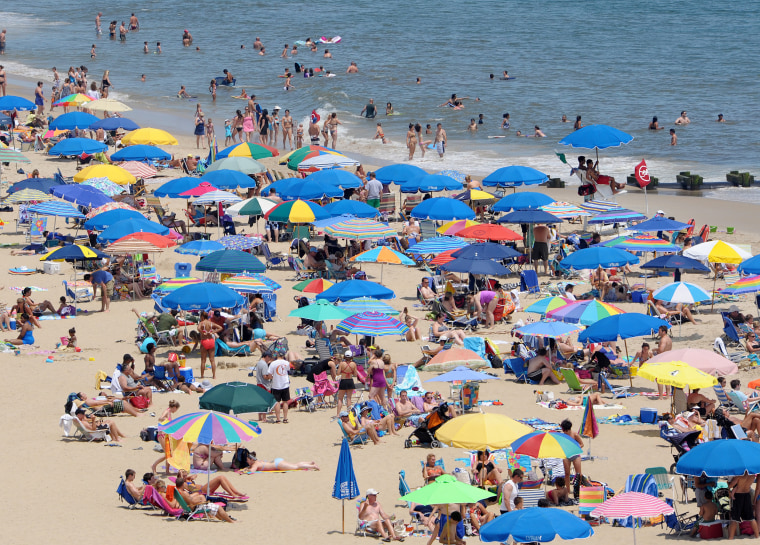
Crowds enjoy Rehoboth Beach in Delaware on July 2, 20011.Chuck Snyder / AP file
As of 5 p.m. Friday, beaches along the Delaware coast will be open for exercising, sunbathing and swimming. Guidelines, which can be found on the state’s website, require social distancing among those from different households and encourage face coverings. There is a catch, though: Those who reside out-of-state will have to maintain a 14-day quarantine upon entering Delaware in order to enjoy what its beaches have to offer.
Kuhns, however, said, “We will not have police at the entrances of Rehoboth checking your ID and making sure you live in town or not.”
As for the town’s shops and restaurants, many will be open with restrictions, with most offering only curbside pick-up.
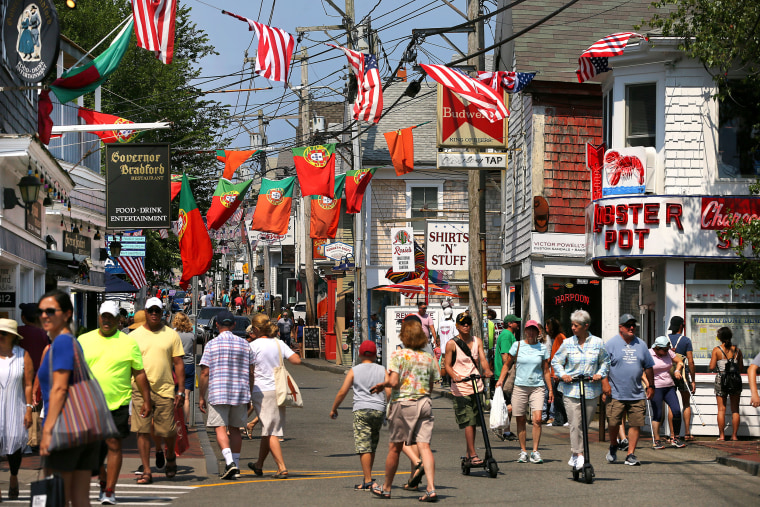
Massachusetts’ Provincetown
As the artist’s colony in Provincetown began to thrive in the early 20th century, so did its gay community. By the 1970s, the bohemian village at the tip of Cape Cod became known for its cabaret and drag scenes. Today, Provincetown boasts around 300 businesses that are part of the Provincetown Business Guild, an organization that focuses on drawing LGBTQ visitors to the destination.
“We are spending a lot of time talking about what the P-Town experience is going to look like this summer and trying to reimagine the Provincetown experience, because we believe there will still be people that come here,” Bob Sanborn, executive director of the Provincetown Business Guild, said. “We have a lot of these large-scale events and theme weeks that won’t happen as they have historically happened. With that said, we aren’t expecting the up-swells and crowds that traditionally happen here week to week.”
Crowds fill Commercial Street in downtown Provincetown, Mass. on July 10, 2019.John Tlumacki / Boston Globe via Getty Images file
During the typical summer peak season, Provincetown has a population of about 30,000 to 50,000, with peak holidays and events seeing nearly 100,000.
“Eighty percent of the homes are second homeowner owned, so those people will still come with their house guests,” Sanborn speculated. “And we still believe there will be some tourists. So it’s going to be a slower but steady summer.”
Both of the region’s most well-known beaches — historically gay beach Herring Cove and Race Point — are part of the Cape Cod National Seashore and have not been closed amid the pandemic, though their operations have been limited. The area’s smaller beaches, those around the harbor, have been closed, but will open on Memorial Day. Social distancing will be expected on all beaches: Household clusters will be allowed to gather, but larger groups, especially with 10 people or more, will be prohibited.
“This summer will still be uniquely Provincetown,” Sanborn explained. “It will be a special summer. Many people are saying this will be like Old Provincetown, before the big theme weeks became such a part of our culture. People used to flock here years ago for the sun and the fun and the joie de vivre and the simple, colorful life. We believe it will be a summer like that.”
And, just like in years past, Sanborn and other community leaders acknowledged the resiliency of the LGBTQ community when unforeseen threats arise.
“The gay community is very creative and inventive, especially in a crisis,” Pagano said. “We survived the HIV epidemic and made a comeback. I think the same thing about this. Those same creative energies will be out this summer.”


:no_upscale()/cdn.vox-cdn.com/uploads/chorus_asset/file/19994281/Image_from_iOS__2_.jpg)