A tiny village made history at the weekend by electing Marie Cau the first-ever trans mayor in France.
On Saturday morning, Cau was elected mayor of a small village in northeastern France – the country’s first out trans mayor.
Cau, 55, was elected almost unanimously by the council in Tilloy-lez-Marchiennes, with 14 votes in favour and one null vote.
The municipal elections were held in March 15, with the village’s 550 citizens voting for councillors solely from the “Deciding Together” list, among them Cau.
She ran on a platform of environmental sustainability and building the local economy, according to the BBC.
Cau said she’s “not an activist” and would be focusing on municipal politics.
“People did not elect me because I was or was not transgender, they elected a programme,” she said.
“That’s what’s interesting: when things become normal, you don’t get singled out.”
Stéphanie Nicot, co-founder of the National Transgender Association (ANT), said that Cau was, to her knowledge, the first trans person elected mayor in France.
However, she cautioned that “people have been able to pass under the radars” before.
The election of Cau showed that “our fellow citizens are more and more progressive”, she added, suggesting that Cau’s win showed people voting on “the value of individuals, regardless of their gender identity”.
Marlène Schiappa, France’s minister for gender equality, tweeted her congratulations to Cau.
“Trans visibility, and therefore the fight against transphobia, also requires the exercise of political or public responsibilities,” she said.
“Congratulations to Marie Cau!”
Cau has lived in Tilloy-lez-Marchiennes for 20 years, and has three children.
She toldLe Parisien that her plan for the village in her role as mayor is “a model based on sustainable development, the local economy and short circuits, social and better living together”.
A qualified engineer, she will combine her mayoral duties with her business of IT consultancy.
Senator Scott Wiener (D-San Francisco) introduced legislation last week that would require California to collect data on the health impacts of COVID-19 on the LGBTQ community, including infection, hospitalization, ICU, recovery, and mortality rates.
“We know that COVID-19 is harming the LGBTQ community, but because no data is being collected, we’re hamstrung in making the case to devote attention and resources. The history of the LGBTQ community is a history of fighting against invisibility. Without data, we quickly become an invisible community and risk being erased. California must lead and collect this critical health data,” Weiner said.
The state currently collects data on COVID-19 based on race/ethnicity, age, gender and other demographic information. SB 932 would expand the type of data to include the LGTBQ community, helping us understand the impacts of the pandemic on LGBTQ people. This would be the first legislation of its kind to compel a state government to collect this information; currently, neither the federal government nor any of the 50 states are doing so.
COVID-19 impacts everyone of all races, nationalities, ages, gender identities, and sexual orientations. But some communities and groups are more vulnerable than others, and it’s critical to understand these discrepancies and provide support accordingly. Because rates of cancer, HIV/AIDS, and respiratory issues (due to smoking) are higher in the LGBTQ community, LGBTQ people are likely experiencing greater health impacts from COVID-19. Additionally, there are higher rates of homelessness and youth homelessness in the LGBTQ community – this is an additional risk factor for COVID-19, as unhoused people are less able to socially distance. But there is currently no state or national effort to collect data on how COVID-19 is impacting the LGTBQ community.
There is also a longstanding history of government neglect for LGBTQ health, often with regards to a lack of data collection. The census – and many health forms – currently do not ask about sexual orientation and gender identity, which means that the LGTBQ community often suffers from a lack of resources and focus from public health infrastructure. This neglect is most pointedly illustrated by the federal government ignoring the HIV/AIDS crisis in the early 1980s, an epidemic of which so many members of the LGBTQ community died. President Ronald Reagan did not say the word “AIDS” until 1986, after thousands had already passed away from the disease. SB 932 will ensure that public health officials will understand the impacts of COVID-19 on the LGBTQ community, and will help LGBTQ people get the resources they need.
Due to any privacy concerns this may bring up, this data will be anonymized, and self-reporting of sexual orientation and gender identity will be optional but encouraged.
“This is not the first pandemic in which the federal government has ignored or erased the LGBTQ+ community, but we’re committed to making sure it’s the last. LGBTQ+ people are more vulnerable to COVID-19 because of disparities in health and well-being that we’ve faced for generations. But as long as public health officials and government agencies aren’t collecting data to understand the size and scope of the impact, our community is at risk of being left out of relief efforts. It’s crucial that California meet this moment and lead the way,” Equality California Executive Director Rick Chavez Zbur said
It was perhaps ironic that Little Richard and Roy Horn (of Siegfried & Roy) died within hours of each other this month. Though they were from totally separate pop culture factions, seeing their obits side by side in some outlets, such as the May 10 New York Times, was a sobering reminder of how an older generation of gay men — Horn, who died at 75 was on the outer cusp of the Boomers; Richard was 12 years older — dealt with (or didn’t deal with) their sexuality in a pre-Stonewall era when practically nobody was officially out but demeanor, style, stage persona and more “read” gay to middle America the same way sexual innuendo was implied in early jazz and movies long before it was discussed or depicted openly.
Little Richard (Richard Wayne Penniman was his legal name) was known for a string of ’50s hits like “Tutti Frutti” and “Long Tall Sally” whose impact went far beyond their initial chart peaks. Richard has been widely lauded as a rock and roll innovator and the first pop star to integrate black and white audiences in a time of rigid segregation in music and society. He died May 9 from bone cancer at his home in Tullahoma, Tenn., after a two-month illness. He was 87.
Horn came to fame with his nearly life-long professional (and for a time personal) partner Siegfried Fischbacher, who were known for their flashy Las Vegas act in which they made lions and tigers (and each other) vanish and reappear. They came to Vegas in 1967 and had a sellout run at the Mirage Resort and Casino from 1990-2003 that found them performing 500 shows yearly. By 1999, the show had grossed half a billion dollars and they were Vegas’s highest-paid entertainers.
Sadly, their careers ended abruptly on Oct. 3, 2003 (Horn’s birthday) when one of the tigers attacked Horn resulting in serious injury. Suffering a stroke and partial paralysis on his left side, Horn was eventually able to walk with assistance but never performed again. The duo made one final public appearance in 2009 with a tiger at a benefit for the Lou Ruvo Center for Brain Health in Las Vegas, the Times reported, before retiring officially in 2010. Horn died of COVID-19.
The duo (both German immigrants) only officially came out in 2007 in a National Enquirer article that announced “We’re gay” on the cover. They gave few interviews (even in their heyday) and could be testy about it when pressed.
Behind the glitz
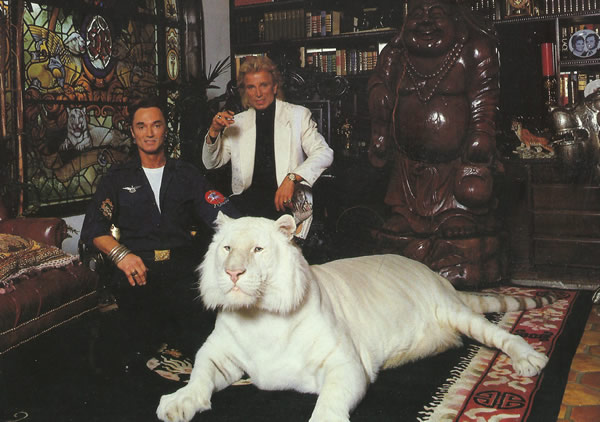
SIEGFRIED & ROY at their home, The Jungle Palace. (Photo illustration from 1998 program book; courtesy Mirage)
But with their over-the-top costumes (including Roy’s trademark codpiece), ostentatious Vegas home and inseparable public image (and never a hint that either might be involved romantically with anyone else), they didn’t have to state it explicitly. They donned capes and silver space suits, battled a sorceress and a fire-breathing dragon amidst smoke machines, lasers and, of course, lions and tigers, many of which were white, which are uber rare. Their act had a Liberace-esque flair to it, even if neither were ever quite that fey. Siegfried was the magician; Roy the animal trainer. They presented a yin/yang-type persona and lived together at Jungle Palace, an eight-acre Vegas estate (a much larger ranch was just outside the city proper) with, as of 1999, 55 tigers and 16 lions. Horn was the “Tiger King” decades before anybody heard of Joe Exotic (also gay) of the hit Netflix series.
“So you go deeper and say what is going on in my bedroom and in Roy’s bedroom,” Fischbacher said in a 1999 Vanity Fair profile. “I don’t care, I don’t know. I tell you this because this is me and I wouldn’t ask what you do with your dick either.”
Both said they were “very honored” to be considered gay icons but spoke of gay as “other.”
“I have a lot of friends who are gay and I made a lot of friends in show business and I found out that they are always interesting, intelligent and good people and fun to be with,” Fischbacher told Vanity Fair.
“I am flattered to think that people think that I am versatile,” Horn said. “You don’t have to define everything and I don’t want to disillusion people because I’m not a guy who kisses and tells.”
Pal Shirley MacLaine told the magazine they “used to be lovers a long time ago, yeah? In this day and age, who cares?”
Mainstream media only coyly touched on Horn’s sexuality. The Times said Fischbacher and Horn “were domestic as well as professional partners” but left it at that. Journalist Steve Friess, who in The Advocate called them “the world’s most openly closeted celebrities,” said a Mirage spokesperson told him the night of Horn’s attack that “it’s well known that they were lovers at one time.”
They were said to have little presence in Vegas gay life, according to Friess and others, and outside of buying an ad in a program book for an AIDS fundraiser, were not known to have used any of their vast wealth to support LGBTQ rights.
For some, that’s not a problem.
Milt Larsen, founder of The Magic Castle, a private club for magicians and enthusiasts in Hollywood, is 89, straight and knew Siegfried and Roy for many years, initially through his late sister-in-law, Irene Larsen. She and her husband Bill Larsen (Milt’s brother) loved magic and animals and discovered Siegfried & Roy in their early years in Vegas. Larsen later met the duo through his brother and sister-in-law and says Horn was “a dear, great friend.”
“Before Siegfried & Roy, magicians were very seldom anything other than an opening act,” Larsen says. “They came along and went from being an opening act to the headliner with their own huge show because it was so popular. … They were the best.”
Larsen’s friend Dale Hindman also know Siegfried & Roy and says he was at their house several times. He says Roy “fought like crazy” to recover and “they had the best medical people” working with him. He did daily physical therapy, swam and would zip around the grounds on a scooter. He recalls one Vegas convention in which Horn made a rare, post-accident appearance and walked to the podium.
“There wasn’t a dry eye in the house,” Hindman says. “I saw him a number of times at different places. He was in the scooter, he would talk, he loved people, he had great quality of life and they had the resources to have the best medical care. It’s such a shame that something like this virus came along and killed him.”
Larsen and Hindman say Horn’s sexuality was understood but “never really discussed.”
“I’ve been in show business a long time and sometimes it feels like just about everybody I’ve ever known was gay,” Larsen says with a laugh. “It was a different world then. I just don’t recall anybody ever talking much about it.”
Hindman says it was generational and gradual when more celebrities started coming out officially. Larsen says Fischbacher, especially (whom he calls a “great” businessman), just “never made a big point of it.”
“They were a couple in the sense that they were absolute partners in what they did and that their lives were their business,” he says. “People are people and in the world we live in today, it’s just not questioned as much.”
Larsen remembers “many, many times” being backstage in their Vegas dressing room post-show.
“The Champagne would be flowing and there were lots of wonderful friends,” Larsen says. “[Roy] was very, very gregarious and he and Irene really got to know each other and became wonderful friends.”
“There would be drinks and hors d’oeuvres and plenty of people,” Hindman says. “After awhile, Roy would go play with the animals. Siegfried would say, “I’m tired but you all stay as long as you want.’”
Out magician/actor Michael Carbonaro, 44, of reality show “The Carbonaro Effect,” said in a written comment to the Blade it didn’t matter if Siegfried & Roy were coy about their sexuality.
“I actually don’t know what Siegfried & Roy ever did or didn’t put into words,” he said. “I grew up seeing two gorgeous men living their magic dreams in bedazzled outfits, so they were always an iconic form of queer inspiration.”
It’s complicated
Others, however, aren’t willing to let them off the gay hook so easily.
Matthew Rettenmund, a gay blogger and pop culture historian/author, says Horn’s approach to being “out” reminds him of singer Barry Manilow who finally came out in 2017 at age 73 after decades of evading the question.
“They’re men who have convinced themselves that being gay in private is the same thing as being out,” he said in an e-mail. “Which is simply not true. I do hope that as the Rip Taylors and Richard Simmonses of the world leave us, as sad as it is to lose their talent, that they won’t be replaced by more of the same. Hiding in plain sight is still hiding and it still sends such a warped message of self-acceptance.”
Long-time gay Vegas resident/historian Dennis McBride says he can see where both sides of the issue were coming from.
“Siegfried and Roy were never involved in the Las Vegas queer community in any public way I’m aware of,” McBride wrote in an e-mail to the Blade. “They were much like Liberace in that respect — they were Las Vegas icons, counted Las Vegas as their personal and professional home, but deeply closeted because they came of age and established their careers during a time when they could have been jailed for being gay and lost those very lucrative careers. I remember there was some resentment in the community because we needed role models — particularly in the 1980s and early 1990s during the worst of the AIDS pandemic — and both Liberace and Sigfried & Roy might have been a great help in our struggle, brought credibility and support to our fight. I don’t think any of us entirely blamed them, though, because we were all in danger then ourselves as queer people.”
And while Richard stated he was gay explicitly on multiple occasions, he was never at peace with it and at multiple times in his career recorded gospel music and even for a time sold Bibles in a repudiation of the rock and roll and gay “devil’s” music and “lifestyle.” For him, being gay was a vexation and something to be overcome, which is, to some, even more troubling than Horn’s avoiding the issue.
“The problem is his religiosity and self doubt forced him back in the closet just as many times, “Rettenmund wrote. “And though he camped it up to earn a living in his final decades, it was homophobia that won. He died an ‘ex-gay,’ a sad loss.”
Richard was married to a woman from 1957-1964. They had one adopted son. As recently as 2017, he was condemning gay sex. “God, Jesus, he made men, men, he made women, women, you know? And you’ve got to live the way God wants you to live,” Richard told the Three Angels Broadcasting Network, a religious channel, reported by The Advocate.
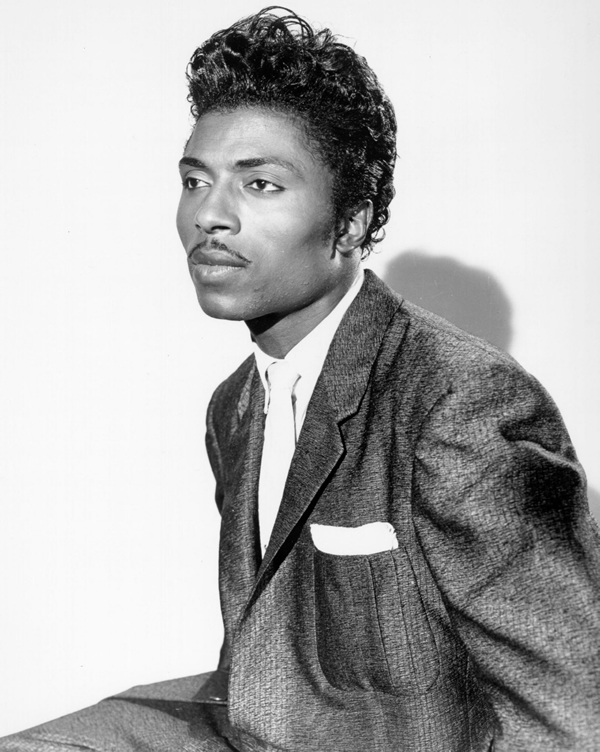
LITTLE RICHARD in the 1950s when he first achieved fame. (Photo courtesy Atlantic Records)
Gay author/actor Michael Kearns (who’s been on “Cheers,” “Murder, She Wrote,” “The Waltons,” “Knots Landing” et. al. and has said in interviews and books he had sex with Rock Hudson and Barry Manilow) says Richard deserves a more compassionate assessment.
“I don’t know how much gay sex he was having, but for me it was all about him having such a gay persona,” Kearns says. “I think what young men like me found so stirring and exciting is that it gave us something to grasp onto. Here was this sissy, this exciting, flamboyant, theatrical, wild persona and yeah, he later had the doubts and went back into the closet as a religious fanatic, well, of course he did. He was a black man from the South dealing with all that church stuff. I mean that’s a big struggle and I think people just don’t give him enough human credit for battling that publicly.”
McBride says after their performing years, Sigfried & Roy were occasioally seen in Vegas’s gay spots. They separated romantically in 1996, he says, when Fischbacher got his own house in Spanish Trails. In more recent years, after Horn’s accident, speaking out for gay causes wouldn’t have carried as much weight, he says.
“No one really cared by then,” McBride says. “The moment when their honesty mght have made a positive difference to the Las Vegas queer community had long passed and so had the careers they might have lost if they’d come out earlier.”
He says they were “largely circumspect” but “we still saw them discreetly out and about.”
“Even before (they broke up), when we saw them in the community, it was usually separately,” he says. “The two of them would visit the Le Cafe nightclub in the 1970s which then stood on the northwest corner of Tropicana Avenue and Paradise Road. The club’s lesbian owner, Marge Jacques, counted them as friends. In the 1980s, separately or together, they’d come to Gipsy, which then was an upscale dance club on Paradise Road and Naples Drive.”
They were also spotted occasionally at seedier gay spots, McBride says.
“Roy seemed to enjoy the Talk of the Town adult bookstore when it was in the Crestwood Shopping Center on East Charleston Boulevard and one or the other was occasionally seen at the Camp David bath house on Industrial Road,” he says. “But mostly, they and their circle of gay friends — which included Liberace and Hans Klok, who came out about the same time Sigfried & Roy did in 2007, and their protege, Darren Romeo, who just came out during his run in Pigeon Forge, Tenn., — kept themselves pretty much sequestered at Little Bavaria back in the day. I think the idea of a queer community was alien to them, outside their experience, maybe even distracting and a bit threatening.”
Religious hangups
Gospel music producer/historian Anthony Heilbut has written at length about how black Christian denominations have shamed or welcomed queer musicians to varying degrees in the ‘50s, ‘60s and prior. He knew Little Richard — not well, but they’d met on several occasions — and says one must consider the era when deciding how much blame to assign him. He wanders into another room of his New York apartment during a phone interview last week and puts on a recording of gospel singer Marion Williams (1927-1994), who for a time was in The Famous Ward Singers, helmed by Clara Ward (one of Aretha Franklin’s major influences) and who also had a significant solo career. He holds the phone up to a recording of her whooping and hollering and it’s easy to see where Little Richard got some of his inspiration. Richard appeared at the Kennedy Center Honors when Williams was inducted.
“His phrasings and his timbre and even his ballad singing, and he was a great ballad singer although we typically think of him as this sort of rock and roll clown, all that came from Marion Williams,” Heilbut, who’s gay, says. “You can’t copyright phrasings. That’s what singers could take from each other.”
Heilbut also says Richard, whom he first met in 1961 and says he’s “one of the very few people who ever saw him sing on a gospel program,” says Richard’s gospel singing career was never terribly convincing or memorable partially because he came from a staid denomination (Seventh Day Adventist, not nearly as musically rowdy as black Baptists and those in the Sanctified Church) and the fact that it was performed more dutifully than his rock and roll material.
“He was singing, ‘I quit show business and I wanna go straight/I wanna serve the Lord before it’s too late,’” Heilbut says. “His singing was very bland. There was more of the real gospel drama in his R&B and rock music.”
Heilbut also says Richard admired Williams in the traditional way gay men have worshiped show-stopping divas. He remembers seeing Richard at a Nashville studio when Heilbut was producing one of Williams’ later recordings. He mimics Richard’s speech patterns, recalling the conversation: “‘Is she still fabulous? Do she still make notes? I makes notes. I heard she preaching. I preaching too. … She always war my heart, she know, she know. I’ve been singing like her down through the years. Mahalia good, but Marion always were my singer.’”
Heilbut also says Richard’s various stints in gospel music robbed his career of momentum in rock. As respected as he was among rock pioneers, he’s almost wholly associated with his ‘50s heyday. Attempts at secular music comebacks in the ‘60s and ‘70s could not come close to matching his peak period.
“He made some very lovely records later and he could be a wonderful singer, but by then the audience had changed,” Heilbut says. “The train had passed.”
Later in life, Heilbut says, Richard was seen socializing in gay bars. He never personally saw him but says friends reported him being “the belle of the ball” at St. Louis gay bars on various occasions.
Richard, whom Heilbut says “always struck me as very goofy,” was ultimately “just incredibly confused.”
Roy, Richard ‘lacked courage’
Gay activist/entrepreneur Mitchell Gold, who like Siegfried & Roy, knows something about being linked for life to a former partner — he and business partner/former domestic partner Bob Williams formed their eponymous furniture company Mitchell Gold+Bob Williams in 1989, which they continue to run jointly. He says celebrities holding onto or returning to the closet are a reminder of “how horrible these religious teachings are, how toxic.”
“I don’t even know what it’s like to live like that,” Gold says. “I was tortured about it until I was 24, 25 but then that was the end of it. These guys who live their whole lives having to be careful about that they said, it’s just horrible. I don’t know as much about Siegfried & Roy except that after awhile it just gets to be ridiculous, like the Barry Manilow thing was for so many years.”
Gold understands Richard not being out in the ‘50s or Siegfried & Roy at the advent of their careers but later in life, once they were financially secure, he says they “lacked courage.”
“I never cared if we lost money for being out,” Gold says. “I don’t have to be a gazillionnaire. If I make less, I make less and it’s the same for Siegfried & Roy. At some point they had plenty of money and so why wouldn’t they speak out for people who aren’t being sheltered the way they are and are forced to live a closeted, unhealthy life. The only thing I can say is I don’t think these folks even know what a healthy life looks like.”
Gay journalist/author Michael Musto agrees.
“It’s partly generational, though many of their generation ended up being belatedly but wonderfully out and proud — Richard Chamberlain, Joel Grey, etc.,” he wrote in an e-mail. “It’s more of a sort of self-loathing-tinged caution based on a lifelong fear of an image adjustment or career damage. Roy played to Middle American high rollers, but obviously didn’t want to gamble on his own career. One of his magic tricks was being cagey about his sexuality.”
Musto says the music business has been especially troubling for non-straight black entertainers.
“Little Richard renounced his queerness when he should have just been at peace with it and allowed himself to celebrate and be celebrated by our community,” Musto says. “Luther Vandross, Whitney Houston and many others were unwilling to step out of the shadows because the people around them (and sometimes their own inner voices) told them not to. Little Richard was so queer that it seems like a ‘duh’ that he should have just gone there. But with Adam Lambert, Sam Smith and many others (and Elton John, Melissa Etheridge and k.d. lang having led the way), things have inalterably changed.”
Although Fischbacher and Horn never spoke of their religious influences — their decor reflected influences of Eastern religion and Horn would sound a large gong in his bedroom to let the tigers know he was awake — for Richard, Kearns says, it was tragic.
“I’m not saying there aren’t some fabulously evolved people who are religious but we’ve seen time and time again how religion gets its hold on gay people at a very early age and just does not let go and the result can be horrific,” Kearns says. “Richard is a fascinating creature to me. In a way, it’s amazing he lived as long as he did with this struggle. He deserves a lot of credit. He didn’t have an easy time of it.”
LGBT+ refugees and asylum seekers are being excluded from crucial coronavirus relief packages offered by the South African government, multiple human rights groups have warned.
South Africa is a common destination for those fleeing countries that persecute sexual minorities, as 33 out of the 70 countries that criminalise homosexuality are in Africa.
But queer people arriving in the country have little access to basic amenities and are now facing starvation amid the ongoing lockdown.
The pandemic has cut them off from working in the informal trades that previously sustained them, including restaurants, bars, or sex work, and they are not eligible to receive government social grants or food parcels, as these are are distributed only to those with South African identity cards and Social Security cards.
Human Rights Watch is appealing to the country’s government to take urgent steps to help these migrants, who were already living on the economic margins before the pandemic began.
“The Ramaphosa administration should either ensure access to food for thousands of refugees and asylum seekers, or say that it can’t meet the need and seek donors to step in and provide assistance,” said Dewa Mavhinga, southern Africa director at Human Rights Watch.
“The government is ignoring the plight of refugees and asylum seekers currently confined in their homes and unable to work to provide for themselves.”
After hearing desperate pleas from refugees and asylum seekers, Human Rights Watch raised the issue with the South African Human Rights Commission.
The Commission confirmed receiving similar reports and pressed the authorities to extend support for these marginalised people during the coronavirus lockdown.
Their calls of alarm were joined by the African Commission on Human and Peoples’ Rights. The ACHPR delivered an urgent appeal to South African President Cyril Ramaphosa, expressing concern at the lack of protection for vulnerable groups, which includes LGBT+ migrants.
“South Africa should make special efforts to protect the most vulnerable in the country and ensure that refugees and asylum seekers are not overlooked or forgotten,” Mavhinga said.
“The authorities should act and seek donor support to avert an imminent humanitarian catastrophe.”
It is with deep sorrow that we announce the unexpected passing of our President, JD Donovan. She passed on Thursday evening May 21, 2020 at home peacefully surrounded by loved ones. Her death was unrelated to the current health emergency. Having fought a battle with a serious illness, it finally took her from us.
When Sonoma County Pride (SCP) reorganized in 2014, she was a charter member along with Vice-President Brian Rogers, Directors Emeritus Vickie Nicholson, and Robbie Ernst. JD served as our President from then until her passing on Thursday. She was passionately committed to the mission of Sonoma County Pride. Extremely proud of the growth and development of SCP, she knew it the hard work of the entire board, the committee chairs, and her beloved volunteers that allowed SCP to be where we are today. Most importantly, they all knew that without the support of our community, none of this would have been possible.
Vice-president, Brian Rogers will assume the role of acting President. In November 2019, Brian announced plans to retire from the board of directors to pursue the development of the Sonoma County Pride Diversity Foundation. Their initial mission will be to support the development of an LGBTQI+ Center for Sonoma County.
The Board of Directors will be holding an election to replace both officers in early June. This will allow for ample transition time prior to Brian’s departure. Sonoma County Pride has grown into a strong and resilient organization managed by a bright and talented team of volunteers. We look forward to the reopening of our county so we can continue our work. We look forward to the great things the future holds for our community and our organization.
JD is survived by her wife, Mel Donovan-Thompson who has requested privacy at this time. At JD’s instruction, no service will take place while social distancing policies are in effect. In several weeks, Ms. Donovan-Thompson will announce the date and time of a virtual celebration of life for JD, which will probably take place in July.
The entire Sonoma County Pride family will miss JD’s calm, compassionate leadership as well as her quick laugh and warm heart. She will stay in our thoughts. As we take the organization forward to meet the future, her spirit will always be with us.
Ramzan Kadyrov, the Chechen tyrant who orchestrated the region’s brutal gay purges, has reportedly been hospitalised with severe coronavirus symptoms.
Kadyrov is president of the Chechen republic in Russia, where LGBT+ people have been imprisoned, beaten, tortured and killed in gay concentration camps.
Despite countless refugee reports detailing the violent abuses they have suffered, Kadyrov has forcefully denied that the crackdown ever happened.
“This is nonsense,” he previously said when asked about the allegations. “We don’t have those kinds of people here. We don’t have any gays. If there are any, take them to Canada.
“Praise be to God. Take them far from us so we don’t have them at home. To purify our blood, if there are any here, take them.”
In what will no doubt be a fortunate twist of fate for the region’s remaining LGBT+ population, Kadyrov now appears to have earned the title of the first Russian official to fall seriously ill in the coronavirus pandemic.
According two Russian state news agencies, RIA Novosti and Tass, Kadyrov was flown to a clinic in Moscow as his symptoms rapidly deteriorated.
“Ramzan Kadyrov has been brought to Moscow by plane with suspected coronavirus. He is currently under medical observation,” Tass said, citing “a source in medical circles”.
Six in 10 gay and lesbian Europeans avoid holding hands with same-sex partners in public, and over half of LGBTQ people in Europe are almost never open about their sexual orientations or gender identities, according to a new survey.
“The overarching finding was that not much has changed and there’s a long way to go,” Miltos Pavlou, the survey’s project manager, told NBC News. “Hate and inequality remain a major challenge in our society.”
“Changing laws are incredibly important first steps, but really building meaningful acceptance takes years.”
EVELYNE PARADIS, ILGA-EUROPE
The report, “A long way to go for LGBTI equality,” published by the European Union Agency for Fundamental Rights, found that there has been “little, if any, progress during the past seven years in the way LGBT people in the EU experience their human and fundamental rights in daily life” since the first edition of the report was issued in 2012. The findings are based on a survey of 140,000 lesbian, gay, bisexual, transgender and intersex people in the E.U., the U.K., Serbia and North Macedonia.
Based on the survey’s criteria — which included questions about discrimination, awareness of rights, life satisfaction and experiences at work and in education — transgender and intersex respondents reported higher rates of discrimination and threat. For example, 1 in 5 trans and intersex people said they were physically or sexually attacked in the five years before the survey, double the proportion of other groups across the LGBTQ spectrum.
While LGBTQ people are legally protected in many nations across Europe, Pavlou said the survey found a hesitation to rely on law enforcement and other government officials. The report found that while one-third of respondents felt their national governments effectively combat prejudice and intolerance, only a fourth of trans respondents said they agreed, and 14 percent of LGBTQ survivors of physical or sexual assault do not report the crimes to the police.
“People are more aware of their rights, but at the same time they don’t report discrimination,” Pavlou said.
Evelyne Paradis, the executive director of the International Lesbian, Gay, Bisexual, Trans and Intersex Association of Europe, said the findings were “not entirely surprising.”
“It’s concerning that our sense of stagnation is confirmed,” said Paradis, whose organization was not involved with the report. “We would’ve hoped there would’ve been more progress.”
Echoing the survey’s findings, she said, “It’s very clear that in a broad rainbow umbrella, the trans and intersex communities are even more marginalized and vulnerable than lesbian, gay and bisexual people.”
When compared to the Agency for Fundamental Rights’ 2012 survey, the 2019 report shows little, if any, progress in how LGBTQ people in the E.U. are treated. While all LGBTQ people reported that they felt discriminated against in all aspects of life in the 12 months before the survey, transgender people reported a significant rise in overall discrimination — 60 percent today, up from 43 percent in 2012. Over 20 percent of all LGBTQ people reported feeling discriminated against at work in 2019, relatively unchanged from 19 percent in 2012.
Download the NBC News app for breaking news and alerts
The comparison between the two surveys did find that LGBTQ people have become increasingly open about their sexual orientations and gender identities: In 2019, 52 percent of respondents over 18 said they were often or always open about their identities, compared with 36 percent in 2012.
“The main reason those who said the situation in their country was better was because of their openness, visibility and participation in society,” Pavlou said.
The report found that in some countries, such as Ireland, Malta and Finland, over 70 percent of respondents think society is more tolerant but that in others, such as Poland and France, more than half find it less accepting.
“It’s not just about policy and law. It’s about implementing them,” Pavlou said. “Belgium has been a progressive country, and they have one of the highest results in terms of hate and violence.”
Paradis said countries with legislation affirming LGBTQ rights become complacent. As people are more aware of the diversity of LGBTQ identity and experience, she said, governments need to continue to protect the LGBTQ population and endorse educational efforts to ensure that equality remains.
“The mistake that many governments still make is thinking that once you adopt the laws, then everything will work out,” Paradis said. “Changing laws are incredibly important first steps, but really building meaningful acceptance takes years.”
On what would have been his 90th birthday, there are many reasons to remember Harvey Milk. One of which is dog poop.
Decades on since his death in 1978, and San Francisco residents each day peak out of their apartments to see the city’s tanned streets free from pet waste.
They have Milk to thank for this, a city official who sponsored an ordinance that fined people for not clearing up after their dogs.
But there’s more to Milk than a cosmetic improvement to the avenues and roads that criss-cross the city. A pioneer of the LGBT+ rights movement, Milk was the first openly gay person ever elected into public office in the US.
Milk was the first openly gay man to be elected to public office in California (Bettman/Getty)
A victory indescribably seismic at a time where fledgeling LGBT+ rights movements were being curtailed by conservative lobbies. Yet Milk managed to galvanise support and, during his time in office, pass a stringent ordinance outlawing discrimination based on sexual orientation.
Less than a year after being elected to the board of supervisors in 1977, he was fatally shot by his former city supervisor opponent, Dan White.
Hearts broken. Votes tallied. Lives risked and saved.
The life of Milk that has come to be lauded by his contemporaries is one of a pioneering spirit.
The son of Russian‐Jewish immigrants, Milk, of Long Island, New York, was born in 1930. He went onto earn a bachelor’s degree in 1951 from the Albany State College for Teachers and spent his school years in the closet.
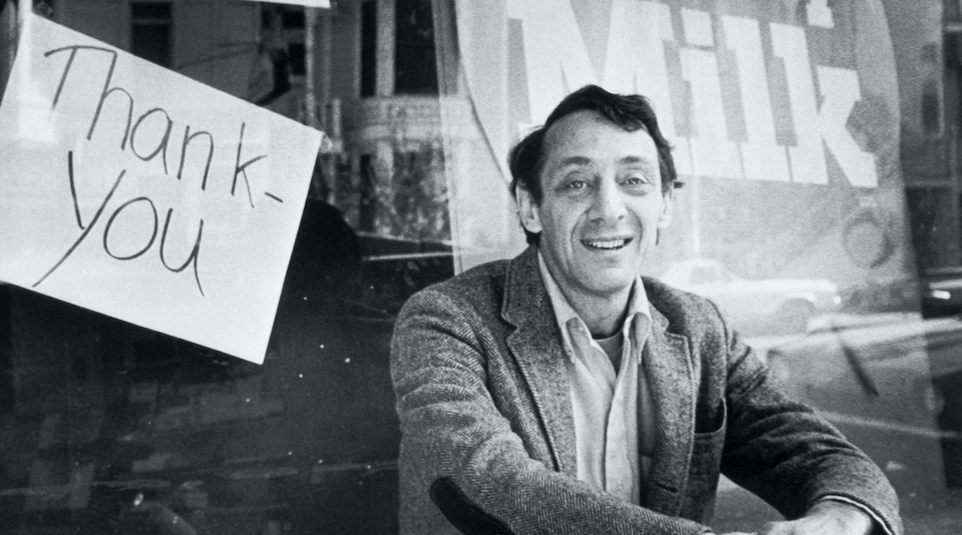
Harvey Milk sits outside his camera shop, November 9, 1977 (Bettmann/Getty)
After graduating, he enlisted in the United States Navy and worked diving instructor in San Diego. Milk served four years before superiors found him in a park with gay men – he was then forced to resign.
His biography then became a brief run-in with Wall Street, but his colleagues noticed his lack of drive for the finance district. Across his forays into local electoral politics, however, everyone could see the passion that fizzled within him.
It took three tries for Harvey Milk to be elected supervisor.
Milk was 41 years old with when he crooned into San Fransisco in 1972.
Settling into the Castro district, he set-up a camera shop that became a refuge for the city’s LGBT+ community, long abraded by prejudice. Many looked to Milk for leadership and he exhorted them to be open and visible.
Armed with nothing more than a bullhorn and a dogged, almost impish attitude, he campaigned for city county supervisor in 1973, a move he attributed to anger generated by the televised Senate Watergate hearings.
He was, however, unsuccessful. Losing again in 1975, before beating over 16 other candidates with 30 per cent of the vote in 1977.
Milk won with his multi-pronged policy plan of not only securing LGBT+ rights, but increased low-rent housing, free municipal transportation and better childcare facilities as well.
“It’s not my victory, it’s yours and yours and yours,” he said after winning the historic seat.
Milk’s district, the fifth, encompassed most of the Haight‐Ashbury and Upper Market Street areas, where many queer migrants had decamped. The city was fractured in this way, with neighbourhoods of hippies and working-class Catholics huddling around one another, but Milk found ways to tenderly unite people.
Harvey Milk was slain by his political opponent.
On November 30 1978, a thick fog tangled with the mid-rise buildings of San Francisco for the third consecutive day. But the thousands of people below it didn’t seem to mind.
They stuffed into the Opera House that evening to attend a non‐denominational ceremony. One that many saw the last 10 months as a steady, bleak drumbeat towards.
Three days prior in City Hall, a bullet struck Milk, killing him. Former board member White surrendered to police minutes later.
It was a moment months in the making.
In 1978, Milk struck down Proposition Six, which would have mandated the firing of state public school teachers. White was the sole supervisor who voted against Milk.
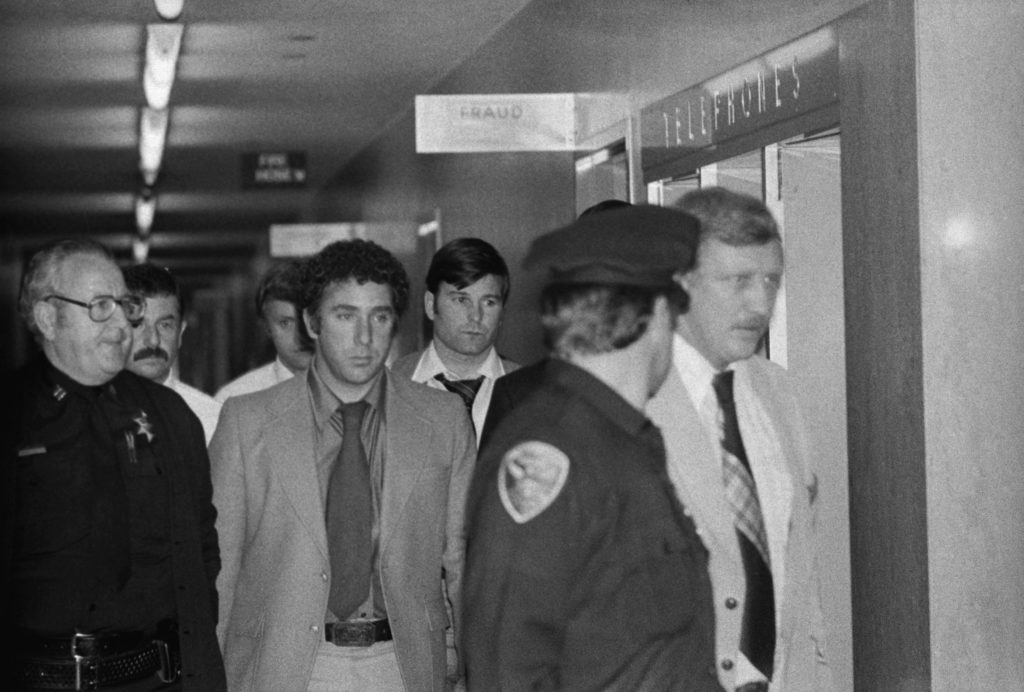
Dan White (directly beneath “Fraud” sign). (Getty Images)
After quitting from his post 10 months in, White urged mayor George Moscone to rescind his resignation, citing money troubles. Moscone refused and, on the morning of November 27, White slung into City Hall through an open window and gunned both Moscone and Milk.
White was subsequently convicted of voluntary manslaughter, rather than of first-degree murder. The verdict sparked the “White Night riots” in San Francisco, and led to the state of California abolishing the diminished capacity criminal defence.
White died by suicide in 1985, a little more than a year after his release from prison.
‘If a bullet should enter my brain, let that bullet destroy every closet door in the country.’
Pushing against the cruel, corrosive attitudes of powerful groups that sought to silence and erase LGBT+ people, Milk always knew the punitive reaction to his quest for equality.
Days after his death, Milk’s associates released a tape recording that he had instructed: “Be played only in the event of my death by assassination.”
“I fully realise that a person who stands for what I stand for, an activist, gay activist, becomes a target or the potential target for somebody who is insecure, terrified, afraid, or very disturbed themselves,” Milk said on his final tape.
“I would like to see every gay doctor come out, every gay lawyer, every gay architect come out, stand up and let that world know,” Milk said.
“That would do more to end prejudice overnight than anybody would imagine. I urge them to do that, urge them to come out. Only that way will we start to achieve our rights.”
“If a bullet should enter my brain, let that bullet destroy every closet door in the country.”
Santa Rosa plans to start an emergency rental assistance program in June expected to help an estimated 50 city households that have lost income during the ongoing pandemic, since county health officials in mid-March ordered all but essential businesses to close.
More than $600,000 in federal funds would help a group of qualified low- and middle-income renters through the end of the year, or until they get another job or resume working regular hours, city officials said.
The money would be distributed based on renters’ needs. Recipients still would pay 30% of their current household income toward monthly rent and funds from the assistance program would cover the remainder.
There is no cap on how much financial aid a renter could receive each month.
Officials anticipate the program would help around 50 households, though that number could change based on how much money is needed to help eligible tenants pay their rent.
GlaxoSmithKline said an injection every other month of its cabotegravir drug was shown to avert an HIV infection more effectively than Gilead’s daily Truvada pill, potentially giving its ViiV unit a foothold in HIV prevention.
The drug trial involving men who have sex with men was stopped early by an independent monitoring board after cabotegravir was found to be 69 percent more effective than the current standard of care, Truvada, the British drugmaker said on Monday.
But the market segment GSK is eyeing is about to become more competitive as cheaper generic versions of Truvada are expected to be launched in the United States in September, as the patent expires.
Gilead, for its part, hopes that Truvada users will opt against the cheaper copies and switch to its new daily pill Descovy, approved in October 2019 after it was shown to be less toxic to the kidneys and bones.
Truvada generated $2.8 billion in sales last year, both from treatment and preventing an HIV infection.
Kimberly Smith, ViiV’s head of research, said a long-acting injection was a better route of administer because users have shown to struggle with a strict routine of daily pills, heightening the infection risk.
“Individuals have to show up every eight weeks in the clinic for the injection but in-between there is not a need to take a pill daily, so you really change the equation for adherence with a long acting (drug),” Smith said.
GSK, which is trailing Gilead in the HIV treatment market, will speak to drug regulators about a possible approval of cabotegravir based on the prevention trial, a spokesman said.
Prevention “has turned into a multi-billion opportunity for Gilead but we think consensus estimates include little or nothing for GSK in this market,” UBS analysts said in a research note.
GSK has won approval in Canada for cabotegravir as one of two key ingredients in long-acting HIV treatment combination Cabenuva, whereas in the United States, the company has run into delays seeking the go-ahead for Cabenuva.
An initial readout from the trial, which started in late 2016, was previously not expected before next year.
A similar trial to test the cabotegravir injection to prevent HIV in women, is still ongoing.
Pfizer and Shionogi & Co Ltd hold small stakes in GSK’s HIV-focused ViiV Healthcare division.