An “out and proud gay law enforcement deputy” from Florida who died of complications from coronavirus is being remembered by as a “protector of the LGBT+ community”.
Deputy sheriff Shannon Bennett was 39 when died on April 3, just a week after testing positive for COVID-19.
He had left work on March 23 feeling unwell, and went to the hospital the following day where he was tested for coronavirus.
Tributes pour in for Florida police officer who died of coronavirus.
Florida’s Broward Sheriff’s Office, where Bennett worked for more than a decade, led tributes to the late deputy.
“Deputy Shannon Bennett was a 12 year veteran of the Broward Sheriff’s Office; an out and proud gay law enforcement deputy; a school resource officer who protected and mentored the young students at Deerfield Beach Elementary; a man in love whose wedding was to be held later this year,” colleagues wrote in a Facebook post.
“We love and will miss you, Deputy Bennett. Thank you for your bravery, your kind heart, and your service. Rest In Peace.”
“During the Stonewall Pride fest in Wilton Manors, he never participated in the drinking aspect, the fun part of it,” he said.
“He always wanted to be in uniform, on the street, protecting his community. And he was very proud of that fact, that that’s what he did on most weekends.
Whenever they closed down Wilton Drive, he was there, in uniform, protecting us.
After the 2016 Pulse nightclub shooting in Orlando, Florida, Bennett took to parking his patrol car outside bars and clubs in the gay area of Wilton Manors to show that they were protected.
“Shannon Bennett was the kind of guy who would put his family first, his friends second, and himself last,” Martin told local media.
A second police officer from Broward Sheriff’s Office, Jose Diaz Ayala, subsequently also died of complications from the disease.
According to the current shelter in place order we are to leave our homes solely for the purposes of providing or receiving essential services. While we all still need to feed ourselves, trips to the grocery store are not what they once were before the inception of the coronavirus. With this in mind, we hope that the following advice collected from the County of Sonoma and local grocers may be of help to facilitate your safe food shopping while helping to decrease the spread of COVID-19.
Limit or avoid all trips to the grocery store
Staying home means staying safe and keeping other people safe: plan ahead by making a detailed list of your food needs. Go to the store only when absolutely necessary. This can be a good time to shop for your pantry and freezer. Try to buy enough food to last for two weeks.
But, you think, what good are grocery lists when many items on your list may be sold out? All the more reason to plan for alternative choices. You can even Google ingredients to see what the world’s collection of recipes can do for the foods you may already have on hand. (Remember to check dates on food items you may have at home. This is not a good time to risk food borne illnesses.)
If you would like to avoid the grocery store all together, several grocery chains — including Safeway and Raley’s — offer no-contact pickup and delivery. Simply order online and pickup your order at a specified parking location in the store’s lot, or have your groceries delivered to your own doorstep. Instacart is another option for home grocery delivery. Because these services are likely to be in high demand right now, make sure to stay on top of your food supply so that you can order a week before you run out.
Wash your hands, wear a mask and don’t touch your face
Experts also advise shoppers to wash their hands before they shop and immediately after. Soap, water and thorough washing is the gold standard for fighting off viruses. And don’t touch your face (wearing a mask or face covering will help prevent you from doing so).
Most stores provide wipes for cart handles and freezer doors — but it’s also a good idea to bring your own.
Don’t bring the family
During a shelter in place order, any trip outside the home can seem like a potential excursion. But while a family trip to the store may sound appealing, it is not a good idea during the coronavirus pandemic.
Write a shopping list together and then send only one person from each household to the store — this reduces the amount of people in the store, making it easier to maintain social distancing, thus decreasing the risk of getting and spreading the virus.
Go when it is less crowded
As more people are unable to work or are working from home, the natural rhythm of grocery stores has shifted. Still, by and large, there are generally less people early in the morning and later at night. If you arrive at a store which is packed with people, come back at another time. A Google search of a particular store can give you an indication of the current foot traffic in a pop-up box.
Several local grocery stores have implemented seniors-only hours: this is a time for older adults and people with underlying medical conditions to shop away from crowds during the coronavirus pandemic.
You may also consider shopping in a small market close to home to reduce the number of people you’re around.
Keep the distance
Local grocers are finding a need to constantly remind people to pay attention to the 6-foot distancing marks. Let’s help them help us. This includes keeping your distance from grocery store workers.
Grocery clerks, while they go about performing an essential service for us, are particularly exposed during the coronavirus pandemic. Try not to crowd the store personnel when asking about the availability of your favorite ice cream.
Get in and get out
Again, plan your shopping trip in advance. Have a list on hand and keep yourself and grocery workers safe by getting your goods quickly. This is not a time to be browsing the store while googling Ina Garten recipes. The people in the line that wraps around the building will appreciate your quick and efficient shopping efforts.
Treat fresh produce like dog poop
Grab that beautiful kohlrabi using a produce bag as a glove, the same way dog walkers pick up their dogs’ waste. Then turn the bag inside out to contain it. Watch this video from Oliver’s for a demo. And don’t touch items you are not purchasing or contemplate purchasing. If you must knock on that melon, put a bag over your fist. Then knock gently.
Wipe down your debit, credit or membership card
Wipe cards down before and after presenting them to the cashier. When possible, pay with your phone so there’s no exchange with the cashier.
Reusable bags are a new no-no
To fight cross-contamination, stores are not accepting your reusable bags for packing groceries. Those bags that you’ve finally remembered to start bringing, they have to stay home for now.
Consider disinfecting food packaging and washing fresh produce
When you return home, take off your shoes, hang up your coat and wash your hands with soap and water for at least 20 seconds.
Currently there is no evidence to support transmission of COVID-19 associated with food, according to the CDC. It may, however, be possible for a person to contract COVID-19 by touching a surface or object that has the virus on it and then touching their own mouth, nose, or eyes. Unpack your groceries at the door and keep those grocery bags outside to use for garbage or put straight in the recycling. Then use sanitizing wipes or a bleach solution to clean food packaging, or dispose of packaging when possible.
Remember to wash your hands again for 20 seconds after you’ve unpacked your groceries and sanitized packaging.
As always, you should handle and prepare food safely. The FDA recommends following the usual best practices for handling food, such as cooking foods to their proper temperature and washing produce thoroughly.
Really clean up
Once you’re done unpacking your groceries, keep your shoes and outerwear by the door, wipe off surfaces and, if you’re really concerned about getting sick, it might be worth throwing your clothes in the wash and taking a shower.
Thank your grocery workers with your actions
They’re here for us in our time of need. Being cooperative and kind and giving them their 6 to 10 feet of space is a great way to thank them.
Be gentle on yourself
For doing this tiring work of staying safe and keeping other people safe, reward yourself with a binge watch, hot tea or a video chat. Forgive yourself if you haven’t used the lockdown as the chance to take up knitting, study physics or launch your career as a stay-at-home filmmaker. Being vigilant about safety is hard work.
The whole world thanks every one of you for your efforts.
Multiple transgender organisations have joined calls for the US government to provide urgent funding to support trans people through the coronavirus pandemic.
The California-based groups have written to governor Gavin Newsom proposing the creation of an Emergency Transgender Wellness and Equity Fund to address the urgent and long-term needs of the trans community.
Trans people are among the most marginalised groups in the country, the open letter explains, and face significant barriers in society which have have only been exacerbated by the coronavirus.
“The structural and institutional change that must occur to counter these barriers means an investment in trans-led organisations and services, those that are tailored to address the specific needs of TGI (transgender, gender non-conforming and intersex) people,” the letter reads.
“Because of a lack of services tailored to serve the trans community, this makes this moment especially isolating and difficult.”
There are approximately 220,000 transgender people in the state of California, many of whom are in “dire economic situations”.
The 2015 U.S. Transgender Survey found that 12 percent of adult respondents made less than $10,000 in annual income, compared to 4 percent of the general population in that income bracket.
Add this to the fact that LGBT+ people are more likely to be vulnerable to the coronavirus, and more likely to face difficulties accessing healthcare, the need for tailored financial support during the pandemic is clear.
A specific emergency fund “would help address the immediate needs of TGI people in the midst of COVID-19, but would also help to create long-term services that would prevent the drastic impact on our community in the midst of crisis in the future,” the letter explains.
It was signed by seven groups: TransLatin@, Coalition Unique Women’s Coalition, Transgender Health and Wellness Centre, Gender Justice LA, Transgender Law Centre, El/La Para TransLatinas and the Transgender, Gender Variant, Intersex Justice Project.
They acknowledge that everyone is struggling in the face of the pandemic, but stress the importance of transgender people not being overlooked in relief efforts.
“When we say we are in this together, that obviously includes trans and gender non-conforming people,” Bamby Salcedo, president of The TransLatin@Coalition told Forbes.
“We as leaders in the community are making sure that we address those needs and issues, and so we invite all of us to really understand the meaning of we are in this together and how we are going to together change the narrative and the landscape of our community.”
Like other members of the service and gig economies, sex workers have been hit hard by the effects of the coronavirus pandemic. Strip clubs across San Francisco have closed. Escorts’ and BDSM professionals’ clients have dried up. And those who continue operating face a smaller and more dangerous clientele, but often have no other options but to continue working.
Live online webcam modeling seems like a natural pivot for sex workers who are no longer able to see clients. VICE noted that popular cam site OnlyFans saw 60,000 new sign-ups in March, and The Chronicle recently reported on several underemployed Bay Area sex industry professionals and members of the gig economy succeeding on the site, but it isn’t always a natural transition.
A stripper from topless San Francisco institution the Condor, who we’ll call Jessica, requested anonymity to weigh in with a perspective of an erotic dancer. Jessica has explored online cam modeling, but found it just as physically taxing as dancing, for significantly less money. The $2 per minute wage advertised sounded appealing at first, but with most sessions lasting only 10 minutes, it didn’t add up to much.
Claire Alwyne, a professional dominatrix (or domme), echoes Jessica’s sentiments on it being difficult to pivot to cam work.
“What I hear from my colleagues is that everybody is trying to go online, and there’s already a well-established population of workers online,” says Alwyne. “And there’s probably far fewer online clients now, because people are home with their families. It’s kind of difficult to have a sexy chat.”
Kristen DiAngelo, executive director of the Sacramento Sex Worker Outreach Project, reiterates that going online isn’t an easy option.
“Camwork isn’t always a possibility. You’re taking a ton of industries and streaming them into one, which is geared toward a certain type of clientele. There are people who don’t photograph well, or don’t even have that technology.”
Cesar Espinoza-Perez, an SF-based escort, also found it difficult to adapt.
“A couple years ago, I was starting to do some online stuff, but I stopped, because it’s really something you have to build up to to have an audience. And it wasn’t monetizing as fast as I was used to with meeting people in person,” he says.
Like other industries affected by the coronavirus, sex professionals could use a bailout. Bay Area Workers Support is offering $50 to 200 grants for sex workers, and according to the SF office of economic and workforce development, the forthcoming $1,200 stimulus does apply to sex workers who file taxes, but the black market nature disqualifies many from unemployment benefits. Those who do run licensed businesses may be out of luck from additional assistance though, as the Small Business Administration’s Economic Injury Disaster Loan Program excludes businesses “of a prurient sexual nature.”
Maxine Doogan, who has done full-service sex work and served as a dominatrix in San Francisco for 30 years, takes issue with that exclusion. She founded the Erotic Service Providers Union in 2007 to advocate for this type of discrimination against sex workers.
“For a long time, we’ve advocated for a policy agenda. We think that there needs to be some specific anti-discrimination legislation for our community,” she says, stressing that prostitution is legal on the federal level. California made a big step last year with SB233, which allows sex workers to carry condoms without fear that they’d be used as evidence against them in a stop, but the act itself is still a crime. “The criminalization of prostitution leaves a bunch of people left out, without access to equal protection under the law,” she says.
Espinoza-Perez had been working on a campaign with a group of 10 other sex workers at the city level to decriminalize sex work, but in the wake of COVID-19, the project has shifted to advocating for emergency funding.
“We’re in a crisis, but this is also an opportunity to learn online organizing. A lot of people are feeling like the government isn’t really defending sex workers,” he says, and stresses that the criminalized status makes it hard for the department of public health to keep statistics and monitor the well-being of sex workers.
Another sex worker named Angel (who requested to be identified by her first name) has been doing full body massages and escorting for 15 years. Like Doogan, she’s still seeing at least one regular, who’s been a weekly client for five years and takes serious sanitary precautions. She pays taxes as an entertainer, so is eligible for the stimulus package.
“I’m one of those that can be helped, but other sex workers are the ones I’m concerned about,” she says. “We’re just like any other business, and just as important as any other business. There should be some help for sex workers.”
Like all dancers at legal strip clubs in California, Jessica from the Condor is considered an employee and not an independent contractor, a legal change mandated in 2018. The status led to a 50% decrease in earnings for Jessica to compensate for being on payroll, but now has had an unexpected benefit.
“It’s really not a very lucrative job anymore. But now, it’s a blessing in disguise, because I can apply for unemployment,” says Jessica.
Jessica’s considering returning to her previous career as a social worker, but could barely make ends meet on her former salary. Some dancers she knows immediately moved back in with their parents.
“We’re pretty much social outcasts, so people aren’t running to our rescue. People don’t really care; that’s what sets us apart from bartenders and waitresses.”
Doogan has a small amount of savings to weather the storm, but is still seeing her regular clients — a defiance of the shelter-in-place order that she justifies as a means of survival.
“I think it’s not reasonable to expect that people who have been cut out of the social compact to comply with all of the restrictions. We’ve been left to fend for ourselves,” says Doogan. “I don’t think it’s really reasonable to think that we’re going to have to suffer without their help.”
Doogan works indoors in private environments, but she thinks even street-based workers will be forced to continue during the coronavirus crisis.
“If I had to walk the streets tonight to get some money for food, I would definitely be doing that,” she says.
Angel agrees that some women simply can’t stop working.
“A lot of women still have to work through these times. They don’t have a choice. There’s going to be a lot of women who are going to take the risk. That might spread it.”
Jessica from the Condor noted that as the public became more aware of the coronavirus risks and started staying home, the clientele turned seedier.
“Strip clubs are about as high risk as it gets. The last day I was there, it was clear we shouldn’t be open. At that point, the people showing up just clearly didn’t care at all. They didn’t bother taking precautions.”
According to Jessica, the closing of strip clubs has led to many dancers to turn to prostitution.
“I know some girls are resorting to doing full service. I happen not to be one of those people. Anyone who’s doing full-service sex work, it’s a higher risk. The customers who are still seeking out sex workers, anyone who’s not social distancing, is pretty high risk,” she says.
Alwyne echoes Jessica’s sentiments on the remaining clientele being riskier.
“The few people who are seeking to purchase services at the moment are pushing the boundaries and seeking to negotiate a special rate. They think we’re desperate, and we are desperate, it’s true. In this situation, the good clients disappear, and the downright bad clients come out of the woodwork,” says Alwyne.
All of the people who spoke to SFGATE stressed that like other out-of-work service-industry professionals, they’re relying on the support and generosity of their regulars to get through the pandemic. If there’s one thing people can do to help, it’s reach out, as many don’t feel comfortable initiating contact with customers while they’re sheltered with their families. Without that support, the outlook for many sex workers is dire.
“The streets are like a ghost town out there. Which means they’ll do one of two things,” says DiAngelo. “They’ll negotiate down all their safety protocols in order to survive. You’ll try to outbid the person next to you. Then a lot of girls will begin to join up, they’ll seek out pimps and other people who can help them.
“For me this is one of the biggest arguments for decriminalization there can be – the safety of the workers and the community,” says DiAngelo. “It doesn’t only endanger the workers, it also endangers the community. But you can’t ask somebody to starve to death so other people can be safe.
“You might survive the virus, you won’t survive not eating for two months. If you ask any rational person if they’d rather take the virus, or not eat, that’s not even a thought.”
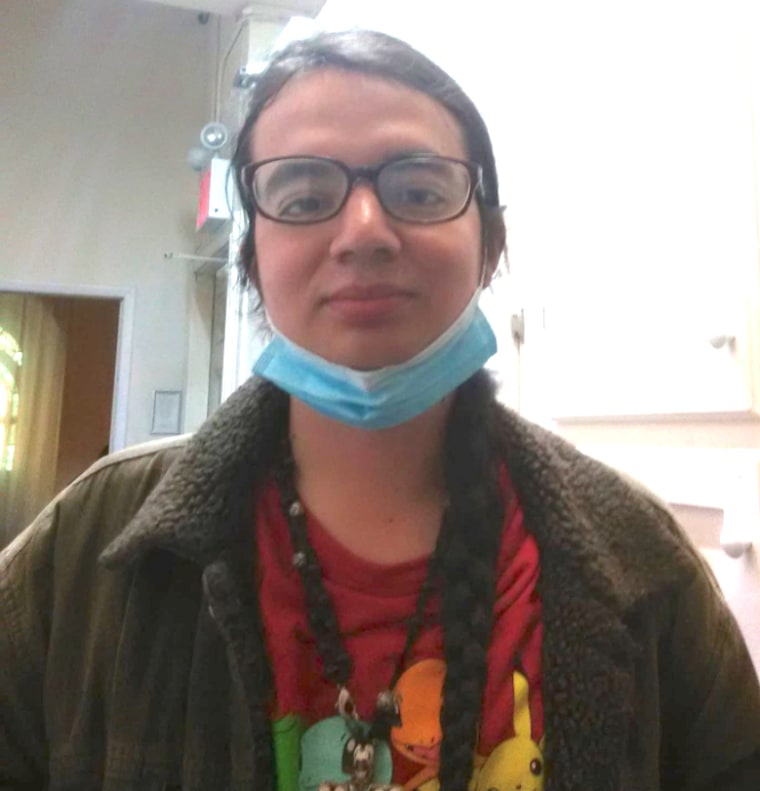
Finding a secure place to live has not been easy for Nez Marquez, 23, who has experienced homelessness for the past five years. Born in Mexico and raised in New York, he left home at 18 because his family did not accept his gender identity and sexual orientation, he said.
Marquez is staying at Sylvia’s Place, an emergency shelter for LGBTQ young adults on the bottom floor of a Manhattan church. He said shelters that specifically cater to lesbian, gay, bisexual, transgender and queer people are safer for him because he has been subjected to homophobic attacks at general-population shelters. But now, in addition to anti-gay violence and the inherent dangers of life on the streets, Marquez has another fear: the coronavirus and its ripple effects.
Nez Marquez, 23, is staying at Sylvia’s Place, an emergency shelter in New York City for LGBTQ teens and young adults.Courtesy of Nez Marquez
“I’ve been worried about not having housing,” Marquez said in an interview. “If where I’m staying shuts down, I’ll be out of options.”
Not only does he worry about being “forced to live in a homophobic environment,” but he also has a congenital lung issue, putting him at higher risk for adverse outcomes if he were to get COVID-19, the illness caused by the coronavirus.
LGBTQ youth and young adults, like Marquez, make up a disproportionate number of homeless young people, and this vulnerable demographic is facing unique hardships amid the global health crisis. With countrywide shutdowns of schools and youth programs, diminished office hours at LGBTQ community centers and, for many of them, unsupportive family members, these young Americans and the organizations that serve them are forced to find new ways to get and provide support.
Increase in needs, decrease in services
LGBTQ adults make up an estimated 4.5 percent of the U.S. population, but recent studies have found that 20 percent to 45 percent of homeless youth identify as LGBTQ, and among young adults ages 18 to 25, LGBTQ people have a 2.2 times greater risk of homelessness than their non-LGBTQ peers, according to a new research brief by the Williams Institute at UCLA Law.
Many homeless LGBTQ young adults rely on the approximately 260 LGBTQ community centers across the U.S. for their vital needs and general well-being. During the pandemic, however, many of the centers are reducing their hours and services or closing their doors completely to protect staff and visitors.
“Our clients rely on nonprofits to provide health care, and a lot of those places have closed or shut down hours.”
KATE BARNHART, NEW ALTERNATIVES EXECUTIVE DIRECTOR
New York City’s LGBT Community Center, at the center of the pandemic in the U.S., closed its Manhattan location and suspended its in-person operations indefinitely on March 13. It is providing some services remotely, such as individual counseling sessions, 12-step support groups and youth social programs. Similarly, the Los Angeles LGBT Center has canceled all nonessential meetings and limited its youth programs to lunch services and critical needs while keeping its housing center open.
Detroit’s Ruth Ellis Center, which includes drop-in services, a health clinic and an overnight shelter, has also reduced some of its services. Before the coronavirus crisis, the drop-in center offered hot meals and showers daily and professional skills training three days a week. Now, the center is open only to distribute groceries from its front doors on Mondays and Wednesdays from 3 p.m. to 5 p.m. Staff members are still doing videoconference appointments for behavioral health and primary care.
“The need for services is increasing, and the availability of services is decreasing,” said Kate Barnhart, executive director of New Alternatives, a New York City-based nonprofit for LGBTQ homeless youth.
Barnhart said the pandemic has further complicated her clients’ already inconsistent access to care, particularly when it comes to their health needs.
“Our clients rely on nonprofits to provide health care, and a lot of those places have closed or shut down hours,” she said, saying a client of hers recently ran out of psychiatric medication when all her go-to medical providers were closed because of the crisis.
Barnhart said a third of her clients are living with HIV, and she fears what will happen if they are unable to get their daily medication.
For LGBTQ youth and young adults who are able to find beds at one of the few overnight shelters across the country that cater to them, there is a different set of challenges and risks.
Brad Schlaikowsky, co-founder of Courage MKE, a Milwaukee organization that operates a group home for LGBTQ youth, said soap, hand sanitizer and other hygiene products — many of which are crucial to help prevent contraction of the coronavirus — have been hard to come by for people who are housing insecure. Due to the contagious nature of the virus, his organization is not accepting food and clothing donations.
“This is a huge expense on the budget, and it’s hitting everyone hard right now,” Schlaikowsky said. “The best way people can help any organization is through financial support.”
The Centers for Disease Control and Prevention recommends that everyone physically distance themselves from others by about 6 feet to reduce the chance of contracting the virus. The CDC has issued interim guidelines for the country’s thousands of homeless shelters if someone does get sick, including confining symptomatic clients to individual rooms or moving them to alternative facilities if possible. However, at many shelters, the guidance is impractical.
“We don’t have a private room,” said Wendy Kaplan, director of Trinity Place Shelter, an LGBTQ youth shelter in New York City. “It’s unrealistic, out of touch and makes us feel like the government isn’t able or prepared to protect some of our most vulnerable members of society.”
‘Serious implications’ for mental health
In addition to the physical well-being of LGBTQ homeless youth and young adults, there are also concerns about the unique mental health challenges they may face.
The Trevor Project, a national nonprofit that focuses on LGBTQ youth in crisis, released a white paper Friday outlining the “serious implications” the COVID-19 crisis could have on the mental health of lesbian, gay, bisexual, transgender and queer young people. The organization cited the physical distancing, economic strain and increased anxiety related to the pandemic as being among the most worrisome problems.
“For a lot of LGBTQ young people, the main sources of support that they get are at their schools, at clubs, at community centers, at physical spaces that they no longer have access to.”
AMIT PALEY, TREVOR PROJECT CEO
“LGBTQ young people … are already at risk of discrimination and isolation, which can impact their mental health,” Amit Paley, the organization’s CEO, said Tuesday in an interview with MSNBC. “For a lot of LGBTQ young people, the main sources of support that they get are at their schools, at clubs, at community centers, at physical spaces that they no longer have access to. … Not being able to connect with some of those really important, positive influences in your life can be extremely challenging for LGBTQ youth right now.”
Paley said the Trevor Project, which operates a 24/7 crisis hotline, has had a steep increase in the number of LGBTQ youth who have been reaching out.
“We saw nearly twice the level of young people reaching out, and we know that this pandemic is having an impact, that young people are not sure where they can turn to for support,” he said.
‘It’s most important they know they’re not alone’
Local and national organizations that serve LGBTQ homeless youth are working to acclimate to the new normal, developing innovative pathways to accommodate the changing and expanding needs of this vulnerable population.
Lilianna Angel Reyes, director of the Ruth Ellis Center’s drop-in service, said staff members at the Detroit facility “aren’t waiting for people to create a solution.”
“They’re creating them, and we’re helping [our clients] be the healthiest they can,” she said.
With schools closed, staff members at the center’s group home, Ruth’s House, have developed an educational curriculum for their residents, who are ages 12 to 17. And at the drop-in center, which typically caters to teens and young adults ages 13 to 30, staffers have turned the large open space into a makeshift classroom for their group home residents.
Reyes said the Ruth Ellis Center is a safe space that “can be built anywhere” — including online, where the center has ramped up its presence. Staffers are now offering some services through digital video platforms, like its tobacco cessation program for transgender women, and clients can connect with staffers on social media, including Facebook Messenger and Snapchat.
Reyes said that overcoming obstacles and a lack of resources “isn’t new” for the youth and young adults whom the Ruth Ellis Center serves and that this may ultimately help them get through the pandemic and its ripple effects.
“Most of our youth have had long histories of trauma, and they’re extremely resilient,” she said.
Trinity Place Shelter, which caters to LGBTQ New Yorkers ages 18 to 24, is typically open only in the evening and overnight, but during the pandemic, it is operating 24 hours a day. The extended hours give the center’s 10 residents a place to socially distance, three meals a day and somewhere to wash their hands.
“The less time they’re on the subway and out interacting with the public, the safer they are,” the Rev. Heidi Neumark, the shelter’s executive director, said in an interview.
Neumark, who is a pastor at Trinity Lutheran Church, which houses Trinity Place Shelter, said that now it is “particularly important that we offer a lot of extra reassurance.”
“Most of the young people are here because they have been rejected by their families and do not have the support system and comfort that some people can count on,” she said.
While Milwaukee schools and most of the city’s youth programs are closed, Courage MKE has tripled the number of onsite staff members working at its group home, Courage House, the only LGBTQ youth shelter in Wisconsin. The increase is intended to help ensure that the organization’s clients get the extra support they need during the pandemic while also keeping burnout low and morale high among the staff.
“We’re 24/7 for the next 30 days, and it’s not always sunshine and daisies, so we want to protect them, too,” Schlaikowsky said of his staff.
Download the NBC News app for full coverage and alerts about the coronavirus outbreak
Schlaikowsky said Courage MKE’s staffers are also trying to keep a brave face on for the youth and young adults they serve.
“If we show fear, it will rub off on the kids and make their anxiety even higher,” he said.
In addition to getting help, Courage MKE’s clients are helping others by preparing sandwiches for people in the community in need of food. Schlaikowsky said that making 300 peanut butter and jelly sandwiches has been an effective distraction for the organization’s clients and that feeding others has been an affecting way to thank the broader community for all the support it has given the nonprofit since it launched in 2015.
In his interview on MSNBC, Paley of the Trevor Project spoke directly to LGBTQ young people, telling them they “are deserving of love and respect” and are not alone. He also stressed that “social distancing is not the same as social isolation.”
“There are places you can reach out to for support,” he said. “There are always organizations like the Trevor Project that are here 24/7.”
The Trevor Project provides multiple round-the-clock services for LGBTQ youth in need, including TrevorSpace, a social networking site specifically for LGBTQ youth, and a network of trained crisis service counselors who can be reached through TrevorChat, TrevorText and TrevorLifeline (1-866-488-7386).
In its new report, the Trevor Project also encourages LGBTQ young people who are in distress because of the negative social impacts of physical distancing to participate in shared activities online, like gaming, watch parties and physical activity classes.
As for Nez Marquez, he has been staying indoors most of the day at his shelter, which is offering extended hours. He said that while his circumstances were not ideal before the coronavirus emerged, he longs to return to his pre-pandemic life.
“I was applying for housing, I was applying for jobs and had interviews, and I can’t do that anymore,” Marquez said. “I just can’t wait for this to be over and I can go back to my life to do what I need to do.”
Lorena Borjas had a wheelie bag, and in the bag she had the world. The first time Lynly Egyes met her, Borjas pulled a birth certificate out of the bag. Egyes was then a lawyer with the Sex Workers Project at the Urban Justice Center and had recently taken the case of a young immigrant transgender woman who was in jail, facing felony assault charges for defending herself against an attacker—an exceedingly common predicament. “Lorena came into my office and said, ‘I hear you need the birth certificate for one of the girls,’ ” Egyes told me on the phone. “I said, ‘Who are you?’ ‘I am Lorena!’ ” Borjas also convinced Egyes to take on a second case that stemmed from the same incident; the proceedings dragged on for about a year, with frequent court appearances. Borjas always came to the hearings and brought supporters. “She felt it was important for the judge to see that these two young women were loved,” Egyes said.
Borjas died on Monday, at Coney Island Hospital, in Brooklyn, of complications from covid-19. She left an orphaned community of transgender women, especially Latina immigrant women in Queens, and countless L.G.B.T.-rights activists who looked to her for guidance, inspiration, and love. About two hundred and forty people gathered for a memorial on Monday night, albeit via Zoom, which added a layer of heartbreak to the mourning of a person whose legacy was one of building community, in the streets and in apartments in her Jackson Heights neighborhood, and of taking close, personal, physical care of people.
Borjas was born in Veracruz, Mexico, in 1960. At seventeen, she ran away to Mexico City, where she lived in the streets. At twenty, she crossed the border into the United States, where she hoped she would be able to receive hormone treatments. She made her way to New York City, where she studied for her G.E.D. and then studied accounting.The New Yorker’s coronavirus news coverage and analysis are free for all readers.
“Back then, the trans community didn’t have spaces,” Cristina Herrera, the C.E.O. and founder of the Translatinx Network, a group for transgender immigrants, told me on the phone. “We met at Port Authority—that was the main place, because you could stay indoors.” Herrera, who is from El Salvador, came to New York in 1985, at the age of fifteen, and met Borjas soon after. “She was like the social worker in our community,” Herrera said. “She was the case worker.” Borjas guided other trans and gay immigrants to the resources she had found: E.S.L. classes, G.E.D. tests, community colleges, H.I.V. screening, immigration lawyers, and research studies that paid for participation.
Borjas was able to obtain legal status under a Reagan-era amnesty. But, in the nineteen-nineties, she developed an addiction to crack, which, Herrera told me, led to more and riskier sex work and, finally, to a relationship in which Borjas was trafficked. She was arrested several times, making her ineligible to renew her green card or apply for naturalization.
In the late nineteen-nineties, Borjas escaped from her abuser. She got clean. Then she got to work helping people who hadn’t been as lucky. “In the morning, she would get up and go to the Department of Health and take free condoms there,” Egyes told me. “Then she might also go to a food pantry. And at night she would walk around with her wheelie bag, distributing the condoms and the food.”
One of Borjas’s closest friends, Cecilia Gentili, who is forty-eight, told me that she met Borjas in a bar in Jackson Heights, in 2005. Gentili, who had come from Argentina five years earlier, was undocumented then and doing sex work. A couple of years later, Gentili got a job at Apicha, a clinic for the L.G.B.T. community, and asked Borjas to help her reach out to potential clients. “She said, ‘Come with me to hand out condoms,’ ” Gentili said. “We started at 11 p.m., up and down Roosevelt Avenue. She said, ‘When you give out condoms, you can give out referrals to your clinic.’ ” They walked the streets until three or four in the morning. At the time, New York police often used possession of condoms as evidence in prostitution cases, and word on the street was that one shouldn’t carry more than three at time. So Borjas considered it her duty to replenish sex workers’ supplies of condoms, a couple at a time, all night long. “She showed people that they had family,” Egyes said of Borjas’s condom-distribution work.
Chase Strangio, the deputy director of the L.G.B.T. and H.I.V. Project at the American Civil Liberties Union, met Borjas more than ten years ago, when Strangio was working at the Sylvia Rivera Law Project. Borjas worked to educate him about patterns of arrests of transgender women of color. “She was so connected to the community that when someone would get arrested, the first phone call was to Lorena,” Strangio said. In 2012, together the two founded the Lorena Borjas Community Fund, which gives bail and bond assistance to transgender immigrants in criminal and immigration proceedings. This was the kind of specific need Borjas’s knowledge of the community could help identify. At the time, the Obama Administration was increasing pressure on local police to coöperate with Immigration and Customs Enforcement; when immigrants ended up behind bars—for whatever reason—they faced the risk of deportation, and so it was essential to get them out fast.
Even while Borjas was advocating on behalf of transgender immigrants, she was at risk for being deported herself. A couple of years into the friendship, Borjas finally asked Egyes to look at her own case. Egyes joined the effort to vacate her convictions—it worked with some but not all of them—and eventually filed a petition for a pardon. In her letter to Governor Andrew Cuomo, Egyes described some of the work that Borjas had done. “At meeting after meeting with law enforcement, many clients explained how Lorena was the reason that they were able to escape their trafficker,” Egyes wrote. “At one point, former Assistant United States Attorney, [name redacted], asked if Lorena was a real person because she seemed to help so many people but wasn’t affiliated with any organization. I explained that Lorena is in fact real and that she helps people because she too was a victim and wanted to ensure that these girls had a way out of bad situations.” Egyes attached a list of more than twenty awards, certificates, and proclamations Borjas had received in recognition of her activism. Governor Cuomo pardoned Borjas in 2017.
Borjas was not paid for most of her work. She cobbled together a living: she was paid for some talks, outreach, and counselling sessions, and sometimes she cleaned houses. “She made the money stretch,” Egyes said. “She gave me hope that people do good things because they are good people, not because they would get anything for it.”
“None of her work was with a ‘rescuing’ mentality,” Gentili said. “It was, We help because we help each other. She was the mother of the trans Latinx community.”
Strangio recalled that, in 2011, Borjas threw a big party for him, complete with a cake. It wasn’t his birthday or a date of any other significance. When Strangio asked what the party was for, Borjas answered that it was a way of giving thanks. “She celebrated people,” he said. A year later, when Strangio and his then partner were expecting a baby, Borjas threw them a baby shower. “She raised money and got us a stroller and a car seat,” Strangio told me. “I mean, we are lawyers! But, no, ‘You are going to have a child, and we are going to take care of you. That’s what we do.’ ”
Last year, Borjas became a U.S. citizen. Her work had inspired several nonprofits, including the one that Herrera runs. “She was starting to see the fruits of her labor,” Herrera said. And Borjas herself was finally safe. “She had made it through the aidsepidemic!” Herrera exclaimed. “She made it through the crack epidemic! She made it through the violence we faced in the nineties and two-thousands, with immigration! I thought we were going to have her until she was in her seventies or eighties.”
There is a particular gut punch that coronavirus deaths pack for people who saw their generation decimated by aids. “When we met, we had a community of fourteen,” Herrera said. “Recently, there were three of us left, two H.I.V.-positive and one negative.” Borjas was positive. “And now there are only two of us left.”
Forty-one years ago yesterday, on April 2, 1974, out lesbian Kathy Kozachenko made history as the first openly gay person elected to political office in the US.
Then a 21-year-old University of Michigan student, she was part of the now-defunct left-wing Human Rights Party, which consisted mostly of college students and recent graduates.
“This is the first time in the history of the U.S. that someone has run openly as a gay person and been elected to public office,” Kathy Kozachenko said during her 1974 victory speech, which was unearthed by Bloomberg.
“Gay liberation was not a major issue in the campaign — both candidates in this ward said they supported gay rights, but 10 years ago, or even three years ago, lesbianism would have meant automatic defeat.
“This year we talked about rent control. We talked about the city’s budget. We talked about police priorities, and we had a record of action to run on.
“Many people’s attitudes about gayness are still far from healthy, but my campaign forced some people at least to re-examine their prejudices and stereotypes.”
Kozachenko’s political career was short-lived – after two years on the city council, she decided not to run for a second term.
“As hard as we tried to make our organization representative of and inclusive of individuals beyond students — to be a voice for working people, people that were on welfare but trying to move beyond welfare, people of color — we weren’t really able to go beyond being a student organization,” she said of the Human Rights Party.
“So the viability of the organization as a vehicle for change, I could see that it wasn’t going to be long term, and I wanted to see where else I could be effective.”
But she was the first of many openly gay public officials in the US.
Since equal marriage was legalised in 2015, a “rainbow wave” of LGBT+ lawmakers were elected.
Today, 855 out LGBT+ political leaders sit in elected office, according to the Victory Institute.
“We need you to run for office and be the next historic first,” she said.
“We’ve seen that we cannot be complacent, that we need even more LGBTQ candidates to run. LGBTQ candidates from all walks of life, with diverse backgrounds, with diverse perspectives.
“We need more LGBTQ candidates of color, more trans candidates, more womxn candidates, more LGBTQ immigrant candidates, more intersex candidates, more LGBTQ candidates with bold ideas who will keep pushing our movement forward.”
Kathy Kozachenko said that she is “so proud” of all the activists who came after her.
“The people that pushed and pushed and pushed for gay marriage, the transgender people that have pushed for their rights and for understanding of who they are.
“I think none of this would have happened without the energy and activism of many, many people not giving up, and I’m very grateful for that, and I’m grateful for the chance that I was able to play a small part in this.”
Just as our fires brought to the surface the vast inequalities in Sonoma County, so too has the COVID-19 pandemic. Rather than corporate bailouts and commitments to simply not evict families ‘‘for now,” we need a real community bailout.
One in five Sonoma County residents are living in poverty1 and hundreds of thousands are now out of work. Members of our community need to know they will not lose work permanently, only to come out of this pandemic owing thousands of dollars to landlords and banks.
A 2019 report found 40% of Americans would not be able to respond to a $400 unexpected expense without some kind of help2. This agenda was created in unity by those very community members and leaders from across our County. The stakes are the highest they’ve ever been. We may be in this pandemic for months.
We call on our local governments to step up to their responsibility of caring for the whole community and prioritize these policies. If we do this right, we will not just survive but thrive. Our communities cannot wait. Every day bold action is not taken is another day families, tenants, seniors, immigrants, workers, and our unhoused community struggle to survive.
SoCo United In Crisis Members: ———————-
North Bay Jobs with Justice
North Bay Organizing Project
North Bay Labor Council
National Union of Healthcare Workers (NUHW)
Graton Day Labor Center
Alianza Laboral de Mujeres Activas y Solidarias (ALMAS)
Sonoma County Tenants Union
Service Employees International Union (SEIU), Local 1021
We have the right for our basic needs to be met 1. The County provides funds for undocumented workers whose work was impacted by
COVID19.
2. The Right to Language Justice: all alerts must be multilingual, in both English and Spanish as well as other languages spoken in the county – including indigenous languages such as Mixteco, Triqui, Chatino. Information must be proactively shared with the unhoused community.
3. Ensure employers do not lay off workers until all means of securing needed funds have been exhausted. Should workers be laid off, ensure employers offer jobs back to those workers in order of seniority when re-hiring.
4. Assure accessible health care for those experiencing actual or possible COVID-19 symptoms and allow laid-off workers to keep their healthcare. Since many companies are receiving emergency taxpayer money, we should ensure all medical costs incurred by “essential” workers who have no access to health insurance be covered by the Employer. This includes farmworkers, domestic workers or undocumented workers.
We have the right to Home
1. By August 1st the Board of Supervisors will comply with state law SB54 to participate in and fund a countywide town hall meeting on issues impacting the immigrant community, including a TRUTH Act report from Sheriff Essick. To ensure language and cultural competency, this will be planned and facilitated by community organizations.
2. A moratorium on all evictions, rent increases, and foreclosures that is extended to at least 6 months after the end of the COVID-19 outbreak. No rent debt accumulated and any tenant relocations will be temporary.
3. Secure and allocate relief funding and rental and mortgage assistance for all who will be impacted economically by this virus.
4. Provide emergency shelter, food and sanitation stations to our homeless population. Cease displacement of homeless encampments. Ensure quarantine options are made available.
We have the right to be safe and protected
1. The Board of Supervisors mandates the Sheriff to stop all communication with ICE. 2. Assurance from the County of Sonoma that the County Courthouse will abide by the new 2020
state law related to access to ICE agents. Courthouse personnel will receive the relevant training.
3. Enact mandatory Paid Sick Leave for all employees. Waive the 90-day requirement to receive paid sick time. Notice regarding current State paid sick leave requirements will be given to all employees in their preferred language.
4. Frontline “essential workers,” healthcare workers and domestic workers must be provided adequate safety protection including but not limited to N95 masks, gloves, face shields, and gowns. Requesting or using adequate safety protection is not grounds for retaliation. Every attempt should be made to ensure tests are provided when needed.
5. Advocate for the release of all COVID-19 vulnerable persons from ICE detention centers in CA. Contact us: info@socounitedincrisis.org Website: www.SoCoUnitedinCrisis.org
On the same day, which was also Transgender Day of Visibility, Orbán’s deputy prime minister Zsolt Semjén introduced a new bill which, if passed, would replace “gender” with “birth sex” in all legal documents issued in the country.
This would mean that Hungarian citizens would be unable to change their gender legally, a significant rollback of rights for the country’s trans community.
Since data in official documents such as ID cards, driving licenses and passports are taken from the civil registry, the change would affect these as well.
Prime minister of Hungary, Viktor Orbán in Brussels on February 21, 2020 (Riccardo Pareggiani/NurPhoto/Getty)
Now, European Union MEPs have hit back at the move to take away trans rights, calling it “intentional abuse”.
Marc Angel, MEP and co-president of the LGBTI Intergroup in the European Parliament, said: “This attack on the trans community is outrageous and deliberate… This move does not only intentionally silence the trans community – it seeks to erase it and deny its existence.”
Angel pointed out that Orbán and his party, Fidezs, have persistently attacked trans rights. He said that “legal gender recognition procedures have been intentionally stalled” since 2016.
Terry Reintke MEP, also co-president of the LGBTI Intergroup in the European Parliament, commented: “Fidezs’s latest move is shocking, yet not surprising.
“The LGBTI community has been continuously exposed to attacks and civil society has been systematically silenced.
“Rule of law in Hungary has been under threat and this move crystallises yet another abuse of power, this time under the pretext of COVID-19 emergency measures… Legal gender recognition is the baseline for protection of trans persons in Hungary.
“Without access to it, they are widely exposed to discrimination and harassment. This move is nothing short of intentional abuse.
“The European community must ensure that it does not go unpunished.”
www.gaysonoma.com’s Gary Carnivele recently interviewed through email Chelsea Rose who is Vice-Chair on the Board of Directors at Positive Images in an effort to check in with representatives of local LGBTQ+ non-profits, Queer Luminaries, business owners, and more. This is the first of a series of interviews that he will conduct each week during our Stay at Home order.
Gary Carnivele: Talk a bit about your background, how you came to be involved with Positive Images, what your position there is, and what it entails.
Chelsea Rose: I am currently the Vice-Chair on the Board of Directors at Positive Images (PI). When I moved to Sonoma County (eight days before the 2017 fires), I already knew the area well because I’d been working in PR and marketing for wine and tourism clients here. What I lacked locally was LGBTQIA+ community, so I started learning about different organizations. Within a few months, I became connected to Positive Images’ Thursday night youth group as an adult volunteer. It was powerful to witness the peer support structure of the group, where youth and young adults ages 12-24 come up with most elements of the programming and facilitate the evenings. I never had a group like this to help me navigate my own queer identity. Like me, I heard other adults over 24 express a similar desire for a peer support space. In October 2018, PI’s Director of Programs Jessica Carroll and I developed and began facilitating a Friday night group for adults.
Positive Images currently has just 1.75 full-time employees — Jessica Carroll and Outreach Coordinator Max Anderson. PI doesn’t have an Executive Director. We are working toward raising enough money to hire someone to fill this role, but for now, the Board of Directors (all volunteers) work to fill those shoes, bringing our various expertise and interests to our respective roles. In addition to co-facilitating the Friday night group, I bring to the organization my PR and marketing experience and event-planning experience. I collaborate with Jessica and fellow Board members to write grants and develop new programs.
GC: How are you and your family doing during this pandemic?
CR: Gosh, what a question. Overall, I’ve been okay, but I’ve had some really tough days. My family mostly lives in southern California and my girlfriend Lucy lives in Oakland. Usually, I visit my family every two or three months and I spend about two days a week with Lucy and our cat Paprika (who lives with her full-time, but is nonetheless also my baby). Lucy takes an immunosuppressant, so I spent more than two weeks in isolation before I felt safe to come see her. I’m writing from Oakland with Paprika in my lap, so things are on the up-and-up now. Everyone’s physical health is good, so far.
In 2013, I hosted a weekly online literary reading that streamed on YouTube via Google Hangouts, with guests from all over the U.S. and occasionally international. I also do a lot of work from home already. In these senses, adjusting to shelter-in-place has come somewhat easily to me. I’m trying to shift my activism online as much as possible, grateful for the webinars and teach-ins that bring so many thinkers into one digital space I can tune into from home. There are also a lot of SF drag performers who have shifted their performances to streaming platforms and they’ve been totally lifting my mood with their brilliance.
GC: How is Positive Images continuing to serve its clients?
CR: We made a rapid shift to Zoom for all of our in-person programs. We held our last in-person meeting at Positive Images’ Community Center on Friday, March 13, and moved our Social Saturday to Zoom the very next day. Under normal circumstances, PI’s LGBTQIA Community Center is open for drop-in hours Tuesday through Friday. We have Art Jams (for ages 12-24) on Wednesday afternoons from 3:00 p.m. – 6:00 p.m., Youth Group (ages 12-24) on Thursdays from 7:00 p.m. – 9:00 p.m., and Adult Group on Friday nights from 6:30 p.m. – 8:30 p.m. The youth leadership team is continuing to meet online and will resume facilitation of the group online.
We are all in contact, digitally, and have moved the leadership program online, too. We are now offering Art Jams, Youth Group and Adult Group online via Zoom, plus an online hangout hour for all ages from 1:00 p.m. – 2:00 p.m. Tuesday through Friday. To the extent that we can, the groups follow the same format they would in person. Our community agreements and rituals (guided breathing exercises to ground us at the beginning and end of meetings, introductions and check-ins) remain the same. We’ve gotten creative with how our social nights work. We’ve played Mad Libs together, created at-home scavenger hunts, and other games that can happen online from remote locations.
So far, groups have been smaller than they were in person, but they’re still really vital. We saw at least 30 different people in our first ten days.
GC: Not all young LGBTQ+ people live in situations that are ideal and/or understanding of their gender identity, sexuality. etc. How is PI helping young folks who are finding themselves in such situations?
CR: I want to acknowledge that some people do not have safe access to Internet or phones right now. Some people in our community do not have access to shelter. Ultimately, we are aware that there are limitations to our reach and the problems we are able to address. Shelter-in-place orders will limit access to resources for some of our community members. Because this interview is appearing online, most of my answers address folks who do have at least some access to phone and internet.
P.I. is a welcoming, affirming space for LGBTQIA+ folks to explore and celebrate their gender, sexual orientation, and other facets of identity. Our mission is to provide support and nurture positive self-image in our community and empower folks to participate in building a just and equitable society. We receive countless testimonials from people–older alums and present participants–who say that PI’s support has saved their lives. On a community needs assessment we created in 2019, folks responded anonymously. Nine different people said Positive Images gave them family. Other answers that stick out in my mind about what people receive from PI included unconditional respect, love, community, safe space.
Today, about 60% of PI’s participants are transgender and about 60% of trans folks at PI are nonbinary. There are still a lot of challenges and lack of acceptance in the world for LGBTQIA+ people, and it can be particularly difficult for trans people, who sometimes aren’t accepted even by LGBQ cisgender people.
In addition to our support groups, Positive Images’ Center has a Transformation Station, which is a closet of free clothing and gender-affirming garments like chest binders. We have a library of books and zines. We provide referrals and field lots of calls from parents and other family members who want to know how to best support their queer and trans kids. Our center is also used by community groups as a meeting space, so TGNB, FTM Sonoma County and PFLAG Santa Rosa all hold their meetings at PI. All this being said, the physical meeting space isn’t available to people during shelter-in-place. People can still call us we will provide information and referrals. As soon as it’s safe to re-open, we will resume operations at the Center.
While we love hearing from supportive families, we are aware that not everyone is safe and supported at home. This is always a concern, and it’s certainly exacerbated when something like COVID19 suddenly has us all stuck at home. We do our best to be in touch (digitally) with all of our young participants and to ensure that they have as many avenues as possible to stay connected to one another. Right now, people connect with us during our online support groups and through various social media channels.
GC: What tips can you offer young people who may find themselves in this situation?
CR: During this shelter-in-place, it is extra important to know that you’re not alone and that your support networks aren’t going to go away. If you’ve never had a support network, now could be a time to seek out something like PI’s groups and see if they’re a good fit for you. I understand that not everyone will feel safe connecting to us from home — if you don’t, can you go for a walk to call in? Or if being on a call/video isn’t an option, is it comfortable and safe to text or chat (typing) with friends or folks who can offer support?
It’s an interesting circumstance we are all in. Making the transition to online meetings may be hard for some people who are used to connecting in person. For many others, doing things online is actually easier, whether that’s because of something like social anxiety or certain types of physical disability.
National Center for Transgender Equality created and regularly updates an excellent website of information and resources about Coronavirus/COVID19 specifically for trans people: https://transequality.org/covid19
GC: Suicide rates are much higher among younger LGBTQ+. What is PI doing to assist those who may be at riskand again what advice would you offer those who are experiencing depression during this Stay-at-Home order?
CR: We know that LGBTQIA+ young people–and especially trans folks–are at higher risk for suicide attempts. We also know that when LGBTQIA+ people are supported in their identities, mental health rates match the general population. I’d say that everything Positive Images does seeks to reduce the risk of suicide in our community. When we provide cultural sensitivity trainings about our community (to schools, government agencies, businesses, etc.), we are working to reduce stigma and enhance understanding and acceptance of LGBTQIA+ people. All of our groups–whether directly focused on support or more social in nature–are about connecting people to community support. We have a wonderful LMFT with whom we contract to be present at our Thursday night meetings, and some of our staff and adult volunteers have suicide prevention training. Before the shelter-in-place order, a speaker from Buckelew was scheduled to present about suicide prevention to our youth group, however, this meeting has been postponed until we can meet in person.
PI will continue to provide online connectivity throughout the shelter-in-place. All of our meetings begin with asking folks to rate how they’re doing physically on a scale of one-to-10 and internally or emotionally on that same scale. We call these numbers your PI levels. Even if you can’t make it to a Zoom meeting, anyone who thinks it might be a useful tool should feel free to keep track of their PI levels as they fluctuate throughout the day. Not everyone likes numbers, so another option is to write a single sentence or a few words describing your physical and internal states.
Is the PI office open at all, perhaps for emergency situations? During this particular crisis, we believe the safest thing we can do is to stay at home and keep our physical center closed to the public.
Have PI group leaders been reaching out to group participants and if so, what I they hearing about their time a home, away from support groups, and being kept from work/scholl/friends?
Yes, we are keeping connected to folks. Normally, we have a youth leadership team (of roughly eight people) who normally meets twice weekly to plan, facilitate and debrief our in-person Thursday night meetings. During shelter-in-place, facilitation has shifted to our staff and adult leaders, however, we are all in contact, digitally. Anything specifically said during our meetings is confidential.
GC: I would imagine donations and even funding will or may be impacted. What can our readers do to help Positive Images continue to provide services and support to LGBTQ+ youth?
CR: Absolutely, it will be a tough year for us. Though our reach is pretty tremendous, we’re a small nonprofit organization with a small budget to begin with. If anyone who is resourced right now wishes to support our work, they can do so by visiting https://posimages.org/donate/. If your birthday is coming up, consider asking loved ones on social media for donations to PI as a gift.
Money isn’t the only way to support our work! If you or someone you know might benefit from our services, check us out and tell the people in your life about us. It’s also amazing to hear from alumni about their experiences at PI. One of the side-effects of being a 30-year-old organization is that our current Board doesn’t have up-to-date contact information for a lot of past participants in our programs. Most people didn’t even have email accounts for the first seven or eight years of our existence. If PI impacted your life, we would love to reconnect. Write to us at info@posimages.org
This is our 30th Anniversary year. If shelter-in-place is lifted in time, we will be having a celebration and fundraiser gala at DeTurk Round Barn on Saturday, August 29. Likewise, we’re also the beneficiaries of Pink Saturday Sunday, a rosé-themed party created by Out in the Vineyard that’s been rescheduled for Sunday, September 13th. Save the dates!
GC: What are you personally focused on as a PI Board Member right now?
CR: I’m on the planning committee for our 30th-anniversary celebration. Orlando O’Shea and I are also on a Board recruitment subcommittee. We recently welcomed Alisse Cottle, co-owner of Brew to our Board, who is a wonderful addition. I had a few upcoming speaking engagements scheduled in April, but those have been postponed, of course. I’m still facilitating our Adult Group on Fridays.
GC: I know you are a very busy woman, so what else are you working on now?
CR: A lot of my work is up-in-the-air right now. My biggest project this year was supposed to be creating and producing Father’s Gay, a queer music festival slated for Saturday, June 20, presented by the Arlene Francis Center. The first Father’s Gay was at a bar and on Father’s Day itself, so I was thrilled to move the event to the Saturday before, to have two stages this time, and to move it to an all-ages venue. My lineup–not even announced publically yet–is a dream.
Most of my paid work is as a writer. I contribute to the North Bay Bohemian, the Press Democrat and Sonoma Magazine’s website. As a copywriter, I do branding, social media marketing, and public relations. I was recently a recipient of Creative Sonoma’s Discovered Award for Emerging Literary Artists and got to teach community workshops on poetry at the Museum of Sonoma County.
For now, I’ve been working on creating online spaces for literary events, developing some teaching materials, and organizing my physical space.