LATEST, March 25, 9:10 a.m. San Francisco County reported 26 new cases of COVID-19 Wednesday morning, bringing the county total to 178. The county reported the first death in a resident on Tuesday night. Read the full story.
March 25, 8:15 a.m. The number of coronavirus cases and deaths in the Bay Area continues to climb, with now more than 1,000 cases in the nine-county region.
San Mateo County announced Wednesday morning four more deaths, bringing the county total to five. Health officials haven’t released details on the patients. In San Mateo, 165 individuals have tested positive for the respiratory illness.
San Francisco County health officials reported the county’s first death of a resident with COVID-19 on Tuesday evening. The patient who passed away was a man in his 40s with “multiple, significant” underlying health conditions, officials said in a statement.
March 25, 8:10 a.m. San Francisco-headquartered Gap Inc. announced Wednesday that the company “is pivoting resources so that factory partners can make masks, gowns and scrubs for healthcare workers on the frontlines and is connecting some of the largest hospitals in California with its vendors to deliver PPE [personal protective equipment] supplies.”
March 25, 8 a.m. To prevent crowds from gathering at beaches, the City of Pacifica announced Wednesday it is closing the parking lots and some facilitiesat its city beaches.
Those include north and south lots at Pacifica State Beach (Linda Mar Beach); parking lots at the Pacifica Community Center; north and south lots at the Rockaway Beach; Council Chambers lot on Beach Boulevard; Beach Boulevard parking south of the Council Chambers and Fisherman’s Lot in 800 block of Palmetto Avenue.
The Pacifica Pier is also closed.
Half Moon Bay say it’s also closing parking lots at beaches.
March 25, 7:30 a.m. In Los Angeles, Mayor Eric Garcetti said there have been reports of so-called nonessential businesses ignoring orders to shut down.
While he hopes for voluntary compliance, those ignoring warnings could face misdemeanor charges and the city could shut off the business’s water and electricity, Garcetti warned.
Such businesses are “irresponsible and selfish … it will put all of us at risk,” Garcetti said.
A teenager who lured a “gentle, kind-hearted” sales assistant to a remote beauty spot on a date and stabbed him to death has been locked up for a minimum of 24 years. Alex Davies, 18, was murdered in Parbold, Lancashire, by Brian Healless, also 18, after they agreed a rendezvous through the dating app Grindr.
Healless, from Chorley, tried to set up similar outdoor meetings with four other men on Grindr in the days after the killing, Preston crown court heard. He had told Davies, from Skelmersdale, he was “not out yet” and suggested a “discreet spot” halfway between their homes for their first meeting.
The defendant stabbed him 128 times at the top of Parbold Hill and dragged the Home Bargains worker face down by his collar in the mud, while still alive, and covered his body with branches and leaves.
His defence team claimed a diagnosis of paranoid schizophrenia meant he had diminished responsibility for the sickening April 29 attack. But jurors took less than hour to dismiss that claim.
They had been told Healless took a kitchen knife to the scene, stole Alex’s mobile phones and wiped the history of both. That was said to be an attempt to cover up evidence of their meeting – with Healless having researched how he could remove the memory of one of Alex’s phones before they met.
Over the following days, Healless contacted four other men over Grindr in what prosecutors said may have “history repeating itself”. But detectives swooped before Healless, 18 and from Chorley, met anyone else.
He also asked ‘Matt’ what mobile phone he had, claiming he was thinking of “upgrading” his own. Matt replied that he had a Huawei P20 Lite.
“Less than four minutes later, what was Brian Healless up to on his computer?” prosecutor David McLachlan asked jurors. “Well, less than four minutes later he had his computer out and he was googling Huawei P20 Lite, Huawei P20 Lite, hard reset.”
In a lucky twist of fate, Matt’s life was saved when pushbike problems led to their meeting being delayed. Detectives tracked Healless down and arrested him before the hook-up could take place.
Three Santa Rosa police officers and a Sonoma County sheriff’s deputy have tested positive for COVID-19 and are among the 34 cases of the viral disease reported so far in Sonoma County, law enforcement officials said Tuesday.
All four tested positive for coronavirus in the past week — including one whose test was confirmed Tuesday afternoon. They are in isolation, at least one at a local hospital, officials said. One of the three officers had “minimal” contact with the public recently and the others had no contact, while the deputy had recently returned from a vacation, officials said.
“Right now, our thoughts are with them as they recover,” Santa Rosa Police Chief Ray Navarro said during a news briefing Tuesday.
The recent cases emerged as health officials around California continued to warn of a coming surge in illnesses, as transmission of coronavirus involving those who are unprotected — and perhaps asymptomatic — continues.
In Sonoma County, officials are honing in on alternative sites that can be converted to house nonacute patients, once local hospitals reach capacity, Emergency Management Director Chris Godley said.
Godley said the county would need about 500 additional beds for a moderate-to-severe outbreak.
Sonoma County Health Officer Sundari Mase said she hoped that aggressive steps taken to curb the spread of the virus, including a shelter-in-place order issued last week and, more recently, closure of all parks in the county, might mitigate the surge.
She also said she spoke Tuesday with law enforcement chiefs and urged them to follow up on reports of “nonessential” businesses that had remained in operation in violation of the preventive order to “see if there is any need for them to gently nudge” those found out of compliance to align with new regulations and close.
Sonoma County supervisors took action Tuesday to alleviate some short-term fears surrounding the burgeoning economic fallout from the coronavirus, unanimously approving a measure that seeks to protect tenants countywide from eviction during the emergency.
The move is the first by county supervisors to address the deepening financial toll of the pandemic and the strict measures put in place to slow its spread.
With nonessential businesses shuttered, and many others doing just a fraction of their normal business as a result of shelter-in-place orders and social distancing rules, some economists are predicting 20% unemployment nationally, and California had already seen a 43% jump in unemployment claims before shelter-in-place orders took effect last week.
The dire situation required immediate action, Supervisor Lynda Hopkins said Tuesday, during the Board of Supervisors meeting.
Immigration Equality on Monday demanded U.S. Immigration and Customs Enforcement release detainees with HIV who are at increased risk for coronavirus.
Immigration Equality in a complaint it sent to the Department of Homeland Security’s Office for Civil Rights and Civil Liberties notes the six men who are named as complainants are at higher risk for coronavirus, in part, because of inadequate health care that includes inconsistent access to antiretroviral drugs and a failure to adequately treat opportunistic infections. The men are currently detained at the Winn and Richwood Correctional Centers in Louisiana, IAH Secure Adult Detention Facility in Texas and La Palma Correctional Center in Arizona.
The complaint also notes Immigration Equality has received reports that indicate “a failure to provide information on COVID-19, including how to protect against transmission.”
“In light of the COVID-19 pandemic, the continued detention of these individuals puts them at even graver risk,” reads the complaint. “As experts have noted, immunosuppressed individuals, like those with HIV, are at heightened risk of serious medical issues with COVID-19, including death. This is particularly troubling for people in detention where they are at even greater risk of transmission.”
All six complainants are asylum seekers who fled persecution based on their sexual orientation and HIV status.
Acting ICE Director Matthew Albence and Acting U.S. Customs and Border Protection Commissioner Mark Morgan are also named in the complaint. Both of their agencies fall under the Department of Homeland Security’s jurisdiction.
Immigration Equality is among the myriad groups that have urged ICE to release from its custody people with HIV/AIDS and other detainees who are at heightened risk for coronavirus.
Louisiana’s Ouachita Parish in which Richwood Correctional Center is located has four confirmed coronavirus cases. There are no confirmed cases in the state’s Winn Parish where Winn Correctional Center is located.
Arizona’s Pinal County in which La Palma Correctional Center is located has 16 confirmed coronavirus cases. There are no confirmed coronavirus cases in the county where the IAH Secure Adult Detention Facility is located.
ICE on its website says as of March 17 there were no confirmed coronavirus cases in any of its detention centers. A guard at a New Jersey jail tested positive for coronavirus last week, but officials said none of the 250 ICE detainees who are currently at the facility were exposed to the disease.
Visitation at all ICE detention centers has been suspended. Lawyers, lawmakers and/or members of their staff who visit an ICE detention center are now required to wear disposable gloves, marks and eye protection.
“The health, welfare and safety of U.S. Immigration and Customs Enforcement (ICE) detainees is one of the agency’s highest priorities,” reads ICE’s website. “Since the onset of reports of Coronavirus Disease 2019 (COVID-19), ICE epidemiologists have been tracking the outbreak, regularly updating infection prevention and control protocols, and issuing guidance to ICE Health Service Corps (IHSC) staff for the screening and management of potential exposure among detainees.”
“ICE continues to incorporate CDC’s COVID-19 guidance, which is built upon the already established infectious disease monitoring and management protocols currently in use by the agency,” it adds. “In addition, ICE is actively working with state and local health partners to determine if any detainee requires additional testing or monitoring to combat the spread of the virus.”
An ICE spokesperson on Monday referred the Washington Blade to their agency’s coronavirus guidelines in response to a request for comment about Immigration Equality’s complaint.
The American Civil Liberties Union, the ACLU of Washington and the Northwest Immigrants Rights Project last week filed a federal lawsuit that calls for ICE to release detainees who are at high-risk for coronavirus. U.S. District Court Judge James Robart on March 19 ruled against them.
The Trump administration on March 20 announced the U.S. will not allow undocumented immigrants to enter the country from either Mexico or Canada. The announcement came hours before Mexico-U.S. and Canada-U.S. borders closed for 30 days in an attempt to stop the spread of coronavirus.
“Many of these individuals arrive with little or no identity, travel or medical documentation, making public health risk determinations all but impossible,” said Acting Department of Homeland Security Secretary Chad Wolf during the White House Coronavirus Task Force’s March 20 briefing. “It’s also important to note that the southern border would likely increase the strain on health systems in our border communities, taking away important and life-saving resources away from American citizens.”
Immigrant advocacy groups sharply criticized the new policy.
With the coronavirus claiming thousands of lives across the globe, medical experts are throwing any and all medications they can against the disease , including drugs used to treat HIV/AIDS that — if effective in clinic trials — may turn attention toward Truvada, commonly used as PrEP for HIV prevention.
One medical expert told the Washington Blade if the early promising results for the HIV drug Remdesivir hold out in clinical trials, the drug Truvada — the more standard medication against HIV/AIDS — could also work against the coronavirus.
David Hardy, adjunct professor of medicine for the Division of Infectious Diseases at Johns Hopkins University School of Medicine, said if Remdesivir works, Truvada could be shown to be effective because the two drugs are in the same family of medications.
“If Remdesivir works, because it falls into the same class of medication as Truvada, then Truvada may be able to be tried as well,” Hardy said.
Hardy said Remdesivir and Truvada — both developed by Gilead Sciences — work by the same “mechanism of action,” hitting the virus in a susceptible point in the virus’ replication cycle.
“I would wager to say that if the clinical studies that are studying Remdesivir in China and then in the U.S. now show some promise, then there’s gonna be a very quick look at Truvada to see if it works,” Hardy said.
Although Hardy said he’s unaware of any clinical trials underway for Truvada against coronavirus as of last week, he predicted that would change soon if Remdesivir is shown to be effective.
Hardy said there’s a key difference between the drugs: Truvada as a pill can be administrated orally, in contrast to Remdesivir, which requires intravenous injection.
“That can be much more complicated for treating large numbers of people than pills are,” Hardy said.
As reported by NBC News, there’s hope for Remdesivir, a drug used to fight HIV, which is still being studied under clinical trials. Based on early tests, the drug “may start working within 24 hours of the first dose” against the coronavirus.
According to anecdotal reports, at least two hospitalized patients who received Remdesivir started to improve by the next day. One was a man who traveled to Wuhan, China, where the virus originated, then after coming back to his home in Washington State became the first person in the United States diagnosed with COVID-19. And Chris Kane, 55, was diagnosed with the coronavirus and given the drug during his hospitalization at Providence Regional Medical Center in Everett, Wash.
In both cases, the patients started to improve after taking Remdesivir within one day.
But with this limited sample, questions remain about whether it was the drug that led to health improvement, or whether these two patients would have gotten better anyway.
The drug’s use against coronavirus is now officially in clinical trials at Providence Regional Medical Center and first results are expected in late April, according to NBC News. The hospital didn’t respond to the Blade’s request for comment and offered limited information to NBC News, citing an inability to discuss the drug before trials are complete.
As scrutiny on Remdesivir’s potential grows, Gilead Sciences announced on Monday in a statement it will eventually expand access to the drug, but — for the time being — suspend acquisition under early compassionate use.
“During this transition period, we are unable to accept new individual compassionate use requests due to an overwhelming demand over the last several days,” the statement says. “We are focused now on processing previously approved requests and anticipate the expanded access programs will initiate in a similar expected timeframe that any new requests for compassionate use would have been processed.”
Another exception Gilead Sciences set for compassionate use requests for Remdesivir was for pregnant women and youth under age 18 with confirmed COVID-19 infection and severe manifestations of the disease.
Remdesivir was among the drugs potentially effective against the coronavirus mentioned by President Trump, who touted the medication at a White House news conference last week.
Hardy warned despite reports HIV medication may be effective against the coronavirus, patients taking the drugs either for prevention or treatment may still be susceptible to COVID-19 and able to transmit it.
“People have misinterpreted when they have read this that HIV drugs work against the coronavirus that this means that they are somehow protected against the coronavirus by virtue of taking HIV drugs, and that is not something that anyone should assume at this point in time,” Hardy said. “We have no idea whether they work against the virus in any great numbers of people who have been taking the medications.”
The HIV drug Truvada is used not only for HIV treatment, but also prevention and in the form PrEP is seen as a key tool to ending the HIV epidemic. Asked by the Blade if HIV drugs are, in fact, proven to be effective in treating the coronavirus, that also would mean they would be effective in prevention, Hardy cautiously replied, “Maybe. Maybe.”
“There’s many, many factors that are involved when we study the same medication for two different infections,” Hardy said. “You know the dose of the medication that may work in HIV may not be enough. So, we don’t know whether or not the dose of medication that works for HIV is going to be the same.”
Medical experts across the board are cautious about raising hopes about potential medications against the coronavirus. For example, Trump’s public mention of drugs tested against the coronavirus without clinical determination they will be effective has inspired criticism from political opponents and from medical professionals.
After Trump tweeted out the unproven claim a combination of hydroxychloroquine and azithromycin has a “real chance” to fight the coronavirus, there were consequences. According to ProPublica, the tweet triggered a run on the medication, which is needed for individuals suffering from lupus, including an estimated 1.5 million Americans and several who reported not being able to obtain the medication.
Trump’s suggested use of unproven drugs against coronavirus led to a now infamous fiery exchange during a White House briefing between NBC News correspondent Peter Alexander, who asked whether it was giving people “false hope.” Trump then attacked Alexander in response to a subsequent question, and said he should be ashamed of himself.
Dr. Anthony Fauci, director of the National Institutes of Allergy & Infectious Diseases, pushed back against Trump’s untested claim hydroxychloroquine and azithromycin would be effective against coronavirus when asked about it Thursday during the White House Coronavirus Task Force briefing.
“I’m not entirely sure what the president was referring to, but believe it was a report of hydroxychloroquine and azythromicin,” Fauci said. “Many of the things you hear out there are anecdotal reports. They may be true – but the only way to know is randomized trials.”
Medications for several diseases are on the table for potential use against the coronavirus, including drugs used to treat malaria, such as chlorquine, which is considered one of the best hopes to fight the disease.
For another HIV drug, Kaletra, which is a combination of lopinavir and ritonavir produced by AbbVie, early tests indicated the drug would be effective, but that didn’t bare out in a major clinical trial.
Early indications Kaletra could be used against coronavirus were tested on an elderly couple from Italy, who were treated in India with the drug and whose test went from positive to negative, as well as a man in Spain.
The results on the couple tested in India were so promising that India’s Union Health Ministry had been recommending the treatment.
But hopes for Kaletra quickly faded, after a study released last week in the New England Journal of Medicine, according to Reuters.
A test in Chinese patients with severe coronavirus infection found the 99 who received Kaletra fared no better than the 100 who received standard care over the course of 28 days. All of the patients had pneumonia and were treated at Jin Yin-Tan Hospital in Wuhan, the city where the pandemic began.
According to Reuters, test participants who took Kaletra showed small improvements in their health, but “the differences were not statistically significant.” The drug was also shown to have side effects, prompting the treatments to be halted in 13.8 percent of patients.
Kaletra, however, was not tested against a placebo, which is considered the most effective way to assess a treatment.
Despite the lack of placebo and modest gains shown in patients taking Kaletra, Hardy said the trial results are dispositive.
“I do think that the verdict on Kaletra has been made…and it is negative,” Hardy said, “This study is rapidly being circulated in medical circles now.”
Regardless of the medication that ends up working, odds are likely the treatment for coronavirus will be available well before a vaccine.
Even with clinical trials underway now, health officials have said it would take between 12 to 18 months before a vaccine would be available to the public. In contrast, Hardy estimated a treatment for coronavirus for individuals who are infected would be ready within six to eight weeks.
Hardy said the effectiveness of treatment will ultimately be gauged on whether or not people infected with coronavirus and taking the medication are able to beat a death rate estimated one time at 3.8 percent.
“If that 3.8 percent can be reduced by giving people Remdesivir, then that will actually prove it works in terms of just giving them supportive care like a ventilator and things like that,” Hardy said.
All parks in Sonoma County were closed to the public beginning first thing Tuesday morning until further notice, another extraordinary step to curb the spread of the coronavirus pandemic that has the entire region on edge.
The order includes all city, county, state and federal parks, as well as parks on school grounds and beaches. Paved, multiuse pathways outside park boundaries in Sonoma County will remain open, as will a few regional trails such as the Joe Rodota Trail and the West County Trail. Bicycles and horses will be prohibited on them.
The move by the county’s top public health official comes after crowds flocked to Sonoma and Marin county beaches over the weekend, leading to overflowing parking lots and packed stretches of sand. People at the beach flouting the countywide directive last week for people to mainly stay indoors and close to home didn’t sit well with county officials. Many at the beach didn’t comply with the recommended social distance of 6 feet from one another, a key tactic to lower the risk of catching or spreading the deadly virus.
Yuanyuan Zhu was walking to her gym in San Francisco on March 9, thinking the workout could be her last for a while, when she noticed that a man was shouting at her. He was yelling an expletive about China. Then a bus passed, she recalled, and he screamed after it, “Run them over.”
She tried to keep her distance, but when the light changed, she was stuck waiting with him at the crosswalk. She could feel him staring at her. And then, suddenly, she felt it: his saliva hitting her face and her favorite sweater.
In shock, Zhu, who is 26 and moved to the United States from China five years ago, hurried the rest of the way to the gym. She found a corner where no one could see her, and she cried quietly.
“That person didn’t look strange or angry or anything, you know?” she said of her tormentor. “He just looked like a normal person.”
As the coronavirus upends American life, Chinese Americans face a double threat. Not only are they grappling like everyone else with how to avoid the virus itself, they are also contending with growing racism in the form of verbal and physical attacks. Other Asian Americans — with families from Korea, Vietnam, the Philippines, Myanmar and other places — are facing threats, too, lumped together with Chinese Americans by a bigotry that does not know the difference.
In interviews over the past week, nearly two dozen Asian Americans across the country said they were afraid — to go grocery shopping, to travel alone on subways or buses, to let their children go outside. Many described being yelled at in public — a sudden spasm of hate that is reminiscent of the kind faced by Muslim Americans after the terrorist attacks of Sept. 11, 2001.
But unlike 2001, when President George W. Bush urged tolerance of Muslim Americans, this time President Donald Trump is using language that Asian Americans say is inciting racist attacks.
Trump and his Republican allies are intent on calling the coronavirus “the Chinese virus,” rejecting the World Health Organization’s guidance against using geographic locations when naming illnesses, since past names have provoked a backlash.
Trump told reporters Tuesday that he was calling the virus “Chinese” to combat a disinformation campaign by Beijing officials saying the U.S. military was the source of the outbreak. He dismissed concerns that his language would lead to any harm.
“If they keep using these terms, the kids are going to pick it up,” said Tony Du, an epidemiologist in Howard County, Maryland, who fears for his son, Larry, 8. “They are going to call my 8-year-old son a Chinese virus. It’s serious.”
Du said he posted on Facebook that “this is the darkest day in my 20-plus years of life in the United States,” referring to Trump’s doubling down on use of the term.
While no firm numbers exist yet, Asian American advocacy groups and researchers say there has been a surge of verbal and physical assaults reported in newspapers and to tip lines.
San Francisco State University found a 50% rise in the number of news articles related to the coronavirus and anti-Asian discrimination between Feb. 9 and March 7. The lead researcher, Russell Jeung, a professor of Asian American studies, said the figures represented “just the tip of the iceberg” because only the most egregious cases that would be likely to be reported by the media.
Jeung has helped set up a website in six Asian languages, to gather firsthand accounts; some 150 cases have been reported on the site since it started last Thursday.
Benny Luo, founder and chief executive of NextShark, a website focused on Asian American news, said the site used to get a few tips a day. Now it is dozens.
“We’ve never received this many news tips about racism against Asians,” he said. “It’s crazy. My staff is pulling double duty just to keep up.” He said he was hiring two more people to help.
No one is immune to being targeted. Dr. Edward Chew, head of the emergency department at a large Manhattan hospital, is on the front lines of fighting the coronavirus. He said that over the past few weeks, he has noticed people trying to cover their nose and mouth with their shirts when they are near him.
Chew has been using his free time to buy protective gear, like goggles and face shields, for his staff, in case his hospital runs out. On Wednesday night at a Home Depot, with his cart filled with face shields, masks and Tyvek suits, he said he was harassed by three men in their 20s, who then followed him out into the parking lot.
“I heard of other Asians being assaulted over this, but when you are actually ridiculed yourself, you really feel it,” he said the following day.
A writer for The New Yorker, Jiayang Fan, said she was taking out her trash last week when a man walking by began cursing at her for being Chinese.
“I’ve never felt like this in my 27 years in this country,” she wrote on Twitter on Tuesday. “I’ve never felt afraid to leave my home to take out the trash because of my face.”
Attacks have also gotten physical.
In the San Fernando Valley in California, a 16-year old Asian American boy was attacked in school by bullies who accused him of having the coronavirus. He was sent to the emergency room to see whether he had suffered a concussion.
In New York City a woman wearing a mask was kicked and punched in a Manhattan subway station, and a man in Queens was followed to a bus stop, shouted at and then hit over the head in front of his 10-year-old son.
People have rushed to protect themselves. One man started a buddy-system Facebook group for Asians in New York who are afraid to take the subway by themselves. Gun shop owners in the Washington, D.C., area said they were seeing a surge of first-time Chinese American buyers.
At Engage Armament in Rockville, Maryland, most gun buyers in the first two weeks of March have been Chinese American or Chinese, according to the owner, Andy Raymond.
More than a fifth of Rockville’s residents are of Asian ethnicity, and Raymond said buyers from Korean and Vietnamese backgrounds were not unusual. But Raymond said he was stunned by the flow of Chinese customers — in particular green-card holders from mainland China — that began earlier this month, a group that rarely patronized his shop before.
“It was just nonstop, something I’ve never seen,” he said.
Raymond said that few of the Asian customers wanted to talk about why they were there, but when one of his employees asked a woman about it, she teared up. “To protect my daughter,” she replied.
For recent immigrants like Du who are in close touch with friends and family in China, the virus has been a screaming danger for weeks that most Americans seemed oblivious to.
Du is trying to remain hopeful. He spends his weekends training to become a volunteer with Maryland’s emergency medical workers. He is part of a group of Chinese American scientists who organized a GoFundMe account to raise money for protective gear for hospital workers in the area. In three days, they raised more than $55,000, nearly all in small donations.
But he said he was afraid of the chaos that could be unleashed if the U.S. death toll rises significantly.
Already a gun owner, Du, 48, said he was in the process of buying an AR-15 style rifle.
“Katrina is not far away,” he said, alluding to the unrest in New Orleans following Hurricane Katrina in 2005. “And when all these bad things come, I am a minority. People can see my face is Chinese clearly. My son, when he goes out, they will know his parents are Chinese.”
For American-born Asians, there is a sudden sense of being watched that is as unsettling as it is unfamiliar.
“It’s a look of disdain,” said Chil Kong, a Korean American theater director in Maryland. “It’s just: ‘How dare you exist in my world? You are a reminder of this disease, and you don’t belong in my world.’ ”
He added: “It’s especially hard when you grow up here and expect this world to be yours equally. But we do not live in that world anymore. That world does not exist.”
One debate among Asian Americans has been over whether to wear a mask in public. Wearing one risks drawing unwanted attention; but not wearing one does, too. Zhu said her parents, who live in China, offered to ship her some.
“I’m like, ‘Oh please, don’t,’ ” she said. She said she was afraid of getting physically attacked if she wore one. “Lots of my friends, their social media posts are all about this: We don’t wear masks. It’s kind of more dangerous than the virus.”
A 30-year-old videographer in Syracuse said he was still shaken from a trip to the grocery store Monday, when the man ahead of him in the checkout line shouted at him, “It’s you people who brought the disease,” and other customers just stared at him, without offering to help. That same day, he said, two different couples verbally abused him at Costco.
“I feel like I’m being invaded by this hatred,” said the man, Edward, who asked that his last name not be used because he feared attracting more attention. “It’s everywhere. It’s silent. It’s as deadly as this disease.”
He said he had tried to hide the details of what happened from his mother, who moved to the United States from China in the 1970s. But there was one thing he did tell her.
“I told her, whatever you do, you can’t go shopping,” he said. “She needed to know there’s a problem, and we can’t act like it’s normal anymore.”
Advocates along the Mexico-U.S. border say they are increasingly concerned about the coronavirus’ impact on migrants.
Jaime Antonio Marin Rocha and his mother, Yolanda Rocha, run Jardín de las Mariposas, a shelter for LGBTQ migrants in the Mexican border city of Tijuana.
Marin told the Washington Blade on Thursday during a telephone interview from Tijuana the shelter has implemented new personal hygiene procedures. Marin said the shelter currently has enough cleaning supplies, “but we don’t have anything that would be for long-term like four months or six months if we have to self-isolate ourselves.”
Marin also said 90 percent of the shelter’s residents have an underlying medical condition that makes them more vulnerable to coronavirus.
“If they were to get this disease, they would basically be more at-risk,” he told the Blade. “That’s why I want to see if we can take any actions to create a preparedness plan so we can have a response in time.”
Upwards of 2,000 migrants live in a camp in the Mexican city of Matamoros, which is across the Rio Grande from Brownsville, Texas. Many of the camp’s residents have been forced to return to Mexico under the Trump administration’s controversial “remain in Mexico” policy and await the outcome of their U.S. asylum cases.
Resource Center Matamoros, co-founded by Gaby Zavala, was the first group to bring clean drinking water into the camp. Resource Center Matamoros, among other things, has also installed hand washing stations and launched a campaign that promotes personal hygiene among the camp’s residents.
Zavala spoke with the Blade from Matamoros shortly after the Trump administration announced the U.S.-Mexico border will remain closed for 30 days after its closure at midnight on Saturday.
Zavala noted Resource Center Matamoros and Global Response Management are the only two organizations that are currently working on the Mexican side of the river because all other non-governmental organizations have pulled their staff out of the city. Zavala told the Blade that groups in Texas’ Rio Grande Valley continue to donate money and make donations to them.
Global Response Management is building a field hospital in the camp that Zavala said is scheduled to open in a couple of weeks. She said Global Response Management is also responding to suspected coronavirus cases.
Zavala said Resource Center Matamoros is working to quarantine camp residents who are suspected to have the disease in local hotels. Zavala told the Blade she first drives to the hotel personal vehicle and then hires a private taxi to drive the person there “so we can avoid contact.”
Zavala said Resource Center Matamoros reached out to a woman with HIV who lives in the camp and asked her if she wanted to self-quarantine in a hotel. Zavala said the woman, who did not have any coronavirus symptoms, decided to isolate herself in the camp.
Zavala also said lawyers who represent migrants are no longer working from Resource Center Matamoros’ offices, but the organization continues to serve those with “immediate court dates” through a video doorbell system. Zavala said migrants are then able to send necessary documents to them via WhatsApp.
Zavala said on Friday there were two in-person “psychological interviews” that were scheduled months earlier. She told the Blade they washed their hands before entering the office and it was disinfected afterwards.
Global Response Management staffers are also sleeping in Resource Center Matamoros’ offices.
“Resource Center in general is closed,” said Zavala, noting Resource Center Matamoros staffers who distribute tents and supplies remain in the camp. “We’re trying to quarantine as much as we can, so there’s only a few staff that go in and out.”
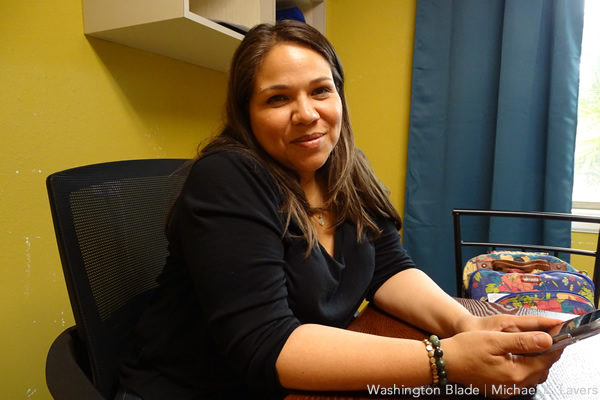
Resource Center Matamoros co-founder Gaby Zavala in her office in Matamoros, Mexico, on Jan. 14, 2020. (Washington Blade photo by Michael K. Lavers)
The Organization for Refugee, Asylum and Migration has also launched a campaign to specifically help LGBTQ asylum seekers and refugees along the Mexico-U.S. border and in Kenya during the pandemic.
Coronavirus preparations in Tijuana ‘minimal’
The Mexican government has confirmed two coronavirus cases in Tamaulipas state in which Matamoros is located, and another four in Baja California state in which Tijuana is located.
Mexican President Andrés Manuel López Obrador on Friday posted a video onto his Twitter page that shows him practicing social distancing, but both Zavala and Marin said the Mexican government’s response to coronavirus has not been as robust as that of the U.S.
“San Diego is doing an excellent job in protecting their citizens and taking the appropriate measures to keep them safe,” Marin told the Blade, noting San Diego is roughly 20 miles north of Tijuana. “It’s not as though they’re not doing anything (in Tijuana), but what they’re doing is very minimal.”
Marin said many bars in Tijuana were open on Thursday. He also said there is a lack of information from officials about coronavirus in the local media.
The Blade on Feb. 28 saw an electronic billboard on the Mexican side of the San Ysidro Port of Entry with coronavirus information. There was no such advisory on the U.S. side of the border.
“We’re never going to know and all of a sudden we’re going to have a lot of people sick,” said Marin.
Zavala told the Blade the Matamoros camp “is still running as is,” but many of the migrants who live there are “staying in.” Zavala said Resource Center Matamoros has added 30 more handwashing stations in the camp and distributed soap and masks.
“They’re washing hands,” she said. “Kids are washing hands.”
“The education part, we’ve done a really good job,” added Zavala. “We’re just trying to keep everything sort of the same so that we don’t cause ripple effects that will be more disastrous later.”
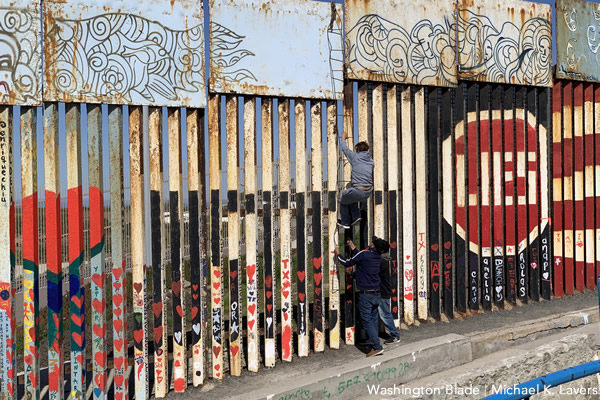
A man uses a makeshift ladder to scale a fence that marks the Mexico-U.S. border in Tijuana, Mexico, on Feb. 26, 2020. (Washington Blade photo by Michael K. Lavers)
Undocumented immigrants prohibited from entering U.S.
The Trump administration on Friday also announced the U.S. as of midnight Saturday will not allow undocumented immigrants to enter the country from either Mexico or Canada.
Acting Department of Homeland Security Secretary Chad Wolf told reporters during the White House’s daily coronavirus briefing his department apprehends people from more than 120 countries around the world. Wolf noted “the vast majority” of these nations have coronavirus cases.
“Many of these individuals arrive with little or no identity, travel or medical documentation, making public health risk determinations all but impossible,” said Wolf. “It’s also important to note that the southern border would likely increase the strain on health systems in our border communities, taking away important and life-saving resources away from American citizens.”
Immigrant rights groups condemned the announcement.
“It’s hard to imagine travel more essential than the journey an asylum-seeker makes to flee persecution,” said Charanya Krishnaswami, advocacy director for the Americas at Amnesty International USA, in a statement. “Yet today’s restrictions, which empower the U.S. to push back people who lack proper documentation, may inexcusably prevent asylum-seekers and unaccompanied children — two of the populations at greatest risk of danger — from accessing safety.”
ICE on Wednesday announced it will “focus enforcement on public safety risks and individuals subject to mandatory detention based on criminal grounds” during the coronavirus. The statement that detailed the new policy directive made no mention of detention centers or detainees.
ICE has suspended visitation at all detention centers. Its website also notes “the health, welfare and safety of U.S. Immigration and Customs Enforcement (ICE) detainees is one of the agency’s highest priorities.”
“Since the onset of reports of Coronavirus Disease 2019 (COVID-19), ICE epidemiologists have been tracking the outbreak, regularly updating infection prevention and control protocols, and issuing guidance to ICE Health Service Corps (IHSC) staff for the screening and management of potential exposure among detainees,” it reads.
“ICE continues to incorporate CDC’s COVID-19 guidance, which is built upon the already established infectious disease monitoring and management protocols currently in use by the agency,” adds the website. “In addition, ICE is actively working with state and local health partners to determine if any detainee requires additional testing or monitoring to combat the spread of the virus.”
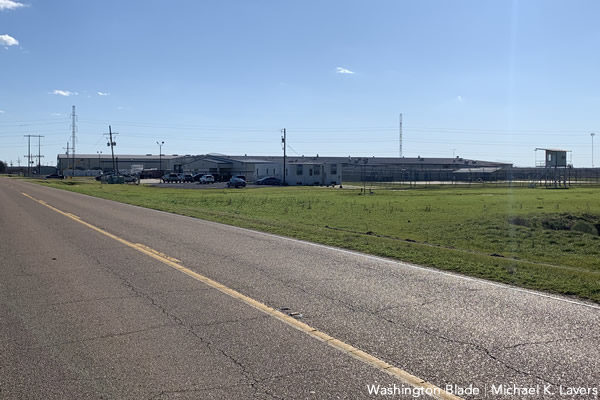
River Correctional Center in Ferriday, La., on Feb. 1, 2020. (Washington Blade photo by Michael K. Lavers)
A guard at the Bergen County Jail in New Jersey — which houses ICE detainees — tested positive for coronavirus on Wednesday. A spokesperson for the Bergen County Sheriff’s Office told a local newspaper that none of the 250 ICE detainees who are currently at the facility were exposed to the disease.
The American Civil Liberties Union, the ACLU of Washington and the Northwest Immigrants Rights Project earlier this week filed a federal lawsuit that calls for ICE to release detainees who are at high-risk for coronavirus. U.S. District Court Judge James Robart on Thursday ruled against them.
“The COVID-19 crisis lays bare our failure to treat migrants with human decency and dignity,” said Laura Rivera, director of the Southern Poverty Law Center’s Southeast Immigrant Freedom Initiative, in a statement. “The Trump administration and its enforcement agencies have been indifferent to the death and suffering of immigrants both at the border and in its cages set up across the country. The pandemic exacerbates this cruel indifference, and unless we swiftly change course, more will die than could be prevented.”
“These deaths will be on government hands,” added Rivera.
Richard Weber Jr, an attorney who dedicated his life to fighting for LGBT+ community, has died of coronavirus complications shortly after reassuring colleagues that he was improving.
The lawyer, 57, was a member of the LGBT Bar Association of New York, or LeGal, and a partner at the law firm Gallo Vitucci Klar.
He specialised in false arrest claims and helped spearhead the LGBT+ community in New Jersey. He undertook many cases pro bono and had volunteered and fundraised for LeGaL’s free weekly legal clinic for the past seven years.
Speaking to the New York Daily News, LeGal executive director Eric Lesh described Weber’s death as “devastating”.
“He reached out by email so that folks wouldn’t worry. He reached out to me and the president of the bar association, letting us know what happened and saying it was the sickest he’d ever been, but that he was on the mend,” Lesh said.
“He’d just liked some innocuous things I posted on social media. He was engaging and thought he was on the mend.
“He was a loving, kind and caring human being who gave generously of his legal talents and his energy to the LGBTQ community,” he said.
Lesh added to the New York Postthat his colleague was “just a wonderful human being with a real dedication to giving back to others”.
Richard Weber Jr began experiencing coronavirus symptoms around two weeks ago and disclosed his symptoms to his law firm on March 10, after which they closed their Manhattan office.