Recently I blocked a number of people on my FB page who have attacked me personally for criticizing Bernie Sanders’s positions and record. They warn of the need to be careful not to offend Sanders voters who threaten to not vote for the Democratic nominee if it’s not Bernie. My response has been we can’t be held hostage by this group of individuals. They are the ones who should be called out for not understanding the repercussions to the programs they espouse, and democracy as we know it, if they help to reelect Trump by not voting for whoever is the Democratic nominee.
Every Democratic candidate is flawed just as every voter is flawed. Sorry Bernie Bros you aren’t perfect and neither is your vision or your candidate. Fact is each of the Democratic candidates is more progressive than Trump by a mile and support a more overall progressive agenda than any previous Democratic nominee. The issue is about scale and scope.
It is also about the American electorate. How far and how fast they are willing to support change. In many ways it is even more important to win the Congress than it is the presidency. By winning the Senate we can stop the appointment of ultra-conservative judges and if we have the Congress can stop budget cuts to programs like Medicare and Medicaid, Social Security, the dismemberment of the Environmental Protection Agency and halt future tax cuts for the rich. So it is crucial Democrats have a nominee at the head of the ticket who will not be a stone around the neck of all down ballot candidates.
Some of the online debate has been about whether we are really a socialist country because we collectively fund schools, our police, the military and programs like social security. Should we really compare ourselves to Sweden and Norway? When Sanders does that we must question whether the American electorate believes it and will vote for a candidate who is a self-declared Democratic Socialist? Will the average voter understand what socialism really is and the difference between socialism and democratic socialism? More likely they will simply fear ‘socialism’ and vote against the candidate who espouses it.
Voters will buy into the ads Trump and his acolytes will surely run attacking Sanders. Trump and his minions will never use the word Democratic along with the word socialist. Because of this each of our down-ballot candidates from school board to United States Senate will be spending half their time distancing themselves from the “socialist” at the head of our ticket if our nominee is Bernie Sanders.
Those defending Sanders keep pointing to how he polls well against Trump. What they conveniently disregard is the Republicans have yet to attack Sanders because they want to run against him. They are just waiting with baited breath and a billion dollars to go after him if he wins the nomination. While it may all be nonsense the commercials will come reminding people of how he spent his honeymoon in the Soviet Union, his support of the Sandinistas and Ortega in Nicaragua, and of Fidel Castro in Cuba. I won’t bother going into the nuances of his support because neither will the Republican attack machine nor will the American public.
The president will also use Sanders call for a “revolution” against him. The majority of Americans don’t want a revolution. We are seeing that even in the Democratic primary electorate. Sanders underperformed in New Hampshire by a wide margin. He even lost one of the big college towns he won in 2016. He didn’t get the big boost in Iowa failing to bring out the hordes of new voters he predicted. He is actually running second to Pete Buttigieg in the delegate count with his 21 to Pete’s 22.
In 2018 Democrats took back the House of Representatives by having moderate Democrats win in swing districts across the country. The progressives Sanders and those like Alexandria Ocasio-Cortez supported in those districts all lost either in a primary or in the election. Primary voters in both parties tend to be more right-wing or left-wing but the general electorate when polled show the majority are middle of the road voters. According to a Gallup poll while Democrats are more liberal Americans as a whole remained center-right ideologically and therefore to win Democratic candidates need to be more moderate. If we field those kinds of candidates we can win. Simply look at Kennedy, Carter, Clinton and Obama as examples of how we win. The goal in 2020 must be to rid us and the world of Trump.
Peter Rosenstein is a D.C.-based LGBT rights and Democratic Party activist. He writes regularly for the Blade.
A newly uncovered video shows Democratic presidential candidate Mike Bloomberg in 2019 describing transgender people as “he, she, or it” and “some guy in a dress” who enters girls locker rooms — invoking a conservative cliché as he argued that transgender rights are toxic for presidential candidates trying to reach Middle America.
And yet, Bloomberg’s campaign published a new video on Tuesday that pledged the former New York City mayor believed in “inclusivity” for “LGBTQ+ youth,” featuring fashion designer Isaac Mizrahi declaring, “Mike is so incredibly sensitive to this issue.”
Bloomberg’s sensitivity was far less apparent at a forum hosted by the Bermuda Business Development Agency on March 21, 2019, in Manhattan, where Bloomberg derided Democratic candidates for talking about transgender protections.
Read the full article for the Bloomberg campaign’s response. He did sign a trans protections bill as NYC mayor in 2002.
“This is really just bringing Virginia into the 21st century,” Ebbin told The Washington Post shortly after the bills’ passage. “Voters showed us they wanted equality on Nov. 5, and the Senate of Virginia has started to deliver on that.”
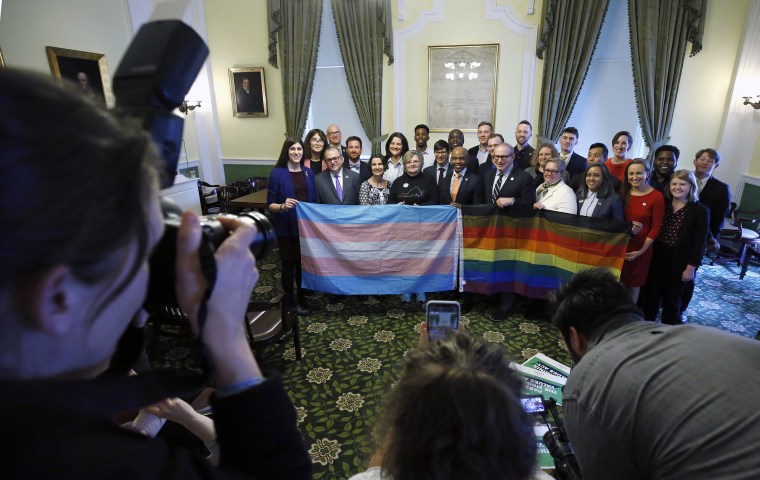
Supporters gather for a group photo ahead of the floor votes on the Virginia Values Act. The event was held in the Jefferson Room of the State Capitol in Richmond, Va., Thursday, Feb. 6, 2020.Bob Brown / AP
Despite the Supreme Court’s landmark 2015 ruling in Obergefell v. Hodges making same-sex marriage the law of the land, most states still have outdated laws on their books like the ones Virginia just repealed.
Indiana is one of those states, though an attempt to remove its gay marriage ban was unsuccessful last month in the Republican-controlled state Legislature. In fact, GOP opposition to its removal derailed legislation seeking to raise the legal age to marry in the state from 15 to 18. An amendment had been added to the age-limit bill that sought to scrap the state’s 1997 law declaring: “Only a female may marry a male. Only a male may marry a female.”
“I did not think it was unreasonable to remove what is now null-and-void unconstitutional language from the code,” state Rep. Matt Pierce, a Democrat, said in defense of the amendment. “I didn’t think it would be that controversial, because this issue has been settled now. Apparently to the Republican caucus it is controversial.”
“The religious right has not said, ‘We lost same-sex marriage, and we are moving on.’ They are still fighting same-sex marriage, both politically and legally.”
PROFESSOR JASON PIERCESON
In Florida, Democratic legislators have been trying for years to repeal thestate’s ban — which says “marriage” means “only a legal union between one man and one woman as husband and wife” — with no luck.
“This is not just, you know, unconstitutional and not just obsolete, but this is cruel language in our statute. So, it needs to get out of there,” Rep. Adam Hattersley told WUSF Public Media, adding that members of the state’s Republican leadership “don’t have an appetite to fix something” that they “hope would come back into play in the future.”
Five years after the Supreme Court had its say on the issue, same-sex marriage remains a politically contentious issue, and LGBTQ advocates continue to battle in courtrooms and statehouses to ensure gay couples can exercise their right to marry.
History of state-level gay marriage bans
States have two types of bans on same-sex marriage: statutory and constitutional. Statutory bans appear in state family law, while constitutional bans are embedded in states’ constitutions.
“Most of them are still on the books, though they are not enforceable,” Jason Pierceson, a political science professor at the University of Illinois Springfield, told NBC News.
“Democratic control of legislatures has created opportunities to get rid of some bans,” Pierceson said. “That’s the big difference between Indiana and Virginia.”
There were two phases of same-sex marriage bans, according to Pierceson. The first one began in the 1970s, when gay couples would apply for marriage licenses and many state judges at the time ruled that these unions were not prohibited. This prompted lawmakers to explicitly outlaw same-sex marriage. In 1973, Maryland became the first state to do so. Other states quickly followed, with Virginia, Arizona and Oklahoma passing similar laws in 1975, and Florida, California, Wyoming and Utah doing so in 1977.
The second phase followed a 1993 Hawaii Supreme Court decisionthat found denying same-sex couples the right to marry may violate the equal protection clause of the state’s constitution. That ruling prompted state and federal lawmakers to take action.
Utah was first to enact a statutory ban in response to that decision in 1995, and then a year later, Congress passed the federal Defense of Marriage Act, or DOMA, which defined marriage as between one man and one woman. Several states adopted their own “mini-DOMAs” after that, according to Pierceson, and by the year 2000, he said “virtually every state,” with the exception of New Mexico, had a “statutory ban on same-sex marriage.” These “mini-DOMAs,” he noted, banned gay marriage in family codes and state law, not the constitution.
In 1998, Hawaii became the first state to pass a constitutional amendment specifically targeting same-sex marriage. The measure empowered the legislature to enact a ban, which it did that same year through a constitutional referendum. Ultimately, 30 more states adopted constitutional amendments prohibiting gay marriage.
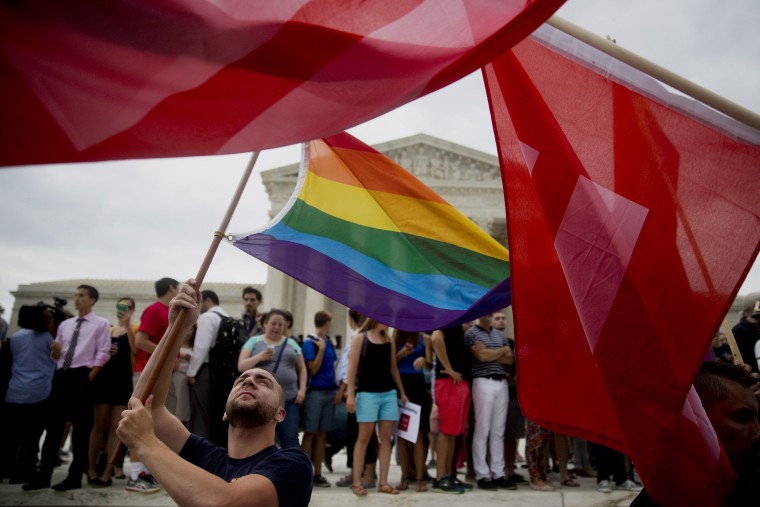
A demonstrator in support of same-sex marriage waves a rainbow colored flag after the same-sex marriage ruling outside the U.S. Supreme Court on June 26, 2015 in Washington.Andrew Harrer / Bloomberg via Getty Images file
While the 2015 Obergefell v. Hodges decision overrides all of those state measures, many of them, particularly the state constitutional amendments, remain on the books for one reason or another. In some cases, there is a lack of political willingness to remove them, while in others, the labor-intensive removal process makes them a low priority.
In Virginia, for example, while the two statutory laws banning same-sex marriage have been repealed, the state’s 2006 constitutional amendment prohibiting gay unions remains for the time being. This is because amendments must pass both the state Senate and House of Delegates and be approved by Virginia voters.
Lawmakers in Nevada will allow voters to decide whether to strike down that state’s constitutional ban at the ballot box in November. Any constitutional amendment in Nevada requires such a statewide vote.
“In Colorado we got a whole host of things to work on from transportation to education to housing to access to heath care, but instead of being able to dedicate all our resources to things like access to HIV-prevention medications, we have to allocate staff time and resource just to be able fight these bills.”
SHEENA KADI, ONE COLORADO
Sheena Kadi, deputy director of the LGBTQ advocacy group One Colorado, told NBC News that her organization has been having internal conversations for years about what to do with the state’s constitutional ban, which has been on the books since 2006 but would, in her estimate, take three to five years to remove it.
“We can take the first step through the Legislature, but then we would need a ballot initiative to remove that from the state Constitution,” she said. Given the organization’s other priorities, Kadi said going after the unenforceable constitutional amendment just seemed like too much work.
Pierceson said that in Colorado and a number of other states, having these amendments removed isn’t necessarily easy, as a number of conservative lawmakers are happy to keep them for both symbolic and political reasons.
“Many Republicans and the religious right hope Obergefell will be overturned, and then their state would go back to banning same-sex marriage, potentially,” he said.
Compliance issues
Even after Obergefell, there have been a number of instances over the past five years where state and local officials have refused to issue marriage licenses to same-sex couples.
Just a few months after the ruling, a Kentucky county clerk, Kim Davis, garnered national attention for refusing to issue marriage licenses to same-sex couples. Davis, who went to jail for her refusal, has since retired after losing re-election in 2018. In 2019, the 6th U.S. Circuit Court of Appeals found that, although Davis was immune from being sued as a county official, she could be sued in her individual capacity for refusing to comply with the law.
In early 2016, Roy Moore, then the chief justice of the Alabama Supreme Court, prohibited probate judges in the state from issuing marriage licenses to gay couples. Moore, who is currently running for a U.S. Senate seat from Alabama, was suspended from his judicial duties in September 2016 over his gay marriage order. And just last year — following the persistent refusal of a number of Alabama probate judges to issue marriage licenses to any couples so they wouldn’t have to issue them go same-sex couples — the state passed a workaround bill that no longer requires a judge’s signature on marriage licenses.
Just last year in Texas, a Waco-based judge was issued a public warning by the state Commission on Judicial Misconduct for her yearslong refusal to perform same-sex weddings. The judge, Dianne Hensley, responded by suing the commission, claiming it violated her rights under the Texas Religious Freedom Restoration Act. Last month, Texas Attorney General Ken Paxton, a Republican, declined to defend the state agency in the lawsuit because its actions conflict with his views of the Constitution.
“We believe judges retain their right to religious liberty when they take the bench,” Paxton’s spokesperson, Marc Rylander, said in a statement at the time.
Hole-y matrimony
Since the legalization of same-sex marriage federally, hundreds of state bills have been introduced that poke holes in gay marriage in various ways.
“The religious right has not said, ‘We lost same-sex marriage, and we are moving on,’” Pierceson said. “They are still fighting same-sex marriage, both politically and legally.”
Equality Federation, an LGBTQ social justice group, is tracking nine marriage bills that affect same-sex marriage across seven states: Iowa, Kansas, Massachusetts, Missouri, North Carolina, South Dakota and Tennessee.
Colorado had been on this list until just last week, when advocates defeated five bills they described as being anti-LGBTQ. One of them, House Bill 1272, had proposed that existing state law — which still stipulates that marriage is between one man and one woman — be enforced as written, and that no judicial rulings, including those from the U.S. Supreme Court, should influence their enforcement.
HB 1272 also sought to restrict adoption to “marriages and civil unions that consist of one man and one woman.” This could have called into question the legal parental status of Colorado Gov. Jared Polis, who in 2018 became the first openly gay man elected governor in the U.S.; he and his same-sex partner are not married and have two children together.
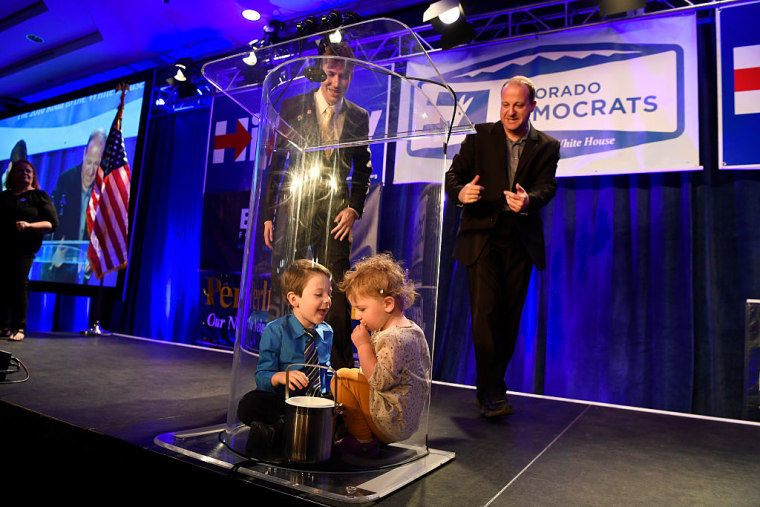
U.S. Representative Jared Polis, right, and his partner, Marlon Reis, with their two children, 5-year-old C.J. and 2-year-old Cora, on stage after Polis addressed supporters on November 8, 2016 at the Westin.John Leyba / Denver Post via Getty Images
North Carolina and Tennessee are considering marriage bills similar to the one Colorado just killed. However, the majority of the bills introduced that target same-sex marriage have fallen within the “religious exemption” category, according to Pierceson.
InMassachusetts, one proposal asserts that the belief that marriage is only between one man and one woman is a protected religious belief and thus prohibits the government from “discriminating” against state employees or businesses that act on this belief.
Bills in Kansas, South Dakota and Tennessee draw on the idea of the separation of church and state in their proposals. These bills define marriage as between one man and one woman and argue that to mandate otherwise is tantamount to state sponsorship of the religion of “secular humanism.”
A bill in Iowa creates a new category of “elevated marriage,” defined as one man and one woman, and it stipulates distinct and additional vows and paperwork. A separate Iowa proposal would require applicants for marriage licenses to disclose their sexual orientation, which could be used in child custody cases.
In Missouri, one lawmaker proposed replacing all marriage licenses with domestic union contracts. The measure, House Bill 2173, has drawn opposition from both LGBTQ advocates and proponents of “traditional marriage.”
“Still seeing attempts to invalidate love and invalidate families and those protections that come along with it is frustrating,” Kadi said. “In Colorado we got a whole host of things to work on from transportation to education to housing to access to heath care, but instead of being able to dedicate all our resources to things like access to HIV-prevention medications, we have to allocate staff time and resource just to be able fight these bills.”
How safe is gay marriage?
More than 10 percent of LGBTQ adults were legally married in June 2017, just two years after the Obergefell ruling, according to Gallup, and the number is likely even higher now. In addition, public opinion has shifted strongly in favor of same-sex marriage, with a2019 Gallup poll finding 63 percent of Americans approve of such unions.
So, is gay marriage safe?
“Absolutely not,” Kadi said, “especially given the current makeup of the Supreme Court.”
Pierceson largely agrees.
“I think in the short term marriage is fairly safe. It’s hard to see the Supreme Court overturn itself in the next couple of years,” he said, though he added that he is less confident about its long-term safety.
“The religious right, conservative movements and the Republican Party are hoping for an overturning of Obergefell with a more conservative judiciary,” Pierceson said.
Kadi noted that President Donald Trump has appointed more than 50 circuit court judges in his first term. And while Trump claimed to be a “real friend” to lesbian, gay, bisexual, transgender and queer people during the 2016 campaign, Kadi said his administration is “no ally to the LGBTQ community.”
“We have seen this impact not only the Supreme Court but the lower courts as well,” she said of Trump-appointed judges, many of whom have come under criticism for their anti-LGBTQ track records.
“It’s only a matter of time before we see another challenge” to same-sex marriage, he said. “That is why we have to stay vigilant.”
Over 2,000 queer and trans people from all 50 states and the District of Columbia have signed onto two letters highlighting criticism from the LGBTQIA+ community toward Pete Buttigieg’s presidential campaign. Two autonomous groups, #QueersAgainstPete, a collective of queer people who interrupted a Chicago fundraiser for Buttigieg in January; and Queers Not Here for Mayor Pete, a group of LGBTQ community organizers across the U.S.; have both circulated open letters making the case that the LGBTQIA community deserves better than Pete.
At Friday’s Democratic debate, Buttigeig declared that “we cannot solve the problems before us by looking back.” The groups contend that we must honor the history of LGBTQIA+ communities to move forward equitably, and Buttigieg appears uninterested in doing so. Leaders within LGBTQIA+ communities—especially Black trans women—have worked tirelessly over the past several decades to push movements to value and fight for our full identities and experiences.
“Pete Buttigieg is not a candidate of the future; he erases and mocks the histories and realities of racial, sexual, and gender minorities. The LGBTQ community, like many others, faces racism, homelessness, unemployment, and a lack of adequate healthcare. In rejecting Pete Buttigieg, we don’t seek a nostalgic return to the past but a reminder that our histories persist into our present,” said Yasmin Nair, writer and activist of Chicago, IL ”We cannot solve the problems all of us face if we leave the most vulnerable behind. That’s not ‘looking back.’ It’s making sure everyone moves forward, not just the wealthiest among us.”
In their open letter, #QueersAgainstPete notes that “gaps in Mayor Pete’s platform will fall particularly hard on economically vulnerable LGBTQIA+ communities” from his opposition to Medicare for All and cancelling student debt, to his history of “tearing down hundreds of homes in Black and Latino neighborhoods in South Bend.”
#QueersAgainstPete also highlights Buttigieg’s ongoing failure to address the concerns of Black Lives Matter – South Bend, from their call to create a Citizens Review Board, to their call for Buttigieg’s resignation following Eric Logan’s murder by South Bend police. The letter cites Buttigieg’s failure to commit to a moratorium on deportations or decriminalization border crossing, and his disregard for the voting rights of the over 230,000 queer and trans people who are currently incarcerated. #QueersAgainstPete also stands with Chelsea Manning and criticizes Buttigieg’s stance that she should remain in prison for blowing the whistle.
In an essay, Queers Not Here For Mayor Pete contrasts issues important to the LGBTQIA+ community such as affordable healthcare and housing with Buttigieg’s embrace of donations from Wall Street and billionaires, earning him the nickname #WallStreetPete. In a second essay on his racial justice track record, the group noted the highly disproportionate marijuana arrests of Black people during Buttigieg’s tenure, an issue also raised in Friday’s debate.
Queers Not Here for Mayor Petecompare Buttigieg’s campaign to that of recently-elected out lesbian Chicago Mayor Lori Lightfoot. The #StopLightfoot campaign, created by a diverse group of LGBTQ organizers, challenged her record on policing, immigration, housing, and ties to Islamophobia. She has backtracked on many of her more progressive campaign promises, and we are sure Buttigieg would do the same. “Just because someone may share our identity, it does not mean they will show up for the most marginalized and those most in need of attention within our community,” wroteQueers Not Here For Mayor Pete.
“Buttigieg has no record fighting for targeted or marginalized peoples and shows little sign of that changing—he surrounds himself with the likes of Big Pharma, CIA veterans, and billionaires,” said Harper Bishop (he/they), a co-founder of Queers Not Here For Mayor Pete based in Buffalo, NY. “We aren’t homophobic or self-hating. He has been bought-out, and we just don’t see his candidacy as a sign of collective liberation.”
#QueersAgainstPete and Queers Not Here for Mayor Pete are not the first LGTBQIA+ individuals to view Mayor Pete’s campaign with skepticism. A November 25 poll released by Out magazine shows Mayor Pete placing fourth among LGBTQIA+ voters. Jacob Bacharach, Yasmin Nair, Shannon Keating, Max S. Gordon, Rich Benjamin, and George Johnson all published critiques of his campaign from a queer lens. Rather than address concerns being voiced by the LGBTQIA+ community, Mayor Pete has decided to plug his ears. When confronted with criticism from LGBTQ media, Pete said “I can’t even read the LGBT media anymore.”
“Queer and trans people deserve a President who listens to our concerns, not one who runs from them,” said Ian Madrigal (they/them), an organizer with #QueersAgainstPete based in Washington, D.C. “While former Mayor Buttigieg boasts about the historic nature of his campaign, every step along the way, he has made the conscious decision to back policies that harm the very communities he claims to represent. Pete may be queer, but we know he is not here for us.”
###
#QueersAgainstPete is a collective of queer people against Mayor Pete Buttigieg’s candidacy for president. We believe the LGBTQIA+ community deserves better than Pete. Follow @QueersAgnstPete on Twitter.
Queers Not Here for Mayor Pete is a community that believes that the foreparents of LGBTQ liberation set the bar high and Buttigieg’s candidacy doesn’t even come close. Follow Queers Not Here for Mayor Pete on Facebook.
Despite recent government promises to protect LGBT+ people, children in Vietnam are still taught at home and at school that being gay is a “disease”, according to a new report by Human Rights Watch (HRW).
Same-sex marriages are not recognised in Vietnam, but gay sex is legal and it is believed to have never been criminalised in the country’s history. There is an equal age of consent, and LGBT+ people are able to serve in the military.
In 2015, the country made headlines for voting to allow trans people who had been through gender affirmation surgery to register as their correct gender.
In 2016, while serving on the United Nations Human Rights Council, Vietnam voted in favour of appointing a watchdog to protect LGBT+ rights.
While recent legal changes in Vietnam make the futures of queer people seem promising, socially LGBT+ people commonly face extreme stigma and discrimination.
In its report on education for LGBT+ youth in Vietnam, HRW interviewed queer youth who were searching for information against a “steady tide of stereotypes, misinformation, and anti-LGBT rhetoric”.
They described how being LGBT+ was frequently described as a “disease”, both by their families and at school.
Nhung, a 17-year-old bisexual girl, said: “I don’t feel safe at school, because the view and mindset of other people on LGBT+.
“I didn’t get hurt physically, but I did suffer mentally. You have to be hurt when people tell you have a disease that frequently.”
Other young people told HRW that the most frequent comments they heard from teachers on LGBT+ issues was that being gay is a “mental illness”.
Quân, an 18-year-old gay man, said he was taught in his high school biology class that “LGBT+ people need to go to the doctor and get female hormone injection” to cure their “disease”.
In 2019, Vietnam’s education ministry announced plans for an inclusive sex education curriculum, but it is yet to be implemented.
Graeme Reid of HRW told The Guardian: “Largely thanks to a vibrant civil society-led LGBT rights movement, social awareness and acceptance of sexual orientation and gender identity has increased greatly in recent years in Vietnam. The government’s actions, however, have so far not officially reflected these changes.
“One result of the sluggish policy change is that social perceptions in many cases remain mired in outdated and incorrect frameworks – such as the widespread belief that same-sex attraction is a diagnosable mental health condition.”
March 1 Occidental Center for the Arts’ Literary Series presents The Ice Palace Waltz by local author Barbara L. Baer. Two Jewish immigrant families come together in a riveting family saga amid the financial and social turmoil of early 20th Century America. Selected readings with slide show, Q&A, book sales & signing. Free admission, all donations gratefully accepted. Refreshments by donation, wine/ beer for sale. OCA: 3850 Doris Murphy Way, Occidental, CA. OCA’s facilities are accessible to people with disabilities. For more info: occidentalcenterforthearts.org or 707-874-9392.
A study of gay, bisexual and questioning teenage boys in the United States has revealed that the majority have never had a HIV test.
Researchers surveyed nearly 700 boys aged between 13 and 18 and found that less than one in four had ever had a HIV test, Healthday reports.
They also asked the boys about their sexual activity and history and found that just one third of teenage boys who have had sex without a condom had taken a HIV test.
Teenage boys who took part in the study thought they couldn’t legally consent to HIV testing because of their age.
Researchers discovered various barriers teenage boys face in looking after their sexual health. Many believed that their age meant they could not legally consent to a HIV test. Others did not know how to go about getting tested, while more were afraid of being outed.
The study, which was published online yesterday in the Pediatrics journal, revealed the best solution to the lack of testing is, of course, education. Teenage boys who had open dialogue with their parents about sex and HIV as well as those who knew basic facts about the virus were more likely to get tested.
Doctors – pediatricians in particular – need to be having more frank and open conversations with their male teenage patients.
The study’s authors also noted that 15 per cent of HIV infections in the United States are undiagnosed, but his figure rises to 51 per cent among 13-24 year-olds.
“Doctors – pediatricians in particular – need to be having more frank and open conversations with their male teenage patients,” said study co-author Brian Mustanski.
“If parents ask their teen’s provider to talk about sexual health and testing, this may be enough to start that key dialogue in the exam room, leading to an HIV test,” he added.
He also said that teenage boys should be empowered to be able to speak about these issues with doctors without their parents present.
Antiretroviral drugs mean that people with the virus can now live healthy and happy lives.
While HIV was once a death sentence, progress in medical science has led to breakthroughs that mean people can now live healthy, happy lives with the virus.
Antiretroviral drugs are used to treat the virus, and when taken effectively, a person’s viral load is undetectable. A major study that concluded last year found that people on effective treatment cannot pass the virus on through unprotected sex.
Furthermore, the availability of PrEP (pre-exposure prophylaxis), when taken daily, prevents people from contracting the virus through unprotected sex.
Democratic presidential candidate and former South Bend, Indiana Mayor Pete Buttigieg was met with protesters representing the group Queers Against Pete outside of a private fundraising event at the National LGBTQ Center for the Arts in San Francisco on Friday.
Inside the building, two activists attempted to disrupt the fundraiser after Buttigieg was asked about his husband, Chasten, by a member of the audience. “I respect your activism,” Buttigieg said, “but this is a gathering of supporters of our campaign and I just got a question about my husband and I’m really excited to answer it.”
Some of the group’s concerns include Buttigieg’s lack of support for canceling student loan debt, his opposition to a fully-realized Medicare for All plan and free universal public college.
Before the event, the line of Buttigieg supporters wrapped around the block to enter, with protesters chanting and waving signs while people waited. Some supporters seemed flummoxed by their presence. “Queers against Pete?” one attendee questioned, reading their signs.
“We’re on the same team,” someone muttered. “What’s the point?” someone else said. “Just vote for your candidate. Don’t tear down the others.”
“You’re coming to San Francisco, the heart of gay activism in America,” Emily Lee, director of the San Francisco Rising Action Fund, said in an interview. “You need to actually respond to the people of San Francisco who identify as gay or queer. It’s a very fitting place to be asking him these hard questions.”
There has been much talk about identity and diversity in the race to win the Democratic party nomination for president. Some have touted former South Bend Mayor Pete Buttigieg’s openly gay identity as proof of progress in our politics. However, being gay is not enough to earn the support of LGBTQIA communities.
We cannot in good conscience allow Mayor Pete to become the nominee without demanding that he address the needs and concerns of the broader Lesbian, Gay, Bisexual, Transgender, Queer, Intersex, and Asexual (LGBTQIA) communities. While many see different issues in silos, we are clear that LGBTQIA people are directly and disproportionately impacted by police violence, incarceration, unaffordable healthcare, homelessness, deportation, and economic inequality among other things.
Mayor Pete is leaning on the support and actively courting the LGBTQIA community, but has shown time and time again that he is out of touch, not fit to be President of the United States, and simply falls short.
National newspaper The Australianhas sparked fury with an article that draws comparisons between the coronavirus and the “contagion” of transgender people.
The newspaper is well known for its its “appalling” coverage of transgender issues, which includes articles such as “They’re castrating children”, “Transgender project ‘out of balance’” and “Corrupting kids’ thinking”.
The latest article evoked strong comparisons with disease with the headline: “Health chiefs can’t ignore ‘global epidemic’ of transgender teens.”
Published on Monday, it begins: “With the coronavirus dominating the news, Queensland’s health authorities have been urged to confront an under-reported global contagion involving troubled teenage girls declaring they are ‘born in the wrong body.’”
It then quotes University of Queensland law dean Patrick Parkinson, a man who wrote a paper comparing transgender children to teens with eating disorders, causing his employer and colleagues to write an open letterdistancing themselves from him.
“Speaking in a personal capacity,” the paper says, “[Parkinson] conceded authorities would be worried and busy with the coronavirus but said the explosion in transgender teenagers, chiefly girls, was ‘another epidemic’ – one that had ‘so far escaped public attention.’”
The article also suggests that efforts to criminalise the harmful practise of conversion therapy are a “global tactic of trans activists” who are attempting a “deceptive widening” of conversion therapy’s definitions in order to criminalise any attempt to change trans children’s gender identity.
Coronavirus aside, The Australian has a history of anti-trans reporting.
For months, The Australian has been publishing claims of a transgender “social contagion” in a section of its website dedicated entirely to sex and gender.
Critics say the articles “demonise and spread misinformation about trans and gender-variant youth,” promoting fringe anti-trans extremists while campaigning against medical experts.
Last September, the Australian Psychological Society rejected the claims as “alarmist and scientifically incorrect”. Australia’s peak trans healthcare body, AusPATH, has also called out the newspaper’s “biased” reporting.
Swiss voters on Sunday approved a referendum to ban anti-gay discrimination in a landslide, 63 percent to 37 percent, reaffirming an antidiscrimination law approved by the Swiss Federal Assembly in 2018.
The reaffirmed law makes it illegal to publicly denigrate, discriminate or stir up hatred based on a person’s sexual orientation. The 2018 bill was an expansion of a law passed in 1995 that banned denigration, discrimination and hate speech on the basis of race and religion with potential fines and prison sentences for violations. The new law does not ban gender identity discrimination.
Only three of Switzerland’s 26 cantons, or states, had majorities vote against the public referendum on Sunday, which was forced after opponents of the 2018 antidiscrimination law gathered enough signatures to force a public vote on the issue.
“After the clear ‘Yes,’ the LGBTI community will use this momentum to push for the equal application of the law and enforce marriage equality for everyone,” Pink Cross, a Swiss advocacy group said in a statement posted in German. Same-sex civil unions have been legal in Switzerland since 2007, and a bill to legalize same-sex marriage for all is pending in the Swiss Pariament and could see passage this year.
Pink Cross also called for better recording of hate crime statistics, and for an overhaul of what it called the “bureaucratic effort” required to change gender on official documents for transgender and intersex Swiss people — “the part of the LGBTI community that cannot benefit from today’s yes,” the group wrote.
The BBC reported that some of the country’s right-wing political parties and evangelical Christian groups opposed the measure. The country’s largest parliamentary party, the far-right Swiss People’s Party, opposed the antidiscrimination law, saying it would silence “unwelcome opinions and voices.”
Justice Minister Karin Keller-Sutter, a member of the seven-person Federal Council that serves as Switzerland’s executive branch, said voters “are saying unmistakably that hatred and discrimination have no place in our free Switzerland.”
“Freedom of expression remains guaranteed,” she said, noting that courts have been “restrained” in their application of the existing law and “anyone who remains respectful need have no fear of being convicted.”