Hungary’s gay community is facing increased government “attacks” and fears that its hard-won rights, and an improvement in public acceptance of them, may be at risk, a rights group said.
The European Union has long criticized Prime Minister Viktor Orban’s right-wing government over its record on the rule of law and civil liberties, including its attitude toward minorities, including LGBTQ people.
The Hatter (“Background”) group said various legislative moves, a lack of police vigilance and sometimes hostile rhetoric from the ruling Fidesz party threatened to undo the progress seen since the fall of communism three decades ago.
“By the end of 2019, our worst fears had become reality when Hungarian state actors led by the governing parties started increasingly concentrated attacks against the LGBTQI community,” it said.
The acronym denotes lesbians, gays, bisexuals, transgender, questioning (or queer) and intersex.
“We fear that this… might become the modus operandi of the government. Ultimately, this will shift Hungarian public opinion that has otherwise shown signs of growing support for LGBTQI causes in recent years.”
Hatter cited several recent homophobic attacks which it said the police had failed to investigate with proper vigor.
Asked about the complaints, a government spokesman said the constitution and other laws guaranteed the same freedoms for all Hungarian citizens.
Hungary does not allow gay marriage but gay couples can acquire a legal status short of marriage. Individual gay people can adopt children but gay couples can’t.
Loopholes
Orban has spoken of closing “loopholes” in adoption law where it applies to gays but has not proposed new legislation. He has also not called into question the legitimacy of gay pride marches, unlike the leader of Poland’s ruling party, Jaroslaw Kaczynski.
However, Orban has defended the traditional family model. In 2018, his government promoted the legal recognition of the traditional heterosexual family model, even though the constitution already defines marriage and family as one man, one woman and their children.
Last year parliament speaker Laszlo Kover, a prominent Fidesz member, outraged rights groups by equating gay adoption with child sex abuse.
“In a moral sense there is no difference between pedophiles and those who demand (gay adoption),” Kover told a public forum, according to the news portal index.hu. “Both objectify the child as a consumer good, and consider it a means of self-fulfillment.”
Orban’s chief of staff, Gergely Gulyas, endorsed Kover’s remarks at the time.
“Such adoptions put the child’s interests below those of the adopters who cannot have children on their own. That is factually correct.”
“Linkage to care” is a well-spoken mantra in the field of HIV: Make sure that people who are living with HIV are seeing an HIV care provider and have access to HIV medications. As simple as it may seem, the changing nature of San Francisco’s HIV epidemic means that more and more people are not accessing—or are not able to access—HIV prevention or care from traditional medical clinics.
HIV providers and frontline staff must confront the challenge of bringing HIV care to people—beyond simply linking people to care.
“Access to HIV care is so much more than making sure a person has a place to receive medical treatment and can afford it,” said Julie Lifshay, MPH, PhD, from San Francisco AIDS Foundation.
“Even if a person knows where to go and has insurance or a way to pay for care, they may not be able to afford the bus ride to get there. Or they can’t navigate the health system to make an appointment, they can’t afford their medication copays, or they can’t pick up prescriptions because that would mean missing their place in the food line. It’s complicated, and there are so many things that can put HIV care just out of reach,” said Lifshay.
“People who are unhoused face a lot of barriers accessing care,” said Beth Rittenhouse-Dhesi, MS, from San Francisco Community Clinic Consortium. “It’s not as easy as walking into a clinic and getting needs met. Because of stigma, many people have had bad experiences and so they choose to stay away. The other issue is that people living on the street are dealing with a lot of survival issues. They’re worried about food, water, shelter and clothing. So even very serious health concerns can be put on the back burner.”
In San Francisco, 20% of new diagnoses were among people experiencing homelessness, a proportion which has been increasing in recent years.Getting to Zero SF, San Francisco’s plan to reach zero new HIV infections, zero AIDS-related deaths and zero HIV stigma hinges on the success of reaching and providing services to people experiencing homelessness.
POP-UP is open to people who are homeless or unstably housed, are off antiretrovirals or have a detectable viral load. The program sees people on a drop-in basis without appointments, starts people on antiretrovirals and provides comprehensive medical care, medication storage, food, clothing, housing assessments, mental health care and gift card incentives for staying in care.
“We call it POP-UP because when people come into the clinic, our team grows around them and we work to meet their needs and concerns,” said Elizabeth Imbert, MD, MPH from Zuckerberg San Francisco General Hospital. “We don’t start with the medical stuff—we try to get to know them, figure out what they want, and what’s important to them. We find out what their health goals are, what has gotten in the way [of meeting goals], and how we can help meet them.”
Since January of 2019, over 95% of people in POP-UP have started on ARVs, and more than half (32 out of 59) are virally suppressed, reported Imbert at a Getting to Zero meeting in December 2019.
Street Outreach Services does not provide ongoing treatment for chronic conditions including HIV, but the team does connect people with regular care, help people figure out transportation to medical appointments, and follows up with clients to make sure they receive HIV care.
Rittenhouse-Dhesi said the van frequents neighborhoods that not only have homeless residents but also a low concentration of service providers.
“We provide care to anyone who is unhoused—our goal is to connect with people in their own environment of places where they’re gathering. That may be a camp, or another place outdoors, or at a meal program. The whole objective is to come to people, and not always expect people to come to a four-walls clinic. After you make that initial relationship, you can help people navigate into other services,” said Rittenhouse-Dhesi.
At San Francisco AIDS Foundation (SFAF), a new program reaches Latinx community member immigrants experiencing homelessness through a group of community health educators.
The “Todos Somos Familia” project, though Latino Programs at SFAF, recruited and trained a group of currently and formerly homeless Latinx immigrants on topics such as overdose prevention, accessing social services, HIV prevention and getting into HIV care. In turn, members of the program reached out into the community and into their networks to share HIV and health information and services, facilitating access to case management, drug treatment, testing, PrEP and HIV care.
(Photo: SFAF)
“There is a lack of investment in reaching immigrants without housing,” said Jorge Zepeda, from SFAF. “These individuals may not be aware of the services they can access, and may not trust them. This project helped SFAF become a safer and friendly space for Spanish-speaking communities, and showed that we can reach people with these services if we do so in culturally competent ways.”
“We’re seeing these great disparities in HIV in San Francisco,” said Lifshay. “It’s because we are dealing with social determinants of health including income disparities, the housing crisis, displacement issues and racism. We have to address those things to get to zero. It’s such a big task, but a smaller piece is making sure our resources go to the people most impacted by these issues. We have to reach homeless folks with HIV care—we must do a better job of that.”
END THE EPIDEMICS
Sign the petition to End the Epidemics, a campaign calling for a statewide plan to end the HIV, STD and hepatitis C epidemics in California. Urge California leaders to make serious investments in public health and help us lead the nation in ending the HIV, STD and hepatitis C epidemics. JOIN US!
HIV SUPPORT & HEALTH NAVIGATION AT SFAF
We offer a range of services that help connect you to HIV treatment, benefits, housing subsidies, and insurance. MORE INFO
STREET OUTREACH SERVICES
SOS provides high-quality, nonjudgmental health services directly to people experiencing homelessness in places where they live and congregate. MORE INFO
EMILY LAND, MAEmily Land is the editor-in-chief of BETA blog and content marketing manager at San Francisco AIDS Foundation.
Transgender girls and women would be barred from participating in sports on the team that aligns with their gender identity under a proposed Arizona law.
The Arizona legislation allows only biological women or girls to play on female teams, and requires a doctor’s note to prove a person is female if their birth sex is disputed. It allows lawsuits by students who believe they’ve missed opportunities because a transgender person is on a school team.
The measure is intended to prevent female athletes from being forced to compete against biological males, Barto said in a statement. It would apply to K-12 schools, community colleges and state universities but only to female teams.
She said most people view the issue as one of basic fairness.
“When this is allowed, it discourages female participation in athletics and, worse, it can result in women and girls being denied crucial educational and financial opportunities,” Barto’s statement said.
Republicans make up the majority in the state House and Senate.
Similar legislation has been proposed in Alabama, Georgia, Indiana, Missouri, New Hampshire, Tennessee and Washington state, according to the American Civil Liberties Union.
The measures are part of a national campaign backed by the Scottsdale-based Alliance Defending Freedom, a conservative religious freedom group.
Barto said she is working with the ADF and the Center for Arizona Policy, a powerful group at the state Capitol that lobbies for religious freedom and anti-abortion legislation, to push the proposal,
Several national women’s rights and sports organizations are pushing back, saying in a letter distributed by the American Civil Liberties Union that barring transgender people from sports teams aligning with their gender identity often means they are “excluded from participating altogether.”
The Alliance Defending Freedom has filed a federal discrimination complaint on behalf of Connecticut girls who competed in track-and-field. The girls say the state’s inclusive policy on transgender athletes has cost them top finishes and possibly college scholarships.
“Forcing female athletes to compete against biological males isn’t fair and destroys their athletic opportunities,” attorney Matt Sharp, the ADF’s state government relations director told The Associated Press in an interview for a recent news report. “Likewise, every child deserves a childhood that allows them to experience puberty and other natural changes that shape who they will become.”
Conservative groups are also pushing bills that would bar doctors from providing them certain gender-related medical treatment.
The proposed laws, if enacted, “would bring devastating harms to the transgender community,” Chase Strangio, a transgender-rights lawyer with the ACLU.
“It is hard to imagine why state legislators have decided to prioritize barring transgender young people from sharing in the benefit of secondary school athletics or disrupting medical treatment consistent with prevailing standards of care,” Strangio said. “But here we are, the start of the session, a time to fight.”
The measure doesn’t apply to males, Barto said, because they are “biologically different from females in terms of bone density, lung capacity, strength, and other respects, are not disadvantaged by females in boys’ sports.”
She had no Arizona examples of girls or young women impacted but pointed to issues in Connecticut and the ADF lawsuit.
A powerful debut by Addie Tsai, Dear Twin is a thought-provoking book that examines the emotional weight of twin-ness through a queer lens.What happens when the person you love most in the world, the person you see as your touchstone, disappears and leaves you alone to pick up the pieces of a broken home? After Poppy’s twin sister, Lola, disappears, Poppy becomes stuck at home, under the thumb of a controlling father who refuses to send a search warrant for Lola or allow Poppy to go to college. Living at home in the silence following her sister’s disappearance, Poppy is forced to reflect on the details of her and her sister’s shared past and untangled the trauma that has shaped their lives.
Poppy’s identity as a twin has colored almost every area of her young life, from the uncomfortable sexual fetishization of twins, to irritating pop culture depictions. Much of her own identity has been attached to that of her sister, who looks like the mirror image of her. Tsai’s book asks how one, who the world views as only part of a whole, a twin set, establishes an identity for oneself.
Tsai also explores, through Poppy’s journey, other relevant themes, including the intersection of queer and Asian identity as well as the reaching effect of abusive relatives. Poppy identities as a queer biracial Chinese-American woman in a society that often fetishizes both parts of her identity, though she does find comfort and a sense of validation with Juniper, a queer butch Korean-American girlfriend. Not only does her relationship with Juniper offer Poppy positive representation of herself as a teen with so many intersectional identities, but a safe place against the toxic effects of her biological family, who are often both physically and emotionally abusive.
Dear Twin explores many narrative components “mainstream” fiction has often neglected to discuss, from the realities of a being a twin beyond the stereotypes, to the discussion of what it means to be queer and Asian in our society.
Addie Tsai brings a touching sense of humanity and realness to their first Young-Adult novel. Though Dear Twin is not for the light-hearted, it is a necessary read for those who are negotiating diverse and complicated identities or those who wish to understand them.
Dear Twin By Addie Tsai Metonymy Press Paperback, 9781999058807, 280 pp. November 2019
As the world marks Holocaust Memorial Day, PinkNews CEO Benjamin Cohen reflects on the persecution of gay people by the Nazis.
If I was alive 80-year-ago and living in Berlin and not London, my outlook would not have been looking good and not just because I’m Jewish. Like some of those who found themselves in concentration camps, I also have a disability, I am member of a trade union and perhaps more pertinently, like many of the people reading this article, I am gay.
More than 80 years ago, Hitler ordered the creation of a list of homosexuals, who would later find themselves persecuted. In total, during their time in power, the Nazis arrested 100,000 people for homosexuality, imprisoning half of them including up to 15,000 in concentration camps. Many of those imprisoned died, some after sickening experiments by scientists trying to find the ‘cure’ for homosexuality.
Unfortunately, when the allies liberated the concentration camps, many of the gay people who were imprisoned were not set free. Instead they were transferred to prisons, then under the control of the Allied forces. Their crime, homosexuality, something outlawed before the Nazis took power, remained on the statute book until 1968 in East Germany and 1969 in West Germany.
If I was alive 80-year-ago and living in Berlin and not London, my outlook would not have been looking good and not just because I’m Jewish.
Unlike other victims of Nazi persecution, they were not offered reparations and it took until 2002 for the German government to officially apologise for the Nazis’ crimes against gay people. Today memorials to the Nazi persecution of the gay community are found in Berlin, Amsterdam, San Francisco, Sydney and Tel Aviv.
Holocaust Memorial Day, marked today, is the opportunity to remember all of the victims of Nazi persecution. The Nazi’s rule of terror was an era that witnessed the single worst example of misery that humanity has ever inflicted on itself. Today in my view, also provides moment of reflection for what happened still in our collective lifetimes and an opportunity to galvanise us never to allow the same persecution of minority groups happen again.
I believe that as a community, should use Holocaust Memorial Day as an opportunity for us to consider, given how many countries around the world continue to criminalise or discriminate LGBT+ people, how unchallenged prejudice can quickly and dramatically escalate into unimaginable brutality.
What happened during the Holocaust also stands to us as a warning to all of us that societies can go backwards as well as forwards. In the 1920s, Berlin was one of the gay capitals of the world, where Germany’s prohibition on homosexuality was widely ignored by the police and a large, open, flourishing gay community was in existence.
It seems incredible that in 2020, 73 countries around the world would either imprison me or put me to death simply for being gay, something that I chose no more than the accident of my birth than means that I am a Jew.
Just before the Nazis took power, the German legislature was poised to repeal the legal ban of male homosexuality. It took a political climate that had nothing to do with gay people to radically alter the treatment of this minority group. The Nazis drew on deep rooted, latent homophobia within the population to stigmatise gay people to justify to ordinarily rational people the single largest act of persecution on the basis of sexuality that the world has ever seen, just as it engulfed the largest single act of anti-semitism on the planet.
What worries me is that eight decades on, as some countries such as Britain have moved forward so much with gay equality, other countries are moving backwards or have yet to move at all. Russia, which legalised homosexuality more than 20 years ago, has in recent years introduced draconian laws that severely clamp down on the rights of gay people and their families.
It seems incredible that in 2020, 73 countries around the world would either imprison me or put me to death simply for being gay, something that I chose no more than the accident of my birth than means that I am a Jew. It is clear that when it comes to gay people, at the least, there are still many lessons from the past that need to be learnt.
Bernie Sanders’ embrace of an endorsement by Joe Rogan drew instant criticism from some corners of the transgender community because of the podcast host’s use of gay slurs and position on trans issues.
Like many Twitter-centric controversies, the debate quickly blew up and then became circular, with Bernie foes jumping on the bandwagon—and other Democrats fuming that the uproar was another example of left-wing self-sabotage.
It began when the Vermont senator’s campaign tweeted out a video clip Thursday of Rogan saying he will “probably vote for Bernie.” The endorsement of a wildly popular public figure—Rogan’s podcast is the second-most downloaded on iTunes, and his YouTube channel has more than 7 million subscribers—would usually be cause for celebration.
But the tweet triggered backlash, even among some of Sanders’ supporters.
“I really like Bernie and am disappointed to see the campaign boost Rogan, who has made some very anti-trans comments,” tweeted trans writer Alexis Goldstein. “I really hope the campaign reconsiders.”
Rogan’s style is brash, unfiltered, and often provocative. A former UFC commentator, he has been slammed for calling athletes “faggots” and using the word “gay” as an insult. While he has previously claimed to be “100% in favor of transgender people,” he has come out against the use of puberty blockers in transgender youth and railed against transwomen competing in women’s sports.
In a 2013 podcast episode, Rogan said transgender MMA fighter Fallon Fox was “not really a she.”
“She’s a transgender, post-op person,” he told a co-host who asked about “that tranny.” “The operation doesn’t shave down your bone density. It doesn’t change.”
“You’re a fucking man. That’s a man, OK?” he continued. “I don’t care if you don’t have a dick any more.”
Because of comments like this, a number of trans people took to Twitter to say they were uncomfortable with Sanders touting Rogan’s endorsement.
“Right now states are moving to criminalize doctors who provide life saving healthcare to trans children,” tweeted Maria Montano. “Joe Rogan supports this and shares that view with his audience. This will lead to the death of many trans kids. Is this endorsement really worth it?”
In a statement, Sanders’ campaign said that “sharing a big tent requires including those who do not share every one of our beliefs, while always making clear that we will never compromise our values.”
“The truth is that by standing together in solidarity, we share the values of love and respect that will move us in the direction of a more humane, more equal world,” press secretary Briahna Joy Gray said.
The Daily Beast reached out to five LGBTQ organizations about the endorsement; none elected to comment. And some trans people said they welcomed Rogan’s endorsement, even if they did not like his beliefs, because it meant Sanders’ views were reaching a different demographic.
“I’m black and trans and a woman. Don’t like Joe Rogan,” one wrote. “But I’m also not stupid, and I understand that he is gonna exist whether I like him or not. I’d rather have his dumb fans with us than against us. Now, can all the cishet white neolibs stop pretending to care what I feel?”
Some Democrats argued they did not have a problem with Rogan’s endorsement, just Sanders’ decision to amplify it; others claimed it would be impossible to amplify Rogan to begin with. Still others said Sanders’ tweet was simply good politicking—the type of tent expansion that Democrats would need if they wanted to build a coalition of voters to beat Trump.
Sanders made a similar “big tent” appeal in 2017, when he campaigned with Heath Mello, a Nebraska mayoral candidate with a history of supporting anti-abortion laws. NARAL and other women’s rights groups criticized Sanders for the decision, but the senator stayed firm. “I think you just can’t exclude people who disagree with us on one issue,” he told NPR at the time.
Sanders has long been a champion of LGBTQ rights, and received a 100 percent positive score on the Human Rights Campaign’s most recent congressional scorecard. His decades-long record on gay rights distinguished him from Hillary Clinton in the 2016 primary, where he highlighted his opposition to the the 1996 Defense of Marriage Act and Bill Clinton’s “don’t ask, don’t tell” policy for gays in the military.
But Sanders was also recently criticized for being one of the only Democratic primary candidates not to attend two LGBTQ presidential forums. “I think it was a huge misstep on his part,” forum host Angelica Ross told The Guardian at the time. “And I’m not here for any of the excuses. I say: ‘Make it up to me. Make it up to us.’”
Rogan, meanwhile, has been known to make inflammatory comments and promote outlandish conspiracy theories, and has hosted right-wing figures like Milo Yiannopoulos, Alex Jones and Stephen Crowder on his podcast. As debate swirled about his endorsement on Friday, clips surfaced of Rogan using the n-word and comparing a black neighborhood to Planet of The Apes. In another, he joked about Hillary Clinton being paid to give blowjobs.
Perhaps it was unsurprising, then, that even right-wing fire-starter Ben Shapiro tried to hitch his wagon to the viral Twitter train.
“By the way, if the logic is going to be that anyone I endorse is now cast into the outer realm, I also endorse Bernie and plan to vote for him in the California primary,” the fellow podcast host tweeted.
In 2020, there are 16 US states that still have sodomy laws against “perverted sexual practice” and “crimes against nature”.
According to ACLU, laws against sodomy were originally designed to prohibit any sex that was not for procreation, and so included crimes like having sex outside of marriage and bestiality.
But in the late 1960s, the laws began to be used to specifically target gay people, as an excuse for discrimination when gay rights progress was just starting to be made.
Some states rewrote their sodomy laws so that they would only apply to gay people, others ruled in court that they could not be applied to straight people.
In other states, no official change was made and sodomy laws were simply treated as if they only applied to gay people.
The laws were used to stop LGBT+ people raising children, to fire them or refuse them jobs and to generally discriminate against them and silence their voices.
Sodomy is illegal in Alabama, Florida, Georgia, Idaho, Louisiana, Maryland, Massachusetts, Michigan, Minnesota, Mississippi, North Carolina, Oklahoma and South Carolina. Three states specifically target their statutes at same-sex relations only: Kansas, Kentucky, and Texas.
In 2003, the case of Lawrence v Texas saw a same-sex couple prosecuted for sodomy for having sex in private. In a landmark Supreme Court decision, prohibiting private same-sex activity between consenting adults was ruled unconstitutional.
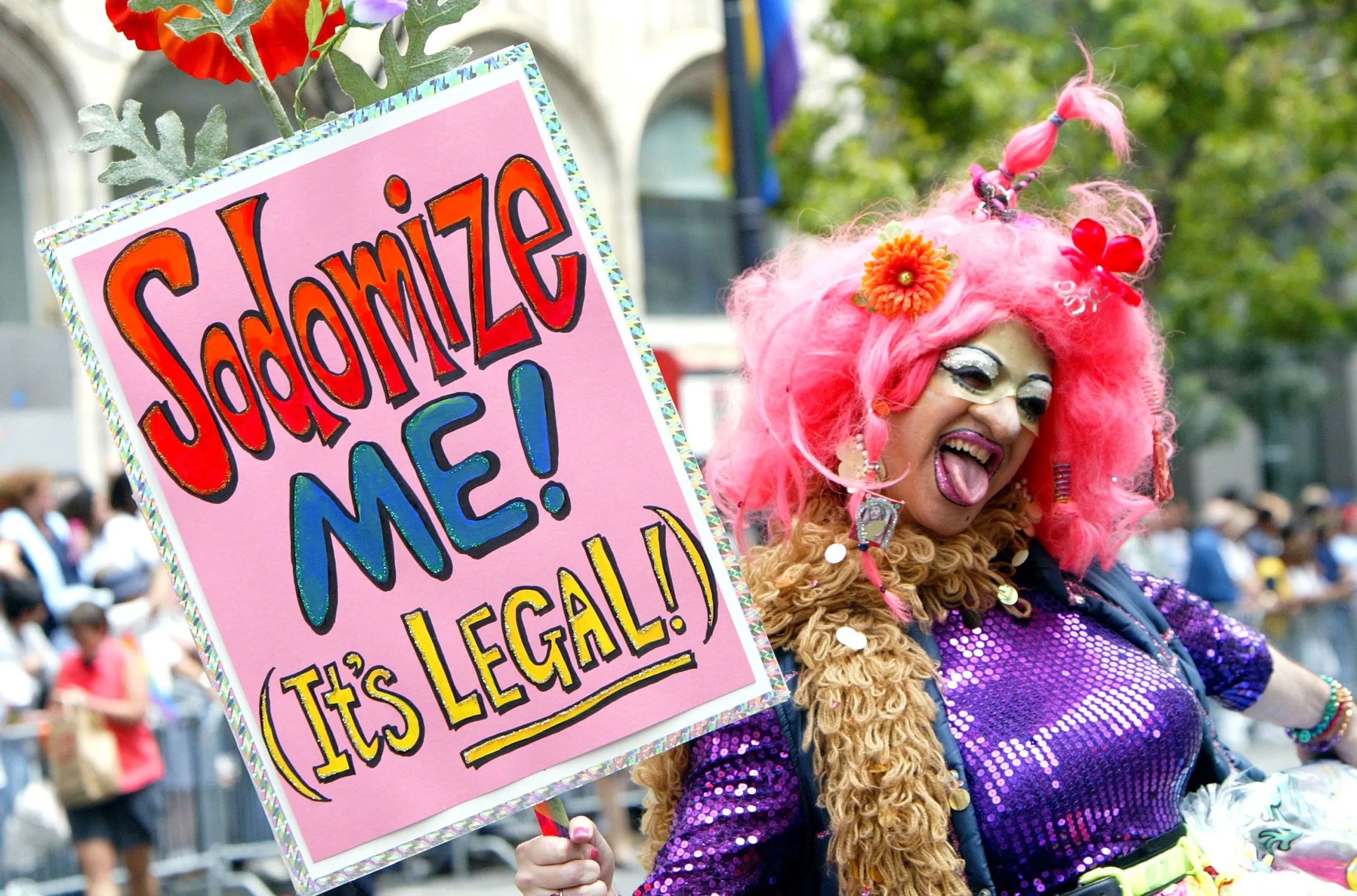
SAN FRANCISCO – JUNE 29: Madame Glinka of San Francisco at the 2003 Pride Parade celebrating the Lawrence v Texas verdict. (Justin Sullivan/Getty)
This, along with anti-discrimination laws, effectively invalidated any remaining sodomy laws, but it still remains technically illegal in 16 states: Alabama, Florida, Georgia, Idaho, Louisiana, Maryland, Massachusetts, Michigan, Minnesota, Mississippi, North Carolina, Oklahoma, Kansas,Kentucky, Texas and South Carolina. In Kansas, Kentucky and Texas the laws solely target same-sex activity.
While it might not seem like a problem if the laws are invalidated, this has not stopped people being arrested for the “crime” in cases which are alarmingly recent.
Although the crimes were thrown out by judges, these cases show that archaic sodomy laws and still having a detrimental effect on the LGBT+ community.
Legislators in Maryland are debating this session whether to repeal sodomy laws in the state.
According to analysis by the Boston Sun editorial board: “Maryland allows for up to 10 years in prison and a $1,000 fine upon criminal conviction for various acts, including bestiality… Setting the intimate relations with animals aside (we dearly hope that’s covered under animal abuse laws), there is no reason for the state to criminalise sexual acts between consenting adults.
“It’s shameful this law is still on the books and in use.”
Transgender individuals who received puberty blockers during adolescence have a lower risk of suicidal thoughts as adults than those who wanted the medication but could not access them, according to a study published Thursday in the journal Pediatrics.
“These results align with past literature, suggesting that pubertal suppression for transgender adolescents who want this treatment is associated with favorable mental health outcomes,” the study states.
The finding suggests that a major — and politically controversial — aspect of transgender health care for minors could help reduce the trans community’s disproportionate risk of suicide.
“Puberty blockers” are a type of reversible medication injection or implant that pause puberty. These drugs are prescribed to children who experience early onset puberty and for transgender youth experiencing gender dysphoria. Natural puberty resumes when the injection wears off or the implant is removed.
The study’s lead author, Dr. Jack Turban, a resident psychiatrist at the Harvard Medical School, said the findings add to the “growing evidence base suggesting that gender-affirming medical care for transgender youth is associated with superior mental health outcomes in adulthood.”
“It certainly argues against the misguided notion that gender-affirming care is inherently harmful and should be legislatively banned,” Turban said in a statement, referring to a number of recently introduced state bills seeking to limit transition-related care for minors.
The study surveyed 20,619 transgender people and found that 90 percent of trans adults who wanted, but could not access, puberty blockers experienced suicidal thoughts. For transgender adults who had been able to access puberty blockers, it was a significantly lower 75 percent.
Less than 3 percent of trans adults who say they wanted puberty suppression during adolescence actually received it — showing how hard it has been, historically, to access this particular treatment for gender dysphoria.
The study also found that a minority of trans adults — 17 percent — say they ever wanted puberty blockers, suggesting that not all trans youths will seek this particular type of treatment.
Turban has been at the forefront of transgender mental health research. A study he co-authored in September showed a link between suicide attempts and transgender “conversion therapy.” Conversion therapy is the medically discredited practice of attempting to change a person’s gender identity or sexual orientation.
For decades, doctors who treat transgender children have argued that an affirming, supportive gender transition is the best way to help trans people thrive and survive. Norman Spack, the Boston pediatric endocrinologist who in 1998 pioneered the use of puberty blockers in the treatment of gender dysphoria, said doing so can “save lives.”
But as the use of puberty blockers in trans kids has became more mainstream — thanks to endorsementS from major medical associations such as the Endocrine Society and the American Academy of Pediatrics — backlash has grown in Republican-dominated legislatures across the country.
Even as medical professionals have publicly argued that puberty blockers are safe, reversible and likely to help reduce gender dysphoria in transgender kids, conservative lawmakers in states such as South Dakota, Georgia and Kentucky are moving forward with efforts to criminalize the provision of transition-related health care, including puberty blockers, to trans minors.
In these states, the proposed bans on the prescription of puberty blockers would only apply to transgender children. In cisgenderchildren who are prescribed puberty blockers to treat early onset puberty, these bills would not restrict their use.
“Transgender people, our families and our doctors are begging legislators to follow the science when crafting policy that could alter the very path of our lives,” said Gillian Branstetter, a transgender advocate and press officer at the National Women’s Law Center. “Transition-related care is only controversial among people who know nothing about it, and lawmakers must treat the suicide risks faced by transgender youth as the public health crisis it is.”
For some, “queer” is a loaded word — a negative epithet from a less accepting time that was hurled at anyone perceived to be gay. But for others, particularly younger LGBTQ people, it is a reclaimed term and a less restrictive self-identifier.
While the word’s use — and its 21st century reclamation — has been mostly anecdotal up to this point, a new report from the Williams Institute at the UCLA School of Law has put scientific data behind the population of queer-identified people in the United States. According to its findings, nearly 6 percent of sexual minorities identify as queer, while 47 percent identify as lesbian or gay, just over 40 percent identify as bisexual and about 7 percent identify as “other.”
“We find in this study that queer individuals make up a sizable proportion of sexual minorities, who are distinct in a number of important ways from other sexual minority people, both in terms of demographic characteristics and sexuality, and across gender identity,” said lead author Shoshana K. Goldberg, a research consultant at the Williams Institute and an assistant professor focusing on LGBTQ health at the University of North Carolina, Chapel Hill.
Diving deeper into the data, the most striking demographic characteristic of the self-identified queer community comes into focus: age. Ninety-eight percent of queer people are ages 18 to 44, with the vast majority (76 percent) ages 18 to 25, or Generation Z. The study found that just 2 percent of queer-identified people are ages 52 to 59, the oldest age cohort in the study.
The vast majority of queer-identifying people, according to the report’s findings, were assigned female at birth (83 percent), with over half identifying as cisgender women. Queer respondents were also significantly more likely than lesbian, gay and bisexual respondents to identify as “genderqueer/nonbinary.”
Queer respondents also reported significantly higher education levels than lesbians and gay men and were less likely to be living in poverty than other sexual minorities. They were also more likely to report being attracted to transgender people, and transgender men in particular.
Eighty-five percent of cisgender queer women report being attracted to both men and women, and two-thirds of them say they’re attracted to both cisgender and trans people. Roughly half of cisgender queer men report being attracted to both men and women, and 72 percent report attraction to both cisgender and trans men.
“Queer identity seems to represent greater openness to partners of all gender identities,” said study author Ilan H. Meyer, a public policy researcher at the Williams Institute. “Some young people may perceive it as an identity that is more fluid than ‘lesbian’ and ‘gay.'”
Robyn Ochs, a bisexual activist and campus speaker and editor of Bi Women Quarterly, said she is “not surprised at all” by the survey’s results, since she sees the trend among young people in her work as a campus speaker.
“We come to our identities for strong personal reasons, and it’s my belief that if we took the entire LGBTQ+ community and locked us in a room and told us we can’t come out until we reached consensus, we would spend the rest of our lives in that room,” she said.
Ochs said that coming out as bisexual still elicits negative responses, even today, for a variety of reasons, including an assumption from other non-straight people that bisexuals benefit from heterosexual privilege. Ochs said she added the word “queer” to her identity in the 1990s and recently added “pansexual,” too.
“I see those three different words almost as describing: Is something blue, or is it turquoise or is it azure?” Ochs said. “I think that they are all overlapping terms; they can overlap comfortably.”
While the Williams Institute report asked respondents to choose their current sexual identity label, many sexual minorities, like Ochs, use multiple, overlapping identifiers at the same time.
Journalist Trish Bendix said she identifies as “a lesbian, a dyke and a queer woman.” She said “queerness feels more all-encompassing,” noting that some corners of the lesbian community are not inclusive of women who are attracted to trans, nonbinary and genderqueer people.
“This is why, although many women who may technically be lesbian-aligned will choose ‘queer’ as their identifier — to set themselves apart from what they see as a closed community,” Bendix said.
For others, “queer” is a catchall term that doesn’t force someone into a restricting box.
Gillian Branstetter, a writer and transgender advocate, said self-identifying as queer “can be a very liberating way to identify precisely because it’s so vague.”
“It allows each person to create their definition for it free of expectations or judgment,” she said.
Mayor London Breed joined transgender and gender non-conforming (TGNC) community leaders huddled outside of a building on Washington St. Thursday, spilling on to the cable car tracks to celebrate the ribbon-cutting of The City’s first transitional housing designated for homeless gender non-conforming adults.
The project, a 13-unit apartment whose first tenant will be aspiring chef Jane Cordova, was spearheaded by the Our Trans Home SF coalition and its “mother,” Saint James Infirmary Executive Director Toni Newman.
It is being funded by a $2.3 million allocation from The City that will not only fund the transitional housing program over a two-year period but also to provide rent support for transgender and non-conforming people facing eviction and advocacy for institutional change.
“Homelessness is acutely an LGBTQ issue, particularly for trans and gender non-conforming folks,” Supervisor Aaron Peskin said.
Transgender people are 18 times more likely to experience homelessness, and one out of every two transgender people have been homeless.
Newman found herself homeless 22 years ago after making her transition despite having a BA from Wake Forest University. She knows first-hand the vitality housing support can provide homeless transgender people.
“I needed help,” Newman said. “Somebody did something like this for me 22 years ago and gave me a place. I got myself together, got into law school. I just needed a little help.”
She sees herself in Cordova, who will be the first tenant to benefit from the program. Cordova came to the United States from Mexico when she was 16. She is currently living in an LGBT adult shelter in the Mission and will move in February, according to The Bay Area Reporter.
Cordova loves cooking and plans to use this rent-free year and the wrap around services that all 13 of its residents will receive to get on her feet, start a culinary career and find a place to live.
While this home is a historic first step in providing housing and support for the TGNC community, Saint James Infirmary Board Member Joaquin Remora detailed broader goals during his time at the podium.
“Members of our community are constantly faced with unjust incarceration, poverty, as well as physical, institutional, and emotional violence,” Remora said. “Our transgender sisters of color are experiencing hate crimes and murder on a daily basis, and this continues to go unnoticed. Society must understand these issues as systemic symptoms of discrimination based on race and gender presentation.”
“By providing services that protect our community members, we are shifting the narrative away from being defined by our margins and barriers towards being defined by our successes and positive impact on the world,” Remora added.
Newman said that a prominent tech company, which she declined to name, is possibly coming on board to fund the opening of a second house. They will be taking a private tour of the units next week.
The Chinatown building is owned by a gay man and his partner, who wish to remain anonymous, and is being rented to Our Trans Home SF at a rate significantly below market value, according to The Bay Area Reporter.
The last of the 13 program residents should be moving in in March said Newman.I