“This is despicable, dangerous, and a crime against journalism.”
Journalist Glenn Greenwald was reportedly charged with cybercrimes by Brazilian authorities Tuesday in connection to his reporting on corruption in the country, a move by the right-wing government of President Jair Bolsonaro that was quickly and forcefully condemned by progressives and journalists around the world.
“This is beyond disturbing,” said Trevor Timm, executive director of the Freedom of the Press Foundation.
Prosecutors claimed that Greenwald—who has lived in Brazil with his husband, David Miranda, for many years—was at the center of a “criminal conspiracy” to hack cellphones of government officials.00:0000:45
Citing intercepted messages between Mr. Greenwald and the hackers, prosecutors say the journalist played a “clear role in facilitating the commission of a crime.”
For instance, prosecutors contend that Mr. Greenwald encouraged the hackers to delete archives that had already been shared with The Intercept Brasil, in order to cover their tracks.
Prosecutors also say that Mr. Greenwald was communicating with the hackers while they were actively monitoring private chats on Telegram, a messaging app.
“Stand with Glenn,” Young Turks reporter Emma Vigeland tweeted. “This is criminalization of journalism.”
Greenwald’s reporting for The Intercept Brasil on corruption has roiled Brazil over the past year. Minister of Justice Sérgio Moro has been a frequent target of the exposés, which have shaken public confidence in the Bolsonaro government.
On Tuesday, the government took action after months of threatening to go more aggressively after journalists, including Greenwald.
Reporting of the charges did not include comment from Greenwald, whose condition and safety were unknown at press time.
Seven Republican lawmakers in Florida filed anti-LGBTQ bills late Monday, just hours before the deadline to file new bills for the coming legislative session.
If passed, the bills would ban gender-affirming health care for transgender children, repeal municipal and county ordinances protecting LGBTQ workers, and legalize so-called gay conversion therapy in places that had banned the medically debunked practice.
The state lawmakers — Rep. Anthony Sabatini, Sen. Dennis Baxley, Rep. Bob Rommel, Sen. Joe Gruters, Rep Michael Grant, Sen. Keith Perry, and Rep. Byron Donalds — together introduced the four pieces of legislation, each with a companion bill in the House and the Senate.
Rep. Shevrin Jones, one of Florida’s openly LGBTQ lawmakers, said in a statement that it is “shameful that Republican lawmakers are wasting tax dollars attacking Florida’s most vulnerable communities rather than prioritizing the issues that impact everyday people’s lives.”
“Clearly they’ve decided that discrimination and hate are central to their election-year platform despite our state’s incredible diversity,” Jones wrote. “Just as I’ve done since I was elected in 2012, I will continue to fight any legislation that marginalizes or threatens any Floridian’s shot at a secure, safe, and bright quality of life.”
Equality Florida, the state’s largest LGBTQ rights group, also decried the late-session bill dump.
“This is the most overtly anti-LGBTQ agenda from the Florida Legislature in recent memory,” Jon Harris Maurer, the group’s public policy director, said in a press release. “It runs the gamut from openly hostile legislation that would arrest and imprison doctors for providing medically necessary care, to legislation that would carelessly erase critical local LGBTQ protections.”
Gina Duncan, Equality Florida’s director of transgender equality, called out the proposed trans health bill, saying, “Transgender youth are some of the most at risk in our community.”
“It is outrageous that conservative legislators would threaten their health and safety,” she said in a statement. “Medical professionals, not politicians, should decide what medical care is in the best interest of a patient. Forcing a doctor to deny best practice medical care and deny support to transgender youth can be life-threatening.”
NBC News reached out to the legislators behind the bills but did not receive any responses before press time. After initial publication, however, Sen. Gruters responded saying his Senate bill — unlike its companion in the House — “includes protections” in the preamble by stating that “nothing in this act is intended to alter” local policies prohibiting employment discrimination.
“The bill certainly does not authorize an employer to discriminate against employees who are members of protected classes, whether protected by federal or state law or local ordinance,” Sen. Gruters told NBC News in an email. “While I do not believe the bill has any impact on local anti-discrimination ordinances, in an abundance of caution, I included language in the bill’s preamble to make clear that the preemption would not affect local anti-discrimination laws, and any court would interpret the preemption consistent with that preamble.”
However, Joe Saunders, Equality Florida’s senior political director, said the preamble is just the bill’s introduction and is not considered part of the law.
“We appreciate that Sen. Gruters put that in,” Saunders said, but “it’s not policy; it’s not considered part of the bill.”
Conservative Republicans across the country have lately moved to introduce bills that would criminalize the provision of medical care for transgender children — including treatments endorsed by all major medical organizations. Florida’s trans health care ban proposal joins a list of similar bills that have been filed in recent weeks by staunchly conservative lawmakers in Tennessee and Texas.
“Sadly, the medical care of transgender youth has been sensationalized and politicized,” Jack Turban, a researcher at Harvard Medical School, said. “Gender-affirming medical care for transgender adolescents is endorsed by major medical organizations, including the Endocrine Society, the American Academy of Pediatrics, and the American Academy of Child & Adolescent Psychiatry. It should go without saying, but providing standard medical care should not be a felony.”
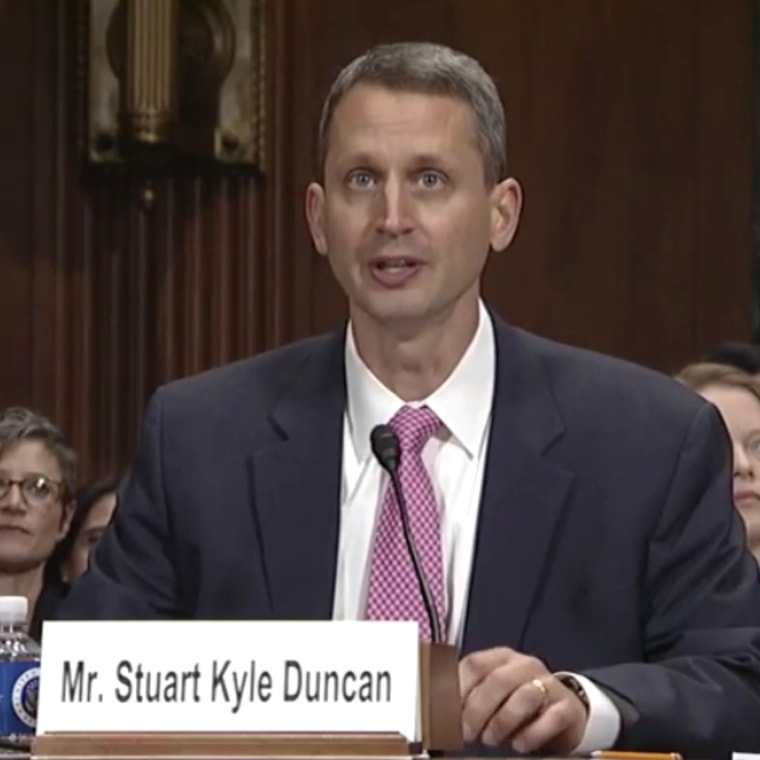
Stuart Kyle Duncan, a judge on the 5th U.S. Circuit Court of Appeals, issued an advisory opinion Wednesday that dismissed a transgender defendant’s chosen pronouns and the broader concept of gender identity, just less than two years after LGBTQ advocates warned that Duncan would not rule fairly if confirmed to the bench.
Stuart Kyle Duncan appears before the Senate Judiciary Committee in Washington on Nov. 29, 2017, after his nomination to join the 5th U.S. Circuit Court of Appeals.C-Span
Kathrine Nicole Jett, a transgender woman who was known as Norman Varner when she pleaded guilty in 2012 to attempted receipt of child pornography, moved to have her conviction records updated to match her changed name, according to the decision. A lower court judge dismissed her motion because there was no “defect” in the original judgment paperwork, in that “Norman Varner” was her legal name when the documents were produced.
Jett’s appeal appeared before the 5th Circuit, where Duncan sits. In his majority opinion, Duncan vacated the lower court ruling that denied Jett’s appeal, saying the court lacked jurisdiction, but then he proceeded to mock Jett’s court motion that she be referred to using female pronouns and her new name.
Duncan refers to Jett only using “he” pronouns throughout and refers to her as a “gender-dysphoric” person, instead of as a transgender person.
“Federal courts sometimes choose to refer to gender-dysphoric parties by their preferred pronouns,” Duncan wrote, and “our court has gone both ways.”
In fact, the 5th Circuit has broadly respected the identities of transgender defendants for at least four decades. In 1980, the 5th Circuit wrote in Rush v. Parham that it would follow the “convention” in “medical literature” of referring to transgender people using their preferred pronouns.
In his argument against using Jett’s pronouns and name, Duncan cites eight cases from 1980 to 2014 in which the 5th Circuit referred to transgender people using their correct pronouns. He cites three cases in which the 5th Circuit did not, including edge cases, such as one in which a prisoner who once identified as a gay man had later come out as a transgender women.
“Congress has said nothing to prohibit courts from referring to litigants according to their biological sex, rather than according to their subjective gender identity,” Duncan correctly observes, noting that the “convention” is and continues to be a “courtesy.”
Duncan goes on to warn that respecting a transgender person’s gender in the same way courts respect a cisgender person’s gender “may unintentionally convey its tacit approval of the litigant’s underlying legal position.” He warns that respecting transgender people’s gender identities “may well turn out to be more complex than at first it might appear” because of a “galaxy” of genders, citing what he says is a “widely circulated” University of Wisconsin LGBTQ+ Resource Center guide to pronouns. (A Google reverse image search of the pronoun guide included in Duncan’s opinions returned no matches.)
Before his confirmation, LGBTQ advocates like Lambda Legal and Congressional Democrats decried Duncan’s nomination, saying he could not be trusted to rule fairly in cases regarding the LGBTQ community.
Indeed, Duncan was part of the legal team that represented the Gloucester County, Virginia, School Board in its case against Gavin Grimm, a transgender high school student who was unable to use the restroom that aligned with his gender identity.
“The idea that Mr. Duncan will cast aside his bigoted beliefs overnight, and miraculously transform into an impartial judge, is ludicrous and reckless,” Lambda Legal Executive Director Rachel Tiven said in 2018, before Duncan was confirmed.
Chase Strangio, a transgender advocate who is a staff attorney for the ACLU, said Duncan’s opinion Wednesday was “far outside the standard practice within the entire legal profession.”
Strangio said Duncan went “on this long advisory opinion about the legal implications of pronouns and the nature of sex discrimination and things that have nothing to do with the case or the question before it.”
“At this point, if the court lets this stand without, on its own, amending the opinion or rescinding it, then it ultimately makes the court look like a political body rather than a legal one,” Strangio said, adding that he thinks the 5th Circuit could vacate the opinion — “even just for the reason that this is just an extensive advisory opinion on all sorts of questions not before the court, which is way outside the bounds of what federal courts generally do.”
Judge James L. Dennis, whom President Bill Clinton appointed to the 5th Circuit Court, filed a blistering dissent that questioned Duncan’s authority to issue an “advisory opinion” — a judicial ruling addressing an issue not brought up before the court — and said “it is not necessary to use any pronoun” in adjudicating the appeal.
“As the majority notes, though no law compels granting or denying such a request, many courts and judges adhere to such requests out of respect for the litigant’s dignity,” Dennis wrote.
Dennis cites nine cases from 1993 to 2018 in which federal courts referred to transgender people by their gender identity.
“Ultimately, the majority creates a controversy where there is none,” Dennis wrote. “The majority then issues an advisory opinion on the way it would answer the hypothetical questions that only it has raised.”
“Such an advisory opinion is inappropriate, unnecessary, and beyond the purview of federal courts,” Dennis wrote, citing a precedential federal court ruling that stated “federal courts have never been empowered to issue advisory opinions.”
“The majority’s lengthy opinion is dictum and not binding precedent in this court,” Dennis wrote. “For these reasons, I respectfully but emphatically dissent.”
A group of 45 Democratic members of Congress sent a letter to Immigration and Customs Enforcement on Tuesday demanding the agency release all transgender migrants in its custody.
“This already vulnerable population faces a heightened and unique set of injustices while in immigration detention,” the letter stated. “Transgender migrants and asylum seekers are particuarly vulnerable to sexual harassment, solitary confinement, physical assault, and medical neglect.”
At least two transgender migrants have died in ICE custody in the past two years. Roxsana Hernandez Rodriguez, a Honduran, died of complications from untreated HIV in 2018. Rodriguez did not receive antiretroviral therapy while in ICE custody, despite guidelines mandating that all detainees receive the minimum standard of care, which for HIV infection is ARV therapy. Last year, another HIV-positive transgender migrant, Johana Medina León from El Salvador, died shortly after being released from ICE custody, where she had requested medical assistance.
After León died last summer, Kris Hayashi, executive director of the Transgender Law Center, called the two deaths “a direct result of U.S. government policy, and will continue unless we force dramatic change.”
Advocates have long accused ICE of improper treatment of LGBTQ migrants, particularly after Hernandez died from a rare, AIDS-related illness at its Cibola detention center in New Mexico.
The Cibola unit — touted by the agency as its premiere detention facility for trans migrants — failed to treat Hernandez’s diagnosedHIV infection for 12 days, despite what ICE has claimed is a maximum 24-hour turnaround on sick-call requests.
The 45 lawmakers in their letter claim that none of ICE’s detention centers — including Cibola — are contracted specifically for housing trans inmates, a requirement set by ICE’s 2015 transgender detention standards. Speaking on background, a congressional staffer noted that at Cibola, ICE’s “compliance is currently voluntary and their standards could slip at any time with no repercussions.”
The letter notes that the “pervasive use of solitary confinement has caused particular harm to transgender migrants in detention.”
“ICE consistently utilizes solitary confinement for so-called protective purposes or violates its own guidance by using segregation as punishment, placing transgender people at risk of physical and mental health deterioration and vulnerability to sexual assault by ICE guards,” the letter states.
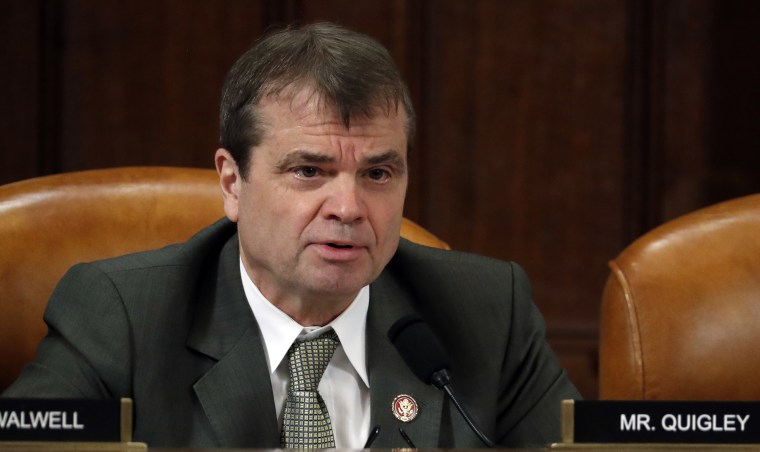
Representative Mike Quigley, a Democrat from Illinois, questions witnesses during a House Intelligence Committee impeachment inquiry hearing in Washington, on Nov. 19, 2019.Jacquelyn Martin / Bloomberg via Getty Images
Rep. Mike Quigley, D-Ill., spearheaded the effort to demand the release of transgender migrants. In a press release shared with NBC News, he said if “ICE cannot provide appropriate and humane accommodations for these migrants, they must release them from detention.”
“Immigrants who have faced fear and violence in their pursuit of a new life in the United States should not be confronted with more fear and threats of violence when they arrive at our borders,” he stated. “Unfortunately, too often, that is exactly what many transgender immigrants face when placed in ICE detention facilities.”
When asked for comment, ICE spokesperson April Grant said in an email that the agency “will respond to Congressional correspondence through official channels and by appropriate officials at the agency.”
Immigration Equality, an advocacy group dedicated to LGBTQ immigrants, called the two deaths “tragic examples of the consequences of ICE’s mistreatment,” and endorsed the demands of the 45 lawmakers: “Transgender immigrants are not safe in ICE custody and must be released.”
“After fleeing horrific persecution in their countries of origin, our transgender clients seek protection in the U.S.,” Bridget Crawford, legal director of Immigration Equality, said. “However, rather than finding safety, our clients are routinely subjected to shocking mistreatment in immigration detention facilities, including sexual assault and harassment, medical neglect and prolonged solitary confinement as a purported means of ‘protecting’ transgender people from abuse.”
The lawmakers’ letter requests a detailed ICE plan by Jan. 27 outlining compliance, and requests semi-monthly updates to “demonstrate such compliance.”
Around the world, attitudes towards lesbians are more positive that they are towards gay men, according to new research.
The study was published in the journal Social Psychology and Personality Scienceand looked at attitudes towards gay men and lesbian women in 23 countries, “representing both Western and non-Western societies”.
The authors of the study analysed Argentina, Australia, Belgium, Brazil, Canada, China, France, Germany, Great Britain, Hungary, India, Italy, Japan, Mexico, Peru, Poland, Russia, South Africa, South Korea, Spain, Sweden, Turkey, and the United States.
The researchers found that in every one of the 23 countries, lesbians were viewed less negatively than gay men. While in some countries, like India and Spain, attitudes to gay men and lesbians were more similar, the disparity was the greatest in Russia and Hungary.
The study also showed that while men were more likely have negative attitudes towards sexual minorities, as well as being more likely to become victims of this discrimination, in many places it was women who held more negative views against lesbians.
Researchers stated: “Only in China, France and Italy did men report more negative attitudes toward lesbian women. In Mexico and the United States, women were significantly more prejudiced than men on the evaluations of lesbian women.
But according to Psychology Today they added: “We found that in several countries (including the United States), men and women did not significantly differ in their attitudes toward gay men.”
The researchers suggested that any negativity towards sexual minorities is “driven, in part, by the perception that gay men and lesbian women violate traditional gender norms”.
Of the 23 countries included in the study, people in Spain were found to be the most positive towards gay and lesbian people, and people in Russia were the most negative. Western countries in general were more positive towards homosexuality, which the highest placing non-Western country being India in 14th place.
A total of 304 human rights defenders in 31 countries were killed in 2019 as space for those defending LGBT+ rights “remains extremely constrained”, a new report has revealed.
The report by Front Line Defenders (FLD) detailed attacks on activists as they worked to defend the environment, free speech, LGBT+ rights and indigenous lands.
Two thirds of the murders took place in Latin America, with Colombia emerging as the most dangerous country after 103 were killed in the past year. The Philippines was the second deadliest country with 43 killings, followed by Honduras, Brazil and Mexico.
Eighty-five per cent of those killed had previously been threatened, either as an individual or as part of the group or organisation they worked with. The report also details multiple physical assaults, defamation campaigns, digital security threats, judicial harassment and gender-based attacks.
“2019 was characterised by waves of public uprisings of remarkable magnitude in each of the world regions, demanding changes to how people were governed,” it reads.
Activists were specifically targeted in nearly all the countries which experienced mass protests, and the periods before, during and after elections were the most dangerous time for those fighting for human rights.
Transgender activists are especially vulnerable due to their heightened visibility, coupled with limited or entire lack of protections. Out of threats reported by LGBT+ activists who received support, 46 per cent were faced by defenders who identify as trans or non-binary.
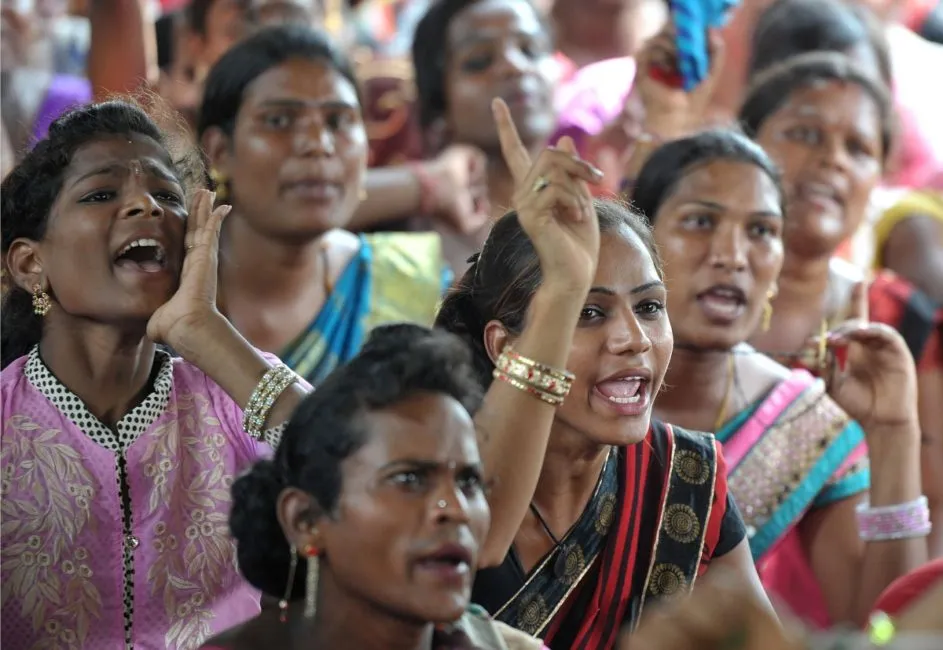
Indian transgender activists protest against the Trangender Persons (Protection of Rights) Bill in Hyderabad on August 26, 2016. (Getty)
“The fact that the security of HRDs is inextricably linked to those in power, starkly highlights how human rights have failed to be institutionalised and continue to be seen as a gift that rulers have the discretion to bestow,” the report observes.
Although the FLD acknowledges “significant gains” in LGBT+ rights, such as in Botswana, Angola and Taiwan, it found that backlash from existing and new anti-rights and conservative actors had doubled while increasing the level of sophistication in their tactics.
For example, in May the Kenyan High Court upheld the country’s law criminalising gay sex, with the government justifying it as an “effective method to contain the country’s HIV epidemic”.
And in India, a bill ostensibly written to protect transgender rights is in reality “deeply flawed” as it requires a proof of gender confirmation surgery, and gives the state the discretion to decide on the final evaluation of a request to change legal gender.
Saturday February 8 @ 7 pm. Occidental Center for the Arts presents ‘Climbing Up the Mountain’: Singing the History of Black America. Benjamin Mertz is a charismatic Bay Area performer, composer, song leader, writer, human rights activist, and the founder/director of Joyful Noise Gospel Singers. He has just released his first CD entitled ‘Climbing Up the Mountain’. Join Benjamin Mertz as he leads us on a song and spoken word journey through history, with the power and beauty of black traditional music. From work songs to spirituals, from gospel to blues and jazz, this inspiring presentation will celebrate the wisdom and courage of black music, and the indelible mark it has made on American culture. Singing along is encouraged! Also features vocalist Nancy Louise, with Brendan Buss on saxophone. $15 Adv. /$20 at the door. Fine refreshments. Wheelchair accessible. www.occidentalcenterforthearts.org. 3850 Doris Murphy Ct. Occidental, CA. 95465.
Only half of cisgender people in the US consider violence against trans women a major problem, despite increasing numbers of fatal attacks on Black trans women in particular.
Just 42 per cent of cis men and 59 per cent of cis women see violence against trans women as an issue, according to the Black Futures Lab report ‘Beyond Kings and Queens: Gender and Politics in the 2019 Black Census’.
In 2019, at least 22 trans and gender non-conforming people were killed and 91 per cent of them were Black trans women, according to the Human Rights Campaign, an LGBT+ advocacy organisation that tracks anti-trans violence in the US.
“Over the last couple of years, we’ve become more aware of the ongoing high levels of violence that trans folks face in their everyday lives,” said Alicia Garza, who founded the Black Futures Lab and is also the co-creator of Black Lives Matter, in an interview with Xtra.
“When Black trans women have an average life expectancy of 35 years old, there is something wrong,” Garza said.
“And it’s not just the function of people being mean to each other—which is what I think a lot of people think is [the reason] why Black trans women are dying. We don’t actually get into these bigger questions of economic security and the choices that Black trans folks are having to make every single day to survive because they’re largely locked out of the formal life economy.”
The lack of economic security for Black trans women was confirmed by the findings of the Black Futures Lab report, which revealed that 91 per cent of trans, gender non-conforming and non-binary people reported their household income as being less than $50,000 (£38,458) a year, compared with 61 per cent of cisgender people.
Black trans women reported the lowest income of all the respondents – with 29 per cent on a yearly income of below $15,000 (£11,537), compared with 16 per cent of all other respondents. This makes them twice as likely to be making less than $15,000 a year as anyone else.
“I don’t think that we’re doing enough to talk about and ideate around what it means to ensure that Black trans people have access to adequate, quality, affordable health care, and that the lack of access to it is one of the primary reasons that folks are dying,” Garza said.
“So it’s not just a function of people being murdered on the basis of discrimination. It is also about the choices that people are forced to make because they don’t have access to the things that they need to live,” she added.
The federal minimum hourly wage in the US is $7.25
Popular dating services like Grindr, OkCupid and Tinder are spreading user information like dating choices and precise location to advertising and marketing companies in ways that may violate privacy laws, according to a new report that examined some of the world’s most downloaded Android apps.
Grindr, the world’s most popular gay dating app, transmitted user-tracking codes and the app’s name to more than a dozen companies, essentially tagging individuals with their sexual orientation, according to the report, which was released Tuesday by the Norwegian Consumer Council, a government-funded nonprofit organization in Oslo.
Grindr also sent a user’s location to multiple companies, which may then share that data with many other businesses, the report said. When The New York Times tested Grindr’s Android app, it shared precise latitude and longitude information with five companies.
A HIV-positive man has said he is “proud and overwhelmed” after becoming the first-ever person in Europe with HIV to become a commercial air pilot.
James Bushe, 31, wanted to be a pilot since he was a child. He began learning to fly at just 15 years old, and by the age of 17 he had his private pilot’s license – before he could even drive a car.
Five years ago, Bushe was diagnosed with HIV. In 2017, when he was offered a place on an airline’s training programme, but he was denied the medical certificate needed to obtain his commercial license because of his diagnosis.
At the time, the Civil Aviation Authority (CAA) was bound by rules from the European Aviation Safety Authority (EASA), which said that a medical certificate could not be granted to someone who was HIV-positive.
Bushe decided to fight his case, with the help of HIV Scotland, and document it anonymously on Twitter under the pseudonym “Pilot Anthony”. Two years on, he has won his case and revealed his identity, officially able to fly from Monday, January 13.
He has been training with the airline Loganair, flying alongside training captains since November 2019, but is now qualified to fly Embraer 145 Regional Jets from the airline’s base at Glasgow Airport.
According to the BBC, the CAA has changed its rules but will only allow HIV-positive people to fly in multi-pilot operations, as it said that is as far as it can go before the EASA reforms its own regulations.
James Bushe was diagnosed with HIV five years ago. (Loganair)
Bushe said: “I am proud, totally overwhelmed and so grateful to Loganair. But this is not just about me – it’s about anyone living with HIV who can now become a pilot.
“My hope now is that it triggers action not just in the UK but in the rest of Europe. Anyone who has felt restricted by the condition, who is in my situation, can now follow their dreams.”
He continued: “There is no reason in the year 2020 why a person who is HIV-positive should face barriers in any profession… Living with this condition doesn’t threaten my life or my health at all, and I cannot pass HIV on to others.
“I want to put that out there to the millions of people who are living with the same fear and stigma that I was once living with.”
Loganair chief executive Jonathan Hinkles added: “HIV is not a bar to employment in other industries and there is no reason why it should be so in aviation.”
Nathan Sparling, chief executive oh HIV Scotland, says that Bushe’s landmark win shows that whatever your status, you can follow your dreams.
“I extend my personal congratulations to James, thank him for bringing this issue into the public eye, and commend him for doing his part in fighting HIV-related stigma by waiving his anonymity,” he said.
“Without James’ determination to pursue his goals these unjust rules would still be in place, and this campaign shows that only by taking on unjust regulations and demanding change can we ever hope to change the world in which we live.”