The Church of Jesus Christ of Latter-day Saints has doubled down on transgender Mormons with a new handbook that spells out the consequences for those who transition.
While it advises church members to treat transgender people with “sensitivity, kindness, compassion, and an abundance of Christlike love”, it also warns transgender people against any form of social transition.
“Gender is an essential characteristic of Heavenly Father’s plan of happiness,” the chapter begins. “The intended meaning of gender in the family proclamation is biological sex at birth.”
It continues: “Church leaders counsel against elective medical or surgical intervention for the purpose of attempting to transition to the opposite gender of a person’s birth sex (‘sex reassignment’).
“Leaders advise that taking these actions will be cause for Church membership restrictions.”
Any Mormon who attempts to transition their gender through “changes in dress, grooming, names, or pronouns intended to reflect a gender identity different from the one assigned at birth” will be subject to a plethora of restrictions “for the duration of this transition.”
These include receiving or exercising the priesthood, receiving or using a temple recommend, and receiving some Church callings.
Building on a statement by a top church leader last year that gender assigned at birth is eternal, the guidance reiterates that the Mormon priesthood, which is reserved for men, will not admit trans men.
Transgender people are assured that they are free to receive Church callings, temple recommends, and temple ordinances, as long as they agree not to pursue any medical, surgical, or social transition to the ‘opposite gender’.
Unsurprisingly, the Church also refuses to budge on its position on same-sex marriage (don’t do it). It states that “God’s law defines marriage as the legal and lawful union between a man and a woman”, and the only people who should be having sexual relations are a married heterosexual couple.
“Any other sexual relations, including those between persons of the same sex, are sinful and undermine the divinely created institution of the family,” the Church claims.
On the plus side, they will no longer consider same-sex marriages “apostasy” (rejection of church teaching) or deny baptism to children whose primary residence is with a same-sex couple.
Two prominent state politicians are urging Gov. Gavin Newsom to nominate an LGTBQ judge to fill a vacancy on the California Supreme Court .
Senator Scott Wiener (D-San Francisco) and Assemblymember Todd Gloria (D-San Diego), on behalf of the California Legislative LGBTQ caucus, sent a letter to Governor Gavin Newsom asking him to nominate an LGBTQ judge to the vacancy on the California Supreme Court. With Associate Justice Ming W. Chin retiring, Governor Newsom is able to nominate a new judge to the Supreme Court. The text of the letter follows:
Dear Governor Newsom, On behalf of the California Legislative LGBTQ Caucus, we encourage you to seize the historic opportunity presented with the retirement of Associate Justice Ming W. Chin by nominating to the California Supreme Court its first openly LGBTQ-identified justice. California has many highly qualified LGBTQ candidates, including appellate justices, trial judges, legal scholars, and attorneys. Nominating an LGBTQ justice would send a powerful message of California’s leadership and values, and it would highlight the success California has achieved in making the state’s judiciary better reflect its rich diversity. The time has come for an openly LGBTQ justice to sit on our state’s highest court.”
Scott Wiener (D-San Francisco), Assemblymember Todd Gloria (D-San Diego)
Equality California Executive Director Rick Zbur celebrated the announcement saying:
“Throughout his career, Governor Newsom has elevated LGBTQ+ leaders to ensure our government reflects the diversity of the people it serves. We now have an historic opportunity to put a qualified openly LGBTQ+ justice on California’s highest court and ensure LGBTQ+ people are represented in every level of our justice system.”
The incident occurred last weekend off school grounds after he attempted to reprimand a student for spouting a homophobic slur towards him, IOL reported.
What happened to the gay teacher?
“I heard a child calling me a moffie [African slang for an effeminate, gay man], and I went to reprimand him,” the Robertson local said.
“I later went to report the incident to his parents, and was met by his mother who was rude and shouted at me.
“She said her husband would deal with me,” Dyamara said.
“I called the police to report a case of discrimination. Her husband appeared out of nowhere and smacked me with an open palm.
He repeatedly attacked me with a fist, and at that time, I was defenceless.
Dyamara continued: “The husband took out a knife and wanted to stab me. If my friend was not there it would have been a different story.
“Members of the LGBTI+ community are not given the respect they need and deserve.
“The community, even though it is diverse, needs to respect gay people.”
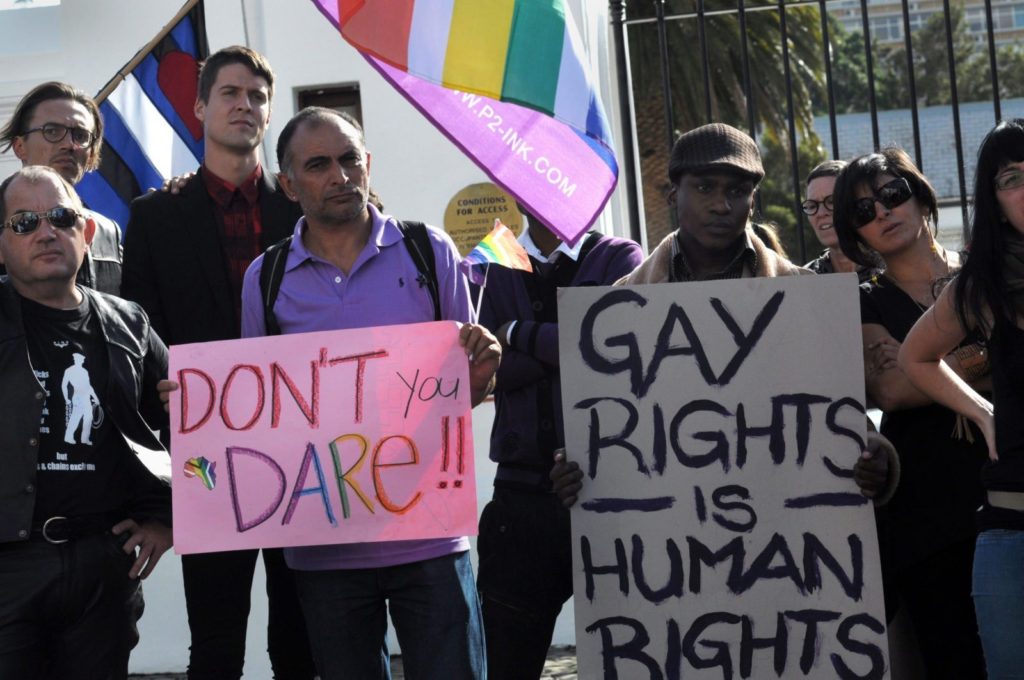
LGBT rights protesters in Cape Town (RODGER BOSCH/AFP/GETTY)
Dyamara alleged that the parent is a former member of the student governing body.
IOL reached out to the body for comment, in which a spokesperson said that, as the incident took place off school premises, it is out of their control.
“The teacher has opened a case against the man,” the spokesperson said.
“For emphasis, the man is no longer a member of the [school governing body], as he resigned. We, as the Masakheke [school governing body], condemn the alleged incident.
“We can offer emotional support to the teacher, because although it happened outside the school premises, it affects the school.
“Once a teacher is emotionally broken, he can be a danger to himself and to the learners.”
School officials also confirmed they were informed of the incident.
“The department cannot confirm what was said between the children, parents and the educator, as it was outside of the school,” a provincial education department spokesperson said.
Moreover local law enforcement described the incident as “common” and that the assault was being investigated.
Lawyers for Army whistleblower Chelsea Manning on Wednesday filed a motion for her release, saying her continued incarceration for refusing to testify before a federal grand jury is unlawful.
The motion, filed in the Alexandria, Virginia-based federal district court for the eastern district of Virginia, says that Manning’s “incarceration is not serving its only permissible purpose”—to coerce her testimony. Rather, the motion argues, the detention is clearly punitive.
Manning has been held in contempt of court and locked away at the Alexandria Detention Center nearly continuously since March 2019. She may be held as long as 18 months unless she agrees to testify to a grand jury about WikiLeaks and its founder, Julian Assange, who remains at a London prison as the U.S. government seeks his extradition.Defend democracy. Click to invest in courageous progressive journalism today.
The detention is also economically costly. Manning is being fined $1000 per day, which her supporters have panned as an “outrageous” escalation of the U.S. government’s ongoing harassment of her.
Manning’s attorney Moira Meltzer-Cohen explained how the continued detention is out of legal bounds.
“A witness who refuses to cooperate with a grand jury subpoena may be held in contempt of court, and fined or incarcerated,” she said in a statement. “The only permissible purpose for sanctions under the civil contempt statute is to coerce a witness to comply with the subpoena. If compliance is impossible, either because the grand jury is no longer in existence, or because the witness is incoercible, then confinement has been transformed from a coercive into a punitive sanction, and thus is in violation of the law.”
“Over the last decade Chelsea Manning has shown unwavering resolve in the face of censure, punishment, and even threats of violence,” says the new motion. In “light of her history, it should surprise nobody to find that she has the courage of her convictions.”
“She reiterated her refusal to cooperate with the grand jury process before this court, and has now reiterated that refusal every day for more than 11 months,” the motion adds. “There is no reason to believe she will at this late date experience a change of heart; there is a profusion of evidence that she will not.”
The attorneys included as evidence United Nations Special Rapporteur on Torture Nils Melzer’s November 2019 letter to the U.S. government expressing his concern about Manning’s incarceration, “particularly given the history of her previous conviction and ill-treatment in detention.”
Melzer said that Manning’s current detention may amount to “an open-ended, progressively severe measure of coercion fulfilling all the constitutive elements of torture or other cruel, inhuman or degrading treatment or punishment.”
Manning’s lawyers also included in their motion a report from a clinical expert on Manning’s personality that described her “willingness to endure social disapproval as well as formal punishments” to pursue her values.
“No realistic possibility remains that continued confinement or other sanctions will bring about Ms. Manning’s testimony,” says the motion. “Further confinement cannot attain its stated coercive purpose, and therefore will be not simply futile, but impermissibly punitive.
Manning confirmed her stance against her incarceration in a statement Wednesday.
“No matter how much you punish me, I will remain confident in my decision,” she said. “I have been separated from my loved ones, deprived of sunlight, and could not even attend my mother’s funeral. It is easier to endure these hardships now than to cooperate to win back some comfort, and live the rest of my life knowing that I acted out of self interest and not principle.”
A 29-year-old marathon runner will be the first out trans woman to compete in a US Olympic trial.
In Atlanta on February 29, Megan Youngren and 62 other women will compete for a spot on the US Olympic team.
The winners at the trials will represent the US in the Summer Games in Tokyo later this year.
Youngren came 40th at the California international marathon in December with a time of 2:43:52 – good enough to qualify for the Atlanta marathon trials.
Her California qualifying time came after running the Los Angeles marathon in 3:06:42 last year, too. Youngren says this is what spurred her to train more intensively.
“I thought that if I worked incredibly hard and took some huge risks that I could run a 2:45,” Youngren said.
“People will try to put it down by saying, ‘That’s too easy because you’re trans.’
“But what about the 500 other women who will qualify? There’s probably someone with the exact same story.
“I trained hard. I got lucky. I dodged injuries. I raced a lot, and it worked out for me.
“That’s the story for a lot of other people, too.”
Susan Hazzard, the US team’s track and fields spokesperson, said: “To my knowledge, and that of other staff who have been with USATF for many years, we do not recall a trans competitor at our marathon trials.”
Megan Youngren said she was prepared for criticism, but that she had “done everything by the book” and could show it.
She also said it was important to her that she’s open about being trans, because “that’s the only way you can make progress on stuff like this”.
As far as training goes, Youngren said “there are days when my feet are sliding around in the snow. My lungs hurt because it’s cold and I’m wearing all these layers” and it’s then that she asks herself: “Am I really getting that much faster?
“Then it warms up a bit for a day and I go, ‘Oh, my God. I am actually getting faster. This is working.’ As far as getting on the starting line in Atlanta, I am super excited because training is going so well.”
While she’s the first openly trans athlete to compete at the US Olympic marathon trials, Youngren follows in the footsteps of Chris Mosier – another US athlete and trans man who, in January 2020, made history as the first openly trans athlete to compete in a US Olympic trial.
Recently I blocked a number of people on my FB page who have attacked me personally for criticizing Bernie Sanders’s positions and record. They warn of the need to be careful not to offend Sanders voters who threaten to not vote for the Democratic nominee if it’s not Bernie. My response has been we can’t be held hostage by this group of individuals. They are the ones who should be called out for not understanding the repercussions to the programs they espouse, and democracy as we know it, if they help to reelect Trump by not voting for whoever is the Democratic nominee.
Every Democratic candidate is flawed just as every voter is flawed. Sorry Bernie Bros you aren’t perfect and neither is your vision or your candidate. Fact is each of the Democratic candidates is more progressive than Trump by a mile and support a more overall progressive agenda than any previous Democratic nominee. The issue is about scale and scope.
It is also about the American electorate. How far and how fast they are willing to support change. In many ways it is even more important to win the Congress than it is the presidency. By winning the Senate we can stop the appointment of ultra-conservative judges and if we have the Congress can stop budget cuts to programs like Medicare and Medicaid, Social Security, the dismemberment of the Environmental Protection Agency and halt future tax cuts for the rich. So it is crucial Democrats have a nominee at the head of the ticket who will not be a stone around the neck of all down ballot candidates.
Some of the online debate has been about whether we are really a socialist country because we collectively fund schools, our police, the military and programs like social security. Should we really compare ourselves to Sweden and Norway? When Sanders does that we must question whether the American electorate believes it and will vote for a candidate who is a self-declared Democratic Socialist? Will the average voter understand what socialism really is and the difference between socialism and democratic socialism? More likely they will simply fear ‘socialism’ and vote against the candidate who espouses it.
Voters will buy into the ads Trump and his acolytes will surely run attacking Sanders. Trump and his minions will never use the word Democratic along with the word socialist. Because of this each of our down-ballot candidates from school board to United States Senate will be spending half their time distancing themselves from the “socialist” at the head of our ticket if our nominee is Bernie Sanders.
Those defending Sanders keep pointing to how he polls well against Trump. What they conveniently disregard is the Republicans have yet to attack Sanders because they want to run against him. They are just waiting with baited breath and a billion dollars to go after him if he wins the nomination. While it may all be nonsense the commercials will come reminding people of how he spent his honeymoon in the Soviet Union, his support of the Sandinistas and Ortega in Nicaragua, and of Fidel Castro in Cuba. I won’t bother going into the nuances of his support because neither will the Republican attack machine nor will the American public.
The president will also use Sanders call for a “revolution” against him. The majority of Americans don’t want a revolution. We are seeing that even in the Democratic primary electorate. Sanders underperformed in New Hampshire by a wide margin. He even lost one of the big college towns he won in 2016. He didn’t get the big boost in Iowa failing to bring out the hordes of new voters he predicted. He is actually running second to Pete Buttigieg in the delegate count with his 21 to Pete’s 22.
In 2018 Democrats took back the House of Representatives by having moderate Democrats win in swing districts across the country. The progressives Sanders and those like Alexandria Ocasio-Cortez supported in those districts all lost either in a primary or in the election. Primary voters in both parties tend to be more right-wing or left-wing but the general electorate when polled show the majority are middle of the road voters. According to a Gallup poll while Democrats are more liberal Americans as a whole remained center-right ideologically and therefore to win Democratic candidates need to be more moderate. If we field those kinds of candidates we can win. Simply look at Kennedy, Carter, Clinton and Obama as examples of how we win. The goal in 2020 must be to rid us and the world of Trump.
Peter Rosenstein is a D.C.-based LGBT rights and Democratic Party activist. He writes regularly for the Blade.
A newly uncovered video shows Democratic presidential candidate Mike Bloomberg in 2019 describing transgender people as “he, she, or it” and “some guy in a dress” who enters girls locker rooms — invoking a conservative cliché as he argued that transgender rights are toxic for presidential candidates trying to reach Middle America.
And yet, Bloomberg’s campaign published a new video on Tuesday that pledged the former New York City mayor believed in “inclusivity” for “LGBTQ+ youth,” featuring fashion designer Isaac Mizrahi declaring, “Mike is so incredibly sensitive to this issue.”
Bloomberg’s sensitivity was far less apparent at a forum hosted by the Bermuda Business Development Agency on March 21, 2019, in Manhattan, where Bloomberg derided Democratic candidates for talking about transgender protections.
Read the full article for the Bloomberg campaign’s response. He did sign a trans protections bill as NYC mayor in 2002.
“This is really just bringing Virginia into the 21st century,” Ebbin told The Washington Post shortly after the bills’ passage. “Voters showed us they wanted equality on Nov. 5, and the Senate of Virginia has started to deliver on that.”
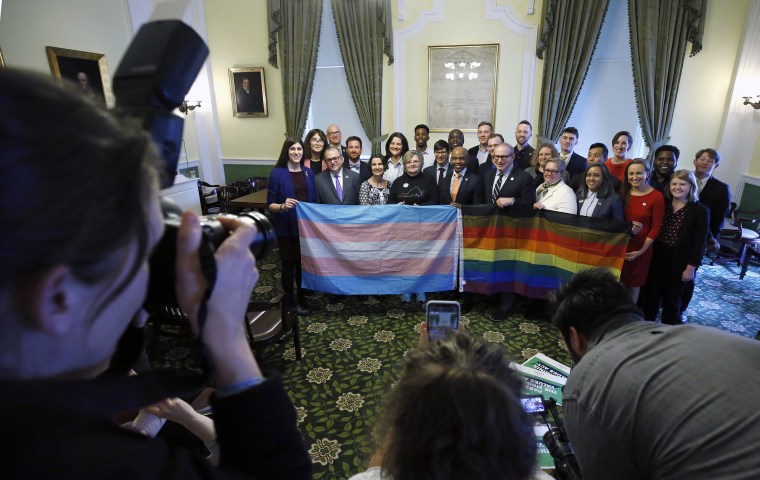
Supporters gather for a group photo ahead of the floor votes on the Virginia Values Act. The event was held in the Jefferson Room of the State Capitol in Richmond, Va., Thursday, Feb. 6, 2020.Bob Brown / AP
Despite the Supreme Court’s landmark 2015 ruling in Obergefell v. Hodges making same-sex marriage the law of the land, most states still have outdated laws on their books like the ones Virginia just repealed.
Indiana is one of those states, though an attempt to remove its gay marriage ban was unsuccessful last month in the Republican-controlled state Legislature. In fact, GOP opposition to its removal derailed legislation seeking to raise the legal age to marry in the state from 15 to 18. An amendment had been added to the age-limit bill that sought to scrap the state’s 1997 law declaring: “Only a female may marry a male. Only a male may marry a female.”
“I did not think it was unreasonable to remove what is now null-and-void unconstitutional language from the code,” state Rep. Matt Pierce, a Democrat, said in defense of the amendment. “I didn’t think it would be that controversial, because this issue has been settled now. Apparently to the Republican caucus it is controversial.”
“The religious right has not said, ‘We lost same-sex marriage, and we are moving on.’ They are still fighting same-sex marriage, both politically and legally.”
PROFESSOR JASON PIERCESON
In Florida, Democratic legislators have been trying for years to repeal thestate’s ban — which says “marriage” means “only a legal union between one man and one woman as husband and wife” — with no luck.
“This is not just, you know, unconstitutional and not just obsolete, but this is cruel language in our statute. So, it needs to get out of there,” Rep. Adam Hattersley told WUSF Public Media, adding that members of the state’s Republican leadership “don’t have an appetite to fix something” that they “hope would come back into play in the future.”
Five years after the Supreme Court had its say on the issue, same-sex marriage remains a politically contentious issue, and LGBTQ advocates continue to battle in courtrooms and statehouses to ensure gay couples can exercise their right to marry.
History of state-level gay marriage bans
States have two types of bans on same-sex marriage: statutory and constitutional. Statutory bans appear in state family law, while constitutional bans are embedded in states’ constitutions.
“Most of them are still on the books, though they are not enforceable,” Jason Pierceson, a political science professor at the University of Illinois Springfield, told NBC News.
“Democratic control of legislatures has created opportunities to get rid of some bans,” Pierceson said. “That’s the big difference between Indiana and Virginia.”
There were two phases of same-sex marriage bans, according to Pierceson. The first one began in the 1970s, when gay couples would apply for marriage licenses and many state judges at the time ruled that these unions were not prohibited. This prompted lawmakers to explicitly outlaw same-sex marriage. In 1973, Maryland became the first state to do so. Other states quickly followed, with Virginia, Arizona and Oklahoma passing similar laws in 1975, and Florida, California, Wyoming and Utah doing so in 1977.
The second phase followed a 1993 Hawaii Supreme Court decisionthat found denying same-sex couples the right to marry may violate the equal protection clause of the state’s constitution. That ruling prompted state and federal lawmakers to take action.
Utah was first to enact a statutory ban in response to that decision in 1995, and then a year later, Congress passed the federal Defense of Marriage Act, or DOMA, which defined marriage as between one man and one woman. Several states adopted their own “mini-DOMAs” after that, according to Pierceson, and by the year 2000, he said “virtually every state,” with the exception of New Mexico, had a “statutory ban on same-sex marriage.” These “mini-DOMAs,” he noted, banned gay marriage in family codes and state law, not the constitution.
In 1998, Hawaii became the first state to pass a constitutional amendment specifically targeting same-sex marriage. The measure empowered the legislature to enact a ban, which it did that same year through a constitutional referendum. Ultimately, 30 more states adopted constitutional amendments prohibiting gay marriage.
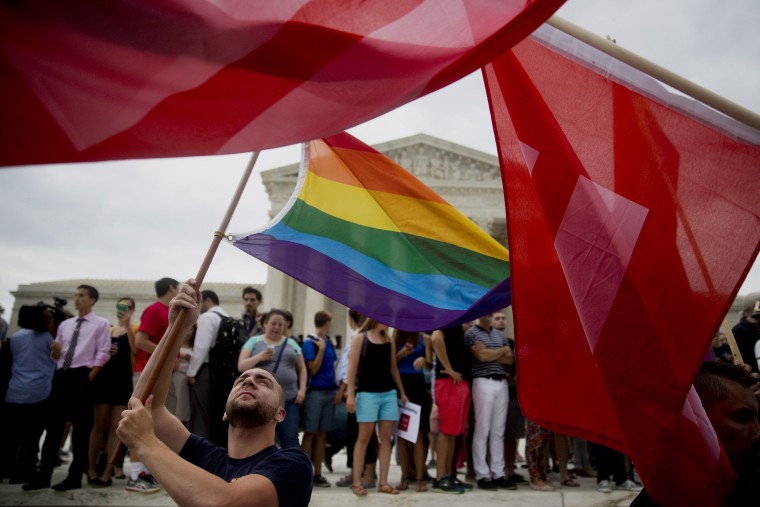
A demonstrator in support of same-sex marriage waves a rainbow colored flag after the same-sex marriage ruling outside the U.S. Supreme Court on June 26, 2015 in Washington.Andrew Harrer / Bloomberg via Getty Images file
While the 2015 Obergefell v. Hodges decision overrides all of those state measures, many of them, particularly the state constitutional amendments, remain on the books for one reason or another. In some cases, there is a lack of political willingness to remove them, while in others, the labor-intensive removal process makes them a low priority.
In Virginia, for example, while the two statutory laws banning same-sex marriage have been repealed, the state’s 2006 constitutional amendment prohibiting gay unions remains for the time being. This is because amendments must pass both the state Senate and House of Delegates and be approved by Virginia voters.
Lawmakers in Nevada will allow voters to decide whether to strike down that state’s constitutional ban at the ballot box in November. Any constitutional amendment in Nevada requires such a statewide vote.
“In Colorado we got a whole host of things to work on from transportation to education to housing to access to heath care, but instead of being able to dedicate all our resources to things like access to HIV-prevention medications, we have to allocate staff time and resource just to be able fight these bills.”
SHEENA KADI, ONE COLORADO
Sheena Kadi, deputy director of the LGBTQ advocacy group One Colorado, told NBC News that her organization has been having internal conversations for years about what to do with the state’s constitutional ban, which has been on the books since 2006 but would, in her estimate, take three to five years to remove it.
“We can take the first step through the Legislature, but then we would need a ballot initiative to remove that from the state Constitution,” she said. Given the organization’s other priorities, Kadi said going after the unenforceable constitutional amendment just seemed like too much work.
Pierceson said that in Colorado and a number of other states, having these amendments removed isn’t necessarily easy, as a number of conservative lawmakers are happy to keep them for both symbolic and political reasons.
“Many Republicans and the religious right hope Obergefell will be overturned, and then their state would go back to banning same-sex marriage, potentially,” he said.
Compliance issues
Even after Obergefell, there have been a number of instances over the past five years where state and local officials have refused to issue marriage licenses to same-sex couples.
Just a few months after the ruling, a Kentucky county clerk, Kim Davis, garnered national attention for refusing to issue marriage licenses to same-sex couples. Davis, who went to jail for her refusal, has since retired after losing re-election in 2018. In 2019, the 6th U.S. Circuit Court of Appeals found that, although Davis was immune from being sued as a county official, she could be sued in her individual capacity for refusing to comply with the law.
In early 2016, Roy Moore, then the chief justice of the Alabama Supreme Court, prohibited probate judges in the state from issuing marriage licenses to gay couples. Moore, who is currently running for a U.S. Senate seat from Alabama, was suspended from his judicial duties in September 2016 over his gay marriage order. And just last year — following the persistent refusal of a number of Alabama probate judges to issue marriage licenses to any couples so they wouldn’t have to issue them go same-sex couples — the state passed a workaround bill that no longer requires a judge’s signature on marriage licenses.
Just last year in Texas, a Waco-based judge was issued a public warning by the state Commission on Judicial Misconduct for her yearslong refusal to perform same-sex weddings. The judge, Dianne Hensley, responded by suing the commission, claiming it violated her rights under the Texas Religious Freedom Restoration Act. Last month, Texas Attorney General Ken Paxton, a Republican, declined to defend the state agency in the lawsuit because its actions conflict with his views of the Constitution.
“We believe judges retain their right to religious liberty when they take the bench,” Paxton’s spokesperson, Marc Rylander, said in a statement at the time.
Hole-y matrimony
Since the legalization of same-sex marriage federally, hundreds of state bills have been introduced that poke holes in gay marriage in various ways.
“The religious right has not said, ‘We lost same-sex marriage, and we are moving on,’” Pierceson said. “They are still fighting same-sex marriage, both politically and legally.”
Equality Federation, an LGBTQ social justice group, is tracking nine marriage bills that affect same-sex marriage across seven states: Iowa, Kansas, Massachusetts, Missouri, North Carolina, South Dakota and Tennessee.
Colorado had been on this list until just last week, when advocates defeated five bills they described as being anti-LGBTQ. One of them, House Bill 1272, had proposed that existing state law — which still stipulates that marriage is between one man and one woman — be enforced as written, and that no judicial rulings, including those from the U.S. Supreme Court, should influence their enforcement.
HB 1272 also sought to restrict adoption to “marriages and civil unions that consist of one man and one woman.” This could have called into question the legal parental status of Colorado Gov. Jared Polis, who in 2018 became the first openly gay man elected governor in the U.S.; he and his same-sex partner are not married and have two children together.
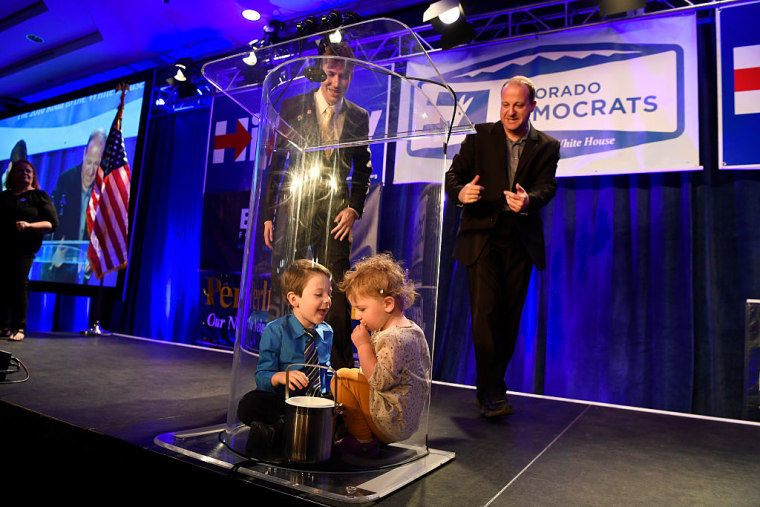
U.S. Representative Jared Polis, right, and his partner, Marlon Reis, with their two children, 5-year-old C.J. and 2-year-old Cora, on stage after Polis addressed supporters on November 8, 2016 at the Westin.John Leyba / Denver Post via Getty Images
North Carolina and Tennessee are considering marriage bills similar to the one Colorado just killed. However, the majority of the bills introduced that target same-sex marriage have fallen within the “religious exemption” category, according to Pierceson.
InMassachusetts, one proposal asserts that the belief that marriage is only between one man and one woman is a protected religious belief and thus prohibits the government from “discriminating” against state employees or businesses that act on this belief.
Bills in Kansas, South Dakota and Tennessee draw on the idea of the separation of church and state in their proposals. These bills define marriage as between one man and one woman and argue that to mandate otherwise is tantamount to state sponsorship of the religion of “secular humanism.”
A bill in Iowa creates a new category of “elevated marriage,” defined as one man and one woman, and it stipulates distinct and additional vows and paperwork. A separate Iowa proposal would require applicants for marriage licenses to disclose their sexual orientation, which could be used in child custody cases.
In Missouri, one lawmaker proposed replacing all marriage licenses with domestic union contracts. The measure, House Bill 2173, has drawn opposition from both LGBTQ advocates and proponents of “traditional marriage.”
“Still seeing attempts to invalidate love and invalidate families and those protections that come along with it is frustrating,” Kadi said. “In Colorado we got a whole host of things to work on from transportation to education to housing to access to heath care, but instead of being able to dedicate all our resources to things like access to HIV-prevention medications, we have to allocate staff time and resource just to be able fight these bills.”
How safe is gay marriage?
More than 10 percent of LGBTQ adults were legally married in June 2017, just two years after the Obergefell ruling, according to Gallup, and the number is likely even higher now. In addition, public opinion has shifted strongly in favor of same-sex marriage, with a2019 Gallup poll finding 63 percent of Americans approve of such unions.
So, is gay marriage safe?
“Absolutely not,” Kadi said, “especially given the current makeup of the Supreme Court.”
Pierceson largely agrees.
“I think in the short term marriage is fairly safe. It’s hard to see the Supreme Court overturn itself in the next couple of years,” he said, though he added that he is less confident about its long-term safety.
“The religious right, conservative movements and the Republican Party are hoping for an overturning of Obergefell with a more conservative judiciary,” Pierceson said.
Kadi noted that President Donald Trump has appointed more than 50 circuit court judges in his first term. And while Trump claimed to be a “real friend” to lesbian, gay, bisexual, transgender and queer people during the 2016 campaign, Kadi said his administration is “no ally to the LGBTQ community.”
“We have seen this impact not only the Supreme Court but the lower courts as well,” she said of Trump-appointed judges, many of whom have come under criticism for their anti-LGBTQ track records.
“It’s only a matter of time before we see another challenge” to same-sex marriage, he said. “That is why we have to stay vigilant.”
Over 2,000 queer and trans people from all 50 states and the District of Columbia have signed onto two letters highlighting criticism from the LGBTQIA+ community toward Pete Buttigieg’s presidential campaign. Two autonomous groups, #QueersAgainstPete, a collective of queer people who interrupted a Chicago fundraiser for Buttigieg in January; and Queers Not Here for Mayor Pete, a group of LGBTQ community organizers across the U.S.; have both circulated open letters making the case that the LGBTQIA community deserves better than Pete.
At Friday’s Democratic debate, Buttigeig declared that “we cannot solve the problems before us by looking back.” The groups contend that we must honor the history of LGBTQIA+ communities to move forward equitably, and Buttigieg appears uninterested in doing so. Leaders within LGBTQIA+ communities—especially Black trans women—have worked tirelessly over the past several decades to push movements to value and fight for our full identities and experiences.
“Pete Buttigieg is not a candidate of the future; he erases and mocks the histories and realities of racial, sexual, and gender minorities. The LGBTQ community, like many others, faces racism, homelessness, unemployment, and a lack of adequate healthcare. In rejecting Pete Buttigieg, we don’t seek a nostalgic return to the past but a reminder that our histories persist into our present,” said Yasmin Nair, writer and activist of Chicago, IL ”We cannot solve the problems all of us face if we leave the most vulnerable behind. That’s not ‘looking back.’ It’s making sure everyone moves forward, not just the wealthiest among us.”
In their open letter, #QueersAgainstPete notes that “gaps in Mayor Pete’s platform will fall particularly hard on economically vulnerable LGBTQIA+ communities” from his opposition to Medicare for All and cancelling student debt, to his history of “tearing down hundreds of homes in Black and Latino neighborhoods in South Bend.”
#QueersAgainstPete also highlights Buttigieg’s ongoing failure to address the concerns of Black Lives Matter – South Bend, from their call to create a Citizens Review Board, to their call for Buttigieg’s resignation following Eric Logan’s murder by South Bend police. The letter cites Buttigieg’s failure to commit to a moratorium on deportations or decriminalization border crossing, and his disregard for the voting rights of the over 230,000 queer and trans people who are currently incarcerated. #QueersAgainstPete also stands with Chelsea Manning and criticizes Buttigieg’s stance that she should remain in prison for blowing the whistle.
In an essay, Queers Not Here For Mayor Pete contrasts issues important to the LGBTQIA+ community such as affordable healthcare and housing with Buttigieg’s embrace of donations from Wall Street and billionaires, earning him the nickname #WallStreetPete. In a second essay on his racial justice track record, the group noted the highly disproportionate marijuana arrests of Black people during Buttigieg’s tenure, an issue also raised in Friday’s debate.
Queers Not Here for Mayor Petecompare Buttigieg’s campaign to that of recently-elected out lesbian Chicago Mayor Lori Lightfoot. The #StopLightfoot campaign, created by a diverse group of LGBTQ organizers, challenged her record on policing, immigration, housing, and ties to Islamophobia. She has backtracked on many of her more progressive campaign promises, and we are sure Buttigieg would do the same. “Just because someone may share our identity, it does not mean they will show up for the most marginalized and those most in need of attention within our community,” wroteQueers Not Here For Mayor Pete.
“Buttigieg has no record fighting for targeted or marginalized peoples and shows little sign of that changing—he surrounds himself with the likes of Big Pharma, CIA veterans, and billionaires,” said Harper Bishop (he/they), a co-founder of Queers Not Here For Mayor Pete based in Buffalo, NY. “We aren’t homophobic or self-hating. He has been bought-out, and we just don’t see his candidacy as a sign of collective liberation.”
#QueersAgainstPete and Queers Not Here for Mayor Pete are not the first LGTBQIA+ individuals to view Mayor Pete’s campaign with skepticism. A November 25 poll released by Out magazine shows Mayor Pete placing fourth among LGBTQIA+ voters. Jacob Bacharach, Yasmin Nair, Shannon Keating, Max S. Gordon, Rich Benjamin, and George Johnson all published critiques of his campaign from a queer lens. Rather than address concerns being voiced by the LGBTQIA+ community, Mayor Pete has decided to plug his ears. When confronted with criticism from LGBTQ media, Pete said “I can’t even read the LGBT media anymore.”
“Queer and trans people deserve a President who listens to our concerns, not one who runs from them,” said Ian Madrigal (they/them), an organizer with #QueersAgainstPete based in Washington, D.C. “While former Mayor Buttigieg boasts about the historic nature of his campaign, every step along the way, he has made the conscious decision to back policies that harm the very communities he claims to represent. Pete may be queer, but we know he is not here for us.”
###
#QueersAgainstPete is a collective of queer people against Mayor Pete Buttigieg’s candidacy for president. We believe the LGBTQIA+ community deserves better than Pete. Follow @QueersAgnstPete on Twitter.
Queers Not Here for Mayor Pete is a community that believes that the foreparents of LGBTQ liberation set the bar high and Buttigieg’s candidacy doesn’t even come close. Follow Queers Not Here for Mayor Pete on Facebook.
Despite recent government promises to protect LGBT+ people, children in Vietnam are still taught at home and at school that being gay is a “disease”, according to a new report by Human Rights Watch (HRW).
Same-sex marriages are not recognised in Vietnam, but gay sex is legal and it is believed to have never been criminalised in the country’s history. There is an equal age of consent, and LGBT+ people are able to serve in the military.
In 2015, the country made headlines for voting to allow trans people who had been through gender affirmation surgery to register as their correct gender.
In 2016, while serving on the United Nations Human Rights Council, Vietnam voted in favour of appointing a watchdog to protect LGBT+ rights.
While recent legal changes in Vietnam make the futures of queer people seem promising, socially LGBT+ people commonly face extreme stigma and discrimination.
In its report on education for LGBT+ youth in Vietnam, HRW interviewed queer youth who were searching for information against a “steady tide of stereotypes, misinformation, and anti-LGBT rhetoric”.
They described how being LGBT+ was frequently described as a “disease”, both by their families and at school.
Nhung, a 17-year-old bisexual girl, said: “I don’t feel safe at school, because the view and mindset of other people on LGBT+.
“I didn’t get hurt physically, but I did suffer mentally. You have to be hurt when people tell you have a disease that frequently.”
Other young people told HRW that the most frequent comments they heard from teachers on LGBT+ issues was that being gay is a “mental illness”.
Quân, an 18-year-old gay man, said he was taught in his high school biology class that “LGBT+ people need to go to the doctor and get female hormone injection” to cure their “disease”.
In 2019, Vietnam’s education ministry announced plans for an inclusive sex education curriculum, but it is yet to be implemented.
Graeme Reid of HRW told The Guardian: “Largely thanks to a vibrant civil society-led LGBT rights movement, social awareness and acceptance of sexual orientation and gender identity has increased greatly in recent years in Vietnam. The government’s actions, however, have so far not officially reflected these changes.
“One result of the sluggish policy change is that social perceptions in many cases remain mired in outdated and incorrect frameworks – such as the widespread belief that same-sex attraction is a diagnosable mental health condition.”