RECRUIT, RECRUIT, RECRUIT!!The Spahr Center is fortunate to have a large, warm and loyal base of supporters who attend our events, volunteer on a variety of tasks, and make generous donations to help us achieve our life-saving and life-affirming mission. We want to GROW that family in order to accomplish even more and better things for our community moving forward. Will you help us to do that? Learn more
SAVE THE DATE!Click the photo for more info!The Spahr Center revises its logoThe Spahr Center is rightfully proud of its name and logo, which pay homage to our brilliant and accomplished founder, Jane Spahr. The Board of Directors has recently approved a revision to the logo that communicates directly and effectively to a wide audience what our purpose is: to serve Marin’s LGBTQ+ & HIV communities. No more wondering; we are out and proud! Look forward to seeing this updated image on all of our publications, and around town! Donate
Social Support GroupsThe Spahr Center offers a variety of social support groups. Below is a list of the groups, with a short description. Please click any of the groups to learn more!
Latino Support Group – this group is for Latinos living with or affected by HIV.
Friends and Family of LGBTQ youth – This group is a welcoming and safe place to discuss how to best support our trans and queer youth.Thriving in Marin – this group is for any individual who identifies as a “long-term survivor” of HIV.
The “most accepting” LGBTQ countries are becoming “more accepting,” while “the least accepting” are becoming “less accepting,” according to a recent report from The Williams Institute, a think tank at the UCLA School of Law.
In executing the study, which came out last month and was built upon the organization’s previous reports, researchers analyzed survey data from 174 countries to produce the Global Acceptance Index (GAI). The GAI uses a country’s public beliefs and policies regarding lesbian, gay, bisexual, transgender and queer people to determine the nation’s score, which was then used to rank each of the countries in order from most accepting to least accepting of LGBTQ people.
“One of the biggest misconceptions, even among people in the U.S., which has seen a notable amount of progress in LGBT acceptance, is the notion that attitudes have not changed or haven’t improved, but this report disputes that idea by showing us the opposite: Acceptance of LGBT people continues to grow globally,” Andrew Flores, a visiting scholar at the Williams Institute and the study’s lead author, told NBC News.
Of the 174 countries analyzed, 131 experienced increases in acceptance since 1981, 16 experienced a decline and 27 had no change in attitude. When looking at the indexes from 2014 to 2017, the most recent years for which data was available, researchers found that Iceland, the Netherlands, Norway, Canada and Spain ranked among the countries most accepting of LGBTQ people, while Ethiopia, Somaliland, Senegal, Azerbaijan and Tajikistan ranked among the the least accepting.
While Flores said definite conclusions could not yet be drawn about why many of the top 10 countries experiencing greater levels of LGBTQ acceptance are clustered in Western Europe, he noted such changes can be attributed to “multi-causal phenomena” — a combination of regional, economic and religious characteristics.
“There are many reasons that can account for the increases in acceptance in certain countries, including advocacy and organizing in a cross-global way and LGBT visibility in the media,” Flores said.
The power of activism is best evinced by Nepal’s jump in the rankings, according to Flores.
Though most of the countries featured in the report did not experience drastic changes in ranking, the South Asian country marked a “standout” exception. Nepal, which ranked 67 in LGBTQ acceptance in 2000, was ranked 10 from 2014-2017.
Flores said that Nepal’s rise in the rankings could in part be attributed to the Blue Diamond Society, a nationwide LGBTQ rights organization that was established in 2001. The group was founded by Sunil Babu Pant, who in 2008 became the first openly gay legislator in Nepal’s history.
Though the index is among the most comprehensive data sets of LGBTQ people globally, Flores said he hopes the GAI scores are used as a launching pad for future research about the violence and discrimination faced by LGBTQ people, economic outcomes for LGBTQ communities and the physical and mental health of LGBTQ people.
“Sexual and gender minorities are heavily impacted by the attitudes and beliefs of those around them,” Flores said. “More acceptance leads to better outcomes and a better quality of life for LGBT people, including less violence and discrimination.”
Same-sex marriage is currently legal in 30 countries, according to the Pew Research Center. The Netherlands, which ranked second in the index from 2014-2017, was the first country to legalize same-sex marriage in 2000. The most recent was Northern Ireland last month, as it aligned itself with the rest of Great Britain, which ranked 11th.
According to a report from the International Lesbian, Gay, Bisexual, Trans and Intersex Association, there are 70 U.N. member states that criminalize same-sex sexual acts and 68 of these countries have explicit laws against same-sex relationships. Six of the 70 countries have imposed the death penalty for same-sex relationships.
Of the 7,120 hate crime incidents reported in 2018, more than 1,300 — or nearly 19 percent — stemmed from anti-LGBTQ bias, according to the FBI’s latest Hate Crime Statistics report.
According to the FBI data, of the nearly 1,200 incidents targeting people due to their sexual orientation, the majority targeted gay men (roughly 60 percent), while approximately 12 percent targeted lesbians, 1.5 percent targeted bisexuals, 1.4 percent targeted heterosexuals and the remaining incidents targeted a mixed group of LGBTQ people. Transgender and gender-nonconforming people were the targets in 168 reported incidents, approximately 2.4 percent of all reported hate crime incidents last year.
When compared to 2017, the number of reported incidents targeting the LGBTQ community increased from 1,217 to 1,347, jumping from roughly 17 percent to 19 percent of each year’s total number of reported hate crime incidents.
In particular, reports of anti-trans violence is growing: Between 2017 and 2018, the number of these reported incidents increased 34 percent.
The lesbian, gay, bisexual, transgender and queer community is estimated by Gallup to comprise 4.5 percent of the U.S. population, yet according to the FBI’s newly released report, they comprise 18.5 percent of hate crime victims.
While the 7,120 overall reported hate crime incidents recorded in 2018 are slightly fewer than in 2017, both years represent historically high levels of reported hate crimes, with only 2008 recording more in the past decade: 7,783. In 2014, hate crimes hit a decade-low rate of 5,479 incidents.
Another noteworthy trend is that reported hate crimes increasingly targeted people (like assault) instead of property (like vandalism), even as the nation enjoys continued decreases in both violent and property crimes.
In 2018, nearly 66 percent of hate crime offenses were directed toward people, while 31 percent were directed toward property. In 2017, 60 percent of hate crimes were directed toward people, while 37 percent were directed toward property.
According to FBI data released in September, this goes against overall nationwide crime trends. In 2018, the national violent crime rate fell 4 percent compared to 2017, while the property crime rate declined 7 percent.
According to this latest report, Jewish and black communities continue to shoulder a disproportionate percentage of federally reported hate crimes: Jewish people comprise an estimated 2 percent of the U.S. population but make up 10 percent of hate crime victims, and the black community is an estimated 13.4 percent of the U.S. population but makes up 26 percent of hate crime victims.
The FBI’s Hate Crime Statistics report tells just part of the story. Of the 16,039 law enforcement agencies across the country that voluntarily participated in the Hate Crime Statistics Program, only 2,026 reported any hate crime incidents at all, according to the FBI. The state of Alabama, for example, did not report a single hate crime in all of 2018.
Tomorrow the high court in Singapore will hear the first arguments to overturn Section 377A, a colonial-era law that criminalises gay sex.
Singapore’s strict penal code classes sex between men as an act of “gross indecency” punishable by up to two years in prison, although prosecutions are rare. The law doesn’t apply to sex between women.
Three Singaporean activists have launched three separate challenges against the outdated law – Roy Tan, a former organiser of the Pink Dot gay rally, Johnson Ong Ming, a DJ, and Bryan Choong, a former leader of the non-profit organisation Oogachaga.
The trio are arguing that Section 377A infringes on privacy, the right to life and personal liberty, both of which are protected by the constitution.
“I think public opinion is pretty clear across religious and age segments that homosexuality should not be a criminal offence,” Ong Ming, the first to launch a challenge, told the Thomson Reuters Foundation.
“I have full confidence in our judicial system and I am hopeful that the court will come to the right decision… and overturn Section 377A.”
While the majority of Singaporeans aged under 24 back LGBT+ rights, older generations are less tolerant, with a September 2018 poll finding that 55 percent of Singaporeans still support Section 377A.
Just 12 percent said they wanted it repealed, and 33 percent were undecided.
A previous legal challenge to overturn the ban failed in 2014, and in June this year, Singapore’s prime minister Lee Hsien Loong reiterated that Singapore would keep Section 377A “for some time”.
Singaporeans holding a vigil for the victims of the mass shooting in Florida’s Pulse gay nightclub (ROSLAN RAHMAN/AFP/Getty)
“Whatever your sexuality orientation is, you’re welcome to come and work in Singapore … [but] you know our rules in Singapore. It is the way this society is: We are not like San Francisco, neither are we like some countries in the Middle East. [We are] something in between, it is the way the society is,” he said.
But activists are empowered by the recent decriminalisation of homosexuality in India, another former British colony. The landmark ruling in 2018 led to more than 50,000 Singaporeans signing a petition entitled ‘READY4REPEAL‘, urging their government to follow suit.
“How much longer must gay Singaporeans live as second class citizens; branded criminals by laws meant to protect all Singaporeans?” the petition asked.
“We are ready for a Singapore that treats all her citizens equally. We are ready for a Singapore that respects its minorities and promotes individual choice and dignity. We are ready for a Singapore where people are not afraid to simply be who they are.”
The court has set aside six days for the legal challenges against Section 377A to be heard.
It seems apt to call Jeanette Winterson’s Frankissstein a pastiche, in both content and form. It’s about the future of transhumanism–the idea that we can create immortality for our consciousnesses beyond our bodies–and its roots in the dream of Frankenstein. Winterson’s scope encompasses different genres, melded with abandoned: there’s postmodern satire; there’s romance; there’s historical fiction, and a close history of Mary Shelley. It’s fitting, then, too, that one of the novel’s protagonists, the scientist Ry, is trans and nonbinary (using the pronoun “he/his”). His lover, the scientist Victor Stein, muses that Ry’s nonbinary identity prefigures some future transhumanism: an existence as brains uploaded to the Cloud, without bodies or gender identity at all.
The book opens in the past, with Mary Shelley at Lake Geneva in 1816. Readers follow her as she embarks on the project that would be Frankenstein. It then flashes forward to a “Tech-X-Po” on robotics attended by the second protagonist and viewpoint character, Ry. He draws the connection for us rather baldly: “It’s why we’re here […] Frankenstein was a vision of how life might be created–the first non-human intelligence.” Ry is also there to interview Ron Lord, who makes sex bots. If that sounds a little flip for a novel engaged in weighty topics, it shouldn’t: themes of sex and love underlay the whole of the book. Without love, Winterson implies, why would we wish to live forever?
The scenes set in present day, centered around the expo, feel almost cartoonishly satirical, with shades of Tom Wolfe. There’s a lot of dialogue, much of it very funny. There’s a religious character, Claire, who strikes up an unlikely partnership with the sex-bot manufacturer, Ron Lord. Lord himself is a fascinating character. He is, in some ways, a naif: his reaction to Ry’s gender identity is simple confusion leavened with unmalicious bigotry. He accepts Ry gradually, after some persistent misgendering. Similarly, he bumbles into profundity in his explanation of why people want sex-bots and what they want from them, and what it means for the future of humanity. There’s a refreshingly feminist perspective from a journalist at the expo, who debates what sex-bots designed by primarily cis male engineers might do to society. Her concerns, though, seem swept aside in the unstoppable rush forward, toward progress. These characters each express distinct viewpoints, but they come across as little more than mouthpieces for those views; it’s an entertaining read, but Winterson sacrifices character for idea in her scenes set in the modern era.
The reader is treated to emotional connection once again when we meet Victor Stein, the enigmatic scientist who becomes Ry’s lover. He is also obsessed with immortality, and uses Ry to help him obtain human body parts for his experiments. The parallel drawn to Mary Shelley’s protagonist is clear and intentional. Winterson’s juxtaposition of past and present, as well as some of Victor Stein’s explicit dialogue, put it to us that there is something prefigured about humankind’s yearning toward this particular sort of immortality. It is a wish that has lain latent for centuries or even millennia, waiting for its technological vehicle. Christian mythology, the Platonic realm of the Ideal–these concepts of transcending the physical indicate that human beings have prefigured its attainment.
Less abstractly, we watch Mary Shelley grapple with the deaths of her children and husband. In the modern era, Ry contends with transphobia, including a violent incident. The tragedies of the characters’ lives, though, don’t take up the meat of the narrative. They’re incidental, as if the whole book were being written by an AI trying to synthesize human feeling.
The story takes a turn for both the creepy and the meta-fictional as it winds toward a (somewhat inconclusive) conclusion. Fictional characters might be real. There might be a contemporary scientist working his own ghoulish resurrection. In one dramatic scene, our characters find themselves trapped in an underground room as water begins to rise… but there’s no need for spoilers. The beating heart of the novel, or rather its lightning-strike, is in the ideas it explores. It is not a perfect book, but it is a deeply affecting one. If you want to lie awake at night thinking of the future of humanity, the future of gender and indeed selfhood, and the implications of sex dolls with sentience… if you loved the Black Mirror episode “San Junipero”… Frankisssteinis for you.
The annual Fall Arts & Crafts Fair will be open for holiday shoppers in the auditorium of the Sebastopol Center for the Arts on Friday, November 15 from 10 AM to 8 PM. Eighteen local artists will be selling fine art, ceramics, jewelry, poetry and books for holiday shoppers looking for special, handcrafted gifts.
All of the artists showcased are members of Sebastopol Center for the Arts and regularly have items for sale at the SCA Store on a rotating basis year-round. Attendees may recognize some of the more well-known artists such as watercolorist Sally Baker, artist and poet Sherrie Lovler, ceramicist Larry Robinson and paper sculptor Nancy Winn among others.
“I love to see artwork get into the hands of those who appreciate it. The items for sale at our Fair are very high-quality pieces produced by working professionals. Any and all of these items would make an exceptional gift,” says SCA Store Manager Elizabeth Peyton.
Additionally, SCA’s current exhibition “ABSTRACT” will be open and on display for the shoppers to view as they shop the Fair. Food and beverages will be available for sale all day and admission to both the Fall Arts & Crafts Fair and “ABSTRACT” Exhibition are free.
CALENDARFall Arts & Crafts FairFriday, November 15, 2019 | 10 AM to 8 PMSebastopol Center for the Arts282 South High Street, (Veterans Building)Sebastopol, CA 95472Admission: Free to the public
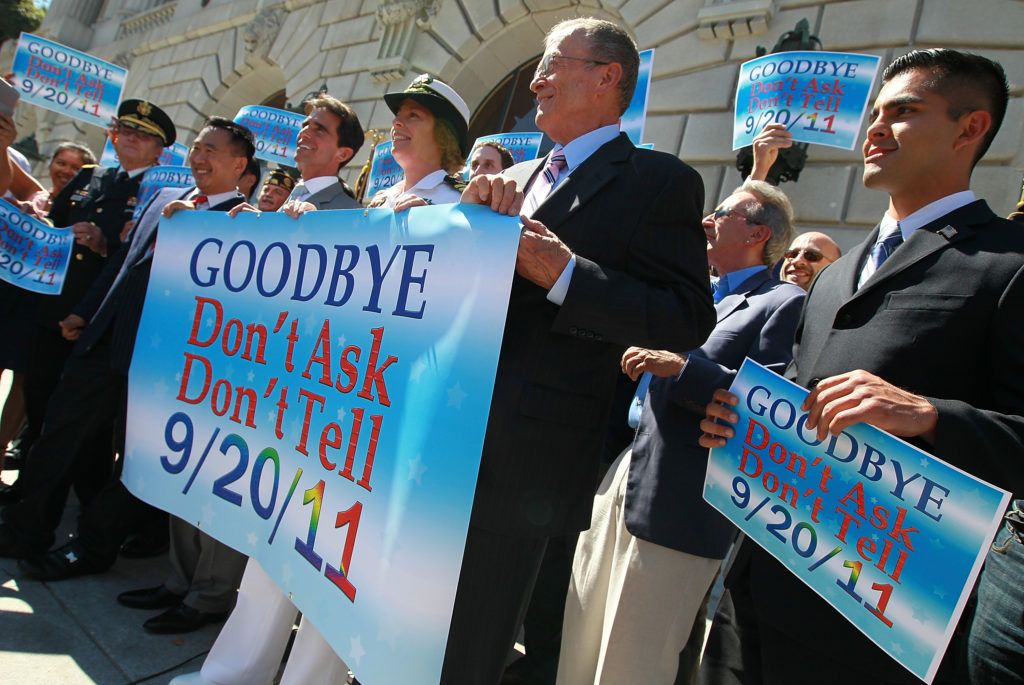
Rhode Island’s governor kicked off Veteran’s Day weekend by approving legislation that will extend local and state benefits to veterans who were dishonourably discharged for their sexuality.
It’s estimated that more than 100,000 LGBT+ people were ‘dishonourably’ or ‘less than honourably’ discharged from the US military between World War II and the repeal of the ‘Don’t ask, don’t tell‘ policy in 2011.
On Friday, November 8, Governor Gina Raimondo ceremoniously signed the crucial legislation allowing these veterans to reclaim the benefits they deserve.
“In the state of Rhode Island, if you’re a veteran who’s served, you oughta be eligible for veterans benefits that the state provides,” she told local stationWLNE-TV.
The bill, which also encompasses gender identity and gender expression, was first signed into law in June. It provides a streamlined petition process to have a discharge from service recorded as honourable, thus restoring the veteran’s benefits.
Local leaders and former members of the military celebrate the end of ‘Don’t ask, don’t tell’ on September 20, 2011 in San Francisco, California. (Justin Sullivan/Getty)
“Far too many veterans have been discharged, shamed and left without the benefits they earned because of decades of a dehumanising policy that said they couldn’t serve,” Rhode Island Senator Dawn Euer, one of the bill’s sponsors, said in a statement.
“They deserved gratitude and honour, and we should be doing everything we can to ensure that these wrongs are righted and that they get the respect they deserve.”
For years after ‘Don’t ask, don’t tell’ was repealed, the process for scrapping a dishonourable discharge was a “cumbersome” process that was “shrouded in mystery,” according to Andy Blevins, executive director of the Modern Military Association of America.
He told NBC: “If an individual is discharged under ‘don’t ask, don’t tell’ with something less than honourable, like most of them were, they would not receive those benefits.
“There was nothing enacted after ‘don’t ask, don’t tell’ that would give those benefits back, and that’s why what Rhode Island did is so incredible.”
Homosexuality, feminism and atheism are classed as extremist ideas in Saudi Arabia, according to the country’s Security Agency.
The claims were made this weekend in an official promotional video posted by the verified Twitter account of Saudi Arabia’s Presidency of State Security, but this now appears to have been deleted.
According to Reuters, the video listed homosexuality, feminism and atheism as takfir – the Islamist militant practice of labelling followers of other schools of Islam unbelievers.
“Don’t forget that excess of anything at the expense of the homeland is considered extremism,” said the video’s voiceover, adding that “all forms of extremism and perversion are unacceptable”.
Homosexuality and atheism have long been illegal and punishable by death in the absolute monarchy, and the country is considered to have one of the worst LGBT+ rights records in the world.
The law punishes acts of homosexuality or cross-dressing with fines, public whipping, beatings, vigilante attacks, chemical castrations, life imprisonment, capital punishment and torture.
Even supporting groups classified as extremist organisations can lead to imprisonment, which immediately puts any activists at risk.
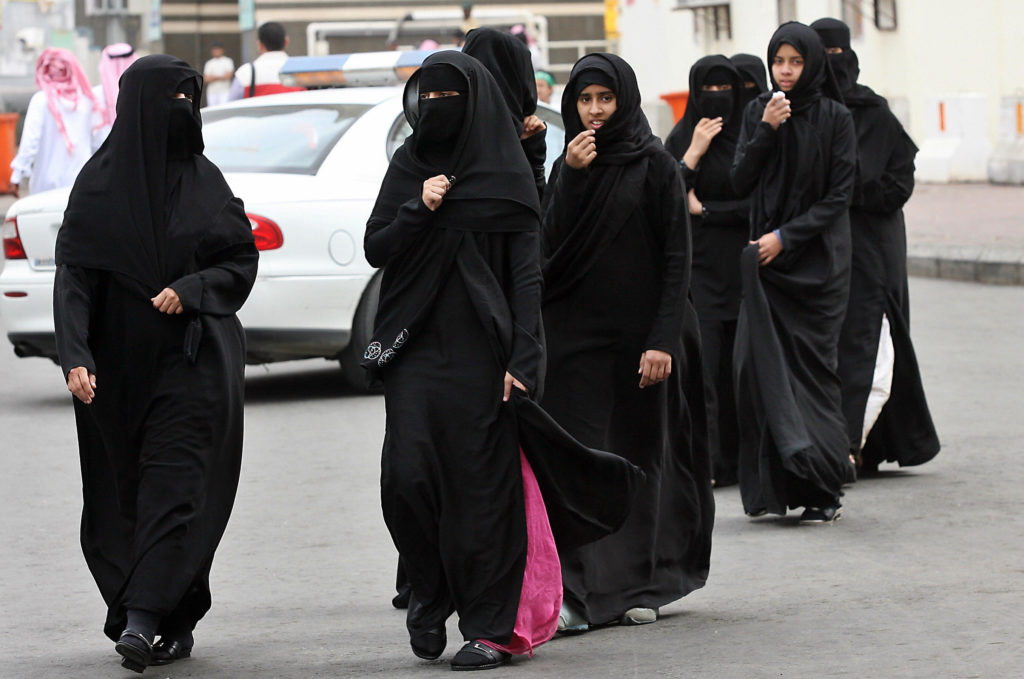
Saudi women cross a street in the holy city of Mecca in Saudi Arabia (HASSAN AMMAR/AFP/Getty)
“What happened in the last 30 years is not Saudi Arabia. What happened in the region in the last 30 years is not the Middle East,” he said in an interview with The Guardian.
“After the Iranian revolution in 1979, people wanted to copy this model in different countries, one of them is Saudi Arabia. We didn’t know how to deal with it. And the problem spread all over the world. Now is the time to get rid of it.”
The Crown Prince has begun breaking down many of Saudi Arabia’s societal taboos, rescinding the ban on women driving and scaling back guardianship laws that restrict women’s roles.
The latest video is seemingly at odds with the conservative Muslim kingdom’s bid to promote tolerance and attract foreigners.
Two well-known scientific groups have dropped job postings from their websites from Brigham Young University because of the school’s LGBTQ policies, igniting a debate on whether research organizations should take a stance on social issues.
The Washington-based American Geophysical Union and the Colorado-based Geological Society of America took down the ads amid mounting pressure from members, the Salt Lake Tribune reported Monday.
Both groups say the ads require applicants to abide by the school’s honor code, which includes a ban on homosexual behavior. Members of both nonprofits criticized the ads as discriminatory.
The Geological Society of America, which has 27,000 members, told the newspaper it has returned the $800 cost of the job post to BYU.
BYU spokeswoman Carri Jenkins declined to comment.
The Provo, Utah, university is owned by the Church of Jesus Christ of Latter-day Saints and mandates students follow the code that also prohibits premarital sex and the consumption of alcohol among other rules.
The code prohibits “not only sexual relations between members of the same sex, but all forms of physical intimacy that give expression to homosexual feelings.”
As a private school and religious institution, the school can legally maintain the honor code.
Benjamin Abbott, a professor in BYU’s College of Life Sciences, believes dropping the ads limits diversity in religious ideologies.
“It removes an opportunity for a diverse candidate from outside of the BYU system from finding the job,” Abbott said. “If we want to learn from and potentially influence others, we shouldn’t cut them off.”
Ellen Alexander, a doctoral student in geology at UCLA who identifies as LGBTQ, was one of several people who complained on social media after the American Geophysical Union initially declined to take the ad down.
“That ideology does not deserve an equal seat at the table,” Alexander said. “It’s not a belief. It’s discrimination.”
Other national groups have previously faced controversy for collaborating with BYU. The Society for Political Methodology apologized in April 2018 for holding an annual conference at the school. The group said many lesbian, gay, bisexual and transgender participants declined to take part. As a result, the group relocated several conference events off-campus.
Hockey player Harrison Browne, thought to be the first openly transgender athlete in any professional U.S. team sport, didn’t have many trans athletes to look up to when he was growing up.
Then he saw Chris Mosier, a pioneering transgender triathlete being true to himself: “a trans athlete while still being a triathlete,” Browne said. “For me, when you see it, you can be it.”
When Browne came out as transgender in 2016 while playing for the Buffalo Beauts, a team within the National Women’s Hockey League, he said he had “a flood of people reaching out to me on social media saying, “It’s amazing to see you play your sport and be yourself.” His desire to take part in that type of positive representation is what drew Browne to play on a historic all-trans hockey team, which competed this past weekend in Massachusetts: Team Trans vs. Boston Pride Hockey.
The friendship tournament, played in Cambridge, was hosted by Boston Pride Hockey, an LGBTQ intramural organization that has both cisgender and transgender members. The game came about after a trans player reached out to Boston Pride Hockey and asked about its friendship series with the New York City Gay Hockey Association, which led to a conversation leading to the game.
Earlier this year, Hutch Hutchinson, who played defense on Team Trans, and New York player Aidan Cleary discussed how they wanted to create a space just for transgender athletes. Cleary contacted Boston Pride Hockey Vice President Mark Tikonoff about how they might recruit a full team of trans players.
“We have a few trans members, but not enough to make an entire team, so we started to reach out — to other cities we play with in national tournaments — San Francisco, New York, Chicago, Canada — to see if there were other players who might be interested in something like this.” Tikonoff said.
Hutch Hutchinson and Shane Diamond, players on Team Trans for the Boston Pride Hockey League.Courtesy of Kyle Outlaw
After receiving a strong response, the group organized the event, secured the space and raised funds to make sure the tournament went off without a hitch.
“For us, we didn’t realize how much we had in common, and we didn’t realize — I’m speaking personally — how much this community was underserved,” Tikonoff said. “As a cis gay man going into a locker room with other cis gay men, I don’t fear for my safety and I don’t fear judgment and I don’t fear exposing part of myself to people.”
While Team Trans lost to Boston Pride Hockey in both of the weekend games, Hutchinson said it was “an honor” to play alongside Browne and Jessica Platt — the two professional hockey players who competed in the weekend tournament. “The common thread was we have all never been on an all-trans team, and we have all gone through the struggle of ‘Where do I belong?’” Hutchinson said.
“We as trans people fight either big battles or little battles every day,” Hutchinson said. “This was an opportunity to walk into a locker room, and we didn’t have to explain anything to each other — we’re here, we are trans, this is great.”
Platt, a transgender woman who played with the Toronto Furies in the Canadian Women’s Hockey Players Association before it went out of business, said that being out and trans in a professional sport is “a really lonely experience.”
“There are not a lot of out trans athletes playing professional sports, and there are few in professional women’s sports,” Platt said. “I think that’s partially due to the fact that there’s a lot of negativity surrounding trans women participating in professional sports.”
“Growing up, I always played boys hockey and it didn’t feel like a safe atmosphere for me,” Platt said. “I knew there was something different about me but I always tried to be who I needed to be to fit in because I saw anyone who didn’t quite fit in the male hockey atmosphere got made fun of pretty harshly, so I didn’t want to be that person.” And yet she persisted, because she loves to play the sport.
Platt said that if presented with the opportunity to play forward on Team Trans again, she’d do it. “It was such a special experience for me, it was such a positive and supportive environment, I feel like everyone had no problem being themselves.”
Once the players hit the ice, it was easy playing the game they all know and love.
“A lot folks that I played with this weekend, we put years of our lives into practicing our sports and then we came out as trans and found there’s not necessarily a space for us in that sport anymore,” Hutchinson said. “I think that what happened this weekend it was important on individual levels — for me personally, it was like a full honoring of my identity: I am a trans hockey player and I am on a trans team.”
For her part, Platt said she hoped that the tournament would open more people’s minds to the fact that transgender athletes work hard and compete fairly just like cisgender athletes.
“We need more knowledge, more education, and for people to go into these things with an open mind and be willing to learn something that they might not be familiar with.”