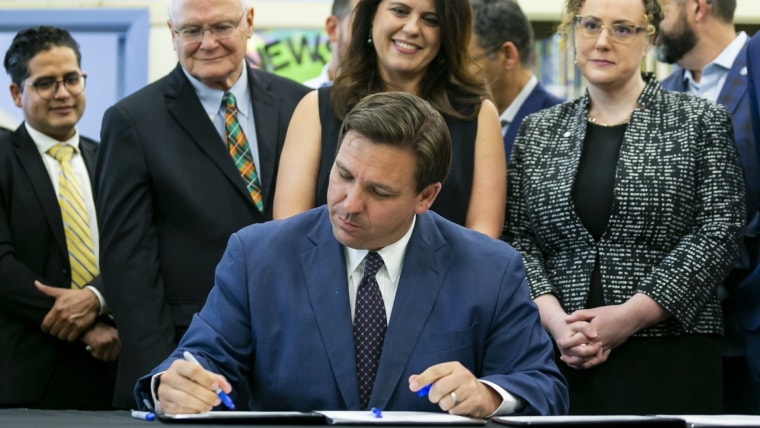
Rep. Sean Patrick Maloney, a New York Democrat, said Monday that he plans to reintroduce a bill aimed at improving sexual orientation and gender identity data collection in violent crimes and suicides.
The “LGBTQ Essential Data Act” would require law enforcement to include sexual orientation and gender identity information in the National Violent Death Reporting System — a database run by the Centers for Disease Control and Prevention that documents violent deaths and suicides, and provides information about why they occurred.
“The epidemic of violence against transgender Americans — particularly transgender women of color — is only getting worse,” Maloney said in a statement provided in advance to NBC News.
Maloney introduced the bill in 2019, but it didn’t pass. Now, Democrats narrowly control Congress, making it more likely that it could.
If the bill is passed, President Joe Biden is expected to sign it, as inclusive data collection was listed as a priority in his plan to advance LGBTQ equality.
The reintroduction comes at a critical time: Fatal violence against transgender people is at a record high — but that’s only according to data from advocacy organizations. The federal government allows law enforcement agencies to voluntarily submit hate crime data, but it doesn’t require them to track anti-trans violence or anti-LGBTQ violence, generally.
Advocates say that’s a serious problem, especially now.
This year is on track to become the deadliest on record for trans people, with at least 28 trans and gender-nonconforming individuals killed so far, according to the Human Rights Campaign. At this time last year, at least 18 trans people had been killed, according to the group. Advocates say these estimates are likely low, as law enforcement often use trans people’s birth name, also known as their deadname, in reports of their deaths.
“HRC has been tracking the underreported data since 2013, and Congress still hasn’t acted to enable local law enforcement to do the same,” Maloney said in his statement. “My bill will help us collect the data necessary to fully support the LGBTQ community. I am proud to be introducing this legislation, which was marked by President Biden as a legislative priority, with broad support. I trust our new Democratic Majority will work to get this bill passed into law. We must act now and help save lives.”
Without comprehensive data, advocates say, it’s hard to know how pervasive anti-LGBTQ violence really is. It’s also difficult to take steps to prevent it, as government data collection is often used to guide funding and resource allocation.
Sam Brinton, vice president of advocacy and government affairs for The Trevor Project, an LGBTQ youth suicide prevention organization, said inclusive data collection “in life and in death” would help advocates “to better understand the scope of suicide and homicide among LGBTQ people and to respond more effectively with resources and policy solutions.”
“The Trevor Project is the largest suicide prevention organization for LGBTQ youth, yet we don’t know how many LGBTQ youth die by suicide each year because that data is simply not collected systematically,” Brinton said in a statement. “The LGBTQ Essential Data Act would help deliver much-needed data that we can use to prevent violent deaths and save young LGBTQ lives.”
A 2018 report from the Human Rights Campaign found that no state has a comprehensive law that requires all government-funded data collection efforts to include sexual orientation and gender identity data with other demographic data such as race, ethnicity and sex.
Four states — New York, California, Oregon and New Jersey — and Washington, D.C., have narrower laws that require LGBTQ-inclusive data collection in some areas other than hate crimes.
Twenty-one states and D.C. require law enforcement to collect and report data on hate crimes based on sexual orientation and/or gender identity, the report found.
In 2019, Los Angeles County became the first jurisdiction in the nation to pass a motion to train medical examiners and coroners to investigate the violent deaths of LGBTQ people and to collect mortality data on sexual orientation and gender identity.
Though all 50 states now report data through the National Violent Death Reporting System, 10 states face a two-year backlog, according to the Trevor Project. Maloney’s bill would authorize $25 million in funding to help the CDC expand data collection.
Dr. Stephanie Ho, a family medicine physician in Fayetteville, Arkansas, said she’s had state legislators in her exam room before.
Ho, who has provided gender-affirming care to transgender people in the state since 2015, is also an abortion provider, so she is familiar with lawmakers’ restricting the care she provides. She said she wasn’t surprised when the Legislature overrode Gov. Asa Hutchinson’s veto of a bill last month that would ban puberty blockers, hormones and surgery for transgender minors.
“I think that it’s kind of ridiculous that we’ve gotten to the point that we’re letting politicians dictate how health care is delivered and what kind of care can be given to whom,” said Ho, a fellow with Physicians for Reproductive Health.
“I think the last thing I’ve ever wanted, being an abortion provider or somebody who provides gender-affirming care, is to have a politician in the back of my mind in the exam room making me think about ‘Oh, I wonder if I should do this, if it’s OK,’” she said. “They’re essentially trying to practice medicine without a license. And that’s incredibly wrong.”
Arkansas was the first state to pass a ban on transition care for minors. Tennessee Gov. Bill Lee last week signed a similar billbarring prepubertal youths’ access to transition care like hormone therapy. Advocates say no doctors in the state provide hormone therapy for prepubertal youths, The Associated Press reported.
So far this year, state legislatures have considered 35 bills to ban or limit gender-affirming care for trans minors, according to the Human Rights Campaign. Physicians say that the bills negatively affect their patients’ health before they even become law and that they require doctors to go against medical standards of care. Legal experts say the bans could also open providers and hospitals up to lawsuits or put them at risk of losing federal funding.
Ho is trying to support her patients as best she can until Arkansas’ law takes effect this summer.
“It’s just a matter of making sure that my patients know that, whether I can provide them hormones or not, we’re still here for them to support them in any way that we can,” she said. “Of course, I’m going to practice within the bounds of the law, whether I agree with it or not, because me being in jail doesn’t help any of my other patients at all.”
Creating ‘contingency plans’
Some physicians, like Dr. Izzy Lowell, who founded a telemedicine practice called QMed in Atlanta in 2017, started planning for the bills months ago.
Dr. Izzy Lowell, second right, founder of QMed.Bonnie Heath
In April, Alabama’s Senate passed a bill that would have made it a felony for doctors to provide minors with gender-affirming care. The bill died Monday after the House missed the deadline to vote on it. Lowell said that when it first passed, the minor patients she treats in Alabama were scared and frustrated.
“It was clear that the state of Alabama was coming after transgender teens, and we talked about some contingency plans,” she said. “Based on each case, I tried to give them as many refills as possible and told them: ‘Go pick up as much of your medicine as you can. I don’t know when I’ll see you again.’”
Lowell is licensed and practices in 10 states via telemedicine, so she also talked with her legal team and with patients in states considering bans about how her patients could continue care should their states ban it. She said her patients’ parents would have to drive to other states, which would “place an extraordinary burden on these families.”
“If they were, for example, able to get over the border into Tennessee or South Carolina and sit in a parking lot somewhere, I could see them technically with my South Carolina license or Tennessee license or my North Carolina license and perhaps find a local pharmacy there and have them pick up the prescription, but it would be a day’s worth of driving for them to get somewhere where I could see them legally,” she said.
Because leaving the state just to get care would be a burden, families in states where transition care restrictions have passed have movedor are considering moving.
The costs of losing ‘lifesaving’ care
Many minors whose parents don’t have the time or money to drive out of state would be forced to stop transition care if their states passed laws like Arkansas’, which comes with potentially life-threatening health risks, physicians say.
Major medical organizations, including the American Medical Association, the American Academy of Pediatrics, the Endocrine Society and the American Psychological Association, support gender-affirming care for trans youths and oppose efforts to restrict access.
Supporters of the Arkansas bill argue that transition care for minors is “experimental” and that trans minors often change their minds about their genders and detransition later in life. Medical experts say neither of those claims are backed by scientific evidence. On the contrary, research has found that access to gender-affirming care such as puberty blockers reduces the risk of suicide among trans youths.
Ho said the danger is evidenced by what happened when Arkansas’ bill passed through one legislative chamber. Dr. Michele Hutchinson, a physician at the Arkansas Children’s Hospital Gender Spectrum Clinic, testified before the state Senate in March that there were “multiple kids in our emergency room because of an attempted suicide, just in the last week,” after the House passed the bill.
Ho said that “since then, I have had one of my own patients attempt suicide,” adding that she has talked to her patients about what would happen if a judge doesn’t block Arkansas’ law from taking effect. The law also bars her from referring her patients to other physicians who provide gender-affirming care. Unless her patients were able to leave the state, they would be likely to lose access to hormones, so she talked to them about what that would mean.
Lowell said forcing people who were assigned female at birth to stop testosterone would cause them to suffer symptoms of low testosterone, which include inability to concentrate and low energy. “They would start doing badly in school most likely, until their bodies started producing estrogen a few months later, and then they would restart their periods, restart breast growth, and it would undo all of the changes that we tried to achieve with testosterone.”
If people assigned male at birth were forced to stop taking estrogen, it “would be like going through instantaneous menopause,” Lowell said. For about a year, they could have symptoms like hot flashes, night sweats, irritability and mood swings, among other issues, such as negative impacts on emotional well-being.
Doctors worry that minors who already receive and rely on transition care would get hormones illegally if they had to. Dr. Ricardo Correa, a board member of GLMA: Health Professionals Advancing LGBTQ Equality, treats trans veterans in Phoenix, where, he said, trans people have traveled to the border to buy hormones illegally when they can’t get them. He said state bans would worsen the problem.
“It will just create chaos in the system from black markets that are going to start selling this kind of medication in that state,” he said.
Lowell said that hormone therapy is safe when it is monitored by a doctor but that using it without medical supervision could cause health problems, such as liver failure, kidney failure or heart problems.
“There’s very serious consequences of completely unmonitored, sort of black market medication use in this situation,” she said.
‘A form of medical malpractice’
Legal experts and advocates say that in addition to having dangerous health impacts, bans on gender-affirming care for transgender youths could expose health care providers to legal and regulatory problems.
Valarie Blake, a law professor at West Virginia University specializing in health care law, said there’s “a pretty strong case” that Arkansas’ law is discriminatory under Section 1557 of the Affordable Care Act, which protects against discrimination based on sex.
The Biden administration announced this month that it would interpret Section 1557 to protect against discrimination based on sexual orientation and gender identity — reversing a Trump-era policy that cut protections for transgender people.
Hospitals and physicians receiving federal funding, such as Medicare and Medicaid payments, are required to comply with laws like Section 1557, Blake said; otherwise, they risk losing the funding.
Arkansas’ law could trigger that risk by allowing physicians and hospitals to prescribe puberty blockers and hormones to cisgender minors for precocious puberty but not transgender teens.
“If the reason that they’re not doing it for transgender teens is because of the fact that they’re transgender, then there’s a very good case that the reason that they’re refusing the treatment is based on the gender identity and not anything else,” Blake said.
“It really puts health care workers in an untenable position when the federal government makes it plain that this is discrimination and has the money to back it up to basically say, ‘We can pull away all of the resources,’ and yet the state persists,” she said.
The American Civil Liberties Union argued in a lawsuit it filed Tuesday against Arkansas that the trans health restrictions are unconstitutional, but Blake said that’s not set in stone.
“We don’t have clear precedent on the books yet to suggest that LGBTQ categories are fully protected in that manner, which is why we’ve been seeing various kinds of Equal Rights Amendment-type laws trying to work their way through Congress,” she said, referring to the Equality Act, a bill that would protect LGBTQ people from discrimination in housing, employment, public accommodations, education and other areas of life.
The bill passed the House in February, but it has stalled in the Senate. “If something like that passes, then suddenly Arkansas as a state is in big trouble,” Blake said.
Lowell said thinking about the potential legal issues “keeps me up at night.” Physicians are required to give patients several months’ warning when they can’t see them anymore and to do their best to find other providers who can see them if they’re unable to.
But laws like Arkansas’ bar physicians from referring patients to other providers for transition care. “In this case, I can’t do any of those things, and I just have to say, ‘Bye,’ and ‘I’m not allowed to see you anymore,’” she said. “That’s patient abandonment, which is a form of malpractice.”
Lowell said that when the first restrictions were introduced several months ago, she felt angry and anxious all the time.
“I worry about what might happen to my patients if these bills are passed and worry about going to jail myself,” she said. “I struggle with the question of what I would do: continue to support my patients and risk going to jail for years or follow these hateful laws? Thankfully, I have not had to answer this question yet, but I will never abandon my patients.”
Holly Duchmann, who lives in Lafayette, Louisiana, plans to attend a Pride celebration for the first time this year.
“In the years before the pandemic, while I was out to my friends, I was still really scared to go to Pride,” Duchmann, 27, said. “Because I’m bisexual, I kind of pass as straight a lot, and so that kind of created anxiety with me for years, making me feel like I didn’t really belong in the LGBT community.”
She felt more accepted after finding queer community through her roller derby team, and in 2020, she was looking forward to going to her first Pride event. She even picked up pieces of “extravagant” clothing here and there to wear. But then everything was canceled because of the pandemic, and, during quarantine, she turned to TikTok to feel connected to other LGBTQ people.
“The pandemic helped me realize I need to celebrate life when I can,” she said. “It’s like being cooped up made me want to burst out. So I’m fully vaccinated and making plans with friends to go all out this year.”
Duchmann plans to go to New Orleans to celebrate, though New Orleans Pride, which has organized the city’s main Pride events in the past, disbanded in 2020. There’s no central Pride event planned this year, but Duchmann isn’t worried.
“I really see Pride as being larger than just an event held by one organization,” she said. “NOLA is great about gathering and celebrating. It’s kind of like Mardi Gras. It’s a whole season.”
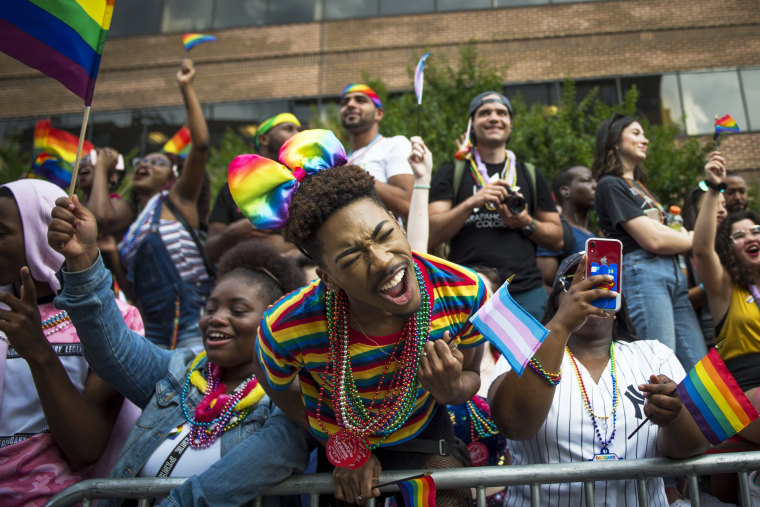
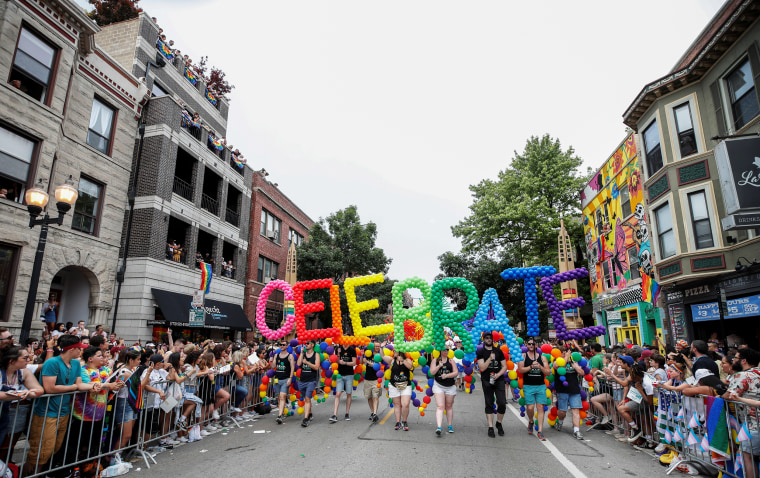
In the last few decades, Pride has been celebrated in cities around the globe with bigger and bigger events such as parades, marches and protests. In June 2019, an estimated 5 million people attended NYC’s annual Pride march, which coincided with WorldPride, which moves to a different major city each year. The celebrations were expected to be just as big in June 2020, the 50th anniversary of the first Pride march — then called Christopher Street Liberation Day — which began a year after the Stonewall Riots of June 1969, a dayslong protest that began after police raided the Stonewall Inn, a gay bar in downtown Manhattan.
But in April 2020, the pandemic brought plans for the 50th anniversary of Pride to a halt, forcing event organizers across the U.S. to pivot to all-virtual programming. Now, Pride — in New York and beyond — will return with a mix of in-person and virtual events. Organizers are balancing concerns about safety with increasing vaccination rates and the LGBTQ community’s excitement to return to Pride after a year of social distancing.
‘More strategic’ virtual programming
Last spring, the group behind NYC Pride, the country’s biggest annual Pride celebration, canceled its in-person march for the first time in a half-century because of the Covid-19 crisis, and then had two months to create a virtual event in June.
“That was a shock that we had to think about very quickly on our feet to adapt to,” Dan Dimant, media director for Heritage of Pride, the group behind NYC Pride, said. “We did our best, but what we had this time around was the luxury of time and foresight.”
This year, Heritage of Pride will host some face-to-face events — like its annual street fair — but its well-known march, which has attracted millions in previous years, won’t be coming back in the same way just yet.
NYC Pride organizers will hold virtual events like a family movie night, a human rights conference and a rally, among others. It will also hold its usual Pride march on June 27, though it will be mostly virtual with “in-person elements that are to be determined,” Dimant said, adding that any in-person element would take place in a supervised area with perimeters to limit attendance.
“We put together a much more strategic virtual program for most of our events, and we’ve also kind of left the door open for most of this year to kind of wait and see what we could do in person,” Dimant said. “We believe that we certainly can’t have millions of spectators in one massive crowd just yet. It’s just too soon for that. But there are some events that we can do safely in person.”
‘Playing the safe card’
Other groups in large cities are organizing their events similarly.
Los Angeles Pride will host a free streaming concert June 10 on TikTok featuring Charlie XCX, a virtual “Thrive With Pride Celebration” on ABC7. LA Pride will also debut its “LA Pride Makes a Difference” volunteer calendar, which will enable people to volunteer — both in-person and virtually — for local nonprofits that support LGBTQ people.
People march in the 50th annual Pride parade on June 9, 2019 in West Hollywood, Calif.Chelsea Guglielmino / Getty Images file
Noah Gonzalez, the vice president of the board of directors for the Christopher Street West Association, the nonprofit behind LA Pride, said its signature parade and festival, which in 2018 drew more than 100,000 attendees and participants, can take six months to a year to plan, so the board had to make a decision about how to host the events in December.
“We had no idea where we were going to be, so we had to plan for what we knew at the time, and keeping the responsibility and safety in mind, we knew we could do something virtual,” he said. He said the group’s in-person events — the volunteer opportunities — allow people to decide what level of exposure they’re comfortable with, and don’t involve large crowds.
“From a celebratory perspective, we’re sort of pulling back a little bit and playing the safe card, but when it came to giving back to the community or being involved in community, our perspective was … we will create these opportunities and bring them to the community, and you can decide what you would like to do,” he said.
A crowd cheers on those participating in the 50th annual Pride parade in Washington on June 8, 2019.Caroline Brehman / CQ-Roll Call via Getty Images file
Some Pride organizers in big cities have committed to larger in-person celebrations, but they are limiting capacity, adhering to strict health requirements or not holding their events until the fall.
LA Pride will host a Pride night at Dodgers Stadium on June 11, with a special package available to fully vaccinated attendees, and an in-person outdoor LGBTQ movie night on June 26. Similarly, San Francisco Pride is having two Pride movie nights on June 11 and 12 at Oracle Park and a Black Liberation Event at the African American Art & Culture Complex on June 18.
Chicago Pride plans to bring back its Pride in the Park concert in person, with Chaka Khan and Tiesto as headliners, but the event is ticketed, and attendees have to verify that they’ve been vaccinatedor provide other health information through an app no more than 12 hours before arriving to the two-day event, which takes place June 26 and 27.
“We worked with [the app] Health Pass by CLEAR so that we could create a very safe environment where people [who] are either tested or have been vaccinated are the only people that can come into the event right now,” Dustin Carpenter, president and lead organizer for Pride in the Park, said.
People march in the 50th annual Pride parade in Chicago on June 30, 2019.Kamil Krzaczynski / Reuters file
Atlanta Pride also plans to host a festival, though the group traditionally doesn’t celebrate until mid-October. The events will take place in Piedmont Park, which is outdoors, unfenced and allows for social distancing, Jamie Fergerson, executive director of Atlanta Pride, said.
“There’s a lot of concern about health and safety, obviously,” Fergerson said. “People have a lot of questions, and we — as a nonprofit organization that works for a community that’s been historically marginalized in a number of ways, including access to health care and access to good health care — we take health and safety very seriously.”
Some events are still on standby. In Philadelphia, Philly Pride Presents planned to host a festival on Sept. 4, but shared on its Facebook page Friday that the event is “a work in progress” and “not yet ‘fully open’” after the city issued guidance on reopening. Pride Houston has a few smaller events listed on its website, including Rock the Runway, a Pride fashion show, and said a “big announcement” is coming this month.
Other groups, like Boston Pride, have postponed their usual June festivities until the fall.
Some LGBTQ people said, regardless of the number of precautions taken, they don’t feel safe attending in-person Pride events just yet.
“I wouldn’t feel comfortable attending a Pride event as a fully vaccinated person, because I don’t know who is vaccinated and who is not,” Justice Dominguez, who is 24 and lives in Corpus Christi, Texas, said in an email. “Even with social distancing and mask requirements, it still feels like a risk. We know that less than half of all U.S. adults are fully vaccinated (per CDC). I thought these numbers would discourage Pride organizers but I was wrong.”
Other LGBTQ people said they won’t be attending large Pride celebrations and will instead attend community-run events, such as New York’s Queer Liberation March, which is organized by the activist group Reclaim Pride, started by community activists in 2019 as an alternative to NYC Pride.
“Being a transgender woman of color, Pride celebrations at large have not included the trans community,” Houston resident Eden Torres, 36, said. “I am moving back to NYC this summer after 13 years in Texas. I will attend any grassroots, no corporation, trans-centered Pride celebrations, but will not participate in corporate Prides any longer.”
But Duchmann isn’t alone in her excitement for Pride festivities — some people are also looking forward to finally being face-to-face.
Patrick Murphy, 71, of Santa Fe, New Mexico, said he and his partner of 49 years will be attending an in-person event.
“We believe that we must continue to show the world that we are still here and will always be strong,” Murphy said. “We survived AIDS and Covid! Just by being there shows the younger generation of LGBT people that they do have a future.”
Ali Fazeli Monfared, a 20-year-old gay Iranian man, was allegedly killed in an “honor killing” by some of his male family members after they found out he was gay, according to an LGBTQ rights group in Iran and Turkey.
Fazeli Monfared, who was known as Alireza by friends and family, lived in a city in southwest Iran. He had applied for an exemption from compulsory military service so he could leave the country and move to Turkey to live with his close friend, Aghil Bayat, according to 6Rang, the Iranian Lesbian and Transgender Network.
Though homosexual conduct is criminalized in Iran, part of the military exemption law allows gay and transgender people to receive a medical exemption from service for their identity. The law states, in part, “a person can be freed from his military service duties, if he is ‘mentally ill’ (homosexual).”
Fazeli Monfared received an exemption card in the mail from the Islamic Revolutionary Guard Corps after disclosing his homosexuality, but one of his male relatives found it and discovered he was gay, according to 6Rang. The organization reported the relative had previously told Fazeli Monfared’s father that the young man had dishonored the family due to the way he dressed.
BBC Persian reported Friday that it received audio recordings of Fazeli Monfared saying his family had threatened his life.
After finding the exemption card, a group of male relatives took Fazeli Monfared to a rural village near Ahvaz on May 4 and killed him, Shadi Amin, executive director of 6Rang, told NBC News. The card, and the exemption for homosexuality as a disease, put Fazeli Monfared in danger, she said.
“We think that because of his gender expression and his behaviors, they knew that he is homosexual, but it was proof that shows he wants to leave the country, and he is a gay man,” Amin said. “We are trying to use this story to challenge the Iranian government … to remove this paragraph [in the exemption law] and the reason on the exemption cards.”
Bayat told 6Rang the alleged killers had called Fazeli Monfared’s mother and told her where to find her only son’s beheaded body.
Though 6Rang first reported that police arrested the three men involved in Fazeli Monfared’s death, Amin said that isn’t accurate and no arrests have been made. She said police told Fazeli Monfared’s mother they made arrests in the case to calm her down.
But Amin said she thinks arrests will be made in the case because Fazeli Monfared comes from a wealthy family, and his father is angry about his death. She added that though Iran criminalizes homosexual conduct, it isn’t illegal to be gay. If Fazeli Monfared’s alleged killers had caught him having sex with a man, then they might receive lesser punishments for his death.
Iran is one of an estimated 11 countries where same-sex sexual acts are punishable by death, according to the International Lesbian, Gay, Bisexual, Trans and Intersex Association, and one of almost 70 countries where it is criminalized, according to Human Rights Watch, an international human rights group based in New York. In Iran, punishments for homosexual conduct range from 31 to 100 lashes to death, according to Human Rights Watch.
Iranian Foreign Minister Mohammad Javad Zarif defended the country’s death penalty punishment for homosexual conduct during a press conference in June 2019. “These are moral principles regarding the behavior of people in general,” he said at the time, according to German broadcaster Deutsche Welle.
There are no statistics or records of the number of anti-LGBTQ “honor killings” — which are perpetrated by relatives who feel the LGBTQ person has brought “dishonor” to the family — that happen in Iran or other countries that criminalize homosexuality, Tara Sepehri Far, who investigates human rights abuses in Iran and Kuwait for Human Rights Watch, told NBC News.
She said Fazeli Monfared’s case highlights the importance of the role of the family in LGBTQ people’s lives when the state criminalizes who they are.
“In the context that the LGBT community is not protected by law — and there’s actually a serious threat to their rights and even safety — the role of the family is becoming even more important,” Sepehri Far said, adding that if you’re coming from a family that accepts you, you can have access to safer spaces and communities.
The NCAA announced a preliminary list of 20 schools being considered to host the Division I Softball Championship, and three of them — Alabama, Arkansas and Tennessee — are in states that have recently passed laws banning transgender girls and women from competing on women’s sports teams.
The final list of 16 schools that will host games in the tournament’s regional round will be announced May 16, about a month after the NCAA released a statement backing trans athletes as more than 30 states have considered legislation to limit their participation.
“When determining where championships are held, NCAA policy directs that only locations where hosts can commit to providing an environment that is safe, healthy and free of discrimination should be selected,” the April 12 statement said. “We will continue to closely monitor these situations to determine whether NCAA championships can be conducted in ways that are welcoming and respectful of all participants.”
Many advocates took the NCAA’s statement to mean that it wouldn’t consider states that had passed legislation targeting trans people to host tournaments.
“The NCAA is making it clear that their Board of Governors supports transgender athletes, and the board should hold those states passing these harmful laws accountable,” Rodrigo Heng-Lehtinen, deputy executive director of the National Center for Transgender Equality, said in a statement at the time.
But the organization’s recent list of potential hosts for an early round of the softball tournament appears to call into question whether the NCAA will be holding states accountable.
Karen Weaver, a former college field hockey coach and athletic administrator now on the faculty at Penn, called the most recent NCAA statement as “wishy washy as you can get.”
Weaver told The Associated Press that the NCAA’s statement was “carefully worded,” and that’s likely due in part to legislation in Congress known as the name, image, likeness, or NIL bill, which would allow athletes to make money on the use of their name, image or likeness.
She said it’s a “tenuous time to be taking any kind of stance that might be viewed as political,” because the NCAA is trying to “craft their future in the Congress and Senate with the NIL legislation.”
“They’re trying to not tick off any potential folks who might vote for something that benefits the NCAA the most,” Weaver told the AP.
The 20 potential regional sites for baseball will be announced next week, and that list will be pared to the 16 official hosts on May 31.
Jeff Altier, the NCAA Division I Baseball Committee chairman and the athletic director at Stetson University in Florida, told the AP last month that his committee had not received a directive to exclude any school from consideration for hosting a regional.
Altier referred other questions to the NCAA.
Seven states — Alabama, Arkansas, Idaho, Mississippi, South Dakota, Tennessee and West Virginia — have laws banning trans girls from competing on girls sports teams, though a federal judge blocked Idaho’s law from taking effect in August pending the outcome of a lawsuit. All of the laws ban trans girls from competing in middle and high school sports. Laws in Arkansas, Virginia and Mississippi also include college sports teams.
Gail Dent, spokeswoman for the NCAA Board of Governors, did not respond to questions about the NCAA’s willingness to pull events out of states with bans.
Shane Windmeyer, founder and executive director of Campus Pride, a national organization advocating for safer college environments for LGBTQ students, said that the NCAA’s Office of Inclusion has been an ally. He said Campus Pride and similar organizations have received grants from the NCAA to fund diversity and inclusion summits and other programming.
That’s one reason he found it “surprising the NCAA would say one thing, that they are monitoring it, and then select site locations that are in areas of the country that are doing anti-trans, anti-LGBTQ legislation.”
The NCAA has had policies in place since 2011 that allow for transgender participation in sports. Testosterone suppression treatment is required for transgender women to compete in women’s sports.
In 2016, the NCAA made good on its threat to pull championship events out of North Carolina in response to the “bathroom bill,” which required transgender people to use restrooms according to their sex at birth and not their gender identity. Greensboro lost first- and second-round games in the men’s basketball tournament in 2017; they were moved to Greenville, South Carolina. The law was repealed before the NCAA could take away more events.
“When they got involved with the bathroom bill in North Carolina, that was, in my opinion, a bold step for them,” Weaver said. “I’m not seeing that same enthusiasm right now.”
The NCAA traditionally selects baseball and softball regional sites based on a team’s performance as well as quality of facilities and financial considerations. This year, potential sites were pre-determined because each must be evaluated for its ability to meet the NCAA’s Covid-19 protocols.
Four of the top five teams in this week’s D1Baseball.com Top 25 — No. 1 Arkansas, No. 2 Vanderbilt, No. 4 Mississippi State and No. 5 Tennessee — ordinarily would be considered shoo-ins to be regional hosts. The four schools confirmed to The Associated Press that they had submitted bids to host but declined interview requests on the topic of the NCAA’s decision.
Since 2000, the home team has won 67.5 percent of baseball regionals, and there is money to be made, too. A University of Arkansas study showed baseball fans visiting the Fayetteville area spent about $2 million during a three-day regional in 2018, excluding the cost of tickets and in-stadium purchases.
For now, everyone is waiting to see the next step on site selections from the NCAA, which has referred all questions to the Board of Governors statement.
Amazon is still selling a book that advocates say perpetuates the idea that being transgender is harmful to youth and something to be “cured.”
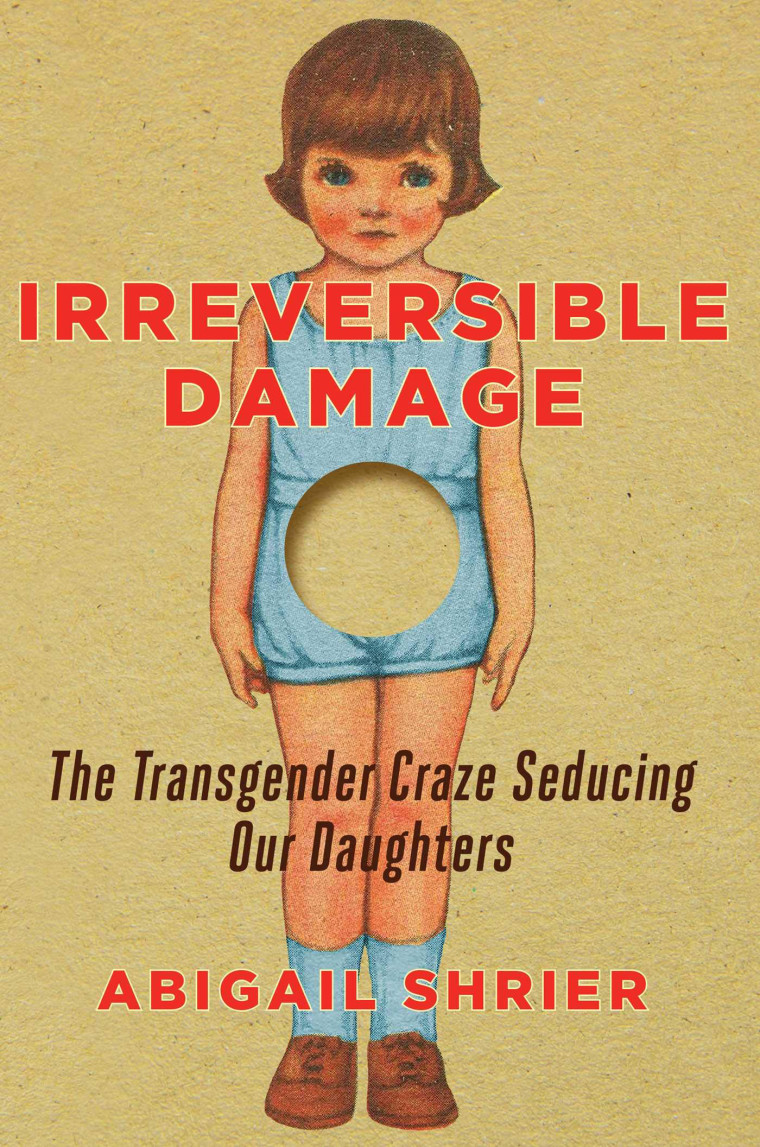
The book, “Irreversible Damage: The Transgender Craze Seducing Our Daughters,” by the journalist Abigail Shrier, explores what Shrier calls an “epidemic” of young girls coming out as trans.
“A generation of girls is at risk,” the Amazon description of the book reads. “Abigail Shrier’s essential book will help you understand what the trans craze is and how you can inoculate your child against it — or how to retrieve her from this dangerous path.”
Dozens of Amazon employees, including some who are LGBTQ, filed an internal complaint in April arguing that the book violates Amazon’s policy against selling books “that frame LGBTQ+ identity as a mental illness,” according to The Seattle Times, which received images of the complaint.
“Irreversible Damage,” by Abigail Shrier.Regnery Publishing
But on April 23, the company’s director of book content risk and quality announced on an internal message board that Amazon would continue to sell the book.
“After examining the content of the book in detail and calibrating with senior leadership, we have confirmed that it does not violate our content policy,” the director wrote, according to The Seattle Times.
Not everyone on the board that reviewed the book agreed with the company’s decision. The Seattle Times cited Slack messages in which at least one employee involved in the review process said, “We told them it’s transphobic and needs to be removed.”
An Amazon spokesperson told NBC News in an email, “As a bookseller, we believe that providing access to written speech and a variety of viewpoints is one of the most important things we do — even when those viewpoints differ from our own or Amazon’s stated positions.”
Amazon CEO Jeff Bezos has vocally supported LGBTQ rights in the past. In 2012, he donated $2.5 million to advocates fighting for marriage equality. The company also recently joined a list of businesses that support the Equality Act — a bill that would provide LGBTQ people with federal protections from discrimination in housing, education, public accommodations and other areas of life. Amazon also signed on to a recent Human Rights Campaign letter condemning states that pass anti-LGBTQ legislation, including bills that target transgender youth.
Shrier has defended the book’s content, writing on Twitter with a link to The Seattle Times article about Amazon’s decision, “Anyone who thinks my book ‘advances a narrative of transgender identity as a disease’ hasn’t read it, or is a bona fide idiot.”
She writes in the book’s introduction that it is “not about transgender adults,” but about what she says is an increasing number of children assigned female at birth identifying as transgender. She told The Seattle Times that her book doesn’t take a stance against transitioning for adults in any way, but that she opposes the “fast-tracking of youth” into medical transition.
Shrier did not immediately respond to NBC News’ request for comment.
Trans advocates and physicians who treat trans youth oppose Shrier’s book because they say it poses a danger to youth and spreads misinformation. Medical experts have said that trans minors are never “fast-tracked” into medical transition. Rather, international medical guidance recommends that prepubertal youth socially transition and receive mental health therapy.
Dr. Jack Turban, a fellow in child and adolescent psychiatry at the Stanford University School of Medicine, where he researches the mental health of transgender youth, said the book “promotes the idea that transgender youth are ‘confused’ and that gender diversity is something to be ‘cured.’”
“Every relevant major medical organization (The American Academy of Pediatrics, The American Psychiatric Association, and The American Academy of Child & Adolescent Psychiatry, to name a few) disagrees with this position,” Turban said in an email. “A recent study from our group found that attempts to force transgender people to be cisgender are strongly associated with suicide attempts.”
The ideas in Shrier’s book, Turban said, could have negative effects on the mental health of transgender youth. “Research consistently shows that family rejection of a young person’s gender identity is a major predictor of bad mental health outcomes, including suicide attempts,” Turban said. “This book promotes that kind of family rejection. I can’t emphasize enough how dangerous that is from a public mental health perspective.”
In November, Target said it would remove Shrier’s book from shelves after backlash from LGBTQ advocates. But it reversed that decision after critics said it was suppressing Shrier’s free speech rights. At the time, trans people and advocates condemned Target’s decision.n1266447&sessionId=f05d091f28fd33ae6b252c89996f977218833b26&siteScreenName=NBCNews&theme=light&widgetsVersion=82e1070%3A1619632193066&width=550px
Shrier and her book faced criticism again when she testified against the Equality Act during a Senate hearing in March.
But she has also received a wave of support in part from people who argue that books of any kind should not be censored.
Nadine Strossen, former president of the American Civil Liberties Union and a law professor at the New York Law School, said she hasn’t read Shrier’s book, but “it doesn’t matter” to her what the book says — she thinks it should continue to be published and sold as a matter of free speech.
She said she recently tried to persuade a publisher to keep publishing “Mien Kampf,” Hitler’s autobiography, “and it’s not despite the fact that my father barely survived the Holocaust — it’s because of that fact,” Strossen said, adding that she believes free speech is “the most effective way to expand rights and safety and dignity for any individual or group, but, in particular, those who have traditionally been marginalized and oppressed.”
No matter how well intended, suppression of speech does more harm than good, Strossen said. First, she argued that it gives the person being censored and their speech even more attention. Second, she said people who are anti-trans can make people like Shrier “martyrs for free speech.”
She said suppression can also create what’s called the forbidden fruits effect or the Streisand effect — after Barbra Streisand, who, in 2003, tried to have photos of her Malibu house taken off of the internet, which sparked more public interest in the photos.
“A lot of people think, ‘Oh, that idea … people who are trying to suppress it must be really threatened by the idea, let me look into it,’” Strossen said of what happens when ideas or speech are suppressed. “And so the idea, paradoxically, gains credibility.”
She said she believes “the more dangerous an idea,” the more important it is for the idea to be understood and responded to by those who can explain why it’s wrong and dangerous.
In the case of Shrier’s book, Strossen said, it’s important that people who support trans young people can show that “if you truly care about the health and lives and mental health and physical health and equal well being and dignity of these young people, that these ideas are wrong and misguided.”
Caitlyn Jenner, the former Olympic champion and reality TV personality now running for governor in California, said she opposes transgender girls competing in girls’ sports at school.
Jenner, a 1976 decathlon gold medalist who came out as a transgender woman in 2015, told a TMZ reporter on Saturday that it’s “a question of fairness.”
“That’s why I oppose biological boys who are trans competing in girls’ sports in school. It just isn’t fair. And we have to protect girls’ sports in our schools,” Jenner said Saturday during a brief interview in a Malibu parking lot.
It was Jenner’s first comment on the issue since announcing her candidacy to replace Gov. Gavin Newsom, a Democrat, in a recall election. Five states have passed laws or implemented executive orders this year limiting the ability of transgender youths to play sports or receive certain medical treatment. There’s been a vehement outcry from supporters of transgender rights.
Jenner, a Republican, supported Donald Trump in the 2016 presidential election but later criticized his administration for some discriminatory actions against transgender people.
Many transgender rights advocates have criticized Jenner, saying she has failed to convince them that she is a major asset to their cause.
Kai Shappley, a trans 10-year-old who lives in Texas, asked Jenner to “stop hurting” trans kids.
Some trans people said Jenner doesn’t represent the community.
Equality California, an LGBTQ advocacy organization, wrote: “Here are the facts: Caitlyn Jenner is willing to sacrifice the health & well-being of trans kids to win votes. Gavin Newsom is not. It’s that simple.”
Others pointed out that, as recently as last year, Jenner supported trans athletes competing on the sports teams that align with their gender identity.
“I think every trans person, if they’re into athletics, should have an opportunity to compete and to improve themselves,” Jenner said in April 2020 on theOutsports podcast,The Trans Sporter Room, according to Forbes. “I think sports is such a great way to learn a lot about yourself. … Hopefully they’ll have the opportunity in the future to do whatever they can do. I’m all for it. I’m all for it.”
She echoed a similarly supportive sentiment in 2015, when she received the Arthur Ashe Courage Award at the ESPY Awards, and spoke about issues affecting trans people.
“I also want to acknowledge all the young trans athletes who are out there — given the chance to play sports as who they really are,” she said in her acceptance speech. “And now, as of this week, it appears that trans people will soon be serving in the military. That’s a great idea. We have come a long way. But we have a lot of work to do.”
Advocates say Jenner’s flip-flop is evidence that she’s changed her public view just to attract the attention of California’s Republican voters.
But trans people say that her comment won’t be without consequence, and that it could help people behind anti-trans legislation justify their views.
“Jenner is gonna be America’s ‘some of my friends are trans’ trans woman that allows countless conservatives a little cover to decimate our rights,” trans filmmaker and author Leigh Finke said. “Not that they’ll succeed, but it’s the elbow room they need to better make their case, and hurt our kids.”
Finn Cooper, who lives in Cincinnati, volunteered for the Michigan Democratic Party to call voters in the swing state on behalf of the Biden-Harris presidential campaign in the months leading up to the election.
Cooper, who uses gender-neutral pronouns, said they supported Joe Biden’s message on LGBTQ rights.
“I thought he seemed like a good candidate — much better than Trump, of course, and I do think he has done infinitely better than Donald Trump on these issues,” Cooper, 20, said. “At the administration level, I think he’s done well. The problem I think more comes down to the legislative things and working with Congress. I don’t think enough of that has happened.”
LGBTQ rights activists generally agree that Biden has accomplished many of the things he said he’d do for the community in the first 100 days of his presidency, most of them through executive orders. A new GLAAD poll of 800 lesbian, gay, bisexual, transgender and queer adults found that 78 percent said Biden is doing an excellent or good job as president. But some, like Cooper, expected more from him.
Despite Biden’s executive actions to protect LGBTQ people, Cooper noted that states are still considering a record number of anti-LGBTQ bills, particularly bills that target transgender youth. Cooper said they’d like to see the president work harder to get the Equality Act through the Senate so LGBTQ people actually have far-reaching legislative protections from discrimination.
“All across the country there are so many state legislatures that are passing these awful, awful anti-LGBTQ laws, particularly anti-trans laws, and he’s not really doing a lot,” Cooper said. “Literally they haven’t passed any national laws, but also just like as president, he’s not speaking out.”
The Biden administration has been better on LGBTQ rights than the Trump administration, Cooper said, but that’s not enough.
“Just because it’s better doesn’t make it good,” they said.
From day one, a ‘commitment to equality’
There are many ways the Trump administration’s “nefarious, anti-LGBTQ policy” has been woven into the government, according to Sharon McGowan, chief strategy officer and legal director of Lambda Legal, an LGBTQ legal advocacy organization.
“We know that it is going to take some time to root all of that out,” she said.
McGowan said the Biden administration has shown a “commitment to LGBTQ equality” from day one by quickly moving to reverse the previous administration’s policies targeting LGBTQ Americans. For example, she said, he issued an executive order on the first day of his presidency recognizing the Supreme Court’s landmark 2020 decision in Bostock v. Clayton County, Georgia, which established that LGBTQ people are protected from employment discrimination under Title VII of the Civil Rights Act of 1964.
That executive order has since had ripple effects, because it directed federal agencies with protections from sex discrimination to also protect people from discrimination based on sexual orientation and gender identity. The Department of Housing and Urban Development announced in February that LGBTQ people will now be protected from discrimination under the Fair Housing Act as a result of Biden’s order. The announcement meant that, for the first time in history, LGBTQ people were clearly protected from housing discrimination by federal law.
The executive order also expanded the sex discrimination protection of Title IX of the Education Amendments of 1972 to include gender identity and sexual orientation.
Also in the first days of his presidency, Biden reversed Trump’s banon transgender people enlisting in the military and rescinded Trump’s executive order barring residents and refugees from several majority-Muslim countries from entering the United States — a move advocates say is important to those fleeing persecution in countries where homosexuality is still illegal.
‘His administration looks like America’
Biden released an executive order on his first day in office to advance racial equity, and his administration has hired people who understand the “nuances and intersections” of communities of color and LGBTQ people, said Victoria Kirby York, deputy executive director of the National Black Justice Coalition.
“The fact that the equity-based orders that he put out included multiple marginalized identities that intersect in a person was huge, because often people have to pick and choose what part of themselves they think is being discriminated against, and sometimes it’s the coming together of all of it,” she said. “It’s not just because I’m a woman or just because I’m Black, but because I’m a Black woman that I’m experiencing a particular form of discrimination, and that kind of nuance in policymaking only happens when you have diverse representation at the decision-making tables.”
In fact, Biden has appointed a record number of LGBTQ officials to serve in his administration, including White House deputy press secretary Karine Jean-Pierre, deputy communications director Pili Tobar, Secretary of Transportation Pete Buttigieg and the first openly trans federal official to be confirmed by the Senate, Dr. Rachel Levine, the assistant secretary of health.
He has also nominated Shawn Skelly to serve as the assistant secretary of defense for readiness. If confirmed by the Senate, she would be the highest-ranking openly trans Pentagon official, The Washington Post reported.
“The president’s very serious about making his administration look like America,” Mara Keisling, executive director of the National Center for Transgender Equality, said. “He’s way out ahead of where the Obama administration was, and probably most importantly, he’s shown us that he’s serious. He’s shown us that he cares. We now have a president who’s not going to use us for target practice.”
Waiting for follow-through
On some issues, advocates are still waiting for Biden to fulfill his promises. One of the most notable was his promise to sign the Equality Act — which would grant LGBTQ people broad protections from discrimination in housing, employment, education, public accommodations, credit and jury service — into law in the first 100 days of his presidency.
Though the House passed the bill in February, it has since stalled in the Senate in part due to the filibuster, which requires 60 members, a supermajority, of the chamber to end debate on a measure to move it to a vote.
During a White House press briefing earlier this month, press secretary Jen Psaki said Biden “continues to work toward” passing the Equality Act, but “in order to sign legislation, it needs to come to his desk.”
McGowan said Biden should continue to draw attention to the fact that the Equality Act is popular: Three-quarters of Americans support nondiscrimination protections for LGBTQ people, according to recent data from the Public Religion Research Institute.
“It’s going to continue to be important for President Biden to use his bully pulpit and to use his position of leadership to speak out about LGBT equality as not some issue that only some small group of people care about — but something that is so central to the moral fabric of our country,” McGowan said. “That’s the kind of thing that then creates the pressure that leads to us being able to get to the 60 votes that should very easily be there for something like the Equality Act.”
In addition to the Equality Act, advocates would like Biden to deliver on his campaign promise to support state and federal efforts to give nonbinary people access to an X gender marker on IDs, including passports.
McGowan said Lambda Legal has led a yearslong lawsuit to help nonbinary people have access to an X gender marker on their passports. In May 2020, the 10th U.S. Circuit Court of Appeals overturned a lower court’s decision in favor of Lambda Legal’s client and ordered the State Department to consider their passport application again.
Now that Biden is in office and Lambda Legal’s case is back at the State Department, McGowan said the group is hoping “we will get the answer that we should have gotten the first time.”
Kirby York said she would also like to see the administration take more action to study and prevent anti-trans violence, adding that reports of violence have reached a new record high. The American Medical Association released a statement in 2019 declaring fatal attacks against trans people an epidemic. Last year surpassed 2019’s number, with 44 trans people reported killed, according to the Human Rights Campaign. So far in 2021, at least 17 transgender people have been killed, with more than half of them Black trans women.
“There’s been a naming of the issue by different elected officials, including President Biden and Vice President Kamala Harris, but there’s been, to my knowledge, no specific initiative or task force even designed to address these numbers,” Kirby York said.
Addressing anti-transgender violence was a key campaign issue for Biden. In October, he criticized the Trump administration for its “dehumanizing government actions and rhetoric” that he said fueled “the flames of transphobia” that lead to violence.
Kirby York hopes that once Biden has filled all the open positions in his administration, he’ll start to directly address the issue.
‘What does having my back mean?’
Some advocates say the rise in anti-trans violence is in part due to state legislative “attacks” on trans people. So far in 2021, at least 144 bills targeting transgender people have been introduced in state legislatures across the country, according to the Human Rights Campaign.
As of Friday, nine anti-LGBTQ bills have been signed into law in 2021, putting the year on track to “become the worst year for state legislative attacks against LGBTQ people in history,” Human Rights Campaign President Alphonso David said during a news conference last week.
Seven states — Arkansas, Mississippi, Tennessee, Alabama, West Virginia, South Dakota and Idaho — have banned transgender athletes from competing on school sports teams that align with their gender identity.
Arkansas is also the first state in the country to ban gender-affirming medical care for trans minors, though the bill was opposed by major medical organizations such as the American Medical Association and the American Academy of Pediatrics.
Biden affirmed his commitment to protecting LGBTQ youth in schools through his executive order on Title IX, and he spoke to trans people directly during his Wednesday address to Congress: “To all transgender Americans watching at home — especially the young people who are so brave — I want you to know your president has your back,” Biden said.
But some trans advocates say it’s not enough.
“I’m very thankful for this. But what does having my back mean? Like, if the bills pass in Texas will you keep them from putting my mom in jail?” tweeted Kai Shappley, a 10-year-old transgender girl who testified before the Texas Legislature against a bill that would make it a felony for doctors and parents to provide gender-affirming care such as hormones or puberty blockers to trans minors.
McGowan said she thinks Biden is giving the Department of Justice and Department of Education “breathing room” to figure out how they want to address the state bills, but, she added, “I certainly would never say that the president could not do more.”
She’s hopeful the administration will “kick it into high gear” in the coming months. She said Biden’s choice of civil rights attorney Vanita Gupta as associate attorney general makes her optimistic.
“There’s a lot of work to do and a lot of damage to be undone, and so it has been very gratifying to see people tapped for these positions who have deep knowledge around working in the federal structures to promote civil rights and promote LGBTQ equality,” she said.
Amy and Stephanie Mudd drove an hour from their home in Glasgow, Kentucky, to the city of Radcliff on April 3 to meet with an accountant at Aries Tax Service.
Mudd said her mother-in-law, who lives in the area, recommended the business because it offers a $55 flat fee to file taxes electronically.
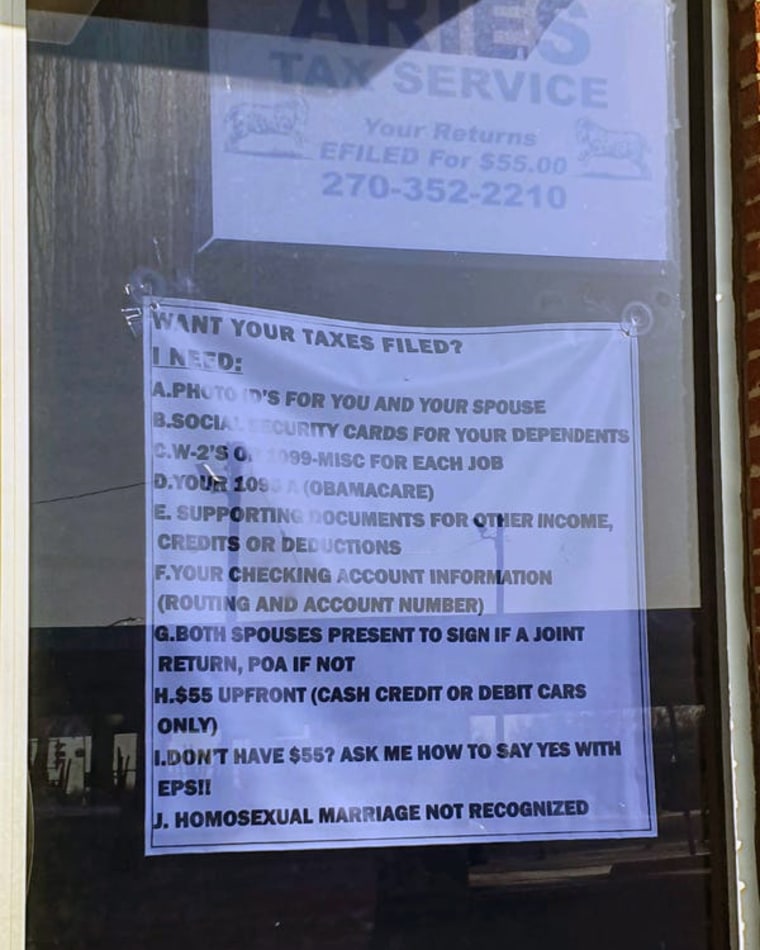
When they got there, they saw a sign on the door that listed 10 things customers should have with them if they want the business to e-file their tax return. But the last item on the list stopped them from opening the door. It read, “Homosexual marriage not recognized.”
Stephanie Mudd said the first emotion she felt was anger that businesses can still turn away same-sex couples.
“It just kind of makes your heart fall into your stomach,” Amy Mudd said.
Aries Tax Service.
The couple took a photo of the sign and left.
“We wanted to bring attention to it, so that he knows that that’s not OK,” Amy Mudd said. “Nowadays, you’re providing a public service, and it’s federal taxes, and in the United States, it’s OK for us to be married.”
Kenneth Randall, owner of Aries Tax Service, said the issue “is a matter of personal conviction.”
“I put it to any reasonable person: ‘If you have a matter that’s a central conviction for you, are you willing to stand up for it?’” he said. “I am.”
He added that there are other tax preparers in the area that same-sex couples could use and that he’s protected by federal law.
There’s no federal law that explicitly allows people, based on their personal beliefs, to turn away same-sex couples or other classes of people, but there’s also no federal or Kentucky state law that protects LGBTQ people from discrimination in public accommodations, such as businesses.
Legal advocates say situations like the Mudds’ are on the rise as conservative religious organizations, such as the Alliance Defending Freedom, have been building campaigns and lawsuits for years to challenge civil rights laws.
“They want to get legal rulings that there are religious and free speech rights to violate these laws,” said Jennifer Pizer, law and policy director at Lambda Legal, a national LGBTQ legal organization. “We have seen a significant rise and a very troubling rise in these cases, and it’s not an accident.”
For years, same-sex couples have been turned away by business owners who don’t want to provide wedding-related services, citing their religious or moral beliefs. In 2018, the Supreme Court narrowly ruled in favor of Jack Phillips, a Christian baker who refused to make a cake for a gay couple’s wedding. The court ruled on a technicality — avoiding the issue of whether a business owner, due to their religious beliefs, could refuse to serve a same-sex couple.
Earlier this month, the ADF filed a lawsuit in the U.S. District Court for the Western District of New York arguing that the state’s nondiscrimination law unconstitutionally prohibits wedding photographer Emilee Carpenter “from adopting an editorial policy consistent with her beliefs about marriage.”
The complaint says Carpenter “is already willing to work with clients no matter who they are, including those in the LGBT community” but that the state goes too far by requiring that she “celebrate” same-sex marriage in images on her website.
The ADF also argues that part of the state law limiting statements that certain customers are “unwelcome, objectionable or not accepted, desired, or solicited” interferes with Carpenter’s free speech, because it doesn’t allow her to express her views about same-sex marriage on her website.
Pizer said the New York case represents an area of law that is unsettled, specifically as it relates to people who work in artistic fields like photography.
For the most part, courts have upheld nondiscrimination laws, but in the instances they haven’t, they often rule on technicalities or rule that the laws violate the freedom of expression of creative professionals, Pizer said. For instance, in September 2019, the Arizona Supreme Court ruled that the state’s nondiscrimination law violated the free speech of two artists who create custom wedding invitations by compelling them to promote same-sex weddings.
Pizer said using free speech rights to justify discrimination “represents a dramatic shift from what the law has been for a long time.”
“Why would you think that a video of a couple’s wedding would be the message of the person holding the camera?” she said. “If the law changes in that way, then it’s hard to see where there’s a limiting principle, and it means that civil rights laws, at best, have a big hole in them and maybe, at worst, have very little effect at all.”
The free speech argument could also represent a potential challenge to the Equality Act, proposed federal legislation that would protect LGBTQ people in many areas. The measure passed the House in February but has not yet been voted on in the Senate.
Pizer said that, because Kenneth Randall is an accountant and not a creative professional, she doesn’t think an argument related to free speech would apply if there were a federal or state nondiscrimination law in Kentucky.
But Randall said he refuses to file taxes for same-sex couples because it would require him to express recognition of their marriage. Randall also sells insurance, and he said he has both sold insurance to and filed taxes for single gay people. But if a same-sex couple asked him to sell them insurance, he would only do it if he could put them down as single, he said.
“I don’t hate a particular individual. It’s a stand on a particular institution that I find wrong,” he said, adding that he’s been harassed and threatened since local news outlets published stories about his sign. “If people are willing to accept that, fine. If they are not willing to accept it, there’s plenty of other places to go for insurance.”
Pizer said the idea that people can receive services elsewhere “ignores a core purpose of civil rights laws.” She said the lunch counter sit-ins held by Black college students in Greensboro, North Carolina, in 1960 to protest racial segregation weren’t about whether they could “get a sandwich.”
“It was about whether they were being treated the same as other people,” she said.
In the absence of a federal measure like the Equality Act or a statewide nondiscrimination law, the Mudds and couples like them don’t have any options for legal recourse, Pizer said, and businesses can — and do — continue to refuse to serve them.
In North Carolina, which also doesn’t have a statewide anti-discrimination law protecting LGBTQ people, at least two wedding venues made national news within the span of four months for refusing to host events for same-sex couples.
But the issue extends far past weddings. Some states, like Arkansas, have passed legislation that allows medical providers to refuse to serve LGBTQ people if it conflicts with their religious or moral beliefs. The Supreme Court will also soon decide a case that could allow private religious adoption agencies that receive federal funds to reject same-sex couples.
Pizer said growing acceptance of LGBTQ people has pressured some religious people “to stop doing types of discrimination that they’ve done for a long time.” That pressure has made them uncomfortable and it has made them feel victimized, in some cases, she said, and they’re fighting back.
“Being encouraged to treat everyone according to the golden rule is not being victimized and it’s not being excluded and it’s not being discriminated against,” she said. “When we’re operating in the public marketplace, being asked to stop discriminating is not to suffer discrimination yourself. It’s to be invited to play by the same rules that everybody else is expected to play by.”
As for the Mudds, they said they wouldn’t pursue legal action even if they could, but they wanted to make a statement about Randall’s choice to refuse same-sex couples.
“I understand that there’s freedom in this country, and that is what we were founded on,” Amy Mudd said. “And I understand that as a private practice, I guess he is allowed to do that … but to provide a service to the public and deny such a huge population is bad business.”
Stephanie Mudd added, “If we’re talking about morals, that’s quite the opposite of morals. People often hide behind their religion to justify their hate, and that is what is so frustrating.”
George and Emily Spurrier are leaving their home of 16 years in central Arkansas due to a new law that will ban the health care that they say their 17-year-old transgender son needs.
Gov. Asa Hutchinson, a Republican, vetoed the measure earlier this month, calling it “a vast government overreach.” But the Arkansas General Assembly overrode the veto, and the bill will become law this summer.
Emily Spurrier said when her son heard the news, he sat in her car and cried for an hour.
“It was just kind of a wave of emotions, thinking about moving and then him worrying about some friends that he has here in the Little Rock area,” she said. “And then just the thought that this is really the only place he ever remembers living.”
Arkansas is the first state in the country to pass a law banning transition care for minors. The measure will bar access to reversible puberty blockers, hormone therapy and gender-affirming surgeries, though surgeries aren’t included in global standards of care for transgender minors and aren’t performed on them in Arkansas, Hutchinson said during his veto.
The Spurriers’ son, who just started using testosterone, will no longer be able to access this physician-prescribed hormone once the new law is implemented, so his family is raising money on GoFundMe to move to New Mexico by August.
“The benefits are not going to outweigh the dangers of raising our children here in this state.”
AMANDA DENNIS
The Spurriers, along with some families in Texas and North Carolina, which are considering similar legislation, told NBC News they are prepared to move to protect their children.
Fourteen states are considering bans or restrictions on transition care for trans minors, according to the American Civil Liberties Union. The Williams Institute, a think tank at the UCLA School of Law, found that 45,100 trans youth are at risk of losing access to care because of the proposals. Major medical associations such as the American Academy of Pediatrics, the American Medical Association and the Pediatric Endocrine Society oppose the bills.
As of Monday, there were at least 44 bills across 25 states targeting transgender youth, with five of them on governors’ desks, according to the ACLU and the Human Rights Campaign. A recent PBS NewsHour/NPR/Marist poll found that two-thirds of Americans are opposed to laws that would limit trans rights.
George Spurrier said that, in addition to the transition-care ban, the Arkansas Legislature is considering several other bills that create an unsafe environment for his son.
“If it had been one or two bills, we may have been more optimistic about fighting and getting through all of it,” he said. “But the fact that they just kept coming one after another after another … has just kind of demoralized us. Even if everything gets defeated or repealed, the spirit behind them is still here, and we just can’t help but feel like it’s not safe.”
In addition to the recently passed trans health care bill, Arkansas is considering four other bills targeting LGBTQ people, and the governor has signed two others into law, according to the ACLU. For example, Hutchinson signed a bill into law on March 26 that allows doctors to refuse to treat someone based on their religious or moral beliefs, a measure that advocates say would allow physicians to refuse to treat trans patients even in the emergency room.
Brooke, 8, won’t be allowed to compete on girls’ sports teams at school once one of Arkansas’ new laws takes effect.Amanda Dennis
Another Arkansas family is also facing a deadline. Amanda Dennis, who has lived in the state for most of her life, said her family has about two to three years to figure out how they’re going to get care for their transgender 8-year-old, Brooke, by the time she begins puberty.
“I will have to fly to another state — and the problem is we’re surrounded by states that are doing the same thing,” she said, adding that Kansas, Missouri and Texas are all considering similar bills.
Flying to another state wouldn’t be financially sustainable for the family, Dennis said, and like the Spurriers, she’s also worried about how other recent laws and proposed bills will affect Brooke. Dennis said her daughter wants to try out for gymnastics, cheerleading and dance, but she wouldn’t be able to compete on a girls’ team due to a bill Hutchinson signed in March that bans trans student athletes from competing on teams that align with their gender identity.
“It breaks my heart that I’m going to have to, at one point, should we choose to stay in Arkansas … tell her, ‘Brooke, you won’t be able to try out for any of these teams.’”
Arkansas is also considering a bill that would prohibit schools from requiring teachers to refer to trans students by a name and pronoun that isn’t consistent with their sex assigned at birth.
“So there’s more things coming down the pike that will really eventually force us to leave the state,” Dennis said. “The benefits are not going to outweigh the dangers of raising our children here in this state.”
Texas is considering a bill similar to Arkansas’ transition-care ban, but with criminal penalties. The bill would make it a felony for parents to provide their trans children with access to gender-affirming care. It would classify the act as child abuse, and parents who violate the proposed law could face up to 10 years in prison, have their child removed from their home and face civil litigation.
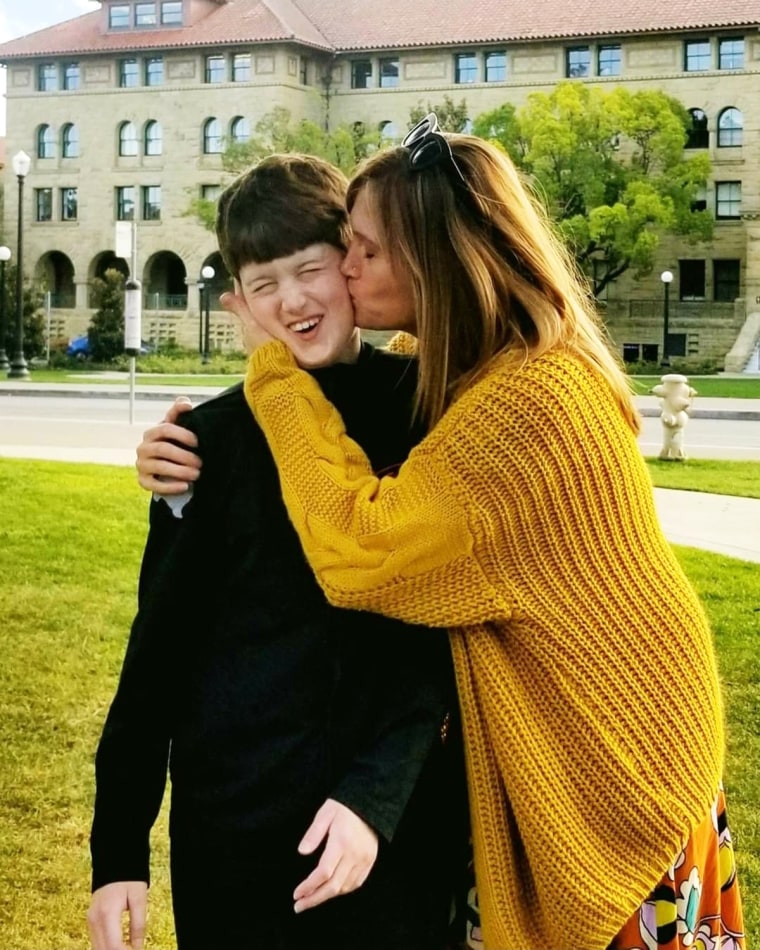
Amber Briggle kissing her son.Amber Briggle
Texas mom Amber Briggle, who lives north of Dallas, testified against the bill last week.
“I’m afraid that by speaking here today my words will be used against me should SB 1646 or SB 1311 pass, and my sweet son, whom I love more than life itself, will be taken from me,” she said.
Briggle said taking away her son’s access to care would “destroy him.”
“We gave him the support that he needed, and it was like a light switch turned on and like my baby came back to me and was perfect again,” she told NBC News, adding that the 13-year-old is a straight-A student and a great musician. “He can play the opening riff to ‘Sweet Child O’ Mine’ on his ukulele — I will say I taught him that.”
Briggle said to have that familial support taken away would be “devastating” for her son.
“It’s devastating because he is as successful as he is because he has that support,” she said. “It’s also devastating and terrifying to think that taking away that support means taking him away from his family, and placing him with, who knows.”
Moving wouldn’t be easy for the family, Briggle said. She’s a small business owner, and her husband is a tenured professor.
“It’d be really complicated for us, but it’s certainly not out of the question,” she added. “My son always comes first.”
Texas’ bill would also make it a felony for medical providers to administer transition care to minors. Kimberly Shappley, who has a trans 10-year-old named Kai and is a nurse at a clinic that serves LGBTQ people, said it’s a “double whammy” for her, because it would affect both her work and her family.
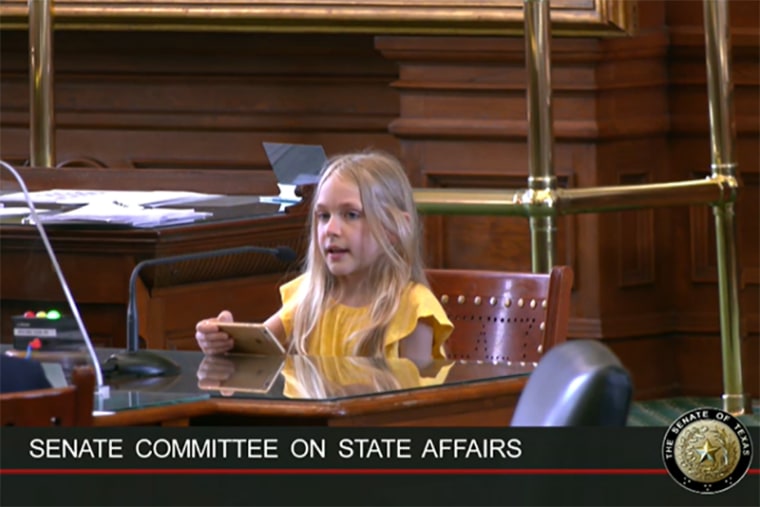
Kai Shappley, a 10-year-old transgender girl from Austin, Texas, speaks before the Texas Senate Committee on State Affairs, on April 12, 2021.Texas Senate
Shappley, a former conservative Christian minister, moved from her small Texas hometown to Austin in 2018, because she said the relatively liberal capital city has more supportive local policies for Kai.
“But if these laws passed, even Austin can’t protect us,” she said. “It’ll take everything we have — just living in Austin has been super expensive — it’ll take everything we have to relocate. I’ll do it. I’ll have to.”
Shappley said she wants to see more action from President Joe Biden and Vice President Kamala Harris. Biden released an executive orderlast month affirming that Title IX of the Education Amendments of 1972 protects students from discrimination based on sexual orientation and gender identity, but he hasn’t made a statement directly addressing the flurry of bills targeting transgender minors.
Shappley said she took time off of work to campaign for the Biden-Harris ticket, so she’s angry that they haven’t explicitly mentioned the bills.
“Even if they can’t do anything right now, tell us what your plan is,” Shappley said. “Kamala Harris had a trans flag outside of her office. OK, if you’re an ally, why aren’t you loudly telling my kid she’s gonna be OK? Why aren’t you loudly saying, ‘You know what, Mrs. Shappley, you don’t have to move; we’ve got your back.’ I want somebody to say something.”
North Carolina is also considering a ban on gender-affirming care for minors. Advocates say it would likely be vetoed by Gov. Roy Cooper, a Democrat, but Katie Jenifer and her daughter Maddie said the debate over the bill is itself harmful.
Maddie, 13, said that, though laws targeting trans youth likely won’t get past North Carolina Gov. Roy Cooper, a Democrat, the debate over the laws is itself harmful.Katie Jenifer
“If I didn’t have my hormones or my [puberty] blocker, I’d be very unhappy, and I wouldn’t want to leave the house sometimes,” Maddie, 13, said.
Even if advocates are saying the bill won’t become law, “there is still the smallest bit of chance, and that alone just makes me very anxious,” Maddie added.
Jenifer said she has told Maddie they would move should the bill or a similar one become law, but she acknowledged not everyone has that option.
“That’s the real crux of the issue: How do we help those families?” she said.
Back in Arkansas, Dennis said Brooke, who’s currently in third grade, is ready to be part of a potential legal battle against the state’s new laws.
“She wants to be someone that can be a light to other kids her age, and she really wants to be a part of the conversation,” she said, adding that Brooke is “ready to put on her activist hat and help.”
While Dennis said she and her husband are proud of their daughter, “at the same time, we do get a little bit sad that an 8-year-old has to be the voice.”