The University of Oklahoma said Monday that the graduate teaching assistant who assigned a failing grade to a student for a psychology essay on gender stereotypes will “no longer have instructional duties” at the university.
A graduate teaching assistant for an online psychology class was “arbitrary in the grading of this specific paper” and therefore will “no longer have instructional duties,” the university said in a statement. It is not immediately clear whether the teaching assistant faces further disciplinary action or is still on leave.
“We are committed to teaching students how to think, not what to think,” the university said. “The University will continue to review best practices to ensure that its instructors have the comprehensive training necessary to objectively assess their students’ work without limiting their ability to teach, inspire, and elevate our next generation.”
The university did not name the teaching assistant, but it appeared to be referring to Mel Curth, who NBC News previously reported gave the paper a zero. Curth did not immediately reply to a request for comment Tuesday.
Curth recently gave Samantha Fulnecky, a junior on a premed track, a zero on her essay about gender stereotypes for an online graduate psychology class.
The assignment asked students to write a 650-word response to a scholarly article about gender expectations in society, according to screenshots shared by Turning Point USA’s local chapter.
Fulnecky wrote in her essay that the scholarly article bothered her, and she described how God created men and women differently, according to the screenshots.
“Society pushing the lie that there are multiple genders and everyone should be whatever they want to be is demonic and severely harms American youth,” she wrote.
Curth, who is transgender, gave Fulnecky a failing grade because her “paper … does not answer the questions for this assignment, contradicts itself, heavily uses personal ideology over empirical evidence in a scientific class, and is at times offensive,” according to the screenshots.
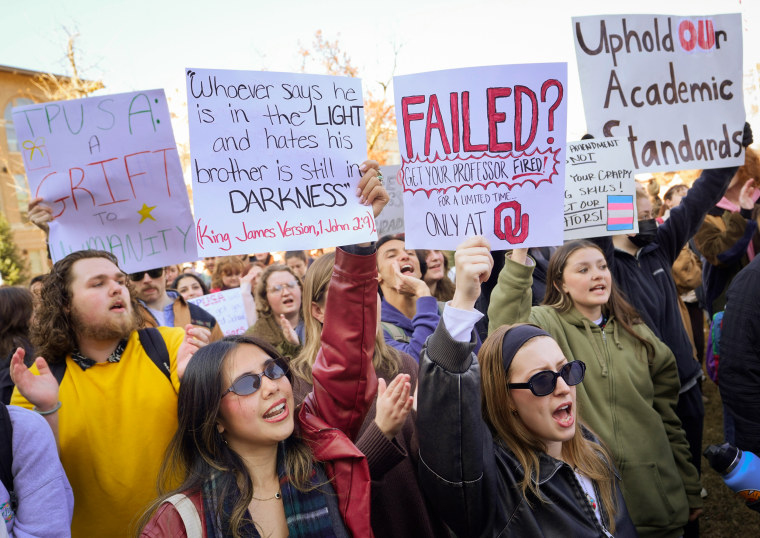
A crowd gathers at the administration building at the University of Oklahoma on Dec. 5 to chant at a protest and march supporting the graduate assistant who graded Fulnecky’s essay.Doug Hoke / The Oklahoman via USA Today Network
Protests and counterprotests have flared up on campus in response to the failing grade. Oklahoma Gov. Kevin Stitt, a Republican, called on the university’s governing board to get involved. And the issue has drawn national attention from conservative politicians and activists in recent weeks.
In the statement, the university said Fulnecky appealed the grade and filed a claim of religious discrimination.
Fulnecky’s grade appeal “was decided in favor of the student, removing the assignment completely from the student’s total point value of the class, resulting in no academic harm to the student,” the university said.
The university added that it had investigated Fulnecky’s religious discrimination claim but would not release the results of its investigation.
Curth had already been placed on leave in connection with the failing grade.
Fulnecky did not immediately reply to a request for comment Tuesday. On Monday, she reposted the university’s statement on her Instagram story and captioned the post “huge win.”
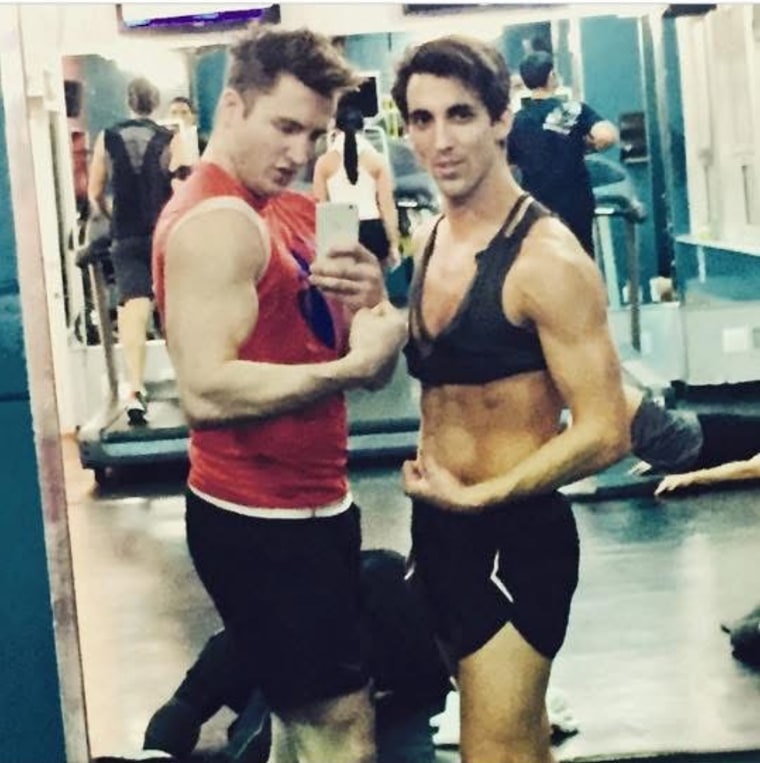
Jacob Zieben and Jacob Paulson were fast friends when they met in 2013. Aside from their shared name, the pair were both young gay men fresh out of college who recently moved to New York City.
After two years spent glued at the hip, Paulson said their dynamic quickly changed after his friend, a personal trainer from Texas, started dating model Donald Hood.
“He just vanished,” Paulson said this week in a phone interview, choking up. “I had no contact with him, and I just wanted him to be happy, and that’s all I really cared about. And I was hoping that he was.”
Although the loss of the friendship stung, Paulson said he moved on years ago. He didn’t attend his former friend’s 2020 wedding and was only aware from social media that Jacob and Donald both changed their last names to Zieben-Hood.
But Paulson was shocked and flooded with memories when, just two weeks ago, he saw his former friend’s name in the headlines after police found the 34-year-old dead inside his Harlem apartment.
When authorities entered the apartment on July 31 after Donald called for help, they found Jacob slumped over his toilet with a gash on his head and multiple stab wounds to the back of his leg, one deep enough to penetrate muscle, according to charging documents.
His death came after years of alleged abuse dating to 2022, detailed in a series of charging documents against Donald on felony counts including strangulation and menacing. Those charges remain pending.
Donald, a 40-year-old model with over 67,000 Instagram followers, was arrested on July 31 and charged with several crimes, including burglary. He is currently being held at Rikers Island without bail. Prosecutors have not charged anyone with murder or named a suspect for Jacob’s death, citing his pending autopsy, but said they are investigating the case as a homicide.
In the days since his death, Paulson and seven others who knew Jacob spoke with NBC News as they slowly learned about the personal trainer’s life over the last decade. And while his fatal stabbing comes as a shock, those who knew Jacob believe Donald cut out his friends — and potential lifelines — years before he truly needed them.
“I wish I had done more, but, in hindsight, what would you do?” said one of Jacob’s old friends, Marti G. Cummings.
Donald’s attorney declined to comment.
After studying biomedical sciences at Texas A&M University, Jacob moved to New York City in 2013 and quickly met Paulson and Joshua Baker.
Paulson and Baker said that the trio never went “anywhere without each other” and spent endless days cooped up in Jacob’s Hell’s Kitchen apartment, which they say overlooked Central Park, playing video games, eating fried food, and daydreaming about their futures.
“We were these cute little misfits that were trying to figure out where we fit in New York society,” Baker said.
Cummings met Jacob around the same time and gravitated toward his selflessness and desire for community. A prominent New York City drag queen who uses they/them pronouns, Cummings said Jacob would frequently walk them between gigs late at night to make sure they got there safely.
“He was a protector, which is why I think it makes this whole thing sadder,” Cummings said. “He didn’t get to be protected from this.”
Jacob Zieben with friend, Marti G. Cummings.Courtesy Marti G. Cummings
Lauren Foster, a friend of Donald’s since 2000, described him as “a good guy” and said that she was never under the impression that his relationship was troubled. She did, however, acknowledge that the roles Jacob and Donald played were clear.
“I don’t think he had a ton of friends,” Foster said of Jacob. “Don was kind of the alpha in the relationship.”
“There’s always one person that’s dominant in the relationship, and that was definitely Don,” she added. “I think Don would be the alpha in any relationship. He’s larger than life.”
Baker said that shortly after Jacob met Donald in the spring of 2015, Jacob began dodging invitations, declining phone calls, and ignoring text messages. Soon, Baker noted, Jacob started to even block his friends’ phone numbers.
Jonathan Starkey, a friend from Texas, recalled that in one conversation around that time, Jacob said that “a lot had changed, and that Donald was a little possessive and jealous and kind of restricted who he was in touch with.”
“Jacob wasn’t really someone who let people tell him what to do, which is why it’s so strange,” Starkey said.
Jacob’s abrupt silence prompted Baker to reach out to Donald.
“Jacob is doing very well,” Donald wrote to Baker in a November 5, 2015, direct message on Facebook, according to screenshots of the conversation provided to NBC News. “He’s decided to break away from his past, which unfortunately included his closest friends, in order to move forward with a healthy life.”
“He’s been very focused and is back on the right track in his life and in order to remain focused he will remain out of contact for the moment,” Donald added.
For years, the only updates Jacob’s friends received about their friend came through social media, where images from the couple’s Instagrams showed what appeared to be a happy couple who traveled the world and lived a glamorous New York life. The pair posted loving selfies, pictures from their wedding in 2020, and snapshots with their families.
But court documents paint a prolonged pattern of alleged abuse in the relationship that authorities say started in 2022.
Prosecutors said in the charging documents filed after Jacob’s death that Donald had nine domestic incident reports filed against him since 2022, but did not provide more details about the nature of the incidents or who filed them. In November 2024, an order of protection was issued in New York County Criminal Court that directed Donald to cease communication and stay away from Jacob, according to charging documents associated with Donald’s arrest in February.
In February, Donald was arrested and charged with strangulation, among several other charges, for allegedly attacking Jacob inside the Harlem apartment. Jacob “almost lost consciousness, and sustained swelling, substantial pain, and redness to his neck” from the incident, according to the charging documents. Donald pleaded not guilty to the charges in the case that is still pending.
A second court order of protection was issued in criminal court in April, which once again prevented Donald from seeing or communicating with Jacob.
Donald was arrested again in June and charged with criminal contempt and menacing, according to court documents. The court records allege that Donald held a knife in Jacob’s direction and said, “I will attack you.” He pleaded not guilty to the charges, and the case is still pending.
Paulson said that earlier this year, Jacob followed him on Instagram and gave him hope that the friends might reconnect after a brief exchange in March.
“I was so excited to have that prospect of him coming back into my life after I’d kind of let him go as a friend,” Paulson said. “And then to have it really just permanently end, it’s just devastated me. It’s really wrecked me.”
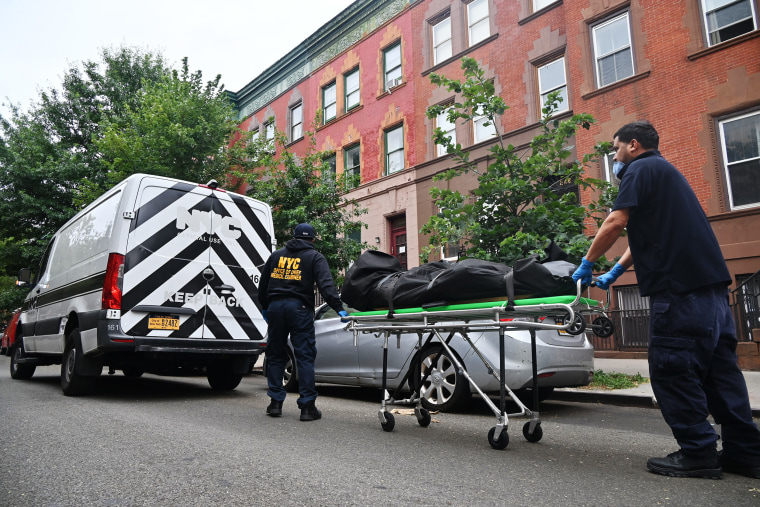
Members of the New York City Office of Chief Medical Examiner remove the body of Influencer model Jacob Zieben-Hood in Harlem, New York, on Aug. 1.Kyle Mazza / NurPhoto/Shutterstock
Donald called 911 on July 31 from Jacob’s one-bedroom apartment at West 138th Street and told them he found his husband dead on the toilet.
When police arrived, they found Donald sitting on their couch with three cuts to his arm that later required stitches, a black eye, and bite marks, according to a criminal complaint. He told authorities that Jacob had attacked him.
However, prosecutors say that Jacob called his father from the bathroom before the attack and allegedly told him that Donald “was coming at him with knives and preventing him from leaving the apartment,” according to the criminal complaint. During the call, Jacob’s father allegedly heard Donald screaming derogatory names at Jacob in the background, the complaint added.
Donald was arrested later that day and charged with burglary, aggravated criminal contempt, criminal contempt in the first degree and possession of a weapon. On Thursday, he was scheduled to appear in court, but a judge waived his appearance at the request of his attorney.
He is now set to appear on September 12, almost a month after Jacob’s funeral, scheduled for this weekend in San Antonio.
As authorities continue to investigate the case, Jacob’s friends have been connecting and sharing old memories of their late friend.
“Years can go by, but he was our family till’ the end,” Baker said.
The company’s new guidelines prohibit insults about someone’s intellect or mental illness on Facebook, Instagram and Threads, as have previous iterations. However, the latest guidelines now include a caveat for accusing LGBTQ people of being mentally ill because they are gay or transgender.
“We do allow allegations of mental illness or abnormality when based on gender or sexual orientation, given political and religious discourse about transgenderism and homosexuality and common non-serious usage of words like ‘weird,’” the revised company guidelines read.
The new guidelines around hate speech are part of Meta’s broader major changes regarding how it moderates online speech on its platforms. On Tuesday, CEO Mark Zuckerberg said it will replace its fact-checking program, which has relied on trusted organizational partners, with a community-driven system similar to X’s Community Notes. X’s system allows users to submit suggested “notes” on other people’s content, and then certain users vote on whether or not the notes are publicly displayed. Zuckerberg cited “recent elections” and “a cultural tipping point towards, once again, prioritizing speech.”
The long list of changes to the new hate speech guidelines include removing rules that forbid insults about a person’s appearance based on race, ethnicity, national origin, disability, religious affiliation, caste, sexual orientation, sex, gender identity and serious disease. Meta also scrapped policies that prohibited expressions of hate against a person or a group on the basis of their protected class and that banned users from referring to transgender or nonbinary people as “it.”
GLAAD, an LGBTQ media advocacy group, denounced the changes.
“Without these necessary hate speech and other policies, Meta is giving the green light for people to target LGBTQ people, women, immigrants, and other marginalized groups with violence, vitriol, and dehumanizing narratives,” President and CEO Sarah Kate Ellis said in a statement. “With these changes, Meta is continuing to normalize anti-LGBTQ hatred for profit — at the expense of its users and true freedom of expression. Fact-checking and hate speech policies protect free speech.”
A spokesperson for Meta did not immediately respond to a request for comment.
CEOs and business leaders in tech and beyond are broadening their efforts to woo President-elect Donald Trump. Meta is among the several tech companies and executives — including Amazon, Apple CEO Tim Cook and OpenAI CEO Sam Altman — that donated $1 million to Trump’s second inaugural fund within the last several weeks. Meta also announced Tuesday that UFC’s Dana White, a longtime Trump supporter, would join its board.
New Jersey Gov. Phil Murphy, a Democrat, signed a law Monday prohibiting public schools and libraries from banning books and protecting librarians who obey state law.
Murphy’s signing of the Freedom to Read Act comes amid an ongoing push by conservative lawmakers and activists across the country to challenge books they consider inappropriate for minors, particularly those about LGBTQ issues and race. Lawmakers in at least 13 states this year have introduced legislation to disrupt library services or limit their materials, according to an NBC News tally.
“Across the nation, we have seen attempts to suppress and censor the stories and experiences of others,” Murphy said in a statement. “I’m proud to amplify the voices of our past and present, as there is no better way for our children to prepare for the future than to read freely.”
Murphy during an interview in New York on Nov. 22.Jeenah Moon / Bloomberg via Getty Images
In September, PEN America, a nonprofit dedicated to promoting free speech, reported that the number of books being removed from school shelves during the 2023-24 school year had tripled from the previous year, to more than 10,000.
The PEN America report, along with one from the American Library Association released that same month, outlined how frequently challenged books are often about or written by people of color or those who identify as LGBTQ.
In 2023, the American Library Association’s list of the 10 most challenged books nationwide included Toni Morrison’s “The Bluest Eye,” a novel about a young Black girl who grew up after the Great Depression; Maia Kobabe’s “Gender Queer: A Memoir,” a graphic memoir about the author’s exploration of gender identity from adolescence to young adulthood; and George M. Johnson’s “All Boys Aren’t Blue,” a coming-of-age memoir about a queer Black man.
New Jersey is the third state to sign a law prohibiting the banning of books at public schools and libraries, following Illinois and Minnesota.
The new law is set to take effect in a year from the governor’s signing. However, the state education commissioner and the New Jersey state librarian are permitted to start implementing it immediately “as may be necessary,” the law states.
“Through this legislation, we are protecting the integrity of our libraries that are curated by dedicated professionals and making those resources available to help every student to grow as a critical thinker,” New Jersey acting Education Commissioner Kevin Dehmer said in a statement.
The United Kingdom on Wednesday indefinitely banned new prescriptions of puberty blockers to treat minors for gender dysphoria. The announcement comes a week after the U.S. Supreme Court heard oral arguments in a case involving state bans on puberty-suppressing medication and other forms of transition-related care for minors.
Puberty blockers are commonly prescribed to transgender children in countries throughout the Western world to delay the onset of puberty or pause it as it is transpiring. The medication is prescribed with the goal of giving children who are experiencing gender dysphoria more time to decide if they want to take more permanent steps to transition genders. Puberty resumes when the medication is no longer taken.
The indefinite ban on the medication in Britain comes several months after an independent study commissioned by England’s National Health Service concluded that the medical evidence around transition-related care for minors is “remarkably weak” and that more research is needed.
“Children’s healthcare must always be evidence-led,” British Health and Social Care Secretary Wes Streeting said in a press release. “The independent expert Commission on Human Medicines found that the current prescribing and care pathway for gender dysphoria and incongruence presents an unacceptable safety risk for children and young people.”
Dr. Hilary Cass, the author of the independent study, known as the “Cass report,” said she supported the ban, according to the same release.
“Puberty blockers are powerful drugs with unproven benefits and significant risks, and that is why I recommended that they should only be prescribed following a multi-disciplinary assessment and within a research protocol,” she said.
Transgender activists around the world condemned the ban.
“I wouldn’t wish medical negligence on my worst enemy. Labour activists just wished it on my entire community,” Iris Duane, a former candidate for Britain’s Parliament, wrote on X. “To friends, family and community, many of us will survive, and we will remind them that hell is calling.”
Trans minors in the U.K. who are already taking the medication can continue doing so, according to the government, and cisgender minors who experience puberty at an abnormally early age will still be able to receive new prescriptions for the medication.
A temporary ban on new puberty-blocker prescriptions for British minors experiencing gender dysphoria was already put in place over the summer. Wednesday’s announcement extends the ban indefinitely as the government begins clinical trials on the medications starting next year. The ban will be revisited in 2027.
The U.K. ban comes as the U.S. Supreme Court weighs the constitutionality of a Tennessee ban on gender-affirming care for minors. Tennessee is one of more than two dozen states that restrict such care in the U.S.
As vaping’s popularity endures, a report issued by the surgeon general’s office Tuesday shows that LGBTQ Americans are among those helping to keep smoke shops in business.
The surgeon general’s 837-page report on tobacco use found that 37.8% of gay, lesbian and bisexual U.S. adults have tried electronic cigarettes, compared with just 16.5% of their straight counterparts. Electronic cigarettes, also known as e-cigarettes, include e-cigars, e-pipes, e-hookahs, vaping pens and hookah pens.
When broken down further, the data, collected from 2019 to 2021, found nearly half of bisexual adults have tried e-cigarettes, compared with 31.8% of gay men and 26.7% of lesbians. The authors noted that figures on transgender Americans’ tobacco use were not widely available for analysis in all areas of the report.
The report found similar disparities exist among the nation’s youths and young adults: Over 42% of young adults and 56% of high school students who identify as gay, lesbian or bisexual reported trying e-cigarettes, compared with 30.3% and 49.8% of their straight counterparts.
“Tobacco use is a singular health threat to LGBTQAI+ communities,” said Kristy Marynak, a senior science adviser at the Centers for Disease Control and Prevention and a co-editor of the report. “This report finds that nearly 1 in 5 of all deaths in the United States are caused by tobacco, and it shines a light on the disproportionate burden borne by certain communities, including LGBTQAI+ communities.”
Marynak noted that the study — and the federal government more broadly — considers products containing nicotine, including e-cigarettes, to be tobacco products. The exceptions, she said, are therapeutic products, like nicotine gum and patches.
Long-term research on the health outcomes of e-cigarettes is not available because the products are relatively new. However, there is clear scientific consensus concerning the adverse effects of some of the chemicals commonly found in e-cigarettes.
E-cigarettes produce a number of dangerous chemicals — including acetaldehyde, acrolein and formaldehyde — that can cause lung and heart disease, according to the American Lung Association.
Nicotine is also commonly found in e-cigarettes. Not only is nicotine addictive and likely to fuel anxiety or depression, it also can harm brain development, which occurs until age 25, according to the CDC.
Dr. Scott Hadland, the chief of adolescent and young adult medicine at Mass General for Children and Harvard Medical School, said he’s observed greater e-cigarette use among gay, lesbian and bisexual youths. He said that LGBTQ people use tobacco products at higher rates largely because of “long-standing stigma” within health care settings.
“LGBTQ+ people might be afraid to present for care to help support their quit attempts,” Hadland said. “They might be afraid to talk to their doctor about it because they’re afraid to go to the doctor in general.”
LGBTQ adults are twice as likely as their non-LGBTQ counterparts to report having had negative health care experiences over the last three years, according to a report published this year by KFF, a health care research nonprofit formerly known as the Kaiser Family Foundation.
Hadland also attributed higher e-cigarette use among LGBTQ Americans to marketing tactics, as is noted in the report.
Tobacco companies marketed directly to the LGBTQ community in the mid-1990s, including through “Project Scum,” which advertised Camel and Red Kamel cigarettes to “consumer subcultures” in San Francisco, according to the study.
Today, tobacco companies advertise in queer magazines and donate to organizations focused on promoting LGBTQ rights and Pride events, the report noted.
In 1964, the surgeon general’s office released its first report on the hazards of smoking and has since then dedicated vast resources to combat cigarette use. The new report shows that those efforts have largely been successful, as only 11.5% of U.S. adults reported being cigarette smokers in 2021, compared with 42.4% in 1965.
Still, 36 million U.S. adults and 760,000 middle and high school students smoke tobacco products, according to the report. Since 2014, the most commonly used tobacco product among U.S. youths and young adults is e-cigarettes.
“These and other noncombustible tobacco products such as nicotine pouches have the potential to undermine overall progress in preventing and reducing young people’s use of tobacco products,” the authors stated.
In June, the Justice Department and Food and Drug Administration announcedthey will create a federal multiagency task force to combat the illegal distribution and sale of e-cigarettes.
Latino teenagers in Georgia getting texts saying they are “set to be deported” by immigration authorities. A lesbian business owner receiving messages telling her she’s been assigned to an “LGB re-education camp” in Las Vegas. Immigrant families afraid to report the text messages to authorities.
Santiago Marquez, of the Latin American Association, a Latino advocacy group in Georgia, said he received phone calls on Monday morning from three concerned parents in his community who had heard about the threatening texts in the news and said their children had received the same messages. Santiago said the students who got the texts are in middle school and high school.
“It’s very easy to panic when you get a message like that,” Santiago said.
The language of the text messages sent to these students were not identical, but they all referenced deportations and actions by Immigration and Customs Enforcement.
According to a screenshot of one of the texts shared with NBC News, one of the messages reads, “You have been one of the selected immigrants that is set to be deported.” The text continued, “Our Executive ICE team will come and get you in a Brown Van.”
An ICE spokesperson told NBC News that these text messages are not from the agency. ICE does not send “random text messages to people,” the spokesperson said in a phone interview. “Sending text messages in the blind is not how us Immigration Customs Enforcement operates. We do targeted enforcements.”
Diana Brier, a 41-year-old lesbian, received a text message on Nov. 10 telling her to check in to Nellis Air Force Base in southern Nevada on Inauguration Day for an eight-week “LGB re-education camp,” according to a screenshot of the message the former Las Vegas resident shared with NBC News.
“Your new President, Donald J. Trump, looks forward to assisting you in becoming a mentally and emotionally stable member of society by eliminating lifestyles that have been detrimental to our American way of life through re-education,” the text reads. “Following the initial eight week period, those interned in the eight week LGB camp will be eligible for release dependent upon your swearing of allegiance to your president, Donald J Trump, and your oath to live a lifestyle befitting of your Lord and Savior, Jesus Christ.”
The message adds that lesbian, gay and bisexual people must “reproduce birthing healthy white Christian children” or be sent to transgender “work camps” for two years to life. Transgender people, the text states, will be sent to work camps indefinitely.
A spokesperson from Trump’s transition team told NBC News in an email, “We have absolutely nothing to do with these text messages.”
The Air Force did not respond to requests for comment.
Brier, who is a wine and cheese entrepreneur, said she was initially spooked by the texts. But she said she’s determined to not let them weigh her down.
“When I open my business in Colorado, it will have Pride flags in the window. And if those get smashed out because I’m gay, I will replace the windows, and then I will replace the Pride flags,” she said. “Because wherever I go, I’m just going to create a safe space for my community because it’s what I’ve always done, and it’s what I always will do.”
Brier said she spoke with a Las Vegas FBI agent on Wednesday after her friend reported the text to the bureau.
The agent did not know where the text came from, if other LGBTQ people in the Las Vegas-area were being targeted, or if the text originated from the same person or group targeting Blacks and Latinos, according to Brier. She said the FBI advised her to spread the word about her story to others in the LGBTQ community and encourage others to speak out.
Brier said this is the first time in her life she has been harassed because of her sexuality, and, she added, she’s worried it won’t be the last because of Trump’s return to the White House.
“Every marginalized population just seems like they’re going to be very embattled for quite some time,” she said. “I really just want the community to know that it’s OK to report these.”
‘Really difficult’
Still, many members of Latino immigrant families who have received these kinds of messages may be hesitant to report it to authorities, said Gilda Pedraza, executive director of the Latino Community Fund Georgia.
“I don’t know that we will ever see significant reporting of these hate messages and texts because people are going to be afraid to report it,” worried that police may assume they’re undocumented, Pedraza said.
Pedraza said she spoke with two families that have relatives with various types of immigration status that received the messages. For them the uncertainty feels real, considering that Trump campaigned on the promise of mass deportations.
“The overwhelming feeling is uncertainty and fear of what could be true, what could happen and how to recognize what’s the difference between a threat and like a real thing,” Pedraza said. “It’s really difficult.”
Marquez, from the advocacy group in Georgia, encouraged families who may feel afraid to say anything to start by talking to school officials or reporting what they have experienced to community leaders they trust.
Texas Attorney General Ken Paxton sued a Dallas doctor Thursday accusing her of providing transition-related care to nearly two dozen minors in violation of state law.
Paxton alleged that Dr. May Chi Lau, who specializes in adolescent medicine, provided hormone replacement therapy to 21 minors from October 2023 to August for the purpose of transitioning genders. Texas enacted a law,Senate Bill 14, last year banning hormone replacement therapy and other forms of gender-affirming care for minors.
“Texas passed a law to protect children from these dangerous unscientific medical interventions that have irreversible and damaging effects,” Paxton said in a statement Thursday. “Doctors who continue to provide these harmful ‘gender transition’ drugs and treatments will be prosecuted to the full extent of the law.”
The statement alleged that Lau used “false diagnoses and billing codes” to mask “unlawful prescriptions.”
Neither Lau nor her employer, the University of Texas Southwestern Medical Center, immediately replied to requests for comment.
If Lau is found to be in violation of the law, her medical license could be revoked and she could face a financial penalty of hundreds of thousands of dollars.
Paxton’s suit is the first in the country by an attorney general against an individual doctor alleging violation of a restriction on transition-related care for minors.
Texas’ law includes a provision that allows physicians to continue to prescribe puberty blockers and hormone therapy to patients who began treatment before June 1, 2023, in order to wean them off the medications “over a period of time and in a manner that is safe and medically appropriate and that minimizes the risk of complications,” according to Paxton’s suit. Minors are required to have attended at least 12 mental health counseling or psychotherapy sessions for at least six months before they started treatment. It’s unclear whether Lau’s treatment of the minors could fall under that provision.
So far, a few attorneys general, including Paxton, have subpoenaed hospitals and practices that provide such care to minors for those patients’ records. Twenty-six states ban at least some forms of gender-affirming care for minors, according to the Movement Advancement Project, an LGBTQ think tank.
Gov. Greg Abbott signed Texas’ restriction in June 2023, and a court blocked itafter families and doctors sued. In September 2023, the Texas Supreme Court allowed the law to take effect pending an appeal from the state, and this June, it vacated and reversed the previous injunction, allowing the law to stand.
The U.S. Supreme Court is expected in its current session to hear oral arguments and rule on whether to strike down a similar law in Tennessee. How the court rules on the Tennessee law is expected to affect similar laws in other states.
The statement from Paxton’s office described gender-affirming care as “experimental, and no scientific evidence supports their supposed benefits.”
Major medical organizations, such as the American Medical Association and the American Academy of Pediatrics, disagree, arguing that transition-related care is an effective and medically necessary way to treat gender dysphoria, which is distress felt by people whose gender identities differ from their genders assigned at birth.
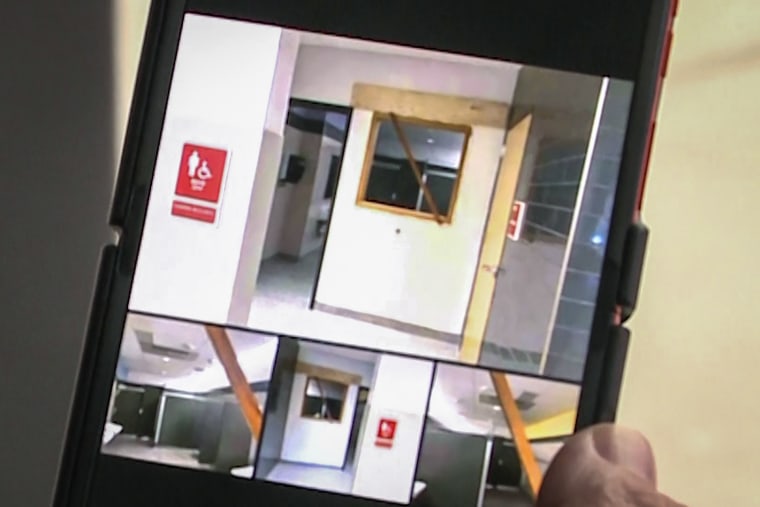
A Pennsylvania middle school installed a window in its gender-inclusive restroom, making its interior visible from the school hallway.
The window was constructed at Emory H. Markle Middle School in Hanover, Pennsylvania, which is roughly 5 miles north of the Maryland border. Gender-inclusive bathrooms are commonly used by transgender and nonbinary people for privacy and safety reasons.
Matthew Gelazela, the board president of the South Western School District, said the district decided to add the window as it “engages in renovating multiuser restroom facilities.”
“It has an interest in opening a view into the non-private area of those facilities in similar fashion to what has existed for years in our elementary schools,” Gelazela said in a statement to NBC affiliate WGAL in Lancaster. “In making the area outside of stalls more viewable, we are better able to monitor for a multitude of prohibited activities such as any possible vaping, drug use, bullying or absenteeism.”
Parents in the South Western School District in Hanover, Pa., are taking to social media to call out their school board after pictures surfaced showing construction of gender-inclusive bathrooms.WGAL
Gelazela added that the window does not provide a “view into those private stall spaces from outside of the restrooms.”
The district did not immediately respond to NBC News’ request for additional comment.
Jennifer Holahan, whose son attends school in the district , said the new window is a “deterrent” to keep students from using the restrooms and a way to single out LGBTQ students who may be more likely to use a gender-inclusive facility.
“I can understand needing to have supervision over middle and high school students, especially in the bathrooms. I was a teenager once; I know it’s a tough spot,” Holahan told WGAL. “But I also think windows aren’t a solution. I think if it was a real issue, it wouldn’t just be gender-inclusive restrooms.”
Emory H. Markle Middle School in Hanover, Pa.WGAL
The American Civil Liberties Union of Pennsylvania condemned the installation of the window, calling it “discriminatory.”
“Schools should be a welcoming and safe environment that nurture students’ curiosity and well-being,” a spokesperson for the group said in an email. “Discriminatory policies like this one not only undermine those goals, they also make students less safe.”
The issue over whether trans people should be able to use the restroom that aligns with their lived gender has played out in the U.S. for roughly a decade. A transgender “bathroom ban” in North Carolina — which barred trans people from using restrooms and changing facilities that matched their gender identity in most public spaces — caused a national uproar in 2016. (The North Carolina law, HB 2, was partially repealed in 2017.) However, similar laws have rebounded in recent years with legislative success and more muted opposition.
Thirteen states across the country have laws that prohibit transgender people from using bathrooms and facilities consistent with their gender identity in K-12 schools, according to the Movement Advancement Project, an LGBTQ think tank. Some of those state laws — also known as “bathroom bans” — also bar trans people from using restrooms that correspond with their gender identities in some or all government buildings.
Kentucky Gov. Andy Beshear signed an executive order Wednesday banning the scientifically discredited practice of so-called conversion therapy on minors in the state.
The state now joins 23 others where the debunked mental health treatment, which aims to change the sexual orientation or gender identity of LGBTQ people, is banned for minors, according to the LGBTQ think tank Movement Advancement Project. The executive order went into effect immediately.
“Kentucky cannot possibly reach its full potential unless it is free from discrimination by or against any citizen — unless all our people feel welcome in our spaces, free from unjust barriers and supported to be themselves,” Beshear, a Democrat, said in a statement. “Conversion therapy has no basis in medicine or science, and it can cause significant long-term harm to our kids, including increased rates of suicide and depression. This is about protecting our youth from an inhumane practice that hurts them.”
As many as 15% of LGBTQ youths have been subjected to or threatened with conversion therapy, according to a 2023 survey of more than 28,000 queer Americans ages 13 to 24 by The Trevor Project, an advocacy group that aims to prevent suicide among LGBTQ youths. The same survey — which the governor’s office cited in its statement — found that 54% of the LGBTQ youths who attempted suicide in the year prior were threatened with or subjected to conversion therapy.
Advocates from The Trevor Project praised the governor’s signing of the measure.
“As a proud queer person who grew up in Kentucky, I am thrilled to see the governor take action to protect LGBTQ+ young people from conversion therapy — an abusive practice that has harmed too many of us, for too long across the Commonwealth,” Tanner Mobley, the manager of state advocacy and conversion therapy campaigns at The Trevor Project, said in a statement.
Beshear’s executive order comes amid the introduction of a historic number of anti-LGBTQ bills in state legislatures across the country this year. State lawmakers have weighed 530 anti-LGBTQ measures this year, according to a tally by the American Civil Liberties Union.
If you or someone you know is in crisis, call 988 to reach the Suicide and Crisis Lifeline. You can also call the network, previously known as the National Suicide Prevention Lifeline, at 800-273-8255, text HOME to 741741 or visit SpeakingOfSuicide.com/resources for additional resources.