A gay dad has emphatically shut down homophobes who think queer people shouldn’t be parents after his son qualified for the Olympics.
Jerry Windle is the proud father of Jordan Windle, a 22-year-old diver who recently qualified for the men’s diving team for the Tokyo Olympics.
Tragically, both of Jordan’s biological parents died when he was just a baby. Jerry later adopted him in Cambodia and nursed him back to health after he had suffered from malnutrition, scabies and intestinal parasites.
Jordan later started diving at the age of seven – and he is now set to achieve a lifelong dream of representing the United States at the Olympics.
“Although there have been some people who didn’t think a gay person could raise a well-balanced, mentally healthy child or should be allowed to raise children; our story is definitive proof that that assumption is purely wrong and is a fallacy,” Jerry told Queerty.
“Jordan is a humble, kind, generous, and nurturing human being who knows and believes all humans are created equal and every human being deserves to be happy, to love and be loved unconditionally – PERIOD.
For the most part, the diving community has been incredibly supportive of our family. In fact, I’ve had many of Jordan’s friends tell him that he had the best dad in the world – and I suppose I’m one of the ‘cool dads’!” he added.
Gay dad Jerry Windle reflected on the sacrifices his son made to achieve his dream
Elsewhere in the interview, Jerry reflected on the personal sacrifices Jordan has made to get to where he is today.
“He has worked tirelessly for 15 years chasing his dream; he has given up high school dances, prom, football games, homecoming, etc, to achieve his goal.
“I have never pushed Jordan in his sport. This has been his journey, and I am so proud to have been able to give him the opportunity, and to be there to support him.
“I never wanted Jordan to feel pressure from me as many athletes do. I’ve always supported his decisions as it relates to his journey chasing the Olympic Dream.”
The night of 9 September, 1982 started off like any other evening for Declan Flynn.
He went to Belton’s Pub in Donnycarney, Dublin with a friend – an establishment that was just a short walk from his home.
At 11.45pm that night, Flynn left the pub and set off on his walk home through Dublin’s Fairview Park, a well-known meeting spot for gay men. He stopped off at the Fairview Grill on his way home where he met with a male friend. Before continuing his journey, his friend kissed him on the cheek.
Shortly afterwards, he was violently beaten to within an inch of his life by a group of “vigilante” teenage boys who wanted to remove queer people from the park.
At around 1.45am, a badly-beaten Flynn was discovered in the park, with paramedics arriving on the scene just minutes later. He died shortly afterwards in Blanchardstown Hospital.
He was just 31-years-old.
Flynn’s death sent shockwaves through Ireland’s LGBT+ community – but anger reached a crescendo when the boys responsible for his death went before the courts.
One of the boys admitted that they went to the park as part of a “queer bashing” mission, boasting about having “battered about 20 steamers”.
“We used to grab them. If they hit back we gave it to them,” said Robert Alan Armstrong, then aged 18.
Despite this, all five boys walked free, with Mr Justice Seán Gannon telling them that Flynn’s killing “could never be regarded as murder”.
Gannon told the court: “One thing that has come to my mind is that there is no element of correction that is required. All of you come from good homes and experienced care and affection.”
Heartbreak in Ireland’s LGBT+ community quickly turned to fury – a rage that was compounded when the teenage killers held a “victory march” in Dublin after walking away with suspended sentences.
Flynn’s death galvanised the modern Pride movement in Ireland as LGBT+ people rose up and demanded that Irish society treat them with the respect they deserved. Between 400 and 800 queer people took to the streets shortly after the boys were given suspended sentences, marching from Liberty Hall through the city to Fairview Park in protest.
“When the judge let them off with suspended manslaughter sentences, essentially what it said to us was that a gay man’s life had no value,” Tonie Walsh, curator of the Irish Queer Archive, told drag queen Panti Bliss on her radio show Pantisocracy.
That march, Walsh said, was “the first large-scale massing of lesbians and gay men in Ireland”.
“We were angry and fearful at the same time. And the only good thing that came out of all that misery was we funnelled all that anger into Ireland’s first proper Pride parade three months later, when 150 of us walked down newly pedestrianised Grafton Street.”
On 25 June, 1983, protesters marched through the streets from Stephen’s Green to the General Post Office (GPO), where Cathal Ó Ciarragáin, Tonie Walsh and Joni Crone addressed the crowd.
In her speech, Crone delivered a satirical queer re-working of the 1916 proclamation of independence, written by Irish revolutionaries and read in the same spot many years before.
It was a moment of protest, anger and visibility — and it marked a radical shift in queer activism in Ireland.
In an interview with Una Mullally for her book In the Name of Love: The Movement for Marriage Equality in Ireland, LGBT+ rights campaigner Izzy Kamikaze said: “We were the people who organised the Fairview Park march after the killing, which is the thing that people say was ‘The Irish Stonewall’. It was.”
Ireland at the time was a staunchly Catholic country and it was a cold, unrelentingly cruel place for queer people to exist.
Since then, things have changed drastically. Gay sex was finally decriminalised in 1993. In 2015, marriage equality was legalised and the Gender Recognition Act was finally passed, giving some trans people legal recognition for the first time.
None of those changes would have happened without the tireless, painstaking work done by LGBT+ activists who spent years marching through the streets, demanding change.
When marriage equality finally became a reality in 2015, activists decorated a footbridge in Fairview Park in memory of Declan Flynn, showing that the legacy of his shocking death will never be forgotten.
Almost 40 years on, Flynn remains a vital figure in Ireland’s Pride movement – even if he never lived to see LGBT+ equality.
An already married couple are planning a beautiful “re-wedding” after one spouse came out as a trans woman.
Jae and Rayna Harvey, of Somerset, England, first got married in 2018 in Texas, where Jae is from, but shortly after the wedding Rayna came out as a trans woman.
Rayna told The Mirror that she had been suppressing her true self since she was 11 years old, and that she felt hugely “liberated” after coming out while on their honeymoon in Wiltshire.
The couple are now planning a “re-wedding” to celebrate their love now that Rayna is out, and Jae said: “There’s a bit of a disconnect when we think back to our first wedding as I feel, ‘Well, Ray wasn’t there?’ and I want her in my wedding.
“What I want more than anything is for her family to see her walk down the aisle and for her to have her day – I got to have mine with all my bells and whistles, so now it’s her turn.”
Rayna said that since coming out as trans, she has received “absolutely incredible support” from everyone in her life, including her 93-year-old nan, who buys her “granddaughter” cards on special occasions.
Jae added that at the “re-wedding”, set to take place in Somerset’s Quantock Hills next September, both brides will be “wearing beautiful black dresses” as part of “an all-black and white theme with white, pink and red roses” symbolising rebirth.
In a message to Jae recently shared on Instagram, Rayna said: “Wife, words will never be able to explain how much of a difference you’ve made to my life, I owe most of who I am to you and the time you invested to teach me and to help me get where I want to be.
“From doing my photoshoots, helping me with what goes together clothes wise, holding my hand and reassuring me, to just loving me and being my wife, you’ve got it all, and I’m so so lucky to be loved by you.
“Here’s to another lifetime of love, laughs and happiness.”
A single gay man who said he’s “always dreamed” of a big family has just adopted his sixth child with a disability.
Ben Carpenter, 37, from Huddersfield worked in the care sector before he adopted his first child when he was just 21 years old.
A single gay man who said he’s “always dreamed” of a big family has just adopted his sixth child with a disability.
Ben Carpenter, 37, from Huddersfield worked in the care sector before he adopted his first child when he was just 21 years old.
Adopting children who had disabilities and additional mental and physical needs was important to him, he said, because they “were the most vulnerable and the ones that were most in need of a loving and caring home”.
In 2015, the British Association for Adoption and Fostering (BAAF) estimatedthat while 25 per cent of all looked-after children have a disability, this number skyrockets to 40 per cent for children waiting on the adoption register.
His first child Jack, who is now 14, has autism, and soon Ben started his family he adopted Ruby, now 11, who has complex needs.
I had a lot to prove at such a young age,” he said.
“I needed to show that I was mature enough and could offer these kids what they needed.”
After adopting Ruby, Ben was asked by the adoption agency whether he would adopt his daughter’s biological sister Lily, who is deaf.
His fourth child was six-year-old Joseph, who has Down’s syndrome, and his fifth child was Teddy, who had Cornelia de Lange syndrome, a rare genetic disorder.
Tragically, Teddy passed away from sepsis in November, 2019, which was unrelated to his disability.
Ben said: “I was devastated and I felt guilty for a while because I kept wondering if there was something I could have done to fix it.
“Before Teddy passed away, I had been contacted to see if I would consider another child. It was a little boy with severe brain issues.
“I had said yes, but when Teddy passed I needed to put the process on hold to allow myself to grieve.”
Last year, although still grieving his son, Ben said: “I realised that this little boy also needed me.”
In April of that year, the gay dad adopted his sixth child, Louis, whose needs to use a wheelchair because of his disability.
He explained: “I had always dreamed about having a big family and I am so happy that my kids are a part of it and that they have so many siblings.
“I often sit and imagine them all at each other’s weddings.
“They are all so supportive of each other’s needs and I am so proud that I have created a happy, loving and stable environment for them to grow up in.
“As much as I have changed their life, they have also changed mine.”
Ben is currently raising money for a multi-sensory room, which “will help the children with sensory issues, developmental disabilities and learning difficulties”, via JustGiving.
Dr Michelle Telfer, who represented Australia in gymnastics at the 1992 Olympic Games, has described how she “made herself a big target” by becoming a global leader in caring for trans kids.
In a short documentary for ABC News In-depth, Telfer explained that after the end of her gymnastics career at the age of 18, she was inspired to become a doctor by those who had treated her various sports injuries.
She said: “I was trying to decide between doing paediatrics or doing psychiatry. And then in paediatrics, I found adolescent medicine, which is that perfect combination of paediatrics and mental health… I’d found the place I wanted to be.”
In 2012, after returning from maternity leave, Telfer took a job as the head of adolescent medicine at the Royal Children’s Hospital in Melbourne.
She oversaw various services for young people, but her life changed forever when she was asked to lead the hospital’s gender clinic for children.
“I was asked to take over this group of trans children in their care, and I jumped at it,” she said. “I’d never met a trans child before I started this job.”
One of the first children she met with, she was, was named Oliver.
She continued: “I said to Oliver, ‘How do you know that you’re a boy? When did you start thinking about yourself as a boy?
“He was 10 at the time, and he told me his story… It was such a beautiful story.
“And I thought, ‘I can help this child have a boy’s body. How many people can do that?”
Oliver went on to receive hormone treatment when he was 15, with the consent of both of his parents. Now 18, he told ABC News: “I’m in my final year of high school. I’m hoping one day to study medicine, cardiothoracic surgery or something similar.
“I’m really optimistic about my future. I’ve huge ambitions I want to do a lot of good in this world. And I think that, you know, I wouldn’t be in that place, I wouldn’t be able to have those dreams, if I didn’t receive support from Michelle.”
Another of the kids in Telfer’s care, a trans teenager named Isabelle, also appeared in the film. She said: “I don’t know where I’d be if I didn’t have Michelle and the Royal Children’s Hospital with me. I think I’d equate a large part of my being alive at the moment to them.”
Right-wing newspaper The Australian has written “nearly 50” articles about Michelle Telfer.
But, despite the huge satisfaction she gets from helping kids to be their true selves, as the “debate” over trans people’s right to exist gets louder, Michelle Telfer has has become a “target”.
“There have always been critics,” she said.
“You don’t go into this area of medicine without being warned about becoming a target. And I’ve certainly made myself a very big target.”
“From August, 2019, to the current time, The Australian newspaper has written nearly 50 articles about me and my work,” said Telfer
“The newspaper is inferring that clinicians like me are harming children, that it’s experimental, that the care is novel, and that they’re potentially mentally ill and they’re not really trans.”
In 2020, following fierce lobbying by right-wing media and anti-trans campaigners for a “national inquiry” into health care for trans kids, Australia’s health minister Greg Hunt referred the issue to the Royal Australasian College of Physicians.
The college shot down the idea of an “inquiry”, instead calling for greater access to gender-affirming services for trans kids.
However, even after the statement in support of her work, Telfer said the articles in The Australian continued and she began to struggle with anxiety.
Finally at the end of her tether, last year Telfer submitted a 42-page complaint to the Press Council over The Australian‘s coverage.
Despite everything, Telfer remains “absolutely optimistic about the future”.
“I know that what we’re doing is the right thing,” she said.
“Society has for hundreds and hundreds of years tried to ignore and dismiss trans people. But now that we’re affirming them, look at what they can do.”
Long before the push for marriage equality truly began, before Obergefell v Hodges, before the Defense of Marriage Act, there was Jack and Michael McConnell.
This year Jack and Michael will celebrate 51 years of happy marriage, making them longest-wed same-sex couple in the world. They were also the very first.
Thanks to a clever legal loophole they managed to do it as early as 1971, exchanging vows before a Methodist pastor and a dozen guests in a friend’s apartment.
Their journey began in 1966, at a Halloween party in Oklahoma where the pair first laid eyes on each other.
“I was looking for the three T’s: tall, thin and 23. And believe it or not, at 24, I thought that time had passed me by!” Jack laughs. “But there was Michael, and the three T’s were standing right in front of me.”
Michael wasn’t quite as enamoured at first, though.
“Well, I was a little taken aback, because Jack had been in the Air Force and he had his hair in a really short, flat top style,” he said. “At that time most people in our community were doing the long Beatles-type hair. So I looked at him and thought, ‘I don’t know about this guy.’
“But my friend Cruz said, ‘Michael, you don’t know what you’re talking about. You two are destined to be together.’ And I think Cruz was absolutely right.”
Sure enough, their love blossomed as the couple went to movies or plays or secret parties with friends, always careful to stay under the religious radar to avoid attacks. After a year together Jack came to Michael with a proposal: he wanted someone to grow old with.
The question caught Michael off guard. “OK, I will commit,” he said, “but only on one condition. If we’re going to do this, you must try to find a way for us to get legally married.”
Jack gave him a long look, then said simply: “Well, I guess I’m going to law school.”
The first rule of law school was simple – what’s not forbidden is permitted. Jack seized upon this, realising the statutes only referred to marriage between “two parties”, not man and woman, which meant he could technically apply for a marriage license.
When their first attempt in 1970 was denied they fought it in the Supreme Court, where they lost their case in a one-sentence dismissal: “The appeal is dismissed for want of a substantial federal question.”
Undeterred, the couple simply figured out another loophole.
First Michael legally adopted Jack, which gave them inheritance and other legal protections. Then Jack changed his first name to the gender-neutral “Pat Lyn”, and Michael went to apply for a license alone. And this time, it worked.
The pair were wed before officials could change their mind; unfortunately, when it was revealed that Jack and Michael were both men, those officials declared the license invalid. Jack refused to accept their decision.
“Something as simple and totally obvious to a law student was not that obvious to the rest of the world,” he said. “It was a fight. We’ve been fighting ever since.”
It was years before the homophobic rhetoric of the AIDS crisis; many people were simply curious and peppered them with questions. How exactly did their relationship work, they asked, and what did they want to accomplish?
More often than not, straight couples would shyly approach them after the event for advice about intimacy problems.
“We actually did not encounter any bullying or any harm at all,” Jack recalls.
“Because what we spoke to was love, our commitment and our relationship, almost everyone could understand that,” Michael says, finishing his husband’s thought.
We’ve jerked everybody 45 years into the future
Ultimately though, Jack and Michael McConnell were just a few decades ahead of their time.
As the 70s passed and marriage equality was no closer, Jack says they realised “we’ve jerked everybody 45 years into the future, and it’s gonna take them a while to catch up”.
The couple eventually took a step back to focus on their careers and allow a new generation of LGBT+ activists to continue the fight. But they never lost sight of their goal, and refused to accept their marriage was invalid.
And nearly five decades later, they were finally proven right. The Supreme Court referenced them by name in the momentous marriage equality battle, Obergefell v Hodges, which officially overturned the case against their marriage.
“I saw it as vindication,” Jack said. “I knew from day one we’d followed the letter of the law, and [the Supreme Court] verified that what was intuitively obvious to a second year law student in 1971 was indeed correct. It only took, what, 40 years?”
But even so, they can’t help but draw parallels between their experience and today’s struggle for trans rights.
“These right-wing crazies can’t attack gay marriage anymore, because it means attacking people like Jack and me, or their brother, their uncle, their aunt, their cousin. So now they’re going to try to find other people that they can label and lie about,” Michael said.
“And it’s not going to work. I can tell you, it’s not going to work, because it’s not natural. We’re all human beings. As long as we stand together, they’re not going to win.”
Now they’re leaving the fight to younger generations who are battling for the next round of LGBT+ rights – and it’s for these people that they’ve penned a book about their lives.
“We wanted to leave a story for them about how you can find your way and find the love you want,” Michael said.
“What I see in younger generations now is inspiring: they’re highly intelligent, they’re well connected all around the planet. And they have a vision that I agree with. It’s one that is based on love, not only for one another, wherever we come from, but for this planet that sustains us all.
“You can’t ask for more than that.”
Jack and Michael McConnell’s book, “The Wedding Heard ‘Round The World: America’s First Gay Marriage,” is out now in Paperback Original.
A former foster child adopted by two fathers after being abandoned for his sexuality has urged Congress not to stand in the way of loving LGBT+ families like his.
On Wednesday Weston Charles-Gallo, a former youth ambassador for the Human Rights Campaign, bravely testified in support of the bipartisan Every Child Deserves a Family Act (ECDF).
he bill would prohibit any federally-funded child welfare services from discriminating against prospective parents based solely on their sexual orientation, gender identity or marital status, as well as the sexuality or gender identity of the child involved.
This law is critical for young people like Weston, who entered the foster care system at 14 when his parents neglected him for coming out as gay. He experienced a year of hospitalisations, shelters and foster home placements before finally, at 15, he received the amazing news: “I was going to be adopted.”
“I have since learned that many, many LGBT+ foster youth never get that news,” he told lawmakers.
Weston was lucky: he found a loving home with two fathers and six siblings, who gave him the love and support he needed to grow into his authentic self.
“My dads showed me what it was like to witness a true marriage and live a normal life, expressing the meaning of family,” he said. “Before I lived with them I never pictured myself marrying someone or even having a family, but they proved to me that anything is possible.
“Without them in my life constantly supporting and encouraging me I don’t know where I would be, or even if I would be alive today. I finally found a home where I can live my authentic self.”
He stressed that in the conversation about same-sex couples fostering and adopting, all too often the message of giving needy children “safety, stability and love” is forgotten.
Why keep qualified parents from giving children the lives they deserve but never imagined?
“I urge committee member to focus on that mission, not on the personal beliefs of adults,” Weston said.
“If it wasn’t for my two dads taking a chance on me and helping me embrace my sexual orientation, the colour of my skin and who Weston is, I wouldn’t be here to share my story.
“When a child enters the foster care system they just want to find a family that loves them unconditionally and supports them continuously. Why keep qualified parents from giving children the lives they deserve but never imagined? Because that is exactly what my fathers did for me.”
Many states like Florida, Utah, Mississippi, Nebraska and Utah have policies that directly disadvantage LGBT+ and unmarried parents, leaving children vulnerable to the individual biases of agencies and case workers.
As well as increasing adoption rates, proponents of the ECDF bill say it would decrease risk factors for youth in foster care, yielding an annual cost savings of $3-$6 billion.
But most importantly, the legislation is about putting the needs of the child before all else.
“We should find more loving families like my dads that can be affirming of all kids in care,” Weston told members of Congress. “I want to ask all policy makers, foster care parents and social workers to take the time to put yourself in our shoes and think about what you wanted as a child.
“LGBT+ youth aren’t going anywhere, we’re here, and we’re asking to be heard and loved for who we are.”
If the traditional gender categories of “male” and “female” feel too restrictive to you, there’s a chance you could be genderfluid or genderqueer.
Gender is a spectrum, not a binary, and the words we use to describe it are constantly changing as our language evolves to encompass identities that have always existed, but were previously hidden under the burden of shame.
We now have a wider range of gender expression than ever before, which is great! But it’s OK to ask questions. Here’s a breakdown of what it means to be genderqueer and genderfluid, and how the two are different.
What is genderqueer?
Genderqueer is an umbrella term to describe someone whose gender identity doesn’t fit within socially constructed norms, whether that’s in terms of their thoughts, feelings, behaviours or presentation.
According to a history of the term published in them, “genderqueer” originated in activist circles in the 1990s and grew in commonality over the last three decades.
Every genderqueer person experiences their gender in a way that is unique to them and the label can mean different things to different people.
For example, some genderqueer people fall under the banner of non-binary, and these two categories can sometimes overlap. Others may feel that they don’t identify with any gender at all, and this is called agender.
“To me, ‘genderqueer’ represents a queering of gender, so to speak,” Laura A Jacobs, a psychotherapist who specialises in trans and gender non-binary issues, told Vice.
“It’s a deliberate playing with gender in a very political sense, and being provocative around gender norms to highlight the gender stereotypes of our culture. It is also how I identify.”
Many genderqueer people will use gender-neutral pronouns such as the singular “they”, while others are comfortable using “she/her/hers” or “he/him/his”. It’s important to ask someone what pronouns they use if you’re not sure.
What is genderfluid?
Unlike genderqueer people, those who identify as genderfluid have a gender that is not fixed, and their gender identity may shift over long or short periods of time.
Some people might identify strongly with a particular gender one day, and another gender the next – it all depends on how they’re feeling in the moment.
“I would be equally comfortable with a male or female body. My male personality is more outgoing than my female one. It’s like having both male and female energies and some days a mix of both,” explained Daniela Esquivel Asturias in the Guardian.
Genderfluidity is often tied into personal expression and presentation. For some it may be a way to explore gender before landing on a more stable gender expression or identity, while others may fluctuate all their lives.
Some genderfluid people are transgender, but not everyone who experiences changes in their gender expression or identity identifies as genderfluid. Nor does everyone want gender-affirming medical treatment to change their body to better align with their gender identity.
As with people who identify as genderqueer, it’s important to ask what pronouns they use rather than assuming.
Genderfluid and genderqueer celebrities
A growing number of celebrities are embracing gender non-conformity and fluidity in their lives.
The stand-up comedian Eddie Izzard, who’s long identified as trans, recently announced she is genderfluid and now uses she/her pronouns.
Australian model and actor Ruby Rose has long been open about her identity, alternately describing herself as “genderfluid” and “gender neutral”. The Walking Dead‘s Nico Tortorella is also genderfluid, as is their spouse Bethany C Meyers.
JD Samson of the lesbian synthpop group Le Tigre uses a range of different labels. “I think my identity, or the words that I choose, vary a bit – but I would identify as a woman, as a lesbian and as a queer person, and also as genderqueer,” she told Archer magazine in 2016.
Game of Thrones star Maisie Williams is also exploring genderfluidity while retaining feminine pronouns. “I like that I don’t need to label that, I guess, and can just express myself that way and still feel, and identify, as female,” she said.
And Queer Eye‘s Jonathan Van Ness described his experience with gender in a 2019 interview with Out. “The older I get, the more I think that I’m non-binary — I’m gender non-conforming. Like, some days I feel like a man, but then other days I feel like a woman,” he said.
“I think my energies are really all over the place. Any opportunity I have to break down stereotypes of the binary, I am down for it, I’m here for it.”
How to be a genderqueer ally
Listen to genderqueer youth and validate their experience of their gender. Don’t make assumptions or project expectations based on their gender – just have patience and allow them to explore without fear of judgement.
If a genderqueer person is struggling with their identity, offer to connect them to appropriate resources so they can talk to others with similar experiences. Gender Spectrum is a great resource for both gender-fluid youth and the adults in their lives.
Use their correct pronouns, but don’t worry if you mess up every now and then, just apologise and move forward.
Finally, don’t pressure them to identify with any particular label. Many people try out a label for a while to see if it fits, and if they change their mind later on that’s fine! Everyone is the expert on their own gender, so let them choose the descriptors that suit them.
Intersex people have been around for as long as humans have, yet they’ve been shrouded in secrecy and ignorance for much of our history.
The truth is that these traits are perfectly natural and far more common than many people realise. Up to 1.7 percent of the world population is born intersex, a figure roughly equivalent to the number of redheads.
Nowadays, growing numbers of intersex people are casting aside the historical stigma and proudly embracing their identity as members of the community. Here’s a breakdown on what it means to be born outside the gender binary.
What is intersex?
Intersex people are born with a particular set of sex characteristics — such as chromosomes, genitalia, reproductive anatomy and hormones — that don’t fit neatly into typical binary categories of male or female.
Some of these traits are visible while others are not. Some are obvious at birth, some become apparent during puberty or later in life, and some are never discovered at all. Most traits are random, although some do run in families.
These biological variances occur naturally in humans and there are over 40 medical terms under the intersex umbrella for the different ways sex anatomy might develop.
That means there is no one way to “look” intersex. An intersex person may have female chromosomes but ambiguous to male-appearing genitals, or male chromosomes but ambiguous to female-appearing genitals.
They could have what’s called “true gonadal intersex”, which means they have both ovarian and testicular organs, or they could have a complex or undetermined form of sexual development that doesn’t fit neatly into any of these categories.
As the Intersex Society of North America wrote over 20 years ago: “Nature doesn’t decide where the category of ‘male’ ends and the category of ‘intersex’ begins, or where the category of ‘intersex’ ends and the category of ‘female’ begins. Humans decide.”
How common are intersex people?
According to campaigners, annually around one in 2,000 live births have these characteristics, and one in 200 of these babies are born with visibly variant genitalia which don’t fit typical binary definitions of male or female.
This amounts to roughly 1.7 per cent of the world population, which makes intersex people about as common as those with red hair.
But the true figure is hard to ascertain since most intersex people don’t have characteristics that are externally visible. Others have their genitalia altered at birth, so some may never know they are a part of this community.
Between 1930 and 1960, various forms of genital reconstructive surgery were pioneered by doctors whose understanding of these conditions was relatively primitive, and whose main motivation was to make the child’s appearance more “typical” of the gender binary.
These invasive procedures include clitoroplasty, vaginoplasty, phalloplasty and gonadectomy, and they are frequently performed on intersex babies to this day.
While some are done to reduce the likelihood of future problems, surgical intervention is usually only necessary in the rare case that an infant is unable to urinate. Often it is the surgeries themselves that cause health issues.
Many adults are left with scarring, incontinence or loss of sexual feeling, while the removal of testes and ovaries results in involuntary sterilisation which may require lifelong hormone replacement therapy.
The community has long called for an end to these operations, pointing out that they have high complication rates and can lead to painful physical and psychological problems in later life.
It looks like we could be on the cusp of a watershed moment for intersex rights as a growing number of medical bodies opt not to perform the procedures, but there is still a long way to go.
Is intersex is different from transgender?
Yes! The two terms are often confused but they are not the same and shouldn’t be used interchangeably.
The key difference is that a trans person has a gender identity that differs from the one they were assigned at birth, whereas an intersex person was born with physical variations to their sexual or reproductive anatomy which mean they don’t fit typical definitions of “male” or “female”.
Intersex people can have any sexual orientation or gender identity. Both intersex and transgender people can identify as men, women, gender-fluid, non-binary, or in a multitude of different ways.
How can I be an ally to intersex people?
For starters, don’t reinforce the belief that they need to be fixed. Instead of pushing “normalising” surgeries, parents and doctors should give intersex children the autonomy to decide when they’re older.
“The most important thing would be to advocate for people to make their own choices about their bodies. The person having that intervention has to have some agency in the decision,” said Dr Arlene Baratz of the Androgen Insensitivity Syndrome-Disorder of Sex Development Support Group, speaking to Health.
Be careful about the terminology you use when referring to intersex people. Historically the term “hermaphrodite” was often used, but many intersex people now find this word insulting and an inaccurate description of intersex bodies.
And finally, don’t ask invasive questions about their bodies – you wouldn’t normally strike up a conversation about a person’s genitals, and intersex people are no different!
Let’s take a moment to celebrate the pansexuals: the wonderful guys, gals and non-binary pals who love who they love regardless of gender.
Pansexuality is part of the Bisexual+ Umbrella, meaning that it’s one of many identities in which someone is attracted to more than one gender.
But how exactly do you define pansexuality, and how is it different from bisexuality or polysexuality?
What does pansexual mean?
Every pansexual’s understanding of their sexuality is personal to them, but in general it means that they aren’t limited by sex or gender when it comes to those they’re attracted to.
The word comes from the Greek word “pan,” which means “all”. But that doesn’t mean pansexuals are attracted to anybody and everybody, just as heterosexual women aren’t attracted to all men. It simply means that the people they are into might identify anywhere on the LGBT+ spectrum.
This includes people who are gender-fluid, and those who don’t identify with any gender at all (agender).
In fact, some pansexuals describe themselves as “gender-blind”, meaning that gender doesn’t play any part in their sexuality; they’re attracted purely to a person’s energy rather than any other attributes.
What’s the difference between pansexual and bisexual?
Good question! Sometimes pansexuality is used as a synonym for bisexuality, but they are subtly different.
Bisexual means being attracted to multiple genders, whereas pansexual means being attracted to all genders. Both orientations are valid in their own right and it’s up to the individual to decide which one fits them best.
Some people assume that bisexual people are erasing non-binary people or enforcing a rigid gender binary, because they believe the word bisexual implies that there are only two genders. We’re happy to inform you this isn’t the case!
The vast majority of bisexual people love and support the non-binary community, and many non-binary people are bisexuals themselves.
The reality is that bi people simply have “the potential to be attracted – romantically and/or sexually – to people of more than one sex and/or gender, not necessarily at the same time, not necessarily in the same way, and not necessarily to the same degree,” as advocate Robyn Ochs describes.
What’s the difference between pansexual and polysexual?
The word polysexual comes from the Greek prefix “poly“ meaning “many”, and the term has been around since the 1920s or 30s, if not earlier.
There’s some overlap between pansexual and polysexual, as both appear under the Bisexual+ Umbrella. The key difference is that someone identifying as polysexual is not necessarily attracted to all genders, but many genders.
A good analogy to describe it is how you feel about your favourite colours: a pansexual person might like every colour of the rainbow, whereas a polysexual person might say they like all the colours except blue and green.
But more often than not, those who identify as polysexual tend to ignore gender binaries altogether, especially when it comes to who they are and aren’t attracted to.
It’s worth noting that polysexuality also has nothing to do with polyamory, which is style of consensual relationship, not a sexuality.
What pansexual celebrities are there?
Pansexuality has been around for as long as humans have, but the term is becoming more mainstream as more celebrities publicly identify as pansexual themselves.
Just a few of the big pansexual names out there are Lizzo, Cara Delevigne, Miley Cyrus, Janelle Monae, Angel Haze, Jazz Jennings, Brendan Urie, Yungblud, Nico Tortorella, Courtney Act, Bella Thorne, Joe Lycett, Tess Holliday and Christine and the Queens.
“Pansexuality, to me, means it doesn’t matter about the physical attributions of the person you fall in love with, it’s about the person themselves,” she told PinkNews.
“It doesn’t matter if they’re a man or a woman or gender non-conforming, it doesn’t matter if they identify as gay or not. In the end, these are all things that don’t matter – the thing that matters is the person, and that you love the person.”
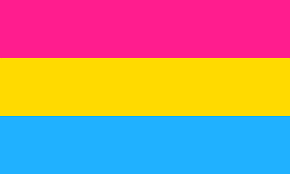
What does the pansexual Pride flag look like?
We’re glad you asked. It looks like this:
The pansexual pride flag (Wikimedia Commons)
When is pansexual Pride day?
Pansexual & Panromantic Awareness Day falls on 24 May. It’s a day to celebrate the pan community and educate others on what it means – so you can start by telling your friends it’s got absolutely nothing to do with saucepans.