A Missouri clinic will stop prescribing puberty blockers and cross-sex hormones to minors for the purpose of gender transition, citing a new state law that the clinic says “creates unsustainable liability” for health care workers.
A statement released Monday by the Washington University Transgender Center at St. Louis Children’s Hospital said patients currently receiving care will be referred to other providers. The center will continue to provide education and mental health support for minors, as well as medical care for patients over the age of 18.
“We are disheartened to have to take this step,” the statement read. “However, Missouri’s newly enacted law regarding transgender care has created a new legal claim for patients who received these medications as minors. This legal claim creates unsustainable liability for health-care professionals and makes it untenable for us to continue to provide comprehensive transgender care for minor patients without subjecting the university and our providers to an unacceptable level of liability.”
As of Aug. 28, health care providers in the state are prohibited from prescribing gender-affirming treatments for teenagers and children under a bill signed in June by Gov. Mike Parson. Most adults will still have access to transgender health care under the law, but Medicaid won’t cover it. Prisoners must pay for gender-affirming surgeries out-of-pocket under the law.
Parson at the time called hormones, puberty blockers and gender-affirming surgeries “harmful, irreversible treatments and procedures” for minors. He said the state “must protect children from making life-altering decisions that they could come to regret in adulthood once they have physically and emotionally matured.”
Every major medical organization, including the American Medical Association, has opposed the bans on gender-affirming care for minors and supported the medical care for youth when administered appropriately. Lawsuits have been filed in several states where bans have been enacted this year.
Parson also signed legislation in June to ban transgender girls and women from playing on female sports teams from kindergarten through college. Both public and private schools face losing all state funding for violating the law.
Shira Berkowitz, of the state’s LGBTQ+ advocacy group PROMO, said in a statement that Parson, Attorney General Andrew Bailey and the state legislature “blatantly committed a hate crime against transgender Missourians.”
“We are working quickly with coalition partners to explore all possible avenues to combat the harm being inflicted upon transgender Missourians,” Berkowitz said.
The St. Louis clinic fell under scrutiny early this year after former case manager Jamie Reed claimed in an affidavit that the center mainly provides gender-affirming care and does little to address mental health issues that patients also faced. Republican U.S. Sen. Josh Hawley and Bailey announced investigations after Reed’s claims.
Missouri’s bans come amid a national push by conservatives to put restrictions on transgender and nonbinary people, which alongside abortion has become a major theme of state legislative sessions this year. Missouri is among nearly two-dozen states to have enacted laws restricting or banning gender-affirming medical care for transgender minors.
In April, Bailey took the novel step of imposing restrictions on adults as well as children under Missouri’s consumer-protection law. He pulled the rule in May after the GOP-led Legislature sent the bills to Parson.
Georgia can resume enforcing a ban on hormone replacement therapy for transgender people under 18, a judge ruled Tuesday, putting her previous order blocking the ban on hold after a federal appeals court allowed Alabama to enforce a similar restriction.
Geraghty did not go that far, but she also said keeping her injunction in place was not possible after last month’s ruling on Alabama’s law by a three-judge panel of the 11th Circuit Court of Appeals, which includes Georgia. She instead issued a stay, or hold, on her injunction in anticipation of a possible rehearing of the Alabama case before a larger panel of the court’s judges.
The Associated Press sent an email seeking comment to a spokeswoman for the Georgia attorney general’s office. Attorneys for the plaintiffs in the Georgia case said they would comment later Tuesday.
The 11th Circuit panel’s ruling last month said Alabama can implement a ban on the use of puberty blockers and hormones to treat transgender children. It came a day after Geraghty issued her preliminary injunction.
The Georgia law, Senate Bill 140, allows doctors to prescribe puberty-blocking medications, and it allows minors who are already receiving hormone therapy to continue. But it bans any new patients under 18 from starting hormone therapy. It also bans most gender-affirming surgeries for transgender people under 18.
The law took effect July 1. Geraghty granted a preliminary injunction blocking it on Aug. 20. The injunction was sought by several transgender children, parents and a community organization in a lawsuit challenging the ban.
In her August decision, Geraghty said the transgender children who sought the injunction faced “imminent risks” from the ban, including depression, anxiety, eating disorders, self-harm, and suicidal thoughts. She said those risks outweighed any harm to the state from an injunction.
The 11th Circuit judges who ruled on Alabama’s law said states have “a compelling interest in protecting children from drugs, particularly those for which there is uncertainty regarding benefits, recent surges in use, and irreversible effects.”
Doctors typically guide children toward therapy or voice coaching long before medical intervention.
At that point, puberty blockers and other hormone treatments are far more common than surgery. They have been available in the U.S. for more than a decade and are standard treatments backed by major doctors organizations, including the American Medical Association.
At least 22 states have now enacted laws restricting or banning gender-affirming medical care for transgender minors. Most of those states have been sued.
A judge on Wednesday halted a Southern California school district from requiring parents to be notified if their children change their gender identification or pronouns at school.
San Bernardino County Superior Court Judge Thomas S. Garza ruled after California Attorney General Rob Bonta sued the Chino Valley Unified School District for adopting a policy requiring schools to tell parents when their children change their pronouns or use a bathroom of a gender other than the one listed on their official paperwork.
“Today’s decision by the San Bernardino Superior Court rightfully upholds the state rights of our LGBTQ+ students and protects kids from harm by immediately halting the board’s forced outing policy,” Attorney General Rob Bonta said in a statement.
Garza’s order halts the district’s policy while Bonta’s lawsuit continues. Full details of the order were not immediately available.
During a court hearing Wednesday, Garza raised questions about why the policy came up in the first place and how it protected students.
The next court hearing on the issue was scheduled for Oct. 13.
Messages left for Chino Valley Unified were not immediately returned.
The district, which serves 27,000 students about 35 miles east of Los Angeles, is one of several that requires parents to be informed if their children are transgender. Two nearby districts have done the same, while at least two others in the state are bringing up similar measures this week.
Bonta argues the policy will forcibly out transgender students in violation of their privacy rights and threaten their well-being. Chino Valley contends the policy seeks to involve parents so they can provide support their children need.
During Wednesday’s hearing, Delbert Tran, a deputy attorney general for California, said students were already being affected by the policy and feared being themselves at school, and that risking the safety of one transgender student would be too many. “This policy needs to be addressed now,” Tran told the court.
Attorneys for Chino Valley Unified argued that the policy would not affect students who were holding private conversations with teachers, but would bring parents into the conversation in situations where students were making decisions on campus such as changing their name, pronouns or using bathrooms or joining sports teams of a gender other than the one on their official paperwork.
The district also questioned whether elementary school students as young as 4 and 5 years old should be treated the same as high school teens involved in confidential counseling.
The national conversation over transgender rights has intensified as other states have sought to impose bans on gender-affirming care, bar transgender athletes from girls and women’s sports, and require schools to “out” transgender and nonbinary students to their parents.
In California, parental notification policies cropped up after Republican state lawmaker Bill Essayli proposed a statewide bill on the issue, but it never received a hearing in Sacramento. He then worked with school board members and the California Family Council to draft the policy that was voted on in Chino Valley.
On Wednesday, Essayli said he hopes other school districts evaluating similar proposals will not be discouraged by the decision of a single judge.
“Today’s ruling does not impact our fight to protect parental rights,” Essayli said in a statement.
Many of the conversations about transgender students and LGBTQ curriculum are taking place in communities that elected more conservative school board members after the pandemic drove many parents who were angry about closures to political action. The districts are increasingly at odds with Gov. Gavin Newsom and fellow Democrats who dominate the state’s political leadership.
An activist detained in Hong Kong partially won his final appeal Tuesday seeking recognition for same-sex marriage registered overseas, in a landmark court ruling that is likely to have a far-reaching impact on the city’s LGBTQ+ community.
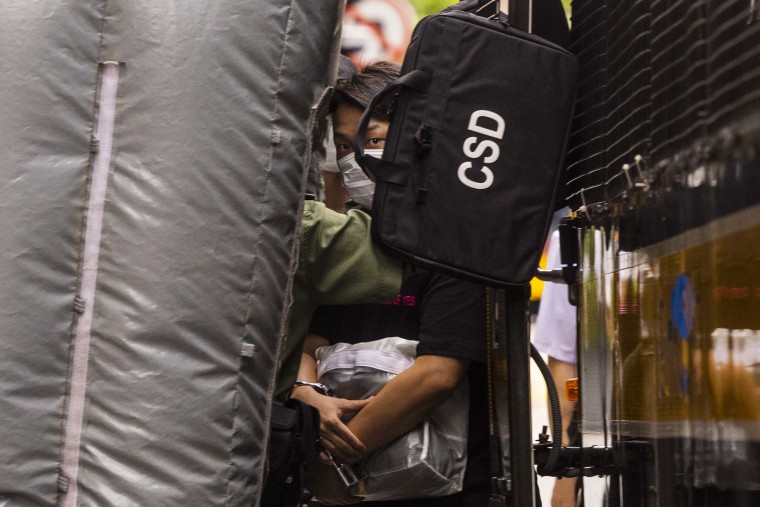
Jimmy Sham, a prominent pro-democracy activist during 2019 anti-government protests, married his husband in New York 10 years ago. Sham first asked for a judicial review in 2018 arguing that Hong Kong’s laws, which don’t recognize foreign same-sex marriage, violate the constitutional right to equality. The lower courts had dismissed his challenges.
Sham has been in custody after being charged under a Beijing-imposed national security law following the massive protests. The law has been used to arrest and silence many other pro-democracy activists as part of a crackdown on dissent in the former British colony.
Jimmy Sham has been in custody after being charged under a Beijing-imposed national security law following massive protests. Louise Delmotte / AP
Judges at the city’s top court, by a majority, declared in a written ruling that the government is in violation of its positive obligation to establish an alternative framework for legal recognition of same-sex partnerships, such as registered civil partnerships or civil unions. But they unanimously dismissed his appeal on other grounds.
Their ruling will have strong implications for the lives of the LGBTQ+ community and the financial hub’s reputation as an inclusive place to stay and work.
Currently, Hong Kong only recognizes same-sex marriage for certain purposes such as taxation, civil service benefits and dependent visas. Many of the government’s concessions were won through legal challenges in recent years and the city has seen a growing social acceptance toward same-sex marriage.
In a previous hearing, Sham’s lawyer Karon Monaghan argued that the absence of same-sex marriages in Hong Kong sent a message that they’re less worthy of recognition than heterosexual marriages.
Sham is the former convenor of Civil Human Rights Front, which was best known for organizing the annual protest march on the anniversary of Hong Kong’s handover to Chinese rule on July 1, 1997, for years.
The group also organized some of the biggest political protests that roiled the city in 2019 but was disbanded in 2021 under the shadow of the security law.
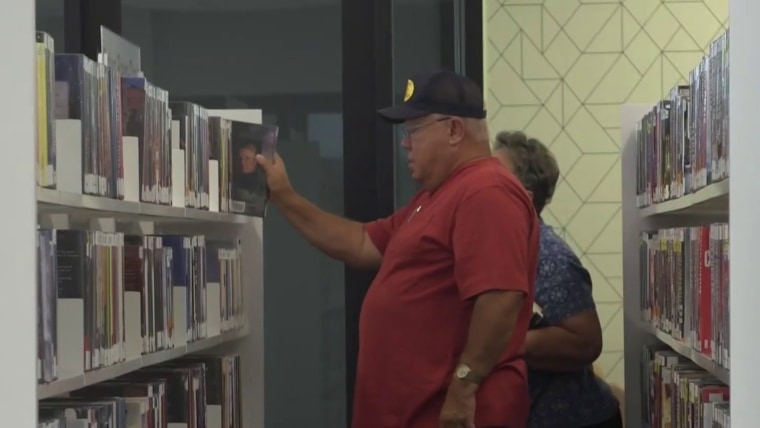
After parents in a rural and staunchly conservative Wyoming county joined nationwide pressure on librarians to pull books they considered harmful to youngsters, the local library board obliged with new policies making such books a higher priority for removal — and keeping out of collections.
But that’s not all the library board has done.
Campbell County also withdrew from the American Library Association, in what’s become a movement against the professional organization that has fought against book bans.
This summer, the state libraries in Montana, Missouri and Texas and the local library in Midland, Texas, announced they’re leaving the ALA, with possibly more to come. Right-wing lawmakers in at least nine other states — Arizona, Georgia, Illinois, Louisiana, Mississippi, Pennsylvania, South Carolina, South Dakota and Wyoming — demand similar action.
Part of the reason is the association’s defense of disputed books, many of which have LGBTQ and racial themes. A tweet by ALA President Emily Drabinski last year in which she called herself a “Marxist lesbian” also has drawn criticism and led to the Montana and Texas state library departures.
“This is the problem with the American Library Association, it has changed from an organization that helped communities and used common sense into one that just promotes a view,” said Dan Kleinman, a blogger and longtime ALA critic.
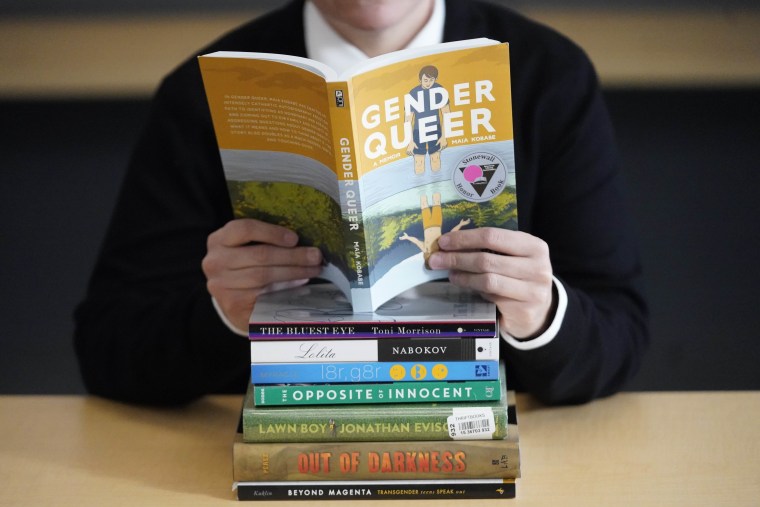
Widely disputed books over the past couple years include Maia Kobabe’s graphic memoir “Gender Queer,” Juno Dawson’s “This Book Is Gay,” and Toni Morrison’s “The Bluest Eye,” the ALA points out.
A person readsMaia Kobabe’s graphic memoir “Gender Queer.”Rick Bowmer / AP file
In northeastern Wyoming’s Campbell County, a coal-mining area where former President Donald Trump got 87% of the vote in 2020, library board meetings have been packed and often heated for over two years now.
After a local outcry over a drag queen story hour and an unsuccessful attempt to prosecute library officials over books in the library’s children’s section, a library board with several new members appointed by the County Commission withdrew from the ALA last year.
“We were the first library in nation to do this. And now it has progressed to something to something I couldn’t even have imagined,” library board member Charles Butler said. “And all we were ever worried about was the sexualization of children.”
The nonprofit American Library Association denies having a political agenda, saying it has always been nonpartisan.
“This effort to change what libraries are, or even just take libraries away from communities, I think, is part of a larger effort to diminish the public good, to take away those information resources from individuals and really limit their opportunity to have the kinds of resources that a community hub, like a public library, provides,” said Deborah Caldwell-Stone, director of the American Library Association’s Office of Intellectual Freedom.
The ALA won’t say how many libraries are members of the group but denied any “mass exodus.”
The troubles come as individual membership in the ALA is down 14% since 2018 to about 49,700, the lowest since 1989, according to figures on the organization’s website. The ALA attributes the decline to suspended library conferences during the pandemic.
While librarians pride themselves about being open to different perspectives and providing access to different kinds of materials, political leaders telling them to part with the ALA runs against that, said Washington University in St. Louis law professor Gregory Magarian.
Magarian has been following Missouri’s departure from the ALA amid a debate over who may take part in local library “story hours” and new state rules that seek to limit youth access to certain books deemed inappropriate for their age.
“When you see state governments kind of replacing that type of control by librarians with greater control by politically motivated, politically ambitious, politically polarized government officials, I think that’s really troubling for the prospects for free access to ideas,” Magarian said.
In Campbell County, recent library policy changes remove the ALA’s “Library Bill of Rights,” which states: “A person’s right to use a library should not be denied or abridged because of origin, age, background, or views.”
Banned books are stacked at an exhibit at the American Library Association’s conference in Chicago, on June 24, 2023.Claire Savage / AP file
The new policy says the library system takes seriously keeping “obscene sexually explicit or graphic materials” out of youth sections and can apply that priority in the routine “weeding” of damaged, unused and out-of-date books.
When library Director Terri Lesley expressed doubts about doing that, the board asked her to resign. After she refused, the board voted 4-1 to fire her.
“If we just start moving books, it is really putting the library staff in a bad position legally,” Lesley said at a library board meeting just before her firing July 28. “This raises First Amendment concerns with no right to appeal or challenge books that have been weeded.”
She singled out MassResistance, an anti-LGBTQ+ group, and Liberty Counsel, a conservative legal advocacy group, for working together on the library policy changes, a claim supported by a July 19 post on the MassResistance website.
Lesley won an ALA award last year for “notable contributions to intellectual freedom” and “personal courage in defense of freedom of expression.” She did not return a message seeking comment and Butler and ALA officials declined to comment on her firing.
“People should be running their own libraries based on common sense, community standards and the law,” said Kleinman, the ALA critic and blogger. “And if library directors don’t want to go along with that? Goodbye.”
Kleinman last month launched an alternative to the ALA, the World Library Association, which he said will offer new policy guidelines for libraries.
“We’re going to return things to commonplace, community standards,” Kleinman said.
Butler and Campbell County Library Board Chairwoman Sage Bear, who did not return phone and email messages seeking comment, have joined as “team members” of the World Library Association. Butler said he hoped the new association will eventually offer librarian continuing education that Campbell County can no longer provide through the ALA.
So far, state library associations — private, professional organizations that resemble the American Library Association, but on a state level — are sticking with the American Library Association. Wyoming librarians don’t always see eye-to-eye with the ALA but the Wyoming Library Association has no plans to cut ties, President Conrrado Saldivar said.
Wyoming librarians are being “constantly critiqued” but they — not the ALA — are the ones who control their collections based on community needs, Saldivar added.
“ALA is not telling our library workers, our collection development librarians, you have to have this book in your library collection,” Saldivar said.
Republican Gov. Mark Gordon looks to be on the same page, criticizing as a “media stunt” a recent letter from 13 state lawmakers and Wyoming’s secretary of state asking him to pull the Wyoming State Library from the ALA.
“The letter implies that Wyoming citizens — Wyoming parents — are not capable of deciding how best to govern themselves and need the self-appointed morality police to show them the way,” Gordon said in a statement.
He called for discussion about the ALA’s “organizational drift” but is keeping the Wyoming State Library in the ALA, at least for now. Whether still more states and communities decide to leave remains to be seen amid what Caldwell-Stone described as a new push to question the group’s very existence.
“We have to question whose agenda is served by taking away library service from the people and taking away the liberty to make ones own choices about one’s own reading,” she said. “Because that’s what we’re here for.”
Police in Nigeria said Tuesday they detained at least 67 people celebrating a gay wedding, in one of the country’s largest arrests targeting outlawed homosexuality.
The “gay suspects” were arrested in southern Delta state’s Ekpan town at about 2 a.m. on Monday at an event where two of them were wedded, state police spokesman Bright Edafe told reporters. He said that homosexuality “will never be tolerated” in the West African nation.
Arrests of gay people are common in Nigeria, Africa’s most populous country, where the Same Sex Marriage Prohibition Act carries up to 10 years in jail for gay individuals. Accomplices also face 10 years in prison. Enacted in 2013, the law has been condemned locally and internationally though it is also supported by many in the country.
Police in Delta stormed a hotel in Ekpan where the gay wedding was being held and initially arrested 200 people, Edafe told reporters. Later, 67 of them were detained after initial investigations, he said.
He spoke at a police station where the suspects were being paraded.
“The amazing part of it was that we saw two suspects, and there is a video recording where they were performing their wedding ceremony,” he said. “We are in Africa and we are in Nigeria. We cannot copy the Western world because we don’t have the same culture.”
He reiterated that police officers in Nigeria “cannot fold their hands” and watch gay people openly express their orientation in the country.
“This is not something that will be allowed in Nigeria,” he said, adding that the suspects will be charged in court at the end of the investigation.
Mississippi will have its first-ever openly gay state legislator after a House candidate won his Democratic primary election runoff Tuesday.
Fabian Nelson, a 38-year-old Realtor from Byram, prevailed over Roshunda Harris-Allen, an education professor at Tougaloo College and alderwoman in Byram. The race to represent the House district in the south Jackson metro area was decided in a runoff after neither Nelson nor Allen received a majority vote in the Aug. 8 primary. A local pastor finished a distant third and did not advance to the runoff.
Republicans did not field a candidate for the general election, so Nelson will go on to represent the district. He will be sworn in before the next legislative session in January. His win marks the fulfillment of a goal he’s had since visiting the Capitol on an elementary school field trip and telling his teacher he’d sit on the House floor one day.
“I still think I’m in a dream. I’m still trying to process it and take it in,” Nelson said in an interview Wednesday. “It’s still shocking to me, I have to be honest.”
Nelson was endorsed by the Human Rights Campaign, the nation’s largest organization devoted to LGBTQ rights. In June, the organization declared a state of emergency for LGBTQ people in the U.S., pointing to the passage of bills it deems discriminatory.
“It sends a real message in a time when we are seeing attacks legislatively and through violence against the LGBTQ+ community that the majority of people reject that kind of animus,” Rob Hill, state director of the Human Rights Campaign’s Mississippi chapter, said in an interview after Nelson’s victory. “I think a lot of youth around the state who have felt like their leaders are rejecting them or targeting them won’t feel as lonely today.”
The Hinds County district includes Southwest Jackson and part of Byram, Salem and Terry. Nelson said he connected with voters by relying on his deep local ties. In office, he wants to increase health care access for low-income people by pushing for Medicaid expansion.
“Don’t get me wrong, it’s great being first, but ultimately what won this campaign is the fact that I’m in touch with my community and the issues my community is facing,” Nelson said.
He also wants to be a voice against policies that harm marginalized communities, he said.
“At the end of the day, I put my suit on the same way every other person who walks in that statehouse does,” Nelson said. “I’m going to walk in there, and I’m going to be a sound voice as to why things like this can’t continue to go on in the state of Mississippi.”
In a statement, Annise Parker, president of the LGBTQ+ Victory Fund, said Mississippi is “one of the last two states to achieve the milestone of electing an out LGBTQ+ lawmaker. ”
“Voters in Mississippi should be proud of the history they’ve made but also proud to know they’ll be well-represented by Fabian,” Parker said.
Nelson’s victory comes on the heels of a historic wave of restrictions passed by Republican-controlled legislatures targeting the rights of transgender people. LGBTQ advocates say they’ve seen a record number of measures aimed at their community in 2023. In February, Mississippi enacted a ban on gender-affirming hormones or surgery for anyone in the state younger than 18.
One of the authors of Mississippi’s ban on gender-affirming care for minors, Republican Rep. Nick Bain from Corinth, was trailing Wednesday in a nail-biting primary runoff in north Mississippi. The race still had not been called Wednesday, but Bain trailed fellow Republican Brad Mattox, who owns a gun shop called Big Bang Trading Company.
In south Mississippi, Felix Gines, a Biloxi City Council member first elected as a Democrat, lost a Republican runoff to Zachary Grady, a former police officer.
Rodney Hall, a recent aide to GOP Congressman Trent Kelly and former Army veteran, won the Republican primary in a northeast Mississippi district and faces no opponent in November. He is set to become the first Black Republican elected to the state Legislature since the 1890s.
A Texas judge blocked the state’s upcoming ban on transition-related medical care for minors Friday as a judge in Missouri ruled that a similar ban in that state could take effect Monday, the latest in a legal fight over efforts by conservatives to restrict such care around the country.
In Texas, a group of families and doctors sued to block the state law, arguing it would violate parents’ rights and have devastating consequences for transgender children and teens who would be denied treatment recommended by their physicians and parents.
The ruling landed just ahead of the Sept. 1 start date for the ban. The Texas Attorney General’s office was expected to quickly file an appeal to let the law take effect.
The Missouri ruling by St. Louis Circuit Judge Steven Ohmer means that beginning next week, health care providers are prohibited from providing transition-related surgeries to minors. Trans youth who began puberty blockers or hormones before Monday will be allowed to continue on those medications, but other minors won’t have access to those drugs.
Some adults will also lose access to gender-affirming care. Medicaid no longer will cover treatments for adults, and the state will not provide those surgeries to people who are incarcerated.
Physicians who violate the law face having their licenses revoked and being sued by patients. The law makes it easier for former patients to sue, giving them 15 years to go to court and promising at least $500,000 in damages if they succeed.
The ACLU of Missouri, Lambda Legal, and Bryan Cave Leighton Paisner last month sued to overturn the Missouri law on behalf of doctors, LGBTQ+ organizations, and three families of transgender minors, arguing that it is discriminatory. They asked that the law be temporarily blocked as the court challenge against it plays out. The next hearing in the case is scheduled for Sept. 22.
But Ohmer wrote that the plaintiffs’ arguments were “unpersuasive and not likely to succeed.”
“The science and medical evidence is conflicting and unclear. Accordingly, the evidence raises more questions than answers,” Ohmer wrote in his ruling. “As a result, it has not clearly been shown with sufficient possibility of success on the merits to justify the grant of a preliminary injunction.”
One plaintiff, a 10-year-old transgender boy, has not yet started puberty and consequently has not yet started taking puberty blockers. His family is worried he will begin puberty after the law takes effect, meaning he will not be grandfathered in and will not have access to puberty blockers for the next four years until the law sunsets.
The law expires in August 2027.
Proponents of the law argued gender-affirming medical treatments are unsafe and untested.
Republican Attorney General Andrew Bailey’s office wrote in a court brief that blocking the law “would open the gate to interventions that a growing international consensus has said may be extraordinarily damaging.”
The office cited restrictions on gender-affirming treatments for minors in countries including England and Norway, although those nations have not enacted outright bans.
An Associated Press email requesting comment from the Attorney General’s Office was not immediately returned Friday.
Every major medical organization in the U.S., including the American Medical Association, has opposed bans on gender-affirming care for minors and supported the medical care for youth when administered appropriately. Lawsuits have been filed in several states where bans have been enacted this year.
“We will work with patients to get the care they need in Missouri, or, in Illinois, where gender-affirming care is protected under state law,” Yamelsie Rodríguez, president and CEO, Planned Parenthood of the St. Louis Region and Southwest Missouri, said in a statement after the ruling.
The Food and Drug Administration approved puberty blockers 30 years ago to treat children with precocious puberty — a condition that causes sexual development to begin much earlier than usual. Sex hormones — synthetic forms of estrogen and testosterone — were approved decades ago to treat hormone disorders and for birth control.
The FDA has not approved the medications specifically as a treatment for trans youth. But they have been used for many years for that purpose “off label,” a common and accepted practice for many medical conditions. The mediations are also used to treat early-onset puberty and other health conditions in children. Doctors who treat trans patients say those decades of use are proof the treatments are not experimental.
A judge has dismissed a lawsuit contesting a transgender woman’s admission into a sorority at the University of Wyoming, ruling that he could not override how the private, voluntary organization defined a woman and order that she not belong.
In the lawsuit, six members of the Kappa Kappa Gamma sorority chapter challenged Artemis Langford’s admission by casting doubt on whether sorority rules allowed a transgender woman. Wyoming U.S. District Court Judge Alan Johnson, in his ruling, found that sorority bylaws don’t define who’s a woman.
The case at Wyoming’s only four-year public university drew widespread attention as transgender people fight for more acceptance in schools, athletics, workplaces and elsewhere, while others push back.
A federal court cannot interfere with the sorority chapter’s freedom of association by ruling against its vote to induct the transgender woman last year, Johnson ruled Friday.
With no definition of a woman in sorority bylaws, Johnson ruled that he could not impose the six sisters’ definition of a woman in place of the sorority’s more expansive definition provided in court.
“With its inquiry beginning and ending there, the court will not define a ‘woman’ today,” Johnson wrote.
Langford’s attorney, Rachel Berkness, welcomed the ruling.
“The allegations against Ms. Langford should never have made it into a legal filing. They are nothing more than cruel rumors that mirror exactly the type of rumors used to vilify and dehumanize members of the LGBTQIA+ community for generations. And they are baseless,” Berkness said in an email.
The sorority sisters who sued said Langford’s presence in their sorority house made them uncomfortable. But while the lawsuit portrayed Langford as a “sexual predator,” claims about her behavior turned out to be a “nothing more than a drunken rumor,” Berkness said.
An attorney for the sorority sisters, Cassie Craven, said by email they disagreed with the ruling and the fundamental issue — the definition of a woman — remains undecided.
“Women have a biological reality that deserves to be protected and recognized and we will continue to fight for that right just as women suffragists for decades have been told that their bodies, opinions, and safety doesn’t matter,” Craven wrote.
The number of gender-affirming surgeries in the U.S. nearly tripled from 2016 to 2019 before dropping slightly in 2020, according to a study published Wednesday.
The increase likely reflects expanded insurance coverage for transgender care after the Obama administration and some states actively discouraged discrimination based on gender identity, lead author Dr. Jason Wright of Columbia University said. The dip in 2020 can be attributed to the pandemic.
About 48,000 patients underwent such surgeries during the five years studied, with about 13,000 procedures done in 2019, the peak year, and 12,800 in 2020.
A little more than half the patients were ages 19 to 30. Surgeries in patients 18 and younger, were rare: fewer than 1,200 in the highest volume year.
In the last couple of years, many states have taken steps to restrict or ban transgender care for people under age 18, adding to waiting lists of patients seeking care in states that have declared themselves refuges for transgender people.
“This age group is really not what’s driving the overall increase in gender-affirming surgery that we found,” Wright said.
Among the youngest patients, the most common surgeries were breast and chest procedures, with more than 3,000 young people undergoing such operations during the five-year period.
These were likely transgender males — generally high school graduates — having their breasts removed, said Dr. Loren Schechter of Rush University Medical Center in Chicago, who specializes in gender-affirming surgery and was not involved in the study. Having breast surgery at that age allows them to “go to the next phase of their life in a body with which they’re comfortable and is synchronous with their identity,” he said.
The study, published in JAMA Network Open, did not look at more common treatments in minors such as puberty blockers and hormones.
Researchers analyzed records from two national surgery databases. For all age groups, breast surgeries were the most common type, followed by genital surgeries. The researchers also counted about 6,600 cosmetic procedures such as liposuction, face lifts and nose reshaping.
The gender identities of the patients were unclear in the data and couldn’t be inferred in categories like breast reconstruction, which could be for either transgender males or females.
Private insurance covered most patients who had such surgeries, the researchers found. About 1 in 4 patients received coverage through Medicaid, the federal-state health care insurance program that helps pay for health care for low-income people.