Officials in Missouri’s largest city approved a resolution Thursday to declare it a sanctuary for people seeking or providing gender-affirming care, defying state lawmakers who voted a day earlier to ban such care for minors and restrict it for some adults.
Democratic Mayor Quinton Lucas praised the 12 to 1 vote, saying the city is committed to being a “welcoming, inclusive, and safe place for everyone, including our transgender and LGBTQ+ community.”
Kansas City’s new, sanctuary status sets it apart as a Democratic-leaning city in a state with a Republican governor and GOP-controlled Legislature. Similar actions have been taken in cities that oppose state actions to restrict rights for transgender people, as in Austin, Texas.
GOP Gov. Mike Parson is expected to sign into law the ban on gender-affirming care, joining at least 16 other states that have enacted similar laws restricting or banning such care for minors.
The resolution also comes as a judge considers a proposed emergency rule from Republican state Attorney General Andrew Bailey that would require adults and children to undergo more than a year of therapy — and fulfill other requirements before they could receive gender-affirming treatment.
A committee signed off Wednesday on the resolution, which says the city will not prosecute or fine any person or organization that seeks, provides, receives or helps someone to receive gender-affirming care such as as puberty blockers, hormones or surgery.
It also says that if the state passes a law or resolution that imposes criminal or civil punishments, fines, or professional sanctions in such cases, personnel in Missouri’s largest city will make enforcing those requirements “their lowest priority.”
Republican state lawmakers across the U.S. who’ve attacked gender-affirming care as part of a larger effort to roll back LGBTQ rights have argued that they’re protecting children from decisions they may later regret. But gender-affirming care for minors has been available in the U.S. for more than a decade and is endorsed by major medical associations.
“This is an important first step in Kansas City’s commitment to trans and nonbinary people,” Merrique Jenson, founder of Transformations KC, said in a written statement after the vote. “I look forward to trans leaders and Kansas City working together to address the health disparities in our communities and ways we can have sustainable funding & programming reaching all trans people.”
Two transgender children, their parents and two health care providers filed a lawsuit Tuesday arguing that a Montana law that would ban gender-affirming care for transgender youth is unconstitutional.
The ban on puberty blockers, hormone treatment and surgical procedures applies only to transgender youth being treated for gender dysphoria, but that same care can be provided to cisgender adolescents for any other purpose, according to the complaint filed by the American Civil Liberties Union, the ACLU of Montana and Lambda Legal.
The ban serves no purpose other than to “intentionally burden a transgender person’s ability to seek necessary care to align their body with their gender identity,” the complaint states. It asks a state judge to block enforcement of the law, which is to take effect on Oct. 1.
“The new law provides commonsense protections for Montana children — who can’t even enter into contracts or buy cigarettes or alcohol — from harmful, life-altering medications and surgeries,” said Emily Flower, spokesperson for Attorney General Austin Knudsen.
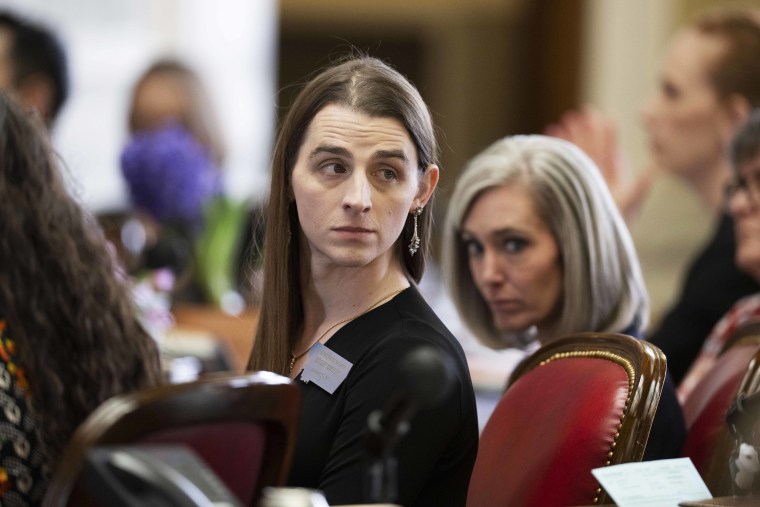
Opposition to the bill by Democratic Rep. Zooey Zephyr — the first openly transgender female lawmaker to serve in the Montana Legislature — triggered a series of events that eventually led to her being banned from the House floor for the final days of the 2023 session.
Rep. Zooey Zephyr at the Montana State Capitol in Helena on April 26, 2023. Tommy Martino / AP
The Republican-controlled Montana Legislature passed the bill and Republican Gov. Greg Gianforte signed it late last month. Montana is one of at least 16 states with laws to ban such care, despite protests from the families of transgender youth that the care is essential.
“It is mentally and physically painful to feel like you are trapped in the wrong body,” Jessica van Garderen, the mother of a 16-year-old transgender daughter, said in a statement. “Going through puberty for the wrong sex is like having your body betray you on a daily basis. The only treatment we have found to be effective and give our daughter hope again is hormone therapy.
“Taking away this crucial medical care is inhumane and a violation of our rights,” van Garderen said.
The complaint argues that the new law interferes with parental rights and is unconstitutional because it violates the plaintiffs’ right to privacy, their right to seek health care and the right to human dignity.
Supporters of the ban, including bill sponsor Republican Sen. John Fuller, said minors should not be allowed to undergo irreversible, life-changing procedures before they are adults and are old enough to understand the consequences and give legal permission.
“Just living as a trans teenager is difficult enough, the last thing me and my peers need is to have our rights taken away,” plaintiff Phoebe Cross, a 15-year-old transgender boy, said in a statement. “The blatant disrespect for my humanity and existence is deeply unsettling.”
Under the new law, health care providers who provide such care could lose their medical licenses for at least a year and be subject to lawsuits for up to 25 years after any treatment was provided.
The bill also prohibits public money, such as Medicaid, from being used to pay for such care.
Federal judges in Alabama and Arkansas have blocked laws that sought to ban gender-affirming care. The Department of Justice joined a federal lawsuit filed on behalf of transgender parents and their children against a similar ban in Tennessee.
Montana became the latest state to ban or restrict gender-affirming medical care for transgender kids Friday when its Republican governor signed legislation that exiled transgender lawmaker Zooey Zephyr told fellow lawmakers would leave “blood” on their hands.
Montana is one of at least 15 states with laws to ban such care despite protests from the families of transgender youth that the care is essential.
Debate over Montana’s bill drew national attention after Republicans punished Zephyr for her remarks, saying her words were personally offensive. House Speaker Matt Regier refused to let Zephyr speak on the House floor until she apologized. She has not.
Zephyr decried the bill’s signing, saying “it is unconscionable to deprive Montanans of the care that we need.”
“I know that this is an unconstitutional bill. It is as cruel as it is unconstitutional. And it will go down in the courts,” Zephyr said. To trans youth she added: “There’s an understandable inclination towards despair in these moments, but know that we are going to win and until then, lean on community, because we will have one another’s backs.”
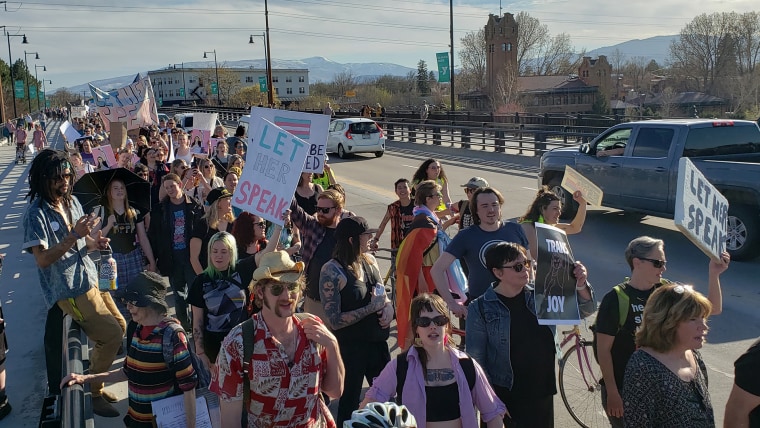
On Monday, Zephyr had stood defiantly on the House floor with her microphone raised as protesters shouted “Let her speak,” disrupting House proceedings for at least 30 minutes. Zephyr was then banned from the House and its gallery and voted on bills from a bench in the hallway outside the House on Thursday and Friday.
Lambda Legal, the American Civil Liberties Union and the ACLU of Montana have said they would file a court challenge against the ban, which is set to take effect on Oct. 1, starting a five-month clock in which Montana youth can try to find a way to work around the ban or to transition off of hormone treatment.
“This bill is an overly broad blanket ban that takes decisions that should be made by families and physicians and puts them in the hands of politicians,” the Montana Chapter of the American Academy of Pediatrics has said.
Gov. Greg Gianforte signaled his willingness to sign the bill on April 17 when he offered some amendments to make it clear that public funds could not be used to pay for hormone blockers, cross-sex hormones or surgical procedures.
The bill “protects Montana children from permanent, life-altering medical procedures until they are adults, mature enough to make such serious decisions,” Gianforte wrote in his letter accompanying the amendments.
Debate over the amendments led Zephyr to admonish supporters the following day. House Majority Leader Sue Vinton said Zephyr’s language was “entirely inappropriate, disrespectful and uncalled for.”
The Montana Freedom Caucus deliberately misgendered Zephyr, using male pronouns in a letter saying she should be censured. After Monday’s protest, the caucus said she should be further disciplined.
Under the new law, health professionals who provide care banned by the measure could have their medical licenses suspended for at least a year. They could also be sued in the 25 years following a banned procedure if a patient suffers physical, psychological, emotional or physiological harm. Physicians could not hold malpractice insurance against such lawsuits. The law also prohibits public property and employees from being involved in gender-affirming treatment.
During hours of emotional committee hearings, opponents testified that hormone treatments, and in some cases, surgery, are evidence-based care, supported by numerous medical associations and can be life-saving for someone with gender dysphoria — the clinically significant distress or impairment caused by feeling that one’s gender identity does not match one’s biological sex.
Parents of transgender children testified that the bill infringed on their parental rights to seek medical care for their children.
Opponents also noted that treatments such as puberty-blockers and breast-reduction surgery would still be legal for minors who are not suffering from gender dysphoria, a difference they argue is unconstitutional.
In the letter to legislative leaders accompanying his proposed amendments, Gianforte said he met with transgender residents, understands that their struggles are real and said Montanans who struggle with gender identity deserve love, compassion and respect.
“That’s not what trans Montanans need from you,” Zephyr said as the House considered his amendments. “We need access to the medical care that saves our lives.”
This was the second legislative session in which Sen. John Fuller brought the bill to ban gender-affirming care for transgender children. In 2021, when he was a member of the House, he brought a bill to ban surgical and hormone treatments for transgender children, which was voted down. He brought a second bill to ban surgical treatments which was also rejected. He was successful in 2021 in passing a bill to ban transgender females from participating in girls and women’s sports. The part of the bill that applied to colleges was ruled unconstitutional.
The federal government is seeking to invalidate the statute because “no person should be denied access to necessary medical care just because of their transgender status,” Assistant U.S. Attorney General Kristen Clarke said in a statement. The DOJ said the law violates the Constitution’s equal protection clause by discriminating on the basis of both sex and transgender status.
“The right to consider your health and medically-approved treatment options with your family and doctors is a right that everyone should have, including transgender children, who are especially vulnerable to serious risks of depression, anxiety and suicide,” Clarke added.
The federal lawsuit comes after Clarke sent a letter to all state attorneys general last month warning them that federal law protects transgender youth against discrimination. The Justice Department also intervened last year in a lawsuit challenging a similar ban on transgender medical care for young people. That lawsuit is ongoing.
Republican Gov. Bill Lee signed off on prohibiting gender-affirming care for minors earlier this year. The bill was the first proposal filed in this year’s legislative session. Republican leaders did so in response to video surfacing on social media last year of a Nashville doctor touting that gender-affirming procedures are “huge money makers” for hospitals. That hospital has since paused its transgender services for young people.
Republican lawmakers also advanced legislation designed to severely limit where drag shows can take place, making Tennessee the first state to do so. A federal judge has temporarily blocked the statute from being implemented.
Nationally, Republican lawmakers have proposed hundreds of laws aimed at transgender people, with at least 14 states restricting or banning gender-affirming care for minors.
Under Tennessee’s law — set to take effect July 1 — doctors will be prohibited from prescribing puberty blockers or hormones, or providing other gender-affirming care to anyone under 18. The law spells out a handful exceptions, including allowing doctors to perform such medical services if the patient’s care begins before the law goes into effect. In those cases, care must end by March 31, 2024.
Health care providers who violate the ban would be subject to regulatory discipline and could be sued by the state attorney general or private parties. Violations carry a $25,000 penalty.
A spokesperson for the Tennessee Attorney General’s office did not immediately respond for comment.
The Justice Department’s lawsuit is the second complaint challenging the new Tennessee law. Last week, three transgender children and their parents sued the state, claiming the law violates the 14th Amendment’s equal protection clause because it excludes treatment for gender dysphoria while allowing the same treatments to be used for other conditions.
North Dakota’s Republican Gov. Doug Burgum signed a bill into law that restricts transgender health care in the state, immediately making it a crime to give gender-affirming care to people younger than 18.
Gender-affirming care for minors has been available in the U.S. for more than a decade and is endorsed by major medical associations, but it has increasingly come under attack in many conservative legislatures, including North Dakota’s, where lawmakers have passed at least three bills targeting trans people this year.
The measure that Burgum signed Wednesday received veto-proof support from GOP lawmakers — though some Republicans did vote against it, alongside all Democrats.
In a statement released Thursday morning, Burgum said the law is “aimed at protecting children from the life-altering ramifications of gender reassignment surgeries” but he added that medical professionals have testified these surgeries have not been and are not being performed on minors in North Dakota.
He said the law still allows medication treatment for early onset puberty and other rare circumstances with parental consent, and minors currently receiving gender-affirming care will still be able to receive treatment.
“Going forward, thoughtful debate around these complex medical policies should demonstrate compassion and understanding for all North Dakota youth and their families,” he said.
The new law takes immediate effect and allows prosecutors to charge a health care provider with a felony — up to 10 years in prison and $20,000 in fines — for performing sex reassignment surgery on a minor.
It also enables prosecutors to charge a provider with a misdemeanor — up to 360 days in prison and $3,000 in fines — for giving gender-affirming medication, like puberty blockers or hormone therapy, to a trans child.
The American Civil Liberties Union of North Dakota denounced the new law as “a vast government overreach that undermines the fundamental rights of parents” and that violates constitutional guarantees of equal protection and due process by singling out gender-affirming care for prohibition.
“By signing this bill into law, Gov. Burgum has put the government in charge of making vital decisions traditionally reserved for parents in North Dakota,” Cody Schuler, the group’s advocacy manager, said in a statement. “This ban won’t stop North Dakotans from being trans, but it will deny them critical support that helps struggling transgender youth grow up to become thriving transgender adults.”
Earlier this month, Burgum also signed a transgender athlete ban into law after it similarly passed the House and Senate with veto-proof majorities. In 2021, Burgum vetoed a bill that would have imposed a transgender athlete ban at that time, but House and Senate lawmakers did not have enough votes back then to override his veto.
North Dakota joins at least 13 other states that have enacted laws restricting or banning gender-affirming care for minors.
Republican lawmakers across the country have advanced hundreds of measures aimed at nearly every facet of trans existence this year.
That includes bans on gender-affirming medical care for minors, restrictions on the types of restrooms transgender people can use, measures restricting classroom instruction on sexual orientation and gender identity, and bills that would out transgender students who want teachers to address them by the pronouns they use.
The Food and Drug Administration approved puberty blockers 30 years ago to treat children with precocious puberty — a condition that causes sexual development to begin much earlier than usual. Sex hormones — synthetic forms of estrogen and testosterone — were approved decades ago to treat hormone disorders or as birth control pills.
The FDA has not approved the medications specifically to treat gender-questioning youth, but they have been used for many years for that purpose “off label,” a common and accepted practice for many medical conditions. Doctors who treat transgender patients say those decades of use are proof the treatments are not experimental.
Research has shown that transgender youths and adults can be prone to suicidal behavior when forced to live as the sex they were assigned at birth. And critics of legislation to restrict gender-affirming care for children say it’s an attempt by conservatives to motivate their voting base.
Proponents of the measure have raised concerns about children changing their minds. Yet the evidence suggests detransitioning is not as common as opponents of transgender medical treatment for youth contend, though few studies exist and they have their weaknesses.
Twitter has quietly removed a policy against the “targeted misgendering or deadnaming of transgender individuals,” raising concerns that the Elon Musk-owned platform is becoming less safe for marginalized groups.
Twitter enacted the policy against deadnaming, or using a transgender person’s name before they transitioned, as well as purposefully using the wrong gender for someone as a form of harassment, in 2018.
On Monday, Twitter also said it will only put warning labels on some tweets that are “potentially” in violation of its rules against hateful conduct. Previously, the tweets were removed.
It was in this policy update that Twitter appears to have deleted the line against deadnaming from its rules.
“Twitter’s decision to covertly roll back its longtime policy is the latest example of just how unsafe the company is for users and advertisers alike,” said Sarah Kate Ellis, the president and CEO of the advocacy group GLAAD. “This decision to roll back LGBTQ safety pulls Twitter even more out of step with TikTok, Pinterest, and Meta, which all maintain similar policies to protect their transgender users at a time when anti-transgender rhetoric online is leading to real world discrimination and violence.”
Twitter did not immediately respond to a message for comment Tuesday.
Missouri’s attorney general announced new restrictions Thursday on gender-affirming care for adults in addition to minors in a move that is believed to be a first nationally and has advocacy groups threatening to sue.
Attorney General Andrew Bailey announced plans to restrict health care for transgender people weeks ago, when protesters rallied at the Capitol to urge lawmakers to pass a law banning puberty blockers, hormones and surgeries for children. But the discussion was focused on minors, not adults.
Missouri Attorney General spokeswoman Madeline Sieren clarified in a statement later in the day that adults also would be covered.
“We have serious concerns about how children are being treated throughout the state, but we believe everyone is entitled to evidence-based medicine and adequate mental health care,” Sieren said.
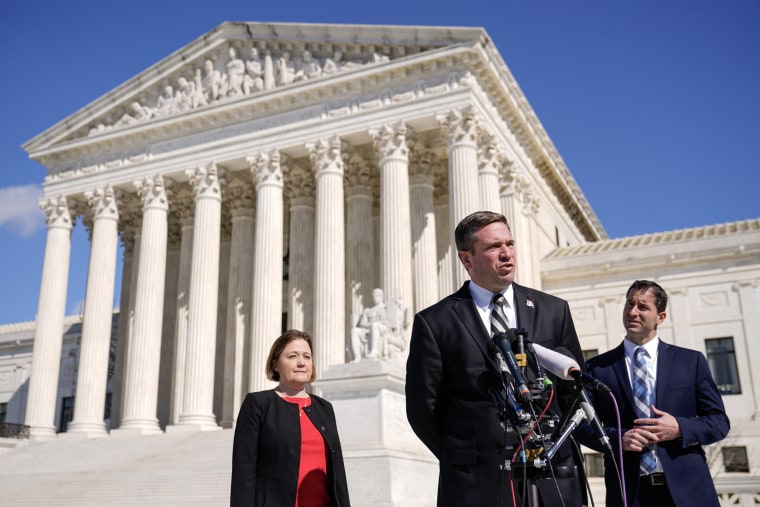
Missouri Attorney General Andrew Bailey speaks outside the Supreme Court on Feb. 28.Patrick Semansky / AP
The rule, which incudes a required 18 months of therapy before receiving gender-affirming health care, is set to take effect April 27 and expire next February.
The ACLU and Lambda Legal said in a joint statement that they would “take any necessary legal action” and urged those affected to call.
“The Attorney General’s so-called emergency rule is based on distorted, misleading, and debunked claims and ignores the overwhelming body of scientific and medical evidence supporting this care,” the statement said.
Robert Fischer, the spokesman for the LGBTQ rights groups PROMO, said he was not aware of similar restrictions elsewhere.
“He’s essentially attacking the entire trans community at this point,” Fischer said of Bailey. “It’s no longer just about children.”
The National Center for Transgender Equality called the order “deeply wrong” in a tweet, adding that “trans people of all ages across the state of Missouri deserve access to health care.”
The restrictions are in response to a former employee’s allegations of mistreatment at a transgender youth clinic in St. Louis run by Washington University. Bailey is investigating the center.
“My office is stepping up to protect children throughout the state while we investigate the allegations and how they are harming children,” Bailey said in a statement.
University spokespeople didn’t immediately respond to phone or email messages from The Associated Press seeking comment.
Moving forward, doctors who provide gender-affirming health care must first provide them a lengthy list of potential negative side effects and information warning against those treatments, according to a copy of the rule released Thursday.
Health care providers will need to ensure “any psychiatric symptoms from existing mental health comorbidities of the patient have been treated and resolved” before providing gender-affirming treatments under the new rule. Physicians also must screen patients for social media addiction, autism and signs of “social contagion with respect to the patient’s gender identity.”
The FDA approved puberty blockers 30 years ago to treat children with precocious puberty — a condition that causes sexual development to begin much earlier than usual. Sex hormones — synthetic forms of estrogen and testosterone — were approved decades ago to treat hormone disorders or as birth control pills.
The FDA has not approved the medications specifically to treat gender-questioning youth, but they have been used for many years for that purpose “off label,” a common and accepted practice for many medical conditions. Doctors who treat transgender patients say those decades of use are proof the treatments are not experimental.
Critics have raise concerns about children changing their minds. Yet the evidence suggests detransitioning is not as common as opponents of transgender medical treatment for youth contend, though few studies exist and they have their weaknesses.
Bailey’s rule was released the same day Missouri’s Republican-led House voted to ban access to transgender-related health care for minors.
The House voted 103-52 along mostly party lines in favor of the ban, although the bill’s passage seems uncertain in the Senate.
The House proposal is stricter than what was passed by the GOP-led Senate, where Democrats have more influence through the use of stall tactics.
Senators compromised to exempt care for minors whose treatment is already underway. The Senate bill also would expire after four years.
The House version includes no exceptions for current treatments and would remain in effect indefinitely.
Republican Senate leaders said it’s unlikely that the House version will make it through the Senate.
“We’ve already passed legislation on this issue out of the Senate,” Senate President Pro Tem Caleb Rowden said. “We would expect the House to appreciate how hard and difficult it was and to take up our bill and pass it.”
Both the House and Senate proposals would ban inmates and prisoners from accessing gender-affirming surgeries and would end coverage of any gender-affirming treatments for Missouri patients on Medicaid, the federal health insurance program.
The Human Rights Campaign condemned the legislation in a statement, describing gender-affirming care as medically necessary.
At least 13 states have now enacted laws restricting or banning gender-affirming care for minors: Alabama, Arkansas, Arizona, Georgia, Idaho, Indiana, Iowa, Kentucky, Mississippi, Tennessee, Utah, South Dakota and West Virginia. Bills are awaiting action from governors in Kansas, Montana and North Dakota. Federal judges have blocked enforcement of laws in Alabama and Arkansas, and nearly two dozen states are considering bills this year to restrict or ban care.
House debate on the bill became emotional as some Democrats argued the ban on health care will hurt transgender children.
“You are erasing my grandchild,” said St. Louis Democratic Rep. Barbara Phifer, whose grandson is transgender.
Republican sponsor Rep. Brad Hudson, of Cape Fair, criticized Democrats for threatening to end political partnerships and friendships with Republicans over the bill.
Hudson said his bill “seeks to protect kids” and that it’s unfair that Democrats are describing it as hateful towards transgender children.
“A yes vote is a vote to protect kids from sex-change drugs and surgeries,” Hudson said.
The first openly gay person to lead the American Medical Association takes the reins at a fractious time for U.S. health care.
Transgender patients and those seeking abortion care face restrictions in many places. The medical judgment of physicians is being overridden by state laws. Disinformation is rampant. And the nation isn’t finished with Covid-19.
In the two decades since Dr. Jesse Ehrenfeld first got involved with the AMA as young medical resident, the nation’s largest physicians’ group has tried to shed its image as a conservative self-interested trade association. While physician pocketbook issues remain a big focus, the AMA is also a powerful lobbying force for a range of public health issues.
Two years ago, the AMA won widespread praise for announcing a plan to dismantle structural racism within its ranks and the U.S. medical establishment. It has adopted policies that stress health equity and inclusiveness — moves that inspired critics to accuse it of “wokeness.”
At 44, Ehrenfeld will be among the AMA’s youngest presidents when he begins his one-year term on June 13. An anesthesiologist, Navy combat veteran and father of two young children, he spoke recently to The Associated Press about his background and new job.
The conversation has been edited for clarity and length.
Q. Why is your being part of the LGBTQ community a big deal at this moment and how will it inform your role as AMA president?
A: I didn’t run as a gay man. That’s not my platform, but it’s a part of my identity. And people know that.
Representation and visibility is so important. I can’t tell you the number of emails, letters, phone calls, text messages that I got when I was elected into this role from people around the world that saw this as an important moment, an important recognition of what inclusivity and equality can be to help advance health equity for everyone.
Q: How will your experience as part of the LGBTQ community inform and influence your new role?
A: I’ve experienced the health care system as a gay person, as a gay parent, as in many ways wonderful positive experiences and other ways, some deeply harmful experiences. And I know that we can do better as a nation. We can do better as a system that can lift up health. And I expect that there’ll be opportunities to shine a light on that during my year as president.
Q: What are examples of those experiences?
A: There’s so many times where our health care system just does not accommodate people who aren’t in the majority. As a gay parent and a gay dad, I can’t tell you how many forms I filled out where there’s a place for the mom and a place for the dad. It’s a small thing. But it’s a signal that we’re different and maybe we’re not welcome or accepted.
When you have those small, subtle irritations that add up day after day after day, whether you’re an LGBT person or from a minority group, that causes stress. These friction points … are so pronounced for so many who are in underserved communities, so many in the LGBT community, and particularly for transgender individuals. And I know we can do better.
I’ve been fortunate to have two beautiful boys brought into this world with the support of an incredible group of physicians. But there were definitely lots of moments along the way where it was clear that we were a little bit different than everybody else in a way that didn’t need to be.
Q: This seems like an unprecedented time for political interference in medicine.
A: I’m deeply concerned about government intrusion into decision-making for patients. The Supreme Court ruling around abortion has had profound implications for reproductive rights. And fundamentally, patients have a right to access evidence-based health care services. That includes comprehensive reproductive health care. It includes care for transgender people.
States that ban abortion, that ban health care for transgender youth are placing the government right into the patient-physician relationship. And we know that this leads to devastating health consequences and can jeopardize lives. The AMA continues to speak out against these kinds of actions.
Q: What power does the AMA really have to protect those rights?
A: I don’t think we’re powerless at all. The AMA was deeply involved in helping the Biden Administration put out guidance to help physicians and patients understand that you don’t have to disclose private medical information to third parties. And we’ll continue to call for things like unrestricted access to (the abortion drug) mifepristone.
Q: Are you discouraged by the number of states that seem to be jumping on this bandwagon?
A: I’m an optimist. There are particular political divisions that are different right now. The attack on science, the attack on following the evidence to deliver care is new. Globally, it has accelerated during the pandemic, but the rampant misinformation, disinformation — all of those challenges are things I know we can overcome. It requires the AMA to lift up our voices and to not give up.
Q: Will addressing the nation’s mental health crisis be part of your role?
A: We need Congress to take action. There have been 15 years now of repeated failures by health care companies to comply with what was a landmark law in 2008 around mental health parity and substance use disorder.
That law passed by Congress has never been enforced. Those violations continue to be more serious than they were a decade ago.
It affects patients with autism. It affects patients with eating disorders, substance use disorders. It delays care. It’s harming patients.
And we are likely causing deaths to happen that are avoidable. We know that there are federal actions that could be taken to help with this, including enabling patients to recover losses associated with an improper denial of care.
The other aspect around mental health access that is really important is permanently expanding access to telehealth.
Q: Critics have long said the AMA is primarily a self-interested trade group. How is that a misconception?
A: We have a pretty simple message, and it’s to elevate the art and science of medicine for the betterment of human health. And that’s why we care about things like climate change and things like health equity.
We have to make sure that there is joy in the practice of medicine. We have to make sure that our health care systems reward and support and allow practices to thrive.
And you look at boneheaded decisions like the fact that physicians got a 2% pay cut from Medicare this past January as opposed to an inflation update. Those are things that are important. They’re financial.
But without advocacy in those realms, practices will close. Medicare patients won’t have a doctor to see. And we just we can’t allow that to happen.
Sports leagues and teams often use Pride nights to raise the visibility and acceptance of LGBTQ people — as well as sell them tickets — and the NHL has been a leader. They can include special jerseys designed by LGBTQ artists, performances, information tables, even drag performances. And they’re largely a hit.
But six NHL players recently opted out of wearing rainbow-colored jerseys on their teams’ Pride nights for the first time, leading the league’s commissioner to say it is weighing the future of the events.
That worries some fans and LGBTQ supporters, who say it’s a sign that a political climate that has led to restrictions on expression, health care and transgender sports participation both in the U.S. and internationally is now threatening events that are meant to be fun and affirming.
“It’s definitely fair to say that this political landscape is helping to sort of normalize people for opting out of the optional ways that they have been asked to show support for marginalized members of society,” said Hudson Taylor, executive director and founder of Athlete Ally, an organization that works with teams and leagues to push for LGBTQ inclusivity.
Pro sports has been here before. In June, five pitchers with the Tampa Bay Rays cited their Christian faith in refusing to wear Pride jerseys, and a U.S. women’s national soccer player skipped an overseas trip in 2017 when the team wore Pride jerseys and also didn’t play in an NWSL game last year for the same reason.
This season, three NHL teams — the Chicago Blackhawks, the New York Rangers and the Minnesota Wild — that previously wore rainbow warmups decided not to. The Rangers and Wild changed course after initially planning for players to wear rainbow-themed warmup jerseys but did not specifically say why.
Between the players opting out and the team decisions, NHL Commissioner Gary Bettman said the league will “evaluate” in the offseason how it handles Pride nights moving forward, calling the refusals a distraction from “the substance of our what our teams and we have been doing and stand for.” Yet he also noted that the NHL, teams and players “overwhelmingly” support Pride nights.
The NHL has partnered for a decade with You Can Play Project, which advocates for LGBTQ participation in sports. No NHL players had previously opted out of Pride nights.
Internationally, a Russian law that restricts “propaganda” about LGBTQ people, including in advertising, media and the arts, has led at least one Russian NHL player to decline participation in Pride night. And Ugandan lawmakers recently passed a bill prescribing jail terms for offenses related to same-sex relations.
It’s all connected, said Evan Brody, an assistant professor at the University of Kentucky whose media studies research often focuses on LGBTQ spaces in sports.
“The laws that are being passed, the players not participating, all exist within the same kind of ecosphere,” Brody said. “They all exist within this larger anti-LGBTQ discourse, which I think we are often very quick to point out about other countries and maybe less so to think about how that’s affecting things in the United States.”
In the NHL, many Pride nights are more about selling tickets, Taylor said. But because the league has been such a leader among men’s sports in how to do Pride nights well, he said, it’s “conspicuous” to see players and teams “roll back the ways in which they have historically shown support for and given visibility to the LGBTQ community.”
Buffalo Sabres Victor Olofsson, left, Jack Quinn and JJ Peterka wear special warmup jerseys commemorating Pride Night before a game against the Montreal Canadiens in Buffalo, N.Y., on March 27, 2023. Adrian Kraus / AP
Russian Ivan Provorov and Canadians James Reimer and brothers Eric and Marc Staal all cited religious beliefs for refusing to take part in warmups in rainbow-colored jerseys. Ilya Lyubushkin said he would not participate because of the law in Russia, where he was born. And Andrei Kuzmenko, another Russian player, decided not to wear the special uniform after discussions with his family.
“Some players choose to make choices that they are free to make,” Bettman said Thursday night at a news conference in Seattle. “That doesn’t mean they don’t respect other people and their beliefs and their lifestyles and who they are. It just means they don’t want to endorse it by wearing uniforms that they are not comfortable wearing.”
Taylor noted that the fear of Russian retribution could be “very real” for a player like Lyubushkin, who has family in Moscow and visits often.
“I don’t think the LGBTQ community should feel that NHL hockey players are turning their back on that community,” new NHL Players’ Association executive director Marty Walsh said. “A supermajority of players have worn the jersey.”
The Twin Cities Queer Hockey Association took part in the Minnesota Wild’s Pride night this season, with two teenage LGBTQ+ members of the association sitting on the bench during warmups, among other things.
Bennett-Danek, who cofounded the association with her wife in early 2022, said the Wild have “been nothing but supportive” of their organization and the community at large.
“Yes, canceling wearing the jerseys was wrong, but they did not cancel any other part of Pride night and they continue to support our group, even today,” Bennett-Danek said. “They are also handing over the Pride jerseys with signatures for auction to further help support our LGBTQIA community here in the Twin Cities. … So, in our mind they have righted the wrong. They have promised us that Pride next year will not be canceled.”
The NHL hasn’t given out a penalty or fine for anti-LGBTQ language since 2017, though the American Hockey League suspended a player in April 2022 for eight games for using homophobic language. And the vast majority of NHL players are participating in pregame Pride skates, which Edmonton’s Zach Hyman said is “an obvious no-brainer.”
“It doesn’t go against any of my beliefs,” Hyman said. “On the contrary, I think it’s extremely important to be open and welcoming to that greater community just because they’re a minority and they’ve faced a lot of persecution over the years. And to show that we care and that we’re willing and ready to include them in our game and our sport is extremely important to me.”
Kentucky’s Democratic governor issued an election-year veto Friday of a sweeping Republican bill aimed at regulating the lives of transgender youths that includes banning access to gender-affirming health care and restricting the bathrooms they can use.
The bill also bans discussion of sexual orientation and gender identity in schools and allows teachers to refuse to refer to transgender students by the pronouns they use. It easily passed the GOP-dominated legislature with veto-proof margins, and lawmakers will reconvene next week for the final two days of this year’s session, when they could vote to override the veto.
Gov. Andy Beshear said in a written veto message that the bill allows “too much government interference in personal healthcare issues and rips away the freedom of parents to make medical decisions for their children.”
In his one-page message, he warned that the bill’s repercussions would include an increase in youth suicides. The governor said, “My faith teaches me that all children are children of God and Senate Bill 150 will endanger the children of Kentucky.”
Beshear told reporters later Friday that transgender children and their parents were among the Kentuckians who contacted his office as he reviewed the legislation.
“I heard from children that believe this bill is picking on them, and asking — in many ways — why?” the governor said. “I told them that I was going to show them that there is at least one person in Frankfort that cares for all of our children in the commonwealth, no matter what.”
Beshear’s veto comes as he seeks re-election to a second term this year in Republican-trending Kentucky, and his veto could reverberate through the November election.
Republicans quickly pounced on the governor’s veto to try to portray him as out of touch with most Kentuckians on the culture wars issue.
“Andy Beshear thinks it’s okay for children to have access to life-altering sex change surgery and drugs before they turn 18,” state Republican Party spokesperson Sean Southard said in a statement. “Today, he revealed how radical he truly is.”
The legislation in Kentucky is part of a national movement, with state lawmakers approving extensive measures that restrict the rights of LGBTQ+ people this year, from bills targeting trans athletes and drag performers to measures limiting gender-affirming care.
In Kentucky, the expanded version that reached Beshear’s desk was rushed through both legislative chambers in a matter of hours on March 16 before lawmakers began an extended break. The fast-track work enabled lawmakers to retain their ability to override the governor’s veto. The action triggered outrage and tears among opponents unable to stop the legislation.
The bill’s supporters say they are trying to protect children from undertaking gender-affirming treatments that they might regret as adults. Research shows such regret is rare.
The repackaged measure would ban gender-affirming care for transgender minors. It would outlaw gender reassignment surgery for anyone under 18, as well as the use of puberty blockers and hormones, and inpatient and outpatient gender-affirming hospital services.
Doctors would have to set a timeline to “detransition” children already taking puberty blockers or undergoing hormone therapy. They could continue offering care as they taper a minor’s treatments, if removing them from the treatment immediately could harm the child.
“The American Medical Association reports that receipt of care dramatically reduces the rates of suicide attempts, decreases feelings of depression and anxiety and reduces substance abuse,” Beshear said in his veto message.
The bill would not allow schools to discuss sexual orientation or gender identity with students of any age.
Another key provision would require school districts to devise bathroom policies that, “at a minimum,” would not allow transgender children to use the bathroom aligned with their gender identities.
It also would allow teachers to refuse to refer to transgender students by the pronouns they use and would require schools to notify parents when lessons related to human sexuality are going to be taught.
Beshear said in his veto message that the bill would turn educators and administrators into “investigators that must listen in on student conversations and then knock on doors to confront and question parents and families about how students behave and/or refer to themselves or others.”
David Walls, executive director of The Family Foundation, condemned the veto, saying the bill seeks to protect children and their parents from “radical, politicized ideologies.” He said the bill would result in “setting policy in alignment with the truth that every child is created as a biological male or female and deserves to be loved, treated with dignity, and accepted for who they really are.”
After the bill passed the legislature, the American Civil Liberties Union of Kentucky warned that it “stands ready” to challenge the measure in court if it becomes law.