California lifted regional stay-at-home orders across the state Monday in response to improving coronavirus conditions, returning the state to a system of county-by-county restrictions, state health officials announced.
The order had been in place in the San Francisco Bay Area, San Joaquin Valley and Southern California, covering the majority of the state’s counties. The change will allow businesses such as restaurants to resume outdoor operations in many areas, though local officials could choose to continue stricter rules. The state is also lifting a 10 p.m. to 5 a.m. curfew.
“Together, we changed our activities knowing our short-term sacrifices would lead to longer-term gains. COVID-19 is still here and still deadly, so our work is not over, but it’s important to recognize our collective actions saved lives and we are turning a critical corner,” Dr. Tomas Aragon, the state’s public health director, said in a statement.
Gov. Gavin Newsom is expected to address the public later Monday.
The decision comes with improving trends in the rate of infections, hospitalizations and intensive care unit capacity as well as vaccinations.
Newsom imposed the stay-at-home order in December as coronavirus cases worsened. Under the system, a multi-county region had to shut down most businesses and order people to stay home if ICU capacity dropped below 15%. An 11-county Northern California region was never under the order. The Greater Sacramento Region exited the order last week. The state makes the decisions based on four-week projections showing ICU capacity improving, but officials have not disclosed the data behind the forecasts.
During the weekend, San Francisco Bay Area ICU capacity surged to 23% while the San Joaquin Valley increased to 1.3%, its first time above zero. The huge Southern California region, the most populous, remains at zero ICU capacity.
Early last year, the state developed a system of color-coded tiers that dictated the level of restrictions on businesses and individuals based on virus conditions in each of California’s 58 counties. Most counties will now go back to the most restrictive purple tier, which allows for outdoor dining, hair and nail salons to be open, and outdoor church services. Bars that only serve beverages cannot be open.
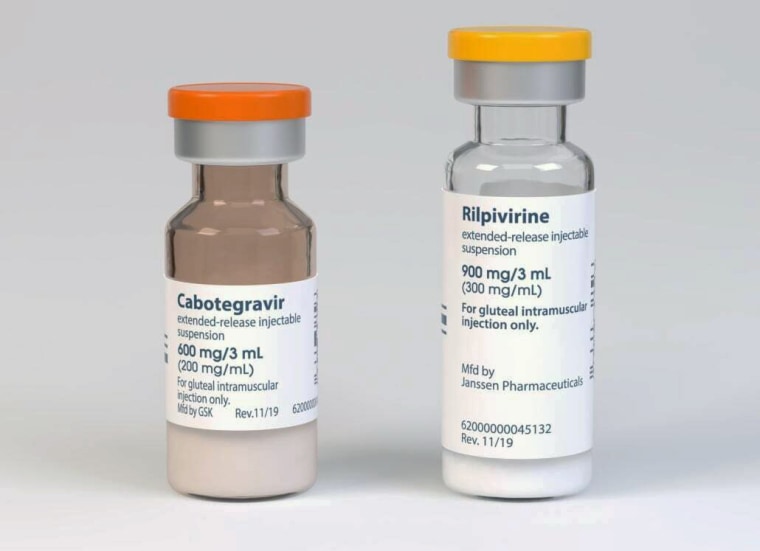
U.S. regulators have approved the first long-acting drug combo for HIV, monthly shots that can replace the daily pills now used to control infection with the AIDS virus.
Thursday’s approval of the two-shot combo called Cabenuva is expected to make it easier for people to stay on track with their HIV medicines and to do so with more privacy. It’s a huge change from not long ago, when patients had to take multiple pills several times a day, carefully timed around meals.
Vials of the HIV treatment Cabenuva.ViiV Healthcare via AP
“That will enhance quality of life” to need treatment just once a month, said Dr. Steven Deeks, an HIV specialist at the University of California, San Francisco, who has no ties to the drug’s makers. “People don’t want those daily reminders that they’re HIV infected.”
Cabenuva combines rilpivirine, sold as Edurant by Johnson & Johnson’s Janssen unit, and a new drug — cabotegravir, from ViiV Healthcare. They’re packaged together and given as separate shots once a month. Dosing every two months also is being tested.
The U.S. Food and Drug Administration approved Cabenuva for use in adults who have had their disease well controlled by conventional HIV medicines and who have not shown signs of viral resistance to the two drugs in Cabenuva.
The agency also approved a pill version of cabotegravir to be taken with rilpivarine for a month before switching to the shots to be sure the drugs are well tolerated.
ViiV said the shot combo would cost $5,940 for an initial, higher dose and $3,960 per month afterward. The company said that is “within the range” of what one-a-day pill combos cost now. How much a patient pays depends on insurance, income and other things.
Studies found that patients greatly preferred the shots.
“Even people who are taking one pill once a day just reported improvement in their quality of life to switch to an injection,” said Dr. Judith Currier, an HIV specialist at the University of California, Los Angeles. She consults for ViiV and wrote a commentaryaccompanying one study of the drug in the New England Journal of Medicine.
Deeks said long-acting shots also give hope of reaching groups that have a hard time sticking to treatment, including people with mental illness or substance abuse problems.
“There’s a great unmet need” that the shots may fill, he said.
Separately, ViiV plans to seek approval for cabotegravir for HIV prevention. Two recent studies found that cabotegravir shots every two months were better than daily Truvada pills for keeping uninfected people from catching the virus from an infected sex partner.
California on Monday became the first state to record more than 3 million known coronavirus infections.
The grim milestone, as tallied by Johns Hopkins University, wasn’t entirely unexpected in a state with 40 million residents but its speed stunning. The state only reached 2 million reported cases on Dec. 24.
The first coronavirus case in California was confirmed last Jan. 25. It took 292 days to get to 1 million infections on Nov. 11 and 44 days to top 2 million.
California’s caseload is also far ahead of other large states. Texas had more than 2 million and Florida topped 1.5 million.
The state has recorded more than 33,600 deaths related to COVID-19.
A caseload surge that began last fall has strained hospitals and especially intensive care units as a percentage of the infected — typically estimated to be around 12% by public health officials — become sick enough weeks later to need medical care.
On average, California has seen about 500 deaths and 40,000 new cases daily for the past two weeks.
Officials warn that a recent slight downward trend in hospitalizations could reverse when the full impact of New Year’s Eve gathering transmissions is felt.
The state is placing its hopes on mass vaccinations to reduce the number of infections but there have been snags in the immunization drive. On Sunday, Dr. Erica S. Pan, the state epidemiologist, urged that providers stop using one lot of a Moderna vaccine because some people needed medical treatment for possible severe allergic reactions.
More than 330,000 doses from lot 41L20A arrived in California between Jan. 5 and Jan. 12 and were distributed to 287 providers, she said.
In Northern California, Stanislaus County health officials responded by announcing they wouldn’t be holding vaccination clinics until further notice.
“Out of an extreme abundance of caution and also recognizing the extremely limited supply of vaccine, we are recommending that providers use other available vaccine inventory” pending completion of an investigation by state officials, Moderna, the U.S. Centers for Disease Control and the federal Food and Drug Administration, Pan said in a statement.
Fewer than 10 people, who all received the vaccine at the same community site, needed medical attention over a 24-hour period, Pan said. No other similar clusters were found.
Pan did not specify the number of cases involved or where they occurred.
Six San Diego health care workers had allergic reactions to vaccines they received at a mass vaccination center on Jan. 14. The site was temporarily closed and is now using other vaccines, KTGV-TV reported.
Moderna in a statement said the company “is unaware of comparable adverse events from other vaccination centers which may have administered vaccines from the same lot.”
The CDC has said COVID-19 vaccines can cause side effects for a few days that include fever, chills, headache, swelling or tiredness, “which are normal signs that your body is building protection.”
However, severe reactions are extremely rare. Pan said in a vaccine similar to Moderna’s, the rate of anaphylaxis — in which an immune system reaction can block breathing and cause blood pressure to drop — was about 1 in 100,000.
The announcement came as California counties continue to plead for more COVID-19 vaccine as the state tries to tamp down its rate of infection, which has resulted in record numbers of hospitalizations and deaths.
California has shipped about about 3.2 million doses of the vaccine — which requires two doses for full immunization — to local health departments and health care systems, the state’s Department of Public Health reported Monday.
Only about 1.4 million of those doses, or around 40%, have been administered.
So far, the state has vaccinated fewer than 2,500 people per 100,000 residents, a rate that falls well below the national average, according to federal data.
Although Gov. Gavin Newsom announced last week that anyone age 65 and older would be eligible to start receiving the vaccine, Los Angeles County and some others have said they do not have enough doses to vaccinate that many people and are first concentrating on inoculating health care workers and the most vulnerable elderly living in care homes.
The death rate from COVID-19 in Los Angeles County — the nation’s most populous and an epicenter of the state pandemic — works out to about one person every six minutes.
On Sunday, the South Coast Air Quality Management District suspended some pollution-control limits on the number of cremations for at least 10 days in order to deal with a backlog of bodies at hospitals and funeral homes.
“The current rate of death is more than double that of pre-pandemic years,” the agency said.
California surpassed 25,000 coronavirus deaths since the start of the pandemic and officials disclosed Thursday that three more cases involving a mutant variant of the virus have been confirmed in San Diego County.
The grim developments came as an ongoing surge swamps hospitals and pushes nurses and doctors to the breaking point as they brace for another likely increase after the holidays.
“We’re exhausted and it’s the calm before the storm,” said Jahmaal Willis, a nurse and emergency room leader at Providence St. Mary Medical Center in Apple Valley. “It’s like we’re fighting a war, a never-ending war, and we’re running out of ammo. We have to get it together before the next fight.”
Public health officials continued to plead with residents just hours before the start of 2021 not to gather for New Year’s Eve celebrations.
In Los Angeles County, where an average of six people die every hour from COVID-19, the Department of Public Health tweeted out snippets every 10 minutes on lives that have been lost.
“The hair stylist who worked for 20 years to finally open her own shop.”
“A grandmother who loved to sing to her grandchildren.”
“The bus driver who put her daughter through college and was beaming with pride.”
The tweets, which included messages to wear a mask, physically distance, stay home and “Slow the spread. Save a life,” came on a day when the county reported a record 290 deaths. That would be a rate of one death every five minutes, though it included a backlog.
Los Angeles County, which has a quarter of the state’s 40 million residents, has had 40% of the deaths in California, the third state to reach the 25,000 death count. New York has had nearly 38,000 deaths, and Texas has had more than 27,000, according to a tally by Johns Hopkins University.
Infections are spreading rapidly. San Diego County confirmed Thursday that it had found a total of four cases of the virus variant that appears to be more contagious. A 30-year-old man tested positive for the variant on Wednesday and three more men — two in their 40s and one in his 50s — also have been confirmed to have the strain. Other cases involving the variant have been confirmed in Florida and Colorado.
At least two of the men in San Diego County hadn’t traveled outside of the country and none had “any known interaction with each other,” the county said. Officials believed many more cases will surface.
San Diego County also reported a record high number of new deaths in a single day at 62, well over the previous record of 39 reported only a week earlier.
Hospitals, particularly in Southern California and the agricultural San Joaquin Valley in the middle of the state, have been overrun with virus patients and don’t have any more intensive care unit beds for COVID-19 patients.
In Los Angeles County, hospitals have been pushed “to the brink of catastrophe,” said Dr. Christina Ghaly, health services director. “This is simply not sustainable. Not just for our hospitals, for our entire health system.”
Cathy Chidester, director of the county’s Emergency Medical Services Agency, said hospitals are facing problems with oxygen with so many COVID-19 patients needing it because they are struggling to breathe. Older hospitals are having difficulty maintaining oxygen pressure in aging infrastructure and some are scrambling to locate additional oxygen tanks for discharged patients to take home.
Ambulances are being forced to wait in bays as long as eight hours before they can transfer patients inside hospitals — and in some cases, doctors are treating patients inside ambulances, she said.
At Providence St. Mary Medical Center, about 60 miles (100 kilometers) east of Los Angeles, there is a cacophany of alarms that sound when a patient’s heart stops and a constant hiss from the oxygen keeping so many alive, Willis said. The hospital has filled the triage area with beds and is assessing new arrivals in the parking lot. Three dozen patients were waiting to be admitted.
“We’re overflowing,” Willis said. “We’re treating patients in chairs, we’re treating patients in the hallways.”
In Santa Clara County, home to Silicon Valley, only 8% of ICU beds were available, which is better than many places. Hospitals are still “stretched to the limit,” said Dr. Ahmad Kamal, county director of healthcare preparedness.
Two months ago, the county had 4.5 cases per 100,000 people. Now it has 50 cases per 100,000.
“What we are seeing now is not normal,” Kamal said. “It is an order of magnitude more than we saw just two months ago. We are not out of the woods. We are in the thick of the woods. And we all need to redouble our efforts.”
Kamal said the one bit of good news was that hospitals hadn’t felt the additional pressure of new cases after Christmas that they did after Thanksgiving, which has led to the current surge.
But public health officials fear a double-whammy from people who gathered at Christmas and New Year’s will create a surge upon a surge. They made their final pleas to persuade people to stay home on what is typically one of the biggest party nights of the year.
“We recognize the temptation and the frustration,” Los Angeles County Public Health Director Barbara Ferrer said. “You may simply want to stray for one night to celebrate with friends. However, all it takes is one slip to have one exposure and the coronavirus has found another host, another victim, and our dangerous surge continues.”
Most of the state is under a 10 p.m. curfew and newly extended restrictions that have closed or reduced capacity of businesses. People people are being urged to stay home as much as possible to try to slow the spread of infections.
Police in Los Angeles will be patrolling streets and looking to shut down large New Year’s Eve gatherings, Mayor Eric Garcetti said. San Diego Mayor Todd Gloria issued an executive order directing stricter enforcement of state and local public health rules.
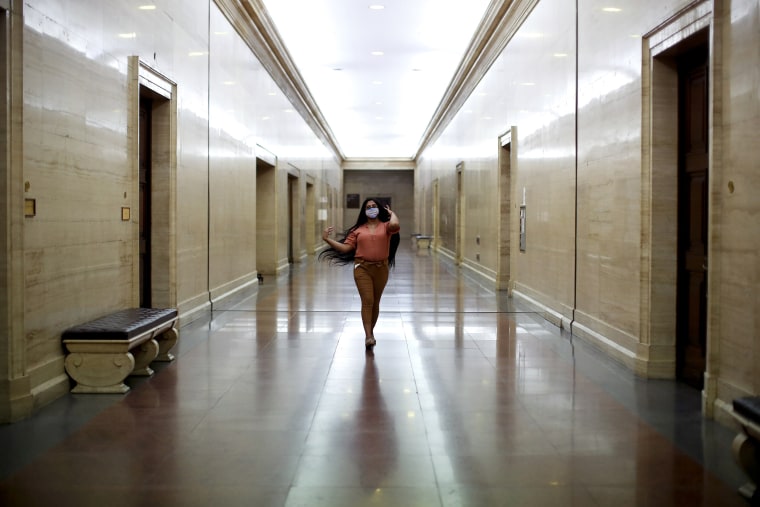
The 23-year-old joined the human resources department of Banco Nación, Argentina’s leading state bank, this year. In September, President Alberto Fernández signed a decree establishing a 1 percent employment quota for transgender people in the public sector.
Only neighboring Uruguay has a comparable quota law promoting the labor inclusion of transgender people, who face discrimination in the region. According to Argentina’s LGBTQ community, 95 percent of transgender people do not have formal employment, with many forced to work in the sex industry where they face violence.
Transgender woman Angeles Rojas poses for a photo as she walks down a corridor of the National Bank where she works in Buenos Aires on Nov. 5, 2020.Natacha Pisarenko / AP
“If all the institutions implemented the trans quota, it would change a lot for many of my colleagues. It would change the quality of their lives and they would not die at 34, or 40, which is their life expectancy today,“ said Rojas, who has long, black hair and intense dark eyes.
There are no official figures on the size of the transgender community in Argentina, since it was not included in the last 2010 census. But LGBTQ organizations estimate there are 12,000 to 13,000 transgender adults in Argentina, which has a population topping 44 million.
Argentina, a pioneer in transgender rights, in 2010 enacted a marriage equality law and in 2012 it adopted an unprecedented gender identity law allowing transgender people to choose their self-perceived identity regardless of their biological sex. The law also guarantees free access to sex-reassignment surgeries and hormonal treatments without prior legal or medical consent.
Rojas’ life story is similar to that faced by many other transgender people.
She came to Buenos Aires three years ago from a small town in northern Argentina, fleeing intolerance, but things were still tough in the capital and she was forced to prostitute herself.
One morning, a client invited her into his car to go to a hotel. But he strayed from the route to the hotel, took out a gun and told her “give me your wallet.”
“I didn’t know what to do,” Rojas said. “I grabbed the steering wheel and he hit me. I woke up three days later in the hospital with a facial fracture, facial reconstruction and the loss of hearing in one ear.”
After spending three months in the hospital, Rojas left sex work and became an activist for the transgender community.
She says she “feels comfortable, happy with the treatment they give me” at the bank.
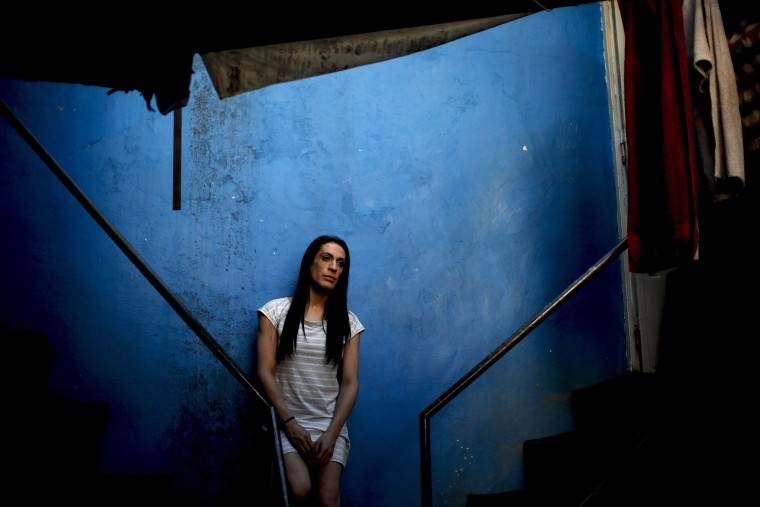
Transgender woman Guadalupe Olivares, who earns money as a sex worker, poses for a photo at the hotel where she lives in Buenos Aires on Nov. 16, 2020.Natacha Pisarenko / AP
Many transgender people live in the Gondolín, a building in the Buenos Aires’ Palermo neighborhood with a blue front and painted mural of a mermaid and colored hearts. Transgender women come and go from the shared bathrooms to their rooms.
Guadalupe Olivares dons the pants, black shirt and briefcase she chose for an earlier job interview at the Ministry of Social Development.
“I think almost 100 percent of us have never had a registered job. You don’t know what a paycheck is. It’s a totally new world,” said Olivares, 33, who comes from San Juan province.
Smoking a cigarette and drinking a soda, Olivares said she submitted a lot of resumés. “When they called, I felt there was discrimination,” she said. “They didn’t tell you: ‘we’re not going to hire you as a ‘trava’ (transvestite),’ but they had that look asking why was I there.”
A report by the Latin American and Caribbean Network of Trans People published in December said “the vast majority of trans women in the region have sex work as their sole economic and subsistence livelihood.”
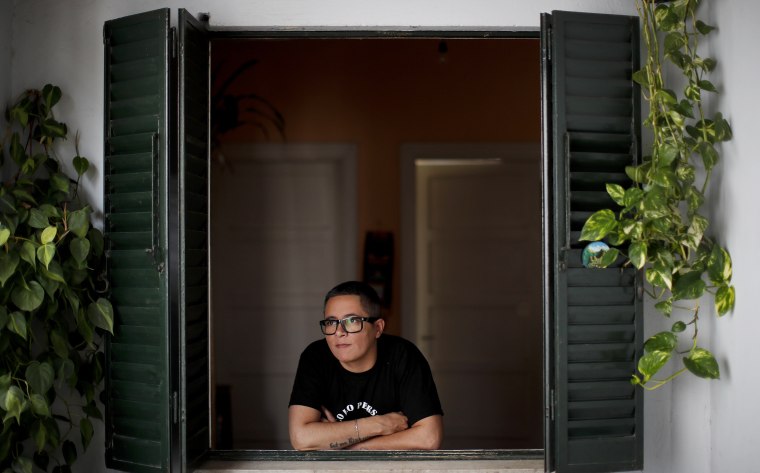
Transgender man Ese Montenegro, an activist hired as an adviser to the Chamber of Deputies’ women’s and diversity commission, at his home in Buenos Aires, on Nov. 25, 2020.Natacha Pisarenko / AP
It goes on to say: In Latin America and the Caribbean transgender people have their right to work violated along with all their human rights, and this takes place “in a context of extreme violence.”
There have been advances in Argentina. This year, Diana Zurco became the first transgender presenter of Argentine television news, Mara Gómez was authorized by the Argentine Football Association to play in the professional women’s league and soprano María Castillo de Lima was the first transgender artist to go on stage at Teatro Colón.
However, the gap between the equality established by law and the real one remains large, warned Ese Montenegro, a male transgender activist hired as an adviser to the Chamber of Deputies’ women’s and diversity commission.
“We lack a lot, we lack education and political decision. We lack material and symbolic resources. There is a violence that is structural,” he said.
When she heard a knock on the door, Colin Monahan figured it had to be about the new garage.
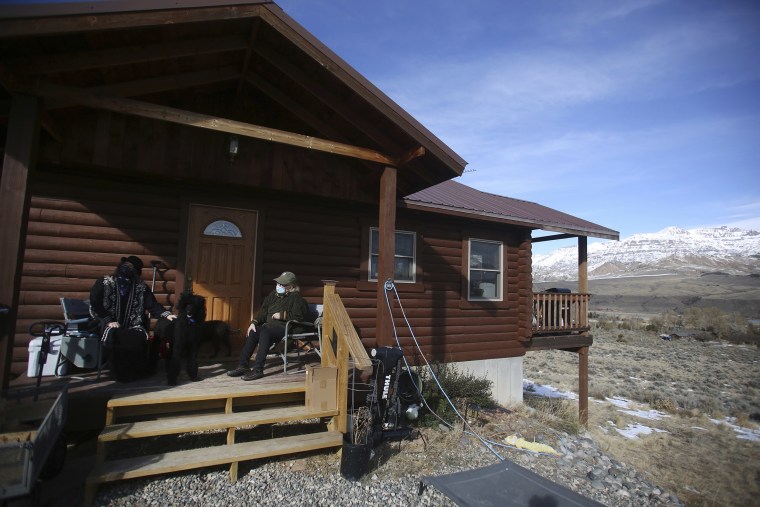
Monahan and her wife, Shannon Lastowski Monahan, had just finished dinner. Their guests had all departed, leaving the couple alone at their log home well off the main road in the rural community of Wapiti, a village of a few hundred in northwest Wyoming. Colin had just finished installing a new, prefabricated garage on their property, painted in a shade of brown to complement the waving grasses of the surrounding valley.
Donning their masks and opening the door, the couple were greeted by five people standing on their porch, there to discuss a “neighborhood issue” — presumably, Colin thought, the garage.
It would have been a strange complaint. The couple had received permission to install it from the subdivision’s management, and the area’s lack of a homeowners’ association made concerns over aesthetics questionable at best. The iconic Smith Mansion — a twisting structure looming on a bluff overlooking Highway 14 — is visible from the couple’s porch, while the subdivisions surrounding them feature a broad mix of architectural styles that had sprouted amid a flood of new residents discovering the Wyoming countryside.
The garage, as it turned out, wasn’t the problem, the Casper Star-Tribune reported.
Shannon Lastowski Monahan and Colin Monahan sit on the front porch of their home in Wapiti, Wyo. Thursday, Oct. 29, 2020.Cayla Nimmo / AP
Looking over the group, the Monahans — a same-sex couple originally from the Chicago area — recognized a familiar face, a man who the couple said had previously harassed them on social media. Both Colin and Shannon, residents of the subdivision four years now, quickly came to realize that the conversation was never about a garage, and was never intended to be.
It was about Colin, who dresses masculine but, in her own words, could be seen as either male or female. She goes by “Colleen” as often as she does “Colin.”
“One of the women said to us, ‘Your kind is not welcome here. You are not welcome in Cody Country and you need to leave,’” Shannon recalled in an interview shortly after the October incident. “She told Colin, ‘You pretend to be a man, and you need to leave.’”
The incident sparked a conversation that reverberated through Wapiti and into the greater Park County community, including Cody, a popular tourist town of 10,000.
Some businesses made clear their support for the LGBTQ community. Sunlight Sports, a sporting goods store on Cody’s main strip, declared on its social media pages that bigots were not welcome inside.
The owners, Wes and Melissa Allen, stressed that they believed that 99 percent of county residents are good people. But they had an unblinking message for the rest.
“If you hate your neighbors so much for who they are — who they love, the color of their skin, where they were born, where they worship, or any of the other things that make up that person — that you need to treat them differently or harass them or make them feel unsafe in their own home, don’t come into our business,” they wrote.
Other businesses began stocking merchandise in solidarity with the couple, producing stickers and buttons with rainbow flags and slogans supportive of the LGBTQ community. But that, in turn, touched off a wave of bigotry on social media, directed at the couple as well as others who publicly supported them. On one local Facebook group, a man described the couple as “liberal socialist democratic homosexual transvestites from Chicago” who “hate this country.” Suggestions of the need for a hate crime bill were described in a letter to the local newspaper as “dangerous” and “Orwellian,” while others cast doubt that the incident happened at all.
“It leads to social justice warriors proclaiming far and wide that Wapiti and all of Wyoming is a racist and homophobic state and needs hate crime laws enacted because all allegations must be immediately and totally believed,” one woman wrote on another Facebook group.
Isolated among a few individuals or not, that response was seen by some as a symptom of a rage brewing among a vocal minority of Park County during a time of dramatic change. But that bigotry also prompted others in the community to stand up and say, “Enough.”
The question is, will it be?
“We have employees and friends and neighbors who don’t fit the ‘white Caucasian’ profile who have been made to feel uncomfortable in our town in recent months,” Wes Allen said in an interview. “Our perception was that it was getting worse. And we’ve already been having conversations in our community when this happened. But this was the time we knew we had to come out and say something. Because if we weren’t going to say something publicly when something bad happened, we have no right to say anything at all.”
A community in flux
Nestled in the foothills at the end of a winding maze of dirt and gravel, the cabin shared by Colin, Shannon and their two dogs doesn’t stand out much from the rest of the homes in the Cody Country subdivision, which sits between Cody and Yellowstone National Park.
From the small porch of the couple’s slice of land, a herd of elk could be seen resting in the distant prairie. Around them, snow-capped peaks stretch around the periphery of the Shoshone River Valley and the North Fork Highway below.
It’s an easy place to disappear in, and plenty have over the years, drawn by the promise of seclusion and the region’s beautiful surroundings.
Manda Siebert’s family has owned a gas station in Wapiti for decades. In that time she has watched the area grow from a minuscule farming community into a tapestry of subdivided ranchland and new construction, with each new subdivision constructed over the past two decades as controversial as the next. “Cultural issues,” as they were called at the time, were of concern even in 2004, when residents raised an uproar over the development of the Copperleaf subdivision, with one man saying at the time that it was not the subdivision itself that was controversial but “the product anticipated which makes it so contentious.”
“There’s been a little bit of an uproar from people upset that more and more people are moving here,” said Siebert, whose business sits across the street from a former hayfield. “But when I was a kid, this was all open. None of this was subdivided. If somebody hadn’t sold their land, those people would not be living here, either. You have to put the shoe on the other foot: If you were living in these big cities and wanted something different, wouldn’t you want to move out here?”
That change has been accelerating in the region. When a Star-Tribune reporter called the Park County planning office last month, an official there said that inquiries concerning building permits and subdivisions have roughly tripled this year, while the rate of home sales among COVID-19 refugees — like similarly attractive corners of the Mountain West — continues to outpace annual averages. According to reporting by the Enterprise, 2020 presented one of the office’s busiest years on record, with the office processing more applications for building permits and subdivisions through the month of July than it did all of last year.
That, in turn, has created tension among some who fear the new arrivals are spoiling the promise of Wyoming.
“There’s a really strong sentiment of resentment when people are buying property here,” Shannon said. “When you’re used to having the view a certain way and then people move in… There’s even been someone — we don’t know who — who has been tearing up the ‘for sale’ signs by the gate.”
Cody Mayor Matt Hall said the first tinges of such a change were felt with the arrival of rapper Kanye West last year. That feeling, the Cody native says, has been amplified by conservative-leaning newcomers in the last few years who believed they would find a city of like-minded people waiting for them upon their arrival. New businesses in town are attracting new residents as well, changing the fabric of the community.
“I talk to the police chief a lot about making sure that we’re managing people’s reactions to things in a way that is going to be fair for everyone, that we’re not going to pull somebody over just because they don’t look like you or anything like that,” Hall said. “It’s interesting to have to grapple with those kind of issues.”
That feeling has bled into the local politics as well. The area’s Republican primary between Rep. Sandy Newsome and former Hot Springs County Clerk Nina Webber featured some of the most vicious politics seen anywhere in Wyoming this election cycle. Meanwhile, members of the community marching in solidarity with the national Black Lives Matter movement earlier this summer were met with armed residents wary of perceived threats from outside agitators that never coalesced. Community Facebook pages with names such as the “Wapiti Whisper” or “Cody Chit Chat” have been increasingly dominated by political discussions fueled by rage and contempt, with dissenting voices being shouted down.
“They’re just really hard to read,” said Sarah Growney, a local business owner and a Cody resident of nearly two decades who has been an active supporter of the Monahans. “It just creates a culture of acceptance for that kind of language or hate. My honest-to-God opinion is that we are not talking about a lot of people, but they’re just very loud. Most people who live in Wapiti or Cody aren’t bad. I think most are good. It’s just the ones who express this kind of hatred are really loud.”
It’s contributed to a shift in sensibilities local leaders say are as much a byproduct of the current pandemic as it is a symptom of a greater demographic shift in the Equality State. Longtime Wyoming residents such as Hall say his community has grown increasingly conservative in the Trump era, and in particular since the tail end of Gov. Matt Mead’s administration, a trend residents say has been exacerbated by outsiders attracted to the area’s natural beauty as much as the state’s deep red politics.
But some people haven’t realized just how diverse their community has become. When counterprotests emerged in the wake of June’s Black Lives Matter demonstrations, Hall found himself playing intermediary between marchers and armed residents unconvinced that a fellow Wyomingite could have different politics than they did.
“I was talking to some friends of mine who estimated at least 70% of that crowd was from outside of the area,” said Hall, a lifelong Cody resident. “Almost every one of them was from the Bighorn Basin. I said, ‘Instead of sitting there with your gun waiting for them to give you a reason to try and shoot them, why don’t you try talking to them?’ We all like to live here, we all like to fish and hunt here. I mean … the commonalities probably exist way more than probably the disparities.”
Small towns, long streets
Wyoming is often characterized as a “small town with long streets,” both for its small population and the neighborly disposition of its residents. Given that reality, how can some people be so blind to their neighbors or unwilling to accept people who might be different?
It’s a paradox that some, like Allen, the shop owner whose social media post provoked a considerable response, have come to understand.
“Wyoming’s always been so lightly populated that you don’t get to really choose your neighbors,” he said. “If you’re going to survive here, you need to develop this thing where you can get along with everybody. If you are mad because your neighbor was one thing or another and you only had like three neighbors, and when things got bad if you would antagonize them … there would be nobody for you to fall back on. And so the culture has become one of tolerance in general.”
Park County already has a small but vibrant LGBTQ community, and one that existed prior to the migration that’s brought many new faces to the area of late.
One of the members of that community is Nikki Flowers, a Cody resident who moved to the area as a high school sophomore nearly two decades ago. In 2014, Flowers became one of the first women to be granted a same-sex marriage license in Park County with her spouse, Desiree, whom she first met in the halls of Cody High School. Even with same-sex marriage controversial in Wyoming at the time, Flowers said she received little pushback in the community save for her mother and the county clerk at the time, who refused to perform the ceremony.
Then the incident in Wapiti happened.
“It hurt my heart,” she said. “What happened to that couple was just terrifying. I mean, I don’t know what I would do. If something like that happened to me… It’s scary. And I’ve never felt scared in this town.”
Newcomers still find themselves wary of the state’s legacy, still tainted by memories of the 1998 murder of gay University of Wyoming student Matthew Shepard. Growney, who has two fathers, dealt with it the first time her dad came to visit, fearful of the way he was dressed and of those who weren’t accepting of people like him. Over time, however, her fear subsided with the growing understanding of her neighbors, who had regularly begun to interact with her fathers and over time began to understand that the men were just like them in a plethora of ways.
“I’m a believer in the idea that ignorance breeds fear,” Growney said. “These folks are anti-whatever they are because they don’t know someone gay, they’ve never lived with black people, or they’ve never been away to school. Their whole existence has been here, in Wyoming.”
Changing the conversation
But sheer exposure is not a sufficient antidote for bigotry.
In a converted greenhouse in the atrium of Cody High School, Amy Gerber — a science teacher of 32 years — had just finished a consultation with a student who had run into issues at home when a reporter arrived to talk with Gerber.
For the past several years, she has served as faculty adviser for the school’s Gay Straight Alliance, a role she developed as a way to provide a safe space for students who felt they did not have one either in the classroom or at home.
A mother to a gay son, Gerber herself saw bigotry on its face when a group of her 14-year-old son’s classmates threw a slur at him as they drove through the parking lot.
“It just broke my heart,” she said. “That’s the last thing you want as a mom. You don’t want people to be mean to your kid. You want people to care about you and care about your kid, and not judge them for being gay.”
Her son asked her not to respond, fearing it would put an even bigger target on his back. But she wanted to do something.
Ten years later — long after her son had graduated — she decided to hang a rainbow flag in her room, a sign of solidarity for a group of students she knew existed but had no means of connecting with. That small show of solidarity, she said, eventually grew into the school’s GSA, which today counts several dozen students among its ranks.
It was an unthinkable prospect during the time her son was in school. She knew several members of the local school board would fight her on it, while the effort itself encouraged opponents to come out of the woodwork. One caller into a morning talk show at the time, she recalled, asked why the school needed a club where “boys were liking boys and girls were liking girls.”
“It was ridiculous. But that was the perception,” Gerber said. “For me, I wasn’t sure whether that was the perception of the whole community, or if it was just a handful of people who have this type of worldview and are just really vocal about it? You really just don’t know.”
The incident in Wapiti drew similar feelings. After being quoted in a local news article about what happened, Gerber was barraged with hate mail and comments on Facebook disparaging her, prompting a former student of hers — the one who helped her start the GSA — to tell community members that the hatred he saw emerging was precisely the Cody he knew.
“I would love to say collectively as a community, there’s way more of us who support the live-and-let-live mentality, that you’re welcome here,” Gerber said. “Gay, straight, black, white doesn’t matter. Like, you’re welcome. But the truth is, even if it’s not the majority, there is a fraction of our community that is just loud, and makes the community seem like it stands for something that it doesn’t.”
The aftermath
Several weeks after the incident, Colin and Shannon are both in good spirits, but still on edge.
Colin, a hunter and an owner of several guns, was just days removed from getting fingerprinted for a concealed carry permit, a little extra security should the worst happen. What worries her most, she said, is the prospect of what won’t happen.
In the years since Shepard’s murder set off a national movement for hate crime legislation, Wyoming lawmakers have failed to enact a similar law despite the pleas of various nonpartisan commissions, small businesses and even the LGBTQ community itself. Critics of hate crime legislation say the state’s constitution is sufficient to protect the rights of everyone.
But Colin, who has faced hate up close, doesn’t feel that protection.
“The bigger story is this culture here, and ultimately, why Wyoming needs hate crime legislation,” she said. “They don’t think that they have an issue, and yet they repeatedly have issues here.”
Still, there are growing signs of tolerance and support. People in Cody and Wapiti banded together in their own way to reject what had happened in their communities. A conservative family near the couple brought them fresh vegetables. Newsome, the Republican lawmaker, announced efforts to co-sponsor hate crime legislation in the coming session. Businesses and community members have been vocal in their support. Across from the town hall, a rainbow flag could be seen hanging from a porch. Down the street, Growney’s gift shop, The Thistle, had already sold out of one batch of pro-LGBTQ stickers.
So what happens now? Will the incident that provoked so much debate and consternation lead to real change?
Colin Monahan and Shannon Lastowski Monahan shared their story, and the community stood up to respond. They just hope that the risk they took was not made in vain, and that their experience — a couple singled out for who they love — underscores the need for a greater level of protection for people like them.
“We can’t be protected by weapons,” Shannon said. “We have an alarm system, surveillance cameras, all of that, but that can only help so much. It gives you a small sense of reducing the risks. But the courts aren’t going to protect us. … It’s just a simple trespass. I guess I just never realized before how vulnerable we are.”
The first study of its kind found that people who are gay, lesbian, bisexual, transgender, queer or gender non-confirming are nearly four times as likely to be victims of violent crime than those outside such communities.
Although other research has long shown that LGBTQ people and gender minorities are disproportionately affected by crime, the study published in Science Advances, a multidisciplinary journal, on Friday looked at data that has only been collected since 2016, making for the first comprehensive and national study to examine the issue.
It found that members of such communities, referred to as sexual and gender minorities, experienced a rate of 71.1 violent victimizations per 1,000 persons a year, compared with 19.2 per 1,000 a year among non-sexual and gender minorities.
But it was the fact that sexual and gender minorities are victims of such a variety of crimes at such disparate rates — and who they’re victimized by — that surprised researchers, said lead author Andrew R. Flores, an assistant professor at American University.
For example, researchers found that such a population is much more likely to be victimized by someone they know well than a person who is a non-sexual and gender minority.
The fact that sexual and gender minorities are victimized by people close to them at such higher rates “does kind of raise questions hopefully future research can address about the nature of these incidents and the nature of these relationships,” Flores said.
“There are certain socializations that goes in that. I think many people are socialized and have a certain disdain for trans and queer people,” said Tori Cooper of the Human Rights Campaign, a national organization that advocates for the LGBTQ community. Cooper is the director of community engagement for the organization’s Transgender Justice Initiative.
A survey of more than 12,000 LGBTQ teens around the country released in 2018 by the Human Rights Campaign found that 67 percent report they’ve heard family members make negative comments about LGBTQ people.
Cooper said transgender people are particularly vulnerable, especially by partners or people close to them. The HRC has documented the killings of at least 29 transgender or non-gender conforming people in 2020 alone. The majority were Black and Latina transgender women.
“There’s an incalculable amount of transphobia … that plays into these relationships,” Cooper said.
The new study didn’t have a large enough sample of surveys by transgender people to come to a conclusion about their specific victimization rates, but Flores said other research has shown they are particularly vulnerable.
The study also found that sexual and gender minorities are burglarized at twice the rate of other households, and that they’re more likely to be victims of other types of property theft.
The study is based on a national crime survey conducted by the federal Bureau of Justice Statistics, which until 2016 had not asked respondents about their sexual orientation and gender identity. Researchers examined responses to the 2017 survey, which was released last year.
But it may be a while before researchers can look at the data in this way again. The Trump administration, without seeking public comment, announced that it was moving the sexual orientation and gender identity questions from the general demographic section of its national crime survey to a part of the survey only pertaining to victims. This will limit what researchers can learn about crime disparities because asking only victims about their sexual or gender identification makes it impossible to compare those rates of violence to the general population.
The U.S. Department of Education is threatening to withhold some federal funding from Connecticut school districts if they follow a state policy that allows transgender girls to compete as girls in high school sports.
In response to a complaint filed last year by several cisgender female track athletes who argued that two transgender female runners had an unfair physical advantage, the federal agency’s office for civil rights determined in May that Connecticut’s policy violates the civil rights of athletes who are not transgender.
Bloomfield High School transgender athlete Terry Miller, second from left, wins the final of the 55-meter dash over transgender athlete Andraya Yearwood, far left, and other runners in the Connecticut girls Class S indoor track meet at Hillhouse High School in New Haven on Feb. 7, 2019.Pat Eaton-Robb / AP file
School districts including New Haven, as well as the Capitol Region Education Council, were asked around the beginning of September to sign a document to receive grants from a program for magnet schools that states they will “not participate in any interscholastic sporting events” unless the Connecticut Interscholastic Athletic Conference changes its policy on transgender athletes.
The Federal Magnet Schools Assistance Program Grants are worth about $3 million a year to New Haven and the education council.
The athletic conference has said its policy is designed to comply with a state law that requires all students to be treated as the gender with which they identify.
But the U.S. Education Department’s Office for Civil Rights argues the policy violates the civil rights of girls who are not transgender under Title IX, the federal law that guarantees equal opportunities in education.
The department did not immediately respond Thursday to a request for comment.
New Haven Mayor Justin Elicker said his city could lose the final two years of funding for its five-year magnet school grant federal when the federal fiscal year ends this month.
“It would basically mean that New Haven schoolchildren would have less access to educational opportunities,” he said. “There are teachers and administrative staff that support our program that are fully funded by this grant.”
He and Timothy Sullivan Jr., the superintendent of schools for the education council, said they have no intention of signing the document.
“It is unconscionable that the federal government would threaten to take away funds that support Hartford area children during a pandemic, and we will fight to keep the money in our community,” he said. “However, no amount of money will deter us from accepting all children for who they are and providing equitable access to programs and services.
The state’s congressional delegation also sent a letter Thursday to Kimberly Richey, the U.S. Education Department’s acting assistant secretary for civil rights, calling the department’s action “an unprecedented overreach.”
“This case is anything but normal, and it is clear that OCR is unwilling to enter conversations with (grant) recipients, even to discuss reasonable options such as waiting until the court ruling on CIAC’s policy,” the delegation wrote.
The dispute over transgender participation in Connecticut high school sports is the subject of a federal lawsuit, filed in February by cisgender track athletes who argue they were denied championships and potential college scholarship opportunities as the result of having to compete against two transgender girls.
The ACLU of Connecticut, which is representing the transgender athletes, said the Trump administration is trying to pressure schools into denying transgender athletes an opportunity to compete.
“It’s incredibly mean spirited,” said Dan Barrett, the ACLU of Connecticut’s legal director. Connecticut Attorney General William Tong declined to say how the state will respond but said he is working with the school districts to secure their magnet school funding.
“Neither federal law nor Connecticut law tolerates discrimination against transgender students,” he said. “Transgender girls are girls, and the Office of the Attorney General will continue to protect every woman and girl in this state against discrimination.
Chick-fil-A said Monday that it no longer plans to open a restaurant in the San Antonio airport, even though the Texas city relented after more than a year of legal wrangling that began when some city leaders opposed the fast-food chain getting a spot, citing donations made by company owners to anti-LGBTQ causes.
“We are always evaluating potential new locations in the hopes of serving existing and new customers great food with remarkable service.” Chick-fil-A said in a statement. “While we are not pursuing a location in the San Antonio airport at this time, we are grateful for the opportunity to serve San Antonians in our 32 existing restaurants.”
In May last year, Texas Attorney General Ken Paxton asked U.S. Department of Transportation Secretary Elaine Chao to look into whether the city had broken federal law or transportation department regulations. He said the fast-food chain’s exclusion from the airport amounted to discrimination “due to the expression of the owner’s religious beliefs.” The complaint prompted an FAA investigation that ended July 24 with an informal resolution for San Antonio to allow Chick-fil-A to seek a lease in the city-owned airport.
Some Texas leaders broadly supported the company. Republican Gov. Greg Abbott signed a bill in 2019 in defense of Chick-fil-A and religious freedom. And on Monday, Paxton, also a Republican, heralded the agreement between San Antonio and Chick-fil-A.
“This is a win for religious liberty in Texas and I strongly commend the FAA and the City of San Antonio for reaching this resolution,” Paxton said in a statement. “To exclude a respected vendor based on religious beliefs is the opposite of tolerance and is inconsistent with the Constitution, Texas law, and Texas values.”
The FAA did not immediately returns calls seeking comment.
“The city itself offered to resolve the FAA investigation informally following Chick-fil-A’s publicly stated change-of-position on its charitable giving policy,” a city spokesman told San Antonio TV station KSAT. “The city maintains that at no point did it discriminate against Chick-fil-A.”
Atlanta-based Chick-fil-A has faced opposition elsewhere over its donations worth millions of dollars to groups that oppose same-sex marriage.
When a right-wing populist party won the right to govern Poland five years ago, Piotr Grabarczyk feared “bad things” might happen to gay men like him and other LGBTQ people. He sometimes considered leaving the country, but waited.
Friends and a job bound Grabarczyk to Warsaw, the relatively liberal capital city. He trusted that Poland’s membership in the European Union would protect his community. Yet his dwindling faith finally fell away as President Andrzej Duda campaigned for reelection on an anti-LGBTQ platform — and won.
Duda, who repeatedly described the LGBTQ rights movement as a dangerous “ideology,” was sworn into his second term Thursday. Grabarczyk, 31, is now gone, along with other gay, lesbian, bisexual and transgender Poles who have emigrated to escape what they consider homophobia promoted by the highest levels of government.
“Like where’s the line? Is there a line they are not going to cross? I don’t know,” Grabarczyk said after landing last week in Barcelona, Spain, where both same-sex marriages and adoptions are legal. “That was kind of scary.”
He spoke to The Associated Press alongside his boyfriend, Kamil Pawlik, 34, who left Poland three days after Duda beat Warsaw’s mayor in a runoff last month.
While gays and lesbians have never had the legal right to marry or to form civil unions in Poland, as they can in much of Europe, many felt confident until not long ago that Polish society was becoming more accepting and that those rights would one day come.
They have instead faced a furious backlash from the Catholic Church and the government. Duda proposed a constitutional amendment to prevent same-sex couples from adopting children. Last year, the Roman Catholic archbishop of Krakow warned of a “rainbow plague,” and the ruling Law and Justice party has described LGBTQ rights as a threat to families and Poland’s Catholic identity.
While Grabarczyk, an entertainment reporter and blogger with a large YouTube following, and freelance graphic designer Pawlik are not planning marriage or children right now, the proposed adoption ban was their exit sign. They felt that it showed a determination by the authorities to put discrimination into law, as President Vladimir Putin has done in Russia.
No statistics exist on how many LGBTQ people have left Poland. Activists say some departed after Law and Justice and Duda, who is backed by the party, came to power in 2015 and created an unfriendly climate for liberals and minorities.
As Duda faced a tough electoral challenge from Warsaw Mayor Rafał Trzaskowski, the rhetoric grew harsher. He called the LGBTQ movement an “ideology” worse than communism and declared that LGBTQ was “not people.” He formally proposed the same-sex adoption ban.
After his victory, Duda apologized for language he acknowledged was sometimes too “harsh.” A prominent LGBTQ activist, Bart Staszewki, nevertheless asked on Facebook if anyone was thinking of moving away from Poland. He received hundreds of replies, mostly from people saying they were contemplating it or had already left.
Britain, Germany, the Netherlands, Spain and other European Union countries are where LGBTQ emigres are envisioning their futures. They follow generations of Poles who have fled political repression at home, including during the communist era.
The recent exodus represents “a second wave of immigration” after the significant number of Poles who moved abroad to work when Poland joined the EU in 2004, Staszewski said.
“This time, people are not looking for better paid jobs, but they are looking for dignity and respect,” he said. “People want to feel that they are protected by the government and not treated as an enemy.”
Others are vowing to stay and fight for LGBTQ rights, among them Staszewski. The 29-year-old said he is inspired by the example of his grandparents, who participated in the underground Polish resistance against the German occupation of Poland during World War II.
But escape is not a realistic option for everyone, particularly those from rural areas without money, foreign languages or other skills required to start over in a new culture.
Michał Niepielski, 57, a radio technician in Krakow who has taken a case to the European Court of Human Rights in hopes of winning the right to marry his partner of 16 years, says he knows some English and could move, but would not be able to work in his field abroad.
Speaking to the AP, Niepielski confessed that he and his partner are “very afraid” but are trying to be positive in their social media comments. The EU’s recent decision to deny small amounts of funding to Polish towns declaring themselves to be “LGBT free” gave them enough hope to keep on going, he said.
“We have sympathy with the people who haven’t come out of the closet yet and now will have to stay in the closet for a long time, perhaps until the end of their lives,” Niepielski said. “That’s a tragedy. That’s one reason we are staying.”
LGBTQ rights have continued to be a flash point since the election. The Justice Ministry awarded funding to a project designed to counteract crimes “committed under the influence of LGBT ideology.”
Three activists protesting homophobia were detained this week and charged with the crimes of insulting monuments or offending religious feeling for hanging rainbow flags on statues in Warsaw, including one of Jesus. If convicted, they could face prison.
There is no law, however, making anti-LGBTQ hate speech a crime.
Grabarczyk, who recently published an ebook of coming-out stories titled “Mom, I’m Gay. Dad, I’m a Lesbian,” said he feels guilty about leaving others behind while he and his boyfriend live in Barcelona. He recalls feeling as a teenager when Poland joined joined the European Union like he was in a new world, where borders didn’t exist and he could easily meet people of different cultures, skin colors and sexual orientations.
“For us, it was a given to live in a world like that, and it’s all crumbling down now,” he said. “So it’s only natural to seek a place where we can return to that.”