At least four transgender people lost their lives in the space of a week, as trans homicides in the US reach the highest pace ever.
According to The Human Rights Campaign, at least 21 transgender or gender non-conforming people have been killed by violent means so far this year, nearly matching 2019’s total of 27.
The organisation says it has “never seen such a high number at this point in the year” since they began tracking this data in 2013, and other advocates across the US are horrified by the pace of “rampant and repeated” murders.
“It is ridiculous that we have to continue to hashtag our friends’ names and add them to a list of names to be memorialised every year, and that we expect it,” Carter Brown, executive director of National Black Trans Advocacy Coalition, told USA Today.
“We expect it because too many trans women of colour are continuously being murdered and beaten with minimum or no consequence being brought to the assailants.”
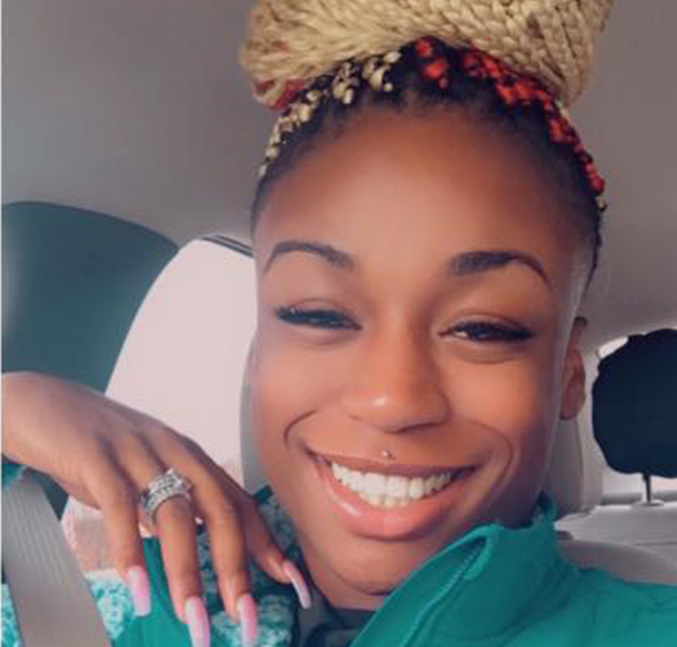
The deadly week began with the loss of Merci Mack, a 22-year-old Black transgender woman shot in the head in Dallas, Texas on June 30. She was initially misgendered and deadnamed by police and local media.
Mack’s death was followed by that of Shaki Peters, a 32-year-old Black transgender woman found dead in Amite City, Louisiana on July 1. Then came the murder of Bree Black, a 27-year-old Black transgender woman who was shot dead in her home in Pompano Beach, Florida, on July 3.
The fourth killing was that of Summer Taylor, a 24-year-old white non-binary person who was hit and killed by a car while participating in Seattle’s Black Femme March on July 4.
Transgender women of colour are known to suffer the highest levels of violence as they fall at the unfortunate intersection of transphobia and racism.
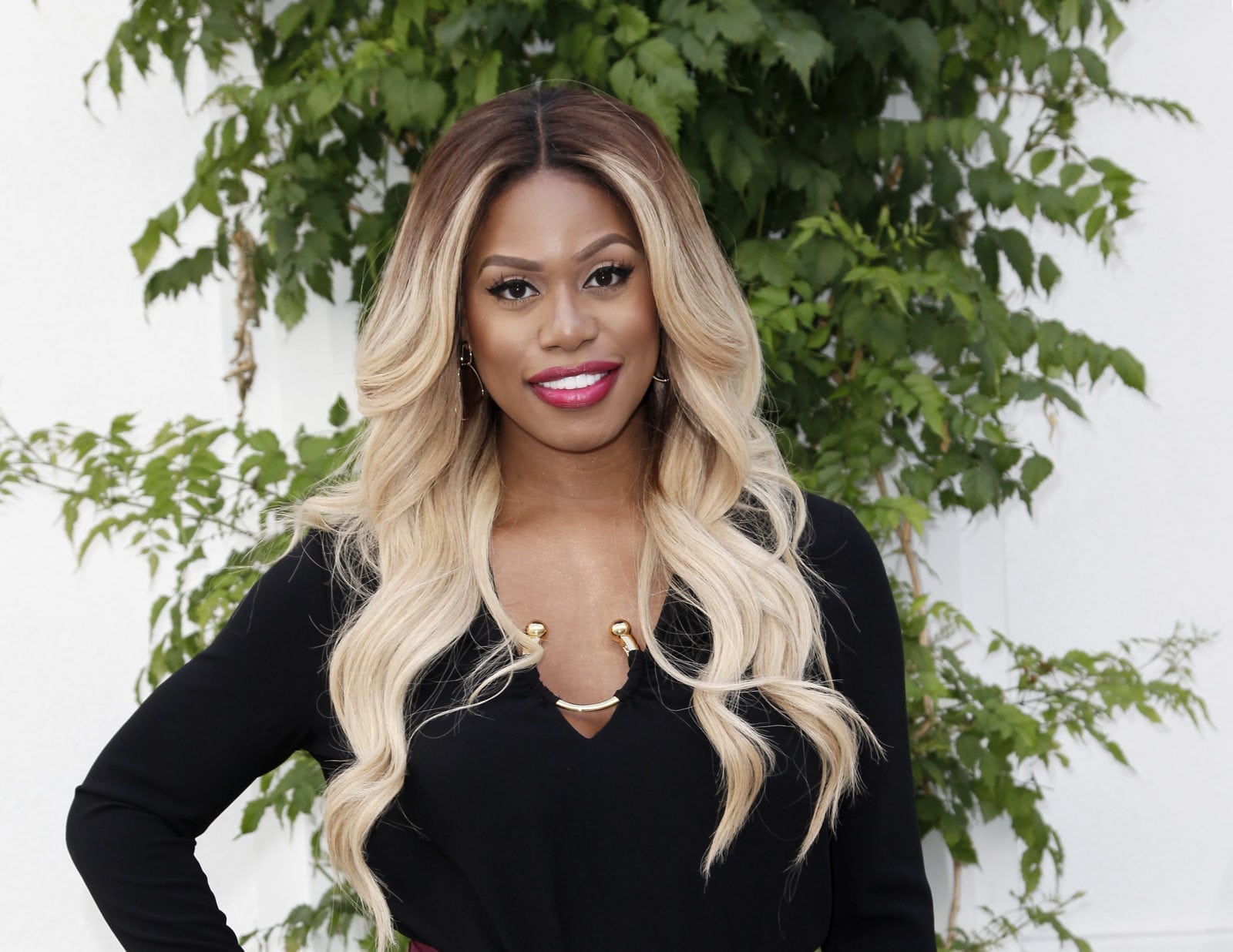
Systemic problems like homelessness, unemployment and lack of access to healthcare make trans people more susceptible to violence, but the actor and trans activist Laverne Cox believes the stigma around cis men’s sexual attraction to trans women is also a part of the problem.
In an interview with Buzzfeed last year, the Orange is the New Black star said: “I think the people who are attacking trans women, what I say to men, is that your attraction to me is not a reason to kill me.
“There’s this whole myth that trans women are out there tricking people and deserve to be murdered, and that’s not the case.
“There’s been a market for trans women in the realms of dating and sex work for a very long time, we don’t have to trick anyone.”
She encouraged cis women to have conversations with the men in their lives about trans people: “We have to lift the stigma around attraction to trans people, and we have to lift the stigma around trans people existing,” she said.
Non-binary people in Oregon will now be able to change the gender marker on their birth certificates to reflect their identity, an appeals court has ruled.
The verdict came when Oregon’s Court of Appeals overturned a 2019 decision that barred people from changing their legal gender to non-binary.
The appeals court sided with Eugene resident Jones Hollister, 53, who has been petitioning to have their gender legally recognised since 2017.
“I am thrilled,” Hollister said. “To have a ruling and to have a really affirming statement by the court, I’m speechless. I can barely talk because I keep crying every time I think about it. I’m just so excited.”
The appeals court said that a judge has the “authority to grant the requested change of legal sex”, without the need for a doctors note, and not restricted to just male or female.
“Rather, the new sex designation must affirm the petitioner’s gender identity whether that is male, female, or non-binary,” the appeals court ruled.
Hollister said of their need for legal gender recognition: “I’ll have a legal piece of paper that says that the gender that I know I am and have always known that I am is legally recognised.
“Every time I’m given a piece of paper that makes me choose male or female, neither of them is accurate.”
“We submitted the appeal in the fall and… I don’t even know what to say. I’m still giddy,” Hollister added.
Hollister’s lawyer, Lorena Reynolds, worked with Basic Rights Oregon and the ACLU on the case.
Kieran Chase from Basic Rights Oregon said the ruling is critical.
“We’ve existed since humanity has existed. We know what is true about ourselves and having the court see and affirm that is really, really important,” Chase said.
Oregon already allowed X gender markers on ID documents.
It was already possible to use the X gender marker on driving licenses and passports in Oregon, but those changes are administrative, and not reflective of a person’s legal gender.
If you’re one of the more than 44 million people who have become recently unemployed thanks to the COVID-19 pandemic, you may be worried about what that might mean for your access to health care, HIV care, or PrEP.
“We have seen a lot of people in our PrEP program or who receive our HIV services–in addition to new clients who have recently lost their health insurance–who come in wondering how to afford their medications,” said Reina Hernandez, PrEP benefits and HIV linkage manager.
“Income from unemployment benefits might put you above the Medi-Cal threshold, meaning that you won’t be able to access full-scope Medi-Cal coverage. And then you’re left choosing whether to use your unemployment benefits to buy insurance or on other necessities like food and rent,” they said.
The good news is that there are a variety of free programs that can help people afford HIV and PrEP treatment and care even if they don’t have insurance, said Hernandez. Gilead’s medication assistance program covers PrEP and the HIV medications made by the company. ADAP, California’s AIDS Drug Assistance Program, can help cover medications, out-of-pocket lab and medical visit costs, in addition to insurance premiums. (You can find a full list of PrEP affordability programs at PleasePrEPMe.org.)
It can be difficult to figure out which programs you qualify for, and how to apply and use benefits, which is where benefits navigators can help.
“Call us, email us, leave us a voicemail, or come in to see us in person. We’ll make sure that you get onto some kind of assistance program, regardless of your immigration status,” said Hernandez. “Even if you’re just visiting the U.S. temporarily, or are living here long-term without residency, we can help.”
If you live outside the San Francisco Bay Area, and are interested in seeing a local benefits navigator, contact any local community health centers or AIDS service organizations in your area to find out if that service is offered. You can also use the PleasePrEPMe.org search tool, filtering results by “accepts uninsured.” If you call a PrEP or health care provider, ask if they have benefits managers, case managers, or social workers who can help you find and apply for assistance programs.
“What this epidemic has demonstrated is that we can’t rely on employer-provided health insurance,” said Hernandez. “COVID-19 has shown us the shortcomings of our current systems–health care in addition to financial, political and social. Since employment isn’t guaranteed, health insurance tied to employment just isn’t sustainable. We need to move to systems like single-payer universal health care, where regardless of your employment you have coverage.”
Resources
Please PrEP Me
Find a PrEP provider, chat with a service navigator, and find useful information about how to pay for PrEP. https://www.pleaseprepme.org/
PrEP, PEP & HIV services at San Francisco AIDS Foundation
Schedule appointments to meet with a health care provider and benefits navigator. Visit https://www.sfaf.org/services/prep-pep/, call the clinic at 415-581-1600, or email prep@sfaf.org.
Although AIDS conferences have previously tackled the issue of racial disparities in HIV, conversations often stop with data and urgent calls to reach “key populations” or “those most at risk for HIV,” coded language oftentimes referring to Black, brown, Latinx and Indigenous people of color in the U.S.
Now, conversations about racism and racial justice in the wake of the murders of George Floyd, Breonna Taylor, Tony McDade, and others are permeating the largest international conference on HIV and AIDS–AIDS 2020–held virtually the week of July 6, 2020. Researchers, practitioners, and activists are discussing systemic bias in public health and our medical systems, and are providing ideas on how to incorporate anti-racist frameworks into the HIV response. Here’s some of what’s been shared.
In a presentation titled “Breathing is a human right” (Bridging Session 1), Darius Rucker, from Williams and Associates, shared his experience as a Black queer man living with HIV in order to name the racist policies and procedures that continue to place Black queer people at a disadvantage in HIV care and prevention.
“It took eight months between my [HIV] diagnosis and linkage to medication,” said Rucker. “In April 2011, my diagnosis was given to me. Months later, I was still not on medications, and was sick. December 2011, still no meds, sick, dying, AIDS. I didn’t have a doctor, a case manager, or support. I needed someone to walk with me. What could have been different? Access to equitable healthcare, and better conversations about healthcare. Racism, homophobia, stigma and HIV still continue.”
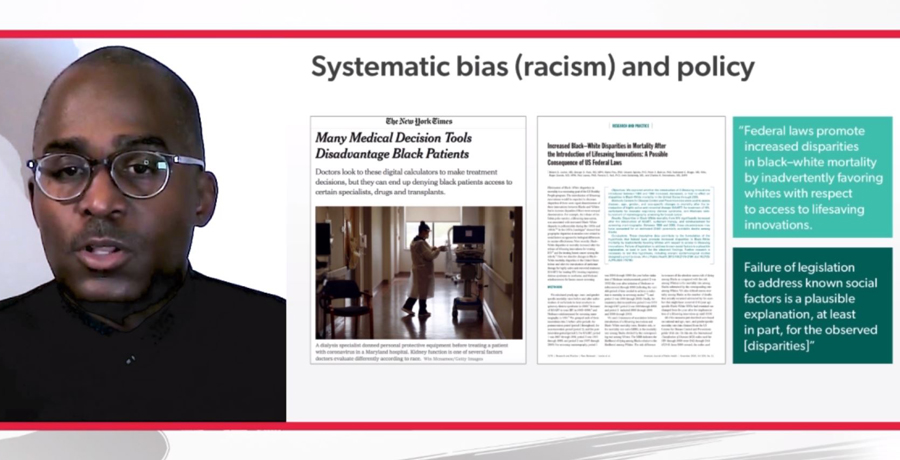
Wearing a Black Lives Matter shirt, Gregorio Millet, from amfAR, gave a comprehensive overview of some of the nuanced ways that historical legacies, policies, and other societal structures aggravate disparities experienced by Black Americans (Prime Session 1) in HIV and now COVID-19. He pointed to systemic biases which dictate who gets access to new technology, such as COVID-19 testing.
Slide: Gregorio Millet, amfAR
“COVID-19 testing centers are less likely to take place or to be located in African American or Latino communities. And we saw the exact same thing, unfortunately, with HIV, when antiretroviral therapy became available. We saw the disparity in mortality rates actually increased between African Americans and whites during the time when ART became available. And that’s because African Americans had less access to antiretroviral therapy and thus were more likely to die,” said Millet.
Access to pre-exposure prophylaxis (PrEP) is also an issue for many Black Americans.
People in the South, particularly people who are Black, experience the highest rates of HIV infection in the U.S., yet have the lowest rates of pre-exposure prophylaxis (PrEP) uptake, shared Jodie Guest, from Emory University (Oral Abstract Session C08). The “PrEP to need” ratio–the number of PrEP users divided by the number of people diagnosed with HIV–is highest in the West (over 25) and lowest in the South (less than 10), pointing to the stark need for increased PrEP access in the South among people of color. In addition to access issues experienced by people in the South, Guest pointed to startling low rates of PrEP awareness (11% in one study), and concluded by emphasizing that PrEP scale up must be equitable.
In San Francisco, Jonathan Volk shared continuum of care data from the Kaiser Permanente PrEP program, which found that African American clients were less likely to receive a PrEP prescription, less likely to begin PrEP, and more likely to discontinue PrEP (Oral Abstract Session C08).
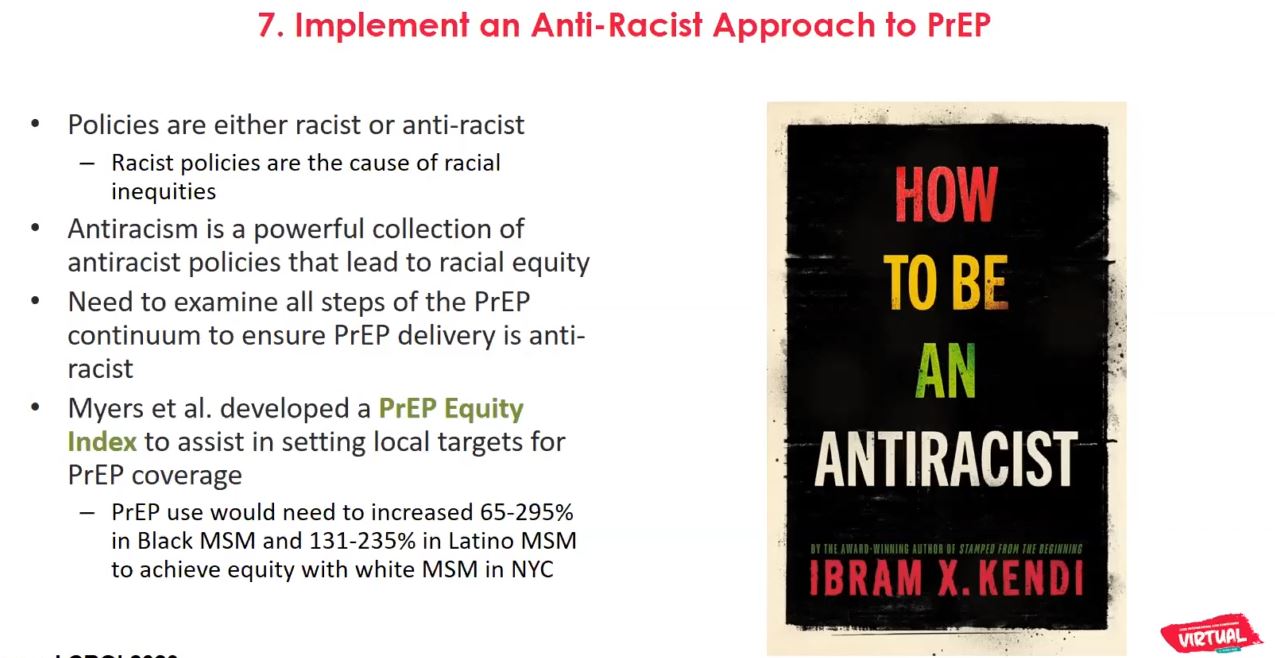
“Given the pervasive effects of systemic racism and anti-blackness in our country, it is imperative that we implement an anti-racist approach to PrEP,” said Albert Liu, MD, MPH from San Francisco Department of Public Health, in a session about creating “person-centered” PrEP programs and reducing barriers to PrEP access and retention (Bridging Session 06).
Liu explained that, according to Ibram Kendi’s “How to be an Antiracist,” ideas and policies are either racist or anti-racist, and racist policies are the cause of racial inequities. This includes health inequities, such as those in HIV incidence and PrEP uptake, which means it’s critical for providers and those in power to upend and revise existing systems. Pointing to a “PrEP equity index” developed by Myers and colleagues, Liu said that PrEP use must increase by up to 300% in Black men who have sex with men (MSM) and 230% in Latino MSM to achieve equity with white MSM in New York City.”
Slide: Albert Liu, San Francisco Department of Public Health
“It’s critical that we examine all steps of the PrEP continuum to ensure PrEP delivery is anti-racist,” said Liu.
“Your HIV organization or health department probably has a racist history–all of ours do,” said Felipe Flores, from San Francisco AIDS Foundation (Satellite Session On-Demand). “Building bridges with BIPOC [Black, Indigenous, and people of color] organizations, offering resources and services to these community partners, begins to heal some of the failings that we have inherited or created.”
Flores said it is critical to dedicate time, appointments, and resources to communities that “we have collectively failed,” and to be “loud and unrelenting about it.”
“What holidays does your organization get time off for? What events does your outreach team go to? What languages are your materials in? Who is pictured on flyers? Integrate a racial justice framework into everything you do,” said Flores.
Carmarion Anderson, from Human Rights Campaign, shared her perspective as a Black trans woman working in HIV advocacy to drive home the importance of understanding of intersectionality in order to connect with (not “target”) people of color living with or at risk for HIV (Symposium SS21).
“You have to understand what barriers we face. Before you offer me an HIV test, before you offer me a biomedical intervention like PrEP, you have to understand the trauma I have gone through,” she said. “Some of these things [rejection, poverty, depression] influence how we show up as you are trying to aid us and implement the work of your organization.”
As Anderson spoke about advocacy, she gave an important recommendation for organizations who work with Black and trans communities.
“As a Black trans woman, I can speak up for who I am. And if I can speak up for myself, I can also sit at your table of decision. You understand what I’m saying. That means you can employ me, in order to have my voice, my narrative and my community working with you,” she said.
Carmen Logie, from University of Toronto, also used an intersectionality framework to present the experiences of Black, Caribbean, African and Indigenous women living with HIV in Canada (Bridging Session 12). Women of color are overrepresented in the number of HIV infections that happen among women in Canada, said Logie, and oftentimes experience the intersectional stigmas related to race, gender, HIV status and sex work.
“Ths intersecting stigma matters,” said Logie. “Racism, HIV stigma and gender discrimination are associated with ART [antiretroviral therapy] adherence issues, depression, and injection drug use. It shapes mental health. We need intersectional stigma interventions, and we need them now. We need them to be trauma-informed, and have a harm reduction approach.”
Monica McLemore, from University of California, San Francisco, shared her personal experience being born prematurely to a Black mother as she spoke about health inequities faced by Black Americans and the importance of movements like Black Lives Matter to HIV prevention and care (Symposium SS21).
“In New Jersey, where I was born, infant mortality was double the rate for mothers of color compared to white mothers. I am lucky and grateful to be alive.” said McLemore. “Now, we have to deal with two two pandemics at once: the novel coronavirus, and racism. We can do better, and we have to.”
McLemore urged the HIV community to consider, and incorporate, the principles of Black Lives Matter and the movement for Black lives into the HIV response. “If we place our asks in terms of a human rights frame, the health of everyone can, and will, and should improve.”
In a presentation about including community in the plan to end HIV (Symposium SS21), Venton Jones-Hill, from Southern Black Policy Advocacy Network advocated for meaningful participation of Black communities in HIV policy. “We need to strengthen the capacity of Balck communities and leaders in the U.S. South to engage in health policy deliberations to improve policy, programs and research,” said Jones-Hill. “Community has to be in the middle of the conversation.”
“Now, after the death of George Floyd and many others, you see this complete shift in sensibility where a majority of white Americans, Black Americans, Latino Americans, and Asians support the Black Lives Matter movement,” said Millet. “And one of the things that was really one of the happiest things that I see lately was in my own neighborhood, two blocks from where I grew up in Brooklyn, there was a rally for thousands of people in support of trans Black women’s lives–saying their lives mattered as well. We need to make sure that communities are at the center of the response and at the center of providing solutions for some of these health crises.”
—
Visit AIDS2020.org for information about the conference. Presentations and materials from the conference will be made available to the general public at the end of July, 2020 through the conference website.
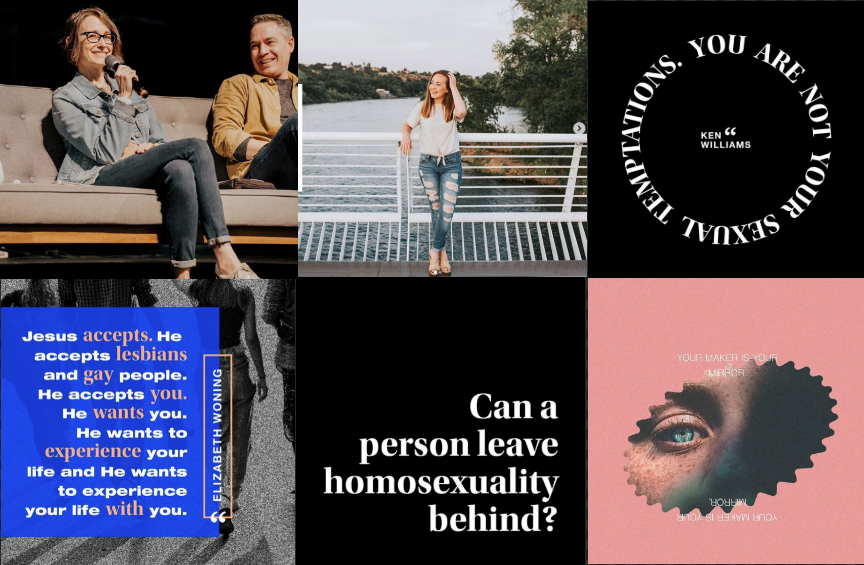
Instagram is taking a hard line on conversion therapy, announcing that it will block all posts promoting the abhorrent practise.
Attempts to change a person’s sexual orientation or gender identity have been rejected by every mainstream medical and mental health organisation for decades and are linked to higher risks of depression, suicide, and drug addiction.
Instagram’s public policy director Tara Hopkins acknowledged the harm it causes as she explained how the company is changing the way it handles conversion therapy content.
“We don’t allow attacks against people based on sexual orientation or gender identity and are updating our policies to ban the promotion of conversion therapy services,” she said, speaking exclusively to the BBC.
She continued: “We are always reviewing our policies and will continue to consult with experts and people with personal experiences to inform our approach.”
Earlier this year Instagram banned the promotion of conversion therapy in ads. From Friday (July 10), any content linked to the practise will be banned across all posts on the platform.
The company stresses that it will take time to update all of its policies to reflect this blanket ban, so while some content that users flag may not immediately be removed, over time that should change.
But conversion therapy is still legal in the UK, despite the government promising to eradicate it two years ago in its July 2018 LGBT+ Action Plan.
Campaigners are now urging the government to make good on its promise, with Elton John, Stephen Fry, Munroe Bergdorf and Dua Lipa joining over influential public figures in calling for a ban.
“Theresa May, as prime minister, vowed to eradicate this “abhorrent” practice in 2018 and since then the British public has been waiting expectantly, not least the LGBTQ+ community,” they write.
“The government has said recently that conversion therapy is complex, which it undoubtedly is, and although we acknowledge this issue is nuanced we strongly believe that effective legislation, supported by a programme of work to help tackle these practices in all their forms, is possible.
“Any form of counselling or persuading someone to change their sexual orientation or behaviour so as to conform with a heteronormative lifestyle, or their gender identity should be illegal, no matter the reason, religious or otherwise — whatever the person’s age.”
The global fight against AIDS was faltering even before the COVID-19 pandemic, and this newly emerged viral disease is now threatening to put progress against HIV back by 10 years or more, the United Nations said on Monday.
“The global HIV targets set for 2020 will not be reached,” the U.N.’s AIDS agency said in a report. “Even the gains made could be lost and progress further stalled if we fail to act.”
Latest data from 2019 show that 38 million people worldwide are now infected with the human immunodeficiency virus (HIV) that causes AIDS, the report said, a million more than in 2018.
Some 25.4 million HIV positive people were on antiretroviral treatment in 2019 – a huge advance on a decade ago, but one that still leaves 12.6 million not getting medicines that can keep the virus at bay and prevent its spread.
The report also found the world is far behind in preventing new HIV infections, with 1.7 million new HIV cases in 2019.
“Every day in the next decade decisive action is needed to get the world back on track to end the AIDS epidemic by 2030,” said Winnie Byanyima, UNAIDS’ executive director.
The worst regions for HIV’s spread were eastern Europe and central Asia, which together have seen “a staggering” 72 percent rise in new HIV infections since 2010, UNAIDS said.
New HIV infections also rose in the Middle East and North Africa, by 22 percent, and by 21 percent in Latin America.
The report said the COVID-19 pandemic, which emerged in China in January, has already “seriously impacted” the AIDS fight, with lockdowns and travel and trade disruptions delaying or halting HIV treatment and testing services.
It said a six-month complete disruption in HIV treatment could cause more than 500,000 extra deaths in sub-Saharan Africa over the next year, bringing the region back to levels of AIDS death rates last seen more than a decade ago, in 2008.
California prison officials are staring down yet another lawsuit from a transgender woman who says she was abused in custody.
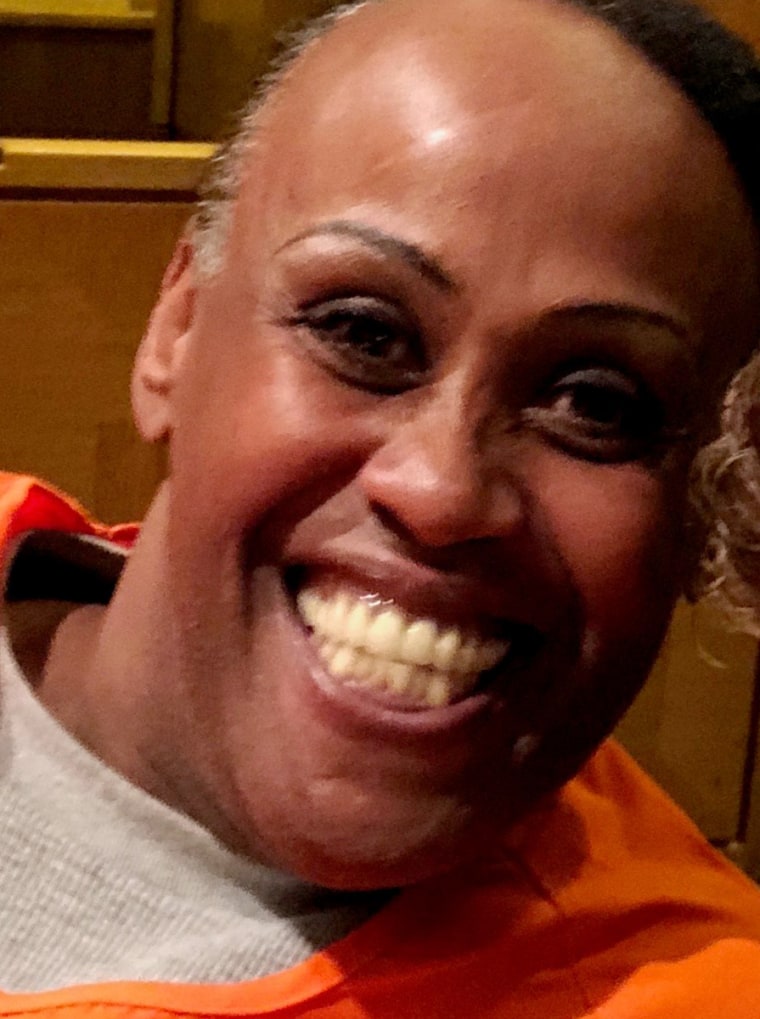
C. Jay Smith, 59, filed a federal lawsuit last Monday alleging that staff members at San Quentin State Prison, just north of San Francisco, refused to investigate reports she had filed after having been sexually abused and that they retaliated against her. Smith alleges that the campaign went so far that guards falsely accused her of serious violations, potentially adding 10 years to her sentence.
C. Jay Smith.Medina Orthwein LLP
A 36-page complaint filed in U.S. District Court for Northern California claims that staff members at the prison “used threatening and coercive tactics to try to get her to withdraw her allegations.”
“Ms. Smith’s case demonstrates that the ‘Me Too’ movement and the protections it has provided to women needs to also find its way to the violence and state-initiated torment transgender people face behind CDCR’s prison walls,” the suit says, referring to the California Department of Corrections and Rehabilitation.
Smith has lived almost her entire life as a woman, according to the complaint. She knew she was transgender at 10 years old and started to transition as a teenager, the suit states. But after she was sentenced to 25 years to life with the possibility of parole, she has spent the entire term — now more than two decades — housed in men’s prisons.
Her complaint alleges that from the time she arrived at a CDCR Reception Center in 1998, officers “allowed multiple men in custody to rape Ms. Smith repeatedly over four consecutive days.” Research has found that sexual abuse of transgender women in prison, especially those housed in men’s facilities, is not uncommon: A 2010 study published in Justice Quarterly, which was cited in Smith’s complaint, found that 59 percent of trans women in men’s lockup facilities had experienced at least one instance of sexual assault.
The 1998 assaults weren’t the only time Smith says she was a victim of sexual violence. Smith said she was again violently raped in 2013, shortly after she arrived at San Quentin, by an unknown assailant who “attacked from behind,” according to the lawsuit.
Not knowing the identity of her attacker “caused her to subsequently experience even more severe symptoms of PTSD,” the complaint alleges, referring to post-traumatic stress disorder.
“Ms. Smith has been the target of indecent exposure and lewd sexual acts by many men in custody,” her complaint states. “She has also been verbally harassed and called homophobic and transphobic slurs by staff — including medical and custody staff — on numerous occasions. The repeated sexual assaults and harassment aggravated Ms. Smith’s PTSD, resulting in her placement in outpatient or inpatient mental health treatment for the majority of her incarceration.”
Smith said she became the target of a campaign of harassment by officers at San Quentin when she tried to speak up about the violence. Her cell was “ransacked” and guards left the doors open to allow “other people in custody to steal her property,” the lawsuit says.
“Defendants then caged Ms. Smith like an animal, verbally berated her, threatened her with physical assault, sexually harassed and assaulted her,” the complaint alleges, adding that she was targeted with false reports of rules violations.
Among them was a charge of possession of a deadly weapon after officers reported her for having a graduation statue in her cell, her complaint says. The statue, she claims, had been a gift from a friend years earlier as motivation to complete her GED program. If she is found guilty, Smith could face 10 more years behind bars.
According to the suit, the “campaign of torture and retaliation” alleged against Smith “sent a message” to transgender women who are sexual assaulted in prison: “Do not report sexual violence or safety concerns or you, too, will be targeted.”
Smith’s lawsuit partly hinges on the federal Prison Rape Elimination Act, or PREA, a 2003 law to stop sexual assault behind bars. It requires state prisons to house transgender prisoners case by case with either men or women after asking them where they would feel the safest. It also mandates that prison staff members immediately report and document knowledge or suspicion of sexual harassment or assault.
Smith’s attorneys, Jen Orthwein and Felicia Medina, argue that cases like Smith’s illustrate why many transgender survivors do not report sexual assault behind bars.
The CDCR “knows that there’s widespread PREA violations, and what it does is it uses [disciplinary] process[es] against folks who are the most impacted, such as C. Jay, who is a transgender woman of color, because she reported sexual assault,” Medina said in an interview. “She was set up.”
Download the NBC News app for breaking news and alerts
Smith is at least the sixth transgender or gender-nonconforming prisoner to have sued the state or its officials in recent years. Candice Crowder, a trans woman, sued in 2017, alleging that guards isolated her in solitary confinement after she reported having been raped at Corcoran State Prison. Crowder’s case was settled for an undisclosed sum. Isaac Medina, a trans prisoner at Central California Women’s Facility in Chowchilla, sued the state last year claiming that corrections officers regularly sexually harassed and threatened him. The case is ongoing.
Three gender-nonconforming people sued the state in November 2017, alleging that the CDCR refused them medical treatment and denied them the opportunity to file grievances after they were sexually assaulted. An amended complaint was filed in 2019, and the case is still being adjudicated.
In a statement to NBC News, a spokesperson said the department “cannot comment on pending litigation.”
“CDCR is committed to providing a safe, humane, rehabilitative and secure environment for all people housed in the state’s correctional facilities and has policies, practices and procedures in place regarding the screening, housing and treatment of incarcerated transgender people,” Deputy Press Secretary Terry Thornton said in an email. “CDCR maintains a zero-tolerance policy for sexual harassment, sexual violence, and staff sexual misconduct. This policy applies to all offenders, all CDCR employees, all volunteers and all contractors.”
Thornton said the department “has not been served with this lawsuit.”
Data show that transgender people face extraordinary rates of violence in prisons and jails. A 2015 report by the Justice Department found that 35 percent of transgender prisoners said they had been sexually assaulted by staff members or other prisoners in the past year. And an NBC News investigation this year found that of 10 trans women interviewed at the California Institution for Men in Chino, nine reported having been sexually assaulted while incarcerated.
– “Harry Potter” author J.K. Rowling is back in the spotlight after stating on Twitter that young people are being “shunted towards” hormones and surgery that may not be in their best interests, and comparing the measures to “conversion therapy.”
“Many, myself included, believe we are watching a new kind of conversion therapy for young gay people, who are being set on a lifelong path of medicalization that may result in the loss of their fertility and/or full sexual function,” Rowling tweeted.
Rowling was responding to a July 4 post by Twitter user @TrinerScot, who called out the author for ‘liking’ a post by Twitter user @Manaxium that claimed hormone prescriptions were “the new antidepressants.”
“Yes they are sometimes necessary and lifesaving, but they should be a last resort – not the first option. Pure laziness for those who would rather medicate than put in the time and effort to heal people’s minds,” read the post.elated
The post by @TrinerScot read: “Who had money on JK Rowling pivoting to supporting those who call people who take mental health medication ‘lazy’? I take daily medication to function, this sentiment is beyond offensive, it is actively harmful to millions.”
In the first of 11 tweets, Rowling began her response to @TrinerScot with: “I’ve ignored fake tweets attributed to me and RTed widely. I’ve ignored porn tweeted at children on a thread about their art. I’ve ignored death and rape threats. I’m not going to ignore this.”
“When you lie about what I believe about mental health medication and when you misrepresent the views of a trans woman for whom I feel nothing but admiration and solidarity, you cross a line,” Rowling continued.
Rowling goes on to write about her “own mental health challenges,” and expressed concern over young people with mental health issues “being shunted towards hormones and surgery when this may not be in their best interests,” before tweeting about conversion therapy. Rowling quotes a BBC documentary and a number of studies on the subject.
“None of that may trouble you or disturb your belief in your own righteousness. But if so, I can’t pretend I care much about your bad opinion of me,” Rowling concludes.
Responding to Rowling’s tweet, transgender model and activist Munroe Bergdorf tweeted, “J.K. Rowling is not a scientist. She is not a doctor. She is not an expert on gender. She is not a supporter of our community.
“She is a billionaire, cisgender, heterosexual, white woman who has decided that she knows what is best for us and our bodies. This is not her fight.”
Rowling has been in the news in recent weeks for her views on the trans community, and has faced considerable backlash.
Almost eight in 10 Gen Z transgender people have only come out online and are still closeted in real life, according to a report by Tinder.
One year on from the introduction of its orientation feature, which allowed daters to pick up to three sexual orientations to find better matches, Tinderhas conducted research into Gen Z attitudes towards LGBT+ issues.
Gen Z, described in the Tinder research as 18 to 25-year-olds, were more likely than other age groups to use the orientation feature, were most likely to include more than one sexual orientation, and were more likely to choose more than one gender descriptor.
Of the 3,453 Gen Z Tinder users surveyed, one third said they had become more open to dating different genders within the last three years, and one fifth said they would explore polyamory.
But despite this openness towards gender identity and sexual orientation, the generation still faces difficulties with living authentically in real life, with just 13 per cent of LGBT+ Gen Z users saying they had come out to family and friends.
A huge 78 per cent of Gen Z transgender people surveyed said that they have been open about their identity online, but not with people in their real lives. Forty-one per cent of those who identified as gender fluid said the same.
The internet has become a safe haven for Gen Z, and 71 per cent said online platforms had allowed them to connect with others, and three quarters said dating apps help them to get to know themselves better.
While 86 per cent believe their generation is more tolerant that their parents’ generation, they are clear that there is more work to be done.
Forty-three per cent said they needed better education and guidance on LGBT+ issues, with more than a quarter using TV and movies to educate themselves, and almost a third learning from social media and influencers.
Tinder’s orientation feature is available in the US, UK, Canada, Ireland, India, Australia and New Zealand, but the dating app has said it will now be rolling out the function globally.
Elie Seidman, CEO of Tinder, said: “Our younger members, Gen Z, are leading the way to a more inclusive world and we know that with our scale, we can help make a difference with our product.”
Facebook reportedly refused to take action on posts that called for the murder of LGBT+ people, according to activists.
LGBT+ activists across the Middle East and North Africa (MENA) have called on Facebook to tackle hate speech, including posts that call for the murder of queer people.
But, the platform reportedly found that they did not “contradict community standards”.
Activists and rights groups wrote an open letter to Facebook in the wake of the death of Sara Hegazy, an Egyptian LGBT+ activist who was jailed and tortured for raising a Pride flag at a concert, and then tragically died by suicide.
The letter said: “Although the MENA LGBTQI+ community has been reporting thousands of Arabic hate speech posts … most of these reports were declined because the content ‘did not contradict the Facebook community standards’.
“This is due to the lax implementation of effective anti-hate speech policies to manage the platform in our region, which makes the platform unsafe for sexual minorities.
“While the right to equal treatment and non-discrimination is a fundamental right enshrined in international treaties and covenants, it should be ensured that a mechanism exists to ensure that complaints from victims of hate speech in the region are examined without violating freedom of expression.”
If you think it’s your right to act on homosexuality, then it’s my right to throw you off the roof.
Activists provided Gay Star News with examples of posts that were reported to Facebook, including one which, when translated from Arabic, read: “If you think it’s your right to act on sodomy/homosexuality, then it’s my right to throw you off the roof.”
Another profile had a photo of a white stick figure kicking a rainbow stick figure in the stomach, with a cover photo of a burning Pride flag.
Adam Muhammed, executive director of the LGBT+ rights group ATYAF Collective in Morocco, told Reuters: “In the US and Europe, there is no room to spread hate speech against any sexual orientation, race, religion, sect or any other social group.
“We addressed a letter to Facebook asking its management to implement the same policy here as it uses in other countries.”
In response, Facebook said that it removed hate speech in more than 50 languages, including Arabic, and that 90 per cent of it was blocked before users reported it.
It added: “We know we have more work to do here and we’ll continue to work closely with members of the LGBTQI+ community in the Middle East and North Africa to develop our tools, technology and policies.”
Calls for Facebook to remove hate speech and disinformation go global.
Facebook is facing increasing pressure around the world to address hate speech and the spread of disinformation.
On June 17, civil rights groups Anti-Defamation League, the NAACP, Free Press, and Color of Change began a campaign called Stop Hate for Profitwhich urged companies to pause their advertising on Facebook and Instagram in an attempt to force them to reconsider their policies.
Stop Hate for Profit said: “What would you do with $70 billion? We know what Facebook did.
“They allowed incitement to violence against protesters fighting for racial justice in America in the wake of George Floyd, Breonna Taylor, Tony McDade, Ahmaud Arbery, Rayshard Brooks and so many others.
“They named Breitbart News a ‘trusted news source’ and made The Daily Callera ‘fact checker’ despite both publications having records of working with known white nationalists.
“They turned a blind eye to blatant voter suppression on their platform.
“Could they protect and support Black users? Could they call out Holocaust denial as hate? Could they help get out the vote?
“They absolutely could. But they are actively choosing not to do so.”
Companies including Adidas, Puma, Vans, Ben & Jerry’s, Levi’s, Verizon and Unilever have all vowed to pull advertising from Facebook during July.
In response to the mass boycott, Facebook founder Mark Zuckerberg said the company would put “warning labels” on posts, but would not stop the content being posted.
According to Out, Zuckerberg said Facebook users should be free to condemn content as “this is an important part of how we discuss what’s acceptable in our society”.