The Trump administration has notified public schools at every level that it will not be enforcing the Biden administration’s revised interpretation of Title IX, which included the protection of LGBTQ+ students from discrimination.
In June 2022, President Joe Biden’s Education Secretary Miguel Cardona announced that Title IX, the 1972 education law that prohibits discrimination in federally funded schools “on the basis of sex,” should rely on the Supreme Court’s 2020 decision in Bostock v. Clayton County. That court decision found that Title VII’s ban on sex-based workplace discrimination includes discrimination based on sexual orientation and gender identity.
The notice repealing this interpretation referred to Donald Trump’s executive order on “restoring biological truth,” which declared, “It is the policy of the United States to recognize two sexes, male and female. These sexes are not changeable and are grounded in fundamental and incontrovertible reality.”
The letter – sent from the United States Department of Education’s Office for Civil Rights – states that the order is “fatal” to the Biden interpretation of Title IX because it “directly contradicts the vacated rule’s novel and expansive meaning of ‘on the basis of sex.”‘ It then emphasized executive power: “As a constitutional matter, the President’s interpretation of the law governs because he alone controls and supervises subordinate officers who exercise discretionary executive power on his behalf.”
It also justified the order based on a January 9, 2025, Kentucky District Court decision that ruled Biden’s interpretation of Title IX is unenforceable, claiming “expanding the meaning of ‘on the basis of sex’ to include ‘gender identity’ turns Title IX on its head.”
The notice also aligns with another Trump executive order seeking to endtransgender-inclusive policies and anti-racist education in K-12 schools. The order calls to cut off federal funding to trans-inclusive and anti-racist schools, to force schools to out trans students to their potentially unsupportive parents, and accuses supportive teachers of “sexually exploiting minors” or “unlawfully practicing medicine.”
The Trump administration also declared in the letter that it will return to policies from Trump’s first term that provided stronger rights to students accused of sexual assault or harassment and limited schools’ liability in those cases.
“This is an incredibly disappointing decision that will leave many survivors of sexual violence, LGBTQ+ students, and pregnant and parenting students without the accommodations critical to their ability to learn and attend class safely,” Emma Grasso Levine, a senior manager at Know Your IX, said in a statement. “Schools must step up to protect students in the absence of adequate federal guidance.”
Department of Education employees themselves have also become victims of Trump’s war on Diversity, Equity, and Inclusion (DEI). According to NBC News, dozens who attended a diversity training course that was encouraged by the Trump administration during the president’s first term have been placed on paid leave.
Hospitals in Colorado, Virginia and the nation’s capital said Thursday they have paused gender-affirming care for young people as they evaluate President Donald Trump’s executive order aimed at cutting federal support for such care.
Denver Health in Colorado has stopped providing gender-affirming surgeries for people under age 19, a spokesperson confirmed Thursday, in order to comply with the executive order and continue receiving federal funding. It is unclear whether the hospital will continue providing other gender-affirming care for youth, including hormone therapy and puberty blockers.
In Virginia, VCU Health and Children’s Hospital of Richmond said they have suspended gender-affirming medication and gender-affirming surgical procedures for those under 19 years old.
In Washington, D.C., Children’s National Hospital said the hospital had “paused prescriptions of puberty blockers and hormone therapy to comply with the directives while we assess the situation further.” The hospital already did not perform gender-affirming surgery on minors, a spokesperson said Thursday.
Trump’s order, signed Tuesday, is part of a push to reverse Biden administration policies meant to protect transgender people and their care. It ordered agencies to take steps to makes sure that hospitals receiving federal research and education grants “end the chemical and surgical mutilation of children.”
Other hospitals told The Associated Press that their current practices would continue. Lurie Children’s Hospital of Chicago said hospital officials are reviewing the order and “assessing any potential impact to the clinical services we offer to our patient families.”
“Our team will continue to advocate for access to medically necessary care, grounded in science and compassion for the patient-families we are so privileged to serve,” the statement said.
The language in Trump’s executive order — using words such as “maiming,” “sterilizing” and “mutilation” — contradicts what is typical for gender-affirming care in the United States. It also labels guidance from the World Professional Association for Transgender Health as “junk science.”
WPATH said in a statement that restrictions and bans on “access to necessary medical care for transgender youth are harmful to patients and their families.”
Gender-affirming medical care for transgender youth isn’t common. A new study shows that fewer than 1 in 1,000 U.S. adolescents with commercial insurance received puberty blockers or hormones during a recent five-year period, and the bulk of gender-affirming surgeries are not performed on youth.
The Denver hospital said Trump’s order would affect the mental health of its transgender patients, and that they would continue to receive primary and behavioral health care.
“Denver Health is committed to and deeply concerned for the health and safety of our gender diverse patients under the age of 19,” the hospital’s statement said.
WHAT YOU NEED TO KNOW: The fourth Master Plan for Aging (MPA) annual report highlights California’s leadership and progress in helping hundreds of thousands of people aged 50 and over get more affordable health care and home care and live in inclusive and safe communities. The report covers accomplishments achieved in year four of California’s nation-leading 10-year plan to help all people, families, and the economy thrive through longer lives.
SACRAMENTO – Today, the California Department of Aging (CDA) released a new report detailing 81 Master Plan for Aging (MPA) initiatives designed to build momentum and drive results for older Californians over the next two years. The MPA, California’s groundbreaking 10-year blueprint for aging and disability services that has become a national model, continues to be a catalyst to empower older adults, Californians with disabilities, and caregivers, according to the new report on its progress in 2024. Developed in 2021, today’s efforts also highlight the state’s commitment to support under-represented older populations, such as LGBTQIA+ older adults, people who are vulnerable in natural disasters like wildfires, families impacted by dementia, people who are isolated, unhoused older adults, and people with disabilities.
The recent wildfires in Southern California reinforce the importance of planning and preparing for a rapidly growing aging population, which the MPA has highlighted over the past four years.
“Ongoing and much-appreciated partnerships with stakeholders, philanthropy, the Legislature, and Governor Newsom’s administration are helping build the aging network of the future,” said Kim Johnson, California Health & Human Services Agency Secretary. “A person-centered, data-driven, equity-focused Master Plan for Aging is a robust tool to advance the health and well-being of all older adults, people with disabilities, and caregivers. This report is a strong accountability measure reflecting our commitment to transparency and outcomes.”
ABOUT THE MASTER PLAN FOR AGING: Governor Gavin Newsom launched the MPA four years ago to address the growing number of older Californians, a population that is increasing faster than the number of children for the first time in history. By 2030, 25% of the state’s population will be aged 60 or older. The MPA is a comprehensive 10-year effort to expand programs and improve access to care so all older adults, people with disabilities, and caregivers feel valued and have equitable opportunities to thrive.
The MPA outlines five Bold Goals to build a California for all ages and abilities by 2030: 1) Housing for All Ages & Stages; 2) Health Reimagined; 3) Inclusion & Equity, Not Isolation; 4) Caregiving That Works; and 5) Affording Aging. To learn more, visit mpa.aging.ca.gov.
KEY 2024 ANNUAL REPORT UPDATES
Progress has been made on all 95 initiatives from the past two years of MPA implementation. Included among 2024 achievements:
Delivering Housing: California is making progress to reduce chronic homelessness. Among many supports, the Community Care Expansion Program led by the California Department of Social Services (CDSS) has invested more than $243 million in 29 projects to date and anticipates building or preserving 7,000 beds or units supporting older adults and people with disabilities who are homeless or at risk of becoming unhoused. And since 2018, the Home Safe Program has served 15,615 older adults or dependent adults facing housing crises because of abuse, neglect, self-neglect, or financial exploitation.
Expanding Medi-Cal Health Insurance: More than 47,000 older adults and people with disabilities with the lowest incomes in California benefited directly from services provided by the California Advancing and Innovating Medi-Cal (CalAIM) program in the last 12 months. The expansion of Medi-Cal to all low-income Californians aged 50 and older has resulted in more than 364,000 additional older adults now receiving health care through Medi-Cal.
Advancing Emergency Preparedness: To help older adults and people with disabilities prepare for emergencies and stay safe during them, the Governor’s Office of Emergency Services (Cal OES) partnered with CDA and the Department of Rehabilitation (DOR) to develop California’s first-ever Emergency Preparedness Guide specifically for this population.
Training Caregivers: To address a growing need for caregivers for older adults and people with disabilities, CalGrows trained 30,884 direct care workers participating in 700 free training courses, paying $35 million in stipends and incentives. The In-Home Supportive Services Career Pathways Program through CDSS trained 58,505 unique learners in 27,030 trainings with $41.3 million paid in incentives.
Combating Loneliness: From January through November 2024, Friendship Line California — a free crisis intervention warmline providing emotional support for older adults and people with disabilities — assisted 117,673 callers in seven languages.
Closing the Digital Divide: To reduce isolation, CDA provided a combined 89,000 digital devices and related training to older adults and Californians with disabilities, who are among those most in need of social connection to remain healthy.
Groundbreaking LGBTQIA+ Study: CDA and its partners administered California’s first survey of LGBTQIA+ older adults, gathering baseline data to better understand and serve this population. Among the more than 4,000 respondents, 86% rated their quality of life as high.
Improving Mobility: With federal funding, the California Department of Transportation (Caltrans) awarded $51.7 million to more than 100 nonprofit organizations and public agencies for projects to improve mobility for and meet special transportation needs of older adults and people with disabilities.
Supporting Home and Community Living: The California Community Transition project from the Department of Health Care Services (DHCS) helped 2,152 people aged 65 and older transition out of skilled nursing, and CDA awarded 708 Bridge to Recoverygrants totaling $55.8 million to support Adult Day Centers and Program for All Inclusive Care for the Elderly sites. Both aim to help people continue living at home rather than in institutions.
Strengthening Retirement for All: In 2024, the CalSavers retirement savings program — for workers who previously had no way to save for retirement — reached $1 billion in assets. More than 50,000 employers have established 519,000 savers fund accounts since a 2019 pilot.
“In the last four years we have seen California invest billions of dollars to strengthen existing programs and launch new services to support older adults, people with disabilities, and caregivers,” said Fernando Torres-Gil, M.S.W., Ph.D., Director of the Center for Policy Research on Aging at UCLA, and Implementing the Master Plan for Aging in California Together (IMPACT) Committee member. “We’ve seen expansions in health care coverage, reforms to bridge clinical care with community living, and a renewed emphasis on behavioral health for older adults. California’s commitment to equity is evident by the progress we have made to date and remains a core value of our future Master Plan for Aging work.”
Visit the MPA Implementation Tracker for more information about progress made on these and prior initiatives.
2025-26 MPA INITIATIVES
The 81 priority initiatives for 2025-26 build upon the work of the MPA’s first four years while preparing for a future with increasing diversity and greater numbers of older Californians. Themes for new initiatives include:
Establishing a framework to develop California’s first-ever Aging and Disability No Wrong Door system, including a pilot for a statewide consumer-facing website and contact center to improve navigation.
Protecting Medicaid expansion with a focus on vulnerable, underserved populations, including older adults, people with disabilities, and caregivers.
Addressing housing needs by elevating and advancing innovative public-private housing solutions.
Improving access to programs supporting people in homes instead of institutions, including day programs for people with Alzheimer’s and related cognitive disorders.
Expanding housing support for crime victims and survivors with specialized needs, including older adults, people with disabilities, LGBTQIA+, non-English speaking, and culturally or religiously marginalized populations.
Expanding resources to help communities develop and implement age- and disability-friendly plans.
Enhancing access to behavioral health and substance use disorder services for older adults.
Bolstering California’s Health Insurance Counseling and Advocacy Program (HICAP) to meet increasing demand for Medicare counseling.
Improving transitions of older adults and people with disabilities leaving incarceration.
“The Master Plan for Aging is a dynamic guide to help Californians live their best lives,” said CDA Director Susan DeMarois. “People of all ages deserve options for housing, availability of health care, and access to community connections that reduce loneliness and isolation — all things that the Master Plan delivers. The 2025-26 initiatives will carry that momentum over the next two years, strengthening California’s commitment to equity for all.”
WHY THIS IS IMPORTANT: By 2030, one in four Californians will be aged 60 or over, introducing new challenges and opportunities for families, communities, workplaces, health care systems, and the economy. California will report annually on investments and progress toward MPA goals, which guide policies and activities that support and empower older adults, people with disabilities, and caregivers. To learn more about the older adults in a specific county, including population and social and economic needs, visit the County Profiles section of the Data Dashboard for Aging.
ABOUT THE CALIFORNIA DEPARTMENT OF AGING: Under the umbrella of the California Health & Human Services Agency, CDA administers programs that serve older adults, adults with disabilities, family caregivers, and residents in long-term care facilities throughout the State. These programs are funded through the federal Older Americans Act, the Older Californians Act, State General Fund, and through the Medi-Cal program. To promote the Department’s goal of every Californian having the opportunity to enjoy wellness, longevity and quality of life in strong healthy communities, CDA actively collaborates with a wide array of partners on transportation, housing and accessibility, emergency preparedness and response, wellness and nutrition, falls and injury prevention, improving services to persons with dementia, reducing fraud and abuse, and many other issues. To learn more, visit aging.ca.gov.
The Centers for Disease Control and Prevention on Friday is scrubbing a swath of HIV-related content from the agency’s website as a part of President Donald Trump’s broader effort to wipe out diversity, equity and inclusion initiatives across the federal government.
The CDC’s main HIV page was down temporarily but has been restored. The CDC began removing all content related to gender identity on Friday, according to one government staffer. HIV-related pages were apparently caught up in that action.
CDC employees were told in a Jan 29. email from Charles Ezell, the acting director of the U.S. office of personnel management, titled “Defending Women,” that they’re not to make references or promote “gender ideology” — a term often used by conservative groups to describe what they consider “woke” views on sex and gender — and that they are to recognize only two sexes, male and female, according to a memo obtained by NBC News.
President Donald Trump speaks before signing the Laken Riley Act in the East Room of the White House in Washington, DC, January 29, 2025. Perdo Ugarte / AFP / Getty Images
Employees initially struggled with how to implement the new policy, with a deadline of Friday afternoon, the staffer said. Ultimately, agency staffers began pulling down numerous HIV-related webpages — regardless of whether it included gender — rushing to meet the deadline. It was unclear when the pages might be restored.
“The process is underway,” said the government agency staffer, who requested anonymity for fear of repercussions. “There’s just so much gender content in HIV that we have to take everything down in order to meet the deadline.”
The White House did not immediately respond to requests for comment. Communications representatives within the CDC’s HIV and STD prevention departments did not return requests for comment; last week, the Trump administration ordered all employees of HHS, which includes the CDC, to stop communicating with external parties.
Trump’s sweeping executive order to wipe out DEI programs across the federal government threatens to upend the CDC’s efforts to combat HIV among Black, Latino and transgender people — groups disproportionately affected by the virus — according to public health experts.
The executive order, signed by Trump last week, proclaims that the U.S. government will recognize only two sexes — male and female — and end what it characterizes as “radical and wasteful” DEI spending. It also requires that the government use the term “sex” instead of “gender.”
These sweeping directives from the Trump administration, health experts say, threaten to dismantle the CDC’s HIV prevention division, as addressing disparities based on race, sex or gender identity is fundamental to HIV prevention work. The virus has long disproportionately impacted various minority groups, including Blacks and Latinos, gay and bisexual men and transgender people.
Separately, a website that provides technical assistance and training resources to agencies and clinics that receive funding from the Ryan White HIV/AIDS Program, which is run by HHS and provides safety-net funding for the care and treatment of low-income people with HIV, has also been pulled down this week, replaced by a note that says it is “under maintenance.”
An archived version of the site indicates it was active as recently as Jan. 24 and rendered inactive by Jan. 29.
“How can we work on preventing HIV among the populations who are most at risk for it if we can’t talk about it?” said the government worker. “This essentially shuts our entire agency down. We are scrambling to figure out what to do.”
Since Trump’s inauguration, an NBC News analysis found, the administration has scrubbed dozens of webpages that mention diversity, equity, inclusion, gender or sexuality from the sites of federal health agencies like the National Institutes of Health, Food and Drug Administration, CDC and Department of Human and Health Services.
Reproductiverights.gov, the HHS website that provided information about access to reproductive care, including abortion, in the U.S. is among the sites that are now offline. The FDA’s Office of Minority Health and Health Equity website has also been purged, and the NIH’s Office of Equity, Diversity and Inclusion website now redirects to a page on equal employment opportunity.
The formation of the CDC’s HIV prevention division dates back to the early 1980s, as the agency responded to the emerging AIDS epidemic.
The agency is responsible for tracking HIV infections across the U.S., conducting research — in some cases with outside groups — that inform HIV transmission efforts, and also launching initiatives to promote testing and prevention, such as the use of the HIV prevention pill, known as PrEP.
Prioritizing local control of HIV prevention efforts, the CDC provides millions of dollars of grants to state and local health departments and nonprofits to conduct much of the on-the-ground efforts to surveil and combat the virus.
The bulk of federal spending on HIV research, including on experimental vaccines, treatments and cure therapies, comes from the NIH. It remains unclear whether such funding is at risk as the Trump administration exerts its influence across the nation’s health agencies.
But Trump’s pick to lead HHS, Robert F. Kennedy Jr., has said he wants to impose an eight-year “break” on infectious disease research to prioritize studying chronic health conditions, such as obesity and diabetes.
While HIV is an infectious disease, it is also considered a chronic health condition, thanks to effective antiretroviral treatment that has extended the life expectancy of people on such medication to near normal. People with the virus are at higher risk of various other chronic health conditions associated with aging, including cardiovascular disease and diabetes. The NIH has devoted considerable resources to seeking means to mitigate these intersecting health risks.
The annual HIV transmission rate peaked in the mid-1980s at an estimated 135,000 cases per year and plateaued at about 50,000 cases during the 1990s and 2000s, according to the CDC. In recent years, as PrEP has become more popular, HIV has declined modestly, including a 12% drop between 2018 and 2022, to an estimated 31,800 new cases. But such progress pales in comparison to the steep recent declines seen in many other wealthy Western nations.
In 2022, the most recent year for which granular data are available, Blacks and Latinos accounted for 37% and 33% of new HIV cases, despite being just 12% and 18% of the U.S. population.
About two-thirds of new cases occur among gay and bisexual men, who are just 2% of the adult population. While research indicates that transgender women in particular have a high HIV rate, the CDC’s routine HIV surveillance reports do not break down the data according to gender identity.
HIV advocates expressed concern that the Trump administration’s anti-DEI efforts would hamstring the CDC’s efforts to combat HIV and jeopardize hard-fought gains.
“An HIV prevention policy that does not tailor outreach, programs, and services to the communities most in need could increase stigma, make outreach and engagements more challenging, and affect trust,” Lindsey Dawson, an associate director at KFF, a nonprofit group focused on health policy, wrote in an email.
Politics have collided with HIV prevention and advocacy since the dawning of the epidemic.
During the 1980s, activists excoriated President Ronald Reagan for his administration’s slow response to the burgeoning AIDS crisis that was decimating the gay community.
In 1987, Congress passed the Helms Amendment, derisively known as the “No Promo Homo” bill, which prohibited the CDC from creating HIV educational materials or developing programs that would “promote or encourage, and condone homosexual activities.”
Carl Schmid, executive director of the HIV+Hepatitis Policy Institute, said that during George W. Bush’s presidency, researchers and organizations writing applications for federal grant funding for HIV-related matters had to avoid making any reference to gay people or condoms.
The iron-fisted impact of Trump’s anti-DEI order, however, appears to be a league unto itself, HIV prevention experts said.
“Many programs that support disadvantaged groups in the United States are in the crosshairs of the administration,” said Dr. Jeffrey Klausner, an infectious disease expert at the University of Southern California and a veteran of the fight against HIV. “I am very worried about HIV prevention in the United States. We have had tremendous success in the United States brought about by career, highly dedicated NIH and CDC scientists who then transferred their discoveries to the private sector for sales and implementation.”
The government employee called Trump’s order “demoralizing.”
Within hours of returning to power Monday, United States President Donald Trump issued a stunningly broad executive order that seeks to dismantle crucial protections for transgender people and denies the validity of gender identity itself.
The order states that the US government will recognize only two sexes, male and female, that are fixed at birth, and orders government agencies to end all reference to and consideration of a person’s gender identity. This sweeping redefinition threatens federal programs used by transgender people and impacts federal documentation such as passports, which can currently reflect the gender identity of transgender and nonbinary people.
The order also pledges to withhold federal funding from any programs that promote “gender ideology,” echoing language used by right-wing movements across Europe and Latin America to oppose not only recognition of transgender people but broader sexual and reproductive rights.
Worryingly, it instructs agencies to house transgender people in detention according to their sex assigned at birth, putting them at extreme risk of physical and sexual violence, and to withhold gender-affirming care in prisons, which can amount to cruel, inhuman, and degrading treatment or punishment under international law. The order further instructs the Department of Justice to help agencies reinforce sex-segregated spaces that exclude transgender people, potentially excluding transgender individuals from everyday facilities like bathrooms but also from crucial services like shelters for those facing homelessness and intimate partner violence.
Some of the order’s provisions will face legal challenges, as they seem to squarely conflict with federal law and judicial precedent. However, the order’s scope underscores the administration’s intention to erase transgender people from public life and strip them of basic protections.
In 2023, the United Nations Human Rights Committee urged the US to address persistently high rates of discrimination and violence against transgender people. Instead, these actions are poised to exacerbate this mistreatment.
In this increasingly hostile environment, lawmakers across the political spectrum should reaffirm that transgender people have the right to live free from discrimination and work to enshrine that basic principle into lasting and meaningful protections.
Federal prosecutors on Friday dropped the case against a Texas doctor who called himself a whistleblower on transgender care for minors and was accused of illegally obtaining private information on patients who weren’t under his care.
The dismissal of the case against Dr. Eithan Haim in U.S. district court in Houston comes as the Trump administration in its first week has already issued executive orders rolling back transgender rights.
Prosecutors had said that Haim, a 34-year-old surgeon, took the information and shared it with a conservative activist with “intent to cause malicious harm” to Texas Children’s Hospital in Houston, one of the nation’s largest pediatric hospitals.
Haim pleaded not guilty in June to four counts of wrongfully obtaining individually identifiable health information, saying outside the courthouse that he had “done nothing wrong.”
“We’re going to fight this tooth and nail, stand up for whistleblowers everywhere,” Haim said in June.
Ryan Patrick, one of Haim’s attorneys, said the dismissal speaks to the veracity of their case, and they “‘are very happy for Dr. Haim and his family that this ordeal is finally over.”
Haim works in the Dallas area but had previously worked at Texas Children’s Hospital as part of his residency. The indictment alleged that Haim asked to reactivate his login there and in 2023 began accessing information on pediatric patients not under his care and then turned it over to a media contact.
Haim has publicly identified himself as the person who gave the information about patients at Texas Children’s to a conservative activist, who published a story that the hospital was providing transgender care for minors in secret.
At the time, transgender care for minors was legal in Texas, but the hospital had announced in 2022 that it would stop would stop gender-affirming care. A ban in Texas on transgender care for minors went into effect in September 2023.
Texas Children’s said in a statement Friday that they “defer to and respect” the Justice Department’s decisions in the case. In previous statements, hospital officials said its doctors have always provided care within the law.
Haim, who had been released on bond, faced up to 10 years in prison and a $250,000 fine if convicted.
President Donald Trump signed four executive orders pertaining to the militaryMonday, including one barring transgender people from enlisting and serving openly and another cracking down on diversity, equity and inclusion initiatives in the armed services.
“It is the policy of the United States Government to establish high standards for troop readiness, lethality, cohesion, honesty, humility, uniformity, and integrity,” the order states. “This policy is inconsistent with the medical, surgical, and mental health constraints on individuals with gender dysphoria. This policy is also inconsistent with shifting pronoun usage or use of pronouns that inaccurately reflect an individual’s sex.”
The order mandates that the Defense Department update its military medical standards within 60 days, promptly “end invented and identification-based pronoun usage” and prohibit people assigned male at birth from using women’s sleeping, changing and bathing facilities.
The order will take time to implement, so transgender service members will not be immediately ejected. It’s unclear what will happen to service members who are receiving transition-related care through Tricare, the military’s health care program. Biden signed a defense bill in December that barred coverage of gender-affirming care for trans children of service members, so that care was already prohibited.
Under the Trump administration’s 2017 trans military restriction, transgender service members fell into two categories: exempt, meaning they came out as trans prior to the restriction and were allowed to continue serving openly and received transition-related medical care, and nonexempt, meaning they came out after the restriction and had to continue serving as their assigned sex at birth and could not have any transition-related care covered by Tricare other than therapy. That policy also completely prohibited openly trans people from enlisting.
At the time, the administration maintained that the policy was not a “trans military ban,” as it was widely referred to, because it allowed service members to apply for a waiver. Though during the four years it was in effect, only one waiver was publicly reported.
“It can take a minimum of 12 months for an individual to complete treatments after so-called transition surgery, which often involves the use of heavy narcotics,” the White House document about Trump’s new trans military order states. “In this time, they are not physically capable of meeting military readiness requirements and continue to require consistent medical care. This is not conducive for deployment or other readiness requirements.”
The document alleges that Biden’s order undoing Trump’s last restriction on trans people serving in the military ordered the Department of Defense to “pay for service members’ transition surgeries, as well as those of their dependent children — at a cost of millions of dollars to the American taxpayer.”
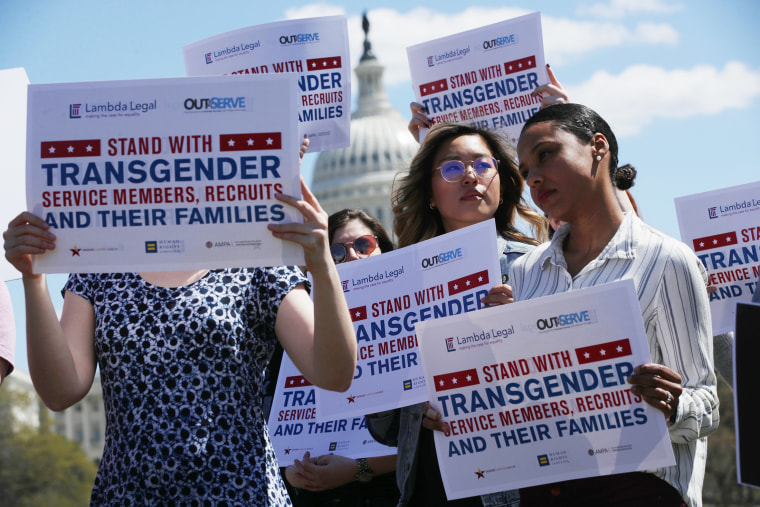
A rally at the U.S. Capitol against the transgender military service ban on April 10, 2019.Alex Wong / Getty Images file
The Department of Defense doesn’t publicly report how many trans people are serving in the military, and estimates vary widely. One 2014 report by the Williams Institute at UCLA using data from the 2011 National Transgender Discrimination Survey found that about 15,500 transgender people were serving in the military. A 2016 report from the Rand Corp. drawing from Department of Defense data and previous research (including the Williams Institute report) found that there were a maximum of 10,790 trans people serving in the military and the reserves, though it found that figure could also be as low as 2,150.
A report by the Congressional Research Service that was updated this month found that from 2016 to 2021, the Defense Department spent about $15 million on transition-related care (surgical and nonsurgical) to 1,892 active duty service members. Of that amount, $11.5 million went to psychotherapy and $3.1 million to surgeries, according to Military.com, citing Defense Department data provided to the outlet.
Emily Shilling, a commander in the Navy, has served in the military since 2005 and is the president of SPARTA, a trans military advocacy group. Shilling came out as a transgender woman in April 2019, shortly after Trump’s first trans military restrictions took effect, and she was required to continue serving in a way that aligned with her birth sex. When Biden lifted those restrictions in 2021, she was able to come out at work, she said.
When asked about Trump’s new order restricting trans military service, Shilling — who emphasized she was not speaking on behalf of the Navy or the Pentagon — said she and other trans service members “just want to continue serving.”
“I want to keep using the skills this nation invested in me as a fighter pilot and leader,” she added. “Since coming out as transgender in 2019, I’ve served with distinction, earning a promotion with distinction as the top officer in my community. My country has given me so much, serving it has been my life’s greatest honor.”
One of the other orders Trump signed Monday, titled “Restoring America’s Fighting Force,” prohibits diversity, equity and inclusion programs in the military, disbanding any DEI offices within the Departments of Defense and Homeland Security and requiring the secretaries of both departments to review United States service academies curricula to “ensure alignment” with the order.
In a post shared Sunday on X, Secretary of Defense Pete Hegseth wrote, in part, “No more DEI at @DeptofDefense” and “No exceptions, name-changes, or delays.” The post included a photo of a handwritten note that said, “Those who do not comply will no longer work here.”
In his latest assault on transgender Americans, President Donald Trump has ordered federal prisons to house transgender women in men’s facilities and halt their gender-related healthcare.
The directive follows an executive order Trump issued on his first day in office declaring the federal government would recognize only two “immutable” sexes, male and female.
The executive order, titled “Defending Women From Gender Ideology Extremism and Restoring Biological Truth to the Federal Government,” also applies to immigration detainees in federal facilities. It does not address trans men held in detention.
The directive requires all gender-related healthcare for trans women inmates to cease, ordering no federal funds be spent “for any medical procedure, treatment, or drug” for what the order describes as “conforming an inmate’s appearance to that of the opposite sex.”
Advocates for transgender rights say the new policy will put transgender women in danger.
“There will be rapes and physical assaults because of this policy,” Shannon Minter, legal director of the National Center for Lesbian Rights, told The New York Times. “It’s also terrible for prison officials, who right now have the authority to use discretion about what makes the most sense for the safety and security of the facility.”
Data from the Department of Justice indicates transgender prisoners are 10 times more likely to be sexually assaulted than straight prisoners.
“We’re encouraged to see these protections for privacy in women’s prisons and in rape shelters, ensuring that no woman ever has to face abuse, harassment, or the loss of privacy and dignity from a man sharing these intimate spaces,” said Matt Sharp, senior counsel and director for public policy at the right-wing Alliance Defending Freedom.
Multiple court cases have found housing transgender women in men’s facilities and denying gender-related healthcare are violations of the Eight Amendment to the Constitution, which bars cruel and unusual punishment. Trump’s order will likely be challenged on that basis.
In 1994, the Supreme Court held that the government had a duty to protect transgender prisoners from violence in Farmer v. Brennan. The plaintiff in the case, Dee Farmer, said she had been raped while housed with men.
Farmer now leads Fight4Justice, a nonprofit advocacy group for LGBTQ+ prisoners. “Yesterday I got three calls from inmates who were in a panic about what was about to happen to them,” she said.
During the Obama administration, the Bureau of Prisons released new guidance that transgender prisoners be housed according to their gender identity in most cases. In his first term, Trump narrowed that guidance to rare cases. President Joe Biden restored the Obama-era policy when he came to office.
Trump’s new order follows a campaign that prominently featured Vice President Kamala Harris’ support for transgender prisoners in California. Republicans spent $215 million on ads attacking Harris and Democrats on the issue.
Roughly 1,500 federal prisoners are transgender women, according to the Bureau of Prisons, accounting for 15 percent of the total population of women in prison. 750 men identify as transgender out of about 144,000 male prisoners.
About one percent of the U.S. population identify as transgender, according to UCLA’s Williams Institute.
GLAAD president and CEO Sarah Kate Ellis took aim at Elon Musk during a panel discussion of business leaders at the World Economic Forum in Davos, Switzerland, warning that his consolidation of power and influence is fueling attacks on LGBTQ+ people and other marginalized groups.
Speaking at the “Open Forum: Protecting LGBTQI+ Lives” on Thursday, Ellis tied Musk’s actions to a broader pattern of billionaires targeting vulnerable communities while enriching themselves.
“We know that algorithms are where the money is made, and the hate algorithms are the better ones,” Ellis said. “What we’ve enacted is free speech for algorithms, not free speech for citizens. Because we do know that more people are accepting and believe in equality for LGBTQ+ people, but you would never believe that if you go onto X or nowFacebook—that’s not where it’s happening.”
After Musk acquired Twitter, he rolled back content moderation policies that made the app dangerous for LGBTQ+ users. Recently, Meta CEO Mark Zuckerberg also announced a sharp turn in the company’s content moderation and fact-checking approach, loosening restrictions on hate speech and stopping independent fact-checking partnerships.
Ellis highlighted the growing threats to LGBTQ+ safety in the United States, drawing a direct connection between online hate and real-world violence. “What’s happening online is happening in real life. It models one to the other,” she said. She cited attacks on drag shows and the murders of transgenderwomen, adding that GLAAD had to establish an alert desk last year to monitor these incidents as violence “gotten so heinous and out of control.”
Musk’s role in targeting LGBTQ+ people
Ellis also spotlighted Musk’s financial support for President Donald Trump’sreelection campaign and his actions since rebranding X in 2023. Federal Election Commission records show that Musk donated $293 million to Trump’s campaign, making him the largest donor of the 2024 election.
“Trump’s first administration hit about 280 acts against our community,” Ellis said. “In his second [run] for this election, he spent over $280 million on ads, specifically targeting the transgender community. That’s a lot of money that could go to a good cause. At the center of that money was Elon Musk.”
Trump later appointed Musk to lead an advisory committee on “government efficiency,” granting him potential access to federal agencies, deliberations, and budgets—resources Musk could use to benefit his companies, many of which hold U.S. government contracts.
Meanwhile, GLAAD has documented how X under Musk refused to enforce—and later wholly removed—policies protecting LGBTQ+ users and allies from hate speech and harassment. The platform has since become a breeding ground for anti-LGBTQ+ rhetoric, which Ellis warned has dangerous real-world implications.
“The billionaires are targeting the most marginalized people in the world,” she added. “To me, it’s a distraction. Don’t watch what they’re doing to us; watch what they’re really doing. Because as long as we are fighting or they’re putting us on guard and politicizing us, they’re making money and grabbing more power.”
LGBTQ+ advocacy at Davos
Ellis’s comments were part of GLAAD’s broader advocacy efforts during the forum. On Wednesday, she participated in “The Economic and Business Case for LGBTQI Inclusion,” a session that highlighted the $4.7 trillion global purchasing power of LGBTQ+ consumers and explored how businesses can harness this potential while addressing anti-LGBTQ+ sentiment and legislation.
GLAAD also partnered with Open for Business and the Partnership for Global LGBTQI+ Equality to organize the third annual rainbow light-up of the Davos Promenade, supported by companies like Amazon, Google, Deloitte, and SAP.
Ellis’s high-profile presence at Davos follows scrutiny from a New York Timesexposé last August, which examined her compensation and travel expenses, including trips to the conference frequented by some of the world’s wealthiest and most powerful CEOs. GLAAD dismissed the article as “grossly misleading,” arguing that Ellis needs to be in places where influential people meet and that it was retaliation for Ellis’s criticism of the Times’s coverage of transgender issues.
In Davos, Ellis addressed the mounting threats to LGBTQ+ communities, doubling down on GLAAD’s mission. “We have always existed. We will always exist,” she said. “You can legislate against us. You can politicize us. We’re not political. We’re everybody. We’re in every family.”
Ellis called for greater accountability from businesses, governments, and civil society in protecting LGBTQ+ lives.
“When you know someone, it’s impossible to hate them. Storytelling is an empathy machine, and we need that more than ever in our society,” she said.
Secretary of State Marco Rubio directed the State Department on Wednesday to suspend all passport applications seeking to change a sex marker and all applications requesting an “X” sex marker, according to a memo reviewed by NBC News.
The memo references an executive order issued by President Trump hours after his inauguration, declaring that the U.S. government will recognize only two sexes, male and female, and that “these sexes are not changeable and are grounded in fundamental and incontrovertible reality.”
“The executive order specifies government-issued identification documents shall refer to an individual’s immutable biological classification as either male or female,” Rubio’s memo states. “In agency documents ‘sex’ and not ‘gender’ shall be used. Further, it is specified that the policy of the United States is that an individual’s sex is not changeable.”
As a result, the memo continues, the State Department will no longer issue “X” sex markers for U.S. passports or birth records for U.S. citizens with children born abroad. It directs employees to suspend all applications requesting an “X” sex marker or a sex marker change, adding that employees should “not take any further action” on those applications “pending additional guidance from the Department.”
The memo applies to all applications currently in progress and any future applications, the memo states, adding that guidance on existing passports containing an “X” sex marker “will come via other channels.”
In an email to NBC News, the State Department confirmed that it is “no longer issuing U.S. passports with X markers” and that it has “suspended processing of all applications seeking a different sex marker than that defined by the terms” of Trump’s executive order pertaining to gender.
The spokesperson did not answer questions regarding whether passports that currently have an “X” marker are still valid or what will happen if people travel with them but said updates are forthcoming and would be shared as soon as possible the department’s travel website.
The uncertainty surrounding how Trump’s executive order would affect passports has caused fear and confusion among some transgender people who have shared on social media that they have passport renewal applications in process with the State Department.
Amy, who has a transgender son and asked to go by her first name to protect her family’s privacy, said she submitted an application to correct the sex marker on her teenage son’s passport, and it was delivered Tuesday, according to postal service tracking. She said she’s called every day since to check on its status, and that, as of Friday afternoon, all of the employees she’s spoken with have told her that they are processing requests to update gender markers as usual. However, after hearing news of Rubio’s memo, she said she’s “devastated.”
She’s concerned her son’s passport application will be suspended and that his valid passport, which has his previous legal name and sex marker and was sent as part of his application, will be held in the processing center at least until the State Department issues new guidance.
“We put these forms in so that everyone in our family would have a valid passport, because that seemed suddenly very necessary,” she said, noting that access to gender-affirming care for minors is changing rapidly across the country. “We didn’t know if we would need to leave the country to get medical care, and for our son’s valid passport to be held with no indication of when we might get that back feels not legal and terrifying.”
A day after Trump — who has promised to ban gender-affirming care for minors nationally — issued the executive order pertaining to gender, the department removed a page from its website titled “Selecting your gender marker.” The page, which still appears in Google search results, said that people applying for or updating a passport could select male (M), female (F), unspecified or another gender identity (X) as the gender marker on their U.S. passport books and cards.
“We promote the freedom, dignity, and equality of all people — including LGBTQI+ individuals,” the page said. “We are demonstrating this commitment to better serve all U.S. citizens, regardless of gender identity.”
The since-removed page also provided information about traveling as an LGBTQ person and cautioned that those with “X” gender markers might not be able to travel to all countries. As of Tuesday afternoon, the page redirected to a general passport information page.
Trump’s executive order regarding gender and identity documents reverses two policies the Biden administration rolled out: one that allowed transgender people to change the gender on their passports without providing proof of their transitions, and another that allowed applicants who are intersex or identify as neither male nor female to select an “X” gender marker.