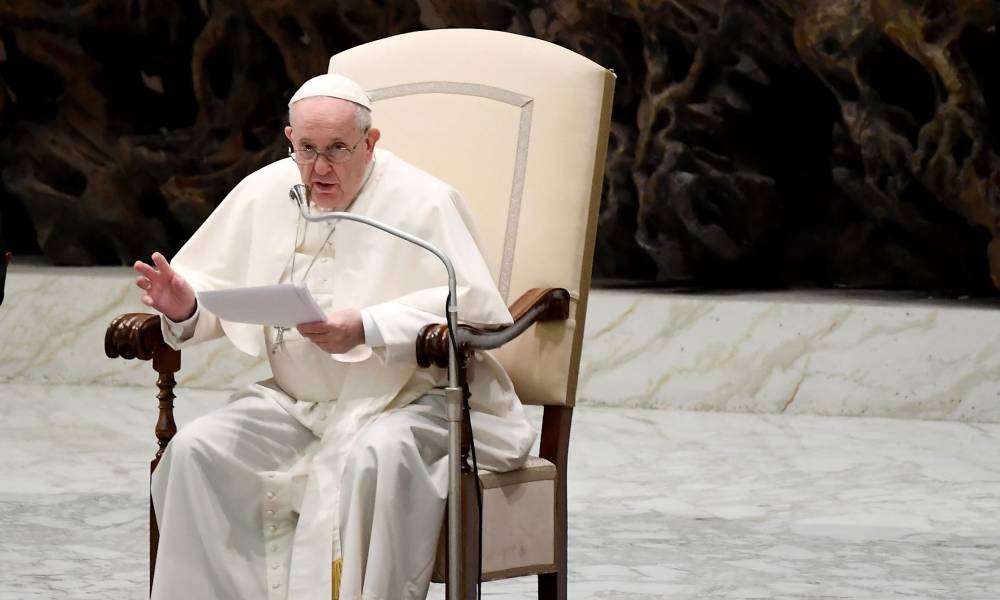
Pope Francis has met with a fourth group of transgender people who found shelter at a Rome church, the Vatican newspaper reported Thursday.
L’Osservatore Romano said the encounter took place Wednesday on the sidelines of Francis’ weekly general audience. The newspaper quoted Sister Genevieve Jeanningros and the Rev. Andrea Conocchia as saying the pope’s welcome brought their guests hope.
The Blessed Immaculate Virgin community in the Torvaianica neighborhood on Rome’s outskirts opened its doors to transgender people during the coronavirus pandemic.
Francis previously met with some of them on April 27, June 22 and Aug. 3, the newspaper said.
“No one should encounter injustice or be thrown away, everyone has dignity of being a child of God,” the paper quoted Sister Jeanningros as saying.
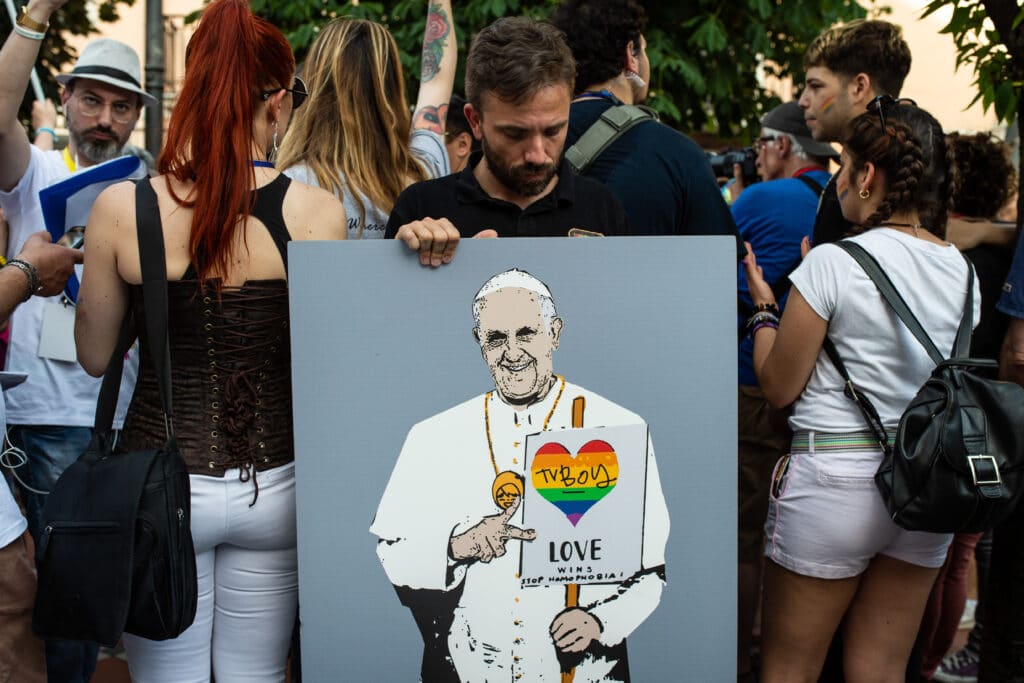
Francis has earned praise from some members of the LGBTQ community for his outreach. When asked in 2013 about a purportedly gay priest, he replied, “Who am I to judge?” He has met individually and in groups with transgender people over the course of his pontificate.
But he has strongly opposed “gender theory” and has not changed church teaching that holds that homosexual acts are “intrinsically disordered.” In 2021, he allowed publication of a Vatican document asserting that the Catholic Church cannot bless same-sex unions since “God cannot bless sin.”
Recently, Francis wrote a letter praising the initiative of a Jesuit-run ministry for LGBTQ Catholics, called Outreach. The online resource is run by the Rev. James Martin, author of “Building a Bridge,” a book about the need for the church to better welcome and minister to LGBTQ Catholics.
Francis praised a recent Outreach event at New York’s Jesuit-run Fordham University, and encouraged organizers “to keep working in the culture of encounter, which shortens the distances and enriches us with differences, in the same manner of Jesus, who made himself close to everyone.”
Several men have alleged they had sex with anti-LGBTQ+ pastor and conservative radio host Jesse Lee Peterson.
The allegations emerged after Church Militant – a far-right Catholic group and website – released an almost 30-minute video in June featuring interviews with men accusing Peterson of making sexual advances toward them.
Patrick Rooney, one of the men in the video, claimed he had a sexual relationship with Peterson that he said lasted about 10 years. Rooney, who has known Peterson since 1992, alleged in the video that the Los Angeles-based pastor made sexual advances toward him for years before they became sexually involved in 2005.
But Rooney admitted in a subsequent investigation by the Daily Beasthe didn’t have any emails, texts, recordings or other documentation that could back up his claims.
“Jesse Lee Peterson is a very smart person, he’s a sly person,” Rooney said. “He’s not going to leave a lot of extraneous evidence out about what he does.”
PinkNews has contacted Jesse Lee Peterson and his Brotherhood Organization of a New Destiny (BOND) for comment.
Another man, named Samuel Arambula, alleged in the Church Militant video that Peterson subjected him to unwanted sexual touching at the “BOND house”, a Los Angeles House where Peterson reportedly lives with other members of his organisation.
Robert Santner – who described himself as the BOND house’s former manager – claimed in the video that he witnessed Peterson “intensely” hugging another man. He said he saw a man wrapped up in blankets “like a burrito” while the pastor hugged and kissed his forehead.
According to the Daily Beast, the video followed an online feud between Jesse Lee Peterson and Church Militant’s founder Anthony Michael Voris, who has been described as “one of the US Catholic Church’s most infamous agitators”.
Peterson has reportedly refused to address the allegations he had sexual relationships with men. He told one caller on his radio show, who asked about the claims, that “it’s not concerning me”, the Daily Beast reported.
The outlet reported the video has caused leading figures in the online “manosphere” – which the Daily Beast described as “Peterson’s hyper-masculine conservative community” – to distance themselves from the pastor. One of the leaders reportedly banned Peterson from future events.
In 2019, Jesse Lee Peterson described then-presidential candidate Pete Buttigieg as a “radical homosexual”. He complained that same-gender married couples – who he described as “radical homosexuals” in “phoney relationships” – had “taken over terms ‘husbands’ and ‘wives’”, forcing straight couples to call each other “partners”.
Peterson also claimed that queer couples are not “mentally capable” of raising children and alleged LGBTQ+ people are “violent toward each other”.
He said in 2016 that intellectual “nutcases” are responsible for same-sex marriage and drag queens.
Last year, Jesse Lee Peterson tweeted the baseless claim that “‘diversity’ and ‘inclusion’ based on race, gender sexual orientation or any other physical attribute is a cancer on America culture”.
A Mormon leader has reaffirmed the faith’s opposition to same-sex marriage and “changes that confuse or alter gender” at a biannual conference.
Dallin H Oaks, the second-highest-ranking leader of the Church of Jesus Christ of Latter-day Saints (also known as the Mormon church), told conference attendees at the church’s headquarters in Salt Lake City, Utah, that it would not be altering its stances on same-sex marriage or gender identity.
Oaks, according to AP, explained that the highest level of salvation “can only be attained through faithfulness to the covenants of an eternal marriage between a man and a woman”.
>”That divine doctrine is why we teach that gender is an essential characteristic of individual pre-mortal, mortal and eternal identity and purpose.”
He added that the Mormon church “opposed changes that confuse or alter gender or homogenise the differences between men and women” and stated that “confusing gender, distorting marriage, and discouraging childbearing” was the devil’s work.
AP reported that the conference also covered the war in Ukraine, with a leader saying all war is “horrifying”.
Russell M Nelson, the church’s president-prophet, said: “I weep and pray for all who are affected by this conflict. The church is doing all we can to help those who are suffering and struggling to survive.”
In a letter announcing his resignation, Green said: “While most members are good people trying to do right, I believe the church is actively and currently doing harm in the world.
“I believe the Mormon church has hindered global progress in women’s rights, civil rights and racial equality, and LGBTQ+ rights.”
Shortly after his resignation, Green announced that he would donate $600,000 (around £457,000) to LGBT+ rights group Equality Utah.
The Church of England has launched an investigation after a gay man claimed he was subjected to a conversion therapy exorcism in a Sheffield church.
Matthew Drapper, 34, says he was “born into a Christian cult [and] was raised believing Satan is at war with Christians and God is at war with the gays”.
He told the Huddersfield Examinerthat he moved to Sheffield from Buxton in 2013, at the age of 25, and joined the Church of England church St Thomas Philadelphia.
Drapper said by that point he had come out as gay, but that he had vowed to remain celibate. In 2014, he claims, the church offered him a chance to “pray that away”.
“I had thought about whether it is even worth living if I’m going to be gay,” he said,
“So, it kind of was a last resort really. By that point, I was like, ‘Well, I’ll try anything.’”
St Thomas Philadelphia has a “belief in the supernatural” and “taught a lot of stuff to do with demons”, Drapper said.
He was invited to a prayer day to “go through our deepest fears”, but this soon became an “exorcism”, he alleged.
Drapper continued: “They told me to speak against the sort of demonic hold that being gay had in my life.
“I was told to renounce the belief system of homosexuality and to cancel my agreement with Satan and to break the power of homosexuality in my life through the blood of Jesus… They told me they could see demons leave my body and go out the window. It was terrifying.”
It took Drapper months to recognise that “something really bad had happened in that space”, and he eventually began accepting his identity.
He was a volunteer at St Thomas Philadelphia at the time, but when he told leaders that he was planning to start dating, he says they said he “wasn’t allowed to work with young adults or children, because I might influence them to become gay”.
The church has denied all of Drapper’s allegations, but finally, eight years on, the Diocese of Sheffield is launching an investigation.
The Diocese of Sheffield said in a statement to the BBC that it believes “conversion therapy is unethical, potentially harmful and has no place in the modern world”, and added that it would keep Drapper informed at all stages of its investigation.
Drapper said: “If conversion therapy had been illegal at the time, then hopefully people would have known enough to intervene and I wouldn’t have gone through that trauma and had eight years of recovering from it.”
St Thomas Philadelphia said in a statement: “St Thomas Philadelphia is a caring and generous church community which does not engage in conversion therapy.
“We welcome the independent investigation initiated by the diocese into these allegations of eight years ago and will participate in it.”
The church has a bizarre and dark history, having been opened in 1998 when it was “planted out” of a huge evangelical church St Thomas Crookes.
According to St Thomas Philadelphia’s website, this planting out was “in response to significant growth and also to a sense of call to the whole city”.
But St Thomas Crookes is also known for being the birthplace of Nine O’Clock Service, often described as a “cult” within the Church of England.
Nine O’Clock Service was an alternative Christian group launched in 1986, which focused on recruiting young people through rock concert-style services featuring lasers in the basement of Sheffield’s Ponds Forge complex.
The group was shut down by the Church of England in 1995 after the group’s leader, Chris Brain, admitted to having sexual contact with more than 20 young female members of Nine O’Clock Service.
A documentary was released chronicling the scandal, and shortly before its release, Brain admitted himself to a psychiatric hospital.
A worrying report has shown that just a third of LGBT+ Christians feel safe to be themselves at church, fearing “hostility and discrimination”.
The report from the Ozanne Foundation, in collaboration with nine LGBT+ Christian organisations, is the result of research conducted last year and overseen by Dr Sarah Carr, a mental health and social care research specialist.
The survey received around 750 responses from queer Christian adults in the UK, with the majority (59 per cent) attending Church of England churches, and the remaining respondents belonging to other Christian denominations.
It found that less than a third (31 per cent) of LGBT+ Christians felt they could “be themselves” at church, with gay men the most likely to “feel safe to be out to everyone in their local church” (45 per cent).
This figure dropped significantly for lesbians (35 per cent), even further for trans and non-binary folk (28 per cent), and just 23 per cent of bisexualChristians said they felt safe to be out at church.
Most respondents felt that while their physical safety was prioritised by church leaders, far less attention was given to their “spiritual”, “sexual”, “psychological” and “emotional” safety.
Dr Carr said: “The findings show that fear and anticipation as well as experiences of hostility and discrimination can make churches feel unsafe, exclusionary environments where many LGBT+ people state they ‘feel scared to be themselves’.
“While there was a recognition that churches focused on physical aspects of safeguarding, attention to emotional and psychological safeguarding was found wanting – which the findings imply are just the type of safeguarding LGBT+ Christians need!”
Asked what being safe at church looked like, three quarters of LGBT+ Christians described it as not being “worried what might be said in the sermon” and being able to be “open with the clergy about my sexuality and/or gender identity”.
The role of clergy in safeguarding LGBT+ Christians was clear, with others saying that church leaders “openly affirming same-sex relationships”, having an “inclusive statement on our church website” and having “positive recognition of LGBT+ people in sermons” would make them feel safer.
The right reverend Paul Bayes, Bishop of Liverpool and former chair of the Ozanne Foundation, said the research “shows just how important it is for church leaders to be clear about where they stand on LGBT+ matters”.
“Silence has a price – and we now see clearly who has been paying it,” he added.
“I long for the day when all LGBT+ people can enter a church and not feel apprehensive or anxious about how they might be treated.”
Dave Moreton of Oasis Open House, an organisation supporting LGBT+ people of faith, described the worrying findings laid out in the report as “the outcome of faith-based rejection and conversion therapy“.
Moreton said: “Safeguarding is one of the most challenging topics before the Church today, especially as many of our LGBT+ siblings tragically harm themselves, leave the church and even take their own lives.
“It is a shame that many of our LGBT+ siblings feel safer in a gay bar than in one of our church congregations.”
The report included recommendations for church leaders, and stated that churches need “to be far more proactive in helping LGBT+ Christians feel safe enough to be themselves”, “to broaden their concept of safety to include matters that impact the emotional and mental health of their members” and “to be clear where they stand on LGBT+ matters”. Wider faith communities must also “drive awareness of pressures faced by LGBT+ Christians”.
Jayne Ozanne, director of the Ozanne Foundation, said: “This research shows just how vulnerable LGBT+ Christians feel in our churches.
“The fact that so many are apprehensive about attending church and are worried about what might be said in the sermon should come as a serious wake-up call to church leaders.
“It’s time we took the wellbeing of LGBT+ people in our care seriously and look at ways in which we can help them feel safe.”
Pope Francis has urged parents worldwide to unconditionally support, not condemn, their children if they are gay.
The leader of the Catholic Church made his latest gesture of outreach to the LGBT+ community in off the cuff statements during his weekly general audience on Wednesday (26 January).
He spoke to the crowd about different “sad” situations that parents face in their children’s lives. This included coping with children who live with serious illnesses, are imprisoned or come out as part of the LGBT+ community.
“Parents who see that their children have different sexual orientations, how they manage that and accompany their children and not hide behind a condemning attitude,” Pope Francis said.
He told parents “never condemn” and not to be afraid of their children.
While the LGBT+ community has long been marginalised within the Catholic Church, Pope Francis has frequently voiced that people should be more accepting of queer people.
In 2013, the pontiff argued that LGBT+ people should not be marginalised by society, famously saying: “Who am I to judge?”
Pope Francis addresses attendees during a weekly general audience on 26 January 2021 at Paul-VI Hall in the Vatican. (Filippo Monteforte/AFP via Getty)
A year later, he said the Catholic Church must help and support parents to stand by their LGBT+ children.
Pope Francis said Catholic Church officials encountered parents who struggled with how to support their gay child “all the time in the confessional”. He added that he had experienced such confessions “several times” when he worked in “Buenos Aires”.
“We have to find a way to help that father or that mother to stand by their son or daughter,” he said.
However, he has not shied away from his support of the Catholic Church’s stance on same-sex marriage.
In September, he declared that “marriage is a sacrament” and that the “church doesn’t have the power to change sacraments”.
But Pope Francis insisted that refusing to allow queer couples the same sacramental rights as heterosexual couples “does not mean condemning them”. He added that LGBT+ people are “our brothers and sisters”, and “we need to be close to them”.
In March last year, the Vatican ruled that the Catholic Church couldn’t bless same-sex unions because God “does not and cannot bless sin”.
The comments, made by the Congregation for the Doctrine of Faith, directed church members not to give blessings to same-sex couples as doing so would be an affront to God.
In December, a Vatican official apologised after the website of the Synod of Bishops removed and later reinstated a link to material referencing leading Catholic LGBT+ advocacy group, New Ways Ministry.
The Synod had included reference to a webinar video made by New Ways Ministry which urged LGBT+ Catholics to participate in a consultation process to make the Church more welcoming.
Thierry Bonaventura, the Synod’s communications director, apologised to “all LGBT and to the members of New Ways Ministries for the pain caused” by taking down the video.
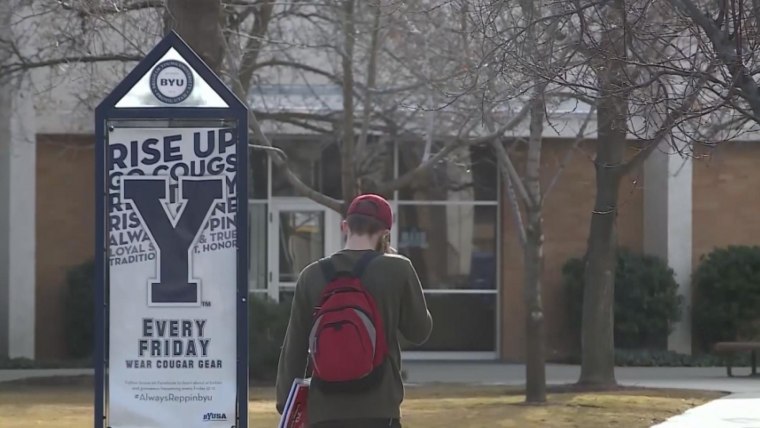
The U.S. Department of Education has opened a civil-rights investigation into how LGBTQ students are disciplined at Brigham Young University, a private religious school.
The complaint under investigation came after the school said it would still enforce a ban on same-sex dating even after that section was removed from the written version of the school’s honor code, the Salt Lake Tribune reported. Students can be punished for holding hands or kissing someone of the same sex, harsher discipline than that faced by heterosexual couples at the school operated by The Church of Jesus Christ of Latter-day Saints.
BYU removed its written ban on “homosexual behavior,” in early 2020, prompting students to publicly come out as members of the LGBTQ community. But the school clarified a few weeks later that same-sex dating is still prohibited, even if it’s no longer expressly written in the honor code. It also bans things such as alcohol consumption, beards and piercings.
Students protested the apparent reversal, saying they felt tricked into coming out. The federal investigation from the department’s Office for Civil Rights started late last year under Title IX, the law that protects against discrimination on the basis of sex in schools.
A university spokeswoman acknowledged the investigation but said in a statement that BYU is within its rights to enforce the church’s policies against same-sex relationships and does not anticipate any further action.
“BYU is exempt from application of Title IX rules that conflict with the religious tenets of The Church of Jesus Christ of Latter-day Saints,” Carri Jenkins said in a statement.
The church has softened its approach in recent years but maintains doctrinal opposition to same-sex marriage and sex outside of marriage.
A Department of Education spokesperson confirmed an investigation was opened in October, but declined to comment further. As a private religious school, BYU does have religious exemptions from Title IX related to sexuality and gender expression.
Federal scrutiny like this is rare at church-owned schools, and typically happens only in places where there are believed to be potential systemic or serious issues, said Michael Austin, a BYU graduate and vice president at the University of Evansville, a private Methodist school in Indiana.
“It’s really significant that investigators are stepping in now,” he told the newspaper. The new investigation appears to be about whether those exemptions allow faith-based discipline for LGBTQ students even if the behavior is not directly related to education or expressly prohibited in its written honor code.
The school’s president argued those exemptions do apply, and everyone who attends or works at BYU agrees to follow the honor code and “‘voluntarily commit to conduct their lives in accordance with the principles of the gospel of Jesus Christ,’” according to a letter Kevin Worthen wrote to the Department of Education in November 2021.
In a response obtained by the Tribune, the Department of Education’s Office for Civil Rights affirmed the school does have some religious exemptions but the department had to investigate whether the complaint it received falls under those exemptions.
LGBTQ rights have been a major issue in recent years at the school located in Provo, Utah. A lawsuit filed by several students last year alleges discrimination, with one recent graduate who is a lesbian alleging she lost her job at the school because she didn’t look “feminine enough” to her boss.
The institution has also banned protests near its large letter “Y” posted on a mountainside after protesters lit the letter with rainbow colors. Last fall, a top-ranking church leader publicly criticized faculty members and students who challenge the faith’s teachings on same-sex marriage.
More than 120 German Roman Catholic priests and officials have jointly come out as LGBT+ and called on the church to do better by queer Catholics.
Presenting a fresh test for the church, which has long resisted calls to modernise when it comes to LGBT+ rights, 125 former and current priests, teachers, church administrators and volunteers came out on Sunday (23 January).
In a Change.org petition, the group wrote that while some have “bravely and dared” to come out in the past, others have only “just taken the step”.
“We no longer want to remain silent,” they wrote.
Jointly, the group is demanding that church leadership bring an end to “outdated statements of church doctrine” when it comes to sexuality and gender.
“We want to be able to live and work openly as LGBTIQ+ persons in the church without fear,” the statement read.
The initiative, called Out In Church, posted Sunday evening a lengthy list of demands addressed to the Roman Catholic Church.
LGBT+ Roman Catholics must have access to “all fields of activists and occupation in the Church without discrimination”, they said.
Out In Church also took aim at Church employment rules that consider being openly queer as a “breach of loyalty or a reason for dismissal”.
“Defamatory and outdated statements of church doctrine on sexuality and gender needs to be revised on the basis of theological and human scientific findings,” the officials continued.
“This is of utmost relevance especially in view of worldwide church responsibility for the human rights of LGBTIQ+ persons.”
Among the group’s other calls is a plea for the church to give LGBT+ people of faith access to God’s blessings and sacraments, and to oppose LGBT+ discrimination in all its forms.
Above all, the group urged church leaders to shoulder accountability for the institution historic discrimination of LGBT+ people.
“In dealing with LGBTIQ+ persons, the church has caused much suffering throughout its history,” Out In Church concluded.
“We expect bishops to take responsibility for this on behalf of the church, to address the institutional history of guilt and to advocate for the changes we call for.”
It’s the latest example of Catholics challenging the Vatican’s increasingly mixed messages on LGBT+ inclusion.
The Vatican’s Congregation for the Doctrine of Faith said that it does not “discriminate” but that God “cannot bless sin”.
The Vatican even objected to a proposed bill in Italy that would protect queer people from discrimination, with the unprecedented intervention sparking outrage.
Francis himself has flip-flopped on the issue of LGBT+ rights. While he once appeared to suggest support for civil unions, he has previously said that parents of queer children should “consult a professional” and referred to “gender ideology” as a “move away from nature”.
A group of activists invite social media to join their campaign to ‘disrupt the religious violence trans people experience every day’.
Lady Dane Figueroa Edidi and J Mase III edited the Black Trans Prayer Book to dismantle toxic religious practices that alienate people in the LGBT+ community. The anthology is composed of work by Black trans, non-binary and gender non-conforming people.
In 2019, the pair hosted their first annual event for the #TransphobiaIsASin Campaign. The online campaign highlights religious violence that impacts trans, non-binary and gender non-conforming people worldwide – especially those from Black, Indigenous and other marginalised communities.
Now, on Saturday (15 January), Dane and Mase will launch their fourth iteration of the campaign. In it, they are inviting anyone that is “invested in ending religious (ie: all) violence against Trans, Non-Binary and Gender Expansive Peoples”.
“Anti-trans religious violence does not just look like demonising trans people within worship spaces,” they said. “It is the theology that finds its way to the tongues of politicians who create anti-trans policies.”
They continued: “It manifests as the framework that blooms violence against trans people on the street, in their families, and in community at large.”
In a post on social media, Dane and Mase explained they want to “call attention to, and disrupt the religious violence trans people experience everyday”.
They have invited anyone interested in taking part to take a photo holding up a sign with one of the following lines: “Transphobia is a Sin”, “Transphobia is Haram”, “Trans People are Divine” or “Trans People Exist Because Our Ancestors Existed”.
The photo should be posted to social media on or close to Saturday, and it should use the hashtag “
Mase told them that the book came into existence as they wanted to do “some intentional work on creating spiritual space” for people within their community.
“That included Black trans people who are part of religious communities as well as Black trans folks who’ve been run out of religious communities,” Mase said.
He added that they knew this wasn’t a job just for him and Dane. So the pair gathered a “crew of people from all over the US and beyond” to offer their insights for the interfaith, multi-dimensional work.
Dane said her main takeaway from the book was: “Wow, Black trans people are just amazing”.
“Black trans people are the leaders this world has been looking for,” she explained. “It’s time some of these cis folks, especially the white ones, get out the way.”
Dane continued: “Get out the way and pour resources into the community.
“The solutions for liberation that the world has been seeking have already been theorised.
“Now it’s time for the world to actually honour the role that Black trans people have always been destined to play: healing the world, prophesying a future and birthing liberation.”
Dane and Mase will also close out the new campaign with a workshop on how to heal from religious trauma which is set to take place on 18 January.
Jeff Green, a billionaire thought to be the richest person from Utah, resigned from the Church of Jesus Christ of Latter-day Saints, writing in a letter to the church’s president that he believes the institution has “hindered global progress in women’s rights, civil rights and racial equality, and LGBTQ+ rights,” according to The Salt Lake Tribune.
Green, the chairman and CEO of The Trade Desk, a technology marketing company, informally left the Mormon church, as the LDS church is commonly called, a decade ago. But in a letter Monday to church President Russell Nelson, he officially resigned and requested the removal of his records, The Tribune reported.
Neither Green nor the church have responded to requests for comment about the letter.
Green said in his letter that most of the church’s members are “good people trying to do right” but that he believes “the church is actively and currently doing harm in the world.”
“The church leadership is not honest about its history, its finances, and its advocacy,” he wrote, according to The Tribune.
Green wrote that he will donate $600,000 to the LGBTQ advocacy group Equality Utah as the first major donation from his family foundation’s giving arm, Dataphilanthropy. According to The Tribune, he added that almost half of the money will go to a new scholarship program for LGBTQ students in Utah, including those who “may need or want to leave” his alma mater, Brigham Young University, which is sponsored by the church.
“We made this investment sizable and publicly to send a message that Equality Utah isn’t going anywhere,” Green wrote, adding that he hopes the donation is the first of many.
A spokesperson for Brigham Young University has not responded to a request for comment.
Executive Director Troy Williams said Equality Utah is “incredibly grateful for Jeff’s generosity and support.”
“In Utah, we have made enormous strides forward toward LGBTQ equality,” he said in an email. “The two most important elements of our success has been the support of allies and the willingness of state and religious leaders to engage with us. We don’t always agree, but great things happen when we seek common ground. Jeff’s financial support will ensure that we will remain a prominent force in Utah politics for years to come.”
The group has celebrated a number of notable achievements in recent years despite the state’s conservatism. About 62 percent of Utah residents and about 86 percent of the state’s lawmakers are members of the LDS church, which opposes same-sex marriage and, more recently, the Equality Act, a federal bill that would protect LGBTQ people from discrimination in housing, employment and jury service, among other areas of life.
Despite those conflicts, Equality Utah has managed to work alongside church leaders and the Republican-controlled Legislature to pass historic legislation.
In 2015, the state passed a bill that prohibits employment and housing discrimination on the basis of sexual orientation and gender identity while providing protection for religious institutions that say such prohibitions would violate their beliefs. In 2017, the governor repealed a law prohibiting discussions of homosexuality in public schools.
But advocates say there is still work to do. For example, in October, Brigham Young University, which Green mentioned in his letter, was named one of the worst colleges and universities for LGBTQ students by Campus Pride, a nonprofit organization that advocates for LGBTQ inclusivity and safety at U.S. colleges and universities.
The university forbids same-sex dating and doesn’t officially recognize or support BYU Pride, the student-run LGBTQ group.
The university was named in a class-action lawsuit against the Education Department in March alleging that a Title IX exemption allows religiously affiliated schools that receive federal funds to discriminate against LGBTQ students and that the exemption is unconstitutional. At the time, a spokesperson for the university said BYU was “aware of the lawsuit” and was reviewing it.
“Our goal is that all our students be treated with respect, dignity and love,” the statement read. “We are concerned when any of our students do not feel this way and greatly value the contributions our students make to BYU.” The university has not replied to a request for additional comment.
In addition to potentially making more donations to Equality Utah, Green — whose net worth is estimated at $5 billion — wrote in a giving pledge that his goal is to give away more than 90 percent of his wealth “through data-driven philanthropy before or at my death.”
“But I will also give of my time, my most precious commodity, to allocate those funds deliberately, and to be personally engaged,” he wrote.