A Vatican official has apologized to a leading Catholic LGBTQ advocacy group for having yanked a reference to it from the Vatican website, saying he realized the move caused pain and that the Catholic Church does indeed want to include gays and hear from them.
The Vatican’s General Secretariat for the Synod of Bishops, which is organizing a two-year consultation of rank-and-file Catholics ahead of a 2023 meeting of bishops at the Vatican, restored the reference to New Ways Ministries on the website over the weekend.
In Ghana, home to a diverse array of religions, leaders of major churches have united in denouncing homosexuality as a “perversion” and endorsing legislation that would, if enacted, impose some of the harshest anti-LGBTQ policies in Africa.
In Nigeria, the umbrella body for Christian churches depicts same-sex relationships as an evil meriting the lengthy prison sentences prescribed under existing law.
And in several African countries, bishops aligned with the worldwide United Methodist Church are preparing to join an in-the-works breakaway denomination so they can continue their practice of refusing to recognize same-sex marriage or ordain LGBTQ clergy.
In the United States, Western Europe and various other regions, some prominent Protestant churches have advocated for LGBTQ inclusion. With only a few exceptions, this hasn’t happened in Africa, where Anglican, Methodist, Presbyterian and Lutheran leaders are among those opposing such inclusion.
“They have always organized a group to maybe silence us or make the church disappear,” Omolo said. “They don’t want it to appear anywhere.”
Ghana, generally considered more respectful of human rights than most African countries, now faces scrutiny due to a bill in Parliament that would impose prison sentences ranging from three to 10 years for people identifying as LGBTQ or supporting that community. The bill has been denounced by human rights activists even as Ghanaian religious leaders rally behind it.
“Their role in perpetuating queerphobia and transphobia is clear and it’s very troubling and dangerous,” said Abena Hutchful, a Ghanaian who identifies as queer and co-organized a recent protest against the bill in New York City.
“The bill’s strongest supporters claim to be doing this in the name of religion,” says Graeme Reid, director of Human Rights Watch’s LGBT Rights Program. He called the measure “a case study in extreme cruelty.”
The lawmakers proposing the bill said they consulted influential religious leaders while drafting it. Among those endorsing it are the Christian Council of Ghana, the Ghana Catholic Bishops’ Conference and the country’s chief imam.
“We don’t accept murderers, why should we accept somebody who is doing sex in a sinful way?” Archbishop Philip Naameh, president of the bishops’ conference, told The Associated Press. “If you take a stance which is against producing more children, it is a choice which is injurious to the existence of the Ghanaian state.”
The Christian Council — whose members include Methodist, Lutheran, Presbyterian and Anglican churches — considers homosexuality “an act of perversion and abomination,” according to its secretary general, the Rev. Dr. Cyril Fayose of the Evangelical Presbyterian Church.
“Homosexuality is not a human right and we reject it in all uncertain terms,” he declared earlier this year.
In Africa’s most populous country, the Christian Association of Nigeria has threatened to sanction any church that shows tolerance for same-sex relationships.
Such acceptance “will never happen,” Methodist Bishop Stephen Adegbite, the association’s director of national issues, told the AP.
Asked about Nigeria’s law criminalizing same-sex relationships with sentences of up to 14 years in prison, Adegbite said there are no alternatives.
“The church can never be compromised,” he declared.
Such comments dismay Nigerian LGBTQ activists such as Matthew Blaise, who told the AP of being manhandled by a Catholic priest distraught that Blaise wasn’t heterosexual.
“The church has been awful when it comes to LGBTQ issues, instead of using love as a means of communicating,” Blaise said.
In Nigeria’s commercial capital, Lagos, Catholic Archbishop Alfred Adewale Martins told the AP that Catholic teaching “recognizes in the dignity of every human person.” However, he said LGBTQ people who enter into same-sex relationships are leading “a disordered way of life” and should change their behavior.
Nigeria is home to one of the United Methodist bishops, John Wesley Yohanna, who says he plans to break away from the UMC and join the proposed Global Methodist Church. That new denomination, likely to be established next year, results from an alliance between Methodists in the United States and abroad who don’t support the LGBT-inclusive policies favored by many Methodists in the U.S.
Bishops Samuel J. Quire Jr. of Liberia and Owan Tshibang Kasap of the UMC’s Southern Congo district also have indicated they would join the breakaway.
The Rev. Keith Boyette, a Methodist elder from the United States who chairs the Global Methodist initiative, said the African bishops’ views reflect societal and cultural attitudes widely shared across the continent.
“Same-sex orientation is viewed negatively,” he said. “That’s true whether a person is from a Christian denomination, or Muslim or from a more indigenous religion.”
In Uganda, where many LGBTQ people remain closeted for fear of violence and arrests, there is a retired Anglican bishop who in 2006 was barred from presiding over church events because he voiced empathy with gays.
In decades of ministering to embattled LGBTQ people, Christopher Senyonjo said he learned that sexuality “is a deep, important part of who we are. We should be free to let people be who they are.”
“Ignorance is a big problem in all this,” Senyonjo told the AP. “When there is ignorance, there is a lot of suffering.”
In 2014, Ugandan President Yoweri Museveni signed a harsh anti-gay law that, in its original version, prescribed the death penalty for some homosexual acts. Later that year, amid intense international pressure, a judicial panel annulled the legislation on a technicality.
However, a colonial-era law criminalizing sex acts “against the order of nature” remains in place.
Frank Mugisha, a prominent gay activist in Uganda, described church leaders as “the key drivers of homophobia in Africa.” Some Anglican leaders, he said, have deepened their hostility toward LGBTQ people in a bid to not lose followers to aggressively anti-LGBTQ Pentecostal churches.
In all of Africa, only one nation — South Africa — has legalized same-sex marriage. Even there, gay and lesbian couples often struggle to be accepted by churches, let alone have their marriages solemnized by clergy.
“People tell me, ‘I grew up in this church, but now I am not accepted,’” said Nokuthula Dhladhla, a pastor with the Global Interfaith Network, which advocates for LGBTQ rights within the religious sector.
She said some religious leaders are privately supportive of same-sex marriage, but reluctant to do so openly for fear of being sidelined by their more conservative peers.
South Africa’s Anglican Archbishop Desmond Tutu, world-renowned for his opposition to apartheid, has been an outspoken supporter of LGBTQ rights.
“I would not worship a God who is homophobic,” he once said. “I would refuse to go to a homophobic heaven. No, I would say ‘Sorry, I would much rather go to the other place.’”
Caroline Omolo, the activist pastor in Nairobi, said some Kenyan religious leaders blame LGBTQ people for the coronavirus pandemic.
“When we say we are still serving God, they don’t see something that’s possible,” she said. “They think it’s something unfamiliar and should be stopped.”
However, she said some faculty and students at Kenya’s theological schools support her LGBTQ church, which has about 300 members.
“The students, we call them the future generation, leaders of tomorrow,” she said. “When we have that population on our side, I believe there’s nothing that can shake us.”
Italy has voted down a bill to tackle hate crimes against women, LGBT+ people and those with disabilities, all in the name of religious freedom.
The bill – known as the Zan bill after the Democratic Party lawmaker and LGBT+ rights activist Alessandro Zan, who proposed it – was approved my the Italian parliament’s lower house last year.
The Zan bill, which would protect Italians from violence, hate speech and discrimination on the basis of sex, gender, gender identity, sexual orientation and disability, has caused a divide in the country since it was introduced, with critics insisting that it would infringe on religious freedom.
On Wednesday, Italy’s senate voted 154 to 131 to block further debate on the bill for the next six months, according to Reuters. Advocates of the bill fear it will now be impossible to pass it before the legislature expires in 2023.
Zan described the outcome of the vote on Twitter as a “betrayal of a political pact that wanted the country to take a step towards civilisation”.
Gabriele Piazzoni, general secretary of of Italian LGBT+ rights group Arcigay, said that the state had “once again turned the other way” when it comes to homophobia and transphobia.
“We thank those who fought,” he added. “Shame on everyone else.”
The LGBT+ rights bill faced opposition from the Vatican and Italy’s far-right
The church feared prosecution for openly opposing same-sex marriage and adoption by LGBT+ families, and also opposed the bill’s requirement that Catholic schools would have to mark a day dedicated to fighting homophobia and transphobia.
The bill also faced fierce opposition from Italy’s far-right League party, with the party’s leader Matteo Salvini describing it as a “gagging law” which would mean that “those who think a mom is a mom and a dad is a dad” would end up in jail.
Andrea Ostellari, a League party senator and president of the Italian senate’s justice committee, managed to repeatedly delay the second vote on the bill.
According to The Guardian, Alessandro Zan said earlier this year that lawmakers who backed the bill were “being held hostage by a president who arbitrarily decides that the vote shouldn’t be scheduled because he belongs to a party that doesn’t want it”.
In a pattern that is becoming worryingly familiar around the world, the bill’s opposition also united anti-trans activists with the far-right.
In April, a group of 17 “feminist” and lesbian groups issued a joint statement against the bill.
Despite the bill aiming to protect Italians on the basis of both sex and gender, the groups declared that the term “gender identity” had been “weaponised against women”.
At the time, Zan rejected the letter, and responded: “To say that trans women are not real women is not acceptable.
“We are talking about people who are particularly discriminated against… Unfortunately, some statements by historic and radical feminists have the same content as the extreme right and religious fundamentalists.”
A vital new research project will examine the impact of “the increasingly toxic rhetoric around sexuality and gender identity” on LGBT+ Christians.
A survey will be launched on World Mental Health Day (10 October) to measure how safe “increasingly vulnerable” LGBT+ Christians feel.
The vital research, looking at the wellbeing of LGBT+ people in religious spaces which “can cause significant harm and trauma”, is being conducted by a consortium of nine Christian LGBT+ organisations.
The survey was instigated by Jayne Ozanne, director of the Ozanne Foundation, who said: “Many LGBT+ Christians feel increasingly vulnerable in their local churches given the increasingly toxic rhetoric around sexuality and gender identity.
“We thought it essential to measure in a safe and anonymous way just how safe people feel able to be about who they are, and what steps should be taken to make them feel safer.”
The survey’s launch on World Mental Health Day will also coincide with the Church of England’s first “Safeguarding Sunday”, an initiative“encouraging local churches to use their regular Sunday service to explore together what safer places look like”.
Dr Sarah Carr, an LGBT+ mental health expert who is overseeing the survey, said: “It is critical that LGBT+ people’s well being is prioritised in spaces which we know have and still can cause significant harm and trauma.
“By asking them directly about how they feel we can build a picture of what is happening in the UK today, and identify steps that they tell us will help improve things.”
Executive director of OneBodyOneFaith Luke Dowding, whose organisation coordinates LGBT-friendly Christian spaces and gatherings and is part of the consortium organising the survey, explained: “We know that many LGBT+ people have a deep faith, but some feel unable to attend church because they fear that they will not be welcomed or understood in their local places of worship.
“We would therefore like to understand if there are LGBT+ Christians who do not currently go to church for fear of their safety, with a desire to learn what if anything local churches might do to help address these concerns.”
The online research survey will run for two weeks, with results to be made public in November, and all LGBT+ adult, self-identified Christian in the UK can take part, whether or not they attend church. Click here to take part.
Twenty years ago, on one of America’s darkest days, two planes flew into the twin towers, another into the Pentagon, and a fourth crashed in a field in rural Pennsylvania.
But even during the tragic early morning hours of Sept. 11, 2001, there were heroes. People like Mark Bingham, who was aboard United Airlines Flight 93 when it went down near Shanksville, Pennsylvania. And the Rev. Mychal Judge, who was tending to victims in the World Trade Center’s north tower when debris from the collapsing south tower killed him and many others.
On the face of it, the two men couldn’t have been more different: Bingham was 31 when he was killed; Judge was 68. Bingham, a former college rugby player with a 6-foot-5, 220-pound build, was a gay public relations executive with an active dating life. Judge was a kindly Franciscan friar who was “selectively out,” according to longtime friend and LGBTQ activist Brendan Fay.
But both men showed courage beyond comprehension that day, saving lives and perhaps even souls.
Along with Todd Beamer, Tom Burnett and Jeremy Glick, Bingham confronted the four hijackers aboard United 93. According to the 9/11 Commission Report, their actions ultimately led to the plane crashing in an empty field instead of slamming into its intended target, likely the White House or the U.S. Capitol.
Bingham had enough time to call his mother, Alice Hoagland, to explain what was happening and tell her he loved her.
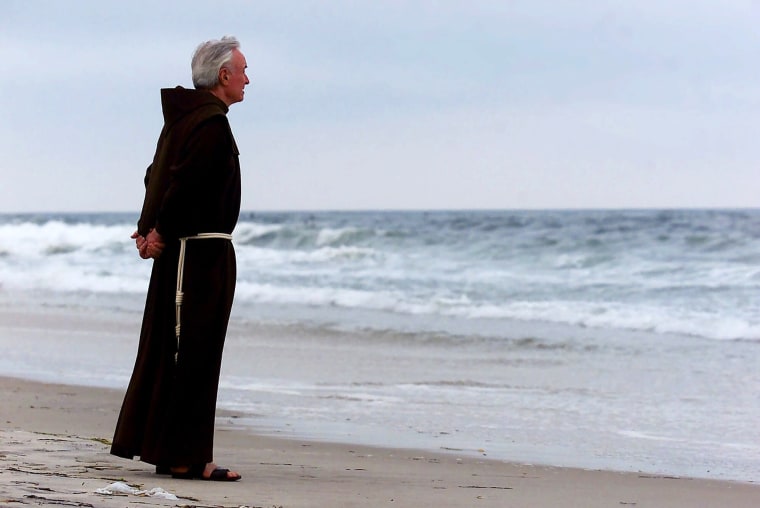
The Rev. Mychal Judge stands at the shore before a service where 230 candles were lit for the victims of TWA Flight 800, at Smith Point Park in Shirley, N.Y., on July 17, 2000.Ed Betz / AP file
The chaplain for the New York City Fire Department, Judge rushed downtown when he heard the World Trade Center had been hit and provided aid to the injured in the area and prayers for the dead.
He then entered the north tower, where a command post had been established, and continued to minister to rescue workers and those trapped in the building. Judge was administering last rites when he was killed, The Irish Times reported in 2018, and praying, “God, please end this.”
But there were other threads that connected Bingham and Judge besides their bravery, including their zest for life.
Judge “had a bursting-at-the-sides sense of humor,” said Fay, who co-produced the 2006 documentary “Saint of 9/11.” “He loved to sing and was a real jokester, with a laugh that would fill a room.”
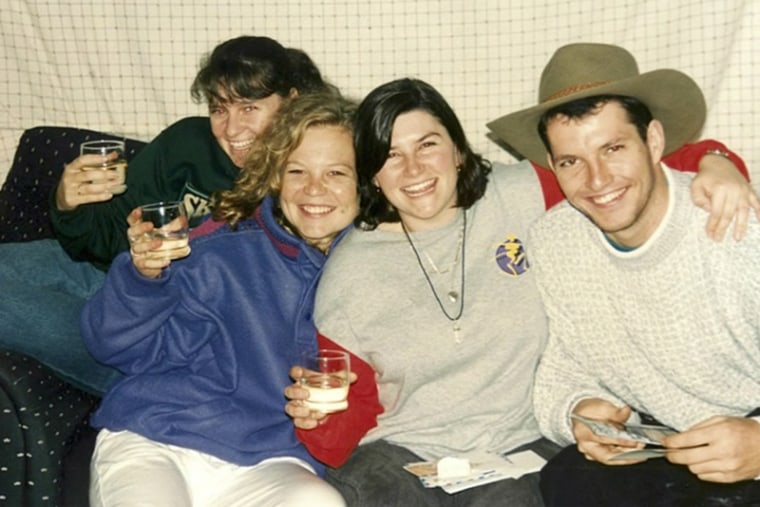
Mark Bingham, right, with friends.Courtesy Amanda Mark
Bingham, once the president of the Chi Psi fraternity at University of California, Berkeley, “was the life of the party,” said Amanda Mark, his roommate in New York and longtime friend. A 2001 Advocate profile recalled Bingham drunkenly running on the field at a college football game to tackle the opposing team’s mascot.
And, according to those who knew them, they both went through a journey of accepting their sexualities.
Like a lot of young gay men of his generation, Bingham struggled to some degree with his sexual orientation. He had come out to his fraternity brothers and his mom, but he wasn’t entirely out at work. Even when he first started playing in a gay rugby league in San Francisco, he had his face blurred in photos in the local press.
“San Francisco didn’t serve as a beacon for him as it had to so many others,” Jon Barrett wrote in the preface to his 2002 biography “Hero of Flight 93.”“He lived there by default, for the most part. His family had moved to the Bay Area in the early 1980s, and most of them were still there.”
Mark recalled how one night, after Bingham relocated to New York and moved in with her, he confessed he wanted “to write the Great American Novel — but gay.”
“So that you’d have to read it in high school, and people would understand that gay people were always among us and were totally normal and a part of our lives,” she said.
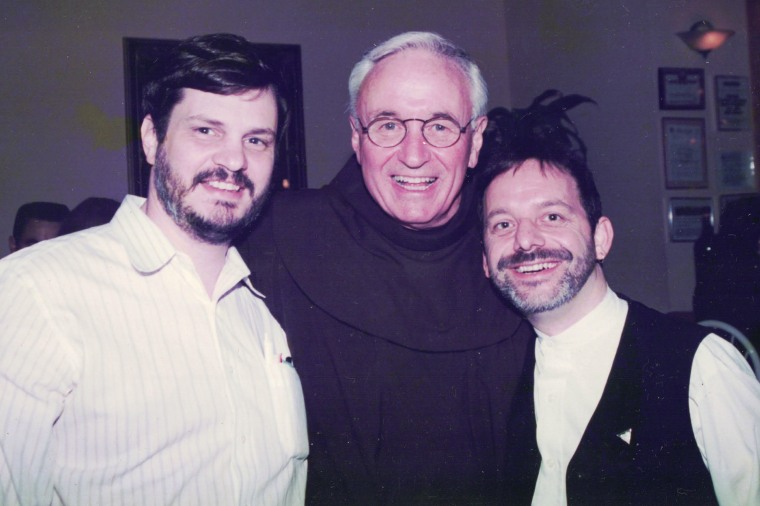
Tom Moulton, the Rev. Mychal Judge and Brendan Fay on May 11, 1998, at Il Campanello restaurant in New York, N.Y.Courtesy Brendan Fay
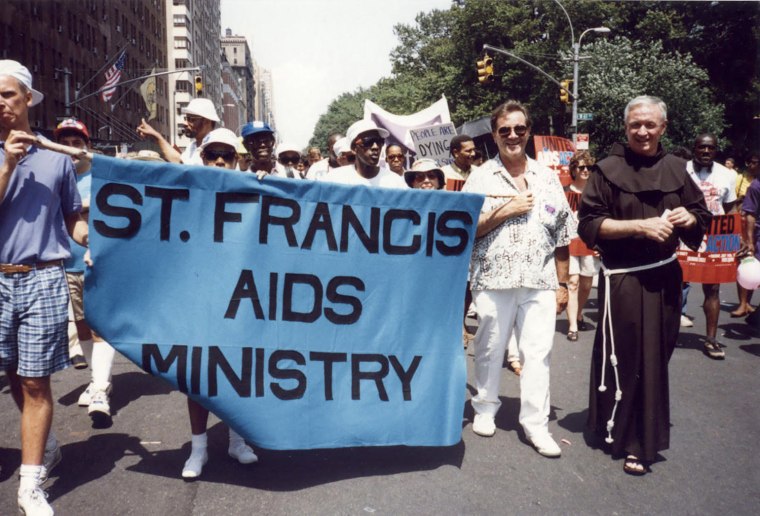
Judge’s sexual orientation was not made public until after his death, but he did actively minister to New York’s LGBTQ community in the 1980s and ‘90s and form one of the first Catholic AIDS ministries.
Fay met Judge in the 1980s through the LGBTQ Catholic organization DignityUSA. He said the FDNY chaplain “was out to friars and friends and people he could trust — or people he thought coming out to would help, like parents wanting to support their gay children.”
Judge was one of the few priests who would conduct Mass and provide sacraments to Dignity members.
Immediately recognizable in his brown robe and sandals, Judge visited people who were sick and dying at St. Vincent’s Hospital’s AIDS ward and lead funerals for the young men when their local parishes refused.
“He’d go to Connecticut, to New Jersey; he’d get on an airplane and fly out to do a funeral in Ohio,” Fay said.
Judge was supportive of groups like PFLAG, a nonprofit group serving LGBTQ people and their families, and wrote one of the first checks for the St. Pat’s for All parade, the inclusive celebration Fay founded in 2000.
“Mychal Judge took risks. He pushed boundaries,” Fay said. “He wasn’t a flag-waver, but he definitely pushed boundaries. He figured out how to weave around and do what he felt needed to be done without suffering the wrath of the church.”
He never missed a Pride parade if he could help it, though he walked with Franciscan brothers. According to Fay, he also regularly attended Alcoholics Anonymous meetings for LGBTQ people.
“It was in these rooms where Mychal felt he could be himself,” Fay said.
“In his journals, [Judge] talks about being at peace with his sexuality and grateful that God had made him gay,” said Francis DeBernardo, author of the upcoming biography “Mychal Judge: Take Me Where You Want Me to Go.”
Friends of both Bingham and Judge also recalled their great sense of compassion and tendency to form long-lasting bonds.
When TWA Flight 800 exploded over the ocean near East Moriches, New York, on July 17, 1996, Judge showed up for several days and forged close relationships with many grieving families.
“When he connected with you in a moment of struggle, very often he stayed with you for life,” Fay said.
Mark Bingham and Amanda Mark.Courtesy Amanda Mark
Mark had met Bingham in 1988 when she was in high school in Australia and he was part of a group of American teens who came to play rugby in an exhibition. Over the years and across two continents, their bond grew closer.
“Rugby taught Mark to be a team player,” she said. “When you joined the team, you were part of the family. When another player was advancing to the goal line, he’d shout, ‘I’m with you! I’m with you!’ That’s what you say in rugby, but it really embodied everything Mark was about. He couldn’t tolerate unfairness or injustice, and he wasn’t afraid to stand up for the people he loved.”
She called Bingham “the great connector” for his ability to bring disparate groups together. He was always making new friends while still reaffirming bonds with old ones — through phone calls, emails and surprise visits.
Once, when she and her friends returned home to one of their houses in Sydney, they found Bingham waiting for them in the living room. He had flown in unannounced from the U.S.
“He’d say, ‘Let’s keep in touch,’ and he would. And he’d arrange to see you when he was in town,” she said. “He would have just loved Facebook.”
A rugby player at UC Berkeley, Bingham continued to play the sport after moving to San Francisco. He even became a key figure in the creation of the International Gay Rugby league in 2000.
Just months before he died, Bingham was at the league’s first invitational in May 2001, helping the San Francisco Fog defeat the hometown team, the Washington, D.C., Renegades, in a 19-0 shutout.
At the time of the crash, Bingham was working to bring a gay rugby team to New York, which led to the formation of the Gotham Knights.
“Mark’s two worlds were rugby and being gay, and when those worlds collided, he was ecstatic,” Mark said.
The Rev. Mychal Judge, right, at a Pride march.Courtesy Brendan Fay
After the terrorist attacks, when it became public that Judge was gay “there was a big debate in Catholic circles,” said DeBernardo, executive director of New Ways Ministry, which advocates for inclusion for LGBTQ Catholics.
“People couldn’t resolve the fact that a gay person could be holy and selfless,” he said. “It was like cognitive dissonance. I wasn’t even totally convinced he was a gay man until I started doing the research [for the book].”
But, he added, Judge’s whole sense of ministry, of being of service to others, came from his coming to terms with being gay.
“He had empathy and sensitivity to being on the margins,” DeBernardo said. “And he understood the great love God had for him just as he was.”
DeBernardo, like other biographers and friends, said he believes Judge honored his vow of celibacy.
“But speaking to others about how accepting he was of his sexuality — and almost not caring if you knew — I can’t believe he’d want to be closeted now,” he said.
Bingham’s closest friends and family were also ambivalent about his being heralded as a gay hero.
“At first I really felt like his being gay didn’t matter,” Mark said. “Don’t put out ‘gay hero’; he was just a hero.”
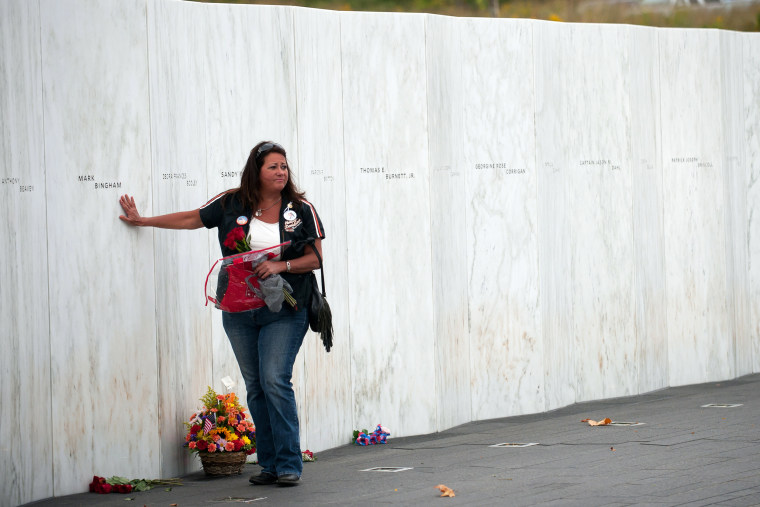
A family member touches the name of Mark Bingham during the 13th anniversary ceremonies commemorating the Sept. 11 attacks at the Wall of Names at the Flight 93 National Monument in Shanksville, Pa., on Sept. 11, 2014.Jeff Swensen / Getty Images file
But in the weeks after the attacks, she, Hoagland and Bingham’s other friends spoke more about it.
“We decided at that time we should encourage that perspective,” Mark said, “because the truth was there weren’t any gay heroes.”
The gay rugby community wasted little time deciding how to honor their fallen brother: In June 2002, less than a year after the attacks, the inaugural Mark Kendall Bingham Memorial Tournament —commonly known as the Bingham Cup — was held in San Francisco with eight teams.
In 2018, the last year the biannual event was held, the competition welcomed 74 teams from 20 different countries. The 2022 Bingham Cup in Ottawa, Ontario, rescheduled from 2020 because of the pandemic, will include 148 teams.
Bingham never got to write his novel, but the tournament that bears his name imparts the lesson he wanted to share, according to Mark.
“Part of the Bingham Cup journey for so many players, they’ll tell you, is that they wanted to play sport but gave it up because they didn’t think they’d fit in,” she said. “Even though they’d never met Mark, they’d say he changed their life.”
Hoagland was integral in keeping her son’s legacy alive: Before her death in 2020, she regularly attended the Bingham Cup tournaments, where players would chant her name and flock to have their photos taken with her.https://iframe.nbcnews.com/UEJc9X6?app=1
One of the tournament’s prizes is called the Hoagland Cup in her honor.
“She was a mother to us all,” Bingham Cup President Jean-François Laberge said. “A lot of members of the IGR movement were abandoned or disowned by their families. She became a mother figure to players across the globe.”
Laberge said he had several discussions with Hoagland and Mark “about the importance of ensuring the tournament not just go on but continue to thrive.”
“All that IGR is, and all that the Bingham Cup has become, carries on Mark’s legacy,” Laberge said. Next year’s tournament will spotlight “our shared values of inclusion, respect and athletic competition,” he added, including a summit on transgender athletes and a wheelchair rugby exhibition game.
At a special dedication ceremony, a Canadian maple will be planted in Ottawa’s Ken Steele Park, where a plaque will officially designate a newly upgraded rugby pitch the Mark Bingham Field.
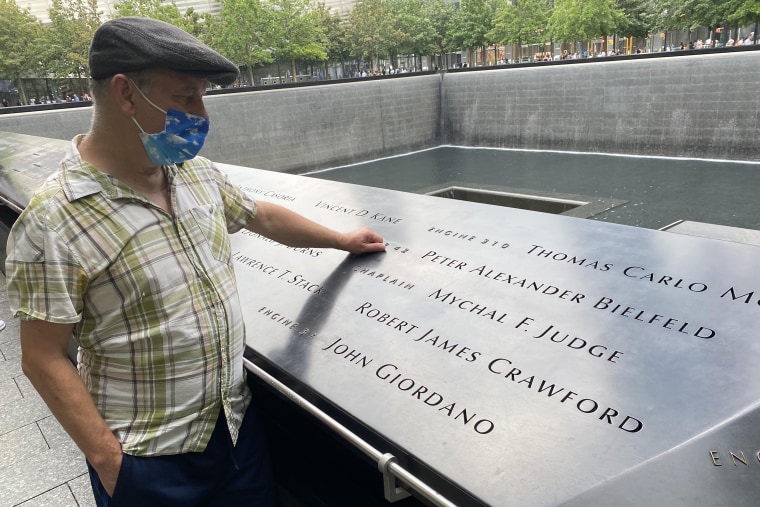
The Rev. Mychal Judge’s name is displayed at the 9/11 Memorial in New York, N.Y.Courtesy Brendan Fay
Judge’s legacy, meanwhile, is both more audacious and more complicated, as supporters redouble their efforts to have him canonized as a Catholic saint.
DeBernardo said a big push for the sainthood movement actually came from the Vatican itself: In 2017, DeBernardo received a call from the Rev. Luis Escalante, an official from the Vatican’s Congregation for the Causes of Saints, suggesting the idea.
“There are many avenues to sainthood,” DeBernardo said. “One is if you are a martyr — someone who dies for the faith. But that year, Pope Francis opened another avenue, ‘the offerer of life.’ Someone who knowingly gives their life as an act of service to others.”
Escalante thought Judge fit into that category, DeBernardo said, “because he went into that building knowing it was very likely he wouldn’t make it out, but he wanted to minister.”
Fay said he understands the desire to have Judge recognized by the church, but he’s not sure Judge would want the honor.
“I think he’d rather there be a shelter in his name for LGBT youth,” he said.
Achieving sainthood is a protracted process involving much research and a lengthy formal investigation. According to DeBernardo, Escalante knew Judge was involved in the gay community and wanted New Ways Ministry to help find people who knew him to provide firsthand accounts or documents “that will give a clearer, more detailed picture of his life, spirituality, and ministry,”DeBernardo wrote in a 2017 post on the ministry’s website, especially “any information regarding a possible miracle attributed to Fr. Judge’s intercession.”
Soon Escalante began receiving testimonies supporting canonization from the many communities Judge touched: firefighters, LGBTQ people, homeless people, AA members and others.
Four years later, on Sept. 2, Escalante called DeBernardo again: The testimonies were helpful, but the process had stalled.
Typically, candidates for sainthood have a sponsor who provides advocacy and fundraising.
“That’s why so many saints belong to holy orders,” DeBernardo said.
But Judge’s order, the Franciscans, declined to sponsor him.
“We are very proud of our brother’s legacy and we have shared his story with many people,” the Rev. Kevin Mullen, leader of the Franciscans’ New York-based Holy Name Province, told The Associated Press. “We leave it to our brothers in the generations to come to inquire about sainthood.”
Escalante implored DeBernardo to encourage a grassroots movement to take up the cause.
On Sept. 11, 2021 — two decades after Judge’s death — New Ways Ministry put out the call for individuals and organizations to form an association to sponsor Judge’s canonization.
In a statement, New Ways Ministry co-founder Sister Jeannine Gramick said she was hopeful people will come forward “so that this priest who symbolized God’s love to so many different communities will be recognized for the way he himself responded to God’s love.”
CORRECTION (Sept. 11, 2021, 12:52 p.m. ET): A previous version of this article misstated the publication year of an article in The Irish Times about the Rev. Mychal Judge. It was published in 2018, not 2011.
A gay substitute teacher was wrongfully fired by a Roman Catholic school in North Carolina after he announced in 2014 on social media that he was going to marry his longtime partner, a federal judge has ruled.
U.S. District Judge Max Cogburn ruled Friday that Charlotte Catholic High School and the Roman Catholic Archdiocese of Charlotte violated Lonnie Billard’s federal protections against against sex discrimination under Title VII of the Civil Rights Act. Cogburn granted summary judgment to Billard and said a trial must still be held to determine appropriate relief for him.
“After all this time, I have a sense of relief and a sense of vindication. I wish I could have remained teaching all this time,” Billard said in a statement released Friday by the ACLU, which represented him in court. “Today’s decision validates that I did nothing wrong by being a gay man.”
Billard taught English and drama full time at the school for more than a decade, earning its Teacher of the Year award in 2012. He then transitioned to a role as a regular substitute teacher, typically working more than a dozen weeks per year, according to his 2017 lawsuit.
He posted about his upcoming wedding in October 2014 and was informed by an assistant principal several weeks later that he no longer had a job with the school, according to the ruling.
The defendants said that they fired Billard not because he was gay, but rather because “he engaged in ‘advocacy’ that went against the Catholic Church’s beliefs” when he publicly announced he was marrying another man, the ruling said.
But Cogburn ruled that the school’s action didn’t fit into exemptions to labor law that give religious institutions leeway to require certain employees to adhere to religious teachings, nor was the school’s action protected by constitutional rights to religious freedom.
Pope Francis invited a group of transpeople to the Vatican to be vaccinated against COVID-19 at Easter, it has been revealed.
The pontiff welcomed 50 people to the Vatican on 3 April to receive their first dose of a COVID-19 vaccine, and they returned later that month to receive their second dose, Cardinal Konrad Krajewski confirmed to theNational Catholic Reporter.
Trans people from a parish in Torvaianica were among those who travelled to the Vatican to receive vaccines after Krajewski reached out to local priest Fr Andrea Conocchia, who has been ministering to the local trans community for some time.
Others who were vaccinated as part of the initiative included volunteers, immigrants, refugees, struggling families and single parents.
Juan Carlos Cruz – a survivor of clerical sex abuse who was recently appointed to the Pontifical Commission for the Protection of Minors – told RNS that Vatican officials called Pope Francis for guidance when two buses from Torvaianica arrived as part of the vaccine initiative.
Absolutely vaccinate them!” Pope Francis said, according to Cruz. He claimed the pope went on to instruct officials to “ask for their names, ask for anything they need, but do not ask them about their sex.”
According to Conocchia, his trans parishioners reacted with “emotion” when they arrived at the Vatican to be vaccinated against COVID-19. Some of them are undocumented, meaning they are not eligible to receive vaccines under Italy’s health service.
Conocchia added: “They were moved to tears and felt remembered, having experienced once again and in a tangible way the closeness and tenderness of the pope’s charity.”
This is not the first time Pope Francis has expressed support for Italy’s trans community. In May 2020, as the world was rocked by the coronavirus pandemic, he donated funds to a group of trans sex workers who were struggling as a result of the pandemic’s economic fallout.
It was reported at the time that up to 20 trans women approached Fr Conocchia for help after their work was eradicated by COVID-19. Conocchia helped as many women as he could, but ultimately was unable to offer assistance to them all.
He subsequently wrote to Pope Francis appealing for help for his parish’s embattled trans community, and the pontiff gave the go-ahead for papal almoner Krajewski to sent money to the trans sex workers.
Catholic teaching remains firmly opposed to LGBT+ acceptance
LGBT+ Catholics will watch Pope Francis’s most recent charitable efforts with interest. The Catholic Church has historically been firmly opposed to any acceptance of queer people’s identities, and it still holds firm on its teaching that homosexuality is intrinsically disordered.
Furthermore, there was dismay among queer Catholics in 2019 when the Vatican issued a document that firmly rejected the existence of trans identities, claiming gender fluidity posed a threat to traditional family structures.
There was some hope that the Catholic Church would change its approach to LGBT+ people after Pope Francis became leader in 2013 – however, the Vatican has instead recommitted to its anti-LGBT+ policies and teachings.
Russia’s foreign minister has made the unlikely claim that schools in a number of Western countries are teaching children that Jesus was bisexual.
Minister Sergei Lavrov, 71, painted the improbable picture in an essay for the Russian Kommersant newspaper titled “The Law, Rights, and the Rules,” published Monday (28 June).
In it he delivered a sweeping critique of “boundlessly permissive” liberal democracies which he believes “encroach on human nature”, starting with Jesus’ sexuality.
“Attempts by reasonable politicians to shield the younger generation from aggressive LGBT propaganda are met with bellicose protests from the ‘enlightened Europe,’” he said.
“All world religions, the genetic code of the planet’s key civilisations, are under attack. In a number of Western countries, children are being persuaded as part of the school curriculum that Jesus Christ was bisexual.”
Lavrov did not provide examples to support his far-fetched claim, nor did he state which countries he was referring to.
However, It’s My City news traced the likely origins of his story to a viral TikTok of an Australian mother eavesdropping on her children debating Jesus’ sexual orientation.
In the video her young son suggests that Jesus was “bi and non-binary,” because “he loves everyone in the world” and “he wears a dress and he’s a man”.
“We learned it at school,” the boy insists in response to his mother’s protests.
Russian observers speculated that the minister’s critique of Western values was aimed at drumming up support from a socially conservative domestic audience ahead of key parliamentary elections this autumn.
“While proclaiming the ‘right’ to interfere in the domestic affairs of other countries for the sake of promoting democracy as it understands it, the West instantly loses all interest when we raise the prospect of making international relations more democratic,” he said.
“The United States is at the forefront of state interference in church affairs, openly seeking to drive a wedge into the Orthodox world, whose values are viewed as a powerful spiritual obstacle for the liberal concept of boundless permissiveness.”
Despite his fervent criticism of Western education and values, Lavrov chose to have his own daughter, Yekaterina, schooled in America.
A top Italian archbishop has spoken out against the Vatican’s unprecedented decision to interfere on Italy’s proposed anti-homophobia law.
The Vatican sparked widespread outrage after issuing a nota verbale opposing the bill – which would extend anti-discrimination protections to women, LGBT+ people and those with disabilities – on the basis that it would supposedly breach a 92-year old treaty with Italy.
Speaking at the Be pop! cultural review in Rome, archbishop Vincenzo Paglia admitted that the Holy See’s resistance to the bill was a “mistake” and acknowledged that homophobic discrimination is “obvious” to see.
“That the problem exists is obvious; that it must be fought is even more obvious still,” said Paglia, as reported by Crux. The anti-homophobia law “brings to light a very important issue that must be faced,” he added.
The archbishop, who is head of the Pontifical Academy for Life and president of an Italian government commission on care for the elderly, criticised the Vatican’s controversial interference in the law as well as the writing of the law itself, saying “the mistake was on both sides”.
“The law as I’ve read and studied it is poorly done,” he said. “It identifies a problem but doesn’t help to resolve it. It’s more of a manifesto, and as a manifesto, it’s fine, but if you have to translate it into legislative language, it must be precisely written.”
Yet the Vatican never should have involved itself in the matter, as the debate over the bill “is a problem regarding only the Italian republic”.
“It has nothing to do with the concordat,” Paglia said, referring to the 1929 Lateran Pacts, which established the Vatican City State as a sovereign entity and which governs relations between the Holy See and Italy.
“So, to me, that note, in my opinion, should not have been written. Absolutely,” he said.
Italian prime minister shuts down Vatican interference
The scandal is thought to be the first time the Holy See has ever issued a nota verbale to the Italian government to object to pending legislation. The bill in question was named the “Zan bill” after Alessandro Zan, the openly gay Italian politician who introduced it.
The Vatican’s secretary of state, cardinal Pietro Parolin, defended the controversial move, saying it was not about interfering with international politics but about highlighting bigger problems the Zan bill could lead to if it is passed.
The Methodist Church has voted to allow same-sex marriage, and will now define marriage as between “two people”, rather than between “one man and one woman”.
In 2019, the Marriage and Relationships Task Group presented a report to the church’s annual conference, titled “God in Love Unites Us“.
The report put forward proposed resolutions same-sex marriage, and these were approved by all but one of the local Methodist synods.
On Wednesday (30 June), the 2021 conference gave final considerations on the resolutions, and officially voted to allow same-sex marriages to be conducted in Methodist churches.
The conference voted overwhelmingly for marriage equality, with 254 votes in favour and 46 against.
The church’s standing orders, or rules, are updated each year by the conference.
The section on marriage previously read: “The Methodist Church believes that marriage is a gift of God and that it is God’s intention that a marriage should be a life-long union in body, mind and spirit of one man and one woman.”
It has now been amended to read: “The Methodist Church believes that marriage is given by God to be a particular channel of God’s grace, and that it is in accord with God’s purposes when a marriage is a life-long union in body, mind and spirit of two people who freely enter it.
“Within the Methodist Church this is understood in two ways: that marriage can only be between a man and a woman; that marriage can be between any two people.
“The Methodist Church affirms both understandings and makes provision in its standing orders for them.”
In “affirming” both those who agree with and disagree with same-sex marriage in the church, the standing orders state that ministers or other officials will not be required to perform same-sex marriages “should it be contrary to the dictates of his or her conscience to do so”.