A lesbian woman has been stabbed to death in Umlazi, South Africa, after reportedly rejecting a man’s advances, leaving the local community “very disturbed”.
IOL Daily News reported that 32-year-old Pinky Shongwe was stabbed to death while going to a local shop after an “unknown” man allegedly harassed her with unwanted advances.
A spokesperson for Umlazi police, lieutenant-colonel Nqobile Gwala, said that the case is now being investigated as a murder.
“She was found lying on the road and was taken to hospital where she succumbed to her injuries on arrival. The motive of the killing is unknown and the matter is still under investigation,” Gwala said.
A spokesperson for KwaZulu-Natal Social Development said he was “disturbed” to hear about the incident after several awareness campaigns for LGBT+ equality in the area.
Mhlaba Memela told IOL Daily News: “We are very disturbed to hear of another brutal murder of a lesbian woman.
“We are angry after our department has done a lot of public awareness campaigns to teach people to accept and live side by side with gays and lesbians. We have been telling people that gay and lesbian rights were protected by the constitution.
“We believe it is high time that our courts start treating this violence differently, and not be lenient when sentencing the perpetrators.”
The tragic stabbing comes after a slew of violent crimes against the LGBT+ population in South Africa in recent years, including the murder of another lesbian in September 2021 in an area only around 15 miles away from Shongwe’s killing.
Previous victims also include Lonwabo Jack, a 22-year-old gay man found tragically murdered on his birthday.
Nonhlanhla Khoza, a politician serving in the Department of Social Development, said in a 2021 statement: “We are deeply ashamed that, in our nation, we still have people facing discrimination based on their sexual orientation.
“This is a gross violation of basic human rights and we should unite to end such crimes.
“It must sink in the minds of all those involved in such crimes that no one has a right to take a life and abuse someone else because of their sexuality.
“Our government has made giant strides towards safeguarding LGBTQ+ rights. However, incidents similar to this one water down all efforts that have been made.”
As the world continues to watch the ongoing Russian invasion of Ukraine with horror, one question continues to plague the minds of queer activists in the West: what about the LGBTQ people?
Russian leader Vladimir Putin has a long record of oppression of the queer community from public humiliation and imprisonment to encouraging mob violence. Filmmaker David France documented Putin’s anti-gay campaign in his film Welcome to Chechnya [now streaming on HBO Max] which detailed queer oppression in the titular Russia-allied republic.
Will Ukraine face the same fate? We sat down with France to discuss the situation for LGBTQ people living in Russia and Ukraine, the state of the underground resistance, and how Vladimir Putin has declared all-out war on queer people. France also reveals how the same forces of oppression have infected the United States, and how preserving democracy may hold the only hope for LGBTQ people in the future.
Are you in contact with the Rainbow Railroad (an underground resistance that smuggles queer people out of Eastern Europe) in Ukraine?
I did just speak with David Isteev [from Welcome to Chechnya] who is doing rescues in the Caucasus. He wanted to talk about what was happening to queers in Russia because of the invasion.
So what’s the situation there?
They are despairing. I’ve never heard the kind of grimness from the folks I know that we’re hearing now. The entire leadership of the LGBTQ movement in Russia is now outside Russia.
They’ve all had to flee?
Correct. Not just because of the invasion, but there was also a crackdown in the months leading up. [The Putin government] has made it impossible for queer leaders to do their work, and they’ve strangled their source of funding. Now the borders are closed, so it’s not possible to move money into the country. It’s not possible to access the money they have in the country. And the people outside the country trying to help are delivering money to the border in cash.
Refugees fleeing Kiev. Via Shutterstock
I’m sure that carries a whole other set of risks.
Yes. And if they bring money in US dollars, is it possible to change it into rubles? And if it is rubles, it’s worth almost nothing.
So is the solution to escape?
Well, here’s another problem. It’s not possible to enter most countries without proving vaccination status, and with an approved vaccine. Almost nobody has approved Sputnik 5, the Russian vaccine, because they’ve never produced reputable data. So if you have Sputnik 5, you’re not getting into Europe.
Putin’s persecution of LGBTQ people is nothing new. Is this personal for him?
It is a strategy that works. 10 or 15 years ago, he discovered the more he spoke against queer folks, the more he generated a divide that turned people against people, instead of against the government.
Putin said he wants to install a new government in Ukraine. How safe is it to believe he would install a leader similar to the one he appointed in Chechnya, Ramzan Kadyrov?
Well, Putin has been using an anti-queer plank in Ukraine for the past decade alleging that if Ukraine joins NATO, they will have to recognize marriage equality. And in some corners, it has worked. It worked with the Russian Orthodox Church—in the past week, they’ve come out in favor of the invasion and against “the gay agenda.”
So what you’re actually saying—Putin’s fighting an international war on LGBTQ people?
Absolutely true. He’s saying modernity and liberalism equal queerness. He’s pulling the Iron Curtain closed again to resist the queer movement. It’s that central.
The Western media implies that the invasion of Ukraine is unpopular in Russia…
Well, from what I understand from my Russian friends is just the opposite. The people they talk to, family, for example, don’t believe [the invasion] is happening.
Pro-Ukrainian independence/LGBTQ protest. Via Shutterstock.
They don’t believe the war is real?
Correct. They have no access to Western or social media. The Kremlin made it a crime to report on Ukraine. People don’t have any reason to believe there is a war unless they have children coming back in body bags.
That’s a total page out of the Stalinist playbook.
That’s why it’s an Iron Curtain—you can’t communicate. And so many young Russians have great experiences traveling across Europe. They’re very integrated into world culture. And those are the people protesting in little pockets here and there. But between 10-15,000 have been arrested. People are just disappearing for saying there’s a war.
So let me ask you then: there seems to be this link between autocracy and autocratic-type leaders and homophobia or anti-queer sentiment. Why?
People want to know what’s causing their problems. It just turns out that it works if you say queers are to blame. Since Putin started his return to power on the backs of the queer community, other leaders take note. Prime Minister Viktor Orbán is doing that in Hungary. It’s happening in Poland. It’s a successful campaign in Belarus. And Trump discovered you could do it here.
Indeed.
It’s a huge shock. For those of us that saw 50 years of LGBTQ civic engagement and thought it was a permanent victory are having to reckon with it getting rolled back. Look what just happened in the Virginia Governor’s race.
Or Florida. Or Texas. Or Georgia.
Mmhmm. And what’s happening to queers in Ukraine—many queer Russians had fled there. The LGBTQ community had a stronghold there, and now that’s at risk. Putin’s state department issued a “kill list” for invading forces to round up and kill political leadership in the country as well as LGBTQ leaders. They gave the hit list to an elite force out of Chechnya. And men can’t get out of Ukraine. They’re terrified.
What’s happening now has people scared. Will Putin go for broke? Will he level Kiev? Will flatten Odessa? Will he drop a nuclear bomb?
Russian bombing in Kiev. Via Shutterstock.
Well, if he drops a nuclear bomb, we all have a lot more to worry about.
Yes. And that’s why everyone is praising the Ukrainian resistance, but talking about [Putin’s] “off ramp.” He may feel like he has no choice but to throw everything at it. And if the West gives him Ukraine, what does that mean [for the rest of Eastern Europe]?
Is there anything we can do in the West?
We need to start talking about how queer panic is being weaponized as the chief articulation of Putin’s dissent for his own military actions. Continue to support the Rainbow Railroad. They’re not solving problems, but they are creating a pipeline for flight. That saves lives. And look to LGA Europe and LGA Asia. They’re doing important work too.
So then, how much of the future of LGBTQ equality is tied to democracy?
It is plain that where democracy is strong, our movement has been successful. There’s a 100% correlation. But crushing democracy in Ukraine will only harm queers there along with everybody else. Putin and his oligarchs have sucked trillions out of the economy and done nothing for the Russian people.
The special U.S. envoy for the promotion of LGBTQ rights abroad on Friday said she and her office continue to provide support to advocacy groups in Ukraine and in countries that border it.
Jessica Stern told the Washington Blade during a telephone interview that she has held “multiple roundtables” with Ukrainian activists and organizations “to make sure that my office and I both have the relationships and then getting information directly from people on the frontlines.” Stern also noted she has also spoken with LGBTQ rights organizations in Poland, Hungary and other countries that “would be receiving LGBTQI Ukrainian refugees” and regional and international groups “that are closely monitoring and supporting LGBTQI Ukrainians in this incredibly difficult time.”
“The first and most important thing that the U.S. has been doing has been establishing contact with people who are advocating for and servicing LGBTQI Ukrainians, and then in all instances, trying to find ways to support them,” said Stern. “One of the things that’s been really important has been to identify the sort of patterns of human rights abuses, violations and vulnerability that they’re tracking that we need to be aware of.”
Stern said the State Department has “activated” its grant mechanisms to provide financial support to LGBTQ organizations in Ukraine and in surrounding countries.
“One of the things we’ve been focused on has been ensuring that LGBTQI Ukrainian organizations and LGBTQI organizations in the surrounding countries have the financial resources to provide emergency support to this population that finds itself facing double and triple discrimination,” she said.
Stern told the Blade a “top priority” is to ensure that humanitarian assistance to Ukraine “is distributed without discrimination.”
“One of the message that my office has been conveying and with working with others at the State Department to convey is that LGBTQI Ukrainian refugees are at heightened risk and that they should be supported and that anyone providing humanitarian assistance should actually be on the watch for instances of discrimination or violence they may be subjected to.”
Stern said her office has not received “too many stories of (discrimination) incidents, but we have to been able to sound the alarm.”
“The institutions and partners, we work with have been taking that seriously,” she said.
Russian airstrike kills Kharkiv activist
Stern spoke with the Blade less than a month after Russia launched its invasion of Ukraine.
A Russian airstrike in Kharkiv, Ukraine’s second-largest city that is less than 30 miles from the Russian border in the eastern part of the country, on March 1 killed Elvira Schemur, a 21-year-old law student who was a volunteer for Kharkiv Pride and Kyiv Pride. A group of “bandits” on the same day broke into the Kyiv offices of Nash Mir, an LGBTQ rights group, and attacked four activists who were inside.
“The case of Nash Mir was really horrific and really demonstrated the kind of opportunistic violence that LGBTQI persons, human rights defenders and organizations can be subject to right now by both state and non-state actors,” said Stern.
Stern told the Blade that activists have also said many transgender and gender non-conforming Ukrainians have decided to remain in the country because they cannot exempt themselves from military conscription.
“What I’ve been told is that many trans and gender non-conforming Ukrainians are sheltering in place, and even in some cases staying in places where they are at risk of being attacked by missiles and bombs and definitely in harm’s way simply because they’re concerned that they don’t have a way of being exempted from military conscription,” she said.
Stern cited the case of a trans man who tried to leave Ukraine and “in an effort to prove who he was who he said he was, he was actually forced to remove his shirt and show his chest” at the border.
“Unfortunately, that’s not the only humiliating and potentially violent incident that I’m hearing us,” she said.
Stern expressed concern about safety of gay men who are conscripted into the Ukrainian armed forces. Stern also noted “all women are at risk in times of war and conflict.”
“There’s absolutely a concern about the safety and well-being of lesbian and bisexual and trans and intersex women,” she said.
Challenges for LGBTQ Ukrainians ‘will be enormous’
Stern told the Blade the State Department is “working to provide as much support as possible for all Ukrainians that want to leave the country.”
She noted many LGBTQ activists in Ukraine with whom she spoke immediately after the invasion began said they did not want to leave. Stern acknowledged some of them have now fled the country.
“The invasion has just been so violent that even the most committed activists that people we both know have had to change their strategy,” said Stern. “So, in every instance where I’m hearing of an individual or a group that is at risk and wants to leave, we’re doing everything we can to help give them the support they need.”
“Most people do not become refugees,” she added. “You know, most people cannot leave … the global community should do everything we possibly can to affirm the human rights and provide support for Ukrainian refugees.”
President Biden shortly after he took office issued a memorandum that committed the U.S. to promoting LGBTQ rights around the world.
Letters that Congressional LGBTQ+ Equality and Ukraine Caucuses sent to Secretary of State Antony Blinken on the eve of the invasion noted Ukraine in recent years “has made great strides towards securing equality for LGBTQ people within its borders and is a regional leader in LGBTQ rights.” These advances include a ban on workplace discrimination based on sexual orientation and gender identity and efforts to protect Pride parades.
Stern reiterated the challenges for LGBTQ people inside Ukraine “will be enormous” as the conflict drags on.
“In all war and conflict, anyone who is vulnerable and vulnerable before the conflict remains at heightened risk and even becomes at greater risk,” she said. “Where people have access to weapons and LGBTQI people are unsafe. In a context where the rule of law is weak, LGBTQI people are at risk as the Nash Mir case showed us immediately.”
“I’m very worried that discrimination and violence will rise for LGBTQI people in Ukraine,” added Stern. “I’m extremely concerned that the track record from the Russian government on these issues is a harbinger of danger for LGBTQI Ukrainians in Russian occupied parts of the country.”
Lawmakers have rejected legislation that would have made Kosovo the first Muslim-majority country in the world to legalise same-sex civil unions.
Kosovo wants to join the European Union, and the bid to introduce same-sex marriage was part of modernising efforts by prime minister Albin Kurti’s government, which also tried to introduce other rights for minorities and business reforms
But after hours of debate, just 28 out of MPs out of 120 voted in favour of the motion with some members of Kurti’s Vetevendosje party voting against it, according to Euractiv. Many against the draft code cited religious beliefs and “family values”.
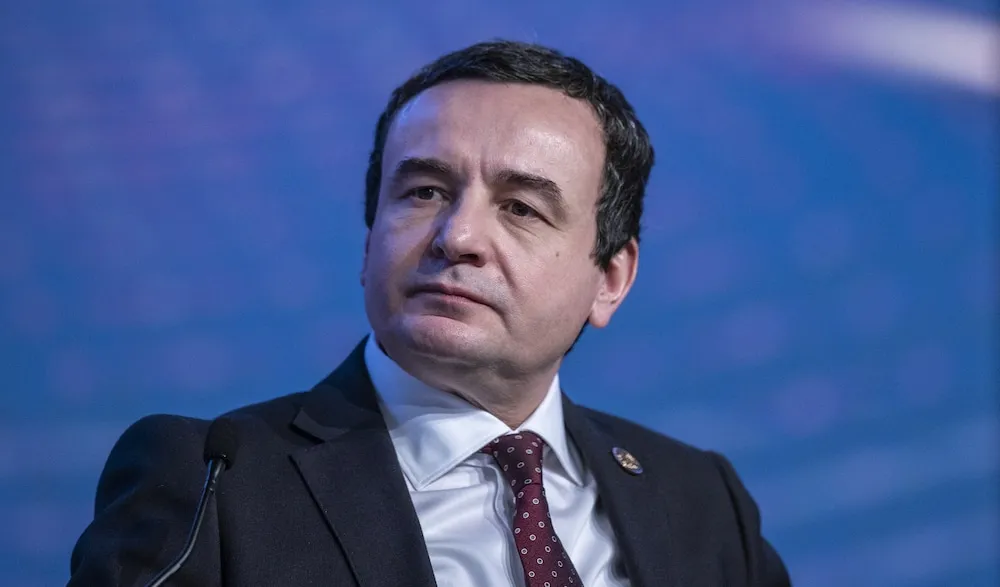
Prime Minister of Kosovo Albin Kurti. (Anadolu Agency via Getty / Ali Balikci)
Vetevendosje representative Labinote Demi-Murtezi said during the debate that she only “sees as acceptable the marriage of persons of opposite sex”.
She added: “Any connection outside of this combination is considered depravity and moral degeneration.”
LGBT+ and human rights groups were devastated by the news, and protesters took to the streets of Kosovo’s capital Pristina on Thursday (17 March).
According to Balkan Insight, they chanted, “homophobes, you have no place in parliament” and “love is resistance; we also are part of the family”.
After the legalisation of civil unions was snubbed, Human Rights Watch sent a letter to Kurti, as well as Kosovo’s president Vjosa Osmani and minister of justice Albulena Haxhiu, urging them to go further and push for full marriage equality.
“We believe that extending marriage to same-sex couples is the most rights-respecting option for Kosovo to pursue,” the human rights group wrote.
“Partnership recognition is a step forward – any protection is better than none – but civil union is unlikely to protect people’s rights to the same extent as equal marriage, and indeed, can signal continued inequality…
“We hope that the Kosovo government will work to ensure that same-sex couples have the same rights as other couples, and to eradicate discrimination based on sexual orientation and gender identity in family law.”
With Ukraine defending itself from Russia’s brutal war of aggression, the country’s LGBT+ activists have found themselves playing a new role.
War is an equaliser, Kyiv Pride director Lenny Ensom tells PinkNews. “The bomb doesn’t ask you what is your identity, the bomb just falls,” he explains.
He hasn’t been able to get much sleep since the invasion started, as the sound of shelling is never far away. On Tuesday night (15 March), a building in his district was hit.
“It’s like Russian roulette. They just hit and you don’t know where the bomb will land.”
As director of Kyiv Pride, he’s dedicated much of his life to making things better for Ukraine’s LGBT+ community. In the last few weeks, the focus of his work has changed dramatically and suddenly, away from advocacy and toward helping the community access food and housing as the war rages on.https://platform.twitter.com/embed/Tweet.html?creatorScreenName=PinkNews&dnt=true&embedId=twitter-widget-0&features=eyJ0ZndfZXhwZXJpbWVudHNfY29va2llX2V4cGlyYXRpb24iOnsiYnVja2V0IjoxMjA5NjAwLCJ2ZXJzaW9uIjpudWxsfSwidGZ3X2hvcml6b25fdHdlZXRfZW1iZWRfOTU1NSI6eyJidWNrZXQiOiJodGUiLCJ2ZXJzaW9uIjpudWxsfSwidGZ3X3NrZWxldG9uX2xvYWRpbmdfMTMzOTgiOnsiYnVja2V0IjoiY3RhIiwidmVyc2lvbiI6bnVsbH0sInRmd19zcGFjZV9jYXJkIjp7ImJ1Y2tldCI6Im9mZiIsInZlcnNpb24iOm51bGx9fQ%3D%3D&frame=false&hideCard=false&hideThread=false&id=1502330256107216901&lang=en-gb&origin=https%3A%2F%2Fwww.pinknews.co.uk%2F2022%2F03%2F17%2Fukraine-lgbt-kyiv-pride-2%2F&sessionId=ee749e993fa9f51c606f5e5f9999ff7e269c4e1a&siteScreenName=PinkNews&theme=light&widgetsVersion=2582c61%3A1645036219416&width=500px
Kyiv Pride is working to help Ukraine’s LGBT+ community stay afloat through the war
Right now, the many queer people who remain in Ukraine are just focusing on staying alive and fighting for their freedom in whatever way they can.
But discrimination and inequalities still exists – there have been widespread reports of racism targeted at Black and brown people trying to flee the country, and of trans people (women, in particular) being unable to leave Ukraine or pass internal checkpoints because of inaccurate documents.
Security is paramount, Lenny says – there are far-right actors in Ukraine who are still targeting the LGBT+ community even as war rages.
“They’re still attacking LGBT+ people during the war and during the invasion and this is absolutely disgusting,” Lenny says. “We are not only fighting Putin, we’re fighting our inner homophobic forces.”
While Lenny’s not getting much rest, his days continue to be busy. Kyiv Pride has set up a secure chat for queer Ukrainians, has created a database of safe places people can stay abroad, and is circulating an easy-to-complete form so that it knows who needs help.
They’ve partnered with Gay Alliance Ukraine to support LGBT+ people who have been evacuated from surrounding areas to access emergency accommodation.
Kyiv Pride is also helping the local LGBT+ community to access mental health support during the war. They’ve put together a psychological support group, and volunteer psychologists are working around the clock to make sure queer people stay afloat.
“We’re answering the community’s demands,” Lenny says.
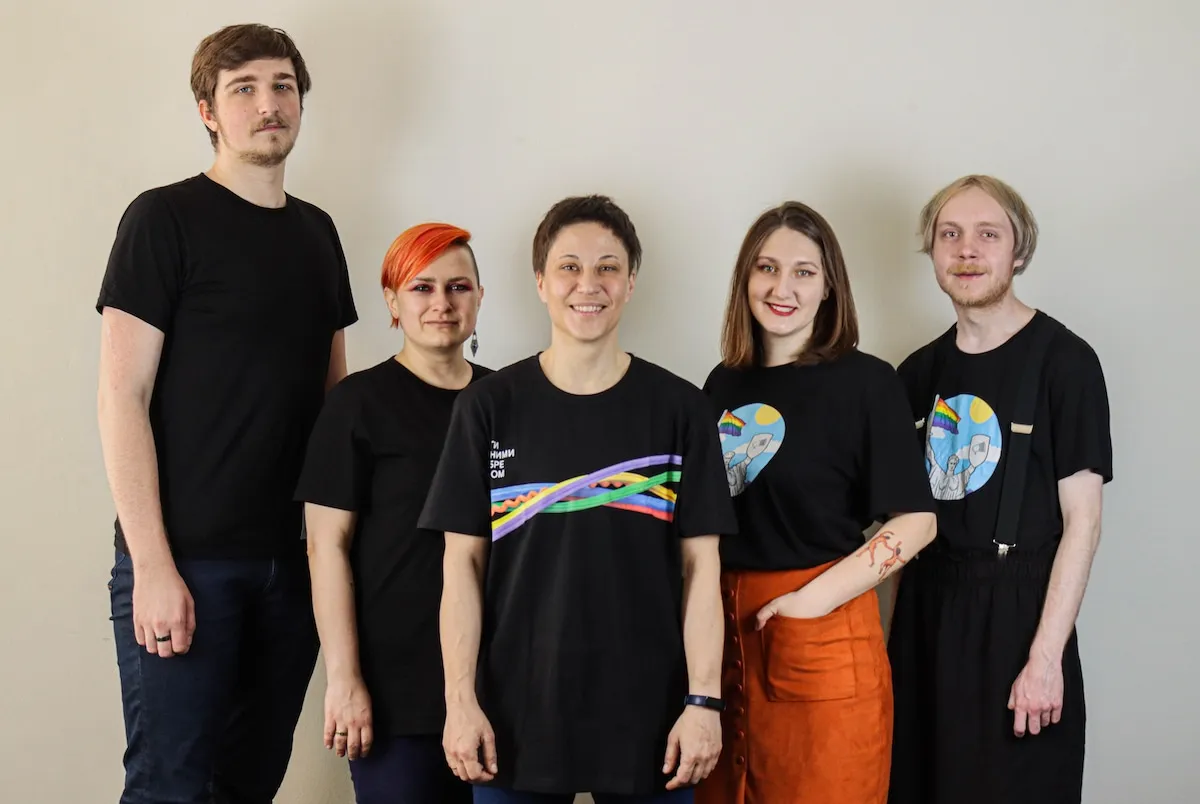
Lenny Ensom (C) with other activists involved with Kyiv Pride. (Provided)
Much of the international media attention has focused on the huge number of Ukrainian people that have fled their home country in search of safety. Around three million have now left Ukraine, but Lenny points out that more than 40 million remain.
“We need to understand that, if we want to stop this war, we cannot evacuate the entire population of Ukraine,” he says. “Unfortunately, it’s not possible. I’d say the community understands that a lot.”
Many of Lenny’s colleagues and friends have actively chosen to stay behind. Some of his friends have joined the military and territorial defence units.
“I really appreciate them doing this,” he says. “Our country needs us right now and we will win if we stay here and we will fight back against Russian aggression. If we just flee from war, nothing will stop the Russians then.”
People in Ukraine woke to the sounds of war three weeks ago
Lenny’s resolve has remained firm ever since he woke up to the sound of his city being shelled – it’s how he discovered Ukraine was being invaded.
“People did not read the news, they just ran away or to the bomb shelter,” he says. “We did not believe it – how on earth can you believe in such a thing as stupid as a ground war in the 21st century? It’s like to believe that aliens will come to earth right now. This is a barbaric way of having a war.”
As Lenny sees it, this isn’t about Russia versus Ukraine – it’s about Russia versus the world. He doesn’t think the world expected Ukraine “to fight back so successfully – and I think right now, when we continue to fight, it’s absolutely clear that Ukraine needs more help and then we will win”.
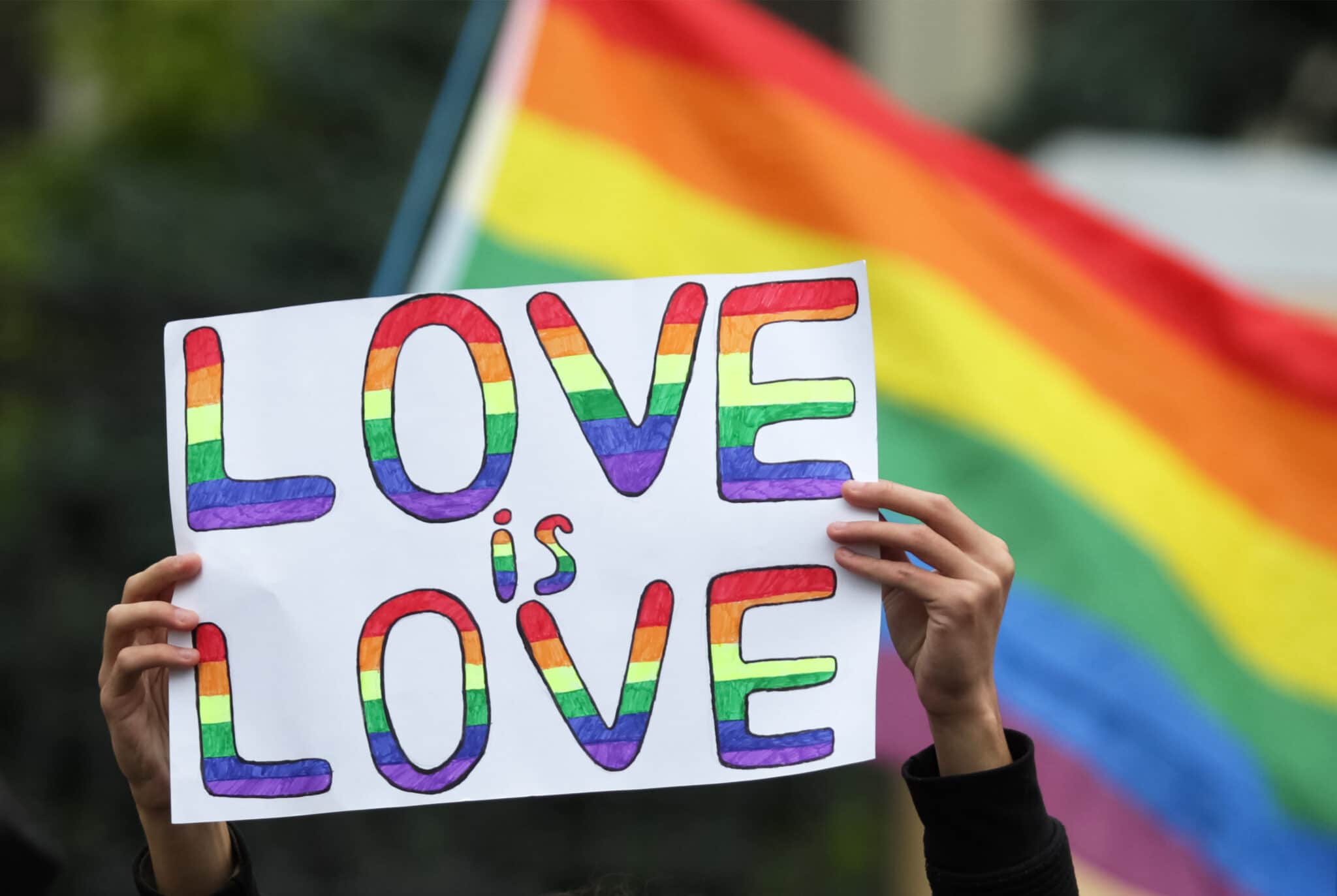
A participant holds a placard which says Love is love during the Equality March KyivPride 2021 of the LGBT community. (Pavlo Gonchar/SOPA Images/LightRocket via Getty)
The situation is terrifying, but there is optimism. “We really believe in our military, our Ukrainian army,” Lenny says. “We have the spirit behind us, and this is keeping us going.”
Part of that means rallying together “to show the community that we’re here to support them”.
“We’re here altogether, and together we will win.”
LGBT+ activist Vira Chernygina had to flee Kharkiv as the war ravaged her city
Vira Chernygina, president of lesbian organisation WA Sphere, was living in Kharkiv in eastern Ukraine when the invasion started. The city has been one of the worst affected by the war.
She stayed there for 10 days before she made the difficult decision to flee to Lviv in the west. Vira had been trying to keep working in Kharkiv, but she found it impossible to focus as the fear for her safety became all consuming.
“Your brain can’t work when there are explosions,” she tells PinkNews. “I tried for 10 days and it’s impossible.”
Putin’s war in Ukraine is part of a mission to turn back the clock to the Soviet era – a prospect that terrifies LGBT+ Russians.
Maria, an LGBT+ activist in Russia whose name has been changed to protect her identity, says queer people have been fleeing her country since Putin launched his invasion of Ukraine – which many agree is all part of a terrifying quest to bring Russia back to its former dominance.
That vision, she says, does not include LGBT+ people.
When Maria speaks to PinkNews over Zoom, she’s quick to describe Russia’s actions in Ukraine as a war. That shouldn’t come as a surprise – it is a war, but Russia has remained adamant that it’s a “special operation”. The government is so committed to that lie that it’s even made calling it a war a crime punishable by up to 15 years in prison.
“According to Russian law, we are required to call it a ‘special operation’,” Maria says with palpable anxiety. “If we talk about real human casualties, it’s treason.”
That’s why Maria doesn’t want to use her real name. She knows that speaking out is the morally right thing to do, but she also knows that queer Russian people are counting on her to be there to help them. She needs to protect herself.
Russia banned what it called “gay propaganda” in 2014, which prohibits the “promotion” of homosexuality. It wasn’t the first – or last – government attack on LGBT+ people. In 2020 Russia attempted (but failed) to legally erase trans people. The following year it solidified a ban on same-sex marriage. Violence against LGBT+ people is widespread, and Russia has been complicit in the so-called gay purges in Chechnya, in which dozens have been abducted, tortured and killed.
Still, activists like Maria have stayed put, working hard to change society and to bring about a better tomorrow for queer Russians.
“I think LGBT+ people recognise that, if the system is getting oppressive, that probably means they’re going to come after minority groups, vulnerable groups,” Maria explains. “We don’t know if tomorrow we’re going to wake up in a world where it’s back to before the 90s where LGBT+ relations are punishable by the law and criminal again. I think people are fearful of that and that’s why they’re leaving.”
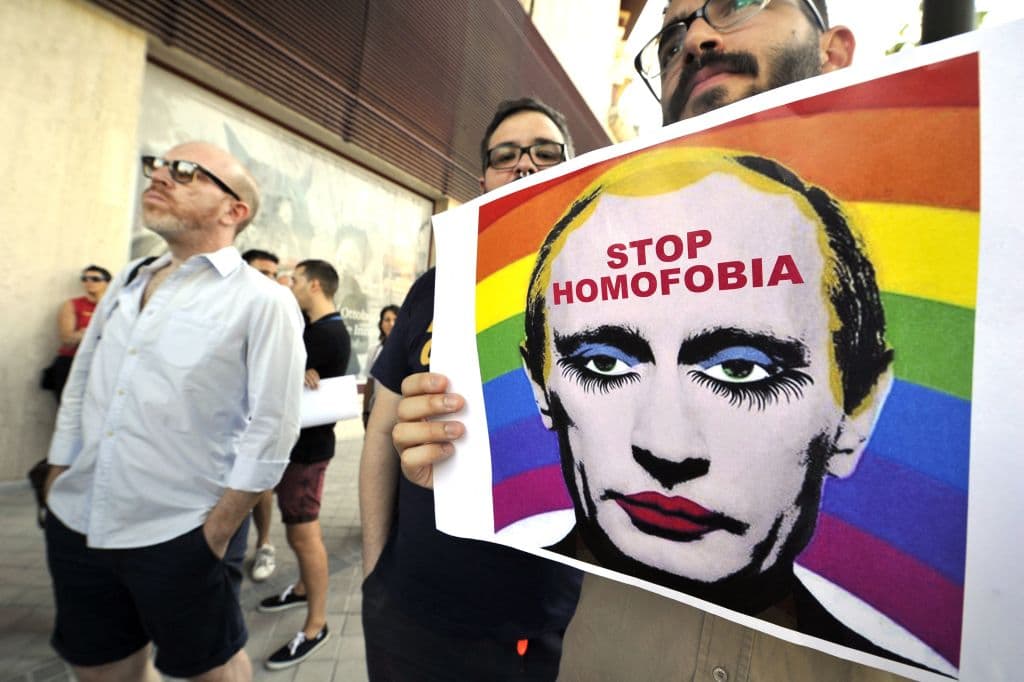
A demonstrator holds a poster depicting Russian President Vladimir Putin with make-up. (GERARD JULIEN/AFP via Getty)
The problem is that many are leaving in a state of panic, meaning they’re not putting in place the right supports beforehand.
“They don’t know that, for example, once they leave Russia, their Russian bank cards are not going to work, so they’re without money and they’re away from their financial resources and they don’t know where to go,” Maria explains. “Even if you leave the country, if you have no registration someplace else, if you have no nationality of another country, the most you can stay someplace is three months, half a year – what’s next?”
The situation has become so bad that Maria is considering setting up a shelter for LGBT+ Russians who are fleeing the country abroad – however, most of her efforts right now are focused on helping LGBT+ Ukrainians.
She’s starting to wonder how she can continue her work in Russia and how she can continue to advocate for her community in a country that is increasingly oppressive.
“At times I feel desperate because I don’t believe it’s possible to be an LGBT+ activist in Russia anymore,” she says.
She knows other activists who have already fled because their partners are male and they fear that they could be drafted to fight in a war they oppose. “They felt it necessary to leave the country so they don’t serve the aggressive regime.”
Russian propaganda is obscuring the truth about Ukraine
The entire thing is made even more complicated by just how sophisticated Russian propaganda is. The free media has been stifled in the country, and most people take at face value the state-sanctioned information they’re receiving.
The country has now been blocked from accessing Facebook and Instagram, meaning reliable information is even harder to come by for Russian people. Because most people are consuming propaganda, many are under the illusion that Russia is “protecting” the Ukrainian people, Maria explains.
“Most of the Russian population thinks that we’re not harming anyone who’s peaceful, that there are no human casualties, that the Russian military is only targeting military objects in Ukraine and that this is all with the good intention of ‘freeing’ the people of Ukraine of ‘nationalistic’ and ‘pro-Nazi’ people,” she says. “It sounds so twisted it’s almost unbelievable, but that’s what people think.”
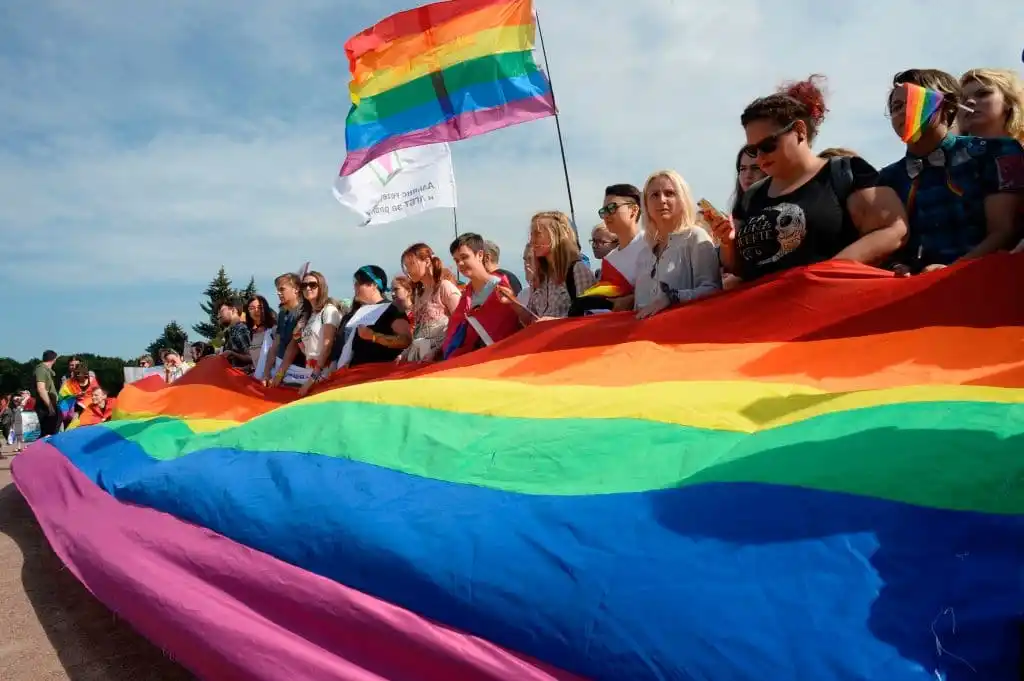
People wave gay rights’ movement rainbow flags during the gay pride rally in Saint Petersburg, on Agust 12, 2017. (MALTSEVA/AFP via Getty)
While Maria was shocked by the invasion – most people were, she says – with hindsight, she can see that it’s been a long time coming. For years, the Russian government has been working to bring the country back to a bygone era. The goalposts were clearly set when Russia banned “gay propaganda”. The government’s commitment to “traditional values” is intrinsically inked to Putin’s view that Russia has a rightful claim to Ukrainian territory.
“It’s this idea of, we are our own people, we have our own values, and we don’t need your values and democratic institutions. Going against International norms and regulations in this war against Ukraine is also part of it,” Maria continues. “Russia doesn’t care anymore – it has its own rules.
“The Kremlin is building this Russian values rhetoric, this anti-western rhetoric, and to set it apart from the rest of the world – to say, we’re different from the west, we follow our own values, we don’t have to be like the rest of them.”
LGBT+ activist Andriy Maymulakhin can hear gunfire in his home, which is located in a village just 50 kilometres from Kyiv, the capital of Ukraine.
Life since Russia invaded has been tense for Andriy, who serves as head of LGBT+ rights organisation the Nash Mir Centre, based in Kyiv. He’s separated from his boyfriend of 10 years, who is in western Ukraine. Two of his friends and one of their elderly parents are sheltering at his home.
Shortly after Russia launched its invasion, Nash Mir’s offices were raided and its employees assaulted. Those who attacked them were, surprisingly, Ukrainian – the raid points to just how high tensions are in the country.
“Our organisation is quite small, just five people in the group and about 12 activists across the country. I did not hear from anyone that he or she wants to leave the country. This is our country,” he says.
Like countless other Ukrainians, Andriy has been separated from his loved ones by war. His boyfriend is currently based in Lviv, where he has family, meaning the pair are now unable to see each other.
“We call each other every day, but still, it’s now impossible to join him. He says, ‘Oh I shall return’ – I say, ‘No, it is so dangerous.’”
LGBT+ people in Ukraine could be ‘exterminated’ under Russian rule
The invasion is devastating for the Ukrainian people and the war is destroying people’s lives. For the country’s LGBT+ community, the war has come as a shocking blow for a number of reasons. One of those is that things had been gradually improving for their community in Ukraine in recent years. If Russia were to exert control over their lives, they fear that those hard won freedoms would be under threat once more.
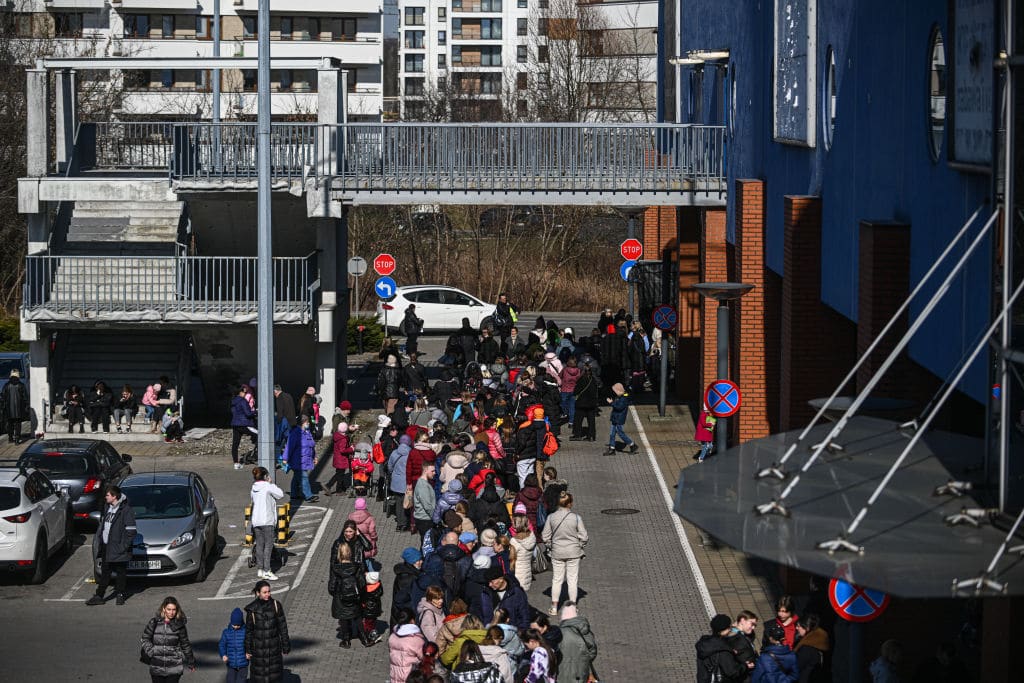
Hundreds of people who fled the war in Ukraine wait to enter the “Wardrobe of Good”, an initiative offering free clothes created in collaboration with IKEA, Strabag and Diverse on March 14, 2022 in Krakow, Poland. (Omar Marques/Getty)
“Since 2014, there has been significant progress on LGBT+ rights in Ukraine, and it is positive. We really are so different now from Russia,” Andriy says.
It is very likely that LGBT+ activists will end up on the lists for concentration camps or extermination.
“For example, five years ago, sociological reports said that 80 per cent of Ukrainians didn’t support LGBT+ people, or they at least don’t want to see LGBT+ Pride. Last year, the same question was asked and it was 56 per cent negative, so it is a significant increase in acceptance. We believe that there is slow but constant progress.”
Like many LGBT+ Ukrainians, the thoughts of Russian control in his country is alarming.
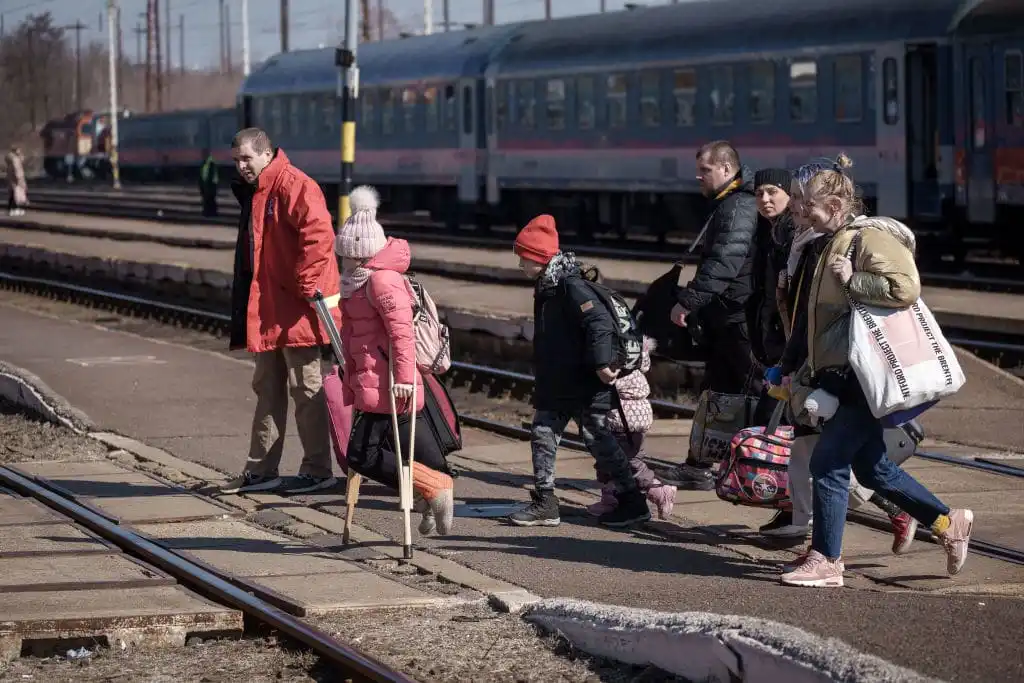
Refugees fleeing Ukraine arrive into Hungary at Zahony train station on March 14, 2022 in Zahony, Hungary. (Christopher Furlong/Getty)
“It is hard to imagine that we will have to come to terms with the so-called ‘Russian world’, its laws and morality, which are aimed against LGBT+ people,” he explained in an email. “It is very likely that LGBT+ activists will end up on the lists for concentration camps or extermination.”
Activists have expressed concern for the safety and wellbeing of LGBT+ Ukrainians
As of now, Andriy is relatively safe – he is still in Ukrainian controlled territory. If that changes, he will try to flee to western Ukraine so he can be with his boyfriend.
“I cannot imagine that I can live on a so-called ‘Russian road’. I shall die better.”
In Ukraine we’re asking other governments to support Ukraine in this very difficult time.
Plenty of people abroad are looking for ways they can help. Right now, Andriy says his organisation doesn’t need donations, although they’re always welcome. Support doesn’t need to be LGBT+ specific, he says.
“In Ukraine we’re asking other governments to support Ukraine in this very difficult time,” he says. “It’s not specific [to the LGBT+ community], but it is what I want to say.”
The war in Ukraine has continued to escalate since Russia launched its invasion in February. According to the United Nations High Commissioner for Human Rights (OHCHR), there have been 1,761 civilian casualties since war broke out, with 636 killed and 1,125 injured.
The human rights watchdog said the actual figures are likely considerably higher.
On Monday (14 March), Ukrainian officials said they had entered into another round of talks with Russia. Mykhailo Podolyak, a Ukrainian negotiator, posted online to say that the discussions were proving difficult because the political systems in Russia and Ukraine are so different.
International LGBT+ groups have expressed concern for queer people in Ukraine since the invasion started last month. Some trans women have been unable to get to safety because they have the wrong gender marker on their passports, while other queer people have been vocal about the impact any Russian influence could have on their rights and freedoms.
A married same-sex couple who is seeking permanent residency in Namibia received a partial victory from the country’s Supreme Court last week
The Supreme Court on March 7 presided over a permanent residency case involving Guillermo Delgado and the Home Affairs Ministry.
Delgado, a gay man from Mexico who married Namibian national Phillip Lühl eight years ago in South Africa, approached the Supreme Court last year after Namibia’s immigration officials ruled that their South African marriage did not qualify Delgado for residency in Namibia since the country does not recognize same-sex marriages.
The Home Affairs Ministry also did not consider the fact that Delgado had lived in the country for more than 10 years.
Although the Supreme Court ruled the government had discriminated against their residency application because one of the spouses is foreign-born and ordered the Home Affairs Ministry to review Delgado’s request for residency, his attorney Uno Katjipuka-Sibolile said it was just a lost cause that would eventually bring them back to the Supreme Court.
“Essentially by saying go back to Home Affairs you have to start afresh and we have outlined to the court how Home Affairs has been hostile towards Guillermo, Phillip and the entire family so going back to Home Affairs for what? We know they are going to reject the application except now they are going to pretend to have thought about it a little bit longer then you would have to institute a review application or something and eventually come to the Supreme Court it’s just a waste of time, a waste of money and a waste of energy to be quite frank.
We will just have to study the judgment but this is not what we wanted. The good part is that they recognized that Home Affairs really mistreated Guillermo and ordered punitive cost order like you would have heard they said cost on an attorney client scale so you appreciate that Home Affairs did something wrong but you are sending the person back to Home Affairs it makes no sense to me,” said Uno.
Delgado said he and Lühl they were going to do as the Supreme Court recommended, but nevertheless described it was a daunting task since he was going back to the same process that denied him the residency,
“I feel a little bit disappointed, the application had already been made. I made an application and they rejected it so they (the Supreme Court) are basically telling me I should apply again so it’s unclear to me why I should apply again, I suppose so that they can reject it again and then we are back to square one but there should be some explanation for the judgement,” said Delgado. “So, for now I will just reapply for my domicile and see how it goes.”
Namibia Women’s Diverse Association, a non-profit organization that works with LGBTQ Namibians, said although the Supreme Court judgment was non-fluid per se, it was a step towards ending discrimination based on sexual orientation and gender identity.
“As we celebrate, we are cognizant that the journey to full recognition equality and equity shall be a struggle we are all prepared to advocate for, with no compromise of anyone’s rights,” said the Namibia Women’s Diverse Association in a statement.
A Namibian woman and her German partner, Elisabeth Frank, in 2001 sued to have their relationship recognized so that Frank could reside in Namibia.
The Immigration Board granted the residence permit, and the government appealed to the Supreme Court. The court ruled Frank should receive a permanent residence permit, which she received a year later, but it did not rule in favor of same-sex relationships.
Discrimination based on sexual orientation and gender identity is not banned in Namibia, and households headed by same-sex couples are not eligible for the same legal protections available to opposite-sex couples.
Section 299 of the Criminal Procedure Act of 2004 includes references to sodomy or attempted sodomy charges.
Schedule 1 groups sodomy together with a list of other crimes for which the police are authorized to make an arrest without a warrant or to use of deadly force in the course of that arrest. Public displays of affection between two men can be considered “immoral” behavior, which is punishable under the Combating of Immoral Practices Act of 1980.
Daniel Itai is the Washington Blade’s Africa Correspondent.
A British territories appellate court on Monday upheld a Bermuda law that rescinded marriage rights for same-sex couples.
The 4-1 decision from the Privy Council’s Judicial Committee in London comes more three years after Bermuda’s government appealed a Bermuda Court of Appeals ruling that found the Domestic Partnership Act — which allows same-sex couples to enter into domestic partnerships as opposed to get married — unconstitutional.
Supreme Court Justice Charles-Etta Simmons in 2017 issued a ruling that paved the way for gays and lesbians to legally marry in Bermuda. The Domestic Partnership Act that then-Gov. John Rankin signed took effect on June 1, 2018.
“To my fellow LGBTQ+ Bermudians, I wish to say to you what I also need to hear at this moment. You matter. Your hurt matters. You deserve better than this,” said Roderick Ferguson, one of the plaintiffs in the marriage equality case, in an OUTBermuda press release on Monday after the Privy Council’s Judicial Committee released its ruling. “The Bermuda government’s crusade against same-sex marriage was waged to convince you that there’s something shameful about your sexuality. Don’t believe that tired old lie.”
The Privy Council’s Judicial Committee on Monday also ruled same-sex couples in the Cayman Islands don’t have a constitutional right to marry in the British territory.
A gay Ukrainian couple went to France on holiday. Overnight, it became their new home.
Nazar and Yuriv arrived in France on 11 February for a short holiday. They were staying with a friend in Paris, when they woke up to the horrifying news that Russia had invaded Ukraine.
They knew that tensions had been on the rise, but they never thought their home country – the place where they had built a life together – would end up under siege in such a brutal, sudden fashion.
“It was like something from a horror movie,” Nazar tells PinkNews. “I see the pictures of everything that has been destroyed and I can’t believe it.”
Overnight, they lost their home and their sense of security. They found themselves separated from friends and family, who are now living in a war zone. Nazar doesn’t even know if his parents are alive.
“I haven’t contacted [my parents] for more than three days because there is no internet, no electricity, no gas where they’re staying,” he says.
As well as fearing for their safety, Nazar is also worried that his parents are being duped by Russian propaganda.
“The last time I reached them on the phone, they told me that it’s not Russians who killed the people and shoot the civilians, it’s Ukrainians,” he explains. “It was just incredible that they were under the fire of Russian military and they were still believing the Russian propaganda. It’s a tragedy for me. I cannot believe it.”
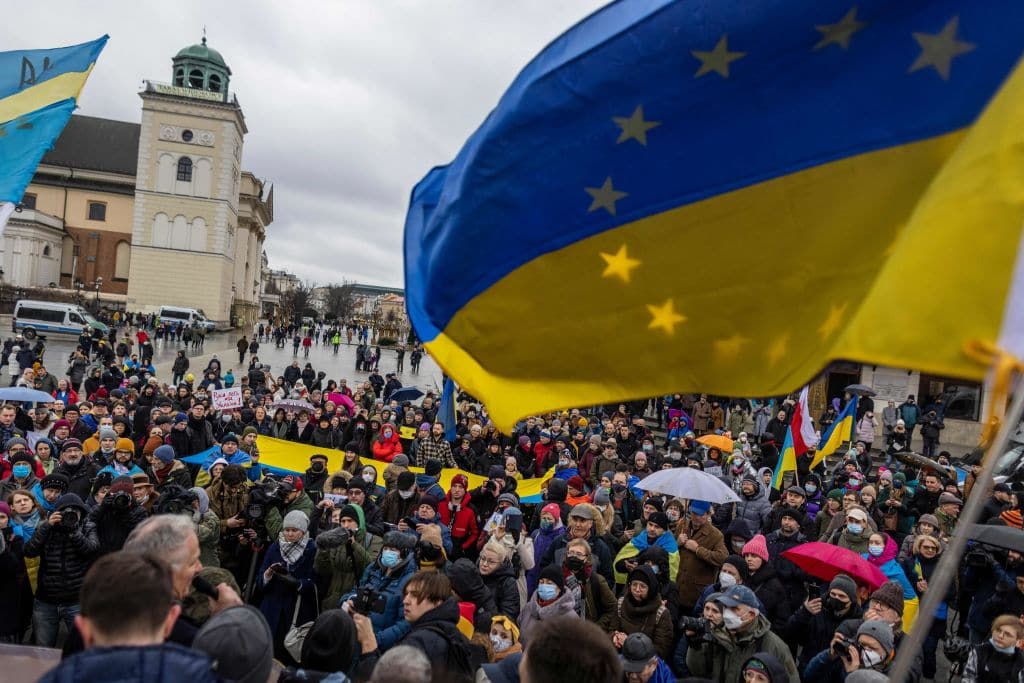
Protesters gather in a protest for peace in Poland. (WOJTEK RADWANSKI/AFP via Getty)
It was the last time he spoke to them. “I was very irritated… but then they just disappeared from online. I don’t know whether they are alive or not or whether they’re just in some cellar without connection.”
Nazar has also been grappling with feelings of guilt that he and Yuriv are not in Ukraine to help fight their oppressors.
“We think that we should have stayed… but all of the friends we’ve discussed this with – who are still in Ukraine – have said we shouldn’t feel guilty because we don’t have any military experience,” he says.
Nazar’s sister once threatened to shoot him if he didn’t ‘change’ his sexuality
Before the war, life in Ukraine wasn’t always easy for Nazar, 32, and Yuriv, 26. They’ve been together for six years, but in that time, they’ve faced oppressive attitudes from family because of their relationship. Nazar’s sister once threatened to shoot him unless he “changed”.
Their life in Ukraine wasn’t ideal, but they had reason to be hopeful for the future. They had considered moving to another European country to start anew, but they were heartened to see things gradually improving for LGBT+ people in Ukraine. Attitudes were becoming more progressive among younger Ukrainians and in big cities.
War has swept LGBT+ rights off the agenda in Ukraine. Nazar and Yuriv are pragmatic about this: equality is fundamental, but LGBT+ people can’t have any freedom when they’re at war – especially when the aggressor is Russia, where LGBT+ people face oppression and violence.
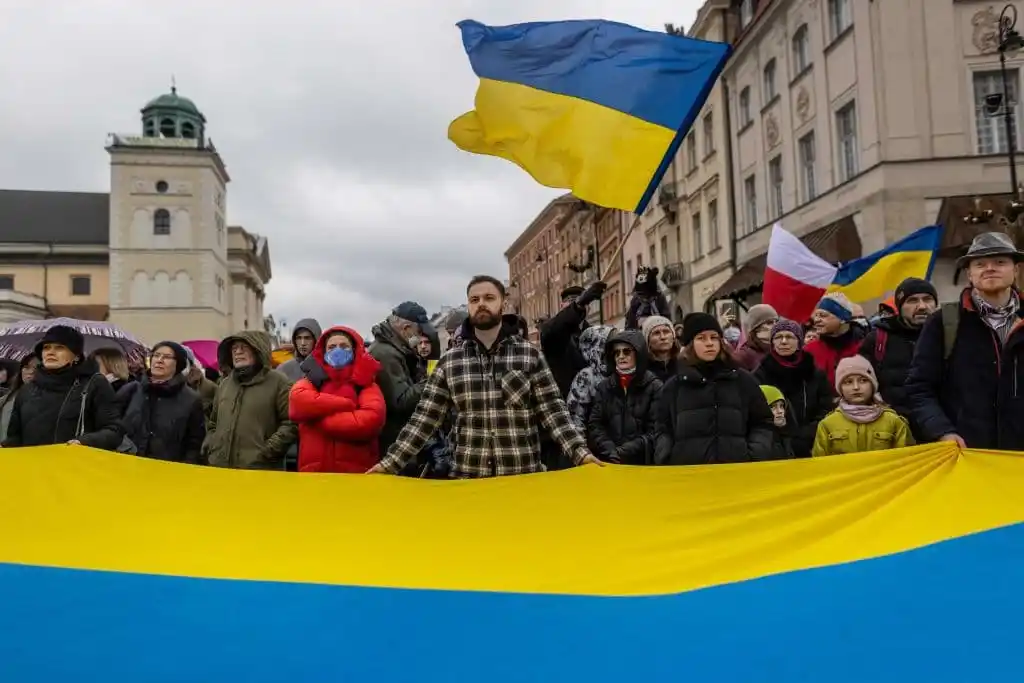
Protesters wave Ukrainian flags during a demonstration for peace in Ukraine, in Warsaw, Poland. (WOJTEK RADWANSKI/AFP via Getty)
“War is war, and people who fight from the other side have no mercy. They do not follow any kind of rules, they can target civilians, peaceful people,” Nazar says.
The idea of a pro-Russian government in Ukraine terrifies him. He says such an eventuality won’t happen – the people of Ukraine are fighting back fiercely, and he believes they will win. Still, if the war doesn’t go well, it would mean Nazar and his boyfriend would likely never return to Ukraine.
“The slightest possibility of a pro-Russian government is so atrocious, so horrible, that I wouldn’t be staying in Ukraine if it is under a pro-Russian government. I know about the atrocities in Chechnya, I know about the attitudes toward LGBT+ people,” he says.
You should know what’s really happening in Ukraine. All of these lies can be refuted by very simple fact checking.
For now, Nazar and Yuriv will be staying in France. They’ve been “surprised” that they’ve been referred to as a couple throughout the process of applying for asylum – it’s the first time in their lives they’ve been treated the same as mixed-gender couples.
“I cannot plan for what will happen in a year or two years,” Nazar says. “For me and for my partner it’s important for us to be in a safe place while war is going on in Ukraine.”
Nazar and Yuriv are determined to help the Ukrainian cause from abroad in any way they can. Nazar is currently exploring ways he can counter Russian propaganda about the war. The most important thing people can do is to listen to Ukrainians, he says.
“Don’t be infected by this propaganda,” he says. “You should know what’s really happening in Ukraine. All of these lies can be refuted by very simple fact checking.”
The situation is devastating for Ukrainian people like Nazar and Yuriv, but they’ve been amazed to see the huge swell of support for their country.
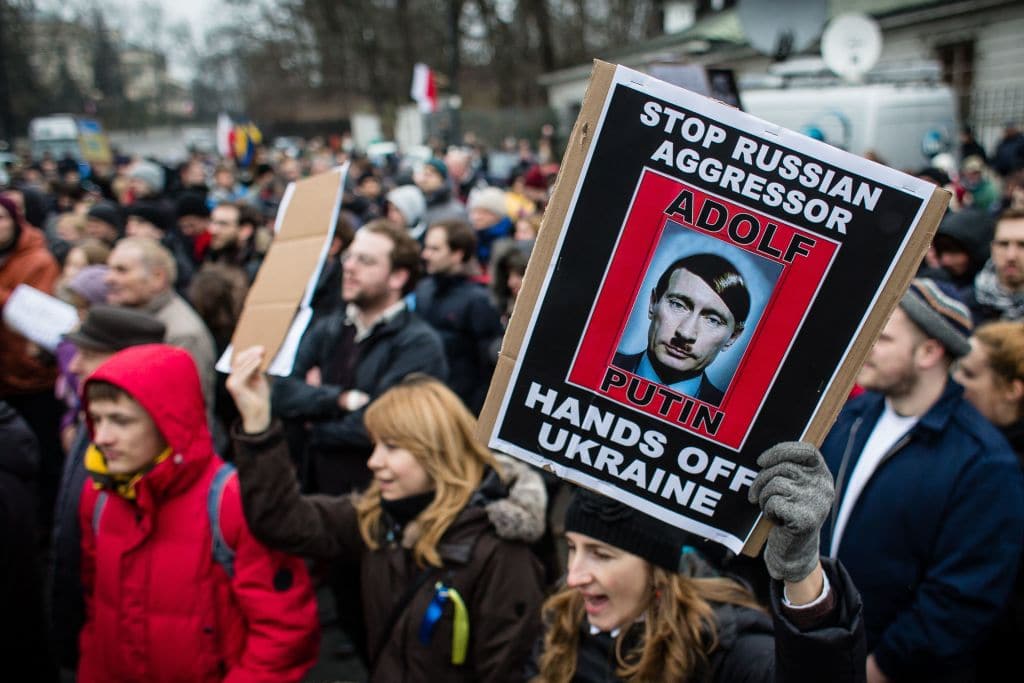
People protest in front of Russian embassy against Russian military action the Crimean peninsula during a pro-peace demonstration on March 2, 2014 in Warsaw. (WOJTEK RADWANSKI/AFP via Getty)
“I’m very grateful to everybody from all over the world for the support they’re showing towards Ukraine,” Nazar says. “For me and for my country it’s very important. The solidarity shows us that people can do something good together, not just destroy countries like our neighbour decided to, but they can be friendly, they can be kind to other people, they can cherish this feeling of solidarity. I think it shows that Ukraine will win.”
Russia has faced international condemnation and sanctions since it launched its full-scale invasion in Ukraine just two weeks ago. More than two million people have fled and in excess of 400 civilian deaths have been reported.