Trans people in Switzerland will be able to legally change their gender by self-ID at a civil registry office from the start of the new year.
Switzerland joins a growing number of European countries that allow a person to legally change their gender and name through self-declaration. It follows Denmark, Norway, Malta, Luxembourg, Ireland, Iceland and Portugal, according to international trans advocacy group TGEU.
Under the new law, which will go into effect on Saturday (1 January), anyone over the age of 16 and not under legal guardianship will be able to change their gender marker and legal name by self-declaration at a civil registry office.
Younger people and those under adult protection will require guardian consent.
Self-ID will also potentially reduce thousands in administrative fees, taking the cost down to just 75 CHF, according to activists.
Current rules on changing gender markers vary by region in Switzerland, but many often require a certificate from a medical professional confirming a person’s trans identity, Reuters reported.
Some require a person to undergo gender-affirming surgery or hormone treatment to legally change gender. If a trans person wants to change their name, some regions require proof that the chosen name has been unofficially used for several years.
In June, the Spanish government approved a draft bill to allow anyone aged 16 and older to change gender marker and name on government-issued documents without a medical diagnosis.
However, the UK has lagged behind in introducing self-ID laws.
The committee recommended the Tories urgently remove the requirement that trans people receive a diagnosis of gender dysphoria before they can be legally recognised by 2023. It also advised that the government launch an action plan in the next 12 weeks for reforming the GRA.
The committee recommended the government scrap the spousal veto from gender recognition laws and remove the requirement that trans people live in their “acquired gender” for two years before they can seek legal recognition.
Rabia was just 15-years-old when she became engaged to a Taliban officer against her will in a small village in Afghanistan.
Now 22-years-old, Rabia has fled Afghanistan and has managed to get away from the man who made her adolescence hell. She is temporarily living in Pakistan, but she’s hopeful she will ultimately be able to claim asylum in either Canada or the UK so she can build a life for herself.
Like so many others, Rabia had no choice but to flee when the Taliban seized power. She is a lesbian, which makes her a threat to Taliban rule. To make matters worse, she knew the man she was engaged to as a teenager was still trying to track her down.
That’s why she and a friend – another lesbian – decided to travel to the border between Afghanistan and Pakistan.
“We had lots of problems because the Taliban stopped us along the way several times,” Rabia tells PinkNews.
Thankfully, Rabia and her friend managed to get into Pakistan with the help of a journalist who advocated for them at the border – but she wishes leaving was never a necessity in the first place.
“Before the Taliban, we had the opportunity to work, to study, to have a job,” Rabia says. “We had opportunities, and I was a student at a university.” Life was far from perfect – Rabia had to hide her identity and she couldn’t live openly as a lesbian. But once the Taliban seized control, things became much worse.
“After the coming of the Taliban, everything changed. I couldn’t go anymore to university, and I couldn’t go to my job,” she says. “I received a call from the job and they told me that you can’t come anymore because you are fired. I don’t know why.”
In the weeks that followed, Rabia changed her location several times out of fear that her ex-fiancé would track her down. She didn’t want to live with her family as she feared doing so would put their lives at risk.
Rabia’s father was forced to accept the engagement by a Taliban officer in Afghanistan
She still remembers vividly what it was like to be a teenager and be forced into an engagement against her will with a man she did not want to marry.
“He was a security member, that was the time that the Taliban was not controlling Afghanistan and they didn’t have any role or right to be in Afghanistan,” Rabia says. “They forced my father for the engagement. They told my father, if Rabia doesn’t accept this, we will go for your other girl, my sister. I didn’t want them to hurt my sister because she’s so sensitive. I had to do this because I didn’t have any option. Fortunately I found a way to escape from him.”
Rabia got away from her fiancé after six months. She was able to make contact with a woman in Kabul who dedicated her time to helping young girls get to the city where they could study and work. Rabia spent some time in a safe house in the city, and she later moved in with a family based in Kabul.
It was there that Rabia finally started to come to terms with her sexuality.
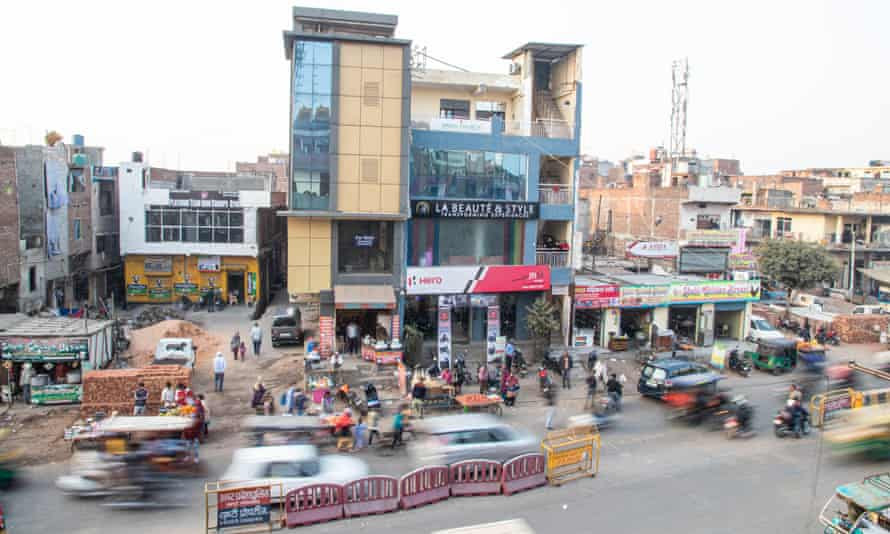
The beauty treatments listed at the new La Beauté & Style salon are much the same as those offered by the dozen or so other parlours that dot the traffic-heavy Dilshad Extension area of Ghaziabad, 17 miles (28km) east of Delhi. But that is where the similarity ends.
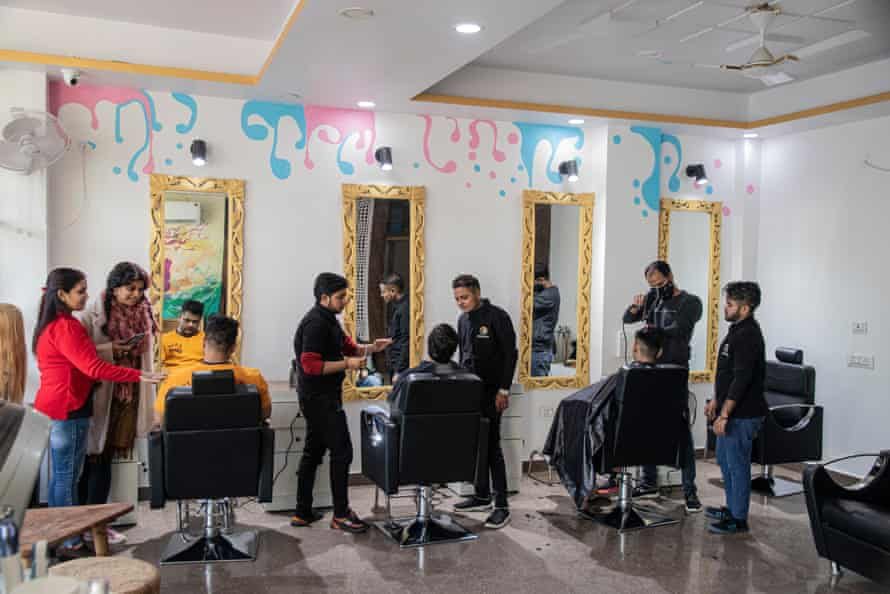
The wall behind the reception desk is painted in rainbow colours; a mural of a trans man with flowing multicoloured locks decorates another wall; a woman wearing a sari is having her eyebrows plucked next to a trans man who is telling a stylist how he would like his hair cut.
I feel loved and appreciated here. I no longer have to act or hide behind a different identity just to do my job
Nakshatra Rajput, salon employee
La Beauté & Style salon created history in September when it opened as India’s first salon run by transgender men. The owner, Aryan Pasha, 30, is a lawyer, activist and India’s first transgender male bodybuilder. He opened the salon to create a space where trans people would feel comfortable requesting beauty treatments. Everyone is welcome, he says, not just the LGBTQ+ community.
Of equal importance was creating a business that would generate employment for his community, which “continues to face social discrimination and rejection in academic institutes, as well as at workplaces, despite the Transgender Persons (Protection of Rights) Act 2019,”, he says.
“While conducting food and ration-distribution drives during the epidemic, it was heartbreaking to encounter young transgenders who were educated and skilled but jobless due to their gender. They were surviving on charity donations, while others were forced to return to unsupportive and abusive families in their villages,” says Pasha.
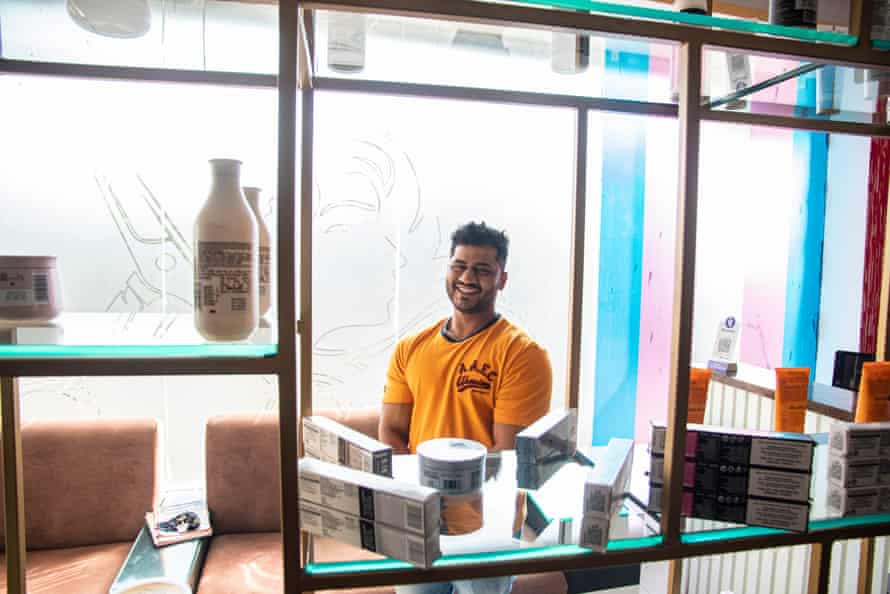
Aryan Pasha, owner of the Beauté & Style salon in Delhi – and India’s first transgender bodybuilder. Photograph: Siddharth Behl/The Guardian
With financial help from the Joint United Nations Programme on HIV/Aids and the Gravittus Foundation, a Pune-based charity that works for social change, Pasha set up the salon with his partner, Laxmi Narayan Tripathi, 43. .
Tripathi has been a transgender activist since 1999, campaigning for numerous causes from HIV to community-led social enterprises. Through their charity, the Gaurav Trust, the couple focuses on raising awareness and protecting the health and rights of male sex workers and others within the LGBTQ+ community.
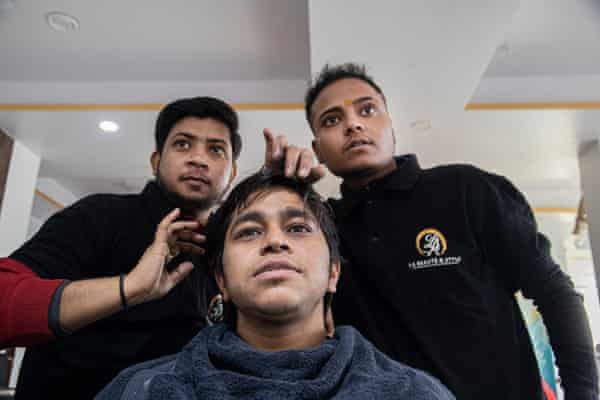
‘My family turned its back on me, but the salon embraced me,’ says one stylist. Photograph: Siddharth Behl/The Guardian
“Despite our collective advocacy and action over the years to mainstream issues like the welfare, rights and health of transgender people, stigma remains a major challenge. We face a hostile environment within schools, colleges and at the workplace, which leaves us scarred for life,” says Pasha, who transitioned from female to male after gender-reassignment surgery in 2011.
According to a 2017 study by India’s National Human Rights Commission, 92% of transgender people in India are deprived of the right to participate in any form of economic activity in the country; 99% have suffered social rejection on more than one occasion, including from their family; and 96% are denied jobs and forced into areas such as sex work or begging to survive.
A customer gets a haircut at the Beauté & Style salon. Photograph: Siddharth Behl/The Guardian
At Le Beauté, the six newly trained staff earn £100 to £300 a month, depending upon their level of expertise and skill.
More beauticians are being trained near Mumbai. “We plan to open our next salon in Pune and ultimately go national once we get more funding,” says Pasha.
Bhanu Rajodiya, 25, says he was at the lowest point in his life when Pasha recruited him. “I used to work at an export house in Delhi and earn £80 to £100 a month, but I lost my job during the pandemic. My family turned its back on me, but the salon embraced me and I now have a secure job with a fixed income. It’s so empowering.”
Another employee, Nakshatra Rajput, who transitioned last year, worked in Delhi as a team leader but lost his job when the management discovered his identity.
The salon, in a busy satellite town near Delhi. Photograph: Siddharth Behl/The Guardian
“They started finding faults in my work and the work atmosphere became so toxic, I had no choice but to leave. This was despite the fact that I was transparent about my gender to the HR department when I joined. They hired me for my skills and paid me well, but kicked me out at whim,” says the 25-year-old.
Rajput added that though his parents and friends had accepted him, Indian workplaces were far from inclusive. “This discrimination really hurts. After leaving my first company, I joined another one but had to leave that also within days because of my identity,” he says.
However, he is happy that La Beauté opened a door for him and trained him as a hairstylist – and has recently made him a part of the salon’s management team. “I feel loved and appreciated here,” he says.
“I no longer have to act or hide behind a different identity just to do my job. It’s so liberating. And that’s how society should be too – inclusive and diverse,” he says pointing proudly to the salon’s rainbow-hued walls.
Salekh Magamadov and Ismail Isaev, gay brothers detained in Chechnya, have begun a hunger strike after a judge denied a request to move their case to another region.
The brothers fled to Russia in June 2020 with the help of the Russian LGBT Network after they were tortured in Chechnya, the site of deadly so-called “gay purges”, for running an opposition Telegram channel.
The Russian LGBT Network said in a statement through its crisis group “North Caucasus SOS” that Magamadov and Isaev “declared the beginning of a hunger strike”.
The Washington Blade reported the declaration came after a judge denied the brothers’ request to move their case from Achknoy-Martan, a locality in Chechnya’s Achkhoy-Martanovsky District, to another court in the semi-autonomous Russian region.
The group said that Magamadov and Isaev had been detained in “the Detention Center No 1 in Grozny, Chechen Republic [for] more than 10 months”, the Advocate reported.
“They have reported being tortured during this time but the Investigation Committee refused to investigate the fact of torturing and to initiate a criminal case,” the group said. “Magamadov and Isaev have said pressure has been applied to them and that they were forced to refuse from legal support.”
The group also claimed that the brothers had been threatened with “honour killings” by distant relatives on television in Chechnya.
The Russian LGBT Network told Russian news site Meduza in March that the men’s friends and families had been encouraged by Chechen police to perform “honour killings”.
In a bizarre turn of events, the gay men were also offered state protection in Chechnya to prevent the “honour killings”.
The Russian LGBT Network petitioned Chechnya’s investigative committee to protect Magamadov and Isayev, according to the Moscow Times. But there was no clarification at the time as to what this protection looked like.
The men’s mother, Zara Magamadova, filmed an appeal with the Russian LGBT+ Network accusing authorities of “fabricating” the case against her children.
“I’m asking anyone who can help, please help me see my sons alive and in good health,” she said.
The Jerusalem Post has reported that thousands of LGBTQ+ Israelisreceived text messages saying they “deserve severe punishment, death and deportation” and calling on them to “repent.” The Association for LGBTQ Equality in Israel confirmed the news Monday.
“You are LGBT and an apostate. You deserve severe punishment, death and deportation from Israel,” the message read. “Come to Yeshiva Ohr Elhanan in order to repent. We would be glad if you undergo conversion to faith.”
According to The Jerusalem Post, “The message included a phone number and a Telegram account to contact and stated that it was sent by Rabbi Chaim Aryeh Hadash, the rosh yeshiva of Yeshiva Ohr Elhanan. The rabbi has denied that he has any connection to the message, saying he has never talked about the issue and the issue is not addressed in his yeshiva.”The Agudah and the Havruta organization for LGBTQ+ religious Jewish men invited Hadash to a dialogue with the LGBTQ+ religious Jewish community. They also called in a letter for Hadash to publish a public condemnation of the messages sent in his name and to “prevent the further great desecration of God that has already been done.” The director-general of the Israel Internet Association, Yoram Hacohen, called for police to investigate whether the person who sent the text used data from the Black Shadow attack, adding that “Since these are text messages, it is possible to find out their source and take criminal action against the perpetrators…These are, on the face of it, elements who have grossly violated the Privacy Protection Law – I call on Israel Police to act immediately to locate the perpetrators. They have the tools to do that.” This latest incident comes just days after a seminar hosted by the 105 hotline for the protection of children online concerning harm against LGBTQ+ youth online.
Transgender people in Thailand have no route to legal recognition of their gender identity, making them vulnerable to various forms of discrimination, Human Rights Watch said in a report released today with the Thai Transgender Alliance.
The 60-page report, “‘People Can’t Be Fit Into Boxes’: Thailand’s Need for Legal Gender Recognition,”found that the absence of legal gender recognition, coupled with insufficient legal protections and pervasive social stigma, limits transgender people’s access to vital services, and exposes them to daily indignities. Thai transgender people said they were routinely denied access to education, health care, and employment. Thailand has a reputation as an international hub for gender-affirming surgery and transgender health care. But this global reputation obscures Thailand’s severely limited legal mechanisms to protect transgender people at home.
“Transgender people in Thailand constantly face harassment and discrimination, and are often excluded from education and employment,” said Kyle Knight, senior LGBT rights researcher at Human Rights Watch and co-author of the report. “The Thai government needs to step in and make legal gender recognition a reality in Thailand.”
Human Rights Watch conducted the research for this report between January and May 2020 with individuals in four locations in Thailand: Bangkok, Trang, Chiang Mai, and Ubon. Researchers conducted in-depth interviews with 62 transgender people, as well as interviews with social workers, scholars, and employees at advocacy and service provision organizations.
Thailand has limited legal provisions that offer some security to transgender people, but they fall far short of comprehensive protections, Human Rights Watch found. In 2007, Thailand’s legislature passed the Persons’ Name Act, which allows transgender people to apply to change their name. The act, however, did not give people the option to apply to change their legal gender. Name change requests are approved at the discretion of individual administrators.
Under the 2015 Gender Equality Act, which prohibits discrimination against people on the basis of gender expression, the legislature attempted to address some forms of discrimination experienced by transgender people. Yet the government has failed to adequately implement the law. The Committee on Determination of Unfair Gender Discrimination, which has the authority to enforce the law, heard 27 cases of alleged discrimination against transgender people between 2016 and 2019. Many of these cases took more than three months to adjudicate, and none of the eight parties found responsible received punishment.
The absence of legal gender recognition in Thailand means that all transgender people carry documents with a gender different from their identity and expression. When transgender people are asked for this documentation, they can feel humiliated. In some instances, transgender people reported that government employees harassed them based on the mismatch.
A 27-year-old transgender man in Bangkok described his humiliation when he tried to replace a lost identification card: “The officials asked how did I get my penis … and whether it’s really possible to become a trans man.” The officials proceeded to compare him with his past photos. “I felt like a caricature for these government officials,” he said.
Many schools have gender-specific dress codes or facilities, and do not allow students to attend school if they dress in ways deemed inconsistent with their legal gender, violating their right to education. The rigid application of gender-specific regulations, including uniforms and sex-segregated facilities, exacerbate bullying of transgender students by classmates and teachers.
“When I started wearing makeup and lipstick to school, my teacher would scold me – call me ‘tud’ [a derogatory Thai term, roughly translated as ‘faggot’],” said a 25-year-old transgender woman who grew up in Ang Thong province in central Thailand. She believed they singled her out because she had started to grow her hair long as well. “I was also beaten at school by teachers, and teachers would instruct the boy classmates to tease me,” she said.
Transgender people also face obstacles in accessing appropriate health care. A 30-year-old transgender woman said that when she was 20, she was hospitalized for appendicitis and needed urgent surgery. “I was placed in the male ward,” she said. “All the bad things like this happen to me because of a single word on my document – my gender marker.”
Many transgender people interviewed said discrimination in medical settings deterred them from seeking care altogether, threatening their mental and physical well-being.
The lack of legal gender recognition also hampers transgender people’s ability to get jobs, often resulting in automatic rejections. Some employers said that transgender people would only be hired if they dressed according to their sex assigned at birth, not their gender identity. Other employers explicitly stated in job applications that transgender applicants would not be considered. Many people interviewed said they feel restricted to niche employment, such as the beauty industry or sex work.
In recent years, the Thai government has begun to engage with civil society organizations and United Nations agencies to develop a legal gender recognition procedure. The process has stalled and needs urgent attention, Human Rights Watch said.
The Thai government has an important opportunity to match its positive global reputation on LGBT issues with its obligations under international human rights law by developing a rights-based procedure for legal gender recognition. This law should enable transgender people to be recognized according to their gender identity and change their legal name and gender without any medical requirements.
“Ensuring transgender people’s rights to nondiscrimination, education, health care, and employment is paramount to any vision of equality,” Knight said. “While legal gender recognition will not ease all the hardships transgender people in Thailand face, it is a crucial step toward equality and nondiscrimination.”
Anti-LGBT+ lawmakers in Senegal are seeking to toughen the west African nation’s already horrific repression of queer citizens.
A bloc of National Assembly members have drafted a bill that would lengthen potential jail terms for those convicted of same-sex acts.
The penalty is already up to five years imprisonment for “acts against nature” – but lawmakers hope to stretch this out to a decade, they announced Monday (13 December).
People who write, speak or finance any form of advocacy in favour of queer rights could face three-to-five years in prison and a fine of CFA500,000 to five million.
The chilling proposals could also place crosshairs on intersex people, too. Lawmakers wish to criminalise “intersexuality” with up to 10 years in jail.
Supporters for the bill grossly consider being intersex – folk born with sex characteristics that don’t fit neatly into the typical binary – as “being adept at all imaginable sexual orgies”.
The proposals seek to plug the apparent gaps in the country’s laws by comparing LGBT+ people to “bestiality, necrophilia and other related practices”.
According to grassroots activists, the law has been in the pipeline for the last two years, fuelled by anti-LGBT+ lobbying collective Ànd Sàmm Djikko Yi.
Senegal activists recoil in horror at ‘freedom-killing’ anti-LGBT+ bill
Alioune Souaré, an assembly deputy and legal expert who helped draft the bill, told Reuters that he and other lawmakers hope to present the proposal to parliament “before the end of the week”.
Souaré is joined by Ababacar Mboup, Mamadou Lamine Diallo and Moustapha Guirassy in forming the “Say No To Homosexuality Alliance”.
While it remains unclear if the bill would shore up any support, local activists have reached with an uneasy mixture of horror and a lack of surprise to the effort to double prison time for LGBT+ people.
“When individual freedoms, in particular the most sacred – privacy between consenting adults – are attacked, then there is little time left to realise that democracy is in danger,” queer activist Djamil Bangoura told the news wire.
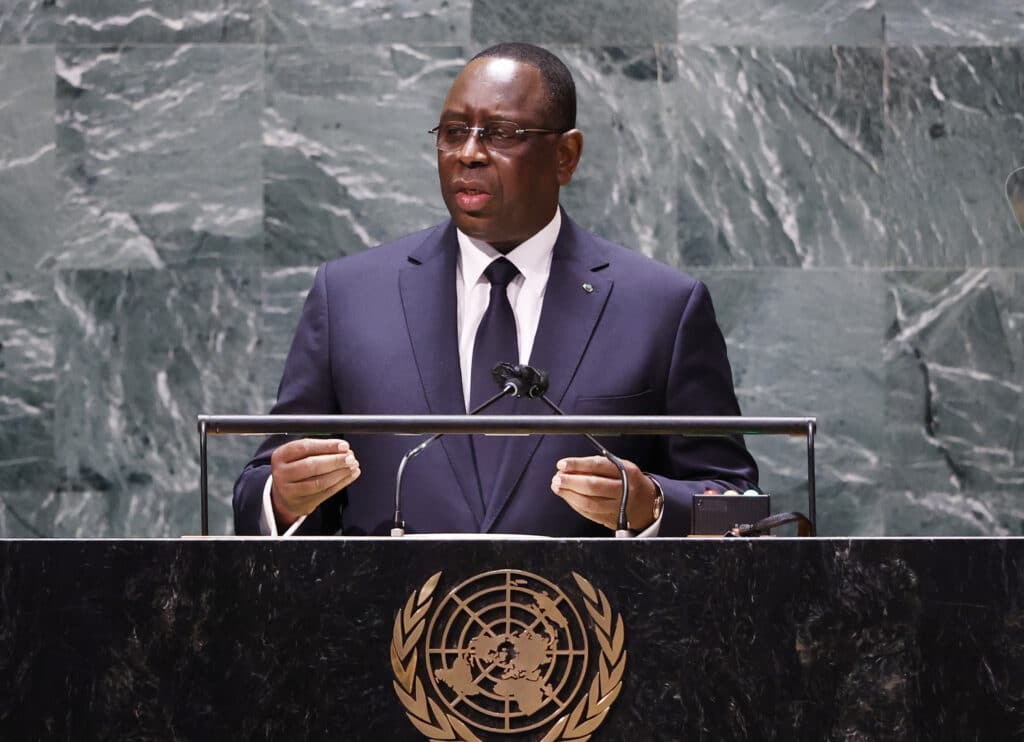
President of Senegal Macky Sall addresses the 76th session of the UN General Assembly. (John Angelillo – Pool/Getty Images)
The Freedom Collective of Senegal dubbed the legislation the “freedom-killing bill” in a statement to the press.
“Homosexuality has always existed in Senegal, as it has everywhere else, and LGBTI people are a full-fledged component of Senegalese society that has the right to respect, just like everyone else,” they wrote.
For years, views held by both the public and politicians and presidents alike have not been thawed in Senegal when it comes to LGBT+ issues.
“Never, under my authority, will homosexuality be legalised in the Senegalese lands,” said president Macky Sall in 2016.
With article 319 of Senegal’s Penal Code looming, arrests of LGBT+ people has risen sharply, according to a 2020 report by the International Lesbian, Gay, Bisexual, Trans and Intersex Association.
Since 2010, local activists have sought to raise the alarms over an upswing in arrests, many of which go unreported. The police’s high-handed arrests, they said, have fuelled a climate of fear for LGBT+ Senegalese.
The country has been met with bruising words by the United Nation’s Human Rights Committee, with the body repeatedlyrecommending in Universal Period Reviews that the country decriminalise homosexuality.
It is a country, the IGLA said, where “homophobic mobs” regularly tear through towns and president Sall called for LGBT+ people to be “hunted” during the 2019 presidential elections.
But such a crackdown is nothing new, local advocacy group Arc-en-Ciel warned in the report. They have ripped through the country for years and swelled in 2018 – at least 36 gay men were arrested last year alone, IGLA found.
Gabriel Boric has won the Chile election, seeing off far-right anti-LGBT+ rival José Antonio Kast.
At just 35 years old, Gabriel Boric was elected Chile’s youngest-ever president on Sunday (19 December).
His far-right rival, Kast, conceded with 97 per cent of the vote counted, Boric having gained a 12 point lead with 55.8 per cent of the tallied votes.
The left-wing former student leader won the presidency after a fraught election which the LGBT+ community feared could turn the clock back on equality.
Same-sex marriage was finally legalised in Chile this month, and while Boric is committed to improving reproductive and LGBT+ rights as well as gender equality, Kast had decried the “gay lobby” and is viciously opposed to marriage equality and abortion.
Sunday’s (19 December) run-off came after an initial round of voting on 21 November saw Kast receiving 28 per cent of the vote and Boric receiving 26, with neither earning the 50 per cent required to win.
According to The Guardian, Gabriel Boric told a crowd of revellers after his win: “We are a generation that emerged in public life demanding our rights be respected as rights and not treated like consumer goods or a business.
“We no longer will permit that the poor keep paying the price of Chile’s inequality… The times ahead will not be easy.
“Only with social cohesion, re-finding ourselves and sharing common ground will we be able to advance towards truly sustainable development – which reaches every Chilean.”
Boric has vowed to transform Chile through higher taxes, increased public spending, and the dismantling of controversial private pension schemes. He is also determined to block mining initiatives that risk “destroying” the environment, and wants to empower women, indigenous communities, young people and other marginalised groups.
He will be sworn in on 11 March, 2022.
Chile’s outgoing president signed same-sex marriage into law on his way out
With just four months left of his presidency, Chile’s current leader signed same-sex marriage into law as one of his final acts.
The bill had been stuck in congress for four years, despite same-sex civil unions having been legalised in Chile in 2015, but earlier this year Piñera expedited it.
According to Reuters, Piñera said at the time: “All couples who so wish, regardless of their sexual orientation, will be able to live love, marry and form a family with all the dignity and legal protection they need and deserve.”
Transgender people in Thailand have no route to legal recognition of their gender identity, making them vulnerable to various forms of discrimination, Human Rights Watch said in a report released today with the Thai Transgender Alliance.
The 60-page report, “‘People Can’t Be Fit Into Boxes’: Thailand’s Need for Legal Gender Recognition,”found that the absence of legal gender recognition, coupled with insufficient legal protections and pervasive social stigma, limits transgender people’s access to vital services, and exposes them to daily indignities. Thai transgender people said they were routinely denied access to education, health care, and employment. Thailand has a reputation as an international hub for gender-affirming surgery and transgender health care. But this global reputation obscures Thailand’s severely limited legal mechanisms to protect transgender people at home.
“Transgender people in Thailand constantly face harassment and discrimination, and are often excluded from education and employment,” said Kyle Knight, senior LGBT rights researcher at Human Rights Watch and co-author of the report. “The Thai government needs to step in and make legal gender recognition a reality in Thailand.”
Human Rights Watch conducted the research for this report between January and May 2020 with individuals in four locations in Thailand: Bangkok, Trang, Chiang Mai, and Ubon. Researchers conducted in-depth interviews with 62 transgender people, as well as interviews with social workers, scholars, and employees at advocacy and service provision organizations.
Thailand has limited legal provisions that offer some security to transgender people, but they fall far short of comprehensive protections, Human Rights Watch found. In 2007, Thailand’s legislature passed the Persons’ Name Act, which allows transgender people to apply to change their name. The act, however, did not give people the option to apply to change their legal gender. Name change requests are approved at the discretion of individual administrators.
Under the 2015 Gender Equality Act, which prohibits discrimination against people on the basis of gender expression, the legislature attempted to address some forms of discrimination experienced by transgender people. Yet the government has failed to adequately implement the law. The Committee on Determination of Unfair Gender Discrimination, which has the authority to enforce the law, heard 27 cases of alleged discrimination against transgender people between 2016 and 2019. Many of these cases took more than three months to adjudicate, and none of the eight parties found responsible received punishment.
The absence of legal gender recognition in Thailand means that all transgender people carry documents with a gender different from their identity and expression. When transgender people are asked for this documentation, they can feel humiliated. In some instances, transgender people reported that government employees harassed them based on the mismatch.
A 27-year-old transgender man in Bangkok described his humiliation when he tried to replace a lost identification card: “The officials asked how did I get my penis … and whether it’s really possible to become a trans man.” The officials proceeded to compare him with his past photos. “I felt like a caricature for these government officials,” he said.
Many schools have gender-specific dress codes or facilities, and do not allow students to attend school if they dress in ways deemed inconsistent with their legal gender, violating their right to education. The rigid application of gender-specific regulations, including uniforms and sex-segregated facilities, exacerbate bullying of transgender students by classmates and teachers.
“When I started wearing makeup and lipstick to school, my teacher would scold me – call me ‘tud’ [a derogatory Thai term, roughly translated as ‘faggot’],” said a 25-year-old transgender woman who grew up in Ang Thong province in central Thailand. She believed they singled her out because she had started to grow her hair long as well. “I was also beaten at school by teachers, and teachers would instruct the boy classmates to tease me,” she said.
Transgender people also face obstacles in accessing appropriate health care. A 30-year-old transgender woman said that when she was 20, she was hospitalized for appendicitis and needed urgent surgery. “I was placed in the male ward,” she said. “All the bad things like this happen to me because of a single word on my document – my gender marker.”
Many transgender people interviewed said discrimination in medical settings deterred them from seeking care altogether, threatening their mental and physical well-being.
The lack of legal gender recognition also hampers transgender people’s ability to get jobs, often resulting in automatic rejections. Some employers said that transgender people would only be hired if they dressed according to their sex assigned at birth, not their gender identity. Other employers explicitly stated in job applications that transgender applicants would not be considered. Many people interviewed said they feel restricted to niche employment, such as the beauty industry or sex work.
In recent years, the Thai government has begun to engage with civil society organizations and United Nations agencies to develop a legal gender recognition procedure. The process has stalled and needs urgent attention, Human Rights Watch said.
The Thai government has an important opportunity to match its positive global reputation on LGBT issues with its obligations under international human rights law by developing a rights-based procedure for legal gender recognition. This law should enable transgender people to be recognized according to their gender identity and change their legal name and gender without any medical requirements.
“Ensuring transgender people’s rights to nondiscrimination, education, health care, and employment is paramount to any vision of equality,” Knight said. “While legal gender recognition will not ease all the hardships transgender people in Thailand face, it is a crucial step toward equality and nondiscrimination.”
A COVID-19 outbreak in Australia has left the queer community reeling as more than 700 patrons of two Melbourne nightclubs have been forced into quarantine.
The Star-Observer reports that health officials in the nation have ordered partygoers of Peel Hotel and Sircuit Bar–two popular LGBTQ nightlife hotspots–into mandatory quarantine. A fellow clubgoer tested positive for the Omicron variant of COVID earlier this week, and confessed to visiting both Peel and Sircuit Bar on Monday (December 10).
“Anyone who attended the Sircuit Bar from 9pm to midnight and the Peel Hotel from 11.30pm to 3am on Friday 10 December needs to quarantine and get tested. The period of quarantine begins from their time of exposure at the venues,” the Victorian Department of Health said in a statement.
“Other patrons who entered Sircuit on 10 December between 6pm and 9pm are being contacted by the Department of Health and asked to self-identify if they were present beyond 9pm. They are also strongly advised to get a standard PCR test and isolate until they get a negative result,” the DoH added.
The Department of Health further stated that vaccinated patrons are only required to quarantine for seven days, as opposed to the standard 14 days for unvaccinated visitors. Anyone who attended should receive a negative PCR test at the end of their quarantine periods before returning to public life.
The Department of Health also stated that neither business has violated any kind of statute or COVID-19 guideline. Still, for Tom McFeely, owner of the Peel hotel, the negative publicity–and mandatory quarantine–present an unneeded headache.
“I can’t understand why my staff and my customers have to go into isolation when every single one of us is double vaxxed,” McFeely told Star Observer. “We were supposed to be living with this thing. There’s nothing anyone could do apart from being double vaxxed. I thought that was the be all and end all and everyone gets to go back and we should be fine. Now there is fear. Does this mean we are going to shut down every time there is a case? They might not use the terminology shut down or closed, but if you don’t have any staff or security, you cannot open.”
McFeely added that the Peel Hotel will reopen this Friday, regardless of the number of staff in quarantine.
The news of the nightclub quarantines in Australia comes amid concerns over the Omicron variant of COVID-19, and if existing vaccines offer adequate protection against it. In the United States, National Institute of Allergy and Infectious Diseases Director Dr. Anthony Fauci has recommended vaccines and booster shots as optimal protection against the variant.