Sweden’s first female prime minister Magdalena Andersson has added the country’s first-ever trans minister to her new majority female government.
On Tuesday (30 November), on her second day as prime minister, Andersson announced her new government, including Lina Axelsson-Kihlbom as education minister.
Axelsson-Kihlbom, 51, is a former headteacher and lawyer who became known as “Superrektorn” (“Super Principal”) after she appeared on a documentary series in which she managed to turn around a failing school in one of Sweden’s most deprived areas.
The mother-of-two also published a book in 2015 titled Kommer du tycka om mig nu? (Will You Love Me Now?) in which she told the world for the first time that she was trans.
She received an outpouring of love and support from the public after her book was released, and said in an op-ed in 2018: “Trans people have always existed, they will always exist and we no longer feel ashamed. We are the new normal.”
Axelsson-Kihlbom has said she knew she was trans from the age of three, according to Aftonbladet, but didn’t have the language to describe it, leading her to feel completely alone.
She medically transitioned when she was 24 years old, but in an interview on the Swedish talkshow Skavlan, discussed the cruel requirement at the time that she be sterilised in order to gain legal recognition as a woman, a law that was ruled unconstitutional in 2013.
She said: “I had to undergo an operation where the state ensured that none of my unique gene set would ever be reproduced.
“I remember that there were tears but did not know if it was tears of pain or because I was so enormously humiliated.”
According to Bloomberg, one of prime minister Andersson’s priorities is reforming Sweden’s highly-privatised school system, and Axelsson-Kihlbom is the perfect person for the job.
The new trans education minister, who has been a member of Sweden’s School Commission since 2015, said at a press conference after her appointment that she would work to ban private profits being made from schools.
She said: “Society needs to take control over schools. Every student’s right to knowledge must be in focus, and not share price movements or religious beliefs.”
Magdalena Andersson, Sweden’s first female prime minister, had to resign on her first day in office
On Wednesday, Magdalena Andersson was elected Sweden’s first female prime minister, but hours later she resigned following the collapse of her coalition.
In a dispute over budget proposals, the country’s Green Party walked away from the coalition with Andersson’s Social Democratic Party, and so she was forced to step down.
On Monday, she was reappointed as prime minister after a second vote, and will lead the one-party government until an election next September.
Botswana’s Court of Appeal on Monday upheld a 2019 ruling that decriminalised gay sex, a decision hailed by gay community as establishing the southern African country as a “true democracy”.
Monday’s decision in effect struck off two sections of the penal code that had outlawed homosexuality. Before the 2019 High Court ruling, which was praised by international organisations and activists, engaging in gay sex in Botswana was punishable by up to seven years in prison.
The state had argued on appeal that the penal code outlawed gay sex and there was no evidence that people’s attitude towards homosexuality had changed.
A violent mob sexually assaulted, beat, threatened, and humiliated a 27-year-old intersex person on November 15, in Yaoundé, Cameroon’s capital. The perpetrators filmed the attack, which lasted for several hours, in two horrific videos which circulated on social media.
According to medical reports issued by a health facility in Yaoundé, the victim Sara (not her real name) suffered multiple hematomas all over her body. Sara’s doctor said that she needed monitoring for 15 to 18 days due to the severity of her injuries.
Police arrested a man in connection with the attack, but released him 48 hours later. On November 16, Cameroonian Foundation for AIDS (CAMFAIDS), a human rights organization advocating for lesbian, gay, bisexual, transgender, and intersex (LGBTI) people, filed a complaint with the police on behalf of Sara as a victim of assault, battery, and inhuman and degrading treatment. CAMFAIDS is providing support to Sara, including for medical and psychological assistance.
Two CAMFAIDS members said Sara is shocked and severely traumatized and attempted suicide on November 19. “We found her unconscious in the bathroom beside a bottle of bleach. We called the doctor. She is under observation,” said a CAMFAID activist.
In August, Human Rights Watch documented another brutal mob attack against two transgender women, Shakiro and Patricia, in Douala, Cameroon’s economic capital. The attack occurred just weeks after a court had ordered the women’s release from prison pending their appeal of a five-year sentence on arbitrary “homosexuality” charges.
Authorities have yet to make a public statement on Sara’s attack. Their silence over this high-profile incident of senseless violence against an LGBTI victim risks sending a message of tolerance for such abuse and highlights the government’s failure to protect LGBTI Cameroonians. Police should urgently respond to CAMFAID’s complaint, investigate the attack against Sara, and bring those responsible to justice. They should also ensure the safety of LGBTI activists who are doing crucial work in a climate of intimidation and violence.
Israel’s openly gay deputy foreign minister this week dismissed the idea that his country’s government promotes LGBTQ rights in order to divert attention away from its policies towards the Palestinians.
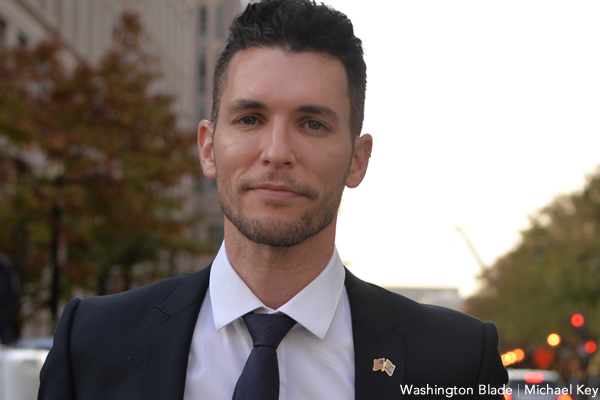
“I would never, ever, put myself in a position that I would be the face of ‘pinkwashing’ as part of my role because I’m confident that there’s no such thing in Israel,” Idan Roll told the Washington Blade on Wednesday during an interview at the Riggs Hotel in downtown D.C.
Roll, 37, spoke with the Blade at the end of a 4-day trip to D.C., which took place less than six months after eight political parties formed a coalition government that ousted long-time Prime Minister Benjamin Netanyahu.
The Knesset earlier this month passed Israel’s first national budget in three years. Roll, who is the youngest person in the Israeli government, noted to the Blade it earmarks $30 million (NIS 90 million) to LGBTQ organizations across the country.
Health Minister Nitzan Horowitz in August announced Israel had lifted restrictions on blood donations from men who have sex with men. The Israeli Supreme Court in July ruled same-sex couples and single men must be allowed to have a child via surrogate.
A group of teenagers on Nov. 12 attacked a group of LGBTQ young people near Jerusalem’s main bus station as they were traveling to a transgender rights conference in Tel Aviv. Neil Patrick Harris is among the actors who expressed their support for the Tel Aviv International LGBT Film Festival amid calls from BDS (boycott, economic divestment and sanctions) Movement supporters to boycott it over Israel’s policies towards the Palestinians.
Roll acknowledged Israel does not extend civil marriage to same-sex couples, but he also pointed out to the Blade the country does not “have civil marriage for straight people either” because marriage in the Jewish state is a religious institution. Roll noted he is among the openly LGBTQ people in the Israeli government and they “live a full, fulfilling life.”
“Are we perfect?” he asked rhetorically. “No. Are we one of the best places for gay people to live in the world? Definitely so, and I feel safe. And I feel welcomed. And I feel empowered and I feel like the best of it is ahead.”
Roll told the Blade the idea of “pinkwashing” comes from the fact “that not everyone is as informed as others about life in Israel.”
“That’s something that’s a task this new government and our ministry has, to better convey the Israeli story, and it’s a wonderful and complex and diverse story,” he said.
Roll also stressed he “would love for people to stop pinning one thing against the other.”
“Us doing tremendous work for LGBTQ equality does not get eliminated or erased or cancelled just because we have to also manage a very intricate conflict, which is the Israeli-Palestinian conflict,” he said. “Promoting progressive values is still something that is worth mentioning, and we are working towards bettering the lives of the Palestinians on a humanitarian and economic level. Things are not as black and white as they are portrayed.”
The separation barrier between Israel and the West Bank as seen from a gas station in Bethlehem, West Bank, on Nov. 12, 2016. (Washington Blade photo by Michael K. Lavers)
Roll lives in Tel Aviv with his husband, Harel Skaat, an Israeli pop star who he married in Utah in March, and their two children who they had via surrogates in the U.S.
The lawyer and former model who is a member of the centrist Yesh Atid party founded Pride Front, a group that encourages LGBTQ Israelis to become involved with the country’s political process. Roll told the Blade he decided to run for office after he and his husband started their family.
“It was quite a struggle,” he said, noting their second child was born via surrogate in Oklahoma. “And then it struck me that I have to practice what I preach. I have to not only just encourage others to take political action and move forward, but also I had to take the lead.”
Roll in 2019 won a seat in the Israeli Knesset. Lapid appointed Roll as deputy foreign minister after the new government took office.
“I’m a very young member of this government … and I am an openly gay member of this government,” said Roll. “I am very grateful of the life that I have been able to create for myself in Israel.”
“That’s a story that I feel like I can portray very authentically and I think that’s a story that needs to be told outside of Israel,” he added. “I’m also very proud to be part of the new face of a new government that is doing things differently and in a way I think now allows people of all different ethnicities and colors and agendas to find someone they can relate to in this government.”
Israeli Deputy Foreign Minister Idan Roll (Washington Blade photo by Michael K. Lavers)
U.S. Sens. Tammy Baldwin (D-Wis.), Jon Ossoff (D-Ga.), Chris Van Hollen (D-Md.), Bill Hagerty (R-Tenn.), U.S. Rep. Ritchie Torres (D-N.Y.) and other members of the Congressional LGBTQ+ Equality Caucus are among those who met with Roll when he was in D.C. Roll also sat down with Deputy National Security Advisor Jon Finer, Deputy Secretary of State Wendy Sherman, American Israel Public Affairs Committee members and Jewish students at George Washington University.
“We have a new government, and the new government is really different in many great ways,” Roll told the Blade. “It’s the most diverse government in our history and in a way it is the most diverse reflection of a very diverse society.”
He said one of the reasons he traveled to D.C. was “to reach out and to open a dialogue.” Roll also stressed Israel “has always been a bipartisan issue.
“It’s crucial to keep it that way and we intend to do that,” he said. “The U.S. is the most cherished and important ally we have and you need to cultivate relationships.”
Same-sex couples can wed in Switzerland from July 1 next year, the government said on Wednesday, enacting the results of a groundbreaking referendum on the issue in September.
Voters approved the “Marriage for All” initiative by a nearly two-thirds majority, making Switzerland one of the last countries in Western Europe to legalize gay marriage.
In a two-stage process, same-sex couples who have married abroad will have their status recognized from the start of January. Previously, the couples were seen as a registered partnership in Switzerland.
The new law will start six months later, which means couples will be allowed to marry or convert their registered partnership from July 1, 2022.
Preparations for the marriage can be submitted before this date, the government added. No more registered partnerships will be allowed after this date.
Advocates expect several hundred people to take advantage of the law change in the first year it comes into effect.
“We are really happy with the outcome of the vote, and that it is now being put into law,” Maria von Kaenel, co-president of the Marriage for All campaign, said on Wednesday.
“We have been fighting for marriage equality for 30 years and the referendum result was a historic moment.”
It is 18 years today since the controversial and homophobic legislation known as Section 28, introduced under Margaret Thatcher, was repealed in England and Wales.
The clause – an amendment to the Local Government Act 1988 – banned local authorities and schools from promoting homosexuality and was brought forward by Thatcher’s government.
The legislation has been labelled “toxic and regressive” by deputy leader of the Liberal Democrats Ed Davey, who introduced the clause that led to its repeal, and told PinkNews that Section 28 left young people feeling “alone and vulnerable”.
“I am proud to have moved the clause that abolished Section 28 once and for all. But we still have so far to go,” Davey said, in 2019.
“From trans rights, to tackling the persistent discrimination faced by the LGBT+ community: the fight is far from over.”
Section 28 was introduced by Margaret Thatcher amid renewed anti-gay sentiment
More than three decades have passed since Thatcher’s government introduced the anti-LGBT+ legislation, but its shadow still looms over schools and local authorities in the UK today.
The legislation meant that councils were prohibited from funding of books, plays, leaflets, films, or other materials showing same-sex relationships, while teachers weren’t allowed to teach about gay relationships in schools.
This clause was the Conservative government’s vitriolic and traditionalist response to calls for equality from lesbian and gay rights activists in the late 1980s.
The homophobic legislation Section 28 was introduced by Margaret Thatcher in 1988. (AFP via Getty/ GERRY PENNY)
Thatcher captured these venomous anti-gay views in her infamous speech at the 1987 Conservative Party conference, which was met with rapturous applause.
“Children who need to be taught to respect traditional moral values are being taught that they have an inalienable right to be gay,” she said. “All of those children are being cheated of a sound start in life. Yes, cheated.”
LGBT+ activists railed against the legislation – but the government didn’t listen
On the day the clause was passed in the House of Lords, a group of lesbians abseiled into the House of Lords in protest, making national news broadcasts.
The legislation – so loathed, so reviled by supporters of LGBT+ equality – caused 20,000 Mancunians to take to their city’s streets to march against it. It also prompted Sir Ian McKellen to come out publicly as gay.
Section 28 was introduced following a difficult period for the LGBT+ community in the UK. There had been some progress, but the outbreak of HIV/AIDS led to the widespread demonisation of gay and bisexual men in the 1980s.
The Conservative Party capitalised on this anti-gay sentiment. In the run-up to the 1987 general election, they issued posters claiming that the Labour Party wanted LGBT+ friendly books like Young, Gay and Proud and The Milkman’s on His Way to be read in schools.
Children who need to be taught to respect traditional moral values are being taught that they have an inalienable right to be gay. All of those children are being cheated of a sound start in life. Yes, cheated.
In 1987, a British Social Attitudes Survey found that three-quarters of the population thought homosexuality was “always or mostly wrong”. Just 11 per cent said it was “never wrong”.
Just before the general election of 1987, the Earl of Halsbury introduced theLocal Government Act 1986 (Amendment) Bill, also known as an act to refrain local authorities from promoting homosexuality.
Owen Franken/Corbis via Getty
This bill was successfully passed through the House of Lords, and even passed the first stage on the way to becoming law in the commons, but it went no further. Section 28 was not dissimilar to the legislation that the Earl of Halsbury tried to introduce.
The anti-LGBT+ legislation left teachers afraid to broach LGBT+ issues in schools.
Soon after the Tories were re-elected, Tory MP David Wilshire put forward an amendment to the new Local Government Bill – known first as Clause 27, and later as the notorious Clause 28 – based on the Earl of Halsbury’s Bill, which was subsequently passed through Parliament.
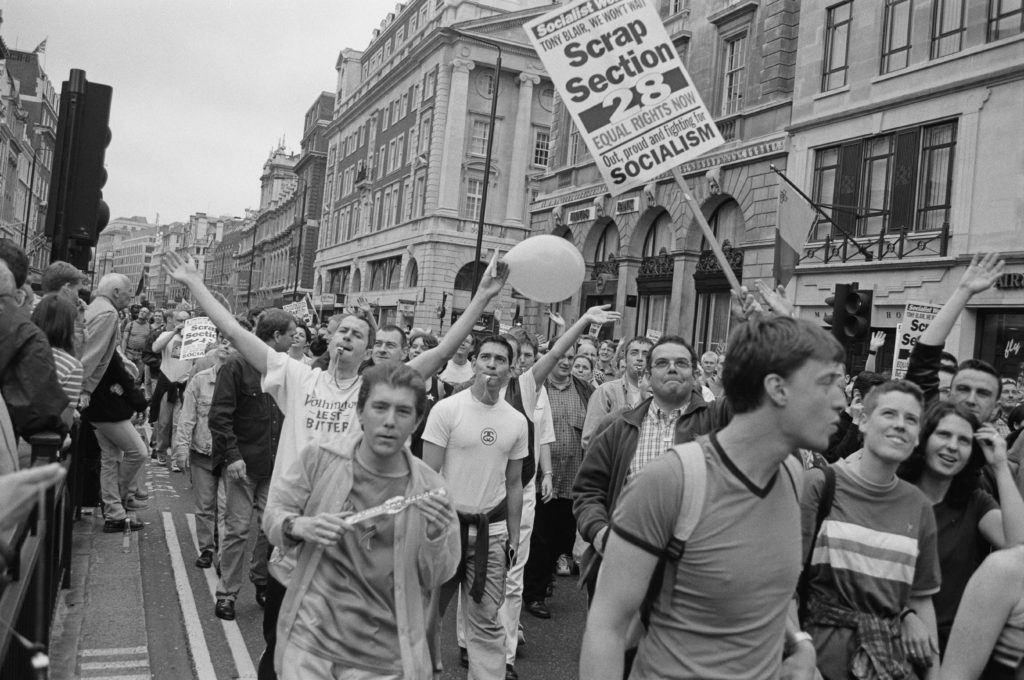
Marchers at the Lesbian, Gay, Bisexual, and Transgender Pride event, Piccadilly, London, 4th July 1998. One marcher is holding a Socialist Worker placard, calling for the scrapping of Section 28. (Steve Eason/Hulton Archive/Getty Images)
The night before Section 28 became law, a group of lesbians famously stormed the BBC’s Six O’Clock News in protest.
The effects of Section 28 soon became apparent, with some schools and councils shutting down LGBTQ+ youth support groups – and many teachers too afraid to teach about same-sex relationships.
The legislation was ultimately repealed in 2003, and David Cameron issued an apology for the harm it had done in 2009 – but despite this, its implications are still felt far and wide and teaching around LGBT+ issues still remains a taboo topic in many schools.
This year, Thatcher was portrayed by queer icon Gillian Anderson in the most recent series of The Crown. However, proving that Section 28’s horrific history can be all too easily forgotten, the show skipped over the issue entirely.
The Papua New Guinea government should seriously address the criticisms of its human rights record and scores of recommendations raised by United Nations member countries, Human Rights Watch said today. Papua New Guinea appeared before the UN Human Rights Council for its Universal Periodic Review (UPR) in Geneva on November 4, 2021.
“UN member countries rightly criticized Papua New Guinea’s record on gender-based violence, retention of the death penalty, and laws that criminalize same sex relations,” said Elaine Pearson, Australia director at Human Rights Watch. “The UN review made it clear that the Papua New Guinea government hasn’t followed through on some of its key past pledges to the UN Human Rights Council.”
The Universal Periodic Review, which began in 2006, is a comprehensive review of the human rights record of each UN member country every five years. The country under UN review, along with local and international organizations, has the opportunity to submit reports to the Council to inform the review process. Human Rights Watch submitted an assessment of Papua New Guinea’s record in March.
At the review, other countries praised Papua New Guinea for the establishment of a special parliamentary inquiry into gender-based violence and for the establishment of an anti-corruption commission since the last review in 2016.
The Papua New Guinea government reported that, of 161 recommendations made in 2016, it had accepted 108.
However, more than 15 nations questioned Papua New Guinea’s retention of the death penalty, from Finland to Spain, Iceland to Fiji. The Papua New Guinea government has increased the number of crimes punishable by death in recent years to include robbery and murder following accusations of sorcery and rape. To the extent that international law permits the death penalty it is only for the most serious crimes following full due process. Robbery is not one of the most serious crimes.
Even though Papua New Guinea’s last execution was in 1954, Papua New Guinea officials rejected the calls to end the death penalty. They said that it was an integral component of their justice system. The use of the death penalty has widespread international condemnation, and the UN General Assembly states that there is no evidence that it is an effective deterrent.
“It’s disappointing to see the Papua New Guinea government’s support for the death penalty, which is clearly out of step with the rest of the Pacific and certainly most of the world,” Pearson said.
Several countries raised Papua New Guinea’s failure to reduce incidents of gender-based violence, and the lack of female representation in politics. More than 1.5 million people experience gender-based violence in the country each year, and prosecutions and convictions remain low. Italy and Cyprus also pressed the government about sorcery-related violence and urged the government to take steps to prevent such attacks and to prosecute offenders. Between May and June, groups of men violently attacked at least five women they accused of “sorcery.” One of the women was killed.
Other concerns included inequality and discrimination experienced by lesbian, gay, bisexual, and transgender people in Papua New Guinea. Many countries, including New Zealand, Montenegro, France, and Argentina, said that the government should decriminalize same-sex relations.
Some countries urged Papua New Guinea to increase access to education for all children, including children with disabilities. International human rights law makes clear that all children have a right to free, compulsory primary education. The Papua New Guinea government admitted that it does not provide schools close to all rural communities, but said it now has a policy of free education, which was not in place earlier in the year.
India said that the government should improve access to health care for children in rural communities, and two countries urged the government to raise the age of criminal responsibility from the current age of 10.
The US and Zambia urged Papua New Guinea to investigate instances of police brutality.
“Women and girls continue to face enormous danger from the scourge of gender-based violence and sorcery accusations,” Pearson said. “The Papua New Guinea government should demonstrate that it is serious about tackling these issues by prosecuting offenders and holding abusers to account.”
August 26 should have been a day of celebration for Ezz Eldin, a 26-year-old transgender man, but it ended in tragedy. He bled to death after he was prematurely discharged following a gender-affirmation surgery in an underground clinic, transgender activists told Human Rights Watch.
Ezz Eldin, who also went by Ahmed Fares, need not have died, and what should have been a life-affirming surgery instead became a life-threatening procedure in an unauthorized clinic. A dysfunctional, discriminatory system left him with no surgical alternative. This is the situation for transgender people in Egypt who are denied access to appropriate health care under a government that discriminates against them and withholds legal gender recognition.
His desperate attempts to get the care he needed arose, in part, due to discord between religious and medical authorities. The impasse originated almost two decades ago and revolves around the extent at which religious authorities should have a say in medical matters. It is based on a fatwa, or religious edict, that permitted medical intervention only for intersex people, who are born with characteristics that vary from what is considered typical for female or male bodies.
Transgender individuals, whose gender differs from the sex they were assigned at birth, were disqualified. This confusing, contradictory, and discriminatory policy has left transgender people in Egypt with very few choices—if they want surgery, unregulated and often unsafe clinics are the only options.
In 2003, Egypt’s Health Ministry established a review committee within the Medical Syndicate for people wanting “sex reassignment surgery.” However, the volunteer committee met irregularly, had no legal authority, and was required to include a representative from Egypt’s Islamic oversight body, Dar Al Ifta.
This led to the anomalous situation of a religious authority participating in medical policy, based on their understanding of religion, not science. In accordance with the fatwa, Dar Al Ifta drew a distinction between “sex change,” referring to gender affirming surgery for transgender people, and “sex reassignment,” referring to surgery for people with intersex characteristics.
Medical authorities were reluctant to refer transgender patients to surgery, out of deference for their religious counterparts. In 2003, the Medical Syndicate amended the Medical Code of Ethics to ban doctors from performing surgery on transgender patients to further please the religious authorities, who believed that sex reassigment sugries should only be allowed for intersex indvidiuals.
Doctors who perform such surgery risk a professional liability, and legal repercussions under article 244 of Egypt’s Penal Code. In several documented cases, prosecutors and judges punished doctors who had performed these operations under the guise of causing a “permanent disability” to transgender patients. This caused a spike in the cost of gender-affirming care, as fewer doctors were willing to take this risk. According to several transgender people we talked to, gender-affirming surgeries could cost anywhere from 7,000 EGP (445 USD) to 25,000 EGP (1,560 USD).
Notwithstanding these barriers, the Medical Syndicate indicated in 2013 that it was willing to consider individual transgender applicants under certain onerous conditions, including two years of psychiatric observation. This was to demonstrate to the religious authorities that the applicant tried to resolve the issue through psychiatric treatment but to no effect. But even this narrow window was closed under pressure from Dar Al Ifta in 2014.
In 2017, religious and medical representatives appeared to have resolved their differences by agreeing that the religious authorities would have the final say. However, the committee remained so dysfunctional that it asked the government to dissolve it and transfer responsibility for handling cases to the Health Ministry or Justice Ministry.
In a landmark 2016 case, a transgender man requested legal gender recognition from the state, but an administrative court denied his request, based on the aforementioned fatwa, and after the Forensic Medical Authority said that “the plaintiff underwent a sex change operation and not a sex reassignment one.” Thus, the plaintiff violated the Shari’a principles, which only allows surgeries for intersex individuals.
The court added that parliament should “issue laws to regulate the matter and to clear the confusion about the process, on the condition that the new laws would be compatible with Islamic Shari’a.” and that “the medical syndicate is a body only responsible to look after the welfare of its members and is not in a position to review requests for sex reassignment surgeries.”
This ruling highlighted the negative impact of having religious authorities determine the health care needs of transgender people, a task for which they are wholly unqualified.
Ezz Eldin could have received the care he needed had the Egyptian authorities remedied this systemic failure and established an administrative procedure that facilitates transgender people’s access to gender affirming medical care.
Egypt’s legislative and executive branches should carry out urgent reforms to create a legal gender recognition system recognized by all government departments. The Medical Syndicate should rescind its ban on surgery for transgender people, and religious bodies, such as Dar Al-Ifta, should end their interference in medical matters. Medical school curricula should also be changed to include medical training for gender affirming procedures.
By reforming its own system, Egypt can influence positive changes in other countries in the region, due to its geopolitical and cultural importance. Egypt should lead the way and establish clear and accessible legal gender recognition mechanisms, as well as allow access to gender affirming healthcare for transgender people modeled on one’s right to self-identification.
Breaking with its usual practices on LGBTQ rights and issues, China launched its first medical clinic to treat transgender children and adolescents.
The Chinese state-backed media outlet The Global Times recently reported that the clinic opened at the Children’s Hospital of Fudan University in Shanghai, saying that it will “serve as a bridge between transgender children, parents, doctors and the various circles of society.”
The clinic’s opening and its celebratory coverage in Chinese state media comes as the country simultaneously works to limit LGBTQ activism and voices.
Homosexuality has not been illegal in China since 1997, but restrictions for LGBTQ people still remain.
Last week, a Chinese LGBTQ advocacy group that has led many of the country’s legal cases to expand LGBTQ rights announced that it would be halting its work “indefinitely.”
Chinese tech giant Tencent’s WeChat social media platform deleteddozens of LGBTQ accounts run by university students in July, saying that the accounts had broken Chinese internet rules. But critics argued that the wipeout of the accounts amounted to censoring LGBTQ activism.
And after 11 years in operation, Shanghai Pride canceled its annual LGBTQ celebration last year and said — without explanation — that it would no longer hold the event.
The Global Times reported that research by Chinese scholars linking transgender youths to higher rates of depression, anxiety and suicide attempts led doctors to believe that specialized care for trans minors was necessary.
In the United States, advocates and scholars have also been warning about the disproportionate rates of bullying, harassment and mental health issues plaguing trans youths.
A survey of over 35,000 LGBTQ youths and young adults this year by The Trevor Project, an LGBTQ youth suicide prevention and crisis intervention organization, found that more than half of transgender and nonbinary respondents seriously considered suicide.
It’s unclear how many children in China identify as transgender, as there is little research from the country on its trans community. However, a 2021 analysis by the Williams Institute at the UCLA School of Law found that 14 percent of over 1,000 Chinese respondents say that they have transgender acquaintances.
The Australian Human Rights Commission issued a report today analyzing the persistent practice of medically unnecessary non-consensual surgeries on children born with variations in their sex characteristics. The commission urged authorities to protect children’s rights to informed consent, and to legally regulate the operations.
Around the world since the 1950s, people born with variations in their sex characteristics, sometimes called “intersex,” have been subjected to harmful medically unnecessary “normalizing” surgeries. Surgeons popularized these cosmetic surgeries on infants to remove gonads, reduce the size of the clitoris, or increase the size of the vagina.
But these procedures are not designed to treat a medical problem, and there is no evidence they help children “fit in,” which some surgeons say is their aim. The operations carry high risks of scarring, loss of sexual sensation, incontinence, and psychological trauma. Some surgeries can sterilize the person, which an Australian Senate Committee condemned in 2013.
Its new report calls on the government to develop rights-based standards of care for children born with variation in their sex characteristics. It urges legislation to regulate the surgeries, limiting them only to when the patient has consented or where they are “required urgently to avoid serious harm” and “the risk of harm cannot be mitigated in another less intrusive way, and intervention cannot be further delayed.”
Momentum for change in Australia is afoot. Federal and local governments should urgently consider the commission’s recommendations and ensure that children born perfectly healthy – just a little different – are free to make decisions about their own bodies.