An amendment filed this past Friday to the legislation that would bar discussions and course materials in Florida’s public schools, colloquially referred to as the ‘Don’t Say Gay’ bill, (HB 1557), would also require school personnel to inform a parent of their child’s sexual orientation or gender identity.
The author of the amendment, Republican Rep. Joe Harding, (R-Williston), the author and chief sponsor of HB 1557 also wrote and introduced the amendment.
The Republican-controlled Florida House of Representatives is set to pass the controversial measure that has received the backing of Governor Ron DeSantis on Tuesday. Democrats and advocacy groups have launched a full-scale campaign to derail the bill’s passage.
n an email to the Blade, Nadine Smith, the Executive Director of Equality Florida said: “We wish every home was an accepting one and that every young person was affirmed and celebrated by their families. Unfortunately, that isn’t always the case for LGBTQ youth. They already make up 40% of the homeless youth population because they face higher rates of family rejection and abuse simply for being who they are. Knowingly subjecting children to abuse, abandonment, and neglect by forcing them to come out to their parents before they’re ready is cruel, dangerous, and underscores that this bill has no regard for the well-being of Florida’s youth”
Popular Information’s investigative reporter Judd Legum noted on Twitter that the bill’s sponsor, Harding, was retweeting a hardline national conservative group, ‘Mom’s For Liberty’ which is based in Florida, and has been actively campaigning in school systems across the U.S. to remove LGBTQ+ books and curriculum.
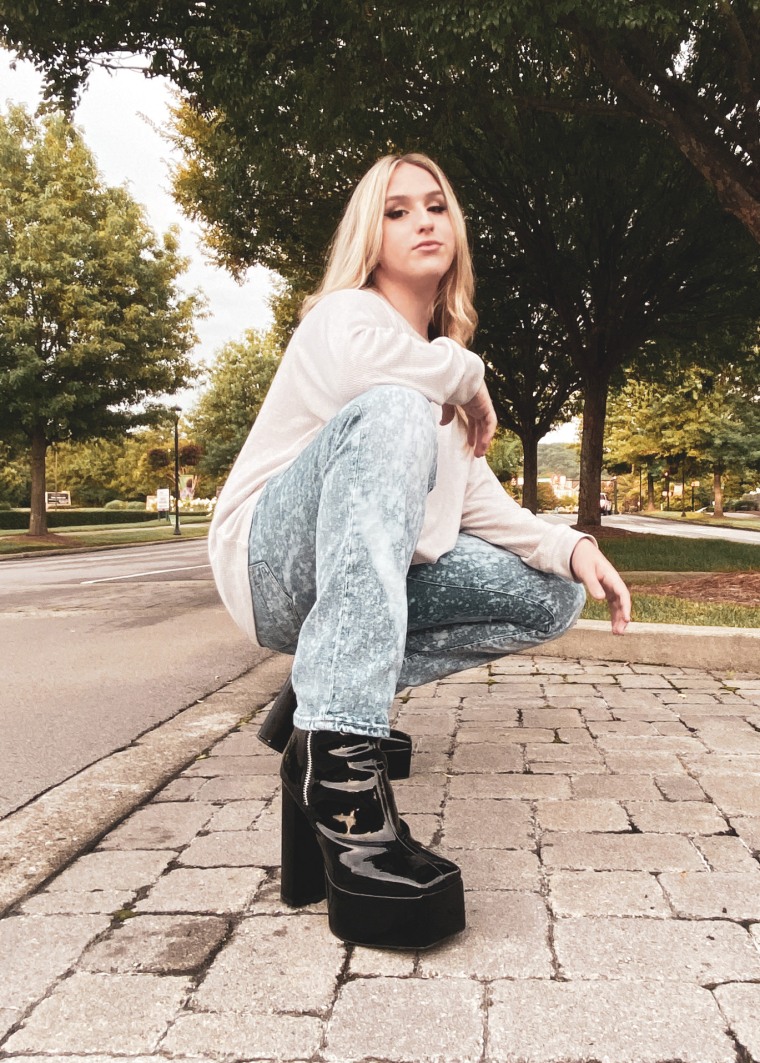
Students have repeatedly vandalized Pride posters at Spencer Lyst’s high school in Williamson County, Tennessee. Teachers have skipped over LGBTQ issues in class textbooks. Trans kids in his state have been legally barred from competing on school sports teams that align with their gender identity. Parents have called on school officials to remove books about sexual orientation and gender identity from the county’s elementary curriculum. And while leading hisschool’s Pride club at a September homecoming parade, Lyst and other LGBTQ students were booed by a group of parents.
“I’m so used to it, but it shouldn’t be something I have to think about,” Lyst, 16, said of the near-constant feeling of being attacked at school because of his identity.
He even said it’s “difficult” to walk into the school bathroom for fear of what or who “might be in there.”
“Like, can I go to the bathroom or am I going to get hate for just existing?” he said.
Lyst’s school experience is a far cry from an isolated case.
Spencer LystCourtesy Spencer Lyst
Since the start of the school year, school officials in states across the country have banned books about gay and trans experiences, removed LGBTQ-affirming posters and flags and disbanded gay-straight alliance clubs. In school districts throughout the nation, students have attacked their queer classmates, while state lawmakers have filed hundreds of anti-LGBTQ bills with many seeking to redefine lesbian, gay, bisexual, transgender and queer students’ places in U.S. schools.
“There is no separating any of these things,” Mary Emily O’Hara, the rapid response manager at LGBTQ advocacy group GLAAD, said at a media briefing on Monday. “What we’re seeing here is anti-LGBTQ groups, on a national level, making schools the new battleground across the board, across various kinds of school policies and various forms of legislation. Schools are the target right now for the anti-LGBTQ movement.”
In the majority of cases, conservative school officials, lawmakers and parents say LGBTQ issues do not belong in school because they are “political” and “not age-appropriate” for students. Conversely, queer youth and their families, along with LGBTQ and ally teachers, say they feel they are being “erased” from the U.S. education system.
‘I’m not going back in the closet’
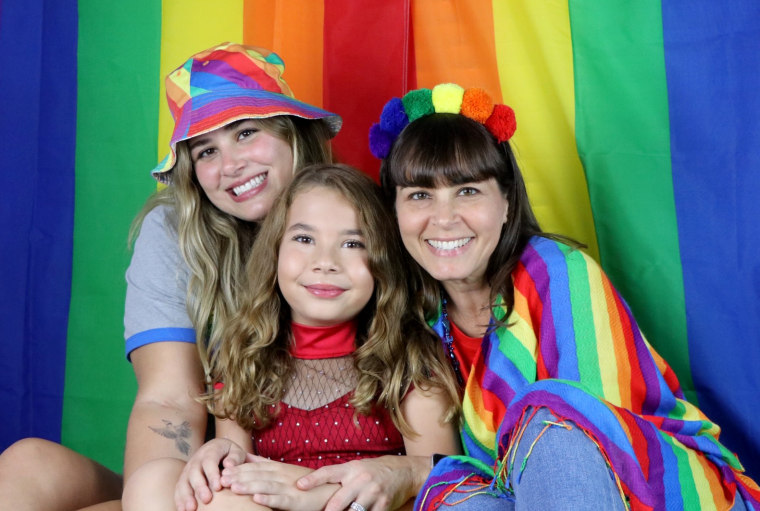
South Florida mom Jennifer Solomon, 50, has four children. Her eldest child, Nicolette, 28, is a lesbian who teaches fourth grade in Miami-Dade County. Her youngest, Cooper, 11, identifies as male, but Solomon said his “expression is female.” Cooper “never wanted to be a girl,” his mom explained, but he prefers to wear his school’s girls uniform and enjoys dressing up like a fairy-tale princess for fun.
“An easy way to describe it is that he’s the opposite of a tomboy,” she told NBC News.
Despite how hard she works to protect her children, Solomon — who leads her local chapter of PFLAG, an LGBTQ family advocacy group — said the slew of anti-LGBTQ school policies “keeps me up at night.”
Nicolette, Cooper and Jennifer Solomon.Courtesy Jennifer Solomon
On Monday, Solomon’s governor, Republican Ron DeSantis, signaledthat he would support a new piece of state legislation — titled the Parental Rights in Education bill, but dubbed the “Don’t Say Gay” bill — that would prohibit the discussion of sexuality and gender identity in schools.
Speaking at a news event in Miami, DeSantis said it is “entirely inappropriate” for teachers to be having conversations with students about gender identity, citing alleged instances of them telling children, “Don’t worry, don’t pick your gender yet,” and “hiding” classroom lessons from parents.
“Parental rights? Whose parental rights? Only parental rights if you’re raising a child according to DeSantis?” Solomon, who is a nurse manager at a health care company, said of DeSantis’ concerns. “DeSantis tries to paint this picture that every family is this 1950s mom and dad with two kids and a cat and dog. That is not what Florida looks like; that is not what the country looks like.”
“DeSantis has found a weak spot, and that weak spot is children,” she added, suggesting that DeSantis is supporting the measure for political gain.
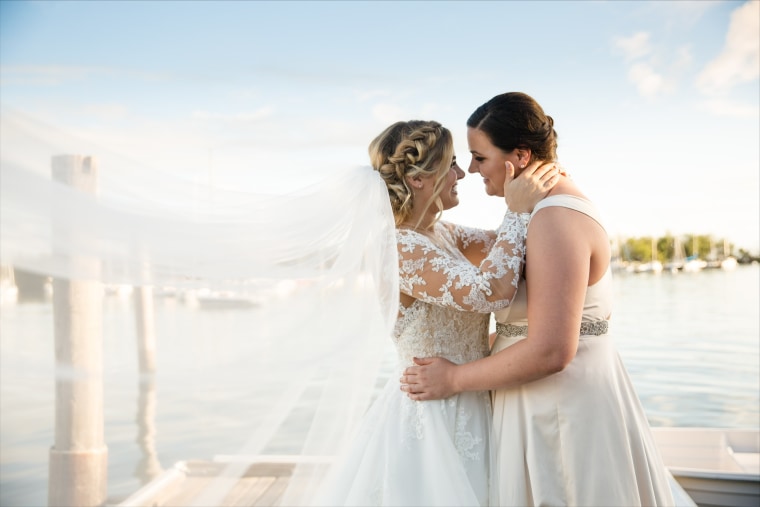
Nicolette Solomon said she is already hesitant to mention her wife — and by default her sexuality — at school, but she said passage of the “Don’t Say Gay” bill would be “the straw that breaks the camel’s back” and vowed to quit if it becomes law.
Nicolette Solomon and her wifeCourtesy Nicolette Solomon
“If I can’t be myself, seven hours a day, five days a week, then I’m going back in the closet, and I can’t do that. It’s not good for my own mental health,” she said. “And I don’t think I can bear to see the students struggle and want to ask me about these things and then have to deny them that knowledge. That’s not who I am as a teacher.”
In less than two months since the start of the year, conservative state lawmakers have filed more than 170 anti-LGBTQ bills — already surpassing last year’s 139 total — with at least 69 of them centered on school policies, according to Freedom for All Americans. The nonprofit group, which advocates for LGBTQ nondiscrimination protections nationwide, said in an email that it didn’t track LGBTQ school policy bills last year, as it was not as much of a “sweeping trend” as it is now.
Three states — including Lyst’s home state of Tennessee — passed bills last year that allow parents to opt students out of any lessons or coursework that mention sexual orientation or gender identity, according to GLSEN, an advocacy group that aims to end LGBTQ discrimination in education. In addition to the “Don’t Say Gay” bill advancing in Florida, there are 15 bills under consideration in eight states that would silence speech about LGBTQ identities in classrooms, according to free speech nonprofit organization PEN America.
But perhaps the biggest trend in state bills targeting LGBTQ youths are those focused on transgender students.
Last year, legislators in at least 30 states weighed legislation that would bar trans students from competing on school sports teams that align with their gender identity, according to LGBTQ advocacy group Human Rights Campaign. Nine of those states enacted the bills into law. So far this year, 27 states have proposed similar bills, with South Dakota enacting its version of the legislation into law this month.
While not school related, there has also been a slew of bills that seek to prevent transgender youths from accessing gender-affirming health care. At least 20 states have proposed such measures since early 2021, with two states — Arkansas and Tennessee — enacting these bills into law. However, a federal judge temporarily blocked the Arkansas law in July after the American Civil Liberties Union challenged it in court on behalf of trans youths and their families.
Cooper Solomon said he thinks lawmakers are pushing anti-LGBTQ legislation “because they were born in another time.”
“I guess back then, a long time ago, they didn’t accept this, and they thought it was really bad,” the fifth grader said. “I would just like them to know that it’s OK to be like this, and it’s not going to hurt anyone.”
Legislation aside, the last straw for Jack Petocz, 17, was when his high school in Flagler County, Florida, removed a young adult memoir detailing the trials of being a Black queer boy: George M. Johnson’s “All Boys Aren’t Blue.”
In November, a school board member filed a criminal complaint against school officials for allowing copies of the book— which has been challenged in at least 19 states —to remain in two of the county’s high schools. The complaint was dismissed, but the superintendent decided to keep the book off of shelves until new policies are drafted to give parents more control over the library’s collection.
“I felt that my community was under attack, that they were trying to silence LGBTQ+ experiences and voices within our community,” Petocz, who is gay and led a student protest in response to the book’s removal, said. “We’re already a minority. Why are you trying to suppress this critical information within our libraries, you know? These books are critical to providing a sense of identity.”
Books about race, sexual orientation and gender identity have historically been challenged in schools, but over the last several months, school libraries have seen a surge of opposition.
In the fall, as book bans started to take off in counties across the country, national groups — including No Left Turn in Education and Moms for Liberty — began circulating lists of school library books that they said were “indoctrinating kids to a dangerous ideology” to rally support.
The bans then became a talking point in the contentious Virginia governor’s race, where the Republican candidate, former private equity executive and political newcomer Glenn Youngkin, made education a central issue of his campaign and swept to victory.
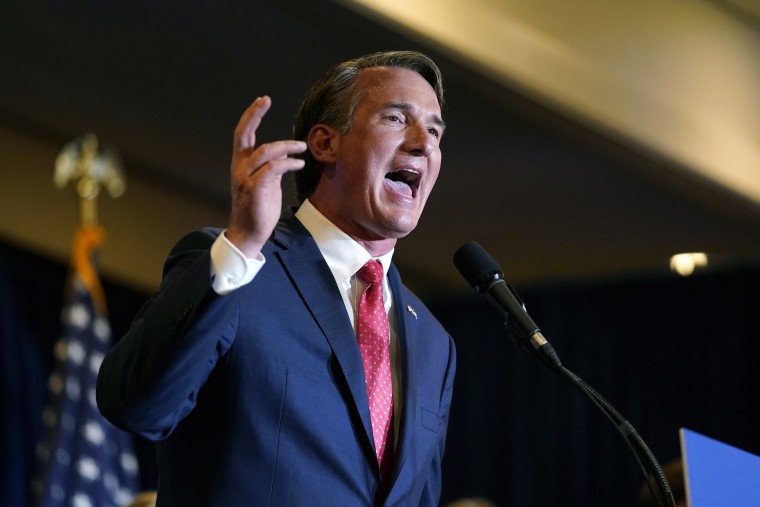
Virginia Gov.-elect Glenn Youngkin speaks at an election night party in Chantilly, Va., on Nov. 3, 2021.Andrew Harnik / AP file
Youngkin’s victory prompted other politicians to jump onto the issue, with the governors of Texas and South Carolina urging state school officials in November to ban several books, deriding them as “pornography” and “obscene” content.
School board members in Virginia’s Spotsylvania County made national headlines after calling for LGBTQ books with “sexually explicit” material to be incinerated.
Deborah Caldwell-Stone, director of the American Library Association Office for Intellectual Freedom, said in November that while challenges to books with LGBTQ- and race-related content have historically been “constant,” the association has recently seen a “chilling” uptick.
“I’ve worked at ALA for two decades now, and I’ve never seen this volume of challenges come in,” she said.“The impact will fall to those students who desperately want and need books that reflect their lives, that answer questions about their identity, about their experiences that they always desperately need and often feel that they can’t talk to adults about.”
To counter LGBTQ book bans — and school bans on race-related texts — a group of more than 600 writers, including bestselling children’s author Judy Blume; publishers; bookstore owners; and advocacy groups signed a joint statement in December condemning the trend, arguing it “threatens the education of America’s children.”
Setting a ‘different tone’
While state bills and book bans have garnered the most media attention, advocates say there are a host of other troubling trends adding to the distress that many queer students are feeling: removals of Pride flags and other LGBTQ-affirming symbols from classrooms, disbandments of gay-straight alliance clubs and resignations of teachers in protest of anti-LGBTQ policies.
In the fall, for example, rainbow stickers were ordered to be scraped off classroom doors at MacArthur High School near Dallas.
“While we appreciate the sentiment of reaching out to students who may not previously always had such support, we want to set a different tone this year,” an email from a school official addressed to school staff read. NBC News obtained the email from a MacArthur High School teacher.
The sticker removals prompted a protest from the student body, but the pushback did not successfully encourage school officials to change their stance on the policy.
School board members in Newberg, Oregon, made national headlines in the fall for taking similar actions. In September, the school board banned educators from displaying Pride and Black Lives Matter flags and other symbols it considered “political” in school.
“We don’t pay our teachers to push their political views on our students. That’s not their place,” the school board member who authored the policy, Brian Shannon, said at a recorded board meeting.
The policy prompted town protests that attracted some members of the Proud Boys, a far-right group that has endorsed violence, who counterprotested the efforts. An attempt to recall Shannon and another school board member over the flag removals failed last month.
Some teachers have resigned in school districts over similar measures, like a Missouri teacher who resigned in September after his district mandated that he take down his Pride flag and not discuss human sexuality or “sexual preference” at school. In December, parents accused teachers at a middle school in Tennessee of trying to “indoctrinate” kids into being gay after helping students start a gay-straight alliance club.
In addition to parents, school officials and lawmakers, classmates are among those targeting LGBTQ students, according to advocacy groups and local news reports.
A national survey of LGBTQ students published in 2020 by GLSEN found that 69 percent of respondents reported experiencing verbal harassment at school based on their sexual orientation, 57 percent based on their gender expression or outward appearance, and 54 percent based on their gender identity.
Last year, more than a dozen local news articles —from California to Florida — reported on trans students being harassed or attacked by other students, some of them in bathrooms. However, advocates say it is unclear whether the attacks have increased or whether local outlets are reporting them at greater rates.
Impact of affirmation
Advocates have long been warning educators about the mental health risks plaguing LGBTQ youths and how anti-LGBTQ policies can exacerbate them.
A survey last year by The Trevor Project, an LGBTQ youth suicide prevention and crisis intervention organization, found that 42 percent of the nearly 35,000 LGBTQ youths who were surveyed — and over half of trans and nonbinary youths — seriously considered suicide within the prior year. Separately, two-thirds of LGBTQ youths said debates about anti-trans legislation have impacted their mental health negatively, according to a small survey The Trevor Project conducted in the fall.
However, researchers at The Trevor Project have also found that LGBTQ youths who reported having at least one LGBTQ-affirming space — such as a school, home or workplace — were significantly less likely to attempt suicide.
With that in mind, Lizette Trujillo drives three hours a day back and forth to her 14-year-old transgender son’s school in Tucson, Arizona. From the time when he socially transitioned in 2015, Daniel’s school was open to the idea of letting him use the bathroom that corresponded with his gender identity — which Trujillo said was not a given in Arizona — and already had experience teaching trans youth.
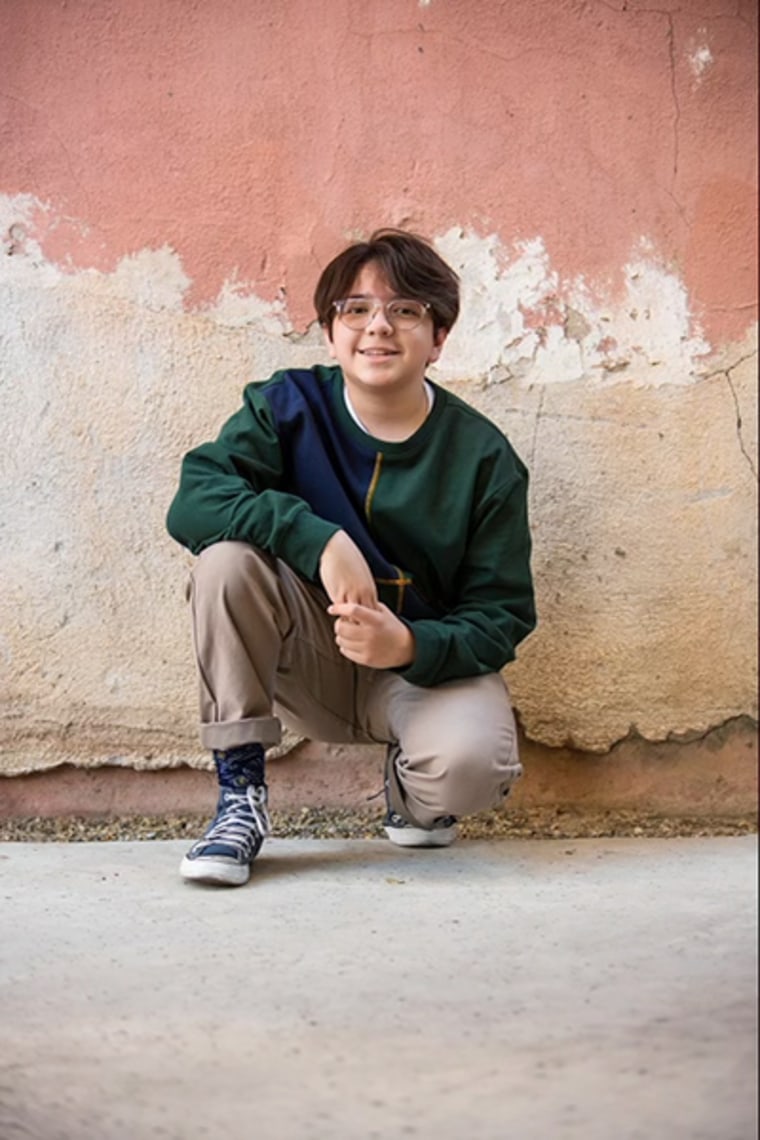
Daniel Trujillo.Courtesy Rachel Marie Photography
Trujillo said while the commute “is not without its challenges,” sending Daniel to a school where he is “not ‘othered’” has made him happier.
“The biggest difference at my school is that I’m supported by all my teachers and the principal and staff; I have access to sports and the bathrooms,” Daniel said. “It makes learning easier.”
It also freed up space for his mother to focus on securing her son gender-affirming health care, filing for new identification documents and working through emotional hardships.
“What people don’t realize is that you’re not just worried about school when your child socially transitions,” Trujillo said. “As you start this gender journey, you start to hit walls, and you’re like, ‘Oh, I didn’t realize I needed that,’ or, ‘I didn’t realize that was going to be a problem. I didn’t realize we were going to lose family.’”
In response to the slew of challenges plaguing LGBTQ students and teachers, President Joe Biden has vowed to lend his support. Earlier this month, the White House issued a rebuke of Florida’s “Don’t Say Gay” bill, while connecting the legislation to the disputes happening nationally.
“Make no mistake — this is not an isolated action. Across the country, we’re seeing Republican leaders take actions to regulate what students can or cannot read, what they can or cannot learn, and most troubling, who they can or cannot be,” a White House spokesperson said in a statement to NBC News. “This is politics at its worse, cynically using our students as pawns in political warfare.”
Students ‘fighting for their basic rights’
There are a number of examples across the U.S. of students getting proactive and successfully turning around anti-LGBTQ policies.
Aaryan Rawal, 17, was one of more than 400 students in Fairfax County, Virginia, who successfully urged their school officials to reinstate two LGBTQ books in November. Rawal, who is gay, said he was relieved when school board members heeded students’ demands, but he lamented that the organizing efforts forced him to miss class and lose sleep.
“No student in any county in this country wants to go to school fighting for their basic rights,” Rawal said. “Instead of doing statistics homework or hanging out with friends, we were expected to go to school board meetings and lobby school board members for stuff that really shouldn’t be up for debate.”
Last month, a group of students in Palm Beach, Florida, met with their newly hired superintendent to describe their experience being LGBTQ in their county’s schools. They went around, one by one, and relayed stories of harassment and assault from students and bullying from teachers, according to two students who attended the meeting.
“Students have just gotten a collective consciousness that, ‘School sucks and because I’m LGBT this is to be expected,’ and that’s not normal,” Marcel Whyne, a nonbinary high school student who attended the meeting, said. “That shouldn’t be the level of standard that we have for LGBT kids. You’re entitled to be treated like your peers and go to school and, you know, just be bored at school like a normal student, not terrified that you’re going to be harassed and have photos taken of you and be embarrassed and assaulted just because you’re trying to be who you are.”
As for Spencer Lyst, in Tennessee, he set out to start his high school’s Pride club, Indy Pride, last fall with the goal of spreading awareness about the school’s LGBTQ community and providing “a place for people who may feel like they don’t have one.” While being booed by adults at his school’s homecoming was a “difficult” experience, he said he remains undeterred.
“People should know that no matter what bill they try to pass or book they try to ban or thing they try to ban teachers or students from talking about in schools, it doesn’t change who people are, and it doesn’t change who we’re going to continue to be,” Lyst said. “So trying to take a legal route to ‘protect your kids’ doesn’t work. They are who they are, and if you can’t accept that, maybe it’s you who has some work to do.”
The percent of U.S. adults who identify as something other than heterosexual has doubled over the last 10 years, from 3.5 percent in 2012 to 7.1 percent, according to a Gallup poll released Thursday.
Gallup found that the increase is due to ”high LGBT self-identification, particularly as bisexual, among Generation Z adults,” who are 18 to 25.
It asked more than 12,000 U.S. adults how they identify during telephone interviews last year. It found that younger U.S. adults are much more likely to identify as LGBTQ than older generations.
More than 1 in 5, or 21 percent, of Generation Z adults identify as LGBTQ, Gallup found. That’s almost double the proportion of millennials, who are 26 to 41, at 10.5 percent, and nearly five times the proportion of Generation X, who are 42 to 57, at 4.2 percent. Less than 3 percent of baby boomers, who are 58 to 76, identify as LGBTQ, compared to just 0.8 percent of traditionalists, who are 77 or older.https://iframe.nbcnews.com/u5fH2si?_showcaption=true&app=1
As the youngest Americans slowly outnumber and replace the oldest, Gallup predicts the number of LGBTQ-identifying adults will only increase — and likely at a much faster rate than past generations.
The poll found that the percent of Generation X, baby boomers and traditionalists who identify as queer has remained relatively the same over the years. More millennials have increasingly identified as LGBTQ, but only slightly, at 5.8 percent in 2012, 7.8 percent in 2017 and 10.5 percent now.
But the poll noted that the percentage of Generation Z adults who are queer has almost doubled since 2017 — jumping from 10.5 percent in 2017 to 20.8 percent. The rise shows that younger Gen Zers, who have turned 18 since 2017, are more likely than older Gen Zers to identify as queer.
Gallup noted that the youngest Gen Zers — who are as young as 10 — still haven’t turned 18, and they are even more likely to identify as LGBTQ.
If the trend of millennials and Generation Z increasingly identifying as LGBTQ continues, “the proportion of LGBT Americans should exceed 10 percent in the near future,” Gallup found.
Bisexuals make up 4 percent of all U.S. adults
Bisexuality is the most common identifier used among LGBTQ Americans, which is in line with a Gallup report released last year. More than half of LGBTQ Americans, at 57 percent, are bisexual.
Over one-fifth of LGBTQ respondents, or 21 percent, are gay, 14 percent are lesbian, 10 percent are transgender and 4 percent identify as something e
Overall, 4 percent of U.S. adults identify as bisexual, compared to 1 percent who identify as lesbian, 1.5 percent as gay, 0.7 percent as transgender and 0.3 percent as other. Heterosexuals comprised 86.3 percent of total respondents, and 6.6 percent did not offer an opinion.
Generation Z adults are the most likely to identify as bisexual, at 15 percent overall, compared to 6 percent of millennials and less than 2 percent of Generation X, baby boomers and traditionalists.
Increasing acceptance — in certain areas
Gallup notes that the proportion of Gen Z Americans who identify as LGBTQ is increasing at a faster pace than previous generations, and that they are growing up at a time when 70 percent of Americanssupport same-sex marriage rights, and a majority also support nondiscrimination protections for LGBTQ people.
But that support varies when broken down further. For example, Gallup’s annual Values and Beliefs survey found last year that 66 percent of people favor allowing openly transgender people to serve in the military, that figure is down slightly from its previous measure in 2019, when 71 percent were in favor.
At the same time, 62 percent of Americans say trans athletes should only be allowed to play on sports teams that correspond with the sex they were assigned at birth, while 34 percent say they should be able to play on teams that match their gender identity, the survey found.
At the time, Mara Keisling, former executive director of the National Center for Transgender Equality, attributed that contrast at least in part to the wave of legislation in states seeking to bar trans students from competing on school sports teams that align with their gender identity.
But she also noted that — consistent with Gallup’s data — as more Americans know trans people and more young people identify as LGBTQ, acceptance will grow. As for those pushing anti-transgender legislation, she added, “Someday, they’ll be in the dustbin of history.”
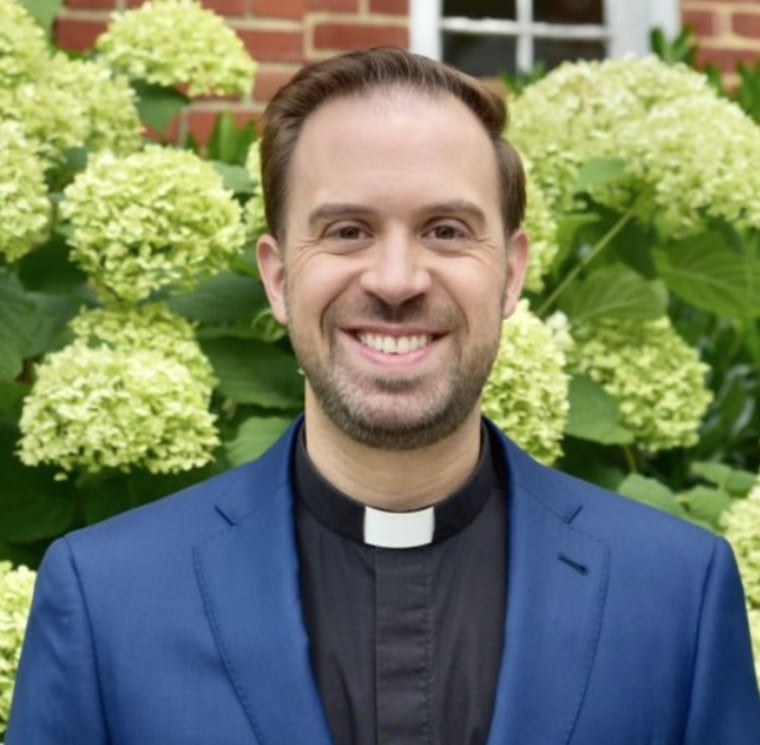
The Rev. Richard Weinberg, an Episcopalian rector in Washington, D.C., was surprised to find that his diocese didn’t have a policy for paid parental leave when he began preparing to adopt a child with his partner last year.
The church allowed three months of specifically paid maternal leave, four weeks more than D.C. law mandates. But unlike some of the district’s provisions, the church’s policy didn’t address people, including LGBTQ couples, who seek to have children through adoption, surrogacy or other means.
After he and another priest petitioned the diocese for a policy that included all methods of starting a family, the church agreed to give him 12 weeks of paid parental leave once his adoption is finalized. But it took numerous discussions with senior leadership and his congregation to figure out what would work for them, as well as for him.
“Without a policy in place or any law to fall back on, the burden was on me to fight for myself and what I thought was fair and appropriate,” Weinberg said.
The Rev. Richard Mosson Weinberg.St. Margaret’s Episcopal Church
Weinberg’s experience is common in the LGBTQ community, advocacy groups and think tanks studying the issue say. According to a 2020 study by the Census Bureau, same-sex couples are more than four times as likely as opposite-sex couples to adopt children — and more than twice as likely to foster children. But the policies vary by employer and are applied inconsistently, according to studies of the issue.
Advocates have called for more inclusive and widespread parental leave policies, and came close with a provision in President Joe Biden’s $1.7 trillion social safety net bill, which would have mandated all U.S. employers provide workers with four weeks of paid parental leave. But talks on the legislation collapsed after Sen. Joe Manchin, a moderate Democrat from West Virginia, announced in December that he wouldn’t vote for the billin part over funding for new programs,denying his Democratic colleagues the 50 votes they would need to pass the legislation under special budget rules.
LGBTQ advocates hope that polls showing broad support for paid parental leave will create momentum for legislative action. Eighty-four percent of voters — including majorities of Democrats, independents and Republicans — support a paid family leave policy, according to a 2018 study from the National Partnership for Women and Families, an advocacy group focused on the issue.
While 12 weeks of leave are available to many new parents under the Family and Medical Leave Act, that time off is unpaid under the law, making it financially unviable for lower-income people. Paid leave through employers or states is available to only about a quarter of Americans, according to Bureau of Labor Statistics data in 2021, and just a handful of states and Washington, D.C., have implemented policies themselves.
The programs that are available aren’t distributed equally, with 12 percent of private industry workers in the lowest income quartile receiving paid family leave and 37 percent of workers in the highest quartile having access, according to the Bureau of Labor Statistics.
Policies also don’t cover sexual orientations and gender identities equally. A 2018 survey by the Human Rights Campaign found fewer than half of LGBTQ respondents said their employers’ leave policies were LGBTQ-inclusive. Respondents also expressed concern about potentially outing themselves or encountering workplace discrimination when asking for leave, the survey found.
In addition, LGBTQ people face distinct financial considerations in starting families. The community is more likely to face economic hurdles like housing instability, unemployment and food insecurity, to begin with, indicating a greater need for social safety net programs, according to the progressive think tank the Center for American Progress. Then there are the additional expenses associated with various means of bringing children into the home.
“LGBTQ-plus parents often have additional needs for paid leave,” Julie Kruse, the director of federal policy at the advocacy group Family Equality, said. “Our families can be expensive to form — for people that require trans fertility services, for people using alternative reproductive technologies, even those going through the processes of fostering and adopting.”
A further issue is how paid leave policies affect employees’ perceived commitment to their job, said Richard Petts, a sociology professor at Ball State University. Taking leave can be stigmatized, causing employees to worry they’ll face a disadvantage at work if they take time off. When those policies are implemented inconsistently in the workplace, it only exacerbates the problem, he said.
Expanded access would help correct the issue and also be of special benefit to marginalized groups, Petts said.
“The U.S. actually has this really golden opportunity to take the lead in providing and showing what an equitable leave policy could look like,” Petts said. “Having a policy that says this is an individual entitlement really is equitable in the truest sense.”
The Covid pandemic, meanwhile, has only heightened financial concerns as it takes a toll on families across the country, Kruse said, adding that she hopes that could influence voters’ opinions and create momentum for a national policy.
“Knowing that we have paid time off without fear of losing our job is just a huge relief, and all families deserve to feel that, so I think there’s going to be a lot of pressure,” Kruse said. “There’s only so much more families can take.”
Support for legislation
For Rep. Angie Craig, D-Minn., the issue is personal. Craig, who co-chairs the Congressional LGBTQ+ Equality Caucus and is one of two LGBTQ parents in Congress, said the complexities that same-sex couples face in becoming parents have shown the importance of a uniform paid leave policy.
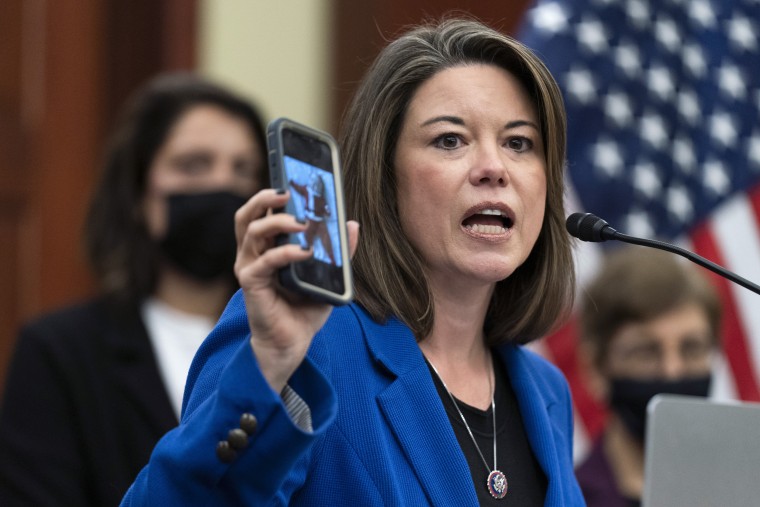
Rep. Angie Craig, D-Minn., shows a picture of her grandson Noah on her phone as she speaks at the Capitol about proposed investments in children to reduce economic disparity on Dec. 14, 2021.Manuel Balce Ceneta / AP
LGBTQ people face a wide range of barriers when starting families, Craig said. One such circumstance occurred when her wife adopted their first child — even though she was married to the primary adoptee, Craig had to file for second-parent adoption, a practice in place in many states.
Across the nation, nearly 20 states, primarily led by Republicans, have not passed protections against discrimination on the basis of gender or sexuality in adoption, according to the Movement Advancement Project, a think tank focused on promoting equal rights.
Craig said including four weeks of leave in the Build Back Better Act was a step in the right direction, although she and many other progressives had initially called for 12 weeks. She said she plans to continue to advocate for expansive paid leave legislation.
“Paid family leave makes sense for all families,” Craig said. “We shouldn’t be putting barriers in place for LGBTQ individuals who want to have families, and that’s what we’ve done in the history of the nation.”
Before negotiations on the bill stalled, Manchin opposed including 12 weeks of paid family leave, saying he preferred standalone legislation, rather than the sweeping bill, for such a significant policy change and expressing concerns about the funding of the broader package. He also expressed concern that Americans would abuse some benefits like paid leave and the child tax credit.
“I believe in family leave, I believe people should have that opportunity,” Manchin said on MSNBC in November. “Can’t we find a better position for this and do this in a bipartisan process that works?”
Progressive lawmakers view passage of such a provision as a necessary and historic opportunity amid favorable views on the subject, including among some businesses, after previous efforts have failed.
The U.S. Chamber of Commerce also supports paid family leave, although it opposed the social spending legislation, according to Marc Freedman, the chamber’s vice president of employment policy.
“The chamber continues to believe there is a fiscally responsible, bipartisan approach to providing a federal paid family leave benefit,” Freedman said in a statement to NBC News. “We believe that such a deal can be forged, but this partisan reconciliation bill is certainly not the vehicle to achieve a sensible solution to making sure paid family leave is available on a nationwide basis.”
Weinberg, the D.C. rector, said national legislation would prevent others from having to go through what he experienced in preparing to adopt a child.
While thankful for the changes his diocese made, he said he hopes to see a national standard. Having a child is a significant change for any family, and the opportunity to bond is essential, he said.
“To be able to continue to earn an income without having to put your life and your financial health on hold in order to have a family is just such a basic right,” Weinberg said. “So having legislation in place and employers who are seeking to happily compensate people when they’re starting their family would be a huge benefit to Americans.”
Now, Weinberg and his partner are navigating the application process for a 10-year-old boy from Colombia they hosted for five weeks last year. They hope to have the adoption finalized by summer.
The Rev. Richard Weinberg, an Episcopalian rector in Washington, D.C., was surprised to find that his diocese didn’t have a policy for paid parental leave when he began preparing to adopt a child with his partner last year.
The church allowed three months of specifically paid maternal leave, four weeks more than D.C. law mandates. But unlike some of the district’s provisions, the church’s policy didn’t address people, including LGBTQ couples, who seek to have children through adoption, surrogacy or other means.
After he and another priest petitioned the diocese for a policy that included all methods of starting a family, the church agreed to give him 12 weeks of paid parental leave once his adoption is finalized. But it took numerous discussions with senior leadership and his congregation to figure out what would work for them, as well as for him.
“Without a policy in place or any law to fall back on, the burden was on me to fight for myself and what I thought was fair and appropriate,” Weinberg said.
The Rev. Richard Mosson Weinberg.St. Margaret’s Episcopal Church
Weinberg’s experience is common in the LGBTQ community, advocacy groups and think tanks studying the issue say. According to a 2020 study by the Census Bureau, same-sex couples are more than four times as likely as opposite-sex couples to adopt children — and more than twice as likely to foster children. But the policies vary by employer and are applied inconsistently, according to studies of the issue.
Advocates have called for more inclusive and widespread parental leave policies, and came close with a provision in President Joe Biden’s $1.7 trillion social safety net bill, which would have mandated all U.S. employers provide workers with four weeks of paid parental leave. But talks on the legislation collapsed after Sen. Joe Manchin, a moderate Democrat from West Virginia, announced in December that he wouldn’t vote for the billin part over funding for new programs,denying his Democratic colleagues the 50 votes they would need to pass the legislation under special budget rules.
LGBTQ advocates hope that polls showing broad support for paid parental leave will create momentum for legislative action. Eighty-four percent of voters — including majorities of Democrats, independents and Republicans — support a paid family leave policy, according to a 2018 study from the National Partnership for Women and Families, an advocacy group focused on the issue.
While 12 weeks of leave are available to many new parents under the Family and Medical Leave Act, that time off is unpaid under the law, making it financially unviable for lower-income people. Paid leave through employers or states is available to only about a quarter of Americans, according to Bureau of Labor Statistics data in 2021, and just a handful of states and Washington, D.C., have implemented policies themselves.
The programs that are available aren’t distributed equally, with 12 percent of private industry workers in the lowest income quartile receiving paid family leave and 37 percent of workers in the highest quartile having access, according to the Bureau of Labor Statistics.
Policies also don’t cover sexual orientations and gender identities equally. A 2018 survey by the Human Rights Campaign found fewer than half of LGBTQ respondents said their employers’ leave policies were LGBTQ-inclusive. Respondents also expressed concern about potentially outing themselves or encountering workplace discrimination when asking for leave, the survey found.
In addition, LGBTQ people face distinct financial considerations in starting families. The community is more likely to face economic hurdles like housing instability, unemployment and food insecurity, to begin with, indicating a greater need for social safety net programs, according to the progressive think tank the Center for American Progress. Then there are the additional expenses associated with various means of bringing children into the home.
“LGBTQ-plus parents often have additional needs for paid leave,” Julie Kruse, the director of federal policy at the advocacy group Family Equality, said. “Our families can be expensive to form — for people that require trans fertility services, for people using alternative reproductive technologies, even those going through the processes of fostering and adopting.”
A further issue is how paid leave policies affect employees’ perceived commitment to their job, said Richard Petts, a sociology professor at Ball State University. Taking leave can be stigmatized, causing employees to worry they’ll face a disadvantage at work if they take time off. When those policies are implemented inconsistently in the workplace, it only exacerbates the problem, he said.
Expanded access would help correct the issue and also be of special benefit to marginalized groups, Petts said.
“The U.S. actually has this really golden opportunity to take the lead in providing and showing what an equitable leave policy could look like,” Petts said. “Having a policy that says this is an individual entitlement really is equitable in the truest sense.”
The Covid pandemic, meanwhile, has only heightened financial concerns as it takes a toll on families across the country, Kruse said, adding that she hopes that could influence voters’ opinions and create momentum for a national policy.
“Knowing that we have paid time off without fear of losing our job is just a huge relief, and all families deserve to feel that, so I think there’s going to be a lot of pressure,” Kruse said. “There’s only so much more families can take.”
Support for legislation
For Rep. Angie Craig, D-Minn., the issue is personal. Craig, who co-chairs the Congressional LGBTQ+ Equality Caucus and is one of two LGBTQ parents in Congress, said the complexities that same-sex couples face in becoming parents have shown the importance of a uniform paid leave policy.
Rep. Angie Craig, D-Minn., shows a picture of her grandson Noah on her phone as she speaks at the Capitol about proposed investments in children to reduce economic disparity on Dec. 14, 2021.Manuel Balce Ceneta / AP
LGBTQ people face a wide range of barriers when starting families, Craig said. One such circumstance occurred when her wife adopted their first child — even though she was married to the primary adoptee, Craig had to file for second-parent adoption, a practice in place in many states.
Across the nation, nearly 20 states, primarily led by Republicans, have not passed protections against discrimination on the basis of gender or sexuality in adoption, according to the Movement Advancement Project, a think tank focused on promoting equal rights.
Craig said including four weeks of leave in the Build Back Better Act was a step in the right direction, although she and many other progressives had initially called for 12 weeks. She said she plans to continue to advocate for expansive paid leave legislation.
“Paid family leave makes sense for all families,” Craig said. “We shouldn’t be putting barriers in place for LGBTQ individuals who want to have families, and that’s what we’ve done in the history of the nation.”
Before negotiations on the bill stalled, Manchin opposed including 12 weeks of paid family leave, saying he preferred standalone legislation, rather than the sweeping bill, for such a significant policy change and expressing concerns about the funding of the broader package. He also expressed concern that Americans would abuse some benefits like paid leave and the child tax credit.
“I believe in family leave, I believe people should have that opportunity,” Manchin said on MSNBC in November. “Can’t we find a better position for this and do this in a bipartisan process that works?”
Progressive lawmakers view passage of such a provision as a necessary and historic opportunity amid favorable views on the subject, including among some businesses, after previous efforts have failed.
The U.S. Chamber of Commerce also supports paid family leave, although it opposed the social spending legislation, according to Marc Freedman, the chamber’s vice president of employment policy.
“The chamber continues to believe there is a fiscally responsible, bipartisan approach to providing a federal paid family leave benefit,” Freedman said in a statement to NBC News. “We believe that such a deal can be forged, but this partisan reconciliation bill is certainly not the vehicle to achieve a sensible solution to making sure paid family leave is available on a nationwide basis.”
Weinberg, the D.C. rector, said national legislation would prevent others from having to go through what he experienced in preparing to adopt a child.
While thankful for the changes his diocese made, he said he hopes to see a national standard. Having a child is a significant change for any family, and the opportunity to bond is essential, he said.
“To be able to continue to earn an income without having to put your life and your financial health on hold in order to have a family is just such a basic right,” Weinberg said. “So having legislation in place and employers who are seeking to happily compensate people when they’re starting their family would be a huge benefit to Americans.”
Now, Weinberg and his partner are navigating the application process for a 10-year-old boy from Colombia they hosted for five weeks last year. They hope to have the adoption finalized by summer.
Two local organizations are partnering to distribute free copies of controversial books in response to the recent increase in attempts to remove titles from school libraries.
In Purpose Educational Services and the St. Louis bookstore EyeSeeMe will deliver free copies of “The Bluest Eye” by Toni Morisson to Missourians who request it.
The organizations raised more than $3,000 in the first few hours after launching the book program, said Heather Fleming, founder of In Purpose Educational Services.
“If you look at most of the books that they are trying to ban, they are the stories of people from historically marginalized groups,” said Fleming. “We have to grapple with some of the things that have happened in our society. Number one, to make sure that they don’t happen again. But then number two, because we need to learn how to live with one another.”
Toni Morrison’s “The Bluest Eye” is photographed in this photo illustration last November at Left Bank Books in St. Louis’ Central West End neighborhood.
A St. Louis Public Radio analysis of the books being challenged in the area in November found two-thirds were written by authors of color or authors who identify as LGBTQ. “The Bluest Eye,” was the book with the most official requests for removal from libraries. It was the first book by Toni Morrison, who would go on to win a Nobel Prize in Literature and a Pulitzer Prize.
The Wentzville School Board voted 4-3 at its Jan. 20 meeting to remove the book from school libraries. That’s after a committee voted to recommend keeping the book, writing, “committee members believe that removing the work would infringe on the rights of parents and students to decide for themselves if they want to read this work of literature.”
A committee in the Francis Howell School District voted to retain the book this month and a review of “The Bluest Eye” is still underway in the Lindbergh School District.
The organizations that are planning the “banned book program” have a form for people to fill out if they are interested in receiving free copies of the book. The books will be distributed to people in Missouri and the groups plan to pick a new book each month, Fleming said.
These conversations and these types of book bans, they’re placing our students at a disadvantage,” Fleming said. “Whether people want to admit it or not, we are becoming an increasingly diverse society … students who are not culturally competent are not going to meet with as much success.”
Parents in Georgia have reported that an elementary school administrator took down a young child’s Pride artwork and compared it to a Nazi flag.
The artwork featured a rainbow Pride flag, an umbrella, and the words “Gay is OK”, and was drawn by a student at Oglethorpe Avenue Elementary School, in Athens, Georgia, which teaches children aged five to 11.
The child’s teacher proudly displayed the drawing in their classroom, but according to local TV station WXIA-TV, was told to remove it by school administrators.
When the teacher questioned why they should take it down, an administrator reportedly compared the adorable Pride artwork to a Nazi flag.
Many parents were extremely upset about the incident, including Jemelleh Coes, who said that it was not isolated.
Coes, a professor at the University of Georgia, said: “There are ongoing complaints about this current administration has been discriminatory against women, being discriminatory against LGBT+ people, being discriminatory against English language learners or emerging bilinguals, emerging multilingual and Spanish speakers.
“So we have seen a pattern of inequity at our school and we have been asking for support at this point for years.”
Gee Campbell, who is transmasculine non-binary and has two children at the school, added: “We’ve been part of this school community for four years.
“My experiences with the teachers in regards to my transitioning have always been positive and respectful. My daughter is in this classroom and my immediate thought was, ‘What message does this give my daughter about her family?’”
One anonymous teacher also released a statement: “On behalf of a majority of the staff at Oglethorpe Avenue Elementary School, we are disheartened that these words and actions have happened in our school building during this time.
“This does not represent why we chose this profession, and it does not represent the feelings, beliefs, values, and attributes our amazing school family has within these four walls.”
They called on the school district to take action, and added: “We will continue to seek resolution and promote a community of love, acceptance, and tolerance within our building and community.”
In response, the Clarke County School District said in a statement: “We have investigated the situation and are working to address the issues with all parties involved.
“To be clear, we condemn this comparison and discrimination in all its forms.
“The Clarke County School District embraces diversity and inclusion for all students and staff. We stand with our LGBTQIA+ community and are dedicated to proving our commitment to diversity and inclusion.
“To that end, we will continue having sensitive and appropriate conversations with our school communities.”
A trans woman has shared her heartbreaking experience of conversion therapy to warn how the barbaric practice can at first come across like “kindness”.
Warning: Discusses mental health, suicidal thoughts, sexual assault and conversion therapy.
While there, she claimed, she underwent horrific conversion therapy.
Megan said that she knew that she was a girl from the age of four.
“When I first learned about trans people I asked a parent about them,” she wrote.
“They told me, ‘Transsexuals are deeply unhappy people who become prostitutes, get AIDS, and die homeless.’ Those words became the root of my closet.”
Negative depictions of trans people in the media forced Meghan even further into the closet, which severely affected her mental health, and saw her try to take her own life at the ages of eight and 15.
She “fell into Evangelical purity culture”, which she was attracted to because of “the constant references to healing, regeneration, renewal, and rebirth”.
“In short, I knew that I wanted to be a woman, society told me that was a bad thing, so I wanted a way out of wanting to be a woman,” Meghan said. “Evangelical purity culture promised me a way out, and I grasped onto it.”
While she prayed “fervently”, she still struggled with dysphoria, and entries from her prayer journals at the time show that she had become desperate for God to “heal” her.
In one entry, Meghan wrote: “I don’t even want to be happy anymore. I’ll make [do] with content. You want to work a work in me? Do it. Do it and get it over with.
“I can’t wait anymore. I hate this. I hate existing.”
In another, she wrote: “I just want to give up. I’ve been praying for a decade. For a decade you haven’t healed me. Maybe tomorrow I’ll finally have the courage and walk out the window.”
Enrolling at Moody Bible Institute, a private Evangelical Christian Bible college founded in Chicago, Illinois, became the next step in her “plan to be healed of [her] gender issues”.
According to the college’s doctrinal statement: “Non-marital sex, homosexual sex, same-sex romantic relationships, and gender identification incongruent with one’s birth-sex all violate God’s generous intention for human relationships.
“Such practices misrepresent the nature of God Himself, and therefore are sinful under any circumstance.”
Meghan claims she was threatened with academic probation if she refused to attend what would soon become conversion therapy
Meghan’s mental health continued to suffer, and while a student at Moody Bible Institute, she suffered a “nervous breakdown” following a bad bout of insomnia.
“I was referred to resident life supervisors who required me to attend therapy with a Moody therapist or else face probation,” she said.
“I want to add that what I now recognise as a threat wasn’t presented as a threat, it was presented in the nicest, most sincere way possible.
“They were incredibly gentle with me at this stage, even though they were holding real academic consequences over my head.”
The therapist Meghan saw practiced nouthetic counseling, “an Evangelical model of therapy that rejects psychiatry and psychology, relying on Biblical principles in order to help their clients”.
In an effort to figure out which “unconfessed sin” had “caused” her mental health problems, Meghan finally admitted that she “hated being a man”.
Her therapist was “extremely kind”, and Meghan was “convinced through his words and deeds that he had my best interests at heart”.
He told her: “Many men struggle with feeling like they should have been women, and we have a way to treat this problem.”
“I was ECSTATIC,” recalled Meghan.
“I left that session thinking that I wished I had confessed those feelings decades ago. He promised me the healing I had been praying for for years. I began to think that this was God’s providence, the fulfillment of my purpose at Moody.”
The trauma of being sexually assaulted as a child became an integral part of Meghan’s ‘therapy’
Meghan said her therapist told her that “abuse, either physical, emotional, or sexual, was the primary cause” of people being transgender.
She disclosed that she “had been sexually assaulted while in the hospital after one of [her] suicide attempts, and that it was extremely difficult to talk about”.
But her therapist, she wrote, told her that the experience had caused “gender identity disorder”.
“Both of us conveniently ignored that the assault occurred over a decade after my first reported experience of gender incongruence,” she wrote.
He reportedly instructed that whenever she felt gender dysphoria she should try to relive the assault under she was hyperventilating and in tears, as “cognitive aversion therapy”.
She said that she continued this “therapy” for a year, while having weekly meetings with “Christopher Yuan, an adjunct faculty member at Moody who was a prominent member of the ex-gay community“.
In an article, still live on the Moody Bible Institute blog, the college describes Yuan’s “ex-gay” journey, stating: “While studying the Bible, Christopher slowly realised he had put his identity in the wrong thing, his sexuality.
“But, God called him to put his main identity in Jesus Christ alone. This new identity in Christ compelled him to live in obedience to God whether regardless of what his sexual desires were. This obedience led to a radically changed life.”
Meghan wrote that her therapist told her “marriage signalled the final end of feelings of ‘same-sex attraction’ and gender identity disorder”, and so she “courted a woman and got married”.
While she told her wife about her experiences, she insisted she was “healed”, until she began to experience a faith crisis “precipitated largely by the rise of racism, xenophobia, and the increasing post-truth culture of the Evangelical Church”.
She said: “It took years for me to finally come out to my ex-wife. I held on for so long because I thought I could just tough it out for the last fifty years of my life.
“But there came a point where, I knew that doing so would kill me in the end.”
Now, Meghan is working “with a therapist to undo the damage done”, but explained that she was telling her story to warn others that conversion therapy can often seem harmless at first.
She wrote: “I suppose the thing I want people to learn from my experience is how NICE and KIND and WELL-INTENTIONED the people involved in my therapy were.
“That kindness reads insidious to me now, like a smile on the face of an abuser.”
Her Twitter thread soon went viral, and has to date been liked almost 8,000 times.
PinkNews has approached Moody Bible Institute for comment.
Readers who are affected by the issues raised in this story are encouraged to contact Samaritans on 116 123 (www.samaritans.org), or Mind on 0300 123 3393 (www.mind.org.uk).
Readers in the US are encouraged to contact the National Suicide Prevention Line on 1-800-273-8255, or The Trevor Project which provides 24/7 crisis support, 365 days a year. Text START to 678-678, or call: (866) 488-7386.
From a secluded spot in her high school library, a 17-year-old girl spoke softly into her cellphone, worried that someone might overhear her say the things she’d hidden from her parents for years. They don’t know she’s queer, the student told a reporter, and given their past comments about homosexuality’s being a sin, she’s long feared they would learn her secret if they saw what she reads in the library.
That space, with its endless rows of books about characters from all sorts of backgrounds, has been her “safe haven,” she said — one of the few places where she feels completely free to be herself.
But books, including one of her recent favorites, have been vanishing from the shelves of Katy Independent School District libraries the past few months.
For more on this story, watch NBC’s “Nightly News with Lester Holt” tonight at 6:30 p.m. ET/5:30 p.m. CT.
Gone: “Jack of Hearts (and Other Parts),” a book she’d read last year about a gay teenager who isn’t shy about discussing his adventurous sex life. Also banished: “The Handsome Girl and Her Beautiful Boy,” “All Boys Aren’t Blue” and “Lawn Boy” — all coming-of-age stories that prominently feature LGBTQ characters and passages about sex. Some titles were removed after parents formally complained, but others were quietly banned by the district without official reviews.
“As I’ve struggled with my own identity as a queer person, it’s been really, really important to me that I have access to these books,” said the girl, whom NBC News is not naming to avoid revealing her sexuality. “And I’m sure it’s really important to other queer kids. You should be able to see yourself reflected on the page.”
Her safe haven is now a battleground in an unprecedented effort by parents and conservative politicians in Texas to ban books dealing with race, sexuality and gender from schools, an NBC News investigation has found. Hundreds of titles have been pulled from libraries across the state for review, sometimes over the objections of school librarians, several of whom told NBC News they face increasingly hostile work environments and mounting pressure to pre-emptively pull books that might draw complaints.
Records requests to nearly 100 school districts in the Houston, Dallas, San Antonio and Austin regions — a small sampling of the state’s 1,250 public school systems — revealed 75 formal requests by parents or community members to ban books from libraries during the first four months of this school year. In comparison, only one library book challenge was filed at those districts during the same time period a year earlier, records show. A handful of the districts reported more challenges this year than in the past two decades combined.
All but a few of the challenges this school year targeted books dealing with racism or sexuality, the majority of them featuring LGBTQ characters and explicit descriptions of sex. Many of the books under fire are newer titles, purchased by school librarians in recent years as part of a nationwide movement to diversify the content available to public school children.https://iframe.nbcnews.com/qT9NUOR?_showcaption=true&app=1
“Why are we sexualizing our precious children?” a Katy parent said at a November school board meeting after she suggested that books about LGBTQ relationships are causing children to improperly question their gender identities and sexual orientations. “Why are our libraries filled with pornography?”
Another parent in Katy, a Houston suburb, asked the district to remove a children’s biography of Michelle Obama, arguing that it promotes “reverse racism” against white people, according to the records obtained by NBC News. A parent in the Dallas suburb of Prosper wanted the school district to ban a children’s picture book about the life of Black Olympian Wilma Rudolph, because it mentions racism that Rudolph faced growing up in Tennessee in the 1940s. In the affluent Eanes Independent School District in Austin, a parent proposed replacing four books about racism, including “How to Be an Antiracist,” by Ibram X. Kendi, with copies of the Bible.
Similar debates are roiling communities across the country, fueled by parents, activists and Republican politicians who have mobilized against school programs and classroom lessons focused on LGBTQ issues and the legacy of racism in America. Last fall, some national groups involved in that effort — including No Left Turn in Education and Moms for Liberty — began circulating lists of school library books that they said were “indoctrinating kids to a dangerous ideology.”
And during his successful bid for governor in Virginia, Republican Glenn Youngkin made parents’ opposition to explicit books a central theme in the final stretch of his campaign, leading some GOP strategists to flag the issue as a winning strategy heading into the 2022 midterm elections.
The fight is particularly heated in Texas, where Republican state officials, including Gov. Greg Abbott, have gone as far as calling for criminal charges against any school staff member who provides children with access to young adult novels that some conservatives have labeled as “pornography.” Separately, state Rep. Matt Krause, a Republican, made a list of 850 titles dealing with racism or sexuality that might “make students feel discomfort” and demanded that Texas school districts investigate whether the books were in their libraries.
A group of Texas school librarians has launched a social media campaign to push back.
“There have always been efforts to censor books, but what we’re seeing right now is frankly unprecedented,” said Carolyn Foote, a retired school librarian in Austin who’s helping lead the #FReadom campaign. “A library is a place of voluntary inquiry. That means when a student walks in, they’re not forced to check out a book that they or their parents find objectionable. But they also don’t have authority to say what books should or shouldn’t be available to other students.”
Carolyn Foote, a retired school librarian, is spearheading a grassroots effort to fight back against book challenges in Texas.NBC News
Ten current or recently retired Texas school librarians who spoke to a reporter described growing fears that they could be attacked by parents on social media or threatened with criminal charges. Some said they’ve quietly removed LGBTQ-affirming books from shelves or declined to purchase new ones to avoid public criticism — raising fears about what free-speech advocates call a wave of “soft censorship” in Texas and across the country.
Five of the librarians said they were thinking about leaving the profession, and one already has. Sarah Chase, a longtime librarian at Carroll Senior High School in Southlake, a Fort Worth suburb, said the acrimony over books contributed to her decision to retire in December, months earlier than she’d planned.
“I’m no saint,” said Chase, 55. “I got out because I was afraid to stand up to the attacks. I didn’t want to get caught in somebody’s snare. Who wants to be called a pornographer? Who wants to be accused of being a pedophile or reported to the police for putting a book in a kid’s hand?”
In interviews and recorded comments at school board meetings, parents who’ve pushed for book removals described doing everything in their power to shield their children from sexually explicit content on the internet, only to discover it’s readily available in school libraries.
“It’s not censoring to guard minors from exposure to adult-themed books,” Kristen Mangus, a parent, said at a meeting in November of the Keller Independent School District Board of Trustees, a suburban district outside Fort Worth that’s fielded dozens of requests to ban books in recent months. “If they choose to check out from the public library with a parent, then so be it. But there is no reason whatsoever to have these books in our schools.”
Some protesting parents have insisted that their opposition is about sexually explicit books, regardless of the races or sexual orientations of the characters. They point out that some of the books being challenged feature heterosexual sex scenes. But in many instances, parents and GOP politicians have flagged books about racism and LGBTQ issues that don’t include explicit language, including some picture books about Black historical figures and transgender children.
Free speech advocates and authors deny that any of the books in question meet the legal definition of pornography. Although some include sexually explicit passages or drawings, those scenes are presented in the context of broader narratives and not for the explicit purpose of sexual stimulation, they said.
“Some parents want to pretend that books are the source of darkness in kids’ lives,” said Ashley Hope Pérez, author of the young adult novel “Out of Darkness,” which has been repeatedly targeted by Texas parents for its depiction of a rape scene and other mature content. “The reality for most kids is that difficulties, challenges, harm, oppression — those are present in their own lives, and books that reflect that reality can help to make them feel less alone.”
Several queer students, meanwhile, said the arguments by some parents, specifically the idea that it’s inappropriate for teenagers to read about LGBTQ sexual relationships, are making them feel unwelcome in their communities.
“Reading books or consuming any kind of media that has LGBTQ representation, it doesn’t turn people gay or make people turn out a certain way,” said Amber Kaul, a 17-year-old bisexual student in Katy. “I think reading those books helps kids realize that the feelings that they’ve already had are valid and OK, and I think that’s what a lot of these parents are opposed to.”
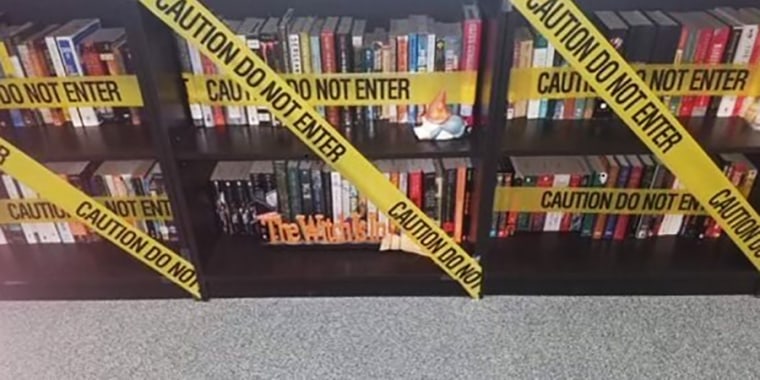
A teacher at the Carroll Independent School District in Southlake hung caution tape over bookshelves in October to protest efforts to remove “controversial” books.Obtained by NBC News
‘Short-circuiting’ the process
This fall wasn’t the first time Texas parents packed school board meeting rooms to complain about the corrupting influence of books.
Every year for nearly two decades beginning in the late 1990s, the Texas chapter of the American Civil Liberties Union surveyed every public and charter school in Texas to document attempts to ban library books. The annual reports paint a picture of past censorship movements, and make clear that the volume of challenges now hitting schools is unlike anything previously recorded in the state.
In the early 2000s, a conservative backlash to the Harry Potter book series, which some Christian leaders condemned as a satanic depiction of witchcraft, fueled a surge of book banning attempts in Texas, according to the ACLU data. But even at the peak of that wave, the Texas ACLU never documented more than 151 school library book challenges in one year. About half that many were documented in just the first four months of the 2021 school year at only a small sampling of Texas school districts, according to the records obtained by NBC News.
During the 2018-19 school year, the last time the ACLU conducted the censorship survey, Texas schools reported only 17 library book challenges statewide. Twice as many have been filed so far this school year at Keller ISD alone.
“I’ve been doing this work for 20 years, and I’ve never seen the volume of challenges that we’re seeing right now,” said Deborah Caldwell-Stone, director of the Office for Intellectual Freedom at the American Library Association, which tracks attempts to ban library books nationwide.
Caldwell-Stone said the number of Texas book challenges documented in the records obtained by NBC News likely represents a vast undercount, because it doesn’t account for books that are being removed from shelves based on verbal complaints at board meetings or parent emails, often in violation of school district policies.
In response to past censorship movements, the American Library Association developed guidelines for schools to prevent the sudden and arbitrary removal of books. Under the guidelines, which have been adopted by most large districts in Texas and nationally, parents are asked to fill out forms explaining why they believe a book should be banned. Then a committee of school employees and community volunteers reviews the book in its entirety and determines whether it meets district standards, keeping in mind that a parent’s ability to control what students can read “extends only to his or her own child,” according to language included in most district policies.
A challenged book is supposed to remain on shelves and available to students while the committee deliberates, and the final decision should be made public, Caldwell-Stone said.
“What we’re seeing these days is a short-circuiting of that process, despite the fact that school boards often do have these reconsideration policies on their own books,” she said. “They’re ignoring them to respond to the controversy and the moral panics that they’re getting targeted with at school board meetings, and books are being abruptly removed.”
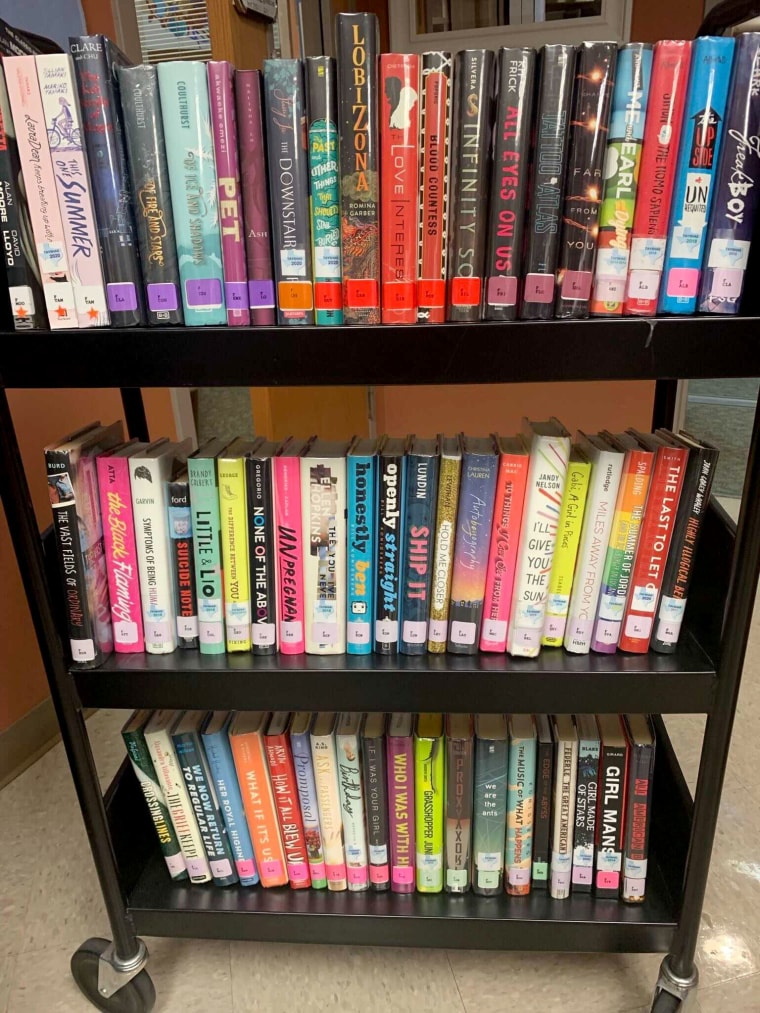
A photo taken by a teacher shows a cart full of books as they were being removed from a North East ISD library in December.Obtained by NBC News
That scenario has been repeated at several Texas school districts in recent months, NBC News found. In December, the Denton Independent School District near Dallas made headlineswhen administrators pulled down a copy of “All Boys Aren’t Blue,” a memoir by queer Black author George M. Johnson, after learning that parents in neighboring towns had concerns about it. A district spokesperson, Julie Zwahr, said school officials are now reviewing a total of 11 library books to determine whether they are “pervasively vulgar,” even though the district has received only one formal book challenge this school year. The North East Independent School District in San Antonio hadn’t received any library book challenges from parents as of December, according to records provided to NBC News. But that month, administrators directed librarians to box up more than 400 titlesdealing with race, sexuality and gender.
At a subsequent school board meeting, North East leaders said that they had pulled the books for review after Krause, the Republican lawmaker, distributed his list of 850 titles that he said violate new state laws governing how sex and race are addressed in Texas classrooms. North East spokesperson Aubrey Chancellor did not respond to a reporter’s request for comment, but told the Texas Tribune in December that the district asked staff to review books on Krause’s list “to ensure they did not have any obscene or vulgar material in them.”
A photo taken by a student in Granbury, Texas, shows men hauling away boxes of library books labeled “Krause’s List,” in reference to the 850 titles that state Rep. Matt Krause wants removed from schools.Obtained by NBC News
“For us, this is not about politics or censorship, but rather about ensuring that parents choose what is appropriate for their minor children,” she said then.
In another instance, the Carroll Independent School District in Southlake, responding to an NBC News public records request, reported that it had received zero library book challenges in 2021. But emails reviewed by a reporter show that a parent had complained informally in August to a Carroll administrator and two school board members about the book, “Beyond Magenta: Transgender Teens Speak Out,” by Susan Kuklin.
“There is extreme sexual content in that book that isn’t even appropriate for me to put in an email,” the parent wrote.https://iframe.nbcnews.com/bExjHrx?_showcaption=true
Rather than requiring the mom to fill out a form to initiate the district’s formal library review process, Chase, the recently retired Carroll librarian, said an administrator shared the email with her and another librarian, and in order to avoid conflict, they agreed to remove the book from high school shelves.
“I hate that we did this, because we didn’t go through the formal review ourselves,” Chase said. “I think a lot of librarians are making decisions out of fear, and that puts us in a position of self-censorship.”
Book fight spreads from Virginia to Texas
Mary Ellen Cuzela, a mother of three in Katy, a sprawling and booming suburb outside Houston, had never thought much about what library books her kids might have access to at school. But in September, she heard then-candidate Youngkin mention a Virginia school district’s fight over “sexually explicit material in the library” during his campaign for governor against Democrat Terry McAuliffe.
Curious, Cuzela searched the Katy Independent School District’s catalog and was surprised to find that one of the books at the center of the Virginia fight, “Lawn Boy,” by Jonathan Evison, was available at her children’s high school.
Cuzela picked up a copy from the public library and “was absolutely amazed” by what she read, she said. The book, which traces the story of a Mexican American character’s journey to understanding his own sexuality and ethnic identity, was “filled with vulgarity,” Cuzela said, including dozens of four-letter words, explicit sexual references and a description of oral sex between fourth-grade boys during a church youth group meeting.
“I don’t care whether you’re straight, gay, transgender, gender fluid, any race,” she said. “That book had it all and was degrading for all kinds of people.”
She soon discovered that several other young adult books that had been targeted in Virginia and other Texas districts were available at Katy ISD. Cuzela shared her findings with some “like-minded parents,” and together they set out to get administrators to do something.
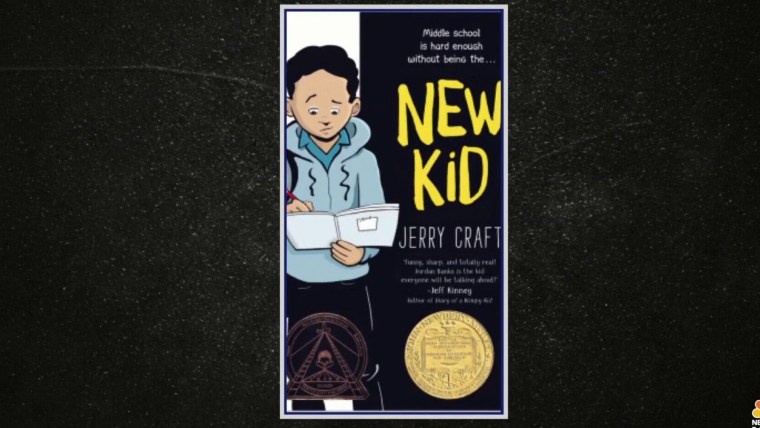
The school system, a diverse district of nearly 85,000 students, had already made national headlines that fall when administrators temporarily removed copies of “New Kid” and “Class Act” by Jerry Craft from school libraries after parents complained that the graphic novels, about Black seventh graders at a mostly white school, would indoctrinate students of color with a “victim mentality” and make some kids feel guilty for being white.
But Cuzela said she and her friends were having a hard time getting Katy administrators to take their concerns about sexually explicit books seriously. So they hatched a plan, and on Nov. 15, she and five other moms showed up at a Katy school board meeting with a stack of books.
One by one, they took turns at the lectern during public comments. Cuzela implored the board to audit all of the district’s library books and get rid of those that are too obscene to be read aloud in public.
“If you are filtering a student’s internet access,” she said, “why are we not filtering the library?”
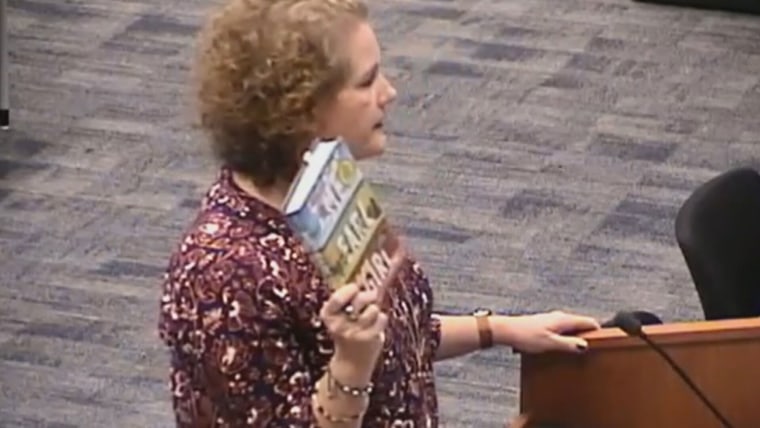
Minutes later, Jennifer Adler, a mother of five, held up a copy of “Jack of Hearts (and Other Parts),” by L.C. Rosen, for the board to see. Adler explained that the book is about a character named Jack, who writes a teen sex advice column for an online site. Then she began reading.
“‘I wonder how he does it … how he gets all that D?’” Adler said, reading the first in a series of explicit excerpts referring to anal and oral sex.
After ending with a passage that included a detailed description of male genitalia and advice on how to give oral sex, she looked up at the board members, her voice shaking as she spoke.
“I cannot even imagine how I would feel if my child came home with this type of book,” said Adler, whose oldest child is in middle school. “We cannot unread this type of content, and I would like to protect my kids’ hearts and minds from this.”
The audience, packed with parents and community members who shared her concerns, erupted in applause.
‘Taking the matter seriously’
Rosen, the author of “Jack of Hearts,” wasn’t surprised when he heard about the demands to ban his book in Katy. Like other authors whose books have been targeted in recent months, Rosen said parents have been reading passages out of context.
At the time of the book’s release in 2015, the School Library Journal, a magazine that districts rely on to select library books, wrote that the dearth of “sex positive queer literature” made “Jack of Hearts” an “essential addition to library collections that serve teens.”
The sex advice columns written by the book’s protagonist are part of a bigger narrative that’s meant to empower queer teens and help them feel safe talking about their sexuality, Rosen said.
All of the questions answered in Jack’s advice column were submitted by real students, Rosen said. And the author consulted with sex education experts to write Jack’s responses, with the goal of providing LGBTQ teens with practical information that’s often omitted from sex ed classes.
“I think it’s troubling when they can’t distinguish between porn — which is not meant for education — and a book like mine that’s trying to educate teenagers and tell them, ‘It’s OK to have these desires; here’s how to act on them consensually and safely,’” Rosen said.
Cuzela and her allies, who denied that they were specifically targeting LGBTQ content, saw things differently. And so did Katy ISD leaders, according to internal messages obtained by NBC News.
Rather than asking the parents to file formal challenges or forming a committee to review the books they’d read aloud, Darlene Rankin, the district’s director of instructional technology, sent an email the day after the school board meeting directing school staff to immediately remove two titles from all libraries: “Jack of Hearts” and “Forever for a Year,” by B.T. Gottfred.
“If these books are currently checked out to students, you must contact the student in order to have the book returned,” wrote Rankin, who declined an interview request.
In the weeks that followed, Katy parents continued applying pressure, calling on the district not only to audit libraries for vulgar content, but to overhaul the selection process to de-emphasize recommendations from prominent book review journals, arguing that those groups are pushing a liberal agenda.
In early December, Superintendent Ken Gregorski responded to those demands, announcing in a letter to all parents that the district was launching a broad review of its library books to remove any that might be considered “pervasively vulgar.” Gregorski, who declined to be interviewed, invited parents to report other books they want removed and assured them that he would “ensure the district is taking the matter seriously and putting into action the plans that resolve the issues for which we are all concerned.”
In total this school year, according to internal messages, the district has launched reviews into at least 30 library books and so far has deemed nine to be inappropriate for students at any grade level, including five that prominently feature LGBTQ characters. Several other books, including “This Is Your Time,” by the civil rights era icon Ruby Bridges, were deemed inappropriate or too mature for young children and removed from either elementary or middle school libraries.
Most of these reviews were opened without a formal book challenge, records show, even though one is required under Katy ISD’s local policy.
In at least two instances, according to three district employees with knowledge of the review process, senior district administrators have ordered books to be removed from libraries even after review committees examined them and voted to keep them in schools. The district employees spoke to a reporter on the condition of anonymity, worried that they might be disciplined for sharing their concerns publicly.
In response to detailed written questions, Katy ISD spokesperson Maria DiPetta wrote that “the district will have to kindly pass on your request.”
Cuzela said she’s pleased that the district is now taking her concerns seriously and hopes administrators go further. Although she doesn’t believe most librarians are knowingly stocking shelves with “pornographic material,” she agrees with Abbott’s call for criminal charges against any who do, including in Katy.
“We have laws in Texas against providing sexually explicit material to children,” she said. “It’s a law on the books, and if they knowingly are providing this, they need to be advised and investigated.”
Foote, the retired school librarian who’s leading a statewide campaign against book bans, said Katy’s approach is flawed, not only because it lacks transparency and opens the door for additional censorship attempts, but because of the signal it sends.
“You can’t overstate the impact these decisions can have on LGBTQ students and even teachers,” Foote said. “Intentional or not, these bans are sending a message to them about their place in the community.”
On the phone at her high school library, the queer Katy student who worries her parents won’t accept her for who she is said she was outraged when she found out librarians had started removing books — especially “Jack of Hearts.”
“For me, a lot of these books offer hope,” the student said. “I’m going to be going to college soon, and I’m really looking forward to that and the freedom that it offers. Until then, my greatest adventure is going to be through reading.”
Like other library books she’d read that centered on LGBTQ characters, the student said “Jack of Hearts” gave her a sense of validation. The main character, a 17-year-old who isn’t shy about his love for partying, makeup and boys, was a sharp contrast to her own high school experience, constantly on guard against saying or doing anything that might lead to her being outed.
The book, she said, made her feel less alone.
Rosen, the author, has heard similar things from other teenagers. When he gets those messages, he said he usually replies to say that he hopes things will get better.
But then he adds: “I can’t promise that it will.”
From a secluded spot in her high school library, a 17-year-old girl spoke softly into her cellphone, worried that someone might overhear her say the things she’d hidden from her parents for years. They don’t know she’s queer, the student told a reporter, and given their past comments about homosexuality’s being a sin, she’s long feared they would learn her secret if they saw what she reads in the library.
That space, with its endless rows of books about characters from all sorts of backgrounds, has been her “safe haven,” she said — one of the few places where she feels completely free to be herself.
But books, including one of her recent favorites, have been vanishing from the shelves of Katy Independent School District libraries the past few months.
For more on this story, watch NBC’s “Nightly News with Lester Holt” tonight at 6:30 p.m. ET/5:30 p.m. CT.
Gone: “Jack of Hearts (and Other Parts),” a book she’d read last year about a gay teenager who isn’t shy about discussing his adventurous sex life. Also banished: “The Handsome Girl and Her Beautiful Boy,” “All Boys Aren’t Blue” and “Lawn Boy” — all coming-of-age stories that prominently feature LGBTQ characters and passages about sex. Some titles were removed after parents formally complained, but others were quietly banned by the district without official reviews.
“As I’ve struggled with my own identity as a queer person, it’s been really, really important to me that I have access to these books,” said the girl, whom NBC News is not naming to avoid revealing her sexuality. “And I’m sure it’s really important to other queer kids. You should be able to see yourself reflected on the page.”
Her safe haven is now a battleground in an unprecedented effort by parents and conservative politicians in Texas to ban books dealing with race, sexuality and gender from schools, an NBC News investigation has found. Hundreds of titles have been pulled from libraries across the state for review, sometimes over the objections of school librarians, several of whom told NBC News they face increasingly hostile work environments and mounting pressure to pre-emptively pull books that might draw complaints.
Records requests to nearly 100 school districts in the Houston, Dallas, San Antonio and Austin regions — a small sampling of the state’s 1,250 public school systems — revealed 75 formal requests by parents or community members to ban books from libraries during the first four months of this school year. In comparison, only one library book challenge was filed at those districts during the same time period a year earlier, records show. A handful of the districts reported more challenges this year than in the past two decades combined.
All but a few of the challenges this school year targeted books dealing with racism or sexuality, the majority of them featuring LGBTQ characters and explicit descriptions of sex. Many of the books under fire are newer titles, purchased by school librarians in recent years as part of a nationwide movement to diversify the content available to public school children.https://iframe.nbcnews.com/qT9NUOR?_showcaption=true&app=1
“Why are we sexualizing our precious children?” a Katy parent said at a November school board meeting after she suggested that books about LGBTQ relationships are causing children to improperly question their gender identities and sexual orientations. “Why are our libraries filled with pornography?”
Another parent in Katy, a Houston suburb, asked the district to remove a children’s biography of Michelle Obama, arguing that it promotes “reverse racism” against white people, according to the records obtained by NBC News. A parent in the Dallas suburb of Prosper wanted the school district to ban a children’s picture book about the life of Black Olympian Wilma Rudolph, because it mentions racism that Rudolph faced growing up in Tennessee in the 1940s. In the affluent Eanes Independent School District in Austin, a parent proposed replacing four books about racism, including “How to Be an Antiracist,” by Ibram X. Kendi, with copies of the Bible.
Similar debates are roiling communities across the country, fueled by parents, activists and Republican politicians who have mobilized against school programs and classroom lessons focused on LGBTQ issues and the legacy of racism in America. Last fall, some national groups involved in that effort — including No Left Turn in Education and Moms for Liberty — began circulating lists of school library books that they said were “indoctrinating kids to a dangerous ideology.”
And during his successful bid for governor in Virginia, Republican Glenn Youngkin made parents’ opposition to explicit books a central theme in the final stretch of his campaign, leading some GOP strategists to flag the issue as a winning strategy heading into the 2022 midterm elections.
The fight is particularly heated in Texas, where Republican state officials, including Gov. Greg Abbott, have gone as far as calling for criminal charges against any school staff member who provides children with access to young adult novels that some conservatives have labeled as “pornography.” Separately, state Rep. Matt Krause, a Republican, made a list of 850 titles dealing with racism or sexuality that might “make students feel discomfort” and demanded that Texas school districts investigate whether the books were in their libraries.
A group of Texas school librarians has launched a social media campaign to push back.
“There have always been efforts to censor books, but what we’re seeing right now is frankly unprecedented,” said Carolyn Foote, a retired school librarian in Austin who’s helping lead the #FReadom campaign. “A library is a place of voluntary inquiry. That means when a student walks in, they’re not forced to check out a book that they or their parents find objectionable. But they also don’t have authority to say what books should or shouldn’t be available to other students.”
Carolyn Foote, a retired school librarian, is spearheading a grassroots effort to fight back against book challenges in Texas.NBC News
Ten current or recently retired Texas school librarians who spoke to a reporter described growing fears that they could be attacked by parents on social media or threatened with criminal charges. Some said they’ve quietly removed LGBTQ-affirming books from shelves or declined to purchase new ones to avoid public criticism — raising fears about what free-speech advocates call a wave of “soft censorship” in Texas and across the country.
Five of the librarians said they were thinking about leaving the profession, and one already has. Sarah Chase, a longtime librarian at Carroll Senior High School in Southlake, a Fort Worth suburb, said the acrimony over books contributed to her decision to retire in December, months earlier than she’d planned.
“I’m no saint,” said Chase, 55. “I got out because I was afraid to stand up to the attacks. I didn’t want to get caught in somebody’s snare. Who wants to be called a pornographer? Who wants to be accused of being a pedophile or reported to the police for putting a book in a kid’s hand?”
In interviews and recorded comments at school board meetings, parents who’ve pushed for book removals described doing everything in their power to shield their children from sexually explicit content on the internet, only to discover it’s readily available in school libraries.
“It’s not censoring to guard minors from exposure to adult-themed books,” Kristen Mangus, a parent, said at a meeting in November of the Keller Independent School District Board of Trustees, a suburban district outside Fort Worth that’s fielded dozens of requests to ban books in recent months. “If they choose to check out from the public library with a parent, then so be it. But there is no reason whatsoever to have these books in our schools.”
Some protesting parents have insisted that their opposition is about sexually explicit books, regardless of the races or sexual orientations of the characters. They point out that some of the books being challenged feature heterosexual sex scenes. But in many instances, parents and GOP politicians have flagged books about racism and LGBTQ issues that don’t include explicit language, including some picture books about Black historical figures and transgender children.
Free speech advocates and authors deny that any of the books in question meet the legal definition of pornography. Although some include sexually explicit passages or drawings, those scenes are presented in the context of broader narratives and not for the explicit purpose of sexual stimulation, they said.
“Some parents want to pretend that books are the source of darkness in kids’ lives,” said Ashley Hope Pérez, author of the young adult novel “Out of Darkness,” which has been repeatedly targeted by Texas parents for its depiction of a rape scene and other mature content. “The reality for most kids is that difficulties, challenges, harm, oppression — those are present in their own lives, and books that reflect that reality can help to make them feel less alone.”
Several queer students, meanwhile, said the arguments by some parents, specifically the idea that it’s inappropriate for teenagers to read about LGBTQ sexual relationships, are making them feel unwelcome in their communities.
“Reading books or consuming any kind of media that has LGBTQ representation, it doesn’t turn people gay or make people turn out a certain way,” said Amber Kaul, a 17-year-old bisexual student in Katy. “I think reading those books helps kids realize that the feelings that they’ve already had are valid and OK, and I think that’s what a lot of these parents are opposed to.”
A teacher at the Carroll Independent School District in Southlake hung caution tape over bookshelves in October to protest efforts to remove “controversial” books.Obtained by NBC News
‘Short-circuiting’ the process
This fall wasn’t the first time Texas parents packed school board meeting rooms to complain about the corrupting influence of books.
Every year for nearly two decades beginning in the late 1990s, the Texas chapter of the American Civil Liberties Union surveyed every public and charter school in Texas to document attempts to ban library books. The annual reports paint a picture of past censorship movements, and make clear that the volume of challenges now hitting schools is unlike anything previously recorded in the state.
In the early 2000s, a conservative backlash to the Harry Potter book series, which some Christian leaders condemned as a satanic depiction of witchcraft, fueled a surge of book banning attempts in Texas, according to the ACLU data. But even at the peak of that wave, the Texas ACLU never documented more than 151 school library book challenges in one year. About half that many were documented in just the first four months of the 2021 school year at only a small sampling of Texas school districts, according to the records obtained by NBC News.
During the 2018-19 school year, the last time the ACLU conducted the censorship survey, Texas schools reported only 17 library book challenges statewide. Twice as many have been filed so far this school year at Keller ISD alone.
“I’ve been doing this work for 20 years, and I’ve never seen the volume of challenges that we’re seeing right now,” said Deborah Caldwell-Stone, director of the Office for Intellectual Freedom at the American Library Association, which tracks attempts to ban library books nationwide.
Caldwell-Stone said the number of Texas book challenges documented in the records obtained by NBC News likely represents a vast undercount, because it doesn’t account for books that are being removed from shelves based on verbal complaints at board meetings or parent emails, often in violation of school district policies.
In response to past censorship movements, the American Library Association developed guidelines for schools to prevent the sudden and arbitrary removal of books. Under the guidelines, which have been adopted by most large districts in Texas and nationally, parents are asked to fill out forms explaining why they believe a book should be banned. Then a committee of school employees and community volunteers reviews the book in its entirety and determines whether it meets district standards, keeping in mind that a parent’s ability to control what students can read “extends only to his or her own child,” according to language included in most district policies.
A challenged book is supposed to remain on shelves and available to students while the committee deliberates, and the final decision should be made public, Caldwell-Stone said.
“What we’re seeing these days is a short-circuiting of that process, despite the fact that school boards often do have these reconsideration policies on their own books,” she said. “They’re ignoring them to respond to the controversy and the moral panics that they’re getting targeted with at school board meetings, and books are being abruptly removed.”
A photo taken by a teacher shows a cart full of books as they were being removed from a North East ISD library in December.Obtained by NBC News
That scenario has been repeated at several Texas school districts in recent months, NBC News found. In December, the Denton Independent School District near Dallas made headlineswhen administrators pulled down a copy of “All Boys Aren’t Blue,” a memoir by queer Black author George M. Johnson, after learning that parents in neighboring towns had concerns about it. A district spokesperson, Julie Zwahr, said school officials are now reviewing a total of 11 library books to determine whether they are “pervasively vulgar,” even though the district has received only one formal book challenge this school year. The North East Independent School District in San Antonio hadn’t received any library book challenges from parents as of December, according to records provided to NBC News. But that month, administrators directed librarians to box up more than 400 titlesdealing with race, sexuality and gender.
At a subsequent school board meeting, North East leaders said that they had pulled the books for review after Krause, the Republican lawmaker, distributed his list of 850 titles that he said violate new state laws governing how sex and race are addressed in Texas classrooms. North East spokesperson Aubrey Chancellor did not respond to a reporter’s request for comment, but told the Texas Tribune in December that the district asked staff to review books on Krause’s list “to ensure they did not have any obscene or vulgar material in them.”
A photo taken by a student in Granbury, Texas, shows men hauling away boxes of library books labeled “Krause’s List,” in reference to the 850 titles that state Rep. Matt Krause wants removed from schools.Obtained by NBC News
“For us, this is not about politics or censorship, but rather about ensuring that parents choose what is appropriate for their minor children,” she said then.
In another instance, the Carroll Independent School District in Southlake, responding to an NBC News public records request, reported that it had received zero library book challenges in 2021. But emails reviewed by a reporter show that a parent had complained informally in August to a Carroll administrator and two school board members about the book, “Beyond Magenta: Transgender Teens Speak Out,” by Susan Kuklin.
“There is extreme sexual content in that book that isn’t even appropriate for me to put in an email,” the parent wrote.https://iframe.nbcnews.com/bExjHrx?_showcaption=true
Rather than requiring the mom to fill out a form to initiate the district’s formal library review process, Chase, the recently retired Carroll librarian, said an administrator shared the email with her and another librarian, and in order to avoid conflict, they agreed to remove the book from high school shelves.
“I hate that we did this, because we didn’t go through the formal review ourselves,” Chase said. “I think a lot of librarians are making decisions out of fear, and that puts us in a position of self-censorship.”
Book fight spreads from Virginia to Texas
Mary Ellen Cuzela, a mother of three in Katy, a sprawling and booming suburb outside Houston, had never thought much about what library books her kids might have access to at school. But in September, she heard then-candidate Youngkin mention a Virginia school district’s fight over “sexually explicit material in the library” during his campaign for governor against Democrat Terry McAuliffe.
Curious, Cuzela searched the Katy Independent School District’s catalog and was surprised to find that one of the books at the center of the Virginia fight, “Lawn Boy,” by Jonathan Evison, was available at her children’s high school.
Cuzela picked up a copy from the public library and “was absolutely amazed” by what she read, she said. The book, which traces the story of a Mexican American character’s journey to understanding his own sexuality and ethnic identity, was “filled with vulgarity,” Cuzela said, including dozens of four-letter words, explicit sexual references and a description of oral sex between fourth-grade boys during a church youth group meeting.
“I don’t care whether you’re straight, gay, transgender, gender fluid, any race,” she said. “That book had it all and was degrading for all kinds of people.”
She soon discovered that several other young adult books that had been targeted in Virginia and other Texas districts were available at Katy ISD. Cuzela shared her findings with some “like-minded parents,” and together they set out to get administrators to do something.
The school system, a diverse district of nearly 85,000 students, had already made national headlines that fall when administrators temporarily removed copies of “New Kid” and “Class Act” by Jerry Craft from school libraries after parents complained that the graphic novels, about Black seventh graders at a mostly white school, would indoctrinate students of color with a “victim mentality” and make some kids feel guilty for being white.
But Cuzela said she and her friends were having a hard time getting Katy administrators to take their concerns about sexually explicit books seriously. So they hatched a plan, and on Nov. 15, she and five other moms showed up at a Katy school board meeting with a stack of books.
One by one, they took turns at the lectern during public comments. Cuzela implored the board to audit all of the district’s library books and get rid of those that are too obscene to be read aloud in public.
“If you are filtering a student’s internet access,” she said, “why are we not filtering the library?”
Minutes later, Jennifer Adler, a mother of five, held up a copy of “Jack of Hearts (and Other Parts),” by L.C. Rosen, for the board to see. Adler explained that the book is about a character named Jack, who writes a teen sex advice column for an online site. Then she began reading.
“‘I wonder how he does it … how he gets all that D?’” Adler said, reading the first in a series of explicit excerpts referring to anal and oral sex.
After ending with a passage that included a detailed description of male genitalia and advice on how to give oral sex, she looked up at the board members, her voice shaking as she spoke.
“I cannot even imagine how I would feel if my child came home with this type of book,” said Adler, whose oldest child is in middle school. “We cannot unread this type of content, and I would like to protect my kids’ hearts and minds from this.”
The audience, packed with parents and community members who shared her concerns, erupted in applause.
‘Taking the matter seriously’
Rosen, the author of “Jack of Hearts,” wasn’t surprised when he heard about the demands to ban his book in Katy. Like other authors whose books have been targeted in recent months, Rosen said parents have been reading passages out of context.
At the time of the book’s release in 2015, the School Library Journal, a magazine that districts rely on to select library books, wrote that the dearth of “sex positive queer literature” made “Jack of Hearts” an “essential addition to library collections that serve teens.”
The sex advice columns written by the book’s protagonist are part of a bigger narrative that’s meant to empower queer teens and help them feel safe talking about their sexuality, Rosen said.
All of the questions answered in Jack’s advice column were submitted by real students, Rosen said. And the author consulted with sex education experts to write Jack’s responses, with the goal of providing LGBTQ teens with practical information that’s often omitted from sex ed classes.
“I think it’s troubling when they can’t distinguish between porn — which is not meant for education — and a book like mine that’s trying to educate teenagers and tell them, ‘It’s OK to have these desires; here’s how to act on them consensually and safely,’” Rosen said.
Cuzela and her allies, who denied that they were specifically targeting LGBTQ content, saw things differently. And so did Katy ISD leaders, according to internal messages obtained by NBC News.
Rather than asking the parents to file formal challenges or forming a committee to review the books they’d read aloud, Darlene Rankin, the district’s director of instructional technology, sent an email the day after the school board meeting directing school staff to immediately remove two titles from all libraries: “Jack of Hearts” and “Forever for a Year,” by B.T. Gottfred.
“If these books are currently checked out to students, you must contact the student in order to have the book returned,” wrote Rankin, who declined an interview request.
In the weeks that followed, Katy parents continued applying pressure, calling on the district not only to audit libraries for vulgar content, but to overhaul the selection process to de-emphasize recommendations from prominent book review journals, arguing that those groups are pushing a liberal agenda.
In early December, Superintendent Ken Gregorski responded to those demands, announcing in a letter to all parents that the district was launching a broad review of its library books to remove any that might be considered “pervasively vulgar.” Gregorski, who declined to be interviewed, invited parents to report other books they want removed and assured them that he would “ensure the district is taking the matter seriously and putting into action the plans that resolve the issues for which we are all concerned.”
In total this school year, according to internal messages, the district has launched reviews into at least 30 library books and so far has deemed nine to be inappropriate for students at any grade level, including five that prominently feature LGBTQ characters. Several other books, including “This Is Your Time,” by the civil rights era icon Ruby Bridges, were deemed inappropriate or too mature for young children and removed from either elementary or middle school libraries.
Most of these reviews were opened without a formal book challenge, records show, even though one is required under Katy ISD’s local policy.
In at least two instances, according to three district employees with knowledge of the review process, senior district administrators have ordered books to be removed from libraries even after review committees examined them and voted to keep them in schools. The district employees spoke to a reporter on the condition of anonymity, worried that they might be disciplined for sharing their concerns publicly.
In response to detailed written questions, Katy ISD spokesperson Maria DiPetta wrote that “the district will have to kindly pass on your request.”
Cuzela said she’s pleased that the district is now taking her concerns seriously and hopes administrators go further. Although she doesn’t believe most librarians are knowingly stocking shelves with “pornographic material,” she agrees with Abbott’s call for criminal charges against any who do, including in Katy.
“We have laws in Texas against providing sexually explicit material to children,” she said. “It’s a law on the books, and if they knowingly are providing this, they need to be advised and investigated.”
Foote, the retired school librarian who’s leading a statewide campaign against book bans, said Katy’s approach is flawed, not only because it lacks transparency and opens the door for additional censorship attempts, but because of the signal it sends.
“You can’t overstate the impact these decisions can have on LGBTQ students and even teachers,” Foote said. “Intentional or not, these bans are sending a message to them about their place in the community.”
On the phone at her high school library, the queer Katy student who worries her parents won’t accept her for who she is said she was outraged when she found out librarians had started removing books — especially “Jack of Hearts.”
“For me, a lot of these books offer hope,” the student said. “I’m going to be going to college soon, and I’m really looking forward to that and the freedom that it offers. Until then, my greatest adventure is going to be through reading.”
Like other library books she’d read that centered on LGBTQ characters, the student said “Jack of Hearts” gave her a sense of validation. The main character, a 17-year-old who isn’t shy about his love for partying, makeup and boys, was a sharp contrast to her own high school experience, constantly on guard against saying or doing anything that might lead to her being outed.
The book, she said, made her feel less alone.
Rosen, the author, has heard similar things from other teenagers. When he gets those messages, he said he usually replies to say that he hopes things will get better.
The percentage of Americans who say they are satisfied with the acceptance of gay and lesbian people in the country has reached a new peak at 62%, according to a poll released Wednesday. Gallup’s annual Mood of the Nation poll asks people about their satisfaction with aspects of U.S. life and policy areas, ranging from the overall quality of life to the nation’s military strength and environmental issues.
In 2022, 62% of survey respondents said they are very or somewhat satisfied with the acceptance of gays and lesbians in the nation, up from 55% in 2021 and 56% in 2020. Jeff Jones, a senior editor at Gallup, told USA TODAY that the question shows whether gay and lesbian people are “being considered not an outsider group but a normal, mainstream group of people in the U.S.”
Read the full article. Perhaps notably, Gallup’s wording of the question specifies “gays and lesbians” – and not the more inclusive LGBTQs.
Stephen Balch, a former professor who also has opposed the 2015 Supreme Court ruling overturning state bans on same-sex marriage, is a content adviser for the revision of the standards that will guide social studies courses from kindergarten through 12th grade.
The Texas Freedom Network, a liberal group promoting religious freedom and education, is calling on the State Board of Education to withdraw Balch’s appointment, citing his writings calling the 2020 election a “literal coup,” among other things.
The group also pointed to Balch’s support of a letter urging officials to disregard the 2015 U.S. Supreme Court ruling against bans on same-sex marriage as an example of another “attack on our constitutional system of government”.