Seven Republican lawmakers in Florida filed anti-LGBTQ bills late Monday, just hours before the deadline to file new bills for the coming legislative session.
If passed, the bills would ban gender-affirming health care for transgender children, repeal municipal and county ordinances protecting LGBTQ workers, and legalize so-called gay conversion therapy in places that had banned the medically debunked practice.
The state lawmakers — Rep. Anthony Sabatini, Sen. Dennis Baxley, Rep. Bob Rommel, Sen. Joe Gruters, Rep Michael Grant, Sen. Keith Perry, and Rep. Byron Donalds — together introduced the four pieces of legislation, each with a companion bill in the House and the Senate.
Rep. Shevrin Jones, one of Florida’s openly LGBTQ lawmakers, said in a statement that it is “shameful that Republican lawmakers are wasting tax dollars attacking Florida’s most vulnerable communities rather than prioritizing the issues that impact everyday people’s lives.”
“Clearly they’ve decided that discrimination and hate are central to their election-year platform despite our state’s incredible diversity,” Jones wrote. “Just as I’ve done since I was elected in 2012, I will continue to fight any legislation that marginalizes or threatens any Floridian’s shot at a secure, safe, and bright quality of life.”
Equality Florida, the state’s largest LGBTQ rights group, also decried the late-session bill dump.
“This is the most overtly anti-LGBTQ agenda from the Florida Legislature in recent memory,” Jon Harris Maurer, the group’s public policy director, said in a press release. “It runs the gamut from openly hostile legislation that would arrest and imprison doctors for providing medically necessary care, to legislation that would carelessly erase critical local LGBTQ protections.”
Gina Duncan, Equality Florida’s director of transgender equality, called out the proposed trans health bill, saying, “Transgender youth are some of the most at risk in our community.”
“It is outrageous that conservative legislators would threaten their health and safety,” she said in a statement. “Medical professionals, not politicians, should decide what medical care is in the best interest of a patient. Forcing a doctor to deny best practice medical care and deny support to transgender youth can be life-threatening.”
NBC News reached out to the legislators behind the bills but did not receive any responses before press time. After initial publication, however, Sen. Gruters responded saying his Senate bill — unlike its companion in the House — “includes protections” in the preamble by stating that “nothing in this act is intended to alter” local policies prohibiting employment discrimination.
“The bill certainly does not authorize an employer to discriminate against employees who are members of protected classes, whether protected by federal or state law or local ordinance,” Sen. Gruters told NBC News in an email. “While I do not believe the bill has any impact on local anti-discrimination ordinances, in an abundance of caution, I included language in the bill’s preamble to make clear that the preemption would not affect local anti-discrimination laws, and any court would interpret the preemption consistent with that preamble.”
However, Joe Saunders, Equality Florida’s senior political director, said the preamble is just the bill’s introduction and is not considered part of the law.
“We appreciate that Sen. Gruters put that in,” Saunders said, but “it’s not policy; it’s not considered part of the bill.”
Conservative Republicans across the country have lately moved to introduce bills that would criminalize the provision of medical care for transgender children — including treatments endorsed by all major medical organizations. Florida’s trans health care ban proposal joins a list of similar bills that have been filed in recent weeks by staunchly conservative lawmakers in Tennessee and Texas.
“Sadly, the medical care of transgender youth has been sensationalized and politicized,” Jack Turban, a researcher at Harvard Medical School, said. “Gender-affirming medical care for transgender adolescents is endorsed by major medical organizations, including the Endocrine Society, the American Academy of Pediatrics, and the American Academy of Child & Adolescent Psychiatry. It should go without saying, but providing standard medical care should not be a felony.”
A group of 45 Democratic members of Congress sent a letter to Immigration and Customs Enforcement on Tuesday demanding the agency release all transgender migrants in its custody.
“This already vulnerable population faces a heightened and unique set of injustices while in immigration detention,” the letter stated. “Transgender migrants and asylum seekers are particuarly vulnerable to sexual harassment, solitary confinement, physical assault, and medical neglect.”
At least two transgender migrants have died in ICE custody in the past two years. Roxsana Hernandez Rodriguez, a Honduran, died of complications from untreated HIV in 2018. Rodriguez did not receive antiretroviral therapy while in ICE custody, despite guidelines mandating that all detainees receive the minimum standard of care, which for HIV infection is ARV therapy. Last year, another HIV-positive transgender migrant, Johana Medina León from El Salvador, died shortly after being released from ICE custody, where she had requested medical assistance.
After León died last summer, Kris Hayashi, executive director of the Transgender Law Center, called the two deaths “a direct result of U.S. government policy, and will continue unless we force dramatic change.”
Advocates have long accused ICE of improper treatment of LGBTQ migrants, particularly after Hernandez died from a rare, AIDS-related illness at its Cibola detention center in New Mexico.
The Cibola unit — touted by the agency as its premiere detention facility for trans migrants — failed to treat Hernandez’s diagnosedHIV infection for 12 days, despite what ICE has claimed is a maximum 24-hour turnaround on sick-call requests.
The 45 lawmakers in their letter claim that none of ICE’s detention centers — including Cibola — are contracted specifically for housing trans inmates, a requirement set by ICE’s 2015 transgender detention standards. Speaking on background, a congressional staffer noted that at Cibola, ICE’s “compliance is currently voluntary and their standards could slip at any time with no repercussions.”
The letter notes that the “pervasive use of solitary confinement has caused particular harm to transgender migrants in detention.”
“ICE consistently utilizes solitary confinement for so-called protective purposes or violates its own guidance by using segregation as punishment, placing transgender people at risk of physical and mental health deterioration and vulnerability to sexual assault by ICE guards,” the letter states.
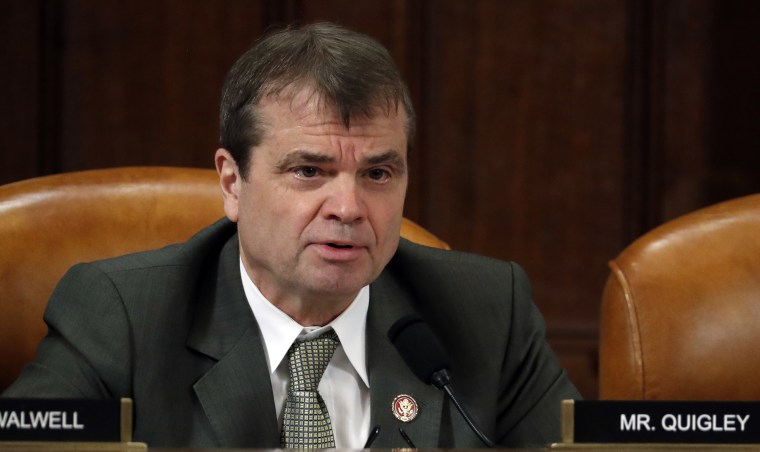
Representative Mike Quigley, a Democrat from Illinois, questions witnesses during a House Intelligence Committee impeachment inquiry hearing in Washington, on Nov. 19, 2019.Jacquelyn Martin / Bloomberg via Getty Images
Rep. Mike Quigley, D-Ill., spearheaded the effort to demand the release of transgender migrants. In a press release shared with NBC News, he said if “ICE cannot provide appropriate and humane accommodations for these migrants, they must release them from detention.”
“Immigrants who have faced fear and violence in their pursuit of a new life in the United States should not be confronted with more fear and threats of violence when they arrive at our borders,” he stated. “Unfortunately, too often, that is exactly what many transgender immigrants face when placed in ICE detention facilities.”
When asked for comment, ICE spokesperson April Grant said in an email that the agency “will respond to Congressional correspondence through official channels and by appropriate officials at the agency.”
Immigration Equality, an advocacy group dedicated to LGBTQ immigrants, called the two deaths “tragic examples of the consequences of ICE’s mistreatment,” and endorsed the demands of the 45 lawmakers: “Transgender immigrants are not safe in ICE custody and must be released.”
“After fleeing horrific persecution in their countries of origin, our transgender clients seek protection in the U.S.,” Bridget Crawford, legal director of Immigration Equality, said. “However, rather than finding safety, our clients are routinely subjected to shocking mistreatment in immigration detention facilities, including sexual assault and harassment, medical neglect and prolonged solitary confinement as a purported means of ‘protecting’ transgender people from abuse.”
The lawmakers’ letter requests a detailed ICE plan by Jan. 27 outlining compliance, and requests semi-monthly updates to “demonstrate such compliance.”
Surprise surprise, Donald Trump has appointed a campaign advisor who promotes conversion therapy and thinks HIV in gay men is “God’s moral law.”
Anti-LGBT+ extremist Jenna Ellis is a right-wing news pundit and former constitutional law attorney. She does nothing to hide her strongly homophobic views and has a long history of tirades against “the homosexual lifestyle” and the “LGBT agenda.”
Trump appointed her for the senior role as he was impressed by Ellis’ TV appearances, Axios reported. He also indicated that he wanted to give her a bigger job, and his team briefly discussed bringing her into the White House.
Ellis is a vocal Christian who believes gay and bisexual men have higher rates of HIV because “we cannot escape God’s moral law and His supremacy.” She has also claimed that Christians cannot follow God while they accept, condone, or participate in homosexuality.
She attacked the out Democratic candidate Pete Buttigieg for being a gay Christian, writing on Facebook: “If Pete Buttigieg is going to invoke the name of his Creator, he should read for himself what his Creator says about homosexuality in the Bible. Truth doesn’t change, regardless of the culture or the Dems’ identity politics.”
When same-sex marriage was legalised in the US, Ellis lamented that the decision “told the LGBT community that their homosexual lifestyle was not just legal privately, but morally validated openly through government recognition and social celebration and therefore equally as valued as heterosexual unions.”
And after the mass shooting at Pulse LGBT+ nightclub in 2016, she responded with a column entitled ‘Two Wrongs Do Not Make an LGBT Right,’ which bemoaned the fact that the massacre was being used to “embrace” homosexuality.
“Let me be clear – the Orlando shooting was absolutely terrible and tragic. But the response to this tragedy should not be embracing and advocating for gay rights,” she said.
Not content with merely making vile comments, Ellis has actively worked against conversion therapy bans, testifying in 2019 at a Colorado House committee hearing against a bill protecting youth from the harmful and discredited practice.
“She gets it,” Donald Trump reportedly told a Daily Beastsource.
The Trump administration’s latest bid to have two HIV-positive airmen discharged from service has been blocked by courts for a second time.
The two men, referred to by the pseudonyms Roe and Voe, were given discharge orders in 2017 on the basis that they couldn’t be deployed to the Middle East due to their HIV-positive status.
Both men are on antiretroviral treatment, have no symptoms, and have been pronounced physically fit to deploy by their doctors.
Their discharges were blocked by a preliminary injunction in February last year, which the Department of Defence and the Air Force appealed.
On Friday, January 10, a federal court moved to uphold the injunction, judging that the ban on deployment was based on an “obsolete understanding” of HIV/AIDS.
“[It] may have been justified at a time when HIV treatment was less effective at managing the virus and reducing transmission risks. But any understanding of HIV that could justify this ban is outmoded and at odds with current science,” said Judge James A. Wynn Jr.
“Such obsolete understandings cannot justify a ban, even under a deferential standard of review and even according appropriate deference to the military’s professional judgments.”
The servicemen, like other HIV-positive people with undetectable viral loads, have no symptoms of HIV. They take a daily medication which means they cannot transmit the virus through normal daily activities, and their risk of transmitting the virus through battlefield exposure is extremely low if at all possible.
“But the Government did not consider these realities when discharging these servicemembers, instead relying on assumptions and categorical determinations,” the ruling stated.
“As a result, the Air Force denied these servicemembers an individualised determination of their fitness for military service.”
Roe and Voe were represented by Lambda Legal, a civil rights organisation that fights on behalf of LGBT+ people. Scott Schoettes, Lambda Legal’s HIV Project director, said that the government was unable to give a reasonable justification for the servicemen’s “discriminatory treatment”.
“This is the second federal court to find that the Trump administration’s attempt to discharge these individuals is unlikely to pass legal muster,” he said in a press release.
“At the root of these discharge decisions and other restrictions on the service of people living with HIV are completely outdated and bigoted ideas about HIV.
“Today’s ruling clears the way for us to definitively prove at trial that a person living with HIV can perform the job of soldier or airman as well and as safely as anyone else.”
Sen. Amy Klobuchar is facing scrutiny on the campaign trail for voting to confirm many of President Trump’s judicial nominees — and a closer look at that record reveals she backed one pick who once derided as “social policy” not only LGBTQ rights and abortion, but also school integration.
With weeks remaining before the Iowa caucuses on Feb. 3, Klobuchar’s vote to confirm David Ryan Stras to the U.S. Eighth Circuit Court of Appeals could dissuade supporters of LGBTQ rights and other progressives from supporting her in the Democratic presidential primary.
Although Stras hasn’t been as viciously anti-LGBTQ as some of Trump’s other picks, his past is troubling to LGBTQ advocates. As a law professor, Stras in a 2008 legal essay was condescending toward judges’ “ventures” into LGBTQ rights, abortion and school integration.
“The court’s own ventures into contentious areas of social policy — such as school integration, abortion, and homosexual rights — have raised the stakes of confirmation battles even higher,” Stras wrote.
Additionally, as a Minnesota Supreme Court justice, Stras in 2012 joined an opinion allowing an anti-gay marriage amendment to come intact to the ballot with a title obscuring its purpose and effect. Minnesota voters ended up rejecting the amendment anyway.
Along with Sen. Doug Wilson (Ala.), Sen. Joe Manchin (W.Va.) former Sen. Claire McCaskill (D-Mo.) Sen. Mark Warner (Va.), former Sen. Heidi Heithkamp (N.D.) and former Sen. Joe Donnelly (Ind.), Klobuchar was among seven Democrats who joined Republicans in voting for Stras. The vote in January 2018 was otherwise along party lines, 56-42.
Ironically, Klobuchar voted for Stras even though she wasn’t consulted on the judicial pick, which was a customary part of the confirmation process before the Trump era, and recommended other choices for the judicial seat.
Carlie Waibel, national press secretary for the Klobuchar campaign, put distance between Klobuchar and Stras in response to a Washington Blade inquiry on whether the Democratic hopeful stands by her vote.
“Of course Sen. Klobuchar disagrees with his comments, just as she will not agree with every one of his opinions,” Waibel said. “She has made clear that Judge Stras was not the judge that she would ever recommend to the White House. In fact, she recommended other candidates.”
Waibel also defended the senator’s vote for Stras by saying he was better than other picks Trump might have offered.
“Her vote was based on the reality that given the choices, on balance she thought he was better than the other candidates who would have been nominated from other states,” the spokesperson said. “Judge Stras was recommended by liberal Justice Alan Page, who Sen. Klobuchar has great respect for, and in the vast majority of cases on the Minnesota Supreme Court Judge Stras sided with the majority, which included several Democratic-appointed justices.”
Klobuchar’s vote for Stras was one of many in favor of judicial nominees by Trump, who set records with judicial confirmations in ways that will likely affect the courts for generations to come.
According to an April 2019 article in ThinkProgress, Klobuchar voted for more than 56 percent of his judicial picks two years into his presidency. According to the Klobuchar campaign, the percentage since that time has dropped to just 33 percent.
Meanwhile, other Democratic senators who have run for president this cycle, such as Bernie Sanders, Kamala Harris, Elizabeth Warren and Kirsten Gillibrand, had a knee-jerk opposition to all of them.
Klobuchar cast a vote for Stras even though he was opposed by civil rights and progressive groups, who pointed to his statements and actions as a law professor and Minnesota Supreme Court justice. Among the groups that opposed him were Lambda Legal, People for the American Way and Alliance for Justice.
“His vision of the role of the courts as a nefarious force that seeks to block the will of the majority sends a dangerous message to vulnerable minorities that their constitutional rights are not guaranteed,” McGowan wrote. “Justice Stras’ failure to appreciate the important role that an independent judiciary plays in our constitutional democracy causes communities like ours grave concern.”
In a 2008 essay titled “Understanding the New Politics of Judicial Appointments,” Stras wrote intensified media scrutiny and organized interest groups have politicized the judicial confirmation process, which he said made lawmakers act “with a keen eye toward pleasing constituent groups and maintaining a consistent policy image.”
As an example of attempts at “pleasing constituent groups,” Stras pointed to judicial rulings on LGBTQ rights, abortion and school integration, suggesting either the decisions were best left to the political process or the courts got it wrong.
Although the Supreme Court decision in Roe v. Wade is the case most cited in the article, Stras also draws on the 2003 decision in Lawrence v. Texas, noting with a tinge of skepticism the court “struck down a Texas ban on homosexual sodomy because, according to the court, the state law violated privacy rights.”
Anthony Kreis, visiting assistant professor of law for the Chicago-Kent College of Law, told the Blade comments deriding LGBTQ rights as “social policy” are off-base.
“The problem with the notion of LGBTQ rights as being ‘social policy,’ is that viewpoint indicates that the Constitution’s protections do not sweep broadly enough to protect sexual minorities,” Kreis said. “In other words, LGBTQ people are at the mercy of legislatures to do right by them — and so then courts aren’t reliable actors to combat homophobia and transphobia.”
In written responses to questions from the Senate on his 2008 writing, Stras when asked about school integration acknowledged the Supreme Court applied the Fourteenth Amendment to desegregate schools in Brown v. Board of Education, which he said “overruled the Supreme Court’s detestable decision in Plessy v. Ferguson.”
“When I wrote the referenced book review essay, I did so as a law professor, not as a judge,” Stras added. “I was describing the factors that have increased political polarization surrounding the judicial nomination process over the past several decades.”
Asked whether the U.S. Constitution provides a textual basis for rights to contraception, women’s access to abortion and same-sex marriage, Stras acknowledged the Supreme Court’s rulings in favor of abortion rights and marriage equality, saying he’d “follow all binding precedent, including each of these precedents” on the Eighth Circuit.
Four years later, when Stras was a justice on the Minnesota Supreme Court, he joined an opinion that prevented the Minnesota secretary of state from changing the ballot title on a proposed anti-gay marriage constitutional amendment from “Recognition of Marriage Solely Between One Man and One Woman” to “Limited the Status of Marriage to Opposite Sex Couples.”
Although Minnesota law dictates the secretary of state must “provide an appropriate title” for proposed constitutional amendments on the ballot, the court in the case of Limmer v. Ritchie concluded that language doesn’t enable the official to change a ballot title designated by the state legislature.
“Allowing the secretary of state, an executive branch officer with no constitutional authority over the form and manner of proposed constitutional amendments, to simply ignore the legislature’s action in proposing and passing a title to accompany a ballot question on a constitutional amendment potentially risks interfering with the legislature’s constitutional authority,” the decision says.
The decision, however, wasn’t unanimous. Minnesota Supreme Court Judge Minnesota Alan Page criticized the majority in his dissent by saying the ruling “announces a fundamentally flawed interpretation” of state law.
“Under the court’s view, a majority of the legislature could propose a constitutional amendment to, say, reinstate prohibition, propose the ballot title ‘Eliminating the Personal Income Tax,’ the secretary of state would be obligated to put the legislature’s title on the ballot, and under the standard the court announces today, this court could do nothing to prevent it,” Page wrote. “That is a result I cannot countenance.”
It should be noted that although the Klobuchar campaign defended the Minnesota Democrat’s vote for Stras by saying he was recommended by Page, the two weren’t in agreement in this instance.
Stras’s LGBTQ record was just part of the reason civil rights and progressives opposed his confirmation. A member of the Federalist Society, Stras clerked for conservative U.S. Associate Justice Clarence Justice, whom he called a “mentor” upon being sworn in to the Minnesota Supreme Court.
In Peterson v. Minnesota, which involves a police officer suing the City of Minneapolis for age discrimination, the Minnesota Supreme Court determined the 14 months the city took to investigate the case need not be applied to the statute of limitations under the law. Stras, however, joined a dissent that would have prevented the officer from bringing his case to the jury.
When the Minnesota Supreme Court ruled in a rape case trial judges can allow expert testimony to explain why a victim would delay in reporting the incident, Stras strikingly dissented on procedural grounds. The testimony was deemed warranted in the case because the victim had waited several hours before reporting the incident.
Stras has cultivated this record even though his own family experienced persecution as a member of a minority community. Stras, who’s believed to be the first Jewish person to serve on the Minnesota Supreme Court, is the descendant of Holocaust survivors.
To be sure, Klobuchar has built a solid record in support of LGBTQ rights as a member of the U.S. Senate. She was a co-sponsor of the Respect for Marriage Act, which sought to repeal the anti-gay Defense of Marriage Act before it was overturned by the U.S. Supreme Court, voted in favor of the Employment Non-Discrimination Act and now co-sponsors the Equality Act. The Minnesota Democrat received a perfect score of “100” in the latest Human Rights Campaign congressional scorecard.
However, Klobuchar’s vote to confirm Stras to the Eighth Circuit despite his record on LGBTQ rights stands out.
Kreis acknowledged “there are often many reasons why senators could vote for nominees they don’t favor,” but didn’t see that at play with Klobuchar’s vote for Stras.
“It is hard to discern what reason she might have,” Kreis said. “Whatever the reason might be for the favorable vote, it was not a vote cast to help the advancement of LGBTQ rights.”
The Council of the District of Columbia on Tuesday introduced legislation that would strip gendered and “patriarchal” terms from the D.C. code and replace them with gender-neutral language.
The Gendered Terms Modernization Amendment Act of 2020 would change instances of “he” or “she” in the law books to “the individual” or “they.” The bill was introduced by David Grosso, an at-large independent member of the council who has been a leader on LGBTQ legislation during his council tenure.
“We believe very strongly that language matters, that it actually holds power, and that the language of our laws matters,” Grosso told NBC News. “And it’s incredibly important that people feel included in the District of Columbia code to the fullest extent.”
The 43-page bill contains a list of “suggested” terms, Grosso said, “because for me it’s important that we have a hearing and listen to the public fully on what they think we should change it to as well.”
“His” would become “the individual’s,” “men” would become “individuals” or “humans,” “brother” and “sister” would become “sibling” and so on.
“Although we have done a lot of research and a lot of work on this, it is not something we should put out there and say: ‘We’ve got all the answers,’” Grosso said.
Among dozens of other proposed changes, the bill supports modifying the D.C. Charter and Home Rule Act so, for example, “chairman” of the District of Columbia Council would become “chairperson.” Modifications to the Charter and Home Rule Act would need to be approved by Congress.
The bill is co-sponsored by 10 of the 13 council members, and was introduced on a tense day during which member Jack Evans offered his resignation instead of facing a disciplinary hearing over an alleged ethics violation.
D.C. is not the first city to undergo a “linguistic cleansing,” according to Fern Johnson, a Clark University English professor. In a recent interview with the Atlanta Journal Constitution about the efforts of Berkeley, California, to make its city code more gender inclusive, she said “Albuquerque, Detroit, Memphis, Minneapolis, New York and Seattle have all made language less gender-specific, but these changes are usually incremental and happen without much fanfare.”
The broadening use of gender-neutral language in everyday vernacular and official documentation is accelerating. In 2017, the Associated Press Stylebook endorsed the use of the singular pronoun “they,” and this year, “they” was Merriam-Webster’s “word of the year” because of high public interest in the word’s definition and use as a singular pronoun.
Authorities are searching for a suspect after a transgender activist was found shot and killed in McAlester, Oklahoma, while on his way to pickup a taxi fare.
Dustin James Parker, 25, was found dead Wednesday with the windows of his car shot out after a 911 caller told police they heard gunshots in the early morning, according to NBC affiliate KJRH.McAlester Mayor John Browne assured the community that law enforcement was doing all it could to locate a suspect in Parker’s death.
“McAlester lost a supremely nice person who had such a positive outlook in his life,” Browne said in a statement. “He loved his job especially that it allowed him to help people. His passing is a loss for our community.”
Rover Taxi owner Brian West, 42, told NBC News Saturday that Parker was the first employee hired for the company, which launched in September. Parker, married with four children, had struggled previously juggling multiple jobs.
“I called him and said I have this idea I want you to help me build this and he did,” West said.
The two friends knew each other for about a year and worked together to launch a McAlester chapter of Oklahomans for Equality in May. Despite their short time together, West said that Parker felt like family.
“You couldn’t ask for a better friend, you couldn’t ask for a better husband, you couldn’t ask for a better employee,” West said. “He was an all around awesome person.”
Human Rights Campaign said in statement that it suspects Parker may be the first violent death of a transgender or gender non-conforming person in the new year. HRC has tracked violent deaths of at least 25 transgender or gender non-conforming people in 2019.
The organization has documented more than 150 killings of trans and gender-nonconforming individuals since the beginning of its “Violence Against the Transgender Community” project
“We say ‘at least’ because too often these stories go unreported — or misreported,” HRC said Thursday. “These victims are not just numbers or headlines. They were real people worthy of dignity and respect, of life and love.”
A Trump-supporting Florida judicial candidate has had his law license suspended after saying that gay people will “face eternal damnation.”
Attorney Donald McBath has been suspended from the Florida Bar for violating the Florida Code of Judicial Conduct while running to become a state circuit court judge.
In a filing with the Florida Supreme Court, the Florida Bar asserted that McBath had “failed to maintain the dignity appropriate to judicial office and act in a manner that is consistent with impartiality, integrity, and independence of the judiciary” due to anti-Muslim and anti-gay messages posted to social media.
Trump-supporting attorney claimed God can ‘heal’ gay people
One message posted to Twitter states: “If the homosexual continues committing that sin of sodomy, his soul faces ETERNAL damnation. Abstain, if you really have that mental illness. It’s not love.”
Another added: “A person with homosexual tendencies that abstains from committing the sin of sodomy, is a man that is trying to live and cope with their mental illness. A person could be healed with the right help from professionals and with the Grace of God.”
McBath – who described himself in his Twitter profile as a “100% Trump supporter #MAGA; #KAG; proud DEPLORABLE; Pro-God; Christian” – sent other messages referring to Muslims as “deranged” and claiming: “Never trust a Muslim.”
Donald McBath made the comments while running to become a judge
According to the Miami Herald, the state Supreme Court leveraged a 91-day suspension and a $1,386 fine against McBath after he declined to contest the state bar’s claims.
The suspension of his law license will run concurrently with a preexisting, unrelated suspension for incompetence, the newspaper reports.
‘Pro-God Christian’ lawyer worked as a divorce attorney
In a statement in 2018, McBath said: “I have very strong personal beliefs about what is right and wrong.
“As a Christian, I love homosexuals. I just don’t like the sinful act of sodomy. In my personal opinion, the Bible is clear as to the sin. It is unnatural.
“It doesn’t mean that two males or two females can’t be best friends. Our Lord Jesus Christ talks about the fact we should love the sinner but hate the sin.”
Despite his apparently devout Christian beliefs, McBath has worked as a divorce attorney.
At the dawn of the year 2010, few Americans could predict that the coming decade would revolutionize the legal and cultural landscape for lesbian, gay, bisexual, transgender and queer people. After all, it was only in 2003 that homosexuality was decriminalized across the country, thanks to a landmark Supreme Court ruling.
Over the past 10 years, the United States saw the nationwide legalization of same-sex marriage, the emergence of transgender rights as the central frontier in the LGBTQ rights battle and the introduction of PrEP to fight the HIV epidemic. The decade also saw tragedies and setbacks, like the Pulse nightclub shooting in Orlando and the trans military ban.
As the 2010s come to a close, NBC Out looks back to some of the decade’s many LGBTQ milestones.
Following through on a campaign promise, President Barack Obama on December 22, 2010, signed the repeal of “don’t ask, don’t tell,” the 1994 Clinton administration policy that banned military service by openly gay people. DADT was a compromise after Clinton failed to deliver on a 1992 campaign promise to allow gay and lesbian Americans to join the military. The repeal went into effect in September 2011.
Governor Andrew Cuomo signed the bill into law on June 24, 2011, just hours after the New York State Senate passed the Marriage Equality Act. Spontaneous celebrations erupted across the state and particularly at New York City’s Stonewall Inn, the birthplace of the modern LGBTQ rights movement.
Hillary Clinton: ‘Gay rights are human rights’
In an echo of her iconic 1995 speech in Beijing as First Lady, where she declared that “human rights are women’s rights and women’s rights are human rights,” Secretary of State Hillary Rodham Clinton delivered a speech on Dec. 6, 2011, to the United Nations declaring, “Gay rights are human rights, and human rights are gay rights.”
Ahead of President Obama’s widely telegraphed “evolution” on same-sex marriage, Vice President Joe Biden in a May 2012 appearance on NBC News’ “Meet the Press” announced that he was “absolutely comfortable” with same-sex marriage.
FDA approves Truvada as HIV PrEP
TruvadaAnthony Correia / NBC News
In July 2012, the Food and Drug Administration approved Truvada as HIV pre-exposure prophylaxis, or PrEP, to prevent HIV acquisition in high-risk individuals, particularly gay men and transgender women. PrEP was controversial when approved but has grown more widely used and accepted as cities, states, and the federal government have moved to widely promote its use as a tool to end the HIV epidemic. In places like New York City that have high rates of PrEP uptake, HIV infection rates have begun to decline.
Wisconsin’s Tammy Baldwin became the first LGBTQ person ever elected to the U.S. Senate in November 2012. But even then, Baldwin — who was first elected to political office more than three decades ago at 24 — was no stranger to making history. In 1998, when she was elected to the House of Representatives, she became the first gay woman and the first openly LGBTQ nonincumbent elected to either chamber of Congress.
-2013-
Supreme Court axes Defense of Marriage Act
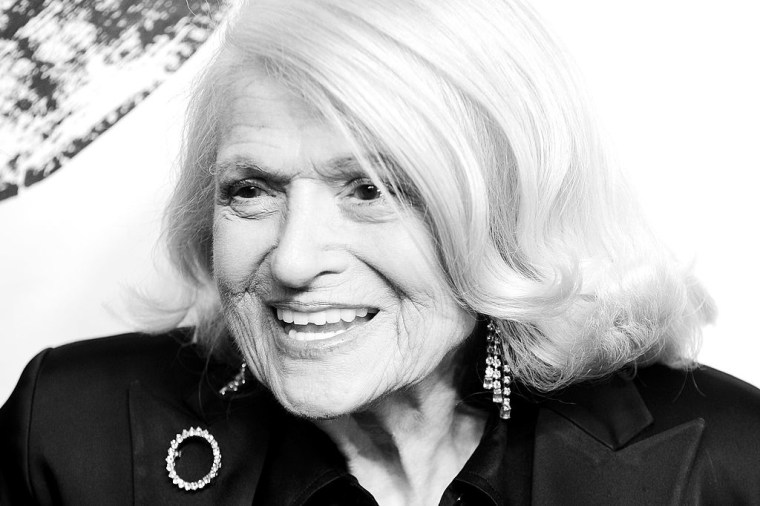
Edie Windsor on June 23, 2014 in New York City.Bryan Bedder / Getty Images for Logo TV
The Defense of Marriage Act, or DOMA, passed in 1996 in response to Hawaii’s brief flirtation with legalizing same sex-marriage, was ruled unconstitutional by the Supreme Court in the June 2013 landmark U.S. v. Windsor decision. The ruling allowed federal benefits to flow equally to same-sex married couples in Washington, D.C., and the 12 states where gay marriage was then legal.
-2014-
Laverne Cox appears on cover of Time
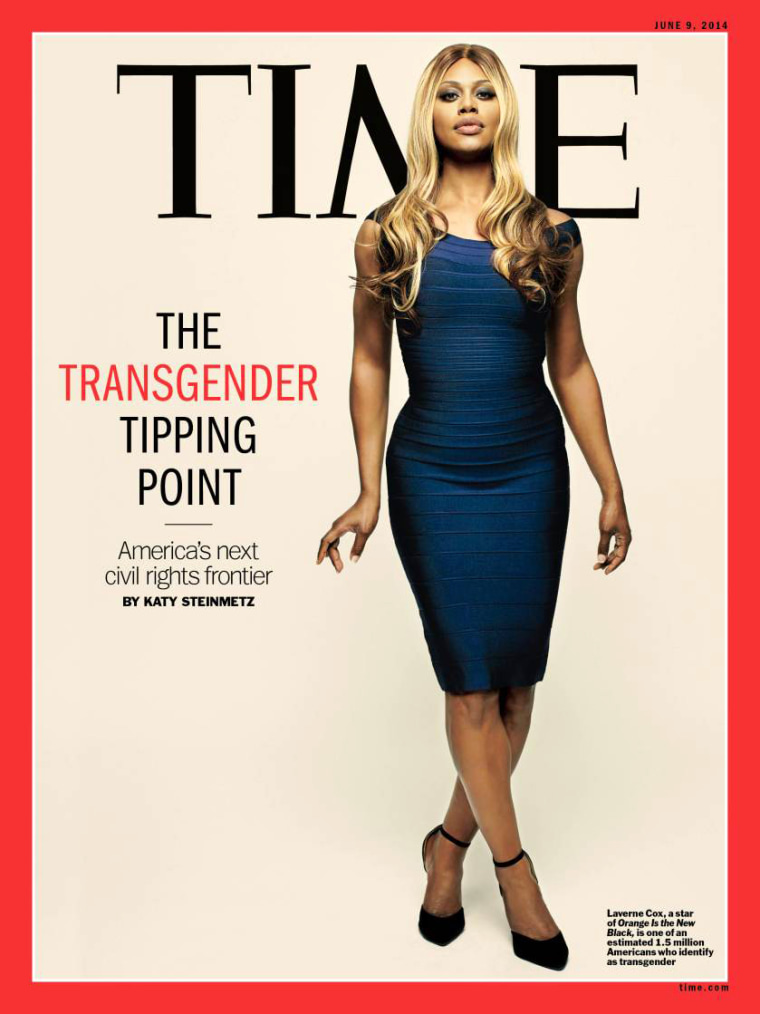
Laverne Cox on cover of TIME in 2014.TIME
Laverne Cox, best known for her role in the hit Netflix series “Orange Is the New Black,” became the first transgender person to appear on the cover of Time magazine in June 2014. A month later, she became the first trans person to be nominated for an Emmy.
-2015-
Caitlyn Jenner comes out as transgender
Caitlyn Jenner on Vanity Fair cover in 2015.Vanity Fair
In a coming out heard ’round the world, Olympic gold medalist Caitlyn Jenner came out as transgender in a glamorous June 2015 Vanity Fair cover photo shot by photographer Annie Leibovitz.
Citing its 2013 decision that overturned the Defense of Marriage Act, the Supreme Court in the landmark June 2015 Obergefell v. Hodges decision found a constitutional right to marriage that included same-sex couples, legalizing gay marriage nationwide. In an iconic image beamed around the world, the White House was lit in the colors of the LGBTQ pride flag to celebrate the ruling.
A gunman opened fire in the Orlando LGBTQ nightclub Pulse on June 12, 2016, killing 49 people. The shooting was briefly the deadliest mass shooting in U.S. history. In a subsequent trial of the shooter’s wife, details emerged showing that the gay club Pulse was chosen randomly after heterosexual clubs appeared to be too securely guarded.
On June 30, 2016, Secretary of Defense Ash Carter announced that transgender Americans would be permitted to serve in the armed forces, sealing President Obama’s legacy as a leader in LGBTQ equality in the military. “This is the right thing to do for our people and for the force,” Carter said.
Kate Brown elected governor of Oregon
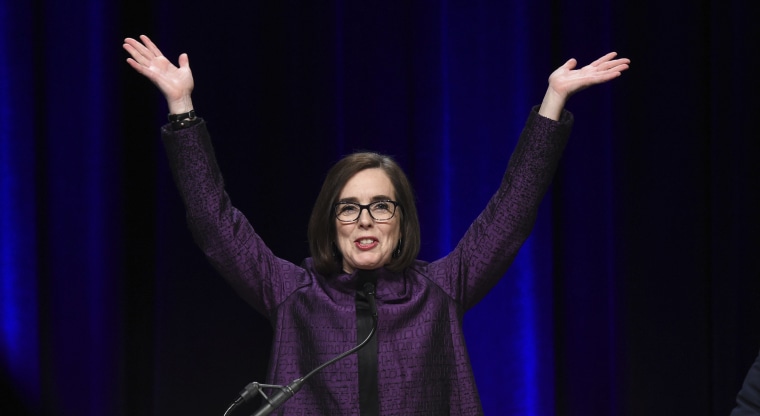
Oregon Gov. Kate Brown speaks to the crowd of supporters in Portland after being elected on Nov. 8, 2016.Steve Dykes / AP
Kate Brown, an out bisexual, made history in November 2016 when she became the first openly LGBTQ person to ever be elected governor of a U.S. state. She had become the governor by default the year prior, after the state’s longest-serving governor, John Kitzhaber, resigned amid a scandal.
-2017-
‘Moonlight’ wins Best Picture Oscar
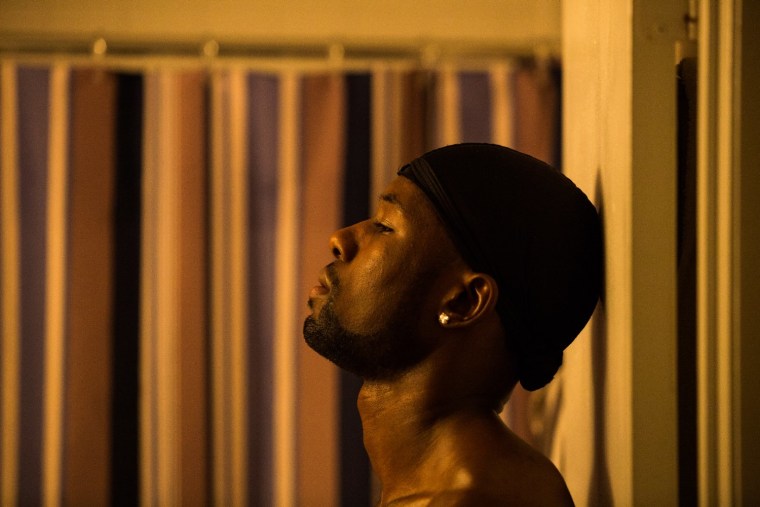
Trevante Rhodes in “Moonlight.””Moonlight” – A24 / IMDB
The 2016 film tracks Chiron, a young black man, who is coming to terms with his homosexuality. “Moonlight” dazzled festival audiences and critics before becoming the first ever LGBTQ-centered film to win an Academy Award for best picture in 2017.
In a series of early morning tweets on July 26, 2017, that reportedly took the Department of Defense by surprise, President Donald Trump announced that he was reinstating the repealed ban on transgender military service.
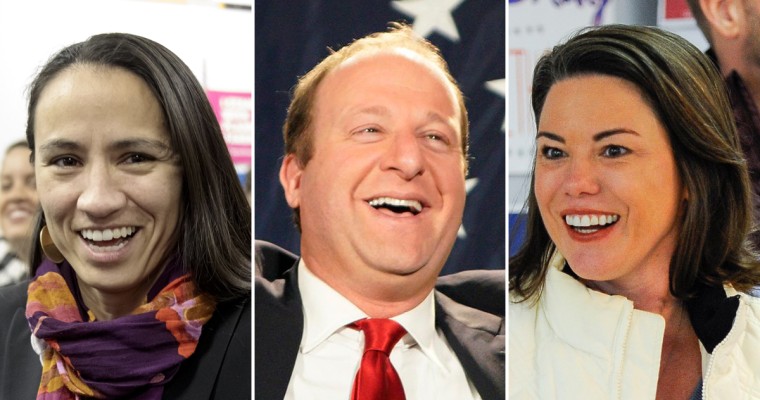
Sharice Davids, Jared Polis and Angie CraigWhitney Curtis, Rick T. Wilking, Craig Lassig / Getty Images / AP Images for Human Rights Campaign
The LGBTQ candidates who saw victory in November 2018’s “rainbow wave” included Democrat Jared Polis, who became the first openly gay man elected governor in the United States, and DemocratSharice Davids, who flipped her district in Kansas against a four-term incumbent to become the first openly LGBTQ member of Congress from Kansas and one of the first two female Native Americans elected to Congress.
I launched a presidential exploratory committee because it is a season for boldness and it is time to focus on the future. Are you ready to walk away from the politics of the past?
In a video posted to Twitter on Jan. 23, 2019, Pete Buttigieg announced the formation of his presidential campaign exploratory committee. The millennial mayor spoke to NBC News and said he once “believed that coming out might be a career death sentence.” Buttigieg is the first openly gay man to ever appear in a Democratic primary debate.
On June 28, 2019, the 50th anniversary of the New York City riot that sparked the modern gay rights movement, #Stonewall50transformed into a giant global celebration of LGBTQ rights. New York City even hosted dueling, record-breaking LGBTQ pride marches
‘They’ is Merriam-Webster’s word of the year
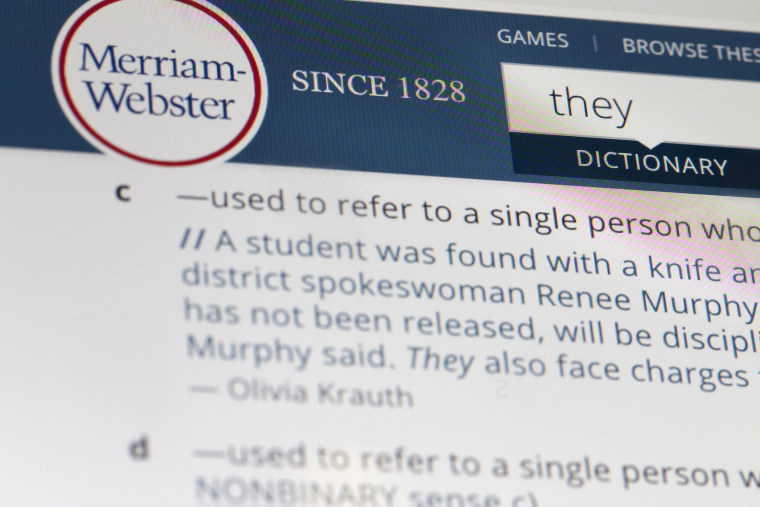
The word “they” is displayed on a computer screen on Dec. 6, 2019, in New York.Jenny Kane / AP
In a “data-driven” decision guided by internet users’ searches, the dictionary brand announced in mid-December that the word of the year is the nonbinary singular pronoun “they,” which preferred by some transgender and nonbinary people. Merriam-Webster added the entry in September.
It surveyed 866 teenage boys in community settings like after school programmes and libraries, covering 20 lower-resource neighbourhoods in Pittsburgh, Pennsylvania.
According to researchers it is the first study to ask teenage boys about violence and attitudes to gender in “US urban, community-based settings”, rather than schools or clinics.
Researchers found that when male high school students supported equality between genders, they were less likely to engage in violent behaviours, for example bullying or sexual violence.
Boys who had seen their peers engage in at least two different abusive behaviours towards women and girls were twice as likely to commit rape and five times as likely to bully others, regardless of gender.
However, of the 866 teenagers, 73.2 percent had engaged in homophobic teasing, for example calling other “homo” or “gay” in a derogatory way.
The study describes the result as “puzzling”, because in contrast to other violent behaviours, views on gender equality had no effect on levels of homophobic teasing, even though questions assessing their views on equality included some about homophobia.
Alison Culyba, assistant professor of pediatrics in the Division of Adolescent and Young Adult Medicine at UPMC Children’s Hospital of Pittsburgh, told CNN: “It is so commonplace, they may see it as a form of acceptable, possibly even pro-social, interaction with their peers.”
Homophobic, biphobic and transphobic teasing and bullying severely affects teenagers around the world, and can lead to mental health problems and even suicide.