The Philadelphia Police Department are set to fire 13 officers for offensive social media posts, which included homophobic and racist sentiments.
This discipline was the result of research done by by the Plain View Project. They published thousands of Facebook posts from jurisdictions around the country, including Philadelphia, in June.
Following the publication of these posts, the Philadelphia Police Department launched an internal investigations.
Overall, the department removed 72 officers from street duty. They gave 13 a 30-day suspension with the intent to formally dismiss them.
Four other officers received a 30-day suspension, three received no other formal discipline, and the rest received varying consequences from formal reprimands to 5-day suspensions.
What did the messages say?
Most of the messages reviewed were homophobic, racist, and Islamophobic in nature.
In one post from 2014, an officer wrote a suspect ‘should be taken out back and put down like the rabid animal he is’. More recently in February, a different officer commented on a news article about an alleged murderer and wrote: ‘Hang him.’
In other posts, officers described Islam as a ‘cult’ which glorified death.
Police Commissioner Richard Ross and Philadelphia Mayor Jim Kenney held a press conference about the matter on Thursday (18 July).
Ross said the 13 officers set to be fired all made posts that advocated violence. He added every officer going forward will receive training about social media and off-duty behavior.
Kenney commented at the conference: ‘We have a duty to represent ourselves and our city. We will not allow this incident to break down the progress we have made and we pledge to do better.’
A project investigating police
A group of Philadelphia attorneys created Plain View Project in 2016. They formed the database when they learned numerous police officers made social media posts that ‘appeared to endorse violence, racism and bigotry’.
As a research project, Plain View identifies such posts.
‘We believe that these statements could erode civilian trust and confidence in police, and we hope police departments will investigate and address them immediately,’ the group states on its website.
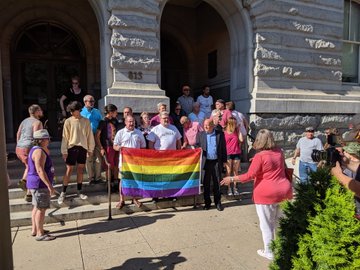
Dozens of Pennsylvanians were geared to make history Monday evening by raising the pride flag for the first time over Reading City Hall. Yet minutes before the event was slated to begin, the city’s mayor, Wally Scott, prohibited council members and city employees via text message from hanging the flag.
“People were disappointed at first, then they just became angry,” Ben Renkus, president of the Reading Pride Celebration, the group that planned the event, told NBC News. “The event was at 4:45 p.m. and many people had to leave work early to attend.”
The flag ceremony coincided with Reading’s 13th annual LGBTQ Pride Celebration, which kicked off this past weekend. The pride flag was supposed to be flown until Sunday, the last day of the festivities.
Following Monday’s last-minute cancellation, Renkus said the group marched to a nearby park where Scott was known to hang out after work, but the mayor wasn’t there. The group now plans to attend the next city council meeting, which is scheduled to be held Monday, with their rainbow flags in hand to express their fury.
“What was supposed to be a proud and historical moment in history today for the City of Reading, the LGBTQ+ community and our allies, turned into a show of blatant, unacceptable discrimination,” the LGBT Center of Greater Reading wrote Monday in a statementposted to its Facebook page. “To those who were on the street today in support; and to those who were with us in spirit, we are resilient; we will continue the fight for our rights.”
Scott contends that anti-LGBTQ discrimination was not behind his decision to cancel the flag-raising ceremony. He said his decision was based on his belief that the rainbow pride flag is a political symbol, and flying it would be against city policy.
“It’s the policy not to put up or endorse movements,” Scott told NBC News. “Numerous people have come into the office asking to put up flags, and we just don’t do it.”
Scott said he’s been asked to put up a Confederate flag and a flag commemorating National Pot Smokers Day, among others.
Renkus does not agree with Scott’s interpretation of the rainbow pride flag, however, and said the flag “represents and validates a specific group of people.”
The rainbow flag has been a universal symbol of LGBTQ pride, equality and inclusion since June 1978, when it made its debut at the San Francisco Gay Freedom Day Parade.
Renkus filed a formal complaint with the Human Relations Commission at Reading City Hall, alleging that Walker’s actions were discriminatory.
“The city has had LGBTQ protections in its ordinance since 2009, and we believe the mayor’s refusal to allow us to fly the flag goes against those protections,” Renkus said. “He’s also the first mayor in the Pride Celebration’s history to not attend any Pride events.”
Renkus is hoping for an apology and the ability to fly the pride flag, noting that flags of other countries and a POW/MIA flag have flown over City Hall in the past.
Donna Reed, a member of the Reading City Council, said the council followed protocol and said Scott showed no indication that he would cancel the original flag ceremony beforehand.
Scott, however, claimed he did not know about Monday’s flag ceremony until the afternoon of the event and insisted “nothing was done maliciously by me.”
“I have no objections with them holding the flag on the City Hall steps,” he said. “I just didn’t want to hang it up.”
News of the incident made its way to the state level, with Pennsylvania Lt. Gov. John Fetterman calling on Scott to reconsider his decision. Fetterman also announced his plans to attend a pride event in Reading to show solidarity with the city’s LGBTQ community.
In May 1933, the Nazi-sympathizing German Student Union entered Magnus Hirschfeld’s Institute of Sexual Research in Berlin.
Hirschfeld’s expansive library of sexual and gender studies was confiscated and later burned in the streets of the German capital, one of many book burnings in Nazi Germany that would decimate the records of this pioneering institute.
Some of the Institute’s records were of the countless sexual and gender minorities who passed through its doors between 1919 and 1933, and even earlier, when Hirschfeld ran the Scientific-Humanitarian Committee, the institute’s predecessor and world’s first LGBTQ rights organization.
“The Nazis tried to destroy information about that group by burning the books and magazines and photographs that were in that amazing institute,” independent historian Jonathan Ned Katz, founder of OutHistory.org, said.
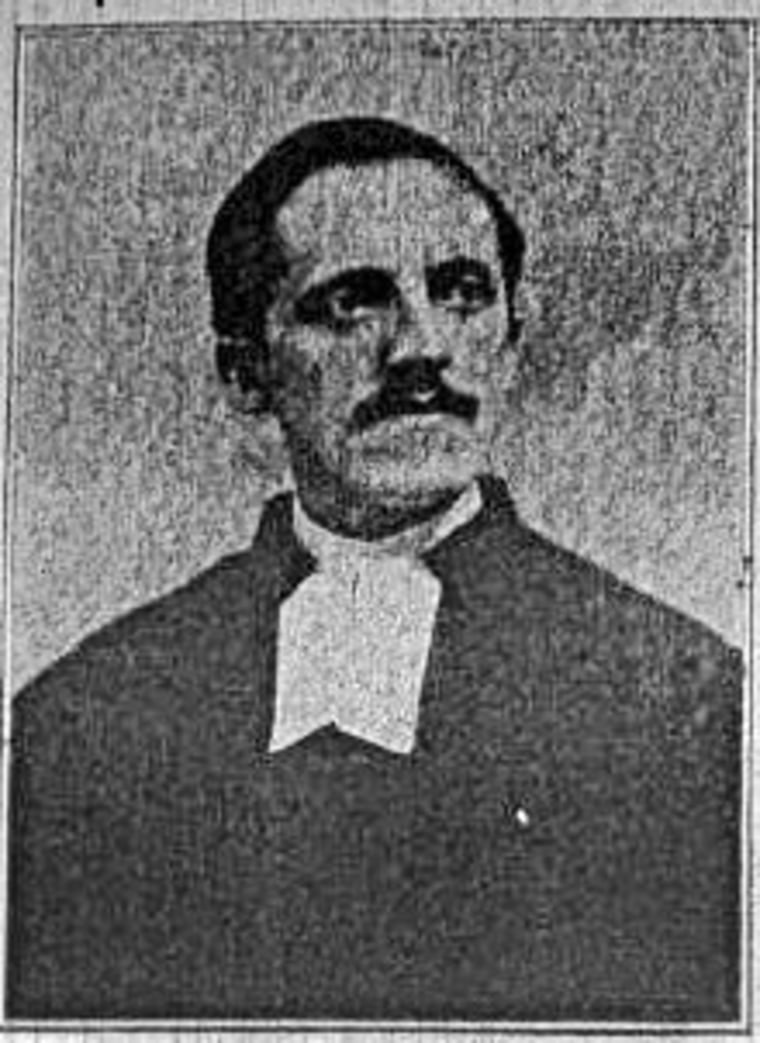
Pastor Carl SchlegelOrganisirt
However, despite the Nazi’s best efforts and thanks to Katz’ research, the name of one of the earliest activists for homosexual rights in America has been revealed: Rev. Karl Schlegel, a German who immigrated to the United States in the late 19th century. (He was also known as Carl or Charles while living in America.)
Based on newly unearthed records that have been uploaded to OutHistory’s website, it appears Schlegel both harbored same-sex attractions and advocated on behalf of homosexuals, bisexuals and asexuals over 100 years ago.
Born in Germany in 1863, Schlegel immigrated to the United States in 1878 at age 15 and later preached as a minister. According to OutHistory.org, an August 1903 edition of the Scientific-Humanitarian Committee’s journal said that Schlegel visited the committee “numerous” times and “aims at an association of his Uranian fellow ministers as well as the founding of a subcommittee in New York.”
“Uranian” is an English translation of the early German word for homosexual: urning.
“Schlegel apparently considered other homosexual Protestant ministers good candidates for his U.S. emancipation organizing,” Katz wrote.
Between September and November of 1903, during a trip to Germany, Schlegel was arrested for an alleged sexual offense and later released. “Hopefully this unpleasant incident will be without further fateful consequences for him professionally,” the Scientific-Humanitarian Committee’s journal wrote at the time.
In 1905, after being dismissed from his position at the First German Reformed Protestant Congregation in New York City, Schlegel relocated to New Orleans. The Times-Picayune announced his first sermon on March 27, 1905.
But less than a year later, in December 1906, the New Orleans Presbyterian Church was investigating Schlegel for unnamed “rumors.”
The church elders met and charged Schlegel with multiple counts of disseminating and defending “the naturalness and lawfulness of Sodomy, otherwise called ‘Homosexuality’ or ‘Uranism,’” according to Presbyterian Church records from that time. Schlegel pleaded not guilty, and the Presbyterian Church proceeded to trial. Entered into evidence was a German language copy of the Yearbook for Sexual Intermediate Types, the annual publication of the Scientific-Humanitarian Committee. The panel found Schlegel guilty.
Church records quote him as saying on Jan. 29, 1907: “Let the same laws for all the intermediate stages of sexual life: the homosexuals, heterosexuals, bisexuals, asexuals, be legal as they are now in existence for the heterosexuals, that is, they should be under punishment: First, if they use compulsion. Second, if they are found to offend publicly. Third, if they use or misuse children, are dangerous and corrupting and will lead only to evil.”
The church judges responded by calling his views “evil and only evil” and finding him “totally disqualified for the office of the Christian ministry” and “do prohibit him from exercising any of the functions thereof.” By January 1907, Schlegel was jobless thanks to his LGBTQ activism.
Schlegel returned to New York, and by 1912, the New York Herald wrote that he had become a “spiritualist,” a religious movement that communicates with spirit popular at the time.
Schlegel died July 25, 1922, in New York City. He is buried at grave number 18004 at the Evergreens Cemetery in Brooklyn, New York.
“I aspire to picnic there and say hello to the Rev. Schlegel and thank him for his early emancipation activities,” Katz told NBC News.
Katz said he hopes that this is “just the beginning” of learning about Schlegel’s life, and he encouraged members of the public with more relevant information to reach out to him at OutHistory.
The United States is “not where we need to be” on increasing employment levels of lesbian, gay, bisexual, and transgender people, a top economic policymaker said on Tuesday.
Federal Reserve Bank of New York President John Williams said at an LGBTQ finance industry event that unemployment rates are nearly double the national average for sexual and gender minorities.
“As President of a Federal Reserve Bank, I am focused on two vital economic goals: maximum employment and stable prices for the U.S. economy,” Williams said in remarks prepared for delivery in New York. “These statistics paint a clear picture of why conferences like this one are so important: We are not where we need to be.”
Williams’ comments come as celebrations take place around the world to mark the Stonewall uprising in New York 50 years ago when patrons of a gay bar fought back against police harassment, which is seen as the fuel that sparked the modern LGBTQ rights movement. Gay pride marches will also be celebrated around the world on June 30.
Williams did not comment on his economic or policy outlook less than a week after the Fed signaled it could cut interest rates by as much as half a percentage point over the remainder of this year in response to increased economic uncertainty and a drop in expected inflation. Yet one argument for keeping rates lower for longer is that doing so can bring more marginalized people into the workforce.
After a string of successful general and special elections, the number of LGBTQ elected officials in the U.S. today stands at 698 — the highest number ever, and an increase of nearly 25 percent over last year, according to the Victory Institute, which tracks openly lesbian, gay, bisexual, transgender and queer elected officials.
The data was released as part of Victory’s 2019 Out for Americareport; in last year’s report, there were 559 out LGBTQ officials.
Some of the most well-known LGBTQ officials to take office this year are Colorado Gov. Jared Polis, Sen. Kyrsten Sinema of Arizona, Rep. Sharice Davids of Kansas and Chicago Mayor Lori Lightfoot. All are Democrats.
“Some of it is that more out people are running, some of it is that more out people are getting elected, and then more people who are in office are coming out,” Victory Institute President and CEO Annise Parker, the former mayor of Houston, told NBC News. “So it’s becoming much more acceptable, so the numbers are going up every day.”
However, Parker noted that for all the increase in representation, the LGBTQ community remains severely underrepresented in raw terms. The 698 out LGBTQ elected officials make up only 0.13 percent of all elected officials nationwide. Gallup estimates that the LGBTQ community is roughly 4.5 percent of the population.
“Unfortunately, even though this is the highest number we have ever had, we need to elect nearly 23,000 more to achieve parity in elected office,” Parker said.
The number of black LGBTQ elected officials rose from 30 to 43, Latino LGBTQ officials rose from 58 to 74, and transgender elected officials rose from 13 to 20.
“It is time for our first trans member of Congress, our first LGBTQ governor of color, and our first LGBTQ American president,” Parker said in a statement. She called for LGBTQ people to be elected “to every school board, to every city council and to every state legislature.”
62 percent of gay and lesbian Black Census respondents report having felt threatened or harassed at least a few times a year, while a quarter say they feel threatened or harassed once a week or more.
The data comes from the US-based Black Futures Lab, which gathered responses from 5,400 black LGB people to its self-selecting Black Census survey.
Black queer people: Violence is a major problem
According to the group’s report, “more than 78 percent of LGB Black Census respondents report that violence against gays, lesbians, and transgender people is a problem in the community, and 62 percent or more say it is a major problem.”
The data also shows that black LGB people’s biggest concerns include “bread-and-butter economic issues like low pay, unaffordable health care, and access to housing.”
Black Lives Matter co-founder Alicia Garza, who set up the project, explained: “Too often, Black LGB+ people are perceived as distinct and separate from the larger Black community and defined more by their sexual orientation than their race.
“Attending a gay wedding and changing your Facebook profile picture to a rainbow flag is great, but it’s simply not enough.”
“In fact, LGB+ respondents prioritise the same concerns as the rest of the Black community and face triple consciousness: violence and discrimination based not only on race but gender, gender identity, and sexual orientation.”
“Black LGB+ people often lose employment opportunities, access to housing and quality affordable health care because of how we identify.
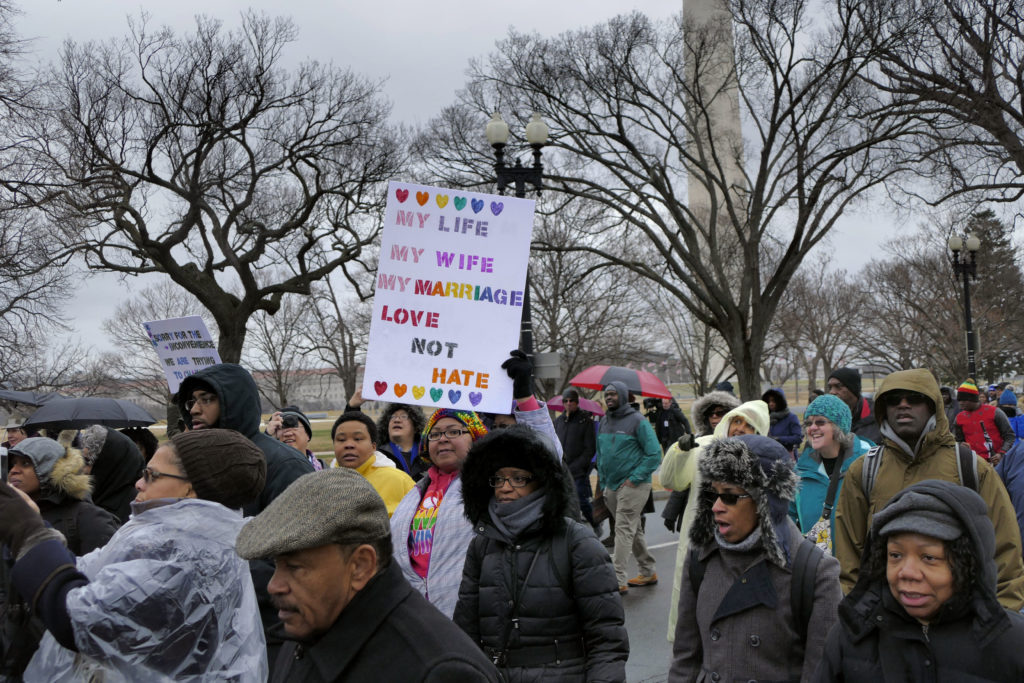
A woman holds a pro-LGBT placard on a Martin Luther King Day march. File photo. (Reza/Getty Images)
“It is important for policymakers, activists and community groups to remember this and create an agenda that reflects that understanding when representing and serving Black LGB+ people.
“Attending a gay wedding and changing your Facebook profile picture to a rainbow flag is great, but it’s simply not enough.”
Separate Black Census report will focus on trans experiences
The group is planning to release a separate report looking at the experience of trans and non-binary people.
It explained: “While transgender and gender non-conforming people are frequently combined with LGB+ people into a single group (often described as LGBTQ+), Black Futures Lab has chosen to consider gender identification separately from sexual orientation in order to highlight in a separate report the distinct viewpoints of Black Census respondents who identify as transgender, gender non-conforming, or identify with a gender different than male or female.”
On the other side of the Atlantic, UK Black Pride is taking place on Sunday (June 7).
GLAAD, the world’s largest LGBTQ media advocacy organization, today released a new report highlighting the records of the anti-LGBTQ activists appointed to serve on the U.S. State Department’s new “Commission on Unalienable Rights.” According to reports, the “Commission” will provide the federal government “an informed review of the role of human rights in American foreign policy” – putting LGBTQ acceptance at risk on a global scale.
“This ‘Commission’ is a farce and further illustrates the bold-faced anti-LGBTQ agenda of this administration,”said Sarah Kate Ellis, President and CEO of GLAAD. ”The Trump Administration is knowingly appointing activists who have made careers out of fighting against LGBTQ progress and is now providing them an opportunity to export their anti-LGBTQ activism around the world through the U.S. State Department.”
GLAAD’s new report dug into the records of the ten members appointed to serve on the State Department’s Commission and found troubling, anti-LGBTQ history in seven of its members. The Commission includes members like Mary Ann Glendon, a longtime anti-LGBTQ activist who claimed marriage equality was a “radical social experiment,” and Shaykh Hamza Yusuf Hanson, who claimed marriage equality was “one of the signs of the End Times.” The launch of the “Commission on Unalienable Rights” now marks the 117th attack against the LGBTQ community by the Trump Administration since the start of 2017.
GLAAD REPORT: Anti-LGBTQ Members of the State Department’s New “Commission on Unalienable Rights”
Peter Berkowitz — Criticized the Supreme Court’s 2003 ruling overturning sodomy laws as “dangerous,” writing that “Justice Kennedy’s majority opinion seemed to follow the logic of his moral and political judgments rather than the logic of the law.”
Mary Ann Glendon (Chair) — Has written extensively on her view that marriage equality is a “radical social experiment” that harms children. She alsorecently wrote a blurb for a viciously anti-trans book, calling the book—which culminates in a plan of action that calls for the complete erasure of trans people —“eminently readable and insightful.”
Shaykh Hamza Yusuf Hanson — Lectured that his belief is for Muslims to repress being gay, and (at 3:23) that homosexuality and same-sex marriage are prophesized as “one of the signs of the End Times.”
Jacqueline Rivers — Delivered a speech at the Vatican, insisting that LGBTQ activists were “abolishing in law the principle of marriage as a conjugal union and reducing it to nothing other than sexual or romantic partnerships or domestic companionship.” She went on insist that LGBTQ activists have “unjustly appropriated” civil rights language.
Meir Soloveichik — Called the notion of gay people’s marriages “nonsensical” (see page 71); he went on to suggest that arguments favoring bestiality will follow same-sex marriage (page 72); Also, blurbed an anti-LGBTQ book written by the National Organization For Marriage’s cofounder.
Christopher Tollefsen — Wrote an anti-trans essay that culminated in the opinion that “…attempts to change one’s biological sex all fail. That is an undefeatable reason against trying to do so.” In a follow up, he further argued that “…it is a mark of a heartless culture that it encourages such confusion even to the point of encouraging bodily mutilation as a solution to gender dysphoria and prohibiting therapy that might be psychologically and spiritually beneficial.”
F. Cartwright Weiland (Rapporteur) — Served as policy analyst for the Texas Conservative Coalition Research Institute, an anti-LGBTQ think thank that advised the Texas legislature and Governor’s office; also served as speechwriter to anti-LGBTQ US Senator John Cornyn.
LGBTQ acceptance has been threatened by President Trump and his administration since the start of 2017. Not only has President Trump banned transgender Americans from serving in the nation’s armed forces, but his administration has also opposed the Equality Act, a bill which would provide across-the-board protections for LGBTQ Americans at home, at work, and in their communities. A full list of the Trump Administration’s anti-LGBTQ actions can be found by going to GLAAD’s Trump Accountability Project.
U.S. Senator Cory Gardner (R-CO) has no problem pretending to be pro-LGBT when he’s at a fundraiser hosted by a conservative LGBT organization, but he can’t hide his record from voters or from his challenger, a gay Democrat.
Dan Baer, a former U.S. Ambassador under President Barack Obama, announced in April he is running for the U.S. Senate, hoping to win the Democratic nomination and the Senate seat currently held by Gardner. As The Advocate reports, Baer “just received the endorsement of the LGBTQ Victory Fund,” which works to help elect out LGBTQ candidates.
Baer, if elected, would be the first openly gay man to serve in the U.S. Senate. Senator Tammy Baldwin, who is a lesbian, was the first out LGBT person elected to serve in the Senate.
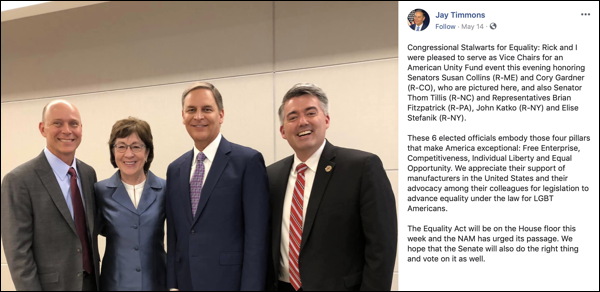
As the Colorado Times Recorder reported in May, Sen. Gardner “was one of three swing-state Republican senators to receive money from a fundraiser hosted by American Unity Fund (AUF), a conservative LGBT rights group.”
Here he is posing with “AUF supporter Jay Timmons, president of the National Association of Manufacturers,” who “posted a picture of Gardner and U.S. Sen. Susan Collins (R-Maine) posing with Timmons and his husband at the event.”00:0100:45
Senator Gardner’s anti-LGBT history is well-known. He has been rated extremely low (12% and 16%) by HRC.
Gardner has a troubling relationship with marriage equality. He has stated very publicly his opposition, but in his tough race against Democrat Tom Udall, the incumbent, Gardner massaged his position, saying it was a matter for the courts.
In June of 2014 HRC called Gardner’s views on equality “incredibly antiquated,” noting he “voted against allowing unmarried same-sex partners to adopt children and to prohibit sexual orientation discrimination.” Gardner, HRC said, “is determined to discriminate against and exclude LGBT people.”
Later that year, less than one month before he would be elected to the U.S. Senate, Gardner “issued a statement … that he isn’t budging from his position that marriage should only be between a man and a woman but also emphasizing his respect for the law and for all couples,” Colorado’s Fox 31 reported.
“My views on marriage have long been clear,” Gardner told the Denver-based station. “I believe we must treat each other with dignity and respect. This issue is in the hands of the courts and we must honor their legal decisions.”
His press secretary in that same article is quoted saying Gardener is “a strong supporter of marriage equality.”
Marriage equality seems to be a marriage of convenience for Sen. Gardner.
U.S. Secretary of State Mike Pompeo on Monday announced the formation of a new commission that will take a “fresh look” at human rights through the lens of “natural law,” and civil and human rights advocates are outraged. In preliminary filings the State Dept. noted the Commission will explore “our nation’s founding principles of natural law and natural rights.”
“Natural law,” is religious right wing extremist code for anti-abortion and anti-LGBTQ rights, especially marriage for same-sex couples.
Secretary Pompeo, a known right wing Christian extremist in his own right, has named Mary Ann Glendon, a professor who is also his former mentor, to lead the “Commission on Unalienable Rights.”
“I hope that the commission will revisit the most basic of questions: What does it mean to claim something is, in fact, a human right?” Pompeo told reporters Monday, adding, as Yahoo News notes, that “words like rights can be used for good or evil.”
Glendon should understand Pompeo’s remarks. She penned a 2004 op-ed supporting a constitutional amendment to ban same-sex marriage. In a unique twist of language she claimed the amendment “should be welcomed by all Americans who are concerned about equality and preserving democratic decision-making.”
And in a shocking move Glendon chastised the awarding of a Pulitzer Prize to the Boston Globe for its work exposing pedophile priests. She reportedly said; “If fairness & accuracy have anything to do with it, awarding the Pulitzer to the Boston Globe would be like giving the Nobel Peace Prize to Osama bin Laden.”
Anti-gay hate group leader Tony Perkins was briefed on the Commission before it was officially announced, CBS News reports.
A State Dept. official says the Commission is a “personal project” of Secretary Pompeo’s, and Politico reports the Commission “was conceived with almost no input from the State Department’s human rights bureau, people familiar with the matter say, effectively sidelining career government experts who have focused on human rights policy and history across numerous administrations.”
“This administration has actively worked to deny and take away long-standing human rights protections since Trump’s inauguration. If this administration truly wanted to support people’s rights, it would use the global framework that’s already in place. Instead, it wants to undermine rights for individuals, as well as the responsibilities of governments.”
“This approach only encourages other countries to adopt a disregard for basic human rights standards and risks weakening international, as well as regional frameworks, placing the rights of millions of people around the world in jeopardy.”
“International agreements, like the Universal Declaration for Human Rights, have been upheld by prior administrations over the last 71 years, regardless of their party. This politicization of human rights in order to, what appears to be an attempt to further hateful policies aimed at women and LGBTQ people, is shameful.”
The Israeli-Palestinian conflict — ostensibly not about LGBTQ issues and thousands of miles from the U.S. — has become a potent flashpoint within the queer community.
For years, the debate over Israel’s treatment of the Palestinians has roiled LGBTQ gatherings and parades where Jewish groups wanted to display symbols of the religion. In 2017, organizers of the Chicago Dyke March kicked women out for carrying the Pride flag with a Star of David, citing its resemblance to the Israeli flag.
This month, a soon-to-open gay bar in Minneapolis became embroiled in the dispute when a journalist unearthed tweets by the bar’s owner calling for the death of all Israelis. The owner also accused Zionist Jews, broadly defined as those who support a Jewish state in Israel in some form, as running America. The tweets were both anti-Semitic and anti-Zionist, but in many other recent controversies, parsing those two ideologies can be divisive.
As it is, many Americans living at the intersection of Jewish and queer identities have been alarmed by news reports that affect the two groups: synagogue shootings, rollbacks in federal rights for LGBTQ people, swastikas painted on Jewish institutions, Israeli and Pride flags being burned and urinated on and rising hate crimes against Jews and queer people. Activists say that shared sense of alarm should prevent political disagreements over Israel from boiling over into anti-Semitism.
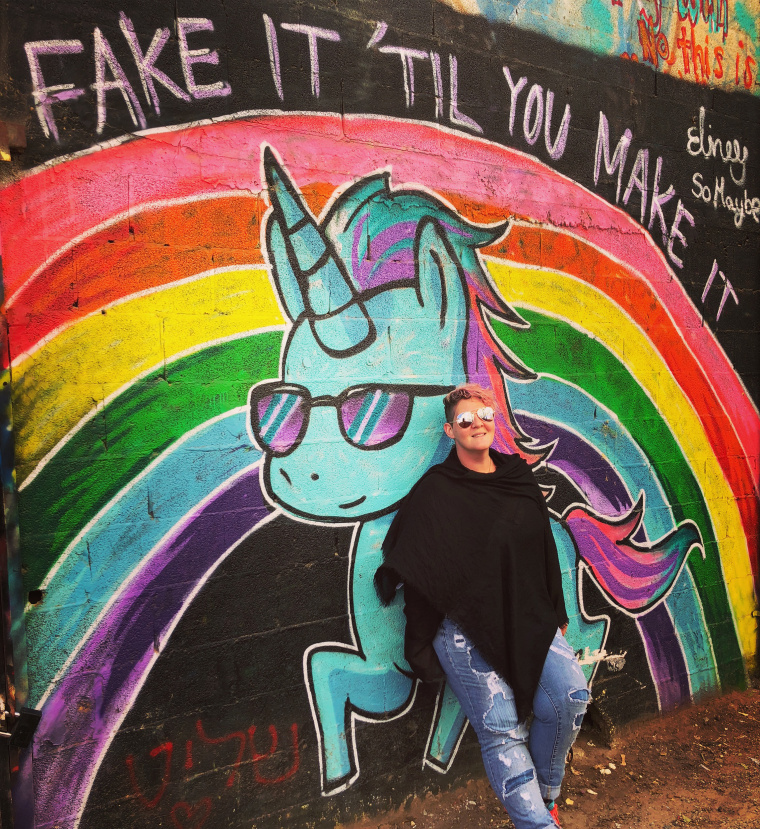
A.J. CAMPBELL
“It’s important that we all call out anti-Semitism in our own spaces,” said Amanda Berman, founder of the “unabashedly progressive” and “unquestionably Zionist” group Zioness. “It’s hard work to call it out in your own movement.”
CONFRONTATION OVER SYMBOLS
At this year’s Creating Change conference in Detroit, a national event that focuses on LGBTQ issues, pro-Palestinian protestors disruptedthe opening ceremony to condemn the lack of Palestinian programming. At the 2016 conference, in Chicago, the pro-Israel LGBTQ organization A Wider Bridge shut down its event and evacuated guests because of intense protests.
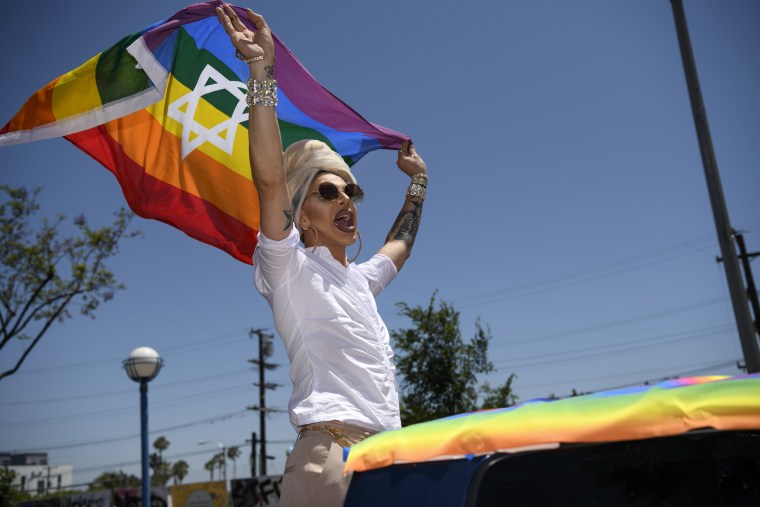
A participant holds a rainbow flag with a Star of David symbol during the LA Pride Parade in West Hollywood on June 10, 2018.Roven Tivony / NurPhoto via Getty Images file
Whether that flag that has produced so many protests is Jewish, Israeli or both is complicated. The Star of David has been a Jewish symbol for hundreds and possibly thousands of years, long before the founding of the state of Israel in 1948. The Pride flag with the Jewish star in the middle of a rainbow background is the most common symbol of Jewish LGBTQ Pride, but it is not the official Israeli Pride flag, which replaces the two blue banners at the top and bottom of the Israeli flag with rainbow colors.
Rae Gaines, 30, is an organizer of the Dyke March in Washington that took place June 7. Gaines, who is Jewish but anti-Zionist, said it was unfortunate that Jewish women were kicked out of the Chicago march and wanted the situation handled better in Washington. Organizers there decided to ask attendees not to bring “nationalist symbols” of any country, but allowed Palestinian flags because they “don’t yet have a nation.”
“It can be scary to be a Jew. I can relate to the fear of existing,” Gaines said. “I wanted to relate to that, but without being nationalist.”
Gaines said march organizers had alternate Jewish Pride flags on hand and intended to ask anyone with a Star of David on their flag to swap them out in order to avoid making Palestinians feel unwelcome or unsafe. However, the nuanced approach Gaines hoped for turned into a bitter public confrontation.
A.J. Campbell, 50, an activist, contacted the march to ask about bringing the rainbow flag with the Jewish star, with the events in Chicago in mind. She was angered when she was told it “would not be welcome.” She took the issue to the media, and it was widely reported and condemned as a ban. The National LGBT Taskforce and the Human Rights Campaign disaffiliated from the march, condemning the policy as anti-Semitic and not inclusive.
“There’s Pride flags with crosses and crescent moons in the center. The Jewish star is our symbol,” Campbell said. “I would never ask Palestinians to censor their symbols,” she continued, noting that some Jews might feel unsafe around a Palestinian flag because of terror attacks against Israelis.
A group of 30 people, including Campbell, showed up to the Dyke March in Washington with their flags and argued with organizers about whether the placement of the star at the flag’s center was equated with Zionism and if the star should be placed elsewhere on the flag.
The group ultimately joined the march, flag in tow. Gaines said there was never an intention to block the flag but rather a hope people would understand why it wasn’t welcome.
“The narrative became that we were a space that was anti-Semitic, which was painful,” Gaines said. “I’m a Jew who loves being Jewish, so it hurts.”
EXCLUDED OVER MIDEAST POLITICS
Some LGBTQ Jews embrace the Jewish Pride flag’s similarity to the Israeli flag, saying they want to celebrate their connection to Israel as part of their intersectional identity. However, some say if they openly identify as anything other than anti-Zionist, they are unwelcome in certain queer spaces.
Emily Cohen, 36, a queer woman who runs an advocacy group for transgender people and other underserved groups in South Florida, said she is constantly defending her beliefs in LGBTQ spaces.
“It’s tiring to have to explain my position over and over,” she said. “There’s a line in the sand, you’re on one side or the other, and it shouldn’t be that way.”
Emily Cohen on a trip to Tel Aviv with A Wider Bridge.Courtesy Emily Cohen
In 2012, Cohen ran an LGBTQ student center at a South Florida university. She said she kept her Judaism quiet, because the students were “vehemently anti-Israel.”
That experience inspired her to explore her connection to Israel, so she went on a mission there with A Wider Bridge.
She said she came back emboldened to defend her support for Israel existing as a Jewish state, clarifying that she would like to see an end to the conflict and a Palestinian state. But she said the situation is complicated and cannot be blamed on or fixed solely by Israel.
She explains to friends that the Israeli government does not represent all Israelis, just as President Donald Trump does not speak for all Americans. Still, she said some of her queer friends dismissed her trip as a brainwashing effort by Israel supporters.
She said that sometimes the comments are blatantly anti-Semitic.
“People talk as if Jews are racist and elitist for wanting their own country, that Jews like to steal land,” she said. “It’s super uncomfortable for me.”
Cohen points out that in Israel, most LGBTQ people live safely with many rights, even if far from full equality, while many queer people in Palestine cannot live openly. She asks why pro-Palestinian queer people don’t specifically condemn queer oppression in Palestine, noting a report of Hamas executing a gay man in Gaza by throwing him off a building.
Gaines, the Washington march organizer, said that discussion of condemning the reported Palestinian brutality against queer people did not come up in planning meetings for the march, which considered itself “fiercely” pro-Palestinian. “Perhaps that’s something we can talk about for next year,” Gaines said.
Alyssa Rubin, 24, a queer activist with IfNotNow, a group that advocates ending the occupation of Palestinians, also declined to specifically condemn Palestinian oppression of queer people.
“Palestinians deal with multiple systems of oppression — from the occupation to the patriarchy and homophobia,” she said.
But, unlike many progressive activists, she also declined to dismiss Pride events in Israel, such as last week’s parade in Tel Aviv with over 250,000 participants, as “pinkwashing,” or an attempt to distract from the occupation of Palestinians.
“Queer Israelis have a right to celebrate being queer,” Rubin said. “Terrible things are happening in the U.S. right now, but we still celebrate Pride. The Dyke March has anti-colonialist politics, yet they’re in the U.S., colonial sins and all.”
Rubin said that while support for Israel can be a litmus test for Jews in queer spaces, it can also be a test for queers in Jewish spaces. She cited events in which Hillel, a Jewish organization across college campuses that supports Israel, banned queer Jewish groups that partner with anti-Zionist groups.
“Unquestionably supporting Israel should not be a requirement for Jews to support Jewish queers,” she said. “Hillel should support all queer Jews, regardless of Israel politics.”
All of the activists interviewed said their Jewish and queer identities are tightly bound and most said they have struggled to gain acceptance within the queer community, the Jewish community or both.
“We’ve made so much progress as queer Jews,” Campbell said. “I did not expect the next fight to be within the queer community.”