The number of Americans who openly identify as LGBT has hit a record high after increasing for the sixth year in a row, according to a new study.
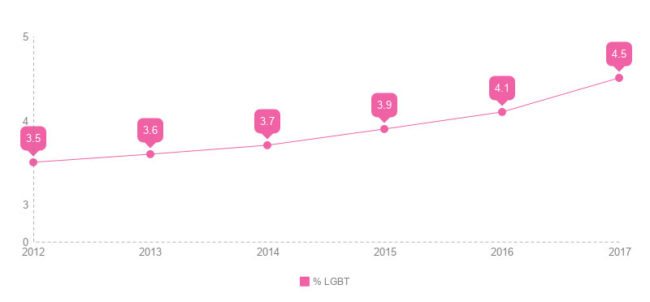
Gallup – a research-based consultant company, known for its opinion polls worldwide – recently released new data that showed a record-breaking 4.5 of Americans surveyed identified as LGBT.
As part of the daily tracking performed by the major polling company, Gallup spoke to over 340,000 people in 2017.
In their polls, Gallup found that 4.5 percent of the population identified as LGBT, an increase from 4.1 percent in 2016.
The company began to ask whether survey-takers identified as LGBT in 2012 and has seen an increase every year since.
(Gallup Daily Tracking)
In 2012, 3.5 percent of the adults surveyed identified as LGBT, compared to 3.7 percent in 2014.
If 4.5 percent of the adult population of the US were LGBT, as this study indicates, it would mean that over 11 million adults in the US would currently identify as LGBT.
Gallup also found that there was a significant generational gap in how people identify.
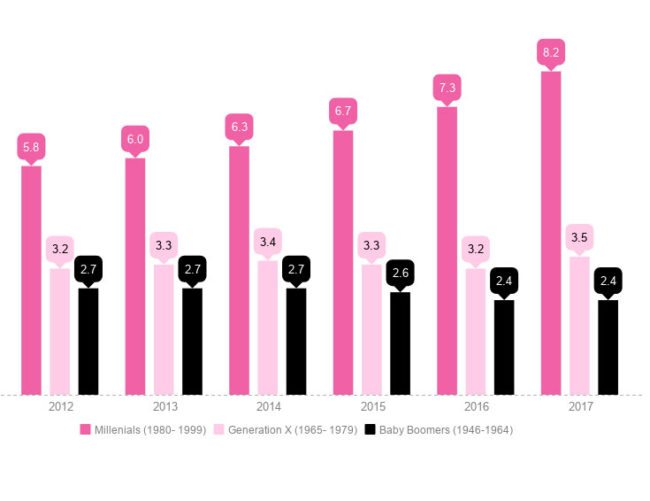
The increase in Americans identifying as LGBT has been driven mainly by millennials, which Gallup records as those born between 1980 and 1999.
Gallup’s data showed that the percentage of LGBT millennials increased from 7.3 percent in 2016 to 8.1 percent in 2017 – up from 5.8 percent in 2012, when the company started research on the issue.
(Gallup Daily Tracking)
The Gallup surveys also included respondents born between 1913-1945.
Gallup also measured people who identified as LGBT by household income and by race and ethnicity.
The survey found that people with lower incomes were more likely to openly identify as LGBT, as they had seen every year since the start of polling about sexuality in 2012.
The results from another recent poll by Gallup marked the highest level of support the firm has ever recorded in more than 20 years of asking Americans about their views on the issue.
Gallup first surveyed Americans on the same-sex union in 1996. Back then, just 27 percent of those queried supported gay marriage.
However, according to the 2017 data, 67 percent of Americans support marriage equality.
The new data showed that 83 percent of those who classed themselves as Democrats said they support legally recognised same-sex marriage – compared to less than half (44 percent) of Republic respondents.
The Department of Justice wants to stop collecting data about the sexual orientation and gender identity of 16- and 17-year-olds, officials announced this week.
The National Crime Victimization Survey is a twice-annual report that collects the data of up to 135 thousand households to understand the “frequency, characteristics, and consequences” of crime in the United States, according to the Bureau of Justice Statistics. Since 2016, the NCVS has given participants 16 and older the option to confidentially list their sexual orientation and gender identity. The survey has been especially useful for acknowledging under-reported crimes.
In a statement released on Wednesday, the DOJ announced its intentions to raise the minimum age “due to concerns about the potential sensitivity of these questions for adolescents.”
The move drew a quick rebuke from advocacy groups, including the University of California-Los Angeles’ Williams Institute, a think tank dedicated to LGBTQ+ research and public policy. In a statement, the Williams Institute argued for the necessity of the data, saying it was essential for understanding violence against LGBTQ+ groups.
“The Bureau of Justice Statistics at the Department of Justice has been a leader in advancing knowledge about the LGBTQ+ population, but the Bureau’s new leadership seems to want to bury its head in the sand,” Director of Federal Policy Adam Romero says in the statement.
This point was echoed by another advocacy group, New York-based Gay, Lesbian & Straight Education Network. “What’s measured is what matters when it comes to public policy,” said executive director Eliza Byard to Mother Jones.
For instance, in August 2016, the Center for Disease Control and Prevention published data that detailed the health disparities and high rates of violence suffered by lesbian, gay, and bisexual high school students. The groundbreaking report has been “hugely important for designing public health programs run out of the CDC,” according to Byard.
On the CDC’s own website, the agency states, “Collecting information about students’ sexual identity and about the sex of their sexual contacts is necessary.”
While LGBTQ+ advocacy groups do not deny the sensitivity of the questions, they find the DOJ’s argument disingenuous. “Youth have been answering questions about their sexual orientation for years, in numerous studies, as well as on federal surveys,” said Kerith J. Conron, Blachford-Cooper Research Director and Distinguished Scholar at the Williams Institute.
Conron points out that two other national surveys have asked similar questions to even younger respondents. The 2015 Youth Behavior Risk Survey included respondents as young as 13, and the National Survey of Family Growth polls subjects as young as 15.
“We know that LGBTQ+ youth are more likely to be victimized, sometimes by their own families, and we need data from the NCVS to learn whether crimes are reported and how the criminal justice system is responding to young LGBTQ+ victims,” said Conron. “Instead of dropping these items from the NCVS, which were cognitively tested and performed well, the Department of Justice should focus on making it easier for youth to answer questions by investigating strategies to improve the data collection process.”
This latest move falls into a strategy of the Trump administration to ignore LGBTQ+ people into bureaucratic nonexistence, denying them use of government protection and services. For historically marginalized groups, the political nostalgia of “Make America Great Again” always represented a red flag of regressive policy. There is no “again” for racial, ethnic, sexual, or gender minorities; there is only the hard-won progress accrued over the last few decades and the current threat to that progress.
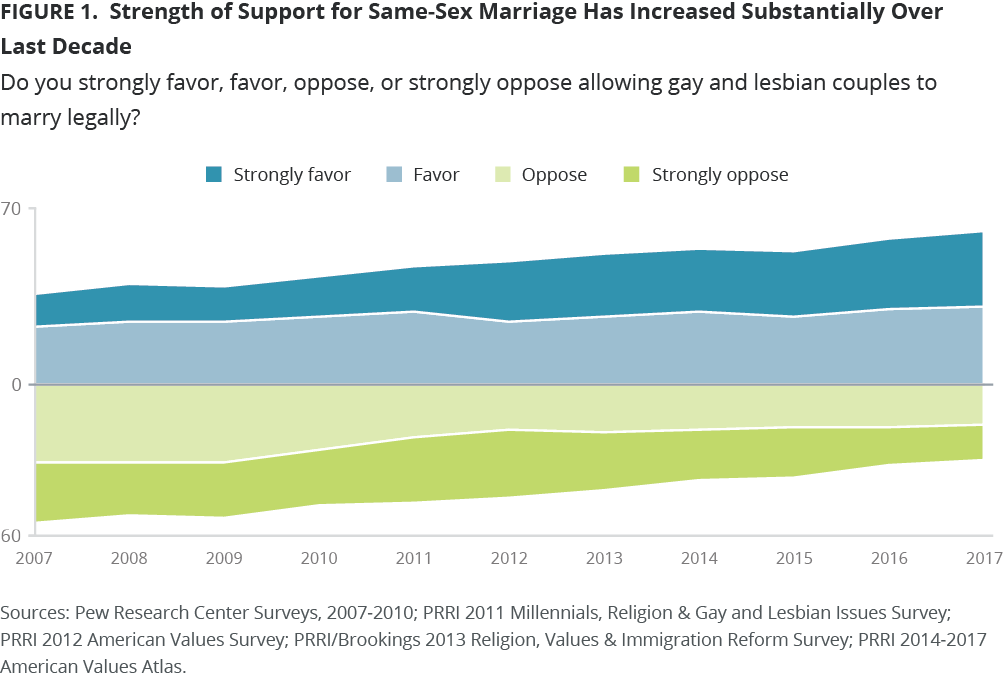
Since the U.S. Supreme Court ruled in 2015 that same sex couples have a constitutional right to marry, support for same-sex marriage has increased substantially. Currently, more than six in ten (61%) Americans say gay and lesbian couples should be able to marry legally, while only about half as many (30%) are opposed.
Strength of support for same-sex marriage has increased dramatically over the past decade, while strength of opposition has fallen in nearly equal measure. Today, Americans who strongly favor same-sex marriage outnumber those who strongly oppose it by more than a two-to-one margin (30% vs. 14%). In 2007, only 13% of the public strongly favored same-sex marriage, while nearly one-quarter (24%) strongly opposed it.1 Much of this shift has occurred within the last five years. As recently as 2013, more than four in ten (42%) Americans opposed same-sex marriage, including about one in four (23%) who strongly opposed it.2 Over the last five years, strong supporters of same-sex marriage increased only modestly, from 25% to 30%.
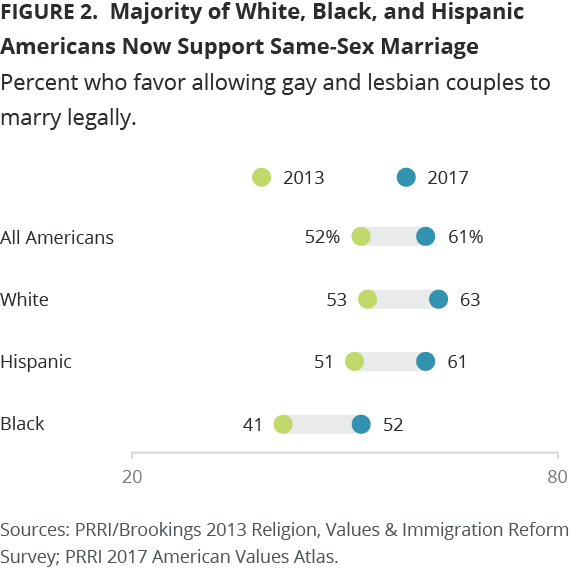
The rise in support for same-sex marriage, particularly over the last few years, has led to a milestone: Today a majority of all racial and ethnic groups favor allowing gay and lesbian couples to marry legally. Between 2013 and 2017, we have seen a double-digit increase in support for same-sex marriage among white (53% vs. 63%), black (41% vs. 52%), and Hispanic (51% vs. 61%) Americans.3 Currently, about four in ten (39%) black Americans, three in ten (30%) white Americans, and only about one-quarter (26%) of Hispanic Americans oppose same-sex marriage. Majorities of smaller racial and ethnic groups also support same-sex marriage today, including Asian-Pacific Islander Americans (72 percent), Native Americans (56 percent), and those identifying as multiracial or with another racial and ethnic group (66 percent).
Conservative Republican Holdouts
Partisan gaps in views of same-sex marriage persist, even as the public has become more supportive of the policy overall. Nearly three-quarters (73%) of Democrats and about two-thirds (66%) of independents favor same-sex marriage, compared to only 42% of Republicans. A slim majority (51%) of Republicans oppose same-sex marriage. However, opposition is mostly confined to conservative Republicans. Nearly six in ten liberal (58%) and moderate (59%) Republicans favor same-sex marriage, compared to only 36% of conservative Republicans. About six in ten (58%) conservative Republicans oppose it.
Among Democrats, as well, there is a considerable ideological divide. Nearly nine in ten (87%) liberal Democrats say same-sex marriage should be legal, compared to 67% of moderate and 52% of conservative Democrats. Four in ten (40%) conservative Democrats oppose same-sex marriage.
Liberal independents are roughly as supportive of same-sex marriage as liberal Democrats. More than eight in ten (82%) liberal independents favor same-sex marriage, compared to nearly three-quarters (73%) of moderate independents and fewer than half (49%) of conservative independents. More than four in ten (41%) conservative independents oppose allowing gay and lesbian couples to marry.
Declining Religious Resistance
Most religious groups in the U.S. now support same-sex marriage, including overwhelming majorities of Unitarians (97%), Buddhists (80%), the religiously unaffiliated (80%), Jewish Americans (77%), and Hindus (75%). Roughly two-thirds of white mainline Protestants (67%), white Catholics (66%), Orthodox Christians (66%), and Hispanic Catholics (65%) also favor same-sex marriage. A slim majority of Muslims (51%) favor same-sex marriage, but only 34% are opposed; 15% offer no opinion on this issue.
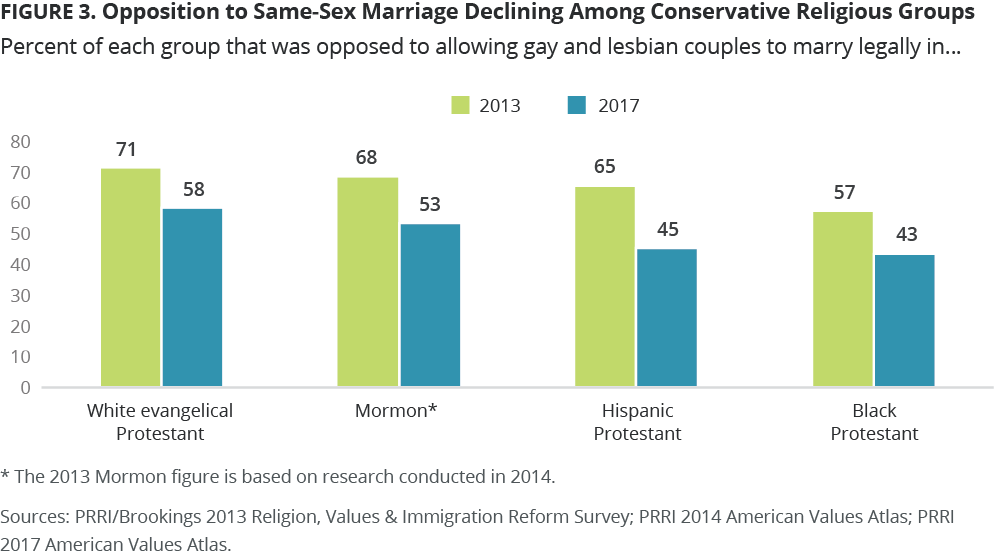
Over the last five years, opposition to same-sex marriage among nonwhite Protestants has dropped considerably. Most notably, black Protestants have moved from solid opposition to a plurality of support for same-sex marriage. In 2013, nearly six in ten (57%) black Protestants opposed same-sex marriage.4 Today just 43% oppose it, compared to nearly half (48%) who support it. Hispanic Protestants have moved from solid opposition to same-sex marriage to being divided over the policy. In 2013, nearly two-thirds (65%) of Hispanic Protestants opposed same-sex marriage. Today, 43% favor the policy, compared to 45% who oppose it and 13% who offer no opinion.
Opposition to same-sex marriage is now confined to a few of the most conservative Christian religious traditions. Only about one-third (34%) of white evangelical Protestants support same-sex marriage today, while nearly six in ten (58%) are opposed, including 30% who are strongly opposed. And just 40% of Mormons support same-sex marriage, compared to 53% who are opposed. Jehovah’s Witnesses, a racially mixed religious group, are the exception. Just 13% support the policy, compared to 63% who oppose it. However, nearly one-quarter (24%) of Jehovah’s Witnesses express no opinion on this issue.
Nevertheless, even those religious groups most opposed to same-sex marriage have become more accepting of it over the last five years. Since 2013, opposition to same-sex marriage has dropped 13 percentage points among white evangelical Protestants (from 71% in 2013 to 58% today).5 Over a similar time period, opposition among Mormons has dropped 15 percentage points (from 68% in 2014 to 53% today).6
Opposition to Same-Sex Marriage Declining Among Conservative Religious Groups
The Coming Generational Realignment
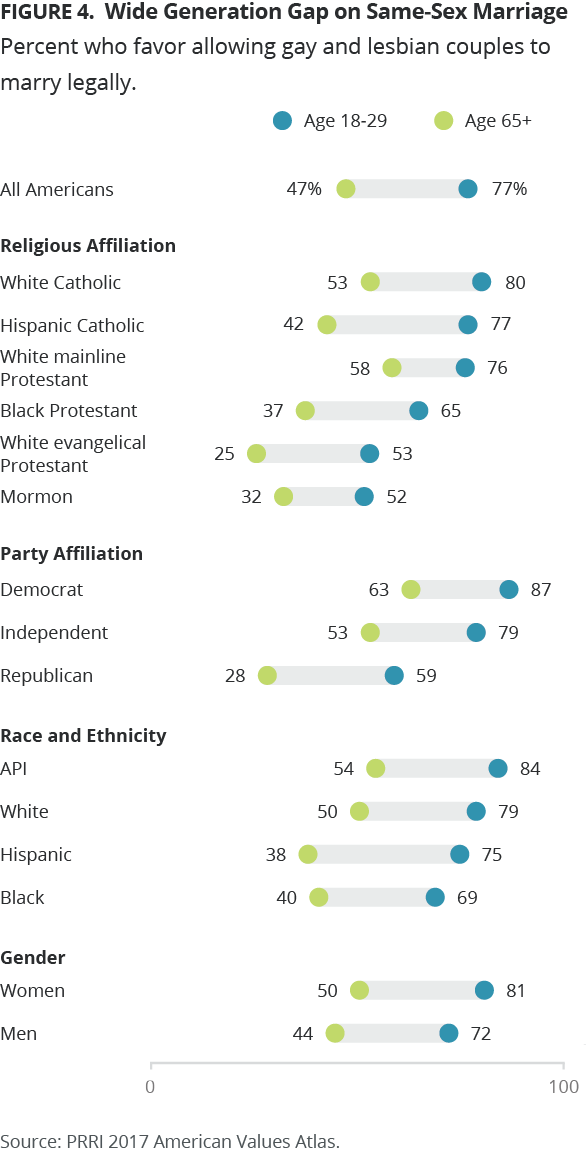
The issue of same-sex marriage is approaching consensus among young adults (age 18 to 29). More than three-quarters (77%) favor legalizing same-sex marriage, including nearly half (45%) who strongly favor it. Only 17% of young adults are opposed. In contrast, fewer than half (47%) of seniors (age 65 and up) say same-sex marriage should be legal, while about four in ten (42%) oppose it. Ten percent of seniors express no opinion on the issue. Notably, there is an increase in support at both ends of the generational spectrum, although more movement occurred among older Americans. Support for same-sex marriage among young adults is up five percentage points from 72% in 2013, and support among seniors is up 11 percentage points from just 36% in 2013.7
The generational divide cuts through every demographic group in the U.S. Even in groups most opposed to same-sex marriage, a majority of young adults favor this policy. A majority (53%) of young white evangelical Protestants favor legalizing same-sex marriage, compared to just one-quarter (25%) of white evangelical seniors. A majority (52%) of young Mormons also believe same-sex marriage should be legal, while only about one-third (32%) of Mormon seniors agree.8 While only 37% of black Protestant seniors favor same-sex marriage, nearly two-thirds (65%) of young black Protestants support it.
Wide Generation Gap on Same-Sex Marriage
The generation gap is larger among Republicans than Democrats. Young Republicans are more than twice as likely as senior Republicans to favor same-sex marriage (59% vs. 28%). In contrast, Democratic young adults and seniors largely agree on same-sex marriage (87% and 63% support it, respectively).
Among no racial or ethnic group is the generation gap wider than Hispanic Americans. Three-quarters (75%) of young Hispanics favor same-sex marriage, compared to only 38% of Hispanic seniors, a gap of 37 percentage points. Among white Americans, roughly eight in ten (79%) young adults favor same-sex marriage, compared to half (50%) of white seniors. And close to seven in ten (69%) young black Americans express support for same-sex marriage, compared to only 40% of black seniors. Finally, majorities of both young (84%) and senior (54%) Asian-Pacific Islander Americans favor same-sex marriage.
Enduring Gender Divides
More women than men in the U.S. support allowing same-sex couples to marry. Roughly two-thirds (65%) of women overall favor same-sex marriage, compared to fewer than six in ten (58%) men. The gender gap crosses lines of race and ethnicity, although its size varies substantially from group to group. Two-thirds (67%) of white women and fewer than six in ten (59%) white men favor same-sex marriage. Among Hispanic Americans, 64% of women favor it, compared to 57% of Hispanic men. And though support is much higher overall among API Americans than other ethnic groups, API women still express greater support than men (76% vs. 67%). Black Americans stand out here in not displaying a gender gap: Similar numbers of black women (53%) and men (50%) favor same-sex marriage.
Notably, the gender gap is slightly larger among young adults than older Americans. More than eight in ten (81%) young women favor same-sex marriage, compared to 72% of young men. The intensity gap is even larger among young people, with 52% of young women expressing strong support for same-sex marriage, compared to 38% of young men. Among seniors, the gender gap and intensity gap are somewhat more modest. Senior women are more likely to favor same-sex marriage than senior men (50% vs. 44%).
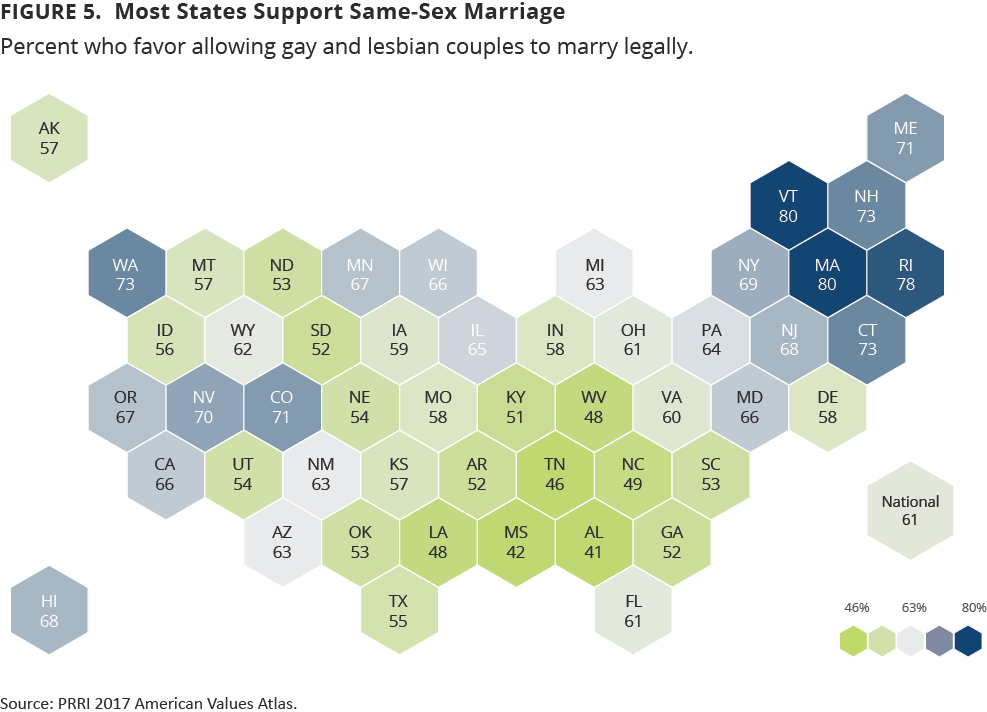
Most States Now Support Same-Sex Marriage
Recent dramatic shifts in support for same-sex marriage are also evident at the state level. Today, majorities in 44 states believe gay and lesbian couples should be allowed to legally marry, compared to only 30 states in 2014.9 In only six states does the issue of same-sex marriage garner less than majority support: Alabama (41%), Mississippi (42%), Tennessee (46%), West Virginia (48%), Louisiana (48%), and North Carolina (49%). But notably, only one state, Alabama, has a majority of residents who oppose same-sex marriage.
Substantial regional disparities in views of same-sex marriage are evident. New England is generally more supportive of same-sex marriage than any other region in the U.S. Roughly eight in ten residents of Vermont (80%), Massachusetts (80%), and Rhode Island (78%) support the policy. And nearly three-quarters of Americans living in Connecticut (73%), New Hampshire (73%), and Maine (71%) support it. A number of Southern states have only a slim majority expressing support for same-sex marriage, such as Kentucky (51%), Arkansas (52%), and Georgia (52%).
Religiously Based Service Refusals Remain Unpopular
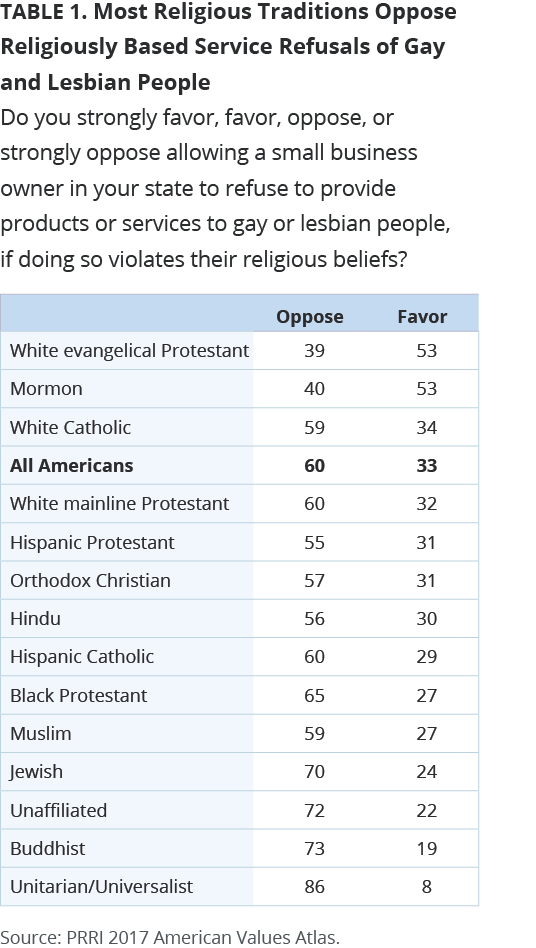
Religiously based refusals of service to gay and lesbian people are relatively unpopular among the American public. Six in ten (60%) Americans oppose allowing a small business owner in their state to refuse products or services to gay or lesbian people if providing them would violate their religious beliefs. One in three (33%) Americans support such a policy. Eight percent offer no opinion. Attitudes have remained stable since 2015, when 59% of Americans opposed allowing business owners to refuse products or services to gay and lesbian people for religious reasons.10
Black Americans are more likely than any other racial or ethnic group to oppose religiously based service refusals. Nearly two-thirds (66%) of black Americans oppose them, compared to roughly six in ten Hispanic (61%), Asian-Pacific Islander (60%), and white (58%) Americans.
Women are more likely than men to oppose religiously based service refusals. Close to two-thirds (64%) of women oppose allowing small businesses to refuse to provide products or services to gay or lesbian people, compared to 55% of men. But the gender gap varies somewhat across racial and ethnic groups. It is most pronounced among white Americans: White women are far more likely to oppose them than white men (64% vs. 52%). Differences between black women and men (68% vs. 64% are opposed) and API women and men (58% vs. 61% are opposed) are much narrower. Hispanic women and men demonstrate a slightly wider gap than other nonwhite Americans, but still not as large a gap as that of white people: Sixty-four percent of Hispanic women oppose religiously based service refusals, compared to 58% of Hispanic men.
Only Mormons and White Evangelicals Support Religiously Based Service Refusals
Most religious groups do not believe small business owners should be allowed to refuse service to gay and lesbian people for religious reasons. Nearly nine in ten (86%) Unitarians and at least seven in ten Buddhists (73%), unaffiliated Americans (72%), and Jewish Americans (70%) oppose such a policy. And roughly two-thirds (65%) of black Protestants and about six in ten white mainline Protestants (60%), Hispanic Catholics (60%), white Catholics (59%), and Muslims (59%) also reject a policy allowing religiously based refusals to serve gay and lesbian people. Majorities of Orthodox Christians (57%), Hindus (56%), and Hispanic Protestants (55%) are also opposed to the policy.
Only two major religious groups believe small business owners in their state should be allowed to refuse service to gay or lesbian people on religious grounds—white evangelical Protestants and Mormons. Notably, they support this position at the same rate—53%.
Although there are profound generational differences among white evangelical Protestants regarding same-sex marriage, on the issue of service refusals the generation gap is minimal. Roughly half (49%) of white evangelical seniors and half (50%) of young adults would allow small business owners to refuse service based on their religious beliefs, while 40% of seniors and 45% of young adults would not.
Sharp Political Divisions
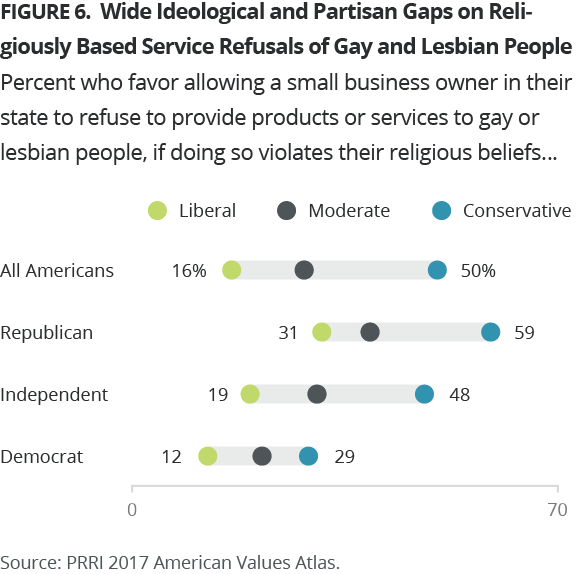
As with same-sex marriage, views on religiously based service refusals vary dramatically by political affiliation. More than three-quarters (76%) of Democrats and six in ten (60%) independents are opposed, compared to only 40% of Republicans. A slim majority (52%) of Republicans favor giving business owners in their state the right to refuse products or services to gay or lesbian people if providing them would violate their religious beliefs.
Among Republicans there are stark divisions by ideology. Nearly six in ten (59%) conservative Republicans say religiously based service refusals should be legal, compared to roughly four in ten (39%) moderate and about three in ten (31%) liberal Republicans. But a majority of moderate (55%) and liberal (63%) Republicans oppose such a policy.
There are also sharp ideological differences among independents. Conservative independents are roughly divided, with about as many supporting the right to religiously based service refusals as opposing (48% vs. 44%) it. In contrast, 63% of moderate independents and more than three-quarters (77%) of liberal independents do not think small business owners have this right.
Democrats are far more unified than Republicans and independents in their position on the matter. Majorities of liberal (85%), moderate (72%), and conservative (63%) Democrats oppose religiously based refusals to serve gay and lesbian people.
More Modest Generational Divisions
Although views on same-sex marriage are highly stratified by age, on the issue of service refusals there is greater consensus across age cohorts. A majority of Americans across generations oppose them. Two-thirds of young adults (67%) and a majority of seniors (53%) say small businesses should not be allowed to refuse to serve gay or lesbian people, even if doing so violates their religious beliefs. Only 36% of seniors say this should be allowed, while 11% express no opinion.
The Relationship Between Support for Same-Sex Marriage and Service Refusals
Even among Americans who oppose same-sex marriage, close to half (45%) are against allowing small business owners to refuse service to gay and lesbian people. A similar number (48%) would allow them this option if providing service violates their religious beliefs.
Opposition Across the Country
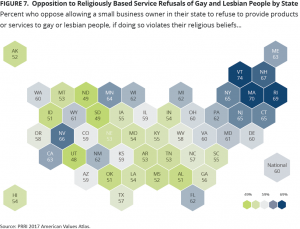
A majority of Americans in nearly every state believe small business owners in their state should not be allowed to refuse service to gay and lesbian people. Notably, state-level opposition to same-sex marriage or nondiscrimination protections for LGBT people does not reliably predict state-level support for religiously based service refusals. Whereas opposition to same-sex marriage and nondiscrimination protections is concentrated in the South, the states with the lowest levels of opposition to service refusals cluster in and near the Mountain West and Midwest. In three states—Utah (48%), North Dakota (49%), and South Dakota (49%)—fewer than half of residents oppose service refusals. A slim majority of residents of Idaho (51%), Oklahoma (51%), Nebraska (53%), and Montana (53%) object to them.
In contrast, New England states express the strongest objection to religiously based service refusals. At least two-thirds of residents of Vermont (74%), Massachusetts (70%), Rhode Island (69%), and New Hampshire (67%) oppose allowing small business owners to refuse gay and lesbian customers.
Americans Continue to Support Nondiscrimination Protections for LGBT People
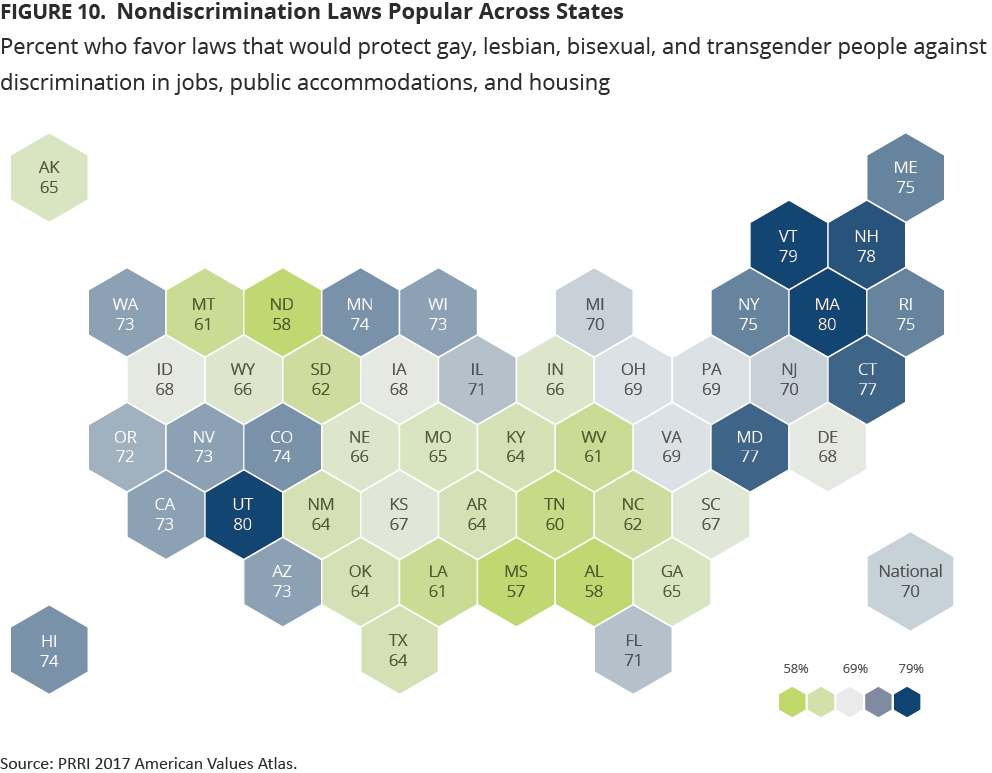
Americans are broadly supportive of laws that would protect lesbian, gay, bisexual, and transgender (LGBT) people against discrimination in jobs, public accommodations, and housing. Seven in ten (70%) Americans favor such laws, including more than one-third (35%) who strongly favor them. Fewer than one-quarter (23%) of Americans oppose legal nondiscrimination protections for LGBT Americans.
Although there is broad agreement about nondiscrimination laws, there are still notable differences by age and gender. Younger Americans tend to be more supportive of legal protections than older Americans. Nearly eight in ten (78%) young adults (age 18-29) favor nondiscrimination protections, including 45% who strongly favor them. Even among seniors (age 65 and up), who tend to be less supportive of same-sex marriage, more than six in ten (61%) favor nondiscrimination protections for LGBT Americans, and only 29% oppose them.
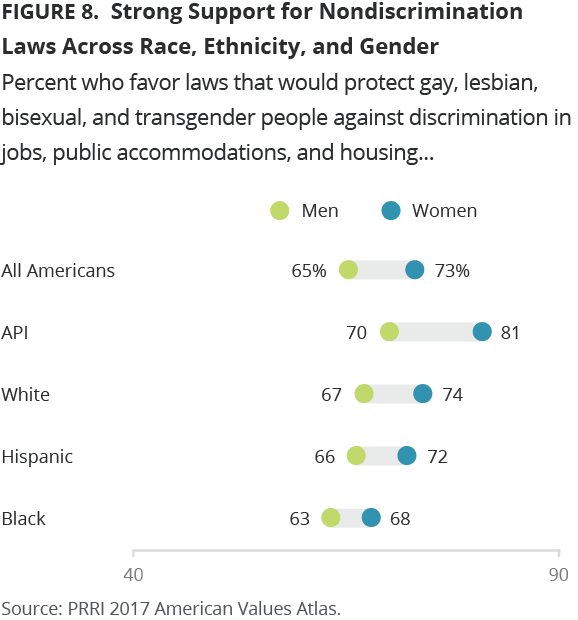
Gender differences on this issue are much more modest than with respect to same-sex marriage. Nearly three-quarters (73%) of women favor the passage of laws that would protect LGBT Americans from discrimination in jobs, public accommodations, and housing, compared to about two-thirds (65%) of men. But there is a considerable intensity gap: Four in ten (40%) women, compared to only about three in ten (29%) men, strongly favor nondiscrimination protections for LGBT people.
Americans, Regardless of Race and Ethnicity, Support Nondiscrimination Protections
There is only modest variation across racial and ethnic lines in support for nondiscrimination laws to protect LGBT Americans. About two-thirds (66%) of black Americans favor these protections, as do about seven in ten Hispanic (69%) and white (71%) Americans. Asian-Pacific Islander Americans demonstrate the highest levels of support, with 75% favoring nondiscrimination laws to protect LGBT Americans.
The gender gap is fairly constant across racial and ethnic groups, but there is considerable variation in its size. Black men express the lowest level of support for nondiscrimination policies aimed at protecting LGBT people, while API women express the greatest. More than six in ten (63%) black men favor nondiscrimination laws, compared to 66% of Hispanic, 67% of white, and 70% of API men. More than two-thirds (68%) of black women favor these policies, while more than seven in ten Hispanic (72%), white (74%), and API (81%) women say the same.
Support for Nondiscrimination Protections Transcends Partisan Boundaries
Nondiscrimination protections for LGBT people are broadly supported across party lines, although Democrats and independents register greater support for them. More than seven in ten independents (72%) and Democrats (79%) favor providing legal protections from discrimination for LGBT people, while nearly six in ten (58%) Republicans say the same. Notably, half (50%) of Democrats strongly favor these protections.
While political ideology also influences views on nondiscrimination protections for LGBT people, it plays a larger role in structuring the attitudes of independents and Democrats than Republicans. Six in ten (60%) conservative independents favor laws to protect LGBT individuals against discrimination in jobs, public accommodations, and housing, compared to about eight in ten moderate (77%) and liberal (82%) independents. Democrats demonstrate a similar pattern. While less than two-thirds (63%) of conservative Democrats support nondiscrimination protections, more than three-quarters (76%) of moderate and nearly nine in ten (87%) liberal Democrats say the same.
There are more modest ideological differences among Republicans. Roughly two-thirds of moderate (68%) and liberal (65%) Republicans support nondiscrimination protections for LGBT people, compared to 56% of conservative Republicans.
Near Consensus Among Religious Groups on Nondiscrimination Policies
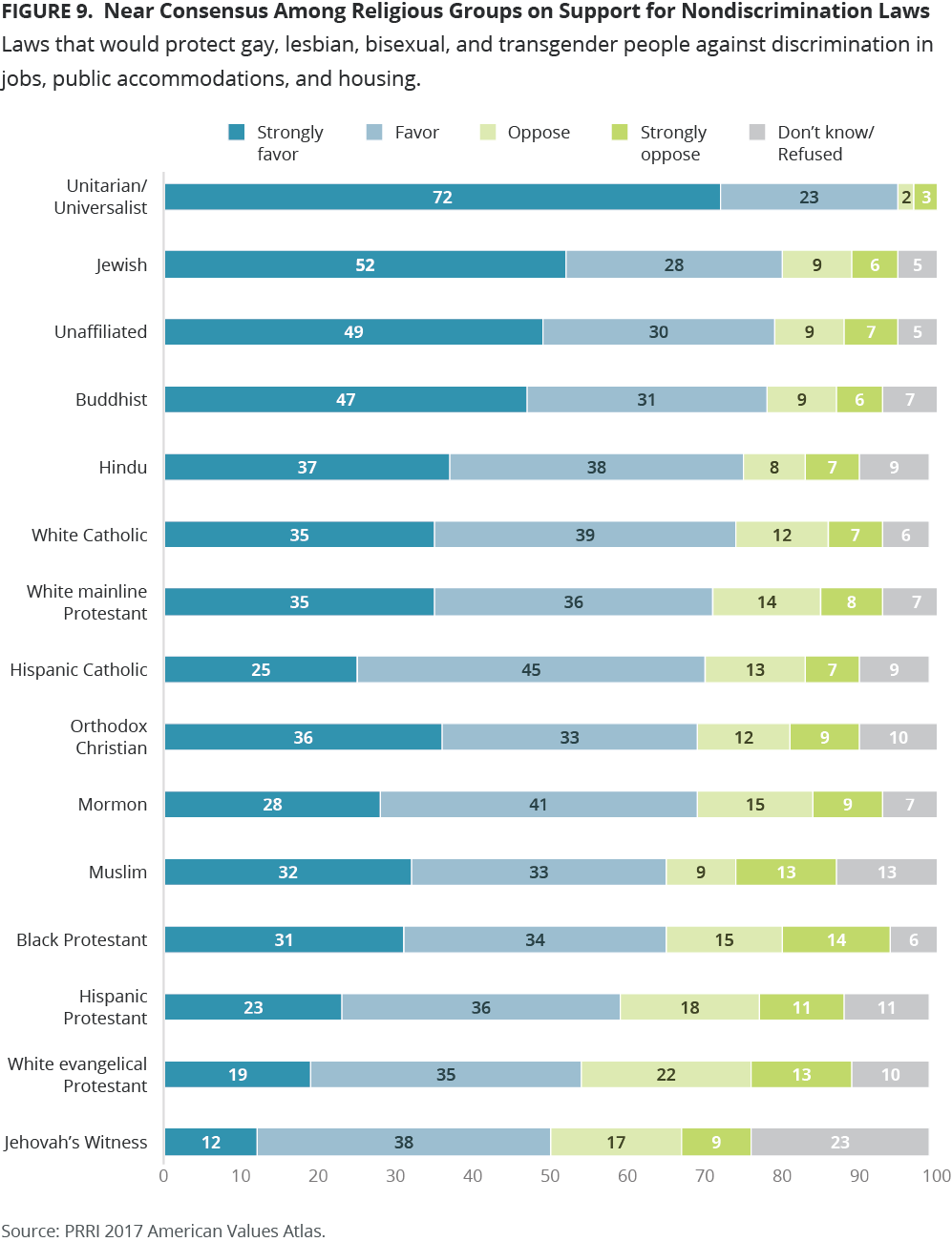
Majorities of nearly every major religious group support legal protections against discrimination for LGBT Americans, with non-Christian religious groups tending to be the most supportive. No religious group is more supportive than Unitarians, among whom 95% favor nondiscrimination policies. At least three-quarters of Jews (80%), religiously unaffiliated Americans (79%), Buddhists (78%), and Hindus (75%) favor laws that protect LGBT Americans against discrimination in employment, housing, and public accommodations.
Support is also robust among most Christian religious communities. At least seven in ten white Catholics (74%), white mainline Protestants (71%), and Hispanic Catholics (70%) support nondiscrimination protections for LGBT people. Approximately two-thirds of Orthodox Christians (69%), Mormons (69%), and black Protestants (65%) favor them, as well as a majority of Hispanic Protestants (59%) and white evangelical Protestants (54%). While only half (50%) of Jehovah’s Witnesses support nondiscrimination protections, just over one-quarter (26%) oppose these protections, and roughly as many (23%) express no opinion.
Mormon Exceptionalism
Mormons are unique among religious Americans in their outlook on same-sex marriage and nondiscrimination protections for lesbian, gay, bisexual, and transgender people. Only 40% of Mormons favor allowing same-sex couples to marry, yet nearly seven in ten (69%) support laws that would protect LGBT people from discrimination in housing, public accommodations, and employment—a 29-point gap. Among no other major religious group is the gap on these two issues larger.
Majorities of Residents of Every State Favor Nondiscrimination Protections for LGBT People
Majorities of residents of every state favor nondiscrimination protections for LGBT Americans. Predictably, New England states express the most robust support for laws designed to protect LGBT people from discrimination. At least three-quarters of the residents of Massachusetts (80%), Vermont (79%), New Hampshire (78%), Connecticut (77%), Maine (75%), and Rhode Island (75%) favor nondiscrimination protections for LGBT Americans.
Conversely, states with the lowest levels of support are primarily located in the South, as only about six in ten residents of Mississippi (57%), Alabama (58%), Tennessee (60%), Louisiana (61%), and West Virginia (61%) say LGBT people should be legally protected from discrimination.
States in the West tend to demonstrate high levels of support for nondiscrimination protections for LGBT individuals. More than seven in ten residents of the Western U.S.—including Washington (73%), California (73%), Nevada (73%), Arizona (73%), and Oregon (72%)—favor laws that would protect LGBT Americans from discrimination. Notably, despite the fact that only 54% of Utahans favor same-sex marriage, fully 80% say they would support laws to protect LGBT people from discrimination.
Survey Methodology
The 2017 American Values Atlas (AVA) is a project of PRRI. Results for questions on specific issues (e.g. LGBT issues) are based on a subset of 40,017 telephone interviews (including 23,903 cell phone interviews) conducted between April 5, 2017 and December 23, 2017 by professional interviewers under the direction of SSRS. The AVA was made possible by generous grants from the Evelyn and Walter Haas, Jr. Fund, the Gill Foundation, the Nathan Cummings Foundation, and the Unitarian Universalist Veatch Program at Shelter Rock.
Throughout 2017, at least 1,000 interviews were completed each week, with about 600 interviews conducted among respondents on their cell phones. Each week, interviewing occurred over a five-day period, from Wednesday through Sunday or from Thursday through Monday. The selection of respondents within households was accomplished by randomly requesting to speak with the youngest adult male or female currently living in the household.
Data collection was based on stratified, single-stage, random-digit dialing (RDD) of landline telephone households and randomly generated cell phone numbers. The sample was designed to represent the total U.S. adult population from all 50 states, including Hawaii and Alaska. The landline and cell phone samples were provided by Marketing Systems Group.
The weighting was accomplished in two separate stages. The first stage of weighting corrects for different probabilities of selection associated with the number of adults in each household and each respondent’s telephone usage patterns. In the second stage, sample demographics were balanced to match target population parameters for gender, age, education, race and Hispanic ethnicity, region (U.S. Census definitions), population density, and telephone usage. The population density parameter was derived from 2010 Census data. The telephone usage parameter came from an analysis of the January-June 2017 National Health Interview Survey. All other weighting parameters were derived from an analysis of the U.S. Census Bureau’s March 2017 Current Population Survey.
The sample weighting was accomplished using iterative proportional fitting (IFP), a process that simultaneously balances the distributions of all variables. Weights are trimmed so that they do not exceed 4.0 or fall below 0.25 to prevent individual interviews from having too much influence on the final results. The use of these weights in statistical analysis ensures that the demographic characteristics of the sample closely approximate the demographic characteristics of the target populations.
The margin of error for the sample is +/- 1.2 percentage points at the 95% level of confidence. The design effect is 1.4. Table 1 shows the margin of error and design effect for each weekly survey at the 95% level of confidence. Tables 2 and 3 show the sample sizes for each state and metro area. In addition to sampling error, surveys may also be subject to error or bias due to question wording, context, and order effects.
Bisexual people in the U.S. state of Utah report the most incidences of sexual violence, according to a new survey.
The shocking new survey analyzes responses from about 10,000 Utahan adults collected in 2016.
It reveals 45.5% of bisexual people in Utah have experienced sexual violence. It also said 33.6% of lesbian/gay respondents reported sexual violence.
This compares to just 8.7% for straight people.
According to the survey, sexual violence is ‘sexual activity (sexual touching, harassment or exposure to sexual content) that involves victims who do not consent, or who are unable to consent.’
Turner Bitton, executive director of the Utah Coalition Against Sexual Assault, said in a written statement: ‘Sexual violence is rooted in the inequities of our society and disproportionately hurts those who have been pushed to the margins.’
He also said: ‘Utah communities are counting on us to ensure that everyone is included in prevention efforts.’
Bitton calls for ‘culturally specific prevention programming’ in the state to combat the huge disparity.
Interestingly, other breakdowns of the statistics include disproportionate incidences among unemployed people, with 21.3%. ‘Student’ comes in second with 10.7% and ’employed’ with 10%.
Sexual violence in Utah breaks down to affecting 3.1% of the state’s male population and 16.4% of females.
The New York Times has addressed its poor history of covering HIV/AIDS during the AIDS crisis.
The newspaper came under heavily criticism from AIDS activists and the LGBT community over its “shameful” coverage of the AIDS epidemic in the 1980s, when New York City’s gay community was ravaged by the spread of the disease.
President Reagan did not mention AIDS in public until 1985, when 5000 people – primarily gay and bisexual men – had already died.
AIDS activist Larry Kramer was vocally critical of the New York Times for its coverage, attributing deaths to the paper’s actions.
In a piece published today, New York Times writer Kurt Soller addressed the newspaper’s coverage – more than 30 years on.
Soller wrote: “Any newspaper must, by definition, aspire to be the “paper of record,” and yet when it came to this newspaper’s coverage of gay people and AIDS in the early ’80s — when the disease was morphing into a national crisis, and when rights that had been won a decade earlier, after the Stonewall Riots, were once again being jeopardized — The Times’s own record was checkered at best.
“Information about the spread of illness was often scant, judgmental or distressingly vague — even while reporters on the Science desk were trying their best with an ever-evolving story. The social and emotional toll of AIDS and the resulting queer movement were, when covered, often buried in the back of the newspaper (on a page called Styles of the Times), far from national news stories that were deemed important enough for the front page.
“Famously, it would take President Ronald Reagan more than four years to acknowledge the disease publicly. And it took until 1983 for The Times to run an article about the disease on Page A1, two years after the first reports of symptoms.”
Economy reporter Natalie Kitroeff notes that “many employees felt that A.M. ‘Abe’ Rosenthal, the paper’s editor, was homophobic”, reflecting on internal battles over the use of terms like “admitted homosexuals”.
Media reporter John Koblin noted that there were 558 dead in the United States before the Times put the issue on the front page.
He added: “Roughly 700 editions of the paper had come and gone before AIDS, quickly turning into a full-fledged crisis, had earned a spot on Page One. It was never lost on AIDS activists just how vital the paper was — and for how long it did not pay serious attention to the disease.”
How Can Lawyers Get More Comfortable With Artificial Intelligence?
It doesn’t matter how AI works as long as it solves problems. Discover the 7 steps to understanding AI and becoming more comfortable with it
Ad by Thomson Reuters
David W. Dunlap, a reporter in the Metro section at the time, told him: “There were strong messages that you got that were not written on any whiteboard. You knew to avoid it. It was a self-reinforcing edict: Don’t write about queers.”
Koblin added: “By the time The Times did give AIDS front-page attention, it did so with a bit of a stiff arm. Though public health officials were now going on the record to discuss the disease’s devastation, there was reluctance to discuss whom it affected most. In that first front-page story, it took seven paragraphs — which appeared after the jump, or inside the paper — to mention how hard it was hitting gay men.”
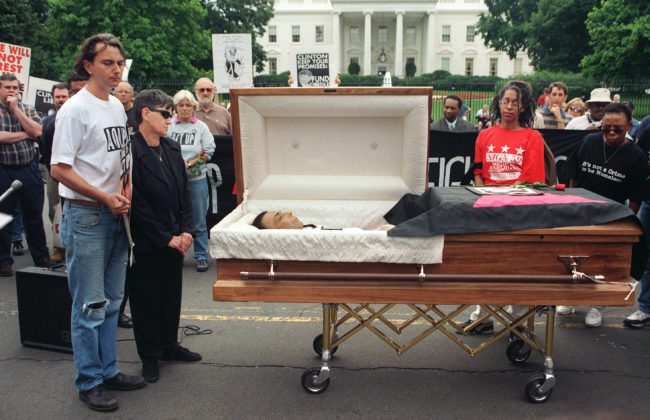
AIDS activists hold an open-casket funeral protest in front of the White House (JAMAL A. WILSON/AFP/Getty Images)
Washington correspondent Jeremy W. Peters wrote that even when it did cover the crisis, the newspaper often did unwitting harm.
He wrote: “They employed the same euphemisms, like ‘bodily fluids’, to substitute for words like semen, leaving the [false] impression that saliva from a kiss might infect you.”
On Thursday, a 69-year-old man was convicted of criminally negligent homicide after stabbing his neighbour to death in 2015.
James Miller will serve 10 years probation after the death of his neighbour Daniel Spencer, in addition to six months in prison.
According to NBC, friends Spencer and Miller were together in Austin, Texas, when Spencer made a sexual advance on him.
“Hold it, I’m not a gay person,” Miller reportedly replied.
Spencer allegedly became aggressive after Miller rejected his advances, brandishing a glass at Miller.
The defence argued that Miller acted in self-defence.
However, the prosecution argued that Miller did not have “so much as a scratch on him.”
Miller reportedly told the jury: “He had height advantage over me, arm length over me, youth over me. I felt he was going to hurt me.”
Miller then stabbed Spencer before turning himself into the authorities.
In addition to the 10 years on probation, Judge Brad Urrutia added the maximum judge-imposed sentence of six months imprisonment as well as 100 hours of community service and $11,000 in restitution to Spencer’s family.
Prosecutor Matthew Foye said that the verdict showed that the self-defence claim was not successful in acquitting Miller.
Foye said: “It establishes that Daniel Spencer was a victim of a senseless killing by the defendant and he did not do anything to bring this upon himself.
Learn How to Turn Your Bedroom into a Relaxing Oasis with the IKEA Home Tour Squad
Follow the team of IKEA design experts who are on the road to help America achieve their dreams.
Ad by IKEA®
“Since the defence’s strategy was to argue self-defence, I think the jury’s verdict makes it clear that they did not believe it was self-defence.”
Miller’s representative Charlie Baird said he was disappointed with the decision to convict him of criminally negligent homicide.
“We thought that he should have been acquitted on the basis of self-defence,” Baird told NBC, before adding that he was glad Miller would not have an extended prison sentence.
Baird said: “The jury, they agreed with us and thought that Mr. Miller was no threat to the community or to society at large, and, therefore, they decided to place him on community supervision.”
Many are reporting that this case is a prime example of the so-called “gay panic” defence in action.
This legal defence means that assailants who attack gay men after seeing homosexual behaviour may argue in court that they could not reasonably control their actions.
It relies on a largely discredited medical idea that many men will have a natural, biological response of rage when witnessing gay behaviour, which will make their actions uncontrollable.
Monica Harrell, a chairperson for Equal Rights Washington, explained: “[The defence] is saying you’re surprised that somebody might be different than you, whatever that difference is, and that that would allow you to initiate violence, and in some cases, lethal violence. That should never be a defence.”
Oklahoma lawmakers have voted in favour of a bill which enable adoption and foster agencies to reject same-sex couples because of their religious beliefs.
The Oklahoma House of Representatives approved Senate Bill 1140 on April 26, after the bill had been passed by the state Senate on March 13.
If Republican Governor Mary Fallin signs it into law, the legislation will come into affect on November 1 this year.
The bill says that “no private childplacing agency receiving neither federal nor state funds shall be required to perform, assist, counsel, recommend, consent to, refer, or participate in any placement of a child for foster care or adoption when the proposed placement would violate the agency’s written religious or moral convictions or policies.”
But many states have tried to find ways around this ruling, mostly through the idea that there should be a religious exception for people and agencies who believe LGB people should not be parents because of their faith.
Including Oklahoma, eight states – including Alabama, Michigan, Mississippi, North Dakota, South Dakota, Texas and Virginia – have managed to pass a law of this kind, which stops same-sex couples from fostering or adopting kids.
GLAAD’s vice president of programmes Zeke Stokes condemned the legislation, saying: “This bill is heartless and un-American.
“No qualified parent should be turned away from adoption or foster agencies simply because they are LGBTQ.”
Stokes called the bill an “attempt to write anti-LGBTQ discrimination into law at the expense of the state’s youth in need of loving and supportive homes.”
The US is currently embroiled in a battle between so-called religious liberty and LGBT people that centres on whether homophobic Christians should have the ability to discriminate against gay people.
This ongoing fight for rights can also be seen in attempts by other states to join the several who already allow discrimination in the name of their religion.
The bill passed the Senate Judiciary Committee, but never saw the light of day in the House or Senate, with several attempts to attach it to other prospective laws failing. Eventually, time ran out for its supporters, with the legislative session ending on March 30.
Oklahoma already has anti-LGBT legislation on the books, as one of several states with a so-called ‘no promo homo’ law which prohibits teachers in publicly funded schools from discussing LGBT issues in the classroom.
Alabama, Arizona, Louisiana, Mississippi, South Carolina and Texas have similar laws.
A significant number of straight men have gay sex, a study has shown.
The analysis of 24,000 undergraduate students revealed that of the men whose last hookup was with a male partner, one in eight defined as heterosexual.
This figure twice as high among women, with one in four whose last sexual experience was a lesbian one identifying as straight.
That study, which had 2,300 respondents, found that women were 33 percent more likely to orgasm when they were having sex with another woman.
The newly released results were discovered by Arielle Kuperberg – an associate professor of sociology at the University of North Carolina at Greensboro – and Alicia M. Walker, assistant professor of sociology at Missouri State University.
Published in Archives of Sexual Behaviour, “Heterosexual College Students Who Hookup with Same-Sex Partners” listed some characteristics of people who would have sexual relations with same-sex partners but continue to self-identify as straight.
Tellingly, these included “more conservative attitudes.”
The researchers also found that there were distinct types of stright people who would engage in gay sex.
Three types,” they explained, “comprising 60% of students, could be classified as mostly private sexual experimentation among those with little prior same-sex experience, including some who did not enjoy the encounter.”
But, Kuperberg and Walker continued, “the other two types in this group enjoyed the encounter, but differed on drunkenness and desire for a future relationship with their partner.”
They said that though some of the hookups were explained away as “performative bisexuality” by women, this factor made up a small minority of the students – just 12 percent, in fact.
More than one in four – 28 percent – had “strong religious practices and/or beliefs that may preclude a non-heterosexual identity, including 7 percent who exhibited ‘internalised heterosexism.’”
Researchers studied the reaction of men and women who identified as heterosexual when they were shown different kinds of pornographic material.
The study’s author, Ritch C. Savin-Williams, said he wasn’t surprised by the research findings, but that he was shocked how many people still identified as heterosexual despite the evidence.
“We’re trying to get at the way people really are,” he said. “Sometimes, it seems people are one way but believe they have to report themselves in another way, and that’s not good.”
Savin-Williams added that the findings of his study proved a “loosening of the boundaries”.
“I think that’s happening for both sexes. It’s probably a good thing, because it gives kids growing up more diversity, more options, so they don’t feel like they have to fit in [at all costs].”
Hawaii has become the twelfth state to pass a ban on gay ‘cure’ therapy for minors.
On April 27, a conference committee cleared the way for the bill to be sent to Democratic Governor David Ige, who is expected to sign SB 270 into law.
Earlier this month, the state’s House of Representatives passed the bill, which bans efforts to “engage in or attempt to engage in sexual orientation change efforts on a person under eight years of age.”
It sailed through the Democrat-dominated legislature with just two votes against, from Republican leaders Gene Ward and Bob McDermott.
The lone vote against belonged to Democratic Senator Mike Gabbard, the head of the so-called Alliance for Traditional Marriage and Values, who previously waged a campaign to ban same-sex marriage in the state.
Performing gay cure therapy on minors is already is illegal in 11 US states and counting, as well as Switzerland, Malta, Taiwan, two Canadian provinces and the Australian state of Victoria.
Michael Golojuch, chair of the Democratic Party of Hawaii’s LGBT Caucus, said: “This has been a priority of the caucus for years,” according to NewNowNext.
He added that the bill “ensures that LGBTQ youth will not be tortured by mental health professionals.”
Lt. Gov. Doug Chin, who is running for Congress, supported the bill “based upon my firmly held belief that no-one should ever be made to feel there is something ‘wrong’ with them because of who they love or how they identify.”
The bill states: “The American Psychological Association convened a task force on appropriate therapeutic responses to sexual orientation.
(daniel ramirez/flickr)
“The task force conducted a systematic review of peer-reviewed journal literature on sexual orientation change efforts. The task force concluded that sexual orientation change efforts are unlikely to be successful and involve risk of harm to lesbian, gay, and bisexual individuals, including depression, suicidality, loss of sexual feeling, anxiety, shame, negative self-image, and other negative feelings and behaviours.
“The legislature further finds that children and adolescents who participate in these types of sexual orientation change efforts, which often use fear-based techniques, are given inaccurate scientific information regarding sexual orientation and gender identity and are also at risk of increased self-stigma and psychological distress.”
It adds: “The legislature additionally finds that sexual orientation change efforts are opposed by the country’s leading medical and mental health professional organisations, including the American Psychological Association, American Medical Association, American Academy of Pediatrics, American Psychiatric Association, National Association of Social Workers, American College of Obstetricians and Gynecologists, and American Academy of Child and Adolescent Psychiatry.
“The purpose of this Act is to protect the physical and psychological well-being of minors, including lesbian, gay, bisexual, and transgender youth, against exposure to serious harms caused by sexual orientation change efforts by regulating the conduct of specific state-licensed persons who provide professional counselling to minors under the age of eighteen and prohibiting these professionals from engaging in, attempting to engage in, or advertising the offering of sexual orientation change efforts on persons under eighteen years of age.”
Running out of money and down on his luck, right-wing provocateur Milo Yiannopoulos laid off the small staff of Milo Entertainment Inc. earlier this month, according to three people familiar with the situation.
Yiannopoulos’ company has fallen on hard times ever since his former patrons, Robert and Rebekah Mercer, severed their financial backing last year.
According to the sources, Yiannopoulos had been expecting to instead receive significant financial backing from the banking heir and cryptocurrency billionaire Matthew Mellon. But those hopes were dashed with Mellon’s unexpected death from an apparent drug overdose on April 16.
On Monday, Yiannopoulos posted a photo on Instagram of himself with Mellon. “I spent a few days and nights in Miami and LA with the incredible human being Matthew Mellon, the last of them just a day before he passed,” Yiannopoulos wrote in the caption. “He was brilliant, infectious and warm-hearted and I will never forget getting to know this remarkable person. Rest in peace now, MM. You left a giant stamp on the world.”
With Mellon’s unexpected death, Yiannopoulos could no longer afford the staff of Milo Entertainment.
“He fired everybody,” said one person familiar with Yiannopoulos’ operation, which had employed a handful of full-time and part-time staffers.
Among them was the journalist Chadwick Moore, who was technically terminated several days before learning of his firing, according to two people familiar with the situation.
Moore spent those days with Yiannopoulos, unaware that he had been fired. Yiannopoulos was supposed to inform Moore of his dismissal, according to a person familiar with the situation.
Instead, Milo Inc. CEO Alexander Macris ended up having to call Moore and tell him about his termination.
Moore, in an email, said: “I haven’t a clue what you’re talking about. I’m just an editor. I got paid today and the work continues!”
Yiannopoulos also disputed this version of events. “There is nothing I was supposed to tell Chadwick that I did not tell him in a timely fashion and in any case such news comes from the CEO not me,” he said.
Yiannopoulos’s business includes Milo Worldwide LLC and Milo Entertainment Inc. The layoffs hit Milo Entertainment Inc., the corporate entity used for employment purposes.
Despite their termination from Milo Entertainment, Moore and Macris retain interests in Milo Worldwide. Yiannopoulos said Moore and Macris were terminated from Milo Entertainment because of the costs of their health care, but that he had increased their compensation through Milo Worldwide to compensate for the move. At least two other full-time staffers were let go entirely.
“The video component of my daily show was stopped recently as the cost wasn’t justifiable,” he wrote in a text message. “Show is now audio only. There were two layoffs as a result. But nothing has changed elsewhere or at Dangerous.com.”
As for those affected, they are taking a less rosy view. “People are very, very furious,” said a person familiar with the situation.