The monthlong celebration of LGBTQ Pride reaches its exuberant grand finale on Sunday, bringing rainbow-laden revelers to the streets for marquee parades in New York, Chicago, San Francisco and elsewhere across the globe.
In New York, 10 pro-Palestinian protesters were arrested at the Pride parade Sunday, according to the NYPD.
Seven people were charged with disorderly conduct. It was not clear what the three other individuals arrested were charged with.
Videos from the parade show protesters being handcuffed by the police, and one person who was carried away. Some of the protesters were chanting “free Palestine.”
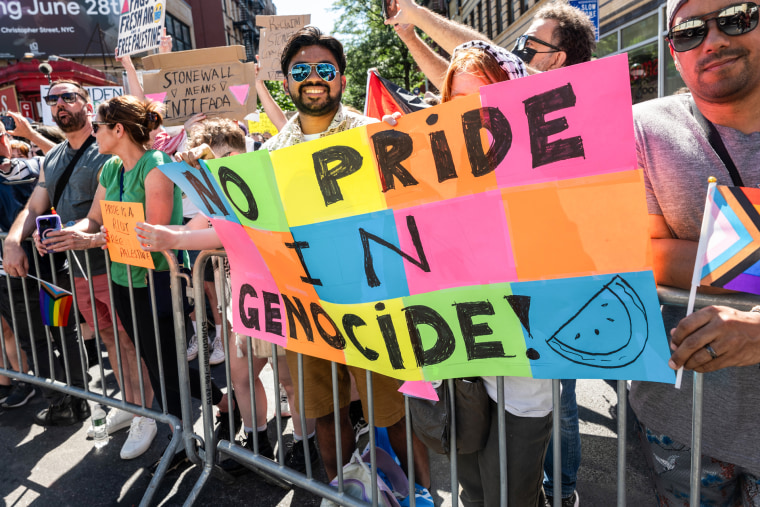
Protesters gather outside Stonewall Inn as President Joe Biden’s motorcade passes by during his visit to the historic gay bar in New York City on Friday to mark the 55th anniversary of the riots.Spencer Platt / Getty Images
Already this month, pro-Palestinian activists have disrupted pride parades held in Boston, Denver, and Philadelphia. Several groups participating in marches Sunday said they would seek to center the victims of the war in Gaza, spurring pushback from supporters of Israel.
“It is certainly a more active presence this year in terms of protest at Pride events,” said Sandra Pérez, the executive director of NYC Pride. “But we were born out of a protest.”
The first pride march was held in New York City in 1970 to commemorate the one-year anniversary of the Stonewall Inn uprising, a riot that began with a police raid on a Manhattan gay bar.
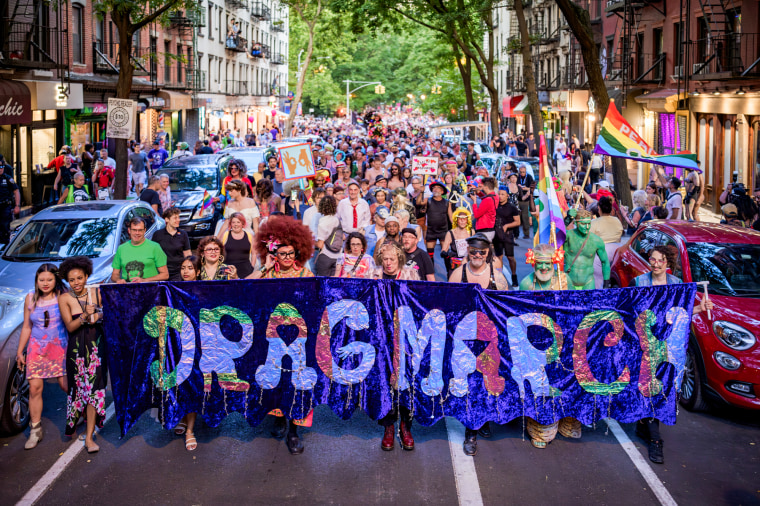
Hundreds of drag queens and kings filled the streets for the 30th annual New York City Drag March on Friday.Erik McGregor / LightRocket via Getty Images
In addition to the NYC Pride March, the nation’s largest, the city will also play host Sunday to the Queer Liberation March, an activism-centered event launched five years ago amid concerns that the more mainstream parade had become too corporate.
Another one of the world’s largest Pride celebrations will also kick off Sunday in San Francisco. Additional parades are scheduled in Chicago, Minneapolis, and Seattle.
On top of concerns about protests, federal agencies have warned that foreign terrorist organizations and their supporters could target the parades and adjacent venues. A heavy security presence is expected at all of the events.
The number of out LGBTQ people who have won elected office has increased nearly 200% since 2017, according to research published Wednesday and first reported on by NBC News.
The LGBTQ+ Victory Institute, which works to increase queer and transgender representation in public service, found that there were 1,303 out LGBTQ elected officials as of May, a 10% increase from 1,185 officials last year and a 190.8% increase from the 448 out officials in 2017, according to the organization’s latest annual “Out for America” report.
For the first time, there is also at least one out LGBTQ elected official in every state and in Washington, D.C., the report found.
“LGBTQ people are running in historic numbers right now, and we are winning,” Elliot Imse, the executive director of the LGBTQ+ Victory Institute, said.
However, Imse noted that LGBTQ people are still underrepresented in public service. A March Gallup poll found that 7.6% of the U.S. population is LGBTQ, and there are 519,682 elected positions, the Victory Institute report found, meaning the country would need to elect 38,193 more LGBTQ officials to achieve equitable representation.
“The representation gap is so large that we need a moonshot effort to close it, and that is more important than ever right now, given all the attacks in our communities from state legislatures and city councils across the country,” Imse said.
The country has had a wave of state legislation targeting the LGBTQ community, particularly transgender youth, in recent years, with each year surpassing the previous year’s record. As of this June, state lawmakers have introduced 523 such bills — including restrictions on transition-related health care for minors, trans students’ participation in school sports, and how LGBTQ topics can be discussed in schools — up from a total of 510 in 2023, according to the American Civil Liberties Union.
Though representation of LGBTQ people has increased overall, the report found that the number of out transgender officials had decreased for the first time since 2017, from 50 last year to 47 this year.
Imse said it’s “concerning” that the number of trans elected officials has fallen as both trans elected officials and trans people generally have faced more hostility, though the report didn’t evaluate whether the hostility is causing fewer trans people to run for or remain in office.
Despite the decrease in trans elected officials in the last year, the overall number of out trans, nonbinary, two spirit and gender-nonconforming people serving in elected office has increased 1,633% since 2017, from six to 104.
The number of known out gender-nonconforming, nonbinary or genderqueer elected officials has increased from none in 2017 to 57 in 2024. Just since last year, the number of out nonbinary officials has increased 70%, from 23 to 39, the report found.
For the first time, the report also found that less than half (48.2%) of LGBTQ elected officials identify as gay. The number of officials who identify as pansexual increased 28.6%, as queer 23.1 % and as bisexual 20.7%, while the number of lesbian elected officials increased by 8.3%.
The number of LGBTQ elected officials who are Black, Latino and Asian American and Pacific Islander increased by 17%, compared with a 9.3% increase of white LGBTQ elected officials.
Imse said the sharp increase in elected officials who are nonbinary, for example, shows that voters will support candidates with various identities.
“It’s a very hopeful message to see that even though so many people do not yet understand sexual orientation and gender identity in a detailed way, they are de-emphasizing the importance of that when they choose their elected officials and are much more willing to look for people because of what they stand for.”
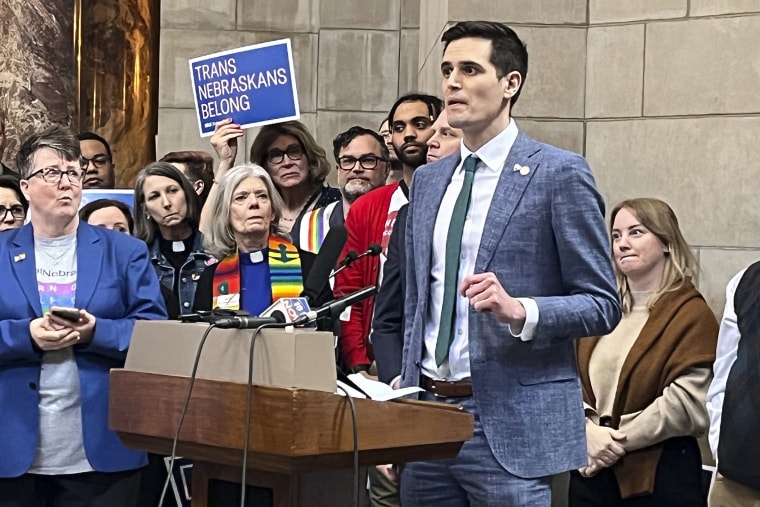
Nebraska state Sen. John Fredrickson, pictured here in the state Capitol in Lincoln on Feb. 8, 2023, is the first openly gay man elected to the Nebraska Legislature.Margery A. Beck / AP file
Imse added that the data doesn’t show the effect that LGBTQ officials are having in their communities. He pointed to Nebraska state Sen. John Fredrickson, a Democrat who gave an emotional speech in April against a bill that would’ve barred trans students from using the school facilities that align with their gender identities and restricted their participation on school sports teams.
The bill needed 33 votes to pass out of committee. After Fredrickson’s speech, two of the bill’s Republican co-sponsors abstained from voting, bringing the final tally to 31-15 and effectively killing the bill.
Fredrickson said that, as the first openly gay man elected to the Nebraska Legislature, he never wanted his legacy to be about his identity.
“That said, I happen to have come into office during a time where we are seeing an unprecedented number of anti-LGBTQ+ bills being introduced, and I feel a high level of responsibility to my community to speak truth in these spaces,” Fredrickson said in an email. “I’ll be honest — it hasn’t always been easy, and it has taken a toll on myself and my family. That said, I go to bed every night knowing who I am, knowing my community, and knowing that I stand on the right side of history, and that is an honor.”
Fredrickson encouraged LGBTQ people who are interested in running for office to do so.
“Without being in these rooms, we risk the conversation continuing to be about us, not with us,” he said.
A new report by the U.K. youth charity Just Like Us has found that many schools still don’t talk openly about diverse families, resulting in what the group describes as social stigma, discrimination, and poor wellbeing for the children and parents of LGBTQ+ families.
The new research independently surveyed 1,012 LGBTQ+ parents across the U.K. and interviewed families about their experiences.
More than half (56%) of lesbian and gay parents face negative comments about their families, while forty-two percent of their kids have experienced remarks about having LGBTQ+ parents, according to the research.
“Every parent wants to send their child to school in the morning and feel reassured that they will be safe, happy, and ready to learn,” said Laura Mackay, Chief Executive of Just Like Us.
“But many LGBT+ parents are instead feeling worried, isolated and unsure whether they or their children will face hurtful and invasive comments, unfair treatment and outright discrimination simply because their family isn’t heterosexual or cisgender.”
Half of lesbian and gay parents are worried their child will be “bullied because they have LGBT+ parents” and “not be accepted” (48% and 52%, respectively), and almost a quarter (23%) say their children have felt “upset or hurt by negative comments at school about LGBT+ people.”
Nearly a quarter (24%) of those surveyed say their children have been “left out of social arrangements seemingly because they are from an LGBT+ family.”
The same number holds for lesbian moms and gay dads who “feel isolated as an LGBT+ parent” and “depressed or anxious about my LGBT+ family not fitting in or not being treated fairly.”
Those numbers are even higher for trans parents.
“As an LGBT+ parent, compiling this report has been far from reassuring,” said Amy Ashenden, Director of Communications and Engagement for the charity. “Some of the findings are harrowing.”
The report reveals that anti-trans rhetoric has seeped into some school communities. Nearly a third (30%) of transgender parents have heard negative comments about trans people at school.
Lesbian moms face invasive questions about their families, too, the report shows. Almost forty percent have been asked by “strangers” about their child’s sperm donor.
More than a third (35%) of all LGBTQ+ parents say their school refers to families as “moms and dads” as the default, while just one in five gay, lesbian, and trans parents say their school openly discusses LGBTQ+ families with pupils.
“There is clearly so much work to be done to help schools and nurseries understand the huge impact that an inclusive – or unaccepting – school environment can have on LGBT+ families,” Ashenden added.
A federal judge inCalifornia has ruled that a lawsuit brought byLGBTQ+ veterans against theDepartment of Defense will move forward. The forward momentum of the suit, which claims the Pentagon has failed to discharge LGBTQ+ service members honorably post-don’t ask, don’t tell, marks a significant victory for those caught up in the homophobic policy.
U.S. Magistrate Judge Joseph Spero’s decision allows the plaintiffs to argue that the process of correcting their discharge papers is not only lengthy but also re-traumatizing, Reutersreports. These veterans, discharged under discriminatory policies, contend that being forced to navigate a complex system to amend their records violates their constitutional rights to equal protection and due process.
The class action, filed in the Northern District of California, aims to mandate the Defense Department to proactively update the discharge statuses of LGBTQ+ veterans. Lawyers for the plaintiffs celebrated the ruling, noting its importance during Pride Month as a step towards rectifying past injustices.
The lawsuit highlights the struggles of veterans who have been unfairly labeled with less-than-honorable discharges. Such discharges can prevent them from accessing crucial benefits, including healthcare, loans, job opportunities, and tuition assistance. The discharge papers often explicitly state the reason for their discharge, effectively outing them whenever they need to present their military records.
“Requiring LGBTQ+ veterans to first bear the stigma and discriminatory effects of carrying indicators of sexual orientation on their DD-214s, and then navigate a broken record correction process to seek resolution, violates their constitutional rights,” thelawsuit states.
While the Pentagon cited an existing procedure for discharge upgrades, Spero noted that this process might need to be revised and could perpetuate discrimination. The Pentagon argued that a two-page application process exists for veterans seeking discharge corrections, claiming that legal representation is unnecessary and that most cases are resolved within ten months. However, the plaintiffs argue that the process is opaque and burdensome, often requiring legal assistance and forcing veterans to relive their traumatic experiences.
In January, three gay Democratic U.S. congressmen — California Rep. Robert Garcia, Wisconsin Rep. Mark Pocan, and New Hampshire Rep. Chris Pappas — sent aletter to the Department of Defense,urging a quicker response to resolve cases of LGBTQ+ service members dishonorably discharged under DADT and the outright ban that preceded it. Garcia, Pocan, and Pappas emphasized the moral obligation of the U.S. government to correct these wrongs and restore honor to LGBTQ+ veterans. “Our service members made the ultimate sacrifice to defend our country. ‘Don’t Ask, Don’t Tell’ was a policy that should have never existed in the first place, but we’re unfortunately still feeling the repercussions of it to this day,” Garcia said in a press release.
The case, Farrell v. U.S. Department of Defense, seeks to address the systemic issues within the department by ensuring that all veterans discharged under DADT and similar policies receive the honorable discharges they deserve. This move could affect thousands of veterans who served their country but were discharged due to their sexual orientation.
“In honor of Pride Month, Secretary of State Antony J. Blinken will host a convening and reception for U.S. leaders championing Lesbian, Gay, Bisexual, Transgender, Queer, and Intersex (LGBTQI+) equality across the U.S. government and around the world on Thursday, June 27, at the Department of State.
“The convening will begin at 1:00 p.m. EDT in the Burns Auditorium, and the reception will begin at 6:00 p.m. EDT in the Benjamin Franklin Room.
“The Secretary will deliver remarks at both events which will be open to pre-registered press and streamed live on www.state.gov and www.YouTube.com/statedept.
“The Pride Month convening will also feature brief remarks by U.S. Ambassador to the United Nations Linda Thomas-Greenfield and U.S. Trade Representative Ambassador Katherine Tai.
“At the Pride Month reception, Special Envoy to Advance the Human Rights of LGBTQI+ Persons Jessica Stern will deliver brief remarks and will announce the release of the Annual Progress Report on the Implementation of the Presidential Memorandum on Advancing the Human Rights of LGBTQI+ Persons Around the World.” – Via press release from the State Department.
When Tom Wheeler set out to help organize Canyon County, Idaho’s first Pride event, he envisioned a small picnic in a park in Nampa, where he volunteers at an LGBTQ+ drop-in center. It would be a small event open to everyone.
But Canyon County’s first Pride was not small and had 700 feet of six-foot-tall metal fencing and a police barricade. The event drew a crowd of thousands of people and featured food trucks, drag entertainers, and a stage.
It was also highly controversial, the mayor of Nampa said that Pride events conflicted with her beliefs, and residents of Nampa said it should be protested.
Though it was never completely safe to be a gay person in the United States, the Obama-era optimism of marriage equality and Pride Celebrations as parties are gone. Thanks to rising homophobia and transphobia, Pride events are now commonly threatened and protested. There have been 1,800 anti-LGBTQ+ bills introduced nationwide, and the State Department recently issued a warning about terrorist attacks during Pride celebrations.
Wheeler and fellow volunteer, Van Knapp, who lives in Nampa, decided to plan a Pride celebration together for the community. But what they originally intended to be a small picnic in the park for about 50 people grew into a gathering for 2,000, with the pair receiving $18,000 in donations.
The Washington Post reports that “there were no explicit threats of violence” against the event, but before the event, Wheeler said that he received a call in which someone told him, “My family’s been here since 1901. This is God’s country. You’re not welcome here.”
His uncle told him he should wear a bulletproof vest. Instead, he opted for a cowboy hat and a pink T-shirt.
Even the mayor of Nampa spoke out, releasing a statement in May that reminded people that, while the First Amendment protects the right for the group to assemble in public, she personally doesn’t agree with Pride.
“While this event does not reflect the personal beliefs and convictions of myself, the Nampa City Council, and many living in Nampa who have already reached out to us requesting it be canceled, the advice of our legal counsel was that the City of Nampa must recognize the protected first amendment rights of those scheduling and involved in this event,” Nampa Mayor Debbie Kling said.
For their safety, Wheeler waited until the day before to announce the drag performers and offered them the option to drop out of the event, which they declined.
“I’m just excited to show a little brown kid what I would have loved to see,” a queen named Percephone Bias said.
The day of saw protests: some people stood outside and held signs that read “Appeal to Heaven” or stood near the entrance wearing Make America Great Again hats. About ten Liberty Dogs, a far-right group, stood at the barricades around the event with guns.
But by 1:45 p.m., the event was at occupancy, and even more so, a 1,000-foot line of people was waiting to get in. While Wheeler was initially worried about getting shut down for having too many people, the fire chief told him that “the crowd is a good thing! It’s good to see this here in Nampa.”
By the time the drag performers started, the Liberty Dogs were gone. The nine queens who lived in Canyon County, who had never gotten to perform in their hometowns, were cheered for and celebrated by a massive crowd. The celebration ended with a proposal: a man from Nampa went on stage and asked his boyfriend to marry him, who said yes.
Wheeler told Inman that he “would totally categorize the event as peaceful and a step in the right direction for civil liberties for LGBTQ folks in Idaho.”
President Joe Biden said Wednesday he will use clemency authority to pardon former servicemembers who were convicted of crimes because of their sexual orientations or gender identities.
Biden will issue a proclamation pardoning veterans who were convicted under a provision of the Uniform Code of Military Justice prohibiting gay sex, senior administration officials said on a call with reporters.
Service members who meet certain eligibility requirements will be able to obtain certificates of pardon and apply to have their discharge characterizations changed within their branches, officials said.
Biden said the action was aimed at “righting an historic wrong” for many former service members who faced convictions “simply for being themselves.”
“Despite their courage and great sacrifice, thousands of LGBTQI+ service members were forced out of the military because of their sexual orientation or gender identity. Some of these patriotic Americans were subject to court-martial, and have carried the burden of this great injustice for decades,” Biden said in a statement. “This is about dignity, decency, and ensuring the culture of our Armed Forces reflect the values that make us an exceptional nation.”
The pardon would apply to any eligible conviction from 1951 through 2013, when Congress rewrote Article 125 of the Uniform Code of Military Justice, which criminalized sodomy.
Administration officials did not specify how many former service members would be affected, but they estimated that “thousands” were convicted under the provision, which held that any person found guilty of sodomy should be punished as directed by a court-martial. The action would also apply to those who are deceased.
Biden’s re-election campaign has sought to shore up support from LGBTQ voters during National Pride Month as some of his allies worry about dwindling support. A poll conducted in January by the advocacy group GLAAD found 68% of LGBTQ registered voters supporting Biden and 15% backing former President Donald Trump.
Biden and Trump have contrasting records on LGBTQ protections.
During his first days in office, Biden signed an executive order repealing a Trump-era ban on transgender people’s serving openly in the military.
In 2019, Trump rolled back Obama-era health care protections for transgender people and opposed the Equality Act, legislation to prohibit discrimination based on sexual orientation and gender identity that gained Biden’s support on the campaign trail in 2020 and that he vowed to prioritize during his first 100 days. The measure failed to pass in the Senate after the House approved it in 2021.
Trump did not recognize Pride Month for the first two years of his term, but in 2019 he became the first Republican president to acknowledge Pride Month, which honors the 1969 Stonewall Uprising in New York, after President Bill Clinton first recognized Pride Month in 1999.
Trump has said that if he is elected in November he plans to roll back government programs to protect trans rights and punish doctors who provide gender-affirming care to minors.
Nearly 7 in 10 adults in the U.S. support same-sex marriage, but that support has dipped in recent years, particularly among Republicans, according to the latest polling data from Gallup.
Support for same-sex marriage remains strong at 69%, though it is down slightly from the record high of 71% in 2022 and 2023. Republican support has decreased to below 50% in recent years: In 2022, 55% of Republicans said they believed same-sex marriage should be legal, while that support has fallen to 46% this year. Democratic support is at 83% this year, down from a record high of 87% in 2022, while independent support is at 74% this year, down from a record high of 77% last year.
Gallup said the decadeslong upward trend in public support has slowed because of “Democrats’ and independents’ support leveling off, while Republicans’ has dipped slightly.”
When Gallup began polling about same-sex marriage in 1996, 27% of Americans said they believed same-sex couples should be allowed to wed. In 2016, the year after the Supreme Court’s landmark ruling Obergefell v. Hodges made same-sex marriage legal nationwide, support increased to 61% and has not fallen below that level since.
Republican support for same-sex marriage has averaged 30 points lower than among Democrats, according to Gallup’s polling data.
Gallup also polls Americans, as part of its Values and Beliefs survey, on their view of the morality of same-sex relations. This year, 64% of Americans said they see same-sex relations as morally acceptable, a steep drop off from 71% in 2022. Democrats (81%) and independents(68%) are more likely than Republicans (40%) to view same-sex relations as morally acceptable.
“Although the longer-term trends have shown increased support among all three party groups, the past two years have seen a leveling off, if not a decline, in that support,” Gallup concluded in its report.
Today, U.S. Senator Tim Kaine (D-VA), a member of the Senate Armed Services and Foreign Relations Committees, and Senator Tammy Baldwin (D-WI) led the introduction of a Senate resolution that acknowledges and apologizes for the mistreatment of and discrimination against lesbian, gay, bisexual, transgender (LGBT) individuals who have served our nation in the uniformed services, as civil servants, or in the Foreign Service.
“LGBT civil servants, foreign service officers and servicemembers have made countless sacrifices and contributions to our country and national security. Despite this, our government has subjected them to decades of harassment, invasive investigations and wrongful termination because of who they are or who they love,” said Kaine.
“This Pride Month, I’m proud to lead this resolution alongside Senator Baldwin to reaffirm our commitment to righting our past wrongs and fighting for equality for all LGBT Americans.”
“Anyone who serves our country, whether they are in uniform or a civil servant, deserves to be treated with respect, fairness, and dignity, regardless of who they are or who they love,” said Baldwin. “I am proud to lead this effort to show our commitment to creating a more accepting, equal country that lives up to our nation’s ideals.”
The United States has a long, disturbing history of discrimination against servicemembers and other federal employees identifying as LGBT.
Beginning in the early 1940s and continuing through the 1990s, a period historians label the “Lavender Scare,” thousands of federal employees were discriminated against because of their sexuality.
At least 100,000 LGBT military service members were forced out of the Armed Forces between World War II and 2011, most recently due to the 1994-2011 ‘Don’t Ask, Don’t Tell’ policy, which prohibited servicemembers from disclosing their sexual orientation.
In 2014, President Obama signed Executive Order 13672, officially prohibiting the federal government and federal contractors from discriminating on the basis of sexual orientation or gender identity.
In 2023, the Department of Defense announced that it would undertake a proactive review of the service records of individuals discharged due to their sexual orientation to assess whether to grant them discharge upgrades.
While these are significant steps in the right direction, we still have more work to do to ameliorate the harm done by decades of discriminatory policies.
The senators have long fought for equal treatment and rights for all individuals, regardless of sexual orientation or gender identity. Last year, they introduced the Equality Act, historic, comprehensive legislation to protect Americans from discrimination based on their gender identity or sexual orientation.
In 2022, they helped pass the Respect for Marriage Act, which was signed into law to ensure that same-sex and interracial marriages are recognized by every state.
The resolution is also cosponsored by U.S. Senators Chris Coons (D-DE), Jeff Merkley (D-OR), John Fetterman (D-PA), Patty Murray (D-WA), Brian Schatz (D-HI), Jeanne Shaheen (D-NH), Bob Casey (D-PA), Dick Durbin (D-IL), Edward Markey (D-MA), Richard Blumenthal (D-CT), Ben Cardin (D-MD), Sheldon Whitehouse (D-RI), Kirsten Gillibrand (D-NY), Michael Bennet (D-CO), Ron Wyden (D-OR), Sherrod Brown (D-OH), and Mark R. Warner (D-VA).
In 2021, gay US House reps David Cicilline and Mark Takano proposed a similar resolution (see below), but it went nowhere after being referred to several committees.
Texas Attorney General Ken Paxton blocked the Biden Administration’s Title IX rule protecting LGBTQ+ students from sex-based discrimination and harassment, Paxton’s office announced in a Tuesday release.
The rule would have protected all students and employees from all sex discrimination, including restoring and strengthening full protection from sexual violence and other sex-based harassment.
Paxton said in the release he won a “major” victory against the Biden Administration’s Department of Education’s attempt to rewrite Title IX to force Texas schools to adopt radical “transgender” policies in violation of state and federal law.