It was advertised as a “fun-filled afternoon” in a Bronx library with a “local celebrity/author who encourages you to embrace your own uniqueness.”
Instead, the free event planned at the Morrisania Library starring drag artist Desmond Napoles was canceled after the teenaged celebrity received hate-filled and violent threats — a trend that has led to many other family-oriented LGBTQ events being canceled across the nation.
The nasty attacks on Desmond — a high school sophomore who likes to volunteer at the New York Public Library “because it’s really fun and it gives me something to do during the summer” — came after the Morrisania Library announced that Desmond would present two teen-focused sessions reading from their book, “Be Amazing: A History of Pride.”
In July 2022, Conservative MP Nadhim Zahawi sparked fears of a return to Section 28 when he promised to “protect” children from “radical activists”.
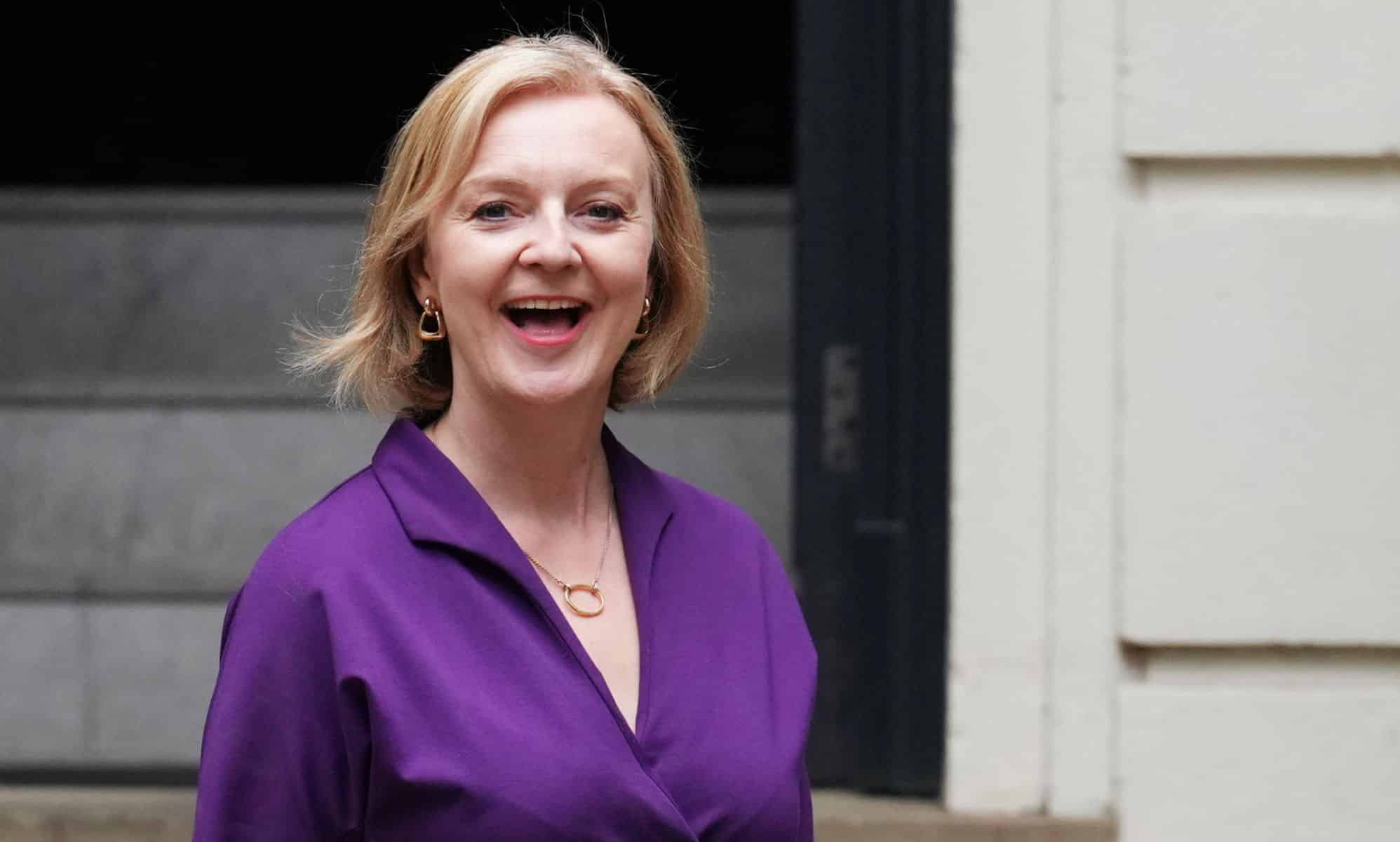
The former education secretary, currently serving as equalities minister in Liz Truss’ cabinet, made his comments while launching a failed leadership bid to become PM.
For LGBTQ+ people, alarm bells rang.
Zahawi’s suggestion that children are being subjected to “damaging and inappropriate nonsense” sounded a lot like Margaret Thatcher’s infamous 1987 speech in which she said kids were being taught they had an “inalienable right” to be gay.
Section 28, which came into effect in 1988, banned the “promotion of homosexuality” by local authorities. It gave rise to a culture of fear that stopped teachers from talking to kids about LGBTQ+ issues, and the scars run deep for queer people who grew up under its shadow.
It was repealed in Scotland in 2000, and in England and Wales in 2003.
More than 30 years on, a culture of hostility for LGBTQ+ people is threatening to boil over. Anti-trans sentiment is at an all-time high, with hit pieces appearing in the right wing press almost daily.
Comments from senior Tories such as Zahawi, Suella Braverman and Liz Truss herself have led some to question whether there could be a new version of Section 28, this time focused on trans issues, right around the corner.
UK government could ‘create an atmosphere’ that discourages LGBTQ+ inclusion
Sue Sanders is chair of Schools OUT UK, an organisation that works to eliminate prejudice from schools. She doesn’t think the Tories would be “foolish enough” to enact a new version of Section 28 – but is concerned the government might introduce guidance that could make schools a cold environment for LGBTQ+ youth.
“I think they’ll do it through producing the sort of language we’ve seen from the likes of Suella Braverman,” Sanders tells PinkNews.
LGBTQ+ advocates have called on Liz Truss to “build bridges” with the queer community after she was elected the new Conservative Party leader. (Getty)
“They’ll make statements which will cause an atmosphere and will then promote self-censorship in teachers unless we give them the resources and the confidence to say, look, you’re still legally able to do this stuff,” Sanders says.
“It’s the stirring of the atmosphere that the media and right-wing politicians do which then makes the atmosphere very unsupportive.”
‘Section 28 had a profound effect on kids and teachers’
Reflecting on Section 28, Sanders says it was “horrendous”.
It created a culture that forced teachers back into the closet and starved children of LGBTQ+ representation and discussion in the classroom.
“The trauma that both teachers and kids went through is something that some of them have not in any way recovered from,” Sanders says.
“It would have had a profound effect on kids and teachers alike… I’m sure we had suicides because of it.
“What’s needed is our teachers’ unions to be very clear and to keep sending out guidance and clarity on where they stand legally.”
Tories want to ‘cement their power’
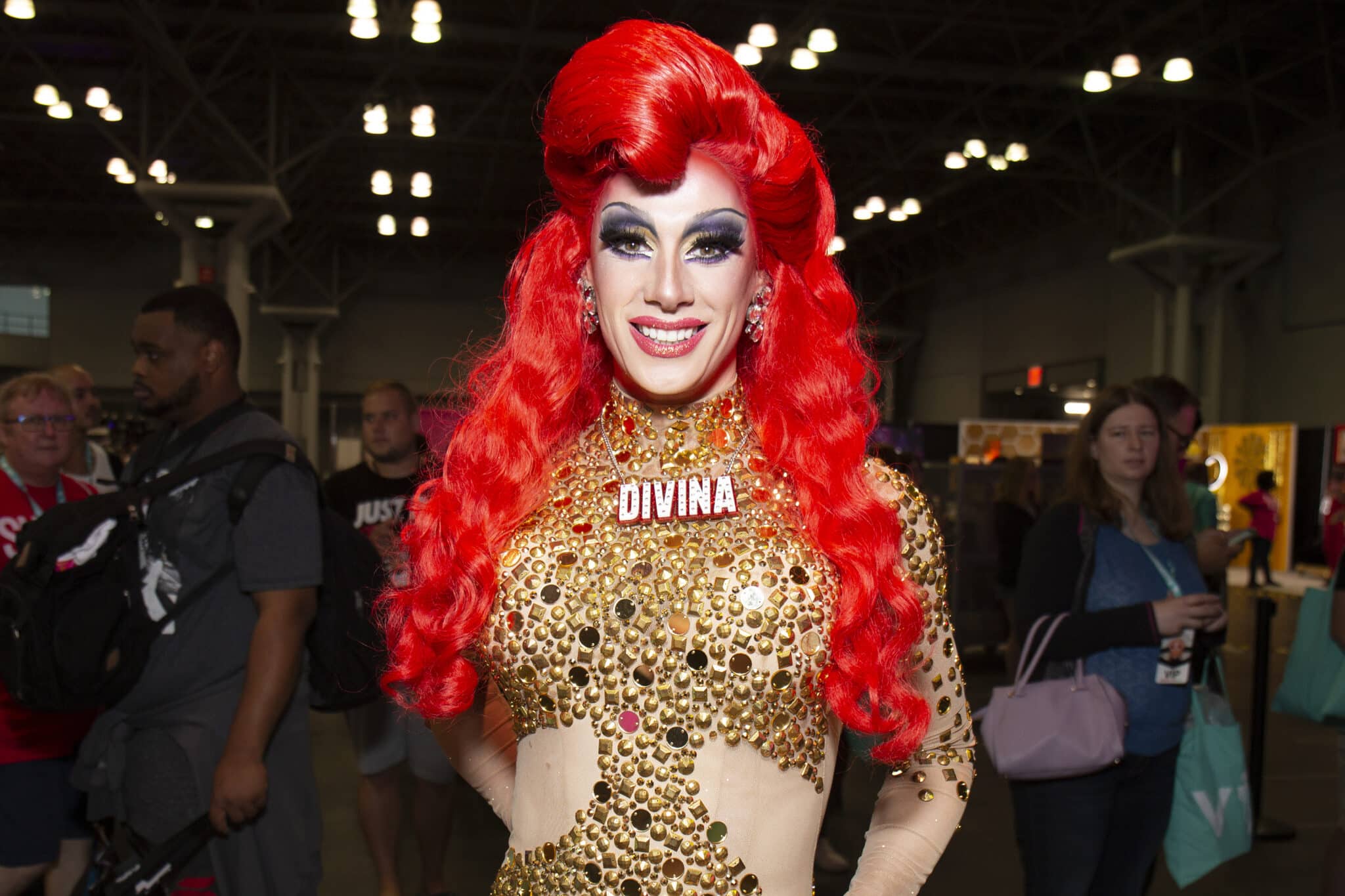
Drag Race UK star Divina De Campo grew up under Section 28. She says the UK was “incredibly homophobic” during the ’80s and ’90s, and Thatcher’s government was quick to capitalise on that.
What’s happening today around trans rights and anti-LGBTQ+ sentiment isn’t dissimilar to what happened then, de Campo says – the Conservative Party has targeted Muslims, migrants and, most recently, the trans community.
“Section 28 created a hostile environment, which is exactly what the Tory party have done again but for other people,” de Campo tells PinkNews.
She points out that the government instructed schools to not use materialsfrom organisations that oppose capitalism in 2020 – for de Campo, that suggests they could do the same with LGBTQ+ issues.
“They’ll do exactly like they did in the ’80s and they’ll use [us] to try and cement their power,” de Campo says.
Drag Race’s Divina De Campo. (Santiago Felipe/Getty)
The media and political figures are driving a moral panic about trans people because it pays to do so, de Campo says. The media is trying to create an “emotional reaction”, whereas the government is listening to the wrong people.
“Rishi Sunak and Liz Truss have both said, ‘Is a trans woman a woman? No.’ They very clearly said that.
“For 20 years we’ve operated under a system where trans women are women so there’s plenty of data about whether trans people are a danger to society in the way they’re being painted and the fact is, no, and we’ve got plenty of evidence about whether self-ID is a danger to women and the answer is no.”
‘Show solidarity, just like we did with the miners’
De Campo says the solution is solidarity – people from marginalised backgrounds need to come together and fight the oppression that’s coming from government. It’s the best way to avoid a repeat of Section 28 in the future.
“If we’re not going to see it get as bad as it was then, now is the time for us to organise,.
“We need to do exactly like we did before. It becomes about solidarity with other groups – showing solidarity with the Muslim community, with the Jewish community, with working class people who are all going to be struggling a lot through the winter and through next year.”
She continues: “It’s going to become about writing to your MP, showing solidarity, just like we did with the miners – just like how it worked before. That’s what we’ve got to do.”
Few have confidence in Truss
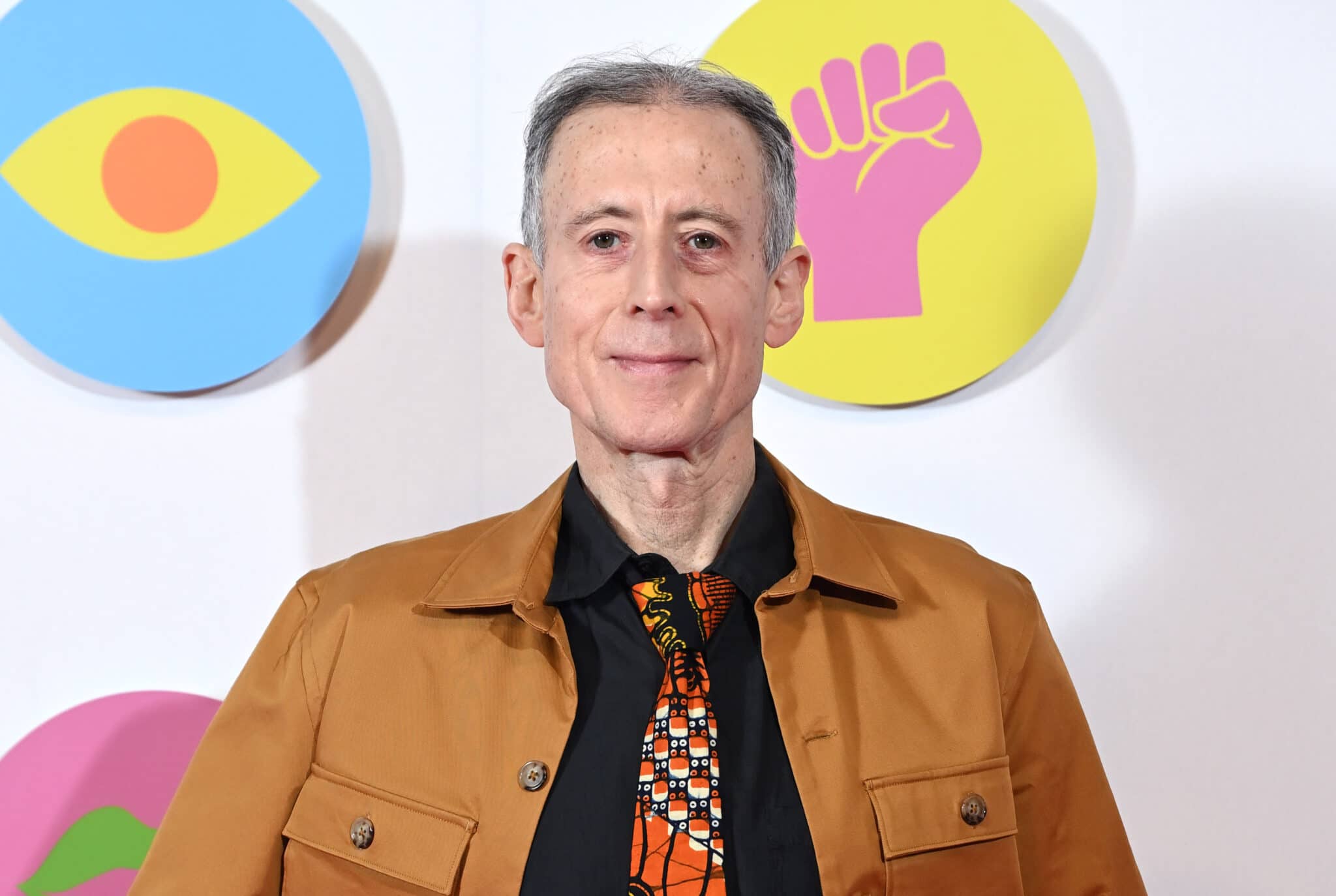
It’s vital we avoid a new version of Section 28 because its effects were so far-reaching, according to LGBTQ+ rights activist Peter Tatchell. It had a “devastating effect” on LGBTQ+ teenagers and caused many to suffer from anxiety, depression and self-harm.
The problem is that avoiding Section 28-like policies could be difficult under a government that’s decidedly right-wing.
LGBTQ+ activist Peter Tatchell. (Karwai Tang/WireImage)
“The Tories have shifted to the right under Liz Truss,” Tatchell tells PinkNews.
“They are waging a culture war against our community and see political mileage in appealing to their conservative bases.”
He says the future for LGBTQ+ rights in the UK right now is “gloomy”.
“Regression seems more likely than progress. We’ve already witnessed more than four years of delay in banning conversion therapy and trans people will not be protected if the legislation finally gets tabled. Reform of the Gender Recognition Act has been kicked into the long grass, despite a majority of those who responded to the public consultation urging change.
“The government wants to deport LGBTs and other refugees to Rwanda, even though it is not safe. There are rising levels of anti-LGBT+ hate crime and no serious government action to remedy it.”
Tatchell has “no trust or confidence” that anything will improve for LGBTQ+ people under Truss’ rule.
“She’s appointed a cabinet dominated by homophobes, including some who oppose marriage equality and trans rights.”
Much is uncertain for LGBTQ+ people right now, but one thing is certain: queer people are facing into a dark period, and they’re going to have to fight hard to protect their hard-won rights.
More than 1,600 books were banned in over 5,000 schools during the last school year, with most of the bans targeting titles related to the LGBTQ community or race and racism, according to a new report.
It found that there were 2,532 instances of individual books’ being banned, which affected 1,648 titles — meaning the same titles were targeted multiple times in different districts and states.
Books were banned in 5,049 schools with a combined enrollment of nearly 4 million students in 32 states, the report found.
Because PEN America stuck to documented cases of bans, which included reports to the group from parents and school staff members and news reports about book bans, the report says its data most likely undercounts the true number of bans.
Suzanne Nossel, the CEO of PEN America, said the recent efforts to ban books are a new phenomenon that has been led primarily by a small number of conservative advocacy groups that believe parents don’t have enough control over what their children are learning.
“We all can agree that parents deserve to and are entitled to a say over their kids’ education,” Nossel said at a news conference PEN America hosted Monday. “That’s absolutely essential. But fundamentally, that is not what this is about when parents are mobilized in an orchestrated campaign to intimidate teachers and librarians to dictate that certain books be pulled off shelves even before they’ve been read or reviewed. That goes beyond the reasonable, legitimate entitlement of a parent to have a give-and-take with the school — things that are enshrined in parent-teacher conferences and PTAs.”
Preliminary data released Friday by the American Library Association, or ALA, found that the number of attempts to ban or restrict library resources in schools, universities and public libraries is on track to exceed the record counts of 2021.
From Jan. 1 to Aug. 31, the ALA documented 681 attempts to ban or restrict library resources, with 1,651 library titles being targeted, compared to 729 attempts for all of last year, with 1,597 books targeted.
The PEN America report said nearly all of the book bans — 96% — were enacted without schools or districts following the best practice guidelines for book challenges outlined by the ALA and the National Coalition Against Censorship.
Before the wave of book bans, parents would sometimes raise concerns to their children’s schools or teachers about books their children brought home, said Jonathan Friedman, PEN America’s director of free expression and education programs.
But now, conservative groups and parents are Googling to find books that have any LGBTQ content, and then a conservative group adds it to a list of inappropriate books, Friedman said.
“They complain about the books online, the books go on a list, the list takes on a sense of legitimacy, and then it being on the list leads a school district to react to that list and take it seriously,” Friedman said, adding that in nearly all of the cases, the cycle happens without respect for process or policy.
Friedman pointed to a case in Walton County, Florida, where a popular children’s book called “Everywhere Babies” landed on a banned books list last spring. A few of the illustrations include what could be interpreted as same-sex couples, but they are never identified as such in the text. The Florida Citizens Alliance, a conservative nonprofit group focused on education, included it in its 2021 “Porn in Schools Report.”
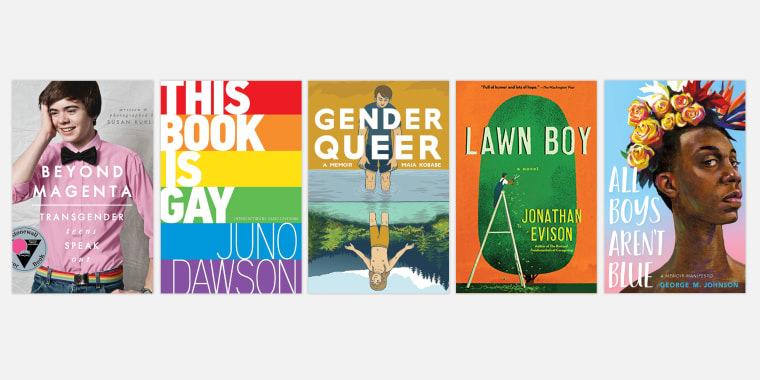
The five LGBTQ books on the ALA’s list of the Top 10 Most Challenged Books of 2021. Candlewick Press; Hot Key Books; Oni Press; Algonquin Books; Farrar, Straus and Giroux
Of the 1,648 titles that were banned last year, the report found, 41% explicitly address LGBTQ themes or have protagonists or prominent secondary characters who are LGBTQ, and 40% include protagonists or secondary characters of color.
More than one-fifth (21%) directly address issues of race and racism, and 22% include sexual content of varying kinds, including novels with some level of description of sexual experiences of teenagers; stories about teen pregnancy, sexual assault and abortion; and informational books about puberty, sex or relationships.
The report estimates that at least 40% of the bans listed on PEN America’s Index of School Book Bans are connected to proposed or enacted legislation or to political pressure from elected officials to restrict the teaching of certain concepts.
PEN America also found at least 50 groups involved in pushing for book bans, 73% of which have formed since last year. One of the largest is Moms for Liberty, a group advocating for parental rights, which lists more than 200 local chapters on its website.
Tiffany Justice, a co-founder of Moms for Liberty, said teachers should value parents’ input.
“I mean, there’s not two sides to this issue,” Justice said in an interview on “CBS Saturday Morning.” “There are moms who love their kids, who don’t want pornography in school, and then there are people who do want pornography in school. I think that the book issue has been used to try to marginalize and vilify parents. And the truth is there is no place for pornography in public schools.”
The 50 groups identified by the report have been involved in at least half of the book bans enacted last year, and at least 20% of the bans can be directly linked to the actions of the groups, the report found.
The most frequently banned books were “Gender Queer: A Memoir,” by Maia Kobabe, followed by “All Boys Aren’t Blue,” by George M. Johnson, and “Out of Darkness,” by Ashley Hope Pérez, the report found.
Pérez said what’s striking about her book’s being banned in 24 school districts is that it was published in 2015 and wasn’t challenged until last year. She said that some right-wing groups have used words like “pornographic,” “inappropriate,” “controversial” and “divisive” to describe the banned books and that the books they describe are most often by or about nonwhite people and other minorities.
“The books are a pretext. It is a proxy war on students who share the marginalized identities of the authors and characters in the books under attack,” she said at Monday’s news conference. “It is a political strategy. The goal is to stir up right-wing political engagement by drawing still brighter lines around targeted identities.”
She said banning books harms students in a few ways. When a student shares a gender or sexual identity with a character in a book and that book is banned, it “sends the message that stories about people like them are not fit for school.”
By giving into their demands, schools give conservative groups an unearned legitimacy, she said.
“When school leaders cave to these pressures, they elevate the questionable judgment of a handful of parents over the professional discretion and training of librarians and educators and, above all, above the needs of students,” she said.
The Senate won’t vote on legislation to protect same-sex marriage until after the midterm elections, key senators said Thursday, apparently in a bid to give Republicans political space to support the bill without offending their base.
The leader of the effort, Sen. Tammy Baldwin, D-Wis., has been working this month on an amendment to the bill aimed at attracting more Republican votes to overcome a filibuster. But the necessary 10 GOP votes have remained elusive.
“We’re very confident that the bill will pass, but we will need a little more time,” Baldwin told reporters Thursday.
Sen. Susan Collins, R-Maine, said Wednesday that the amendment language they were working on would “make it very clear” that the bill wouldn’t “legalize polygamous marriages” or require churches to “perform same-sex marriages.”
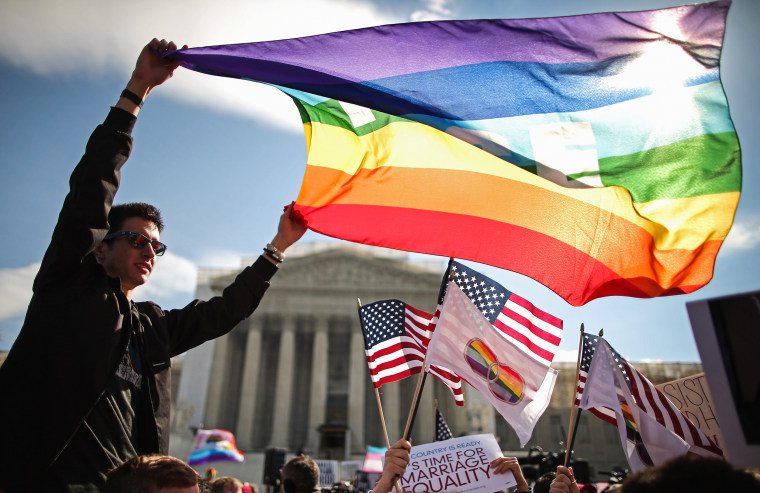
People rally in support of marriage equality outside the Supreme Court during oral arguments in a case challenging the Defense of Marriage Act on March 27, 2013.Chip Somodevilla / Getty Images file
“I think we’re in very good shape, very good shape. And this bill is going to pass,” Collins said Thursday. “I think we managed to thread the needle on the religious liberty concerns.”
The underlying legislation, which would enshrine federal protections for same-sex marriage, is co-sponsored by Collins and Sen. Rob Portman, R-Ohio, whose son is openly gay. Sen. Thom Tillis, R-N.C., also has said he supports it.
A version of the legislation cleared the House this summer, with 47 Republicans joining all Democrats in voting yes.
Senate Majority Leader Chuck Schumer, D-N.Y., signaled this week that he wanted to kick-start the floor process Thursday, but his office announced a change of course in the afternoon.
Schumer is “extremely disappointed that there aren’t 10 Republicans in the Senate willing to vote yes on marriage equality legislation at this time,” said his spokesperson, Justin Goodman, and because his “main objective is to pass this important legislation, he will adhere to the bipartisan group of Senators’ request to delay floor action.” Schumer is “100 percent committed to holding a vote on the legislation this year,” Goodman added.
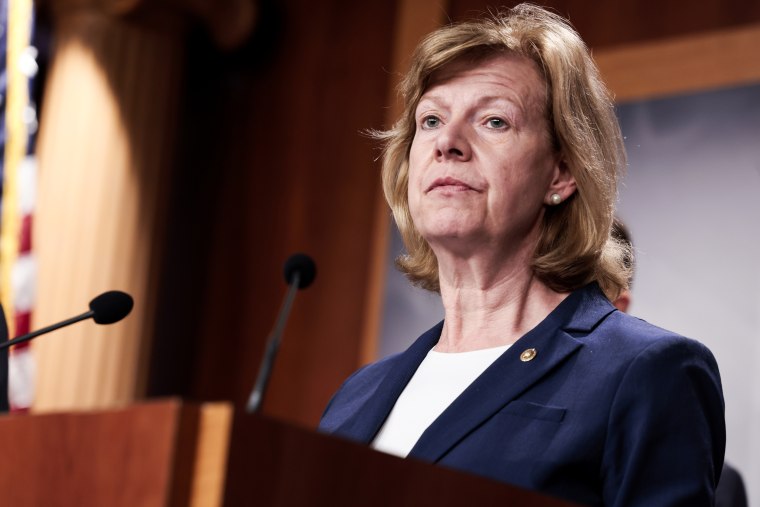
Sen. Tammy Baldwin, D-Wis., at the Capitol on May 5.Anna Moneymaker / Getty Images file
Shortly after a bipartisan huddle in Schumer’s office, the group explained why the vote would be delayed.
“We have just put together language that has tremendous respect for the input that we’ve received on religious freedom. But the fact of the matter is it’s only about 18 hours old — less than that,” Tillis told reporters Thursday, adding that senators should have more time to review the five-page amendment.
“There have been some that said the timing of the vote was political,” Tillis said. “This is clearly a situation where we want to make our members feel comfortable with it. Then I’m confident that we’ll ultimately pass it.”
Sen. Roy Blunt, R-Mo., a former House GOP whip, who hasn’t made up his mind about whether to back the bill, argued the vote tally would be higher after Election Day.
“The unreformed whip in me would say you should have a vote when you’ve got the votes,” Blunt said, “but they’ll get more votes in November and December than they’ll get on Monday.”
Backers of the bill have been assigned to reach out to certain Republicans who are on the fence. Sen. Ron Johnson, R-Wis., told NBC News that Sen. Kyrsten Sinema, D-Ariz., was tasked with contacting him and that he’s reviewing the new language, which he received Wednesday night.
Johnson wouldn’t share details of their conversation. He said he has “always enjoyed my work with Sen. Sinema when we worked on” homeland security and border issues, adding, “I respected her genuine effort to try and fix the problem at the border.”
A new law in California will help military service members who were discharged under “don’t ask, don’t tell” policies because of their sexual or gender identities to reestablish their eligibility for Veterans Affairs benefits, Gov. Gavin Newsom said Saturday.
“For decades, our bravest heroes, men and women who wore the uniforms of the armed services had to hide who they really were, and many were other than honorably discharged if their sexuality was discovered,” Newsom said in a statement after announcing he had signed the bill.
Gays and lesbians were banned in the military until the 1993 approval of “don’t ask, don’t tell,” which allowed them to serve only if they did not openly acknowledge their sexual orientation. Rather than helping, advocates say, the policy created more problems. In its entire history, the military dismissed more than 100,000 service members based on their sexual or gender identities — 14,000 of them during “don’t ask, don’t tell.”
Repeal of the law was approved by Congress and then President Barack Obama in late 2010 and took effect nine months later, allowing lesbian, gay and bisexual people to serve openly.
The Department of Defense subsequently created a path for veterans who had been discharged under the policy to receive the full range of veterans’ benefits.
“But many veterans sadly don’t know or can’t even access this important process,” Newsom said, adding that some veterans trying to reclaim benefits have had to hire expensive legal counsel and other assistance to navigate the process. “We’re taking steps to fix this.”
The law will require the California Department of Veteran Affairs to establish the Veterans Discharge Upgrade Grant Program to help advise LGBTQ veterans who were discharged under “don’t ask, don’t tell” and to help those who qualify to update and correct their records and access veterans’ benefits.
Senate Majority Leader Chuck Schumer (D) has announced his attention to hold a vote “in the coming weeks” on the “The Respect for Marriage Act,” a bill that would help enshrine same-sex marriage rights into law.
In doing so, he’d get Senate Republicans to state whether they support marriage equality before the November midterm elections. Democrats could use Republican opposition to the bill to pummel conservative candidates and convince larger numbers of Democratic voters to come to the polls.
ADVERTISING
Democratic and Independent voters have come out against Republicans in greater numbers since the conservative-led Supreme Court overturned the right to abortions nationwide in June. Political commentators think even more voters could come out against Republicans over same-sex marriage, considering that a June Gallup poll found that 71 percent of voters support marriage equality.
“Let me be clear,” Schumer said in a Wednesday press conference, “a vote on marriage equality will happen on the Senate floor in the coming weeks, and I hope there will be 10 Republicans to support it.”
“Our two leading members on this issue, Sen. [Tammy] Baldwin and [Kyrtsten] Sinema, are working with Republicans to see if there are enough votes to pass the bill,” he added.
Thus far, Senators Susan Collins (R-ME), Lisa Murkowski (R-AK), Rob Portman (R-OH), and Thom Tillis (R-NC) have all said that they would vote in favor of the bill. The bill needs 10 Republican senate votes to reach the 60-vote threshold needed to overcome a guaranteed filibuster and become law.
When asked about the legislation on Wednesday, White House Press Secretary Karine Jean-Pierre said, “I know there’s a legislative pathway that’s being discussed currently in Congress. We’ll let leadership decide how to move forward with that.”
She added, “The President is proud is a champion of a right for people to marry. They can choose who they love, and he believes it is non-negotiable, and the Senate should act swiftly to get this to the President’s desk.”
However, several Republican senators have come out against the bill.
“Never felt this bill is necessary,” he told reporters on Wednesday. “This is just Democrats opening up a wound that doesn’t need to be opened up. And now that I’ve talked to people there are some very serious concerns on religious liberty…. I would not support it in its current state.”
Sen. Ted Cruz (R-TX) has also said he will oppose the bill due to concerns over “religious liberties.”
“This bill without a religious liberty protection would have massive consequences across our country, weaponizing the Biden administration to go and target universities, K-12 schools, social service organizations, churches and strip them all of their tax-exempt status,” Cruz claimed earlier this week on his podcast Verdict.
Cruz said that he and his allies are encouraging fellow Republicans to vote against the bill. He also said Republicans would push to add an amendment to the bill that would provide “a strong protection of religious liberty.”
Sen. James Lankford (R-OK) has also said he’ll oppose the bill, stating, “I believe marriage is between a man and a woman.”
In mid-July, 47 Republican House lawmakers voted in favor of the bill, helping it pass the lower legislative chamber.
In late July, 83 conservative organizations wrote a letter to Senate Minority Leader Mitch McConnell (R-KY), claiming that the bill will legalize polygamy and incest.
In reality, he Respect for Marriage Act would officially repeal the so-called Defense of Marriage Act (DOMA), the 1996 law that forbade the federal government from legally recognizing same-sex marriages. In its place, the act would require the federal and state governments to recognize same-sex marriages as long as they occurred in states that offer them. If any state refuses to recognize such marriages, the act says, the spouses can sue.
Democrats and Collins introduced the bill after Supreme Court Justice Clarence Thomas indicated that the nation’s highest court should consider overturning Obergefell v. Hodges, the 2015 court ruling that legalized same-sex marriage nationwide.
In his footnote to the June Supreme Court decision overturning abortion access nationwide, Justice Thomas wrote that the court should “reconsider all of this Court’s substantive due process precedents, including Griswold [the case that granted the right to contraception] Lawrence [the case that struck down anti-sodomy laws], and Obergefell [the case that legalized marriage equality].”
“We have a duty to ‘correct the error’ established in those precedents,” Thomas wrote.
If the court overturns Obergefell, it would essentially leave individual states to decide their own same-sex marriage laws. Nearly 30 states have same-sex marriage bans currently on their books.
The Respect for Marriage Act has the support of LGBTQ and allied national organizations including the ACLU, the Center for American Progress, the Equality Federation, Family Equality, Freedom for All Americans, GLAD, Human Rights Campaign (HRC), Lambda Legal, the National Black Justice Coalition, the National Center for Lesbian Rights, the National Women’s Law Center, and PFLAG.
Malta’s prime minister, Robert Abela, has promised reforms for the country’s LGBTQ+ community, including free gender affirming surgery for trans people.
According to local publication Lovin Malta, the prime minster attended Malta’s Pride march in Valletta on 10 September to share news that the government is committed to carrying out these reforms.
In an interview with ONE Radio he said: “I believe that social reform gives the Labour Party its identity.
“My presence yesterday, as well as that of ministers and MPs, symbolises the messages that while we have done a lot, more is yet to come. While we’re proud of what we did, more needs to be done.”
The Labour Party leader noted the recent lift of a ban on gay men donating blood in Malta, and said the next step will be free gender affirming surgeries for trans people, as promised in Labour’s manifesto.
Abela took to social media to announce the reform for donating blood in Malta.
In the Facebook post he said: “Today we will fulfil another electoral promise with new protocols for donating blood.
“That way we will have fairer protocols that remove any form of discrimination with LGBTIQ+ people where the parameters for a person to be able to donate blood will be equal for everyone.”
He ended the message by saying: “Reforms remain at the top of this government’s agenda. Not least in the equality sector.”
Speaking to One Radio about the promise of free gender reassignment surgery Abela said: “They will be placed on the national health service, which means the state will finance the procedure.”
In 2019 Malta was named Rainbow Europe’s best European holiday destination for LGBTQ+ travellers, scoring an impressive 90 percent out of 100.
Belgium scooping up second place with 73 per cent, and the UK scraped in the top 10 in ninth place with 62 per cent.
PinkNews has reached out to Abela’s office for comment.
The president of Sri Lanka has said his government won’t oppose a bill to decriminalise homosexuality – but added the bill must gain support before any laws change.
On Sunday (11 September) president Ranil Wickremesinghe, who has held his role since July this year, said the government will not oppose a private member’s bill presented to parliament by MP Premnath C Dolawatte to decriminalise homosexuality.
Same-sex relationships are currently illegal in Sri Lanka, and there are other discriminatory laws against trans people and sex workers.
Dolawatte’s bill seeks to decriminalise same-sex sexual activity between consenting adults by amending sections 365 and 365A of Sri Lanka’s penal code.
‘A matter of private conscience’
However, it will require support from individual members of parliament, as president Wickremesinghe explained during talks with Samantha Power, the administrator of the United States Agency for International Development (USAID).
According to the Colombo Gazette he said: “We are for it, but you have to get the support of individual members. It’s a matter of their private conscience.”
Last month a bill to amend the penal code with the aim of protecting the rights of Sri Lanka’s LGBTQ+ community was handed over to Wickremesinghe by Dolawatte.
The Penal Code (Amendment) (19th Act) Bill to amend the penal code was also submitted to parliament by Dolawatte as a private member’s bill, the Eastern Eye reported.
The paper said the LGBTQ+ community of Sri Lanka and its allies issued a statement welcoming the private member’s bill.
But despite the bill being submitted, Sri Lanka’s LGBTQ+ community questioned the commitment of its government to address issues faced by the community.
It comes after the Sri Lanka government were accused of forcing abusive anal and vaginal virginity “tests” on LGBTQ+ people in an attempt to prove homosexual conduct.
Since 2017, at least seven people have been forced into the “cruel, inhuman, and degrading” physical examinations, according to a Human Rights Watch report.
Rosanna Flamer-Caldera of equalities group Equal Ground described the ex-leader as “pathetic” and hit out at the president’s “insidious references degrading the LGBTIQ community”.
Since 2013, Russia has had a law in place that criminalizes the distribution of “homosexual propaganda” to minors. This vague and overly broad law can be used to punish anyone who speaks positively about LGBTQ relationships or displays any kind of pro-LGBTQ sentiment. As a result, Russia has become one of the most dangerous countries in the world for members of the LGBTQ community.
Recently, Russian legislators have proposed to extend the LGBTQ propaganda law, which would criminalize anyone who promotes “non-traditional” sexual relationships to minors and adults. This, critics say, will further endanger the lives of Russia’s LGBTQ population, which has already suffered increased harassment, violence, and hostility in recent years.
ADVERTISING
Here, we take a look at the state of LGBTQ rights in Russia and what has fueled the shift towards anti-LGBTQ sentiments there.
Technically, it isn’t illegal to be LGBTQ in Russia. Homosexuality was decriminalized in 1993 and declassified as a mental illness in 1999. Transgender Russians have also been able to legally change their gender and identity documents since 1997.
However, there are currently no anti-discrimination protections in the country, despite the high rate of homophobia in Russia. Owing largely to President Vladimir Putin’s plan to position himself as the “world’s leading defender of traditional values”, the Russian government has only made it harder for its LGBTQ population to live freely and openly.
In 2012, the year Putin assumed office as President, the city government of Moscow banned LGBTQ pride parades for the next hundred years.
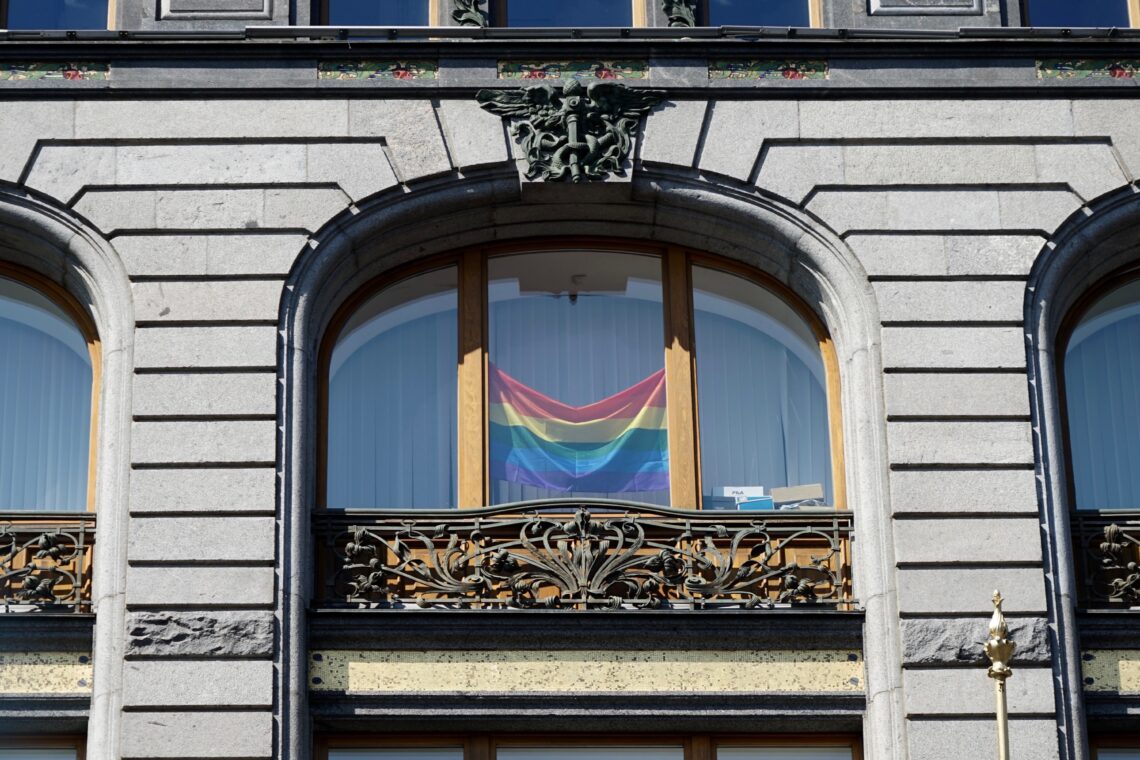
August 2, 2018: Pride flag at a window in Russian city St Petersburg Shutterstock
LGBTQ Rights In Russia Today
So, what is life like for an LGBTQ person living in Russia today? Here is a brief primer on Russian LGBTQ rights in the time of Putin:
The “Homosexual Propaganda” Law
Putin’s government classifies LGBTQ people as a threat to the traditional family values it hopes to uphold. In 2013, Putin signed a federal law banning the “promotion of nontraditional sexual relations to minors”. Ultimately, this law makes it illegal for anyone to introduce information about LGBTQ people to minors – encompassing any information shared online, on TV, and by the press.
The law has not only had a chilling effect on LGBTQ rights but has also been used as a justification to shut down valuable websites that offer resources and services to LGBTQ youth. The law also discourages mental healthcare providers and educators from giving patients and students the information and care they need to cope with their struggles and navigate a homophobic environment.
According to LGBTQ advocates, this law is about much more than simply “protecting children” – it is a political tool to further the state’s anti-Western liberalism agenda. LGBTQ people are positioned as dissidents who wish to “finish off the traditional morality” – essentially making them out to be enemies of the state and a threat to Russian culture and values. According to the co-founder of the Russian LGBT Network, Igor Kochetkov, the 2013 law “is used in information campaigns to generate hatred, including against human rights defenders.”
“In the rhetoric of the Kremlin and state-loyal media, LGBT rights, feminism, multiculturalism, and atheism are identified not only as foreign to Russia’s values but as existential threats to the nation,” says the Boston Review.
The European Court of Human Rights and the United Nations Committee on the Rights of the Child have both condemned the law, as it is in opposition to their policies on freedom of expression and the right to assembly.
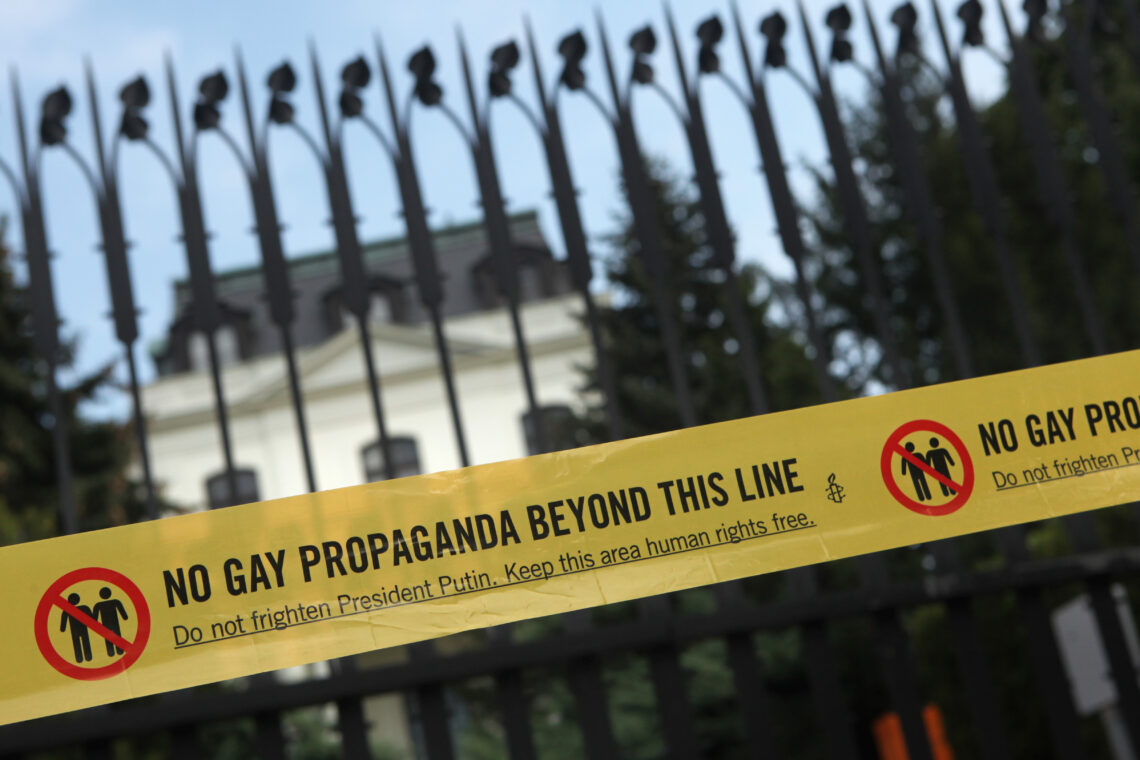
SEPTEMBER 8, 2013: No gay propaganda beyond this line. Banner against the Russian anti gay laws in front of the Russian Embassy in Prague, Czech Republic. Shutterstock
Same-Sex Marriage And LGBTQ Adoption In Russia
In April 2021, Putin signed a series of constitutional amendments that included a formal ban on same-sex marriage in the country. Previously, the Russian constitution did not explicitly define marriage as a relationship between one man and one woman – a loophole that gave LGBTQ Russians a sliver of hope that same-sex marriages could be introduced on that basis.
But with the recent amendments – which also removed term limits for the president and allowed the Russian constitution to take precedence over international law – LGBTQ Russians now have little hope for marriage equality in their country.
The amendments also ban transgender people from adopting children in Russia. Currently, only single adoptions – meaning no same-sex couples – are allowed.
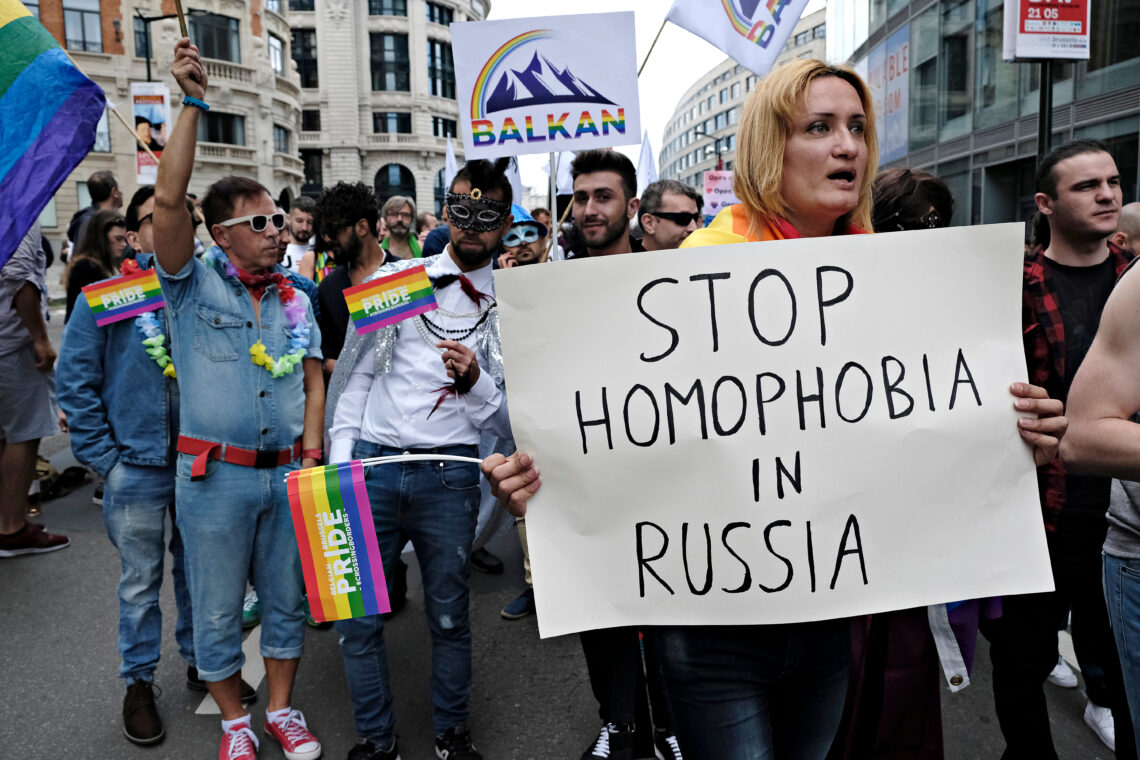
Participants march during the Belgian Gay Pride parade in Brussels Belgium on May 20, 2017 Shutterstock
Illegal Detentions In Chechnya
In 2017, reports surfaced of a “gay purge” in the semiautonomous state of Chechnya. These purges, which were conducted by Chechen authorities, targeted gay and bisexual men and resulted in the detention of over 200 people. More have reportedly been beaten, tortured, and even killed.
Despite international protests and demands to end the purge from the UN and the European Court of Human Rights, the detention and torture resumed in 2019. According to a report by Human Rights Watch, men have been “kicked, beaten, and shocked with electricity” and were detained for three to 20 days. They were also stripped of their cellphones and forced to out other queer men.
According to Amnesty International, Russian authorities have “failed to provide justice” for the victims of the Chechnyan gay purges and offer effective protection to Igor Kotchetkov, who received death threats after leading the public investigation of the incident.
In the 2020 documentary Welcome to Chechnya, which follows a group of activists as they attempt to evacuate queer people from the region, Chechen leader Ramzan Kadyrov blatantly denies the mere existence of queer people in Chechnya, stating, “We don’t have LGBT people here.”
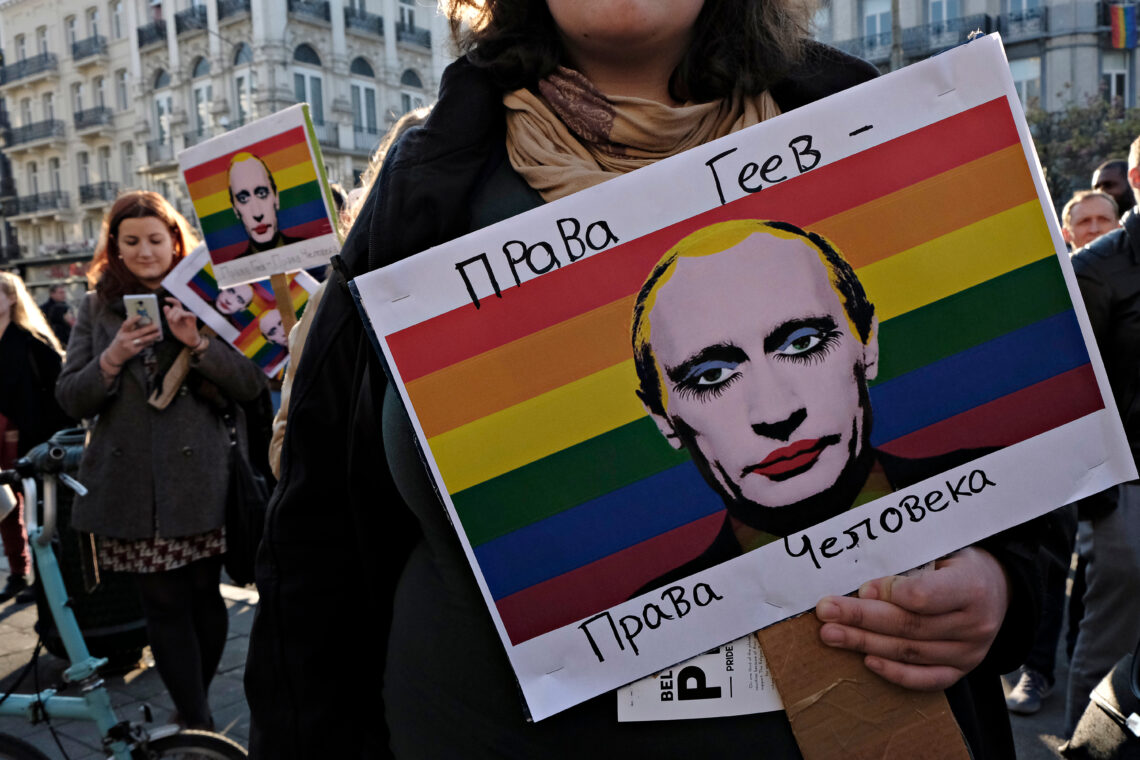
Brussels, Belgium March 20, 2017. A woman holds a placard with an image of Russian President Vladimir Putin during protest against the detention of gay men in concentration camps in Chechnya. Shutterstock
The Bottom Line
Russia has come under fire in recent years for its treatment of the LGBTQ community. With lawmakers proposing a total ban on spreading “LGBTQ propaganda” to both minors and adults and the amendment to the Russian constitution that makes same-sex marriage in the country illegal, LGBTQ Russians face a mountain of challenges in earning the right to live openly and safely.
These policies have not only curtailed the rights of LGBTQ people in Russia but have also inspired deeper hate and homophobia in the country – particularly among its ultra-conservative population.
You can show your support by learning more about the situation in Russia and spreading awareness.