Members of the Honduran Congress voted on Thursday to amend the constitution making it much harder to reverse existing hard-line bans on abortion and same-sex marriage, as lawmakers double down on socially conservative priorities.
Lawmakers voted to require a three-quarters super-majority to change a constitutional article that gives a fetus the same legal status of a person, and another that states that civil marriage in the Central American nation can only be between a man and a woman.
With 88 legislators in favor, 28 opposed and seven abstentions, the proposal will still need a second vote in the unicameral legislature next year before it is enacted.
Currently, all constitutional changes require a two-thirds majority vote of the 128-member body.
Mario Perez, a lawmaker with the ruling party of President Juan Orlando Hernandez, explained during a virtual floor debate that the change will create a “constitutional lock” on any would-be softening of the existing articles.
The country’s criminal code sets out three to six-year prison terms for women who abort a fetus as well as anyone else involved.
Abortion-rights proponents accused backers of the proposal of seeking to cement the current bans.
“This legislation permanently condemns pregnant women or pregnant girls who have been raped or risk dying due to health reasons,” said Merary Mendoza, a researcher with the Honduran women’s studies center CEMH.
Kevihn Ramos, the head of a gay rights advocacy group in Honduras, blasted the lawmakers who voted to make it harder to change the two constitutional articles.
“This reform is the product of a state-imposed religion on Honduras,” he said.
Joe Biden’s new secretary of state has made several promises to the LGBT+ community, including “urgently” appointing an LGBT+ envoy.
Antony Blinken, who will lead the Biden-Harris administration’s Department of State, made the comments at his confirmation hearing with the Senate Foreign Relations Committee on Tuesday (19 January), according to CNN.
He outlined changes he would make to ensure that the US government was “standing up for and defending” the LGBT+ community once Biden is in office.
The position of LGBT+ envoy, which was created to oversee US government efforts to support LGBT+ human rights, was left vacant during Trump’s presidency.
But Blinken said that filling the role was “a matter, I think, of some real urgency”.
He added: “We’ve seen violence directed against LGBTQI people around the world increase.
“We’ve seen, I believe, the highest number of murders of transgender people, particularly women of colour, that we’ve seen ever.
“And so I think the United States playing the role that it should be playing in standing up for and defending the rights of LGBTQI people is something that the department is going to take on and take on immediately.”
The new secretary of state also said that while working for the Biden administration, he would officially repudiate the findings of Trump’s anti-LGBT+ “Commission on Unalienable Rights”.
The commission, which was supposedly based on “natural law”, was formed by the Trump administration in July, 2019, to undercut the US government’s existing human rights laws.
Lastly, Blinken said he would allow all US embassies to fly Pride flags, after Trump banned US embassies from flying it for the entirety of June, 2020.
US President-elect Joe Biden should work with global leaders who have sought to shore up a defense of human rights around the world, Human Rights Watch said today in releasing its World Report 2021. His administration should also look for ways to entrench respect for human rights in US policy that are more likely to survive the radical changes among administrations that have become a fixture of the US political landscape.
“After four years of Trump’s indifference and often hostility to human rights, including his provoking a mob assault on democratic processes in the Capitol, the Biden presidency provides an opportunity for fundamental change,” said Kenneth Roth, executive director of Human Rights Watch, in his introductory essay to the World Report 2021. “Trump’s flouting of human rights at home and his embrace of friendly autocrats abroad severely eroded US credibility abroad. US condemnations of Venezuela, Cuba, or Iran rang hollow when parallel praise was bestowed on Russia, Egypt, Saudi Arabia or Israel.”
World Report 2021, Human Rights Watch’s 31st annual review of human rights practices and trends around the globe, reviews developments in more than 100 countries.READ IT HERE
Roth said that other governments recognized that human rights were too important to abandon, even as the US government largely abandoned the protection of human rights, and powerful actors such as China and Russia sought to undermine the global human rights system. New coalitions to protect rights emerged: Latin American governments plus Canada acting on Venezuela, the Organization of Islamic Cooperation defending Rohingya Muslims, a range of European governments acting on such countries as Belarus, Saudi Arabia, Syria, Libya, Hungary, and Poland, and a growing coalition of governments willing to condemn China’s persecution of Uyghur and other Turkic Muslims in Xinjiang.
“The past four years show that Washington is an important but not indispensable leader on human rights,” Roth said. “Many other governments treated Trump’s retreat as cause for resolve rather than despair and stepped up to protect human rights.”
Biden’s presidency provides an opportunity for fundamental change, Roth said. He said that the president-elect should set an example by strengthening the US government’s commitment to human rights at home in a way that cannot be easily reversed by his successors.
Biden should speak in terms of the human rights involved as he works to expand health care, dismantle systemic racism, lift people out of poverty and hunger, fight climate change, and end discrimination against women and LGBT people. The slim Democratic Party majorities in the US Senate and House may also open possibilities for more lasting legislation. Biden should also allow criminal investigations of Trump to proceed to make clear that no one is outside the rule of law.
Abroad, to better entrench human rights as a guiding principle, Roth said, Biden should affirm and then act on that principle even when it is politically difficult. That should include:
Curbing military aid or arms sales to abusive friendly governments such as Saudi Arabia, Egypt, the United Arab Emirates, and Israel absent significant improvements in their human rights practices;
Condemning the Indian government’s encouragement of discrimination and violence against Muslims, even if India is seen as an important ally against China;
Re-embracing the UN Human Rights Council, even though it criticizes Israeli abuses;
Voiding Trump’s sanctions on the International Criminal Court, even if he doesn’t like the prosecutor’s investigations; and
Abandoning Trump’s inconsistent, transactional unilateral policy towards China and adopting a more principled, consistent, and multilateral approach that will encourage others to join.
“The big news of recent years isn’t Trump’s well-known abandonment of rights but the less-noticed emergence of so many other countries in leadership roles,” Roth said. “The Biden administration should join, not supplant, these shared efforts. These governments should maintain their important defense of rights, not relinquish their leadership to Washington, while Biden works to entrench a less variable US commitment to human rights.”
We asked four partners to respond to Human Rights Watch’s call on US President-elect Joe Biden and other leaders to prioritize human rights at home and abroad, and why international attention is important to their work. Here are selected quotes:
The United States Dr Tiffany Crutcher, of the Terence Crutcher Foundationand Black Wall Street Memorial in Tulsa, recalls the racist history preceding the January 6 attack on the US Capitol and urges President-elect Biden to tackle white supremacy:
In 1921, it was a lie that incited the Tulsa race massacre where mobs of white rioters burned down the Black community of Greenwood. And almost 100 years later on January 6, 2021, it was a lie that incited mobs of white rioters to storm our nation’s capital to overthrow our democracy. Confederate flags were waved, nooses were erected, and white supremacy showed its ugly head.
Which is why I’m calling on the Biden administration to attack white supremacy head on its first 30, 60, 90 days of taking office. You must prioritize racial justice and you must re-engage on the issues of human rights, and most importantly you must reverse the regressions from the Trump administration. We don’t need another Breonna Taylor, we don’t need another Tamir Rice, another George Floyd, another Terence Crutcher. You must demand a just America and be the change that we so desperately need in this country right now.
Russia Tatiana Glushkova, a board member of the Russian group Memorial Human Rights Center, recalls the arrest on bogus charges of Memorial’s lead researcher in Chechnya, Oyub Titiev, and the difference international attention made in his fate:
The goal was to force Memorial to close its office in Grozny and to complicate the collection of information about human rights violations in Chechnya. However, the case itself was so crudely and clumsily fabricated and so obviously in retaliation for Oyub’s human rights work, that it attracted intense attention from the international community. Oyub’s case was discussed at the Council of Europe, the UN, European parliament, and FIFA. It was discussed in foreign ministries of many different countries, and numerous human rights organizations, both Russian and international. For nine months, foreign diplomats and journalists regularly visited the Shali city court [where Titiev’s trial was held].
Such attention did not escape the authorities of the Chechen Republic. Their most important reaction was, of course, the fact that Oyub’s verdict was relatively light, and also that he was very quickly released on parole. Such a reaction by the Chechen authorities, given their longstanding and deep hatred for Memorial, can only be explained by their desire to quickly turn this page, get rid of this case, of this political prisoner, and of the intense interest of the international community. The result we now have, that our colleague has been free for over a year, would not have been possible without [this] international attention. We are extremely grateful to everyone who took part in this effort.
Cameroon Cyrille Rolande Bechon, head of Nouveaux Droits de l’Homme Cameroun, a human rights organization based in Yaoundé, discusses the international response to the massacre of 21 civilians in Ngarbuh, Cameroon:
This is the place for me to thank the organizations that come together in the Coalition for Human Rights and Peace in the Anglophone Regions, international organizations like Human Rights Watch, [and countries like] France, the United States, who supported us and conveyed the message with us about the need to set up a commission of inquiry into this massacre.
Although this commission has announced its conclusions and a trial opened last December 17 against the four members of the security forces identified by the commission as having participated in this massacre, we’re still dissatisfied. Dissatisfied because the chain of responsibility in this massacre has yet to be established. We would like all those responsible, whether directly or indirectly, including high-ranking army officials, to be prosecuted and sentenced.
Venezuela Feliciano Reyes, a Venezuelan human rights defender deeply involved in providing humanitarian support to Venezuelans in need, on the country’s humanitarian emergency:
The complex humanitarian emergency that has affected Venezuela for at least four years has caused enormous damage to the population, for example, their lack of access to food, health services, [and] education. [These things] also generate mass forced migration because it’s so hard to survive in the country. The root causes include political conflict and years of abuse of power, of erosion of the rule of law. The international community has a fundamental role to play, not only in terms of diplomatic political actions in fora such as the Human Rights Council, the United Nations General Assembly, [and] the Security Council, to help find solutions to the political conflict, but also in providing vital international humanitarian assistance for Venezuela.
This has produced visible effects but is still insufficient. We hope the World Food Program will enter the country this year, for example, since there are reports of Venezuelans facing serious levels of food insecurity. This work is fundamental. This work of political and diplomatic pressure and humanitarian cooperation to restore decent living conditions for the Venezuelan people, and, eventually, to redirect the country towards development and well-being for its people.
The Presidential Inaugural Committee for President-elect Joe Biden and Vice President-elect Kamala Harris is calling on the LGBTQ community to participate in several planned virtual inaugural events that reflect the theme of “America United,” an inaugural official told LGBTQ representatives at a Jan. 12 online briefing.
“We are looking forward to the inaugural ceremonies in which the American people and the world will witness the peaceful transition of power,” said Rina Patel, the inaugural committee’s Associate Director of Coalitions before a Zoom gathering of close to 50 representatives of LGBTQ organizations from across the country.
“This will mark a new day for the American people focused on healing our nation, bringing our country together, and building back together,” she said.
Patel noted that the inaugural swearing-in ceremony for Biden and Harris, which will take place outside the U.S. Capitol, will not be open for in-person viewing and will be restricted mainly to members of Congress.
“In order to be mindful of COVID-19 guidelines there are no public tickets available for the inauguration,” she said. “I know some folks are excited about being in D.C., but we are really encouraging everyone to stay home and not to travel to D.C.”
At least three national LGBTQ organizations, meanwhile, were scheduled to hold their own inaugural celebrations in honor of the incoming Biden-Harris administration.
The Human Rights Campaign, the nation’s largest LGBTQ advocacy organization, announced it is joining “community partners” in holding a virtual LGBTQ Inaugural Ball on Jan. 20 called the Power of Unity.
“This not-to-be-missed virtual event will feature musical performances and special appearances from equality leaders across the LGBTQ movement,” a statement promoting the event says. Among the performers scheduled to appear, the statement says, is Billy Porter, the Grammy, Tony and Emmy Award-winning actor, singer and activist who stars in the FX hit series “Pose.”
HRC is billing the event as a fundraiser with suggested levels of donations of $400, $250, $175, $100, and $35, with financial supporters having access to an online reception and having their name posted as an official sponsor. But HRC says people can also attend the online Inaugural Ball free of charge by registering in advance of the event.
The Center for Black Equity, the D.C.-based national LGBTQ advocacy organization that organizes the nation’s Black Pride events, is holding its own virtual inaugural ball on Jan. 20, according to Executive Director Earl Fowlkes. Fowlkes said some LGBTQ elected officials were expected to speak at the event along with Reggie Greer, who served as the LGBTQ liaison for the Biden presidential campaign.
The LGBTQ Victory Fund, which raises money and provides logistical support for openly LGBTQ candidates running for public office, was scheduled to hold a virtual Inauguration 2021 fundraising event on Jan. 14.
In a statement on its website, the group said the event would celebrate “the queerest U.S. Congress in history!” a reference to the record number of LGBTQ candidates elected or re-elected to Congress in the 2020 election. Nine U.S. House members and U.S. Sen. Tammy Baldwin (D-Wisc.), were expected to appear at the Victory Fund event.
The Biden inauguration was scheduled to take place two weeks after the Jan. 6 Capitol riots in which hundreds of supporters of President Donald Trump stormed the U.S. Capitol building in a siege that took the lives of five people, including a U.S. Capitol Police officer.
The Biden-Harris inaugural committee has said it was working closely with the U.S. Secret Service, D.C. police, and a Capitol Police force with new leadership to ensure the security and safety of all those participating in the few in-person inaugural events.
Patel and Carrie Gay, another inaugural committee official, told the LGBTQ representatives at the Jan. 12 online briefing about at least three virtual inaugural events that community-based organizations, including LGBTQ groups, could participate in.
The two said one of the events scheduled for Jan. 18 was being organized in conjunction with the annual Martin Luther King Jr. National Day of Service. Community organizations throughout the country, including LGBTQ organizations, were being invited to organize events assisting those in need that would be publicized on the inaugural committee’s website, Gay told the briefing. Most of the events were to be virtual.
“Events will focus on COVID-19 relief and address challenges that have been exacerbated by the pandemic, such as poverty, hunger, racial injustice, homelessness, mental health, and educational disparities,” a statement released by the inaugural committee says.
“The Presidential Inaugural Committee is asking Americans everywhere to participate in community service and urging them to sign up to volunteer at bideninaugural.org/day-of-service and encourage their friends, family, and neighbors to join,” the statement says.
Three North Carolina municipalities passed discrimination protections for LGBTQ people this past week, shortly after the expiration of a yearslong moratorium on such measures.
Hillsborough, Carrboro and Chapel Hill passed ordinances protecting lesbian, gay, bisexual, transgender and queer people from discrimination in public accommodations and employment on Monday, Tuesday and Wednesday, respectively.
They’re the first measures of their kind passed since the 2017 repeal of North Carolina’s infamous HB2 “bathroom bill.” That controversial legislation, which passed in 2016 and restricted which public facilities transgender people could use, spawned national outrage and boycotts that were expected to cost the state billions in lost business. The repeal of HB2, however, was part of a “compromise bill” that placed a statewide moratorium on municipalities passing nondiscrimination ordinances. That bill, HB142, expired on Dec. 1, and advocates were ready and waiting.
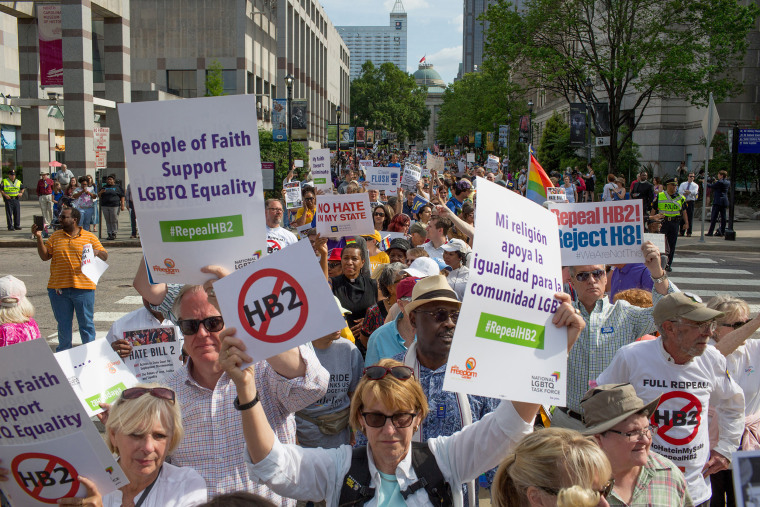
Demonstrators call for the repeal of HB2 in Raleigh, North Carolina on April 25, 2016.Jill Knight / Raleigh News and Observer/TNS via Getty Images
The three bills that passed so far are similar, though the Carrboro and Hillsborough ordinances carry a $500 penalty for violation and, according to their text, “Each and every day during which such discrimination continues shall be deemed a separate offense.” Officials in Orange County and the city of Durham are expected to vote on nondiscrimination measures Tuesday, and the Greensboro City Council is expected to discuss a similar ordinance in the coming weeks.
Advocates say it’s been a long time coming.
“We’ve been talking with elected officials since well before HB2 and trying to get these kinds of progressive policies passed,” Allison Scott, director of policy and programs at the Campaign for Southern Equality, told NBC News. “So to see these actually coming up to a vote feels amazing.”
People who live in the municipalities that pass these ordinances will not only be protected on the local level from discrimination based on sexual orientation and gender identity — but also based on race, national origin, marital or familial status, pregnancy, veteran status, religious belief, age and disability. That’s because North Carolina is one of five states that only have statewide discrimination protections for people with disabilities, leaving LGBTQ people and other groups open to discrimination in areas where they aren’t currently protected by federal law.
Even in areas where LGBTQ individuals are protected by federal law, there may be loopholes that leave some people out. Scott cited the Supreme Court’s decision in Bostock v. Clayton County, Georgia, as an example: The landmark 2020 decision ruled that LGBTQ people are protected under federal civil rights law from employment discrimination, but this doesn’t include individuals who work at small businesses with fewer than 15 employees. Those individuals, however, will now be protected from discrimination under these new local ordinances.
“It just shows the importance of why these laws are needed and why cities and counties need to step up,” Scott said.
HB2’s lasting impact
In early 2016, the Charlotte City Council passed North Carolina’s first public accommodations law protecting LGBTQ people from discrimination. The ordinance, however, drew criticism due to a clause that said transgender people would be allowed to use the bathroom that aligns with their gender identity rather than their sex assigned at birth.
Shortly after, the North Carolina General Assembly called a special session to debate the ordinance. Lee Storrow, executive director of the North Carolina AIDS Action Network, said the ordeal was disheartening to many LGBTQ people in the state.
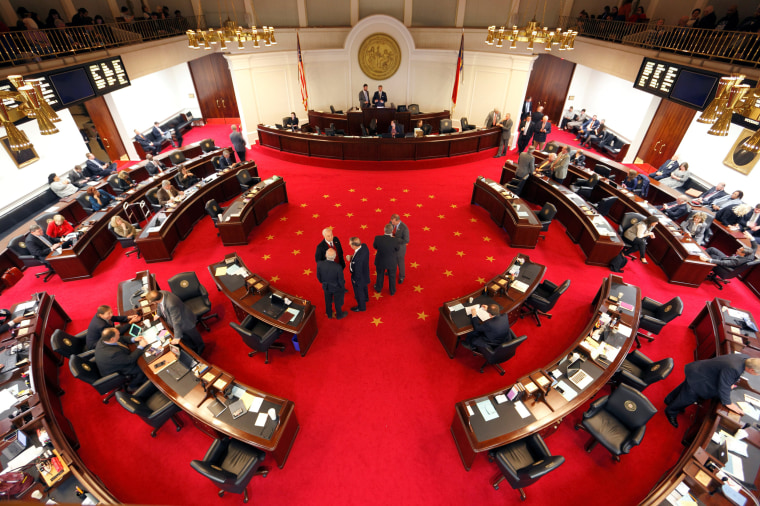
Lawmakers confer during a negotiations on the floor of North Carolina’s State Senate chamber as they meet to consider repealing the controversial HB 2 law, Dec. 21, 2016.JONATHAN DRAKE / Reuters
“That whole debate was just really hard to be a part of,” said Storrow, who has lived in Chapel Hill since 2007. “Because of the debate in 2016, people are so aware that they’re not protected, and it may not be that they have a specific moment where they’ve directly been discriminated against, but just the threat and knowing that they have no legal protections, that really has an impact on folks.”
In March 2016, just a few weeks after Charlotte passed its nondiscrimination ordinance, then-Gov. Pat McCrory, a Republican, signed into law HB2, or the Public Facilities Privacy and Security Act.
When the General Assembly did finally repeal HB2 the following year, municipalities still weren’t allowed to pass their own nondiscrimination measures. While advocates have waited for the moratorium to expire, LGBTQ North Carolinians have continued to face discrimination, they say.
“Just this month, someone in our network reached out about a person who was denied gender-affirming care who works for the state,” Kendra Johnson, executive director of Equality North Carolina, said.
The statewide LGBTQ advocacy group also received calls during the election about people being “policed around their identity, because their name does not match what the particular poll worker thought they should look like if they had a certain gender marker on their ID,” according to Johnson.
“It’s every single month we hear cases of discrimination,” Johnson added. “I know that these measures are necessary because we don’t have comprehensive nondiscrimination in the state, and we do not have it on the federal level, so we have to start where people live and work, and that’s cities and towns.”
The end of the moratorium means municipalities can start passing their own nondiscrimination ordinances, but there are limits. Scott said there’s a clause in HB142 that gives only the General Assemblythe power to legislate bathrooms and public changing facilities.
“That’s why we still need a full repeal of 142,” she said. “We know fully 67 percent of North Carolinians, a supermajority, believe that LGBTQ people should be protected from discrimination.”
‘A sense of relief’
After Carrboro passed its ordinance Tuesday, Mayor Lydia Lavelle said it reminded her of how she felt when same-sex marriage became legal.
“It’s kind of like, ‘About time,’” she said. “I’m feeling like it was long overdue.”
North Carolina will join 47 other states that either have statewide protections for LGBTQ people or allow cities and counties to create their own protections, according to Lavelle, who is a law professor at North Carolina Central University.
“We were an outlier before,” she said. “We’re joining the strong, strong majority of states that allow communities to do this.”
Tiz Giordano, who works in Carrboro, said they’re “elated” that the town passed discrimination protections for LGBTQ people.
“I’ve been able to build queer community, have chosen family and live in safety as my true self due to living in Carrboro and working in an affirming workplace,” they said. “I just want other queer and trans people to be able to feel this way and feel protected, especially in medical settings.”
Though Carrboro is a relatively progressive community, Giordano said their spouse has faced medical discrimination in the past. Under the new ordinance, hospitals and physicians’ offices will be considered public accommodations and LGBTQ people will be protected.
“Knowing that people will be able to have a case in court if they are being discriminated against definitely gives me a sense of relief,” Giordano said.
Vanity Reid Deterville, program director of the LGBTQ Center of Durham, said nondiscrimination laws at any level of government are especially important after the Trump administration rolled back certain federal protections for LGBTQ people over the last four years.
“Protections of any sort when it comes to the LGBT community — and, more specifically, queer and trans Black women, people of color — is critical,” she said, pointing to their level of marginalization in society.
Johnson said she’s confident the newly passed ordinances will help better protect LGBTQ people in the state, but she said she’s also happy to see elected officials coming together to do something for their constituents.
“I think we’re in a moment where there’s been a real ‘us versus them’ mentality coming from the White House down,” she said. “It’s nice to see elected officials recognizing that yes, there is discrimination, people should have the right to pursue their livelihood, to have housing, to not be discriminated [against] in health care and to be treated as equal and valuable citizens of towns, and acting to actually start to make that a reality.”
Senator Scott Wiener (D-San Francisco) introduced SB 225: the Bodily Autonomy, Dignity and Choice Act, to provide children and their families a chance to make informed decisions about major surgeries to change variations in the appearance of genitalia and other sex characteristics. Under SB 225, these surgeries will be prohibited when a child is under the age of six (except in the cases where it is medically necessary), allowing for parents to continue to learn with their child and child’s physician regarding the potential need for medical interventions. SB 225 is cosponsored by Equality California, interACT: Advocates for Intersex Youth, the National Center for Lesbian Rights, and the ACLU of California.
One to two percent of people are born with variations in their genitalia and sex anatomy, some of whom identify as intersex. Parents of children with these variations are often offered medically unnecessary surgical interventions – such as major surgeries to cut a clitoris, create a vagina for penetrative sex, remove hormone-making organs, or move a working urinary opening – which are typically performed on children under two years old and often without a complete discussion of the various risks. These surgeries may result in extreme scarring, chronic pain, chronic incontinence, loss of sexual sensation, post-traumatic stress disorder, incorrect gender assignment, and the need for additional surgeries to treat complications from the original surgery. SB 225 will allow parents to make a decision, in consultation with their child and medical professionals, once a person is old enough to participate in decision making about whether or not a surgery to change sex anatomy is right for them.
For every person, identity and sense of self — including gender — can evolve over a lifetime. But many of the procedures performed on infants with variations in their physical sex characteristics are permanent and irreversible. SB 225 will provide a way for families and children to have autonomy over decisions about their children’s bodies and their identities by delaying these surgeries until a child has reached six years old. Six is around the time when research shows that for many, gender identity has begun to form and take shape. The only way to know what an individual will want is to safely delay these non-emergency surgeries.
SB 225 will delay procedures to reduce the clitoris, create vaginas, and remove hormone-producing tissues often performed on infants – such as clitoroplasty, clitoral reduction, clitoral recession, gonadectomy, procedures to lengthen or reroute a urethra from its native orifice, vaginoplasty, urogenital sinus mobilization, and vaginal exteriorization.
Many adults who underwent these surgeries as infants have expressed deep concern and anguish about the procedures. The intersex community is leading the movement to ensure that no matter what gender identity a person grows up to have, everyone born with unique sex anatomy should be able to play a role in major healthcare choices. Organizations such as the United Nations, Human Rights Watch and the World Health Organization agree that these surgeries can be harmful and should only be an option when the individual is able to participate in an informed decision. Many in the medical community agree: in 2020, two U.S. hospitals committed to stopping infant clitoral and vaginal surgeries, citing issues raised by intersex and human rights organizations.
“People should have the chance to make informed decisions about their own bodies instead of having those decisions made for them and without their input,” said Senator Scott Wiener.“This legislation gives children and their families more time to research and opt in or out of non-emergency surgeries to irreversibly change a child’s sex characteristics. We must provide people the ability to make important healthcare decisions for themselves – especially when healthcare decisions are associated with a person’s gender assignment, and can result in long-term pain, PTSD, depression, and a loss of sexual sensation. The intersex community is leading this movement, and I am proud to work with a broad coalition of LGBTQ, civil rights, and health advocates to get this legislation passed.”
“The LGBTQ+ community — and transgender, nonbinary and intersex folks in particular — have been fighting for decades to secure our rights to make decisions about our own bodies. That fight continues today,” said Equality California Executive Director Rick Chavez Zbur. “Children born with diverse physical sex traits and their parents should be able to participate in the critically important decision-making process regarding medically unnecessary and often irreversible surgical interventions. We are proud to stand with Senator Wiener and the intersex community in this important work to safeguard the human rights of all Californians.”
“Building on 15 years of advocacy work by interACT, we saw two premier children’s hospitals finally commit to stopping infant clitoral and vaginal surgeries in 2020. Now it’s California’s time to shine,” said Kimberly Zieselman, Executive Director of interACT: Advocates for Intersex Youth, herself an intersex woman. “SB 225 builds on SCR 110, California’s 2018 resolution that established the state’s commitments to equality and autonomy for people born with variations in their sex anatomy.”
Becca Cramer-Mowder, Legislative Coordinator and Advocate for the ACLU of California, said: “SB 225 gives California the opportunity to advance equality by protecting the physical and psychological well-being of children born with variations in their physical sex characteristics.”
“Current medical practice allows surgeons to conduct life-altering and medically unnecessary surgeries on infants with variations in their sex anatomy simply to address the anticipated discomfort of others rather than the child’s health and well-being,” said Shannan Wilber, Youth Policy Director at the National Center for Lesbian Rights. “These practices perpetuate gender stereotypes and may not reflect the child’s choices when they are old enough to participate in the decision. NCLR is honored to stand with the intersex community to support their autonomy and dignity.”
###
Equality California is the nation’s largest statewide LGBTQ+ civil rights organization. We bring the voices of LGBTQ+ people and allies to institutions of power in California and across the United States, striving to create a world that is healthy, just, and fully equal for all LGBTQ+ people. We advance civil rights and social justice by inspiring, advocating and mobilizing through an inclusive movement that works tirelessly on behalf of those we serve. www.eqca.org
interACT: Advocates for Intersex Youth affects nearly every piece of policy that touches intersex issues in the United States. Committed to ending stigma against variations in genitalia and other sex anatomy, interACT has over 15 years of experience driving legal, legislative, media, and youth initiatives that elevate the voices of intersex people. Learn more or donate to our work at https://interactadvocates.org/
The National Center for Lesbian Rights (NCLR) is a national legal organization committed to advancing the human and civil rights of the lesbian, gay, bisexual, transgender, and queer community through litigation, public policy advocacy, and public education. Since its founding, NCLR has maintained a longstanding commitment to racial and economic justice and the LGBTQ community’s most vulnerable. http://www.nclrights.org
California on Monday became the first state to record more than 3 million known coronavirus infections.
The grim milestone, as tallied by Johns Hopkins University, wasn’t entirely unexpected in a state with 40 million residents but its speed stunning. The state only reached 2 million reported cases on Dec. 24.
The first coronavirus case in California was confirmed last Jan. 25. It took 292 days to get to 1 million infections on Nov. 11 and 44 days to top 2 million.
California’s caseload is also far ahead of other large states. Texas had more than 2 million and Florida topped 1.5 million.
The state has recorded more than 33,600 deaths related to COVID-19.
A caseload surge that began last fall has strained hospitals and especially intensive care units as a percentage of the infected — typically estimated to be around 12% by public health officials — become sick enough weeks later to need medical care.
On average, California has seen about 500 deaths and 40,000 new cases daily for the past two weeks.
Officials warn that a recent slight downward trend in hospitalizations could reverse when the full impact of New Year’s Eve gathering transmissions is felt.
The state is placing its hopes on mass vaccinations to reduce the number of infections but there have been snags in the immunization drive. On Sunday, Dr. Erica S. Pan, the state epidemiologist, urged that providers stop using one lot of a Moderna vaccine because some people needed medical treatment for possible severe allergic reactions.
More than 330,000 doses from lot 41L20A arrived in California between Jan. 5 and Jan. 12 and were distributed to 287 providers, she said.
In Northern California, Stanislaus County health officials responded by announcing they wouldn’t be holding vaccination clinics until further notice.
“Out of an extreme abundance of caution and also recognizing the extremely limited supply of vaccine, we are recommending that providers use other available vaccine inventory” pending completion of an investigation by state officials, Moderna, the U.S. Centers for Disease Control and the federal Food and Drug Administration, Pan said in a statement.
Fewer than 10 people, who all received the vaccine at the same community site, needed medical attention over a 24-hour period, Pan said. No other similar clusters were found.
Pan did not specify the number of cases involved or where they occurred.
Six San Diego health care workers had allergic reactions to vaccines they received at a mass vaccination center on Jan. 14. The site was temporarily closed and is now using other vaccines, KTGV-TV reported.
Moderna in a statement said the company “is unaware of comparable adverse events from other vaccination centers which may have administered vaccines from the same lot.”
The CDC has said COVID-19 vaccines can cause side effects for a few days that include fever, chills, headache, swelling or tiredness, “which are normal signs that your body is building protection.”
However, severe reactions are extremely rare. Pan said in a vaccine similar to Moderna’s, the rate of anaphylaxis — in which an immune system reaction can block breathing and cause blood pressure to drop — was about 1 in 100,000.
The announcement came as California counties continue to plead for more COVID-19 vaccine as the state tries to tamp down its rate of infection, which has resulted in record numbers of hospitalizations and deaths.
California has shipped about about 3.2 million doses of the vaccine — which requires two doses for full immunization — to local health departments and health care systems, the state’s Department of Public Health reported Monday.
Only about 1.4 million of those doses, or around 40%, have been administered.
So far, the state has vaccinated fewer than 2,500 people per 100,000 residents, a rate that falls well below the national average, according to federal data.
Although Gov. Gavin Newsom announced last week that anyone age 65 and older would be eligible to start receiving the vaccine, Los Angeles County and some others have said they do not have enough doses to vaccinate that many people and are first concentrating on inoculating health care workers and the most vulnerable elderly living in care homes.
The death rate from COVID-19 in Los Angeles County — the nation’s most populous and an epicenter of the state pandemic — works out to about one person every six minutes.
On Sunday, the South Coast Air Quality Management District suspended some pollution-control limits on the number of cremations for at least 10 days in order to deal with a backlog of bodies at hospitals and funeral homes.
“The current rate of death is more than double that of pre-pandemic years,” the agency said.
The Lincoln Project co-founder John Weaver has resigned from the group after admitting to sending sexually inappropriate messages to several men online.
The veteran strategist, who has a wife and children, is accused by at least 30 young men of dangling his political connections and access to high-profile job opportunities “in an attempt to receive sexual favours,” according to aForensic News report.
Weaver later issued a statement apologising in full for his actions while coming out as gay.
“To the men I made uncomfortable through my messages that I viewed as consensual mutual conversations at the time: I am truly sorry,” he told Axios. “They were inappropriate and it was because of my failings that this discomfort was brought on you.”
“The truth is that I’m gay,” Weaver added. “And that I have a wife and two kids who I love. My inability to reconcile those two truths has led to this agonising place.
“I have the most beautiful, loving and courageous family who I deceived all these years. I don’t deserve you. But I love you with all my heart and I’m sorry that you have to suffer for my mistakes.”
The Lincoln Project started in 2019 as a coalition of Republican operatives, including Kellyanne Conway’s husband, George Conway, who united to help prevent Donald Trump’s re-election.
The group gained a reputation for its viral memes bashing Trump and his administration, including billboards in New York City mocking Ivanka Trump and Jared Kushner.
Weaver, 61, became one of the most prominent members of the group – until earlier this week, when allegations of his inappropriate behaviour began to surface.
Forensic News claimed that at least 30 individuals had come forward, accusing Weaver of sending them unsolicited pictures, flying “politically-ambitious men to his location for massages,” and offering jobs in exchange for sexual relations.
The men were reportedly aged between 19 and 28, and most indicated that they were in college or had recently graduated and were looking for jobs in politics. The crux of the complaints levied by the men is that Weaver used his position of power to exploit them as they were beginning their careers.
While Weaver said he took “full responsibility” for the inappropriate messages and conversations, he attributed the emergence of the allegations to critics’ animosity for the Lincoln Project.
“I want to state clearly that the other smears being levelled at me by Donald Trump’s enablers as a way to get back at the Lincoln Project for our principled stand for democracy are categorically false and outrageous,” he asserted.
A spokesperson for The Lincoln Project said simply: “John’s statement speaks for itself.”
A Republican lawmaker in Montana has introduced a pair of bills targeting transgender youth.
House Bill 112, authored by state Rep. John Fuller, requires athletic teams at all public educational institutions — from elementary schools to colleges — to be designated based on “biological sex.” The measure, also known as the Save Women’s Sports Act, would prohibit transgender students from joining teams that match their gender identity, no matter how long ago they transitioned.
“Athletic teams or sports designated for females, women, or girls may not be open to students of the male sex,” it reads in part.
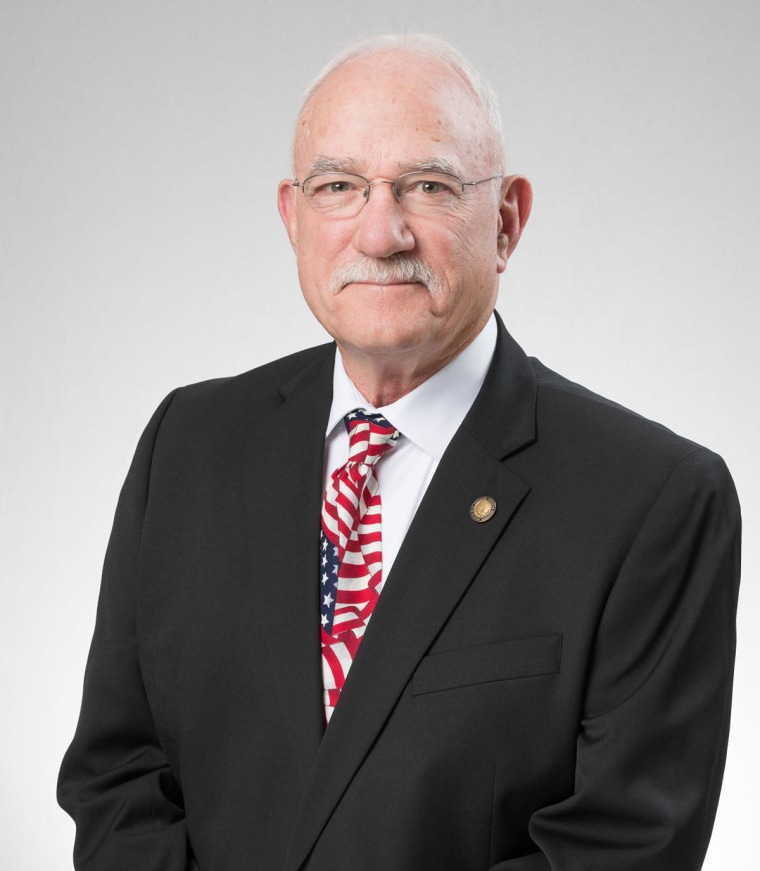
Montana Rep. John Fuller of Whitefish (R-HD8).Montana State Legislature
Fuller told Montana Public Radio that, as a former women’s soccer coach, he believes allowing transgender girls to play on women’s teams is unfair. His bill would allow students to sue if they feel they’ve been deprived or harmed in some way by a trans athlete participating in school sports.
“I want to protect and defend women’s sports,” he told the Helena Independent Record. “I believe this continued practice of allowing males to compete as females … is egregious and wrong.”
Another bill, also penned by Fuller, would bar health care professionals from providing transgender minors certain transition-related care.
Under House Bill 113, also known as An Act Providing for Youth Health Protection, physicians and other medical professionals are prohibited from treating gender dysphoria in minors by prescribing, providing or administering puberty-suppressing drugs or cross-sex hormones (including estrogen and testosterone); performing gender-reassignment surgery; or removing “any otherwise healthy or nondiseased body part or tissue.” Penalties for providers who violate the law would include fines of up to $50,000.
Fuller said it was “deeply wrong” for young people to undergo such procedures, according to Montana Public Radio. “We don’t let children do all kinds of things,” he told the Helena Independent Record. “Why should we allow this to happen? The state has a vested interest to protect children from such barbaric behavior.”
Fuller did not respond to a request for comment from NBC News.
Chase Strangio, deputy director for transgender justice at the American Civil Liberties Union, said that after the fallout from North Carolina’s House Bill 2, conservatives pivoted away from so-called “bathroom bills” toward legislation targeting trans youth.
“After the marriage decision, there was an immediate backlash on trans people using the bathroom — you saw dozens of these bills,” Strangio told NBC News. “Then you see the extremely affirming response — from companies, from the NCAA — and between 2017 and 2019 they lose the bathroom fight. There’s no more laws, they lose their court fights and they lose ballot initiatives.”
In 2018, Montana’s own bathroom bill garnered less than half of the 25,000 signatures needed to qualify for a state referendum.
Then, in 2019, Juniper Eastwood, a student at the University of Montana, became the first transgender runner to compete at the Division I level. That, according to Strangio, is “when conservatives start shifting to sports.”
“They start forming this narrative about trans student athletes that appears on Fox News, Breitbart, the Daily Caller. It attracts some cis women groups who were worried about female athletes,” he said, using a shortened term for the word cisgender, which means nontransgender.
That same year, Strangio said, a highly publicized custody battleinvolving a 7-year-old transgender girl in Texas became “another right-wing media moment.”
“By summer 2020, you have the Alliance Defending Freedom and the Heritage Foundation drafting these model trans-youth bills,” he added. “They’re not constituent-led. They’re put together by well-funded right- wing groups and shipped out to state legislatures. And they play on people’s fears and misconceptions.”
In 2020, the Michigan-based American Principles Project spent $4 million on political ads denouncing transgender athletes and access to gender-affirming health care for people under 18.
In addition to Montana, at least six other states — including Alabama, Indiana, New Hampshire, Mississippi, Missouri and Utah — are currently considering bills levying criminal or civil penalties for offering transition care to minors, according to the ACLU.
Lawmakers have sponsored legislation restricting transgender students from sports participation in at least 12 states, including Alabama, Georgia, Idaho, Indiana, Kentucky, Missouri, Montana, New Hampshire, North Dakota, Oklahoma, Tennessee and Washington. Only Idaho’s bill has passed so far.
Idaho’s House Bill 500, the Fairness in Women’s Sports Act, was signed by Republican Gov. Brad Little last March. A month later, Lindsay Hecox, a transgender student athlete at Boise State University, filed a lawsuit challenging the law. After a lower court issued an injunction against enforcement, HB 500 is now before the 9th U.S. Circuit Court of Appeals.
In a friend-of-the-court brief, nearly 200 elite female athletes — including Billie Jean King, Megan Rapinoe and Candace Parker — argued HB 500 “flies in the face of bedrock principles of equality and diversity in sports.”
“The global athletic community grows stronger when we welcome and champion all athletes — including LGBTQI+ athletes.” King said in a statement.
Strangio said Montana’s HB 112 is practically “a carbon copy” of Idaho’s law.
Readings for both Montana bills were rescheduled from Wednesday to Jan. 20 to allow for public comment. Republicans, who currently control both chambers of the Montana state Legislature, will have until April to pass the measure this legislative session.
On Thursday, more than 150 state nonprofits, businesses and professional groups joined the organization in opposing Fuller.
“Make no mistake: these bills target and attack trans youth and will cause them serious and lasting harm,” ACLU of Montana Executive Director Caitlin Borgmann said in a statement. “We cannot let fear mongering and lies about what it means to be transgender result in laws that would stigmatize trans youth, harm families and communities, and drive businesses away from Montana.”
Bozeman restaurateur Pete Strom pointed to the economic toll HB 112 and 113 could take by recalling the fallout from North Carolina’s HB2 “bathroom bill.” In 2016, North Carolina lost an estimated $630 million in economic activity related to HB2, according to Forbes.
“Montana doesn’t need that,” he said in a statement. “It’s simply common sense to oppose these out-of-touch and harmful anti-trans bills.”