“You don’t imagine things – seeing things like that, ever, especially not your friends.”
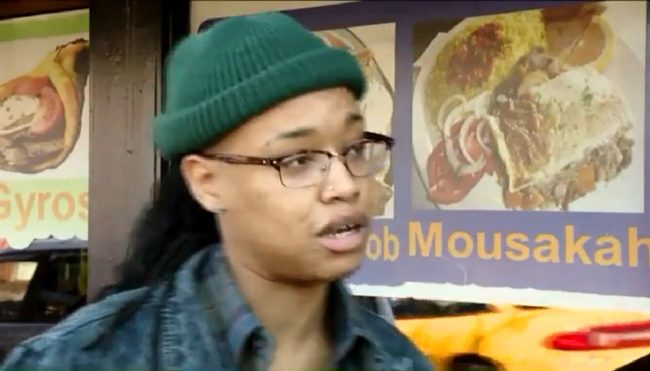
Bronson turned around, and watched helplessly as her friend, who was also known as Rio, died.
Through tears, she said: “I saw my boy, I saw Ta’Ron, I saw Rio, I saw my boo.
“I saw him on the ground. I saw him. I saw him go.”
Bronson said her friend was special.
“He loved himself, and in loving yourself you are able to love so many more people,” she said.
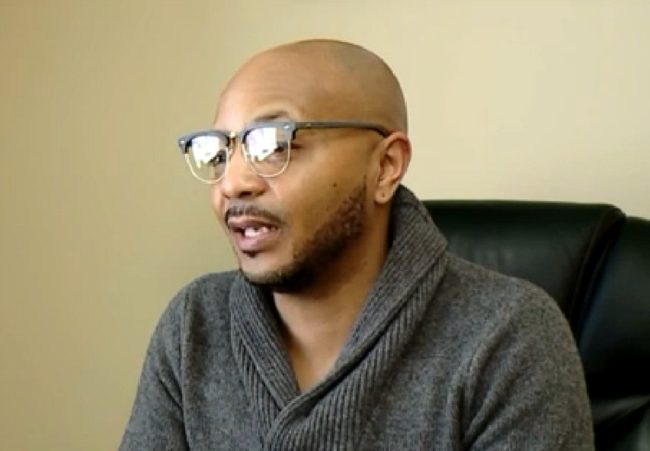
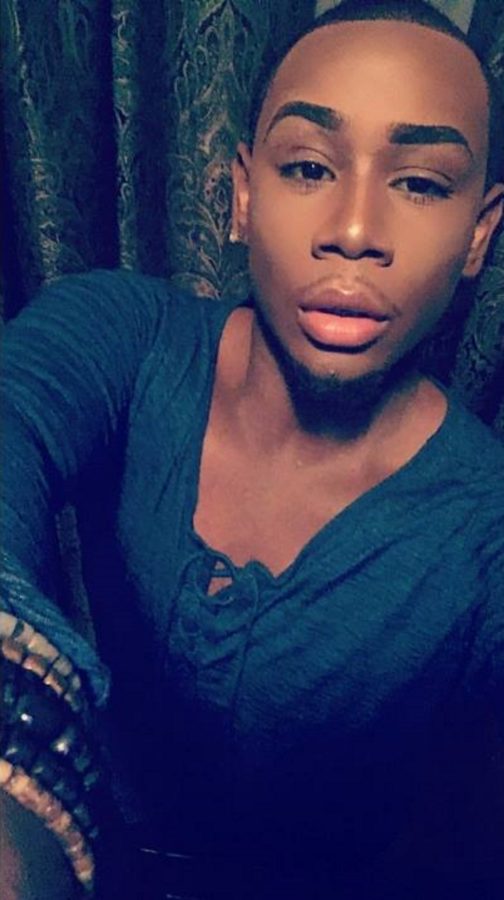
Another of Carson’s friends, D. Rashaan Gilmore, said: “In gay vernacular, particularly in black gay vernacular, there is a term called ‘beating your face,’ and so Rio would always be beat for the gods.
D. Rashaan Gilmore (Fox 4 news)
“That is just powder, pad, getting your face together, because he was beautiful.”
He added: “The beauty of Rio is that because of how he lived his life, it helped to free others to live their lives in that way.
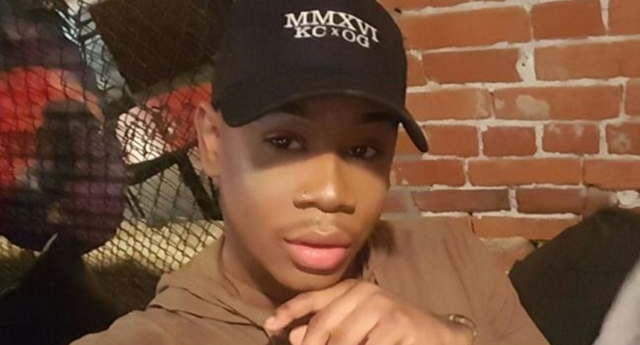
Gary Junior also paid tribute to his friend, telling The Kansas City Star: “Ta’Ron was always himself.
(Facebook/Ta’Ron Carson)
“He was not ashamed of his sexuality. He did not hide himself from anybody. He was really about standing up for the LGBT community.”
Junior said Carson had not argued with anyone at Aura, and had left on good terms.
“There was nothing to say he was leery about anything,” he said. “He gave everybody hugs and said goodbye.”
Aura’s owner Stuart Salomon agreed, saying: “It was peaceful and docile,” he said. “Kids with glow sticks and hula hoops. Not a single person thrown out. Not a cross word.”
Breyana White said she had known him for nearly a decade, having met at Northeast High School, where Carson was made senior class president in 2011.
“He was really just like the life of the party,” said White.
“He was really outgoing, always welcoming to people, always, like, open to meeting new people. He just made sure everyone was happy and kept smiles on their faces.”
She added: “I’m still in disbelief.
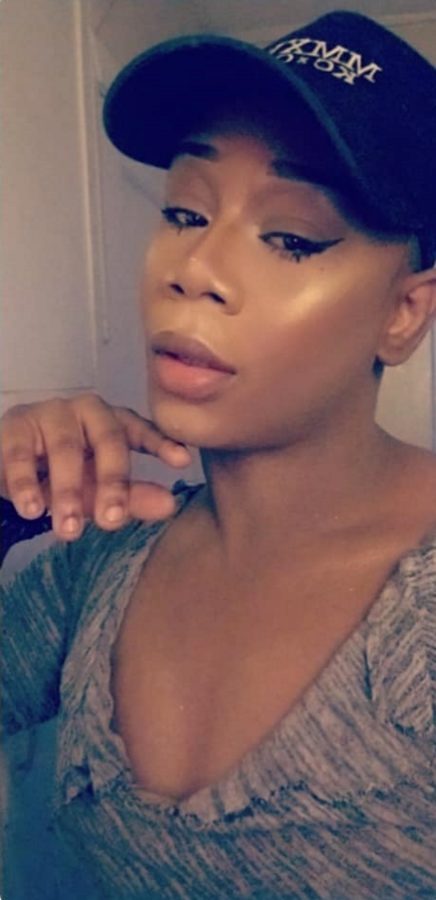
(Facebook/Ta’Ron Carson)
“Kansas City lost a great person. They lost someone who was just full of life. He was just all about positivity.
“He was a good dancer. We always would just have fun.”
Simon Lokodo, the Minister of State for ‘Ethics & Integrity’, likened LGBTQ+ people to paedophiles in the statement in which he warned people would be apprehended.
He said: “We are aware that there are inducements, including money, being offered to young people to promote the practice.
“We wish to emphasise that whereas the promotion of homosexuality is criminalised under the Penal Code, there is no violence against the LGBT community in Uganda – contrary to some claims made loosely by proponents of this movement.”
Despite emphasising the lack of violence, organisers of the Pride officially cancelled it out of fear of physical harm.
“It is with very heavy hearts and deep-felt sadness that we announce the cancellation of Pride Uganda 2017.
“Following the Police raid and interruption of the Pride parade last year, extra precaution was taken in organising this year’s festival,” the statement read.
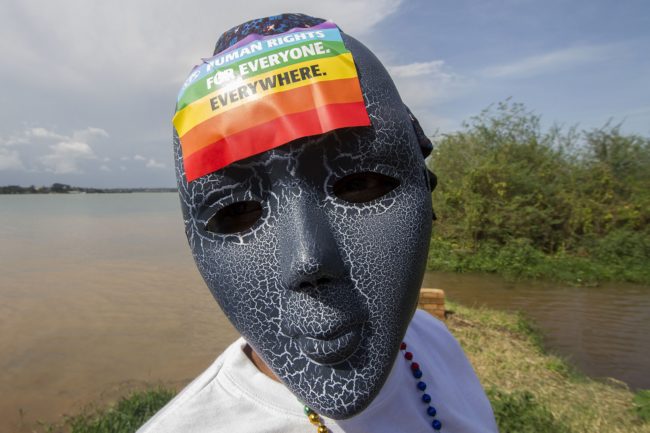
Despite the last Pride being “officially” cancelled, many Pride-goers still went to the event but they were broken up by police and some were arrested, including organiser and executive director of Sexual Minorities Uganda (SMUG), Frank Mugisha.
Any hope for a Pride event in 2017 was completely dashed after Lokodo promised “arrest, even violence”.
Living conditions for LGBTQ+ people are reportedly getting slightly better in the country, with activists reporting fewer people being “arrested, put in police cells and tortured”.
Activist Isaac Mugisha, from Uganda, told The Daily Beast that he and other LGBTQ+ activists were now trying to work with straight allies to ensure Pride events could go ahead without being raided.
“The momentum is now so different to 2015. Then just a handful of LGBTS gathered. Now we are looking at hundreds of people wanting to gather for a Pride event,” Isaac Mugisha said.
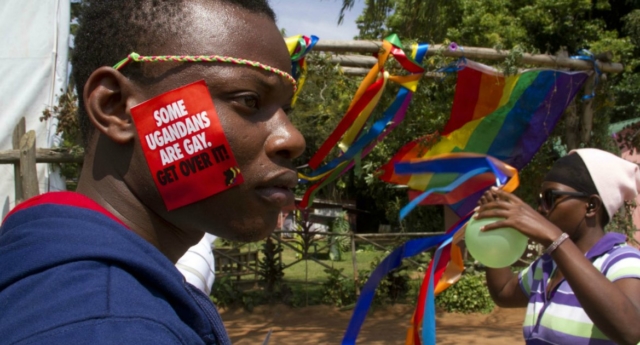
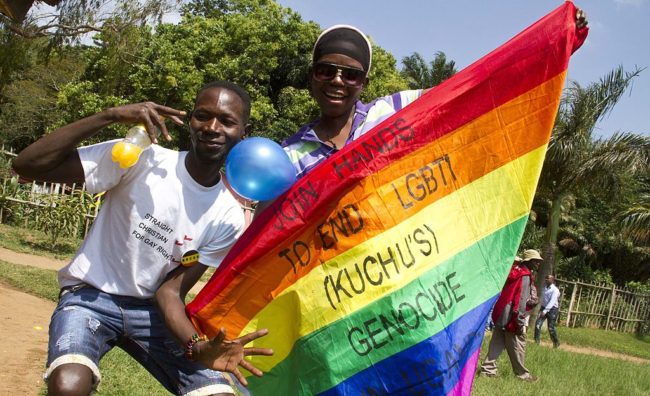
Ugandan men hold a rainbow flag reading “Join hands to end LGBTI genocide” at Ugandan Pride 2014 (ISAAC KASAMANI/AFP/Getty Images)
Frank Mugisha (who is not related to Isaac) added that “things are not looking so bad so far.
“Learning from last year our idea is to start planning early for Pride 2018.
“Our visibility is still very important to us, and we are hoping to have Pride this year, and a much bigger event,” he said.
However, he explained that it is still a very real fear that a Pride event could be raided by police.
“Even with the efforts to sensitize states’ institutions and lawmakers there is still so much discrimination and violations of LGBT persons going on here,” he said.
Some LGBTQ+ activists argue that the country is no safer than two years ago.
Adrian Jjuuko, executive director of Human Rights and Awareness and Promotion Forum (HRAPF), said: “From my perspective, I do not think any progress has been made, particularly in LGBT organizing. To the contrary, the situation seems to be worsening since 2016.”
Ugandan President Museveni signed the draconian Anti-Homosexuality Bill in February 2014. The law called for repeat offenders to be sentenced to 14 years in prison and to make it a criminal offence not to report someone for being gay.
Toronto police have found a seventh set of remains related to the investigation into alleged serial killer Bruce McArthur and have released a picture of a bearded, darker skinned dead man.
Detective Sgt. Hank Idsinga said Monday they could not identify the man in the picture and are now seeking the public’s help.
“I do not want to release this picture and I’m doing so as a last resort,” he said.
Idsinga declined to say how police obtained the picture of the dead man.
He said they showed the picture to members of the gay community but could not identify him. Many of the other alleged victims have been darker skinned and of South Asian or Middle Eastern descent who frequented the “Gay Village” area of Toronto.
Det. Hank Idsinga stands with a photo of an unidentified man who may be seventh victim of Toronto serial killer, at a news conference at Toronto Police headquarters on March 5, 2018. Chris Young / Canadian Press via AP
Idsinga said they’ve now found the dismembered remains of at least seven individuals this year in large planters at a home where McArthur did landscaping work and stored objects. It’s not clear if the remains of the seventh man are of the same man seen in the picture released by police.
He said they realize how difficult it might be for a relative or friend to see the picture and realize the man is deceased.
“I’ve never done this before,” he said about releasing the photo. “I do it with great hesitation. It is obviously a key piece of evidence that we have that we are releasing, but we feel by releasing it, hopefully we can identify him and close off that area of the investigation.”
Investigators have identified three sets of remains so far — 49-year-old Andrew Kinsman, 50-year-old Soroush Mahmudi and 40-year-old Skandaraj Navaratnam.
Bruce McArthur appears in a photo posted to his Facbeook account. Facebook via Reuters
McArthur, 66, is charged with first-degree murder in their deaths, as well as the presumed deaths of 44-year-old Selim Esen; Majeed Kayhan, 58; and Dean Lisowick, either 43 or 44. Police have said they believe there are more victims.
Dr. Michael Pollanen, Chief Forensic Pathologist for the Province of Ontario, said the causes of death are pending further studies.
Investigators have not yet released complete details, but McArthur is believed to have met his alleged victims in the Gay Village and on gay dating apps for older and large men with names such as “SilverDaddies” and “Bear411.”
Police are looking at unsolved missing person cases to determine if there are connections to McArthur and are running down tips that have come in from around the world.
McArthur, a grandfather and former mall Santa Claus, has not entered a plea. His case is due back in court March 14. Edward Royle, a lawyer for McArthur, has previously declined to comment on the case and didn’t respond to a message seeking comment on Monday.
In mid-January, the human rights group Immigration Equality filed a lawsuit against the U.S. Government on behalf of toddler Ethan Dvash-Banks. Before Ethan could speak, crawl, or register what the words “family” and “country” meant, the case of his American citizenship was being contested by a government that granted it without a thought to his twin brother Aiden, but not to Ethan himself. The lawsuit, brought about by Ethan’s parents, Elad and Andrew Dvash-Banks, was a practical measure and a statement. It was filed in order to reunite a family, give two twin brothers equal rights, and create a more inclusive idea of what family means in America in 2018.
Elad and Andrew’s story spans across years, countries, and continents. The two met in Israel, forming a relationship that would lead to their marriage in 2010. The couple wanted to settle in the United States, but the Defense of Marriage Act stood in their way. Instead of compromising, they moved to Canada to begin a life together. In 2016, their twin sons were born through surrogacy. Elad served as Ethan’s biological father, Andrew was Aiden’s. But the family wanted to move back to Andrew’s hometown of L.A. to be closer to his family. Seeking American citizenship for the children, Elad and Aiden visited the American Consulate in Toronto, where they were asked for DNA tests to prove their parentage. As a result, only one twin was allowed citizenship. Ethan, by virtue of being Elad’s biological son, was not. Elad’s Israeli citizenship meant that his son could only live in the U.S. on a tourist visa at the age of 16 months.
The case has created a flurry of outrage and interest from human rights groups around the country, many of which feel that the problem is due to LGBTQ+ discrimination. The family is currently living in Brentwood, preparing to fight the case on a national stage. Immigration Equality, an organization with a 99% win rate, has decided to take on the case.
Immigration Equality’s Executive Director, Aaron C. Morris, will be serving the Dvash-Banks family as their attorney.
“[We’re fighting for] the idea that you are born and raised in the United States, and you leave for another country, fall in love, and get married, and children that you have as a product of that marriage are U.S. citizens from birth.” Said Morris in a press call. “This has been the law for more than 20 years…if you’re an opposite-sex couple and you walk into an embassy abroad, you have two things. A birth certificate and a marriage license. You literally walk out with that child as a U.S. citizen. What’s happening with same-sex couples is that the U.S. government is creating an additional unconstitutional burden. And that requirement, which is not articulated in the law in any way, is a state department policy that was created around the same time as the end of the Defense of Marriage Act. That policy is to require a biological link to a United States citizen. Unlike opposite-sex couples, when a same-sex couple walks in with the very same pieces of evidence…they’re required to either establish a DNA relationship, or that they gave birth to the child. This requirement is illegal as a matter of Supreme Court law. It also creates an unconstitutional burden that our couples could not overcome.”
Andrew, whose extended family still lives in L.A., wanted his relatives to be able to see the twins grow up firsthand. When he and Elad received the news from the American Embassy, their plans were dashed.
“Being a father is everything for me,” says Elad, who despaired of ever being able to have children as a young gay man growing up in a society with limited media representation of queer families. “How am I going to explain this to him when he grows up? ‘You’re different from your brother?’ “
At this time in America, with Republicans holding the majority voice in our government, issues of immigration and LGBTQ+ rights are coming newly under fire. With Trump seeking to roll back protections for immigrants and DREAMers alike, children of foreign-born gay parents like Ethan are looking at a hard-fought, upward battle when it comes to securing their equal rights as well as their citizenship.
Peter* had set up a Skype account just to speak to PinkNews.
Even though it has been six months since he left Russia to embark upon a new life in Belarus, he has to be cautious, and won’t tell me his real name.
Since Russia’s gay propaganda law came into action in 2013, a spate of attacks against the country’s LGBT+ community have a affected the gay, bi and lesbian community’s right to an education, a job, and even the right to their life.
An according to Peter, even sharing a post advocating for gay rights can result in your arrest.
“Everyone knows everything about you. You can go to jail just for reposting stuff on social media,” he said.
The story of exile began for Peter* when the Russian’s neighbours began to gossip about Peter and his boyfriend.
Living in a small Russian town near Moscow, the 32-year-old found that news quickly spread about his sexuality.
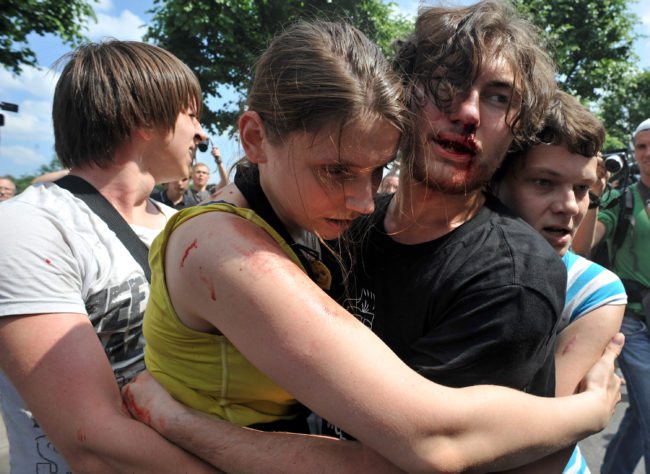
St. Petersburg LGBT demonstration, 2013 (OLGA MALTSEVA/AFP/Getty Images)
“People in the city saw us and the gossips told everyone around the city. After that everyone in the community knew,” he said.
Although he had lived in his hometown for as long as anyone could remember, his life as a gay man started to become difficult as pressures from religious groups and the government mounted.
“Everyone knows me everywhere. In the city when I worked, everyone knew, no matter where I went or no matter what I did,” he said.
Since the introduction of the gay propaganda law, the little protections LGBT+ Russians had have now dissipated.
In order to survive, Peter started to take lower paid work as a programmer, as his sexuality was used as a bargaining chip for him to take lesser paid work.
“I couldn’t find work or live my life normally. There’s a forum where gay freelancers and programmers are listed. Everyone in the community online and offline knew me,” he said.
“I wasn’t beaten, but I was discriminated against. I identify as gay, and I’ve never hidden it. That’s why there were problems. There’s a website that writes about every programmer and freelancer there, and they outed me. After that, it was even hard to get work through unofficial channels.
“I would get lower paid work, when I could,” he added.
The stress of not being able to find paid work was compounded by the hostile reactions Peter faced from his family, which left him with no other options: he would have to move.
“My family knew about my sexuality, and were incredibly negative about me. One of the main reasons I left Russia was because I had so little support from my family there,” he said.
The pressure started to take its toll on Peter and his boyfriend.
After moving to a different city in the hope that life would improve, the relationship started to fall apart.
First, we lived together in a different city first, and moved together. But it may have been a different city, but the same attitudes remained. We couldn’t get work, and we were scared of being attacked. That’s when my boyfriend left me, and said “I don’t need this.” It’s really hard, and not everyone can manage to keep a relationship going under that pressure,” he said.
Now alone, Peter decided to ask a friend for advice on how to escape Russia, and decided to enter Belarus.
The post-Eastern Bloc nation of Belarus lies to the left of Moscow.
The landlocked country, which shares borders with Ukraine, Poland, Lithuania, and Latvia, is home to 9.5 million people – 800,000 more people than in London.
Around 8.3% of the country is made up of Russian migrants, and Russian is spoken as the country’s official language.
With its close ties to Russia, it was a feasible place for Peter to flee.
“You can access Belarus without a VISA or passport,” he said.
“It takes about two days to get to Belarus on the train. It took another three days on the car so we could get away from the border. You can go to Belarus without even a passport – it’s easier to enter even than Ukraine, which made the decision for me,” he said.
But unfortunately for Peter and other Russian LGBT+ asylum seekers, it shares a lot of the same hostilities.
“When I got there, friends took me in and helped me out. They even helped me with money and work when I first arrived. In Belarus, it’s more tolerant than in Russia,” he explained.
“I still can’t work properly, but at least I know I won’t be killed here. It’s not so tolerant, it’s old-fashioned, but they won’t kill you, like what happened in Russia,” he added.
Apart from with a small group of friends, Peter now lives his life in the closet, disclosing his sexuality only when he feels it is safe.
“If anyone found out about my sexuality, they might get aggressive, or even start a fight. There is not one way people react. There are only two ways, but in Russia, there’s just one: aggression all of the time. Some people are really easy about it here, some people are ridiculously aggressive. But in comparison to Russia, it’s a lighter load to bear,” he added.
But, similar to other post-Eastern Bloc LGBT+ asylum seekers from Russia, Peter is concerned that time is not on his side, and a move out of the country is essential to his survival.
“I try to hide my sexuality now, but as I am facing a small community just like before, it’s only a matter of time before people find out,” he said.
“I am working to save money to get out of Belarus. I want to go to the EU, an English-speaking country, where people are more tolerant,” he said.
We are offering our ver first LGBTQ training in Spanish “LGBTQ en Español” to better serve our Spanish-speaking young people and their families. This is one part of LGBTQ Connection’s new Latino LGBTQI Youth inclusion project funded by the LGBTQI Giving Circle. Presently, Sonoma County has essentially ZERO LGBTQ Spanish- speaking resources. Let’s change that; Our young people deserve better.
LGBTQ Connection está organizando un nuevo taller en español “LGBTQ En Español: Un Entrenamiento Para Profesionales Que Apoyan a Jóvenes y Sus Familias” en el Valle De Sonoma y ¡ud. está invitada/o! Basado en el corazón de los entrenamientos altamente recomendados de LGBTQ Connection, este entrenamiento está diseñado para aumentar las habilidades de profesionales que sirven a jóvenes y familias. El entrenamiento destaca maneras de apoyar las identidades de jóvenes latinas/os que también son lesbianas, gay, bisexuales, transgénero, queer, o explorando su identidad y como mejor entenderlas y discutirlas.
Los Detalles del Entrenamiento:
Hora: 1:00pm – 5:00pm
Día: 28 de Marzo
Ubicación: El Centro de La Luz; 17560 Gregor Street, Sonoma
Los Contenidos del Entrenamiento:
Están invitados las/los profesionales de habla hispana quienes trabajan con jóvenes y familias. Este entrenamiento educacional, interactivo, y divertido es especialmente para las/los profesionales quienes quieren aumentar su competencia para servir a gente LGBTQ. Reserve su espacio aquí: http://lgbtqconnection.eventbrite.com. Por parte del “Community Foundation Sonoma County LGBTQI Giving Circle”, podemos ofrecer este entrenamiento gratis. Hay cupo limitado para 40 personas, por lo tanto reserve su espacio lo más pronto posible.
Objetivos y Actividades:
Los objetivos incluyen:
Explorar la diferencia entre la identidad de género y orientación sexual y como discutirlas en español;
Nombrar varios factores estresantes que enfrentan jóvenes LGBTQ;
Interactuar con un panel de jóvenes Latinos LGBTQ;
Aprender varias maneras de abordar los retos que enfrentan jóvenes LGBTQ con mejores prácticas definidas por la comunidad y basadas en evidencia;
Practicar escenarios basados en las experiencias de las vidas reales de jóvenes LGBTQ;
Ganar más conocimiento de los recursos e información referencial para gente LGBTQ.
Favor de compartir esta invitación con tus redes y colegas.
Si tiene preguntas, póngase en contacto conmigo por medio de mi celular o este correo electrónico.
The former governor of Arkansas, Mike Huckabee, resigned from the Country Music Association Foundation board of directors this week.
Huckabee faced a backlash over a number of stances against LGBT rights he has aired throughout his time as Governor of Arkansas and beyond.
Writing in a letter of resignation, Huckabee who has made his stance on LGBT issues clear in recent years, said that some had “bullied” him out of the appointments with threats of boycotts and the reversal of support.
He wrote: “I genuinely regret that some in the industry were so outraged by my appointment that they bullied the CMA and the Foundation with economic threats and vowed to withhold support for the programs for students if I remained.”
The two-time Republican presidential candidate Huckabee, has in the past hit out at same-sex marriage, comparing it to incest and polygamy, suggesting that adoption by same-sex couples is experimentation, has attacked trans people, joked about rape and murder, used gay as an insult, and various other anti-LGBT stances.
He oddly did not mention the controversy around his LGBT-rights stance in his letter.
But he did write: “If the industry doesn’t want people of faith or who hold conservative and traditional political views to buy tickets and music, they should be forthcoming and say it.”
The Country Music Association Foundation was warned by business owners that they would drop support if Huckabee remained as a board member.
Jason Owen, who is married to his same-sex partner and with who he has a son, is the co-president of Monument Records.
He told Monument CEO Sarah Trahern and CMA Foundation executive Tiffany Kerns that his companies and their clients would drop support of the foundation in light of Huckabee’s appointment
“Huckabee speaks of the sort of things that would suggest my family is morally beneath his and uses language that has a profoundly negative impact upon young people all across this country,” wrote Owen wrote in an email published by MusicRow.
“Not to mention how harmful and damaging his deep involvement with the NRA is. What a shameful choice.”
The Court of Tamales con Pollo
San Francisco Imperial Coronation 54
February 23, 2019
Her Most Imperial Majesty,
The Razor-Tongue
Beacon of Hope, Unity,
Sass & Service,
Her Most Imperial H.U.S.S.,
The Reigning Empress, Pollo Del Mar
His Most Imperial Majesty,
The Teal Mariachi,
Golden Bear,
Protector of the People
Emperor,
The Reigning Emperor, Leandro Gonzales
The Imperial Council of San Francisco, Inc.is a not-for-profit 501(c)(3) Public Benefit Corporation in the State of California that hosts and participates in a variety of entertainment and educational events, and activities to raise monies, which support the causes of other diverse community-based charitable organizations that do not discriminate based upon race, age, gender, sexual orientation, religion or ethnic background.
Our purpose is to collect charitable contributions from individuals and organizations, to distribute those contributions to other not-for-profit 501(c)(3) public benefit charitable organizations, and to have fun while doing it.
Our intent is to allow membership to any individual or organization. Though our primary membership is drawn from the LGBT culture we believe everyone has the right of inclusion and the desire to help their community.
Coronation 54 Anniversary Monarchs:
50 Year Anniversary
In Loving Memory, Her Imperial Majesty, Absolute Empress IV de San Francisco, Reba
45 Year Anniversary
In Loving Memory, Their Imperial Majesties,
Emperor II of San Francisco, After Norton, Russ Higginbotham
Absolute Empress IX de San Francisco, Frieda
40 Year Anniversary
In Loving Memory, Their Imperial Majesties,
Emperor VII of San Francisco, After Norton, Bob Ross
Absolute Empress XIV de San Franciso, Ginger
35 Year Anniversary
In Loving Memory of Their Imperial Majesties,
Emperor XII of San Francisco, After Norton, Rich Carle
Absolute Empress XIX de San Francisco, Remy Martin
30 Year Anniversary
His Imperial Majesty, Emperor XVII of San Francisco, After Norton, Jerry Coletti
In Loving Memory, Her Imperial Majesty, Absolute Empress XXIV de San Francisco, Pat Montclaire
25 Year Anniversary
In Loving Memory, His Imperial Majesty, Emperor XXII of San Francisco, After Norton, Chuck Adkins
Her Imperial Majesty, Absolute Empress XXIX de San Francisco, Anita Martini
20 Year Anniversary
His Imperial Majesty, Emperor XXVII of San Francisco, After Norton, T.J. Istvan
Her Imperial Majesty, Absolute Empress XXXIV de San Francisco, Sheba!
15 Year Anniversary
In Loving Memory, His Imperial Majesty, Emperor XXXII of San Francisco, After Norton, Fernando Robles
Her Imperial Majesty, Absolute Empress XXXIX de San Francisco, China Silk
10 Year Anniversary
His Imperial Majesty, Emperor XXXVII of San Francisco, After Norton, Paul Maka Poole
Her Imperial Majesty, Absolute Empress XLIV de San Francisco, Angelina Josephina Manicotti
5 Year Anniversary
His Imperial Majesty, Emperor XLII of San Francisco, After Norton, J.P. Soto
Her Imperial Majesty, Absolute Empress XLIX de San Francisco, Misty Blue
People For the American Way, the organization that runs Right Wing Watch, filed suit against the Department of Justice and the Department of Housing and Urban Development today to demand the release of documents concerning reported changes in federal policy toward LGBTQ people.
Right Wing Watch had filed Freedom of Information Act requests with both agencies asking for documents on reported actions removing mentions of LGBTQ people from federal announcements and programs. These reported actions were being taken quietly and without public announcement, raising the questions of who made the decisions, what the decisions covered, and whether agency staff had been directed to implement certain policies regarding programs affecting LGBTQ people without public knowledge.
In August, the organization asked HUD for copies of any directives to pull back from efforts to combat LGBTQ homelessness after New York magazine reported that department leadership had:
… ordered the removal of online training materials meant, in part, to help homeless shelters make sure they were providing equal access to transgender people. It also pulled back a survey regarding projects in Cincinnati and Houston to reduce LGBT homelessness. And it forced its Policy Development and Research division to dissociate itself from a major study it had funded on housing discrimination against gay, lesbian, and transgender people — the study ended up being released in late June under the aegis of the Urban Institute instead.
In September, after The New York Times reported that the Department of Justice had “scrubbed references to ‘L.G.B.T.Q. youth’ from the description of a federal program for victims of sex trafficking,” we asked DOJ for any directives related to that action as well.
Although the deadlines for fulfilling these requests have long past, neither agency has produced any responsive documents.
The group have also recently filed a FOIA request with the Department of Health and Human Services regarding similar decisions to remove references to LGBTQ people from agency policies.
Survivors of the mass shootings at Orlando’s Pulse nightclub and a South Florida high school embraced Wednesday outside the club where 49 people were killed nearly two years ago.
“We’re all family,” said Neema Bahrami, who was an event manager at Pulse at the time of the attack.
Pulse survivors, wearing shirts that read “We Will Not Let Hate Win,” stood among Parkland survivors, whose shirts read “Kids First, Politics Second.” The Parkland group hung 49 white roses on the gate surrounding the nightclub, one for each of the victims.
The visitors from Parkland made a stop at Pulse to pay tribute to the nightclub shooting victims and show solidarity with its survivors and activists as part of their trip home from Tallahassee, where they had petitioned lawmakers to reform the state’s gun laws.
If stricter gun legislation had been enacted in response to the June 12, 2016, mass shooting at Pulse, the Parkland survivors argued, they would have been spared the shooting that killed 17 people at Marjory Stoneman Douglas High School on Feb. 14.
Stronger laws should have been in place even before the Pulse shooting, said both sets of survivors, including 16-year-old Annabel Claprood, who was in the first room the Parkland school gunman approached.
“This should have been changed after Sandy Hook,” Annabel said, referring to the 2012 massacre of 20 children and six adults at an elementary school in Newtown, Conn. “Pulse shouldn’t have even happened.”
She testified before state lawmakers Tuesday.
“We’re gonna get it done,” a Parkland survivor said to Bahrami.
“Thank you for keeping it up. It’s exhausting,” another Parkland survivor said. Bahrami held her hands, and they vowed to keep fueling the conversation about gun-control legislation.
State lawmakers rejected an assault-style weapons ban Tuesday, despite the group’s testifying in its favor.
“They just made a huge group of activists out of us who are teaming up with other activists. This community right here,” said Shelbie Seys, who has three children going to schools in Parkland.
Orlando knows their pain and the road to healing far too well, said Mayor Buddy Dyer, who was at Pulse on Wednesday to welcome the group. Dyer said he wanted to show the same love and support that Orlando felt from around the world after Pulse.
Orlando city attorneys have been to Broward County since the massacre, helping School Board attorneys there navigate some issues that confronted Orlando immediately after the Pulse shooting, Dyer said.
Dyer said he favors gun-control legislation.
“If the shooter in the case in Parkland had not been able to purchase that weapon during the course of the last two years, he could not have carried out the act that he did,” Dyer said. “I do support a ban on assault weapons moving forward.”
The nation watched as student survivors organized rallies and delivered compelling testimony. Students got in front of state lawmakers who were in their legislative session, an opportunity Pulse survivors did not have because the shooting occurred in June.
The session begins in January and ends in March.
Construction is currently under way on a “interim” memorial at Pulse that is meant to make it easier for visitors to pay their respects while long-term plans for the site are still being determined.
On Wednesday, Pulse survivor Luis Ruiz befriended Heather Davidson, director of public policy and advocacy for United Way of Broward County. They exchanged numbers and a hug before Davidson boarded the bus.
They stood together for a photo in front of the roses.
“We’re stronger together,” Davidson said. “This needs to stop.”