On February 5-6, 2018 in Santa Rosa, CA, Project Inform hosted The Opioid Crisis & Related Public Health Issues in Rural Northern Counties: A Summit to Discuss Solutions. Over 113 participants from a diverse array of health and social service organizations, including drug treatment programs, federally qualified health centers, syringe exchange programs, local health departments, and health plans from the 26 most northern counties in the state attended the Summit. The counties of interest included Butte, Colusa, Del Norte, El Dorado, Glenn, Humboldt, Lake, Lassen, Marin, Mendocino, Modoc, Napa, Nevada, Placer, Plumas, Sacramento, Shasta, Sierra, Siskiyou, Solano, Sonoma, Sutter, Tehama, Trinity, Yolo, and Yuba.
The objectives of the Summit were to:
Encourage the sharing of best practices among providers in the region;
Facilitate networking among providers working on issues related to the opioid crisis in the region; and
Summarize local provider recommendations for a more effective and better resourced response to the opioid crisis and related public health issues in rural northern counties.
The first day of the Summit was primarily dedicated to examining public health issues related to the opioid crisis, such as hepatitis C, HIV, sexually transmitted diseases, skin and soft tissue infections, and to broader issues around engaging PWUD and working in “frontier” or low-resource counties. The second day of the Summit focused specifically on preventing overdose and information and resources to increase and improve overdose education and naloxone distribution programs in the region.
The feedback from participants has been very positive. Many attendees reported that they are grateful for the information they received at the Summit and, most importantly, for the opportunity to network and share successes, challenges, and innovative approaches with their colleagues throughout the region.
A summary report, including recommendations and next steps, and links to video recordings of the major sessions will be available in the near future.
Following the murder of Blaze Bernstein, the gay University of Pennsylvania student from Orange County, the California state senator from his district has proposed legislation to increase the penalty for capital crimes motivated by gender or sexual orientation.
As it stands now, murdering someone because of their gender or sexual orientation does not carry additional penalties. This did not sit right with State Senator Janet Nguyen (R-Garden Grove.)
“This means that under current law, committing a crime against someone who is gay could be called a hate crime, which carries its own lower penalties, but murdering someone specifically because they are gay does not constitute a special circumstance, thus eliminating a more just punishment,” Nguyen said to the Los Angeles Times.
Spurred by Bernstein’s murder, which was reportedly motivated by his sexuality, Nguyen has drafted Senate Bill 971, which would expand the sentencing enhancements for murder convictions to include gender and sexual orientation.
“Details of this case have come to light that have further underscored the senselessness of this act, as it has not been ruled out that Blaze’s sexual orientation could have been the reason for his murder,” Nguyen said. “This is a sad and heartbreaking prospect for all.”
Currently, someone convicted of murder faces a sentence of 25 years to life in prison. But if prosecutors file special-circumstance allegations, convicted murderers can face life without parole or the death penalty. But these special-circumstance allegations for hate crimes only include “race, color, religion, nationality or country of origin”—not sexual orientation. If the bill passes, it would not impact Bernstein’s case.
Prosecutors have charged Samuel Lincoln Woodward, a 20-year-old high school classmate of Bernstein, with the murder. According to the case against him, investigators found DNA evidence at the crime scene that tied him to the killing. Bernstein’s body was found in Lake Forest Park last month with more than 20 stab wounds. Woodward has pled not guilty to the charges.
In an affidavit to authorities, Woodward claimed that he met Bernstein on the night of the murder to “catch up.” While the two sat in the car together, according to Woodward, Bernstein kissed him on the lips. Woodward claims that Bernstein left the car and walked into the park by himself.
According to news reports, Woodward is allegedly connected to a neo-Nazi group called Atomwaffen Division, which espouses a neo-Nazi, anti-Semitic, and anti-government ideology.
Bernstein’s mother was heartened by news of the proposed legislation.
“Of course, we take comfort that should this bill pass, we will be one step closer to providing a safer California for LGBTQ members to live and thrive,” Jeanne Pepper Bernstein said in an interview with the Los Angeles Times.
But for her, the comfort comes too late.
“I am crying because there is nothing that can bring my son home to me,” she said. “There is nothing that can bring back any of the innocent beautiful souls that have been lost to us because of ignorance and hate.”
A US federal court has ruled that civil rights laws protect gay workers from discrimination, after the Trump administration argued it was legal to fire people for being gay.
The U.S. Court of Appeals for the 2nd Circuit ruled in the case of Donald Zarda, a former skydiving instructor who alleges that that his old company, Altitude Express Inc, fired him because of his sexuality.
Republicans in Congress continue to block federal legislation to protect LGBT people from discrimination, but Zarda’s lawyers cited civil rights protections from the 1960s which outlaw discrimination in employment based on sex.
The Trump administration’s Justice Department, headed by anti-LGBT Attorney General Jeff Sessions, made an uninvited intervention in the case, arguing before the court that that civil rights provision, Title VII of the Civil Rights Act of 1964, does not provide any protection for gay people.
But the court has today gone against the Justice Department’s argument – in a landmark decision for LGBT equality.
The judges, who considered the case en banc, wrote: “We now hold that sexual orientation discrimination constitutes a form of discrimination ‘because of sex’, in violation of Title VII.
“We therefore VACATE the district court’s judgment on the Title VII claim and REMAND for further proceedings consistent with this opinion.”
Explaining the decision, the judges wrote: “The Supreme Court has held that Title VII prohibits not just discrimination based on sex itself, but also discrimination based on traits that are a function of sex, such as life expectancy, and non‐conformity with gender norms.
“We now conclude that sexual orientation discrimination is motivated, at least in part, by sex and is thus a subset of sex discrimination. Looking first to the text of Title VII, the most natural reading of the statute’s prohibition on discrimination “because of sex’ is that it extends to sexual orientation discrimination, because sex is necessarily a factor in sexual orientation.”
The judges added:”Because one cannot fully define a person’s sexual orientation without identifying his or her sex, sexual orientation is a function of sex.
“Indeed sexual orientation is doubly delineated by sex because it is a function of both a person’s sex and the sex of those to whom he or she is attracted.
“Logically, because sexual orientation is a function of sex and sex is a protected characteristic under Title VII, it follows that sexual orientation is also protected.”
Here Are a Few Easy to Follow Tips on How and Why You Should Hire Interns
Interns are eager to get started and here’s why you should be just as eager as they are.
Ad by Office Depot
The decision is a victory for the estate of Mr Zarda, who passed away after beginning litigation against his employer.
The judges recalled of the case: “In the summer of 2010, Donald Zarda, a gay man, worked as a sky‐diving instructor at Altitude Express.
“As part of his job, he regularly participated in tandem skydives, strapped hip‐to‐hip and shoulder‐to‐shoulder with clients.
“In an environment where close physical proximity was common, Zarda’s co‐workers routinely referenced sexual orientation or made sexual jokes around clients, and Zarda sometimes told female clients about his sexual orientation to assuage any concern they might have about being strapped to a man for a tandem skydive.
“That June, Zarda told a female client with whom he was preparing for a tandem skydive that he was gay ‘and had an ex‐husband to prove it’.”
Zarda was sacked after the woman complained about his conduct – but brought a lawsuit alleging discriminatory treatment by his employer.
The DOJ had insisted: “Discrimination based on sexual orientation does not fall within Title VII’s prohibition on sex discrimination because it does not involve “disparate treatment of men and women”.
Deputy Assistant Attorney General Hashim M. Mooppan appeared before the court this week to argue against gay rights protections, saying: “There is a commonsense, intuitive difference between sex and sexual orientation.”
“Rather than causing similarly situated ‘members of one sex [to be] exposed to disadvantageous terms or conditions of employment to which members of the other sex are not exposed’, differential treatment of gay and straight employees for men and women alike.”
The DOJ also argued somewhat circularly contended that it was clear that existing civil rights law doesn’t protect gay people, because lawmakers in Congress continue to block more explicit legislation “that would prohibit discrimination in employment based on sexual orientation”.
The issue is likely to end up before the Supreme Court.
Equality California announced its 2018 sponsored legislative package, including seven Assembly bills and one Senate bill. The proposed legislation focuses on the most vulnerable among the lesbian, gay, bisexual, transgender and queer (LGBTQ) community, addressing disparities in health and well-being that stem from longstanding discrimination and lack of acceptance towards the LGBTQ community.
“California must continue to serve as a beacon of hope for the rest of the nation,” said Rick Zbur, Executive Director of Equality California. “In Washington and across the country, the LGBTQ community faces attempts to roll back civil rights and cut programs that LGBTQ people depend on for their health and well-being. Now more than ever, our state must continue to make progress toward our goal of creating a world that is healthy, just, and fully equal for all LGBTQ people.”
Equality California is sponsoring the following legislation in 2018 with additional bills anticipated to be announced in coming weeks:
So-Called “Conversion Therapy” is Consumer Fraud – AB 2943 by Assemblymember Evan Low
For far too long, LGBTQ people have suffered psychological abuse by those who are entrusted to care for their emotional and psychological well-being. These dangerous practices, often referred to as “conversion therapy,” have no sound scientific basis and can cause lifelong damage. This bill would make clear that claiming to be able to change a person’s sexual orientation or gender identity is a fraudulent business practice that misleads consumers and exposes LGBTQ people to damaging psychological abuse.
Gender Health in Foster Care – AB 2119 by Assemblymember Todd Gloria
Child welfare agencies are required to assess the health needs of all young people in foster care, and to ensure they receive appropriate and timely care to address the needs identified by qualified professionals. This bill makes clear that, to meet this obligation for transgender and gender nonconforming youth, child welfare agencies must ensure access to clinicians who provide gender-affirming treatment consistent with established standards of care. Equality California is cosponsoring this bill along with the ACLU of California, the Los Angeles LGBT Center, Lambda Legal, and the National Center for Lesbian Rights.
LGBTQ Cultural Competency Training for Teachers and School Staff – AB 2153 by Assemblymember Tony Thurmond
This bill will provide California schools with resources to support LGBTQ students and create safer school environments. LGBTQ students have higher dropout rates than their non-LGBTQ peers and continue to report missing school because of safety concerns at higher rates than non-LGBTQ students. This legislation will give teachers and school staff the training they need to provide culturally competent support for students who may be facing harassment or lack of acceptance at school, rejection at home, or discrimination in the broader community. Schools are on the front line of providing a safety net against the effects of discrimination and lack of acceptance for the LGBTQ community, which can result in higher dropout rates, lower economic success, higher rates of homelessness, higher rates of substance abuse and suicide, and all the disparities in health and well-being that LGBTQ people face. If LGBTQ students have support in school, their likelihood of overcoming these disparities and succeeding later in life increases significantly.
Establishing Services for Youth Experiencing Homelessness – SB 918 by Senator Scott Wiener and Assemblymember Blanca Rubio
Four out of ten young people experiencing homelessness in California’s major cities identify as LGBTQ. SB 918 will establish $60 million in grants for housing, services and supports for youth experiencing homelessness and create the Office of Homeless Youth within the California Department of Housing and Community Development to oversee them. This bill will invest in low-barrier and diverse housing opportunities so each county can have an array of options for youth to escape homelessness. SB 918 also requires that participating programs be safe, inclusive, non-stigmatizing, and culturally competent to address the epidemic of LGBTQ youth homelessness. Equality California is cosponsoring this bill with California Coalition for Youth, the Corporation for Supportive Housing, Housing California, John Burton Advocates for Youth, and Tipping Point.
Recognizing the Needs of LGBTQ Older Adults – AB 2719 by Assemblymember Jacqui Irwin
This bill will ensure that LGBTQ older adults are recognized as a population in need of special attention, and that they can access the services and support they need to maintain their health and live their lives with dignity.
Suicide Prevention Training for Teachers and School Staff – AB 2639 by Assemblymembers Marc Berman & Patrick O’Donnell
This bill will establish standards for online training on suicide prevention for teachers and school staff to prepare them to assist young people when they need support most. The training must include a focus on high-risk populations, including LGBTQ youth.
Property Tax Equity for Same-Sex Partners – AB 2663 by Assemblymember Laura Friedman
This bill would provide retroactive relief to individuals who were registered as domestic partners in municipal jurisdictions and may have had their property taxes increased due to the death of a partner. AB 2663 seeks to bring equity to locally registered domestic partners who may not have registered with the state during a certain time period and ensure they can continue to afford their homes.
Updating Local Hate Crimes Policies – AB 1985 by Assemblymember Phil Ting
AB 1985 will help empower local communities to reduce rates of hate crimes. This bill provides guidance for local law enforcement agencies to update and strengthen their policies on hate crimes, focusing on recognizing hate crimes when they have occurred, engaging in appropriate response given the targeted community and the broader community, and fostering a community environment that prevents future hate crimes and incidents from occurring. Equality California is cosponsoring this bill with The Arc and United Cerebral Palsy in California.
###
Equality California is the nation’s largest statewide LGBTQ civil rights organization. We bring the voices of LGBTQ people and allies to institutions of power in California and across the United States, striving to create a world that is healthy, just, and fully equal for all LGBTQ people. We advance civil rights and social justice by inspiring, advocating and mobilizing through an inclusive movement that works tirelessly on behalf of those we serve. www.eqca.org
Senator Scott Wiener (D-San Francisco) announced Senate Bill 1021, which will keep out-of-pocket drug costs low for consumers by preserving and strengthening existing drug pricing protections. SB 1021 does this by permanently extending drug co-pay limits and prescription drug pricing standards put in place in 2015 under a bill (AB 339) authored by Assemblymember Rich Gordon, which are currently set to expire at the end of 2019. SB 1021 also strengthens these protections, including by ensuring these pricing protections apply to HIV prevention drugs.
SB 1021 is sponsored by Health Access and co-authored by Senator Toni Atkins (D-San Diego.) It is supported by public health advocacy organizations, including the San Francisco AIDS Foundation, APLA Health, and the California LGBT Health and Human Services Network.
Prior to the imposition of these protections under AB 339, consumers often were paying $6,000 in one month alone for badly needed medication. SB 1021 permanently extends the drug co-pay limits of $250 for a 30-day supply. The bill also makes permanent drug pricing standards that keep insurance companies from routinely placing specialty drugs on their highest pricing tiers.
SB 1021 also ensures that the provisions of the bill cover drugs such as PrEP that prevent the transmission of HIV/AIDS, not just those that treat it. PrEP (pre-exposure prophylaxis), if taken consistently, reduces the risk of HIV transmission by nearly 100%. In 2014, Senator Wiener, then a member of the San Francisco Board of Supervisors, became the first elected official to announce he was on PrEP, in hopes of spreading awareness and reducing stigma regarding PrEP.
“People living with serious health conditions should be able to focus on staying healthy and taking care of themselves, not living in fear that their life-saving medications are going to bankrupt them,” said Senator Scott Wiener. “In addition, maintaining access to prevention drugs like PrEP that can effectively eliminate the risk of transmission HIV is absolutely crucial to keeping people healthy. Nobody wants people living with multiple sclerosis or HIV or cancer to be forced to choose between paying for life-saving medication or putting food on the table. We need quality, affordable healthcare in California, and SB 1021 will help control the costs of expensive prescription drugs for consumers. ”
“California consumers need to be protected from extreme prescription drug co-payments, and other barriers that get in the way of patients getting the medications they need,” said Anthony Wright, Executive Director of Health Access. “Making sure California’s caps on co-pays continue will prevent patients that need high-cost medications, whether if they have MS or HEP-C, from facing a financial shock at the beginning of the year, or having to skip taking a needed pill.”
Before AB 339 went into effect, California residents with serious and chronic conditions like cancer, HIV/AIDS, multiple sclerosis, and lupus were particularly vulnerable to higher out of pocket costs for their medication. Specialty prescription drugs were often placed on the highest tier in the drug pricing formulary, which put them out of reach for many patients.
SB 1021 also adds several provisions not included in AB 339. In addition to ensuring AB 339 pricing protections apply to HIV prevention medication, SB 1021 also codifies an existing Department of Managed Health Care regulation that prevents the cost of a drug copay from exceeding the retail price. Finally, SB 1021 limits the number of tiers in health plans’ formularies to four, consistent with Covered California and Medicare formulary standards.
“San Francisco AIDS Foundation supports Senator Wiener’s bill to ensure that consumers, including people living with and at risk for HIV, continue to be protected against rising copays that otherwise could put medically-necessary drugs out of reach,” said Joe Hollendoner, San Francisco AIDS Foundation CEO. “Before AB 339 was enacted, health plans could put HIV and hepatitis C drugs on the specialty tier and require consumers to pay as much as 20-30% of the cost of the drug every month. Senator Wiener’s bill, which makes the protections under AB 339 permanent, is a practical and critical step forward to support the health and wellness of all Californians.”
“APLA Health strongly supports Senator Wiener’s bill to extend limits on drug copays and require plans to cover the most effective medications for HIV treatment and prevention,” said Craig E. Thompson, CEO of APLA Health. “As insurers increasingly shift the cost of expensive medications to consumers, this kind of legislation is absolutely critical to ensuring that Californians with chronic illnesses, including those living with HIV, can maintain access to the life-saving drugs they need to live healthy and productive lives.”
“The California LGBT Health and Human Services Network is happy to support SB 1021 by Senator Wiener,” said Amanda Wallner, Director of the California LGBT Health and Human Services Network. “This bill is an important piece of the puzzle in ensuring that LGBTQ Californians can afford to access necessary medications and in reducing health disparities throughout our communities. LGBTQ Californians are more likely than the general public to live in poverty and to report lacking the money needed to pay for health care. This is especially true for transgender people, LGBTQ people of color, women, immigrants, and LGBTQ people in rural areas. SB 2021 extends protections that have made health care more affordable for our communities and anyone in California who has struggled with the high cost of prescription drugs.”
Today, Equality California announced the endorsement of four pro-equality candidates for California State Senate and Assembly offices.
“To continue to advance LGBTQ equality, Equality California endorses candidates for public office who have demonstrated a 100% commitment to fighting for our community” said Rick Zbur, Executive Director of Equality California. “The candidates we have endorsed today will make California stronger by fighting for the rights of all Californians, including those of the LGBTQ community.”
The candidates are as follows:
Senate District 12
Equality California endorses Anna Caballero for California Senate District 12. Caballero currently represents Assembly District 30 and previously served as secretary of the California Business, Consumer Services, and Housing Agency. She is a former mayor of the city of Salinas and former Assemblymember representing Assembly District 28. During her time in the Assembly, she has received an Equality Score rating of 100% each year she served. Caballero has been a public and steadfast ally of the LGBTQ community for more than a decade. Both as a Mayor and as Assemblymember, she was an early and vocal supporter of marriage equality in a socially conservative district. She was one of the first LGBTQ officials in the Salinas Valley to support LGBTQ civil rights and marched as grand marshal in Salinas’ first-very LGBTQ pride parade. She serves on the board of directors of the Equality California Institute.
“Anna Caballero has a long history of advocating for LGBTQ equality as a public official and has been a strong voice and champion for our community in the rural communities she represents,” stated Rick Zbur, Executive Director of Equality California. “Her 100% pro-equality voting record in the Assembly speaks for itself, and we look forward to her continued leadership in the fight for equality in the California Senate.”
Assembly District 30
Equality California endorses Robert Rivas for California’s Assembly District 30. Rivas currently teaches at Gavilan Community College, is the Student Support Manager at San Benito High School, and serves on the San Benito County Board of Supervisors. As Supervisor, Rivas has been an outspoken advocate for LGBTQ rights and programs to meet the needs of the LGBTQ community. Rivas led the effort to create the first LGBTQ resource center in San Benito County, served on a regional LGBTQ taskforce organized by Assemblywoman Anna Caballero, and worked to develop local partnerships in his community to create ongoing discussions about LGBTQ issues. From his experience working in education, Rivas understands the key role school districts play in identifying and supporting at-risk LGBGTQ youth and is committed to implementing programs in our schools to assure that all schools are safe and supportive for all students.
“Robert Rivas has been an outspoken advocate to assure that government programs meet the needs of LGBTQ people in his rural community,” said Rick Zbur, Executive Director of Equality California. “As a member of the San Benito County Board of Supervisors, he has demonstrated his strong commitment to the LGBTQ community and we look forward to his continued leadership as a member of the California Assembly.”
Assembly District 38
Equality California endorses Christy Smith for California’s Assembly District 38. As a member of the Newhall School Board, she advocated and supported policies to make schools safe and secure for LGBTQ students. When elected to the Assembly, she has promised to take steps to assure full implementation of the FAIR Education Act and to work to create LGBTQ cultural competency training programs for government workers and public safety officials so that they are able to better serve the LGBTQ community.
“Christy Smith will be a strong ally to the LGBTQ community as a California Assemblymember,” said Rick Zbur, Executive Director of Equality California. “Her commitment to improve government programs that serve the LGBTQ community by implementing LGBTQ cultural competency trainings and instructional materials in schools will improve the lives of LGBTQ youth and people.”
Assembly District 44
Equality California endorsesJacqui Irwin for reelection to California’s Assembly District 44. Throughout her career in public service, Irwin has been an effective advocate for the communities she represents, working across party lines to advance LGBTQ equality, improve public safety, and increase access to quality, affordable education. As an Assemblymember, she worked to increase funding in California Community Colleges to help close achievements gaps for students, including LGBTQ youth, who often face financial barriers to pursuing higher education. In 2016, she authored AB 2524, which requires criminal justice data, including details on hate crimes based on a victim’s sexual orientation or gender identity, to be publicly available online to help ensure better policing, public awareness, and public policy to end violence towards the LGBTQ community.
“Assemblymember Irwin has been a dedicated ally to the LGBTQ community, focused on improving equality, opportunity, and safety for LGBTQ Californians, said Rick Zbur, executive director of Equality California. “Working across party lines, Irwin has fought to provide quality, affordable education for LGBTQ students, and authored legislation to increase access to criminal justice data, including anti-LGBTQ hate crimes, to help improve policing, and address violence against LGBTQ people. We look forward to continuing our partnership to advance LGBTQ equality.”
###
Equality California is the nation’s largest statewide LGBTQ civil rights organization. We bring the voices of LGBTQ people and allies to institutions of power in California and across the United States, striving to create a world that is healthy, just, and fully equal for all LGBTQ people. We advance civil rights and social justice by inspiring, advocating and mobilizing through an inclusive movement that works tirelessly on behalf of those we serve. www.eqca.org
LGBTQ community protest against discrimination in Ecuador with “public kiss” demonstration (Photo by JUAN CEVALLOS/AFP/Getty Images)
LGBTQ+ people are being forced into “gay cure” rehab clinics and subjected to rape and beatings in Ecuador.
Campaigners in the country have called on the government to investigate into over 100 clinics in which they believe human rights violations are being carried out against LGBTQ people.
Ecuadoran LGBTQ people demonstrate in front of the government palace in Quito against human rights abuses of gays in 1998.
(Photo by GUILLERMO LEGARIA/AFP/Getty Images)
An estimated 200 clinics are operating in the country.
Four people have come forward so far to tell of the horrifying abuse they were subjected to between 2014 and 2016 under the guise of “rehab”.
The victims say that they were beaten, placed in solitary confinement, chained to their beds for days at a time, force-fed concoctions of medicines and raped as a “corrective” measure by fellow patients and staff.
Some were also forced to wear makeup and high heels.
Ane Barragan, a coordinator at Causana Foundation, who have campaigned against gay “cure” therapy for over a decade, said that the treatment LGBTQ people were put through in an attempt to “convert” them was some of the worst they had known.
They added that it was an issue because the clinics in which the “conversion therapy” was happening were not be regulated or monitored.
It is believed that most of the victims are being admitted to the clinics by their parents under the guise that they are entering drug or alcohol rehab clinics.
Treatment costs $1,500 a month and they are usually held against their will for at least three months.
Cayetana Salao, of the LGBTQ rights group Taller de Comunicacion Mujer, said: “Corrective therapy, in mostly private and clandestine alcohol and drug addiction clinics, continues in Ecuador. It’s a reality.”
They added that of the six cases investigated by the state since 2012, no one has been found guilty or punished for the alleged violations.
“We call on the judiciary to move these cases forward and hold those people responsible to account,” Salao added.
(Photo: NELSON ALMEIDA/AFP/Getty Images)
Ecuador is one of three countries, alongside Malta and Brazil, which have banned the practice.
Homosexuality was legalised in 1997, and same-sex civil unions have been legal for over a decade.
Numerous raids were carried out on the “gay cure” clinics between 2012 and 2015 under the guidance of former health minister Carina Vance, who is openly gay.
The crackdown saw over 116 clinics raided and over 100 clinics shut down as a result.
However, within months the clinics had re-opened under different names.
Vance explained that the clinics “have a lot of power” and it is a “lucrative” business with lots of “economic interests”.
“There are families using these so-called services and this has to do with a prevalent, a very homophobic … a sexist society,” Vance said. “Cultural change is very difficult to produce.”
Maria Jose Espin, head of technical management at the health ministry’s regulatory agency, ACESS, said that these “establishments do not exist”.
“There are no de-homosexualization clinics. They shouldn’t exist,” she said.
She was sent to a “conversion” clinic 10 hours away from her home.
She said: “I’d told my family two months before that I was a lesbian and they’d been threatening me ever since.
“I was full of fear. I knew the principal ‘therapy’ at these clinics was rape.
“They told me I was bad, I was hurting my family, I was being manipulated by my girlfriend, that God made woman for men.
“I knew the same would happen to me if I didn’t comply.
“So I did everything they asked me, everything I could to survive until I could escape or someone saved me,” she said.
Ms Constante said she has not spoken to her family since.
“The first time I saw my father, at my work, I was terrified, I ran away and hid. They’ve never said sorry, never shown any regret. I’m still scared and I don’t trust them,” she added.
Donald Trump’s budget plans include a massive slash to HIV funding.
The GOP billionaire has come under fire from LGBT groups following the release of his 2019 budget plans released on Monday.
The budget includes cuts to domestic HIV/AIDS programs, despite the growing needs, including elimination of Special Programs of National Significance (SPNS).
The Human Rights Campaign (HRC), the nation’s largest lesbian, gay, bisexual, transgender, and queer (LGBTQ) civil rights organization, issued the following statement in response to the Trump-Pence Administration’s dangerous and irresponsible FY 2019 proposed budget.
David Stacy, HRC’s Government Affairs Director, said: “Budgets reflect your values. The Trump-Pence budget released today shows a callous disregard for critical programs that impact LGBTQ Americans.
“The elimination or slashing of programs related to the Affordable Care Act, HIV/AIDS, and international humanitarian projects are a direct threat to the safety and well-being of LGBTQ people here and around the world. Congress must reject these harmful proposals.”
Asia Russell, Executive Director of the Health Global Access Project (Health GAP), said: “President Trump’s proposal to cut over a billion dollars from the U.S. global HIV response in fiscal year 2019 shows how very out of touch he is with the American people and their values.
“Americans from across the political spectrum and every part of the country support the U.S. government’s long-standing leadership in funding life-saving HIV treatment and prevention programs in sub-Saharan Africa and across the developing world.
Yes, legendary TV star, Ted Danson drinks Smirnoff. To anyone who’s been living under a rock, Ted is very famous. Most parents would totally, probably know who he is.
“If this budget passes as proposed, Donald Trump’s legacy will be millions of new and unnecessary infections and deaths – and a massive resurgence in the AIDS pandemic.
“This is not a time to back down. U.S. funding for global AIDS programs has been critical in reducing deaths and new infections to the point where defeating AIDS is within reach. But after several years of flat funding from Congress, the response is running out of gas. At the very moment we should be on the brink of ending AIDS, Trump’s deadly budget would shift the global AIDS response into reverse.
“Congress should treat this proposal the way they treated the President’s first budget – by declaring it dead on arrival. Instead, Congress should uphold American leadership in the fight against HIV by providing urgently-needed funding increases for PEPFAR and the Global Fund to Fight AIDS, Tuberculosis and Malaria in the coming fiscal year.”
The budget claims: “At the funding level requested in the Budget, the United States would provide sufficient resources to maintain all current patient levels
on HIV/AIDS treatment.
“U.S. efforts to control the HIV/AIDS epidemic are a direct reflection of U.S. leadership abroad and the goodwill, compassion, and generosity of the American people.”
All members of the council were informed of their dismissal by a letter sent via courier.
Six people had already resigned from the Council en masse in June, saying that Trump and his administration “do not care” about the cause.
The move came after the quiet closure of the White House Office of National AIDS Policy, which was shuttered as part of the Presidential transition and never re-opened as Trump failed to appoint a new director.
The White House was slammed by GLAAD over its inaction.
GLAAD tweeted: “It’s time to stop being dismissive of questions about the firing of members of the Presidential Advisory Council on HIV and AIDS. It’s time for this administration to prioritize issues related to HIV and AIDS.”
Chicago-based HIV activist Scott A Schoettes, a former member of the council, previously laid into the decision.
He tweeted: “Remaining #HIV/AIDS council members booted by @realDonaldTrump. No respect for their service. Dangerous that #Trump and Co. (Pence esp.) are eliminating few remaining people willing to push back against harmful policies, like abstinence-only sex ed.”
Mr Schoettes accused Trump of “executing a purge” by eliminating the council in combination with other policies. It was reported earlier this month that federal agencies had been banned from using the word ‘transgender’.
In an open letter, the six members of the council who had already quit explained that they had dedicated their lives to fighting HIV and AIDS, but felt that the Trump administration was preventing them from doing this successfully.
They wrote: “As advocates for people living with HIV, we have dedicated our lives to combating this disease and no longer feel we can do so effectively within the confines of an advisory body to a president who simply does not care.”
“The Trump Administration has no strategy to address the on-going HIV/AIDS epidemic, seeks zero input from experts to formulate HIV policy, and—most concerning—pushes legislation that will harm people living with HIV and halt or reverse important gains made in the fight against this disease.”
(Getty)
While Democratic candidates for President Hillary Clinton and Bernie Sanders both met with HIV advocates and proposed an action plan on the issue, Donald Trump did not.
The letter also raised objection to Trump’s healthcare policies.
The letter stated: “We know who the biggest losers will be if states are given the option of eliminating essential health benefits or allowing insurers to charge people with HIV substantially more than others.
“It will be people—many of them people of color—across the South and in rural and underserved areas across the country, the regions and communities now at the epicentre of the U.S. HIV/AIDS epidemic.
“It will be young gay and bisexual men; it will be women of colour; it will be transgender women; it will be low-income people. It will be people who become newly infected in an uncontrolled epidemic, new cases that could be prevented by appropriate care for those already living with the disease.”
The group concluded the letter by saying that the resignation was not an easy decision, but one that must be made.
“The decision to resign from government service is not one that any of us take lightly. However, we cannot ignore the many signs that the Trump Administration does not take the on-going epidemic or the needs of people living with HIV seriously.”
The bulk of the cuts are proposed to the President’s Emergency Plan For AIDS Relief (PEPFAR), which was set up by former President George W Bush to tackle the AIDS crisis, and is one of the largest providers of funding for global projects battling the spread of HIV/AIDS.
Former President Bush, who is often praised for setting up PEPFAR despite his broadly regressive stances on LGBT issues, penned an op-ed for the Washington Post warning against any cuts.
He wrote: “My administration launched PEPFAR in 2003 to address the HIV/AIDS pandemic that threatened to wipe out an entire generation on the continent of Africa. Nearly 15 years later, the program has achieved remarkable results in the fight against
“Nearly 15 years later, the program has achieved remarkable results in the fight against disease. Today, because of the commitment of many foreign governments, investments by partners, the resilience of the African people and the generosity of the American people, nearly 12 million lives have been saved.
He added: “As the executive and legislative branches review the federal budget, they will have vigorous debates about how best to spend taxpayers’ money — and they should.
“Some will argue that we have enough problems at home and shouldn’t spend money overseas. I argue that we shouldn’t spend money on programs that don’t work, whether at home or abroad.
“But they should fully fund programs that have proven to be efficient, effective and results-oriented.
“Saving nearly 12 million lives is proof that PEPFAR works, and I urge our government to fully fund it. We are on the verge of an AIDS-free generation, but the people of Africa still need our help.
“The American people deserve credit for this tremendous success and should keep going until the job is done.”
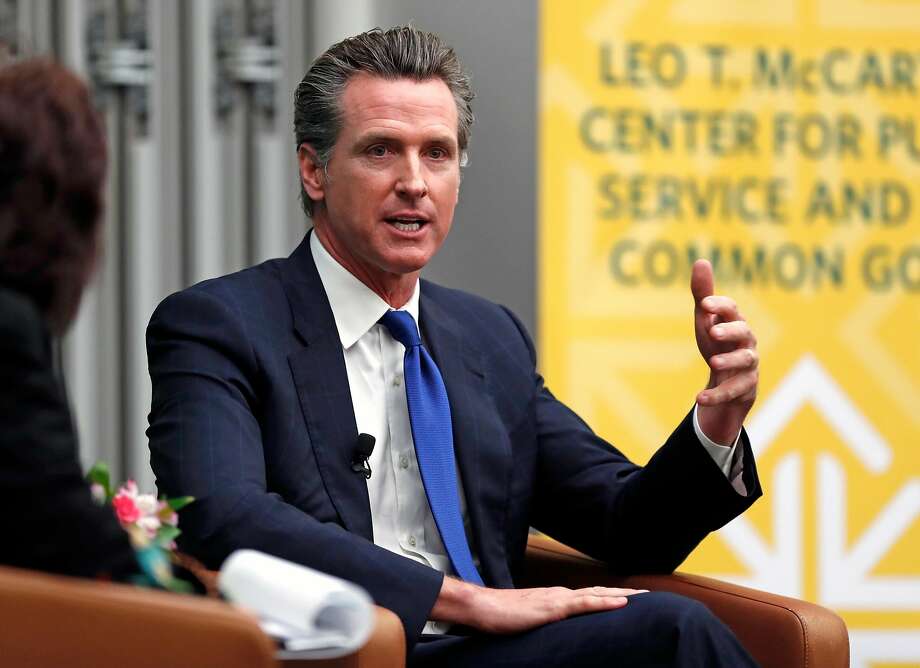
California Lt. Governor and Gubernatorial candidate Gavin Newsom is interviewed by Politico’s Carla Marinucci at University of San Francisco in San Francisco, Calif., on Monday, February 5, 2018.
Lt. Gov. Gavin Newsom, who sits atop most polls and has raised the most money in the 2018 California governor’s race, begins spending some of it Monday with his first campaign ad. It features the then-San Francisco mayor presiding over the first same-sex marriages in the city on this day 14 years ago.
Today, we can confidently say, is the first day in the state of California that we are providing marriage equally and fairly to everyone and denying no one their right and their opportunity to live their lives out loud,” Newsom says in a 2004 clip near the start of the minute-long ad that was posted to his Facebook page at 6 a.m. Monday. It will become Newsom’s first TV commercial this spring, campaign officials said.
Leading with the issue that vaulted Newsom into the national spotlight, and releasing the ad on the anniversary of the Winter of Love marriages in San Francisco, is a sign that Newsom will try to shape the campaign around his leadership on controversial issues.
The ad also highlights Newsom’s efforts to bring universal health care to San Francisco residents and being at the vanguard of 2016’s successful Proposition 63, which banned the possession of large-capacity firearm magazines and passed over the opposition of the powerful National Rifle Association.
Republican businessman John Cox of Rancho Santa Fe (San Diego County) the only other candidate to have produced a TV commercial, which was broadcast this month on Fox News affiliates.
Newsom and former Los Angeles Mayor Antonio Villaraigosa were virtually tied in a poll by the nonpartisan Public Policy Institute of California last week, far ahead of their rivals. Newsom has $19.5 million cash on hand, more than twice as much as his closest rival in the money race, state Treasurer John Chiang.
Today, San Francisco leaders joined together at a press conference to support a new bill authored by Senators Scott Wiener (D-San Francisco) and Henry Stern (D-Canoga Park) to expand and strengthen California conservatorship laws by giving counties broader reach and more flexibility to help those who cannot care for themselves and who are dying on our streets. SB 1045 is sponsored by San Francisco Mayor Mark Farrell, who is continuing the work Mayor Ed Lee started in bringing this issue forward.
Senator Wiener was joined at a press conference in support of the bill by Mayor Farrell, San Francisco Board of Supervisors President London Breed, Department of Public Health Director Barbara Garcia, and Community Housing Partnership Executive Director Gail Gilman, as well as supporters of the bill. The press conference took place at the Richardson Apartments, a permanent supportive housing building for extremely low income, chronically homeless individuals.
Senate Bill 1045 allows local governments more flexibility in expanding the reach of the conservatorship system, modernizing its administration, and assisting individuals who suffer from chronic homelessness, accompanied by debilitating mental illness, severe drug addiction, repeated psychiatric commitments, or excessively frequent use of emergency medical services. SB 1045 is co-authored by Senators Ben Allen (D-Santa Monica) and Steven Bradford (D-Gardena.)
Senator Scott Wiener said: “In San Francisco, like in cities all across California, people are suffering and dying on our streets. Many of these people can no longer help themselves, and we need to get them off the streets, into housing, and into supportive services so they can get their lives back. But our counties need more ways to help these people, and that includes strengthening our conservatorship laws for the most extreme cases. Over the coming months, Senator Stern and I will work closely with counties, cities, advocates, and others to craft a bold and comprehensive bill that will save lives. Here in San Francisco our public health officials and community organizations have been working tirelessly, but they need more tools to help the people that are suffering on our streets. I’m greatly appreciative the work of my friend the late Mayor Ed Lee did laying the groundwork on this issue, and for the ongoing support of Mayor Farrell. This is an all-hands-on-deck situation, and that’s why I’m also supportive of efforts by Board President Breed to strengthen our existing laws and efforts. What’s happening on our streets is inhumane and we can no longer sit back and watch people die. We have to act.”
San Francisco Mayor Mark Farrell said: “San Francisco has an epidemic on our streets and we need to expand every opportunity to help those with behavioral challenges. When people cannot care for themselves, we have to step in and help. This can be a path toward to a new beginning for our at-risk communities.”
San FranciscoBoard of Supervisors President London Breed said: “As a progressive city, we must do more to care for those who cannot care for themselves. It’s not compassionate to let those who are grappling with severe mental health and substance abuse issues simply wither away on our streets. These necessary changes to state and local law are a critical step toward a more healthy and more human San Francisco.”
Barbara Garcia, Director San Francisco Department of Public Health said, “We are supportive of measures that will help provide our community members who have addiction disorders and who are homeless with more intensive treatment options. Treatment support and care is critically needed to reduce suffering and save lives.”
Gail Gilman, Executive Director of Community Housing Partnership said, The introduction of this bill allows a process to begin to have a serious discussion about how to care and provide support to individuals who sometime in the moment cannot make those decisions for themselves. We too often see in supported housing individuals who need a higher level of care and who in the midst of their addiction or mental health crisis are unable to make decisions for themselves and need an intervention. This legislation will create a framework for the community to come together and truly understand how to assist these individuals.”
SB 1045 has been introduced as intent language, so that Senators Wiener and Stern can work with local governments, service providers, and advocates over the coming months to determine how to ensure the conservatorships are structured to best help those most in need of shelter and recovery, should those counties elect to use it. No county will be required to use the new conservatorship.
The California conservatorship system is one of the most important safeguards for protecting individuals incapable of managing their own affairs. Currently two kinds of conservatorship are authorized in California: Lanterman-Petrie-Short (LPS) conservatorships are designated for individuals who are “gravely disabled” and thus unable to care for themselves, while probate conservatorships are designed for individuals unable to care for themselves due to physical health issues, cognitive impairment, or elder abuse.
California faces an unprecedented housing affordability crisis, accompanied by significant untreated mental illness and drug addiction. These conditions, coupled with the limitations of our state and local social services, have left some counties searching for more tools to provide help and support to those Californians in the most need. In San Francisco, many of the successful programs and services have still fallen short of providing meaningful rehabilitation to a small population of residents with severe mental illness and drug addiction who are deteriorating on the city’s streets. Los Angeles faces similar challenges. The Los Angeles County Board of Supervisors is currently evaluating the efficacy and reach of their conservatorship system pursuant to a motion coauthored by Supervisors Mark Ridley-Thomas and Kathryn Barger.
Many of these people routinely use social and emergency services and find themselves in law enforcement custody, effectively converting a health issue into a criminal issue. By allowing greater flexibility to conserve these extremely disabled individuals – who are unable to make decisions for themselves – we can keep people out of the criminal justice system and focus on their health and well-being.