Category: State

  • Bringing LGBTQ History Into California’s Classrooms: A Conversation From the Front Lines

    In 2011 California ratified the Fair, Accurate, Inclusive and Respectful Education Act, a law that mandates the inclusion of the political, economic and social contributions of people with disabilities and LGBTQ people in educational textbooks and the social studies curricula in California public schools. The legislation was groundbreaking in its own right, but was only a first step. Real change involves updating textbooks and classroom materials, providing teacher support and fighting efforts to water down or undermine the requirements of the statute. Eight years after passage of the FAIR Education Act, History Happens is checking in with two California educators to learn how the act is being implemented both in the policy realm and in the classroom. Don Romesburg, a professor of women’s and gender studies at Sonoma State University and one of the key advocates of the legislation, engaged in a conversation with Ángel Rafael “Ralph” Vásquez-Concepción, an eighth-grade teacher at Everett Middle School in San Francisco, to compare notes from their respective vantage points.  

    Ralph: Don, can you please offer some updates on the implementation of the act? How have you seen it roll out from your perspective as an advocate for the act and as a university professor?

    Don: Implementation has been slow and has required tireless advocacy by LGBTQ historians, advocacy organizations, students, community members and educators. In 2014, queer historians produced Making the Framework FAIR, a policy document drawing on decades of scholarship, including research based on materials in the GLBT Historical Society’s archives. It proposed comprehensive curricular changes for the California Department of Education to incorporate into its History–Social Science Framework. In 2016 the CDE approved the revised framework, and it now features significant LGBTQ content for elementary schools, middle schools and high schools. Finally, in 2017 the CDE also approved 10 possible textbooks for the state’s K–8 classrooms, which cover most of the LGBTQ material.
    Since then, organizations such as the California History–Social Science Project and Our Family Coalition, as well as individuals such as me and Rob Darrow, who works with the Safe Schools Project in Santa Cruz County, have been collaborating with the state’s teachers and administrators to inegrate the LGBTQ content into their curricula.  It’s been encouraging to see how enthusiastic educators are. Many want to bring LGBTQ history into their classrooms, but are unsure how. Most K–12 teachers never learned any LGBTQ history in their own primary, secondary or undergraduate education or in their credentialing and graduate programs. So there’s a big demand for training, but unfortunately not much funding to support it. Progress is being made slowly. Individual professors are teaching this content: I’ve been doing it with my undergrads at Sonoma State and so has Wendy Rouse, who teaches history for future teachers at San Jose State. Ralph, I’m interested to know how well you think implementation is going, since you’re on the ground. How proactive has San Francisco Unified School District been about training teachers on the LGBTQ content? How supported do you feel in your school, and what are some examples of ways you are teaching queer content in eighth grade? 

    Ralph: I feel very supported. At Everett we consistently bring up LGBTQ experiences not just in social sciences and history, but in natural sciences as well. There are many queer and Two-Spirit people who have made important contributions to our democratic and scientific institutions, and as a school we enagage that history as much as possible. During Pride Week, queer content is the backbone of lesson-planning, ensuring that our students get exposure in all their classes. Every teacher brings their unique expertise to bear; for example, I use contemporary art history and queer poetry. Don: Also, Ralph, how could you use the GLBT Historical Society’s resources in teaching students? 

    Ralph: While consulting the archives for past exhibitions I have curated at the GLBT Historical Society Museum, I have used materials that could serve as primary source documentation of queer life in this city. It would be great to create lessons around some of these materials. Don, can you offer some clues as to how similar legislation is proceeding in other parts of the country? 

    Don: It’s been so exciting to see how what started in California has taken off nationally. New Jersey, Colorado, Illinois and Oregon have passed laws similar to the act, and now we are waiting to see how implementation proceeds. In Massachusetts, an LGBTQ-inclusive curriculum has been put forward, but it’s optional; I’m curious if it will become mandatory, following in the other states’ footsteps.
    In August, Maryland’s Department of Education announced that it would incorporate the LGBTQ civil rights movement into its history framework when it is revised in 2020. I expect that we’ll see a number of other states follow suit in the next couple of years. California fortunately set the curricular standard pretty high, and it’s going to be hard for other states to just mention Stonewall and think they’ve done it right.  Ralph, what role do you think California’s teachers can play in helping other states create change? 

    Ralph: We live in a very special state, where teachers have the freedom to prepare students to engage differences and be culturally responsive. Teachers elsewhere face pressure from religious groups and homophobic organizations, and some live in fear of being outed and having their livelihoods destroyed. By continuing to develop community programming around Pride and actively seeking to bring visibility to LGBTQ curricula, teachers in California can help ensure that queer history is not erased, and that it is ultimately protected by federal policy. I also foresee the need for more collaboration between college professors and K–12 teachers.

    Don Romesburg is aprofessor of women’s and gender studies at Sonoma State University. Ángel Rafael Vásquez-Concepción teaches eighth grade at Everett Middle School in San Francisco.
  • This Month at The SF GLBT Historical Society Museum

    Neighborhood EventCastro Art Walk at the GLBT Historical Society Museum
    Thursday, September 56:00–9:00 p.m.The GLBT Historical Society Museum4127 18th St., San FranciscoFree The GLBT Historical Society Museum is participating in September’s Castro Art Walk, a monthly event in the Castro neighborhood on the first Thursday of the month. Participating merchants extend their business hours to host special events and share artwork with the neighborhood. Drop by the museum during your self-guided tour of the Castro and enjoy our exhibitions at your own pace. Entry is free and the museum will remain open until 9:00 p.m. Light refreshments will be served. More information is available here.
    Panel DiscussionQueering Familias: Building Latinx Resilience & Hope
    Thursday, September 127:00–9:00 p.m.The GLBT Historical Society Museum4127 18th St., San Francisco$5 | Free for members Rooted in a history of resistance, LGBTQ Latinx people in the Bay Area have created numerous activist groups and institutions that have built a strong foundation for subsequent generations. Over time, they have forged personal and community bonds that create familias, or chosen families. This intergenerational panel brings together Latinx activists, artists, performers and community leaders to discuss the unique ways they have mobilized by building strong bonds of kinship. The event is being held in conjunction with the exhibition “Chosen Familias: Bay Area LGBTQ Latinx Stories,” now on view at the GLBT Historical Society Museum. Tickets are available online here.
    Book LaunchIn Search of Stonewall: 25 Years of Scholarship
    Thursday, September 197:00–9:00 p.m.The GLBT Historical Society Museum4127 18th St., San Francisco$5 | Free for members
    The year 1994 marked the 25th anniversary of the Stonewall Riots, and it was also the year in which a new journal, The Harvard Gay & Lesbian Review (known since 1998 as The Gay & Lesbian Review/Worldwide), published its first issue. In honor of its own 25th anniversary, the journal has released a book, In Search of Stonewall: The Riots at 50, The Gay & Lesbian Review at 25 (G & LR Books, 2019) collecting Stonewall-related articles published in the Review over the past quarter century. Join three contributors to the collection — Jewelle Gomez, Will Roscoe and Eve Goldberg — for a panel discussion about Stonewall scholarship and for readings from the collection. Copies of In Search of Stonewall will be available for purchase and signing. Tickets are available online here.
    Living History DiscussionEnola Gay: The Birth of Militant AIDS Activism
    Friday, September 207:00–9:00 p.m.The GLBT Historical Society Museum4127 18th St., San Francisco$5 | Free for members
    In September 1984, members of Enola Gay, a gay men’s direct-action affinity group, joined a blockade at the entrance to Lawrence Livermore National Laboratory during a large demonstration against the development of nuclear weapons. The activists poured real human blood at the entrance and chanted “Money for AIDS, not for war!” The protest called attention to government neglect in the face of a deadly epidemic and has been described by one historian as “the first recorded instance of civil disobedience to confront AIDS.” To mark the 35th anniversary of the event, Enola Gay members Robert Glück, Richard Bell and Jack Davis will share photographs and stories from the group’s history, discuss the shifting priorities for sexual politics during the 1980s and reflect on direct action and intersectional organizing during the early years of the AIDS crisis. Tickets are available online here.
    Book LaunchThe Ventriloquists: A Novel of Queer Resistance
    Thursday, September 267:00–9:00 p.m.The GLBT Historical Society Museum4127 18th St., San Francisco$5 | Free for members
    Author E. R. Ramzipoor will read selections from her new novel, The Ventriloquists (Park Row Books, 2019), a work inspired by the true story of a ragtag gang of journalists and resistance fighters who published a satirical fake edition of the Nazi-controlled Brussels newspaper Le Soir during World War II. Inviting the reader on a fast-paced, high-stakes caper featuring a diverse cast of queer heroes, the novel highlights the LGBTQ community’s role in reclaiming occupied spaces. Ramzipoor will supplement her talk by discussing stories of everyday queer heroes from World War II until the present, focusing on ordinary people who carried out daring feats of resistance. Tickets are available online here.
    Current Exhibitions
    Front GalleryChosen Familias: Bay Area LGBTQ Latinx StoriesOpen through October 20, 2019More information
    Community GalleryThe Mayor of Folsom Street: The Life & Legacy of Alan SelbyOpen through October 20, 2019More information
    Main GalleryQueer Past Becomes PresentLong-term exhibitionMore information
    Visit Us
    THE GLBT HISTORICAL SOCIETY MUSEUMExhibitions & Programs4127 18th St.San Francisco, CA 94114(415) 621-1107www.glbthistory.org/museum
    Monday–Saturday: 11:00 a.m.–6:00 p.m.Sunday: Noon–5:00 p.m.
    DR. JOHN P. DE CECCO ARCHIVES & SPECIAL COLLECTIONSResearch & Public History Center 989 Market St., Lower LevelSan Francisco, CA 94103-1708(415) 777-5455www.glbthistory.org/archives
    Call to schedule a research appointment or make an appointment online by clicking here.
  • San Francisco Police Chief Apologizes to LGBTQ Community

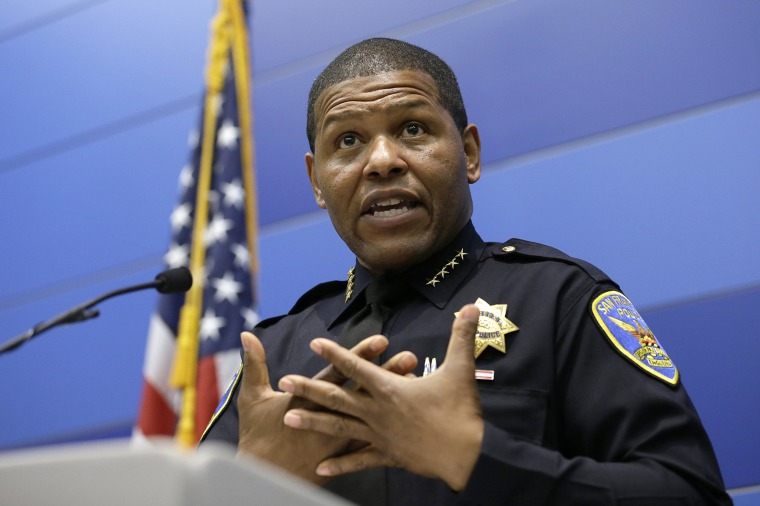
    San Francisco’s police chief apologized Monday for the way the department historically treated LGBTQ people and for “the harm that was caused.”

    “Unless the wrongs of the past are acknowledged and dealt with appropriately, our past will continue to put a stain on the present and on our future,” Chief William Scott said during a “Reflection and Reconciliation Session” aimed at increasing trust between the LGBTQ community and police.

    Image: William Scott
    San Francisco Police Chief William Scott answers questions during a news conference, May 21, 2019, in San Francisco.Eric Risberg / AP file

    The forum was hosted by the Police Department and GLIDE, which provides social services to the homeless and others.

    A department release said input from the forum and other planned “listening sessions” will move the department “forward in ways that emphasize respect, safety and diversity.”

    It marked the 53rd anniversary of rioting in 1966 at Compton’s Cafeteria in the Tenderloin district after police were called to evict transgender people — many of them sex workers — who gathered there and tried to arrest a transgender woman.

    The 1966 confrontation preceded by three years New York’s famous Stonewall Riots, which were considered a landmark in LGBTQ civil rights activism.

    Related

    NBC OUT

    WATCH: “Stonewall 50: The Revolution”

    Historically, police were known for beating gay men in the Castro district and for arresting transgender women for wearing dresses.

    “I and the men and women of this police department are truly sorry,” Scott told an audience at the Glide Memorial church. “We are sorry for what happened. We are sorry for our role in it. And we are sorry for the harm that it caused.”

    Scott agreed to meet with LGBTQ community members after a Pride Parade march in July was disrupted by protesters opposed to a police and corporate presence. About 40 people interrupted the parade for about an hour and two people were arrested after protesters broke down barricades, threw water bottles at police and at least one person fought with officers, authorities said.

    Related

    NBC OUT

    Meet the ‘don’t ask, don’t tell’ veteran who became Stonewall’s first park ranger

    On Monday night, some people submitted comments asking whether the Police Department would agree not to have uniformed officers march in the Pride Parade.

    But Cmdr. Teresa Ewins, a lesbian, said it was important “for kids to see us,” to show the LGBTQ presence in the department, the San Francisco Examiner reported.

    “Many of us joined to make a difference,” she said. “It’s a special day for me as well as everyone in the department who is LGBT.”

    Some speakers said more work needs to be done to reconcile police and the LGBTQ community.

    Anubis Daugherty, 25, said he was homeless for six years and police sweeps of homeless communities disproportionately affected LGBTQ people who are a significant portion of homeless and impoverished people in the Tenderloin, the Examiner reported.

    “I was born here, I was raised here,” Daugherty said. “If you want to truly apologize for something you have to stop what you’re doing.”

  • In-N-Out Burger’s $25,000 Donation to California GOP Brings Call for Boycott from Democrats

    California Democratic Party Chair Eric Bauman is calling for a boycott of In-N-Out Burger after the fast-food chain donated $25,000 to the California GOP to boost party coffers ahead of the November election.

    Bauman called for the boycott of the popular California-based chain via his Twitter account late Wednesday with the following: “Et tu In-N-Out? Tens of thousands of dollars donated to the California Republican Party… it’s time to #BoycottInNOut – let Trump and his cronies support these creeps… perhaps animal style! ”

    According to a public filing dated Aug. 28, In-N-Out Burger made a contribution for $25,000 to the California Republican Party on Monday. The document on the California secretary of state’s website also lists the GOP’s “late contribution” as going toward the Nov. 6 election.

    This isn’t the first time the privately owned burger chain has donated to the California GOP. Public records show the chain donated $30,000 in August 2017 and another $30,000 in May 2016.

    However, In-N-Out Burger also donated extensively to a moderate Democratic PAC known as “Californians for Jobs and a Strong Economy.” The pro-business PAC received $50,000 in contributions in May 2018 and $30,000 in both 2016 and 2017.

    CNBC reached out to the California Democratic Party and Bauman for comment.

    In a statement, In-N-Out Burger Executive Vice President Arnie Wensinger said the company “made equal contributions to both Democratic and Republican Political Action Committees in the state of California. For years, In-N-Out Burger has supported lawmakers who, regardless of political affiliation, promote policies that strengthen California and allow us to continue operating with the values of providing strong pay and great benefits for our Associates.”

    Wensinger added, “We have been fortunate to do business in this great state for almost 70 years. While it is unfortunate that our contributions to support both political parties in California has caused concern with some groups, we believe that bipartisan support is a fair and consistent approach that best serves the interests of our company and all of our customers.”

    In-N-Out operates more than 330 restaurants in six states, but most of the locations are in California. The chain, known for its “Double-Double” hamburgers and “animal style” burgers and fries, was founded in 1948 in Southern California and is majority owned by billionaire Lynsi Snyder.

    Some social media users were unhappy to hear about the recent GOP donation and agreed with the call for a boycott. The hashtag #BoycottInNOut was trending Thursday on Twitter after Bauman used it in his tweet.

    One user, @KatrinaHagen2, said the burger chain’s food has been “a staple” of their kids and friends but added that the boycott was “a no brainer.”

    “They’ve lost me as a customer,” said user @makingtheater. “Pity, but I will find my animal style somewhere better.”

    @PatClearySoCal tweeted: “Guess I ate my last InNOut burger last week. I will write them to let them know about my decision. Maybe we all should.”

    Then again, the boycott inspired others to have lunch at the burger chain.

    Another user, @ramincol, called the boycott “stupid” and asked whether “we have gone just crazy with boycotts. If a business wants to support either party why does it matter?”

    California GOP gubernatorial candidate John Cox also weighed in on the controversy by making a point to have lunch at one of the restaurants. Cox also took a jab at his challenger, Gavin Newsom — a Democrat and the state’s current lieutenant governor.

  • AIDS Healthcare Foundation Faces Probe Over Use Of Federal Drug Discount Funds For Lobbying

    Politico reports:

    A California state senator has formally asked state Attorney General Xavier Becerra to investigate whether the powerhouse AIDS Healthcare Foundation is fraudulently misusing savings from a federal drug-discount program designed to help poor patients.

    The request comes from state Sen. Ben Hueso (D-Chula Vista), who has urged an investigation into the politically powerful organization that has dumped upwards of $60 million into state ballot drives since 2012, according to Hueso’s letter obtained by POLITICO.

    The senator’s concerns center on a somewhat obscure federal drug discount program known as 340B, which requires pharmaceutical companies to sell their drugs at steep discounts to participating hospitals and other providers that serve a significant percentage of indigent patients.

    Hueso contends that the AHF is spending millions from the drug discount program to lobby for various California ballot measures not directly related to health care, such as rent control and affordable housing, an aspect of their work that has been well discussed here on JMG over the years.

    The AHF, the self-proclaimed largest AIDS advocacy group in the world, contends that with an annual budget of $1.6 billion they don’t come close to approaching the limit of allowable lobbying. 

    However they have declined to provide documentation to support that claim, which recently resulted in being removed from Baton Rouge’s drug discount program. While based in California, the AHF has a sprawling network of pharmacies and thrift stores nationwide.

    The group is perhaps best known here on JMG for their characterization of Truvada as a “party drug” when used for HIV prevention and for its combative CEO, Michael Weinstein, pictured above.

  • CA Considers Non-prescription PrEP

    A bill moving through the California Legislature could make PrEP available over the counter, Capital Public Radio reports

    Advocates and patients say some people who need PrEP don’t know it exists or are unsure about how to talk to their doctors about it. Many physicians aren’t educated on what PrEP is or when to prescribe it, said Courtney Mulhern-Pearson, senior director of policy and strategy for the San Francisco AIDS Foundation, which is sponsoring the bill. 

    “(The pharmacy) is a more accessible access point for a lot of people,” she told Capital Public Radio. “It wouldn’t require an appointment, and they’re in every community. So for all pharmacies that are willing to participate in this, we potentially have a broader reach of access points than we have currently.”

    Los Angeles resident Gabe Zichermann said he had to be his own advocate when it came to PrEP, and that it took months to get a prescription for the treatment. When he switched doctors, he said he had to start the process all over again. And his insurance plan put up additional barriers.

    “It was like pulling teeth,” he told Capital Public Radio. “They rejected it multiple times … I’m glad that legislators in California are looking to make it easier, because it’s just going to save a lot of lives.”

    The bill would also ban prior authorization for PrEP and PEP, a process by which doctors have to get special approval from health plans before writing the script. Mulhern-Pearson said this poses a challenge, especially for patients who need urgent access to PEP, which is only effective in the first 72 hours after a potential exposure, Capital Public Radio reports.

  • Modesto Denies Permit for Straight Pride Rally

    The Associated Press reports:

    A Northern California city has denied a request to hold a so-called Straight Pride rally at a park. Modesto city officials on Friday denied an application by the National Straight Pride Coalition for an Aug. 24 event at Graceada Park.

    Organizer Don Grundmann had estimated 500 people would attend. The group says it supports heterosexuality, Christianity and white contributions to Western civilization. Opponents argued the rally would promote hatred of LGBTQ people and minorities.

    City spokesman Thomas Reeves says the permit request was denied over safety concerns, because the group lost its liability insurance and the parks department determined the event wasn’t consistent with park use.

    The other Straight Pride event in Boston is still on.

  • Organizer’s Gay Son Opposes ‘Straight Pride’ Event

    A planned “Straight Pride” event in Modesto, California, is facing vocal opposition — including from the estranged gay son of one of the event’s organizers.

    Matthew Mason, 28, of Turlock, California, is scheduled to address the Modesto City Council on Wednesday to oppose the National Straight Pride Coalition’s application for a permit to host a Straight Pride event on Aug. 24 at the Mancini Bowl in Modesto’s Graceada Park. The event would celebrate “heterosexuality,” “masculinity,” “femininity” and “babies, born and unborn.”

    While Modesto City Council members don’t actually approve or deny such permits, according to The Modesto Bee — that’s the job of city staff — Mason, who is gay, is hoping that his perspective as the adopted son of one of the event’s organizers will still make an impression with the city.

    Mason’s adoptive mother, Mylinda Mason, is one of the event’s organizers. The two are estranged because he is gay.

    In an interview with NBC News, Matthew Mason said he was home-schooled by Mylinda Mason from kindergarten to 12th grade and was “raised to toe her party line.”

    “Any sort of ideological deviation from her philosophy was grounds for punishment, so I quickly learned that I had to say what she wanted me to say and do what she wanted me to do — until I became an adult and I was free and then I lived in my own truth, so that’s what I’m doing,” Matthew Mason said.

    Today, Matthew Mason is studying for his bachelor’s degree in kinesiology and hopes to pursue a career as a nurse practitioner. When he was young, he said his mother would bring him to anti-LGBTQ protests outside the annual LGBTQ prom in Hayward, California.

    “I am in a unique place to call her out for where she’s coming from, which is white supremacy, and I did not feel like I had the right to stay silent,” Matthew Mason said.

    “Mylinda constantly talks about revisionist history, but really her style of history is the one that’s revisionist,” Matthew Mason said. “The genocide of the indigenous population of North America was not ever covered in our home-schooling. I learned about ‘the white men that built the world,’ to quote Mylinda, but as I got older and I got a little more aware of history, I realized that these white men who built the world built it on the backs of people of color, of slaves, and through genocide.” Matthew said that he was taught that America was a “God-blessed nation” but that his lessons also completely ignored “the genocide, slavery, and white nationalism that built it.”

    Related

    NBC OUT

    In a company first, Victoria’s Secret hires openly transgender model

    In an interview, Mylinda Mason confirmed that she has been involved in anti-LGBTQ advocacy for three decades.

    “I had experienced watching in the media and the educational system and America declining, I watched the dumbing down, if you will, of my nation, and as a young Christian I was concerned what was going on in our society. So I decided that someone should be involved in these issues, and one day it appeared to me that I’m someone,” Mylinda Mason said. “I might not be able to take it all on, but i can certainly do a part.”

    She acknowledged that she brought Matthew to protest LGBTQ people — while he struggled with being gay. “I could see the struggle on my son’s face at the very last prom,” she said. And yet she said that her son’s homosexuality was to blame for their poor relationship, not her political opinions.

    “Homosexuals in general pull away from family and friends at some point,” she said, calling it “very typical.”

    “All I can say about my son is that I have read a lot of the word ‘hate’ out there and I do not hate my son, I do not like my son, I do not love my son, I adore my son — and I want my son in heaven ultimately with me one day. And so I will remain firm on standing what I believe are biblical family values.”

    As for Matthew’s claim that she taught him a history of white supremacy, Mylinda Mason said, “Let’s get the quote correct — it’s Western civilization that was built by European males that came here to establish the greatest nation on earth.”

    Mylinda Mason denied that she was a white supremacist. “We are the only nation in the world that has had the black man and the white man stand side by side to free their brothers from slavery,” she said. “It’s a beautiful testimony to the liberty under union.”

    Related

    NBC OUT

    Ohio lawmaker blames mass shootings on open borders, homosexuality, video games

    “Like I told the media in the past, to sensationalize it is good for selling newspapers, but it’s going to be much like a church service,” whose purpose, she said, was to celebrate “life.”

    “That is, to celebrate all of life,” Mason said, “Under the order of our creator, begins with heterosexuality, masculinity, femininity, babies born and unborn, Western civilization, our wonderful country, and Christianity — really all of life — it’s a celebration of all of life.” She then quoted Psalms 44:8 — “In God we make our boast all day long, and we will praise your name forever.”

    “I think that the word ‘pride’ has been stolen, if you will, or hijacked by the evil one, and I want to say that we are taking pride in our God almighty, in our creator, and in his order.”

  • 35th Anniversary for AIDS Walk Los Angeles

    This week 35 years ago in history, actor Rock Hudson publicly announced that he had AIDS. He was one of the first mainstream celebrities to be diagnosed with the disease. Then, three days later on July 28, 1985, Walk Los Angeles held its first event, hoping to raise $100,000.  – Advertisement –

    The news of Hudson’s diagnosis shook the HIV/AIDS and LGBTQ+ communities in Los Angeles but also surged a tide of 4,500 walkers to participate in the first AIDS Walk Los Angeles at Paramount Studios in Hollywood. The walk surpassed its goal, raising $673,000 and ignited a movement to eradicate the disease. Yet, today, the need to eradicate HIV/AIDS is still as prevalent as ever. 

    This year, AIDS Walk Los Angeles will be held on October 20 at Grand Park in Downtown Los Angeles. Individuals and Teams can register at no cost and fundraise on a newly launched website (aidswalkla.org). AIDS Walk Los Angeles is the pioneer fundraising walk that raises vital funds and builds support and awareness of the continuing need to address the HIV/AIDS epidemic. 

    “AIDS Walk Los Angeles is the premiere HIV/AIDS event to organize community, educate, bring awareness and work to end an epidemic,” said Craig Thompson, CEO, APLA Health. “We’ve made major strides in improving the health and quality of life for people living with HIV, but the disease has yet to be eradicated and our work continues. Our ask for this year’s walk is simple: Walk with us, talk with us, and share your experience.”

    This year’s AIDS Walk Los Angeles is the first to be managed in house by APLA Health, which has been the beneficiary of the walk since its inception. The theme for the 2019 event is “AIDS Has Met Its March,” which calls upon participants to continue the fight in our efforts to make AIDS history. The walk is approximately four miles and starts and ends at the steps of L.A. City Hall and takes about two hours to complete. The morning kicks off with an aerobic warm-up, followed by opening ceremonies featuring celebrities, musical performances, and HIV/AIDS activists and leaders. A post-walk celebration congratulates walkers, volunteers and supporters.

    Each year AIDS Walk Los Angeles opens registration during Pride Month – when LGBTQ+ communities and supporters stand together to celebrate and advocate for inclusiveness and civil rights. Since 1985, hundreds of thousands of walkers and supporters have raised over $88 million in the fight against HIV/AIDS. These funds are a vital lifeline that sustains APLA Health as well as other HIV/AIDS health and support organization beneficiaries.

    “The HIV health services and support programs, HIV prevention programs, and advocacy we offer to the thousands of men, women, and families affected by the disease in Los Angeles County are still as relevant today as they were when we opened our doors to help our first five clients in 1983,” said Thompson. “In 2017, the CDC reported that African-American and Latinx gay or bisexual men accounted for a higher proportion of new HIV diagnosis and people living with HIV compared to other races. In 2018, the CDC reported an uptick in HIV infections in millennials. Because of these statistics, we continue to walk to educate, provide care, and support for all of our communities. Funds raised allow us to offer critical services that include primary medical care, HIV specialty care, dental and behavioral health care, as well as food, housing support and more.”

  • California Governor Signs Immunity From Prostitution Arrest Bill SB233

    The Erotic Service Providers Legal, Education and Research Project (ESPLERP) applauds California Governor Gavin Newsom for signing Senate Bill 233 into law.

    Originally sponsored by Senator Scott Wiener, Assembly Members Bill Quirk and Laura Friedman, SB233 picked up two more sponsors along the way: Assembly Members Buffy Wicks and Sydney Kamlager-Dove.  This first of its kind legislation protects anyone reporting a serious crime (such as sexual assault, trafficking, robbery, domestic violence, or other violent crime) without being charged with a misdemeanor  prostitution charge under California Penal Code 647. It also removes condoms as probable cause for prostitution arrests.

    “I was violently assaulted by a predator who targeted prostitutes in 2012,” said Reada Wong. “But when the police found out that I was a prostitute, they lost interest, demeaned me, and threatened to charge me. And then, much later,  when the guy was finally charged, he plead guilty. If the police and district attorney had done their jobs when I first reported the assault, the predator wouldn’t have still been out there to assault other women.”

    “I was raped by a client in 2001,” said Veronica Monet. “Three weeks later, he stabbed a young woman in the face when she resisted. We were sharing information online so we knew he was a dangerous serial rapist. But when I reported him to the Oakland Police Department they wanted to arrest me for getting raped, because I admitted that I was a prostitute. Then, after three years of pressure on then Oakland Mayor Jerry Brown, I was finally allowed to report this rape without threat of being arrested myself. However, the police still made no attempt to contact this violent predator’s other victims, and he was neither questioned or apprehended. As a result, he is still out there to this day, and remains a serious threat to the safety of all women.”

    SB 233 will make it easier for people like Reada Wong and Veronica Monet to report violence – and encourages the police to take assaults against sex workers seriously.

    “This is important legislation,” said Maxine Doogan of ESPLERP. “We are very pleased to see Governor Newsom’s signature on a law which enables prostitutes to report rape and assault without fear of being arrested. And now we can do our part in helping the state get to zero HIV transmissions, a goal long held by the California Department of Public Health, without the fear of our carrying condoms being used as evidence for prostitution arrests”.

    SB 233 is based on policy supported by the San Francisco Police Department and District Attorney. It’s especially relevant after the passing of Fight Online Sex Trafficking Act (FOSTA), in April of 2018 which has disastrously affected the safety of sex workers. So we applaud our Governor for taking our call for help seriously.  Now police can prioritize public health and public safety. 

    The Erotic Service Providers Legal, Education and Research Project (ESPLERP) is a diverse community-based coalition advancing sexual privacy rights through litigation, education, and research. Contributions to support the court case can be submitted through our crowd fundraiser – www.litigatetoemancipate.com.

    Erotic Service Providers Legal, Education and Research Project (ESPLERP)

    2261 Market St. #548 San Francisco, CA 94114

    esplerp.orgdecriminalizesexwork.com