The Arizona Legislature passed bills Thursday to prohibit gender reassignment surgery for minors and ban transgender athletes from playing on girls sports teams, joining a growing list of Republican-controlled states attempting to restrict transgender rights as they gain more visibility in culture and society.
Republican Gov. Doug Ducey has not said whether he will sign either bill. Two GOP governors this week bucked conservatives in their party and vetoed bills in Indiana and Utah requiring trans girls to play on boys sports teams.
Republicans have said blocking transgender players from girls sports teams would protect the integrity of women’s sports, fearing that trans athletes would have an advantage.
Many point to the transgender collegiate swimmer Lia Thomas, who won an individual title at the NCAA Women’s Division I Swimming and Diving Championship last week.
But there are few trans athletes in Arizona schools. Since 2017, about 16 trans athletes have received waivers to play on teams that align with their gender identities out of about 170,000 school-based athletes in the state, according to the Arizona Interscholastic Association.
“This bill to me is all about biology,” said Republican Rep. Shawnna Bolick, who said she played on a coed team in the 1980s but could not have made the high school boys team. “In my opinion, its unfair to allow biological males to compete with biological girls sports.”
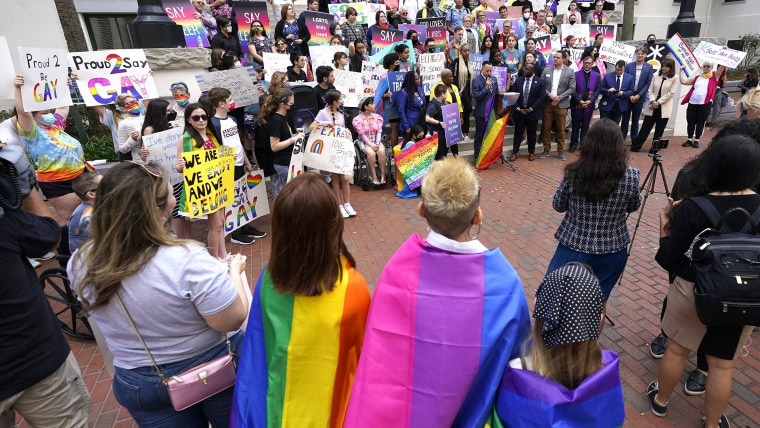
Critics said the legislation dehumanizes trans youth to address an issue that hasn’t been a problem.
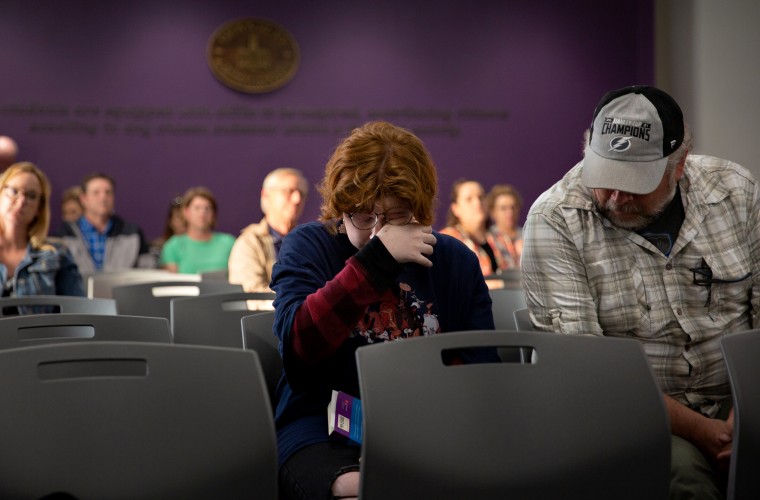
“We’re talking about legislating bullying against children who are already struggling just to get by,” said Democratic Rep. Kelli Butler. fighting back tears.
Until two years ago, no state had passed a law regulating gender-designated youth sports. But the issue has become front-and-center in Republican-led statehouses since Idaho lawmakers passed the nation’s first sports participation law in 2020. It’s now blocked in court, along with another in West Virginia.
Get the Evening Rundown
A rundown of the day’s top stories and headlines.SIGN UPTHIS SITE IS PROTECTED BY RECAPTCHA PRIVACY POLICY | TERMS OF SERVICE
“This bill is creating a pointless and harmful solution to a non-existent issue,” Skyler Morrison, a 13-year-old transgender girl, told lawmakers during a committee hearing earlier this month. “It’s obvious this bill is just an excuse to discriminate against transgender girls.”
Republicans around the country have leaned into culture war issues including transgender rights. The debate and vote on the transgender sports legislation came the same morning the House considered and passed a ban on abortions after 15-week gestation. Republicans said little during debates on all three bills.
Arizona is one of 20 states that have considered legislation to restrict gender-affirming health care. The bill originally would have banned all gender-affirming care, including hormone therapies and puberty blockers, but was scaled back in the Senate.
Similar legislation passed the Idaho House earlier this month but it died in the Senate amid concerns from some Republicans about restricting parental rights.
Supporters of the Arizona bill said it would prevent children from making permanent decisions that they might later come to regret. Republican Rep. John Kavanagh compared the vote to the Legislature’s unanimous decision in years past to ban genital mutilation.
“We should stand the same way today because this is mutilation of children,” Kavanagh said. “It is irreversible. It is horrific.”
Critics said the decision should be left to parents, their children and the health care team caring for them. They said operations are performed only after extensive care and therapy.
“We’re talking about our kids, who are already going to be taking the proper steps with their parents to be able to be who they are,” said Democratic Rep. Andres Cano.
Former staffers of animation studio Blue Sky have claimed they were pressured by Disney into censoring an LGBT+ scene from the movie adaptation of Nimona.
Nimona was originally published as a webcomic by ND Stevenson – the trans writer, cartoonist and animation producer behind acclaimed projects like She-Ra and the Princesses of Power and Lumberjanes.
The fantasy comic about a shape-shifter named Nimona was eventually published as a graphic novel by HarperCollins and won an Eisner award in 2016. Nimona was picked up by Disney-acquired Blue Sky and was set to become a film before Disney closed the animation studio in 2021.
Three ex-Blue Sky workers told Business Insiderthat Disney didn’t fully approve of the film because it contained LGBT+ characters and themes.
The anonymous staffers said Disney executives particularly pushed back against one queer scene featuring a same-sex kiss in the movie during a meeting in mid-2020 between leadership teams.
The same-sex kiss in the movie would have been between villain Lord Ballister Blackheart and the supposedly heroic Sir Ambrosius Goldenloin, who have a romantic relationship in the comic.
Blue Sky’s leadership apparently “felt enough pressure” on them to remove the kiss from further pitch presentations to Disney, according to the workers.
But the sources told Insider that the animation studio apparently hoped to ultimately include the kiss in the final film.
Disney did not respond to Business Insider‘s request for comment on the allegations. PinkNews has also contacted Disney for comment.
The news comes after a group of LGBT+ Pixar staff accused Disney of cutting “nearly every moment of overtly gay affection” from their projects. The accusation, which was released in an open letter, claimed that animators were “being barred from creating” LGBT+ content by Disney despite fierce protests from “both the creative teams and executive leadership at Pixar”.
The letter called out the Disney’s delayed response to Florida’s reviled ‘Don’t Say Gay’ bill, which would ban classroom discussion about LGBT+ identities in the state’s primary schools.
The three ex-Blue Sky members said that Nimona experience similar pressure from Disney’s top leaders and ultimately caused a rift in the formerly “tight-knit” workplace.
The workers told Insider that omitting the same-sex kiss caused “confusion” within the studio, which they described as akin to a “family”. One staffer said it “caused a weird atmosphere” at Blue Sky, especially among LGBT+ workers, that was completely different from his experience at the company.
Another worker said the group had come forward to not only highlight the need for “more queer stories” but to also “call out how nefarious it is when you don’t tell queer stories”.
“When the biggest entertainment company in the world creates content for children and systematically censors queer content, they are pushing queer children to dark places,” the worker said.
The third former worker called Nimona a film that they truly “believed in” and “loved”, and they “thought people needed to see” the movie.
Nimona was planned to be released in January 2022. Several Blue Sky employees told BuzzFeed Newslast year that the film was about 75 per cent complete – with only a couple more months of work left to finish the movie – when the studios were closed.
One of the former workers said they “personally didn’t see the support from Disney” while they worked on Nimona. They added that they didn’t think Disney had a “great track record of making queer-inclusive media”.
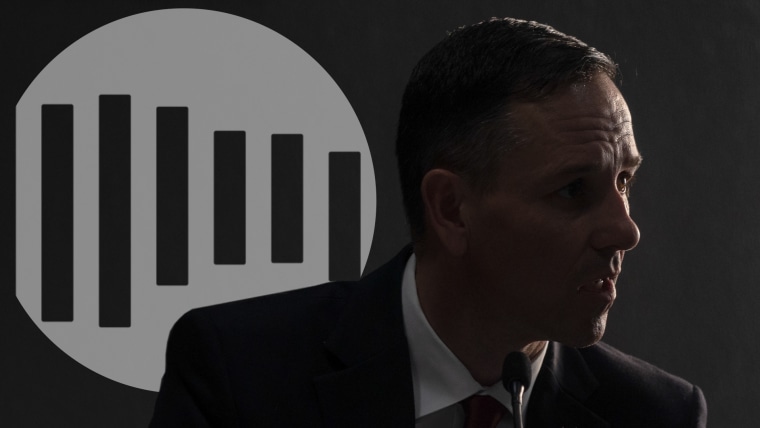
In early January, a day before students returned from winter break, Jeremy Glenn, the superintendent of the Granbury Independent School District in North Texas, told a group of librarians he’d summoned to a district meeting room that he needed to speak from his heart.
“I want to talk about our community,” Glenn said, according to a recording of the Jan. 10 meeting obtained and verified by NBC News, ProPublica and The Texas Tribune. Glenn explained that Granbury, the largest city in a county where 81 percent of residents voted for then-President Donald Trump in the 2020 presidential election, is “very, very conservative.”
He noted that members of Granbury’s school board — his bosses — were also very conservative. And to any school employees who might have different political beliefs, Glenn said, “You better hide it,” adding, “Here in this community, we’re going to be conservative.”
That’s why, he said, he needed to talk to them about some of the books available in the school district’s libraries.
For months, conservative parents and politicians across Texas had been pressuring districts to remove from school libraries any booksthat contain explicit descriptions of sex, labeling several young adult novels as “pornography.” Gov. Greg Abbott, a Republican, called for criminal investigations into school employees who make such content available to students.
Many of the titles targeted statewide have featured queer characters and storylines, but those calling for the books’ removal have repeatedly said they are concerned only with sex and vulgarity, not with suppressing the views of LGBTQ students and authors.
Glenn made a similar argument during his closed-door meeting with librarians in Granbury, which is about an hour’s drive southwest of Dallas.
“I don’t want a kid picking up a book, whether it’s about homosexuality or heterosexuality, and reading about how to hook up sexually in our libraries,” Glenn said.
He also made it clear that his concerns specifically included books with LGBTQ themes, even if they do not describe sex. Those comments, according to legal experts, raise concerns about possible violations of the First Amendment and federal civil rights laws that protect students from discrimination based on their gender and sexuality.
“And I’m going to take it a step further with you,” he said, according to the recording. “There are two genders. There’s male, and there’s female. And I acknowledge that there are men that think they’re women. And there are women that think they’re men. And again, I don’t have any issues with what people want to believe, but there’s no place for it in our libraries.”
Minutes later, after someone asked whether titles on racism were acceptable, Glenn said books on different cultures “are great.”
“Specifically, what we’re getting at, let’s call it what it is, and I’m cutting to the chase on a lot of this,” Glenn said. “It’s the transgender, LGBTQ and the sex — sexuality — in books. That’s what the governor has said that he will prosecute people for, and that’s what we’re pulling out.”
Over the next two weeks, the school district embarked on one of the largest book removals in the country, pulling about 130 titles from library shelves for review. Nearly three-quarters of the removed books featured LGBTQ characters or themes, according to a ProPublica and Texas Tribune analysis. Others dealt with racism, sex ed, abortion and women’s rights.
Two months later, a volunteer review committee voted to permanently ban three of the books and return the others to shelves. But that may not be the end of the process.
In his recorded comments to librarians, Glenn described the review of 130 titles as the first step in a broader appraisal of library content, and a new policy approved by the school board later in January grants him and other administrators broad authority to unilaterally remove additional titles they deem inappropriate, with no formal review and no way for the public to easily find out what has been pulled from shelves.
Legal, education and First Amendment experts contacted by NBC News, ProPublica and the Tribune said the audio of the superintendent, combined with the decision to abruptly remove books from circulation, even temporarily, raises constitutional concerns.
Glenn’s comments also call into question the district’s commitment to fostering a safe and inclusive school environment for LGBTQ students and could be grounds for a complaint to the Department of Education’s Office for Civil Rights, which enforces federal anti-discrimination laws, the experts said.
“This audio is very much evidence of anti-LGBTQ and particularly anti-trans discrimination,” said Kate Huddleston, a staff attorney with the American Civil Liberties Union of Texas, who reviewed the recording at the request of NBC News, ProPublica and the Tribune. “It is very much saying the quiet part out loud in a way that provides very significant evidence that book removals in the district are occurring because of anti-LGBTQ bias.”
In a written statement, Glenn said the district was committed to supporting students of all backgrounds. And although he said the district’s primary focus is educating students, “the values of our community will always be reflected in our schools.”
“In Granbury and across Texas we are seeing parents push back and demand elected officials put safeguards in place to protect their children from materials that serve no academic purpose, but rather push a political narrative,” Glenn said in the statement. “As a result, classrooms and libraries have turned schools into battle grounds for partisan politics.”
None of Granbury’s school board trustees responded to messages requesting comment. District spokesperson Jeff Meador sent a statement emphasizing that all of the books permanently removed from shelves in Granbury are “sexually explicit and not age-appropriate” and noting that district libraries “continue to house a socially and culturally diverse collection of books for students to read, including books which analyze and explore LGBTQ+ issues.”
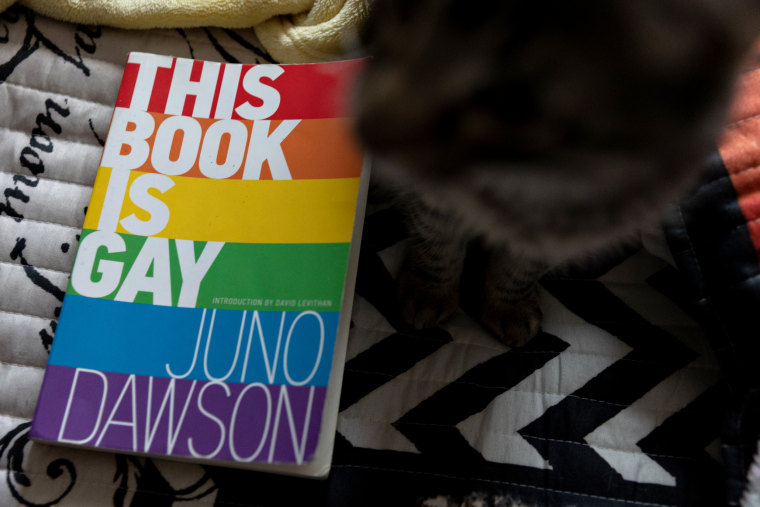
The three books the committee voted to remove were “This Book Is Gay,” a coming out guide for LGBTQ teens by transgender author Juno Dawson that includes detailed descriptions of sex; “Out of Darkness,” by Ashley Hope Pérez, a young adult novel about a romance between a Mexican American girl and a Black boy that includes a rape scene and other mature content; and “We Are the Ants,” by Shaun David Hutchinson, a coming-of-age novel about a gay teenager that includes explicit sexual language.
At least one member of the volunteer review committee was dissatisfied that only three books have been permanently removed so far, and she has started calling for a second review of the ones that have been returned.
“There are people who want to tear down values and force theirs and then also force acceptance,” Monica Brown, the committee member, said in a Facebook video following the decision. Brown did not respond to a request for comment.
One of the Granbury ISD employees in attendance at the Jan. 10 meeting with librarians said that regardless of which books are pulled from shelves or returned, Glenn’s comments left her afraid to display or purchase LGBTQ books going forward — a chilling effect that she said could limit the diversity of Granbury library catalogs for years to come. The staff member, who was not the source of the audio, spoke on the condition that she not be named, because she feared retaliation from the district.
“He literally said books on trans issues have no place in a school,” she said. “It was alarming.”
The superintendent’s comments reflect a broader national debate. Conservative state legislatures across the country have been considering bills to restrict the ways educators teach about gender and sexuality in schools. This month, the Florida Legislature passed the Parental Rights in Education bill, dubbed the “Don’t Say Gay” bill by its critics, which restricts or bans discussion of LGBTQ issues in the classroom.
Conservative activists and politicians pushing these changes nationally say the goal is to prevent teachers from having sensitive conversations with students unless the parents give their consent. Some have at times conflated sex and sexual orientation, accusing educators of attempting to “groom” young children because the teachers had discussed the existence of transgender people and same-sex relationships. Opponents contend that the measures discriminate against LGBTQ students and educators and violate federal laws meant to prevent discrimination in schools.
These changes coincide with attempts in several conservative states to limit the rights of transgender minors to participate in school sports and to access gender-affirming medical care. Last month, Abbott issued a directive — temporarily halted by a Texas judge — ordering the state’s child welfare agency to open abuse investigations into any reported instances of minors receiving such medical care, including the prescription of puberty blockers or hormones.
As superintendent of a district that’s home to more than 7,400 students, Glenn is responsible for implementing and enforcing policies that ensure that children are not discriminated against based on their gender identity or sexual orientation.
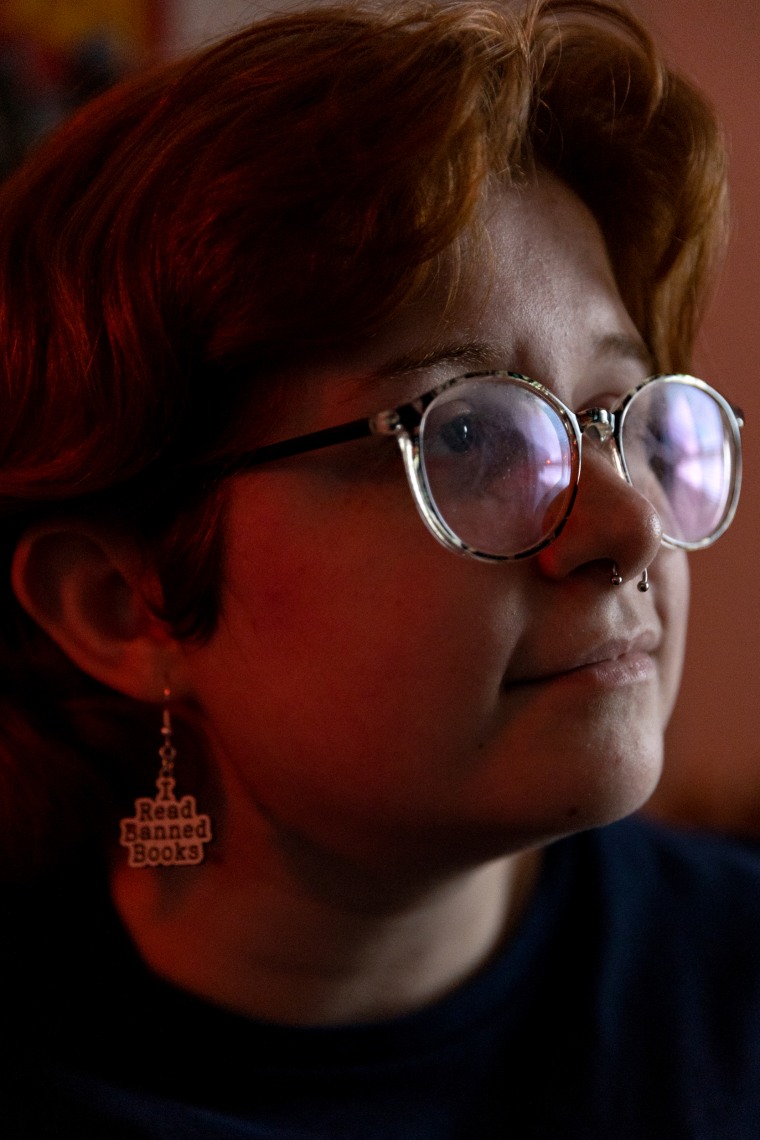
After listening to the recording of Glenn’s remarks, Lou Whiting, a nonbinary junior at Granbury High School, said they were outraged. Whiting and another student who’s part of the LGBTQ community said classmates at Granbury have harassed them at school, but they’ve avoided reporting the harassment because they worried administrators wouldn’t take their complaints seriously.
Lou Whiting, a nonbinary junior at Granbury High School, said they were angry when they learned the district was pulling dozens of LGBTQ-themed books from libraries.Shelby Tauber for ProPublica, The Texas Tribune, NBC News
Glenn’s comments validated those fears, Whiting said.
“I don’t feel incredibly safe or welcomed by a large majority of the students at my school,” Whiting said. “I’ve been called slurs. I’ve been verbally attacked. I’ve been physically attacked. But it kind of feels worse when the attacks are coming from adults, from the people who are supposed to keep us safe.”‘A very conservative board’
The meeting with librarians wasn’t the first time Glenn had publicly embraced socially conservative values in schools.
In 2014, when he was superintendent at another district, he and a pair of education professors wrote a book called “Daily Devotionals for Superintendents,” which lamented the legalization of same-sex marriage and the passage of state laws “making it a crime to counsel gay young people about changing their sexual orientation.”
In another section of the book, Glenn and his co-authors said those pushing for broader acceptance of “alternative lifestyles” and other cultural changes are doing so through the indoctrination of children in schools, as “was done by Hitler when he took over Germany.” They warned that school superintendents will face pressure to “recognize the demands of alternative life-style adults,” adding, “As a superintendent, you will have to be strong and courageous to stand against the onslaught of the enemy. Your country and your children’s future are at stake”
Glenn, who arrived at Granbury ISD in 2018 following stints leading two other Texas districts, said he couldn’t recall if he wrote those specific passages, but he acknowledged co-authoring the book, adding, “It’s fair to say I am aware of its content.”
In November, voters in Granbury elected a pair of school board members who, while campaigning, also raised concerns about the spread of LGBTQ-affirming curricula in schools. Melanie Graft rose to local prominence after leading a conservative movement in 2015 to remove a pair of LGBTQ-themed picture books from the children’s section at Granbury’s public library. She ran alongside Courtney Gore, the co-host of a local far-right internet talk show.
As candidates, the women promised to stop the “indoctrination” of students and rid the district of educational materials they said promote LGBTQ ideology or what they referred to as critical race theory, a university-level academic framework based on the idea that racism is embedded in U.S. legal and other structures.
In the weeks after Graft’s and Gore’s election victories, Glenn began asking district administrators about several books, including “This Book Is Gay,” that an unnamed school board member had found on the district’s online card catalog, according to text messages obtained by a parent through an open records request and shared with the news organizations.
The text messages included screenshots of eight titles, all of which deal with LGBTQ topics, with the keyword search terms “gay,” “trans” and “gender” highlighted in some of the book descriptions.
In a December text message, Glenn asked an administrator in charge of overseeing district libraries if any of the books were physically on shelves and available to students. Librarians needed to have a sense of urgency in responding to community complaints about books, Glenn wrote, “otherwise this will consume us in the spring.”
The list comprised titles that were aimed at helping transgender and LGBTQ teens navigate life and that told teen love stories through an LGBTQ lens, as well as an LGBTQ-themed fairy tale. Although some of the books included descriptions of sex, others did not.
Glenn referred to concerns from a board member during his Jan. 10 meeting with librarians.
“We do have a very conservative board,” Glenn said, according to the recording. “They are elected, and recently more conservative. And so that’s what our community is. That’s what our job is.”
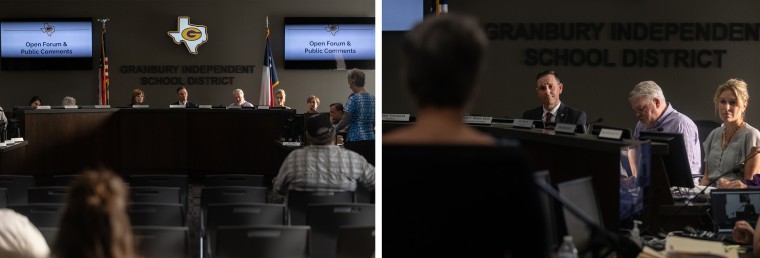
Jeremy Glenn listens as parents speak against books removals at a March 21 school board meeting in Granbury.Shelby Tauber for ProPublica, The Texas Tribune, NBC News
NBC News, ProPublica and the Tribune spoke to three Granbury teachers who were not present at the Jan. 10 meeting but who have listened to the recording and said they were troubled by Glenn’s remarks. The teachers said they’ve seen additional library books being pulled from district shelves — mostly young adult books containing talk of sex — that haven’t been subject to a formal review, raising concerns among staff members that content is being eliminated with no oversight from the public.
The teachers said they feared retribution and spoke on the condition of anonymity, citing Glenn’s comments advising educators against sharing opinions that don’t align with the conservative views of district leaders.
“I was disturbed that our superintendent would say those things,” one of the teachers said, referring to Glenn’s comments about there being no place for transgender and LGBTQ content in school libraries.
Schools have wide latitude to remove library books that are deemed age-inappropriate or “pervasively vulgar.” But free speech advocates say Republican politicians and school districts have applied an overly broad definition to the phrase in recent months, mislabeling coming-of-age stories and sex-ed books as pornography.
“The most striking feature of the current crop of book challenges is this effort to mischaracterize literature and sexual education resources, which clearly have educational value, and stigmatizing them by claiming that they violate obscenity statutes,” said Deborah Caldwell-Stone, director of the American Library Association’s Office for Intellectual Freedom.
Under a 40-year-old U.S. Supreme Court legal decision, Island Trees School District v. Pico, a public school system can’t remove a book because school board members or administrators disagree with its viewpoints or ideas, including its discussion of LGBTQ identities.
The 1982 case dealt with the removal of books deemed “anti-American” and “anti-Christian” by a school district in Levittown, New York. At the time, a school board member testified that he believed it was his duty to make decisions for the school district that reflected the community’s conservative values. Those comments were echoed decades later in the Granbury superintendent’s directive to librarians.
Whiting, who owns a copy of “This Book Is Gay,” was upset when they learned it was being banned from their high school library. “I’ve read this book however many times I questioned my identity,” Whiting said, noting that the book made them feel less alone.Shelby Tauber for ProPublica, The Texas Tribune, NBC News
“If the evidence shows that the motivation for a book removal is to keep these ideas from getting to children, then the courts are very skeptical,” said North Carolina attorney Neal Ramee, who advises school districts on constitutional issues. “That could potentially lead to a finding of a violation of the First Amendment.”
Justin Driver, a Yale Law School professor, former clerk for two Supreme Court justices and author of “The Schoolhouse Gate,” which analyzes legal battles over education, said the similarities between the Pico case and the Granbury situation are “striking and overwhelming.” As a result, he said, Glenn’s statements to librarians “would seem to place the school district in an unenviable litigating position.”
Yet because the Pico case was a divided opinion, some legal scholars said the issue is ripe for another appearance in front of the Supreme Court.LGBTQ students push back
On Jan. 11, a day after Glenn’s meeting with librarians, Kennedy Tackett, a 17-year-old senior at Granbury High School, was working in a student-run store on campus when one of her friends approached, looking upset.
The friend had been volunteering in the school library and noticed several boxes filled with books that had been taken off of shelves.
“She said, ‘Kennedy, a lot of them look like they’re LGBTQ,’” said Tackett, who is bisexual. “And so I immediately texted my parents, and I was like, ‘Hey, have y’all heard about this?’”
In the days that followed, Tackett and her father, a former school board trustee who has criticized the school district’s conservative shift, used public records requests to unearth what the district hadn’t shared publicly: the list of more than 130 books that librarians had been directed to immediately remove from shelves. (The records also included the December text messages about the eight LGBTQ books.)
Some of the 130 books had no sexual content whatsoever, including “George” by Alex Gino, a book meant for children in elementary school that tells the story of a transgender child who’s coming to terms with her gender identity.
Most of the books appeared to come from a larger list of 850 titlesdealing with racism, sex and LGBTQ themes that had been compiled by state Rep. Matt Krause. The Republican lawmaker said in a letter sent to districts across Texas that the books might violate a new state law that restricts the ways teachers can talk about “currently controversial” issues, including racism and sexuality. Krause did not respond to a request for comment.
Tackett created an online petition calling on the district to return the books to shelves, quickly drawing more than 600 signatures. A couple of weeks later, on Jan. 24, she and several other LGBTQ students showed up at a meeting of the Granbury ISD board of trustees and called on the district to reverse course.
Instead, the board voted to amend a district policy that required contested books to remain on shelves while a committee reviewed them, giving administrators more discretion to remove titles that they deem to lack “educational suitability.”
“The job of the superintendent and the school board is not only to protect the students in this district, but to make them feel like they have a place in this community,” Tackett told the board during public comments prior to the vote. “But I gotta tell you, from what I’ve seen so far, you are failing at your job.”
The comments, which would later go viral and be broadcast on national news reports, drew a rebuke from Glenn during the meeting. Glenn announced that the district had previously removed five books unrelated to LGBTQ themes that were written by Abbi Glines, an author known for including explicit sex scenes that push the boundaries of young adult fiction.
“Let’s not misrepresent things. We’re not taking Shakespeare or Hemingway off the shelves,” Glenn said, at one point referring to those who frequently speak out at school board meetings as “radicals” and emphasizing that the district was focused on sexually explicit content. “We’re not going and grabbing every socially, culturally or religiously diverse book and pulling them. That’s absurd. And the people that are saying that are gaslighters, and it’s designed to incite division.”
Those comments gave Whiting, the nonbinary Granbury junior, an idea: Using Granbury’s G logo, Whiting designed a T-shirt with the words “Radical Gaslighter” and created a page where students could buy them. They ended up selling nearly 250 to people all over the country, raising more than $2,000 for the American Library Association’s Freedom to Read Foundation.
Whiting, seated next to their father, wipes away tears after speaking against book removals at a March 21 school board meeting.Shelby Tauber for ProPublica, The Texas Tribune, NBC News
By early February, word began to spread through Granbury that someone had recorded Glenn’s comments to librarians. The employee who’d made the recording did not post it publicly or share it with reporters, but soon a copy of it was circulating among a small group of educators and community activists.
That month, the ACLU of Texas sent a letter to Granbury calling on the district to apologize for the book removals and to release a statement affirming its commitment to “LGBTQ+ and racial inclusivity.” That was before Huddleston, the ACLU lawyer, reviewed the recording at the request of reporters.
Huddleston said the recorded comments also raise serious questions about what else has been said behind closed doors, not just in Granbury, but also in other districts where books are being banned.
“This is very strong evidence of what is happening in the background,” she said. “But it also raises a host of questions about all the other districts in Texas where this is happening and we don’t have audio.”
Tackett, the Granbury senior, cried after listening to the recording of Glenn’s remarks. She thought of his public comments accusing critics of trying to deceive the public about the district’s motivations for removing and reviewing books. If anyone was gaslighting the community, Tackett said, it was him.
“It’s unsettling,” she said. “You can’t just turn your back on the students you’re supposed to be protecting.”
For years, Mandy (not her real name), a trans sex worker, used to commute two hours from Bristol to London just to access non-judgemental sexual healthcare.
“When I went to Bristol’s central clinic for a sexual health check-up, they told me they ‘don’t know how to deal with people like me,’” she tells PinkNews. “I even experienced having a student nurse brought in to look at my post-operative vagina.” This humiliating experience made her determined to find more inclusive services, but doing so was far from easy.
In Mandy’s eyes, “finding clinicians that are able to handle my trans body and my sex work was an uphill struggle”.
“I basically had to travel 100 miles just to get tested in an environment and a situation that didn’t traumatise me,” she says.
At first, she sought out sex worker-friendly clinics, like the Spittal Street Women’s Clinic in Edinburgh. These were a marked improvement, she says, but nothing compared to the care she received at CliniQ, a trans-led sexual health and wellbeing service based in London.
Services like these are still all too rare, but the last few years have seen a tiny handful of other openly trans-inclusive sexual health services crop up across the UK, many of them trans-led.
A handful of these services only have limited hours, but they still represent a vital step forward in the fight for accessible trans sexual healthcare. More importantly, they demonstrate a clear demand for such services.
The Butterfly Clinic first opened its doors back in 2018. After briefly closing throughout the pandemic, the Liverpool-based service is now open every Monday and Tuesday. “We offer a wide range of services,” a representative explains, “including vaccinations for Hepatitis A, B and HPV where appropriate. We can also initiate and manage [HIV prevention medication] PEP and PrEP.”
(Pexels)
Clinic lead Hayley cites an appointment with a trans sex worker as a landmark moment in her decision to spearhead the Butterfly Clinic. “The patient was using sex work to fund their transition, and they spoke about the barriers they had faced,” Hayley recalls. “I asked them why they had decided to come for a sexual health screening after so many years of avoiding appointments, to which they replied: “I’ve always looked after myself from a safety and security point of view, but I had neglected my health.”
It was an epiphany of sorts for Hayley, who hadn’t previously recognised the dire need for a trans-specific service.
The Butterfly Clinic is provided by axxess sexual health, who were immediately supportive of the idea. “After being given the go-ahead, I first reached out at Liverpool Pride, which got a great response,” continues Hayley. Since then, she’s worked with local support groups and other trans-led organisations to ensure a gold standard of trans-specific care.
For trans people long accustomed to feeling let down by professionals, the feeling of being treated fairly and taken seriously can be hugely affirming.
The first time 25-year-old Harry went to 56T in London, he found himself amazed that practitioners actually knew how to help him. “My questions were mainly around whether or not the pill (which I thought must have some kind of hormone in it) would interact with my testosterone, what contraceptives would be available to me other than condoms and what would be my risks of HIV exposure as a a gay trans man,” he tells PinkNews.
Previously, Harry had broached some of these concerns with other sexual health clinicians, but he was told he would have to seek out a “specialist” – a gender clinic practitioner in other words.
But of course, gender clinics have endless waiting lists, and their practitioners aren’t specifically trained to answer sexual health questions. As a result, Harry found himself at a loss for answers.
(Pexels)
This wasn’t the case at 56T. “I don’t have periods, so the clinic was able to offer me a pregnancy test if I was worried I might be pregnant,” he explains. “They really knew their stuff and made me feel at ease. I was told – through their trans-inclusive practice and approach – that my body wasn’t odd, unusual or strange. For the first time, professionals had answers to my questions. That felt really important.”
Perhaps unsurprisingly, given the context of these backstories, plenty of trans people have long been reluctant to seek care.
According to 2019 research published in the British Medical Journal, “trans people were less likely to have attended a sexual health clinic in the past 12 months compared to cisgender people,” and those who did were “more likely to report experiencing discrimination in a medical setting [than cisgender people]”.
This discrimination often isn’t mild, either. The statistics show that “over four-fifths of trans participants had high or very high levels of psychological distress”.
At trans-led clinics, we’re treated with the care and attention we deserve.
Harry has found himself feeling anxious about the potential quality of care he’ll receive. “I’ve had sexual health professionals say ‘I’ve seen it all, nothing can surprise me, love!’” he says. “In my experience though, that’s not the case.”
In the past, Harry has had multiple clinicians say he’s the first trans person they’ve come into contact with. He recalls: “One time, the sexual health practitioner got confused and said that her manager would have to do the consultation instead.”
Chris Higgins, a fellow clinic lead at The Butterfly Clinic, has heard plenty of these horror stories. “The first we need to address is the high likelihood that the trans patients coming to us have previously had negative experiences. Without giving anecdotes, let’s just say these patients definitely need to have their trust earned.”
Sensitivity is key. “Being able to take a sexual history from a trans patient without them feeling the exercise is voyeuristic is important,” continued Higgins. “We ask questions that are necessary for best care, not out of a sense of personal interest or curiosity.”
Crucially, these environments also don’t treat trans people as “other,” which is rarely the case elsewhere. In fact, when it comes to mainstream healthcare providers helping trans people, it’s often too much about luck. There are online resources like trans subreddits and advocacy groups like Action for Trans Health to point people in the right direction, but largely, access to good trans healthcare relies on word-of-mouth recommendations from other trans people in the know.
Trans-led clinics are looking to remedy these issues. CliniQ in particular is known for taking a holistic approach; although it’s not a gender clinic, practitioners can give advice on hormones, mental illness and point people in the direction of peer mentoring schemes. The website also contains a valuable list of external resources, which feature advice on everything from homelessness to support for LGBT+ survivors of domestic violence.
In these trans-led sexual health clinics, there’s an understanding that trans bodies often work differently to cis bodies. “For us, our genitals are sometimes a source of trauma or difficulty,” continues Mandy, “and our bodies after surgical intervention don’t always operate the same as, or look the same as, their cis counterparts.”
These differences aren’t sensationalised in trans-led clinics, nor do they lead to intrusive, potentially triggering lines of questioning. “In these spaces, you’re able to say, as a man with muscles and a beard, ‘I’ve had some discoloured, unusual discharge from my vagina’ and nobody bats an eyelid,” says Harry. “We’re treated with the care and attention we deserve.”
(Pexels)
Funding these services is no easy feat, though. It’s no secret that grassroots organisations have long been forced to plug holes in government provision; as a result, a handful of these clinics can only operate during strict opening hours due to funding restrictions, or they’re partially reliant on donations.
According to Mandy, a potential solution is to acknowledge the overlap between trans and sex worker populations, and to work to more closely integrate their services. “The two communities are intrinsically linked, and our lives often intersect in difficult ways,” she explains. “Sometimes it’s impossible to access a trans-specific clinic in places where there’s a sex worker clinic, and vice versa. Therefore, it’s vital that these services are able to cater to our needs.”
The rise of at-home testing
At-home testing has made a huge difference, too. Last year, a UK study found that HIV testing rates had trebled amongst trans communities due to the increased accessibility of at-home tests. “That doesn’t surprise me in the slightest,” says Harry, who believes “most people – not just trans people, or people who are anxious about their bodies – will find it easier to do tests in the comfort of their own home.”
However, there’s more to good sexual healthcare than just testing –– from PrEP and birth control to informed practitioners able to answer questions about hormones, treatment and much more, there’s still a huge need for more trans-specific clinics.
These healthcare issues are often reduced to hot-button, clickbait “debates” about inclusive language by right-wing commentators, but there are actual lives at stake when it comes to conversations around healthcare access.
At-home testing and trans-led clinics may be plugging vital gaps in UK healthcare, but there’s more funding, more education and more awareness needed to ensure more trans people can access them.
“I definitely welcome at-home testing,” concludes Harry, “but it can’t be treated as a replacement for good care and trans-inclusive training.”
The Metropolitan Police made assumptions about “the lifestyles of gay men” in investigating the crimes of Stephen Port, according to a leaked report from the Independent Office of Police Conduct (IOPC).
The unpublished report, seen by Channel 4 News, states that “the public cannot be satisfied that police are making decisions based on evidence and fact” because of the assumptions made in the investigation into Port, who murdered four gay men.
Port, known as a the “Grindr killer”, murdered Anthony Walgate, Gabriel Kovari, Daniel Whitworth and Jack Taylor over a 15-month period in 2014 and 2015.
He approached his victims via dating apps before giving them fatal doses of the date rape drug GHB, and was finally sentenced to life in prison in 2016.
Last year, following a lengthy inquest, a jury ruled that there had been police “failures” in investigating Port’s crimes and, had they been avoided, some of his victims may still be alive.
But the leaked IOPC report tells a different story.
It states that officers made assumptions about “the lifestyles of gay men”, and adds: “The investigations into the four deaths reveal that assumptions were made and could have been based, consciously or unconsciously, on discriminatory views.”
The families of Stephen Port victims want an inquiry into whether there is institutional ‘homophobia’ within the Met
Although the idea that homophobia could have allowed Stephen Port’s murder spree to continue is reprehensible, it could come as some relief for the families of his victims.
A petition launched by the families, which has been signed by more than 42,000 people, is calling for an inquiry into homophobia in the Met, and for officers involved in the investigation to be harshly punished.
During the recent inquest, it was revealed that five police officers who were reprimanded for “performance failings” have since been promoted to more senior roles.
Furthermore, following Port’s arrest, nine detectives were told by the IOPC that their performance had “fallen below the standard required”.
Yet not a single officer was fired.
The petition reads: “We need justice for Jack, Anthony, Gabriel and Daniel.
“The families need justice. The officers need to be held accountable. They should not be in the positions of authority they currently hold.
“There is widespread homophobic and gender-phobic discrimination in the police forces, a full public inquiry should be launched to fully investigate the police failings and make an example of those who let down the families of Stephen Port victims.”
In December, a group of 18 MPs wrote a letter to then Met Police chief Cressida Dick to demand a public inquiry into whether the Met Police is “institutionally homophobic”.
They said: “The key question everyone is asking is yet to be answered – whether institutional homophobia in the Met played a role in these investigations… It is imperative that a public inquiry takes place urgently to consider if institutional homophobia played a role in this case.”
In a statement to Channel 4 News, a spokesperson for the Met Police said: “In an organisation of more than 44,000 people, we have already acknowledged there will be a small number with attitudes and beliefs that are not welcome in the Met; we will challenge, educate and discipline as appropriate.”
“We are concerned to hear that, anecdotally, the IOPC has learned some of our LGBT+ advisers have experienced discrimination from colleagues,” they added.
“This is a serious matter and we will be exploring this further.”
PinkNews has contacted the Met Police and the IOPC for comment.
A lesbian woman has been stabbed to death in Umlazi, South Africa, after reportedly rejecting a man’s advances, leaving the local community “very disturbed”.
IOL Daily News reported that 32-year-old Pinky Shongwe was stabbed to death while going to a local shop after an “unknown” man allegedly harassed her with unwanted advances.
A spokesperson for Umlazi police, lieutenant-colonel Nqobile Gwala, said that the case is now being investigated as a murder.
“She was found lying on the road and was taken to hospital where she succumbed to her injuries on arrival. The motive of the killing is unknown and the matter is still under investigation,” Gwala said.
A spokesperson for KwaZulu-Natal Social Development said he was “disturbed” to hear about the incident after several awareness campaigns for LGBT+ equality in the area.
Mhlaba Memela told IOL Daily News: “We are very disturbed to hear of another brutal murder of a lesbian woman.
“We are angry after our department has done a lot of public awareness campaigns to teach people to accept and live side by side with gays and lesbians. We have been telling people that gay and lesbian rights were protected by the constitution.
“We believe it is high time that our courts start treating this violence differently, and not be lenient when sentencing the perpetrators.”
The tragic stabbing comes after a slew of violent crimes against the LGBT+ population in South Africa in recent years, including the murder of another lesbian in September 2021 in an area only around 15 miles away from Shongwe’s killing.
Previous victims also include Lonwabo Jack, a 22-year-old gay man found tragically murdered on his birthday.
Nonhlanhla Khoza, a politician serving in the Department of Social Development, said in a 2021 statement: “We are deeply ashamed that, in our nation, we still have people facing discrimination based on their sexual orientation.
“This is a gross violation of basic human rights and we should unite to end such crimes.
“It must sink in the minds of all those involved in such crimes that no one has a right to take a life and abuse someone else because of their sexuality.
“Our government has made giant strides towards safeguarding LGBTQ+ rights. However, incidents similar to this one water down all efforts that have been made.”
The Supreme Court says it won’t review the case of a Seattle-based Christian organization that was sued after declining to hire a bisexual lawyer who applied for a job. A lower court let the case go forward, and the high court said Monday it wouldn’t intervene.
Two justices, Justice Samuel Alito and Justice Clarence Thomas, agreed with the decision not to hear the case at this stage but said that “the day may soon come” when the court needs to confront the issue the case presents.
The case the high court declined to hear involves Seattle’s Union Gospel Mission. In addition to providing food and shelter to the homeless the organization offers addiction recovery, job placement and legal services. In 2016 it was looking for an attorney to help staff its legal-aid clinic.
One of the applicants was Matthew Woods, who had volunteered at the clinic for more than three years. Woods identifies as bisexual and was in a same-sex relationship. He was told before he applied that his application would be rejected because the organization’s “code of conduct excludes homosexual activity.” Woods sued, arguing that the organization violated state law by discriminating against him on the basis of his sexual orientation.
A state trial court judge ruled for Seattle’s Union Gospel Mission and dismissed Woods’ lawsuit. The judge ruled that the organization is exempt from the state’s anti-discrimination law. But the Washington Supreme Court reversed the decision and let the lawsuit go forward.
The Supreme Court does already have a different high-profile dispute involving a clash between religion and the rights of LGBTQ people on its docket. That dispute involves a Colorado web designer who says her religious beliefs prevent her from offering wedding website designs to gay couples. That case is expected to be argued in the fall.
Twitter has refused to take down Texas attorney general Ken Paxton’s hateful tweet deliberately misgendering Dr Rachel Levine as it’s within the ‘public interest’.
On Thursday, the Texas attorney general decided to continue his anti-trans campaign by intentionally misgendering the nation’s only openly trans four-star admiral in a cruel statement on Twitter.
Despite immense backlash on social media, Twitter decided to let the tweet remain up despite it breaking the social media platform’s rules about hateful conduct and misgendering trans individuals.
Twitter posted an update on Ken Paxton’s tweet, acknowledging that it violates the website’s rules but would remain accessible because it “may be in the public’s interest”.
“As is standard with this notice, engagements with the tweet will be limited,” a spokesperson told PinkNews. “People will be able to quote the tweet, but will not be able to like, reply or retweet it.”
According to Twitter, an exception for having a tweet removed does require the account to be verified; have more than 100,000 followers; violate one or more rules; and represent a “current or potential member” of a legislative body.
The website states that it is “more likely to remove” a tweet if it includes a “declarative call to action that could harm a specific individual or group”. It will also remove tweets that “shares information or engages in behaviour that could directly interfere with an individual’s exercise of their fundamental rights”.
The outlet named the top Biden official as one of its “Women of the Year” for her trailblazing work and role during the COVID-19 pandemic.
As part of her interview for the accolade, the US assistant secretary for health sent a beautiful message of acceptance to trans, non-binary and gender non-conforming Americans.
“I think you have to be true to yourself, and I think that you have to be who you are,” Dr Levine said.
“You have tremendous worth just for who you are, no matter who you love, no matter who you are, no matter what your gender identity, sexual orientation or anything else, and to be, be true to that. And then everything else will follow.”
In today’s heightened culture war, the coffers of the anti-gay movement are overflowing. According to publicly available annual returns, 11 nonprofit groups identified as anti-LGBTQ hate groups by the Southern Poverty Law Center took in over$110 million in contributions during the financial year ending in 2020.
The dollar amount represents a recent high-water mark for the organizations, whose take of donations, grants and other noncash contributions has increased steadily since 2016, when the same 11 groups reported more than $87 million in such contributions.
In just four years, their total revenue swelled by over 25 percent, with some indication that the positive trend continued into 2021. The multimillion-dollar war chest has bolstered a movement that just a few years ago appeared to be losing ground in America’s decadeslong culture war around lesbian, gay, bisexual, transgender and queer rights. Far from retreating, the groups have won significant battles at all levels of American government and society — from local school boards to the federal courts.
The Southern Poverty Law Center, or SPLC, based in Montgomery, Alabama, has tracked the anti-LGBTQ movement for more than a decade. In 2011, the SPLC published its first list of 13 “hate groups” that propagate known falsehoods and pseudoscience to disparage gender and sexual minorities. Since 2020, the organization has been tracking more than 40 entities,of which many engage in a host of issues beyond LGBTQ rights, like abortion and Covid-related mandates. Several groups are also churches, which are exempt from filing annual returns and therefore do not disclose their finances.
Many of these groups assert that LGBTQ people are a threat to society itself. “
SCOTT MCCOY, SOUTHERN POVERTY LAW CENTER
Then, as now, a loose affiliation of fundamentalist churches, conservative law centers and far-right advocacy organizations makes up the anti-LGBTQ movement.
“Many of those, while not specifically tied to a church, are rooted in the conservative Christian, biblical sense of human sexuality,” said Scott McCoy, the interim deputy legal director for LGBTQ rights and special litigation for the SPLC and the SPLC Action Fund, the group’s political action committee.
But simply holding a religious belief that views homosexuality or transgender identity as sinful does not automatically land a church or an organization on the SPLC’s list of hate groups.
“Many of these groups assert that LGBTQ people are a threat to society itself. That kind of extremist rhetoric and belief is part of what goes into our decision-making process,” McCoy said. He also pointed to groups that justify violence against LGBTQ people, like Westboro Baptist Church.
‘The hard core of the anti-gay movement’
When the SPLC began tracking anti-LGBTQ hate in the early 2010s,the organization noted that “a small coterie of groups now comprise the hard core of the anti-gay movement.” The same groups — many now flush with financial resources — continue to shape the anti-LGBTQ agenda.
“As of today, there probably are five or six key players,” McCoy said, highlighting the Family Research Council, the Alliance Defending Freedom, Liberty Counsel and the American College of Pediatricians as parts of the core.
From 2011 to 2021, the total revenue of the Family Research Council — an advocacy organization based in Washington, D.C., that, according to its website, believes “homosexual conduct is harmful to the persons who engage in it” and “is also harmful to society at large” — jumped from over $12 million to more than $23 million.
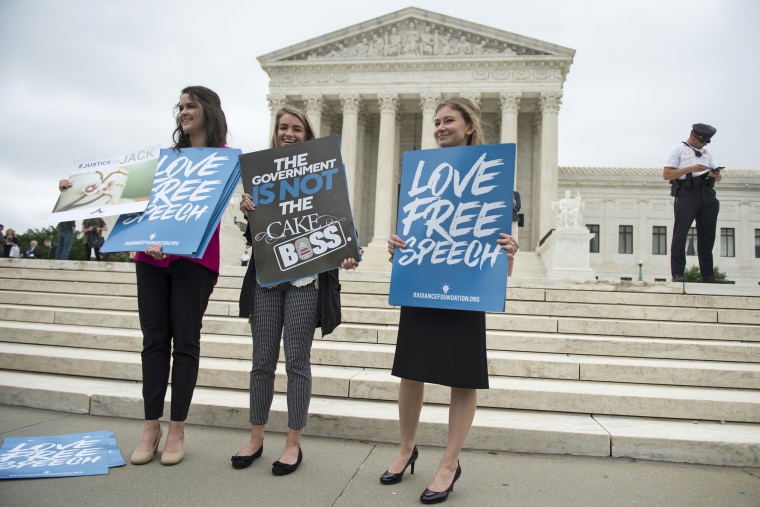
Members of the Alliance Defending Freedom gather outside the Supreme Court on June 4, 2018, to support the decision in Masterpiece Cakeshop v. Colorado Civil Rights Commission.Sarah Silbiger / CQ-Roll Call, Inc via Getty Images file
During the same period, contributions to the Alliance Defending Freedom, which is based in Scottsdale, Arizona, more than doubled, from over $34.5 million in 2011 to more than $76 million in 2021. According to its website, the group aims to secure “generational wins” to ensure “the law respects God’s creative order for marriage, the family, and human sexuality.”
In a statement, Jeremy Tedesco, the senior counsel and senior vice president of corporate engagement at the Alliance Defending Freedom, touted its judicial track record and alleged that the SPLC has “destroyed its own credibility because of its blatant partisan agenda.”
“Alliance Defending Freedom is among the largest and most effective legal advocacy organizations dedicated to protecting the religious freedom and free speech rights of all Americans. Our record since 2011 includes 13 Supreme Court victories, including two wins last year and one upcoming case next term,” Tedesco said. “Our track record of success is due in large part to those who generously support our work, and increased giving demonstrates the growing movement to protect Americans’ First Amendment freedoms.”
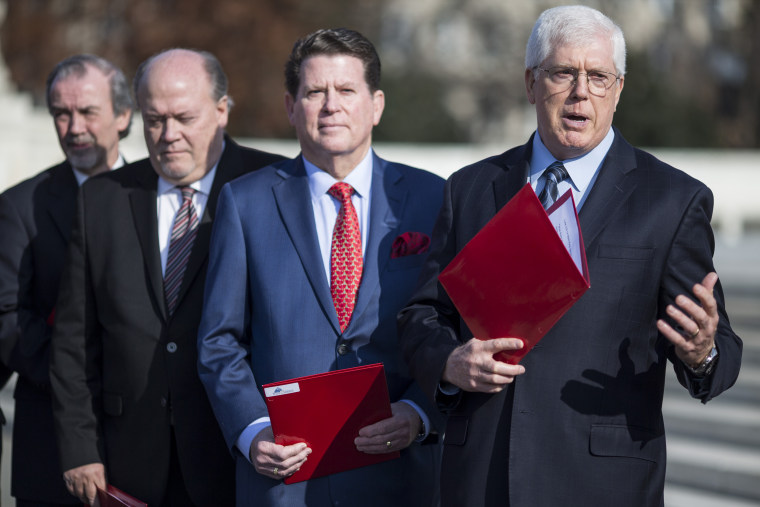
Mat Staver, the founder and chairman of Liberty Counsel, right, speaks outside the Supreme Court on Dec. 12, 2018. Zach Gibson / Getty Images
Mat Staver, founder and chairman of Liberty Counsel, based in Orlando, Florida, said that the organization is “neither anti-LGBTQ nor a hate group” and that the SPLC’s “self-appointed hate group list is false and defamatory.”
“We hate no one and oppose violence and demeaning language or behavior towards anyone,” Staver said in a statement. “We believe every person is created in the image of God and has inherent dignity and value. Liberty Counsel believes everyone is entitled to religious freedom and freedom of speech.”
The Family Research Council and the American College of Pediatricians did not respond to requests for comment. They have previously rejected the accusation that they are hate groups.
‘Outliers’ who ‘wield a pretty big hammer’
The significant flows of contributions to the groups, however, do not reflect a growing antagonism toward the LGBTQ community in broader American society.
Survey after survey confirms that Americans of many different political stripes and religious affiliations have become more supportive of LGBTQ rights over the past decade. According to the2021 American Values Atlas, more than two-thirds (68 percent) of Americans supported same-sex marriage last year, up from 47 percent a decade before. That included majorities of historically conservative religious groups, like Catholics and Orthodox Christians, and nearly half of all Republicans.
The same survey found even greater public support for protections against discrimination in the workplace and public accommodations for LGBTQ people.In 2021, the American Values Atlas reported that 79 percent of respondents supported such protections.
One group in the American Values Atlas continues to lag behind the rest of the country when it comes to affirming LGBTQ equality: white evangelical Protestants, whose fringe, far-right elements comprise the core of the anti-LGBTQ movement in the U.S. today.https://iframe.nbcnews.com/qDAUKZK?_showcaption=true&app=1
“As someone who writes social science, I can’t tell you how many sentences I have begun with the words ‘with the lone exception of white evangelical Protestants,’” said Robert P. Jones, the CEO and founder of the Public Religion Research Institute, or PRRI, the organization behind the American Values Atlas. “Whether it is on immigration, LGBTQ issues, abortion — white evangelical Christians are increasingly outliers to the middle of the country, not just to the left.”
Get the Evening Rundown
A rundown of the day’s top stories and headlines.SIGN UPTHIS SITE IS PROTECTED BY RECAPTCHA PRIVACY POLICY | TERMS OF SERVICE
Jones, a scholar of white Christianity in the U.S., has spent years tracking the cultural and political power of white evangelical Protestants.
“I think the biggest marker of change among white evangelicals over the last decade has just been the internal shifts that they have undergone,” Jones said. “They have shrunk by nearly a third just over the last decade. Today, they are 14.5 percent of the population. And as they have shrunk, they have been hemorrhaging young people. I think that is one of the reasons why they have become increasingly out of step with the middle of the country.”
Despite the bleed of parishioners, white evangelicals have managed to maintain their power in electoral politics by solidifying their stake in the Republican Party. Between 2016 and 2020, Pew Research Center found that white evangelical voters’ support of President Trump rose from 77 percent to 84 percent. Although this voting bloc only accounted for 19 percent of the total electorate in 2020, it made up 34 percent of all Trump voters.
“When you’re a third of one party’s base, you wield a pretty big hammer,” Jones said.
Without the broad support of white evangelicals, Pew Research Center observed, Trump would have lost to Joe Biden by more than 20 points in the last presidential election.
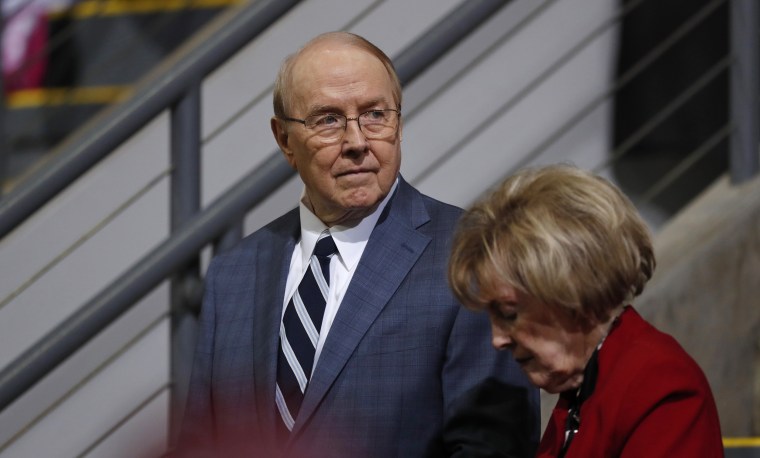
James Dobson waits for President Donald Trump to speak at a campaign rally in Colorado Springs, Colo., on Feb. 20, 2020.David Zalubowski / AP file
From the start of his foray in national politics, Trump made an effort to woo this key constituency. In 2016, during his first run for the Oval Office, Trump formed a so-called evangelical executive advisory board to help shape his political platform. Among the people in the group of advisers were heavy hitters in evangelical Christianity, as well as the anti-LGBTQ movement, including James Dobson, an Alliance Defending Freedom co-founder and the founder and former leader of the fundamentalist Christian organization Focus on the Family.
“We saw this shift throughout Trump’s presidency — and it has certainly lasted past it — of the term ‘evangelical’ becoming more of a political signifier than it is a religious one, that being almost a stand-in for white, Christian nationalist beliefs,” said Maggie Siddiqi, the senior director of Religion and Faith at the Center for American Progress, a progressive think tank.
It was not just Trump who welcomed evangelical leaders into the highest levels of politics and policy. In 2018, then-Senate Majority Leader Mitch McConnell, R-Ky., appointed Family Research Council President Tony Perkins to the U.S. Commission on International Religious Freedom, an independent, bipartisan commission created by the International Religious Freedom Act of 1998 that is “dedicated to defending the universal right to freedom of religion or belief abroad.” At the time, Heidi Beirich, then the director of the SPLC’s Intelligence Project, called Perkins’ appointment “deeply disturbing.” His current term on the commission expires in May.
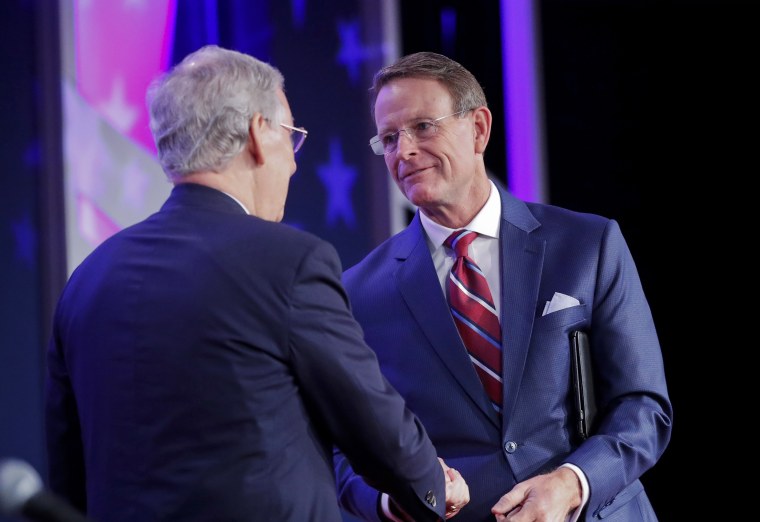
Mitch McConnell, R-Ky., then the Senate majority leader, is greeted by Family Research Council President Tony Perkins before he speaks at the 2018 Values Voters Summit in Washington, D.C., on Sept. 21, 2018.Pablo Martinez Monsivais / AP file
Siddiqi noted that among evangelicals, there is some noted resistance to marrying faith with contemporary American politics. For example, in 2019, the Baptist Joint Committee for Religious Liberty launched the campaign Christians Against Christian Nationalism, which, among other tenets, holds that “conflating religious authority and political authority is idolatrous and often leads to oppression of minority and other marginalized groups.”
Still, conservative white evangelicals have found in the modern Republican Party champions for a political agenda that extends well beyond LGBTQ rights. On issues of abortion, religious freedom and, more recently, Covid vaccination mandates, today’s GOP has aligned itself with the interests of many white evangelicals, affording the group outsized power in the U.S.’s two-party political system.
With so many evangelicals flocking to one side of the political spectrum, Jones said, they have “yielded disproportionate influence in the public, by leveraging a political party.”
A strategic ‘pivot’
At the same time, the political arenas where conservatives and progressives battle over LGBTQ rights and other fraught social issues have continued to evolve.
“There’s been a focus downward to more local places like school boards, boards of health, bodies of that nature,” said McCoy of the SPLC. “Now they are taking up the latest fault lines in the culture war, whether it be mask mandates, LGBTQ school policies or even critical race theory.”
There has also been “a pivot” to targeting the transgender community, said Sharita Gruberg, the vice president for the LGBTQI+ Research and Communications Project at the Center for American Progress.
“The groups that are opposed to LGBTQ equality did their message testing and found that attacking gay people is no longer the broadly popular culture war totem that they used in the ’90s,” Gruberg said. “From the bathroom bills in 2015 and 2016 to the bans on trans kids playing school sports, it is easier for these groups to frame attacks to focus on trans kids paired with policies that they say are restoring parental rights. It’s a bit of a Trojan horse.”https://iframe.nbcnews.com/j2EQSqk?_showcaption=true&app=1
The Parental Rights in Education bill — dubbed the “Don’t Say Gay” bill by its critics — which is on Florida Gov. Ron DeSantis’ desk, is a case in point. If it is signed into law, it would prohibit “classroom discussion about sexual orientation or gender identity” in the state’s primary schools. Opponents say the law would harm LGBTQ youths by creating an antagonistic educational environment. But Republican state Rep. Joe Harding, who introduced the bill in the House in January, contends the measure is about “empowering parents.”
Last month, Harding defended his bill in a blog post for the Family Research Council, an SPLC-designated anti-LGBTQ hate group since 2011.
Gruberg contends that protecting LGBTQ rights nationwide would require federal intervention. Congress is considering the Equality Act, which would amend the Civil Rights Act of 1964 to prohibit discrimination on the basis of sex, sexual orientation and gender identity. But passage of the law is far from ensured: All Democratic-voting senators and 10 Senate Republicans would need to vote in favor of the measure to overcome the filibuster.
Even then, the law could still meet its demise in the courts. While the Supreme Court has a history of affirming LGBTQ rights, conservatives now command a solid majority.
The most recent addition to the court, Justice Amy Coney Barrett, even has a past with members of the anti-LGBTQ movement. From 2011 to 2016, Barrett gave lectures on five different occasions to theBlackstone Legal Fellowship, the Alliance Defending Freedom’s flagship summer program for Christian law students. During her confirmation hearing in 2020, Barrett described her experience with the Blackstone Legal Fellowship as a “wonderful one” but also said that “nothing about any of my interactions … were ever indicative of any kind of discrimination on the basis of anything.”
For Jones, the pace at which LGBTQ equality has advanced has created a “last stand mentality” among white Christian conservatives, who have worked diligently over the decade to shore up their power on the federal bench.
“It’s that dynamic that is driving the fundraising,” he said. “There’s a kind of last-stand desperation, an apocalyptic feeling that if we don’t do something now, we will lose the country. And if we don’t do something to win it back, there will never be another opportunity.”
As the world continues to watch the ongoing Russian invasion of Ukraine with horror, one question continues to plague the minds of queer activists in the West: what about the LGBTQ people?
Russian leader Vladimir Putin has a long record of oppression of the queer community from public humiliation and imprisonment to encouraging mob violence. Filmmaker David France documented Putin’s anti-gay campaign in his film Welcome to Chechnya [now streaming on HBO Max] which detailed queer oppression in the titular Russia-allied republic.
Will Ukraine face the same fate? We sat down with France to discuss the situation for LGBTQ people living in Russia and Ukraine, the state of the underground resistance, and how Vladimir Putin has declared all-out war on queer people. France also reveals how the same forces of oppression have infected the United States, and how preserving democracy may hold the only hope for LGBTQ people in the future.
Are you in contact with the Rainbow Railroad (an underground resistance that smuggles queer people out of Eastern Europe) in Ukraine?
I did just speak with David Isteev [from Welcome to Chechnya] who is doing rescues in the Caucasus. He wanted to talk about what was happening to queers in Russia because of the invasion.
So what’s the situation there?
They are despairing. I’ve never heard the kind of grimness from the folks I know that we’re hearing now. The entire leadership of the LGBTQ movement in Russia is now outside Russia.
They’ve all had to flee?
Correct. Not just because of the invasion, but there was also a crackdown in the months leading up. [The Putin government] has made it impossible for queer leaders to do their work, and they’ve strangled their source of funding. Now the borders are closed, so it’s not possible to move money into the country. It’s not possible to access the money they have in the country. And the people outside the country trying to help are delivering money to the border in cash.
Refugees fleeing Kiev. Via Shutterstock
I’m sure that carries a whole other set of risks.
Yes. And if they bring money in US dollars, is it possible to change it into rubles? And if it is rubles, it’s worth almost nothing.
So is the solution to escape?
Well, here’s another problem. It’s not possible to enter most countries without proving vaccination status, and with an approved vaccine. Almost nobody has approved Sputnik 5, the Russian vaccine, because they’ve never produced reputable data. So if you have Sputnik 5, you’re not getting into Europe.
Putin’s persecution of LGBTQ people is nothing new. Is this personal for him?
It is a strategy that works. 10 or 15 years ago, he discovered the more he spoke against queer folks, the more he generated a divide that turned people against people, instead of against the government.
Putin said he wants to install a new government in Ukraine. How safe is it to believe he would install a leader similar to the one he appointed in Chechnya, Ramzan Kadyrov?
Well, Putin has been using an anti-queer plank in Ukraine for the past decade alleging that if Ukraine joins NATO, they will have to recognize marriage equality. And in some corners, it has worked. It worked with the Russian Orthodox Church—in the past week, they’ve come out in favor of the invasion and against “the gay agenda.”
So what you’re actually saying—Putin’s fighting an international war on LGBTQ people?
Absolutely true. He’s saying modernity and liberalism equal queerness. He’s pulling the Iron Curtain closed again to resist the queer movement. It’s that central.
The Western media implies that the invasion of Ukraine is unpopular in Russia…
Well, from what I understand from my Russian friends is just the opposite. The people they talk to, family, for example, don’t believe [the invasion] is happening.
Pro-Ukrainian independence/LGBTQ protest. Via Shutterstock.
They don’t believe the war is real?
Correct. They have no access to Western or social media. The Kremlin made it a crime to report on Ukraine. People don’t have any reason to believe there is a war unless they have children coming back in body bags.
That’s a total page out of the Stalinist playbook.
That’s why it’s an Iron Curtain—you can’t communicate. And so many young Russians have great experiences traveling across Europe. They’re very integrated into world culture. And those are the people protesting in little pockets here and there. But between 10-15,000 have been arrested. People are just disappearing for saying there’s a war.
So let me ask you then: there seems to be this link between autocracy and autocratic-type leaders and homophobia or anti-queer sentiment. Why?
People want to know what’s causing their problems. It just turns out that it works if you say queers are to blame. Since Putin started his return to power on the backs of the queer community, other leaders take note. Prime Minister Viktor Orbán is doing that in Hungary. It’s happening in Poland. It’s a successful campaign in Belarus. And Trump discovered you could do it here.
Indeed.
It’s a huge shock. For those of us that saw 50 years of LGBTQ civic engagement and thought it was a permanent victory are having to reckon with it getting rolled back. Look what just happened in the Virginia Governor’s race.
Or Florida. Or Texas. Or Georgia.
Mmhmm. And what’s happening to queers in Ukraine—many queer Russians had fled there. The LGBTQ community had a stronghold there, and now that’s at risk. Putin’s state department issued a “kill list” for invading forces to round up and kill political leadership in the country as well as LGBTQ leaders. They gave the hit list to an elite force out of Chechnya. And men can’t get out of Ukraine. They’re terrified.
What’s happening now has people scared. Will Putin go for broke? Will he level Kiev? Will flatten Odessa? Will he drop a nuclear bomb?
Russian bombing in Kiev. Via Shutterstock.
Well, if he drops a nuclear bomb, we all have a lot more to worry about.
Yes. And that’s why everyone is praising the Ukrainian resistance, but talking about [Putin’s] “off ramp.” He may feel like he has no choice but to throw everything at it. And if the West gives him Ukraine, what does that mean [for the rest of Eastern Europe]?
Is there anything we can do in the West?
We need to start talking about how queer panic is being weaponized as the chief articulation of Putin’s dissent for his own military actions. Continue to support the Rainbow Railroad. They’re not solving problems, but they are creating a pipeline for flight. That saves lives. And look to LGA Europe and LGA Asia. They’re doing important work too.
So then, how much of the future of LGBTQ equality is tied to democracy?
It is plain that where democracy is strong, our movement has been successful. There’s a 100% correlation. But crushing democracy in Ukraine will only harm queers there along with everybody else. Putin and his oligarchs have sucked trillions out of the economy and done nothing for the Russian people.