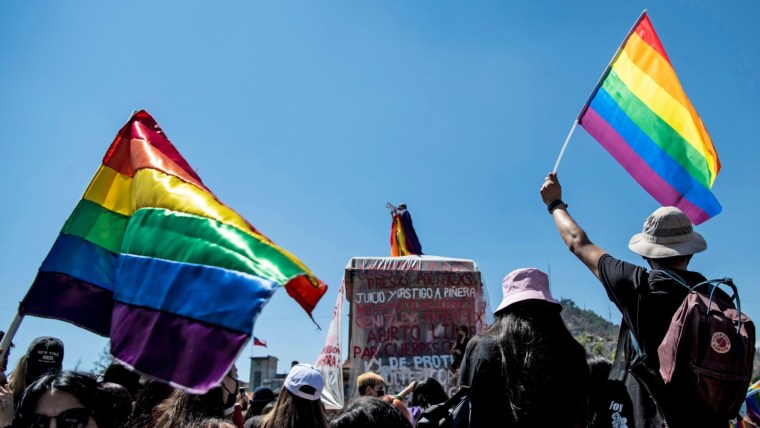
The percent of U.S. adults who identify as something other than heterosexual has doubled over the last 10 years, from 3.5 percent in 2012 to 7.1 percent, according to a Gallup poll released Thursday.
Gallup found that the increase is due to ”high LGBT self-identification, particularly as bisexual, among Generation Z adults,” who are 18 to 25.
It asked more than 12,000 U.S. adults how they identify during telephone interviews last year. It found that younger U.S. adults are much more likely to identify as LGBTQ than older generations.
More than 1 in 5, or 21 percent, of Generation Z adults identify as LGBTQ, Gallup found. That’s almost double the proportion of millennials, who are 26 to 41, at 10.5 percent, and nearly five times the proportion of Generation X, who are 42 to 57, at 4.2 percent. Less than 3 percent of baby boomers, who are 58 to 76, identify as LGBTQ, compared to just 0.8 percent of traditionalists, who are 77 or older.https://iframe.nbcnews.com/u5fH2si?_showcaption=true&app=1
As the youngest Americans slowly outnumber and replace the oldest, Gallup predicts the number of LGBTQ-identifying adults will only increase — and likely at a much faster rate than past generations.
The poll found that the percent of Generation X, baby boomers and traditionalists who identify as queer has remained relatively the same over the years. More millennials have increasingly identified as LGBTQ, but only slightly, at 5.8 percent in 2012, 7.8 percent in 2017 and 10.5 percent now.
But the poll noted that the percentage of Generation Z adults who are queer has almost doubled since 2017 — jumping from 10.5 percent in 2017 to 20.8 percent. The rise shows that younger Gen Zers, who have turned 18 since 2017, are more likely than older Gen Zers to identify as queer.
Gallup noted that the youngest Gen Zers — who are as young as 10 — still haven’t turned 18, and they are even more likely to identify as LGBTQ.
If the trend of millennials and Generation Z increasingly identifying as LGBTQ continues, “the proportion of LGBT Americans should exceed 10 percent in the near future,” Gallup found.
Bisexuals make up 4 percent of all U.S. adults
Bisexuality is the most common identifier used among LGBTQ Americans, which is in line with a Gallup report released last year. More than half of LGBTQ Americans, at 57 percent, are bisexual.
Over one-fifth of LGBTQ respondents, or 21 percent, are gay, 14 percent are lesbian, 10 percent are transgender and 4 percent identify as something e
Overall, 4 percent of U.S. adults identify as bisexual, compared to 1 percent who identify as lesbian, 1.5 percent as gay, 0.7 percent as transgender and 0.3 percent as other. Heterosexuals comprised 86.3 percent of total respondents, and 6.6 percent did not offer an opinion.
Generation Z adults are the most likely to identify as bisexual, at 15 percent overall, compared to 6 percent of millennials and less than 2 percent of Generation X, baby boomers and traditionalists.
Increasing acceptance — in certain areas
Gallup notes that the proportion of Gen Z Americans who identify as LGBTQ is increasing at a faster pace than previous generations, and that they are growing up at a time when 70 percent of Americanssupport same-sex marriage rights, and a majority also support nondiscrimination protections for LGBTQ people.
But that support varies when broken down further. For example, Gallup’s annual Values and Beliefs survey found last year that 66 percent of people favor allowing openly transgender people to serve in the military, that figure is down slightly from its previous measure in 2019, when 71 percent were in favor.
At the same time, 62 percent of Americans say trans athletes should only be allowed to play on sports teams that correspond with the sex they were assigned at birth, while 34 percent say they should be able to play on teams that match their gender identity, the survey found.
At the time, Mara Keisling, former executive director of the National Center for Transgender Equality, attributed that contrast at least in part to the wave of legislation in states seeking to bar trans students from competing on school sports teams that align with their gender identity.
But she also noted that — consistent with Gallup’s data — as more Americans know trans people and more young people identify as LGBTQ, acceptance will grow. As for those pushing anti-transgender legislation, she added, “Someday, they’ll be in the dustbin of history.”
A study has found that COVID-19 vaccine rates in the United States are higher among gay and lesbian adults than in heterosexual adults.
The Centre for Disease Control and Prevention (CDC) found that lesbians and gay men aged 18 and older reported higher levels of vaccine coverage (85.4 per cent) than their straight counterpoints (76.3 per cent).
It was found that bisexual (76.3 per cent) and transgender adults (75.7 per cent) had similar COVID-19 vaccine rates to heterosexual people.
The study authors explained that the data could help to “increase vaccination coverage”.
The authors said: “Understanding COVID-19 vaccination coverage and confidence among LGBT+ populations, and identifying the conditions under which disparities exist, can help tailor local efforts to increase vaccination coverage.
“Adding sexual orientation and gender identity to national data collection systems would be a major step toward monitoring disparities and developing a better-informed public health strategy to achieve health equity for the LGBT+ population.”
According to CDC researchers, people within the LGBT+ community “have higher prevalences of health conditions associated with severe COVID-19 illness compared with non-LGBT populations”, for example obesity, smoking, and asthma.
A previous study explained: “Because of their sexual orientation, sexual minority persons experience stigmatisation and discrimination that can increase vulnerabilities to illness…
“Persons who are members of both sexual minority and racial/ethnic minority groups might therefore experience a convergence of distinct social, economic, and environmental disadvantages that increase chronic disease disparities and the risk for adverse COVID-19–related outcomes.”
Sia Sehgal, a student at a private international school outside Mumbai, raised 200,000 rupees (£1,933) for the Maharashtra District AIDS Control Society (MDACS) to buy COVID-19 vaccines.
MDACS administered 120 first doses to trans people during a free vaccination drive in July last year.
Varshabhai Dhokalia, a trans woman, told the Hindustan Times after receiving the free vaccine: “We are always being mocked. While I was standing in the queue for the shot, people were staring and laughing at me. Someone even passed a comment that the vaccination was only for males and females.
“This discourages us from going to these centres for vaccination.”
Sehgal raised the money for the 120 first COVID-19 vaccine doses in two weeks, and planned to raise more funds so that the people who had their first vaccine could have their second.
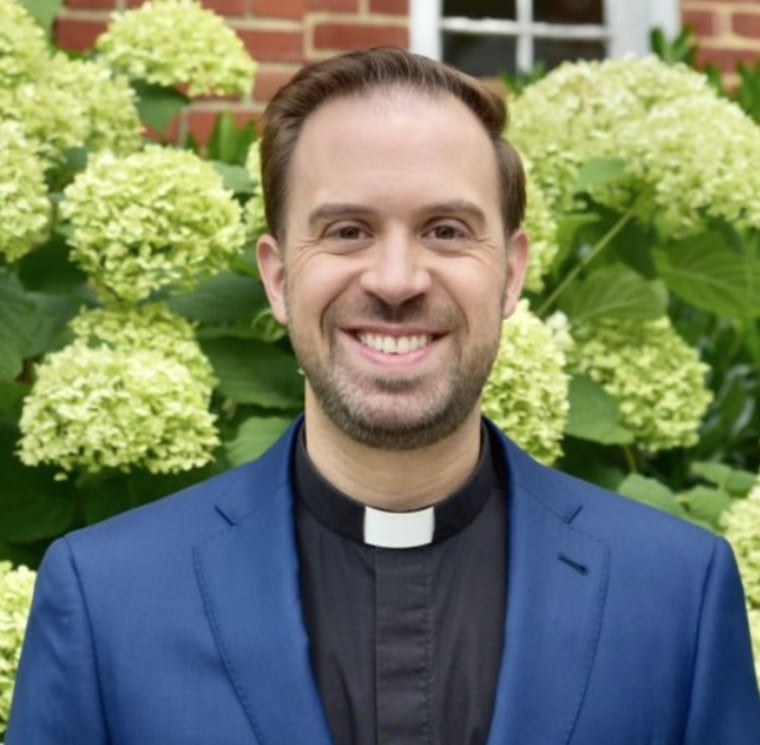
The Rev. Richard Weinberg, an Episcopalian rector in Washington, D.C., was surprised to find that his diocese didn’t have a policy for paid parental leave when he began preparing to adopt a child with his partner last year.
The church allowed three months of specifically paid maternal leave, four weeks more than D.C. law mandates. But unlike some of the district’s provisions, the church’s policy didn’t address people, including LGBTQ couples, who seek to have children through adoption, surrogacy or other means.
After he and another priest petitioned the diocese for a policy that included all methods of starting a family, the church agreed to give him 12 weeks of paid parental leave once his adoption is finalized. But it took numerous discussions with senior leadership and his congregation to figure out what would work for them, as well as for him.
“Without a policy in place or any law to fall back on, the burden was on me to fight for myself and what I thought was fair and appropriate,” Weinberg said.
The Rev. Richard Mosson Weinberg.St. Margaret’s Episcopal Church
Weinberg’s experience is common in the LGBTQ community, advocacy groups and think tanks studying the issue say. According to a 2020 study by the Census Bureau, same-sex couples are more than four times as likely as opposite-sex couples to adopt children — and more than twice as likely to foster children. But the policies vary by employer and are applied inconsistently, according to studies of the issue.
Advocates have called for more inclusive and widespread parental leave policies, and came close with a provision in President Joe Biden’s $1.7 trillion social safety net bill, which would have mandated all U.S. employers provide workers with four weeks of paid parental leave. But talks on the legislation collapsed after Sen. Joe Manchin, a moderate Democrat from West Virginia, announced in December that he wouldn’t vote for the billin part over funding for new programs,denying his Democratic colleagues the 50 votes they would need to pass the legislation under special budget rules.
LGBTQ advocates hope that polls showing broad support for paid parental leave will create momentum for legislative action. Eighty-four percent of voters — including majorities of Democrats, independents and Republicans — support a paid family leave policy, according to a 2018 study from the National Partnership for Women and Families, an advocacy group focused on the issue.
While 12 weeks of leave are available to many new parents under the Family and Medical Leave Act, that time off is unpaid under the law, making it financially unviable for lower-income people. Paid leave through employers or states is available to only about a quarter of Americans, according to Bureau of Labor Statistics data in 2021, and just a handful of states and Washington, D.C., have implemented policies themselves.
The programs that are available aren’t distributed equally, with 12 percent of private industry workers in the lowest income quartile receiving paid family leave and 37 percent of workers in the highest quartile having access, according to the Bureau of Labor Statistics.
Policies also don’t cover sexual orientations and gender identities equally. A 2018 survey by the Human Rights Campaign found fewer than half of LGBTQ respondents said their employers’ leave policies were LGBTQ-inclusive. Respondents also expressed concern about potentially outing themselves or encountering workplace discrimination when asking for leave, the survey found.
In addition, LGBTQ people face distinct financial considerations in starting families. The community is more likely to face economic hurdles like housing instability, unemployment and food insecurity, to begin with, indicating a greater need for social safety net programs, according to the progressive think tank the Center for American Progress. Then there are the additional expenses associated with various means of bringing children into the home.
“LGBTQ-plus parents often have additional needs for paid leave,” Julie Kruse, the director of federal policy at the advocacy group Family Equality, said. “Our families can be expensive to form — for people that require trans fertility services, for people using alternative reproductive technologies, even those going through the processes of fostering and adopting.”
A further issue is how paid leave policies affect employees’ perceived commitment to their job, said Richard Petts, a sociology professor at Ball State University. Taking leave can be stigmatized, causing employees to worry they’ll face a disadvantage at work if they take time off. When those policies are implemented inconsistently in the workplace, it only exacerbates the problem, he said.
Expanded access would help correct the issue and also be of special benefit to marginalized groups, Petts said.
“The U.S. actually has this really golden opportunity to take the lead in providing and showing what an equitable leave policy could look like,” Petts said. “Having a policy that says this is an individual entitlement really is equitable in the truest sense.”
The Covid pandemic, meanwhile, has only heightened financial concerns as it takes a toll on families across the country, Kruse said, adding that she hopes that could influence voters’ opinions and create momentum for a national policy.
“Knowing that we have paid time off without fear of losing our job is just a huge relief, and all families deserve to feel that, so I think there’s going to be a lot of pressure,” Kruse said. “There’s only so much more families can take.”
Support for legislation
For Rep. Angie Craig, D-Minn., the issue is personal. Craig, who co-chairs the Congressional LGBTQ+ Equality Caucus and is one of two LGBTQ parents in Congress, said the complexities that same-sex couples face in becoming parents have shown the importance of a uniform paid leave policy.
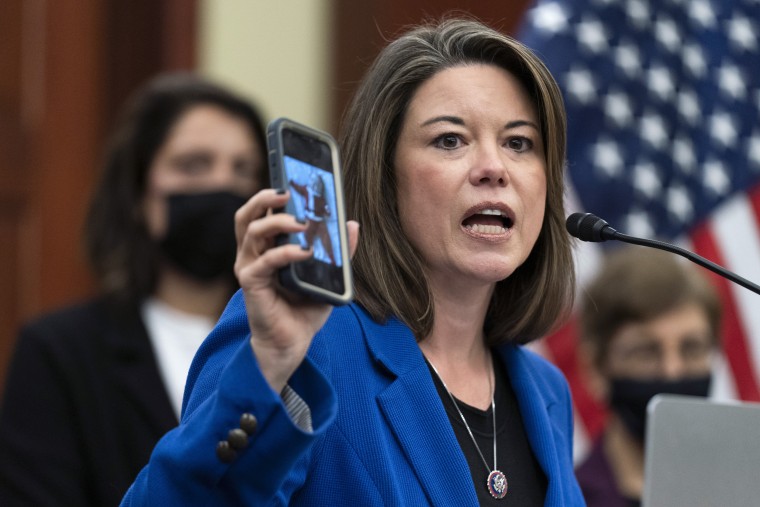
Rep. Angie Craig, D-Minn., shows a picture of her grandson Noah on her phone as she speaks at the Capitol about proposed investments in children to reduce economic disparity on Dec. 14, 2021.Manuel Balce Ceneta / AP
LGBTQ people face a wide range of barriers when starting families, Craig said. One such circumstance occurred when her wife adopted their first child — even though she was married to the primary adoptee, Craig had to file for second-parent adoption, a practice in place in many states.
Across the nation, nearly 20 states, primarily led by Republicans, have not passed protections against discrimination on the basis of gender or sexuality in adoption, according to the Movement Advancement Project, a think tank focused on promoting equal rights.
Craig said including four weeks of leave in the Build Back Better Act was a step in the right direction, although she and many other progressives had initially called for 12 weeks. She said she plans to continue to advocate for expansive paid leave legislation.
“Paid family leave makes sense for all families,” Craig said. “We shouldn’t be putting barriers in place for LGBTQ individuals who want to have families, and that’s what we’ve done in the history of the nation.”
Before negotiations on the bill stalled, Manchin opposed including 12 weeks of paid family leave, saying he preferred standalone legislation, rather than the sweeping bill, for such a significant policy change and expressing concerns about the funding of the broader package. He also expressed concern that Americans would abuse some benefits like paid leave and the child tax credit.
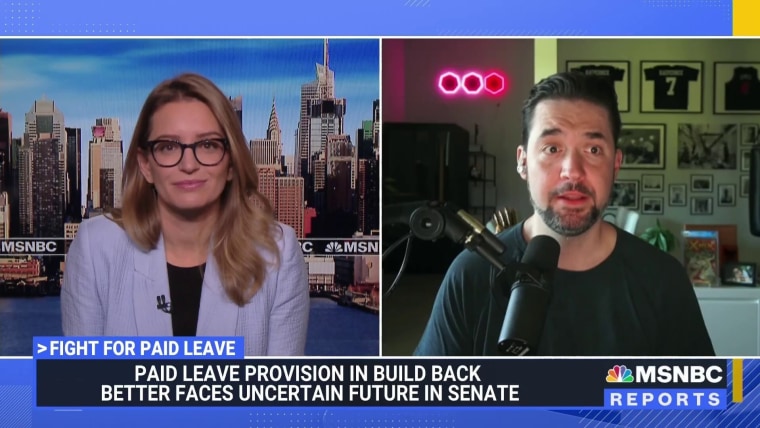
“I believe in family leave, I believe people should have that opportunity,” Manchin said on MSNBC in November. “Can’t we find a better position for this and do this in a bipartisan process that works?”
Progressive lawmakers view passage of such a provision as a necessary and historic opportunity amid favorable views on the subject, including among some businesses, after previous efforts have failed.
The U.S. Chamber of Commerce also supports paid family leave, although it opposed the social spending legislation, according to Marc Freedman, the chamber’s vice president of employment policy.
“The chamber continues to believe there is a fiscally responsible, bipartisan approach to providing a federal paid family leave benefit,” Freedman said in a statement to NBC News. “We believe that such a deal can be forged, but this partisan reconciliation bill is certainly not the vehicle to achieve a sensible solution to making sure paid family leave is available on a nationwide basis.”
Weinberg, the D.C. rector, said national legislation would prevent others from having to go through what he experienced in preparing to adopt a child.
While thankful for the changes his diocese made, he said he hopes to see a national standard. Having a child is a significant change for any family, and the opportunity to bond is essential, he said.
“To be able to continue to earn an income without having to put your life and your financial health on hold in order to have a family is just such a basic right,” Weinberg said. “So having legislation in place and employers who are seeking to happily compensate people when they’re starting their family would be a huge benefit to Americans.”
Now, Weinberg and his partner are navigating the application process for a 10-year-old boy from Colombia they hosted for five weeks last year. They hope to have the adoption finalized by summer.
The Rev. Richard Weinberg, an Episcopalian rector in Washington, D.C., was surprised to find that his diocese didn’t have a policy for paid parental leave when he began preparing to adopt a child with his partner last year.
The church allowed three months of specifically paid maternal leave, four weeks more than D.C. law mandates. But unlike some of the district’s provisions, the church’s policy didn’t address people, including LGBTQ couples, who seek to have children through adoption, surrogacy or other means.
After he and another priest petitioned the diocese for a policy that included all methods of starting a family, the church agreed to give him 12 weeks of paid parental leave once his adoption is finalized. But it took numerous discussions with senior leadership and his congregation to figure out what would work for them, as well as for him.
“Without a policy in place or any law to fall back on, the burden was on me to fight for myself and what I thought was fair and appropriate,” Weinberg said.
The Rev. Richard Mosson Weinberg.St. Margaret’s Episcopal Church
Weinberg’s experience is common in the LGBTQ community, advocacy groups and think tanks studying the issue say. According to a 2020 study by the Census Bureau, same-sex couples are more than four times as likely as opposite-sex couples to adopt children — and more than twice as likely to foster children. But the policies vary by employer and are applied inconsistently, according to studies of the issue.
Advocates have called for more inclusive and widespread parental leave policies, and came close with a provision in President Joe Biden’s $1.7 trillion social safety net bill, which would have mandated all U.S. employers provide workers with four weeks of paid parental leave. But talks on the legislation collapsed after Sen. Joe Manchin, a moderate Democrat from West Virginia, announced in December that he wouldn’t vote for the billin part over funding for new programs,denying his Democratic colleagues the 50 votes they would need to pass the legislation under special budget rules.
LGBTQ advocates hope that polls showing broad support for paid parental leave will create momentum for legislative action. Eighty-four percent of voters — including majorities of Democrats, independents and Republicans — support a paid family leave policy, according to a 2018 study from the National Partnership for Women and Families, an advocacy group focused on the issue.
While 12 weeks of leave are available to many new parents under the Family and Medical Leave Act, that time off is unpaid under the law, making it financially unviable for lower-income people. Paid leave through employers or states is available to only about a quarter of Americans, according to Bureau of Labor Statistics data in 2021, and just a handful of states and Washington, D.C., have implemented policies themselves.
The programs that are available aren’t distributed equally, with 12 percent of private industry workers in the lowest income quartile receiving paid family leave and 37 percent of workers in the highest quartile having access, according to the Bureau of Labor Statistics.
Policies also don’t cover sexual orientations and gender identities equally. A 2018 survey by the Human Rights Campaign found fewer than half of LGBTQ respondents said their employers’ leave policies were LGBTQ-inclusive. Respondents also expressed concern about potentially outing themselves or encountering workplace discrimination when asking for leave, the survey found.
In addition, LGBTQ people face distinct financial considerations in starting families. The community is more likely to face economic hurdles like housing instability, unemployment and food insecurity, to begin with, indicating a greater need for social safety net programs, according to the progressive think tank the Center for American Progress. Then there are the additional expenses associated with various means of bringing children into the home.
“LGBTQ-plus parents often have additional needs for paid leave,” Julie Kruse, the director of federal policy at the advocacy group Family Equality, said. “Our families can be expensive to form — for people that require trans fertility services, for people using alternative reproductive technologies, even those going through the processes of fostering and adopting.”
A further issue is how paid leave policies affect employees’ perceived commitment to their job, said Richard Petts, a sociology professor at Ball State University. Taking leave can be stigmatized, causing employees to worry they’ll face a disadvantage at work if they take time off. When those policies are implemented inconsistently in the workplace, it only exacerbates the problem, he said.
Expanded access would help correct the issue and also be of special benefit to marginalized groups, Petts said.
“The U.S. actually has this really golden opportunity to take the lead in providing and showing what an equitable leave policy could look like,” Petts said. “Having a policy that says this is an individual entitlement really is equitable in the truest sense.”
The Covid pandemic, meanwhile, has only heightened financial concerns as it takes a toll on families across the country, Kruse said, adding that she hopes that could influence voters’ opinions and create momentum for a national policy.
“Knowing that we have paid time off without fear of losing our job is just a huge relief, and all families deserve to feel that, so I think there’s going to be a lot of pressure,” Kruse said. “There’s only so much more families can take.”
Support for legislation
For Rep. Angie Craig, D-Minn., the issue is personal. Craig, who co-chairs the Congressional LGBTQ+ Equality Caucus and is one of two LGBTQ parents in Congress, said the complexities that same-sex couples face in becoming parents have shown the importance of a uniform paid leave policy.
Rep. Angie Craig, D-Minn., shows a picture of her grandson Noah on her phone as she speaks at the Capitol about proposed investments in children to reduce economic disparity on Dec. 14, 2021.Manuel Balce Ceneta / AP
LGBTQ people face a wide range of barriers when starting families, Craig said. One such circumstance occurred when her wife adopted their first child — even though she was married to the primary adoptee, Craig had to file for second-parent adoption, a practice in place in many states.
Across the nation, nearly 20 states, primarily led by Republicans, have not passed protections against discrimination on the basis of gender or sexuality in adoption, according to the Movement Advancement Project, a think tank focused on promoting equal rights.
Craig said including four weeks of leave in the Build Back Better Act was a step in the right direction, although she and many other progressives had initially called for 12 weeks. She said she plans to continue to advocate for expansive paid leave legislation.
“Paid family leave makes sense for all families,” Craig said. “We shouldn’t be putting barriers in place for LGBTQ individuals who want to have families, and that’s what we’ve done in the history of the nation.”
Before negotiations on the bill stalled, Manchin opposed including 12 weeks of paid family leave, saying he preferred standalone legislation, rather than the sweeping bill, for such a significant policy change and expressing concerns about the funding of the broader package. He also expressed concern that Americans would abuse some benefits like paid leave and the child tax credit.
“I believe in family leave, I believe people should have that opportunity,” Manchin said on MSNBC in November. “Can’t we find a better position for this and do this in a bipartisan process that works?”
Progressive lawmakers view passage of such a provision as a necessary and historic opportunity amid favorable views on the subject, including among some businesses, after previous efforts have failed.
The U.S. Chamber of Commerce also supports paid family leave, although it opposed the social spending legislation, according to Marc Freedman, the chamber’s vice president of employment policy.
“The chamber continues to believe there is a fiscally responsible, bipartisan approach to providing a federal paid family leave benefit,” Freedman said in a statement to NBC News. “We believe that such a deal can be forged, but this partisan reconciliation bill is certainly not the vehicle to achieve a sensible solution to making sure paid family leave is available on a nationwide basis.”
Weinberg, the D.C. rector, said national legislation would prevent others from having to go through what he experienced in preparing to adopt a child.
While thankful for the changes his diocese made, he said he hopes to see a national standard. Having a child is a significant change for any family, and the opportunity to bond is essential, he said.
“To be able to continue to earn an income without having to put your life and your financial health on hold in order to have a family is just such a basic right,” Weinberg said. “So having legislation in place and employers who are seeking to happily compensate people when they’re starting their family would be a huge benefit to Americans.”
Now, Weinberg and his partner are navigating the application process for a 10-year-old boy from Colombia they hosted for five weeks last year. They hope to have the adoption finalized by summer.
Argentina, a traditionally conservative country, has emerged in the last two decades as a Queer Rights powerhouse. Since the early 2000s this country has legalized egalitarian marriage and introduced non-binary IDs, state-paid gender-affirming surgeries and IVF treatments. So how did this transformation come about in such a short time, you might ask? Join the first ever Argentine Queer History Tour and find out!
Lunfarda Travel, a boutique incoming agency based in Buenos Aires, launched the first – and so far only! – tour about the history of the Argentine LGBTQIA+ community, from pre-colonial times into the massive Pride demonstrations of 2021.
The tour was created by the founder of the agency, Mariana Radisic Koliren who said: “it feels like all LGBT+ tour products in Argentina are way too focused on the G. What about all the lesbians, trans people and non-binary activists? Our Queer history is so rich, fascinating and intersectional. It’s a story of resilience and pride and it has literally transformed our lives: it needs to be out there to inspire people around the world”
The tour starts at Plaza de Mayo, the foundational block of the city, where a member of the local community explains how different indigenous peoples understood gender and sexual orientation, and how all of that was erased to favor cis-heteronormativity after the Spanish Conquista. That same square would eventually become the gathering spot for Pride demonstrations, attended by hundreds of thousands.
Throughout the tour, you’ll explore the periods, landmarks, characters and events that forged Argentina’s current reality. Enjoy unique points of view, like the role of Evita Peron in the acceptance of Queerness, visit the first subway station to commemorate a Gay Rights activist and get the chills at the National Congress, the place where our community cemented our rights for future generations. In this tour, you’ll also get to visit a community center to have drinks, make new friends and check out some of the cool artwork and culture led by local porteñes.
This tour is about helping create a better future for our community, too. Despite all our strides, there are still lots of people who struggle to have long and fulfilling lives, which is why 10% of the profits of this tour are donated to Mocha Celis, a high school that caters specifically to trans and gender non-conforming students (you can donate to them here, which is always immensely appreciated!).
Thanks to generations of gritty, perseverant activism, our Queer community is increasingly thriving. This tour is a way of acknowledging and recognizing all the people who were trailblazers, and a way of showing all that’s yet to come for our community as this new generation takes up the baton.
Lunfarda Travel specializes in shedding light on the previously untold stories of Buenos Aires through an intersectional scope. The boutique incoming agency is proudly made of over 75% of women, POC and members of the LGBTIAQ+ community, and has a commitment to fair trade wages and environment preservation. Join Lunfarda Travel for the only tours in the city of Black History or on its Jewish Heritage Walks, Graffiti and Foodie Outings and family friendly tours. The agency also organizes tailor made itineraries across Argentina, and actively welcomes all human beings
The Church of England has launched an investigation after a gay man claimed he was subjected to a conversion therapy exorcism in a Sheffield church.
Matthew Drapper, 34, says he was “born into a Christian cult [and] was raised believing Satan is at war with Christians and God is at war with the gays”.
He told the Huddersfield Examinerthat he moved to Sheffield from Buxton in 2013, at the age of 25, and joined the Church of England church St Thomas Philadelphia.
Drapper said by that point he had come out as gay, but that he had vowed to remain celibate. In 2014, he claims, the church offered him a chance to “pray that away”.
“I had thought about whether it is even worth living if I’m going to be gay,” he said,
“So, it kind of was a last resort really. By that point, I was like, ‘Well, I’ll try anything.’”
St Thomas Philadelphia has a “belief in the supernatural” and “taught a lot of stuff to do with demons”, Drapper said.
He was invited to a prayer day to “go through our deepest fears”, but this soon became an “exorcism”, he alleged.
Drapper continued: “They told me to speak against the sort of demonic hold that being gay had in my life.
“I was told to renounce the belief system of homosexuality and to cancel my agreement with Satan and to break the power of homosexuality in my life through the blood of Jesus… They told me they could see demons leave my body and go out the window. It was terrifying.”
It took Drapper months to recognise that “something really bad had happened in that space”, and he eventually began accepting his identity.
He was a volunteer at St Thomas Philadelphia at the time, but when he told leaders that he was planning to start dating, he says they said he “wasn’t allowed to work with young adults or children, because I might influence them to become gay”.
The church has denied all of Drapper’s allegations, but finally, eight years on, the Diocese of Sheffield is launching an investigation.
The Diocese of Sheffield said in a statement to the BBC that it believes “conversion therapy is unethical, potentially harmful and has no place in the modern world”, and added that it would keep Drapper informed at all stages of its investigation.
Drapper said: “If conversion therapy had been illegal at the time, then hopefully people would have known enough to intervene and I wouldn’t have gone through that trauma and had eight years of recovering from it.”
St Thomas Philadelphia said in a statement: “St Thomas Philadelphia is a caring and generous church community which does not engage in conversion therapy.
“We welcome the independent investigation initiated by the diocese into these allegations of eight years ago and will participate in it.”
The church has a bizarre and dark history, having been opened in 1998 when it was “planted out” of a huge evangelical church St Thomas Crookes.
According to St Thomas Philadelphia’s website, this planting out was “in response to significant growth and also to a sense of call to the whole city”.
But St Thomas Crookes is also known for being the birthplace of Nine O’Clock Service, often described as a “cult” within the Church of England.
Nine O’Clock Service was an alternative Christian group launched in 1986, which focused on recruiting young people through rock concert-style services featuring lasers in the basement of Sheffield’s Ponds Forge complex.
The group was shut down by the Church of England in 1995 after the group’s leader, Chris Brain, admitted to having sexual contact with more than 20 young female members of Nine O’Clock Service.
A documentary was released chronicling the scandal, and shortly before its release, Brain admitted himself to a psychiatric hospital.
I write this column as a Democrat. One who’s afraid our democracy is at risk and believing the Republicans in Congress are taking us to the abyss and leading a retreat on all the progress we have made in the areas of civil and human rights over the last 50 years.
There are three choices American voters have in the 2022 mid-term elections. The first option is to work hard to elect Democrats up and down the ballot. The second is to vote for Republicans, and the third is to stay home. If you believe LGBTQ rights, women’s rights, civil rights, DACA, and voting rights are crucial issues to move forward, then choosing anything but the first option is like the old cliché about ‘cutting off your nose to spite your face.’
We are seeing a spate of attacks on the president from various interest groups saying “he didn’t do enough or speak out enough on my issues.” In the LGBTQ community it’s the cover of last week’s Washington Blade and James Finn’s column ‘Biden’s empty political theater on LGBTQ equality.’ He gives short shrift to all Biden has done through Executive Orders, regulation and the hiring of countless members of the LGBTQ community, all of which the Human Rights Campaign recently highlighted in praise of the president.
Among the actions HRC mentions are: within the first week in office an executive order repealing the Trump-era ban on transgender military service; having the Department of Housing and Urban development withdraw a Trump-era proposal to gut the equal access rule; having the State Department make changes to passport gender markers to include intersex and non-binary people; have the administration form an interagency working group to focus on the safety, inclusion, and opportunities for transgender persons; appoint as Transportation Secretary Pete Buttigieg who became the first Senate-confirmed gay member of a president’s Cabinet and had Dr. Rachel Levine, a transgender woman, confirmed by the Senate as Assistant Secretary for Health at HHS and then seeing her promoted to four-star admiral.
In his column, Finn counters his own claim Biden speaking out more could have seen the Equality Act pass when he admits without a change in the Senate filibuster rule it won’t. He agrees Biden doesn’t control either Sen. Joe Manchin (D-W.Va.) or Kyrsten Sinema (D-Ariz.) who along with every Republican won’t vote to change it.
Then Finn tries to speak for the LGBTQ community and threatens, “We won’t vote for Biden again.” First, Joe Biden’s name is not on the ballot in 2022. Yes, he will have a clear impact on the elections and understands that. During his recent press conference he said he would be “on the road” talking about the positive things he and the Democratic Congress have accomplished and why voting for Democrats is so important to all he still wants to accomplish. It is my fervent hope Finn and others like him in various communities understand instead of attacking Biden at this time they should be out in the community at a minimum explaining to Democrats and independent voters who support more progressive issues, including all those who understand how important it is to act now on climate change, “if you want to get anything on your issue done in the next two years of the Biden/Harris administration, you must get out and vote for Democrats up and down the ballot.”
It is important to recognize how we must view the Biden administration and this president. Since the day he was inaugurated, the country has been in the midst of a pandemic. So yes, the president was forced to spend an incredible amount of his time dealing with and speaking about COVID. He was right to do so as millions of our fellow citizens were, and still are, getting sick and dying. While he was doing this, President Biden moved Congress to pass legislation totaling over $3.1 trillion to help the American people. This included both the American Rescue Plan, which Democrats passed using reconciliation, and the infrastructure bill, which got passed with bipartisan support in the Senate.
The American Rescue Plan’s goal was to give the American economy a boost, which it did. It included more than $569.5 billion in direct Economic Impact Payments for Americans in need. It also had $350 billion earmarked for emergency funding for state, local, territorial, and tribal governments to address the COVID-19 pandemic. The infrastructure bill “included among other things $312 billion for roads, bridges, public transit, airports, ports, waterways and other transportation-related needs and $266 billion for items including improvements to the power grid and developing broadband internet access for most Americans.”
In his recent press conference, Biden agreed that without a change in the filibuster rule some of his proposals will not be passed. He said he will continue to fight aggressively for all of them but at the same time will work with Congress to try to get some of his Build Back Better bill passed in smaller chunks. Even that won’t be easy. But he committed to continue to fight for what he believes in and what he ran on. Let us give him credit for an amazing first year, better than any president since Franklin Roosevelt.
Let’s focus on keeping the House of Representatives in Democratic hands and adding to Democratic numbers in the Senate. That will give Senate Majority Leader Chuck Schumer (D-N.Y.) a better chance of passing legislation Biden supports.
It is time to stop the attacks on President Biden and Democrats for not doing enough and changing tactics to focus on attacking Republicans who are doing nothing and worse are committed to taking us backwards on a host of issues including Roe v. Wade, voting rights, civil rights and LGBTQ rights. Let those of us committed to progress be unified in attacking Republicans instead of forming a circular firing squad attacking Democrats, and participating in our own defeat.
Peter Rosenstein is a longtime LGBTQ rights and Democratic Party activist. He writes regularly for the Blade.
Possibly because the notion of Critical Race Theory is so vague to most conservative voters, when Republican Glenn Youngkin, then-candidate for Virginia governor, ran for office, he labeled himself as the “parents’ rights candidate” by attempting further to instill fear on the part of the white electorate.
He raised his racist bullhorn by declaring not only his intent to ban Critical Race Theory the day he is elected but also to outlaw the reading of the critically acclaimed and award-winning novel by author Toni Morrison, Beloved, which was turned into a major feature film.
Beloved, a truthful and painful story of the lives and loves of two enslaved black people in the U.S. South, has become an integral part of the cannon of not only African American literature but of U.S.-American literature generally.
After winning the Virginia gubernatorial election and with the support of the Virginia state legislature, new bills to limit the teaching of our country’s true past have circulated throughout the Virginia statehouse.
House bill No. 781, proposed by Republican Delegate Wren Williams, prohibits “divisive concepts” from instruction in Virginia public elementary and secondary schools. While Williams made clear his opposition to the teaching of Critical Race Theory, the wording “divisive concepts” in its vagueness closes the door on the teaching of anything and everything conservatives deem appropriate and necessary to ban.
In the wording of the bill, Virginia’s social studies curriculum will be standardized (a.k.a. controlled and regimented) and educators will teach about, “founding documents of the United States,” like “the Declaration of Independence, the United States Constitution, the Federalist Papers, including Essays 10 and 51, excerpts from Alexis de Tocqueville’s Democracy in America, the first debate between Abraham Lincoln and Frederick Douglass, and the writings of the Founding Fathers of the United States.”
Even Virginia’s elementary and secondary school students, I would hope, know so much more than the legislators attempting to enact severe constraints on curriculum and pedagogy throughout their systems of “education.”
By the 5th grade, students should have learned about the “Lincoln-Douglas” debates of 1858 in Illinois between incumbent Democratic Senator Stephen A. Douglas and Lincoln, his Republican challenger in the race for U.S. senator. The major topic during the series of seven debates included the candidates’ views on whether new states joining the union would permit or prohibit slavery within their borders.
In Youngkin’s inauguration speech on Saturday, January 15, 2022, he seemed to talk from both sides of his mouth when he promised, “We will remove politics from the classroom and re-focus on essential math, science and reading. And we will teach all of our history the good and the bad.”
Then within an hour following his speech, he immediately signed 11 executive orders including lifting the mask mandate for Virginia schools and ending the vaccine mandate for state employees in a school system and state with increasingly rising infection rates.
Wanting to be known as “The Education Governor,” one of his executive orders ends the use of “divisive concepts” in schools such as Critical Race Theory, which is not currently part of the curriculum.
One day later in an interview on Fox, Youngkin doubled down on his misunderstanding, the perpetuation of misinformation, and yes, the politicization of the teaching of the legacy of racism and race relations in the United States.
“We are not going to teach the children to view everything through a lens of race. Yes, we will teach all history, the good and the bad. Because we can’t know where we’re going unless we know where we have come from. But to actually teach our children that one group is advantaged and the other disadvantaged because of the color of skin, cuts everything we know to be true.”
So, whom does Youngkin designate as “we” in “everything we know to be true”?
The Virginia governor and state legislature pose a great and common example clearly demonstrating why politicians cannot and must not dictate the parameters of what educators teach in the schools throughout the nation.
Professor and Executive Director of the Human Rights Center at the University of Dayton, Shelley Inglis, studies authoritarian leaders around the world and came up with a list of ten common markers characteristic to many.
One maker states that authoritarians appeal to populism and nationalism. While “populism” encompasses a range of political stances emphasizing the idea of siding with “the people” against the so-called “elite” and can exist on the political left, the right, or the center, right-wing populism co-opts the term and juxtaposes nationalist and nativist aims. This form of populism we have clearly witnessed during this era of Trumpism.
Another of Inglis’ markers of authoritarianism is the control of information at home (propaganda and stifling of truth in schools, the media, and the larger society) and misinformation abroad.
Though Youngkin is but a petty autocrat in one state, his influence has become immense since winning the Virginia statehouse. The larger Republican Party is taking several pages from his political playbook by first, straddling the line between embracing Trumps’ brand of populism while keeping a certain distance from the twice impeached failed president.
Secondly, they have implemented Youngkin’s successful tactic of scaring parents and other community members with the false flag of “Critical Race Theory” by banning age-appropriate truthful education of young people to the realities of our history.
While Youngkin promised to allow the teaching of our history, “the good and the bad,” the schools will continue to teach a watered-down whitewashed version of what students need to know to help our country come to terms with and begin to heal from the violations to human and civil rights of the past.
Before Youngkin won his election and continuing to the present day, since January 2021, Education Week has found that 32 states have either introduced bills in their legislatures or have taken other actions that would ban the teaching of Critical Race Theory or restrict how educators discuss racism, sexism, and LGBTQ issues in the classroom. Thirteen states have already inflicted these restrictions.
Just think about it: States are passing laws and enacting executive orders banning the teaching of how the states passed laws banning the teaching of enslaved peoples under the apartheid system of U.S.-American slavery.
They are passing laws and enacting executive orders banning the teaching of how the states passed laws banning voting rights of people of color.
These very laws and executive order banning the teaching of the true legacy of race confirms one of the primary characteristics of Critical Race Theory: that racism is a permanent feature of the U.S. political and social system.
These laws challenge any reality, any truth that contradicts the pablum we are fed as young people of the nationalist narrative that this country functions as a meritocracy: that the individual succeeds or fails based chiefly on their merit, from their motivation, abilities, values, ambition, commitment, and persistence, rather than on their backgrounds or social identities.
Autocrats have a vested stake in withholding the true accounting of our past.
It seems that each new day brings a fresh debate around speech and the weight of impact that speech holds. Back in October hundreds of Netflix employees staged a walkout protesting their company’s controversial Dave Chappelle stand-up special. At issue were a number of jokes aimed at the transgender community. The protest happened in response to Netflix CEO Ted Sarandos’ defense of the special, saying that “content doesn’t directly translate to real-world harm.” This statement could not be further from the truth. Not only do words carry impact and directly translate to real-world harm, words form our conception of the world and oftentimes what is seen as truth. The language we use and condone shapes how everything around us is perceived, which is why there is great responsibility in considering the words we use before we put them out into the world.
We think about this every day at Reading Partners, an organization that places community volunteers in Title I elementary schools to support students in mastering reading skills. Because many of our volunteers do not share racial identity or a similar lived experience of the students we partner with, it is incredibly important to us that they understand that their role is to empower students who need a little extra support rather than coming to “help” or “save” them. The white-savior narrative has historically run rampant in spaces looking to mobilize volunteers for a cause and it is our responsibility to dismantle this narrative. This dismantling starts with the language we use and the stories we share about the communities we have the great privilege to partner with. Given that structural racism and oppression have created the current conditions facing under-resourced students, it is incumbent upon us that we recognize our role within the community and understand that we are here to act as a partner with students and their families whom have already created plans to address gaps in learning.
Because of the impact words yield, it is essential to carefully consider language choice, especially if it could affect marginalized and oppressed groups. Even those who have good intent, like journalists and public figures, often use outdated language and phrases that stigmatize communities or frame them through an othering lens. Some common examples of misguided language often used include phrases like “low-income students,” and “learning loss.” Both of these phrases place responsibility on students for the situation they are in despite the fact that students do not receive income, or have intentionally chosen to miss out on learning opportunities particularly with the disruptions that COVID-19 created. This type of framing has a direct corollary on how these students might be treated by teachers, administrators, and tutors, as well as how they are viewed by leaders, politicians and other people who hold power. It is therefore important that we use terms that accurately describe the situation, which may need to include political or historical context—so instead of “low-income students” we say, “historically under-resourced communities,” while a more accurate substitute for “learning loss” is actually “unfinished learning.” While these are subtle shifts in language, it completely reframes the situation, elucidating who shares responsibility for the current state of things and who does not.
It is also of note that the positive or negative connotations inherent in the language we use are hugely important to how we see those who may have different lived experiences than our own. At Reading Partners, we know that our students are not in fact “struggling” or “suffering from a lack of” something. We highlight our students as they are: “working hard,” “enduring,” “skill builders,” etc. despite growing up in a world where they have been denied access to high-quality literacy education.
It is a fallacy that words cannot do harm. Language has served to dehumanize and subjugate people for as long as it has existed and it is often those in power who have the loudest voice. We as people, institutions, corporations, media, and otherwise must think through what we say and how it might impact others. Let’s be clear—this is not about censorship or ‘cancelling’ anyone. Language changes all of the time and it can be hard to keep up with. We are simply making the appeal that those in power, and with platforms, continue learning from and listening to those who have been harmed for centuries by systemic injustice. Free speech is a privilege, and with that privilege, there is incredible responsibility to utilize language that truly aligns with and demonstrates the user’s values.
Shukurat Adamoh-Faniyan is executive director of Reading Partners DC, a nonprofit that for more than 20 years has helped empower local students to succeed in reading and in life by engaging community volunteers to provide one-on-one tutoring. If you’re interested in learning more and becoming a volunteer visit readingpartners.org/volunteer-washington-dc.
Two local organizations are partnering to distribute free copies of controversial books in response to the recent increase in attempts to remove titles from school libraries.
In Purpose Educational Services and the St. Louis bookstore EyeSeeMe will deliver free copies of “The Bluest Eye” by Toni Morisson to Missourians who request it.
The organizations raised more than $3,000 in the first few hours after launching the book program, said Heather Fleming, founder of In Purpose Educational Services.
“If you look at most of the books that they are trying to ban, they are the stories of people from historically marginalized groups,” said Fleming. “We have to grapple with some of the things that have happened in our society. Number one, to make sure that they don’t happen again. But then number two, because we need to learn how to live with one another.”
Toni Morrison’s “The Bluest Eye” is photographed in this photo illustration last November at Left Bank Books in St. Louis’ Central West End neighborhood.
A St. Louis Public Radio analysis of the books being challenged in the area in November found two-thirds were written by authors of color or authors who identify as LGBTQ. “The Bluest Eye,” was the book with the most official requests for removal from libraries. It was the first book by Toni Morrison, who would go on to win a Nobel Prize in Literature and a Pulitzer Prize.
The Wentzville School Board voted 4-3 at its Jan. 20 meeting to remove the book from school libraries. That’s after a committee voted to recommend keeping the book, writing, “committee members believe that removing the work would infringe on the rights of parents and students to decide for themselves if they want to read this work of literature.”
A committee in the Francis Howell School District voted to retain the book this month and a review of “The Bluest Eye” is still underway in the Lindbergh School District.
The organizations that are planning the “banned book program” have a form for people to fill out if they are interested in receiving free copies of the book. The books will be distributed to people in Missouri and the groups plan to pick a new book each month, Fleming said.
These conversations and these types of book bans, they’re placing our students at a disadvantage,” Fleming said. “Whether people want to admit it or not, we are becoming an increasingly diverse society … students who are not culturally competent are not going to meet with as much success.”
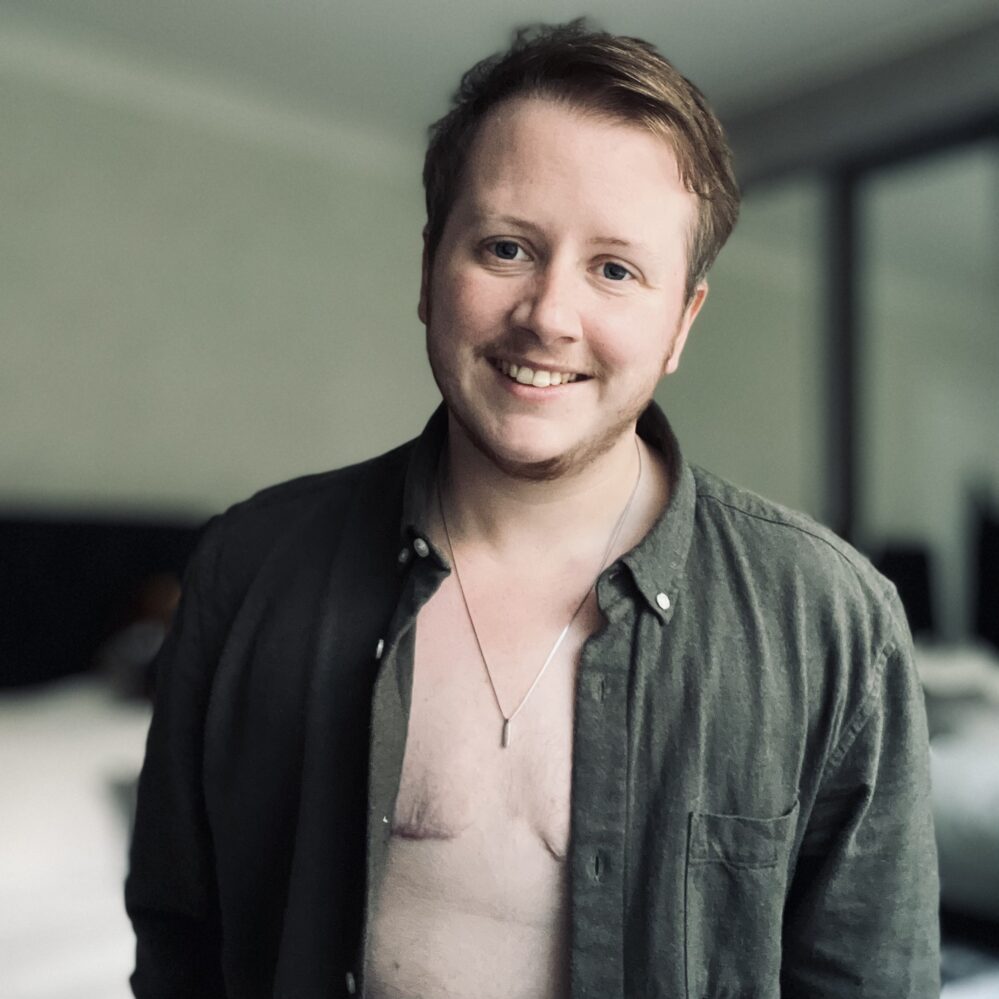
While having surgery is not a requirement of being transgender and not everyone medically transitions (perhaps out of choice, due to financial situations, or other reasons), undergoing surgical procedures can be a big step in some trans folks’ transitions.
After surgery comes a healing process, and not just the physical kind, as trans people start a new chapter in their lives with new mental and emotional challenges. However, for some, accepting their scars from surgery is a major aspect of accepting who they are as a person.
Let’s meet three trans people who found power in learning to love their scars.
Lara Provided
Lara
Lara realized she did not identify as masculine when she was a toddler, however, they were forced by family members and religious pressures to hide their identity until they turned 30.
While coming out is still an ongoing process for Lara with other relatives and friends, she decided to have bottom surgery to affirm her feminine identity.
“I refused to get any surgeries until I came to terms with who I am and the body I was born with. I didn’t want to undergo surgery than still have the same issues with myself on the inside as before, since surgery only solves some of the challenges of being trans. The real challenge is loving and accepting who you are on the inside,” they say.
Lara shares that the biggest benefit from her surgery is that she can’t produce testosterone anymore.
“I had to come to terms with the fact that I would depend on injecting hormones for the rest of my life rather than feel the way I did with the wrong, naturally occurring, chemicals in my body. I had to accept that there was nothing wrong with me. There was something wrong with the way my body produced chemicals.”
Following on from their surgery, Lara says their scars have healed largely, but she can still feel them.
She says they are a constant reminder that she was able to become their whole, true self.
“The decision to have surgery changed my entire life. I’m reminded of that decision every time I trace my fingers over my scars, and it makes me feel validated. It allows me to move through my days with more clarity and purpose.”
When asked their advice for other trans folk learning to accept their bodies post-surgery, Lara wants everyone to know that self-love is the key.
“Scars from gender-affirming surgeries are a mark of self love. Let your scars be a permanent reminder to love yourself and your identity.”
Faye
Faye
Faye also had an emotional experience when she saw her scars for the first time after surgery.
“The first time I looked down and saw my scars after surgery, I thought they were so beautiful that I cried. I felt proud and sexy because they symbolized the fact that I took charge of a bad situation and did everything I could to ensure that I would live a long, healthy life. They prove I’m a warrior.”
She feels like she saved her own life by choosing to transition and live as her authentic self, and Faye wants the world to accept trans scars and how they mark a chapter in someone’s life.
“We need to show our real skin so others can see what that looks like. We need to show our scars because they are simply part of being human, and mine just add to the tapestry of my life,” Faye says.
She continues to assure others that, while others may see your scars and judge you, how you feel inside is what matters most.
“Only you know what you’ve been through and how much stronger you’re becoming because of it. If you want to talk about your scars and your journey, that’s fine. You are allowed to show them off.”
However, Faye also highlights how surgery isn’t just one thing, since representations of trans people in the media tend to focus on the surgical aspects of transitioning, especially bottom surgery.
“Surgery can be incredibly affirming for people like me who wish to have it. But, it’s important to remember that hormonal transitions are also valid medical options and can produce results that alleviate dysphoria.
“But, ultimately, having or not having surgery doesn’t make anyone’s experience more or less valid. Surgery simply changes the body in which you experience your gender, not your gender itself. So, to any other trans people, I remind you that your gender is valid, regardless of whether you want to have surgery.”
Ethan
Ethan
Finally, we meet Ethan, who came out as transgender in the summer of 2016. He first recognized that he was trans in his teenage years, but coming out was a journey, especially to his parents.
“Admittedly, it took both of my parents quite some time to adjust, to move through their own phases of processing and understanding, and eventually settling in a place of support and acceptance. With that, of course, came many a time of still using my birth name, or female pronouns which was impossibly hard to cope with. But, I knew they needed time and space to let the new reality become familiar territory,” he shares.
Fortunately, his family unit is now stronger than ever and he has fiercely supportive friends who are quick to correct others and advocate on Ethan’s behalf when he isn’t present.
“I had top surgery in 2019, but that in itself is quite a broad and all-encompassing term for any of the chest masculinizing surgeries transmasculine folks undergo. I had a double incision, bilateral mastectomy, with free nipple grafts.”
Ethan says his initial focus of importance when he came out was to start testosterone and effectively go through a second puberty. He wanted the world to see him the way he was on the inside.
However, once that started to kick in and the discomfort began to lessen around his image, he felt overwhelming dysphoria around his chest. Therefore, chest surgery and no longer needing to wear a binder to compress the tissue and give a flatter appearance in clothes was really important for Ethan.
He says having surgery solidified the comfort he had found in his identity, and he felt immediate relief post-op that he struggles to describe with words.
Following surgery, Ethan has been on a journey with his scars, since he initially experienced pain and frustration that his body wasn’t healing quickly as his incisions popped open.
“This means now that parts of my scars are thicker and more raised than perhaps they would have been. For at least a year or more that really got me down. I desperately wanted my scars to heal and fade to be barely noticeable so that they didn’t ‘out’ me. However, chest surgery has been a wholly liberating and genuinely life-changing process,” he shares.
Ethan does admit that surgery isn’t a “fix,” and there are still aspects of his body where he doesn’t feel comfortable, but he has developed a happy relationship with his scars.
“There are days where they itch and are tight, and that’s frustrating. But, there is comfort in sitting massaging them with creams to help with the long term fading and settling that scar tissue does over many years. I never once have felt ashamed of my scars.”
He says scars tell a story, and his are a story of strength and ownership as he began living as himself.
“Scars come in many colors, shapes, sizes, and body locations, and that’s something to celebrate.”