“Marriott International has long been a champion for diversity, equity, and inclusion, and our commitment to the cause is stronger than ever…we believe in a warm welcome for all.” Brian King, President, the Caribbean and Latin America region.
LA PRIDE DISCOUNT RATEUnleash your inner celebrity at this historic West Hollywood Hotel. 20% off Best Available Rate! Use Special Offer Code: ZPRIDE Photo Credit: Toni Reed
Celebrate with PRIDE now through October 31, 2021 Accommodations for 2 adultsComplimentary room upgrade upon availabilitySelf-parking for one vehicle per nightWelcome Amenity upon arrival2pm check out Book your escape using code 4LG
Copenhagen is one of the world’s most gay-friendly cities on the planet with its colorful buildings and welcoming lifestyle! WorldPride 2021 is August 12 – 22 and will celebrate equality, arts, and human rights proudly hosted by Copenhagen Pride in collaboration with Malmö Pride. COVID protocols mean the Opening Ceremony will be live-streamed, setting the stage for the next 10 days of spectacular events.
Steel House Copenhagen embodies “industrial chic” combined with a warm and welcoming staff who create a positive vibe around the house. You’ll settle right into this hip, luxury hostel.Manon les Suites manifests a tropical vibe smack in the middle of Copenhagen. You’ll experience bohemian luxury in a festive atmosphere at this sustainable and 5-star hot spot!
Bryggen Guldsmeden is Denmark’s most accomplished sustainable hotel. Its name comes from the Islands Brygge. “Bryggen” is a waterfront neighborhood best known for “Havneparken,” and within walking distance to Tivoli & the Central Station.Axel Guldsmeden is a lovely, eco-friendly hotel located in a turn-of-the-century building in the center of Copenhagen. Their garden, lush with plants and flowers, has an outdoor fireplace & fleece blankets to wrap around yourself. Ahhhh.
Check for calendar updates not just during Pride Month but throughout the full year! Events and schedules are subject to change. Photo Credit: Toni Reed
The Vatican has taken a highly unusual step against its neighbor, sending a diplomatic note to the Italian government that protests a draft law aimed at preventing hate and violence against LGBT people.
The complaint marks a formal effort by the Vatican to influence Italian lawmaking and could provide a test for how forcefully the church can exercise its clout on culture war issues — not just as a religion but as a state.
While it’s common for church figures to take stances on affairs in other countries — whether on same-sex marriage, LGBT rights or abortion — in this case the Vatican is invoking its prerogatives as a nation, arguing that the law, if passed, would violate the “concordat” that provides the framework for its relationship with Italy.
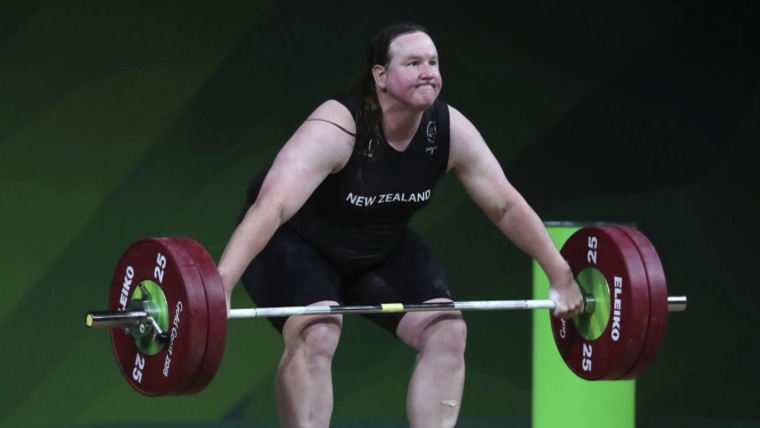
Weightlifter Laurel Hubbard will become the first transgender athlete to compete at the Olympics after being selected by New Zealand for the women’s event at the Tokyo Games, a decision set to fuel the debate over inclusion and fairness in sport.
The 43-year-old, who will be the oldest lifter at the Games, had competed in men’s weightlifting competitions before transitioning in 2013.
“I am grateful and humbled by the kindness and support that has been given to me by so many New Zealanders,” Hubbard said in a statement issued by the New Zealand Olympic Committee (NZOC) on Monday.
Hubbard has been eligible to compete at Olympics since 2015, when the International Olympic Committee (IOC) issued guidelines allowing any transgender athlete to compete as a woman provided their testosterone levels are below 10 nanomoles per litre for at least 12 months before their first competition.
Some scientists have said the guidelines do little to mitigate the biological advantages of those who have gone through male puberty, including bone and muscle density.
Advocates for transgender inclusion argue the process of transition decreases that advantage considerably and that physical differences between athletes mean there is never a truly level playing field.
NZOC CEO Kereyn Smith said Hubbard met IOC and the International Weightlifting Federation’s selection criteria.
“We acknowledge that gender identity in sport is a highly sensitive and complex issue requiring a balance between human rights and fairness on the field of play,” Smith said.
“As the New Zealand Team, we have a strong culture of …. inclusion and respect for all.”
The New Zealand government offered its support.
“Laurel is a member of New Zealand’s Olympic team. We are proud of her as we are of all our athletes, and will be supporting her all the way,” Minister for Sport and Recreation Grant Robertson said in a statement.
Center of debate
Weightlifting has been at the centre of the debate over the fairness of transgender athletes competing against women, and Hubbard’s presence in Tokyo could prove divisive.
Save Women’s Sport Australasia, an advocacy group for women athletes, criticized Hubbard’s selection.
“It is flawed policy from the IOC that has allowed the selection of a 43-year-old biological male who identifies as a woman to compete in the female category,” the group said in a statement.
Hubbard’s gold medal wins at the 2019 Pacific Games in Samoa, where she topped the podium ahead of Samoa’s Commonwealth Games champion Feagaiga Stowers, triggered outrage in the host nation.
Samoa’s weightlifting boss said Hubbard’s selection for Tokyo would be like letting athletes “dope” and feared it could cost the small Pacific nation a medal.
Belgian weightlifter Anna Vanbellinghen said last month allowing Hubbard to compete at Tokyo was unfair for women and “like a bad joke”.
Australia’s weightlifting federation sought to block Hubbard from competing at the 2018 Commonwealth Games on the Gold Coast but organizers rejected the move.
Hubbard was forced to withdraw after injuring herself during competition, and thought her career was over.
“When I broke my arm at the Commonwealth Games three years ago, I was advised that my sporting career had likely reached its end,” said Hubbard on Monday, thanking New Zealanders.
“But your support, your encouragement, and your aroha (love) carried me through the darkness.”
Olympic Weightlifting New Zealand President Richie Patterson said Hubbard had “grit and perseverance” to return from injury and rebuild her confidence.
“We look forward to supporting her in her final preparations towards Tokyo,” he said.
Another transgender athlete, BMX rider Chelsea Wolfe, will travel to Tokyo as part of the United States team, but is named as an alternate and not assured of competing.
Canadian women’s soccer player Quinn, who came out as transgender last year and uses only one name, also has a chance to be selected for the Olympics, five years after winning bronze with the women’s team at the 2016 Rio Games.
The Stonewall Inn’s owners say they won’t serve certain beers at the famous LGBTQ bar during Pride weekend to protest manufacturer Anheuser-Busch’s political contributions to some politicians who have supported anti-LGBTQ legislation.
Co-owners Stacy Lentz and Kurt Kelly said they would be instituting the ban on Friday in support of the “Keep Your Pride” campaign, a recently launched effort highlighting five companies that it says advertise support during Pride but have also made contributions to anti-LGBTQ lawmakers.
The campaign, a project of Corporate Accountability Action, used data compiled from the National Institute on Money in Politics to show that Anheuser-Busch contributed more than $35,000 to 29 legislators it described as anti-LGBTQ between 2015 and 2020.
“We just felt Stonewall having the platform, the power to do this, it was important to stand up,” Lentz said. “We really just want Anheuser-Busch to stop donating to lawmakers who are trying to legalize discrimination.”
In a statement, Anheuser-Busch said, “We support candidates for public office whose policy positions and objectives support investments in our communities, job creation, and industry growth.”
The statement continued, “Together, with our brands, we have a clear role to play in bringing real change and creating an inclusive and equitable world where we cherish and celebrate one another.”
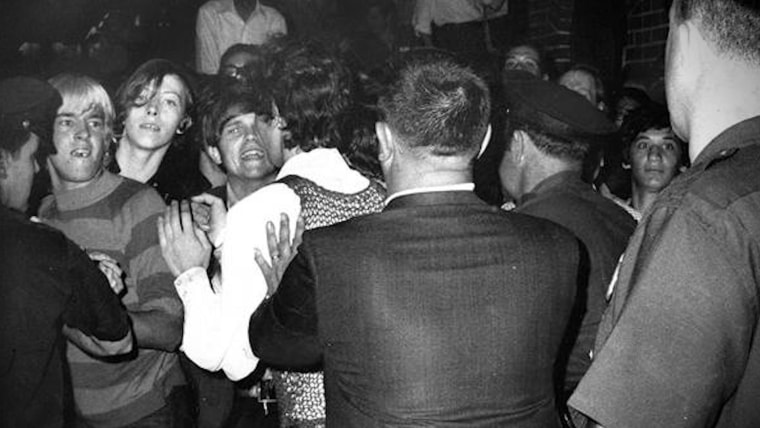
It was at an earlier incarnation of the Stonewall Inn in June 1969 when bar patrons fought with police who had come to carry out a raid, which galvanized gay rights activism around the country and the world.
Rep. Ritchie Torres, a New York Democrat, said he plans to introduce the first resolution to condemn state bills targeting transgender people this week.
This year, state legislatures have considered more than 100 bills targeting trans people, “making 2021 the worst year for legislation that discriminates against the Lesbian, Gay, Bisexual, Transgender, and Queer (LGBTQ) community since 2015,” the bill states. Eighteen anti-LGBTQ bills have passed, and 10 await governors’ final signatures, it adds.
Most of the bills target transgender youth by seeking to ban them from school sports teams that align with their gender identity or limit their access to gender-affirming medical care. Governors in nine states have signed athlete bans into law, and two have signed restrictions on medical care.
“It is shameful to witness legislatures across the country endorse policies that endanger the safety of trans individuals and block access to critical services,” Torres said in a statement to NBC News. “My resolution makes it clear that Congress denounces the rise in anti-trans legislation and hate crimes, and that as a body we will pursue legislation that protects the well-being and safety of the trans community.”
The legislation specifically mentions an Arkansas law that will ban gender-affirming care, including hormones and puberty blockers.
Arkansas Gov. Asa Hutchinson, a Republican, vetoed the bill in April, calling it a “vast government overreach,” but the Legislature overrode the veto, and the bill will become law next month unless a judge intervenes. The American Civil Liberties Union filed a lawsuitlast month in an effort to block the law.
Nearly 1,500 trans kids will lose access to medical care if takes effect, according to Torres’ bill.
Legislation like Arkansas’ “discriminates against the transgender community, is not based in science and is intended to sow division and instill animosity toward our fellow Americans,” the bill states.
The bill also connects “laws and political rhetoric that deny the humanity of transgender people” to negative mental health outcomes for LGBTQ youth and rising anti-trans violence. By blocking trans people from accessing health care, housing, public spaces and employment, the bills “give license to others to take violent action based on their biases,” the bill says.
Fatal violence disproportionately affects trans women of color, especially Black trans women, who make up half of those killed so far this year.
Torres’ legislation is co-signed by 30 other representatives and endorsed by 13 LGBTQ advocacy organizations.
In a letter to colleagues requesting sponsors for the legislation, Torres urged them not to ignore the “troubling lived realities experienced by members of the transgender and nonbinary community.”
“We must uplift their narratives and take actions that advocate for their well-being.”
Benali Hamdache, Green Party spokesperson for migration and refugee support, looks at the issues facing LGBT+ refugees on World Refugee Day.
In too many places, this pandemic has allowed regimes to crackdown on LGBT+ people. Cameroon, Ghana, Philippines and Uganda have all seen outbreaks of arbitrary arrests and violence. LGBT+ refugees in Kenyan camps have experienced assault and murder.
Here in the UK the Home Office’s social media is currently adorned with the rainbow flag and Boris Johnson has acknowledged that COVID has worsened the situation for LGBT+ people globally. We have a government that professes inclusivity, openness and action.
But Priti Patel’s New Plan for Immigration threatens to close the door on countless LGBT+ refugees. At a time when refuge is in greater need, our Home Secretary is out selling harsh new proposals on refugees during Pride Month.
Earlier on in the year, the Home Secretary released a 46 page policy statement on her vision for changing the asylum process. These represent the biggest changes proposed in two decades. Nowhere in the document is the impact on refugees seeking support because of their gender or sexuality considered.
But those impacts are real and have been laid out by Rainbow Migration, one of the country’s leading charities working with LGBT+ refugees.
The first concern is the demand that all evidence for an asylum claim must be laid out at the beginning of the case. It is suggested that anything disclosed later will be given “minimum weight”.
This will mean many more LGBT+ asylum seekers will have their claims rejected. The reality is that not everyone is able to tell a stranger everything that has happened to them immediately. Many will carry huge amounts of shame and trauma about the experiences that brought them to flee. This harsher process will result in people being sent back to danger.
There is no need to dramatically shorten the process in manner. People deserve a fair hearing and the time to open up and share their journey.
The second concern is around how refugees will be detained. Detaining people in “reception centres” will be doubly damaging for a range of asylum seekers.
There’s huge amounts of evidence that LGBT+ asylum seekers face discrimination and intimidation in refugee holding centres. While out in the community people have been able to find support and begin to express their gender and sexuality freely.
We’ve seen what mass detention of refugees looks like in Australia. Unbelievably hostile spaces that re-traumatise the traumatised. We should not be emulating that here.
The final concern, also laid out excellently by Rainbow Sisters (a collective of LGBT+ women and non-binary refugees), is around routes to the UK.
The new proposals threaten to send back anyone who could have claimed asylum somewhere on their way to the UK. They make arbitrary decisions about what constitutes a safe harbour for LGBT+ refugees and emphasise the value of resettlement plans. But many LGBT+ people have to flee their homes suddenly and quickly. What constitutes a safe country may differ widely from person to person and across the EU not all countries guarantee the same level of rights to LGBT+ people.
These proposals also threaten the plight of trafficked people. Punishing refugees for being brought here “illegally” would add another layer of cruelty.
In reality Priti Patel’s proposals that asylum seekers can be sent back to their first “safe” harbour seem unlikely. EU countries in the wake of Brexit seem unwilling to sign any kind of reciprocal deal along these lines. LGBT+ refugees deserve more than empty threats and being treated like a political football.
We already have an undoubtedly harsh asylum system. A Freedom of Information request looked at how many claims based on gender or sexuality had been rejected between 2016 and 2018. More than 3,100 LGBT+ asylum claims had been rejected from countries where gay sex is criminalised. From Pakistan and Nigeria to Bangladesh.
Priti Patel’s proposals to make the system harsher are wrongheaded and mean spirited. This Pride, our government cannot claim to be allies, but then turn its back on LGBT+ people in danger.
A trans woman was reportedly beaten and brutally dismembered by her friends after going for drinks in an attack that has fuelled fear in Miranda, Venezuela.
Elizabeth Rondón, a 33-year-old vegetable seller, was slain Monday morning (13 June) after at least three people beat her, according to activists and witnesses.
Loved ones described Rondón as a quiet but charismatic person who traded vegetables for food in the Santa Cruz del Este neighbourhood of the Baruta municipality.
But her friends, they said, “bothered her a lot” for being trans, often harassing her for it.
On Sunday night (12 June), Rondón went to drinks with her friends who proceeded to cruelly mock her for being trans, witnesses told police, according to Agencia Carabobeña de Noticias.
Rondón, upset from the comments, hit back and a scuffle reportedly ensued. She then allegedly left with the group who beat her unconscious, police said.
The morning after, passers-by found her dismembered body in El Pozo. Her head had been severed off, her jaw detached, and her arms and legs all detached, a coroner report said.
Rondón is the fourth LGBT+ slain in Baruta this year, according to data collected by LGBT+ advocacy group Never Stop Dreaming. Fearing the “growing wave of violence” in the municipality, it tweeted: “They are killing us.”
Never Stop Dreaming called for “competent authorities to carry out an exhaustive investigation” while urging police to consider the killing a hate crime, considering that “trans women are not recognised” in Venezuela.
To Movimiento SOMOS, an activist group working from Mérida, the killings represent the “importance of Pride as a political response to systematic hatred”.
The group took aim at what it called the “indifferent” authorities, it wrote in a Twitter statement.
“Trans lives matter,” it added. “We demand justice for this and all crimes against LGBT+ done with impunity.”
A conservative Republican lawmaker in the House of Delegates took to Twitter and other social media platforms this past weekend announcing that he is gay. Twenty-four year old Joshua Higginbotham said that he felt he owed it to the voters of West Virginia, after recently deciding to share it with his family and friends.
Higginbotham, who was first elected to the House when he was only 19, represents rural Putnam County located alongside Interstate 64 between the state’s capital city of Charleston to the East and Huntington to the West. His campaign adverts have all trumpeted his avid support of the Second Amendment as well as taking a pro-life position.
However, a check of some of his recent legislation shows a more progressive mindset. He is lead sponsor on House Bill 2998, a measure amending the State’s current codes relating to unlawful discriminatory practices in four categories covered by the West Virginia Human Rights Act and the Fair Housing Act, adding language that prohibits discrimination based upon age and sexual orientation, or gender identity; and defining “sexual orientation” and “gender identity.”
That measure, earlier in the legislative session, led to a series of conflicts which involved the state’s only other openly gay lawmaker, Democratic Delegate Cody Thompson (D43-Marion). Republican House Delegate John Mandt, who resigned after posting an anti-gay slur but then was re-elected drew harsh criticism for an extended online diatribe opposing protections against discrimination based on sexual orientation and gender identity the Associated Press reported earlier this year on February 7, 2021.
In his social media video as well as in an interview with reporter Anthony Conn from the local ABC News affiliate WCHS 8 in Charleston, Higginbotham said, “I am still a Christian. People think that gay people can’t be Christians. I believe God loves me no matter what. I’m still a conservative Republican. That’s rare, I know, but you can be gay and Republican. You can be gay and conservative.”
He added referring to his conservative politics that “nothing changes except now [you] know about my personal life.”
The statewide LGBTQ advocacy group Fairness West Virginia applauded the delegate’s decision to come out. “We think that it’s great that Delegate Higginbotham can lead his authentic life now. This must be a big burden that’s lifted off his shoulders,” Executive Director Andrew Schneider told WCHS ABC 8.
There are some in the state who are critical of Higginbotham. One source who asked to not be identified, told the Blade in a phone call Tuesday that Higginbotham’s support of former President Trump raised some doubts as to his veracity especially in issues surrounding Transgender West Virginians.
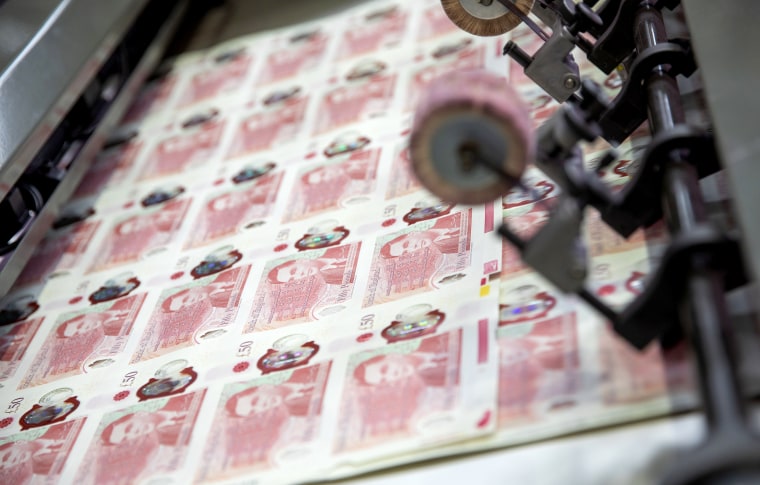
The Bank of England began circulating its new £50 bank notes featuring World War II codebreaker Alan Turing on Wednesday, which would have been the pioneering math genius’ 109th birthday.
Often referred to as the “father of computer science and artificial intelligence,” Turing was hailed a war hero and granted an honor by King George VI at the end of the war for helping to defeat the Nazis. Despite this, however, he died as a disgraced “criminal” — simply for being a gay man.
“I’m delighted that Alan Turing features on our new £50 bank note. He was a brilliant scientist whose thinking still shapes our lives today,” Sarah John, Bank of England’s chief cashier, told NBC News. “However, his many contributions to society were still not enough to spare him the appalling treatment to which he was subjected simply because he was gay. By placing him on this new £50, we are celebrating his life and his achievements, of which we should all be very proud.”
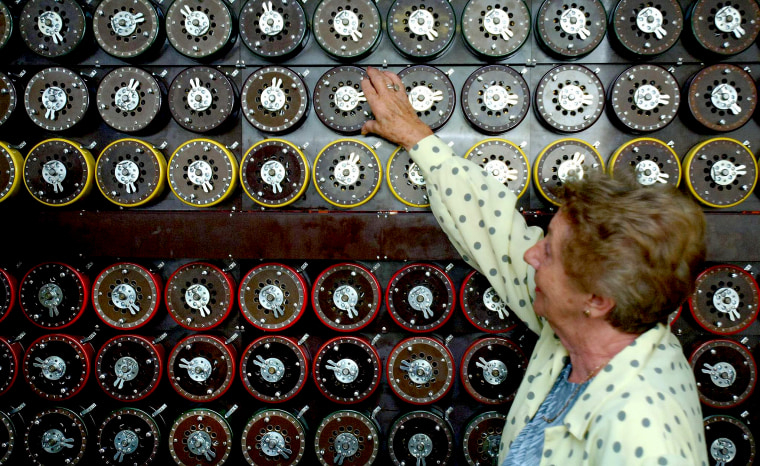
Born in London on June 23, 1912, Turing graduated from the University of Cambridge in 1934. At the start of WWII, he joined the British government’s wartime operation, designing a code-breaking machine known as “Bombe.” Bombe went on to supply the Allied Forces with significant military intelligence, processing, at its peak, 89,000 coded messages per day.
Former operator Jean Valentine, 82, with a restored and fully functioning Turing Bombe during it’s unveiling at Bletchley Park, Buckinghamshire on Sept. 6, 2006.Rui Vieira / PA Images via Getty Images file
At the end of the war, Turing was made an Officer of the Most Excellent Order of the British Empire, an honor granted by the royal family to a selected few for their contribution to science, arts and public service.
In the years that followed, Turing carried on working as a computer scientist. His design for the Automatic Computing Engine, or ACE, would have been the first and most advanced computer for his time. But his colleagues at the National Physical Laboratory feared the engineering was too complex and decided to build a much smaller pilot ACE instead. Their competitors at Manchester University consequently won the race, and the disheartened Turing had joined their forces as deputy director. Turing also wrote the first programming manual.
“What we really don’t realize is how this moment and Turing’s vision changed the entire world. Before this, literally nobody in the world had imagined that a single machine could apply countless strings of abstract symbols. Now we know them as programs,” according to David Leslie of the Alan Turing Institute.
But being an outstanding computer scientist and a war hero didn’t spare Turing from what some have called a “witch hunt” of gay and bisexual men in the U.K., which led to the imprisonment of thousands of gay men and those suspected of being gay throughout the 1950s.
In January 1952, Turing was prosecuted for indecency over his relationship with another man in Manchester. Despite being referred to as a “national asset” during this trial by character witness Hugh Alexander, the head of cryptanalysis at the Government Communications Headquarter, Turing was persecuted.
The Bank of England began circulating its new £50 bank notes featuring World War II codebreaker Alan Turing on Wednesday.Bank of England
In March of that year, Turing pleaded guilty and, to avoid imprisonment, had to agree to be chemically castrated by taking a hormonal treatment designed to suppress his libido.
His criminal record disqualified him from working for a governmental intelligence agency. Disgraced and disenfranchised, he took his own life by cyanide poisoning June 8, 1954, in his home in Manchester. He was 41.
Homosexuality was decriminalized in the U.K. more than a decade later June 14, 1967.
Despite his tragic end, Turing’s legacy as a wartime hero and the father of computer science has lived on, and the British government has attempted to right its past wrongs. In 2009, more than a half century after Turing’s death, then-British Prime Minister Gordon Brown, speaking on behalf of the government, publicly apologized for Turing’s “utterly unfair” treatment. In 2013, Queen Elizabeth II granted Turing a royal pardon.
Featuring him on a £50 bank note marks another milestone. This is the first time that a gay man is featured on a British bank note. It has been welcomed by parts of the LGBTQ community as a symbol of the country facing up to its dark past of the horrific persecution of gay men.
This visionary computer and artificial intelligence pioneer, once criminalized and disgraced, is now widely celebrated. In Turing’s own words from 1949: “This is only a foretaste of what is to come, and only the shadow of what is going to be.”