Two members of Guatemalan civil society who work with the LGBTQ community and people with HIV/AIDS participated in a roundtable with Vice President Kamala Harris on Monday.
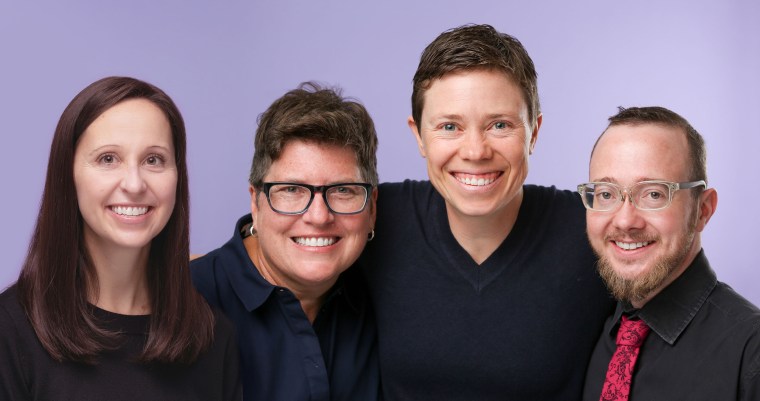
Visibles Executive Director Daniel Villatoro and Ingrid Gamboa of the Association of Garifuna Women Living with HIV/AIDS are among the 18 members of Guatemalan civil society who participated in the roundtable that took place at a Guatemala City university. Rigoberta Menchú, an indigenous human rights activist and Nobel Peace Prize winner, is among those who also took part.
Villatoro is among those who attended a virtual roundtable with Harris on April 27.
“When we met last time, I was so moved to hear about the work that you have been doing, the work that has been about helping women and children, indigenous, LGBTQ, Afro-descendants, people who have long been overlooked or neglected,” said Harris before Monday’s meeting began.
Visibles in a tweet acknowledged it participated in the roundtable.
“Today we participated in a meeting with the vice president of the United States to talk about development opportunities for Guatemala and the search for inclusive justice,” tweeted Visibles. “We, as an organization, spoke about the importance of addressing discrimination and acts of violence towards LGBTIQ+ people.”
Jalen McKee-Rodriguez, a high school math teacher and graduate student who has lived in San Antonio since 2013, beat his former boss and incumbent in the runoff race for the San Antonio City Council. With his victory, McKee-Rodriguez became the first out gay Black man ever elected in the state of Texas.
McKee-Rodriguez once worked for his opponent, incumbent City Councilwoman Jada Andrews-Sullivan, but left her office in 2019 after facing retaliation for reporting anti-gay discrimination and harassment. Just last week, poll watchers heard two pastors who endorsed Andrews-Sullivan tell congregants voting for McKee-Rodriguez would be a “sin.”
“Jalen shattered a lavender ceiling in Texas, and it came as right-wing state legislators target LGBTQ people and people of color with bigoted policies aimed at rallying their extremist political base,” said former Houston Mayor Annise Parker, President & CEO of LGBTQ Victory Fund. “We need more people of color, young people and LGBTQ people in state and local government who will ensure politicians look to improve the lives of Texans, not further marginalize them. Jalen’s victory is a rejection of the homophobic and racist politicking so fashionable in Austin and it will inspire more LGBTQ Black leaders to run and win.”
McKee-Rodriguez graduated from the University of Texas at San Antonio, (UTSA) with a BA in Communication in 2017 and will graduate with a Masters of Education in Educational Leadership and Policy Studies this year. McKee-Rodriguez married his husband Nathan, a pharmacy technician, in 2018, and the couple owns a home in the suburban San Antonio Northeast Crossing neighborhood.
New polling released by Gallup Tuesday showed that 70% of those Americans surveyed approved of same-sex marriage, a new milestone in the trend of approval since 1996 when Gallup first polled Americans on recognition of same-sex marriages, which then only registered a 27% approval.
According to the data kept by the firm, the upward trend steadily increased with a majority approval in 2011, followed by a 60% rating at the time of the U.S. Supreme Court’s Obergefell v. Hodges decision in 2015.
Gallup noted; “Since then, the issue has been less prominent in U.S. politics, and public support for same-sex marriage has continued to increase. Gallup has recorded other shifts in Americans’ ideas on marriage over time, historically, including expanded support for interracial marriage, which had 87% approval as of Gallup’s 2013 update.”
Republicans, who have consistently been the party group least in favor of same-sex marriage, show majority support in 2021 for the first time (55%). The latest increase in support among all Americans is driven largely by changes in Republicans’ views, Gallup reported.
Democrats have consistently been among the biggest supporters of legal same-sex marriage. The current 83% among Democrats is on par with the level of support Gallup has recorded over the past few years.
Dr. Stephanie Ho, a family medicine physician in Fayetteville, Arkansas, said she’s had state legislators in her exam room before.
Ho, who has provided gender-affirming care to transgender people in the state since 2015, is also an abortion provider, so she is familiar with lawmakers’ restricting the care she provides. She said she wasn’t surprised when the Legislature overrode Gov. Asa Hutchinson’s veto of a bill last month that would ban puberty blockers, hormones and surgery for transgender minors.
“I think that it’s kind of ridiculous that we’ve gotten to the point that we’re letting politicians dictate how health care is delivered and what kind of care can be given to whom,” said Ho, a fellow with Physicians for Reproductive Health.
“I think the last thing I’ve ever wanted, being an abortion provider or somebody who provides gender-affirming care, is to have a politician in the back of my mind in the exam room making me think about ‘Oh, I wonder if I should do this, if it’s OK,’” she said. “They’re essentially trying to practice medicine without a license. And that’s incredibly wrong.”
Arkansas was the first state to pass a ban on transition care for minors. Tennessee Gov. Bill Lee last week signed a similar billbarring prepubertal youths’ access to transition care like hormone therapy. Advocates say no doctors in the state provide hormone therapy for prepubertal youths, The Associated Press reported.
So far this year, state legislatures have considered 35 bills to ban or limit gender-affirming care for trans minors, according to the Human Rights Campaign. Physicians say that the bills negatively affect their patients’ health before they even become law and that they require doctors to go against medical standards of care. Legal experts say the bans could also open providers and hospitals up to lawsuits or put them at risk of losing federal funding.
Ho is trying to support her patients as best she can until Arkansas’ law takes effect this summer.
“It’s just a matter of making sure that my patients know that, whether I can provide them hormones or not, we’re still here for them to support them in any way that we can,” she said. “Of course, I’m going to practice within the bounds of the law, whether I agree with it or not, because me being in jail doesn’t help any of my other patients at all.”
Creating ‘contingency plans’
Some physicians, like Dr. Izzy Lowell, who founded a telemedicine practice called QMed in Atlanta in 2017, started planning for the bills months ago.
Dr. Izzy Lowell, second right, founder of QMed.Bonnie Heath
In April, Alabama’s Senate passed a bill that would have made it a felony for doctors to provide minors with gender-affirming care. The bill died Monday after the House missed the deadline to vote on it. Lowell said that when it first passed, the minor patients she treats in Alabama were scared and frustrated.
“It was clear that the state of Alabama was coming after transgender teens, and we talked about some contingency plans,” she said. “Based on each case, I tried to give them as many refills as possible and told them: ‘Go pick up as much of your medicine as you can. I don’t know when I’ll see you again.’”
Lowell is licensed and practices in 10 states via telemedicine, so she also talked with her legal team and with patients in states considering bans about how her patients could continue care should their states ban it. She said her patients’ parents would have to drive to other states, which would “place an extraordinary burden on these families.”
“If they were, for example, able to get over the border into Tennessee or South Carolina and sit in a parking lot somewhere, I could see them technically with my South Carolina license or Tennessee license or my North Carolina license and perhaps find a local pharmacy there and have them pick up the prescription, but it would be a day’s worth of driving for them to get somewhere where I could see them legally,” she said.
Because leaving the state just to get care would be a burden, families in states where transition care restrictions have passed have movedor are considering moving.
The costs of losing ‘lifesaving’ care
Many minors whose parents don’t have the time or money to drive out of state would be forced to stop transition care if their states passed laws like Arkansas’, which comes with potentially life-threatening health risks, physicians say.
Major medical organizations, including the American Medical Association, the American Academy of Pediatrics, the Endocrine Society and the American Psychological Association, support gender-affirming care for trans youths and oppose efforts to restrict access.
Supporters of the Arkansas bill argue that transition care for minors is “experimental” and that trans minors often change their minds about their genders and detransition later in life. Medical experts say neither of those claims are backed by scientific evidence. On the contrary, research has found that access to gender-affirming care such as puberty blockers reduces the risk of suicide among trans youths.
Ho said the danger is evidenced by what happened when Arkansas’ bill passed through one legislative chamber. Dr. Michele Hutchinson, a physician at the Arkansas Children’s Hospital Gender Spectrum Clinic, testified before the state Senate in March that there were “multiple kids in our emergency room because of an attempted suicide, just in the last week,” after the House passed the bill.
Ho said that “since then, I have had one of my own patients attempt suicide,” adding that she has talked to her patients about what would happen if a judge doesn’t block Arkansas’ law from taking effect. The law also bars her from referring her patients to other physicians who provide gender-affirming care. Unless her patients were able to leave the state, they would be likely to lose access to hormones, so she talked to them about what that would mean.
Lowell said forcing people who were assigned female at birth to stop testosterone would cause them to suffer symptoms of low testosterone, which include inability to concentrate and low energy. “They would start doing badly in school most likely, until their bodies started producing estrogen a few months later, and then they would restart their periods, restart breast growth, and it would undo all of the changes that we tried to achieve with testosterone.”
If people assigned male at birth were forced to stop taking estrogen, it “would be like going through instantaneous menopause,” Lowell said. For about a year, they could have symptoms like hot flashes, night sweats, irritability and mood swings, among other issues, such as negative impacts on emotional well-being.
Doctors worry that minors who already receive and rely on transition care would get hormones illegally if they had to. Dr. Ricardo Correa, a board member of GLMA: Health Professionals Advancing LGBTQ Equality, treats trans veterans in Phoenix, where, he said, trans people have traveled to the border to buy hormones illegally when they can’t get them. He said state bans would worsen the problem.
“It will just create chaos in the system from black markets that are going to start selling this kind of medication in that state,” he said.
Lowell said that hormone therapy is safe when it is monitored by a doctor but that using it without medical supervision could cause health problems, such as liver failure, kidney failure or heart problems.
“There’s very serious consequences of completely unmonitored, sort of black market medication use in this situation,” she said.
‘A form of medical malpractice’
Legal experts and advocates say that in addition to having dangerous health impacts, bans on gender-affirming care for transgender youths could expose health care providers to legal and regulatory problems.
Valarie Blake, a law professor at West Virginia University specializing in health care law, said there’s “a pretty strong case” that Arkansas’ law is discriminatory under Section 1557 of the Affordable Care Act, which protects against discrimination based on sex.
The Biden administration announced this month that it would interpret Section 1557 to protect against discrimination based on sexual orientation and gender identity — reversing a Trump-era policy that cut protections for transgender people.
Hospitals and physicians receiving federal funding, such as Medicare and Medicaid payments, are required to comply with laws like Section 1557, Blake said; otherwise, they risk losing the funding.
Arkansas’ law could trigger that risk by allowing physicians and hospitals to prescribe puberty blockers and hormones to cisgender minors for precocious puberty but not transgender teens.
“If the reason that they’re not doing it for transgender teens is because of the fact that they’re transgender, then there’s a very good case that the reason that they’re refusing the treatment is based on the gender identity and not anything else,” Blake said.
“It really puts health care workers in an untenable position when the federal government makes it plain that this is discrimination and has the money to back it up to basically say, ‘We can pull away all of the resources,’ and yet the state persists,” she said.
The American Civil Liberties Union argued in a lawsuit it filed Tuesday against Arkansas that the trans health restrictions are unconstitutional, but Blake said that’s not set in stone.
“We don’t have clear precedent on the books yet to suggest that LGBTQ categories are fully protected in that manner, which is why we’ve been seeing various kinds of Equal Rights Amendment-type laws trying to work their way through Congress,” she said, referring to the Equality Act, a bill that would protect LGBTQ people from discrimination in housing, employment, public accommodations, education and other areas of life.
The bill passed the House in February, but it has stalled in the Senate. “If something like that passes, then suddenly Arkansas as a state is in big trouble,” Blake said.
Lowell said thinking about the potential legal issues “keeps me up at night.” Physicians are required to give patients several months’ warning when they can’t see them anymore and to do their best to find other providers who can see them if they’re unable to.
But laws like Arkansas’ bar physicians from referring patients to other providers for transition care. “In this case, I can’t do any of those things, and I just have to say, ‘Bye,’ and ‘I’m not allowed to see you anymore,’” she said. “That’s patient abandonment, which is a form of malpractice.”
Lowell said that when the first restrictions were introduced several months ago, she felt angry and anxious all the time.
“I worry about what might happen to my patients if these bills are passed and worry about going to jail myself,” she said. “I struggle with the question of what I would do: continue to support my patients and risk going to jail for years or follow these hateful laws? Thankfully, I have not had to answer this question yet, but I will never abandon my patients.”
When Stephanie Ocasio-Gonzalez heard that the Connecticut Parentage Act passed the state Senate in a late-night session on May 20 and was headed to the governor’s desk, she congratulated her wife.
“I told Denise, ‘You’re now the owner of a 14-year-old boy,’” she said.
It was a joke shared between two people who have long struggled to have their family recognized. Despite being there for their teenage son, Jayvin, for over a decade, Denise Gonzalez is still not officially recognized as Jayvin’s parent under Connecticut law.
“She bought his first bike. She was there for the first day of kindergarten and every first day of school since,” Ocasio-Gonzalez said of her wife. “She was there for his surgery, taught him math, and so much more. She’s his mom.”
Soon the state of Connecticut will recognize her as such. On Tuesday, the first day of LGBTQ Pride Month, Gov. Ned Lamont, a Democrat, signed a ceremonial copy of the Connecticut Parentage Act into law. The measure, which was officially signed last week and takes effect Jan. 1, will make it easier for those who don’t share a biological connection with their child, like Gonzalez, to establish parentage.
“This is such an important day — what it says for our kids, what it says for Connecticut, what it says for respecting everybody and who they are,” Lamont said at the signing ceremony.
Ocasio-Gonzalez and Gonzalez have been married since 2014, and they share a 2-year-old daughter, Destiny, in addition to their teenage son. Both women are on Destiny’s birth certificate, but even though they were married at the time of her birth, Gonzalez is still not considered Destiny’s legal parent outside of Connecticut.
Denise’s parental rights are limited because she did not go through what is often referred to as a second-parent-adoption process. As a result, routine activities like taking her children to the doctor or picking Jayvin up from school have been anxiety-provoking events that require extra paperwork and preparation.
“It just took a lot more work,” Ocasio-Gonzalez said.
But the adoption process seemed daunting, she said. In addition to the costs involved, the couple worried about interacting with Jayvin’s birth father, according to Ocasio-Gonzalez.
“I read that in some cases, even though I have full custody, I would have to get the other parent to give permission, and just thinking about having to go through that was emotionally draining,” she said. “I know he would not agree to it.”
Once in effect, the Connecticut Parentage Act will allow the family, and others like them, to avoid a potentially lengthy and costly second-parent adoption.
This means starting Jan. 1, Gonzalez can declare her de facto parentage in court and be legally recognized as Jayvin’s parent. The process to become Destiny’s legal parent outside of Connecticut is even easier.
“The really great thing this bill does for those families is that it allows them to establish parentage through a simple administrative form,” Douglas NeJaime, a professor at Yale Law School and the principal drafter of the bill, told NBC News. The new law changes the existing acknowledgement of paternity form to an acknowledgement of parentage form, making it gender-neutral. The form “has the effect of having a judgment from a court, and all other states have to treat it as valid,” NeJaime said.
So if Ocasio-Gonzalez and her family move to another state — any other state, regardless of its parentage laws — they will both be recognized as the legal parents of their two children.
The newly enacted law makes it easier to establish parentage at birth regardless of the sexual orientation, gender or marital status of the parents and adds protections for children born using assisted reproductive technologies. The new measure also removes gender-specific language from the state’s parentage law to make every path to parentage available on a gender-neutral basis. To be inclusive of transgender parents, for example, the new law makes references to the “person” who gives birth, rather than the woman who gives birth.
State Sen. Alex Kasser, one of the bill’s lead sponsors, called its passage a “historic and long overdue moment for Connecticut.”
“Finally all children will be given equal protection under the law, and all parents will be recognized when their child is born,” Kasser, a Democrat, said in a statement. “This bill confirms that there is no place for discrimination in Connecticut.”
Variation in state parentage laws
With Lamont’s signature, Connecticut will join Maine, Washington, Vermont, California and Rhode Island in passing bills that update parentage laws to recognize the realities of LGBTQ families. However, many states continue to have gaps in their legislation that make the children of same-sex couples vulnerable.
For example, many states do not recognize the parental rights of nongestational parents who are not married. Only 14 states afford rights to these parents, according to the LGBTQ think tank Movement Advancement Project. The other states, according to the group, explicitly recognize the nongestational parent only if the couple is married and lack clear guidelines for unmarried couples, leaving them in a legal gray zone.
“We have a lot of states that do not treat LGBT families as full members of the community, and that is the problem,” NeJaime said.
Connecticut’s new law is a version of the Uniform Parentage Act of 2017. The model legislation is intended to help lawmakers update laws to include LGBTQ families and those who have used assisted reproductive technology. The act, originally promulgated in 1973, was drafted by members of the Uniform Law Commission, a group of experts, academics, practicing lawyers and judges, who work on model legislation for states.
What’s next?
Advocates already have their eyes on upcoming legislation in other states, including Massachusetts. Like Connecticut’s legislation, Massachusetts’ bill is also based on the Uniform Parentage Act.
“People are not aware that some of these core protections are still not in place,” said Polly Crozier, a senior staff attorney at GLBTQ Legal Advocates and Defenders, or GLAD.
The bill, currently in committee, would provide protection for children born through assisted reproductive technologies and through surrogacy.
Ocasio-Gonzalez said she hopes Massachusetts follows Connecticut’s lead so more families like hers can enjoy equal rights.
“We already know we are a family, and now with this bill passing, no one can tell us differently,” she said.
Gay, lesbian and transgender candidates are competing for votes in Mexico’s midterm election, aiming to upset politics as usual in the largely Roman Catholic, socially conservative Latin American country.
A total of 117 candidates, or nearly 2 percent of more than 6,000 hopefuls running for office on Sunday who responded to a survey by national electoral institute INE, identified as part of the LGBTQ community.
About 21,000 local and national races are being contested in the vote, including 15 governorships and all 500 seats in the lower house of Congress, in a pivotal election for the agenda of leftist President Andres Manuel Lopez Obrador during the second half of his six-year term.
Mexico’s political parties were already required to nominate equal numbers of men and women, and new INE rules adopted last January added the obligation to also nominate candidates from vulnerable groups, including the LGBTQ community.
Candidate for deputy for the Citizens’ Movement party, Aurelien Guilabert, speaks during an interview with Reuters, ahead of the mid-term elections on June 6, in Mexico City on May 30, 2021.Carlos Jasso / Reuters
Like others aiming for jobs in politics, LGBTQ candidates are emphasizing public safety and the economy, but also specific obstacles for those who are often marginalized.
“That’s exactly why I want to serve in Congress, to fight discrimination everywhere and shake things up with a representative voice,” said Maria Garcia, a transgender candidate for Congress in Mexico City.
Garcia is running under the banner of the ruling National Regeneration Movement (Morena) of Lopez Obrador, who has seldom championed LGBTQ causes and has sided with conservatives on same-sex marriage.
Gay activist-turned-candidate Aurelien Guilabert said the need to tackle a growing number of hate crimes targeting LGBTQ people helped motivate him to run for the capital’s local congress.
“We’re suffering through one of the worst crises,” he said.
Guilabert is with the Citizen Movement (MC) party. According to the INE survey, nearly 32 percent of the LGBTQ candidates running on Sunday are from the party, the highest percentage of any party.
For Eric Sawyer, the 40th anniversary of the first scientific report that described AIDS as a new disease brings up “a dichotomy of feelings.”
When Sawyer, who was living in New York, first began exhibiting symptoms of HIV in 1981, he said he was urged by his friend, the late activist and playwright Larry Kramer, to begin seeing “a doctor who’s also gay, who is seeing patients with this disease.”
That same year, across the country, a young physician named Michael Gottlieb and his colleagues at UCLA wrote in an official Centers for Disease Control and Prevention report about patients diagnosed with a lung infection common in what would come to be called AIDS.
“In the period October 1980-May 1981, 5 young men, all active homosexuals, were treated for biopsy-confirmed Pneumocystis carinii pneumonia at 3 different hospitals in Los Angeles, California. Two of the patients died,” the report, published on June 5, 1981, in the CDC’s Morbidity and Mortality Weekly Report, stated.
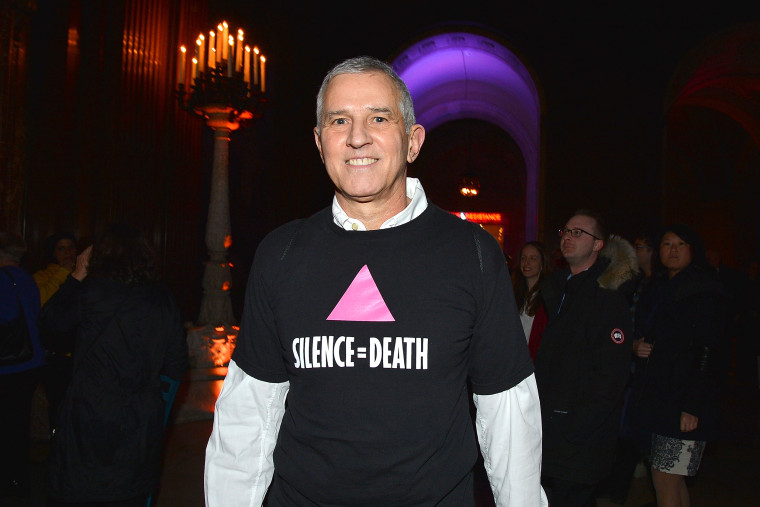
Eric Sawyer attends the “Love & Resistance: Stonewall 50” event at New York Public Library on Feb. 14, 2019.Patrick McMullan / Getty Images file
Sawyer, now 67, recalled being told by a doctor, at just 32, to put his affairs in order.
“In addition to being elated that I have survived for 40 years with this illness, I also have a certain degree of survivor’s guilt,” Sawyer, a founding member of AIDS activist group ACT UP New York, told NBC News. “Why me? Why did I deserve to survive when so many of my friends and a couple of my boyfriends died really horrible, ugly deaths at very young ages?”
Four decades after the CDC published the now-historic report, long-term survivors like Sawyer, as well as HIV/AIDS activists and doctors, are reflecting on their experiences on the front lines of the crisis and warning of the inequities that have allowed it — which has killed an estimated 34.7 million people globally since the epidemic began, according to UNAIDS — to persist.
“AIDS in the United States is not over, and especially it’s not over in the Global South or around the world,” said Jawanza James Williams, the director of organizing at VOCAL-NY, a nonprofit that helps low-income people impacted by HIV and AIDS. “There’s a sort of tendency to talk in the past tense, as if HIV and AIDS, as an epidemic, has been ended in the States, and it erases the realities and the experiences of Black people, of brown people, or poor people, people that are uninsured, and it really misses the mark.”
People of color are disproportionately impacted by HIV, according to the CDC. Of new HIV diagnoses in the U.S. in 2018, Black Americans accounted for 42 percent and Latinos accounted for 27 percent.
‘Something clicked’
Gottlieb’s encounters with the patients he would end up documenting in his June 5, 1981, CDC report started with one gay man “whose immune system was kind of totaled by something.” Then, within a month, there were three patients just like the first, he recalled. They were all between the ages of 29 and 36.
“Something clicked. There’s something going on that is very unusual and needs to be reported to someone,” said Gottlieb, now an HIV and internal medicine specialist at Los Angeles-based APLA Health, a network of Federally Qualified Health Centers that serve LGBTQ people and people impacted by HIV.
While the CDC uses the date of the report to mark the start of the HIV/AIDS epidemic, “that’s not factually correct,” Gottlieb said.
Prior to 1981, evidence suggests that Robert Rayford, a 15 year-old boy, died in St. Louis in 1969 from a condition later identified as AIDS.
Later in the 1970s, there were accounts of individuals becoming sick with parasites or what was then called “Gay bowel disease,” “and it probably was HIV, but we didn’t know it,” Dr. Howard Grossman, a primary care physician specializing in HIV treatment and prevention, told NBC News.
For activists and survivors, the history of the HIV crisis transcends a linear timeline that can forget the nuance of human experience, according to Ted Kerr, a writer and organizer whose work focuses on HIV/AIDS.
“My No. 1 fear is that people will think that HIV started 40 years ago, and what that does is it suggests that HIV begins when the United States government says it begins,” Kerr said. “Actually for me, it begins when someone’s journey with HIV starts. So, the history of HIV starts tomorrow for somebody when they get their HIV diagnosis. HIV started in 1969 for the Rayford family in St. Louis when Robert died, and, of course, that also includes the June 5 article from the CDC.”
‘New homosexual disorder’
As a gay man in medical school in New York in the early 1980s, Grossman, now the medical director of Midway Specialty Care Center in Wilton Manors, Florida, said the first stories he heard of people getting what would eventually be known as AIDS were imbued with “judgment” about drug use and promiscuity.
In an article from May 1982, The New York Times referred to the disease as a “new homosexual disorder.” A month later, in NBC News’ first report on the mysterious illness, “Nightly News” anchor Tom Brokaw reported that a new study found “the lifestyles of some male homosexuals has triggered an epidemic of a rare form of cancer.”
When Grossman attended a packed meeting convened by Larry Kramer and the newly formed Gay Men’s Health Crisis in 1983, “that was when people realized something really bad was going on,” he said.
As a medical resident in a Brooklyn hospital that same year — when much of the public still thought this mysterious illness primarily affected gay men — Grossman saw intravenous drug users, people of Caribbean descent and women who, in retrospect, he believes were exhibiting symptoms of AIDS.
Less than a decade later, Ivy Kwan Arce, a long-term survivor of AIDS and an ACT UP member, said she encountered disbelief when she asked her doctor for an HIV test after seeing an ACT UP poster that said, “Women don’t get AIDS. … They just die from it,” with fine print recommending that women with multiple sexual partners or who are drug users get tested.
After Kwan tested positive, she had to retest because the attitude was that “maybe the test was wrong.” She ended up at an ACT UP meeting at The Lesbian, Gay, Bisexual & Transgender Community Center.
At the time, the CDC’s definition of AIDS excluded medical conditions experienced by women who were later known to have the disease, causing the government to undercount the number of women who had died due to AIDS-related complications. Kwan participated in activism that pushed the government to expand the definition of AIDS to include specific conditions for women, alongside Katrina Haslip, an HIV/AIDS activist and fellow ACT UP member who died in 1992 from complications of AIDS, according to a New York Times obituary.
Kwan had been working as a graphic designer, but when her workplace found out she was HIV positive, she said they announced her diagnosis to her co-workers, forbade her from using the bathroom and asked for a calendar of her menstrual cycle before she was eventually fired.
More than 30 years after her diagnosis, Kwan said, the narrative for women living with HIV/AIDS “has not changed a whole lot.”
Jawanza James Williams, who was diagnosed with HIV at 23, said various communities that were responding to the crisis early on have been erased from AIDS history.
“It suggests that somehow Black folks, brown folks, women, trans people weren’t on from day one, responding with love to this crisis and still are,” he said.
Looking back to move forward
When Williams was diagnosed with HIV in 2013, he said he thought about the more than 30 years that had lapsed since President Ronald Reagan first publicly said the word “AIDS” in 1985. By the end of that year, the U.S. had more than 16,000 reported cases of the then-fatal illness.
For Williams, his diagnosis was also a moment of realization.
“It wasn’t some unique sexual behavior,” Williams, now 31, said of why he contracted the virus. Instead, he said he realized it was because of systemic reasons — such as race, location and class — and his close proximity to communities that are disproportionately impacted by HIV/AIDS.
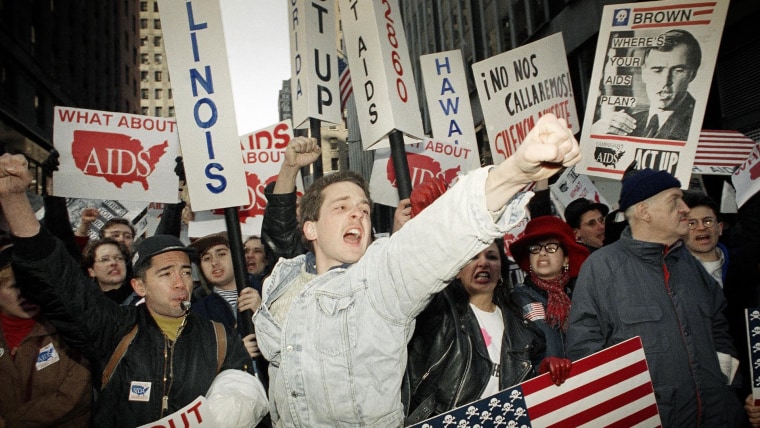
Members of AIDS activist group ACT UP hold up signs of George W. Bush, Ronald Reagan, Nancy Reagan, Jesse Helms and others with the word “Guilty” stamped on their foreheads, along with a banner stating “Silence Equals Death” at a protest at the FDA headquarters on Oct. 11, 1988, in Rockville, Md.Catherine McGann / Getty Images file
While there is currently an effective HIV-prevention drug available for those at risk of contracting HIV, and a pill with few side effects that can treat those who are already living with the virus, Sawyer does not want the public to overlook the hundreds of thousands of people around the globe who contract HIV and die from AIDS-related complications annually. In 2020, an estimated 1.5 million people became newly infected with HIV, and 690,000 people died from AIDS-related illnesses, according to global statistics from UNAIDS.
“That’s far too many people dying and far too many people getting infected with what is a fatal disease if you don’t get access to the latest medical interventions and the latest medications,” said Sawyer, a co-founder of Housing Works, an organization working to end the dual crisis of homelessness and AIDS.
For Sawyer, the 40th anniversary of the historic June 5, 1981, report is a moment to recognize the lessons that “AIDS should have taught us.”
“It’s time we start caring about the health of everyone on this planet,” he said.
A court in India ordered state and federal officials on Monday to draw up plans for sweeping reforms to respect LGBTQ rights, in a ruling that went far beyond the narrow terms of a case brought by a lesbian couple who said they had been harassed by police.
Judge Anand Venkatesh of the Madras High Court ruled in favor of the couple, who had complained that police had subjected them to harassing questioning after their parents filed a missing persons report.
But the judge also used the opportunity to issue a broad ruling that called for the elimination of what he described as illegal discrimination against members of the LGBTQ community. He ordered state and federal government departments to report back with steps they intend to take to comply.
Among his recommendations: police and government officials should be given awareness training to ensure they respect LGBTQ rights. Medical practitioners who claim to be able to “cure” homosexuality should have their licenses revoked.
Schools and colleges should make gender neutral restrooms available, and gender-nonconforming or trans prisoners should be housed separately if needed to protect them from sexual assault.
“Ignorance is no justification for normalizing any form of discrimination,” Venkatesh wrote in his order. Educators should reach out to parents, to help “sensitize parents on issues of LGBTQIA+ community and gender nonconforming students, to ensure supportive families,” his order read.
Activists hailed the order as a major step toward equality for marginalized groups. Although the court could not by itself impose such widespread change with a single ruling, government departments could not ignore the order to report back on the steps they plan to take to comply, and the arguments raised by the judge could serve as precedent for future cases.
“This is the first major order that addresses most challenges concerning the whole LGBTQIA+ community and issues specific directions,” said L Ramakrishnan, vice-president at SAATHII, a Chennai-based public health advocacy group.
“I am hopeful of change given the judge has indicated he would follow up on the directions on a regular basis,” he said.
In reaching his ruling, the judge said he had sought information on same-sex relationships from a psychologist. The judge described himself as not “fully woke” and said he belonged to the majority in India, who are “yet to comprehend homosexuality completely”.
Holly Duchmann, who lives in Lafayette, Louisiana, plans to attend a Pride celebration for the first time this year.
“In the years before the pandemic, while I was out to my friends, I was still really scared to go to Pride,” Duchmann, 27, said. “Because I’m bisexual, I kind of pass as straight a lot, and so that kind of created anxiety with me for years, making me feel like I didn’t really belong in the LGBT community.”
She felt more accepted after finding queer community through her roller derby team, and in 2020, she was looking forward to going to her first Pride event. She even picked up pieces of “extravagant” clothing here and there to wear. But then everything was canceled because of the pandemic, and, during quarantine, she turned to TikTok to feel connected to other LGBTQ people.
“The pandemic helped me realize I need to celebrate life when I can,” she said. “It’s like being cooped up made me want to burst out. So I’m fully vaccinated and making plans with friends to go all out this year.”
Duchmann plans to go to New Orleans to celebrate, though New Orleans Pride, which has organized the city’s main Pride events in the past, disbanded in 2020. There’s no central Pride event planned this year, but Duchmann isn’t worried.
“I really see Pride as being larger than just an event held by one organization,” she said. “NOLA is great about gathering and celebrating. It’s kind of like Mardi Gras. It’s a whole season.”
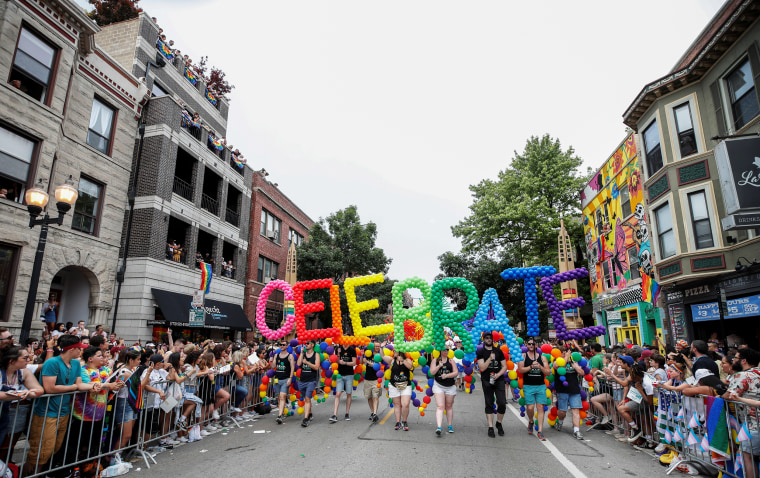
In the last few decades, Pride has been celebrated in cities around the globe with bigger and bigger events such as parades, marches and protests. In June 2019, an estimated 5 million people attended NYC’s annual Pride march, which coincided with WorldPride, which moves to a different major city each year. The celebrations were expected to be just as big in June 2020, the 50th anniversary of the first Pride march — then called Christopher Street Liberation Day — which began a year after the Stonewall Riots of June 1969, a dayslong protest that began after police raided the Stonewall Inn, a gay bar in downtown Manhattan.
But in April 2020, the pandemic brought plans for the 50th anniversary of Pride to a halt, forcing event organizers across the U.S. to pivot to all-virtual programming. Now, Pride — in New York and beyond — will return with a mix of in-person and virtual events. Organizers are balancing concerns about safety with increasing vaccination rates and the LGBTQ community’s excitement to return to Pride after a year of social distancing.
‘More strategic’ virtual programming
Last spring, the group behind NYC Pride, the country’s biggest annual Pride celebration, canceled its in-person march for the first time in a half-century because of the Covid-19 crisis, and then had two months to create a virtual event in June.
“That was a shock that we had to think about very quickly on our feet to adapt to,” Dan Dimant, media director for Heritage of Pride, the group behind NYC Pride, said. “We did our best, but what we had this time around was the luxury of time and foresight.”
This year, Heritage of Pride will host some face-to-face events — like its annual street fair — but its well-known march, which has attracted millions in previous years, won’t be coming back in the same way just yet.
NYC Pride organizers will hold virtual events like a family movie night, a human rights conference and a rally, among others. It will also hold its usual Pride march on June 27, though it will be mostly virtual with “in-person elements that are to be determined,” Dimant said, adding that any in-person element would take place in a supervised area with perimeters to limit attendance.
“We put together a much more strategic virtual program for most of our events, and we’ve also kind of left the door open for most of this year to kind of wait and see what we could do in person,” Dimant said. “We believe that we certainly can’t have millions of spectators in one massive crowd just yet. It’s just too soon for that. But there are some events that we can do safely in person.”
‘Playing the safe card’
Other groups in large cities are organizing their events similarly.
Los Angeles Pride will host a free streaming concert June 10 on TikTok featuring Charlie XCX, a virtual “Thrive With Pride Celebration” on ABC7. LA Pride will also debut its “LA Pride Makes a Difference” volunteer calendar, which will enable people to volunteer — both in-person and virtually — for local nonprofits that support LGBTQ people.
People march in the 50th annual Pride parade on June 9, 2019 in West Hollywood, Calif.Chelsea Guglielmino / Getty Images file
Noah Gonzalez, the vice president of the board of directors for the Christopher Street West Association, the nonprofit behind LA Pride, said its signature parade and festival, which in 2018 drew more than 100,000 attendees and participants, can take six months to a year to plan, so the board had to make a decision about how to host the events in December.
“We had no idea where we were going to be, so we had to plan for what we knew at the time, and keeping the responsibility and safety in mind, we knew we could do something virtual,” he said. He said the group’s in-person events — the volunteer opportunities — allow people to decide what level of exposure they’re comfortable with, and don’t involve large crowds.
“From a celebratory perspective, we’re sort of pulling back a little bit and playing the safe card, but when it came to giving back to the community or being involved in community, our perspective was … we will create these opportunities and bring them to the community, and you can decide what you would like to do,” he said.
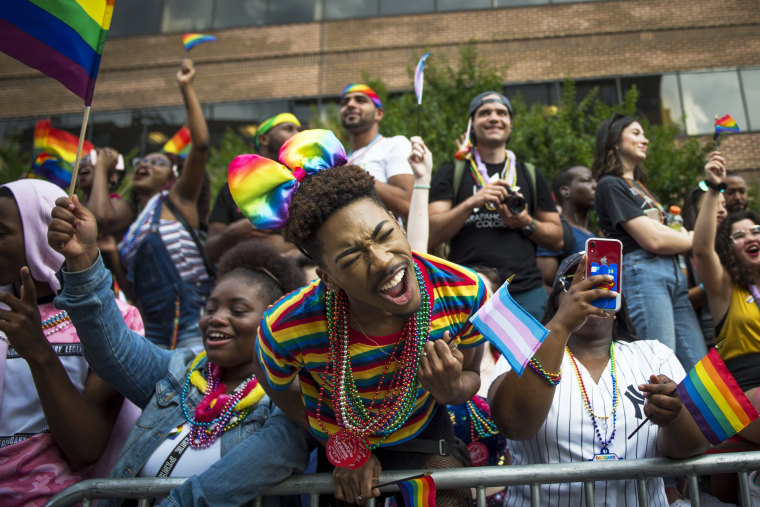
A crowd cheers on those participating in the 50th annual Pride parade in Washington on June 8, 2019.Caroline Brehman / CQ-Roll Call via Getty Images file
Some Pride organizers in big cities have committed to larger in-person celebrations, but they are limiting capacity, adhering to strict health requirements or not holding their events until the fall.
LA Pride will host a Pride night at Dodgers Stadium on June 11, with a special package available to fully vaccinated attendees, and an in-person outdoor LGBTQ movie night on June 26. Similarly, San Francisco Pride is having two Pride movie nights on June 11 and 12 at Oracle Park and a Black Liberation Event at the African American Art & Culture Complex on June 18.
Chicago Pride plans to bring back its Pride in the Park concert in person, with Chaka Khan and Tiesto as headliners, but the event is ticketed, and attendees have to verify that they’ve been vaccinatedor provide other health information through an app no more than 12 hours before arriving to the two-day event, which takes place June 26 and 27.
“We worked with [the app] Health Pass by CLEAR so that we could create a very safe environment where people [who] are either tested or have been vaccinated are the only people that can come into the event right now,” Dustin Carpenter, president and lead organizer for Pride in the Park, said.
People march in the 50th annual Pride parade in Chicago on June 30, 2019.Kamil Krzaczynski / Reuters file
Atlanta Pride also plans to host a festival, though the group traditionally doesn’t celebrate until mid-October. The events will take place in Piedmont Park, which is outdoors, unfenced and allows for social distancing, Jamie Fergerson, executive director of Atlanta Pride, said.
“There’s a lot of concern about health and safety, obviously,” Fergerson said. “People have a lot of questions, and we — as a nonprofit organization that works for a community that’s been historically marginalized in a number of ways, including access to health care and access to good health care — we take health and safety very seriously.”
Some events are still on standby. In Philadelphia, Philly Pride Presents planned to host a festival on Sept. 4, but shared on its Facebook page Friday that the event is “a work in progress” and “not yet ‘fully open’” after the city issued guidance on reopening. Pride Houston has a few smaller events listed on its website, including Rock the Runway, a Pride fashion show, and said a “big announcement” is coming this month.
Other groups, like Boston Pride, have postponed their usual June festivities until the fall.
Some LGBTQ people said, regardless of the number of precautions taken, they don’t feel safe attending in-person Pride events just yet.
“I wouldn’t feel comfortable attending a Pride event as a fully vaccinated person, because I don’t know who is vaccinated and who is not,” Justice Dominguez, who is 24 and lives in Corpus Christi, Texas, said in an email. “Even with social distancing and mask requirements, it still feels like a risk. We know that less than half of all U.S. adults are fully vaccinated (per CDC). I thought these numbers would discourage Pride organizers but I was wrong.”
Other LGBTQ people said they won’t be attending large Pride celebrations and will instead attend community-run events, such as New York’s Queer Liberation March, which is organized by the activist group Reclaim Pride, started by community activists in 2019 as an alternative to NYC Pride.
“Being a transgender woman of color, Pride celebrations at large have not included the trans community,” Houston resident Eden Torres, 36, said. “I am moving back to NYC this summer after 13 years in Texas. I will attend any grassroots, no corporation, trans-centered Pride celebrations, but will not participate in corporate Prides any longer.”
But Duchmann isn’t alone in her excitement for Pride festivities — some people are also looking forward to finally being face-to-face.
Patrick Murphy, 71, of Santa Fe, New Mexico, said he and his partner of 49 years will be attending an in-person event.
“We believe that we must continue to show the world that we are still here and will always be strong,” Murphy said. “We survived AIDS and Covid! Just by being there shows the younger generation of LGBT people that they do have a future.”
Twitter is set to add the long-sought option to add pronouns to users’ profile pages.
As part of a sprawling design shakeup, the social media platform that boasts some 192 million daily active users will introduce a new ‘About’ tab on accounts.
Alongside options to add their date of birth, job title, current location and interests will be a dedicated section to list their pronouns.
The ‘About’ tab will be to the left of the already existing ‘Tweets’, ‘Tweets & Replies’, ‘Media’ and ‘Likes’, according to mock-ups seen by TechCrunch.
Twitter has not provided a timeline for the slated update, but did say it would be “coming soon”.
“The profile hasn’t been meaningfully updated since 2014, which is a little mind-blowing, considering how much both Twitter and the world have changed since then,” said Andrea Conway, the lead designer on Twitter’s identity and profiles team, in a statement.
“Today, we don’t give people a ton of ways to express themselves and, in turn, we limit the number of signals available to understand the quality of that account and help people determine who and what to trust on Twitter.
“Additionally, from a design perspective, we’re dealing with a serious lack of space on the profile, and we really want to change that.”
Alongside the ‘About’ tab, the company is also taking steps to reopen its public form to request verification, otherwise known as the blue tick, according to a blog post on Twitter’s website posted Thursday (20 May).
While it remains unknown at the time of writing how Twitter will launch the new support for pronouns, Instagram may have supplied a blueprint.