The gruesome killing on Saturday of a second transgender woman in northern Mexico has unnerved the local transgender community and amplified calls for greater protections in the Latin American nation.
The murder of Leslie Rocha in the border city of Ciudad Juarez came days after a transgender civil society group staged a protest there to demand greater protection.
Those demands were sparked by the murder late of Ciudad Juarez-born transgender activist Mireya Rodriguez Lemus, whose body was found earlier this week in Aquiles Serdan, a town in the northern Chihuahua state.
Last year 117 people from the LGBTQ community were killed in Mexico, up almost a third compared from 2018 and the highest since 2015, according to local advocacy group Letra S.
“They’re torturing them, they’re killing them horribly,” said Rocha’s aunt, Leticia Sanchez.
“Justice must be had because they deserve respect,” she said. “Why are they doing this?”
An LGBT+ rights protest at the Poland-Germany border has shone a light on the growing disparity between the two nations on queer issues.
While Germany has progressed significantly on LGBT+ rights in the past few years, introducing same-sex marriage and banning conversion therapy, the picture is far bleaker in Poland – where nationalist politicians have fuelled a rise in public homophobia and anti-LGBT+ extremism.
Around 2,000 demonstrators stood up to homophobia on Saturday (September 5) with a protest held jointly by activists in the closely-connected border towns of Slubice, Poland, and Frankfurt an der Oder, Germany, which are separated by a symbolic bridge across the River Oder.
German protesters carried signs and banners expressing their love for their LGBT+ Polish neighbours, as the groups marched across the border.
“This is our response to what is happening in other parts of Poland, where LGBT-free zones are being created,” Kacper Kubiak of the Institute of Equality told Gazeta Lubuska.
Mewa Topolska, a teacher from Slubice and one of the organisers of the march, told Reuters: “The only way we can change people’s opinions is through visibility.
“We don’t have full queer rights in Poland — and won’t for a long time so the main [aim of the march] is solidarity with the Polish side.”
Stella, a care worker in Frankfurt an der Oder, told the outlet: “No one should judge people according to their race, religion or [sexuality]. We are all born different and we don’t choose how we are born.”
A handful of counter-protesters turned up on the Polish side of the border, Reuters reports, bringing with them a van daubed with anti-LGBT+ slogans.
Politicians have repeatedly stoked anti-LGBT+ hatred in Poland.
LGBT+ people are a popular punching bag for Poland’s conservative government, with right-wing president Andrzej Duda narrowly winning re-election in July after making homophobia one of the core planks of his campaign.
In a “family charter” published ahead of the election, Duda pledged to “prohibit the propagation of this ideology” in public institutions and “defend the institution of marriage” as defined as a “relationship between a women and a man”.
With days to go until the run-off vote, Duda also proposed an amendment to Poland’s constitution that would ban same-sex couples from adopting children. He said: “I am convinced that, thanks to this, children’s safety and concern for the good of children will be ensured to a much greater extent.”
The European Parliament passed a resolution that strongly condemned the concept of LGBT-free zones in December, noting that they are “part of a broader context of attacks against the LGBT+ community in Poland, which include growing hate speech by public and elected officials and public media, as well as attacks and bans on Pride marches”.
In just a matter of seconds, Firas Naboulsi, a 23-year-old drag queen and bartender living in Beirut, lost everything he had worked for.
“We heard the first explosion, then the second one happened,” Naboulsi said of the Aug. 4 blast that tore through the capital city’s port area.
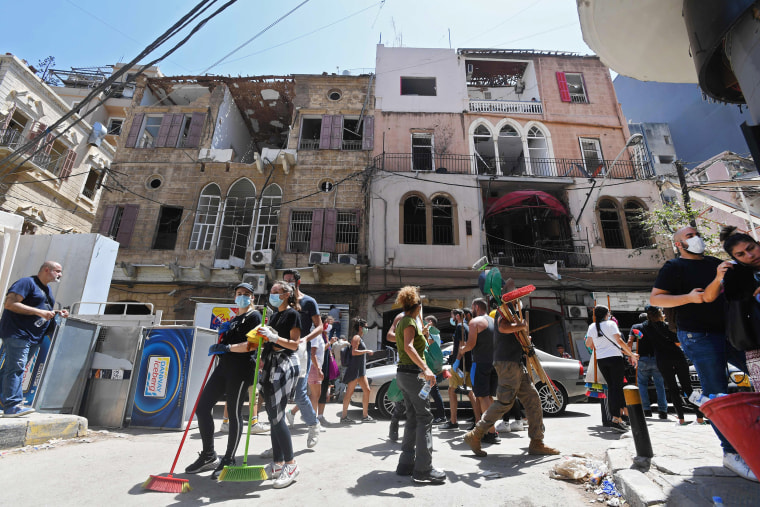
The colossal chemical explosion nearly destroyed his apartment, but Naboulsi and his housemate managed to escape injury and carry a friend with a broken leg to the nearest hospital. The incident, one of the largest non-nuclear explosions in history, killed more than 180 people, injured 6,000 and badly damaged the districts of Mar Mikhael and Gemmayzeh, famous for their centuries-old homes, art galleries, bars, restaurants and clubs.
“Going to this area, it just breaks me … We’ve lost most of the venues where we can be ourselves.”
FIRAS NABOULSI
In those districts, many LGBTQ people, like Naboulsi, also found tolerance and safety in a region not known for queer acceptance.
Naboulsi fled the conservative, Sunni-dominated northern city of Tripoli in 2018 for the relative freedom of Beirut. He said he found what he was looking for: acceptance, friends and a family he chose for himself. But now, following the blast, he said “it was all shattered.”
“Going to this area, it just breaks me,” he said of the torn-apart section of the city he calls home. “We’ve lost most of the venues where we can be ourselves in, and put aside that we’ve lost our jobs, our houses are damaged.”
Following the blast, Naboulsi’s parents, with whom he had not been in contact for two years, came to pick him up and take him back to his hometown. He said relatives had previously threatened him after he had revealed that he worked as a drag performer on social media, but he went anyway. The reunion, however, was short-lived.
“My parents are super religious, so my mom had this conversation with me where she was like, ‘Ah, you can’t stay here because my religion wouldn’t allow me to keep you here, because you’re gay, because you do a lot of things that we can’t accept,’” he said.
Volunteers clear the rubble in the Gemmayzeh neighborhood of Beirut on Aug. 7, 2020.AFP – Getty Images
Just three days after the blast, Naboulsi was back in Beirut. He said the feeling of rejection was more devastating this time than when he first left home.
“It hurt way more knowing with everything that happened in Beirut, you still … have to leave home because you’re gay,” he said. “I was so close to los[ing] my life, and the only thing you had to say was, ‘I can’t accept you, because my religion doesn’t allow me to.’”
The Arab world’s progressive enclave
Lebanon is considered relatively liberal in the Arab world, even though it remains one of the approximately 70 countries around the globe that still criminalizes homosexuality. Vocal advocates in the tiny Mediterranean country defend LGBTQ rights, and gay bars and clubs are allowed to operate. And while cases involving homosexuality still go to trial from time to time in the country, an 80-year old article in the penal code prosecuting homosexual relations has been undermined in recent years by a successful campaign waged by activist lawyers to obtain liberal judicial rulings, which have made it increasingly difficult to criminalize same-sex relationships.
In 2017, a judge in Lebanon ruled for the first time that homosexuality is not a crime, so long as it is not in public, with a minor or under coercion. However, some police officers still use the law as a basis to arrest and harass LGBTQ people, especially transgender people, according to Karim Nammour, an activist and lawyer for Lebanon-based nongovernmental organization Legal Agenda.
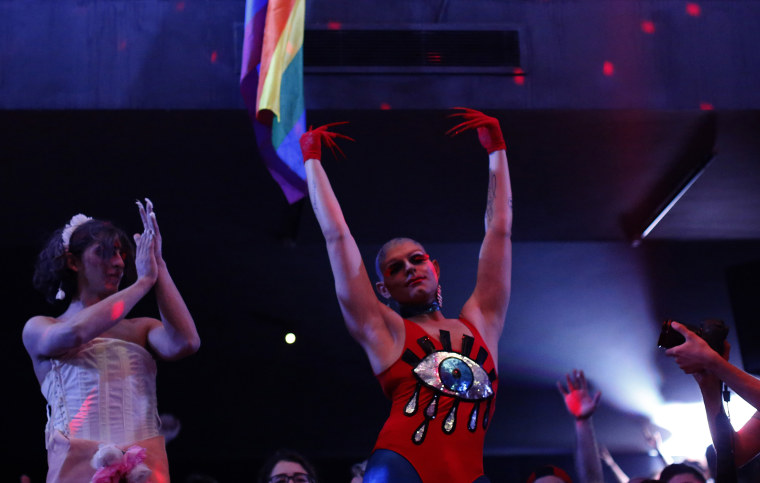
Elias, 24, who goes by the stage name of Melanie Coxxx performs during a Sunday drag queen show, called the drag ball, during Beirut Pride week, north of the capital Beirut on May 13, 2018.Hassan Ammar / AP
And while Lebanon is progressive when compared to its neighbors, Beirut is progressive when compared to the rest of Lebanon.
“When you want to look at Lebanon as a whole, at least from a personal queer perspective, you have to separate Beirut from the rest of it at least in terms of tolerance,” Sandra Melhem, an LGBTQ activist and owner of Beirut gay club Ego, said.
Melhem called the neighborhoods of Mar Mikhael and Gemmayzeh hubs for the city’s queer community and slammed government officials for storing nearly 3,000 tons of highly explosive ammonium nitrate in the heart of the densely populated capital city for years.
“They kind of took away our hope,” she said. “These are the streets we all live in — not all of us, but a lot of people that are young, that are artists, that are invested in changing the country.”
‘A sense of unity’
Melhem is among those who have turned their anger into action. When she saw that her LGBTQ neighbors had lost homes and didn’t have money to eat, she launched a fundraising campaign. She called out on social media to people who needed help and others who could provide it and was surprised by the response. She said the desire to help overcame a former lack of cohesion among different groups within the lesbian, gay, bisexual, transgender and queer community.
“We got a lot of people who were keen on supporting this and started sending food provisions, hot meal donations, detergents, clothes [and] medications,” she said. “We got three registered nurses on board volunteering, two paramedics … we were actually able to go on ground and start working.”
More than 50 volunteers showed up, including some from Beirut’s LGBTQ community whom she had never met.
“For the first time in years, we are all working for one purpose: to get each other out of this mess. Honestly, the past two weeks have shown a sense of unity I have not seen in a very long time,” Melhem said.
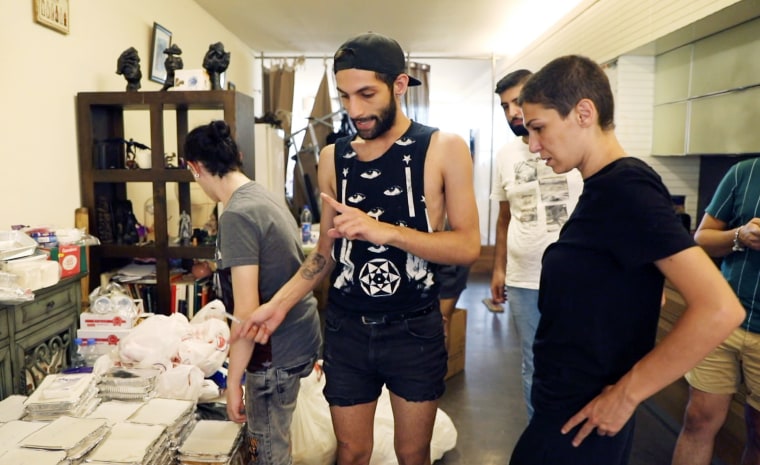
LGBTQ activist and bar owner Sandra Melhem, right, organizes the distribution of food and supplies with volunteer Firas Naboulsi in Melhem’s Beirut home.Mohamed Muslemany
She turned her spacious two-room apartment into a storage space for neatly stacked food trays, cases of bottled water and piles of care packages tailored to specific needs.
Omran Gharib, 26, a registered nurse, was among those who answered Melhem’s appeal on Instagram. He paid home visits to the injured to change dressings and listen to their concerns.
“The most common thing was they were scared of what happened, and they cannot handle the fact that they lost it all,” Gharib said. “They lost the places where they had so much memories, and now there is no place to be like themselves.”
Andrea Nagerian, a 23-year-old drag queen and makeup artist, lost his home in the blast and had to run to a hospital after suffering multiple cuts and internal bleeding. He stayed at Melhem’s home during his recovery and then joined the aid effort.
“The only way we can really use our anger to our benefit is by helping people or helping ourselves to get through the trauma,” Nagerian said. “Right now, we are really focusing on helping … marginalized groups as much as possible … people who are in the depths of poverty.”
Naboulsi has also found solace in helping. After repairing his ruined apartment enough to make it habitable, he spends most of his day at Melhem’s house.
“I’m around my friends and at the same time helping people, so I don’t have this free time to keep thinking about what happened, to keep thinking about what’s going to happen,” he said.
The aid and outreach from the city’s LGBTQ community to other communities following the explosion also helped to change some hearts and minds, according to Melhem.
“We’re entering areas I would never have sent the boys to if they looked very flamboyantly gay. You know, they would be harassed,” she said. “Now when they’re going and they’re lending a helping hand to marginalized communities, people in need … you see that there’s acceptance from the people who previously we would not ever have gone to. So I think it is also lifting the threshold of tolerance.”
While many in Beirut’s queer community are still mourning the loss of homes and popular venues in their neighborhood, Melhem said she’s hopeful that this once-vibrant hub that provided freedom and acceptance can be revived. Her next step is to set up a committee tasked with disbursing donated funds to help people rebuild, and there is also a grassroots movement composed of activists urging desperate residents not to sell to developers seeking damaged but valuable property.
Nagerian said he believes the community can come back even stronger than before.
“I’m someone who lost their home, got severely injured, and I experienced first-hand the explosion, and I’m saying there’s a glimpse of hope — even if it’s bare, and you have to believe in it and push forward and try to use this experience to your advantage and build a new version of what you want to see in the world.”
Philippines President Rodrigo Duterte on Monday pardoned a United States Marine convicted of killing a transgender woman in the country nearly six years ago, sparking condemnation from activists who described the move as a “mockery of justice.”
Lance Corporal Joseph Scott Pemberton was jailed in 2015 for killing Jennifer Laude near a former U.S. navy base. A trial court signed off on his early release last week for good conduct, but was blocked by an appeal from Laude’s lawyers.
A trans sex worker was violently stabbed by her client in São Paulo, Brazil, last Wednesday (September 2) and her body carelessly thrown out of a 7th-floor balcony.
Chiara Duarte, 27, was found dead with multiple stab wounds in Rua Rangel Pestana in the downtown Sé neighbourhood in the early morning, police said.
The suspect, they said, met Duarte and invited her to his apartment. But the night curdled into violence after she asked for payment, sparking a heated argument in which he stabbed her several times with a knife, local mediareported. A merchant, Jeferson Pereira, 18, was arrested by authorities charged with manslaughter after being found with two knives.
Duarte, who both lived at and volunteered with Casa Florescer II, a shelter for trans people, was remembered by her loved ones as simply someone who wanted to be “happy”.
“It was prejudice, it was a hate crime, transphobia,” her brother, Luan, toldGlobo News.
Mother of slain trans woman mourns of the loss of her ‘beautiful’ daughter.
Fala Mãe Londrina, a grassroots network for the mothers of LGBT+ people in Londrina, explained in a Facebook statement published September 4 that Duarte’s mother, who was unnamed, phoned up the shelter after learning of her daughter’s death.
“I want to make a wish for my daughter,” she told the shelter staffers, “my daughter is leaving with lipstick.
“She’s wearing a pink onesie and skirt. She looks beautiful. Needs lipstick, though.”
During Duarte’s funeral at São Luis Cemetery, the statement said, the victim’s mother reflected: “She looks beautiful, right?
“Look girl how beautiful she looks. Isn’t my daughter beautiful?”
Officers from Brazil’s state police agency Polícia Militar arrested Pereira after a witness said they saw him enter the apartment complex at the time of the killing.
In a nation now seemingly inured to homophobia, anti-LGBT+ violence has increased in Brazil in recent years, LGBT+ watchdogs warn. Last year, Brazil was found to be the deadliest country for trans people, with some tallies suggesting that a trans person dies almost every day in a nation of 200 million.
For the attendees of a circuit party in Georgia, coronavirus was the last thing on their minds.
Across digital flyers and social media posts, the organisers of Peach Party Atlanta 2020 urged attendees to come wearing face coverings and practice social distancing.
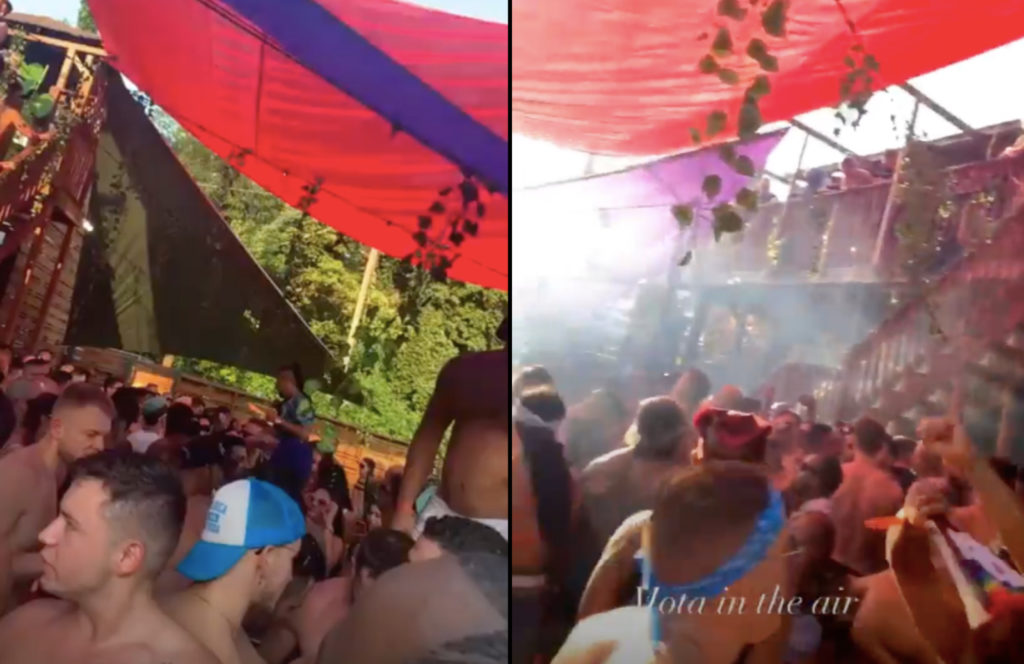
Yet, as much as the four-day festival was billed as a dialled-down affair, video footage taken at the sold-out circuit parties showed a vastly different story.
At the August 28 “Peach Party Tea Dance” held at Atanta LGBT+ club Heretic, scores of partygoers stuffed into the 1,000 square foot-wide space across three patios, fans occasionally dotting the dancefloor.
Despite signs instructing partygoers to maintain a distance as well as wear masks, the dance area was rammed with countless men pressed up against one another, and barely anyone was wearing a mask.
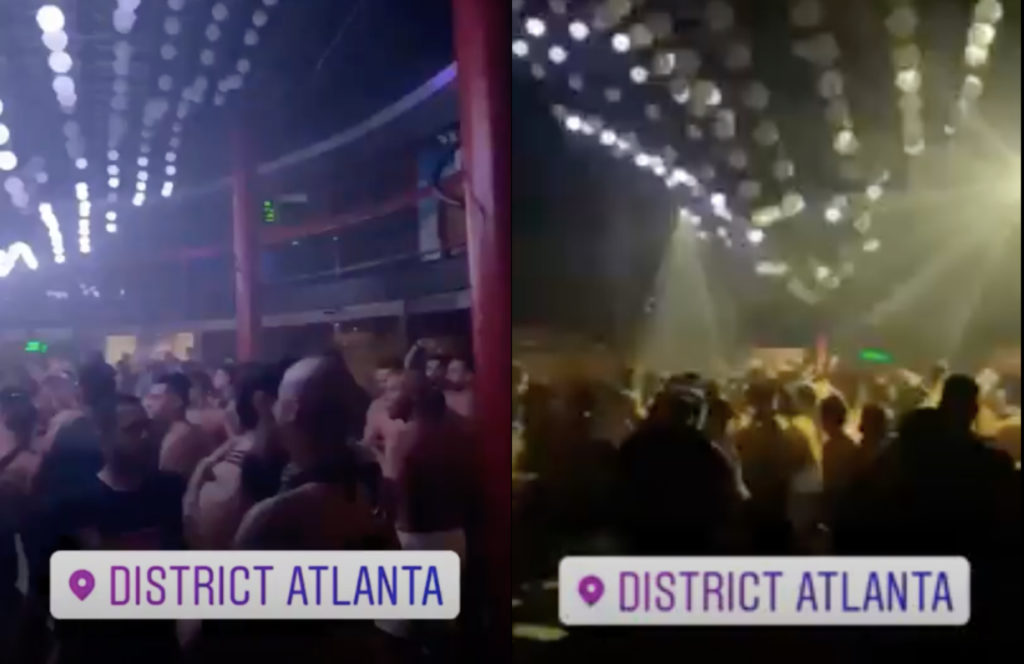
Similar scenes took place at a second Peach Party event held in Heretic the following night, as well as another event at District Atlanta on August 30, according to social media videos uploaded by attendees.
Just one event was held outdoors – the other six were in nightclubs, spaces considered by health experts as petri dishes for the coronavirus.
(Screen captures via Instagram)
Scenes of shirtless, maskless men at gay circuit party spark fury online.
For nine years, Peach Party has been a highlight of the Georgia circuit party calendar and a crucial way for the city’s LGBT+ community to blow off steam.
The beloved festival, typically held in June, was thrown into jeopardy as the coronavirus began to gnaw on nearly every facet of modern life and was delayed earlier this year.
Peach Party announced it would be running in August, with its website saying it has “scaled all events back to a small group instead of the normal party”, and noted that masks were “required”.
Heretic’s general manager Alan Collins beamed with pride in an August 13 Facebook post as he showed off a revamped patio space outside the club, now splashed with the colours of the Pride flag, prepping for the outdoor party.
Heretic hosted a queer circuity outdoor party event where patrons appeared to rarely wear face masks or conduct social distancing, despite club operators saying it would be mandatory. (Screen captures via Instagram)
He urged club-goers to come wearing masks and said that staffers could provide free masks as needed.
Moreover, Collins said, Heretic would operate at 35 per cent capacity and had installed hand sanitiser stations, in line with the Georgia Department of Health’s guidelines for bars operating amid the pandemic.
The code states that bars must “prevent activities that enable close human contact”, and that, for temporary outdoor events in which more than 50 people are attending, social distancing must be enforced.
“If you are sick or think you may have been exposed to COVID-19, PLEASE STAY HOME,” Collins added.
As images of the Peach Party crowds radiated online, some Facebook users branded those in attendance as “reckless”, while others simply resigned to saying: “No one cares anymore.”
At the time of writing, there have been at least 256,544 cases and 5,604 deaths in Georgia since the beginning of the pandemic, according to a New York Times database. More than 187,000 people have died across the US.
PinkNews contacted Peach Party Atlanta, Heretic and District for comment.
Democratic presidential nominee Joe Biden added several former Obama administration officials as well as former South Bend, Ind. mayor and presidential hopeful Pete Buttigieg to his transition team.
According to multiple media outlets, former National Security advisor Susan Rice and former Deputy Attorney General Sally Yates are joining the transition team.
New Mexico Gov. Michelle Lujan Grisham (D) and Jeff Zients, former President Obama’s National Economic Council director, will also reportedly join the transition team as co-chairs.
Dictionary.com has released its “biggest ever update”, revising definitions and adding 650 new words relating to race, mental health, climate and the LGBT+ community.
The dictionary has revised the definitions of many LGBT+ words to put “people first”, including replacing the word “homosexual” with the words “gay, gay man, or gay woman”.
The site explained: “For example, we now define gayness as ‘gay or lesbian sexual orientation or behavior’ compared to the outmoded gloss of ‘homosexuality’. These changes alone affect over 50 entries.
“The previously used terms, homosexual and homosexuality, originated as clinical language, and dictionaries have historically perceived such language as scientific and unbiased.
“But homosexual and homosexuality are now associated with pathology, mental illness, and criminality, and so imply that being gay – a normal way of being – is sick, diseased, or wrong.”
The online dictionary has also given Pride – with a capital P – its own entry “to better document the specific, widespread use of the term”.
Dictionary.com added that the revisions will “help eliminate heterosexual bias in language, they also help better convey the diversity and richness of… human sexual experience and identity”.
Other new LGBT+ entries on Dictionary.com include the words “ace, ambisextrous, asexual, biromantic, deadname, gender-inclusive, gender diversity, and trans+”.
Another major update to the dictionary was the capitalisation of the word Black when used in reference to people.
“Capitalising Black confers the due dignity to the shared identity, culture, and history of Black people,” the site said.
“Dictionaries are not merely a linguistic exercise or academic enterprise.
“What are the effects of Black, referring to human beings, being grouped together with black, which can mean, among other things, ‘wicked’?
“The effects are social. They are psychological. They are personal. How words are entered into the dictionary – especially words concerning our personal identities – have real effects on real people in the real world.”
Dictionary.com added: “Change is constant, a principle that’s true in language as in life.
“No matter what is happening in the world, we’re committed to documenting and describing – and helping you stay informed on and, yes, sometimes entertained by – the English language as it evolves.”
In the midst of a worsening pandemic and with record numbers of Americans unemployed, the president and his administration have focused their attention on something else entirely — giving federally funded shelters a license to discriminate against transgender people.
Under the Obama administration, the Department of Housing and Urban Development (HUD) implemented and strengthened a policy known as the Equal Access Rule to guarantee that HUD-funded shelters are open to all Americans, specifically putting protections in place to ensure trans individuals can seek accommodations that correspond to their gender identity.
Now, at a time when access to safe housing is absolutely vital, HUD is advancing a rule change that would enshrine anti-trans discrimination in federal regulations. This senseless policy needlessly puts lives at risk, and it’s critical that the American people speak out about why this rule change is dangerous and contrary to our values.
On July 24, HUD published its proposed rule change and initiated a public comment period that will run through Sept. 22. In an announcement made on July 1, HUD claims, “the proposed rule modifications also better accommodate religious beliefs of shelter providers.” HUD cites no evidence that the existing rule is placing an undue burden on faith-based shelter providers. In response to a Freedom of Information Act request in 2017, HUD was unable to locate any requests for waivers or accommodations or complaints made while the Obama-era Equal Access Rule protections were in place.
HUD has indicated that it will not recognize the recent landmark U.S. Supreme Court ruling in Bostock v. Clayton County which affirmed that Title VII of the Civil Rights Act protects the LGBTQ community from discrimination based on gender identity and sexual orientation, and is pressing forward with this discriminatory rule.
HUD has also perpetuated the dangerous myth that protecting transgender people’s access to accommodations that reflect their gender identity puts others at risk without citing a shred of evidence. In the text of the proposed rule itself, HUD admits that it is not aware of any data suggesting that transgender individuals pose an inherent risk to biological women. Nondiscrimination protections have been in place for years in more than 20 states and 300 localities with no increase in public safety issues.
These are simply bad faith arguments by HUD Secretary Ben Carson, someone who has openly denigrated transgender women as “big, hairy men” in front of his own agency staff. The rule is more of the same, allowing shelter staff to judge the physical characteristics of those seeking services to decide who is sufficiently male or sufficiently female. His long history of vitriol toward the LGBTQ community and determination to press forward with this deeply anti-trans policy is a total departure from the mission of HUD, “to create strong, sustainable, inclusive communities and quality affordable homes for all.”
The right to safe housing should never be obstructed by the political or social beliefs of others. But even worse, this anti-transgender proposal directly targets a group that has historically and disproportionately suffered from the hardships of homelessness. According to the 2015 U.S. Transgender Survey, nearly one-third of transgender people experience homelessness at some point in their lives and 70 percent reported mistreatment in shelter due to their gender identity.
Removing these protections puts individuals living in states without protections at risk of being left on the streets. The consequences are often dire when a transgender individual is turned away from an emergency shelter.
While I have introduced legislation in the House to block this rule, the most immediate step we can all take is to speak out against this dangerous and discriminatory policy. It is critical that the public submit comments — which you can do here — urging the Trump-Pence White House and HUD to abandon this reckless proposed regulation.
In August, I led 144 of my colleagues in the House and Senate in a public comment letter to Secretary Carson demanding that this rule be rescinded.
We need to fight this policy like trans lives depend on it — because they do.
Jennifer Wexton is a member of the U.S. House of Representatives for Virginia’s 10th District. Follow her on Twitter: @RepWexton.
Texas assistant attorney general Nick Moutos has lost his job after he was criticised for past tweets in which he called trans people an “abomination” and promoted the QAnon and Pizzagate conspiracy theories.
Moutos is a lawyer and, until this week, was an assistant attorney general in Texas’ criminal prosecutions division.
On Thursday (September 3) Media Matters produced a report detailing Moutos’s racist, transphobic, homophobic, misogynistic and Islamophobic tweets, as well as his support of the controversial conspiracy theories. Every tweet included in the report was published by Mouto in 2020.
QAnon followers, among many outlandish claims, believe that Satan-worshipping paedophile rings involving high-ranking officials are working to take down president Donald Trump. Those who believe the conspiracy theory have been accused of inciting violence, and it was labelled a potential domestic terror threat by the FBI last year.
Pizzagate is another right-wing violence-linked conspiracy theory which preceded QAnon, and its supporters believe that Democrats have been trafficking children through a pizza restaurant in Washington, DC.
In July this year, Twitter announced that it would be cracking down on QAnon content on the platform.
Moutos responded to the announcement: “Q must be getting close to outing you as a pedophile or child trafficker or perhaps involved with Pizzagate?”
He has repeatedly used his Twitter account to refer to women, including house representatives Alexandria Ocasio-Cortez and Ilhan Omar, as “Whore of Babylon”. When tweeting at both women, he used the hashtag “no warning shots” and suggested he was “armed and ready”.
Moutos is viciously Islamophobic, comparing Muslims to Nazis, and has also said that Omar is an “incestuous jihadi terrorist” who belongs in Guantanamo Bay.
He has described Islam as a “virus” that “seeks only to steel, kill, and destroy”, and claimed that the UK is “overrun with Muslims”.
The lawyer believes that the US is in the middle of a second civil war, and threatened Barrack Obama on Twitter: “I pray to meet you on the Civil War 2 battlefield.”
Moutos has also posted multiple anti-LGBT+ tweets, including ones calling trans people “abhorrent” and “an abomination” who “have a mental disorder”, and saying that supporting queer rights is “normalising perversion”.
Texas assistant attorney general Nick Moutos lost his job following the backlash against his comments.
Initially, when contacted about Nick Moutos and his comments on Twitter, a spokesperson for Texas’ office of the attorney general told Media Matters: “Thank you for bringing this to our attention.
“We’re looking into the matter and will address it as appropriate.”
But now, according to the Houston Chronicle, a spokesperson for the office said he no longer works there, without specifying why.
Moutos, however, wrote on Twitter: “Speaking out against the China Virus Plandemic [sic] & Democrats using it to steal Election 2020 makes people angry.
“Stories slamming me and others… were enough to cost me my job.”
On Friday (September 4), addressing the backlash against his anti-LGBT+ comments Moutos wrote on Twitter: “How is it ‘bigoted’ to say that LGBTQ is an abomination?”