A transgender man was attacked by two assailants Sunday night inside a Philadelphia 7-Eleven, according to his family.
The man stopped in the store around 9 p.m. after OutFest, an annual block party celebrating the city’s LGBTQ community.
Video surveillance footage from inside the gas station shows the 30-year-old being repeatedly punched and thrown onto the ground. Two of the victim’s sisters, who did not want to be identified, told WCAU, NBC’s local Philadelphia affiliate, that their brother was kicked in the head multiple times.
The victim was wearing a “Trans Lives Matter” sweatshirt, which his family believes may have caused the ambush.
“I’m very hurt that my brother is sitting very hurt with a broken jaw, eyes messed up and nobody helped him,” one sister said. “I just want the people to get caught.”
One worker who claimed he was at the store at the time of the incident told WCAU that he wasn’t sure how the altercation began.
The family said they reported the incident to the police, however the Philadelphia Police Department denied NBC News’ request for information regarding whether it planned to open an investigation into the incident.
Since 2014, the total number of hate crimes motivated by anti-LGBTQ bias has increased every year, rising 3 percent in 2017, according to the FBI. A separate survey from Gallup found that almost 17 percent of all reported hate crime victims are lesbian, gay, bisexual or transgender.
Trans people of color remain an especially vulnerable population. Since the beginning of 2019, at least 19 trans people have been killed, according to the Human Rights Campaign.
“What hope do we have to be ourselves if we can’t be out here and be ourselves?” the victim’s other sister told WCAU.
The U.S. isn’t the only country plagued by anti-trans attacks. According to a Home Office report released Tuesday, over the past year hate crimes against transgender people in England and Wales have risen by 37 percent. From April 2018 to March 2019, there were 2,333 reported hate crimes against transgender people, up from 1,703 the previous year.
Some 21% of LGBTQ adults aren’t registered to vote, according to a study released this week by the University of California, Los Angeles’ Williams Institute. That’s compared to an estimated 17% of non-LGBTQ adults.
The finding, part of a larger poll of 2,237 people that measured LGBTQ voters’ demographic characteristics and political attitudes, came as LGBTQ rights have taken center stage in the national conversation. Meanwhile, Friday marked National Coming Out Day.
Some LGBTQ voters already face an uphill battle making their voices heard at the ballot box.
“Voter suppression has primarily targeted voters of color, who also happen to include LGBTQ Americans, who far too often face disproportionate barriers in accessing their right to vote,” Human Rights Campaign president Alphonso David told the Washington Post after HRC, a nonprofit that advocates for LGBTQ rights, backed a voting-rights initiative led by former Georgia gubernatorial candidate Stacey Abrams.
For instance, David said, voter-ID laws in some states requiring that a person’s documentation match their birth-assigned gender could preclude a transgender person from casting a ballot. While about 137,000 transgender people who had transitioned in the U.S. were eligible to vote ahead of the 2018 midterm elections, more than half might not have had documentation or ID that correctly reflected their gender, the Williams Institute found in August 2018.
XSEE ALSOQueen’s Speech Opens Crucial Week for Brexit
PauseUnmuteCurrent Time 0:00/Duration Time0:00Fullscreen
Half of the LGBTQ adults registered to vote next November said they were Democrats, 22% were independents and 15% were Republicans.
With that said, almost 9 million LGBTQ adults are eligible and registered to vote next November, according to the most recent poll, which was conducted by Ipsos in collaboration with the Williams Institute and Thomson Reuters. Half said they were Democrats, while 22% were independents and 15% were Republicans.
The sample included 136 registered LGBTQ voters and 1,836 registered non-LGBTQ voters.
LGBTQ rights feature in the 2020 presidential race
The analysis by the Williams Institute, a UCLA Law think tank that researches sexual orientation, gender identity and public policy, comes ahead of a high-stakes election in which civil-rights protections for LGBTQ people could hang in the balance.
The Equality Act, a bill that would shield LGBTQ individuals from discrimination in credit, housing, employment and a range of other areas, passed earlier this year in the Democrat-led House. Activists believe that turning the Republican-led Senate blue in 2020 would boost the bill’s chances of being signed into law.
Many leading Democrats vying for the 2020 nomination — including former Vice President Joe Biden and South Bend mayor Pete Buttigieg, the only openly gay candidate running — have thrown their support behind the Equality Act. Sen. Elizabeth Warren (D-Mass.) has also proposed abolishing the filibuster to clear a path for the Equality Act’s passage, should Senate Republicans block it.
‘LGBT voters differ from non-LGBT voters in several ways. For example, they are more likely to be young, male, and live in urban areas.’ —Study author Christy Mallory, the Williams Institute’s state and local policy director
Senate Majority Leader Mitch McConnell has not brought the bill to the floor, and President Trump’s administration has claimed that the bill in its current form “is filled with poison pills that threaten to undermine parental and conscience rights.”
“I’m just going to be blunt: We’ve got to have some more Democrats in the Senate,” Warren said during CNN’s Equality Town Hall on Thursday, responding to a question about how to ensure that the Equality Act passed the Senate. “I’m willing to continue to push Mitch McConnell right now, but my No. 1 goal is to make sure he is not the majority leader come January 2021.”
The Supreme Court will make critical decisions for LGBTQ protections
Separately, the U.S. Supreme Court heard arguments on Tuesday to determine whether Title VII of the 1964 Civil Rights Act, which prohibits sex discrimination, also protects LGBTQ people from discrimination in the workplace on the basis of gender identity and sexual orientation.
LGBTQ people were more likely than their non-LGBTQ counterparts (51% to 40%) to support “a career politician who knows his or her way around the political process,” the Williams Institute study found. LGBTQ voters and non-LGBTQ voters alike showed greater support for younger candidates, and both groups signaled that the race of a candidate wouldn’t impact how they voted — though LGBTQ voters were more likely than non-LGBTQ voters to back a candidate because that person was black or Latino.
Majorities of both groups said it wouldn’t matter to their vote if a candidate were gay or lesbian, but far more LGBTQ voters than non-LGBTQ voters said they were “more likely to support a gay candidate” (41% to 10%) or “more likely to support a lesbian candidate (34% to 11%). LGBTQ voters also showed greater support for hypothetical candidates who were transgender or gender-nonbinary.
“LGBT voters differ from non-LGBT voters in several ways. For example, they are more likely to be young, male, and live in urban areas,” study author Christy Mallory, the Williams Institute’s state and local policy director, added in a statement. “LGBT voters are also more likely to identify with the Democratic Party. Over four million LGBT Democrats are eligible to vote in the primaries next year.”
Gold medalist Kerron Clement is finally ready to share his story. The track athlete publicly came out Friday, on National Coming Out Day, exclusively telling Out, “I was tired of loving in the dark.”
“I have been through what a lot of people have been through which is being afraid of being who you are,” he says. “I struggled with my sexuality for 17 years. Over time, as you get older, you care less. Now it’s time to just be yourself and be free. That’s what I’ve become, free.”
Clement competed in the 2008 and 2016 Olympic Games, in Beijing and Rio de Janeiro, respectively. The track star won gold and silver medals in 2008, and another gold medal during his Olympic return.
Clement has also worked as a model and actor. In 2011 he made a fleeting appearance in a Beyonce video (at 1:47) despite “being more of a Mariah Carey fan.”
Rainbow Rebellion, the LGBT+ branch of Extinction Rebellion, is trying to show that during an ecological crisis, it’s marginalised communities who will be hit first.
Extinction Rebellion has organised a fortnight of international action, which began on October 7, in cities around the world, calling for governments to take immediate action to address climate change.
He said: “We are a diverse network hailing from all walks of life, united in the belief that climate breakdown and ecological crisis is not only a crisis of the planet, not only a crisis of migrants, but is a crisis of the LGBT+ community as well. There’s no Pride in ecocide.
“LGBT+ people, particularly migrants, disabled people, trans folk and people of colour, are facing disaster on multiple fronts.
“Austerity is killing us off in vast numbers, hate crimes against us have risen exponentially since the financial crash in 2008, and more recently risen since the EU referendum.
“Homelessness is rising, with 24 percent of homeless youth identifying as LGBT+.”
He continued: “As climate breakdown and ecological crisis accelerates, it is the minority communities and the marginalised who will be hit first. And we refuse to let that happen. We are here as part of a nationwide fortnight of action by Extinction Rebellion.
“The queer community are seasoned protesters. We have fought for our survival before, and we will do it again… This is everyone’s fight.”
Extinction Rebellion posted on Twitter: “ExtinctionRebellion has its first marriage. In love, and in rage, they stand on Westminster Bridge to be married. #RebelForLife
“We rebel for their future. They rebel for yours. We all encourage each other.”
In much of America, you can still be fired for being gay. You can be denied government services. You can lose your home. Ensuring our basic civil rights protections is at the heart of the cases that the Supreme Court is hearing this week. Businesses have been a key community that have stood with us in this legal effort. They signed on to a friend-of-the-court brief in record numbers, and they are a key component of the coalition that is pushing to pass the Equality Act.
There is another important way that businesses, and other large employers, are showing up for us. Next week, more than 6,000 people will be coming to Washington, D.C. to take part in the Out & Equal Workplace Summit, the largest gathering of LGBTQ professionals anywhere in the world. These attendees come from 38 countries and represent more than 70% of Fortune 1000 companies. And it’s not just the business sector; five U.S. government agencies are also sponsoring this conference.
Summit is a forum for thought leadership. It brings together a richly diverse group who raise ideas and programs that push the envelope, who give visibility to often ignored identities, and who establish best and next practices. Summit workshops and stages are where the next iteration of LGBTQ workforce inclusion is showcased: The future is pan. It is non-binary. It is unafraid to call out racism. It openly acknowledges the significance of mental health at work.
What started as a small gathering 20 years ago has grown into a powerful testament of the commitment of leaders of large businesses to further equality and belonging. What can explain this meteoric growth?
First, large businesses increasingly understand that fostering inclusion impacts their bottom line. When people can show up authentically at work, unencumbered by fears – of social isolation, judgment, or worse – simply because they happen to be LGBTQ, individuals, teams and, yes, businesses and other types of organizations thrive.
This business case is particularly pronounced when it comes to recruiting and retaining top talent. Companies who fail to create a workplace atmosphere where employees feel comfortable end up losing out. Younger generations, Millennials and Generation Z, identify as not “exclusively heterosexual” in far higher rates than older generations. Business leaders have figured out that they need to adapt if they’re going to survive.
Second, Out & Equal has transformed its approach to facilitate and support the type of interaction professionals and organizations need to succeed in these times. Historically, organizations like ours invested in developing proprietary knowledge and passing it out to the businesses that we want to impact. That top-down approach may have been the norm in the past, but it is no way to get things done in today’s interconnected world. It’s also a wastefully inefficient way to bring change.
Our approach starts with the recognition that nobody has a monopoly on good ideas. Rather, the people within these companies and government agencies who work – day in, day out – on improving the work lives of LGBTQ employees have a great deal of knowledge. We can do more for our cause by creating opportunities for these practitioners to come together, learn from each other, and co-create better solutions to the challenges that need to be addressed.
The 6,000 people who will be at the Workplace Summit will certainly have the opportunity to learn from each other. But it’s not the only such opportunity available to them.
In the United States, we know that there are different religious and cultural contexts that impact what it’s like to lead LGBTQ lives. Life in San Francisco or New York is different than in the rural South. The tools that have been used successfully in big cities to impact workplaces need to be tailored in order to be as effective in rural settings. This awareness drove us to convene two forums this year in the South. By bringing southerners together to explore the obstacles they face, and the solutions that have worked in their companies, we can catalyze change. The answer is never one-size-fits-all.
The same logic applies to our work outside of the United States. We forge partnerships across Latin America and hold summits in Brazil, India, and China. We know that the most impactful thing to do is bring together our partners who function in those regions so that they can figure out together the strategies and nuances that they need to pursue to make their workplaces ones where all people are equal, belong, and thrive.
You might be surprised to hear that businesses are sharing their best practices with one another. They certainly are! I can tell you, in these trying times, they are less interested in competing in the areas of diversity and inclusion, than in coming together to more efficiently improve their organizational cultures. This realization drove us to develop a new online Global Hub (in partnership with JP Morgan Chase) that gives change agents in each organization a secure portal in which they can engage with their colleagues at other businesses – anytime, anywhere.
The legal advocacy being done to protect LGBTQ rights to employment, at the Supreme Court and vis-à-vis the Equality Act, matters. As our community pursues these basic protections, we also need to invest in what it takes for each of us to be ourselves and to thrive at work.
Work is where we spend most of our waking hours. We interact with our coworkers. We brainstorm together. We grab coffee together. It is who we share our lives with. But too many people in our community, even if they do not fear that they will be fired for who they are, do not work in a space that allows them to fully share who they are. The work that gets done at Summit in Washington next week, and all around the year by Out & Equal and our partners, is how this reality gets better.
Erin Uritus is CEO of Out & Equal Workplace Advocates, the world’s premier nonprofit dedicated to achieving global LGBTQ workplace equality.
A Syrian father of a gay man says he hopes his son will burn in hell. A woman says her once-loving father now wants her dead. And the day one young Syrian told his parents he was gay was the last time he spoke to anyone in his family.
Like countless fellow countrymen and women fleeing the civil war, many LGBTQ Syrians have lost their homeland, livelihoods and often hope itself. But many of them have also lost the little they had left over — their families and communities, who are unable to accept them.
The mentality they’re up against is uncompromising. One conservative Syrian imam confidently told NBC News that there are no homosexual Muslims and that the act was punishable by death.
Fuad al-Essa came out as gay after he fled war-ravaged Syria and settled down in Turkey in 2017.
“I was living a nightmare,” al-Essa told NBC News, sitting in a cafe in the Turkish city of Gaziantep, just 80 miles north of his native Aleppo in Syria. “It broke my heart that I was scared to death to talk to my parents about my identity. It broke my heart that my parents were the ones I was most afraid of.”
“They believe I have a devil inside of me.”
He says he eventually worked up the courage to call his parents who stayed in Syria from Turkey — where it is relatively safer to be openly gay — and “face them with the truth.”
“I told my father that I will always love him and the family, but this is my life and I will not hide myself anymore,” al-Essa, 27, said. “That was the last time I talked to him.”
According to the United Nations Refugee Agency, more than 5.6 million people have fled Syria since 2011 to escape the bloody civil war.
There are no exact figures on how many Syrian refugees who identify as lesbian, gay, bisexual, transgender and queer or questioning (LGBTQ) have left the country devastated by years of war.
Their numbers are not widely documented as even human rights organizations, such as Amnesty International and Human Rights Watch, have told NBC News they had been unable to do much work on LGBTQ issues in Syria due to limited resources on the ground.
OutRight Action International, a U.S.-based nonprofit that works to defend human rights for LGBTQ people around the world, said they have found that Syria is one of 30 countries in the world where no LGBTQ organizations could be found, whether registered or unregistered — meaning there is no concerted advocacy for change.
It said it also means LGBTQ Syrians don’t have any groups to turn to for advice, knowledge, information or support, making their lives that much more challenging.
Amira al-Tabbaa has been an LGBTQ activist since 2004.
The 35-year-old English literature graduate from Damascus who fled to neighboring Lebanon in 2014 said Syrian families typically do not even talk about LGBTQ issues.
“They will say — don’t talk about it, you are fine. Just don’t talk about it,” she said on the phone from Lebanon.
Women who reveal their nontraditional sexual orientation to their families often get beaten for “bringing shame on the family,” she added. Some are kept at home and not allowed to communicate with anyone, so their actions can be controlled.
“Some will be taken to a psychologist to fix them,” al-Tabbaa said, adding that while all LGBTQ individuals face discrimination in Syria, the social stigma is worse for women, because they symbolize “dignity of the home.”
She said fleeing Syria is dangerous in general, but escaping as a LGBTQ individual can be especially perilous.
“I am hearing from men and women who are really suffocating in Syria and they really need to get out, but there is no way out,” she said.
‘No homosexual Muslims’
Syria is majority Muslim, a religion that prohibits same-sex relations.
According to Abo Abdulrahman al-Ansari, a conservative imam and member of the Shariah council in the northwestern Syrian city of Idlib, homosexuality is strictly forbidden.
“I can assure you that there are no homosexual Muslims,” he said. “Its punishment according to Islam is death.”
The religious and societal stigma surrounding homosexuality in Syria means that for many families, having a son or daughter who comes out after escaping the country can bring enormous shame.
Ahmad Hassan’s son Ammar came out as gay after he fled to Germany in 2015.
The 59-year-old broke down in tears talking about his son on the phone from Idlib in Syria, where he lives with his wife and other children.
“My son didn’t just break my heart, he broke my back,” Hassan said. “I’m no longer respected by the others. I can see that in their eyes. I feel their hatred and revulsion towards me.”
He said he hoped his son would burn in hell for what he did to the family.
“I feel stupid when I think about how much and how long we all cried when he decided to flee to Europe,” he said. “If only he sank in Mediterranean before he reached Europe, I would have cried, but he would have died as an honest, respectful man.”
But for at least some who flee, the pain of losing family is at least party outweighed by the newfound freedom they find in their new homes.
“I used to fight against who I am,” Anas Qartoumeh told NBC News. Courtesy of Anas Qartoumeh
Anas Qartoumeh, who left Syria and settled in Canada at the height of the refugee crisis in 2015, has found a community that accepts him for who he is.
On the phone from Kelowna, a small west coast community where he was the grand marshal at a pride march last year, Qartoumeh, 35, said he had to overcome an internal struggle.
“I used to fight against who I am, I tried to ignore who I was,” he said.
Originally from Damascus, Qartoumeh said he came out when he reached Canada.
And while he enjoys his new home and ability to be himself, he said he misses his family in Syria.
“My door is always open for them if they still want me and accept who I am,” he said. “I don’t think they are ready, not now and not in the future, because they’re very religious. They believe I have a devil inside of me.”
‘I broke her heart’
Sporting short black hair, no makeup and a white T-shirt with the words “live your life” written on it, Hiba said she always had an especially close relationship with her father.
That connection has now turned poisonous.
“The person who was once the closest to me wants to kill me,” said Hiba, 22, fighting back tears at a coffee shop in the southern Turkish port city of Mersin.
Hiba, who spoke on condition that only her first name be used out of fear for her safety, tells her story of love and heartbreak.
After the war broke out, her family left Aleppo due to airstrikes and moved to Atmeh, a small village on the border with Turkey.
In 2014, she met a girl named Aysha, whose family lived in a nearby tent. Hiba says the two decided to run away to “fight for their love.”
They made it as far as Turkey, but their parents soon started looking for them, eventually forcing them to return to Syria.
Hiba, who hasn’t seen Aysha since, says she was not allowed to leave home for weeks and her parents didn’t speak with her.
In March last year, she was forced to get engaged to a man. Days before the wedding, Hiba decided to escape again, making it to Mersin, a community on Turkey’s Mediterranean coast, 140 miles northwest of her native Aleppo.
“I talked to my family and asked for their forgiveness,” she said. “But nothing had changed — my father threatened me on the phone. My mother told me that I’m dead for her and that I broke her heart.”
Hiba has lost more than one love — not only Aysha, but her family who cannot accept who she is. And now she is alone.
A year to the day after crossing the U.S.-Mexico border in May 2018, Luis Rodriguez, 20, writhed on a gurney in a Los Angeles emergency room with a kidney and bladder infection.
He wasn’t just in pain – he was worried. His asylum claim had not yet been approved. He had no work permit, though he’d been working seven days a week anyway. Now he was seriously ill, and bills were mounting.
When Rodriguez arrived in the United States, he had planned to finish his final year of high school, earn a university degree and then become a systems engineer. He’d always been studious and driven in El Salvador, the kid teachers commended. But here in the hospital, his goals seemed out of reach.
He felt alone in this country – but, he told Reuters, he hadn’t had much choice in leaving his own.
Rodriguez is gay. He and his first love, Bryan Claros, were high school classmates, meeting secretly when they could on an isolated stretch of beach outside their hometown of La Libertad. One March night, four gang members surrounded them there, beat up Claros and threatened Rodriguez, both men told Reuters.
“Never show your faces here again,” Rodriguez recalled them saying.
A police detective’s report on the incident, reviewed by Reuters, confirmed the outlines of their account, saying Rodriguez was the victim of “aggravated threats” by terrorist groups or gangs and that “it was recommended that he emigrate … because these individuals who threaten people always act out the threats they make.”
The couple left town within the week, along with Rodriguez’s father, Andres Rodriguez, 52. He told Reuters he accepted his son’s relationship and refused to let the pair risk the journey alone. “He’s my son, and I will always support him,” he said.
They joined a gathering caravan in spring 2018 in southern Mexico. To anyone who asked, the young men said they were cousins.
Just shy of the U.S. border in Tijuana, Mexico, Andres Rodriguez decided not to cross with the younger men, convinced that his case for asylum was not as strong. He waited long enough to ensure his son made it out of detention, then headed home.
Luis Rodriguez and Claros were sent to the Otay Mesa Detention Center in San Diego to await immigration court hearings. There, Rodriguez – schooled by caravan members on the language of human rights – wrote a letter on behalf of 36 other detainees to protest the living conditions.
“In this country,” he wrote, “the First Amendment protects the rights of all human beings no matter their race, religion, nationality, social group, sexual orientation or political opinion. For that reason we urge CCA” – a private company, now called CoreCivic, that runs Otay Mesa – “to treat us like the humans we are.”
The May 2018 letter, reviewed by Reuters, alleged the detained migrants were forced to work six hours a day for $1.50 per hour.
“When we ask for medical attention they do not treat us, and many of us have wounds and pains,” the letter said.
In a statement to Reuters, CoreCivic representative Amanda Gilchrist said work programs were “completely voluntary.” In a separate statement to Reuters, the Immigration and Customs Enforcement agency, which oversees the center, also said work was voluntary and that all detainees were screened for health issues and provided treatment as needed.
Conditions at the center briefly improved and Rodriguez said he suffered no punishment for taking a stand – a result that impressed him.
Rodriguez and Claros were released on immigration parole after four months, each moving in with their respective relatives in Los Angeles.
The young men said the addresses on their court papers were not updated. Receiving word of his San Diego hearing a day in advance, Claros said he rushed more than 100 miles to make it in time. He was granted asylum on October 18, according to his court papers. He then moved in with relatives in Texas.
Rodriguez got notice of his hearing on the day it was to be held and missed it, he said. His next court date is later this year.
After his relative learned he was gay, Rodriguez said, tension mounted in the household and he moved out. He found a job, was fired for being undocumented, then found another as a metal worker. Every day, he worked nine to 12 hours. His relationship with Claros became strained by distance and the pressures in their lives, he said. They broke up.
One afternoon in early May 2019, he was hospitalized in unbearable pain. After 15 days’ absence from work, his boss fired him, he said. Rent was due. His hospital bill climbed to $1,155.
After he was discharged, however, his luck began to turn. His work permit landed and he began applying for jobs the next day. Soon he started as a half-time cashier at McDonald’s, making $14.50 an hour, and took a second job as a house painter.
A friend agreed to help him find a center where he could earn his general education diploma.
Making his way in the United States is still difficult, he said, but things are starting to work out for him.
“To be able to go to school in a few years, I see that as a lot better – because then I won’t have been defeated.”
Founded in 1988 by psychologist Robert Eichberg and activist Jean O’Leary, National Coming Out Day is observed annually on Oct. 11, and it’s day to celebrate and promote the increased visibility of the LGBTQ community. The date was chosen to mark the anniversary of the 1987 National March on Washington for Lesbian and Gay Rights, which drew an estimated 500,000 people to the nation’s capital.
“Most people think they don’t know anyone gay or lesbian, and in fact everybody does,” Eichberg said in a 1993 interview. “It is imperative that we come out and let people know who we are and disabuse them of their fears and stereotypes.”
In honor of National Coming Out Day, here are some of our top coming out stories of 2019.
Sam Smith performs live on stage at The O2 Arena on April 6, 2018 in London.Gareth Cattermole / Getty Images file
Grammy-Award winning singer-songwriter Sam Smith came out as nonbinary on actor Jameela Jamil’s Instagram show “I Weigh Interviews in March.” Smith said when they saw the words “nonbinary” and “genderqueer” and heard people speak about these identities, which are used to describe those who identify as neither exclusively male nor female, they thought, “F–ck, that’s me.” Last month, the artist announced they will be using gender-neutral they/them pronouns.
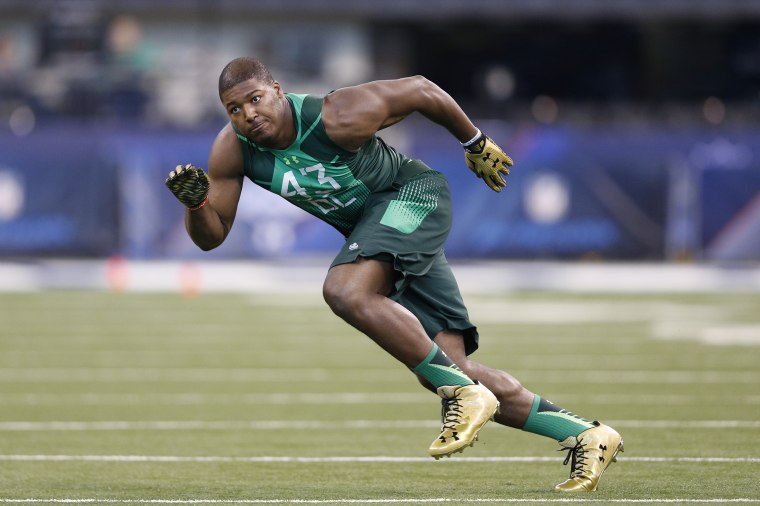
Defensive lineman Ryan Russell of Purdue in action during the 2015 NFL Scouting Combine at Lucas Oil Stadium on Feb. 22, 2015 in Indianapolis.Joe Robbins / Getty Images file
Defensive end Ryan Russell, an NFL free agent, came out as bisexual in an article published on ESPN.com. “My truth is that I’m a talented football player, a damn good writer, a loving son, an overbearing brother, a caring friend, a loyal lover and a bisexual man,” said Russell, who spent one season on the Cowboys roster and played two more for the Buccaneers.
Republican lawmaker Nathan Ivie said it took him more than 20 years to come to terms with his identity. Ivie said he attempted to cure himself of “gay feelings,” but that interacting with gay couples through his passions for the outdoors and photography helped him accept himself.
Mr. Ratburn from the children’s show “Arthur” got married to another man in the show’s 22nd season premiere, spurring effusive reactions from those who grew up watching the program. The historic episode, titled “Mr. Ratburn and the Special Someone,” starred lesbian actor Jane Lynch as a special guest.
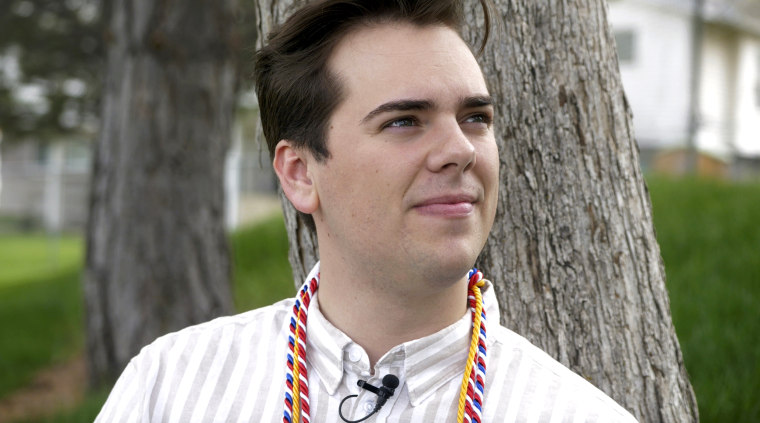
Matt Easton on April 29, 2019, in Cottonwood Heights, Utah.Rick Bowmer / AP
Matt Easton, valedictorian of the Brigham Young University class of 2019, came out as gay in his graduation speech. Easton said he hopes the speech helps ease loneliness felt by other LGBTQ students at the institution where an honor code forbids dating between members of the same sex.
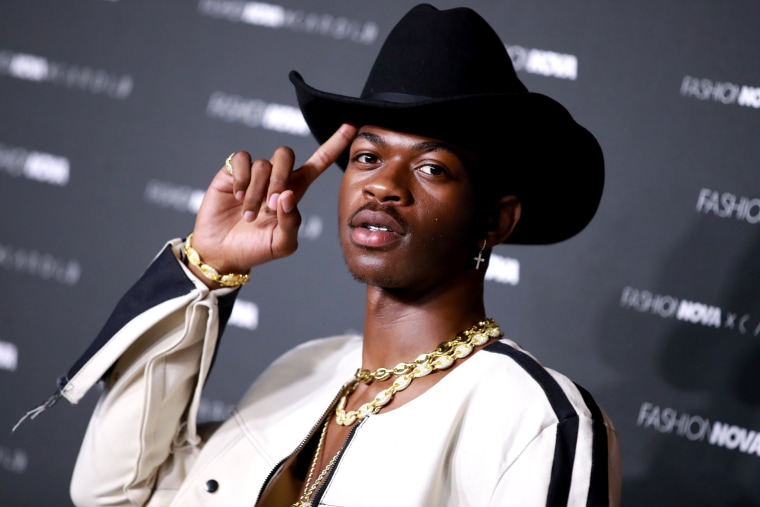
Lil Nas X attends a Fashion Nova launch party in Los Angeles on May 8, 2019.Rich Fury / Getty Images file
On the last day of Pride Month, rapper Lil Nas X came out as gay. The performer — who shot to stardom with the country-rap hit “Old Town Road,” which held the No. 1 spot on the Billboard Hot 100 chart for weeks — asked his followers to listen to his new song, “c7osure,” in which he alludes to his sexuality.
Adrian Brown, 20, first came out to his family as transgender in September of 2018.Kara Davis
The father of five, including kidnapping survivor Elizabeth Smart, announced his departure from the Mormon church and his divorce from his ex-wife in August. “I have recently acknowledged to myself and my family that I am gay. The decision to be honest and truthful about my orientation comes with its own set of challenges, but at the same time it is a huge relief,” Smart wrote in a Facebook post.
Amy Ko, an associate professor at The Information School at the University of Washington, took to Medium to share that she identifies as a woman, prefers she/her pronouns and would like to be called Amy instead of her given name. “Sharing this in such a public way has led a lot of other people in the world coming out to me … that’s helped them have a little bit more courage, in the same way that I got courage from all the people in the world who are out that I saw in public,” Ko told NBC News.
Kristin Brumm with her 16-year-old daughter, Anna.Courtesy Kristin Brumm
After a 16-year-old, who identifies as asexual and panromantic — one who feels their partner’s gender has little affect on their relationship — came out publicly to her neighborhood, neighbors left her flowers and cards at her home as a sign of their support.
Joe Fryer and his partner, Peter.Courtesy Joe Fryer
NBC correspondent Joe Fryer recalls coming out to his family 22 years ago and says coming out is a continuous experience. “I’m still telling people. It happens, for example, when someone sees the ring on my left hand and makes a comment about my ‘wife,’ Fryer wrote. “Most of the time I politely correct them and tell them I have a partner.”
Everyone has a different coming out story. In celebration of Pride Month and the 50th anniversary of the Stonewall riots, a group of LGBTQ people shared how their experience of coming out has changed through the years.
Young people in search of support in coming out can contact The Trevor Project’s TrevorLifeline 24/7 at 1-866-488-7386. Counseling is also available 24/7 via chat every day atTheTrevorProject.org/Help, or by texting 678-678.
Nine Democratic presidential candidates touted their support for LGBTQ rights and sought to illustrate a stark contrast between their views and those of the man they hope to defeat in 2020: President Donald Trump.
A town hall Thursday hosted by the Human Rights Campaign Foundation and CNN focused on lesbian, gay, bisexual, transgender and queer rights. The candidates’ views and policy proposals displayed more similarities — including ending the transgender military ban and passing the Equality Act — than differences.
Each was given about 30 minutes to address issues ranging from HIV prevention pills to hate crimes and violence. While the topics were wide-ranging, five themes could be found throughout the forum: violence, workplace discrimination, religion as a defense for discrimination, the HIV epidemic and LGBTQ youth.
The forum included nearly every top Democratic contender: South Bend, Indiana, Mayor Pete Buttigieg; former Vice President Joe Biden; U.S. Senators Elizabeth Warren, Kamala Harris, Cory Booker and Amy Klobuchar; former U.S. Representative Beto O’Rourke; former U.S. Secretary of Housing and Urban Development Julian Castro; and businessman Tom Steyer.
Bernie Sanders, who had been scheduled to attend, missed the event as he recovers from a heart attack.
Thursday’s town hall in Los Angeles was the second Democratic presidential forum dedicated to LGBTQ issues this year. Last month, an event in Iowa drew 10 candidates.
Ahead of the forum, at least three candidates — Warren, Buttigiegand Harris — released detailed plans to secure equality for LGBTQ people, and their priorities for doing so include a number of similar initiatives.
At the event, Booker called hate violence against LGBTQ people of color “a national emergency” and said he plans to create a “presidential-level effort” against hate crimes and white supremacy.
“We can’t stop there,” he continued. “Thirty percent of LGBTQ youth — 30 percent — have reported missing school in the last month because of fears of their physical safety.”
Booker also promised to appoint a LGBTQ-friendly secretary of education. Warren also made a similar vow.
Many candidates also decried the violence faced by members of the transgender community.
“You’re right,” Harris said after she was interrupted by an activist who shouted that trans people were being “hunted.”
“There has to be serious accountability,” the senator said before highlighting efforts she made as San Francisco’s district attorney to create a plan that prosecutors could use to beat the gay and trans panic defense.
Biden — whose first question came from Judy Shepard, mother of Matthew Shepard, the Wyoming man who was killed in a brutal 1999 hate crime — called for increased law enforcement efforts “to keep watch on these groups that we know are out there, like terrorist groups.”
The former vice president also urged the passing of the Equality Act and predicted “very little disagreement” from his fellow candidates on the issue. Indeed he was right: Every candidate endorsed the Equality Act.
“Let’s remember that even if the Supreme Court upholds the idea that the Civil Rights Act applies to discrimination against, for example, same-sex couples in the workplace, we’ve still got a long way to go when it comes to other forms of discrimination, for housing, public accommodation,” Buttigieg said. “That is why we urgently need an Equality Act. I will fight for that, and I will sign it the moment that it hits my desk.”
Buttigieg, the only openly LGBTQ candidate, drew upon his religious background and said his marriage to Chasten Buttigieg moved him “closer to God.” He also said that LGBTQ people, by dint of being randomly scattered throughout the population, can serve a healing role in society.
“We are in every state, every community, whether folks realize it or not, we are in every family, and that means also we can have the power to build bridges.”
In a viral moment that Warren’s campaign quickly shared in a tweet, Warren was asked what she would say to a potential voter who tells her that his religion makes him believe that marriage is between one man and one woman.
“I’m gonna say: then just marry one woman. I’m cool with that — assuming you can find one,” Warren joked.
Several candidates fielded questions about anti-LGBTQ countries. Biden swore to curtain foreign aid to anti-gay countries, and said Saudi Arabia, which executes gays, has “very little socially redeeming values,” eliciting murmurs from the crowd. “Culture is never a rationale for pain, never a rationale for prejudice,” Biden continued.
Candidates are also united in their mission to improve the HIV epidemic by expanding access to PrEP, pre-exposure prophylaxis, — and aside from lowering the price, some candidates called for more drastic measures.
O’Rourke endorsed an activist effort to #BreakThePatent and strip Gilead of its right to exclusively market and distribute Truvada in the U.S. market — though that privilege ends in September 2020.
Warren touted her plan to publicly manufacture PrEP. “I commit that in my administration, we will let out a government contract to produce that drug and make that drug available at cost, both here in the United States and around the world,” Warren said, avoiding saying the name of the patented drug, Truvada, that will go off patent next year.
Buttigieg, who came out publicly at age 33, was asked about pressure to be an “adequate representative” of the LGBTQ community.
“I so admire people who are coming out at young ages, but also recognize that there is no right age or time to come out,” Buttigieg said. He noted he was well into his 20s before he could admit to himself that he was gay and said that going to war in Afghanistan made him realize he might die without ever “having any idea of what it’s like to be in love.”
Gavin Grimm, a transgender activist and college student, asked Booker about Title IX of the Civil Rights Act, which forbids sex discrimination in education. “As your president,” Booker said, “I will fight for it with the same ferocity the same sense of urgency every single day for LGBTQ Americans.”
Jacob, a young trans boy from Massachusetts, asked Warren about school safety for LGBTQ children. “Here’s what I plan to do,” Warren told Jacob. “I’m going to make sure that the person I think is the best Secretary of Education meets you and hears your story, and then I want you to tell me if you think that’s the right person, and then we will make the deal.”
The event was historic in many ways. It represents the longest extended discussion devoted to LGBTQ rights with major presidential candidates and featured multiple gay moderators. The four-hour event faced several interruptions, including three by transgender activists, including an extended exchange between Blossom Brown, Don Lemon, and Beto O’Rourke.
And Democrats are fighting for LGBTQ vote in primaries and the general election. LGBT people made up 6 percent of the electorate in the 2018 midterms, and 82 percent cast their ballot for their district’s Democratic candidate for the House of Representatives, according to a NBC News exit poll.
Research from UCLA’s Williams Institute shows that 9 million LGBTQ Americans are now registered to vote and half are Democrats, 15 percent are Republicans and 22 percent are independents. They’re likelier to support a minority candidate, but also are likelier to “say that they would support a seasoned political candidate,” according to the research. The Human Rights Campaign estimates that 57 million voters prioritize LGBTQ-inclusive policies when picking candidates.
Politics isn’t a friendly game for those of us who exist at the margins. And, yet, this is precisely the analogy Ellen DeGeneres used to defend her friendship with former President George W. Bush, a man who spent his eight years in the Oval Office passing and upholding anti-LGBT policies.
“Why is a gay Hollywood liberal sitting next to a conservative Republican president?” DeGeneres quipped rhetorically Tuesday during the opening monologue of CBS’ “Ellen DeGeneres Show,” oversimplifying the criticism she received online after she was spotted sitting next to Bush on Sunday at the Dallas Cowboys game into a rivalry between identities.
Today, DeGeneres is not only famous, she is incredibly wealthy. And she has developed a global brand that is both unfailingly positive and predictably safe.
More than two decades ago, DeGeneres did a courageous thing. She came out at a time when essentially everyone in Hollywood was straight — or pretending to be straight. In doing so, she put her comedy career on the line. A year after coming out on television, her show was canceled. (ABC denied the cancellation had anything to do with DeGeneres’ sexual orientation.)
That was then. Today, DeGeneres is not only famous, she is incredibly wealthy. And she has developed a global brand that is both unfailingly positive and predictably safe. She’s not a radical, so there’s no danger that seating her next to a former president like Bush would result in confrontation or debate. (Remember when she defended another “friend,” Kevin Hart?)
“When we were invited I was aware I’d be surrounded by people with very different views and beliefs,” she noted on the show, “and I’m not talking about politics. I was rooting for the Packers — and, get this, everybody in the Cowboys suite was rooting for the Cowboys.”
You’re not playing for the home team, Ellen. We get it.
Within this sporty frame, her friendship with the former president is recast as innocuous and inconsequential (It’s only a game!). And games aren’t real. They’re fun.
DeGeneres is not unique in equating politics with sports — just look at the media and how they report on presidential campaigns. “The race for the White House!” is CNN’s exclamatory mantra. There’s a new poll every day charting who’s “winning” or “leading” the pack.
“Here’s the thing: I’m friends with George Bush,” DeGeneres explained in her monologue. “In fact, I’m friends with a lot of people who don’t share the same beliefs that I have. We’re all different, and I think that we’ve forgotten that that’s OK.”
But here’s the thing: Politics is not a football game. LGBT lives are not toys to be tossed around for entertainment.
Ellen is the world’s most famous lesbian. George W. Bush is a straight, white man who conscientiously fronted his administration’s agenda to diminish and prevent rights and benefits being afforded to LGBT Americans.
Context matters, especially when it is broadcast on national television: Ellen DeGeneres is the world’s most famous lesbian. George W. Bush is a straight, white, cisgender man who conscientiously fronted his administration’s agenda to diminish and prevent any modicum of rights and benefits being afforded to LGBT Americans in the 2000s.
In 2004, for example, he announced his support for the Federal Marriage Amendment, which aimed to “protect” the institution of marriage by limiting it to “the union of a man and a woman.” In his endorsement of the amendment, Bush implied that gay marriage is harmful to society: “Marriage cannot be severed from its cultural, religious and natural roots without weakening the good influence of society.” Later, in 2008, his administration refused to support the United Nations’ declaration condemning acts of homophobia — voting against the measure alongside Russia and China.
DeGeneres’ nacho-sharing pal-around was criticized by those of us who remember this not-so-distant history, who remember the policies and values espoused by Bush’s administration. This history looms especially large this week, as the Supreme Court hears multiple cases on LGBT protections and rights in the workplace.
“Just because I don’t agree with someone on everything doesn’t mean that I’m not going to be friends with them,” she explained. “When I say, ‘Be kind to one another,’ I don’t only mean the people that think the same way that you do. I mean be kind to everyone.”
These words sound good. But what does “be kind” really mean? Who does it work for, whose ideology does it uphold, and what power does it service?
“Be kind” is the mashed potatoes of words on a plate of respectability politics. For those of us within the LGBT community, as well as for people in minority communities, the request to “be kind” is a demand for silence. It is a demand for tolerance of hate and discrimination. It is a demand for complicity. It is bending oneself into the mold of likability defined by a man-centered, straight-centered culture.
DeGeneres, as she joked, just wanted to “keep up with the Joneses,” the mythical gateway family to social acceptance, as well as the name of the family that owns the Cowboys. Doubling down on her message in her monologue, DeGeneres revealed the cost of this acceptance: integrity.
She made it a point to quote a tweet supporting her friendship: “Ellen and George Bush together makes me have faith in America again.”