The Mormon church has doubled down on its stance that marriage is “between a man and a woman”, despite adjusting one of its anti-LGBT+ policies.
President of the Church of Jesus Christ of Latter-day Saints, Russell M Nelson, addressed students at Mormon institution Brigham Young University (BYU) on Tuesday, September 17, to tell them about “five truths”.
This year, the church revoked this policy and said that bishops would have the power to decide whether or not to baptise someone raised in an LGBT+ family.
But, in his speech at the notoriously anti-gay university, Nelson reiterated that the Mormon church defines marriage as opposite-sex only.
He said: “In recent years, many countries, including the United States, have legalised same-sex marriage. As members of the church, we respect the laws of the land and abide by them, including civil marriage.
“The truth is, however, that in the beginning – in the beginning – marriage was ordained by God! And to this day it is defined by Him as being between a man and a woman.”
Nelson said that the 2015 policy was intended “to facilitate harmony in the home and avoid pitting children and parents against each other”.
He added: “Though it may not have looked this way to some, the 2015 and 2019 policy adjustments on this matter were both motivated by love.”
Its honour code states: “One’s stated same-gender attraction is not an Honour Code issue. However, the Honour Code requires all members of the university community to manifest a strict commitment to the law of chastity.
“Homosexual behaviour is inappropriate and violates the Honour Code.
“Homosexual behaviour includes not only sexual relations between members of the same sex, but all forms of physical intimacy that give expression to homosexual feelings.”
India’s Tamil Nadu state government has issued an executive order banning medically unnecessary surgeries on children born with intersex variations.
“Intersex,” sometimes called “differences of sex development” in medical literature, refers to the estimated 1.7 percent of people born with sex characteristics – such as chromosomes, gonads, or genitals – that differ from social expectations of female or male. Except in very rare cases when the child cannot urinate or internal organs are exposed, these variations are medically benign natural variations of human anatomy, and do not require surgery.
But in the 1960s, surgeons in the United States popularized “normalizing” cosmetic operations on intersex children, such as procedures to reduce the size of the clitoris. These types of surgeries have since become common globally. United Nations human rights treaty bodies have condemned the operations 40 times since 2011.
The Tamil Nadu order comes in response to an April court judgment prohibiting “normalizing” surgeries until the patient is old enough to consent.
For decades, intersex advocates around the world have asked governments and the medical community to develop standards to defer surgical procedures until the patient can consent. But medical organizations have largely been unwilling to engage on the issue.
In Tamil Nadu, the Indian Association of Pediatric Surgeons said the government must exclude intersex-related surgeries from the ban – effectively opposing the ban, which the government has so far ignored. While the order is promising, there’s still a long way to go to ensure the rights of intersex people.
The order bans genital surgeries except in “life-threatening situations,” and warns against surgeons deliberately misinterpreting that clause to continue performing medically unnecessary operations. A committee will be created to define this threshold.
Two seats on the committee are reserved for doctors, while one is for a “social worker/psychology worker/intersex activist,” and the other for a government representative. Given the lack of a guarantee that an intersex person will be present, the committee should avoid falling into the trap of ignoring intersex voices in favor of medical authority.
Tamil Nadu has stepped out as a leader in respecting informed consent rights of intersex people. Their next steps should create a policy based on medical evidence and human rights.
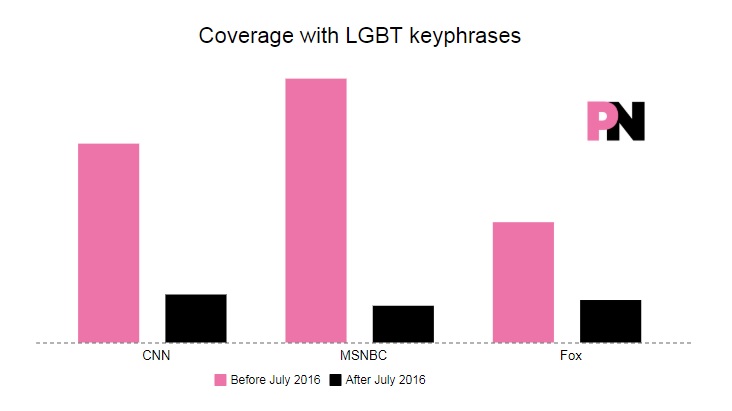
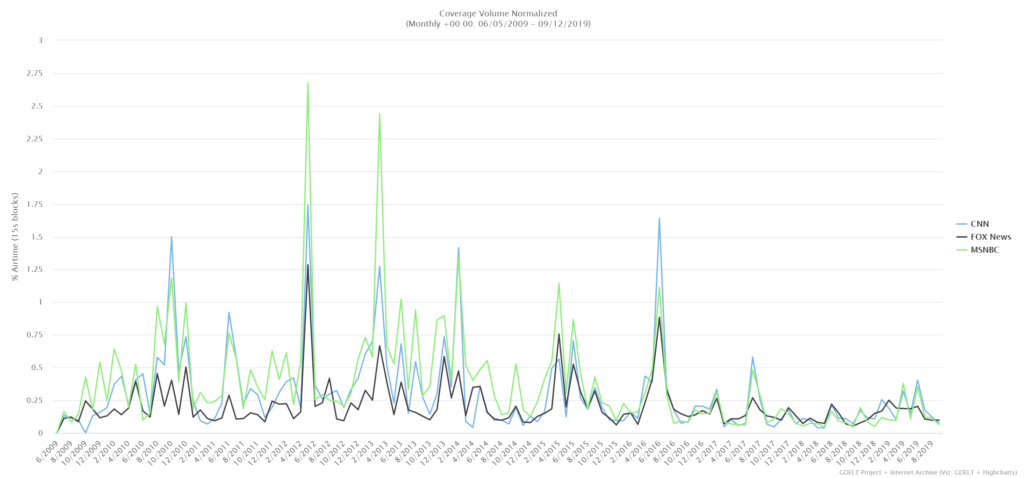
An analysis of a decade’s worth of CNN, MSNBC and Fox News coverage by The GDELT Project shows the flatlining focus on LGBT+ issues on all three networks coinciding with the 2016 election, when Trump began to dominate the news agenda.
The analysis, drawing on transcripts from the Television News Archive, looked at the frequency with which terms like gay, lesbian, transgender, LGBT and queer are mentioned.
The analysts wrote: “Starkly apparent is that mentions have almost disappeared across all three stations since November 2016.”
According to PinkNews‘ analysis of the data set, between July 2009 and July 2016 – when Donald Trump became the Republican nominee – around 0.43 percent of MSNBC airtime, 0.32 percent of CNN airtime, and 0.20 percent of Fox News airtime was dedicated to discussions including the LGBT+ keywords.
Since August 2016, however, coverage has declined by three-quarters, with only 0.06 percent of MSNBC airtime, 0.08 percent of CNN airtime and 0.07 percent of Fox News airtime including the same keywords.
The frequency of LGBT+ keyphrases has declined significantly since Donald Trump began to dominate the news agenda
The percentages are likely to significantly underestimate the total amount of coverage dedicated to LGBT+ issues, as the data only records blocks of time where specific key phrases are used.
However, the analysts said that it would be “highly unusual for all three stations to change their terminology overnight and especially coincidental that this abrupt transition occurred immediately after Trump’s election”.
Coverage has flatlined since the 2016 election
Prior to Trump taking office, coverage saw occasional spikes that appear to correlate with the 2012 election and showdowns at the US Supreme Court on issues including marriage equality.
However, Trump’s anti-LGBT+ policies and an impending Supreme Court showdown over whether LGBT+ people are legally protected from discrimination appear to have generated little additional attention by comparison.
Despite the lack of coverage on TV news channels, Google search data from the same time period shows a steady increase in interest of LGBT+ issues.
The GDELT Project noted: “The most likely explanation is that in a world defined by chaos, television news has simply shifted its coverage priorities. Though this has substantial ramifications with respect to raising awareness of LGBTQ issues.”
Three people, including a transgender woman, were attacked in Portland, Oregon, in what police say may be a bias crime.
The assault happened in a downtown parking lot around 2:30 a.m. Thursday, and the assailants had fled by the time officers arrived, Portland police said in a statement.
“There were elements of the crime that possibly met the criteria for a Bias Crime,” Portland police said in the statement, which also asked anyone with information to come forward.
In Oregon, bias crimes are defined as any criminal act in which a person is targeted because of race, color, religion, sexual orientation, disability, gender identity or national origin, Portland police said.
KGW reported that Thursday’s incident occurred a week after another transgender woman, Marla Standing-Owl, said she was attacked while driving for the ride-sharing service Lyft on Sept. 6 in Portland.
Standing-Owl said she was attacked by a male customer she picked up from a hotel who was drunk and told her “you’re nothing but a man.”
“I told him I don’t need bigotry in my car and that’s when he snapped,” she told the station. Standing-Owl said that the man punched her repeatedly while she was driving and that she pulled over and used pepper spray on the assailant before he ran off.
The LGBT Pride March in Honduras’s San Pedro Sula, which drew 450 people, was the uplifting culmination of a week of Pride activities that also included more sober reflections, such as a candlelight vigil for lesbian, gay, bisexual, and transgender people killed in Honduras.
LGBT activists led the August 24 march with a banner that read, “Honduras inhabitable LGBTI,” meaning “Honduras unlivable [for] LGBTI.” Despite the activists’ courage and pride, which I also observed at Tegucigalpa’s march on the International Day against Homophobia, Biphobia, and Transphobia in May, violence against LGBT people does make Honduras unlivable for many.
In a country where many cannot safely express their sexual orientation or gender identity publicly, it is hard to measure how much violence LGBT people in Honduras suffer. The Honduran government told Human Rights Watch it has no data on how many victims of violence are LGBT.
Absent official statistics, Lesbian Network Cattrachas maintains an observatory tallying cases of violence against LGBT people based on media monitoring and direct reports. According to Cattrachas, in 2018, 25 LGBT people were killed: 16 gay men, 5 trans people, and 4 lesbian women. And the situation appears to be worsening: the number of killings tallied between January and August of 2019 – 13 gay men, 7 trans people, and 6 lesbian women – already outpaces the entire year of 2018. San Pedro Sula is located in the region where Cattrachas has documented the highest rates of violence against LGBT people.
Hondurans endure extraordinary levels of violence regardless of sexual orientation or gender identity. Gang violence abounds – in some cases Human Rights Watch investigated, LGBT victims may have simply been in the wrong place at the wrong time. But in other instances, violence appears targeted. Shakira, a trans woman also known by her nickname La Loba (the Wolf), was killed on June 9 in Choloma, 10 miles north of San Pedro Sula. A person who saw Shakira’s body told me her face was mutilated with a rock, her penis was cut off, and a note was left by her body that said, “[this] is the first one, two more to go.”
In the face of such violence, a pride march is an act of defiance.
The Arizona Supreme Court has ruled the City of Phoenix cannot apply its LGBT-inclusive Human Rights Ordinance to penalize a local business for refusing to make custom-made invitations for a same-sex wedding, delivering a victory for groups seeking to justify anti-LGBT discrimination in the name of “religious freedom.”
In a 4-3 decision written Justice Andrew Gould, the court determines the guarantee of freedom of religion and speech under the Arizona state constitution permits Joanna Duka and Breanna Koski, owners of Brush & Nib Studios, LC, to deny services to same-sex couples.
“Duka and Koski’s beliefs about same-sex marriage may seem old-fashioned, or even offensive to some,” Gould writes. “But the guarantees of free speech and freedom of religion are not only for those who are deemed sufficiently enlightened, advanced, or progressive. They are for everyone.”
The court issued its determination based on Article 2, Section of the Arizona Constitution, as well as Arizona’s Free Exercise of Religion Act. The court didn’t issue the decision on grounds of the First Amendment under the U.S. Constitution, even though the anti-LGBT legal firm Alliance Defending Freedom, which is defending the business, argued the case on those grounds.
The ruling finds freedom of speech under the Arizona state constitution is broader than the freedom of speech afforded under the First Amendment of the U.S. Constitution.
“In examining the text of Arizona’s free speech clause, we first observe that whereas the First Amendment is phrased as a constraint on government…our state’s provision, by contrast, is a guarantee of the individual right to ‘freely speak, write, and publish,’ subject only to constraint for the abuse of that right,” Gould writes. “Thus, by its terms, the Arizona Constitution provides broader protections for free speech than the First Amendment.”
The ruling marks another win for anti-LGBT groups seeking to justify the detail of services to LGBT people in the name of religious freedom. Last month, the U.S. Eighth Circuit of Court of Appeals found in the Telemedia Media Case business could invoke a First Amendment right to refuse to make video for same-sex weddings.
Jonathan Scruggs, senior counsel for Alliance Defending Freedom, crowed in victory in a statement following the the decision from the Arizona Supreme Court in favor of the business owners.
“Joanna and Breanna work with all people; they just don’t promote all messages,” Scruggs said. “They, like all creative professionals, should be free to create art consistent with their convictions without the threat of government punishment. Instead, government must protect the freedom of artists to choose which messages to express through their own creations. The court was right to find that protections for free speech and religion protect the freedom of creative professionals to choose for themselves what messages to express through their custom artwork.”
According to Alliance Defending Freedom, the owners of Brush & Nib Studios, LC were under threat of up to six months of jail time, $2,500 in fines, and three years of probation for each day the city would find them in violation of the law.
Writing the dissent in the case was Justice James Baker, who determined the City of Phoenix has a compelling interest in enforcing its ordinance against business seeking to deny wedding-related services for same-sex couples.
“Our constitutions and laws do not entitle a business to discriminate among customers based on its owners’ disapproval of certain groups, even if that disapproval is based on sincerely held religious beliefs,” Baker writes. “In holding otherwise, the majority implausibly characterizes a commercially prepared wedding invitation as ‘pure speech’ on the part of the business selling the product and discounts the compelling public interest in preventing discrimination against disfavored customers by businesses and other public accommodations.”
Gould takes another approach to the Masterpiece Cakeshop decision, asserting the decision would an allow religious and speech exemptions to a non-discrimination ordinance.
“Masterpiece Cakeshop did not hold that public accommodations laws were immunefrom free exercise exemptions; rather, it clearly contemplated that someexemptions, if narrowly confined, were permissible,” Gould writes. “And while we must, in determining whether plaintiffs’ invitations are entitled to an exemption from the ordinance, consider the impact on the City’s nondiscrimination purpose, we must also consider the effect of compelling plaintiffs to create these invitations.”
Justin Unga, deputy campaign director for the Human Rights Campaign, said in a statement the ruling was “an alarming decision that puts the state’s people, reputation, and economy at risk.”
“For years, Arizona’s economic councils, lawmakers, and leaders from every community, including faith and business leaders, worked together to build an Arizona that is open to everyone and attracts investments from across the country,” Unga said. “Not only does this decision affect countless LGBTQ Arizonans, it sends a message about inclusivity to businesses and institutions seeking to invest in states that welcome all people. Today’s decision could also open the door for discrimination against other communities protected by the ordinance including religious minorities and women.”
Julie Watters, a spokesperson for the City of Phoenix, said in a statement the Phoenix “is still a legal, valid law and remains in effect” and the ruling is limited to a solitary business.
“The Arizona Supreme Court made a very narrow ruling that one local business has the right to refuse to make custom wedding invitations for same-sex couples’ weddings that are similar to the designer’s previous products,” Watters said. “This ruling does not apply to any other business in Phoenix. The city of Phoenix has had an anti-discrimination ordinance since 1964 to protect all residents and believes that everyone should be treated equally.”
In response to a Blade inquiry on whether the city will be filed before the U.S. Supreme Court, Watters said “everything is currently being evaluated by our legal team.”
Alessandra Soler, executive director of the American Civil Liberties Union of Arizona, echoed the sense the ruling was limited. The ACLU filed a friend-of-the-court brief in the case.
“While today’s limited decision from the Arizona Supreme Court is disappointing, it does not grant businesses a license to discriminate,” Soler said. “Discrimination has no place in our state, and we call on all local businesses to make it clear that they are open to all. We’ll keep fighting to ensure protections for LGBT Arizonans so that no one can be fired from their job, denied a place to live, or be turned away from a business simply because of who they are and who they love.”
Rep. Greg Stanton (D-Ariz.), who served as Phoenix’s mayor when the city passed its Human Relations Ordinance in 2013, also condemned the decision.
“This is a shameful day for Arizona,” Stanton said. “Four years after the U.S. Supreme Court held that same-sex couples have a fundamental right to marry, the state Supreme Court has decided that cities cannot safeguard those same couples from active and harmful discrimination by corporations. This is backwards, dark-ages thinking.”
Across the internet, companies buy ad space that appears alongside news, entertainment and sports articles. These purchasing decisions are made, in part, with ad verification partners that compare the articles’ content with “block lists” of thousands of terms that advertisers want to avoid associating their brand with, like “shooting,” “kill” and “attack.”
It doesn’t matter if the article is positive (“City’s murder rate down to historic low”) or negative (“Gruesome murder shocks city”), because both articles would be banned by a keyword block list.
But a new study from CHEQ, which runs a competing ad verification service, found that nearly two thirds of all nonpornographic and nonexplicit LGBTQ news content is banned by these lists, because the lists often contain neutral LGBTQ terms like “lesbian” and “bisexual.” Both PinkNews, a U.K.-based LGBTQ news site, and The Advocate, a U.S.-based LGBTQ news site, saw 73 percent of their positive or neutral content blocked by these lists.
The result, according to CHEQ, is that for LGBTQ news sites, the majority of their content may be unavailable for mainstream advertising. “This is severely damaging publishers’ ability to monetize premium content,” the report states, “making minority news and opinion unviable.”
“In the end, blocked words/blacklists hurt us all,” Orlando Reece, CEO of The Advocate’s parent company, Pride Media, told NBC News in an email. “We create content from an LGBTQ+ lens and use words that our community (as the general community) do not find offensive, such as ‘lesbian,’ ‘queer,’ etc. These words are part of our lives and how we communicate and identify with one another. Brand safety needs to be a conversation involving people, not technology that is ill-equipped for today’s digital publishing landscape.”
Reece also said the ad-blocking appears to be worsening. He said Pride Media sometimes works with ad-buying agencies and brands to clean up these “blacklists” before something is published, but they don’t always have the opportunity.
“Some agencies’ blacklists are agency-wide and they cannot be adjusted,” Reece explained. “In those instances we request a switch from blocking tags to monitoring tags, and this helps clean up the situation.”
The CHEQ report comes amidst a crisis in LGBTQ news content. Just this past year, LGBTQ-dedicated news sites GayStarNews and Into shut down, and other mainstream sites that consistently shone a light on LGBTQ issues laid off staff.
Daniel Avital, CHEQ’s chief strategy officer, said these advertisers are often progressive and seek to reach LGBTQ consumers, but a “technology deficit” is to blame.
“Companies struggle to determine the good stuff from the bad stuff, then the only recourse you have is to blacklist all of it,” Avital told NBC News.
Avital said he spoke to the founders of GayStarNews, who confirmed that declining ad revenue “was one of the key reasons” they shut down this year.
“If you’re an LGBTQ content creator, then you seem to be having a much harder time over the past two years to get ad dollars,” he said.
Surprisingly, the report notes, these block lists even affect sports sites, because they often use words like “shoot” for basketball. Sports site Bleacher Report had 67 percent of its neutral or positive stories blocked by these lists, according to CHEQ’s report.
Avital said the majority of major U.S. advertisers use these “crude” block lists, which range in size from a few hundred to thousands of blacklisted terms. But since the bidding for internet ads is automated and happens nearly instantaneously, smaller brands still bid for ads to appear in the space that larger brands pass on.
“What happens is the price of this inventory just goes down, because the big advertisers aren’t bidding for it, so the next in line gets it,” Avital explained. “So, if you’re able to monetize the content, you’re monetizing it for a much lower price than you would otherwise.”
Exposure to “conversion therapy” — efforts by a secular or religious professional to change a transgender person’s gender identity — is associated with thoughts of and attempts at suicide, according to a study published Wednesday in the journal JAMA Psychiatry.
Dr. Jack Turban, the study’s lead author and a resident physician in psychiatry at Harvard Medical School, said it was the first study “to show that gender identity conversion efforts are associated with adverse mental health outcomes, including suicide attempts.”
Turban said that previous reports showing the negative effects of conversion therapy, also known as “ex-gay therapy” or “reparative therapy,” have focused on efforts to change a person’s sexual orientation.
But this was novel, he said, because of its large sample size — over 27,000 transgender people responded to the survey — and its broad approach to identifying past efforts to change participants’ gender identity.
Seventy-one percent of respondents recalled speaking to a religious adviser or secular therapist about their gender identity, and of those, roughly 20 percent said these interactions involved efforts to change their gender identity from transgender to cisgender.
“The rate of previous suicide attempts among transgender people in the United States is extremely high, with 41 percent reporting that they have had that experience,” said study co-author Dr. Alex Keuroghlian, director of the National LGBT Health Education Center at The Fenway Institute and the Massachusetts General Hospital Psychiatry Gender Identity Program.
“What this new study shows is that transgender people who are exposed to conversion efforts anytime in their lives have more than double the odds of attempting suicide compared with those who have never experienced efforts by professionals to convert their gender identity, he said.
Turban said one of the most alarming findings from the study was the even higher risk of psychological distress for those who reported exposure to conversion therapy during childhood. Those who were subjected to the practice before age 10 were four times more likely to report lifetime suicide attempts than the general transgender population, according to the findings.
“This is important because some experts continue to advocate for gender identity conversion efforts for young children,” Turban said in a statement. “We hope our findings contribute to ongoing legislative efforts to ban gender identity conversion efforts.”
Currently 18 states, along with the District of Columbia, ban the practice of conversion therapy on minors. And nearly every major health association — including the American Medical Association, the American Psychological Association and the American Academy of Pediatrics — has spoken out against the practice.
“The term ‘conversion therapy’ is a misnomer,” Keuroghlian noted. “It suggests that conversion efforts are a legitimate therapeutic practice, even though we are finding that this practice is associated with significantly increased risk of harm, including serious psychological distress and potentially fatal suicide attempts.”
The study found no difference in the outcome based on whether the effort to change a person’s gender identity was conducted by a religious adviser or secular professional. According to the findings, the vast majority of conversion therapy is conducted by secular professionals, like psychologists or counselors, with religious efforts accounting for roughly a third of all conversion therapy efforts reported by this cohort.
“Current training of mental health clinicians in the U.S. does not usually include gender-affirming care as standard curriculum,” Keuroghlian said. “We hope this study will inspire clinical training programs to revise their standard curricula.”
“All clinicians need to be trained in concepts and terminology related to gender identity, how stigma is related to mental health disparities and best practices for gender affirmation grounded in scientific evidence,” he added.
This latest study builds on previous work published last month by Turban, Keuroghlian and their colleagues that found nearly 200,000 transgender people in the United States have been exposed to conversion therapy at some point in their lives.
Months after joining the gay-friendly Hotlanta Softball League, Gerald Bostock was out of a job in a Georgia county government office and was convinced he had become the victim of workplace discrimination based on his sexual orientation.
Proud of his job as an advocate for children caught up in the juvenile justice system in Clayton County in suburban Atlanta, Bostock said he was shocked when he was abruptly fired in 2013, an action that figures prominently in a major LGBTQ rights fight coming before the U.S. Supreme Court next month.
“I was devastated. I had just lost the job I had loved – my passion. I lost my source of income. I lost my medical insurance,” Bostock, 55, said in an interview at the house he shares with his partner in Doraville, located just northeast of the capital city of this southern U.S. state.
A rainbow-colored gay pride flag flutters outside.
Bostock, who was recovering from prostate cancer at the time, was escorted out of the Clayton County Youth Development and Justice Center building after being fired, and never returned. “I don’t even remember driving home,” Bostock said.
He believes that joining the league drew attention to his sexual orientation and that his firing was motivated by anti-gay sentiment. The county has denied it discriminated against Bostock and defended its decision to fire him.
The Supreme Court is set to hear arguments on Oct. 8 in three related cases including Bostock’s on whether gay and transgender people are protected from workplace discrimination by a landmark civil rights law.
Title VII of the Civil Rights Act of 1964 bars employers from discriminating against employees on the basis of sex as well as race, color, national origin and religion. At issue in these three cases is whether the protections against sex discrimination cover gay and transgender people.
Bostock, after losing in lower courts, is asking the conservative-majority Supreme Court to let him bring a federal discrimination lawsuit against the county seeking monetary damages over his firing.
A ruling in favor of Bostock would give gay and transgender workers greater protections, especially in the 28 states including Georgia that do not have comprehensive measures on the books against employment discrimination. A ruling against him would mean gay and transgender people in those states would have few options if they encounter workplace discrimination.
Republican President Donald Trump’s administration, reversing the government’s position taken under Democratic former President Barack Obama, has joined conservative religious groups in arguing that Title VII does not offer protections relating to sexual orientation or gender identity.
“I’m willing to be the one to stand up so that anyone that wants to work or has the ability to work can do so without living in fear of being fired for who you are or who you love,” Bostock said.
Bostock worked for Clayton County for a decade – managing a program to recruit volunteers to help represent the interests of children in the criminal justice system – until being fired after he started participating in the recreational softball league for fun. The league was formed in 1981 as a “safe inclusive environment” for LGBT people to play softball.
Soon after joining the Hotlanta league, Bostock said, he heard at least one senior staff member in his office make negative comments about his sexual orientation.
Three months later, the county launched an audit of the program he managed. Bostock said the audit looked in part at his expenditures to take prospective volunteers out for dinner, including other participants in the Hotlanta league.
‘Non-discriminatory reasons’
A spokesman for Clayton County declined to comment on the firing, citing the ongoing litigation. But lawyers for the county said in court papers he was dismissed for “legitimate, non-discriminatory reasons” based on the audit.
“The county denies that Bostock’s sexual orientation was a motivating factor in its decision to conduct an audit of the program he managed or its decision to terminate his employment after the audit was completed,” the lawyers added.
The two other cases the Supreme Court will hear raise similar issues.
One involves a now-deceased New York skydiving instructor named Donald Zarda who was fired by his employer in 2010 after revealing he was gay. The other involves a Detroit funeral home’s bid to reverse a lower court’s ruling that it violated the Civil Rights Act by firing a transgender funeral director named Aimee Stephens after Stephens revealed plans to transition from male to female.
Big business, typically eager to avoid liability in employment disputes, is backing the LGBTQ plaintiffs in the three cases. More than 200 companies, including Amazon, Alphabet Inc’s Google and Bank of America Corp, joined a friend-of-the-court brief asking the justices to rule in favor of the plaintiffs.
The current patchwork of state and local anti-discrimination laws harms the ability of businesses to recruit and retain top talent, the companies argued.
“Businesses and their employees all benefit from the consistency and predictability that uniform federal law provides nationwide,” the companies said in their brief.
The definition of ‘sex’
The legal fight centers on the definition of “sex” in the Civil Rights Act.
The plaintiffs and civil rights groups have argued that discriminating against gay and transgender workers is based on their sex and, thus, unlawful. The Trump administration and the three employers accused of discrimination have argued that Congress did not intend for Title VII to protect gay and transgender people when it passed the law.
“The courts don’t get to rewrite the law. They get to apply it,” said John Bursch, a lawyer with the conservative Christian legal group Alliance Defending Freedom, who will argue at the court on behalf of employer R.G. & G.R. Harris Funeral Homes Inc in the transgender case.
The Supreme Court delivered a landmark gay rights decision in 2015 legalizing same-sex marriage nationwide. But its dynamics on LGBTQ issues have changed following the 2018 retirement of Justice Anthony Kennedy, a conservative who backed gay rights in several major cases and wrote the same-sex marriage ruling.
The Title VII cases represent the court’s first major test on gay and transgender rights since Trump appointed conservative Justice Brett Kavanaugh to replace Kennedy on a court with a 5-4 conservative majority, with the four liberal justices sympathetic to LGBTQ rights. Kavanaugh, whose approach to gay rights is unclear, could provide a pivotal vote.
Trump, strongly supported by evangelical Christian voters, has undermined gay and transgender rights since taking office in 2017. His administration has supported the right of certain businesses to refuse to serve gay people on the basis of religious objections to gay marriage, restricted transgender service members in the military and rescinded protections on bathroom access for transgender students in public schools.
Now working as a mental health counsellor at nearby Georgia Regional Hospital, Bostock said he will not give up his fight for gay rights even if the Supreme Court rules against him.
“I’m a firm believer,” Bostock said, “in throwing positivity out into the universe.”
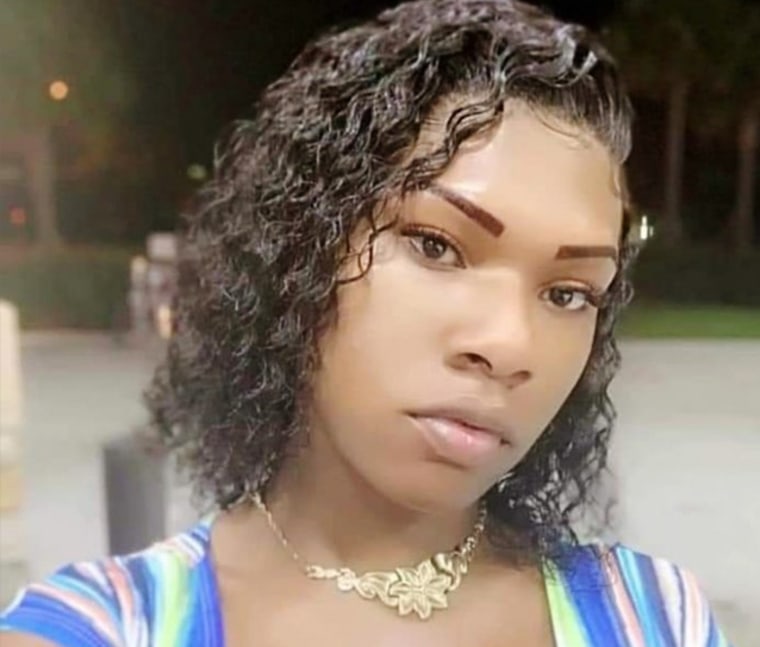
A black transgender woman was found dead in her burning car in South Florida in what is being investigated as a homicide, authorities said.
It is the 18th killing of a transgender person in the U.S. this year.
The body of Bee Love Slater, 23, was discovered in Clewiston on Sept. 4, according to the Palm Beach Post.
Hendry County Sheriff Susan Harrell told NBC News in a statement that authorities could not initially identify the body “due to the burns and lack of identification available.” A medical examiner later identified the body through dental records, Harrell said.
The body of transgender woman Bee Love Slater was found in a burned car in Clewiston, Florida.via WBBH
According to The Advocate, investigators said Slater’s death was one of the most brutal murders they had seen.
Authorities have not said if they think Slater’s gender identity played a role in her death, the Palm Beach Post reports. Investigators are not releasing how she died.
Her death is the 18th killing of a transgender person in the United States this year, according to the Human Rights Campaign, which tracks the deaths of transgender people. A majority of those killed have been black transgender women.
George Wallace, executive director of LGBT+ Center Orlando, told NBC News in a statement Thursday that transgender women of color “are killed at a higher rate than that of their peers.”
“I find it sad and upsetting that our trans brothers and sisters continue to be targets of hate and intolerance,” Wallace said. “I wish I had a solution, but we must continue advocating and educating.”
Slater’s friend, Jackson, who asked to be referred to by his last name, told the Palm Beach Post that Slater underwent surgery this year. But, he said, she was verbally harassed and bullied online and had expressed concerns about her safety.
“We have more questions than answers,” Jackson said of her death.
The American Medical Association in June announced it efforts to bring national attention to what it called “the epidemic of violence against the transgender community, especially the amplified physical dangers faced by transgender people of color.”