LGBTI tour operator, Toto Tours, has decided to cancel their 16-day package tour to Ethiopia that was schedule for this October, amid concerns for the safety of their clients. The tour itinerary was to include visits to several religious sites.
The Ethiopian Orthodox organization, the Sileste Mihret United Association, alluded to violence.
The chairperson said: ‘Homosexuality is hated as well as being illegal in Ethiopia.
‘If Toto Tours comes to Ethiopia where 97% of Ethiopians surveyed oppose homosexuality, they will be damaged. They could even die.’
Toto Tours canceled Ethiopia trip after death threats
Dan Ware, owner of the company, decided to cancel the tour after consideration of the above statement, and also receiving several other threats of violence should the tour proceed.
According to reports from NBC Chicago, Ware explained: ‘We had descriptions of buried alive, burned alive; I had an ISIS-type video with a guy with a mask on his head, brandishing his sword saying we are going to cut your throat. It was not something to ignore.
Spokeswoman for the US Embassy in Ethiopia, Amanda Jacobsen, stated: ‘Our country specific information for Ethiopia notes the challenges American citizen LGBTI travelers to Ethiopia may face, including the fact that consensual same-sex sexual activity between adults is illegal and punishable by imprisonment.
‘There is no law prohibiting discrimination against LGBTI persons.
‘Ethiopians do not generally identify themselves as LGBTI due to severe societal stigma.’
Tour company still planning trips to countries where being gay is illegal
Ware stated that he hopes to one day still plan a tour to Ethiopia.
However, in the meantime, he’s refunding all clients who were booked on the October departure.
Toto Tours has been serving the LGBT community since 1990.
Their website states the name is derived from the Latin word meaning ‘all-inclusive,’ not in reference to Dorothy’s infamous dog from the Wizard of Oz. The company website still has trips planned to Botswana, Bhutan, and Egypt, all places where same-sex activity is illegal.
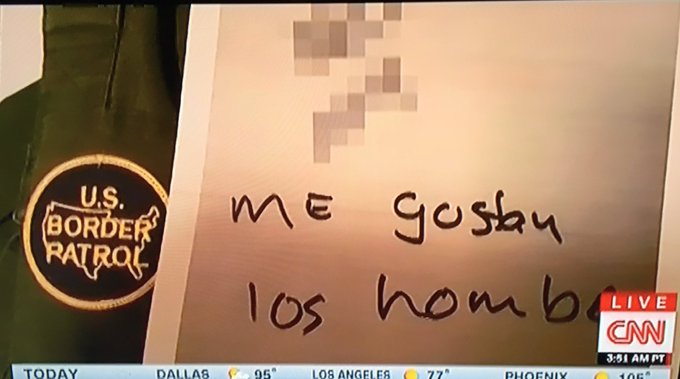
US Customs and Border Patrol agents at a migrant processing center in Texas allegedly attempted to humiliate a Honduran migrant by making him hold a sign that read, “I like men,” according to emails written by an agent who witnessed the incident.
The emails — obtained by CNN — were sent to the agent’s supervisor and outlined the March 5 episode in which a Honduran man was forced to hold a piece of paper that said, “Me gustan los hombre(s),” which translates to “I like men,” while being paraded through a migrant detention center.
The incident is one of many, per the emails, in which the CBP agent allegedly witnessed several colleagues displaying poor behavior and management’s failure to act.
Stacy Feintuch, a mother of two in suburban New Jersey, said she didn’t know what was wrong when her oldest daughter, Amanda, 17, began to withdraw.
“I confronted her and said, ‘You need to talk to me,’” Feintuch said: “She said, ‘It’s not what you think. I’m fine, it’s not that.”
“I can’t tell you, I can’t tell you.’”
Feintuch said her mind raced: “Is she pregnant? Is she in trouble?” Finally, Amanda buried her head in her pillow and said, “I’m gay.”
“I was just dumbfounded, just shocked. It wasn’t even a thought in my head,” Feintuch said. “I said, which ended up being the absolute wrong thing to say, ‘Why do you think this?’ She started screaming at me.”
“I said: ‘Take a breath, I didn’t mean anything by it. I love you. I’m shocked, I just want to talk to you about this.”
Amanda calmed down and, fortunately, they talked.
While Feintuch considers herself an accepting person, she still faced some immediate stress and shock when her child came out to her. That’s not uncommon. A new study conducted by researchers at George Washington University found that most parents of lesbian, gay, and bisexual youth have difficulty adjusting after their kids come out.
The study says it is one of the first to systematically examine the experience of parents raising lesbian, gay and bisexual children. David Huebner, one of the study’s lead authors and a public health professor at George Washington University, said his team approached the study with a question: “Can we identify the families that most need intervention to support the families and protect the kids?”
The study found that African American and Latino parents have a harder time accepting their lesbian, gay and bisexual children, as do the parents of children who come out at a later age.
The study, which surveyed a much larger sample size than previous studies, confirmed smaller studies that showed parents’ negative reactions tend to ease over time; the first two years are the hardest for parents.
There were no significant differences in reactions between mother and father, the age of the parent, or the gender of the child. The study did not examine the reactions for the parents of transgender children.
In general, acceptance seems to be growing rapidly for lesbian, gay and bisexual youth. “We see improvement in people’s respect for LGBT rights, we’ve seen political progress, concrete political progress, and we have also seen attitudes shifting at the population level,” Huebner said. “I think for parents, when you’re confronted with your own child who you love so fiercely, I think that reaction in that moment is a very personal one, and it’s one that’s hard to predict from public opinion.”
After Amanda came out, Feintuch told her daughter that she worried her life would become more difficult after having struggled with depression in high school. “I was hoping that now your time would get easier, and your life would get easier, and it scares me that it would be more difficult.”
“She’s like: ‘It’s not like how it was when you were growing up. There’s a lot of kids in my school who are gay. Its not a big deal,’” Feintuch said. “I had to get it through my head first, and get it through my mind: ‘This is how her life is going to be, and it’s going to be fine.’”
“It was about a year until Amanda was like, OK, definitely 100 percent, and then she had a girlfriend and then I saw it all come together.”
Huebner said his study is the first to measure these reactions and that previous studies of the parents of LGBTQ youth mostly recruited from accepting and friendly environments, like PFLAG, an organization for the parents of LGBTQ people.
“I think we have made a huge improvement here — 80 percent [of survey respondents] had never been to a support group, had never talked to a therapist,” Huebner said. “These were parents who had never before been heard from in research.”
Still, Huebner pointed to some potential oversights: “There’s reason to believe we are missing two groups of people: those super rejecting people, and those parents who were so immediately accepting that they also didn’t need the resources.”
Huebner hopes that this will allow advocates to devise materials so parents can better prepare themselves to accept and love their kids.
“Parents have the power to protect their kids, their LGBT kids, from all sorts of threatening forces,” Huebner said. “We know that when parents are supportive of their LGBT kids those kids have less depression and fewer risk behaviors.”
GLAAD and The Harris Poll’s annual Acceptance Index shows a decline in LGBTQ acceptance among younger Americans. At the same time, GLAAD’s Trump Accountability Project counts more than 114 attacks on LGBTQ Americans from The Trump Administration since President Trump took office.
Additionally, anti-LGBTQ violence continues to plague LGBTQ Americans. GLAAD compiled the following partial list of incidents of violence from news coverage from January to June 2019. From the horrific murders of transgender women of color to other random acts of violence – this list is a snapshot of anti-LGBTQ violence in America and is not comprehensive. If you’ve seen examples of anti-LGBTQ violence reported on in the media, contact press@glaad.org.
If you or someone you know has experienced anti-LGBTQ violence, please contact the Anti-Violence Project by calling their 24 hour free and confidential hotline at 212-714-1141 or vsiting their Report Violence site.
GLAAD mourns the loss of the following transgender women. For more about their lives please visit the Human Rights Campaign. GLAAD released the ‘More Than A Number’ report for more information on the epidemic of violence facing transgender Americans, especially transgender women of color, and best practices for reporting on this issue.
If you or someone you know has experienced anti-LGBTQ violence, please contact the Anti-Violence Project by calling their 24 hour free and confidential hotline at 212-714-1141 or vsiting their Report Violence site.
The LGBTQ community in Montgomery, Alabama, has been left with more questions than answers after a drag show was shut down by authorities Saturday night, during the 50th anniversary weekend of the historic Stonewall uprising.
“We’ve been running for weeks trying to raise money for a gay club in Montgomery, because we don’t have one,” Victoria A. Jewelle, a local drag queen who serves as the show’s director, told NBC News. “We were trying to raise money for a new establishment so we can have a place to feel safe.”
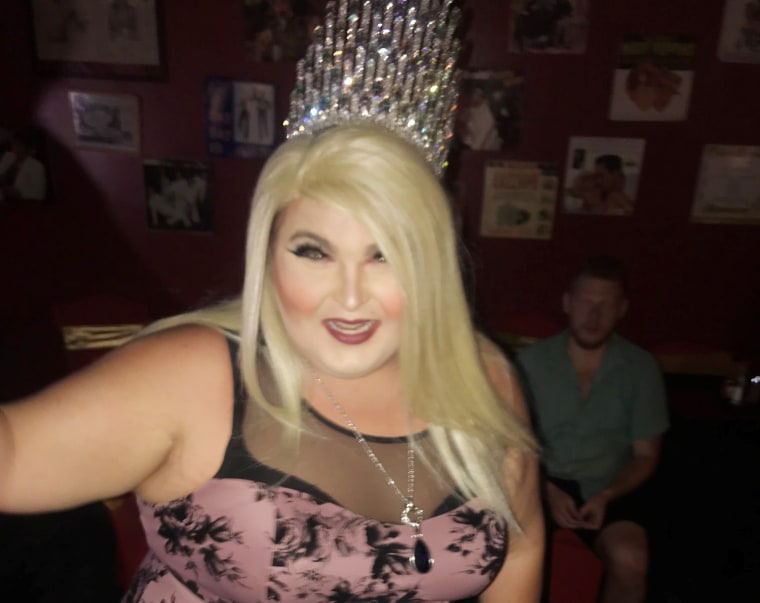
Alee Michelle is one of the drag queens who was set to perform at A Touch of Soul on Saturday, June 29, 2019, before authorities shut down the venue.Courtesy Nakeia Moss
Officials with Alabama Alcoholic Beverage Control Board canvassed a dozen local bars, restaurants and nightclubs June 29 for what they call a “minor buy.” Essentially, the board sends a young person under the age of 21 into the establishment to see if the business will sell alcohol to them. It was assisted in this effort by the Montgomery Police Department and the Montgomery Fire and Rescue, in addition to other agencies.
At 10:45 p.m., officials arrived on the scene at A Touch of Soul, a soul food restaurant that was hosting a drag show to raise funds for the opening of a new LGBTQ nightclub in Montgomery. The city’s only full-time gay bar, Club 322, closed in May.
According to Jewelle, the fundraiser has gone on for weeks with absolutely no backlash from local authorities. All of that changed when performers say officials with the agencies came into their dressing rooms while they were putting on their makeup, shined flashlights in their faces and even went through their laptops.
Authorities ordered A Touch of Soul to close at midnight, giving everyone about an hour to pack up and leave. The fundraiser, which also served as the after party for Montgomery’s LGBTQ pride weekend, was essentially over before it even started.
Ambrosia Starling, a drag queen and community leader in Montgomery, said the scene was reminiscent of the bar raids at the long-closed HoJohns, the city’s premiere gay nightclub during the 1980s. She claimed that police would typically visit the bar at the end of their shifts to “practice the dogs” on its LGBTQ clientele.
“They used to raid HoJohns continuously,” Starling said. “The city of Montgomery has a history of harassing some of the older community LGBTQ spaces.”
‘NEVER HAD THIS PROBLEM BEFORE’
A second establishment experienced issues with authorities while hosting an LGBTQ event on Saturday night, the same day as the city’s LGBTQ Pride Month celebrations. Montgomery officials showed up at Club Reset, which was formerly known as Envi Ultra Lounge, at 2:00 a.m. and ordered patrons to “pour out their drinks” and vacate the premises immediately.
T’Chelle Monroe, a party promoter who has been organizing LGBTQ events at Club Reset for a year, said the bar typically stops serving drinks at that time and allows clubgoers to file out in a leisurely fashion.
Monroe said she’s “never had this problem before.”
“I’ve been in other clubs before, and I know they shut their bar down at 2 a.m.,” she said. “I’ve never heard that you actually had to be out of the club at that time.”
As LGBTQ people filed out of Club Reset after it was shut down, Monroe said many went over to nearby Club Ciroc, which shares a building with an auto supply shop and a hookah lounge. She said officials “followed” them to Club Ciroc, despite the fact that it had already passed its regulations check earlier in the evening.
A representative with Club Ciroc confirmed authorities did show up a second time at 2:30 a.m. but did not know whether they had followed patrons of Club Reset there.
“It made me feel like they’re targeting us,” Monroe said. “We already have enough to deal with being gay, but we’re here trying to celebrate each other on our weekend. They were tarnishing what we were trying to do. We’re just trying to have a good time amongst each other.”
NBC News contacted two other businesses that Monroe said were visited by police Saturday: Xscape Tapas Grille and Sky Bar.
A representative with Xscape confirmed that authorities were at the business for a half hour on Saturday, rigorously checking the lights, inspecting identifications and looking at liquor receipts, though the representative had no complaints about the interactions with city officials that night.
While Club Ciroc, Xscape and Sky Bar all confirmed authorities had visited their businesses, representatives from each declined to be quoted in this story.
Montgomery officials maintain that everything that took place Saturday night was completely by the book.
Dean Argo, the government relations manager for the Alabama Alcoholic Beverage Control Board, said the board didn’t initially intend to scrutinize A Touch of Soul this weekend. However, he said an inspector approached the restaurant after he observed “people outside sitting on stools collecting money at the door,” as a board representative would later write in an incident report.
Argo read NBC News the report in its entirety.
“Upon entering the location, we found there was no food in the kitchen, no cook on duty,” the report states. “A restaurant license is issued for this location and that is described as habitually and principally used for the purpose of preparing and serving meals for the public to consume on premise.”
“Speaking only for the ABC Board,” Argo added, “we did not instruct anyone at this business to shut down.”
Jason Cupps, a captain with the Montgomery Fire Rescue, added that city authorities “verbally reminded the restaurant that, under the terms of its business license, it is required to close by midnight.”
Geri Moss, the restaurant’s owner, said that explanation doesn’t hold water. Since opening A Touch of Soul in 2016, she said it has regularly stayed open Fridays and Saturdays until 2 a.m. without incident. A Google search confirms those hours. According to Moss, the restaurant doesn’t shut its doors before that time unless business is slow.
“I was told that I could stay open until 2 a.m. on Saturday,” she said, adding that the city authorities who came to the restaurant over the weekend didn’t mention its hours being an issue.
While the ABC Board inspector noted in his report that there was no cook in the kitchen at the time of the visit, Moss claimed that is not true. She said she got up that morning around 4 a.m. to prepare the menu for the show, which was steak, potatoes and salad. There was another cook onsite ready to assist patrons in the meantime, should they want to order a hamburger and fries, she added.
“My kitchen is never closed unless the cafe’s closed, and there is always a cook,” she said. “If I’m not there, there’s a cook.”
Others confirmed there was a cook onsite.
Moss also said despite claims that A Touch of Soul was “collecting money at the door” for the fundraiser, she claimed there “weren’t any customers at that point.”
“The only persons that they saw were workers that I hired to work the party,” she claimed.
When NBC News approached the ABC Board and the Montgomery Fire and Rescue with the discrepancies between their official statements and what those present at A Touch of Soul said occurred Saturday, they could not offer an explanation. Both Argo and Cupps say they had been offered no additional information on the subject.
‘UNFORTUNATE’ TIMING
Several members of Montgomery’s LGBTQ community said what upsets them most about the weekend incident is that it seems to be a departure from the improving relationship between LGBTQ residents and city authorities. That relationship, they maintain, has improved greatly since the 1980s, when police harassment of gay, lesbian, bisexual, transgender and queer people was the norm.
Montgomery, Alabama’s second-largest city, hired its first LGBTQ liaison officer two years ago, and now it has two: Bianka Ruiz and Devin Douglas.
“We thought that we had gotten on such good footing, and that was one of the things that was so confusing for us,” Starling said. “We’re trying to build a good relationship with the police department. We thought that was being accomplished.”
Starling credits the Montgomery Police Department with being responsive to the community’s concerns about how the drag show was handled. Police Chief Ernest N. Finley addressed the matter in a speech to the LGBTQ community Sunday. According to the Montgomery Advertiser, Finley claimed the action had been planned for weeks but admitted the timing was “unfortunate.”
“You have my word that this shouldn’t happen,” he said, promising “more communication” in the future.
But even if the intentions of local authorities were benign, those present during the incident at A Touch of Soul wondered why officials couldn’t have chosen any weekend other than Pride to do a sweep of bars and nightclubs in Montgomery.
“If you knew for months, why didn’t you switch the day out of respect?” Jewelle asked.
When NBC News reached out to the Montgomery Police Department for comment, it deferred to the Montgomery Fire and Rescue’s statements on the matter.
Despite the controversy, A Touch of Soul has no plans to cease holding drag shows at the restaurant. Moss promised members of the city’s LGBTQ community they could keep putting on events until they raise enough money to “get their home,” and she doesn’t intend to break that pledge.
“If they got to shut me down, then they’re going to have to come with something not bogus and not made up,” she said.
Amazon has removed books by a ‘gay cure’ conversion therapy author.
Joseph Nicolosi penned a book that spread the dangerous and harmful practice of attempting to ‘cure’ a person’s sexual or gender identity.
He was the co-founder of the National Association of Research & Therapy of Homosexuality (NARTH) and a prominent leader in the ex-gay movement.
His book, A Parent’s Guide To Preventing Homosexuality, is one of the most well known ‘conversion therapy’ books.
But now, it has been removed from the UK and US versions of Amazon.
Rojo Alan, from Peterborough, wrote to Amazon several times to get the book removed from listings.
He previously went through conversion therapy himself as a young child.
Failing to get the right response, he engaged with others to leave negative reviews on the website. Quickly, the rating fell from four stars to two stars.
‘I looked into the “rules of publishing” on Amazon, to see what sort of things they allow and don’t allow,’ he said.
‘Once I wrapped my head around that I started to look into the laws of conversion therapy. The legal side of things.
‘Once I gathered everything I went back to Amazon and I threw all the information I had at them in several conversations. Yet I was given the same “we will refer this to the relevant team”. Again it felt hopeless and I wasn’t too sure what else I could do.’
But, sure enough, Amazon removed all of the English language books by Nicolosi. It took Alan three months from the first email to removing the books.
‘Huge step’
‘These books were “how to” books,’ Alan told Gay Star News, also describing it as a ‘huge step in the right direction’.
‘These were books that were lying to parents on how they could cure their children from being gay or trans. It’s lying because it’s actually just a form of abuse.
‘The books went into ways in which you can mentally and physically abuse your child.
‘If this helps anyone from being harmed, that would be a good reason to do it.’
He was previously quoted in a documentary: ‘Everyone is heterosexual.’
‘The idea that some people are naturally homosexual, or naturally gay, is just a social construct.’
He also said: ‘So when you have individuals with same-sex attraction, we it as something went wrong developmentally and we try to resolve the issue and put them back on the path toward their natural heterosexuality.’
The World Psychiatric Association has condemned so-called ‘gay cure’ conversion therapy.
The group said they consider sexual orientation to be ‘innate’. They also said it is determined by ‘biological, psychological, developmental and social factors’.
‘WPA believes strongly in evidence-based treatment,’ they also said.
‘There is no sound scientific evidence that innate sexual orientation can be changed.
‘Furthermore, so-called treatments of homosexuality can create a setting in which prejudice and discrimination flourish, and they can be potentially harmful … The provision of any intervention purporting to “treat” something that is not a disorder is wholly unethical.’
Nepal made history on Saturday (29 June) when hundreds marched through the capital Kathmandu to celebrate LGBTI pride.
More than 300 people donned colorful face paint, carried rainbow umbrellas, and waved flags according to local media.
Although Nepal has held LGBTI pride events in the past, this was the first march through the city in June. Hundreds of LGBTI rights supporters, for example, attend the Gai Jatra festival each year in August.
Queer Youth Group (QYG) and Queer Rights Collective organized the event.
Attendees of the first pride parade in the capital of Nepal Kathmandu. (Photo: Queer Youth Group) 4
‘I feel like these are my people. I know they won’t judge me and I can fully be myself here, attendee Jyoti Shrestha told South Asia Time.
‘People here don’t know the specific terms used and although they know we exist, there is still taboo surrounding this topic,’ Shrestha also said.
One pride attendee shared footage of an apparent confrontation with police on Twitter.
User Shubha Kayastha told pride attendees to take down their rainbow flags outside the designated area.
The mountainous South Asian country legalized gay sex in 2007, and theoretically has laws to protect LGBTI equality. It also recognizes a third or ‘other’ gender marker in citizenship documents.
But, local activists have warned, that is not always the case in practice.
‘There has always been a romanticization of Nepal as being one of the more tolerant countries in Asia; however, the ground reality is very different’ organizer Rukshana Kapali told South Asia Time.
A new criminal code enacted in August last year fails to guarantee equal marriage, for example.
As the U.S. — and many other parts of the world — celebrates the 50th anniversary of the 1969 Stonewall uprising, rainbow flags and LGBTQ-inclusive ad campaigns appear to be omnipresent, especially in big cities. The ubiquity of these Pride campaigns make it easy to forget that this was not always the case. While many point to corporate America’s embrace of LGBTQ inclusivity as a major sign of progress, others believe corporations are coopting the movement.
Advertisements geared toward gay and lesbian consumers began to appear in earnest in the 1970s, inspired in part by the energy of the Stonewall uprising, which is widely considered the spark that fueled the modern LGBTQ movement.
So-called “sin” products, like alcohol and tobacco, were the first marketed to gays. These companies had little or nothing to lose from a potential boycott by the religious right, according to Katherine Sender, a communications professor at Cornell University and author of “Business, Not Politics: The Making of the Gay Market.”
“Now, getting a gay boycott is a much worse thing than getting a boycott from the religious right.”
PROFESSOR KATHERINE SENDER
Absolut vodka was the first brand to build itself with an eye toward the gay market, featuring full-page ads in gay outlets, such as The Advocate. Other alcohol brands like Boodles Gin ran ads in gay publications, but most ad revenue came from local gay bars and businesses.
However, with the exception of Absolut, much of the advertising aimed explicitly at gays came to a halt in the 1980s because of the HIV/AIDS crisis and the stigma surrounding the disease.
Things changed in the 1990s. Marketing surveys, namely the 1988 Simmons Market and the 1990 Overlooked Opinions survey, presented an image of gays and lesbians as an affluent, untapped market. Marketers estimated the total annual income of the gay community at over $500 billion. The surveys, however, were not representative and helped to start what researchers have since described as the “myth of gay affluence.”
In 1994, Ikea launched the first television ad to feature a gay couple. In the commercial, the two men tease each other about their taste in furniture.
“I remember it extremely well, because it was radical,” said Bob Witeck, president of Witeck Communications, a firm specializing in LGBTQ marketing. The couple “behaved in every sense like a married couple, and it was radical because it was normal and natural,” he said.
Not everyone loved the ad. In fact, the backlash was swift and strong. The American Family Association staged a boycott, and an Ikea store in New York received a bomb threat.
That same year, AT&T launched a direct-marketing mail campaign, making them the first US phone company to openly target lesbian and gay customers (MCI ran an earlier campaign, but used suggestive statements and imagery rather than a direct appeal).
“They got a big pushback from the religious right,” Sender said.
Companies remained more focused on gay men, though a notable exception was Subaru. In the late ‘90s, Subaru undertook a very successful lesbian-focused marketing campaign after research revealed its sturdy, practical cars appealed to this demographic. “It’s not a choice, it’s the way we’re built,” a 2000 print ad boasted.
This new interest in the “pink dollar” coincided with a massive increase in gay and lesbian visibility in the media. Ellen came out on TV in 1997, which Sender called “a massive deal.” Shows like “The L Word,” “Queer as Folk” and “Queer Eye for the Straight Guy” ushered images and information about gays and lesbians into homes across the country.
Despite the increased visibility and a number of successful ad campaigns, even into the early 2000s mainstream companies still risked a backlash for gay and lesbian inclusivity, according to Sender. Many companies were still afraid to be labeled as selling a “gay product.” Representation of transgender people was almost always negative, relying on transphobic tropes of deceit or mistaken identity, according to Sender’s research.
FROM THE GAY MARKET TO THE LGBTQ MARKET
Rich Ferraro, chief communications officer at GLAAD, a national LGBTQ media advocacy organization, has been consulting on LGBTQ images in advertising since 2008. He sees a very different media landscape today.
“The backlash that once occurred if a brand had LGBTQ marketing campaigns is no longer,” Ferraro wrote in an email. “For instance, fringe organizations like Family Research Council, National Organization for Marriage and One Million Moms would start petitions (which never really reached large numbers), but now they do not.”
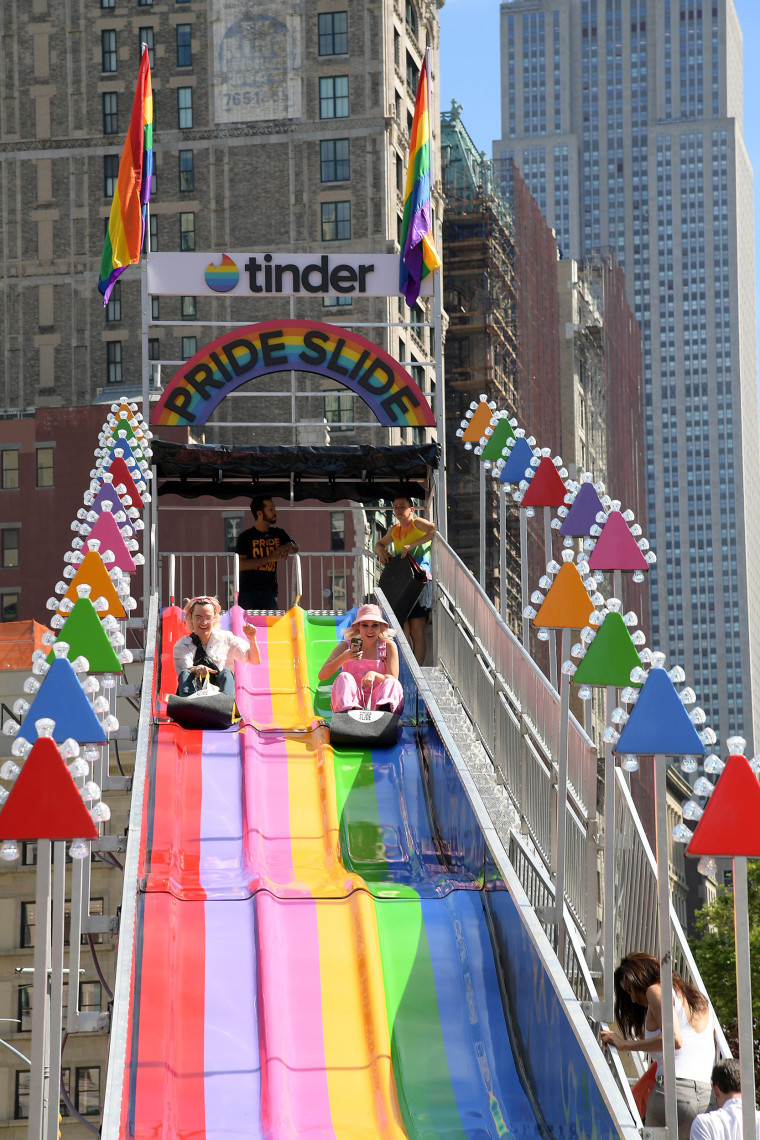
Chloe Pultar, right, slides down the Tinder Pride Slide in support of Equality Act kicking off WorldPride at Flatiron Plaza on June 24, 2019 in New York City.Michael Loccisano / Getty Images
Sender agreed, saying, “Now, getting a gay boycott is a much worse thing than getting a boycott from the religious right.”
More and more companies are engaging in LGBTQ-inclusive advertising, Ferraro said. “Categories have exploded — spirits and travel were typically leaders in LGBTQ-inclusive campaigns, but now it’s retail, cars, banking and financial services, food and beverages, youth-oriented brands,” he explained.
Witeck said “there is probably no more efficient way to say we are a contemporary brand” than to make your ad campaigns LGBTQ-inclusive.
For legacy brands, like Coca Cola, they must always be refreshed and made relevant, Witeck added. “LGBTQ marketing is an effective way to say, ‘We get it. We look and talk and act like we are in the 21st century.’”
However, Sender said that LGBTQ consumers are not only looking for inclusion in campaigns, but are holding companies accountable in their employment and production practices.
“Now, people are asking more questions, particularly around transgender polices and health care,” she said.
“What constitutes the responsibility of the advertising companies is expanding in ways that are really quite powerful,” Sender added, noting that consumers are asking questions like, “Are they buying products or services or in countries that have extremely bad policies and legal enforcement around LGBTQ people?”
Because of their resources, companies are also in a position to exert powerful political influence if they want to. Witeck mentioned the corporate boycotts of North Carolina after the passage of HB2 (the so-called “bathroom bill) that helped to precipitate its repeal and major companies’ outspoken support for transgender equality.
While historically there has been much less representation of transgender and gender-nonconforming individuals, this year examples of such campaigns abound: Raquel Willis for Express on a Times Square billboard, Gillette’s commercial featuring a young trans man and his dad, and Uber running a campaign featuring trans, genderqueer and bisexual pride flags.
“Traditionally, one or two campaigns are inclusive of transgender people, now it is a norm,” Ferraro said.
GAY INC.
Kristin Comeforo, associate professor of communications at Hartford College, worries that advertisers often take a “check-the-box approach” to the inclusion of gender and racial diversity, rather than a genuine engagement with intersectional experiences.
She also worries that corporate sponsorship can silence the voices of LGBTQ people who face intersectional marginalization.
Sender agreed, noting that “the 50th anniversary of Stonewall is such a big deal everyone wants a piece of that.” As a result, she added, Pride marches have become “a party for everybody.”
“What gets left behind are the very real struggles of LGBTQ people in this country — trans people in particular and people of color facing multiple layers of discrimination,” she added. “This ‘party’ suggests that being gay is just an excuse to have a lovely time, but there is still a long way to go.”
Nearly 2 million LGBTQ youths ages 13 to 24 in the United States consider suicide each year, according to research released Thursday by the Trevor Project.
Using data from a variety of sources, including the U.S. Census Bureau, the Centers for Disease Control and Prevention and its own National Survey on LGBTQ Youth Mental Health, Trevor Project researchers determined that LGBTQ teens were particularly at risk. Those 13 to 18 were approximately twice as likely to contemplate suicide as those 19 to 24.
Amy E. Green, the nonprofit’s director of research, told NBC News that although these numbers are harrowing, they are “conservative estimates.”
“These numbers are the bare minimum they could be because we used a conservative method to conclude our estimates,” Green said. “The fact that we still arrived at these huge astonishing numbers shows that this is a serious health problem.”
According to the mental health survey, released this month, there are multiple factors that can negatively affect the well-being of queer adolescents — the foremost being lack of acceptance.
More than 70 percent of respondents reported experiencing discrimination because of their sexual orientation or gender identity, and two-thirds of respondents stated that someone has tried to convince them to change those identities.
Though previous research has revealed that LGBTQ youth are more likely to experience thoughts of suicide, Green said these latest figures “provide additional context to just how widespread this problem is.”
A separate research released by the Trevor Project on Thursday offered some positive news, however. LGBTQ youth who report having at least one accepting adult in their lives were 40 percent less likely to report a suicide attempt in the past year.
“I hope this research will inspire the country to come together to change policies on the state and federal levels that affect LGBTQ youth’s lives, like ending the harmful practice of conversion therapy, as well as inspire other researchers who are looking into this area to study the factors and find solutions,” Green said. “We also need to support organizations that are doing the work to launch anti-bullying and suicide prevention efforts.”
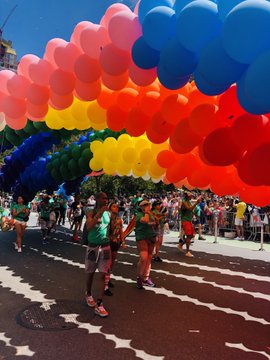
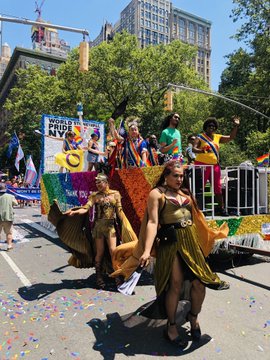
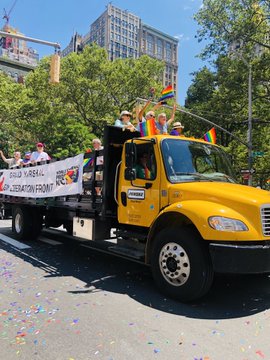
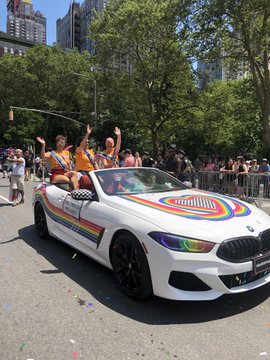
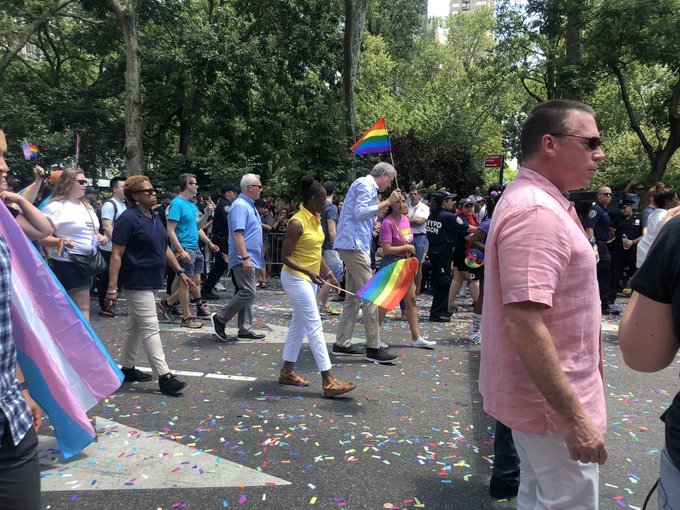
Millions of LGBTI supporters took to the streets of New York on Sunday (30 June) to celebrate pride and renew calls for equality.
Some 150,000 participants from 600 contingents hosting more than 100 floats marched down the four-kilometer route, according to BBC News.
An estimated four million people, meanwhile, took to the streets to watch and celebrate New York City Pride Parade.
This year, New York hosted global LGBT-event WorldPride.
The mass march also marked 50 years since Stonewall Riots. On 28 June, 1969, LGBTI community members launched spontaneous protests against discrimination following raids of the Stonewall Inn.
People regard it as the birth of the modern LGBTI rights movement in the US.
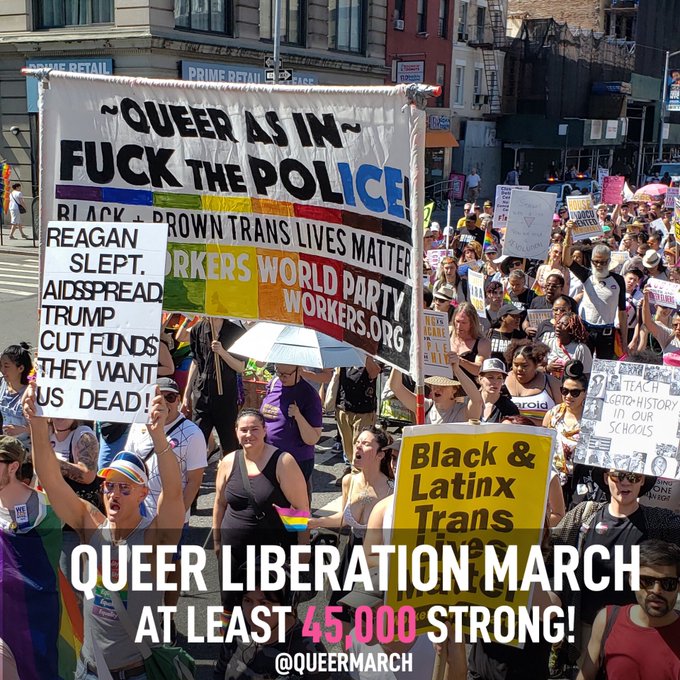
The Reclaim Pride Coalition organized the Queer Liberation March. The wanted to protest a pride parade they say has become too money-centric and will be devoid of police or corporate sponsors.View image on Twitter
The estimated 45,000 attendees performed acts of resistance. For instance, on 23rd Street, in collaboration with ACT UP, they held a die-in to represent the 17 HIV+ asylum seekers who died in ICE custody.
The main march, titled New York City Heritage of Pride parade, meanwhile, passed important LGBTI landmarks. These included the Stonewall National Monument and the New York City Aids memorial.
Among the Grand Marshals at this year’s Pride is the cast of hit FX show Pose, The Trevor Project, and the Gay Liberation Front (the original group who organized following the Stonewall riots).
New York Mayor and Democrat presidential hopeful Bill De Blasio walked in the parade with his wife.View image on Twitter
Representatives from around the world marched in New York. These included a team from London Pride and Taiwan, which became the first country in Asia to legalize same-sex marriage this year.
World-renowned artists, including Madonna and Lady Gaga, performed at the WorldPride closing ceremony on one of the city’s piers.