Police pushed back crowds celebrating Istanbul’s 17th gay pride march on Sunday, an event Turkish authorities had banned for the fifth year in a row.
The rally, on a side street off Istanbul’s main pedestrian avenue, drew several hundred people who cheered and waved rainbow flags. Chants of “shoulder to shoulder against fascism” and “we will not be quiet” were heard among the crowd.
“There is a massive police presence all around the city to prevent the celebration of Pride, but despite that, activities are still going on,” DW’s Turkey correspondent Dorian Jones reported, noting also that riot police officers were backed up with water cannon.
Police with dogs allowed rally leaders to make a short statement to the media before officers dispersed the crowd with tear gas, blocking the street. Istanbul Pride organisers said they would continue to fight to get sexual orientation and gender identity recognised in Turkish laws.
Amnesty International said the authorities had rejected all suggested locations for the rally by deeming the LGBT+ community “societally objectionable”. In 2014, up to 100,000 people attended a Pride march in Istanbul, but police have tried to block the events since.
The Stonewall riots were a six-night series of protests that began in the early morning of June 28, 1969, and centered around the Stonewall Inn, a gay bar in New York City.
Four days earlier, on June 24, 1969, the police, led by Deputy Inspector Seymour Pine, raided the Stonewall Inn and began arresting bar employees and confiscating liquor. But when Pine led a second raid on the 28th, patrons fought back. Approximately 150 people fled, regrouped on the street and stormed the bar, trapping the police inside. The protesters began throwing bricks, bottles and garbage, and attempted to set the bar on fire.
For six nights, protesters clashed off and on with police, while chanting and marching in and around Christopher Street.
Today, many credit the protests with sparking the LGBTQ rights movement. But at the time, if you were a New Yorker reading the local, mainstream papers, you wouldn’t know that a new civil rights movement was unfolding in the city.
In the days after the Stonewall riots, depending on which paper you read, you would have been exposed to a vastly different version of events. The major dailies gave a megaphone to the police, while alternative outlets embedded themselves among the protesters.
To understand the differences in media coverage, it’s important to recall the relationship between gay people, the press and the police prior to Stonewall.
If arrested, a person’s name, age, address and crime would be published as part of the police blotter in most local newspapers across the U.S. For example, if a man was arrested for committing a “homosexual” act in Dayton, Ohio, his information would be published in the Dayton Daily News. Such publication often had disastrous consequences for the person “outed” in print.
Gay men, therefore, were forced underground. Christopher Street in Manhattan’s Greenwich Village became a fairly safe locale with bars and coffee shops that surreptitiously catered to a LGBTQ clientele. These bars often were run by the Mafia, which owned the cigarette machines and jukeboxes, and sold watered-down liquor.
Unlike many clubs, the Stonewall Inn, which opened in March 1967, was on a main thoroughfare instead of a side street. The clientele was mostly men, though even marginalized segments of the LGBTQ community frequented the bar because of its two dance floors.
On average, police raided bars once a month, though they typically would warn the bar that a raid was coming and time the raid to minimize disrupting the bar’s business. Police raids usually were accepted by bar employees and clientele.
However, this time was different. Stonewall’s patrons already were upset about the June 24 raid, so when one person resisted arrest, others joined in. The situation quickly escalated.
Inside Stonewall, Pine gave his officers the order not to shoot, fearing that any additional escalation could lead to a full-scale massacre. Outside, hundreds of protesters were throwing almost anything they could get their hands on, while others were trying to find a way to set Stonewall on fire with the cops inside.
Yet the mainstream media largely failed to adequately cover the protests.
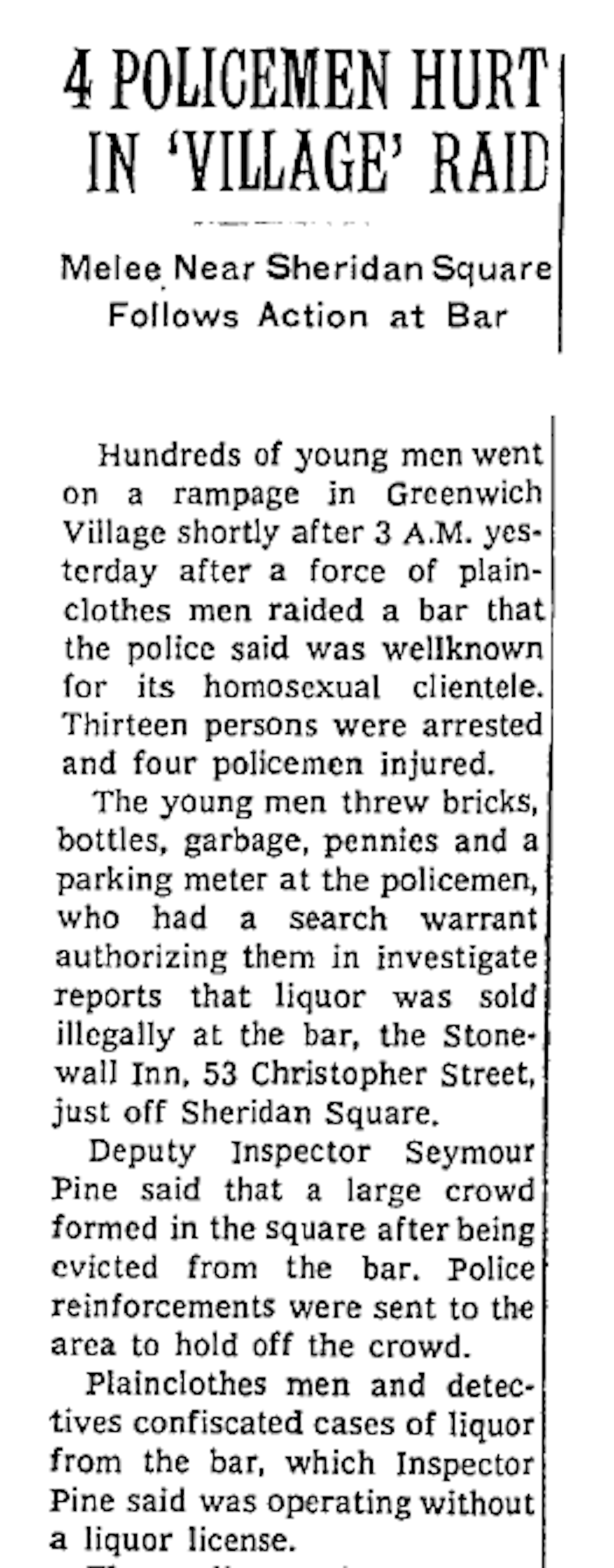
The first article on Stonewall to appear in The New York Times relied solely on interviews with the police. New York Times
The three city dailies – The New York Times, The New York Daily News and New York Post – wrote a smattering of stories in which they quoted exclusively police sources and offered little context. The story was framed as an instance of lawless youth run amok – an almost unprovoked riot.
For example, the Times’ first Stonewall article, “4 policemen hurt in ‘Village’ raid” began “Hundreds of young men went on a rampage in Greenwich Village shortly after 3 a.m. yesterday after a force of plainclothes men raided a bar that the police said was wellknown for its homosexual clientele.”
The mainstream papers at least covered Stonewall. Local TV stations failed to even report on the riots happening in the heart of Manhattan.
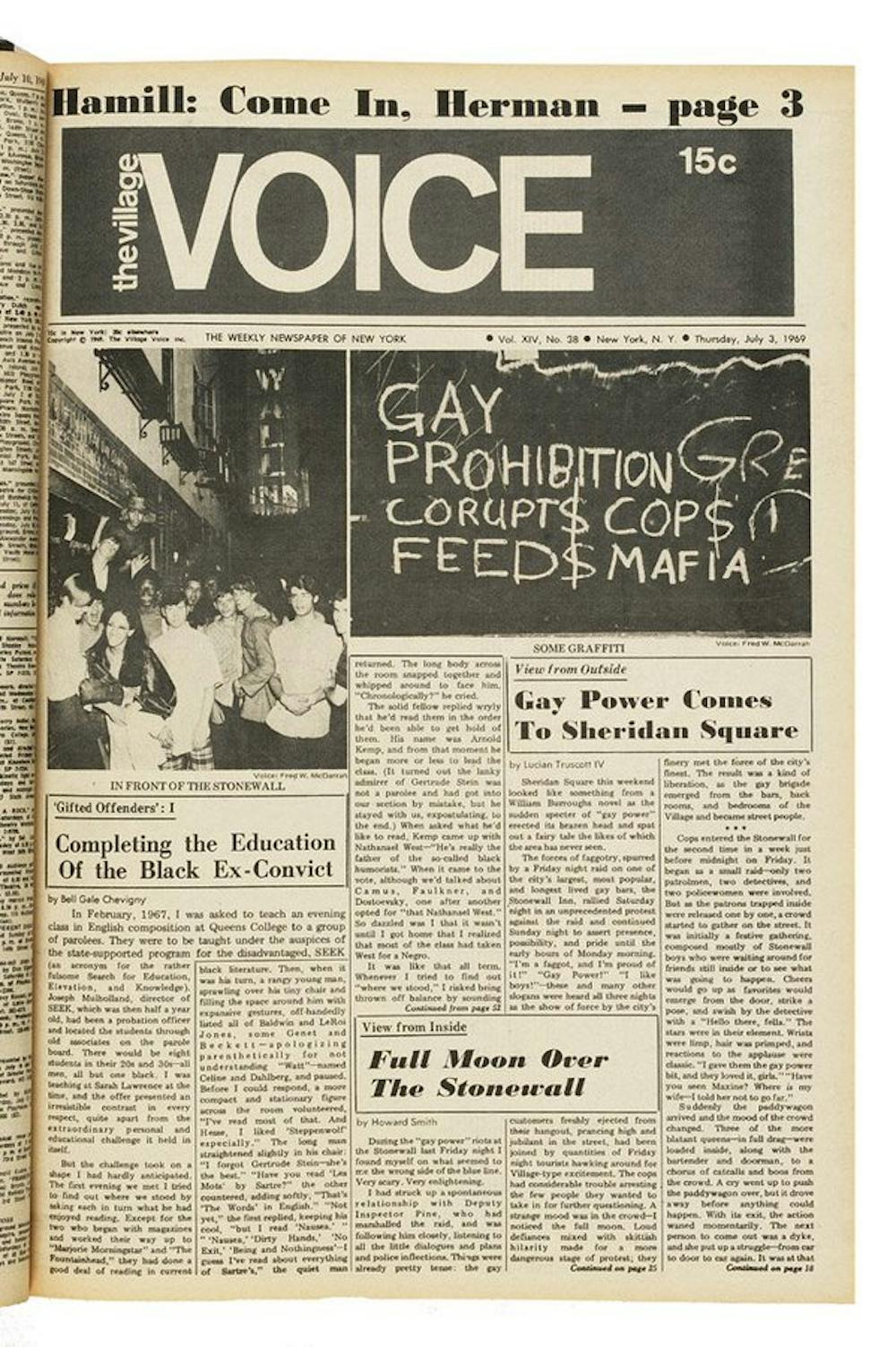
In contrast, the most popular local alternative paper, The Village Voice, gave the riots front-page coverage. It included interviews and quotes from the protesters, as well as two first-person accounts by Voice reporters Howard Smith, who was trapped inside the bar with police officers, and Lucian Truscott IV, who was outside with protesters.
Both reporters initially witnessed the riot from the Voice offices, which were a few doors down Christopher Street from Stonewall.
The Voice’s coverage featured many hallmarks of alternative publications.
By incorporating the views of both protesters and police, they created a more complex, nuanced story. And the paper framed the Stonewall riots as an expression of liberation instead of rebellion, with Smith writing that the protesters were simply “objecting to how they were being treated.”
‘Gay Power Comes to Sheridan Square’ – The Village Voice gave the riots front-page treatment. Google News
However, the Voice coverage was far from perfect. The anti-gay tone in Truscott’s piece angered protesters, as did some of the paper’s long-held editorial policies against same-sex personal ads.
While the Voice often was left-of-center politically, it wasn’t as radical as some of its more underground counterparts – the Rat, the East Village Other and the Berkeley Barb, all of which also covered the Stonewall riots.
Still, the Voice served as an important platform for the otherwise voiceless left out of the mainstream discussion during both Stonewall and the paper’s 60-year run. The Voice closed in 2018, following the shuttering of similar publications in Boston, Baltimore, Philadelphia and San Francisco.
An alternative press has existed alongside the mainstream since the earliest days of the nation. These papers play an important role in the U.S. media landscape by covering stories and topics that go unreported by their mainstream counterparts. They often forego the pretense of objectivity for activism; rather than quote government officials and business leaders, they’ll quote people on the ground.
Fifty years after Stonewall, it’s important to reflect on the gains of the LGBTQ movement. But it’s equally important to think about what’s lost when alternative newspapers stop publishing – and thus stop covering unreported, underreported or misreported stories.
A new survey reveals most LGBTI Americans are welcoming of police and other groups, such as corporations, at annual Pride parades.
BuzzFeed News and Whitman Insight Strategies conducted the survey from 5-10 June, speaking to 801 LGBTI people in the US. Most of the respondents identified as bisexual (46%). Gay and lesbian respondents were next, at 29 and 17%, respectively. Finally, 7% of respondents identified as transgender and nonbinary, respectively.
The survey asked a broad range of questions, including ones about Pride, gay icons, and the Pride flag.
Pride parades should be inclusive and open
Police at pride has become a controversial and heated debate in the LGBTI community.
Numerous cities have declared police in uniform are not welcome at their Pride parades, such as Portland and Sacramento. Based on this survey, however, a majority of LGBTI Americans — 79% — said police should be welcome. This includes cops marching in the parade.
The survey did not specify if the question specifically meant police in uniform, or in general.
Results of question about police at Pride | Photo: BUzzFeed News
The survey also found 7 in 10 respondents believe police sometimes discriminate against LGBTI people.
Despite this belief, only 8% said police should absolutely not be allowed to participate at Pride events, such as parades.
This welcoming attitudes towards Pride events extended to groups beyond police. A majority said both corporations (76%) and kink groups (72%) should be able to participate as well. People who responded no unequivocally were equal or lesser to 1 in 10.
Results of question about corportations Pride | Photo: BuzzFeed News
People’s critiques of kink groups present at Pride events often offer family and children as the reasoning for the critiques.
The respondents of this survey, however, also said families with children should be allowed and welcomed. Specifically, 87% said they should be present, even alongside the kink groups.
Chart showing results about kink groups at Pride | Photo: BuzzFeed News
Teaching LGBTI history — and having diversity
Another component of the survey included questions on diversity and history.
Less than half (45%) said they attended a Pride event this year (or had plans to), but an overwhelming 90% also responded they believe Pride advances LGBTI equality.
Only a little over half (54%) said they knowledge of the Stonewall Riots, but tellingly, 89% said they believed LGBTI history should be taught in schools.
How inclusive lessons or the promotion of LGBTI rights will be remains to be seen, as most respondents (56%) said they do not approve of adding black and brown stripes to the Pride flag to acknowledge LGBTI people of color.
Chart about making the Pride flag more inclusive | Photo: BuzzFeed News
Is Taylor Swift a gay icon?
Not according to this survey.
Only 9% of respondents classified her as a gay icon — three points above the Babadook.
Ellen DeGeneres was the clear winner, with 78% of LGBTI people saying she’s a gay icon. Figures like RuPaul (65%), Lady Gaga (53%), Cher (40%), and Madonna (36%) followed.
Finally, a slight majority of people (53%) also believe public figures have a responsibility to come out if they identify as LGBTI.
In an open letter, officials with Cathedral High School in Indianapolis said the teacher, who is in a same-sex marriage, was “living in contradiction to Catholic teaching.”
To remain within the archdiocese, the letter said, “Cathedral must follow the direct guidance given to us by Archbishop Thompson and separate from the teacher.”
If the school were to continue employing the teacher, the letter said, Cathedral would no longer be considered a Catholic school. The letter said Cathedral would lose its nonprofit status, its priests would not be able to serve on the school’s board of directors and it could not celebrate important Catholic rituals.
The letter, which was signed by Matt Cohoat, chairman of the school’s board of directors, and president Rob Bridges, described the firing as an “agonizing” decision.
The move was in contrast to another school, Brebeuf Jesuit Preparatory School, that defied an order from Archbishop Charles Thompson last week to fire a long-time teacher in a same-sex marriage.
In that case, school officials said Thompson’s “direct insertion into an employment matter of a school governed by a religious order is unprecedented.”
“After long and prayerful consideration, we determined that following the Archdiocese’s directive would not only violate our informed conscience on this particular matter, but also set a concerning precedent for future interference in the school’s operations,” school officials said.
In its letter, Cathedral, which is run by a different order, the Brothers of the Holy Cross, said that while it “respected” Brebeuf’s decision, it could not continue to function in the same way as that Jesuit-sponsored school were it to be banished by the archdiocese.
The schism that resulted in two separate events on June 30, the last Sunday of LGBTQ Pride Month, is the product of a longstanding political disagreement within the community: whether pride is a demand for acceptance and integration into broader society or whether it’s a radical demand for the liberation of all LGBTQ people.
For those paying attention, this tension has been on full display during the past two NYC Pride Marches — while the roots of the broader debate go back decades.
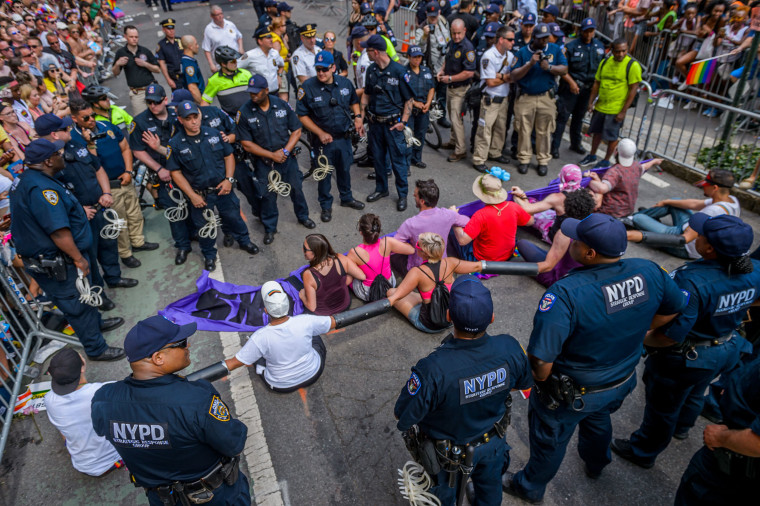
In 2017, activists used a “lockdown” technique to halt the official march in front of the Stonewall Inn to protest the presence of corporations and uniformed police. The NYPD was forced to arrest12 activists outside the Stonewall, where a police raid in 1969 helped spawn the modern LGBTQ rights movement — a raid that the department only apologized for this year.
Protesters from No Justice No Pride movement blocked the NYPD and Toronto police contingents during the New York City Pride March in 2017.Pacific Press / LightRocket via Getty Images file
Then, before last year’s march, a group of activists calling themselves the Reclaim Pride Coalition delivered a set of demands to Heritage of Pride, the nonprofit that has produced the NYC Pride March since 1984.
Reclaim Pride told Heritage of Pride that if it wanted to allow police to participate, the officers had to be out of uniform and unarmed. The activist group also demanded that there be no barricades along the sidewalk of the march, to ease congestion and allow passersby to join the massive annual event. Reclaim Pride also demanded that a “resistance contingent” be given a place near the front of the march to highlight the LGBTQ community’s opposition to the Trump administration’s policies.
“Reclaim Pride Coalition believes that HOP’s management of the annual NYC Pride March, resulting in commercial and police saturation of the March among other unacceptable characteristics, has led to decades long conflict with and the alienation of many individuals and groups within the NYC LGBTQ community,” the group wrote last year.
When Heritage of Pride responded to those demands a month before the 2018 NYC Pride March, Reclaim Pride activists were incensed: The march was shortened, the route was reversed and no changes were made to the presence of police officers or barriers. In addition, Heritage of Pride distributed wristbands for officially sanctioned marchers.
This year, with the 50th anniversary of the 1969 Stonewall uprising and the addition of WorldPride to the city’s events, millions of additional people are expected to descend on New York City the last weekend of June. And Reclaim Pride will be holding its first Queer Liberation March — a separate, police-free, anti-corporate, unsanctioned event that will take place just hours before the official NYC Pride March.by TaboolaSponsored StoriesKELLEY BLUE BOOK10 Longest-Range Electric Cars of 2019 SENIOR LIVINGSonoma Apartments May Have Seniors Packing Their Bags
Organizers from both groups spoke to NBC News about their views on Pride. They represent a historic divide that was present even before the Stonewall uprising of 1969: whether the LGBTQ rights movement is a revolutionary one or one seeking integration into the American body politic.
RECLAIM PRIDE’S VIEW
Natalie James, a co-founder of the Reclaim Pride Coalition, said the reason New York needs the Queer Liberation March is because of what Stonewall really was about.
“What was different about Stonewall, in terms of New York City leading up to that time, was the massive response to the brutality,” James said. “People fought back, and they fought back not just for one day, for multiple days.”
The barriers now set up by police for crowd-control purposes prevent passersby from joining the march, James said. During the first pride march in 1970, called Christopher Street Liberation Day and held on the anniversary of the Stonewall uprising, marchers shouted, “Off of the sidewalks, into the streets!” — and people listened. By the time marchers entered Central Park, the event’s last stop, the crowd stretched for blocks.
We’re not going to change the world again if we just sort of go along with the program.
MARTHA SHELLEY GLF FOUNDING MEMBER
Several veterans of the early LGBTQ movement agree with James and have thrown their support behind the Queer Liberation March, including Fred Sargeant, one of the organizers of the first pride march, and the activist Martha Shelley.
“I can see the Heritage of Pride point of view, that they need money to pull off a huge party and all that sort of thing,” Shelley told NBC News. “I’m also seeing from the Reclaim Pride point of view that we’re not going to change the world again if we just sort of go along with the program.”
Shelley, a founding member of the Gay Liberation Front, which was founded right after the Stonewall raid, said she is dividing her time between the dueling groups.
“I am going to be the Gay Liberation Front spokesperson at the Heritage of Pride rally on Friday night,” she explained. “And then on Sunday, I’ll be marching with Reclaim Pride.”
When she speaks Friday, Shelley said she’s coming with a political message: “We have to deal with a vast economic inequality and corporate control of our political and economic system.”
“When Gay Liberation Front started, we were a tiny little group of raggedy-ass kids,” Shelley said. “We were, with one or two exceptions, all under 30. We didn’t have careers to lose, and yet we changed the world.”
During its brief existence from 1969 to 1973, the Gay Liberation Front reached out to all sorts of other revolutionary liberation groups, including the Black Panthers, according to Shelley.
“The previous gay organizations were kind of single-issue groups and weren’t making those alliances,” Shelley added, referring to integrationist groups like the Mattachine Society, which had staged an annual, lightly attended picket protest in Philadelphia.
“By doing that — by changing the attitudes on the left first — we eventually changed the entire culture,” Shelley said.
HERITAGE OF PRIDE’S VIEW
Heritage of Pride contends that there is no way to pull off the massive NYC Pride March — which is expected to draw an estimated 4.5 million people this year — without police, barricades and some level of corporate partnership.
“I understand on some level where Reclaim Pride is coming from, but I also have been an event organizer in New York City and I understand that to do a large-scale event like our march, logistically, you can’t do it without barricades,” Sue Doster, director of strategic planning at Heritage of Pride, told NBC News. “You can’t do it without police, and in New York City, if you get a permit for an event of this scale, you automatically get police, you automatically get barricades.”
Doster said that even though the parade’s corporate presence is a far cry from the small group of marchers that first stepped off from the Stonewall Inn in 1970, it is particularly meaningful for people all around the world — particularly those in homophobic countries where LGBTQ people are still demanding basic rights. Doster recounted a discussion she had with an LGBTQ activist from Kenya: “She said to me, ‘Seeing what you do in the United States, even before I came here, seeing the pictures, gives me and my friends hope, because for us it shows us how it can be.’”
When Doster started volunteering with Heritage of Pride in the 1990s, “we literally cut out letters and made our own banners,” she said. “Now, of course, we have mass-produced banners that are vertical on light poles down the entire route — very, very different.”
“When we were making our banners, we actually hung them ourselves,” she added. “We climbed the ladders with ropes and duct tape and attached them to the top of light poles all along Christopher Street.”
Now, the packs of protesters verbally harassing marchers as they paraded past St. Patrick’s Cathedral have been replaced by supportive spectators packed 10 deep on sidewalks along the entire route, according to Doster.
“And the truth of the matter is, regarding sponsors, Pride has gotten more and more expensive over the years,” Doster explained. “A lot of our attendees really want big names, and that is expensive. It’s a balancing act, and I think we at Heritage of Pride are very conscious that it’s the community’s, so that it’s not T-Mobile’s event or TD Bank’s event.”
Three high-school students in Connecticut have filed a federal discrimination complaint challenging the state’s policy of letting trans students compete on sports teams according to their gender identity.
The complaint was filed on behalf of the three girls on Monday (June 17) by the Alliance Defending Freedom (ADF), a conservative Christian organisation in the US that has also filed over 40 cases against Planned Parenthood.
Their complaint to the US Department of Education alleges that Connecticut’s policy violates Title IX, the federal civil-rights law that is meant to ensure students have equal access to opportunities regardless of their sex.
The complaint, which refers to trans girls as “biological males,” says that trans athletes should not be allowed to compete in the category corresponding to their gender identity because it’s unfair to cisgender girls.Free Antivirus Software Reviews 2019. Compare Free Antivirus Software Providers Side-By-Side.SEE MORE
Eliza Byard, executive director of GLSEN, a group dedicated to rights for LGBT+ students, said to CNN, “This is a serious lawsuit brought about by a parent and the Alliance Defending Freedom as part of a broader effort to bar trans students from equal access in sports.”
“Trans girls are girls, and they should have access to all parts of school,” Byard said.
All three girls making the complaint are teen track athletes. Two are unnamed and the third is Selina Soule.
“Girls deserve to compete on a level playing field. Forcing female athletes to compete against boys is grossly unfair and destroys their athletic opportunities,” said Christiana Holcomb, a lawyer with ADF, in an online statement.
“Title IX was designed to eliminate discrimination against women in education and athletics, and women fought long and hard to earn the equal athletic opportunities that Title IX provides. Allowing boys to compete in girls’ sports reverses nearly 50 years of advances for women under this law. We shouldn’t force these young women to be spectators in their own sports.”
ADF have other anti-trans lawsuits
The ADF’s mission statement is “defending religious liberty, the sanctity of life, and marriage and family.”
Its website says, “The abortion industry has been profiting from the deaths of infants for over 40 years,” and adds that the “good news” is that “a surging pro-life movement has forced the closure of 75 percent of surgical abortion businesses in America.”
Another lawsuit related to trans issues is detailed on ADF’s website in a post called“Two recent victims of the transgender movement.”
The lawsuit was filed by the ADF in November 2018 on behalf of a male professor who was given a written warning by a university for refusing to use she/her pronouns for a student who had informed him she was a trans woman.
“This isn’t just about a pronoun; this is about endorsing an ideology,” said Tyson Langhofer, a lawyer for ADF.
Complaint calls for ban on transgender students in girls sports
The high schoolers complaint in Connecticut calls for an investigation of Connecticut Interscholastic Athletic Conference (CIAC), the non-profit organisation responsible for high-school athletics regulations.
It also demands that trans girls track records are removed and for them to be denied access to women’s sports in Connecticut.
CIAC says that its policy follows a state-wide anti-discrimination law that requires students to be treated in school as the gender they identify with.
“The CIAC reviewed our transgender policy with the Office of Civil Rights in Boston earlier this school year to ensure compliance with Title IX,” said Glenn Lungarini, executive director of CIAC.
“In addition to reviewing the policy with our legal counsel, the CIAC also discussed our current policy with Connecticut’s Commission on Human Rights and Opportunities to ensure compliance with Connecticut legislation protecting students (and others) in their gender expression and identity.”
“They came during the night,” Ahmed said. “They knocked on my door, not saying they are police, but when I opened the door and saw a couple of big, long-bearded men, I knew immediately.”
This is how Ahmed said his torture began in Chechnya, a semi-autonomous region in southeastern Russia. The short-bearded, blue-eyed 20-something, who has since fled to another part of the country, asked to use a pseudonym to protect his own safety, as well as the safety of family members still in Chechnya.
“I was driven to a police station,” Ahmed told NBC News via Skype, his face turned away from the camera while being recorded. “While police officers repeatedly asked me to betray other LGBTQ community members, I was beaten — for hours. They were using a plastic pipe.”
“I was telling them that I don’t know what they’re talking about, but they said that they know who I am,” he added. “Then they started torturing me with electricity.’
AHMED
For at least two hours, Ahmed explained, police officers were putting electricity in his body through his fingers. He said the pain was unbearable.
“Like all your body is burning,” he said. “These police officers are accustomed to torturing people … Some men I know told me that some were left hanging from the ceiling, had been suffocated with a plastic bag or even raped with the police bat. This kind of torture can last for weeks.”
Life as a gay man in Chechnya is far from easy, according to Ahmed. Meeting other gay men can be a dangerous proposition, as authorities use people as bait to attract gay men, he claimed.
“There were many cases where this kind of ‘friendship’ resulted with arrest,” Ahmed explained. “I was not using social networks to meet other gay men, and I believe that this saved me for a long time. I was mostly in a circle of well-known, trusted people, and I was cautious, so that’s why police released me in the end. They didn’t have anything solid on me.”
Ahmed said no one was ever brought in to testify against him. He speculated that his “different appearance” is probably what made authorities suspect he’s gay.
Rachel Denber, the deputy director of Human Rights Watch’s Europe and Central Asia division, said that Ahmed is far from being the only person to face this type of police inquiry in Chechnya.
Human Rights Watch has interviewed several men who have been detained in Chechnya on suspicion of being gay or bisexual. Denber said these men have been through “horrific, depraved torture and humiliation,” including rape. While this torture is allegedly happening at the hands of Chechen authorities, Denber said these “cases of abduction and secret detention” are happening illegally in the region.
Igor Kochetkov, head of the Russian LGBT Network, a nongovernmental LGBTQ rights organization, said there are several dozen Chechens who have been detained and tortured in this most recent wave of persecution, which he said started at the end of 2018.
By Chechen law, he said, there are no legal grounds to deprive someone of their freedom due to their sexual orientation. He added that only few detainees manage to leave Chechnya, since authorities usually take their passports.
“Most of the Chechens who turn to us want to leave Russia, because they are afraid that the Chechen police or their own relatives will be able to find them anywhere in Russia,” Kochetkov explained.
Ahmed was among the lucky ones, as his passport was returned to him, and he was able to flee Chechnya. He is in another part of Russia and is hoping to leave for a country in Western Europe. He did not specify which country, to protect his safety, but he said his partner lives in a European country where gay rights are highly respected.
“I don’t feel safe here at all,” he said of Russia. “[Chechen leader Ramzan] Kadyrov’s people are so powerful that they can find me here, too. I keep a low profile here, and I don’t live a normal life. So until I leave Russia, I won’t be able to live free.”
Chechen authorities have repeatedly denied that this kind of persecution is happening in the republic. At the beginning of the year, Alvi Karimov, a spokesman for Kadyrov, the region’s strongman leader, said “it’s an absolute lie.” In 2017, following the reports of the initial “anti-gay purge,” Karimov stated, “You can’t detain and oppress those who don’t exist in the republic,” seemingly denying the existence of any gay people in Chechnya.
“That is totally not true,” Ahmed said of Karimov’s assertion. “There are gays even among Chechen political representatives.”
Ahmed said he would like to get married one day, but he lamented that same-sex marriage is so far away from being possible in Chechnya. He claimed even heterosexual couples can’t express their love openly in the region.
But despite what he’s been subjected to, Ahmed said Chechnya will always be his home: “If I could live there freely, I wouldn’t go anywhere else.”
An estimated 10,000 LGBTQ youth, ages 13 to 17, have been protected from conversion therapy by living in states that have banned the contentious practice on minors, according to an updated report from UCLA’s Williams Institute.
Starting in 2012 with California, 18 states and the District of Columbia have banned conversion therapy for those under 18, though no state bans the practice on adults. Conversion therapy seeks to change the sexual orientation or gender identity of an individual through various tactics including talk therapy, and, in extreme cases, aversion treatments like inducing nausea or vomiting.
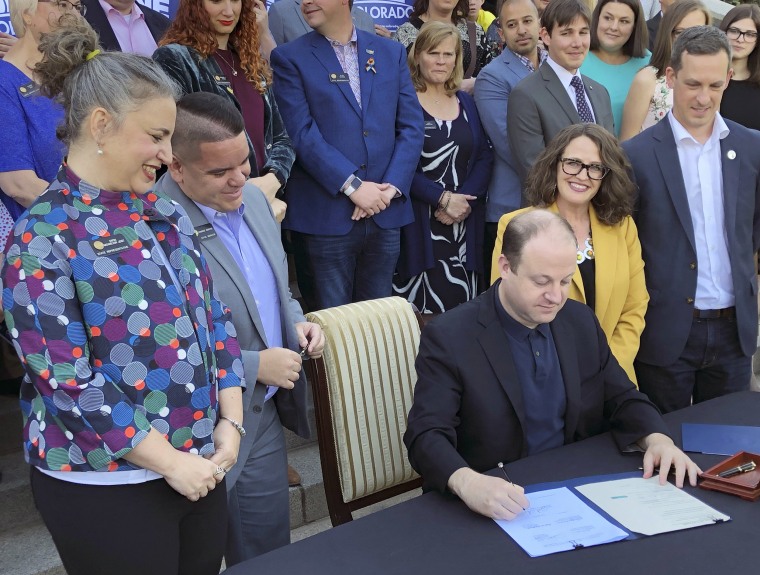
Colorado Gov. Jared Polis signs legislation banning psychotherapy, known as “conversion therapy,” that seeks to change the sexual orientation or gender identity of minors, at a Capitol ceremony in Denver on May 31, 2019. Jim Anderson / AP file
“The scientific research since the late 1940s has been remarkably consistent that sexual orientation and gender identity are remarkably resistant to efforts to change,” Catherine Lugg, a professor at the Graduate School of Education at Rutgers University, told NBC News.
“Since the 1970s, no credible medical organization has claimed that one can change — or, by implication, should change — their sexual orientation and/or gender identity,” Lugg added.
In fact, the vast majority of the general population does not support conversion therapy on lesbian, gay, bisexual, transgender and queer youth. The Williams Institute reports 18 percent of those surveyed this year believe the practice should be legal for minors, with 56 percent believing it should be illegal, and the remaining 26 percent not sure.
Yet, 32 states haven’t banned the practice, and 16,000 young people in those states are expected to undergo conversion therapy from a licensed health care professional before reaching the age of 18, according to the report.
The negative mental health outcomes caused by the medically discredited practice may affect young people for the rest of their lives, expert say. This month, The Trevor Project, a nonprofit that helps LGBTQ youth in crisis, released its 2019 National Survey on LGBTQ Youth Mental Health, which found that 42 percent of LGBTQ youth who underwent conversion therapy reported a suicide attempt in the last year. That number was even higher (57 percent) when looking specifically at transgender and nonbinary youth who’ve undergone the practice in the past 12 months.
Sam Brinton, the project’s head of advocacy and government affairs, underwent conversion therapy as a minor. Brinton told NBC News that “the real and lasting effects of it are too awful to list and mention.”
Brinton said conversion therapy gives vulnerable LGBTQ youth “false hope” that they can actually change their sexual orientation or gender identity. Being unable to do so then leads to “massive mental health challenges such as depression and suicidal ideation,” Brinton added.
While 13 states have banned conversion therapy on minors in the past two years alone — roughly one state every two months — Brinton expects this pace to slow, noting that the remaining states lean more conservative.
“But that doesn’t mean we don’t try,” Brinton added, noting that an additional 21 states — including reliably conservative Kansas, Kentucky and Georgia — have already submitted bills that would ban the discredited practice for minors.
In fact, The Trevor Project is leading the 50 Bills 50 States campaign, which works to get legislation passed in every state that would ban conversion therapy on minors.
Brinton, however, does not believe legislation alone will end the controversial practice. The key, Brinton said, is making clear to providers that practicing conversion therapy is no longer lucrative.
That’s why Brinton says the recent bill introduced by Rep. Sean Patrick Maloney, D-N.Y., which seeks to ban taxpayer funding of conversion therapy, is a step in the right direction. Currently, states decide which services Medicaid can cover, and Medicaid doesn’t require a detailed description of the services provided, meaning practices like conversion therapy — which has been discredited by nearly every major health organization — can simply be billed and covered like traditional therapy.
While Brinton was not able to provide an exact number, The Trevor Project tracks close to 500 known conversion therapists and claims “millions of dollars” are currently going into the pockets of these providers.
Brinton made clear it’s necessary to remind LGBTQ youth — especially those being pushed into something like conversion therapy — that they are not alone.
“I remember feeling I was alone, and I was literally so worthless that I was being erased by a doctor,” Brinton recalled. “This is the best time for us to tell them, ‘You’re not alone, and we’re fighting for you in every state across the country.’”
Alphonso David, a civil rights lawyer who has been serving as chief counsel to New York Gov. Andrew Cuomo, was named Tuesday as the new president of the Human Rights Campaign, the largest LGBTQ-rights organization in the U.S.
David, 48, is the first African American to lead the Human Rights Campaign since its founding in 1980. At times in the past, some critics perceived the group as focusing too heavily on the interests of white gay and lesbian people. David becomes its seventh president, succeeding Chad Griffin, who has held the post since 2012.
David was appointed as Cuomo’s chief counsel in 2015, and before that served as New York’s Counsel for Civil Rights. He played key roles in the legalizing of same-sex marriage in New York in 2011, banning so-called conversion therapy for LGBTQ minors and establishing non-discrimination protections for transgender New Yorkers.
Alkyl nitrites, commonly known as poppers, pose very little chance of addiction, risky consumption habits or other psychosocial problems.
Many LGBTI people, but especially gay and bisexual men use poppers for recreational purposes or to enhance sex.
A new study found little evidence of typical dependency characteristics, including health, social, legal and financial problems. It also found no correlation between popper use and mental health or psychological stress.
Researchers at the University of Technology Sydney (UTS) surveyed more than 800 men aged 18 to 35. Lead researcher Dr Daniel Demant, welcomed the decision by the Therapeutic Goods Administration (TGA) to not ban poppers.
In 2018, the TGA issued a temporary ban on poppers. It put them onto Schedule 9 of the Poisons Standard – the same schedule as heroin.
But thanks to a vocal campaign from the LGBTI community and passionate submissions to the TGA, it backtracked on the ban. The TGA instead elected to classify them as a Schedule 3 drug. From February 2020, poppers will be available over the counter in pharmacies.
Poppers users will be made ‘overnight criminals’
Demant described the ban as creating ‘overnight criminals’ of the estimated more than 100,000 Australian users.
‘What we see with this research is that poppers are a very commonly used drug in the LGBT community, both recently and over their lifetime,’ Demant said.
‘Most of the users are already oppressed or marginalized based on their social identity as gay or bisexual men. This creates a question as to whether there would have been a discriminatory element in banning a substance with such a low risk profile.
Currently, poppers are available on prescription from pharmacies. But many people buy them illicitly at sex-on-premises venues or LGBTI bars. A vial for up to AU$50,(US$34.60/€30.63) despite costing a couple of cents to manufacture.
The new TGA decision to regulate poppers rather than banning them hopefully paves the way for some measure of quality control as well as the removal of the ‘extreme profit margin’ that exists now Demant said.
‘We could stop pretending that poppers are sold for anything other than getting people high,’ he said.
‘And once we do offer it in pharmacies, we would have something made to the highest standards for people to use.’