A soldier has detailed what happened to him after he was caught up in South Korea’s hunt for gay people in the military.
While same-sex activity is legal in the country, the military bans it under Article 92-6. The law says it is in order ‘to keep the military community sound’. However, South Korea has a mandatory two year draft for all able-bodied male citizens.
Those caught could be placed in prison for six months to two years.
An anonymous soldier told Agence France-Presse (AFP) that he faces legal action even after leaving the military because his relationship with another soldier was caught.
The 27-year-old told the site: ‘I worked very hard as an officer, but none of that mattered when I became a suspect.
‘There were days when I just wanted to die.’
A witch hunt since 2017
Authorities arrested 22 soldiers during a 2017 inquiry into homosexual activity in the army – including this soldier. They found messages on his partner’s phone.
Luckily, they charged him on his last month of service. This meant his case was transferred to a civilian court, where he was acquitted.
This makes him the first soldier charged under the military sodomy law to be found not guilty.
Prosecutors are appealing the decision, leaving him in legal and social limbo before his next hearing. This jeopardize his civilian job and his relationship with his family.
He added: ‘It is as if my entire existence was being denied. I should never have been charged… in the first place.’
A defense ministry official told AFP: ‘The ban needs to remain in place as it is required to maintain a sound and wholesome lifestyle and discipline in the military, which is a communal institution.’
Spain’s health minister has called for gay conversion therapy to be abolished.
It comes after a report in a national Spanish newspaper claimed that a branch of the Catholic Church near the capital, Madrid, offered to “cure” a reporter who was posing as a gay man trying to change his sexuality.
The article en El Diario says the man was advised, in a counselling session provided by the diocese. to stop watching porn and masturbate less.
But Spanish Health Minister, Maria Luisa Carcedo Roces, said such practices are illegal.
“They (the church) are breaking the law,” the minister told a press conference. “therefore, in the first instance, these courses have to be completely abolished.”
She went on to say that it was unfortunate that there are still pockets (of Spain) where people are told what their sexual orientation should be.”
What does the therapy consist of?
Conversion therapy is based on the belief that being gay, bisexual or transgender is a mental illness that can be cured. Methods can include hypnosis and electric shock treatment.
The practice is banned in the Madrid region, even if the recipient gives consent or not. Punishment can include fines of up to 45,000 euros.
In a statement on its website, the diocese of Alcala de Henares claimed the report was “fake news.”
But it also said that while it acknowledged the “respect and love due to all people”, it would offer help to “all those who freely request it.”
The website also recommends books including “How to Prevent Homosexuality: children and gender confusion”.
The health minister said that if the law continued to be broken then Spain’s Department of Justice would have to decide what action to take.
Other places that have banned conversion therapy include Ecuador, Malta and over a dozen US states.
DNA tests have shown that American Revolutionary War hero Casimir Pulaski was almost certainly intersex, a documentary to be broadcast on Monday will reveal.
Researchers for the documentary established that the disputed remains of the general known as the “father of the American Cavalry” were genuine, cementing the view that he was born with an intersex condition.
Rumours have swirled for years over whether Pulaski, a Polish nobleman born in Warsaw in 1745, was born with both male and female sex characteristics.
A forensic investigation conducted in 1996 on exhumed remains showed signs of a more oval-shaped pelvis and rounded facial features, both indicators of female physiology.
However, scientists and researchers had been split over whether the skeleton, which was the same height as Pulaski and bore many of his reported wounds, was actually the general who fought under the command of George Washington.
Pulaski died from his battle wounds in 1779 in Savannah, the former capital of the U.S. state of Georgia.
Thanks to scientific advances, researchers from the Georgia Southern University were able to match Pulaski’s skeleton from DNA extracted from remains of a relative exhumed in Poland.
“The issue with the previous work done by the forensic anthropologist, was that she didn’t have any genetic samples that worked at the time that confirmed (Pulaski’s identity),” said Virginia Hutton Estabrook.
Estabrook, an assistant professor of anthropology at the university who examined the remains for the documentary, told the Thomson Reuters Foundation there was a need for further forensic examination of the intersex condition.
“Part of this is the whole intersex issue forensically, as we don’t know what intersex skeletons look like,” she said.
“There are no comparative samples because there hasn’t been a (forensic) history of the intersex condition.”
The documentary, called “America’s Hidden Stories: The General Was Female?”, will be broadcast on the Smithsonian Channel.
As many as 1.7 percent of babies are born with genitals, gonads, reproductive organs, hormones or chromosomes that do not fit the usual expectations of male and female, according to the United Nations.
They often undergo surgery to bring the appearance and function of their genitalia into line with that expected of men or women.
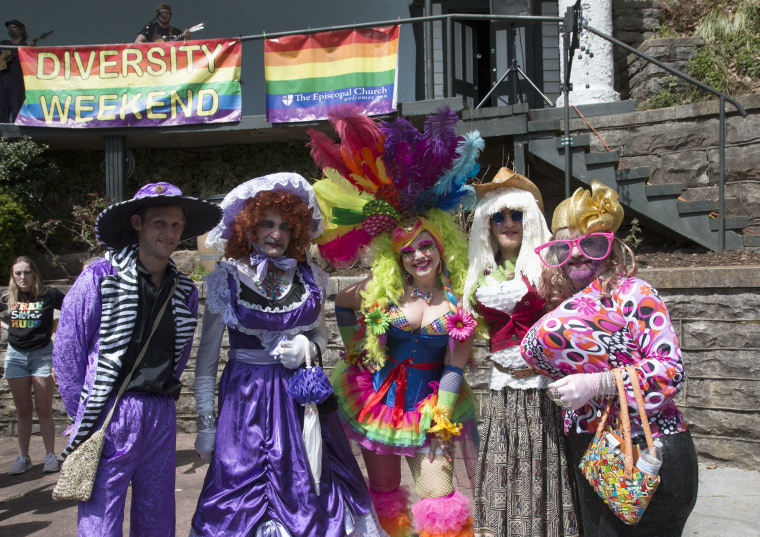
On the count of three, about 50 gay couples kissed their partners in the public square of a small town in the Ozark Mountains.
Jay Wilks, the event’s organizer, told the crowd to do it over.
“With more passion this time!” he shouted into the microphone.
Wilks counted down again, and queer and trans people embraced their partners, now with the gusto he demanded. The couples, decked out in so much pride gear that despite the day’s clear weather rainbows abounded, held each other, laughed and, most important, kissed.
It was PDA in the Park, the signature event of early April’s Spring Diversity Weekend in Eureka Springs, Arkansas. Eureka is a rural, hilly town of about 2,000 people where locals say over 30 percent of residents are LGBTQ and playfully remark their town has “no straight streets.”
Amber Clark, 36, who has rainbow-dyed hair, drove in for the weekend from Carthage, Missouri, a city of less than 15,000 where you’d be hard-pressed to find 100 queer people making out in the small downtown. She came with what she characterized as “a group of loud, out, queer women.”
“We’re here to be normal for a weekend,” she said, “and to kiss in the park.”
About 2.9 to 3.8 million LGBTQ people live in rural America, and they are increasingly finding that they don’t need to travel to a big city or the coasts to find a place to be themselves and unwind on vacation.
Public imagination renders LGBTQ people as city dwellers, and the dominant narrative says anyone queer or trans living in rural America yearns for escape. There is some truth in that, and for good reason — a recent survey found that Arkansas residents were the least supportive of measures to protect LGBTQ people from discrimination, compared to residents of other states. But in Eureka Springs, Wilks, who runs Out in Eureka, an LGBTQ event and information organization, is working to create what he sees as an oasis: a space for LGBTQ people to explore a quaint Southern town while being welcomed exactly as they are.
Other cities and towns in red states have also begun courting lesbian, gay, bisexual, transgender and queer tourists, as a way of showing their openness and because there’s money to be made. (It’s difficult to determine the economic impact of LGBTQ travelers, but by using population data, the United Nations World Tourism Association estimates they generate more than $50 billion in annual revenue in the U.S.)
Performers and attendees at Diversity Weekend in Eureka Springs, Arkansas.Ludwig Hurtado / NBC News
Salt Lake City is so dedicated to making sure people know it’s LGBTQ-friendly that it has an explainer on its tourism website that begins, “Yes, Salt Lake IS a great place for the LGBTQ Community.”
Oklahoma City tries to entice LGBTQ tourists with its annual Memorial Day gay rodeo and its small but thriving gayborhood.
Forty miles southwest of Eureka Springs, Fayetteville is on a similar mission, trying to appeal to LGBTQ people in Arkansas and neighboring states, for whom going on vacation to a major city is cost prohibitive — or not at all desirable. People who are rural and queer, or Southern and queer, often feel like they need to give up one of those identities, but city leaders in Fayetteville and Eureka Springs are marketing their towns as a place where visitors and residents alike can have it all, even if the state’s politics are not as progressive.
“Our focus is not to become a San Francisco or a Fort Lauderdale,” Wilks, 51, a former flight attendant, said. “Fire Island is fun,” he added of the gay destination east of New York City, but Wilks wants to remain “true to who Eureka is” — a small town that’s wooded, Southern and super gay.
‘DO THEY REALLY WANT US HERE?’
Fayetteville recently became the first city in Arkansas to join the International Gay and Lesbian Travel Association, which provides free resources, travel suggestions and safety tips to LGBTQ travelers. The city of about 85,000 has always had a reputation for being progressive, especially within its own state, partly because it’s a college town that votes blue. Since 2014, Fayetteville fought to get an LGBTQ nondiscrimination law on its books, but the state supreme court struck it down in January.
That put Molly Rawn, executive director of Experience Fayetteville, the city’s tourism office, in a bit of a bind. How do you convince LGBTQ people to come to your city, which prides itself on inclusivity, when the state sends a different message?
One way Rawn does it is by being clear in her message to LGBTQ folks: “We want you here,” she said.
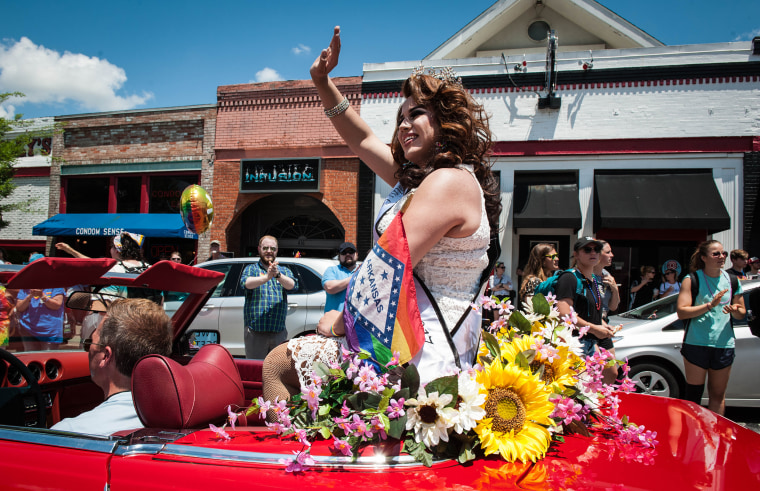
A Pride participant in Fayetteville in 2018.Courtesy Vincent Griffin
Experience Fayetteville takes out ads in gay newspapers in nearby cities and neighboring states touting its attractions and making sure queer and trans folks know they can visit without worry.
“In my experience, you only have to get them here once, and then they come back,” Rawn said. A lifelong Arkansan, she knows she’s fighting an uphill battle — while she loves the state, she acknowledges that it isn’t always a great place to be LGBTQ, with a lack of workplace discrimination protections and scant health care for trans people.
Still, Fayetteville Pride, the biggest gay event of the year, has flourished, drawing visitors from all over the region. The first parade in 2005 drew about 200 attendees; last year, it had over 15,000.
John Tanzella, president and CEO of the International Gay and Lesbian Travel Association, was thrilled when Fayetteville wanted to be promoted by his organization. But some travel writers and tourists wrote to his organization and asked: “Is it really somewhere welcoming?” and “Do they really want us there?”
His answer: “Yes.”
Tanzella said that in recent years, gay tourism has “evolved from a one-size-fits model to all these different niches.” No longer just cruises and bed-and-breakfasts in Provincetown, Massachusetts, LGBTQ tourism has grown as diverse as the community itself. One of those niches is LGBTQ people who live in the South or the Midwest, and aren’t itching for big city life — they just want a place to be themselves.
Still, the impulse to court LGBTQ tourists doesn’t sit well with everyone.
Brody Parrish, a queer, trans and nonbinary Fayetteville resident, said the effort to draw LGBTQ visitors feels like a “misappropriation of resources.”
Parrish believes Northwest Arkansas should focus on allocating resources to its LGBTQ residents by increasing health care access and opening spaces like community drop-in centers were queer and trans people can congregate. Progressive cities like Fayetteville should “really be putting in the work to make it a safe space for everyone to exist here.”
“I would love to meet random LGBT people that come to this area to visit,” Parrish added, but at the same time, “What are you doing to support those people that are in your town, versus trying to bring people from other areas?”
‘IT FEELS LIKE HOME’
Melodye Purdy moved to Eureka Springs about 15 years ago from Memphis, Tennessee. She and her partner chose Eureka mostly because “there is no other place on Earth like it.”
“Being a woman and being a lesbian, it was very important to find a sense of security and safety,” Purdy, 53, said. Some “gay-friendly” places she and her partner considered seemed to cater only to men, while others, like Key West and Provincetown, felt too far from her home in the South. “I did think that I had to leave the South to be a lesbian,” she said. But in Eureka, among the curvy streets, she found home. “I was wrong.”
Melodye PurdyLudwig Hurtado / NBC News
Eureka’s reputation as an LGBTQ haven isn’t new — at least for Northwest Arkansas residents. It started as a hippie town in the ’70s, and slowly, queer and trans people began moving there. The picturesque town features old saloons with rainbow flags, a haunted hotel, and dozens of other gay-owned shops, restaurants and businesses. Every bar in Eureka, residents like to say, is a gay bar.
Ashley Buckmaster, 36, makes the two-hour drive from her home in Carthage, Missouri, to Eureka Springs a couple times a year. “It’s not scary to go places here,” Buckmaster, who is queer, said at Diversity Weekend. On her visits, she’s met and made lifelong friends. “It feels like home.”
That is exactly why Wilks organizes Diversity Weekend.
“With the cost of travelling to some of the major cities, it’s not something that everyone can just up and do,” he said. “Gay affluence” is a largely a myth, and transgender people often face structural hurdles to finding work and housing. Eureka, Wilks and others hope, can provide an affordable and safe refuge.
‘WE’RE MOVING’
Preparing for his first trip to Eureka Springs a year ago, Ethan Avanzino, 30, said he took out a lot of cash.
“My initial thought of Arkansas was like: ‘Do they take credit cards? Can we barter?’” Avanzino, a gay trans man who grew up on the West Coast and currently lives in Dallas, said. He’s been back four times since then, making the six-to-seven-hour drive with his husband.
On Diversity Weekend this April, he returned to enjoy the festivities and to lead a “Transgender 101” workshop for visitors and community members.
Ethan AvanzinoLudwig Hurtado / NBC News
In the town’s public library, people asked Avanzino about they/them pronouns, what it means to be intersex and how best to support the trans people in their lives. Outside the library window, if you looked east, you could see a 66-foot white statue of Jesus called “Christ of the Ozarks” towering over the hills.
In Dallas, Avanzino is out and does media production for a Fortune 500 company; things are pretty good. But there’s something about Eureka that he feels like he can’t get elsewhere. “The inclusivity in the South is what captured me,” he said. “I like to disconnect and be out in the middle of the wilderness and not have cell reception.”
The Navy will allow transgender sailors to dress in accordance with their gender identity while off duty. The dress code clarification comes as the military prepares to roll out a controversial new policy on Friday restricting the service of openly transgender people.
The Navy will permit all transgender service members to “live socially” as “their preferred gender” when they are not in uniform, a U.S. Navy spokesperson confirmed to NBC News. The dress code guidance was sent in an administrative message to troops earlier this week.
“There is no policy that prohibits the ability of a Service Member to express themselves off-duty in their preferred gender,” the message states. “Appropriate civilian attire, as outlined in the uniform regulations, will not be determined based on gender.”
The new trans military policy set to be unveiled Friday — which was ignited by a series of surprise tweets sent by President Donald Trump in July 2017 — allows currently serving transgender troops and service members who have already received a diagnosis of gender dysphoria to continue to serve in their preferred gender. But after April 12, when the policy goes into effect, no one with gender dysphoria who is taking hormones or has transitioned will be allowed to enlist.
Further, any currently serving troops diagnosed with gender dysphoria after April 12 will have to serve in their sex as assigned at birth and will be barred from taking hormones or getting gender-affirming surgery.
Those guidelines, which the Defense Department insists do not constitute a ban, were announced after the U.S. Supreme Court and the U.S. Court of Appeals for the District of Columbia allowed the Trump administration to enforce the policy while it is being challenged in court. LGBTQ advocacy organizations, including the National Center for Lesbian Rights and GLBTQ Legal Advocates and Defenders (GLAD), have filed lawsuits to overturn the “trans military ban,” calling it “discriminatory.”
As those cases make their way through the court system, LGBTQ groups working on behalf of transgender members of the military credited the Navy for taking a “step forward” to affirm the lived identities of trans sailors.
Bree Fram, communications director at the LGBTQ military advocacy group SPART*A, said the organization is “thrilled.”
“The Navy is taking care of its transgender service members by giving them the option to dress and express themselves as they choose,” Fram told NBC News.
Melody Stachour, a trans woman who serves as a chief petty officer in the Navy Reserve, said the newly announced guidelines are “an attempt to support trans service members to the maximum extent possible, even while they are constrained by the overall policy that they are governed by.”
“This is not just good for the sailors, but also for the Navy,” she said, “as it allows them to retain sailors who are doing an excellent job … while acknowledging that they are still required to follow the orders given by their seniors.”
Others expressed reservation about the Navy guidelines on gender expression, saying it could put transgender people at risk of being discharged from the military.
Although the Department of Defense has maintained the restrictions on trans troops are not a “ban,” a report released by the Palm Center, a nonpartisan public policy think tank, claims the new regulations make it almost impossible for transgender people to serve. According to the report, both “gender dysphoria” and a “medically advised need for any treatment for gender dysphoria” constitute a “basis for separation from military service.”
Aaron Belkin, the Palm Center’s director, claims trans individuals could be reported and sent to a mental health counselor for a “gender dysphoria” diagnosis if they’re seen dressed according to their gender identity off base.
“Once the information gets out that someone is trans, then the service member has no more control over it,” he tells NBC News.
Belkin compares it to life under “don’t ask, don’t tell.” Enacted in 1994, the Clinton-era policy allowed gay, lesbian and bisexual people to enlist in the military as long as they didn’t disclose their sexual orientation. However, closeted troops faced being outed by fellow service members, former partners and even family members.
“In practice, the permission to live a private life was complete B.S.” Belkin added. “It existed on paper, and it’s the same mechanism here.”
Andy Blevins, who was discharged under “don’t ask, don’t tell,” said the predicament that faces transgender people serving in the Navy or other branches of the military is actually “worse” than “don’t ask, don’t tell” — which was lifted in 2011.
“We entered the service knowing we had to hide a crucial aspect of our identity,” said Blevins, who now serves as the executive director of OutServe-SLDN, an LGBTQ military advocacy group. “These service members were told nearly three years ago: ‘We see you, we hear you, we’re going to support you, we affirm your identity. Be true to yourself, because that’s what’s needed.’ And then the rug was pulled out from underneath them.”
While Blevins is “grateful” to the Navy for making a gesture to support trans troops, he said the “lack of clarity” surrounding its dress code policies is the issue. As of now, no one knows if it could be used to target transgender service members down the line.
The guidelines issued earlier this week by the military branch advised all members of the military to “continue to treat each other with dignity and respect,” saying there would be “zero tolerance for harassment, hazing or bullying of any service member in any form.”
As the restrictions on trans service go into effect, National Center for Lesbian Rights Legal Director Shannon Minter says these unanswered questions only “underscore the serious harms” of singling out members of an already vulnerable population.
“Gender is a fundamental aspect of a person’s identity,” Minter explained. “It cannot be turned on and off like a switch, and the very notion of requiring a non-transgender person to do so would be immediately recognized as cruel and unworkable. It is equally cruel and unworkable for transgender people.”
According to the Palm Center and OutServe-SLDN, no other branches of the military have announced similar policies regarding the attire of off-duty trans troops.
Will Colorado elect an openly gay man to the US Senate in 2020? That’s a distinct possibility as Dan Baer has thrown his hat into the ring for the Democratic nomination.
The 42-year-old Baer was the ambassador to the Organization for Security and Cooperation in Europe under President Barack Obama, serving from August 2013 to January 2017.
A former economics and business ethics professor at Georgetown University, Baer also served as an assistant secretary of state from 2009 to 2013. Most recently, he was head of Colorado’s Department of Higher Education.
If Baer gets the Democratic nomination, he would be running against the Republican incumbent, attorney Cory Gardner.
Gardner is considered one of the most vulnerable US Senators up for re-election in 2020. Although elected as a moderate in 2014, Gardner has grown increasingly conservative, voting in favor of many of President Donald Trump’s policies.
Crowded Democratic field
However, getting the Democratic nomination may prove difficult for Dan Baer. Hisopponents have greater name recognition in the state than he does.
Those Democratic opponents include former state senator Mike Johnston, former state speaker of the house Andrew Romanoff and former US attorney John Walsh.
If Baer wins, he would be the first openly gay man to ever serve in the US Senate.
There are LGBTI women in the Senate, but no openly gay men. In 2018, Arizona voters sent openly bisexual Kyrsten Sinema to the US Senate while Wisconsin voters re-elected openly lesbian Tammy Baldwin, who has been in the Senate since 2013.
Last year, Colorado voters elected an openly gay man, Jared Polis, to be the state’s governor. So, it’s not a far fetched notion to think the state could elect a gay man to the US.Senate.
Yet, Baer has never won elected office before. He was in the Democratic primary for Colorado’s 7th Congressional District in 2018, but ended his campaign when US Rep. Ed Perlmutter decided to seek another term.
Married to his longtime partner, Brian Walsh, since August 2014, Baer drives part time for the Lyft ride service, saying in a campaign ad that it’s a way to connect with voters and hear their issues.
He told the Denver Post his time in Vienna as ambassador to the Organization for Security and Cooperation in Europe makes him strong on foreign affairs. Baer reports foreign affairs are increasingly relevant to voters thanks to Trump’s trade wars and tariffs.
In his campaign ad, he says he wants to create policies that support the middle class, saying that America needs a hard reset.
America’s ‘first’ homeless shelter for trans young people has opened in San Francisco.
The three-bedroom house has room for six people between the ages of 18 to 24. It opened quietly nearly two months ago, according to reports from the San Francisco Chronicle.
Five trans young people currently live in the refuge, which will allow its residents to stay for two years, offering them a safe haven from transphobia and abuse.
Christopher Rodriguez, a manager at the house, explained that trans youth have more complex needs than the rest of the LGBT+ community.
“Transgender youths have more medical needs, and they have a whole added extra layer of trauma,” said Rodriguez. “Many need hormone therapy, surgeries, preparation for surgeries,” he told the SF Chronicle.
Transphobia rife in homeless shelters
Rodriguez added: “They’re outed more easily than others — a gay man can pass as not gay if he wants to, but generally not someone who’s trans. So they get more attention, and not the good kind. And more violence. That takes a lot of careful work to heal.”
One of the residents spoke to the SF Chronicle about their past experiences of homeless shelters.
22-year-old Bobby Perez, whose parents are homeless, was staying in a Larkin Street shelter when she was told about the trans house. At one of her previous shelters, someone left tampons on her bed to taunt her.
“Now that I’m stable in a safe place, it’s about, ‘Who am I?’” Perez told the SF Chronicle. “I want to see where I can go. I just have to find a passion now.”
Larkin Street Youth Services, which is the leading homeless-youth agency in the city, is renting the house and running the trans program.
90% of homeless trans youths rejected by their families
Lewis’s organisation, True Colors United, ran two surveys in 2012 and in 2015, which showed that 75% of LGB homeless youth are rejected by their families, and the figure is 90% for trans youths.
About 40% of the 1.6 million homeless youths are LGBT, and 3% are trans, according to True Colors United.
Iowa governor Kim Reynolds signed a law that will limit public funds for trans and intersex healthcare.
Iowa Republicans introduced a last-minute amendment to the Iowa Department of Human Services (DHS) budget bill on April 26 in an effort to carve a broad exemption into non-discrimination healthcare laws.
The amendment to the law signed by Governor Reynolds on Friday (May 3) stipulate that civil rights measures “shall not require any state or local government unit or tax-supported district to provide for sex reassignment surgery or any other cosmetic, reconstructive, or plastic surgery procedure related to transsexualism, hermaphroditism, gender identity disorder, or body dysmorphic disorder.”
As such, those procedures will no longer be funded under public programs such as Medicaid. The amendment directly undermines a March ruling by Iowa’s Supreme Court, which stated that the state’s Civil Rights Act protects transgender Iowans from discrimination based on gender identity, including in the provision of services via Medicaid.SPONSORED CONTENTOne Vegetable That Destroys You From The InsideSponsored by United Naturals
Leading Gut Health Expert & frequent guest of Dr. Oz and Good Morning America is begging we all change this one thing.SEE MORE
“By signing this cruel legislation into law, Gov. Reynolds has told every transgender Iowan that they are second-hand citizens and unwelcome in our state.”
— One Iowa
The law comes into effect the moment the governor signs it. LGBT+ campaigners have condemned the legislation and Governor Reynolds’ decision to sign it.
“It’s deeply disappointing that Gov. Kim Reynolds is caving to the pressure from some radical lawmakers in the Iowa Senate, instead of protecting the rights and dignity of transgender Iowans,” said JoDee Winterhof, senior vice president of policy and political affairs at the Human Rights Campaign.
Winterhof added: “Gov. Reynolds had the option to line-item veto this provision and leave the rest of the funding bill intact, but she did not. This sends a strong message that she is not working for all of her constituents and a craven desire to please Iowa’s most extreme lawmakers. As a native Iowan, Iowa deserves better—and different—leaders.”
U.S. President Donald Trump listens as Iowa Gov. Kim Reynolds speaks during a campaign rally at the Mid-America Center on October 9, 2018 in Council Bluffs. (Scott Olson/Getty)
LGBT+ rights group One Iowa also condemned the governor’s decisions in a statement on Friday.
“We are deeply disappointed that Gov. Reynolds has ignored medical experts, Iowa business leaders, cost analysis data, and the many transgender Iowans and allies who shared their stories with her to sign this bill into law,” the statement read.
It added: “By signing this cruel legislation into law, Gov. Reynolds has told every transgender Iowan that they are second-hand citizens and unwelcome in our state. Make no mistake, this law threatens people’s lives. Today is a shameful day to be an Iowan.”
An intersex woman in Russia said her landlord evicted her after police allegedly harassed her.
Olga Moskvitina lives in Makhachkala a city on the western shore of the Caspian Sea.
She said a plain clothed police officer forced his way into her apartment. This happened after her identity documents which showed she had a male name were published on social media.
People on social media left hateful comments including, ‘people like that should be killed’.
According to a report on news site Lenta, the policeman allegedly made Moskvitina strip naked and examined her genitals. He also interrogated her about her genitals and threatened to out her to locals so the could kill her.
Moskvitina tried to explain that she is in fact intersex, but cannot update her identity documents to reflect her intersex status. As a result she is forced to identify as trans.
After the incident at her apartment, Moskvitina’s landlord then evicted citing ‘such affairs’ as a reason.
While it not illegal to be trans in Russia, the LGBTI community faces high levels of discrimination, intimidation and violence. In 2013, Russian president Vladimir Putin introduced the ‘gay propaganda’ law. It prevented the positive portrayal of the LGBTI community in mass media.
Transgender adults may be more likely to have unhealthy habits and medical issues that negatively impact their quality of life than people whose gender identity matches what it says on their birth certificates, a U.S. study suggests.
Researchers examined survey data from 3,075 transgender adults as well as 719,567 adults who are cisgender, meaning their gender identity matches the sex they were assigned at birth.
Compared to cisgender Americans, transgender individuals were more likely to be sedentary, current smokers, and uninsured, researchers report in JAMA Internal Medicine.
Transgender people were also 30 percent more likely to report being in “fair” or “poor” health over the past month than cisgender adults, as well as 66 percent more likely to report experiencing severe mental distress.
“The U.S. has made a lot of progress over the last several years toward acceptance and celebration of natural human diversity in gender identity and expression,” study author Kellan Baker said by email. But between 2014 and 2017 – the period when the survey was done – attitudes shifted and treatment of transgender often got worse, said Baker, a researcher at the Johns Hopkins Bloomberg School of Public Health in Baltimore.
“This study shows that being a transgender person in the U.S. today – being transgender in a society that you know doesn’t fully accept you – is hard,” Baker added. “It affects your health in negative ways, and that’s why issues such as nondiscrimination protections for transgender people are public health issues.”
An estimated 0.55 percent of the people in the survey identified as transgender, which suggests there may be about 1.27 million transgender adults in the U.S.
Survey participants were asked if they considered themselves transgender and were given four options to categorize their identities: trans male (people who identify as male but were assigned female at birth); trans female (individuals who identify as female but were assigned male at birth); gender non-conforming; or not transgender.
Overall, about 19 percent of transgender respondents were current smokers, compared with roughly 16 percent of cisgender people.
About 35 percent of transgender individuals were inactive, compared with nearly 26 percent of cisgender adults.
And, almost 80 percent of transgender participants had health insurance, compared with 85 percent of other people in the study.
Transgender adults also reported more days in the previous month when they felt physically and mentally unhealthy or felt unable to do all of their usual daily activities.
The study wasn’t a controlled experiment designed to prove whether or how gender identity might directly impact health. Another limitation is that researchers lacked data on how differences within the transgender population such as gender, race and sexual orientation might influence the results.
“I think the take-home message for transgender adults here is clear, which is that transgender adults face additional mental and physical health disparities when compared to cisgender individuals,” said Xiang Cai, a researcher at the Columbia University Mailman School of Public Health in New York City who wasn’t involved in the study.
Cai attributes the higher risks for poor health in trans people to “multiple levels of transgender-specific stigmas.”
“However, I think it is important to note that adults in the transgender community are capable and resilient,” Cai said by email.
The study also didn’t look at whether transgender individuals had gender-affirming surgery or were able to make their outward appearance match their gender identity, Cai said.
“Gender-affirmation treatments may be associated with higher levels of quality of life among those who desire them regardless of age,” Cai noted.