With a new policy rolling out, public schools in Washington, DC, are slated to become some of the first in the United States to allow students to enroll as non-binary.
According to a report from the Washington Post, starting next school year, families can select non-binary for students on forms, rather than simply male or female.
The DC public school system confirmed the news with a tweet.
Interim chancellor Amanda Alexander of the school system said in a statement: ‘We value the whole child at [D.C. Public Schools], and have worked diligently to ensure our schools are safe and inclusive for all students, staff, and families.’
DC joins the likes of Oregon and Minneapolis, who allow students to enroll with a third gender ‘x’ or tell their school and teachers they have a preferred name and do not identify as male or female.
Through these enrollment forms, DC teachers will know which of their students identifies as non-binary. This removes the burden from these students or their families having to inform the teachers.
Further, knowing the number of non-binary students in the system also allows for the better allocation of resources.
‘It’s a step in the right direction,’ said Jessica Raven, an activist and mother of a trans daughter in the school system. ‘I hope that it will lead to better accommodation to trans, non-binary and gender-expansive youth.’
This move by the DC public school system is the latest in US locations recognizing these identities.
Beyond schools, numerous states have introduced legislation allowing people to choose a third gender option on various identification forms.
A new report has shed light on the horrific epidemic of violence against transgender people in the US, ahead of the annual Transgender Day of Remembrance.
The Human Rights Campaign (HRC) Foundation report, released on November 19, looks at the high levels of violence against America’s transgender community, who are disproportionately more likely to face violent attacks than the general population.
The report, titled “Epidemic: Fatal Anti-Transgender Violence in America in 2018,” found that at least 22 transgender people have been murdered in the US so far this year.
The actual number may be higher, as there is no official data collection on crimes against trans people, and monitors frequently have to rely on LGBT+ community sources.
“We must address the root causes of violence to make our communities safer for everyone. It is unacceptable that transgender and gender-expansive people are killed simply because of who they are.”
Human Rights Campaign Foundation
The report included some shocking statistics about the murder victims.
82 percent of the identified victims were transgender women of colour, while 55 percent of the deaths occurred in Southern states.
Research also found that 74 percent of identified transgender murder victims were misgendered (referred to using their birth gender) or deadnamed (referred to using their birth name) in initial police or media reports surrounding their deaths.
File photo. Candles mark the Transgender Day of Remembrance.
Many police forces across the US still insist on using the name or gender listed on the victim’s ID in reports, even when it is several years out of date, while local news organisations are frequently both reliant on official police channels for information, and lacking in expertise on transgender issues.
Experts say the practice can cause significant harm to police investigations during the most critical phase, because people with information may only know the victim by their chosen name, and because misgendering fosters mistrust of police within the transgender community.
HRC calls for action On Transgender Day of Remembrance
The report states that in addition to direct hate-motivated violence, the systemic discrimination faced by transgender people in education, employment and family life can push them into circumstances such as as sex work where they are more likely to face violence.
It notes: “Transgender people face devastating levels of discrimination and harassment in the workplace.
“These barriers are even higher for Black transgender people, who have double the unemployment rate of all transgender people, and four times that of the US general population.
“With limited access to workplaces that are affirming and inclusive, transgender and gender-expansive people are put at greater risk for poverty, homelessness and involvement with criminalised work.
“Together, these factors put transgender people at an increased risk of violence and danger.”
HRC called to address the root causes of violence make communities safer. “It is unacceptable that transgender and gender-expansive people are killed simply because of who they are,” the report stated.
It added: “For far too long in our society, transgender people—and especially transgender women of color—have faced blatant discrimination and severe violence simply for being who they are. In order for this to change, we must all take action to dismantle the barriers that dehumanize, delegitimize and endanger transgender lives.”
What is Transgender Day of Remembrance?
The report comes ahead of the Transgender Day of Remembrance on November 20, an annual day of remembrance for trans murder victims across the world.
The Transgender Day of Remembrance was first held on November 20, 1998, following the murder of Rita Hester, a transgender African-American woman in Massachusetts. Organised by volunteers from the transgender community, it has since grown into an international commemoration.
Vigils are held across the world to mark the day, at events where the full list of victims is read.
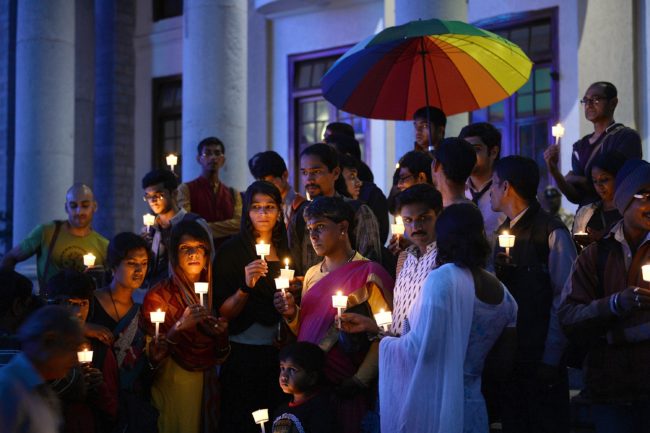
Transgender people take part in a candle light vigil for the Transgender Day of Remembrance in Bangalore on November 20, 2015. (MANJUNATH KIRAN/AFP/Getty)
A list of transgender murder victims published by the Remembering Our Dead Project includes 310 known victims in the past year.
HRC President Chad Griffin said: “On Transgender Day of Remembrance, we join together to mourn the lives lost to hate and violence this past year and rededicate ourselves to the urgent action that this epidemic requires.
“From anti-trans employment and housing discrimination to systemic racism, we must recognize the intersecting factors that influence, motivate and embolden the violence that plagues so many within the transgender community — particularly Black and Latina transgender women.
Griffin added: “White, cisgender men like me have a unique responsibility to support our transgender siblings in combating this violence, and join fully in the work to achieve equality for every person in the LGBTQ community.”
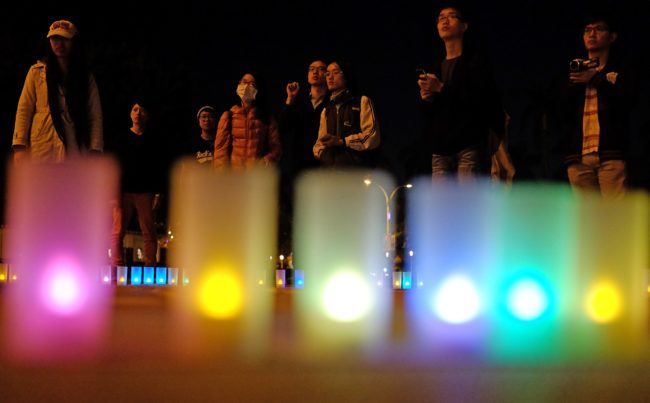
Supporters of the transgender community in Taiwan light candles during the Transgender Day of Remembrance in 2014. (SAM YEH/AFP/Getty)
Jay Brown of HRC Foundation said: “At least 128 transgender people—the vast majority transgender women of colour—have been killed [in the US] in the last five years.
“But most people can’t even name one victim—one human being who left behind family, friends and a future. We must do better.
“Solidarity means showing up, speaking out, saying their names and steadfastly working to change the realities that conspire to put transgender people at risk of violence. We can do better.”
A trans woman has won a court victory after being kept as a ‘sex slave’ in a men’s prison.
Strawberry Hampton, over the past two years, has been housed in four different facilities for men.
She has sued the Illinois Department of Corrections several times to get transferred to a women’s prison.
She claims she was the victim of sexual assault, both by other inmates and by guards.
Court documents show Hampton claims an officer pulled down her pants. She also says she was forced to have phone sex with an officer, and other officers made her have sex with her cellmate while they watched.
She says she was also told if she complained, she would ‘disappear’.
US District Court Judge Nancy Rosenstengel issued an order requiring the Illinois Department of Corrections to reevaluate Hampton’s request to transfer to a women’s facility.
‘A review of Hampton’s full mental health and disciplinary history in the context of her substantiated… complaints and grievances may lead the [Department’s Transgender Care Review Committee] itself to conclude that Hampton is safest in a woman’s prison,’ Rosenstengel wrote.
‘If not, the Court can revisit the issue after the Constitutional issues have been decided at trial.’
The judge also ruled Hampton must be allowed to attend a transgender support group at the prison. She is currently not allowed to.
She mandated the Illinois Department of Corrections develop training for staff on transgender issues.
‘This is also an important step, not only for Strawberry but, in general, for transgender women imprisoned across the nation,’ said Vanessa del Valle, Hampton’s lawyer.
‘The Illinois Department of Corrections maintains a strict zero-tolerance policy toward all forms of sexual abuse and sexual harassment,’ said a spokesperson for the Department of Corrections.
Hampton is serving a 10-year sentence for burglary.
The Republic of San Marino just passed civil union laws for same-sex couples.
Nestled within Italy, San Marino is the world’s smallest republic and has a population of just over 33,000 people.
The Grand and General Council governs the people of San Marino and yesterday (15 November) it began to discuss the proposed Regulation of Civil Unions.
It was the second reading, after the Commission for Constitutional and Institutional Affairs approved the draft on 27 September.
Milan pride 2011. | Photo: Federico Moroni / Flickr
There are 14 articles in the law, but most notably one that states: ‘A civil union is a contract stipulated by two legal adults of the same-sex or of opposite sex in order to organize their life together as a couple.’
The law passed today (16 November) with 40 votes in favor, four votes against and four abstaining.
There is currently no date planned for the law to come into effect.
Marco Tonti from Arcigay told Gay Star News: ‘It is a historic step forward for San Marino since homosexuality had been criminalized until 2004.’
He then added: ‘There are still many civil rights missing from the appeal, such as the voluntary termination of pregnancy.’
Last year, San Marino scored fairly low on a list of 49 European countries ranked on rights for LGBTI people.
It came in at number 44, with only 12% of LGBTI rights.
In fact, San Marino only six years ago struck down a medieval law that forbade same-sex couples to live together.
The small independent country wouldn’t give visa rights to gay men and women living together as a couple.
The removal of the medieval law was an historic step forwards.
Michele Pazzini, secretary of the LGBT-San Marino association said at the time: ‘This is a little step towards the full recognition of same-sex couples.’
Many Italians want to live in San Marino because of the very low taxation of the republic.
The Caribbean Court of Justice (CCJ) ruled against a law in Guyana banning men and women from going into public places ‘dressed in clothing of the opposite sex for an “improper purpose”‘.
In their ruling, the CCJ deemed the law unconstitutional.
The law, part of the Section 153(1)(xlvii) of the Summary Jurisdiction (Offences) Act, was enacted in 1893. Guyana, a country located in the north of South America, developed the law as part of their post-emancipation vagrancy laws.
In February 2009, authorities arrested four transgender individuals: Quincy McEwan, Seon Clarke, Joseph Fraser, and Seyon Persaud. Per the report from the CCJ, they were all ‘convicted and punished for cross-dressing in public’.
They all pleaded guilty to the charges.
During their hearing in the Georgetown Magistrate’s Court on 9 February 2009, the Magistrate reportedly told them ‘they must go to church and give their lives to Jesus Christ and advised them that they were confused about their sexuality’.
Initially, the Society Against Sexual Orientation Discrimination (SASOD) challenged the law in Guyana. Both the High Court and the Court of Appeal denied these challenges.
More than nine years later, the CCJ ultimately struck down the law.
The Honourable President Mr. Justice Saunders and Justices Wit, Anderson, Rajnauth-Lee and Barrow made up the CCJ’s panel ruling on the law.
In their decision, they found the law hailed ‘from a different time and no longer served any legitimate purpose in Guyana’.
Saunders stated: ‘Law and society are dynamic, not static. A Constitution must be read as a whole. Courts should be astute to avoid hindrances that would deter them from interpreting the Constitution in a manner faithful to its essence and its underlying spirit.
‘If one part of the Constitution appears to run up against an individual fundamental right, then, in interpreting the Constitution as a whole, courts should place a premium on affording the citizen his/her enjoyment of the fundamental right, unless there is some overriding public interest.’
Guyana’s Constitution also prohibits discrimination.
The CCJ found the law resulted in trans people being ‘treated unfavourably by criminalising their gender expression and gender identity’.
GSN reached out to SASOD and the Guyana Equality Forum for comment.
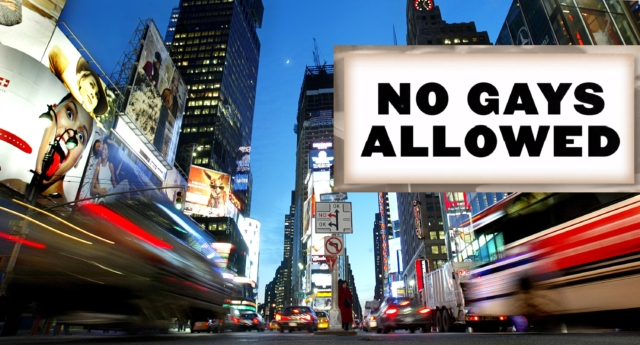
Cars drive through Times Square. The logo of the ‘No Gays Allowed’ ad campaign(Mario Tama/Getty)
A billboard bearing the message “NO GAYS ALLOWED” has been installed in New York City’s iconic Times Square.
NBC reports that the billboard, which reads “NO GAYS ALLOWED” on a blank white background, was installed on Tuesday and is set to remain in place until February.
Despite the outwardly homophobic message, the Times Square billboard is not what it initially seems.
The Times Square ad unit was actually placed as a protest against legal firm Alliance Defending Freedom (ADF), a shadowy ultra-conservative body that has brought several cases seeking to undermine LGBT+ anti-discrimination protections across the US.
The 2018 midterm election has been considered the most diverse election in terms of candidates and elected officials in America’s history.
It was the lowest year ever in terms of straight white male candidates running for political office. There were a record number of queer and transgender candidates in the 2018 midterms, many of them winning their races.
With over 150 queer and trans folks victorious in their respective elections, this midterm was a major advancement in social progress.
Many are calling this “Rainbow Wave” a major checkpoint in the fight to achieve equality for queer and trans people in the United States. There were many queer and trans people who made history this election season, being the first of their people to be elected in their position.
Colorado elected the nation’s first openly gay governor with Democrat Jared Polis. Coming from a state with homophobic bakery owners to electing an openly gay man to the state’s highest elected position, this midterm election has shown Colorado’s evolution with gay rights and equality. As the first openly gay governor elect, Polis is the first to have such major influence over queer and trans policy in a state.
Sharice Davids became the first ever queer person to be elected to Congress from the state of Kansas. Winning Kansas’s 3rd District, Davids was also one of two women this midterm election to be the first Native American women to be elected to U.S. Congress, joining Debra Haaland of New Mexico. In a year where thousands of Native Americans were threatened to be disenfranchised, its is encouraging to see two Native American women victorious.
New Hampshire elected to two openly trans women to their state legislature. Lisa Bunker and Gerri Cannon make history by joining the very few openly trans officials in elected positions. With their victories, this can be considered a major triumph for trans rights.
Over 110 million people and counting voted in the 2018 midterm election, making this the highest ever voter turnout in a midterm election, with around 48 percent of eligible voters casting a ballot this November, according to AP projections.
Undoubtedly, the spike in queer and trans representation can be attributed to the spike in voter turnout. Historically, high voter turnout favors left-leaning candidates, and there were no queer or trans candidates for the republican party.
With more representation, queer and trans folks will have more of a say in creating, defending, and combating policy that will directly affect them.
Chad Griffin, the influential LGBTQ activist who helped turn the Human Rights Campaign into a powerful political force, announced Thursday that he is stepping down as the organization’s president.
Griffin’s announcement follows a midterm election in which the group invested heavily in Democratic campaigns. The capstone for the organization came this week, when Rep. Kyrsten Sinema, D-Ariz., won a close Senate race, becoming the first openly bisexual person elected to the Senate.
Griffin has spent seven years at the helm of HRC, steering the organization through the landmark Supreme Court ruling in favor of gay marriage nationwide and the repeal of a North Carolina law that required transgender people to use restrooms matching their birth certificates. Former North Carolina Gov. Pat McCrory, who was defeated after signing the “bathroom bill,” called HRC a more powerful advocacy group that the National Rifle Association.
Griffin informed staff at HRC of his decision to step down Thursday.
Sen. Kamala Harris, D-Calif., who has worked closely with Griffin, praised his leadership of the nation’s largest gay rights advocacy group through a time of enormous change for the LGBT community.
“History will show that Chad was a leader in the moment he was needed to lead,” Harris said in an interview.
Griffin hasn’t said what he plans to do next. He is expected to stay at HRC until the organization names a new president; that process could take several months.
A prolific fundraiser with deep political ties, Griffin probably will become one of the most sought after advisers for Democrats preparing to undertake White House campaigns.
“Every person in the Democratic Party who is thinking of running for president is going to call Chad,” said Dan Pfeiffer, a White House adviser to President Barack Obama and longtime friend of Griffin.
Harris, who is considering a 2020 presidential campaign, demurred when asked if she would hire Griffin, saying only that she hadn’t made a decision on entering the race.
During Griffin’s tenure, HRC invested heavily in campaign work across the country, including a $26 million effort to send staff to all 50 states during the midterms. The organization said it registered more than 32,000 new voters since the 2016 election.
Griffin’s supporters credited him with plunging HRC more deeply into the political arena and pushing Democratic politicians in particular to do more than just pay lip service to gay rights issues.
“It really wasn’t enough for him for elected officials and candidates to respect the LGBTQ community,” said Kristina Schake, Griffin’s former business partner. “He wanted them to fear them — to fear the power of their vote.”
Griffin, 45, got his start in politics working in President Bill Clinton’s White House press office. Before joining HRC, he was co-founder of the American Foundation for Equal Rights, an organization that challenged the California law banning same-sex marriage. That effort was a precursor to the Supreme Court’s verdict on gay marriage nationwide.
At least 70 members of the caravan had arrived at the Mexican border town of Tijuana on Tuesday (12 November), Newsweek reported.
They are the first of a group of thousands of migrants making its way from South and Central America to seek asylum in the US. Importantly, many of this initial group identified as LGBTI.
The US saw a spike in anti-immigrant rhetoric from many conservatives during the lead up to the midterm elections.
Local journalist Jorge Nieto reported the LGBTI group had clashed with residents. They checked in to an Airbnb with funds from US lawyers.
Members of the group, some of whom identified as LGBTI, said they had faced discrimination from the caravan.
Individuals told NBC they had not suffered physical violence from the caravan.
But, migrants said, they were victims of verbal violence.
‘Even to bathe was a big problem, and when we wanted to shower there was no water…same with food,’ the group’s leader, César MejíaMejía, told NBC San Diego.
He said they planned to stay in Tijuana a week.
On Sunday (11 November) officials in the central Mexican city, Queretaro, said 6,531 people traveling with the caravan were on their way to Tijuana.
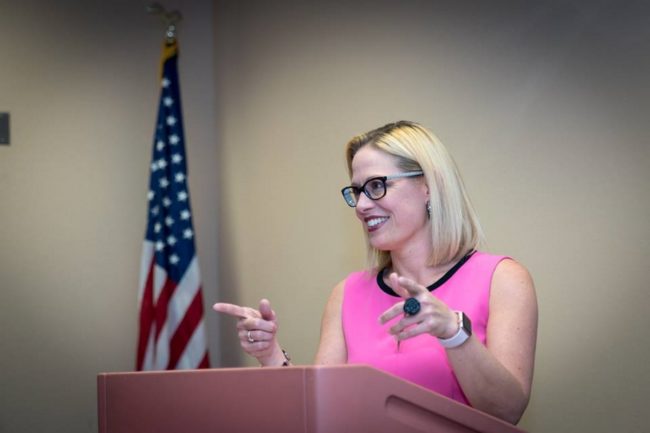
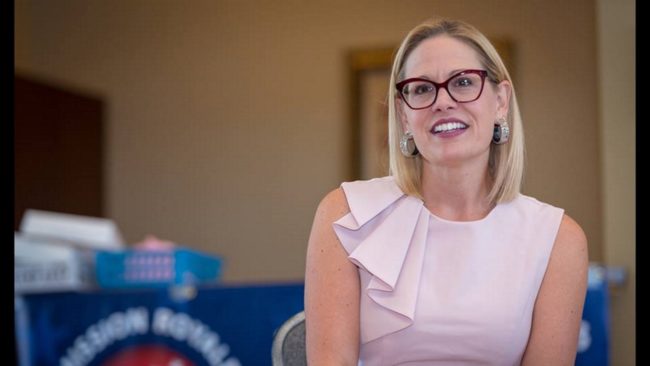
Kyrsten Sinema has won a landmark victory to represent Arizona in the US Senate, becoming the first ever openly bisexual senator.
The Democratic congresswoman, who has already served three terms in the US House of Representatives as the only openly bisexual member of Congress, narrowly defeated Republican candidate Martha McSally to replace Jeff Flake, a Republican senator who retired ahead of the midterm elections.
With her nail-biting victory, the margin of which currently stands at just 38,000 votes, she became the country’s second out LGBT+ senator alongside Wisconsin’s Tammy Baldwin, who was re-elected last week in a double-digit landslide.
Sinema was also the first openly bisexual Senate candidate from a major party (kyrsten sinema/facebook)
US’s first bisexual Senator calls for unity
Sinema, who was also the first ever openly bisexual senate candidate for a major party, reacted to the win by writing on Twitter: “As long as I’ve served Arizona, I’ve worked to help others see our common humanity & find common ground.
“That’s the same approach I’ll take to representing our great state in the Senate, where I’ll be an independent voice for all Arizonans.”
Speaking to ecstatic supporters in the state capital of Phoenix, Sinema took aim at Republican tactics which have seen McSally accuse her of “treason” and “protesting us in a pink tutu” during a fractious election campaign.
Sinema has served in the House for six years as the only openly bisexual member of Congress (kyrsten sinema/facebook)
Sinema said: “Arizona rejected what has become far too common in our country: name-calling, petty, personal attacks and doing and saying whatever it takes just to get elected.
“We can embrace difference while seeking common ground.”
— Kyrsten Sinema
“It’s dangerous, and it lessens who we are as a country. But Arizona proved that there is a better way forward.”
In a call for unity and acceptance, Sinema continued: “We can work with people who are different than us. We can be friends with people who are different than us.
“We can love and care about people who are different than us. We can keep people who different than us safe. We can be good people who care deeply about each other even when we disagree.”
The 42 year old, who was first elected to her state’s House of Representatives when she was 28, added: “We can embrace difference while seeking common ground.”
Democratic National Committee chair Tom Perez congratulated Sinema on a “stunning victory,” adding that “Arizonans went to the polls last Tuesday looking for bold new leadership, and that’s exactly what they’re going to get with their first-ever female senator and our nation’s second openly LGBTQ senator.”
“Unlike her predecessor, Senator-elect Sinema is ready to fight on day one for quality health care, a VA system that works the way it should for our veterans, comprehensive immigration reform, good-paying jobs, and an economy that works for all Arizonans.”
Annise Parker, CEO of the LGBTQ Victory Fund, said: “An LGBTQ woman winning a U.S. Senate seat in a state that voted for Trump is a game-changer, both for the LGBTQ community and the Democratic party.
“Kyrsten’s victory makes clear that an LGBTQ candidate who listens to voters and prioritises their issues can win elected office anywhere—blue state or red state.
Sinema narrowly defeated Martha McSally to win the election (kyrsten sinema/facebook)
“It also signals to the Democratic party that nominating more LGBTQ candidates for high-level positions should be a strategic priority, because their openness and authenticity resonate with independent voters.”
She added that “by doubling our influence with two passionate and tough LGBTQ women… the U.S. Senate will certainly find our community more difficult to ignore.”
It is the first time a Democrat has held a Senate seat in Arizona since 1995, and ensures the Democrats will fill at least 47 of the Senate’s 100 seats, with Florida’s race going to a recount and Mississippi awaiting the results of a run-off later this month.
Kyrsten Sinema has a pro-LGBT record—unlike her opponent
During her nearly six years in Congress, Sinema—who won her Democratic primary with an overwhelming 80.5 percent of the vote—has repeatedly taken a stand for LGBT+ rights.
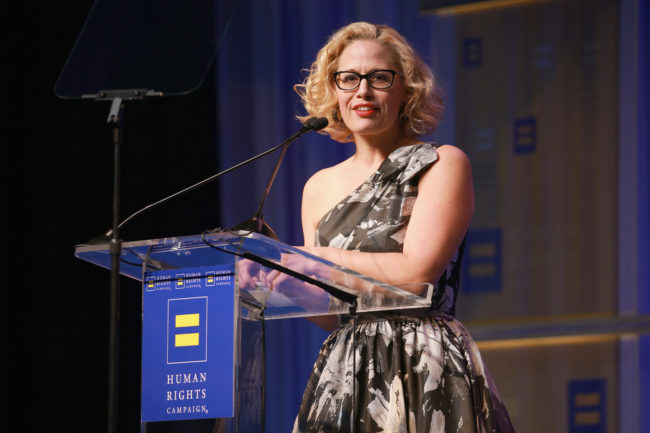
The Arizona-born politician, who spoke at the Human Rights Campaign gala this year, co-sponsored the Equality Act, which would amend the 1964 Civil Rights Act to also ban discrimination on the basis of sexual orientation and gender identity.
Sinema speaks at the Human Rights Campaign 2018 Los Angeles Gala Dinner (Rich Fury/Getty)
Sinema also sponsored HR4041, a bill currently in committee which, if it were passed, would ensure that transgender people were able to serve in the US military, despite President Donald Trump’s attempts to institute a ban.
In contrast, McSally voted for an amendment which would have made it impossible for the military to pay for gender surgeries for its trans service people, and stood against using Title IX to protect the right of trans students to use the bathroom which matches their gender, an issue which has been mainly used by Republicans as a way of fighting against trans equality.